Biochemical changes in whole blood stored for transfusion at Bungoma County Referral Hospital, Kenya
Abstract
BACKGROUND: During storage, transfusion blood may undergo a series of biochemical changes that could pose risks to patients when used. It is important therefore to monitor biochemical changes that may reduce survival or function of stored blood cells. OBJECTIVE: This study assessed biochemical changes in whole blood stored for transfusion at Bungoma County Referral Hospital in the western region of Kenya between February 2019 and August 2019. METHODS: A prospective study design involving 20 randomly selected donor blood units in citrate phosphate dextrose adenine anticoagulant was employed. Biochemical changes were evaluated for 35 days. Potassium and sodium levels were tested using the HumaLyte Plus5 analyser. Blood pH level was estimated using the Hanna pH meter. RESULTS: At the end of the 35 days of storage under blood bank conditions, the mean potassium level significantly increased from 7.31 mmol/L at baseline to 20.14 mmol/L at week 5 (p < 0.0001), and the mean sodium level significantly decreased from 150.72 mmol/L at baseline to 121.56 mmol/L at week 5 (p < 0.0001). The pH level decreased insignificantly from 7.48 at baseline to 7.38 at the end of week 1 (p = 0.0757) but decreased significantly to 6.15 at the end of week 5 (p < 0.0001). CONCLUSION: Potassium increased and sodium concentrations decreased significantly from the first week of blood storage. The pH decreased significantly from the second week of storage. Therefore, aged blood should be avoided to circumvent potential adverse outcomes from biochemical changes and stored blood should be tested before use.
blood; transfusion; biochemical changes; storage; Kenya
Introduction
Biochemical variations take place during transfusion blood reservations, affecting their function.1234
Blood reservation improves access to blood for transfusions. However, questions arise regarding the toxicity and value of such blood reserved for extended periods. In various medical retrospective investigations, authors propose that transfusion of reserved blood may cause harm, particularly in severely ill patients such as patients with severe myocardial infarction conditions.25466
According to records of Bungoma County Referral Hospital in Bungoma, Kenya, the transfusion rate averages 300 transfusions monthly and there has been an increase in blood reactions in the patients that receive a blood transfusion. A monthly average of 2% - 3% of patients react to transfused blood, especially aged blood, which is blood that has been stored for over 20 days. Despite the high levels of post-reaction after transfusions in Bungoma County Referral Hospital and the risk of toxicity to patients due to leakage of blood chemicals, the biochemical changes in blood stored for transfusions have not been studied and remain unknown. Therefore, this study aimed to assess the biochemical changes in whole blood stored for transfusions at Bungoma County Referral Hospital.
Materials and methods
Ethical considerations
The study was cleared by the Ethical Committee of Jaramogi Oginga Teaching and Referral Hospital (#ERC.IB/VOL.1/454) and authority to carry out the research was issued by the National Commission for Science, Technology and Innovation (#NACOSTI/P/19/32125/27143). Written informed consent was obtained from each donor after a brief explanation of what the study is about. Participation in the study was voluntary. Donor details were kept confidential by the exclusion of all forms of identification on the data collection tool, and filled data tools were stored physically under lock and digitally with restricted password access on a computer. The donors were informed that their blood units, if selected for the study, were not transfused to patients.
Study area
The study was carried out between February 2019 and August 2019 at Bungoma County Referral Hospital, which is located in the western region of Kenya. This was a good study area because adverse reactions among the patients who receive a blood transfusion was common. The hospital also has an accredited laboratory that is well equipped with biochemistry equipment required for the study. The hospital has a blood donation centre which collects on average 600 blood units monthly.
Study design
This was a prospective study involving the collection of blood from healthy volunteers into blood bags containing citrate phosphate dextrose adenine anticoagulant. All donated blood samples were reserved at temperatures between 2 °C and 6 °C and analysed at baseline and then at the ends of week one, two, three, four and five. The whole units of blood were used in the study to ensure that all storage conditions for blood meant for transfusions were met.
Study population
The sample size for the research was determined by Yamane Taro's formulae for a finite population.7
Data collection
Sample collection and analysis
All blood units were collected according to blood transfusion donor guidelines as described by the World Health Organization.8
Quality assurance of the data
To ensure the quality of data collected, pre-donation requirements (such as ensuring that donors had a haemoglobin level of 12.5 g/dL and above, weighed 50 kg and above, had no transfusion in the past 12 months, had not donated blood in the past 3 months, had no history and signs of malignancy, had no signs and symptoms of sickle cell disease, had no signs and symptoms of polycythaemia Rubra Vera and had no history of haemophilia and other coagulation disorders) were followed and only blood units that met these criteria were used. A qualified phlebotomist collected the blood samples, ensuring that the right quantity of between 450 mL and 500 mL was collected. The pints were transported and stored as per blood transfusion guidelines at 2 °C - 6 °C. Sample aliquots at the various study points were brought to optimum temperature as per the manufacturer's instructions before testing. Samples were analysed in duplicate for each sample and an average computed to ensure accuracy. Both external and internal quality controls for pH, sodium and potassium tests were verified and ensured during the study. Recorded results were verified by a second analyst to ensure accuracy.
The laboratory is enrolled in the Human Quality Assessment Services External Quality Assurance Scheme for chemistry scope including pH, sodium and potassium. The chemistry scope is also accredited by the Kenya Accreditation Services which further assured the quality of data collected.
Data management and analysis
The data were stored in Microsoft Excel (Microsoft Corporation, Redmond, Washington, United States). Data analysis was done using the Statistical Package for the Social Sciences (SPSS V.23) (IBM Corporation, Chicago, Illinois, United States). Descriptive statistics (frequencies, mean and standard deviation) were used to describe the data. The trends of the biochemical changes were shown using line plots. Analysis of variance was used to establish if there were significant biochemical changes in transfusion blood at baseline and each study point compared to normal reference intervals for 35 days of storage. Findings were considered significant at a p-value less than 0.05. Tukey's honest significant difference test was used to collate all feasible pairs of means.
Results
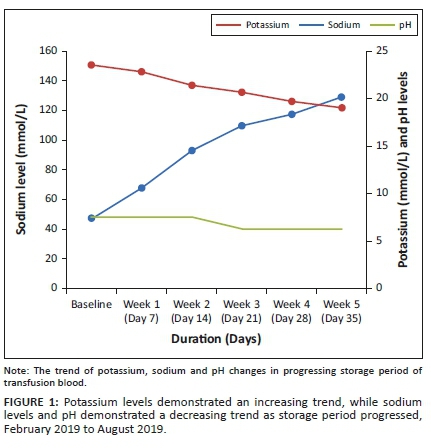
Potassium (K+) levels increased progressively from 7.31 mmol/L to 20.14 mmol/L, while sodium (Na+) levels and pH respectively demonstrated corresponding decrease from 150.72 mmol/L to 121.56 mmol/L and from 7.48 to 6.15 as storage period progressed (Figure 1).
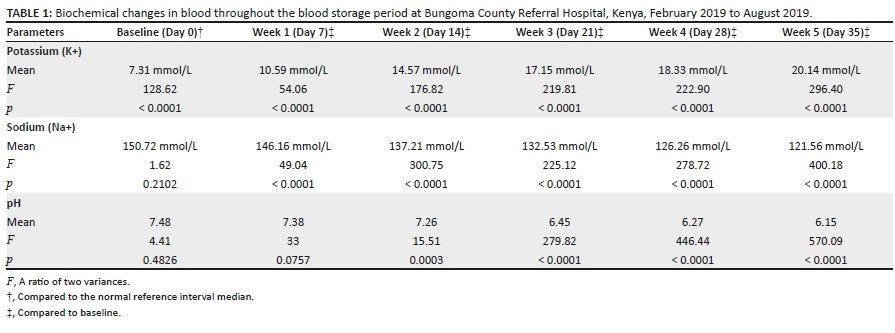
This study observed significant variance in potassium levels at baseline compared to the normal reference interval median of 4.5 mmol/L. Potassium levels also increased significantly throughout the blood storage period compared to the baseline mean of 7.31 mmol/L (Table 1). There was no significant variance in sodium concentrations at the baseline compared to the normal reference interval median of 150 mmol/L; however, a significant decrease in sodium concentration was observed throughout the blood storage period compared to the baseline. pH levels demonstrated no significant variance at baseline compared to the normal reference interval median of 7.4 and no significant variance at the end of week 1 (Day 7) compared to baseline. pH levels at weeks 2, 3, 4 and 5 however decreased significantly from 7.31 at baseline (Table 1).
Discussion
The current study sought to evaluate the biochemical changes in whole blood for transfusion stored at blood bank conditions. At the end of the 35 days of blood storage at blood bank conditions, the potassium levels significantly increased while sodium levels significantly decreased over time. On the other hand, the pH levels significantly decreased over time; however, the change was insignificant at week 2 of storage. Potassium levels had a significant variation from normal reference at the baseline while sodium concentrations and pH had insignificant variance from normal reference intervals. Regardless of the advantages of blood transfusion in clinical care (such as to treat anaemia, prepare patients for a surgical process, and limit manifestations of blood depletion), the procedure may cause harm to patients.9
The present study has found that there are biochemical variations in blood during the 35 days storage period. Potassium ions increased significantly after one week and further increased significantly through to 35 days of storage. This result compares with previous studies in Portugal,1091112
The current study observed an increase of plasma potassium level to 10.59 mmol/L within the first week. The increase continued to 20.14 mmol/L at the end of the fifth week which was equivalent to an average of 12.83 mmol/L rise after 35 days of storage. This indicates that blood transfusion after the first week of storage may not be safe for patients due to the potassium levels. In the course of blood reservations, there is a steady but continuous efflux of potassium ions from cells into the encircling plasma.1212
The current study observed that a decrease in sodium levels was significant after 2 weeks (14 days) and further decreased significantly through to 35 days of storage. This result compares with previous studies in India, Portugal and Ghana which demonstrated that sodium levels decreased throughout the storage period.10,11,131412
The reference range for plasma sodium level is 145 mmol/L - 155 mmol/L. The findings of this study indicate that within the first week of storage, sodium levels in blood could fall below the normal range. Blood stored at blood bank conditions slows down cellular metabolism and energy demand which permits blood to be reserved for 35-42 days. This makes the sodium-potassium pump defective and, as a result, permits potassium ions to depart the cell and sodium ions to move into the cells through the semipermeable membrane.1015
This study reported a significant pH decrease after 14 days of storage which further decreased significantly through to 35 days of storage. This result compares with previous studies in Uganda, India and Ghana which demonstrated that the pH of reserved blood lessened during the storage period.9,109912
Overall, together with other parameters, biochemical changes in stored blood for blood transfusion should be properly monitored especially in consideration of the patient to be transfused. Because of the increase in potassium level with storage, caution is required to ascertain the storage duration of blood to be transfused, volume to be transfused at a time, and rate of transfusion to decrease hyperkalaemia-linked blood transfusion problems. Transfusing hyperkalaemic blood, however, may have little effect if the recipient's kidneys are working normally and the sodium-potassium adenosine triphosphate pump is also working efficiently. However, this is a significant concern in recipients with renal failure.
Recommendations
The study recommends the monitoring of biochemical changes and the use of fresh blood to avoid the negative effect of changes in stored blood especially to patients who suffer from renal failure and myocardial infarction.
Limitations
In the current study, other biochemical parameters such as iron, lactate, calcium, and so on, which could have an impact on the viability of blood were not assessed.
Conclusion
This study showed that variations in biochemical parameters occur during the storage of blood despite the use of adequate storage conditions, and may cause risks to patients during transfusion.
Competing interests
The authors have declared that no competing interests exist.
Authors' contributions
All authors contributed equally to this work.
Sources of support
This research received no specific grant from any funding agency in the public, commercial or not-for-profit sectors.
Data availability statement
Data sharing is not applicable to this article as no new data were created or analysed in this study.
Disclaimer
The views and opinions expressed in this article are those of the authors and do not necessarily reflect the official policy or position of any affiliated agency of the authors.
Acknowledgements
Mr Thomas Khisa Wekesa contributed by assisting in the donors' recruitment and blood donation. Ms Joan Wasike, Ms Beatrice Lungai, Mr Antony Sangolo and Ms Julia Wasike contributed by assisting in the running of the samples and the data collection.
References
-
1.Yalcin O, Ortiz D, Tsai AG, Johnson PC, Cabrales P. Microhemodynamic aberrations created by transfusion of stored blood. Transfusion. 2014;54(4):1015-1027. https://doi.org/10.1111/trf.12361
» https://doi.org/10.1111/trf.12361 -
2.Roback JD. Vascular effects of the red blood cell storage lesion. Hematology Am Soc Hematol Educ Program. 2011;2011:475-479. https://doi.org/10.1182/asheducation-2011.1.475
» https://doi.org/10.1182/asheducation-2011.1.475 -
3.Burger P, Kostova E, Bloem E, et al. Potassium leakage primes stored erythrocytes for phosphatidylserine exposure and shedding of pro-coagulant vesicles. Br J Haematol. 2013;160(3):377-386. https://doi.org/10.1111/bjh.12133
» https://doi.org/10.1111/bjh.12133 -
4.D'Alessandro A, Gevi FZL. Red blood cell metabolism under prolonged anaerobic storage. Mol Biosyst. 2013;9(6):1196-1209. https://doi.org/10.1039/c3mb25575a
» https://doi.org/10.1039/c3mb25575a -
5.Hod EA, Spitalnik SL. Harmful effects of transfusion of older stored red blood cells: Iron and inflammation. Transfusion. 2011;51(4):881-885. https://doi.org/10.1111/j.1537-2995.2011.03096.x
» https://doi.org/10.1111/j.1537-2995.2011.03096.x -
6.Adams F, Bellairs G, Bird AR, Oguntibeju OO. Biochemical storage lesions occurring in nonirradiated and irradiated red blood cells. Biomed Res Int. 2015; 102015:968302. https://doi.org/10.1155/2015/968302
» https://doi.org/10.1155/2015/968302 - 7.Israel GD. Determining sample size. Fact Sheet PEOD-6. Orlando, FL: Florida Coop Extension Service; 1992.
-
8.World Health Organization. Blood donor selection: Guidelines on assessing donor suitability for blood donation. Geneva: WHO;2012. Available from https://apps.who.int/iris/handle/10665/76724
» https://apps.who.int/iris/handle/10665/76724 -
9.Oyet C, Okongo B, Onyuthi RA, Muwanguzi E. Biochemical changes in stored donor units: Implications on the efficacy of blood transfusion. J Blood Med. 2018; 9:111-115. https://doi.org/10.2147/JBM.S163651
» https://doi.org/10.2147/JBM.S163651 -
10.Nogueira D, Rocha S, Abreu E, Costa E S-SA. Biochemical and cellular changes in leukocyte-depleted red blood cells stored for transfusion. Transfus Med Hemother. 2015;42(1):46-51. https://doi.org/10.1159/000370140
» https://doi.org/10.1159/000370140 -
11.Verma M, Dahiya K, Malik D, et al. Effect of blood storage on complete biochemistry. J Blood Disord Transfus. 2015;6:6. https://doi.org/10.4172/2155-9864.1000329
» https://doi.org/10.4172/2155-9864.1000329 - 12.Adias TC, Moore-Igwe B, Jermeiah ZA. Storage related haematological and biochemical changes of CPDA-1 whole blood in a resource limited setting. J Blood Disord Transfus. 2012;3(3):124.
-
13.Opoku-Okrah C, Acquah BK, Dogbe EE. Changes in potassium and sodium concentrations in stored blood. Pan Afr Med J. 2015;20:236. https://doi.org/10.11604/pamj.2015.20.236.5851
» https://doi.org/10.11604/pamj.2015.20.236.5851 -
14.Upadya UB, Seema H, Motakapalli K. Effect of blood storage on biochemical parameters assessed at periodic intervals in CPDA1 blood bags. J Clin diagnostic Res. 2018;12(10):EC05-EC07. https://doi.org/10.7860/JCDR/2018/37223.12139
» https://doi.org/10.7860/JCDR/2018/37223.12139 - 15.Metheny NM. Fluid and electrolyte balance: nursing considerations. 5th edn. Sudbury, MA: Jones & Bartlett Learning; 2012.

Accepted: 14 Oct. 2020
Published: 21 Dec. 2020