Childhood aplastic anaemia with paroxysmal nocturnal haemoglobinuria clones: A retrospective single-centre study in South Africa
Abstract
BACKGROUND: Paroxysmal nocturnal haemoglobinuria (PNH) clones in children are rare but commonly associated with aplastic anaemia (AA) and myelodysplasia. OBJECTIVE: This study aimed to determine the prevalence of PNH clones in paediatric patients with idiopathic AA, identify differences in clinical and laboratory features and outcomes, and determine the impact of clone size on clinical presentation METHODS: Patients with confirmed idiopathic AA who were tested for PNH between September 2013 and January 2018 at the Inkosi Albert Luthuli Central Hospital, Durban, KwaZulu-Natal, South Africa, were included. PNH clones were detected in neutrophils and monocytes by flow cytometry using fluorescent aerolysin, CD24, CD66b and CD14. RESULTS: Twenty-nine children with AA were identified and 11 were excluded. Ten patients (10/18, 55.6%) had PNH clones ranging from 0.11% to 24%. Compared to the PNH-negative group, these children were older (median: 10 years vs 4 years, p = 0.02) and had significantly lower total white cell counts (median 1.7 × 10⁹/L vs 3.2 × 10⁹/L; p = 0.04). There was no difference in median absolute neutrophil count or haemoglobin concentration. Four patients in each group received immunosuppressive therapy (IST). At six months, all four patients with PNH clones had responded, compared to one in the PNH-negative group. CONCLUSION: More than half of children with AA had a PNH clone. The size of the clone did not impact clinical severity; however, IST use may positively impact prognosis. We recommend early initiation of IST in patients with AA to avoid delays associated with human leukocyte antigen typing.
paroxysmal nocturnal haemoglobinuria clones; aplastic anaemia; paediatrics; flow cytometry; HLA typing
Introduction
Paroxysmal nocturnal haemoglobinuria (PNH) is an acquired haematopoietic stem cell disorder.11,2,34,54,6
Patients may also present with bone marrow failure, and the presence of PNH clones has been shown in a large percentage of children with aplastic anaemia (AA).2,7895,10104
Flow cytometry-based tests are the most accurate tests for the detection of PNH clones.7,11322
Historically, patients with AA were managed either supportively with transfusions or cured with a haematopoietic stem cell transplant (HSCT).12,1314,151617,18
In our setting, the majority of patients are of recent African ancestry, where significant human leukocyte antigen (HLA) diversity exists.19,20
Our study was conducted at a quaternary hospital in Durban, South Africa. The haematology laboratory provides in-house flow cytometry services and has been using the fluorescent aerolysin method to detect the presence of PNH clones in patients since September 2013.
This study aimed to determine the prevalence of PNH clones in paediatric patients with AA, identify differences in clinical and laboratory features and treatment responses between patients with and without PNH clones, and determine the impact of clone size on clinical presentation.
Methods
Ethical considerations
Ethics approval was obtained from the Biomedical Research Ethics Committee of the University of KwaZulu-Natal (BCA325/18). Individual patient consent was not required due to the study being retrospective. Data were password-protected, and patient confidentiality was maintained by only including patient hospital numbers on the final datasheets.
Study population
The electronic database of the Paediatric Haematology-Oncology unit of the Inkosi Albert Luthuli Central Hospital, Durban, South Africa, was screened to identify patients with a diagnosis of AA between 01 September 2013 and 31 January 2018. The diagnosis was based on pancytopenia secondary to bone marrow hypoplasia in the absence of a clonal malignant disorder. Patients who had an inherited bone marrow failure syndrome such as Fanconi anaemia, or who were not tested for PNH, were excluded. The electronic medical files of these children were searched on the hospital information system (Meditech, Westwood, Massachusetts, United States) as well as the laboratory information system (Trak Care, Intersystems, Cambridge, Massachusetts, United States) to retrieve demographic and clinical information, as well as laboratory test results. Patients with and without a PNH clone were compared with respect to demographics, laboratory parameters, presenting complaints, management and outcomes. The severity of AA was determined based on Camitta's criteria (cited by Marsh et al.).219922
Laboratory analysis
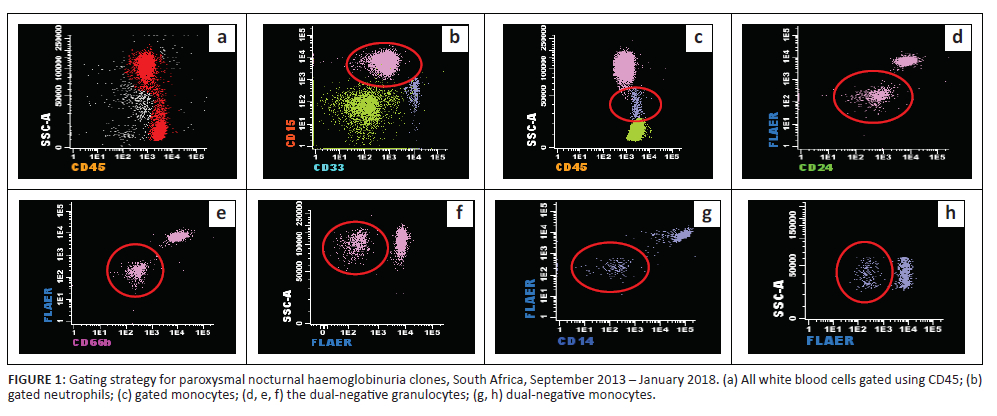
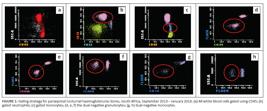
Flow cytometry (FacsCanto II, Becton Dickinson, San Jose, California, United States) was performed to detect PNH clones using non-GPI-linked markers (CD15 and CD33) to identify the monocytes and neutrophils, and GPI-linked markers (fluorescent aerolysin, CD24, CD66b and CD14) to detect the loss of GPI anchors in a sequential gating strategy (Figure 1). After performing doublet discrimination using forward scatter-area vs forward scatter-height and removing debris, all white blood cells were gated using CD45. Neutrophils were then discriminated by gating on CD15-positive, CD33-dim and high-side scatter white blood cells. Monocytes were discriminated by gating on CD33-bright, CD15-negative and low-side scatter white blood cells. Neutrophil PNH clones were defined as clones negative for CD24, CD66b and fluorescent aerolysin, and monocyte PNH clones were clones negative for CD14 and fluorescent aerolysin.
A loss of two GPI-linked markers on both the monocyte and neutrophil lineage was required to detect a clone. All clone sizes were included as per the latest guidelines of the International Clinical Cytometry Society/European Society for Clinical Cell Analysis,23 which classify clones as "PNH clone" for PNH populations > 1.0%, "minor population of PNH cells" or "minor PNH clone" for PNH populations between 0.1% and 1.0%, and "rare cells with GPI deficiency" or "rare cells with PNH phenotype" for PNH populations < 0.1%. For uniformity, we refer to all PNH populations, even if < 1.0%, as clones in this publication.
Data analysis
Statistical analysis was performed using GraphPad Prism version 8.4.3 (2020, San Diego, California, United States). A multiple t-test which was used to determine the statistical difference between numerical variables using means (Holm-Sidak method) and a chi-square test or Fisher's exact test which was used for categorical variables. A p < 0.05 was considered statistically significant.
Results
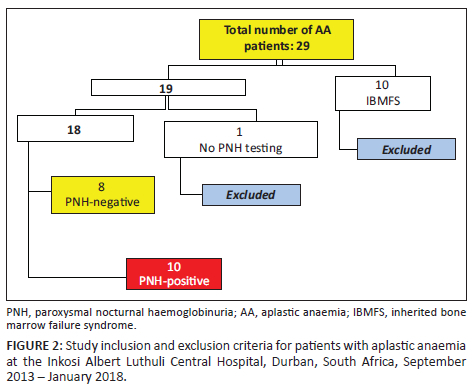
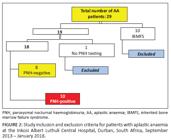
Twenty-nine patients were diagnosed with AA during the study period, ten of whom had Fanconi anaemia and were subsequently excluded (Figure 2). Of the remaining 19 patients, only one patient did not have PNH testing performed. Eighteen patients were thus included. Ten patients had a PNH clone (10/18; 55.6%); six of which were classified as having a "PNH clone" and four as having a "minor population of PNH cells".
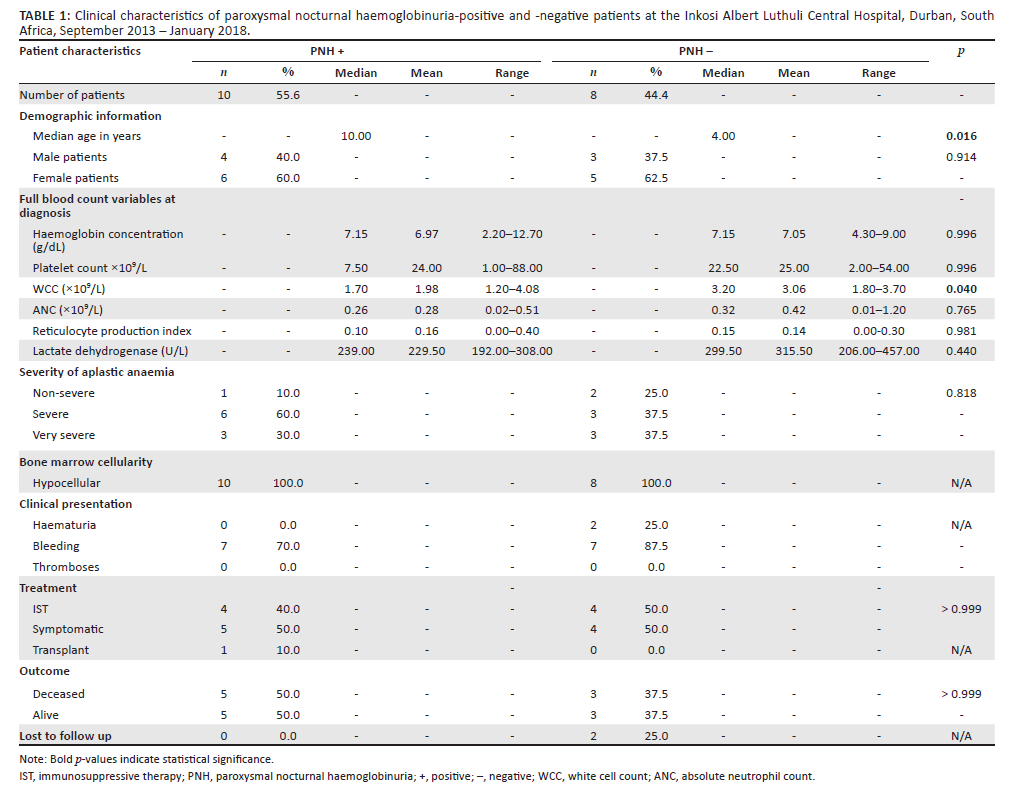
Patients with a PNH clone were older compared to those without the clone (median age: 10 years vs 4 years; p = 0.02) (Table 1). Female patients made up the majority of patients in both the PNH-negative group (5/8; 62.5%) and the PNH-positive group (6/10; 60.0%). The full blood count results showed no difference in haemoglobin concentration and platelet count between the two groups. Paroxysmal nocturnal haemoglobinuria-positive patients had a significantly lower median total white cell count of 1.7 × 1099p = 0.04). However, the median ANC was similar in both groups: 0.26 × 1099
The majority of patients in both groups presented with severe or very severe AA. Two patients without the PNH clone presented with haematuria, but this was not a presenting feature in any patients with the clone. Bleeding from a peripheral site was noted in 70.0% of PNH-positive and 87.5% of PNH-negative patients, while no patients presented with evidence of thromboses. Four PNH-positive (4/10; 40.0%) and four PNH-negative patients (4/8; 50.0%) were given IST. Fifty percent of patients with the PNH clone died, compared to 37.5% among patients without the clone.
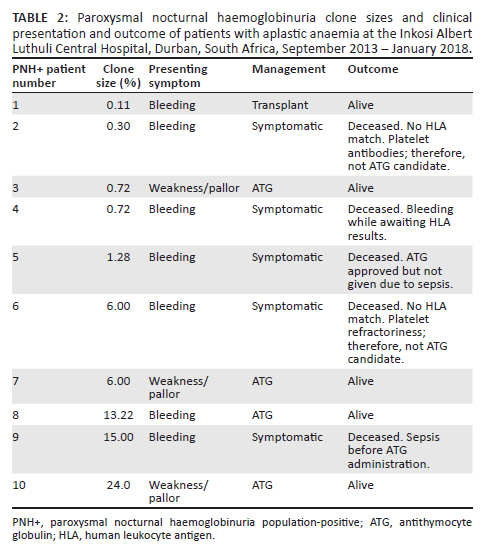
Seven of the ten (7/10; 70.00%) PNH-positive patients presented with bleeding (Table 2). Clone sizes in the granulocyte population and monocyte population in each patient ranged between 0.11% and 24.00%. Five of the total PNH-positive patient cohort survived (5/10; 50.00%), four (40.00%) of whom received ATG. The other survivor went on to receive an HSCT and is still alive. The remaining five PNH-positive patients (5/10; 50.00%) died, two from sepsis and three from bleeding. One of these patients died while awaiting HLA results. Among those who died, the PNH clone sizes ranged from 0.30% to 15.00%.
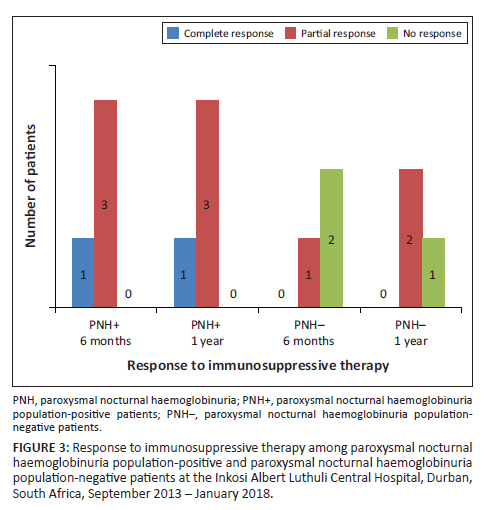
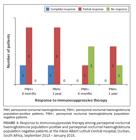
Eight patients (four PNH-positive and four PNH-negative patients) in our cohort received ATG. All patients received equine ATG, and one patient subsequently received an additional dose of rabbit ATG. One patient in the PNH-negative group died from sepsis a few days after infusion and was excluded from further analysis (Figure 3). At both six and 12 months, one patient in the PNH-positive group had a complete response and the other three patients had a partial response. In the PNH-negative group, one patient had a partial response at six months while two did not respond. At 12 months, the patient with a partial response still had a partial response, one of the patients with no response had developed a partial response, while the other patient remained non-responsive despite receiving a second dose of ATG.
Discussion
Paroxysmal nocturnal haemoglobinuria is rare in children and does not present classically. The presentation is normally bone marrow failure,1210,24
The differences in the presentation of PNH between adults and children have been described.8825262
The PNH clone prevalence in this study, at 55.6%, is much higher than the 12.9% prevalence observed in a paediatric cohort in India in 2015272829303132
It must be noted that although we included very small clones in our study, the evidence for the impact of these minor clones on clinical presentation is not yet well established.2733
The median age of children presenting with a PNH clone was significantly higher (p = 0.02). There is also evidence in the literature suggesting that PNH clones increase with age in children.27,3421999359/L, while the haemoglobin and platelet counts remained above the defined cut-off likely due to transfusions received, suggesting that ANC may be a more important factor to consider in the diagnosis and severity grading of patients with AA.
This study also found no association between PNH clone size and severity of clinical presentation. A study from India published in 2018 also showed no correlation between clone size and PNH symptoms in a large paediatric cohort.1
Importantly, only one child in our cohort received an HSCT. Two patients had already developed platelet refractoriness and this may be due to the continuation of platelet transfusions while awaiting the HLA results. Our findings show an improved ATG response in the PNH-positive cohort; however, the small size of the study population makes it impossible to reach a definitive conclusion. Some studies have either shown, suggested or referenced an improved response to IST in patients with AA presenting with a PNH clone,18,27,36,371,28,30383940
Regarding the timing of IST administration, it is important to note that in South Africa, the genetic diversity of the population is such that less than 20.0% of patients (non-European) will have an HLA match for HSCT.41,4220,431,29
Limitations
The lower limit of quantitation or detection for PNH clones has not been defined by our laboratory. The quantitative values below 1.0% must thus be interpreted cautiously as the external quality assurance samples analysed in the laboratory have clone sizes greater than 1.0%. However, the external quality assurance programme used for minimal residual disease monitoring verifies the accuracy of the laboratory in defining clone sizes below 0.1% and the identification of very small clones in patients with bone marrow failure has been consistently reported in the literature. For this reason, we have opted to include all clones. The sample size is small; however, this is attributable to the rarity of PNH in the paediatric population and the lack of testing in all paediatric patients with AA. It is thus not possible to make any definitive conclusions regarding any observed differences between the two populations. Additionally, the PNH-negative group was not monitored for the subsequent development of a PNH clone and the clone sizes in PNH-positive patients were not monitored and correlated to clinical outcomes. With clear evidence of the risk of developing clinical PNH in future,2 these are important factors to consider in the future management of these patients.
Conclusion
Our study found a very high prevalence of PNH clones in patients with AA. Patients with PNH clones were older at presentation and had significantly lower total white cell counts. A higher clone size was not associated with a worse clinical presentation. Patients with PNH clones who received IST survived. In similar settings where significant HLA diversity exists and in the absence of a potential sibling donor, once malignancies and inherited bone marrow failure syndromes have been excluded, patients presenting with AA should be initiated on IST even while awaiting HLA typing results. Larger studies are needed to further determine the impact of PNH clones on the disease course in paediatric patients with AA.
Competing interests
The authors declare that they have no financial or personal relationships that may have inappropriately influenced them in writing this article.
Authors' contributions
C.L.H., A.N. and S.B. were responsible for conceptualisation of the study, protocol preparation, data analysis and write up of the manuscript; R.T., N.R., B.N. and Y.G. were responsible for data analysis, and write up of the manuscript; C.L.H. collected the data.
Sources of support
This research received no specific grant from any funding agency in the public, commercial or not-for-profit sectors.
Data availability
Data supporting the findings of this study are available from the corresponding author, C.L.H., on request.
Disclaimer
The views and opinions expressed in this article are those of the authors and do not necessarily reflect the official policy or position of any affiliated agency of the authors.
Acknowledgements
The authors acknowledge Dr Hamida van Staaden who assisted with data collection for the project.
References
-
1.Rahman K, Mittal N, Gupta R, et al. Clinicopathological profile of paroxysmal nocturnal haemoglobinuria clone-positive aplastic anaemia paediatric patients - A single centre study from North India. Int J Lab Hematol. 2018;40(5):604-610. https://doi.org/10.1111/ijlh.12875
» https://doi.org/10.1111/ijlh.12875 -
2.Narita A, Muramatsu H, Okuno Y, et al. Development of clinical paroxysmal nocturnal haemoglobinuria in children with aplastic anaemia. Br J Haematol. 2017;178(6):954-958. https://doi.org/10.1111/bjh.14790
» https://doi.org/10.1111/bjh.14790 -
3.Fletcher M, Whitby L, Whitby A, Barnett D. Current international flow cytometric practices for the detection and monitoring of paroxysmal nocturnal haemoglobinuria clones: A UK NEQAS survey. Cytom Part B Clin Cytom. 2017;92(4):266-274. https://doi.org/10.1002/cyto.b.21368
» https://doi.org/10.1002/cyto.b.21368 -
4.Van den Heuvel-Eibrink MM, Bredius RGM, Te Winkel ML, et al. Childhood paroxysmal nocturnal haemoglobinuria (PNH), a report of 11 cases in the Netherlands. Br J Haematol. 2005;128(4):571-577. https://doi.org/10.1111/j.1365-2141.2004.05337.x
» https://doi.org/10.1111/j.1365-2141.2004.05337.x -
5.Luzzatto L, Risitano AM. Advances in understanding the pathogenesis of acquired aplastic anaemia. Br J Haematol. 2018;182(6):758-776. https://doi.org/10.1111/bjh.15443
» https://doi.org/10.1111/bjh.15443 -
6.Schubert J, Röth A. Update on paroxysmal nocturnal haemoglobinuria: On the long way to understand the principles of the disease. Eur J Haematol. 2015;94(6):464-473. https://doi.org/10.1111/ejh.12520
» https://doi.org/10.1111/ejh.12520 -
7.Dezern AE, Borowitz MJ. ICCS/ESCCA consensus guidelines to detect GPI-deficient cells in Paroxysmal Nocturnal Hemoglobinuria (PNH) and related disorders part 1 - Clinical utility. Cytom Part B Clin Cytom. 2018;94(1):16-22. https://doi.org/10.1002/cyto.b.21608
» https://doi.org/10.1002/cyto.b.21608 -
8.Ware RE, Hall SE, Rosse WF. Paroxysmal nocturnal hemoglobinuria with onset in childhood and adolescence. N Engl J Med. 1991;325(14):991-996. https://doi.org/10.1056/NEJM199110033251403
» https://doi.org/10.1056/NEJM199110033251403 -
9.Luzzatto L, Bessler M, Rotoli B. Somatic mutations in paroxysmal nocturnal hemoglobinuria: A blessing in disguise? Cell. 1997;88(1):1-4. https://doi.org/10.1016/S0092-8674(00)81850-4
» https://doi.org/10.1016/S0092-8674(00)81850-4 -
10.Luzzatto L. PNH phenotypes and their genesis. Br J Haematol. 2020;189(5):802-805. https://doi.org/10.1111/bjh.16473
» https://doi.org/10.1111/bjh.16473 -
11.Hill A, Richards SJ, Hillmen P. Recent developments in the understanding and management of paroxysmal nocturnal haemoglobinuria. Br J Haematol. 2007;137(3):181-192. https://doi.org/10.1111/j.1365-2141.2007.06554.x
» https://doi.org/10.1111/j.1365-2141.2007.06554.x -
12.Andolina JR, Reinish AL, Akhtar R, et al. Successful reduced-intensity conditioning hematopoietic stem cell transplantation for paroxysmal nocturnal hemoglobinuria with aplastic anemia in two children. Pediatr Blood Cancer. 2018;65(8):e27218. https://doi.org/10.1002/pbc.27218
» https://doi.org/10.1002/pbc.27218 -
13.Luzzatto L, Gianfaldoni G, Notaro R. Management of paroxysmal nocturnal haemoglobinuria: A personal view. Br J Haematol. 2011;153(6):709-720. https://doi.org/10.1111/j.1365-2141.2011.08690.x
» https://doi.org/10.1111/j.1365-2141.2011.08690.x - 14.Galiba Atipo Tsiba FO, Kocko I, Okouango Ova Guelongo JD, Ondzotto Ibatta CI, Malanda F, Elira Dockekias A. Severe aplastic anemia: Management challenges at the university teaching hospital of Brazzaville. Rwanda Med J. 2016;73(2):22-25.
- 15.Arewa OP, Akinola NO. Survival in primary a plastic anaemia; experience with 20 cases from a tertiary hospital in Nigeria. Afr Health Sci. 2009;9(4):290-293.
-
16.Williams DA, Bennett C, Bertuch A, et al. Diagnosis and treatment of pediatric acquired aplastic anemia (AAA): An initial survey of the North American Pediatric Aplastic Anemia Consortium (NAPAAC). Pediatr Blood Cancer. 2014;61(5):869-874. https://doi.org/10.1002/pbc.24875
» https://doi.org/10.1002/pbc.24875 -
17.Cheung WC, Lam CCK, Kwong YL. Anti-thymocyte globulin treatment of marrow aplasia associated with paroxysmal nocturnal haemoglobinuria (PNH) resulted in haematological improvement due to an expansion of the PNH clone. Br J Haematol. 2003;120(2):325-328. https://doi.org/10.1046/j.1365-2141.2003.04046.x
» https://doi.org/10.1046/j.1365-2141.2003.04046.x -
18.Narita A, Muramatsu H, Sekiya Y, et al. Paroxysmal nocturnal hemoglobinuria and telomere length predicts response to immunosuppressive therapy in pediatric aplastic anemia. Haematologica. 2015 Dec 1;100(12):1546-1552. https://doi.org/10.3324/haematol.2015.132530
» https://doi.org/10.3324/haematol.2015.132530 -
19.Tshabalala M, Mellet J, Pepper MS. Human leukocyte Antigen diversity: A Southern African perspective. J Immunol Res. 2015;2015(class I):1-11. https://doi.org/10.1155/2015/746151
» https://doi.org/10.1155/2015/746151 -
20.Viljoen IM, Hendricks CL, Mellet J, Pepper MS. Perspectives on establishing a public cord blood inventory in South Africa. Cytotherapy. 2021;23(6):548-557. https://doi.org/10.1016/j.jcyt.2021.02.116
» https://doi.org/10.1016/j.jcyt.2021.02.116 -
21.Marsh JCW, Ball SE, Cavenagh J, et al. Guidelines for the diagnosis and management of aplastic anaemia. Br J Haematol. 2009;147(1):43-70. https://doi.org/10.1111/j.1365-2141.2009.07842.x
» https://doi.org/10.1111/j.1365-2141.2009.07842.x -
22.Mercuri A, Farruggia P, Timeus F, et al. A retrospective study of paroxysmal nocturnal hemoglobinuria in pediatric and adolescent patients. Blood Cells, Mol Dis. 2017;64:45-50. https://doi.org/10.1016/j.bcmd.2017.03.006
» https://doi.org/10.1016/j.bcmd.2017.03.006 -
23.Illingworth AJ, Marinov I, Sutherland DR. Sensitive and accurate identification of PNH clones based on ICCS/ESCCA PNH consensus guidelines - A summary. Int J Lab Hematol. 2019;41(S1):73-81. https://doi.org/10.1111/ijlh.13011
» https://doi.org/10.1111/ijlh.13011 - 24.Olutogun T, Cutini I, Notaro R, Luzzatto L. Complement-mediated haemolysis and the role of blood transfusion in paroxysmal nocturnal haemoglobinuria. Blood Transfus. 2015;13(3):363-369.
-
25.Agarwal R, Chapple P, Brown M, Szer J, Juneja S. Analysis of abnormal clones by the fluorescent aerolysin method in paroxysmal nocturnal haemoglobinuria and other marrow disorders. Int J Lab Hematol. 2015;37(1):14-21. https://doi.org/10.1111/ijlh.12207
» https://doi.org/10.1111/ijlh.12207 -
26.Raza A, Ravandi F, Rastogi A, et al. A prospective multicenter study of paroxysmal nocturnal hemoglobinuria cells in patients with bone marrow failure. Cytom Part B Clin Cytom. 2014;86(3):175-182. https://doi.org/10.1002/cyto.b.21139
» https://doi.org/10.1002/cyto.b.21139 -
27.Sreedharanunni S, Sachdeva MUS, Bose P, Varma N, Bansal D, Trehan A. Frequency of paroxysmal nocturnal hemoglobinuria clones by multiparametric flow cytometry in pediatric aplastic anemia patients of Indian ethnic origin. Pediatr Blood Cancer. 2016;63(1):93-97. https://doi.org/10.1002/pbc.25691
» https://doi.org/10.1002/pbc.25691 -
28.Timeus F, Crescenzio N, Longoni D, et al. Paroxysmal nocturnal hemoglobinuria clones in children with acquired aplastic anemia: A multicentre study. PLoS One. 2014;9(7):e101948. https://doi.org/10.1371/journal.pone.0101948
» https://doi.org/10.1371/journal.pone.0101948 -
29.DeZern AE, Symons HJ, Resar LS, Borowitz MJ, Armanios MY, Brodsky RA. Detection of paroxysmal nocturnal hemoglobinuria clones to exclude inherited bone marrow failure syndromes. Eur J Haematol. 2014;92(6):467-470. https://doi.org/10.1111/ejh.12299
» https://doi.org/10.1111/ejh.12299 -
30.Scheinberg P, Marte M, Nunez O, Young NS. Paroxysmal nocturnal hemoglobinuria clones in severe aplastic anemia patients treated with horse anti-thymocyte globulin plus cyclosporine. Haematologica. 2010;95(7):1075-1080. https://doi.org/10.3324/haematol.2009.017889
» https://doi.org/10.3324/haematol.2009.017889 -
31.Ally M, Magesa P, Luzzatto L. High frequency of acquired aplastic anemia in Tanzania. Am J Hematol. 2019;94(4):E86-E88. https://doi.org/10.1002/ajh.25388
» https://doi.org/10.1002/ajh.25388 -
32.Rizk S. Screening for Paroxysmal Nocturnal Hemoglobinuria (PNH) clone in Egyptian children with aplastic anemia. J Trop Pediatr. 2002;48(3):132-137. https://doi.org/10.1093/tropej/48.3.132
» https://doi.org/10.1093/tropej/48.3.132 -
33.Araten DJ, Nafa K, Pakdeesuwan K, Luzzatto L. Clonal populations of hematopoietic cells with paroxysmal nocturnal hemoglobinuria genotype and phenotype are present in normal individuals. Proc Natl Acad Sci. 1999;96(9):5209-5214. https://doi.org/10.1073/pnas.96.9.5209
» https://doi.org/10.1073/pnas.96.9.5209 -
34.Reiss UM, Schwartz J, Sakamoto KM, et al. Efficacy and safety of eculizumab in children and adolescents with paroxysmal nocturnal hemoglobinuria. Pediatr Blood Cancer. 2014;61(9):1544-1550. https://doi.org/10.1002/pbc.25068
» https://doi.org/10.1002/pbc.25068 -
35.Yoon HH, Huh SJ, Lee JH, et al. Should we still use Camitta's criteria for severe aplastic anemia? Korean J Hematol. 2012;47(2):126. https://doi.org/10.5045/kjh.2012.47.2.126
» https://doi.org/10.5045/kjh.2012.47.2.126 -
36.Borowitz MJ, Craig FE, DiGiuseppe JA, et al. Guidelines for the diagnosis and monitoring of paroxysmal nocturnal hemoglobinuria and related disorders by flow cytometry. Cytom Part B Clin Cytom. 2010;78(4):211-230. https://doi.org/10.1002/cyto.b.20525
» https://doi.org/10.1002/cyto.b.20525 -
37.Tutelman PR, Aubert G, Milner RA, Dalal BI, Schultz KR, Deyell RJ. Paroxysmal nocturnal haemoglobinuria phenotype cells and leucocyte subset telomere length in childhood acquired aplastic anaemia. Br J Haematol. 2014;164(5):717-721. https://doi.org/10.1111/bjh.12656
» https://doi.org/10.1111/bjh.12656 -
38.Tu J, Pan H, Li R, et al. PNH Clones for aplastic anemia with immunosuppressive therapy: A systematic review and meta-analysis. Acta Haematol. 2021;144(1):34-43. https://doi.org/10.1159/000506387
» https://doi.org/10.1159/000506387 -
39.Rogers ZR, Nakano TA, Olson TS, et al. Immunosuppressive therapy for pediatric aplastic anemia: A North American Pediatric Aplastic Anemia Consortium study. Haematologica. 2019;104(10):1974-1983. https://doi.org/10.3324/haematol.2018.206540
» https://doi.org/10.3324/haematol.2018.206540 -
40.Dufour C, Veys P, Carraro E, et al. Similar outcome of upfront-unrelated and matched sibling stem cell transplantation in idiopathic paediatric aplastic anaemia. A study on behalf of the UK Paediatric BMT Working Party, Paediatric Diseases Working Party and Severe Aplastic Anaemia Working Party of EBMT Br J Haematol. 2015;171(4):585-594. https://doi.org/10.1111/bjh.13614
» https://doi.org/10.1111/bjh.13614 -
41.Dessels C, Alessandrini M, Pepper MS. Factors influencing the umbilical cord blood stem cell industry: An evolving treatment landscape. Stem Cells Transl Med. 2018;7(9):643-650. https://doi.org/10.1002/sctm.17-0244
» https://doi.org/10.1002/sctm.17-0244 -
42.Tshabalala M, Ingram C, Schlaphoff T, Borrill V, Christoffels A, Pepper MS. Human leukocyte antigen-A, B, C, DRB1, and DQB1 allele and haplotype frequencies in a subset of 237 donors in the South African bone marrow registry. J Immunol Res. 2018;2018:1-8. https://doi.org/10.1155/2018/2031571
» https://doi.org/10.1155/2018/2031571 -
43.Cao K, Moormann AM, Lyke KE, et al. Differentiation between African populations is evidenced by the diversity of alleles and haplotypes of HLA class I loci. Tissue Antigens. 2004;63(4):293-325. https://doi.org/10.1111/j.0001-2815.2004.00192.x
» https://doi.org/10.1111/j.0001-2815.2004.00192.x

Accepted: 10 Mar. 2022
Published: 06 June 2022