Molecular detection of hepatitis B virus genotype E with immune escape mutations in chronic hepatitis B patients on long-term antiviral therapy in Jos, Nigeria
Abstract
BACKGROUND: Previous studies in Nigeria have reported the presence of hepatitis B virus (HBV) genotype E and the availability of immune escape mutants. There is a paucity of data on chronic patients on long-term antiviral therapy for HBV infection OBJECTIVE: This study assessed HBV genotypes and drug resistance variants among patients with chronic HBV infection receiving tenofovir in Jos, Nigeria METHODS: This cross-sectional study consecutively enrolled 101 patients (51 with HIV/HBV co-infection and 50 with HBV infection only) on antiviral therapy from February 2018 to May 2019 at four hospitals in Jos, Nigeria. DNA quantification of HBV was performed on all samples; 30 samples with detectable viral load were selected for genotyping using Sanger sequencing by targeting the full-length sequences of reverse transcriptase gene of the HBV genome. Phylogenetic analysis was performed with reference sequences from GenBank. Escape mutant and drug resistance analysis were performed using HBV drug resistance interpretation and Geno2pheno RESULTS: Only 30 (29.7%) of the 101 study participants had detectable HBV DNA. Of these, six (20.0%) isolates were successfully amplified and sequenced. The identified genotype was E, including escape mutations L127R (16.7%) and G145A (16.7% CONCLUSION: This study revealed exclusive dominance of genotype E in Nigeria. The S gene mutations G145A and L271R are known to be associated with modified antigenicity and impaired serologic assays, which may cause false negatives in the detection of anti-HBV surface antigen. The presence of mutants that are associated with vaccine immune escape may also have diagnostic and vaccine immune response implications
hepatitis B virus (HBV); genotyping; antiviral drug resistance; chronic hepatitis B
Introduction
Hepatitis B virus (HBV) infection is a public health problem worldwide, with an estimated global infection of 2 billion, 257 million of whom are chronically infected.1,2334,567,8,9
There is mounting evidence for heterogeneity of HBV treatment outcomes and vaccination efficacy attributed to the variations in the distribution of HBV genotypes.104,11124,1314,15,16,17,181920,21
The reverse transcriptase encoded by the pol gene lacks effective proofreading ability, which has implications in HBV therapy.222119
Methods
Ethical considerations
The study protocol was approved by the four study sites research ethics committees, namely: Jos University Teaching Hospital, Faith Alive Foundation, Bingham University Teaching Hospital and Plateau State Specialist Hospital (study approval numbers: JUTH/ADM/11/0517, FA/0112F, BUTH/EC/01-25-18B and PLASHREC/12018). After explaining the study objectives and procedures to the participants, a written informed consent was obtained from each patient before data and sample collection. The patients' data were coded and reported without divulging personal health information. All other aspects of the study were conducted in accordance with the ethical standards of the Helsinki Declaration.
Study design and population
We conducted a cross-sectional study between February 2018 and May 2019 at Jos University Teaching Hospital, Plateau State Specialist Hospital, Faith Alive Foundation and Bingham University Teaching Hospital, all in Jos metropolis, Nigeria. The 101 consecutively enrolled adult patients, including 51 patients co-infected with HIV, were confirmed to have chronic HBV infection after testing positive for hepatitus B surface antigen antibodies. For HBV sero-diagnosis, 5 mL of blood sample was collected, centrifuged at 2500 revolutions per minute for 1 min, and 1 mL of plasma was used for testing HBsAg by third-generation enzyme-linked immunosorbent assay (Monolisa, Bio-Rad, Paris, France) according to manufacturer's instruction; a positive HBsAg result indicates current infection. All participants were on antiviral therapy (HBV/HIV: lamivudine/tenofovir combination, HBV-mono: tenofovir alone) ≥ 12 months.
Sample preparation
The 5 mL of blood samples collected were centrifuged, and the sera separated, aliquoted, and stored at -80 °C until use. The HBV DNA detection and quantification were performed using automated COBAS® AmpliPrep TaqMan HBV Test version 2.0 (Roche Diagnostics International AG, Rotkreuz, Switzerland). A total of 30 samples with detectable viral load were selected for DNA sequencing reactions.
Hepatitis B virus DNA extraction
DNA extraction, amplification and direct sequencing of the full-length HBsAg and the reverse transcriptase genes were performed at Center for Human Virology and Genomics, Nigeria Institute of Medical Research, Lagos, Nigeria. Viral DNA was extracted from 200 µL of plasma samples using the ZR Viral DNA kitTM (Zymo Research, Irvine, California, United States), according to the manufacturer's protocol.
Primers and nested polymerase chain reaction
Universal primers from previous study were used for detection of HBV genotypes,2323® (Biotium, Fremont, California, United States) on a Cyfox Gel Documentation System (Sysmex-Partec, Münster, Germany). The amplified products were purified using ExoSAP-IT (Thermofisher, Waltham, Massachusetts, United States) and quantified using dsDNA high-sensitivity (Thermofisher, Waltham, Massachusetts, United States) reagent on the Qubit-4TM (Thermofisher, Waltham, Massachusetts, United States). Samples with DNA concentration ≥ 5 ng/µL and gel bands of appropriate size were selected for further processing.
Purification and Sanger sequencing
Verified nested PCR products were purified using ExoSAP-ITTM PCR Product Cleanup reagent (Thermofisher, Waltham, Massachusetts, United States) at 37 °C for 15 min (to digest excess primers and deoxynucleoside triphosphates), and 80 °C for 15 min (to inactivate the enzymes) according to manufacturer's protocol. The sequencing reaction mixture contained 1.0 µL of BigDye® Terminator version 3.1 Ready Reaction Mix (Applied Biosystems, Foster City, California, United States), 4.0 µL of 5× sequencing buffer, 2.0 µL of template, 11.0 µL of double distilled water, and 2.0 µL of 10.0 µM 251F and 1190R primers. Cycle sequencing was performed using 251F and 1190R primers in a MiniAmp Plus Thermal Cycler with the following program: 25 cycles of 96 °C for 10 s, 50 °C for 5 s and 60 °C for 4 min. The cycle sequencing product was purified using the BigDye Xterminator® Solution (Applied Biosystems, Waltham, Massachusetts, United States) followed by the capillary electrophoresis on the 3130XL Genetic Analyzer using a 50 cm capillary array, and POP-7 polymer (Applied Biosystems, Waltham, Massachusetts, United States). All the generated sequences were analysed and assembled using CLC Genomic Workbench version 8.0.3 (CLC Bio, Aarhus, Denmark) and then subjected to NCBI nucleotide BLAST (https://blast.ncbi.nlm.nih.gov/Blast.cgi) for quality check. In this study, a chromatogram was considered of good quality if (1) at least 80% of total amplicon length was sequenced and (2) the noise-to-signal ratio was estimated to be < 5%.
Phylogenetic analysis of hepatitis B virus sequences
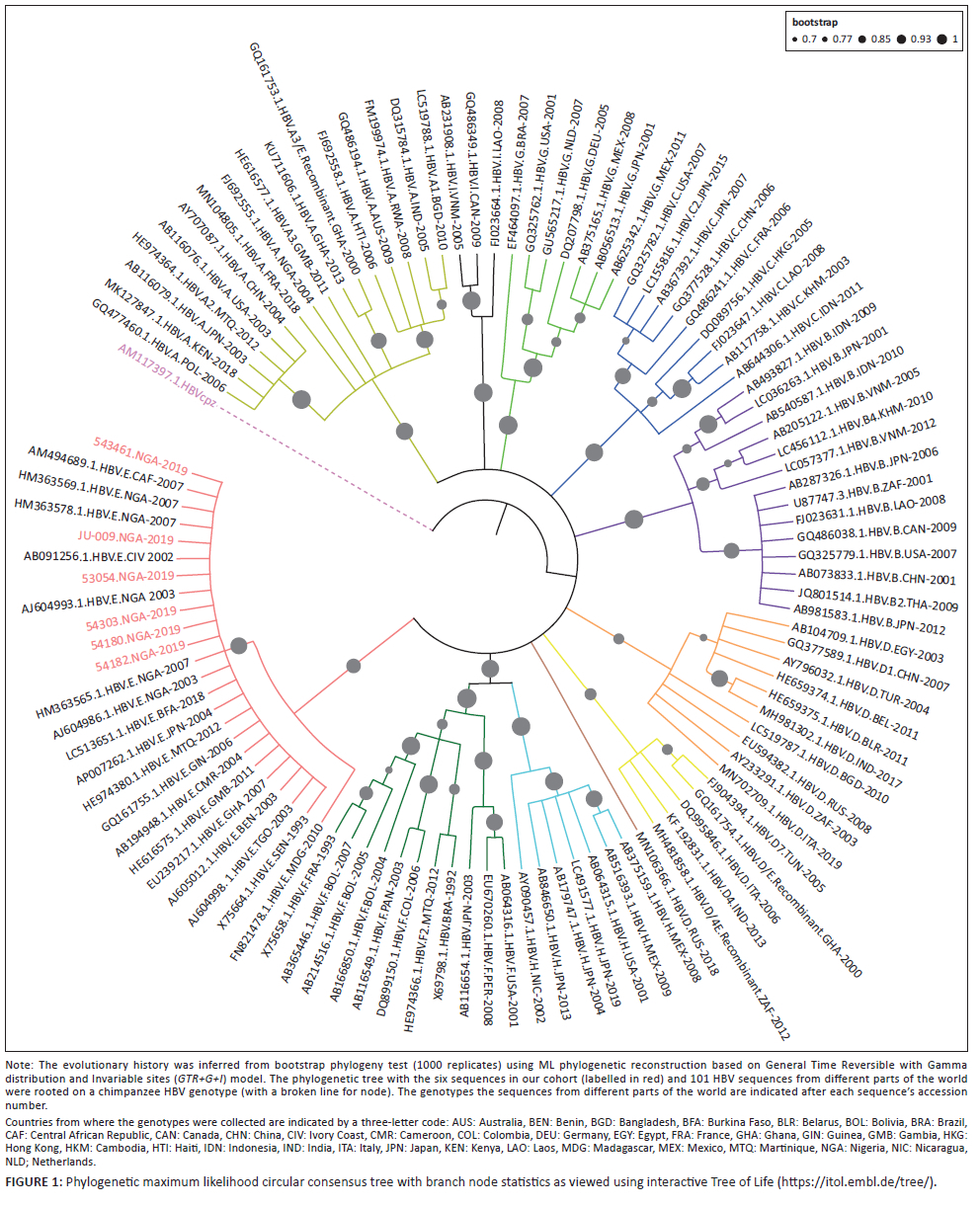
To infer the evolutionary relationship between the six HBV nucleotide sequences in our study and HBV sequences from different parts of the world, we used Molecular Evolutionary Genetics Analysis (MEGA) X version 10.1.7 (Mega Software, Dortmund, Germany).24https://www.ncbi.nlm.nih.gov/nucleotide/). The sequence from the chimpanzee was used as an out-group. The generated nucleotide sequence data were deposited in the GenBank database under the accession numbers ON236588-ON236593.
These sequences, together with the six from our cohort, were aligned using MUltiple Sequence Comparison by Log-Expectation (MUSCLE) software,25+G = 0.51, with 5 rate categories) and some invariant evolutionary sites (+I = 35.51% sites) was chosen as the best model, based on its low Bayesian information criterion score (18 980). For the phylogeny reconstruction the ML statistical method was used with a bootstrap of 1000 replicates and the sub tree-Pruning-Regrafting (Extensive; SPR level 5) as the ML heuristic method. Moreover, we used the option of 'moderate branch length filter' to enable a semi-stringent exhaustive optimisation of the branch lengths of the phylogenetic trees. Initial trees for the heuristic search were generated using Neighbor-Joining and BioNJ algorithms and the phylogenetic tree with superior log likelihood value selected. Phylogenetic trees were produced in Newick format employing interactive Tree of Life interface (https://itol.embl.de/tree/).
To determine the genetic diversity of the six HBV sequences, we performed an alignment analysis using MEGA.24
Assessment of hepatitis B virus drug resistance mutations
The obtained sequences of overlapping surface (S) and pol gene were translated to the protein sequences and aligned with the references in BioEdit version 7.1.3.0.26https://hbv.geno2pheno.org/index.php). It is a program that searches for homology between the input sequence and other DNA sequences in the existing stored database for drug resistance and surface gene mutations. Genotype assignments were confirmed using the GenBank BLAST and HBVseq tools from the HIV Drug Resistance Database.26,27
Statistical analysis
The obtained data were analysed using Statistical Package for Social Science software (version 19.0; IBM Corp., Armonk, New York, United States) and expressed as medians (with interquartile ranges [IQR]) for continuous variables, and as counts and percentages for discrete variables. Chi-squared test was used for discrete data.
Results
Thirty (29.7%) of the 101 had detectable HBV DNA. Of the 30 patients, 11 (36.7%) were co-infected with HIV while 19 (63.3%) had HBV-mono infection. Seventeen (56.7%) were female; the mean age was 41 years. The proportion of patients with HBV DNA copies/mL of < 20 copies/mL was 22/30 (73.3%); 6/19 (31.6%) of HBV-mono and 2/11 (18.2%) of HIV/HBV had 20 copies/mL - 20 000 copies/mL. Median aspartate aminotransferase U/L was 28 (23.8-36.0) for HIV/HBV co-infected patients and 27 (IQR: 19-32) for those with HBV-mono infection. Median alanine aminotransferase was 26.1 (IQR: 19.8-35.5) for those with HIV/HBV dual infection and 27 (IQR: 20-41) for those with HBV-mono infection while platelet level was 259 (IQR: 198.3-298.8) for those with HIV/HBV dual infection and 195 (168-257) for those with HBV-mono infection.
Phylogeny and genetic diversity of the hepatitis B virus sequences
All the generated sequences were from the HBV-mono infected patients. The genotypes of the six HBV nucleotide sequences were inferred from the phylogenetic tree (Figure 1), which showed that all the sequences were HBV genotype E. All the six sequences clustered with HBV genotype E, most of which were from the West African region.
Hepatitis B virus drug resistance report
According to the Geno2pheno (HBV) 2.0 report, all the six HBV genotype E sequences were susceptible to lamivudine, adefovir, entecavir, tenofovir disoproxil fumarate, and telbivudine. Two (33.3%) of the six genotypes, all from HBV-mono infected individuals, had escape mutations, the SH2 domain-containing adapter protein B protein of the surface-gene. One sample had L127R escape mutation while the other had G145A at a position first described as vaccine escape mutation. These mutations are amino acid substitutions within the major hydrophilic region called the 'a' determinant (124-147).
Discussion
Our findings showed a predominance of genotype E consistent with previous studies from Nigeria and other West African regions.4,14,16,17,18,28,29,301418,3128
The ease of transmission and epidemiological pattern of HBV have been linked to genotype variability, as well as clinical virological parameters. The pathogenicity of HBV has been shown to vary with genotype and certain mutations have been associated with genotype diversity that influences disease outcome, HCC development, diagnostic testing and treatment outcomes.2832,3329
As reported in other studies, we did not find any tenofovir or underlying lamivudine-associated mutations including the rtA194T that was earlier reported to be resistant to tenofovir.34,3516363738
Similarly, mutations arising in the S ORF region because of inherent or selective pressure by antiviral drugs can end up in the emergence of virus escape mutants in the adjacent S region with subsequent lack of response to HBV vaccine. The presence of this mutant over time could lead to partial replicative capacity of resistant HBV variant, and lack of response to HBV vaccine.3940,41424344
The L127R escape mutation in the 'a' determinant region observed in our study has been associated with HBV antigenicity, diagnostics and immunogenicity.4536,3738
Studies on the HBV genotypes, immune escape and antiviral drug resistance mutations in Nigeria are scarce. This is the first published study, to the best of our knowledge, that characterised HBV genotypes and drug resistance in chronic hepatitis B patients (HBV/HIV co-infected and HBV-mono infected patients) on long-term antiviral therapy (tenofovir) in Nigeria. However, one recent study assessed the effect of HBV mutations with liver severity in HIV/HBV co-infected antiretroviral therapy-naïve patients in Nigeria.27
Limitations
There are limitations to this study that need to be highlighted. It is a cross-sectional study with a small sample size, and low amplification and sequencing rate, yielding only 20.0% of the intended samples. Many factors could be responsible for this. For example, several freeze-thawing cycles and poor storage due to frequent power outage could have affected the sample integrity, resulting in decreased HBV DNA quantity. Other causes include intrinsic reagent-related issues and impact of HBV/E on the sensitivity of HBsAg assays due to surface antigen gene mutations located outside the sequenced region.46
Conclusion
Our study confirmed the dominance of genotype E, and it has great public health significance, given that the protective vaccine currently in use by the national vaccination programme is from the HBV-A2 strain. Additionally, no patients had HBV drug resistant mutations, suggesting that the use of tenofovir is an effective treatment in the management of HBV infection in both chronic HBV/HIV co-infected and HBV-mono infected patients. The study also showed the presence of mutation associated with immune escape mutant in chronic HBV-infected patients on long-term antiviral therapy. Therefore, further larger study is required to understand the dynamics of immune escape mutant on HBV diagnosis, and impact of genotypes on treatment outcomes.
Competing interests
The authors declare that they have no financial or personal relationships that may have inappropriately influenced them in writing this article.
Authors' contributions
J.A.-O., E.O. and C.H. were involved in conceptualisation, methodology, funding acquisition, project administration, investigation, writing original draft preparation and supervision. A.S.S. and O.A. assisted with funding acquisition, supervision, project administration, resources, writing, reviewing and editing. H.O. and C.O. performed data curation, assisted with software and contributed to the formal analysis, validation, preparation of the original draft and validation. P.M.D., P.O. and M.D. were responsible for investigation, project administration, resources, writing, reviewing and editing. All authors discussed the results, contributed to and approved the final manuscript.
Sources of support
Research reported in this publication was partly supported by the Fogarty International Center and National Institute of Mental Health, of the United States National Institutes of Health under award number D43 TW010543.
Data availability
The data sets generated with unique identifiers and analysed during the study are available on request from the corresponding author, J.A.-O., but are not publicly available.
Disclaimer
The content is solely the responsibility of the authors and does not necessarily represent the official views of the National Institutes of Health.
Acknowledgements
We thank the patients who participated in this study. We also thank the staff and management of Jos University Teaching Hospital, Faith Alive Foundation Hospital, Bingham University Teaching Hospital, and Plateau State Specialist Hospital for their support during patients' enrolment and sample collection. Finally, we thank the of the management and staff of Center for Human Virology and Genomics, and Nigeria Institute of Medical Research, Lagos, Nigeria, for providing the laboratory space and equipment during the analysis.
References
-
1.Stanaway JD, Flaxman AD, Naghavi M, et al. The global burden of viral hepatitis from 1990 to 2013: Findings from the Global Burden of Disease Study 2013. Lancet. 2016;388(10049):1081-1088. https://doi.org/10.1016/S0140-6736(16)30579-7
» https://doi.org/10.1016/S0140-6736(16)30579-7 - 2.WHO. Hepatitis B fact sheet. Geneva: World Health Organization (editor); 2017.
-
3.Hou J, Liu Z, Gu F. Epidemiology and prevention of hepatitis B virus infection. Int J Med Sci. 2005;2(1):50-57. https://doi.org/10.7150/ijms.2.50
» https://doi.org/10.7150/ijms.2.50 -
4.Kramvis A, Kew MC. Epidemiology of hepatitis B virus in Africa, its genotypes and clinical associations of genotypes. Hepatol Res. 2007;37(S1):S9-S19. https://doi.org/10.1111/j.1872-034X.2007.00098.x
» https://doi.org/10.1111/j.1872-034X.2007.00098.x -
5.Schweitzer A, Horn J, Mikolajczyk RT, Krause G, Ott JJ. Estimations of worldwide prevalence of chronic hepatitis B virus infection: A systematic review of data published between 1965 and 2013. Lancet. 2015;386(10003):1546-1555. https://doi.org/10.1016/S0140-6736(15)61412-X
» https://doi.org/10.1016/S0140-6736(15)61412-X -
6.Kim BK, Han KH, Ahn SH. Prevention of hepatocellular carcinoma in patients with chronic hepatitis B virus infection. Oncology. 2011;81(Suppl. 1):41-49. https://doi.org/10.1159/000333258
» https://doi.org/10.1159/000333258 -
7.Olayinka TA, Oyemakinde A, Balogun SM, et al. Seroprevalence of hepatitis B infection in Nigeria: A national survey. Am J Trop Med Hyg. 2016;95(4):902-907. https://doi.org/10.4269/ajtmh.15-0874
» https://doi.org/10.4269/ajtmh.15-0874 -
8.Akindigh MT, Abba OJ, Robert OC, Okojokwu JO, Okechalu NJ, Anejo-Okopi AJ. Seroprevalence of hepatitis B virus co-infection among HIV-1-positive patients in North-Central Nigeria: The urgent need for surveillance. Afr J Lab Med. 2019;8(1):622. https://doi.org/10.4102/ajlm.v8i1.622
» https://doi.org/10.4102/ajlm.v8i1.622 -
9.Musa B, Bussell S, Borodo MM, Samaila AA, Femi OL. Prevalence of hepatitis B virus infection in Nigeria, 2000-2013: A systematic review and meta-analysis. Niger J Clin Pract. 2015;18(2):163-172. https://doi.org/10.4103/1119-3077.151035
» https://doi.org/10.4103/1119-3077.151035 -
10.Croagh CM, Desmond PV, Bell SJ. Genotypes and viral variants in chronic hepatitis B: A review of epidemiology and clinical relevance. World J Hepatol. 2015;7(3):289-303. https://doi.org/10.4254/wjh.v7.i3.289
» https://doi.org/10.4254/wjh.v7.i3.289 -
11.Yu H, Yuan Q, Ge SX, et al. Molecular and phylogenetic analyses suggest an additional hepatitis B virus genotype 'I'. PLoS One. 2010;5(2):e9297. https://doi.org/10.1371/journal.pone.0009297
» https://doi.org/10.1371/journal.pone.0009297 -
12.Tatematsu K, Tanaka Y, Kurbanov F, et al. A genetic variant of hepatitis B virus divergent from known human and ape genotypes isolated from a Japanese patient and provisionally assigned to new genotype J. J Virol. 2009;83(20):10538-10547. https://doi.org/10.1128/JVI.00462-09
» https://doi.org/10.1128/JVI.00462-09 -
13.Yousif M, Mudawi H, Bakhiet S, Glebe D, Kramvis A. Molecular characterization of hepatitis B virus in liver disease patients and asymptomatic carriers of the virus in Sudan. BMC Infect Dis. 2013;13:328. https://doi.org/10.1186/1471-2334-13-328
» https://doi.org/10.1186/1471-2334-13-328 -
14.Forbi JC, Ben-Ayed Y, Xia GL, et al. Disparate distribution of hepatitis B virus genotypes in four sub-Saharan African countries. J Clin Virol. 2013;58(1):59-66. https://doi.org/10.1016/j.jcv.2013.06.028
» https://doi.org/10.1016/j.jcv.2013.06.028 - 15.Ayodele MBO, Ogugbue CJ, Frank-Peterside N, Tatfeng YM. Prevalent hepatitis b virus genotypes circulating among HIV co-infected patients in an Urban City, South-South Nigeria. J AIDS Clin Res. 2019;10:5.
-
16.Faleye COT, Adewumi OM, Ifeorah MI, et al. Detection of hepatitis B virus isolates with mutations associated with immune escape mutants among pregnant women in Ibadan, Southwestern Nigeria. SpringerPlus. 2015;4:43. https://doi.org/10.1186/s40064-015-0813-1
» https://doi.org/10.1186/s40064-015-0813-1 -
17.Ahmad AE, Bakari AG, Olayinka AT. Pattern of prevalent hepatitis B virus genotypes in Zaria, Nigeria. Niger Postgrad Med. 2019;26(2):80-86. https://doi.org/10.4103/npmj.npmj_59_19
» https://doi.org/10.4103/npmj.npmj_59_19 -
18.Assih M, Ouattara KA, Diarra B, et al. Genetic diversity of hepatitis viruses in West-African countries from 1996 to 2018. World J Hepatol. 2018;10(11):807-821. https://doi.org/10.4254/wjh.v10.i11.807
» https://doi.org/10.4254/wjh.v10.i11.807 -
19.De Clercq E, Ferir G, Kaptein S, Neyts J. Antiviral treatment of chronic hepatitis B virus (HBV) infections. Viruses. 2010;2(6):1279-1305. https://doi.org/10.3390/v2061279
» https://doi.org/10.3390/v2061279 -
20.Mokaya J, McNaughton AL, Hadley MJ, et al. A systematic review of hepatitis B virus (HBV) drug and vaccine escape mutations in Africa: A call for urgent action. PLoS Negl Trop Dis. 2018;12(8):e0006629. https://doi.org/10.1371/journal.pntd.0006629
» https://doi.org/10.1371/journal.pntd.0006629 -
21.Locarnini S, Mason WS. Cellular and virological mechanisms of HBV drug resistance. J Hepatol. 2006;44(2):422-431. https://doi.org/10.1016/j.jhep.2005.11.036
» https://doi.org/10.1016/j.jhep.2005.11.036 -
22.Sayan M, Akhan SC, Meric M. Naturally occurring amino-acid substitutions to nucleos(t)ide analogues in treatment naïve Turkish patients with chronic hepatitis B. J Viral Hepat. 2010;17(1):23-27. https://doi.org/10.1111/j.1365-2893.2009.01149.x
» https://doi.org/10.1111/j.1365-2893.2009.01149.x -
23.Chook JB, Teo LW, Ngeow FY, et al. Universal primers for detection and sequencing of hepatitis B virus genomes across genotypes A to G. J Clin Microbiol. 2015;53(6):1831-1835. https://doi.org/10.1128/JCM.03449-14
» https://doi.org/10.1128/JCM.03449-14 -
24.Kumar S, Stecher G, Li M, Knyaz C, Tamura K. MEGA X: Molecular Evolutionary Genetics Analysis across computing platforms. Mol Biol Evol. 2018;35(6):1547-1549. https://doi.org/10.1093/molbev/msy096
» https://doi.org/10.1093/molbev/msy096 - 25.Edgar RC. MUSCLE: A multiple sequence alignment method with reduced time and space complexity. BMC Bioinformatics. 2004;5:113.
- 26.Hall TA. BioEdit: A user-friendly biological sequence alignment editor and analysis program for Windows 95/98/NT. Nucleic Acids Symp. 1999;41:95-98.
-
27.Neumann-Fraune M, Beggel B, Kaiser R, Obermeier M. Hepatitis B virus drug resistance tools: One sequence, two predictions. Intervirology. 2014;57(3-4):232-236. https://doi.org/10.1159/000361076
» https://doi.org/10.1159/000361076 -
28.Grant J, Agbaji O, Hawkins C, et al. Hepatitis B virus sequencing and liver fibrosis evaluation in HIV/HBV co-infected Nigerians. Trop Med Int Health. 2017;22(6):744-754. https://doi.org/10.1111/tmi.12873
» https://doi.org/10.1111/tmi.12873 -
29.Mulders MN, Venard V, Njayou ME, et al. Low genetic diversity despite hyperendemicity of hepatitis B virus genotype E throughout West Africa. J Infect Dis. 2004;190(2):400-408. https://doi.org/10.1086/421502
» https://doi.org/10.1086/421502 -
30.Fujiwara K, Tanaka Y, Orito E, et al. Distribution of HBV genotypes among HBV carriers in Benin: Phylogenetic analysis and virological characteristics of HBV genotype E. World J Gastroenterol. 2005;11(41):6410-6415. https://doi.org/10.3748/wjg.v11.i41.6410
» https://doi.org/10.3748/wjg.v11.i41.6410 -
31.Dongdem ZA, Dzodzomenyo M, Adjei AA, et al. Hepatitis B virus genotypes among chronic hepatitis B patients reporting at Korle-Bu teaching hospital, Accra, Ghana. Pan Afr Med J. 2016;25(Suppl 1):5. https://doi.org/10.11604/pamj.supp.2016.25.1.6170
» https://doi.org/10.11604/pamj.supp.2016.25.1.6170 -
32.Shi Y-H. Correlation between hepatitis B virus genotypes and clinical outcomes. Jpn J Infect Dis. 2012;65(6):476-478. https://doi.org/10.7883/yoken.65.476
» https://doi.org/10.7883/yoken.65.476 -
33.Kramvis A. Clinical implications of hepatitis B virus genotypes and HBeAg in pediatrics. Rev Med Virol. 2016;26(4):285-303. https://doi.org/10.1002/rmv.1885
» https://doi.org/10.1002/rmv.1885 -
34.Sunbul M. Hepatitis B virus genotypes: Global distribution and clinical importance. World J Gastroenterol. 2014;20(18):5427-5434. https://doi.org/10.3748/wjg.v20.i18.5427
» https://doi.org/10.3748/wjg.v20.i18.5427 -
35.Amini-Bavil-Olyaee S, Herbers U, Sheldon J, Luedde T, Trautwein C, Tacke F. The rtA194T polymerase mutation impacts viral replication and susceptibility to tenofovir in hepatitis B e antigen-positive and hepatitis B e antigen-negative hepatitis B virus strains. Hepatology. 2009;49(4):1158-1165. https://doi.org/10.1002/hep.22790
» https://doi.org/10.1002/hep.22790 -
36.Mahmood M, Anwar MA. Analysis of resistant mutations in reverse transcriptase domain of hepatitis B virus from patients from Islamabad, Pakistan. J Unexplored Med Data. 2017;2:60-64. https://doi.org/10.20517/2572-8180.2017.13
» https://doi.org/10.20517/2572-8180.2017.13 - 37.Liu Y, Wang CM, Cheng J, et al. Hepatitis B virus in tenofovir-naive Chinese patients with chronic hepatitis B contains no mutation of rtA194T conferring a reduced tenofovir susceptibility. Chin Med J (Engl). 2009;122:1585-1586.
-
38.Malagnino V, Salpini R, Maffongelli G, et al. High rates of chronic HBV genotype E infection in a group of migrants in Italy from West Africa: Virological characteristics associated with poor immune clearance. PLoS One. 2018;13(3):e0195045. https://doi.org/10.1371/journal.pone.0195045
» https://doi.org/10.1371/journal.pone.0195045 -
39.Bivigou-Mboumba B, Francois-Souquiere S, Deleplancque L, et al. Broad range of hepatitis B virus (HBV) patterns, dual circulation of Quasi-Subgenotype A3 and HBV/E and heterogeneous HBV mutations in HIV-positive patients in Gabon. PLoS One. 2016;11(1):e0143869. https://doi.org/10.1371/journal.pone.0143869
» https://doi.org/10.1371/journal.pone.0143869 -
40.Perazzo P, Eguibar N, González RH, Nusblat AD, Cuestas ML. Hepatitis B Virus (HBV) and S-Escape Perazzo P mutants: From the beginning until now. J Hum Virol Retrovirol. 2015;2(3):00046. https://doi.org/10.15406/jhvrv.2015.02.00046
» https://doi.org/10.15406/jhvrv.2015.02.00046 -
41.Caligiuri P, Cerruti R, Icardi G, Bruzzone B. Overview of hepatitis B virus mutations and their implications in the management of infection. World J Gastroenterol. 2016;22(1):145-154. https://doi.org/10.3748/wjg.v22.i1.145
» https://doi.org/10.3748/wjg.v22.i1.145 -
42.Sheldon J, Ramos B, Garcia-Samaniego J, et al. Selection of Hepatitis B Virus (HBV) vaccine escape mutants in HBV-infected and HBV/HIV-coinfected patients failing antiretroviral drugs with anti-HBV activity. J Acquir Immune Defic Syndr. 2007;46(3):279-282. https://doi.org/10.1097/QAI.0b013e318154bd89
» https://doi.org/10.1097/QAI.0b013e318154bd89 -
43.Salpini R, Colagrossi L, Bellocchi MC, et al. Hepatitis B surface antigen genetic elements critical for immune escape correlate with hepatitis B virus reactivation upon immunosuppression. Hepatology. 2015;61(3):823-833. https://doi.org/10.1002/hep.27604
» https://doi.org/10.1002/hep.27604 -
44.Cao GW. Clinical relevance and public health significance of hepatitis B virus genomic variations. World J Gastroenterol. 2009;15(46):5761-5769. https://doi.org/10.3748/wjg.15.5761
» https://doi.org/10.3748/wjg.15.5761 -
45.Zeid WMA, Ramadan DI, Shemis MA. Prevalence of mutations within major hydrophilic region of hepatitis B virus and their correlation with genotypes among chronically infected patients in Egypt. Arab J Gastroenterol. 2016;17(1):34-40. https://doi.org/10.1016/j.ajg.2016.03.001
» https://doi.org/10.1016/j.ajg.2016.03.001 -
46.Launay O, Masurel J, Rosenberg RA, et al. High levels of serum hepatitis B virus DNA in patients with 'anti-HBc alone': Role of HBsAg mutants. J Viral Hepat. 2011;8(10):721-729. https://doi.org/10.1111/j.1365-2893.2011.01482.x
» https://doi.org/10.1111/j.1365-2893.2011.01482.x

Accepted: 28 Apr. 2022
Published: 18 Oct. 2022