Healthcare waste management knowledge, attitudes and practices of laboratory workers at a regional hospital, Lesotho
Abstract
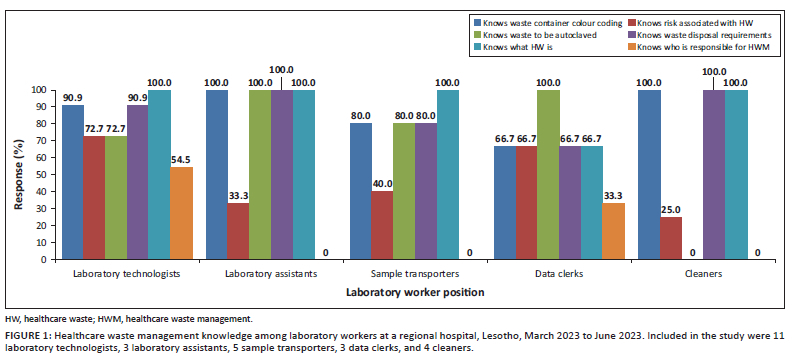
BACKGROUND: Safe management of healthcare waste (HW) safeguards laboratory biosafety and biosecurity. Knowledge and attitudes influence HW practices, presenting a need for evidence of the current status OBJECTIVE: This study assessed the knowledge, attitudes and practice of laboratory workers towards waste management at a regional hospital laboratory in Lesotho METHODS: The study was conducted from March 2023 to June 2023 using a mixed-methods descriptive case study design. The entire population (n = 30) of technical and non-technical laboratory workers and generated waste were sampled. A structured questionnaire and an observational checklist were used to collect data. Waste generation was assessed by weighing and measuring waste volumes. Data were analysed using descriptive statistics RESULTS: All respondents (26/26; 100%) can define HW and (3/3) laboratory assistants (100%) gave correct responses for three questions, namely: risk associated with HW, waste container colour-coding, and disposal requirements. Knowledge on waste management responsibilities ranged between 0% (0/4) for cleaners and 54.5% (6/11) among laboratory technicians. Attitudes were mainly positive, and practices conformed in part to standard operating procedures. Infectious solid waste comprised 77% of solid HW, while 63% of chemical liquid waste emanated from the full blood count area CONCLUSION: Knowledge exists among workers and attitudes are predominantly positive; however, some unsafe practices continue, thus knowledge is not fully translated to safe practices. Regular training and measuring and recording of HW were recommended WHAT THIS STUDY ADDS: The study contributes understanding of the status of HW knowledge, attitudes and management practices, highlighting the need for compliance monitoring
healthcare waste management; knowledge; attitudes; practices; biosafety; biosecurity
Introduction
Healthcare waste (HW) is defined as all waste generated within healthcare facilities, research centres, and laboratories related to medical procedures.12,3,4
Developed countries deal with the fine-tuning of their already established systems, while developing countries are faced with the difficulties of setting up systems that work,556738
Various studies3,9,10,1112213141415,16,1758
In terms of attitudes, significant and positive correlations were found between knowledge and attitude, knowledge and practice, and practice and attitude.1814,19138,20,21,225,23,24
The management of HW has been of major concern because of potentially high risks to human health and the environment.255
Medical and diagnostic laboratories are mandated to maintain biosafety and biosecurity in their operations in an effort to align with national and international legislation and treaties. Lesotho developed the national HWM Policy (2010),2627282928
Methods
Ethical considerations
The study was subjected to review by the Institutional Review Board of the Faculty of Health Sciences, National University of University of Lesotho (NUL/EN/2023). Ethical clearance was also sought from the Ministry of Health's Research Ethics Committee (ID55-2023). To access the study site, permission to conduct the study was received from the management of the hospital and the laboratory. Care was taken to gain written informed consent from participants. Privacy was ensured by obtaining written consent and allowing participants control over their information through a self-administered questionnaire. For anonymity, participants did not disclose their names on the questionnaire and confidentiality was guaranteed through storing data in a locked space and their freedom to participate and withdraw from the study was explained prior to signing consent forms.
Study design and setting
A descriptive cross-sectional study design was used to assess KAP and to undertake hazardous waste characterisation, with the variables of concern being KAP and masses and volumes of waste generated. For KAP assessment, the Total Population sampling method was selected for respondents (n = 30), including technical laboratory workers, sample transporters, cleaners, and data clerks. A survey was conducted using a self-administered semi-structured questionnaire and an observational checklist. The questionnaire and checklist were created by the researchers and approved by the Institutional Review Board and the Laboratory Head/Manager prior to data collection. The questionnaire was distributed to consenting respondents and collected data pertaining to KAPs. The observational checklist recorded staff practices vis-à-vis the laboratory's standard operating procedure (SOP) for waste management. A total of 20 observations were made on a convenience sampling basis on six technical staff on duty during three shifts and two cleaners during two shifts to assess the implementation of HWM.
To enumerate waste generation, the waste stream was defined as all solid and liquid waste resulting from the processing of specimens. All waste generated on weekdays between the dates 16 May 2023 and 26 May 2023 was included in the study. An electronic balance was used to weigh the masses of solid waste, and estimation of chemical liquid waste volumes was undertaken using containers of known volume.
The laboratory is located approximately 105 km north-west of the capital, Maseru, and serves as a regional laboratory for referred specimens from nearby hospitals and selected health centres in the region. The laboratory includes a reception and six sections focusing on tuberculosis and coronavirus disease 2019 (COVID-19), molecular diagnostics, full blood count, CD4, microbiology, and clinical chemistry; all sections, including the reception, were included in the study assessments. On average, 13 625 specimens are processed monthly. Combustible risk waste emanating from tests is managed onsite through autoclaving and incineration, chemical waste is exported from the facility to the National Reference Laboratories for stockpiling and treatment, while general waste is collected and disposed of at the district's designated disposal area by a contracted private company.
Data analysis
For qualitative data, a category scheme was devised and data coded according to the categories. Descriptive statistics were then computed from the coded data and quantitative data using Microsoft Excel (2019) (Microsoft Corporation, Redmond, California, United States). Frequencies and percentages were used to express the data, from which a discussion was developed. Observations on KAP were made among the different categories of staff in the laboratory.
Results
Profile of respondents
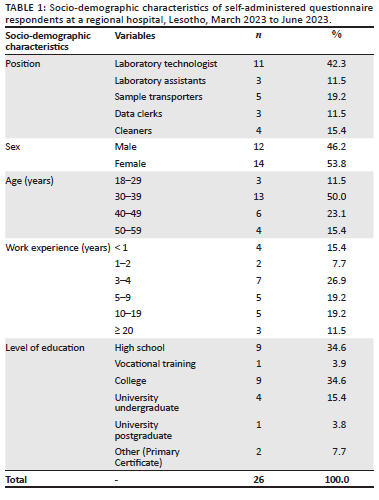
The target population was n = 30 and a high response rate of 86.7% (26/30) was achieved through the consenting participants. Most respondents were women (53.8%), and 50% were aged 30-39 years (Table 1). Education level ranged from primary certificate to university postgraduate studies, where the majority (34.6%) had completed high school and college level. Work experience ranged from less than a year (15.4%) to a maximum of 20 or more years (11.5%), and the highest proportion of staff had 3-4 years of experience (26.9%).
Knowledge of staff on healthcare waste management
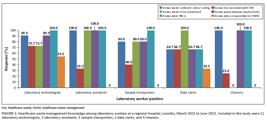
All respondents (26/26; 100%) knew what HW is (Figure 1). In addition, all laboratory assistants (100%) answered three questions correctly, namely: the risk associated with HW, the colour coding used for segregating, and the requirements for HW disposal. Findings revealed that for three questions regarding what HW is, container colour coding, and disposal requirements, all 4 cleaners (100%) answered correctly, thus performing better than laboratory technicians, data clerks, and sample transporters on the latter two questions. A crucial finding also was that the question most poorly performed on by all cadres was regarding who is responsible for HWM in the laboratory, ranging from 0% among cleaners (0/4) to 55% (6/11) among laboratory technicians.
Attitudes of staff on healthcare waste management
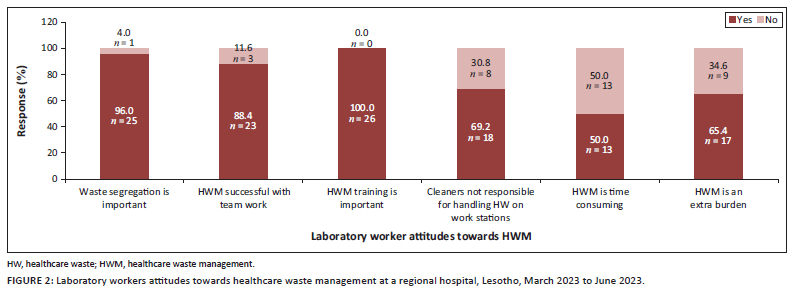
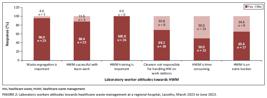
Ninety-six per cent (25/26) believe that segregation is key to HWM, while all 26 respondents (100%) agree on the importance of training to HWM (Figure 2). A positive attitude portrayed by 84% (22/26) of the respondents was that HW is best managed with teamwork. In addition, more respondents (69.2%; 18/26) felt that cleaners should not be allowed to handle all infectious waste on work benches. There was a tie at 50% (13/26) regarding whether HWM is or is not a time-consuming phenomenon. It was also discovered that 65.4% (17/25) of the respondents felt that HWM is an extra burden.
Practices of staff on healthcare waste management
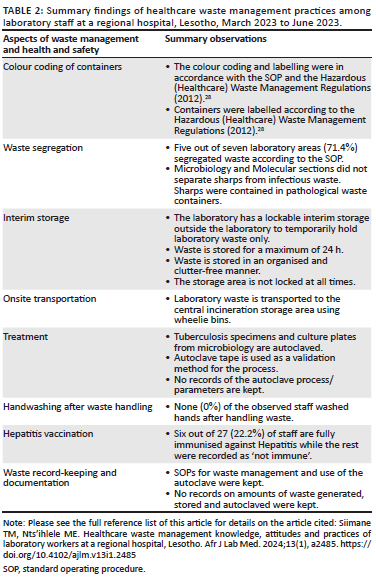
The laboratory has a waste management SOP which is in version 2 and was last reviewed on 07 February 2022 (Table 2). From the records, all technical and non-technical staff had signed that they had read and understood the SOP.
Waste generated through laboratory practices
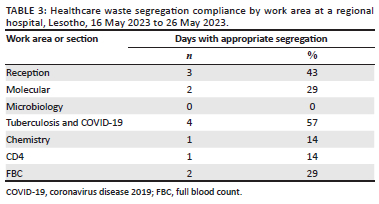
Out of seven (n = 7) days of segregation observations, the findings showed that the microbiology section did not comply with segregation requirements at all (0/7 days), while the tuberculosis and COVID-19 section complied for 4 out of 7 days (Table 3).
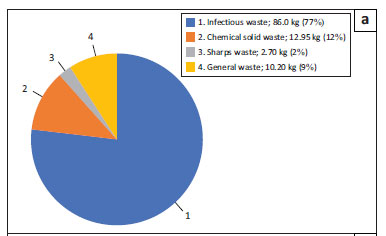
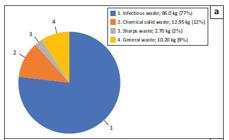
Findings revealed that the laboratory does not routinely quantify and record the amounts of waste generated. For solid waste, the findings reveal that the category of HW generated the most is infectious waste (77%), while the lowest generated was sharps waste (7%) (Figure 3a). Healthcare general waste constituted 9% of the waste stream. The major infectious waste generating areas were the CD4, molecular, and tuberculosis and COVID-19 areas.
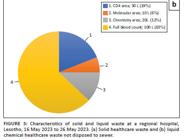
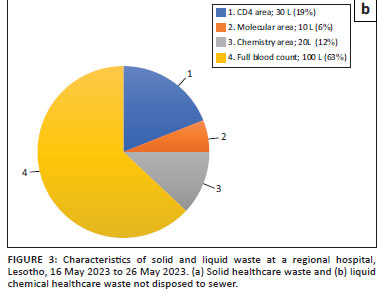
The majority of the chemical liquid waste that was not directly disposed of via the drain was generated by the full blood count area (63%), and the least emanated from the molecular section (6%) (Figure 3b).
Discussion
This study, conducted between March 2023 and May 2023 at the regional hospital in Lesotho, found that laboratory workers have knowledge about HWM, and that workers' attitudes towards HWM are predominantly positive. Despite the findings, some unsafe HW practices remain.
Demographic data show that the majority of participants were women (53.8%), which is in line with the country's demographic profile, where women in the labour force constitute 53.5% in urban settlements.3031
In general, it is known that the knowledge of workers will influence the attitudes and practices towards HWM.32813
All participants (100%) had positive attitudes towards HWM training, and they were willing to take part in such trainings. The majority (88.5%) had a positive attitude towards managing HW as a team. The positive attitude could be harnessed by the laboratory to continue to champion improved HWM as demonstrated in a study conducted in South Africa in 2016 by Olaifa et al.,2511
The microbiology section indicated that it generated infectious waste only. There were no records indicating that pathological waste such as culture plates were autoclaved. This presents a biosafety and biosecurity challenge since it becomes impossible for the laboratory to account for the destruction of pathogens using validated methods as required by Chartier et al.133343515
The laboratory generated more healthcare risk waste (91%) than healthcare general waste (9%). Of the healthcare risk waste, infectious waste was highest at 77%, and sharps waste the lowest (7%). This tallies with the 2018 findings of Mazloomi et al.3637
The full blood count area generated the majority (63%) of the liquid chemical waste, with the lowest amount emanating from the molecular area (6%). The chemical liquid waste is drained into an impermeable underground conservancy tank which is emptied by trained and authorised personnel. The tank contents are secured from unauthorised access, contrary to the findings of Ali et al.2
It was observed that full hepatitis immunisation status was not achieved by the majority of workers (67.8%), which differs from the findings of Soyamet al.1913
It was not clear as to when and how often temporary storage area was emptied of laboratory waste. Historically, HW was well secured and locked until recently, where the storage key was lost and the area left unlocked. In addition, the storage area has no signage to control entry, affirming some of the challenges of HWM as reviewed in 2017 by Ali et al.238
Limitations
Responses for the questionnaire were self-reported and could bring bias. Furthermore, because of the short period for monitoring waste generation, the picture of waste generation gained cannot be generalised over longer periods of operation. Lastly, inferential statistics could have improved the researchers' understanding of the dynamics at play between KAPs.
Conclusion
The laboratory has oversight mechanisms in place for engaging in safe HWM. While knowledge may exist among workers and attitudes may be positive, these do not always translate into the best practices for compliance with national regulation and SOPs. Therefore, improvement is needed to enhance biosafety and biosecurity. The study findings have been used to inform action such as refresher trainings, which are tied to monitoring and training impact assessment activities. Further investigation is needed to understand the factors leading to what hampers and promotes the observed attitudes and practices. As the laboratory continues to implement programmes that promote a culture of safety, performance monitoring should also be strengthened.
Competing interests
The authors declare that they have no financial or personal relationships that may have inappropriately influenced them in writing this article.
Authors' contributions
T.M.S. and M.E.N. conceptualised and designed the study. T.M.S. supervised the project, reviewed the data collection tools, reviewed and curated the data, and wrote the article. M.E.N. developed the data collection tool, collected and analysed the data, and contributed to the review and finalisation of the article. Funding for the study was sourced by M.E.N.
Sources of support
This research received no research grant from any funding agency in the public, commercial or not-for-profit sectors.
Data availability
The authors confirm that the data supporting the findings from this study are available within this article. Raw data supporting this evaluation's findings are available from the corresponding author, T.M.S., upon reasonable request.
Disclaimer
The views and opinions expressed in this article are those of the authors and are the product of professional research. The article does not necessarily reflect the official policy or position of any affiliated institution, funder, agency, or that of the publisher. The authors are responsible for this article's results, findings, and content.
Acknowledgements
The authors would like to pass their gratitude to all staff members in the hospital laboratory for their participation in providing valuable data that brought this study to fruition.
References
- 1. Chartier Y, Emmanuel J, Pieper U, et al. Safe management of wastes from health-care activities. 2nd ed. Geneva: World Health Organization; 2014.
-
2. Ali M, Wang W, Chaudhry N, Geng Y. Hospital waste management in developing countries: A mini review. 2017;35(6):581-592. https://doi.org/10.1177/0734242X17691344
» https://doi.org/10.1177/0734242X17691344 -
3. Minoglou M, Gerassimidou S, Komilis D. Healthcare waste generation worldwide and its dependence on socio-economic and environmental factors. Sustainability. 2017;9(22):220. https://doi.org/10.3390/su9020220
» https://doi.org/10.3390/su9020220 -
4. Al-Khatib IA, Sato C. Solid health care waste management status at health care centers in the West Bank - Palestinian Territory. Waste Manage. 2009;29(8):2398-2403. https://doi.org/10.1016/j.wasman.2009.03.014
» https://doi.org/10.1016/j.wasman.2009.03.014 -
5. Mohamed LF, Ebrahim SA, Al-Thukair AA. Hazardous healthcare waste management in the Kingdom of Bahrain. Waste Manage. 2009;29(8):2404-2409. https://doi.org/10.1016/j.wasman.2009.02.015
» https://doi.org/10.1016/j.wasman.2009.02.015 -
6. Ceylan Z, Bulkan S, Elevli S. Prediction of medical waste generation using SVR, GM (1,1) and ARIMA models: a case study for megacity Istanbul. J Environ Health Sci Eng. 2020;18(2):687-697. https://doi.org/10.1007/s40201-020-00495-8
» https://doi.org/10.1007/s40201-020-00495-8 -
7. Kenny C, Priyadarshini A. A review of current healthcare waste management methods and their effect on global health. Healthcare. 2021;9(3):284. https://doi.org/10.3390/healthcare9030284
» https://doi.org/10.3390/healthcare9030284 -
8. Mathur V, Dwivedi S, Hassan M, Misra R. Knowledge, attitude, and practices about biomedical waste management among healthcare Personnel: A cross-sectional study. Indian J Community Med. 2011;36(2):143-145. https://doi.org/10.4103/0970-0218.84135
» https://doi.org/10.4103/0970-0218.84135 -
9. Uloma AA, Benjamin N, Kiss I. Knowledge, attitude and practice of healthcare workers towards medical waste management: A comparative study of two geographical areas. J Waste Manage Disposal. 2022;5(1):1-18. https://doi.org/10.18875/2641-8827.5.101
» https://doi.org/10.18875/2641-8827.5.101 -
10. Mugabi B, Hattingh S, Chima SC. Assessing knowledge, attitudes, and practices of healthcare workers regarding medical waste management at a tertiary hospital in Botswana: A cross-sectional quantitative study. Niger J Clin Pract. 2018;21(12):1627-1638. https://doi.org/10.4103/njcp.njcp_270_17
» https://doi.org/10.4103/njcp.njcp_270_17 -
11. Khan MJ, Hamza MA, Zafar B, Mehmod R, Mushtaq S. Knowledge, attitude and practices of health care staff regarding hospital waste handling in tertiary care hospitals of Muzaffarabad, AJK, Pakistan. Int J Sci Rep. 2017;3(7):220-226. https://doi.org/10.18203/issn.2454-2156.IntJSciRep20173094
» https://doi.org/10.18203/issn.2454-2156.IntJSciRep20173094 - 12. Babanyara YY, Ibrahim DB, Garba T, Bogoro AG, Abubakar MY. Poor medical waste management (MWM) practices and its risks to human health and the environment: A literature review. Int J Environ Chem Ecol Geol Geophys Eng. 2013;7(11):757-764.
-
13. El-Gilany AH, El-shaer S, Khashaba E, El-dakroory SA, Omar N. Knowledge, attitude, and practice of 'teaching laboratory' technicians towards laboratory safety and waste management: a pilot interventional study. J Hosp Infect. 2017;96(2):192-194. https://doi.org/10.1016/j.jhin.2017.02.007
» https://doi.org/10.1016/j.jhin.2017.02.007 - 14. Mehta TK, Shah PD, Tiwari KD. A Knowledge, attitude and practice study of biomedical waste management and bio-safety among healthcare workers in a tertiary care government hospital in western India. Natl J Community Med. 2018;9(5):327-333.
-
15. Deress T, Hassen F, Adane K, Tsegaye A. Assessment of knowledge, attitude, and practice about biomedical waste management and associated factors among the healthcare professionals at Debre Markos Town healthcare facilities, northwest Ethiopia. J Environ Public Health. 2018;2018:7672981. https://doi.org/10.1155/2018/7672981
» https://doi.org/10.1155/2018/7672981 -
16. Anozie OB, Lawani LO, Eze JN, et al. Knowledge, attitude and practice of healthcare managers to medical waste management and occupational safety practices: findings from southeast Nigeria. J Clin Diagn Res. 2017;11(3):IC01-IC04. https://doi.org/10.7860/JCDR/2017/24230.9527
» https://doi.org/10.7860/JCDR/2017/24230.9527 - 17. Ismail IM, Kulkarni AG, Kamble SV, Borker SA. Knowledge, attitude and practices about bio-medical waste management among personnel of a tertiary health care institute in Dakshina Kannada, Karnataka. 2013;6(6):376-380.
-
18. Akkajit P, Romin H, Assawadithalerd M, Al-Khatib IA. Assessment of knowledge, attitude, and practice in respect of medical waste management among healthcare workers in clinics. J Environ Public Health. 2020;28:1-12. https://doi.org/10.1155/2020/8745472
» https://doi.org/10.1155/2020/8745472 -
19. Soyam GC, Hiwarkar PA, Kawalkar UG, Soyam VC, Gupta VK. Knowledge Attitudes and Practices study of bio-medical waste management among health care workers in Delhi. Int J Community Med Public Health. 2017;4:3332. https://doi.org/10.18203/2394-6040.ijcmph20173840
» https://doi.org/10.18203/2394-6040.ijcmph20173840 -
20. Letho Z, Yangdon T, Lhamo C, et al. Awareness and practice of medical waste management among healthcare providers in national referral hospital. PLoS One. 2021;16(1):e0243817. https://doi.org/10.1371/journal.pone.0243817
» https://doi.org/10.1371/journal.pone.0243817 -
21. Majara M, Leduka R. Health-care waste practices in selected health-care facilities in Maseru. Rev Southern Afr Stud. 2010;13(1):1-29. https://doi.org/10.4314/rosas.v13i1.59020
» https://doi.org/10.4314/rosas.v13i1.59020 -
22. Manyele S, Anicetus H. Management of medical waste in Tanzania hospitals. Tanz J Health Res. 2009;17;8(3):177-182. https://doi.org/10.4314/thrb.v8i3.4511700
» https://doi.org/10.4314/thrb.v8i3.4511700 -
23. Hassan AA, Tudor T, Vaccari M. Healthcare waste management: A case study from Sudan. Environments. 2018;5(8):89. https://doi.org/10.3390/environments5080089
» https://doi.org/10.3390/environments5080089 -
24. Yazie TD, Tebeje MG, Chufa KA. Healthcare waste management current status and potential challenges in Ethiopia: a systematic review. BMC Res Notes. 2019;12:285. https://doi.org/10.1186/s13104-019-4316-y
» https://doi.org/10.1186/s13104-019-4316-y -
25. Olaifa A, Govender RD, Ross AJ. Knowledge, attitudes and practices of healthcare workers about healthcare waste management at a district hospital in KwaZulu-Natal. S Afr Fam Pract. 2018;60(5):137-145. https://doi.org/10.1080/20786190.2018.1432137
» https://doi.org/10.1080/20786190.2018.1432137 - 26. Lesotho Ministry of Health. Health Care Waste Management Policy. Maseru: Lesotho Ministry of Health; 2010.
-
27. Lesotho Department of Environment. Integrated Strategy on Waste Management [homepage on the Internet]. Maseru: Lesotho Ministry of Tourism, Environment and Culture; 2022 [cited n.d.]. Available from: https://environment.gov.ls/download/integrated-strategy-on-waste-management/
» https://environment.gov.ls/download/integrated-strategy-on-waste-management/ - 28. Lesotho Government. Hazardous (Health Care) Waste Management Regulations of 2012 [homepage on the Internet]. Government Printing. Maseru: Lesotho Government; 2012.
- 29. Lesotho Environmental Health Division. Health Care Waste Management Guidelines. Maseru: Lesotho Ministry of Health; 2012.
-
30. Lesotho Bureau of Statistics. Population and housing census [homepage on the Internet]. 2016 [cited 2024 Apr 30]. Available from: https://www.bos.gov.ls/Publications.htm
» https://www.bos.gov.ls/Publications.htm -
31. Love HB, Stephens A, Fosdick BK, Tofany E, Fisher ER. The impact of gender diversity on scientific research teams: a need to broaden and accelerate future research. Hum Soc Sci Commun. 2022;9(1):386. https://doi.org/10.1057/s41599-022-01389-w
» https://doi.org/10.1057/s41599-022-01389-w -
32. Udayanga L, Sahana L, Perera A, Ranasinghe K, Ranathunge T. Knowledge, perceptions and practices on healthcare waste management and associated occupational health hazards among healthcare professionals in the Colombo District, Sri Lanka: a cross-sectional study. Front Public Health. 2023;11:1215648. https://doi.org/10.3389/fpubh.2023.1215648
» https://doi.org/10.3389/fpubh.2023.1215648 - 33. United Nations Environment Programme. Compendium of technologies for treatment/destruction of healthcare waste. Osaka: United Nations Environmental Programme; 2012.
-
34. Endris S, Tamir Z, Sisay A. Medical laboratory waste generation rate, management practices and associated factors in Addis Ababa, Ethiopia. PLoS One. 2022;17(4):e0266888. https://doi.org/10.1371/journal.pone.0266888
» https://doi.org/10.1371/journal.pone.0266888 - 35. Mohankumar S, Kottaiveeran DK. Hospital waste management and environmental problems in India. Int J Pharm Biol Arch. 2011;2(6):1621-1626.
-
36. Mazloomi S, Zarei A, Alasvand S, Farhadi A, Nourmoradi H, Bonyadi Z. Analysis of quality and quantity of health-care wastes in clinical laboratories: A case study of Ilam city. Environ Monit Access. 2019;191:207. https://doi.org/10.1007/s10661-019-7345-z
» https://doi.org/10.1007/s10661-019-7345-z - 37. Radha KV, Kalaivani K, Lavanya R. A case study of biomedical waste management in hospitals. Global J Health Sci. 2009;1(1):82-88.
- 38. Lesotho Ministry of Health. National laboratory biosafety and biosecurity assessment report. Maseru: Lesotho Government; 2023.

Accepted: 02 Oct. 2024
Published: 06 Dec. 2024