Therapeutic drug monitoring of phenytoin and valproic acid in critically ill patients at Windhoek Central Hospital, Namibia
Abstract
BACKGROUND: Phenytoin and valproic acid, anticonvulsants, have a low therapeutic index and are highly plasma protein bound, mainly to albumin. Hypoalbuminaemia is common in critically ill patients and increases the unbound drug concentration. Thus, monitoring unbound rather than total plasma drug concentrations is recommended to optimise the dosing of these drugs OBJECTIVE: This retrospective study determined unbound plasma concentrations of phenytoin and valproic as a more accurate value of drug levels than total plasma drug concentrations METHODS: Total plasma concentrations were retrieved for 56 Intensive Care Unit patients for phenytoin and 93 for valproic acid. Total drug concentrations were converted to unbound concentrations using a serum albumin-based normalising equation RESULTS: Total phenytoin plasma concentration was below (41.1% of patients), within (46.4%) or above (12.5%) the therapeutic range (10 μg/mL - 20 μg/mL). However, the predicted unbound plasma concentration of phenytoin was above the therapeutic range (1 μg/mL - 2 μg/mL) in the majority of patients (57.1%). For valproic acid, the total plasma concentration of most patients (87.1%) was below the therapeutic range (50 μg/mL - 100 μg/mL); among remaining patients (12.9%), it was within the therapeutic range. In the majority of patients (91.4%), the predicted unbound plasma concentration of valproic acid was between 2.5 μg/mL and 20 μg/mL CONCLUSION: The usefulness of monitoring the total phenytoin or valproic acid levels for dose optimisation is limited as it is an inaccurate indicator of a patient's drug therapeutic state. Thus, the unbound plasma drug concentrations should be quantified experimentally or predicted in resource-limited settings
phenytoin; valproic acid; critically ill patients; therapeutic drug monitoring; unbound concentration
Introduction
The incidence of seizures in North American general intensive care units (ICUs) was reported in 2013 to range from 3.3% to 34.0%.12,34,5,62,4,5566
The pharmacokinetic behaviour of phenytoin and valproic acid is complicated because their elimination kinetics are nonlinear. In addition, the pharmacokinetics of both drugs show a high degree of interindividual variability as a result of pharmacogenetic differences in enzyme and transporter activities, as well as high interpatient variability in plasma protein binding, in the case of valproic acid.7,8,92,7
Phenytoin and valproic acid are highly bound to serum albumin (≥ 90%). The binding of these drugs depends on the drug plasma and albumin concentrations and the presence of other albumin-binding substances that may compete for binding sites with these drugs.1011,12,1314,1510,12,16,175,18,19,20,21,224,54,5
The Windhoek Central Hospital in Windhoek (Namibia) conducts therapeutic phenytoin and valproic acid monitoring in critically ill patients in the ICU facility by measuring only total plasma concentrations of the drugs. This study aimed to retrospectively estimate unbound plasma concentrations as a more accurate measure of the therapeutic plasma levels of two drugs.
Methods
Ethical considerations
The Research and Ethics committees of the Ministry of Health and Social Services, the Republic of Namibia, approved this study; reference numbers HM2019 and LNI2019. Data were retrieved from patient record archives; no patients were required to participate in the data collection procedure of this study, and the ethics committee waived the requirement to obtain consent from patients before accessing their records. Furthermore, names were excluded from the data collected for this study to protect patients' privacy.
Patient population and data collection
This retrospective analysis utilised data from the ICU of Windhoek Central Hospital, Namibia. Records of patients admitted between January 2013 and July 2019 were reviewed. Patients who received phenytoin or valproic acid while at the ICU and whose anticonvulsant plasma concentrations and serum albumin levels had been recorded were included in the study. The following information was extracted from the records: age, gender, diagnosis, total plasma concentrations of phenytoin or valproic acid, serum albumin concentration, and concomitant medication. Serum albumin concentrations were measured at the Namibia Institute of Pathology using the bromocresol purple method (cobas® 6000 Analyser, Roche Diagnostics International, Rotkreuz, Switzerland). The total plasma concentrations of phenytoin and valproic acid were measured by fluorescence polarisation immunoassay (Abbott Architect i2000, Abbott Laboratories, Chicago, Illinois, United States).
Data analysis
For each patient, the unbound plasma concentration of phenytoin (Cu PHT) was calculated based on the measured total plasma concentration of phenytoin (Cp PHT) and the serum albumin concentration (ALB), in grams/decilitre, by using the original Winter-Tozer equation54,5

The unbound plasma fraction of valproic acid (α VPA) was calculated based on the serum albumin concentration (ALB) in μmol/L, by use of the hyperbolic equation proposed by Parent et al.16,17

The unbound plasma concentration of valproic acid (Cu VPA) was then estimated for each patient based on the measured total valproic acid plasma concentration (Cp VPA) (Equation 3). The therapeutic ranges were 50 μg/mL to 100 μg/mL for total valproic acid plasma concentration and 2.5 μg/mL to 20.0 μg/mL for unbound valproic acid plasma concentration:4,5

Descriptive statistics were used to summarise the results. All statistical calculations were carried out using the Excel software package of Windows 10 (Microsoft Corporation, Redmond, Washington, United States).
Results
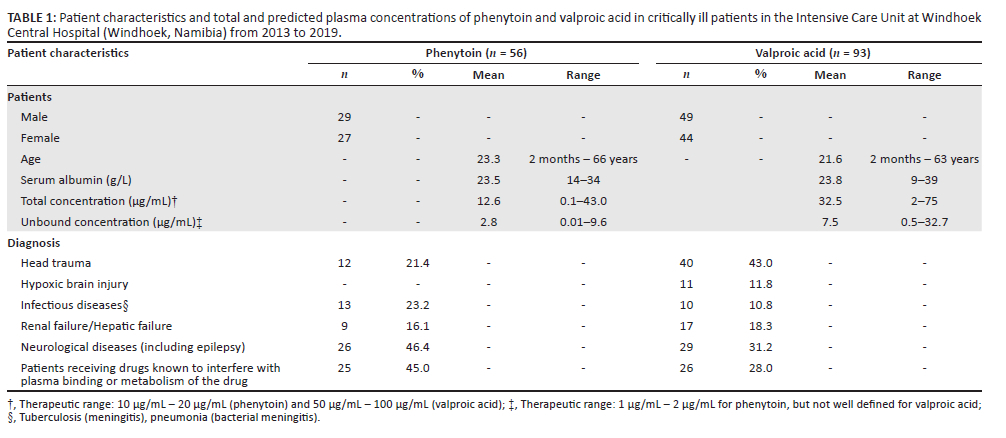
In total, 1661 files of patients hospitalised between January 2013 and July 2019 at the ICU of Windhoek Central Hospital were reviewed. Fifty-six patients, given phenytoin and 93 patients given valproic acid, who had data recorded for total plasma concentrations and serum albumin levels, were included in the study. Patients were admitted to the ICU for the following conditions: head trauma, hypoxic brain injury, infectious diseases such as meningitis and acute gastroenteritis, renal failure, and hepatic failure. The age of the patients ranged from two months to 66 years. The mean serum albumin levels were below 35 g/L in both sets of patients (mean ± s.d.: 23.5 ± 5.00 g/L for phenytoin, mean ± s.d.: 23.8 ± 5.9 g/L for valproic acid) (Table 1). Forty-five percent of patients on phenytoin were also receiving drugs known to interfere with its plasma binding or metabolism. For valproic acid, 28% of patients were concomitantly treated with drugs interfering with its plasma binding or metabolism.
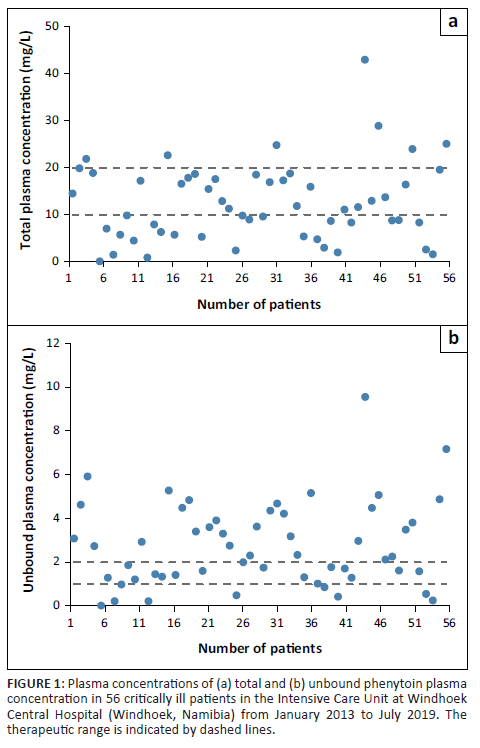
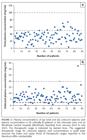
The total plasma concentration of phenytoin recorded for 56 patients ranged from 0.1 μg/mL to 43.0 μg/mL, with an average of 12.6 ± 8.20 μg/mL (Table 1). In 23 patients (41.1%), the phenytoin total plasma concentration was within the therapeutic range (10 μg/mL to 20 μg/mL) (Figure 1). In 26 patients (46.4%), the plasma concentrations were subtherapeutic, that is, below 10 μg/mL, and in seven patients (12.5%) they were above 20 μg/mL. In 16 patients (28.6%), the predicted unbound plasma concentration of phenytoin was within the therapeutic range (1 μg/mL to 2 μg/mL). The unbound plasma concentration of phenytoin was subtherapeutic in eight patients (14.3%) and supratherapeutic in 32 patients (57.1%).
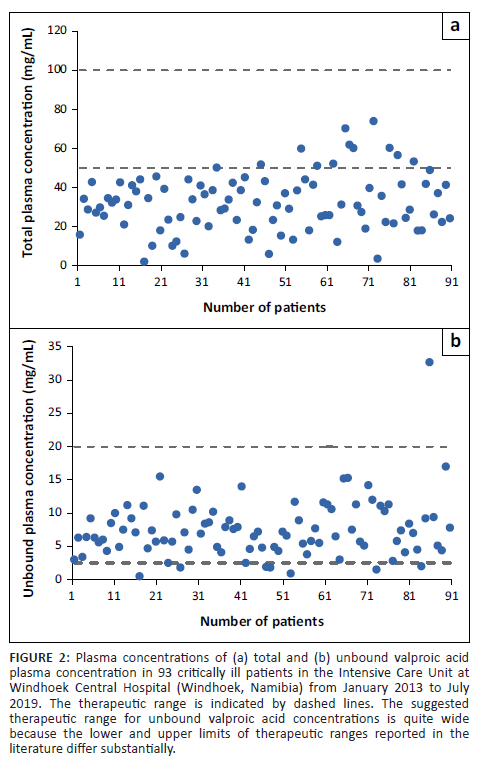
For valproic acid, in 81 patients (87.1%), the total plasma concentration was below the therapeutic range of 50 μg/mL to 100 μg/mL (Figure 2). Binding of valproic acid to albumin in individual patients ranged from 9.0% to 39.0%. In 12 patients (12.9%), the total plasma concentration was within the therapeutic window, and no patients had a total plasma concentration of valproic acid above the therapeutic range. The average estimated unbound valproic acid plasma concentration was 24.0% (7.0% to 67.0%). In the majority of patients (n = 85, 91.4%), the unbound plasma concentration of valproic acid was within the therapeutic range (2.5 μg/mL to 20 μg/mL). In seven patients (7.5%), the unbound plasma concentration was below the therapeutic range, and in only one patient (1.1%) was it above the therapeutic range.
Discussion
This retrospective study determined the plasma concentrations of phenytoin and valproic acid in critically ill patients at the ICU of Windhoek Central Hospital and found that the estimated unbound plasma concentration is a more accurate measure of the therapeutic plasma levels for the two drugs compared to total plasma concentration. Using the total plasma concentration, most patients were within or below the phenytoin therapeutic range. In contrast, unbound plasma concentration showed that less than one-third of the patients were within the therapeutic range and over half were above. For valproic acid, total plasma concentrations placed most patients were below the therapeutic range. However, unbound plasma concentrations placed majority within the therapeutic range.
Noval et al. reported a 2-fold increase in critical care patients having phenytoin concentrations falling within the therapeutic range when unbound concentrations instead of total phenytoin concentrations were considered for dose adjustment.23132413
Therapeutic drug monitoring of phenytoin and valproic acid by measuring unbound plasma concentrations is not widespread because of the additional time and cost implications. Thus, some therapeutic drug monitoring services measure only the total drug plasma concentrations or estimate the unbound plasma drug concentrations. These equations, including those used in this study, estimate the unbound concentrations of phenytoin and valproic acid based on the patient's measured total drug plasma concentration and serum albumin level.5,18,19,20,21,2225,26,27,28,29,303130,28
Therapeutic drug monitoring of phenytoin and valproic acid should be based on unbound drug concentrations. The best way to monitor the unbound drug concentration would be by measuring it directly in ultrafiltrate obtained from serum to ensure that the accurate concentration of the free drug is determined and used to inform dosage adjustment.
Limitations
The main limitation of this retrospective study is that the unbound plasma concentrations of phenytoin and valproic acid were not determined experimentally. However, because the albumin-based normalising equations that were used underestimate the patient's unbound plasma concentrations of phenytoin and valproic acid, the discordance between total and unbound concentrations is less pronounced than it would be in reality. In addition, there was no follow-up to adjust the dosage regimen of these two drugs in the individual patients based on the observed total plasma concentrations.
Conclusion
In conclusion, for therapeutic drug monitoring of phenytoin and valproic acid in critically ill patients, direct measurement of the unbound phenytoin and valproic acid concentration in plasma would be the best approach.
Competing interests
The authors declare that they have no financial or personal relationships that may have inappropriately influenced them in writing this article.
Authors' contributions
B.S.S. supervised the study and reviewed the write-up of the manuscript. H.M. and L.I. collected the data and provided the draft manuscript. R.K.V. was the overall supervisor of the project and provided the final manuscript.
Sources of support
This research received no specific grant from any funding agency in the public, commercial, or not-for-profit sectors.
Data availability
Data supporting the findings of this study are available from the corresponding author, B.S.S., on request.
Disclaimer
The views and opinions expressed in this article are those of the authors and do not necessarily reflect the official policiy or position of any affiliated agency of the authors.
Acknowledgements
References
-
1.Varelas PN, Spanaki MV, Mirski MA. Seizures and the neurosurgical intensive care unit. Neurosurg Clin N Am. 2013;24(3):393-406. https://doi.org/10.1016/j.nec.2013.03.005
» https://doi.org/10.1016/j.nec.2013.03.005 -
2.Farrokh S, Tahsili-Fahadan P, Ritzl EK, Lewin III JJ, Mirski MA. Antiepileptic drugs in clinically ill patients. Crit Care. 2018;22(1):153. https://doi.org/10.1186/s13054-018-2066-1
» https://doi.org/10.1186/s13054-018-2066-1 -
3.Allen B, Vespa PM. Antiseizure medications in critical care: An update. Curr Opin Crit Care. 2019;25(2):117-125. https://doi.org/10.1097/MCC.0000000000000587
» https://doi.org/10.1097/MCC.0000000000000587 - 4.Garnet WR, Anderson GD, Collins RJ. Antiepileptic drugs. In: Burton ME, Shaw LM, Schentag JJ, Evans WE, editors. Applied pharmacokinetics & pharmacodynamics: Principles of therapeutic drug monitoring. 4th ed. Philadelphia, PA: Lippincott Williams & Wilkins; 2006, pp. 491-511.
- 5.Winter ME, Tozer TN. Phenytoin. In: Burton ME, Shaw LM, Schentag JJ, Evans WE, editors. Applied pharmacokinetics & pharmacodynamics: Principles of therapeutic drug monitoring. 4th ed. Philadelphia, PA: Lippincott Williams & Wilkins; 2006. pp. 463-490.
-
6.Ghodke-Puranic Y, Thorn CF, Lamba JK, et al. Valproic acid pathways: Pharmacokinetics and pharmacodynamics. Pharmacogenet Genomics. 2013;23(4):236-241. https://doi.org/10.1097/FPC.0b013e32835ea0b2
» https://doi.org/10.1097/FPC.0b013e32835ea0b2 -
7.Patsalos PN, Berry DJ, Bourgeois BF, et al. Antiepileptic drugs - Best practice guidelines for therapeutic drug monitoring: A position paper by the subcommission on therapeutic drug monitoring, ILAE commission on therapeutic strategies. Epilepsia. 2008;49(7):1239-1276. https://doi.org/10.1111/j.1528-1167.2008.01561.x
» https://doi.org/10.1111/j.1528-1167.2008.01561.x -
8.Thorn CF, Whirl-Carillo M, Leeder JS, Klein TE, Altman RB. PharmGKB summary: Phenytoin pathway. Pharmacogenet Genomics. 2012;22(6):466-470. https://doi.org/10.1097/FPC.0b013e32834aeedb
» https://doi.org/10.1097/FPC.0b013e32834aeedb -
9.Gomez Bellver MJ, Garcia Sanchez MJ, Alonso Gonzales AC, Santos Buelga C, Dominguez-Gil A. Plasma protein binding kinetics of valproic acid over a broad dosage range: Therapeutic implications. J Clin Pharm Ther. 1993;18(3):191-197. https://doi.org/10.1111/j.1365-2710.1993.tb00612.x
» https://doi.org/10.1111/j.1365-2710.1993.tb00612.x -
10.Rowland M. Plasma protein binding and therapeutic drug monitoring. Ther Drug Monit. 1980; 2(1):29-37. https://doi.org/10.1097/00007691-198001000-00005
» https://doi.org/10.1097/00007691-198001000-00005 -
11.Wiedermann CJ. Hypoalbuminemia as surrogate and culprit of infections. Int J Mol Sci. 2021;22(9):4496. https://doi.org/10.3390/ijms22094496
» https://doi.org/10.3390/ijms22094496 -
12.Von Winckelmann SL, Spriet I, Willems L. Therapeutic drug monitoring of phenytoin in critically ill patients. Pharmacotherapy. 2008;28(11):1391-1400. https://doi.org/10.1592/phco.28.11.1391
» https://doi.org/10.1592/phco.28.11.1391 -
13.Riker RR, Gagnon DJ, Hatton C, et al. Valproate protein binding is highly variable in ICU patients and not predicted by total serum concentrations: A case series and literature review. Pharmacotherapy. 2017;37(4):500-508. https://doi.org/10.1002/phar.1912
» https://doi.org/10.1002/phar.1912 -
14.Perucca E. Plasma protein binding of phenytoin in health and disease: Relevance to therapeutic drug monitoring. Ther Drug Monit. 1980;2(4):331344. https://doi.org/10.1097/00007691-198010000-00005
» https://doi.org/10.1097/00007691-198010000-00005 -
15.Hatton C, Riker RR, Gagnon DJ, May T, Seder DB, Fraser GL. Free serum valproate concentration more reliable than total concentration in critically ill patients. Resuscitation. 2016;10:e15e16. https://doi.org/10.1016/j.resuscitation.2016.05.027
» https://doi.org/10.1016/j.resuscitation.2016.05.027 -
16.Heuberger J, Schmidt S, Derendorf H. When is protein binding important? J Pharm Sci. 2013;102(9):3458-3467. https://doi.org/10.1002/jps.23559
» https://doi.org/10.1002/jps.23559 -
17.Lenn NJ, Robertson M. Clinical utility of unbound antiepileptic drug blood levels in the management of epilepsy. Neurology. 1992;42(5):988-990. https://doi.org/10.1212/wnl.42.5.988
» https://doi.org/10.1212/wnl.42.5.988 - 18.Parent X, Marzullo C, Gutbub AM. Acide valproique: Estimation simple de la concentration sérique libre. Ann Biol Clin (Paris). 1993;51(6):649-650.
-
19.Hermida J, Tutor JC. A theoretical method for normalising total serum valproic acid concentration in hypoalbuminemic patients. J Pharmacol Sci. 2005;97(4):489-493. https://doi.org/10.1254/jphs.fpe04007x
» https://doi.org/10.1254/jphs.fpe04007x - 20.Sheiner LB, Tozer TN. Clinical pharmacokinetics: The use of plasma concentrations. In: Melmon KL, Morelli HF, editors. Clinical pharmacology: Basic principles in therapeutics. New York, NY: MacMillan; 1978, p. 1978.
-
21.Anderson GD, Pak C, Doane KW, et al. Revised Winter-Tozer equation for normalised phenytoin concentrations in trauma and elderly patients with hypoalbuminemia. Ann Pharmacother. 1997;31(3):279-284. https://doi.org/10.1177/106002809703100301
» https://doi.org/10.1177/106002809703100301 -
22.Kane SP, Bress AP, Tesoro EP. Characterisation of unbound phenytoin concentrations in neurointensive care unit patients using a revised Winter-Tozer equation. Ann Pharmacother. 2013;47(5):628-636. https://doi.org/10.1345/aph.1R651
» https://doi.org/10.1345/aph.1R651 -
23.Noval M, Seung H, Armahizer M. Evaluation of fosphenytoin therapeutic drug monitoring in the neurocritical care unit. Drugs R D. 2020;20(1):17-22. https://doi.org/10.1007/s40268-019-00292-1
» https://doi.org/10.1007/s40268-019-00292-1 -
24.Lagneau F, Perbet S, Delefosse D, et al. Drugs pharmacokinetics in ICU patients: Consequences of hypoalbuminemia upon drugs monitoring and dosing scheme. Intensive Care Med 2004;30:1247. https://doi.org/10.1007/s00134-004-2313-6
» https://doi.org/10.1007/s00134-004-2313-6 -
25.Smetana KS, Cook AM, Thompson Bastin ML, Oyler DR. Antiepileptic dosing for critically ill adult patients receiving renal replacement therapy. J Crit Care. 2016;36:116-124. https://doi.org/10.1016/j.jcrc.2016.06.023
» https://doi.org/10.1016/j.jcrc.2016.06.023 -
26.Wolf GH, McClain CD, Zurakowski D, Dodson B, McManus ML. Total phenytoin concentrations do not accurately predict free phenytoin concentrations in critically ill children. Pediatr Crit Care Med. 2006;7(5):434-439. https://doi.org/10.1097/01.PCC.0000235252.43921.DE
» https://doi.org/10.1097/01.PCC.0000235252.43921.DE -
27.Cheng W, Kiang TKL, Bring P, Ensom MHH. Predictive performance of the Winter-Tozer and derivative equations for estimating free phenytoin concentration. Can J Hosp Pharm. 2016;69(4):269-279. https://doi.org/10.4212/cjhp.v69i4.1573
» https://doi.org/10.4212/cjhp.v69i4.1573 -
28.Kiang TKL, Ensom MHH. A comprehensive review of the predictive performance of the Sheiner-Tozer and derivative equations for the correction of phenytoin concentrations. Ann Pharmacother. 2016;50(4):311-325. https://doi.org/10.1177/1060028016628166
» https://doi.org/10.1177/1060028016628166 -
29.Javadi S-S, Mahjub R, Taher A, Mohammadi Y, Mehrpooya M. Correlation between measured and calculated free phenytoin serum concentration in neurointensive care patients with hypoalbuminemia. Clin Pharmacol. 2018;10:183-190. https://doi.org/10.2147/CPAA.S186322
» https://doi.org/10.2147/CPAA.S186322 -
30.Barra ME, Phillips KM, Chung DY, Rosenthal ES. A novel correction equation avoids high-magnitude errors in interpreting therapeutic drug monitoring of phenytoin in critically ill patients. Ther Drug Monit. 2020;42(4):6-17-25. https://doi.org/10.1097/FTD.0000000000000739
» https://doi.org/10.1097/FTD.0000000000000739 -
31.Tseng Y-J, Huang S-Y, Kuo C-H, Wang C-Y, Wang K-C, Wu C-C. Safety range of free valproic acid serum concentration in adult patients. PLoS One. 2020;15(9):e0238201. https://doi.org/10.1371/journal.pone.0238201.
» https://doi.org/10.1371/journal.pone.0238201
Accepted: 14 Apr. 2022
Published: 21 July 2022