Experiential Bloom's Taxonomy learning framework for point-of-care diagnostics training of primary healthcare workers
Introduction
The delivery of accessible, affordable and equitable primary healthcare (PHC) is a key focus in many resource-limited settings. One strategy that has been used to improve health access and healthcare equity in rural and resource-limited settings is the use of point-of-care (POC) diagnostics in PHC clinics. POC testing is defined as: pathology testing performed in a clinical setting at the time of patient consultation, generating a result that is used to make an immediate informed clinical decision that contributes to an improved health outcome for the patient.12
The advent of POC diagnostics in rural and resource-limited settings brings hope of improving health outcomes, particularly in HIV-epidemic countries. Prompt access to these diagnostics, in resource-limited settings with a high burden of disease, poor access to quality healthcare facilities and lack of laboratory infrastructure, is strongly encouraged.3,4
In this article, we discuss the significance of quality assurance as it pertains to POC diagnostic testing in PHC clinics. In addition, we suggest a training/retraining strategy for PHC nurses to ensure both the quality of POC diagnostic testing and the sustainability of quality control procedures in PHC clinics, by improving the proficiency and retention of skilled nurses.
Concerns related to quality of point-of-care diagnostic services
The need for good quality assurance programmes to ensure accuracy of POC devices used to inform appropriate patient care in resource-limited settings has been demonstrated.35
Research has also demonstrated poor regulatory control standards for the diagnosis of sexually-transmitted infections, in both public- and private-sector venues, within low- and middle-income countries.6
negative impact on their employment status and family relationships. A false-negative test result caused by a test's failure to detect HIV antibodies or antigens in an HIV-infected person could lead to an HIV-negative diagnosis in an HIV-positive patient. This could have devastating consequences for the patient, particularly if their condition is at a stage where antiretroviral treatment is needed. It also increases the risk of infection of others, if the patient is sexually active.
Adequate PHC clinics must have the resources to enable appropriate storage and performance of diagnostic tests, as well as appropriate training of staff. The implementation of quality assurance practices is critical in ensuring the suitable administration of POC diagnostic tests and correct interpretation of their results.78,91011
Importance of competency of point-of-care diagnostic test users on service delivery
In recent years, there has been a significant increase in public- and private-sector investment in HIV and tuberculosis POC diagnostics.121314,1514
A strategy for improving the quality of primary healthcare clinic-based point-of-care diagnostic services
Despite the need for improving the availability of essential POC diagnostics in settings that lack laboratory infrastructure, such as rural PHC clinics,3,4
The overall aim of such a training programme would be to supplement current education and training resources for healthcare workers with a specialised POC diagnostics training curriculum. As stated above, since the competency of the healthcare professionals performing diagnostic POC testing influences the reliability of such services, we suggest a training strategy to equip frontline PHC workers with appropriate diagnostic knowledge and skills. This will help to ensure the quality, reliability and sustainability of POC diagnostic services.
Such training on the appropriate use of POC diagnostics needs to be incorporated into the medical and nursing curricula as part of continual professional development. In order to provide a real opportunity for ensuring the effectiveness and sustainability of such a programme, an appropriate educational strategy is essential. For example, a training programme that incorporates practical experiential learning is most desirable.
Implementation of experiential learning for a point-of-care diagnostic training programme
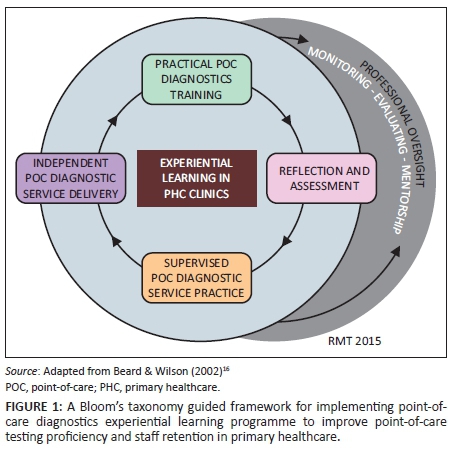
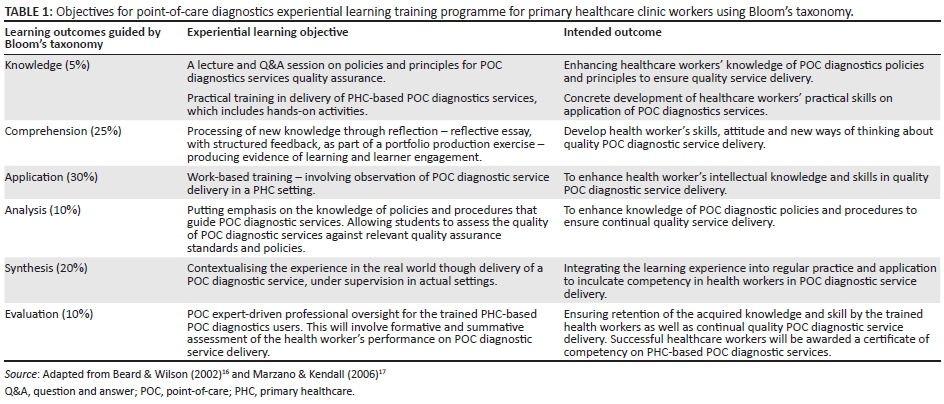
Experiential learning, which is defined as a client-focused, supported learning approach,1617Table 1). This approach would provide PHC workers with a practical, cost-effective, on-site learning opportunity. Furthermore, it would enable direct exposure to POC diagnostic service delivery, rather than a traditional passive learning approach, which offers no exposure to service delivery.
However, due to the ever-changing nature of healthcare services and associated technologies, implementation of an experiential learning strategy alone will not guarantee continual quality service delivery and retention of skilled staff. Therefore, complementary strategies are needed, including continual mentorship, monitoring and evaluation to provide professional oversight to trained users of POC diagnostics.
Professional oversight of staff trained to provide point-of-care diagnostic services
To ensure the retention of the acquired knowledge and skills by the trained healthcare workers, we suggest an expert-driven process for professional oversight of trained PHC-based POC diagnostics users, using the following four strategies:18Figure 1 depicts a framework for an experiential learning programme for continual, quality delivery of POC diagnostics services by PHC-based healthcare workers.
Appropriate implementation of the proposed programme will likely result in staff empowerment and provide an incentive to improve staff retention in PHC clinics. Successful implementation of the programme would require incorporation of a community-based, participatory research approach prior to and during implementation.192020
Conclusion
Delivery of high quality POC diagnostic services requires highly competent and dedicated staff. A special focus on well-structured POC diagnostic training strategies for improving staff competency in performance and quality maintenance for POC diagnostic services is urgently needed to ensure the highest quality diagnostic services. We recommend a guided framework, based on a Bloom's taxonomy approach, for implementing a POC diagnostics experiential learning programme to improve POC testing proficiency and staff retention in PHC workers. Stakeholder engagement, consensus building and collaboration will be crucial to ensuring appropriate implementation and sustainability of the proposed programme.
Competing interests
The authors declare that they have no financial or personal relationships which may have inappropriately influenced them in writing this article.
Sources of support
This project was supported by research project number BE484/14.
Authors' contributions
T.P.M-T., F.C.J.S., B.S. and P.K.D. conceptualised the study, and T.P.M-T. wrote the first draft. T.P.M-T was the principal investigator for the project, P.K.D. and B.S. were supervisors, and F.C.J.S was a collaborator. All authors contributed to the writing and editing of the report and approved the final version.
Acknowledgements
The authors wish to thank Rowan Mark Thompson for assistance with technical graphics.
References
- 1. Price CP, John AS, Hicks JM. Point-of-care testing. 2nd ed. Washington, DC: AACC Press; 2004.
-
2. Engel N, Ganesh G, Patil M, et al. Barriers to point-of-care testing in India: results from qualitative research across different settings, users and major diseases. PloS One. 2015;10(8):e0135112. http://dx.doi.org/10.1371/journal.pone.0135112. eCollection 2015.
» http://dx.doi.org/10.1371/journal.pone.0135112 -
3. Yager P, Domingo GJ, Gerdes J. Point-of-care diagnostics for global health. Ann Rev Biomed Eng. 2008;10(1):107-144. http://dx.doi.org/10.1146/annurev.bioeng.10.061807.160524
» http://dx.doi.org/10.1146/annurev.bioeng.10.061807.160524 -
4. Drain PK, Hyle EP, Noubary F, et al. Diagnostic point-of-care tests in resource-limited settings. Lancet Infect Dis. 2014;14(3):239-249. http://dx.doi.org/10.1016/S1473-3099(13)70250-0
» http://dx.doi.org/10.1016/S1473-3099(13)70250-0 - 5. Mashauri F, Siza J, Temu M, et al. Assessment of quality assurance in HIV testing in health facilities in Lake Victoria zone, Tanzania. Tanzan Health Res Bull. 2007;9(2):110-114.
- 6. Peeling RW, Holmes KK, Mabey D, et al. Rapid tests for sexually transmitted infections (STIs): the way forward. Sex Transm Infect. 2006;82(suppl 5):v1-v6. Epub 2006 Dec 6.
-
7. Arora DR, Maheshwari M, Arora B. Rapid point-of-care testing for detection of HIV and clinical monitoring. ISRN AIDS. 2013;2013:287269. http://dx.doi.org/10.1155/2013/287269
» http://dx.doi.org/10.1155/2013/287269 -
8. Delobelle P, Rawlinson JL, Ntuli S, et al. Job satisfaction and turnover intent of primary healthcare nurses in rural South Africa: a questionnaire survey. J Adv Nurs. 2011;67(2):371-383. http://dx.doi.org/10.1111/j.1365-2648.2010.05496.x. Epub 2010 Nov 2.
» http://dx.doi.org/10.1111/j.1365-2648.2010.05496.x -
9. Rispel LC, Chirwa T, Blaauw D. Does moonlighting influence South African nurses' intention to leave their primary jobs? Glob Health Action. 2014;7:25754. http://dx.doi.org/10.3402/gha.v7.25754. eCollection 2014.
» http://dx.doi.org/10.3402/gha.v7.25754 - 10. Sawchuk ME. Ensure staff competency with point-of-care testing. Nurs Manage. 2004;35(4):24.
-
11. Peeling RW, Mabey D. Point-of-care tests for diagnosing infections in the developing world. Clin Microbiol Infect. 2010;16(8):1062-1069. http://dx.doi.org/10.1111/j.1469-0691.2010.03279.x
» http://dx.doi.org/10.1111/j.1469-0691.2010.03279.x -
12. McNerney R. Diagnostics for developing countries. Diagnostics. 2015;5(2):200-209. http://dx.doi.org/10.3390/diagnostics5020200
» http://dx.doi.org/10.3390/diagnostics5020200 - 13. World Health Organization. Consolidated guidelines on HIV testing services. Geneva, Switzerland: WHO; 2015.
- 14. Moodley D, Moodley P, Ndabandaba T, et al. Reliability of HIV rapid tests is user dependent. S Afr Med J. 2008;98(9):707-709.
- 15. Yeo CP, Ngo A, Ng WY, et al. Assessing performance of i-STAT at the point of care in the emergency room. Proceedings of Singapore Healthcare. 2011;20(3):157-161.
- 16. Beard C, Wilson JP. The power of experiential learning: a handbook for trainers and educators: London, UK: Kogan Page; 2002.
- 17. Marzano RJ, Kendall JS. The new taxonomy of educational objectives. Thousand Oaks, CA: Corwin Press; 2006.
- 18. Kolb AY, Kolb DA. Learning styles and learning spaces: enhancing experiential learning in higher education. Acad Manag Learn Edu. 2005;4(2):193-212.
-
19. Horowitz CR, Robinson M, Seifer S. Community-based participatory research from the margin to the mainstream: are researchers prepared? Circulation. 2009;119(19):2633-2642. http://dx.doi.org/10.1161/CIRCULATIONAHA.107.729863
» http://dx.doi.org/10.1161/CIRCULATIONAHA.107.729863 - 20. Eldredge LKB, Markham CM, Ruiter RAC, et al. Planning health promotion programs: an intervention mapping approach. 4th ed. San Francisco, CA: Jossey-Bass; 2016.

Accepted: 03 Aug. 2016
Published: 30 Sept. 2016