Cost of running a full-service receiving office at a centralised testing laboratory in South Africa
Abstract
BACKGROUND: The National Health Laboratory Service operates a platform of 226 laboratories across South Africa, ranging from highly sophisticated central academic hospitals to distant rural hospitals. The core function of the National Health Laboratory Service is to provide cost-effective and efficient health laboratory services in the public healthcare sector. OBJECTIVE: This study aimed to assess the comprehensive cost of running a full-service receiving office (RO) at the Charlotte Maxeke Johannesburg Academic Hospital (CMJAH) laboratory. METHODS: Top-down costing was conducted, with the cost per registration as the main outcome of interest. The annual equivalent costs (AEC) for the following categories were determined: registration materials, collection materials, staffing, laboratory equipment, building and electricity, and other operating costs. Data for the period from 01 April 2019 to 31 March 2020 were included in the analyses. RESULTS: The AEC was $1 657 483.00 United States dollars (USD) and the cost per registration was $0.766 USD. Staff contributed 59.9% of the total cost per registration, while collection materials contributed 21.4%. The RO core staff (data clerks) contributed 50.8% of the total staffing costs, while messengers and drivers contributed 31.2%. The introduction of order entry at the CMJAH and other primary healthcare facilities reduced the total AEC by 20%. A single order entry application would serve both the CMJAH and primary healthcare facilities - hence we would prefer to not refer to order entries. CONCLUSION: Providing a comprehensive RO service costs approximately $1.00 USD per registration. The implementation of order entry at the CMJAH would reduce AECs substantially and improve efficiency.
receiving office; cost per registration; order entry; costing; pre-analytical
Introduction
The National Health Laboratory Service (NHLS) operates a platform of 226 laboratories across South Africa, ranging from central academic to distant rural laboratories, with a mandate to provide cost-effective and efficient services in the public healthcare sector.11
The Charlotte Maxeke Johannesburg Academic Hospital (CMJAH) is the largest NHLS reference laboratory in South Africa. The laboratory is International Standards Organization 15189-accredited and provides quality results that contribute to patient care.233
An estimated 4.8 million tests are performed annually at the CMJAH laboratory, with steady year-on-year increases recorded. The receiving office (RO) plays a pivotal role in the correct and timeous capturing of samples into the laboratory information system (LIS) to facilitate the delivery of patients' reports and expenditure reporting. Unfortunately, unlike the analytical phase at the CMJAH laboratory, the pre-analytical processes at the RO are not automated. Pre-analytics refer to the procedures carried out before actual sample testing and include patient identification, preparation, sample collection, sample packaging, sample transportation, and sample preparation for analysis and storage.43
In other settings, many of these manual processes can be automated through order entry (OE). For example, public sector laboratories such as the Inkosi Albert Luthuli Central Hospital have adopted a paperless approach that uses OE to replace multiple manual RO tasks.56789,10
As OE is part of the clinical workflow, it should ideally be implemented as a collaborative effort with the entire healthcare team.7101111
This study aimed to assess the comprehensive cost of running a full-service RO at a busy centralised academic laboratory that processes local samples and receives referred samples for specialist pathology testing and to assess the impact of the implementation of OE on RO costs.
Methods
Ethical considerations
Ethical clearance (approval number: M160978) was obtained from the University of the Witwatersrand Human Research Ethics Committee (Medical). No patient identifiers were collected and thus patient consent was not required.
Study setting
This study was conducted at the full-service RO based at the CMJAH laboratory, Johannesburg, South Africa. Data are reported for the April 2019 to March 2020 financial period.
Workflow at the Charlotte Maxeke Johannesburg Academic Hospital laboratory receiving office
Forty-two primary healthcare (PHC) facilities and two national central hospitals are directly served by the CMJAH laboratory; the laboratory offers all routine haematology, chemistry and microbiology testing, as well as specialist pathology testing (e.g. HIV viral load or CD4 testing, flow cytometry, cytogenetics, etc.). In addition, similar specialised tests that are referred from other PHC facilities and hospitals outside the immediate precinct of the CMJAH laboratory (n = 354) are also processed at the CMJAH laboratory, including those based in the West Rand, Ekurhuleni, City of Johannesburg, and Sedibeng districts.
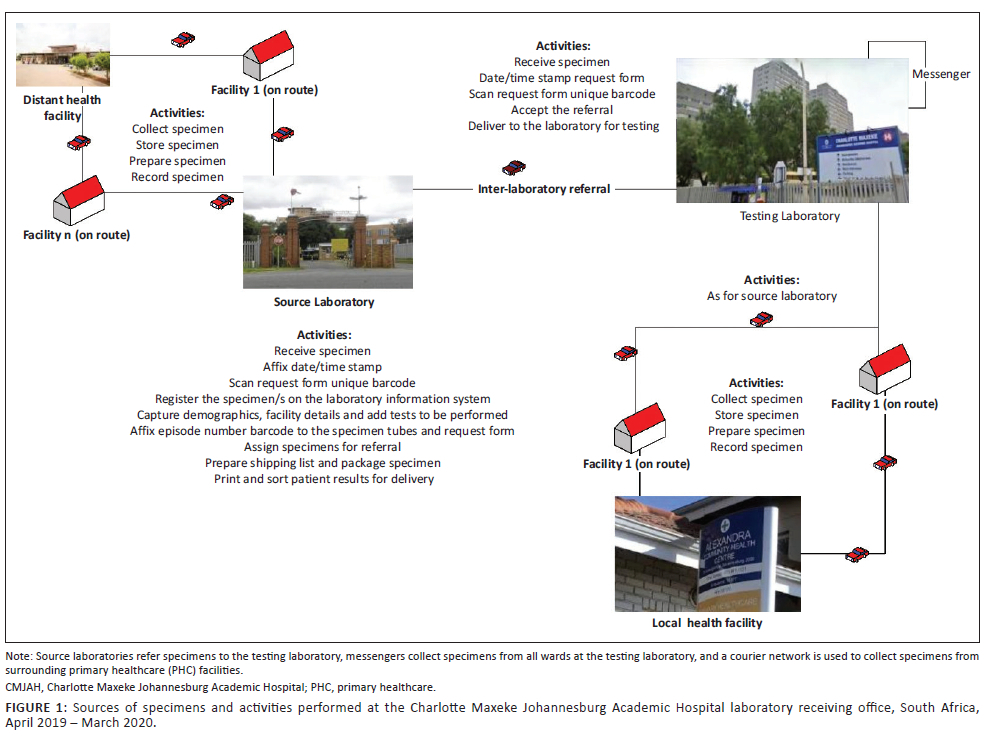
Samples collected at distant health facilities are delivered to the closest local NHLS source laboratory using a hub-and-spoke courier network with multiple health facilities located along designated routes (Figure 1). These source laboratories serve their respective surrounding health facilities and perform routine clinical pathology testing. All specialised tests such as HIV viral load are subsequently referred within the NHLS network to academic testing facilities such as CMJAH. An inter-laboratory referral courier network is used to transport the referred samples to the larger academic laboratories. Locally sourced specimens are collected from hospital wards at CMJAH (n = 64; samples transported every 2 h) and the Nelson Mandela Children's Hospital (n = 6; samples transported every 4 h). The final source of specimens is the surrounding health facilities (e.g. Alexandria Community Health Centre) that deliver samples directly to the CMJAH RO using a courier network.
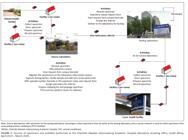
Pre-analytical activities include sample receipt, sample sorting to identify where testing will take place, and registration on the LIS. These activities take place at both the CMJAH RO as well as at surrounding source laboratories. The registration process involves entering the details provided on the request form (patient demographics and health facility and healthcare worker details) into the LIS and attaching barcodes with the episode numbers on all samples. Samples not tested at the source laboratory are referred on the LIS; this involves preparing a shipping list and packaging samples for courier pick-up. The pre-analytical activities performed at the CMJAH RO are the same for surrounding health facilities. Referral samples are accepted on the LIS before testing. After testing, patient reports are printed and delivered to each health facility.
Costing methodology
The costing analysis was done using Microsoft Excel (Microsoft Corporation, Redmond, Washington, United States). Costs were obtained using historical CMJAH expenditure data for the April 2019 to March 2020 financial period. The accounting stance was as a provider of the RO service, that is, all costs were obtained as the provider of laboratory services (costs incurred by the health facility were excluded). A top-down costing approach was used, with the main outcomes of interest being the annual equivalent cost (AEC) and cost per registration. The cost per registration refers to the costs of all the activities conducted in the RO for each patient visit, during which one or more tests may be requested. Therefore, it is not the cost per sample received as multi-disciplinary registration is performed. Multi-disciplinary registration refers to a single registration on a single episode number of multiple tests requested for multiple pathology disciplines. Costs were collected in South African rand (ZAR) and reported in United States dollars (USD) (using the monthly average exchange rate of R14.7835 ZAR to $1.00 USD for November 2019).12131415
Registration materials included items such as disposable gloves, N95 masks, thermal barcode printer paper, paper (to print worklists for the laboratory), disposal boxes, etc. Specimen collection materials included laboratory request forms, sharps disposal boxes, specimen collection kits and biohazard bags, which are all issued by the NHLS to healthcare facilities for sample collection.
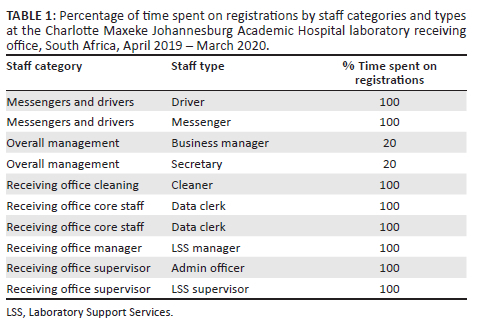
Receiving office staff included the business manager (grade D5), the RO manager (D1), supervisors (C3), and operational staff, consisting of data clerks (B2/4), messengers (A3), administrative officers (C1), drivers (B4) and cleaners (A1). For staff costs, we used the annual salary data that include medical aid, pension and other allowances.16Table 1).
The costs of the following laboratory equipment were included: a messenger monitoring system (used to track and log the times when messengers arrive and collect samples at each ward and deliver samples back to the RO), date and time stamp devices, multi-function printers, barcode scanners, operator chairs, workbenches, computers, network points, barcode printers, specimen tube racks, shopping baskets (used for sample delivery to each section), air conditioners, fridges, freezers (-20 °C), document scanners, and filing cabinets. To calculate the AEC for laboratory equipment, working life was set at five years with a discount rate of 4%. Working life is defined as the period that an asset is likely to remain in service. We used the Microsoft Excel 'sum' and 'PMT' functions (equation 1):

Studies have reported that the 'PMT' function in Microsoft Excel is easy to use for calculating the AEC for equipment using assumptions of the discount rate, working life, and purchase price.17,1821919
We used the RO income statement to assign other operating costs. These included the AEC for items such as cellular phones, computer consumables, printing, telephones, couriers, freight, postage, laundry, accreditation, waste disposal, uniforms, etc. The cost for LIS licenses and other costs were also obtained from the income statement.
Costing analysis
We reported the AEC and the cost per registration. Data were reported for each cost category. The percentage contribution of each cost category to the total cost per registration was reported.
We assessed the impact of implementing OE at surrounding PHC facilities only versus implementing OE at all surrounding PHC facilities and all CMJAH wards. To calculate costs for each OE scenario, the percentage reduction in manual RO activities was applied to the staff costs of RO clerks. A rejection rate of 6% was used to determine the reduction in data collection materials and registration materials (based on LIS reports). Samples are rejected because of electronic gatekeeping rules (such as minimum re-testing intervals) or for failing to meet essential criteria stipulated in the laboratory handbook (such as missing mandatory information or using the incorrect specimen type).20,21,22,2322,23
Results
Data from a total of 2 163 421 registrations at the CMJAH RO were included in the analyses. The CMJAH RO consists of 68 employees (excluding the business manager and administrative assistant), including 34 data capturers, 22 messengers, four drivers, four cleaners, three managers or supervisors, and one administrative officer. Assuming a 24/7 service for 365 days, this equates to a daily workload of 5927 registrations. On average, it takes 12 min per sample to complete sample receipt, sorting, registration, barcoding, and addition of test tubes to the track for delivery to each laboratory section.
Annual equivalent cost
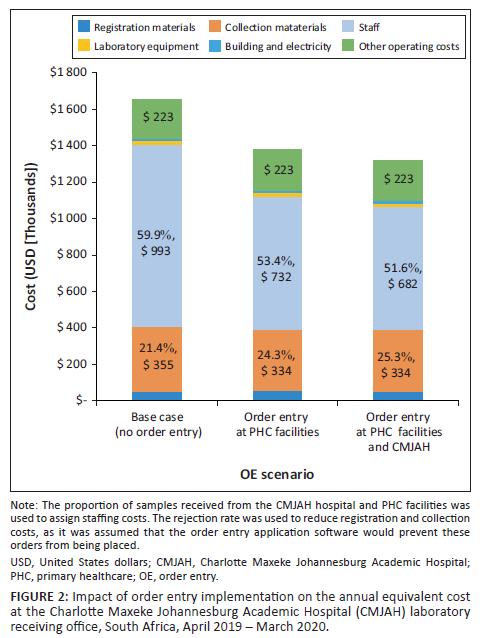
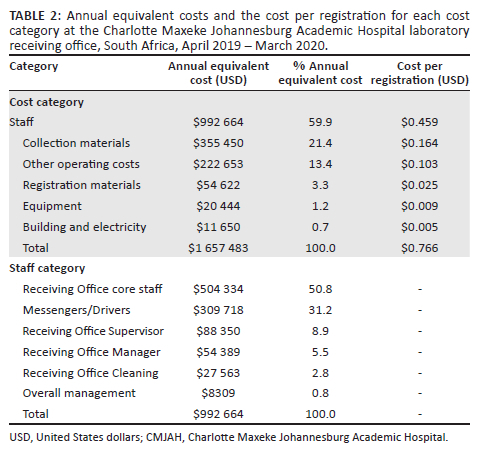
An AEC of $1 657 482 USD was reported for the CMJAH RO. Staffing contributed $992 664 USD (59.9%), collection materials contributed $355 450 USD (21.4%) and other operating costs contributed $222 653 USD (13.4%) to the AEC (Table 2). Registration materials ($54 622 USD), equipment ($20 444), and building and electricity ($11 650) collectively contributed $86 716 USD (5.2%) to the AEC.
Cost per registration
The total cost per registration was $0.766 USD. Staffing contributed $0.459 USD, collection materials contributed $0.164 USD, other operating costs contributed $0.103 USD, registration materials contributed $0.025 USD, equipment contributed $0.009 USD, and building and electricity contributed $0.005 USD to the cost per registration.
Staffing costs
The RO core staff (50.8%) and messengers and drivers (31.2%) contributed 82.0% of the total staffing costs, while the RO supervisor and RO manager contributed 14.4% of the total staffing costs.
Impact of order entry
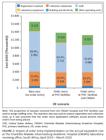
Introducing OE at the surrounding PHC facilities, which contribute 50% of registrations at CMJAH, would reduce costs by $285 081 USD. By implementing OE at the surrounding PHC facilities and the CMJAH wards, the estimated cost savings increased to $335 514 USD (Figure 2). This is a 20.2% cost reduction from the current costs of running the RO service.
Discussion
The cost to register one sample at the CMJAH RO was less than $1.00 USD. Staffing was the major contributor to the overall cost, highlighting the manual nature of activities performed by RO staff. Collection materials and other operating costs, on the other hand, contributed only one-third of the total RO costs.
One of the current data challenges in healthcare services in South Africa is that patient demographics and personal identifiers are captured on multiple data systems in different formats. This highlights the inefficiencies of the current paper-based system. At the CMJAH, patients are assigned a unique patient identifier and their details are captured on the hospital information system when they first present for care. When they present to the pharmacy or radiology units, for example, their details are re-captured. Also, when a laboratory test is requested, this information is transcribed onto the laboratory request form and then manually captured in the LIS by data clerks. Aside from the multiplied workload, this multipronged, multi-layered approach to patient data capture and sample tracking can lead to transcription errors and data field omissions. These manual transcription errors have been confirmed during random data audits of patient request forms where differences were observed between LIS-contained information and information on the request forms (data not shown). Inefficient use of existing information within the healthcare system thus increases the workflow complexity and workload in the RO, thereby increasing the need for a large staffing component to process and capture information on the LIS.
For the implementation of OE across the public health sector in South Africa, the use of a national unique patient identifier is imperative to ensure consistency of information irrespective of the site of presentation. Currently, no unique patient identifier is used within the public health system.2425252525
The cost to implement OE (capital expenditure and maintenance) and an electronic health record system is a function of bed size.2626,2726,272828282930
Given the connectivity and information technology infrastructure challenges in the public health sector in South Africa, extensive investments would have to be made to make OE accessible and to develop the necessary interfaces with the different hospital information system and EPRC systems used by hospitals and PHC facilities. To implement OE at PHC facilities, some minimum infrastructures such as tablets, computers, Internet connection and an EPRC interface are required.9931
Implementing OE at the surrounding PHC facilities and CMJAH wards would result in an estimated annual cost saving of around 20%. Should the cost of OE installation be similar to the cost of the CMJAH RO, it would be possible to pay the capital cost of the system with the savings generated over a five-year period. There may also be additional cost savings generated by better adherence to treatment and pathology testing guidelines, reduced rejections and more appropriate ordering. Another study reported that the implementation of OE at a large academic hospital resulted in an annual saving of $2.2 million USD compared to an investment of $11.8 million USD, albeit it took over five years for these savings to be realised.32
As indicated by Birkmeyer et al., the primary motivation for introducing OE should be to improve the quality of care provided and not to reduce healthcare expenditure.333234
The development of EPRC systems in the United States has been challenging due to closed, proprietary and incompatible systems.3534
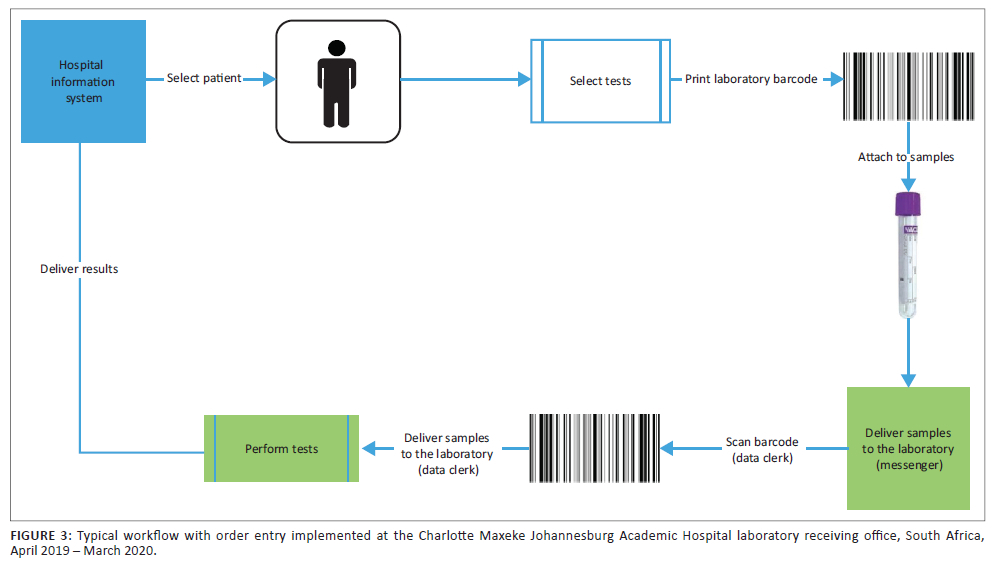
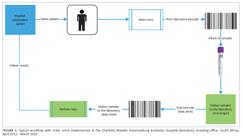
The implementation of OE across the public health system beyond CMJAH would dramatically streamline the process of placing laboratory orders and receiving results. The major benefit of OE would be a move from paper-based to electronic systems, removing the requirement to re-capture information that exists in the EPRC. In addition, the RO at laboratories would be dramatically scaled down given the electronic transfer of data. This would change the visibility of orders at both the health facility and laboratory, with better monitoring of samples and results that are outstanding. Overall, the interface with the laboratory would become efficient and streamlined by bypassing multiple manual steps in the current workflow (Figure 3).
Once OE is implemented, the CMJAH RO data clerks will not be retrenched. Staff may be re-allocated, deployed to other duties, or transferred to other laboratories with staff shortages. In addition, clerks could be encouraged to consider training as laboratory technicians and migrating to the analytical phase where shortages exist.
Limitations
This study excluded the cost of organisational overheads. Should the organisational overheads be included, it would result in a minor change to the cost per registration as the organisational overheads would be divided by the number of registrations across the NHLS. The costs reported would also vary depending on the size and complexity of the RO, as well as the distance of the RO from source laboratories. In a small province such as Gauteng, health facilities are close (≤ 50 km) to testing laboratories. However, in more rural provinces such as the Northern Cape, facilities could be located over 300 km from their local laboratory, thus leading to higher logistics costs. Another limitation is that this study did not consider the costs of training required to introduce OE. Although the coronavirus disease 2019 pandemic has demonstrated that it is possible to conduct clinical training remotely,3636
Conclusion
Providing a comprehensive RO service at a large referral laboratory in South Africa costs less than $1.00 USD per registration; however, most of this expenditure can be attributed to the high RO staffing costs due to the manual nature of RO activities. The implementation of OE has the potential to reduce RO costs by as much as 20% while also improving efficiency, reducing turn-around times, and improving patient outcomes.
Competing interests
The authors declare that they have no financial or personal relationships that may have inappropriately influenced them in writing this article.
Authors' contributions
N.C. developed and executed the research, conducted the costing analysis, prepared the first draft and made editorial input. S.M. and N.R. provided costing information, reviewed the data and reviewed the article. D.K.G. was the project leader and provided editorial input.
Sources of support
This research received no specific grant from any funding agency in the public, commercial, or not-for-profit sectors.
Data availability
The data are not publicly available due to the authors not having permission to share the costing data.
Disclaimer
The views expressed in this manuscript are those of the authors and not those of the University of Witwatersrand or the NHLS.
Acknowledgements
The authors would like to thank the various suppliers for providing quotations. We would also like to thank the National Health Laboratory Service for providing costs from the Oracle ERP system.
References
-
1.National Health Laboratory Service (NHLS). Annual report 2018/19 [homepage on the Internet]. Johannesburg: National Health Laboratory Service (NHLS); 2019 [cited 2020 Feb 19]. Available from: https://www.nhls.ac.za/key-documents/annual-reports/
» https://www.nhls.ac.za/key-documents/annual-reports/ -
2.Schneider F, Maurer C, Friedberg RC. International Organization for Standardization (ISO) 15189. Ann Lab Med. 2017;37(5):365-370. https://doi.org.10.3343/alm.2017.37.5.365
» https://doi.org.10.3343/alm.2017.37.5.365 -
3.South African Government. Gauteng health launches automated Pathology Laboratory at Charlotte Maxeke [homepage on the Internet]. Johannesburg: South African Government; 2017 [cited 2020 Nov 03]. Available from: https://www.gov.za/speeches/official-launch-nhls-charlotte-maxeke-johannesburg-academic-hospital%E2%80%99s-automated-pathology
» https://www.gov.za/speeches/official-launch-nhls-charlotte-maxeke-johannesburg-academic-hospital%E2%80%99s-automated-pathology - 4.Plebani M. Quality indicators to detect pre-analytical errors in laboratory testing. Clin Biochem Rev. 2012;33(3):85-8.
-
5.Seemela VPP. Public-private partnership as a tool for developmental state. J Public Admin. 2008;43(si-2):483-491. https://doi.org.doi:10.10520/EJC51650
» https://doi.org.doi:10.10520/EJC51650 -
6.Dixon BE, Zafar A. Inpatient computerized provider order entry (CPOE): Findings from the AHRQ health IT Portfolio [homepage on the Internet]. Agency for Healthcare Research and Quality (AHRQ), National Resource Center for Health Information Technology; 2009 [cited 2021 Nov 05]. Available from: https://digital.ahrq.gov/sites/default/files/docs/page/09-0031-EF_cpoe.pdf
» https://digital.ahrq.gov/sites/default/files/docs/page/09-0031-EF_cpoe.pdf -
7.Aarts J, Ash J, Berg M. Extending the understanding of computerized physician order entry: Implications for professional collaboration, workflow and quality of care. Int J Med Inform. 2007;76:S4-S13. https://doi.org/10.1016/j.ijmedinf.2006.05.009
» https://doi.org/10.1016/j.ijmedinf.2006.05.009 - 8.Teich JM, Hurley JF, Beckley RF, Aranow M. Design of an easy-to-use physician order entry system with support for nursing and ancillary departments. Proc Annu Symp Comput Appl Med Care. 1992:99-103.
-
9.Baron JM, Dighe AS. Computerized provider order entry in the clinical laboratory. J Pathol Inform. 2011;2(1):35. https://doi.org.10.4103/2153-3539.83740
» https://doi.org.10.4103/2153-3539.83740 -
10.Westbrook JI, Georgiou A, Dimos A, Germanos T. Computerised pathology test order entry reduces laboratory turnaround times and influences tests ordered by hospital clinicians: A controlled before and after study. J Clin Pathol. 2006;59(5):533-536. https://doi.org.10.1136/jcp.2005.029983
» https://doi.org.10.1136/jcp.2005.029983 -
11.Cassim N, Coetzee LM, Schnippel K, Glencross DK. Compliance to HIV treatment monitoring guidelines can reduce laboratory costs. S Afr J HIV Med. 2016;17(1):449. https://doi.org.10.4102/sajhivmed.v17i1.449
» https://doi.org.10.4102/sajhivmed.v17i1.449 -
12.Standard Bank. Rand/dollar exchange rate: Monthly average for November 2019 [homepage on the Internet]. Standard Bank; 2020 [cited 2020 Oct 20] Available from: https://ws15.standardbank.co.za/cdp_bluecurve/PublishedResearchDocument?id=650C6031-0C3C-4A49-B0EB-7D1450C782CA
» https://ws15.standardbank.co.za/cdp_bluecurve/PublishedResearchDocument?id=650C6031-0C3C-4A49-B0EB-7D1450C782CA -
13.Husereau D, Drummond M, Petrou S, et al. Consolidated health economic evaluation reporting standards (CHEERS) statement. Eur J Health Econ. 2013;14(3):367-372. https://doi.org.10.1007/s10198-013-0471-6
» https://doi.org.10.1007/s10198-013-0471-6 -
14.South African Reserve Bank (SARB). Selected statistics [homepage on the Internet]. 2021 [cited 2021 Nov 03]. Available from: https://www.resbank.co.za/en/home/what-we-do/statistics/releases/selected-statistics
» https://www.resbank.co.za/en/home/what-we-do/statistics/releases/selected-statistics -
15.World Bank. Inflation, consumer prices (annual %) - South Africa [homepage on the Internet]. 2021 [cited 2021 Nov 03]. Available from: https://data.worldbank.org/indicator/FP.CPI.TOTL.ZG?locations=ZA
» https://data.worldbank.org/indicator/FP.CPI.TOTL.ZG?locations=ZA -
16.Payscale. Average salary for NHLS employees in South Africa [homepage on the Internet]. 2021 [cited 2021 Nov 04]. Available from: https://www.payscale.com/research/ZA/Employer=NHLS/Salary
» https://www.payscale.com/research/ZA/Employer=NHLS/Salary -
17.Larson B, Schnippel K, Ndibongo B, Long L, Fox MP, Rosen S. How to estimate the cost of point-of-care CD4 testing in program settings: An example using the Alere Pima™ analyzer in South Africa. PLoS One. 2012;7(4):e35444. https://doi.org.10.1371/journal.pone.0035444
» https://doi.org.10.1371/journal.pone.0035444 -
18.George G, Chetty T, Strauss M, et al. Costing analysis of an SMS-based intervention to promote HIV self-testing amongst truckers and sex workers in Kenya. PLoS One. 2018;13(7):e0197305. https://doi.org.10.1371/journal.pone.0197305
» https://doi.org.10.1371/journal.pone.0197305 -
19.Statistics South Africa (STATS SA). Construction: What are the costs per square metre? [homepage on the Internet]. Statistics South Africa (STATS SA); 2019 [cited 2020 Oct 20]. Available from: http://www.statssa.gov.za/?p=7974
» http://www.statssa.gov.za/?p=7974 -
20.National Department of Health (NDOH), National Health Laboratory Service (NHLS). Primary health care laboratory handbook: A step by step guide [homepage on the Internet]. 2018 [cited 2021 Nov 03]. Available from: https://www.idealhealthfacility.org.za/App/Document/Download/20
» https://www.idealhealthfacility.org.za/App/Document/Download/20 -
21.Pema AK, Kiabilua O, Pillay TS. Demand management by electronic gatekeeping of test requests does not influence requesting behaviour or save costs dramatically. Ann Clin Biochem. 2018;55(2):244-253. https://doi.org.10.1177/0004563217707980
» https://doi.org.10.1177/0004563217707980 -
22.Elnenaei MO, Campbell SG, Thoni AJ, Lou A, Crocker BD, Nassar BA. An effective utilization management strategy by dual approach of influencing physician ordering and gate keeping. Clin Biochem. 2016;49(3):208-212. https://doi.org/10.1016/j.clinbiochem.2015.11.005
» https://doi.org/10.1016/j.clinbiochem.2015.11.005 -
23.Sripa P, Hayhoe B, Garg P, Majeed A, Greenfield G. Impact of GP gatekeeping on quality of care, and health outcomes, use, and expenditure: A systematic review. Br J Gen Pract. 2019;69(682):e294. https://doi.org.10.3399/bjgp19X702209
» https://doi.org.10.3399/bjgp19X702209 -
24.Haeri Mazanderani A, Sherman GG, Moyo F, Goga AE, Feucht U. Leveraging the road to health booklet as a unique patient identifier to monitor the prevention of mother-to-child transmission programme. S Afr Med J. 2018;108(9):729-733. https://doi.org.10.7196/SAMJ.2018.v108i9.13093
» https://doi.org.10.7196/SAMJ.2018.v108i9.13093 -
25.Beck EJ, Shields JM, Tanna G, et al. Developing and implementing national health identifiers in resource limited countries: Why, what, who, when and how? Glob Health Action. 2018;11(1):1440782. https://doi.org.10.1080/16549716.2018.1440782
» https://doi.org.10.1080/16549716.2018.1440782 -
26.Nuckols TK, Asch SM, Patel V, et al. Implementing computerized provider order entry in acute care hospitals in the United States could generate substantial savings to society. Jt Comm J Qual Patient Saf. 2015;41(8):341-350. https://doi.org.10.1016/s1553-7250(15)41045-1
» https://doi.org.10.1016/s1553-7250(15)41045-1 -
27.Zimlichman E, Keohane C, Franz C, et al. Return on investment for vendor computerized physician order entry in four community hospitals: The importance of decision support. Jt Comm J Qual Patient Saf. 2013;39(7):312-318. https://doi.org.10.1016/s1553-7250(13)39044-8
» https://doi.org.10.1016/s1553-7250(13)39044-8 -
28.International Monetary Fund (IMF). Interest rates selected indicators: United States [homepage on the Internet]. 2021 [cited 2021 Nov 08]. Available from: https://data.imf.org/regular.aspx?key=61545855
» https://data.imf.org/regular.aspx?key=61545855 -
29.Kathini E, Kiongo JG, editors. Utilization levels of computerized physician order entry (CPOE) by health care workers in Mbagathi District Hospital Nairobi, Kenya. Nurs Health Sci. 2020;9(2):57-64. https://doi.org.10.9790/1959-0902025764
» https://doi.org.10.9790/1959-0902025764 -
30.Nganga SW, Otieno NA, Adero M, et al. Patient and provider perspectives on how trust influences maternal vaccine acceptance among pregnant women in Kenya. BMC Health Serv Res. 2019;19(1):747. https://doi.org.10.1186/s12913-019-4537-8
» https://doi.org.10.1186/s12913-019-4537-8 -
31.Campbell WS, Karlsson D, Vreeman DJ, Lazenby AJ, Talmon GA, Campbell JR. A computable pathology report for precision medicine: Extending an observables ontology unifying SNOMED CT and LOINC. J Am Med Inform Assoc. 2018;25(3):259-266. https://doi.org.10.1093/jamia/ocx097
» https://doi.org.10.1093/jamia/ocx097 -
32.Kaushal R, Jha AK, Franz C, et al. Return on investment for a computerized physician order entry system. J Am Med Inform Assoc. 2006;13(3):261-266. https://doi.org.10.1197/jamia.M1984
» https://doi.org.10.1197/jamia.M1984 - 33.Birkmeyer CM, Lee J, Bates DW, Birkmeyer JD. Will electronic order entry reduce health care costs? Eff Clin Pract. 2002;5(2):67-74.
-
34.Osler M, Hilderbrand K, Hennessey C, et al. A three-tier framework for monitoring antiretroviral therapy in high HIV burden settings. J Int AIDS Society. 2014;17(1):18908. https://doi.org.https://doi.org/10.7448/IAS.17.1.18908
» https://doi.org.https://doi.org/10.7448/IAS.17.1.18908 -
35.Fraser H, Biondich P, Moodley D, Choi S, Mamlin B, Szolovits P. Implementing electronic medical record systems in developing countries. J Innov Health Inform. 2005;13(2):83-95. https://doi.org.10.14236/jhi.v13i2.585
» https://doi.org.10.14236/jhi.v13i2.585 -
36.Schmutz AMS, Jenkins LS, Coetzee F, et al. Re-imagining health professions education in the coronavirus disease 2019 era: Perspectives from South Africa. Afr J Prim Health Care Fam Med. 2021;13(1):e1-e5. https://doi.org.10.4102/phcfm.v13i1.2948
» https://doi.org.10.4102/phcfm.v13i1.2948
Accepted: 19 Apr. 2022
Published: 13 July 2022