The time to address diagnostic needs in universal health coverage is now: Leveraging the scale up of national testing capacity for HIV viral load and SARS-CoV-2
Francesco Marinucci; Jens Dhein
Abbott GmbH, Wiesbaden, Germany
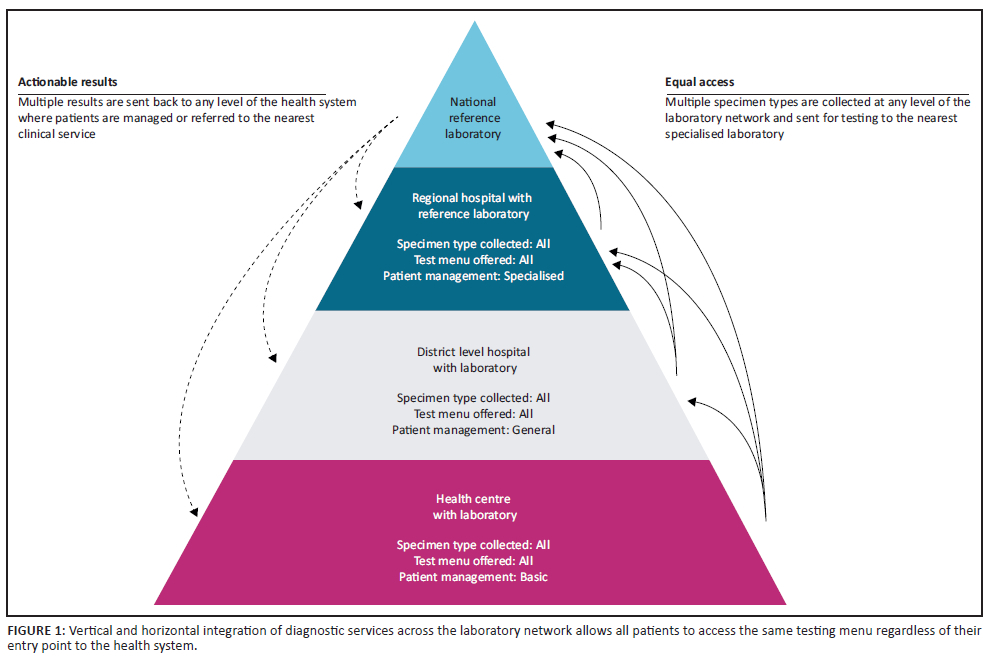
The goals of Universal Health Coverage (UHC) are to ensure that all people can access the quality health services that they need, to protect people from public health threats and to avoid catastrophic health expenditure.1Figure 1). As a result of the laboratory network optimisation, the laboratory system can fulfil the multiple needs of patients in more efficient and sustainable ways.2
Most testing has been carried out in central laboratories serving a large network of health facilities. Unfortunately, the role of laboratory-based platforms that allow the expansion of laboratories' menus of assays (polyvalence) on the same analyser across different public health programmes has been undervalued, resulting in inadequate investments in vertical integration. This lack of investment has exacerbated the persistent issues related to communications between health facilities with the consequence of long turn-around times to get actionable results back to clinicians. Instead of strengthening the infrastructural gaps, the focus of different vertical programmes switched to bringing diagnostic services closer to patients, which increased the divides within laboratory networks.
The development of diagnostics that can generate results in primary healthcare settings has favoured the decentralisation of diagnostic services in several areas, including tuberculosis, HIV, viral hepatitis and malaria, with the main result being that diagnostic capacity is now closer to the patients.34
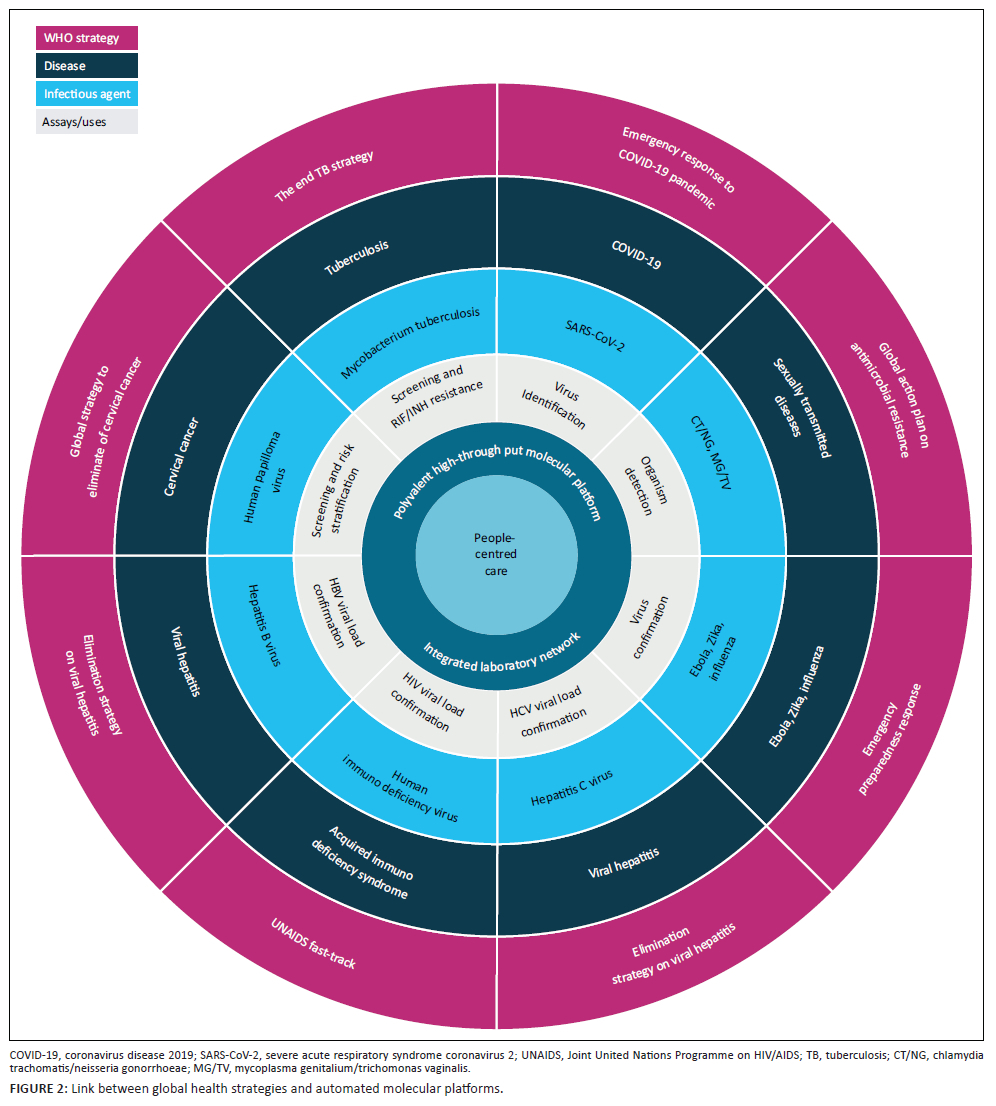
The recent coronavirus disease 2019 (COVID-19) pandemic exacerbated the need for expanded diagnostic capacity in such situations and the importance of a quick response time to address the increased demand for testing.56Figure 2). COVID-19 has demonstrated the advantages and limitations of current technologies to diagnose infections. The polymerase chain reaction is regarded as the gold standard for the detection of severe acute respiratory syndrome coronavirus 2 as a result of its high sensitivity for specific genetic sequences. Polymerase chain reaction-based techniques amplify this genetic material through multiple amplification cycles allowing the detection of small quantities of pathogens. Over the last 17 years many countries have scaled up their HIV viral load testing capacity with financial support from the United States President's Emergency Plan for AIDS Relief and the Global Fund. The COVID-19 pandemic has pushed countries to further scale up their polymerase chain reaction testing capacities for severe acute respiratory syndrome coronavirus 2 by installing automated and high-throughput molecular diagnostic systems. Many of these systems have random access capability and allow the use of multiple polymerase chain reaction assays on the same platform. While demand for HIV viral load testing will remain stable in the near future, the demand for severe acute respiratory syndrome coronavirus 2 testing will likely decline, leaving molecular diagnostic testing platforms free and available for testing of other disease markers. With the equipment, reagents, skilled personnel, connectivity to the laboratory information system, training, and the technical support already in place, such automated platforms may help to achieve meeting the targets defined in the global strategies and UHC initiatives (Figure 2). Previous limitations would be mitigated since the increased level of automation reduces complexity and makes it easier for laboratories to perform testing. Random access systems eliminate the need for the sorting and batching of samples, provide continuous loading capability, and ready-to-use reagents. Larger on-board assay storage capacities and random access allow testing of low, medium and high-volume assays side-by-side. Testing capabilities could be rapidly adapted in response to increasing demand during a pandemic or in response to seasonal changes caused by respiratory viruses.789
While enabling scalability to react in an outbreak situation, an expanded menu of assays is a strong basis to continue expanding UHC packages. Countries can leverage existing sample referral networks, such as for HIV viral load testing, to serve multiple disease programmes by using the current infrastructure to move different specimen types from peripheral sites to the testing laboratory.10118
The authors declare that they have no financial or personal relationships that may have inappropriately influenced them in writing this article.
Authors' contributions
F.M. and J.D. contributed equally to the conceptualisation and writing of the manuscript.
Ethical considerations
This article followed all ethical standards for research without direct contact with human or animal subjects.
Sources of support
This research received no specific grant from any funding agency in the public, commercial, or not-for-profit sectors.
Data availability
Data sharing is not applicable to this article as no new data were created or analysed in this study.
Disclaimer
The views and opinions expressed in this article are those of the authors and do not necessarily reflect the official policy or position of any affiliated agency of the authors.
Acknowledgements
Competing interests
References
-
1.Kieny MP, Bekedam H, Dovlo D, et al. Strengthening health systems for universal health coverage and sustainable development. Bull World Health Organ. 2017;95(7):537-539. https://doi.org/10.2471/BLT.16.187476
» https://doi.org/10.2471/BLT.16.187476 -
2.Ondoa P, Ndlovu N, Keita MS, et al. Preparing national tiered laboratory systems and networks to advance diagnostics in Africa and meet the continent's health agenda: Insights into priority areas for improvement. Afr J Lab Med. 2020;9(2):1103. https://doi.org/10.4102/ajlm.v9i2.1103
» https://doi.org/10.4102/ajlm.v9i2.1103 -
3.Parsons LM, Somoskovi A, Lee E, et al. Global health: Integrating national laboratory health systems and services in resource-limited settings. Afr J Lab Med. 2012;1(1):11. https://doi.org/10.4102/ajlm.v1i1.11
» https://doi.org/10.4102/ajlm.v1i1.11 -
4.Considerations for adoption and use of multidisease testing devices in integrated laboratory networks [homepage on the Internet]. World Health Organization Information Note 2017. WHO/HTM/TB/2017.06. [cited 2021 May 07]. Available from: https://www.who.int/tb/publications/2017/considerations_multidisease_testing_devices_2017/en/
» https://www.who.int/tb/publications/2017/considerations_multidisease_testing_devices_2017/en/ -
5.Ondoa P, Kebede Y, Loembe MM, et al. COVID-19 testing in Africa: Lessons learnt. Lancet Microbe. 2020;1(3):e103-e104. https://doi.org/10.1016/S2666-5247(20)30068-9
» https://doi.org/10.1016/S2666-5247(20)30068-9 -
6.Pai M, Walia K, Boehme CC. Essential medicines and essential diagnostics: A package deal. Lancet Public Health. 2019 Oct;4(10):e492. https://doi.org/10.1016/S2468-2667(19)30165-3
» https://doi.org/10.1016/S2468-2667(19)30165-3 -
7.Venkatesan P. COVID-19 diagnostics-not at the expense of other diseases. Lancet Microbe. 2020;1(2):e64. https://doi.org/10.1016/S2666-5247(20)30041-0
» https://doi.org/10.1016/S2666-5247(20)30041-0 -
8.Obermeier M, Pacenti M, Ehret R, et al. Improved molecular laboratory productivity by consolidation of testing on the new random-access analyzer Alinity m. J Lab Med. 2020;44(6):319-328. https://doi.org/10.1515/labmed-2020-0102
» https://doi.org/10.1515/labmed-2020-0102 -
9.Amukele T. Africa CDC: Establishing integrated surveillance and laboratory networks for rapid disease detection and response, control, prevention, and clinical care in Africa. Afr J Lab Med. 2017;6(1):a638. https://doi.org/10.4102/ajlm.v6i1.638
» https://doi.org/10.4102/ajlm.v6i1.638 -
10.Fonjungo PN, Alemnji GA, Kebede Y, et al. Combatting global infectious diseases: A network effect of specimen referral systems. Clin Infect Dis. 2017;64(6):796-803. https://doi.org/10.1093/cid/ciw817
» https://doi.org/10.1093/cid/ciw817 -
11.Williams J, Edgil D, Wattleworth M, et al. The network approach to laboratory procurement and supply chain management: Addressing the system issues to enhance HIV viral load scale-up. Afr J Lab Med. 2020;9(1):a1022. https://doi.org/10.4102/ajlm.v9i1.1022
» https://doi.org/10.4102/ajlm.v9i1.1022

Accepted: 01 Mar. 2022
Published: 22 June 2022