Appropriate disposal of waste in the laboratory: Neglected but not forgotten
Christoffel J. Opperman; Sarishna Singh; Francois Barton
Green Point TB Laboratory, National Health Laboratory Service, Cape Town, South Africa
Laboratory waste management should focus on environmental and worker safety in a cost-effective manner to ensure ongoing diagnostic testing in accredited laboratories, especially in low- and middle-income countries with limited resources.1Mycobacterium tuberculosis generate biosafety level three infectious material that must be decontaminated and disposed of correctly to maintain good laboratory practice within a legislative framework.23M. tuberculosis diagnostic laboratory.
A technical brief published in 2020 by the Global Fund on sustainable healthcare management highlighted strategic waste management and best practice principles to limit hazardous infectious waste.44Figure 1, number 1), effectively reduces waste and cost. Digital platforms can limit paperwork and, thereby, paper waste. It is often noticed that forms and labels are discarded in biological waste containers within a busy laboratory. Disposal of these and other reusable materials in bins designated for recyclables is not only a cost-saving initiative but should be a moral obligation on our journey to a 'green' and sustainable environment. Implementing local guidelines with testing algorithms is essential to limit unnecessary investigations that generate extensive 'routine diagnostic' waste (Figure 1, number 2). Waste created by high sample rejection rates secondary to leaked specimens, insufficient volumes of poor quality, inappropriately submitted sample types, unlabelled containers, mismatched samples with the laboratory request forms, samples unsuitable due to contamination, et cetera, and should form part of quality control procedures. Gatekeeping (reducing tests that can be avoided without negatively impacting patient management) and letting local healthcare facilities know the reason when they have a sample rejected from a laboratory can positively reinforce national guidelines and reduce sample rejection.5
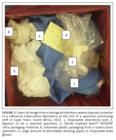
Laboratory waste should be classified according to the category that will dictate the waste management approach.6Figure 1, number 3) does not require a biological infectious material container for discard. In addition, large amounts of packaging (Figure 1, number 4) and large containers should be avoided during transportation from a local healthcare facility to the laboratory. Such packaging creates a financial burden and consumes space in waste bins. Although it is tempting to use recyclable products in the laboratory (plastics), laboratory professionals should be careful not to contaminate new products when using recycled instruments, as partial decontamination could cause erroneous results and impact patient management. Unless being used to absorb spilled liquids, surface cleaning materials, such as paper towels, should be kept to a minimum (Figure 1, number 5). Care should be taken to maximise the use of personal protective equipment in the laboratory to preserve the supply chain, particularly during the coronavirus disease 2019 pandemic.7,8Figure 1, number 6). A 'just in time' approach should be utilised when purchasing inventory. This could limit waste generated by reagents or diagnostic tests lost to expiration. However, we acknowledge that many African laboratories have constrained resource allocations and challenges maintaining sustainable budgets.
This correspondence is not intended to be an all-inclusive guideline on the management of waste in the laboratory. Instead, we looked critically into the waste bins to remind all laboratory workers about their responsibilities and opportunities for disposing of waste diligently and correctly. Staff should be trained and updated regularly on correct waste disposal procedures. In addition, waste auditing systems should be implemented to gather robust data, guide planning, and assist laboratory managers with decision-making.4
The authors declare that they have no financial or personal relationships that may have inappropriately influenced them in writing this article.
Authors' contributions
C.J.O. conceptualised and wrote the original draft, then reviewed and edited the manuscript. S.S. and F.B. reviewed and edited the manuscript.
Ethical considerations
This article does not contain any studies involving human participants performed by any of the authors.
Sources of support
This research received no specific grant from any funding agency in the public, commercial or not-for-profit sectors.
Data availability
Data sharing is not applicable to this article, as no new data were created or analysed in this study.
Disclaimer
The views and opinions expressed in this article are those of the authors and do not necessarily reflect official policy or position of any affiliated agency of the authors. This article does not contain any studies involving human participants performed by any of the authors.
Acknowledgements
Competing interests
References
-
1.Tuberculosis laboratory biosafety manual. In: Essential biosafety measures for TB laboratories. Geneva: World Health Organization; 2012. Available from: https://www.ncbi.nlm.nih.gov/books/NBK179129/
» https://www.ncbi.nlm.nih.gov/books/NBK179129/ -
2.Johnson KR, Braden CR, Cairns KL, et al. Transmission of Mycobacterium tuberculosis from medical waste. JAMA. 2000;284(13):1683-1688. https://doi.org/10.1001/jama.284.13.1683
» https://doi.org/10.1001/jama.284.13.1683 -
3.Myneedu VP, Aggarwal A. Disposal of the large volume of sputum positive for Mycobacterium tuberculosis by using microwave sterilisation technology as an alternative to traditional autoclaving in a tertiary respiratory care hospital in Delhi, India. Infect Prev Pract. 2020;2(3):100072. https://doi.org/10.1016/j.infpip.2020.100072
» https://doi.org/10.1016/j.infpip.2020.100072 - 4.Technical brief: Sustainable health care waste management. Geneva: The Global Fund; 2020.
-
5.Rooper L, Carter J, Hargrove J, Hoffmann S, Riedel S. Targeting rejection: Analysis of specimen acceptability and rejection, and framework for identifying interventions in a single tertiary healthcare facility. J Clin Lab Anal. 2017;31(3):e22060. https://doi.org/10.1002/jcla.22060
» https://doi.org/10.1002/jcla.22060 -
6.Ferronato N, Torretta V. Waste mismanagement in developing countries: A review of global issues. Int J Environ Res Public Health. 2019;16(6):1060. https://doi.org/10.3390/ijerph16061060
» https://doi.org/10.3390/ijerph16061060 -
7.Yuan X, Wang X, Sarkar B, Sik Ok Y. The COVID-19 pandemic necessitates a shift to a plastic circular economy. Nat Rev Earth Environ. 2021;2:659-660. https://doi.org/10.1038/s43017-021-00223-2
» https://doi.org/10.1038/s43017-021-00223-2 -
8.Bauchner H, Fontanarosa PB, Livingston EH. Conserving supply of personal protective equipment-A call for ideas. JAMA. 2020;323(19):1911. https://doi.org/10.1001/jama.2020.4770
» https://doi.org/10.1001/jama.2020.4770

Accepted: 04 Apr. 2022
Published: 14 July 2022