Common uropathogens among diabetic patients with urinary tract infection at Jinja Regional Referral Hospital, Uganda
Abstract
Between June 2015 and October 2015, 159 mid-stream urine samples from diabetic patients were cultured. The prevalence of urinary tract infection was high at 22% and women were more affected compared with men (P = 0.017). Factors associated with urinary tract infection in these patients were age, sex and high blood glucose levels. Diabetic patients should be screened periodically for urinary tract infection.
Introduction
Urinary tract infection (UTI) is common among both adults and children. According to Tandogdu and Wagenlehner,12,34546
Several uropathogens have been implicated in diabetic patient infections. The most common uropathogens isolated from diabetic patients are Escherichia coli, Klebsiella spp., Staphylococcus aureus and Candida albicans.7
This study was conducted to establish which UTI aetiological agents are most common among diabetic patients attending the diabetes clinic at Jinja Regional Referral Hospital. Risk factors for UTIs by these pathogens were also evaluated.
Methods
Ethical considerations
This study was approved by the Institutional Review Board of the International Health Sciences University in Kampala, Uganda (approval number: UGS 420-2016). Research staff explained the study to eligible participants. Patients who agreed to participate in the study signed consent forms.
Study design
This was a cross-sectional study conducted between June 2015 and October 2015. A total of 210 diabetic men and women aged between 18 to 70 years who presented with a medical history of painful urination, urinary incontinence and lower abdominal pain at the time of the study and who provided informed consent to participate were recruited by systematic sampling. Upon arrival, patients were requested to pick a card from a box containing three numbers: 1, 2 or 3. Every fourth patient was enrolled after a patient picked a card with the number 2. Participants were instructed to collect about 20 mL of mid-stream urine into a pre-labelled sterile screw-capped, graduated, wide-mouth plastic container. Urine specimens were transported to the laboratory at 4°C within two hours of collection.
All the specimens were subjected to a leukocyte esterase and nitrite test using a dipstick rapid test from Cypress Diagnostics (Langdorp, Belgium). Urine specimens positive for nitrites or leukocyte esterase were subjected to bacterial culture.
Using a 0.002 mL, calibrated wire loop, urine specimens positive for nitrites or leukocytes were aseptically inoculated on cystine-lactose-electrolyte deficient medium (Oxoid Ltd, Basingstoke, Hampshire, United Kingdom) and blood agar (Oxoid Ltd, Basingstoke, Hampshire, United Kingdom), then incubated aerobically overnight at 37°C. Pure growth with > 105 colony-forming units (CFU) per millilitre of urine was considered positive. Mixed cultures and growth with < 105 CFU were considered negative. Standard reference strains, Staphylococcus aureus (ATCC25923), Escherichia coli (ATCC25922) and Pseudomonas aeruginosa (ATCC 27853) were used as controls for testing the quality of culture media.
A non-fasting 5-mL blood specimen was collected from each participant in oxalate/fluoride vacutainers (Becton, Dickinson and Company, Franklin Lakes, New Jersey, United States). Each specimen was analysed on a Cobas Integra 400 analyzer (Roche Diagnostics, Indianapolis, Indiana, United States) for blood glucose level. A blood glucose level of > 7.8 mmol/L was considered to be hyperglycaemic.8
Data management and analysis
Data were analysed using STATA, version 11 (StataCorp, LLC, College Station, Texas, United States). A 95% confidence level was used for the analyses. Multivariate logistic regression was used to evaluate associations of urinary tract infection with age group and blood glucose. The Chi-square test was used to compare occurrence of urinary tract infection between men and women. P-values of less than 0.05 were considered statistically significant.
Results
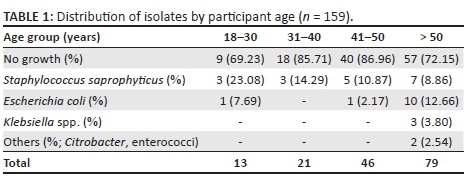
A total of 210 diabetic patients consented and were recruited, of whom 122 (76.7%) were women. The rapid dipstick test showed that a total of 159 (75.7%) of the urine specimens were positive for either nitrites, leukocytes or both; these were cultured and included in the analysis. Thirty-five of the 159 cultures were positive for bacterial growth (> 105P = 0.017). Also, 22 out of the 35 positive culture were from patients aged over 50 years (P = 0.003) (Table 1), and 28 of 35 (80%) uropathogens were isolated from participants with hyperglycaemia (P = 0.0026). Only 7 of the 35 (20%) isolates were obtained from participants with a normal glucose level, whereas no isolate was obtained from participants with low fasting blood glucose (P < 0.0001). Eighteen of the 35 (51.4%) isolates were Staphylococcus saprophyticus, 12 (34.3%) were Escherichia coli, 3 (8.6 %) were Klebsiella spp., 1 (2.85%) was Citrobacter spp. and 1 (2.85%) were enterococci.
Discussion
Urinary tract infection, defined as the presence of > 1059910212
More women had UTI compared to men (29/35, P = 0.017). This finding agrees with observations from other studies, in which female patients had a higher risk of UTI than male patients.11418
Our study also found that the number of UTI cases increased with increased age. Participants older than 50 years were more affected (22/35) compared with other age groups. Another study, by Wilke et al., found similar associations between age and UTI.1717
Our study revealed that hyperglycaemia was positively associated with UTI among diabetic patients. Up to 80% of the isolates were from participants with high blood glucose levels (> 7.8 mmol/L) compared with participants with normal glucose levels (< 7.8 mmol/L). The high UTI prevalence among hyperglycaemic patients is most likely due to poor contraction of a dysfunctional bladder leading to static urine pools; this, together with glycosuria, creates a suitable environment for bacterial growth. However, some studies have not detected associations between UTI and blood glucose level.13
The most common uropathogen in our study was S. saphrophyticus, followed by E. coli. This finding is not in agreement with several studies conducted on diabetic patients. A study in Bangladesh showed that bacteria of the Enterobacteriacae family, especially E. coli and Klebsiella spp., are the most common uropathogens in diabetic patients.19E. coli as the most common uropathogen responsible for UTI in diabetic patients.7S. saprophyticus infections often yield < 105S. saprophyticus. The small sample size could account for our low rates of E. coli. Another reason could be differences in the population distribution of the organisms, since most studies have been performed outside of Uganda and there is little literature on the distribution of these organisms among diabetic patients in Uganda.
Recommendations
We recommend periodic screening of diabetic patients for UTI. A study with larger sample size and power should be conducted to evaluate the distribution of uropathogens among diabetic patients in Uganda.
Limitations
A limitation to our study that should be considered when interpreting its results is that the sample size was small. This limited the power of the study for some analyses.
Conclusions
There is high prevalence of UTI among diabetic patients in Uganda. Age, sex and high blood glucose were associated with UTI in this group of diabetic patients.
Competing interests
The authors declare that they have no financial or personal relationships which may have inappropriately influenced them in writing this article.
Sources of support
None.
Authors' contributions
C.O. conceived the topic and wrote the protocol, B.I.N. collected the data, B.M. analysed the data, C.O. drafted the manuscript and J.O. edited the manuscript.
Acknowledgements
The authors wish to extend their heartfelt appreciation to the patients who agreed to participate in the study. We would like to categorically acknowledge the immense contribution of the staff of Jinja Regional Referral Hospital and Central Public Health Laboratory. The manuscript was edited by Ms Bethanie Rammer for English-language usage.
References
- 1. Tandogdu Z, Wagenlehner FM. Global epidemiology of urinary tract infections. Curr Opin Infect Dis. 2016;29(1):73-9.
- 2. Funfstuck R, Nicolle LE, Hanefeld M, et al. Urinary tract infection in patients with diabetes mellitus. Clin Nephrol. 2012;77(1):40-8.
- 3. Bateganya MH, Luie JR, Nambuya AP, et al. Morbidity and mortality among diabetic patients admitted to Mulago Hospital, Uganda. Malawi Med J. 2003;15(3):91-4.
- 4. Boyko EJ, Fihn SD, Scholes D, et al. Risk of urinary tract infection and asymptomatic bacteriuria among diabetic and nondiabetic postmenopausal women. Am J Epidemiol. 2005;161(6):557-64.
- 5. Joshi N, Caputo GM, Weitekamp MR, et al. Infections in patients with diabetes mellitus. N Engl J Med. 1999;341(25):1906-12.
- 6. Benfield T, Jensen JS, Nordestgaard BG. Influence of diabetes and hyperglycaemia on infectious disease hospitalisation and outcome. Diabetologia. 2007;50(3):549-54.
- 7. Sewify M, Nair S, Warsame S, et al. Prevalence of urinary tract infection and antimicrobial susceptibility among diabetic patients with controlled and uncontrolled glycemia in Kuwait. J Diabetes Res. 2016;2016:6573215.
- 8. American Diabetes Association. Diagnosis and Classification of Diabetes Mellitus. Diabetes Care. 2010;33(Suppl 1):S62-9.
- 9. Abrahamian FM, Moran GJ, Talan DA. Urinary tract infections in the emergency department. Infect Dis Clin North Am. 2008;22(1):73-87, vi.
- 10. Nitzan O, Elias M, Chazan B, et al. Urinary tract infections in patients with type 2 diabetes mellitus: Review of prevalence, diagnosis, and management. Diabetes Metab Syndr Obes. 2015;8:129-36.
- 11. Chita T, Timar B, Muntean D, et al. Urinary tract infections in Romanian patients with diabetes: Prevalence, etiology, and risk factors. Ther Clin Risk Manag. 2017;13:1-7.
- 12. Hamdan HZ, Kubbara E, Adam AM, et al. Urinary tract infections and antimicrobial sensitivity among diabetic patients at Khartoum, Sudan. Ann Clin Microbiol Antimicrob. 2015;14:26.
- 13. Raoofi A, Ghavami M, Shahhamzeh M, et al. The impact of demographic factors and blood sugar control on the incidence of urinary tract infections in Khorramabad in 2013. Iran Red Crescent Med J. 2016;18(5):e21942.
- 14. Yu S, Fu AZ, Qiu Y, et al. Disease burden of urinary tract infections among type 2 diabetes mellitus patients in the U.S. J Diabetes Complications. 2014;28(5):621-6.
- 15. Mohammed A, Abdelfattah M, Ibraheem A, et al. A study of asymptomatic bacteriuria in Egyptian school-going children. Afr. Health Sci 2016;16(1):69-74.
- 16. Yeshitela B, Gebre-Selassie S, Feleke Y. Asymptomatic bacteriuria and symptomatic urinary tract infections (UTI) in patients with diabetes mellitus in Tikur Anbessa Specialized University Hospital, Addis Ababa, Ethiopia. Ethiop Med J 2012;50(3):239-49.
- 17. Wilke T, Boettger B, Berg B, et al. Epidemiology of urinary tract infections in type 2 diabetes mellitus patients: An analysis based on a large sample of 456,586 German T2DM patients. J Diabetes Complications 2015;29(8):1015-23.
- 18. Leydon GM, Turner S, Smith H, Little P. Women's views about management and cause of urinary tract infection: Qualitative interview study. BMJ (Clinical Research Ed). 2010;340:c279.
- 19. Shill MC, Huda NH, Moain FB, Karmakar UK. Prevalence of uropathogens in diabetic patients and their corresponding resistance pattern: results of a survey conducted at diagnostic centers in Dhaka, Bangladesh. Oman Med J. 2010;25(4):282-5.

Accepted: 08 Sept. 2017
Published: 09 Feb. 2017