Virtual reality in health science education: Critical reflections on designing effective procedural skill training
BACKGROUND: Virtual reality (VR) offers a novel solution to overcoming traditional barriers in procedural skills training among medical students. Correct ECG lead placement is a critical yet undertrained skill owing to resource limitations. The design process underpinning VR-based training platforms, especially in low- and middle-income countries, is not yet fully described in the literature. OBJECTIVES: To describe and reflect on the process of developing a VR-based training platform aimed at improving ECG lead placement skills among medical students. METHODS: A design-based thinking approach was employed, involving needs analysis, ideation, development, implementation and reflection. Critical reflection was performed at each step to guide the development of VR-based training platforms for health science education. RESULTS: Critical elements of VR design were identified, including enhancing student engagement, providing monitoring and feedback, managing side-effects and deployment considerations of VR systems. CONCLUSION: The VR-based training platform shows promise in addressing resource constraints, enhancing procedural skill acquisition and offering broader implications for medical education in low-resource settings. However, careful consideration of VR platform design is critical to ensure the successful application of such a system.
Virtual reality; health science education; design thinking; critical reflection
Virtual reality in health science education: Critical reflections on designing effective procedural skill training
M E CochraneI; L SmitII; W van der MerweIII; R HerselmanIV; K de BeerV
IPhD (Physiotherapy); Health Professions Education, Faculty of Health Sciences, University of Pretoria, South Africa
IIBCur (I et A); Centre for Simulation and Innovation, Faculty of Health Sciences, University of Pretoria, South Africa
IIIMNurs (Nursing Management); Centre for Simulation and Innovation, Faculty of Health Sciences, University of Pretoria, South Africa
IVPhD (Nursing Science); Centre for Simulation and Innovation, Faculty of Health Sciences, University of Pretoria, South Africa
VMIS (Multimedia); Health Professions Education, Faculty of Health Sciences, University of Pretoria, South Africa
BACKGROUND: Virtual reality (VR) offers a novel solution to overcoming traditional barriers in procedural skills training among medical students. Correct ECG lead placement is a critical yet undertrained skill owing to resource limitations. The design process underpinning VR-based training platforms, especially in low- and middle-income countries, is not yet fully described in the literature.
OBJECTIVES: To describe and reflect on the process of developing a VR-based training platform aimed at improving ECG lead placement skills among medical students.
METHODS: A design-based thinking approach was employed, involving needs analysis, ideation, development, implementation and reflection. Critical reflection was performed at each step to guide the development of VR-based training platforms for health science education.
RESULTS: Critical elements of VR design were identified, including enhancing student engagement, providing monitoring and feedback, managing side-effects and deployment considerations of VR systems.
CONCLUSION: The VR-based training platform shows promise in addressing resource constraints, enhancing procedural skill acquisition and offering broader implications for medical education in low-resource settings. However, careful consideration of VR platform design is critical to ensure the successful application of such a system.
Keywords: Virtual reality, health science education, design thinking, critical reflection.
The accurate placement of a 12-lead electrocardiogram (ECG) is critical to ensure that this clinical skill is taught correctly to health science students.[1] Mastering the ECG technique provides the foundation for more advanced competencies, such as the accurate diagnosis and treatment of cardiac conditions.[2] However, the growing number of students, limited availability of standardised patients, costs associated with electrodes and ECG machines, and staff resource constraints often limit students' opportunities to gain proficiency in this essential skill.[3] Given resource limitations in low- and middle-income countries (LMICs), finding effective alternatives for ECG training is crucial.
Although immersive technology such as virtual reality (VR) has long been recognised as an effective tool for training clinical skills in health science education, the perceived high costs often make it inaccessible in LMICs.[4] To address this challenge, the researchers developed a VR application using equipment already available at the institution where the study was conducted. This VR application simulates a realistic clinical environment, with a patient and relevant medical equipment, to train large groups of students in ECG lead placement. VR systems using head-mounted displays (HMDs) enable the development of low-cost, realistic, easy-to-use and easily configurable simulators that reduce safety, ethical and health-related challenges.[5] VR HMDs can therefore be used for low-, medium- and high-risk medical training to assist students in acquiring skills such as ECG lead placement in a safe environment. The scenario for this VR HMD was specifically designed to train health science students to acquire the skill of correctly placing ECG leads on a patient. A basic scenario using voice prompts, visual indicators and a holographic picture was designed to address the identified needs. The same scenario could be adapted as the development process continues, both to test students' learning experiences and for assessment purposes. The goal of this study was to describe the design-based thinking approach that underpinned the development of the VR platform and to critically reflect on the processes involved in designing such a platform.
Methods
A design-based thinking approach combined with VR design concepts was used as the basis for this study.[6,7] At the design stage of the project, ethical clearance was not required; however, ethics approval was obtained (ref. no. 714/2024) from the Ethics Committee of the university where the study was conducted prior to the implementation of VR training (experimental phase). Six critical steps were identified to ensure optimal development of the VR platform and are discussed separately below.
As the first step in the design-based thinking approach, a needs analysis was conducted among staff members in the skills laboratory of a health sciences faculty. The learning outcome identified as being in critical need of improvement was the correct placement of leads for performing a 12-lead ECG. Staff identified a lack of training resources - including the availability of ECG machines, space and human resources - as the main threat to students' successful mastery of this procedural skill. Approximately 350 medical students require ECG training each year. This training occurs during a one-week period at the start of the third academic year. Currently, students receive training in small groups to ensure that all students have the opportunity to see and use the ECG machines. VR skills training would allow 30 students to receive individual training simultaneously, with the option of participating in self-directed training after completion of the formal training. In addition to the identified barriers, staff also expressed the need to develop technology-driven teaching innovation. This aligns with current literature, in which traditional teaching approaches are being replaced by immersive VR.[8]
The second step in the design process entailed ideation. VR HMDs were available at the institution where the skill was taught and were considered the best alternative to conventional simulated bedside training. When using the VR HMD, each student could experience one-on-one teaching, feedback and repetitive practice, while multiple students could participate simultaneously. Because students were required to train a single skill and all were exposed to the same scenario, cognitive load during training was minimised and standardised learning was provided.[9] In addition, academic staff members could use the VR software to monitor learning analytics. These analytics included the duration of skills training and the number of attempts each student required to master the skill, measured in hours and days. The learning analytics data could then be used to monitor student progress and maximise the potential of the VR training platform. Students could also use learning analytics data to monitor both their own and their peers' performance.[10]
Identifying practical considerations for using VR was the third step in the design process. Accessibility of the VR platform was crucial, as this was one of the main identified disadvantages of conventional skills training. Student experience was a practical consideration that underpinned the successful implementation of VR. Using the VR platform should create a sense of enjoyment among students, while attention and engagement in the task should foster satisfaction in the learning process.[11] A practical consideration that could adversely affect the success of the experience was VR sickness, which may occur when using HMDs. Prior to implementation of the VR training, methods to reduce the risk of VR sickness had to be considered.[12] VR addiction was another practical consideration that could negatively influence the desired outcomes of the intervention. To mitigate this risk, skills to be trained using a VR platform should be carefully selected, and students should be exposed to a variety of learning environments, including skills laboratories and clinical settings.[13]
The fourth step in the design process was the implementation of the VR procedural skills training platform designed in this study. Full implementation was conducted in 2025, and approximately 260 students participated in the VR ECG skills training using HMDs. Participants were third-year medical students from a university in South Africa. All participants were exposed to the VR training platform and were asked questions regarding the usability of the platform, their experiences with it and whether they prefer traditional skills training to VR skills training. In addition, participants were asked whether they had experienced any side-effects from using VR and whether they had recommendations for improving the training system.
Upon completion of the implementation, the fifth step in the design process was debriefing and reflection. This process was undertaken with the skills laboratory staff to identify areas for improvement. Finally, step six entails redesign and reimplementation of the VR procedural skill training platform. Steps five and six will be iterative over several years to ensure that an optimal system is developed for this type of skills training.
Results
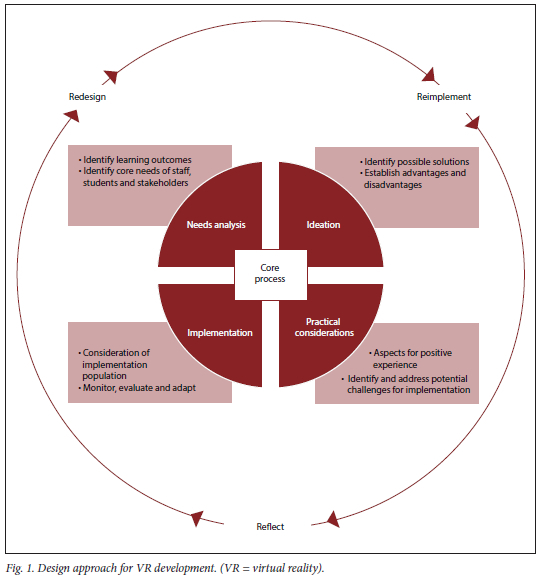
The novel design approach used in this study aimed to describe a comprehensive approach to VR development for procedural skills training. The approach entailed combining the design-based thinking process with VR design concepts to assist institutions considering VR implementation in designing such platforms. A summary of the design approach used in this study is presented in Fig. 1.
Discussion
Upon critical reflection of the design process, an effective needs analysis was identified as the most critical step in the process. Performing a comprehensive analysis of student and staff needs, with consideration of resource availability, determines the feasibility of the proposed design.[14] In this study, the learning outcome (i.e. students' ability to accurately position all 12-lead ECG electrodes on a simulated patient according to anatomical landmarks by the end of the module, thereby ensuring a reliable cardiac reading) was the main consideration in developing the VR application.
Performing a 12-lead ECG is among the most useful and commonly performed non-invasive medical procedures for patients presenting with cardiac symptoms. ECGs help assess, diagnose, identify risk and guide decision-making in response to findings, thereby informing treatment strategies.[2] A 12-lead ECG consists of only 10 electrodes, of which six are precordial leads (V1 - V6) placed on the patient's chest, and four are limb leads (a-VL, a-VR, a-VF and a neutral lead) positioned at precise anatomical landmarks to measure the electrical activity of the heart.[15]
An important aspect of the ECG, compared with other medical imaging modalities, is its graphical recording of the heartbeat; the ECG signal and waveforms represent the temporal processes of the electrical activity co-ordinating the heartbeat, recorded as deflections from the baseline.[15]
ECG interpretation is a complex task undertaken by various healthcare professionals. Breen et al.[16] reported 65% accuracy for identifying lead misplacement in dextrocardia cases and only 37% accuracy for identifying structural abnormalities such as hypertrophy. Only 25% of measured PR and QT intervals were reported as being interpreted accurately.[16] Therefore, ensuring that students are competent in performing this skill is an essential component of their training.[1] Conducting an in-depth needs analysis is essential for identifying the challenges experienced by students and staff, and learning outcomes should be considered when selecting a skill for the design and development of a VR training application.
Ideation in the design process needs to be achievable and realistic.[17] This phase of the process was not merely about selecting VR as a tool, but involved a deeper exploration of how immersive technology could best address the identified training gaps while ensuring usability, scalability and effectiveness.[18] When considering VR for procedural skills training, the advantages and disadvantages of the VR platform were compared with those of the conventional simulated bedside learning method. In addition, an iterative process was employed. Initial concepts focused solely on lead placement, but after early feedback, the scope was expanded to include real-time feedback, student performance tracking and the analysis of learning analytics. By comparing the conventional and novel skills training methods, the researchers were able to evaluate the feasibility of procedural skills training using a VR platform.
When VR HMDs are compared with conventional learning methods, VR allows larger groups of students to be trained simultaneously.[19] During conventional learning, students are exposed to simulated environments in academic settings and, although these simulations are feasible, students share simulated patients and are not fully exposed to a clinical environment.[18] In conventional learning students are usually divided into smaller groups that are not all taught simultaneously. When content is taught over multiple sessions with smaller groups, there is no guarantee that the information provided in each training session will remain consistent.[20] By contrast, VR HMDs allow each student to have their own patient in a fully immersive environment. Students benefit from this immersive, individual training: they are not cognitively overloaded during the sessions (as only one skill is taught), and they are all exposed to the exact same learning scenario, providing a fair and equitable learning environment.[9]
During conventional skills training, feedback is typically provided by one instructor throughout the training process, which may result in some students not receiving in-depth feedback or not receiving feedback at all.[21] VR allows for standardised feedback through HMDs for each student during the training session, which enhances the fairness and, at times, the quality of the feedback.[20] Visual and auditory cues provided by the VR HMDs can be programmed to deliver feed-forward and feedback to students in real time, ensuring that fundamental competency in ECG lead placement is achieved.[9] In addition to providing feedback, VR can be programmed to collect users' learning analytics. Although learning analytics can also be obtained during conventional skills training, the cumbersome manual analysis of learning events often results in poor use of these analytics.[22] When the advantages and disadvantages of VR were compared with those of conventional skills training, VR appeared to be the more favourable method for skills training and was therefore selected for further design and development by the researchers.
Practical considerations are not a typical component of the design-based thinking process, but they are necessary when designing a VR-based skills training platform. These considerations are important because the use of VR requires technical expertise, both regarding its design and its application, to ensure an optimal user experience and the successful attainment of learning outcomes. Considerations such as accessibility, student experience, learning scaffolding and risk management help ensure the technical feasibility of the VR training platform.[22]
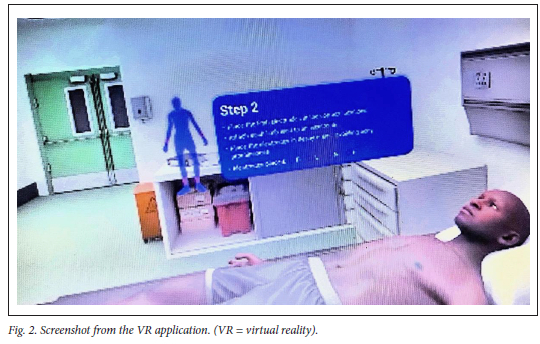
To ensure an optimal experience for students in this study, a theoretical framework was provided in the form of lecture notes on the institution's learning management system. The aim of these notes was to guide students regarding what to expect during the training session and to ensure that all students approached the session with the same theoretical knowledge. During the VR session, students were able to immerse themselves fully in the simulated environment, where they encountered a patient in a hospital room with an ECG machine positioned next to the bed. Voice prompts and visual cues (in the form of arrows) guided students through performing an ECG with correct lead placement according to anatomical landmarks. A holographic image provided simultaneous guidance to help students identify the correct anatomical landmarks and ensure a reliable ECG reading. Fig. 2 illustrates the students' view during the VR application. Students were allocated sessions to learn the skill of performing an ECG using VR HMDs. In each session, students had the opportunity for multiple attempts, thereby further enhancing confidence in their own learning.[9]
Potential risks and side-effects of the VR training system need to be considered as part of the user experience. One of the main risks identified was VR sickness.[12] To minimise this risk, students watched a video explaining the use of HMDs and the associated risks before each session. The aim of providing the video was to offer students a non-immersive introduction to the procedure and to inform them about VR sickness and how to manage its symptoms. Any students experiencing VR sickness were identified, managed by trained healthcare providers and given the opportunity to attend an alternative (conventional) learning session. VR addiction was another risk factor that should be considered when designing a VR application for skills training.[13] To mitigate this risk, clinical staff members should carefully consider which skills are suitable for conversion to VR training and should avoid overexposure to VR. Students should also be trained across various platforms, including clinical settings and simulations, to ensure optimal learning throughout their skills training.[13]
Implementation of this novel teaching platform using VR HMDs was the next logical step in the design process. This implementation consolidated the core steps of the design process and provides a platform for reflection, redesign and re-evaluation.
Conclusion
The integration of VR into medical education presents a transformative opportunity for enhancing procedural skills training, particularly in resource-constrained environments. This study demonstrates the potential of VR to address current training limitations through immersive, scalable and cost-effective solutions. Future research should focus on longitudinal outcomes to assess the influence of VR on clinical competency and to explore its application across diverse medical disciplines.
Data availability statement. None.
Declaration. None.
Acknowledgments. The authors would like to acknowledge the University of Pretoria Faculty of Health Sciences for funding the VR headsets for simulated skills training.
Conflicts of interest. None.
Author contributions. All authors contributed to conceptualisation of the study, writing of the drafts, proofreading, editing and submission for publication.
Funding. None.
References
-
1. Giannetta N, Campagna G, Di Muzio F, Di Simone E, Dionisi S, Di Muzio M. Accuracy and knowledge in 12-lead ECG placement among nursing students and nurses: A web-based Italian study. Acta Biomed 2020;91(Suppl 12):e2020004. https://doi.org/10.23750/abm.v91i12-S.10349
» https://doi.org/10.23750/abm.v91i12-S.10349 -
2. Amini K, Mirzaei A, Hosseini M, Zandian H, Azizpour I, Haghi Y. Assessment of electrocardiogram interpretation competency among healthcare professionals and students of Ardabil University of Medical Sciences: A multidisciplinary study. BMC Med Educ 2022;22:448. https://doi.org/10.1186/s12909-022-03518-0
» https://doi.org/10.1186/s12909-022-03518-0 -
3. Kashou AH, Noseworthy PA, Beckman TJ, et al. EDUCATE: An international, randomized controlled trial for teaching electrocardiography. Curr Probl Cardiol 2024;49(3):102409. https://doi.org/10.1016/j.cpcardiol.2024.102409
» https://doi.org/10.1016/j.cpcardiol.2024.102409 -
4. Ryan GV, Callaghan S, Rafferty A, Higgins MF, Mangina E, McAuliffe F. Learning outcomes of immersive technologies in health care student education: Systematic review of the literature. J Med Internet Res 2022;24(2):e30082. https://doi.org/10.2196/30082
» https://doi.org/10.2196/30082 -
5. Bracq MS, Michinov E, Arnaldi B, et al. Learning procedural skills with a virtual reality simulator: An acceptability study. Nurse Educ Today 2019;79:153-160. https://doi.org/10.1016/j.nedt.2019.05.026
» https://doi.org/10.1016/j.nedt.2019.05.026 -
6. Moffett J, Cassidy D. Building a digital educational escape room using an online design-thinking process. Online Learn 2023;27(2):223-244. https://doi.org/10.24059/olj.v27i2.3279
» https://doi.org/10.24059/olj.v27i2.3279 -
7. Pedram S, Kennedy G, Sanzone S. Toward the validation of VR-HMDs for medical education: A systematic literature review. Virtual Real 2023;27(3):2255-2280. https://doi.org/10.1007/s10055-023-00802-2
» https://doi.org/10.1007/s10055-023-00802-2 -
8. De Lorenzis F, Pratticò FG, Repetto M, Pons E, Lamberti F. Immersive virtual reality for procedural training: Comparing traditional and learning by teaching approaches. Comput Ind 2023;144:103785. https://doi.org/10.1016/j.compind.2022.103785
» https://doi.org/10.1016/j.compind.2022.103785 -
9. Sawyer T, White M, Zaveri P, et al. Learn, see, practice, prove, do, maintain: An evidence-based pedagogical framework for procedural skill training in medicine. Acad Med 2015;90(8):1025-1033. https://doi.org/10.1097/ACM.0000000000000734
» https://doi.org/10.1097/ACM.0000000000000734 -
10. Christopoulos A, Pellas N, Laakso M-J. A learning analytics theoretical framework for STEM education virtual reality applications. Educ Sci 2020;10(11):317. https://doi.org/10.3390/educsci10110317
» https://doi.org/10.3390/educsci10110317 -
11. Yang H, Cai M, Diao Y, Liu R, Liu L, Xiang Q. How does interactive virtual reality enhance learning outcomes via emotional experiences? A structural equation modeling approach. Front Psychol 2023;13:1081372. https://doi.org/10.3389/fpsyg.2022.1081372
» https://doi.org/10.3389/fpsyg.2022.1081372 -
12. Kezhavarz B, Golding JF. Motion sickness: Current concepts and management. Curr Opin Neurol 2022;35(1):107-112. https://doi.org/10.1097/WCO.0000000000001018
» https://doi.org/10.1097/WCO.0000000000001018 -
13. Zhai X, Asmi F, Zhou R, et al. Investigating the mediation and moderation effect of students' addiction to virtual reality games: A perspective of structural equation modeling. Discrete Dyn Nat Soc 2020:5714546. https://doi.org/10.1155/2020/5714546
» https://doi.org/10.1155/2020/5714546 -
14. Gaspard J, Yang CM. Training needs assessment of health care professionals in a developing country: The example of Saint Lucia. BMC Med Educ 2016;16:112. https://doi.org/10.1186/s12909-016-0638-9
» https://doi.org/10.1186/s12909-016-0638-9 - 15. Petty BG. Basic Electrocardiography. 2nd ed. Switzerland: Springer Nature, 2020:1-19.
-
16. Breen CJ, Kelly GP, Kernohan WG. ECG interpretation skill acquisition: A review of learning, teaching and assessment. J Electrocardiol 2022;73:125-128. https://doi.org/10.1016/j.jelectrocard.2019.03.010
» https://doi.org/10.1016/j.jelectrocard.2019.03.010 -
17. Bender-Salazar R. Design thinking as an effective method for problem-setting and needfinding for entrepreneurial teams addressing wicked problems. J Innov Entrep 2023;12:24. https://doi.org/10.1186/s13731-023-00291-2
» https://doi.org/10.1186/s13731-023-00291-2 -
18. Marougkas A, Troussas C, Krouska A, Sgouropoulou C. Virtual reality in education: A review of learning theories, approaches and methodologies for the last decade. Electronics 2023;12(13):2832. https://doi.org/10.3390/electronics12132832
» https://doi.org/10.3390/electronics12132832 -
19. Pottle J. Virtual reality and the transformation of medical education. Future Healthc J 2019;6(3):181-185. https://doi.org/10.7861/fhj.2019-0036
» https://doi.org/10.7861/fhj.2019-0036 -
20. Abich J, Parker J, Murphy JS, Eudy M. A review of the evidence for training effectiveness with virtual reality technology. Virtual Real 2021;25: 919-933. https://doi.org/10.1007/s10055-020-00498-8
» https://doi.org/10.1007/s10055-020-00498-8 -
21. Magar ST, Suk HJ. The advantages of virtual reality in skill development training based on project comparison (2009-2018). Int J Contents 2020;16(2):19-29. https://doi.org/10.5392/IJoC.2020.16.2.019
» https://doi.org/10.5392/IJoC.2020.16.2.019 -
22. Nunn S, Avella JT, Kanai T, Kebritchi M. Learning analytics methods, benefits, and challenges in higher education: A systematic literature review. Online Learn 2016;20(2):13-29. https://doi.org/10.24059/olj.v20i2.790
» https://doi.org/10.24059/olj.v20i2.790

Accepted 17 November 2025