Knowledge, attitudes and practices of final-year health sciences students regarding interprofessional education at a tertiary institution in South Africa
BACKGROUND: Interprofessional education (IPE) has been identified as a means of improving the readiness of health sciences students for interprofessional collaborative practice and promoting effective, patient-centred care. To prepare future healthcare professionals for interprofessional collaboration, academic leaders at health professions institutions recommend integrating IPE into the training of health sciences students. OBJECTIVES: To assess the knowledge, attitudes and practices of final-year undergraduate health sciences students regarding IPE at a single institution in Gauteng, South Africa. METHOD: A descriptive quantitative study was conducted among final-year health sciences students during the 2022 and 2023 academic years. A validated, self-administered Likert-scale questionnaire was used to collect data online and included three open-ended questions to provide additional context. There was an estimated total of 327 final-year students, and a minimum sample size of 177 was required. Purposive sampling was used to select students from eight health science programmes. RESULT: Of the 327 distributed questionnaires, 177 were returned, giving a response rate of 54%. The overall mean (standard deviation) age was 24 (4.1) years. More than half of the participants (60%) indicated that they have prior experience of IPE. The Likert-scale questions showed that the majority had good knowledge (97.7%), attitudes (88.1%) and practices (75.7%) regarding IPE. The themes arising from the narrative responses to the open-ended questions revealed self-perceived benefits of IPE (e.g. understanding other students' roles), barriers (e.g. timetable clashes) and opportunities to improve IPE (e.g. a need for planned and co-ordinated IPE activities). CONCLUSION: The findings revealed that participants had good knowledge, attitudes and practices regarding IPE. However, challenges such as limited exposure to other healthcare programmes, timetabling constraints and a lack of co-ordinated IPE activities should be addressed to inform future IPE practice.
Knowledge, attitudes and practices of final-year health sciences students regarding interprofessional education at a tertiary institution in South Africa
M MoruleI; S SinghII; A BhayatIII
IMHPE, B Ed (Hons); Discipline of Dentistry, School of Health Sciences, University of KwaZulu-Natal, Durban, South Africa
IIPhD; Discipline of Dentistry, School of Health Sciences, University of KwaZulu-Natal, Durban, South Africa
IIIM Dent, MPH; Department of Community Dentistry, School of Dentistry, University of Pretoria, Gauteng, South Africa
BACKGROUND: Interprofessional education (IPE) has been identified as a means of improving the readiness of health sciences students for interprofessional collaborative practice and promoting effective, patient-centred care. To prepare future healthcare professionals for interprofessional collaboration, academic leaders at health professions institutions recommend integrating IPE into the training of health sciences students.
OBJECTIVES: To assess the knowledge, attitudes and practices of final-year undergraduate health sciences students regarding IPE at a single institution in Gauteng, South Africa.
METHOD: A descriptive quantitative study was conducted among final-year health sciences students during the 2022 and 2023 academic years. A validated, self-administered Likert-scale questionnaire was used to collect data online and included three open-ended questions to provide additional context. There was an estimated total of 327 final-year students, and a minimum sample size of 177 was required. Purposive sampling was used to select students from eight health science programmes.
RESULT: Of the 327 distributed questionnaires, 177 were returned, giving a response rate of 54%. The overall mean (standard deviation) age was 24 (4.1) years. More than half of the participants (60%) indicated that they have prior experience of IPE. The Likert-scale questions showed that the majority had good knowledge (97.7%), attitudes (88.1%) and practices (75.7%) regarding IPE. The themes arising from the narrative responses to the open-ended questions revealed self-perceived benefits of IPE (e.g. understanding other students' roles), barriers (e.g. timetable clashes) and opportunities to improve IPE (e.g. a need for planned and co-ordinated IPE activities).
CONCLUSION: The findings revealed that participants had good knowledge, attitudes and practices regarding IPE. However, challenges such as limited exposure to other healthcare programmes, timetabling constraints and a lack of co-ordinated IPE activities should be addressed to inform future IPE practice.
Interprofessional education (IPE) refers to the pedagogical practice of students learning with, from or about one another to improve collaboration and quality of care.[1] IPE equips students to learn and work collaboratively and to provide the highest possible standard of care, particularly for patients with more complex health challenges.[2] This initiative requires intentional efforts to bring students together in a meaningful way and to foster interprofessional communication and teamwork skills. According to the World Health Organization (WHO), once students understand how to work interprofessionally, their readiness for collaborative practice upon entering the workplace improves.[3]
The value of IPE lies in its promotion of collaboration as participants review relationships between their professions, enhance mutual understanding and explore ways to combine their expertise to improve service delivery, patient safety and quality of care.[3,4] The decision-making process becomes collaborative, and individual opinions and expertise are valued and respected. Benefits include role clarification, effective communication, improved team functioning, better access to and co-ordination of care, improved healthcare outcomes, a reduced occurrence of medical errors, more efficient referral systems, reduced gaps in service provision and greater healthcare worker productivity.[4-6]
Traditional educational approaches in which health sciences students have minimal interprofessional contact and few collaborative learning experiences may result in graduates who are poorly prepared for collaborative team environments and who lack knowledge of different roles and teamwork skills.[5] Previous studies have reported various challenges affecting IPE implementation and success, including scheduling conflicts, a lack of planning, inadequate administrative support, limited facilitation skills and stereotypes.[5-7] Despite implementation challenges, IPE is increasingly recognised as a valuable component of undergraduate health sciences education, providing benefits for students that extend beyond their training into professional healthcare practice.
This study was guided by the movement to increase interprofessional collaboration as a means of supporting patient safety and health outcomes and addressing various global healthcare demands.[3,8,9] At the selected university, collaboration among healthcare sciences departments and schools is minimal. As a result, students from different professions have little to no training in an interprofessional environment. Educating students using a discipline- or field-specific approach offers little opportunity to learn about the role of other professions or the development of interprofessional teams. Although this discipline-specific approach is appropriate for teaching many professional competencies, it is limited in its capacity to prepare students for the realities of working in interprofessional clinical teams.[5]
Several studies have assessed the knowledge and attitudes of undergraduate health sciences students regarding IPE worldwide.[1,2,7,10,11] Some IPE-driven modules have been identified in undergraduate curricula, primarily in the health sciences disciplines of nursing, physiotherapy, occupational therapy and human nutrition. However, evidence regarding students' knowledge, attitudes and practices related to IPE at the selected university is scarce. Therefore, this study aimed to assess final-year undergraduate health sciences students' knowledge, attitudes and practices regarding IPE and to provide evidence-based data to inform future IPE planning and implementation.
Methods
The study employed a descriptive cross-sectional quantitative design. Purposive sampling targeted all final-year undergraduate students across eight health sciences programmes who were willing to participate. The programmes included oral hygiene (n=21), dentistry (n=55), medicine (n=68), nursing (n=40), clinical associates (n=45), occupational therapy (n=34), physiotherapy (n=34) and human nutrition (n=30). According to class lists, an estimated total of 327 final-year students were eligible to participate and were targeted for recruitment. Using the Raosoft sample size calculator (Raosoft Inc., Seattle), with a margin of error of 5% and a 95% confidence interval (CI), the calculated minimum required sample size was 177.
An information letter explaining the research and inviting participation in the study was sent to all eligible final-year students via the student blackboard portal and included a secure link to an online survey developed using Qualtrics software (Qualtrics, Utah). The questionnaire featured an introductory informed consent page that introduced the researcher and provided a brief description of the study, its purpose and procedures, as well as the rights of participants. Participants were only allowed to access the questionnaire after consenting to participate in the study on the electronic platform. Data were collected between July 2022 and July 2023. Reminders to complete the questionnaire were sent to participants every three weeks following distribution of the link. The study was approved by the Research and Ethics Committee of the university (ref. no. 46/2022). Owing to a low response rate in 2022, permission to continue data collection in 2023 was requested to improve the response rate.
Data were collected using a self-administered questionnaire adopted and modified from two previous studies that employed the Readiness for Interprofessional Learning Scale (RIPLS; 19-item Likert scale)[13] and the Interprofessional Attitudes Scale (IPAS; 27-item Likert scale).[12] Because the IPAS uses questions originally found in the RIPLS, nine duplicate questions were eliminated. A total of 34 questions were selected and ranked on a 5-point Likert scale to explore health sciences students' knowledge, attitudes and practices regarding IPE at the selected institution. Responses were classified as follows: 5 - strongly agree, 4 - agree, 3 - not sure, 2 - disagree and 1 - strongly disagree.
Three open-ended questions were included to give respondents the opportunity to share their views on the benefits and barriers of IPE, as well as suggestions on how IPE activities could be improved. Information on the demographic characteristics of participants included age, gender, study programme, programme duration and previous IPE experience. This approach provided detailed responses and additional context to support the quantitative data. The questionnaire was peer reviewed and, following ethics approval, piloted among junior-year students who did not participate in the main study.
Quantitative data were statistically analysed using SPSS Statistics version 29.0 (IBM Corp., USA). Descriptive statistics, including frequencies and percentages, were used to describe participants' demographic characteristics. Overall knowledge, attitudes and practices scores were categorised as good (a score of between 13 and 18 for knowledge, 20 and 28 for attitudes and 16 and 22 for practices items), moderate (7 - 12 for knowledge, 12 - 19 for attitudes and 10 - 15 for practices) or poor (0 - 6 for knowledge, 0 - 11 for attitudes and 0 - 9 for practices). Summary scores for the Likert scale were calculated for each item.
Associations between knowledge, attitudes and practices and participants' demographic characteristics were explored using bivariate analysis. The χ2p-value of <0.05 was considered statistically significant. Thematic analysis was used to analyse qualitative data from the open-ended questions, following the process described by Braun and Clarke,[14] in which concepts are read, identified and summarised, and themes are grouped into specific subthemes.
Results
Demographic characteristics
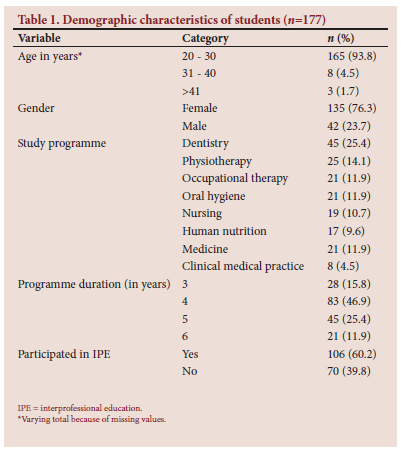
A total of 177 participants responded to the survey. The majority of participants were from the dentistry and physiotherapy programmes (25.4% and 14.1%, respectively). The mean (standard deviation (SD)) age of the respondents was 24 (4.1) years (Table 1). Most respondents (93.8%) were aged between 20 and 30 years, and the majority were female (76.3%). More than half of the participants (60%) indicated that they have prior experience with IPE.
Knowledge, attitudes and practices of IPE
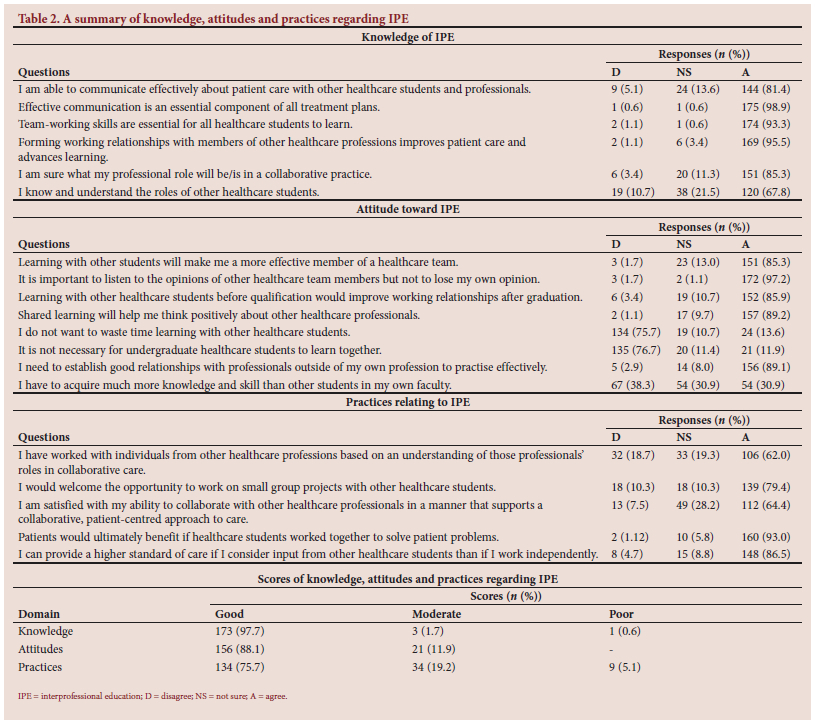
A summary of the domain-specific questions (knowledge, attitudes and practices) and the corresponding Likert-scale scores is presented in Table 2.
For the knowledge domain, almost all participants (98.9%) agreed that effective communication is an essential component of all treatment plans, and 93.3% agreed that teamwork skills are essential for all healthcare students to learn. However, only 67.8% of participants indicated that they knew and understood the roles of other healthcare students; 21.5% were unsure and 10.7% indicated that they had no knowledge or understanding of these roles.
In the attitude domain, the majority of participants agreed that shared learning with other healthcare students before qualification would improve working relationships after graduation (85.9%) and would help them think positively about other healthcare professionals (89.2%). Similarly, 89.1% agreed that they needed to establish good relationships with professionals outside their own profession to practise effectively. Interestingly, many disagreed with the statements that learning with other healthcare students was a waste of time (75.7%) and that it was unnecessary for undergraduate students to learn together (76.7%).
In the practices domain related to IPE, 62% of participants indicated that they had worked with individuals from other healthcare professions based on an understanding of those professionals' roles in collaborative care. Only 64.4% agreed that they were satisfied with their ability to collaborate with other healthcare professionals in a manner that supports a collaborative, patient-centred approach to care.
After the knowledge, attitudes and practices scores had been obtained, summary scores for the Likert scale were calculated for each domain. The results demonstrated that 97.7% (n=173) of participants had good knowledge and 88.1% (n=156) showed positive attitudes. The practice score was lower, at 75.7% (n=134), which may indicate a decline in IPE practices (Table 2).
The χ2p<0.03) and practices and prior IPE participation (p<0.02).
Additional analyses were conducted to explore associations between participants' demographic characteristics and IPE participation. The results showed statistically significant associations between both study programme and programme duration and IPE participation (p<0.01) (Supplementary Table 1). The association between IPE participation and study programme highlights the positive influence of IPE participation on attitudes toward and practices of IPE, according to the χ2
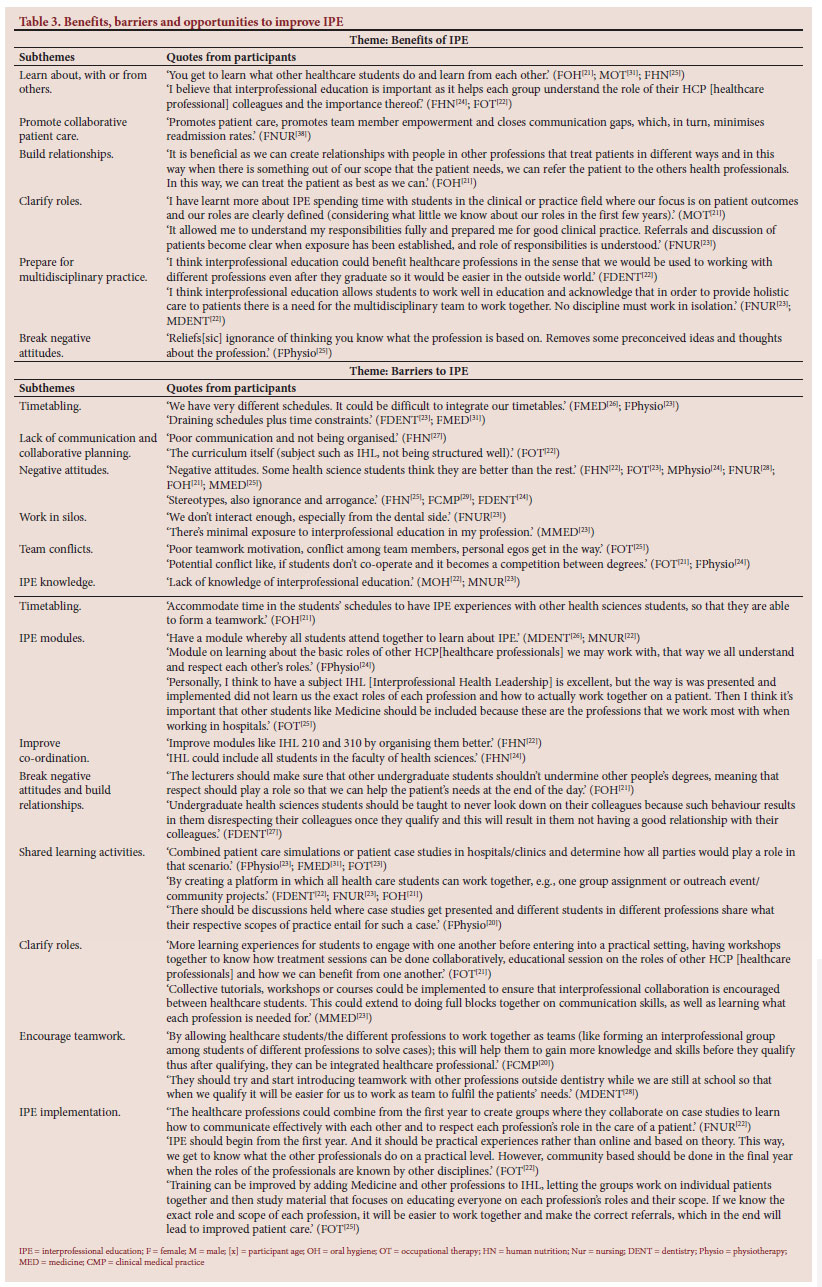
The themes arising from the open-ended questions included self-perceived benefits of IPE, barriers to IPE and opportunities to improve IPE. Comments by participants were categorised into subthemes and are presented as illustrative quotes (Table 3).
Participants' suggestions for improving IPE corroborated what they considered to be barriers to IPE. Suggestions on how the IPE programme could be improved are presented in Table 3.
Discussion
This study assessed the knowledge, attitudes and practices regarding IPE among health sciences students to provide evidence-based data on IPE at the selected university. The results revealed that participants had good knowledge and practices, as well as positive attitudes toward IPE across all study programmes, concurring with several other studies that have used similar RIPLS and IPAS scales.[1,2,11] The results also indicated that students who participated most frequently in IPE activities were enrolled in four-year programmes, including nursing, occupational therapy, human nutrition and physiotherapy. The open-ended responses suggested that these students had greater exposure to existing IPE-related modules and were able to recall previous interprofessional learning experiences. These findings suggest an association between exposure to IPE activities and more positive attitudes toward, and engagement in, IPE practices (Table 2).
Programmes with minimal IPE participation were dentistry (78%) and medicine (62%). Participants from these programmes reported limited opportunities for interprofessional interaction and expressed concerns about inadequate exposure to IPE activities. Similar findings were reported by Yune,[15] who found that medical students had less favourable perceptions of IPE than other health sciences students. The authors argued that medical students may perceive IPE as a poor use of time because of their demanding curricula and heavy academic workloads, resulting in less interest in and enthusiasm for IPE implementation. These findings are also consistent with the perceptions of dental and medical students reported by Al-Shaikh et al.[16]
Participants' experiences reinforced the established benefits of IPE outlined in the literature, including learning to work as a team, improving communication and referral practices, developing professional relationships, fostering mutual respect and preparing for multidisciplinary practice after graduation.[17,18] In addition to these benefits, participants also highlighted the potential of IPE to improve patient-centred care, reduce siloed practice and address negative attitudes toward other professions. Positive student attitudes may indicate readiness for new experiences and recognition of different learning opportunities, such as IPE.[19] This is further supported by Quartey et al.,[11] who reported that learning may improve communication skills and prevent conflict among health sciences students.[11] Participants agreed that IPE offers an opportunity to learn with and from others and provides a better understanding of the roles of other professions. However, concerns remained regarding limited knowledge of the roles and responsibilities of other professions, a finding also reported by Almalki et al.[2] This may be attributable to the limited participation of some students in IPE activities, which restricts opportunities to develop an understanding of the roles of other professions.[2]
Participants mentioned barriers similar to those reported previously, particularly timetabling clashes, limited knowledge of IPE and of roles of other professionals, poor communication resulting from isolated programmes, resistance to IPE among students and lecturers, and negative attitudes toward other professions.[20] Such barriers have been reported to hinder both the effectiveness and sustainability of IPE programmes.[19] Timetabling has been identified as one of the main barriers to IPE. Therefore, careful planning, together with support from facilitators and academic leaders, is required.[2]
Similar to other studies, most participants in this study advocated for more co-ordinated planning and the inclusion of IPE initiatives in the undergraduate curriculum.[8,21] Suggestions for improving IPE included promoting shared teaching and learning and creating platforms for collaboration in authentic settings, such as community activities and hospital rounds, where different disciplines can work together in outreach projects and patient-centred care.[19,22] Participants also proposed improving existing module activities by establishing clear and relevant objectives and enhancing the co-ordination of the existing IPE module implemented by the School of Healthcare Sciences. In addition, the inclusion of other programmes, such as medicine, dentistry and clinical associates, which are currently isolated and not part of the existing IPE module, was emphasised.
Working collaboratively with other healthcare professionals requires knowledge of their roles, as well as the ability to communicate and interact effectively with them. Depending on the vision and objectives of the curriculum, the integration of IPE may involve a blend of collaborative learning models, including classroom-, online-, hospital- and community-based teaching.[23,24] In addition, participative and experiential learning approaches have been proposed to facilitate understanding of how IPE teams function, including case-based discussions, role-plays, clinical rounds, simulations, community engagement activities and community-based projects such as home visits and visits to care facilities.[25,26]
Furthermore, several authors have articulated the need for careful planning to identify the most appropriate pedagogical approaches and topics for online teaching and learning, as well as the importance of stakeholder buy-in and adequate staff and facilitator training to ensure effective student learning. Findings from the study by Black et al.[27] suggest that an effective approach to IPE can be achieved through planning, developing and sustaining collaboration. Similarly, other authors have identified key factors for the successful implementation of IPE, including a culture that supports IPE, dedicated leadership teams, educators who embrace IPE, an interest in and willingness to learn, openness to learning from others, openness to innovation and exposure to interprofessional learning opportunities.[28,29]
Strengths and limitations
A strength of this study is its use of a validated questionnaire that was peer reviewed, piloted and used in previous studies to assess students' knowledge, attitudes and practices regarding IPE.
A limitation of this study is that, although the minimum sample size was achieved, many students from medicine and medical clinical practice did not participate despite numerous recruitment efforts. Consequently, the results should be interpreted with caution and cannot be generalised to the entire student population. In addition, the findings are limited to a single institution.
Nevertheless, the study provides evidence-based data on the IPE experiences of health sciences students at the selected university, which may inform future IPE development, implementation and research.
Recommendations
The challenges to IPE identified in this study should be explored further to inform future planning. Although barriers to the implementation and effectiveness of IPE exist, once these factors have been identified, they can be addressed through collaborative efforts and co-ordinated IPE planning. Further research is needed to explore the perspectives of other stakeholders who are essential to promoting and supporting IPE, including educators and academic leaders within the school.
Conclusion
Participants demonstrated good knowledge, attitudes and practices regarding IPE. However, they displayed gaps in their knowledge of the roles and responsibilities of other professionals, which should be addressed. Improved co-ordination of IPE activities may help strengthen existing initiatives and support their continued success. Shared learning opportunities through community-based learning, simulation, case-based learning and clinical rotations may provide opportunities for health sciences students to work together in interprofessional teams, thereby learning with, from and about one another's roles and responsibilities.
Data availability statement. None.
Declaration. None.
Acknowledgements. The authors would like to thank the students who participated in the study and the lecturers who assisted with the distribution of the questionnaires.
Author contributions.
Funding. None.
Conflicts of interest. None.
References
-
1. Yasin H, Palaian S, Shankar PR, Nallamilli S. Readiness for interprofessional education among health profession students in a university in the United Arab Emirates. J Multidiscip Healthc 2023;16:1141-1149. https://doi.org/10.2147/JMDH.S395320
» https://doi.org/10.2147/JMDH.S395320 -
2. Almalki A, Park YS, Tekian A. Needs assessment for interprofessional education: Implications for integration and readiness for practice. Healthcare (Basel) 2021;9(4):411. https://doi.org/10.3390/healthcare9040411
» https://doi.org/10.3390/healthcare9040411 -
3. World Health Organization. Framework for action on interprofessional education and collaborative practice. Geneva: World Health Organization, 2010. https://www.who.int/publications/i/item/framework-for-action-on-interprofessional-education-collaborative-practice (accessed 21 October 2021).
» https://www.who.int/publications/i/item/framework-for-action-on-interprofessional-education-collaborative-practice -
4. Grimes TC, Guinan EM. Interprofessional education focused on medication safety: A systematic review. J Interprof Care 2023;37(1):131-149. https://doi.org/10.1080/13561820.2021.2015301
» https://doi.org/10.1080/13561820.2021.2015301 -
5. Ho JMC, Wong AYL, Schoeb V, Chan ASW, Tang PMK, Wong FKY. Interprofessional team-based learning: A qualitative study on the experiences of nursing and physiotherapy students. Front Public Health 2022;9:706346. https://doi.org/10.3389/fpubh.2021.706346
» https://doi.org/10.3389/fpubh.2021.706346 -
6. Soemantri D, Findyartini A, Werdhani RA, Koesnoe S, Dahlia D. Are we ready to collaborate? The interprofessional collaborative competencies of healthcare professionals in the Global South context. Front Med 2022;9:904658. https://doi.org/10.3389/fmed.2022.904658
» https://doi.org/10.3389/fmed.2022.904658 -
7. Belrhiti Z, Van Belle S, Criel B. How medical dominance and interprofessional conflicts undermine patient-centred care in hospitals: Historical analysis and multiple embedded case study in Morocco. BMJ Glob Health 2021;6(7):e006140. https://doi.org/10.1136/bmjgh-2021-006140
» https://doi.org/10.1136/bmjgh-2021-006140 -
8. Au S. The outcomes of interprofessional education in prelicensure nursing education: An integrative review. Nurse Educ Today 2023;121:105703. https://doi.org/10.1016/j.nedt.2022.105703
» https://doi.org/10.1016/j.nedt.2022.105703 -
9. Shuyi AT, Zikki LYT, Qi AM, Lin SKS. Effectiveness of interprofessional education for medical and nursing professionals and students on interprofessional educational outcomes: A systematic review. Nurse Educ Pract 2024;74:103864. https://doi.org/10.1016/j.nepr.2023.103864
» https://doi.org/10.1016/j.nepr.2023.103864 -
10. Toassi RFC, Meireles E, Peduzzi M. Interprofessional practices and readiness for interprofessional learning among health students and graduates in Rio Grande do Sul, Brazil: A cross-sectional study. J Interprof Care 2021;35(3):391-399. https://doi.org/10.1080/13561820.2020.1773419
» https://doi.org/10.1080/13561820.2020.1773419 -
11. Quartey J, Dankwah J, Kwakye S, Acheampong K. Readiness of allied health students towards interprofessional education at a university in Ghana. Afr J Health Prof Educ 2020;12(2):86-89. https://doi.org/10.7196/AJHPE.2020.v12i2.1243
» https://doi.org/10.7196/AJHPE.2020.v12i2.1243 -
12. Norris J, Carpenter JG, Eaton J, et al. The development and validation of the Interprofessional Attitudes Scale: Assessing the interprofessional attitudes of students in the health professions. Acad Med 2015;90(10):1394-1400. https://doi.org/10.1097/acm.0000000000000764
» https://doi.org/10.1097/acm.0000000000000764 -
13. Parsell G, Bligh J. The development of a questionnaire to assess the readiness of health care students for interprofessional learning (RIPLS). Med Educ 1999;33(2):95-100. https://doi.org/10.1046/j.1365-2923.1999.00298.x
» https://doi.org/10.1046/j.1365-2923.1999.00298.x -
14. Braun V, Clarke V. Using thematic analysis in psychology. Quali Res Psychol 2006;3(2):77-101. https://doi.org/10.1191/1478088706qp063oa
» https://doi.org/10.1191/1478088706qp063oa -
15. Yune SJ, Park KH, Min YH, Ji E. Perception of interprofessional education and educational needs of students in South Korea: A comparative study. PLoS ONE 2020;15(12):e0243378. https://doi.org/10.1371/journal.pone.0243378
» https://doi.org/10.1371/journal.pone.0243378 -
16. Al-Shaikh GK, Al-Madi EM, Masood J, et al. Interprofessional learning experiences: Exploring the perception and attitudes of Saudi Arabian medical and dental students. Med Teach 2018;40(Suppl 1):S43-S48. https://doi.org/10.1080/0124159x.2018.1465180
» https://doi.org/10.1080/0124159x.2018.1465180 -
17. Makkonen A, Turunen H, Haaranen A. Social and healthcare students' competence in patient-oriented care enhanced during interprofessional practice: A scoping review. Nurse Educ Pract 2023;72:103750. https://doi.org/10.1016/j.nepr.2023.103750
» https://doi.org/10.1016/j.nepr.2023.103750 -
18. Miselis HH, Zawacki S, White S, et al. Interprofessional education in the clinical learning environment: A mixed-methods evaluation of a longitudinal experience in the primary care setting. J Interprof Care 2022;36(6):845-855. https://doi.org/10.1080/13561820.2022.2025768
» https://doi.org/10.1080/13561820.2022.2025768 -
19. Sadikan MZ, Ariffin IA. Breaking barriers, building bridges: A review of interprofessional collaboration in medical education. Int J Transform Health Prof Educ 2024;2(1):21-36. https://doi.org/10.71354/ijthpe.02.01.19
» https://doi.org/10.71354/ijthpe.02.01.19 -
20. Katoue MG, Awad AI, Dow AW, Schwinghammer TL. Interprofessional education and collaborative practice in Kuwait: Attitudes and perceptions of health sciences students. J Interprof Care 2022;36(1):117-126. https://doi.org/10.1080/13561820.2021.1884537
» https://doi.org/10.1080/13561820.2021.1884537 -
21. Berger-Estilita J, Chiang H, Stricker D, Fuchs A, Greif R, McAleer S. Attitudes of medical students towards interprofessional education: A mixed-methods study. PloS ONE 2020;15(10):e0240835. https://doi.org/10.1371/journal.pone.0240835
» https://doi.org/10.1371/journal.pone.0240835 -
22. Depasquale C, Cunningham S, Jacob SA, et al. A cross-sectional study examining the nature and extent of interprofessional education in schools of pharmacy in the United Kingdom. Int J Clin Pharm 2024;46(1):122-130. https://doi.org/10.1007/s11096-023-01655-0
» https://doi.org/10.1007/s11096-023-01655-0 -
23. Kristina TN, Asmara FY, Sudaryanto S, Nuryanto N, Bakri S. Increasing the value of community-based education through interprofessional education. Asia Pac Scholar 2023;8(2):4-13. https://doi.org/10.29060/TAPS.2023-8-2/OA2755
» https://doi.org/10.29060/TAPS.2023-8-2/OA2755 -
24. Teuwen C, van der Burgt S, Kusurkar R, Schreurs H, Daelmans H, Peerdeman S. How does interprofessional education influence students' perceptions of collaboration in the clinical setting? A qualitative study. BMC Med Educ 2022;22(1):325. https://doi.org/10.1186/s12909-022-03372-0
» https://doi.org/10.1186/s12909-022-03372-0 -
25. Chen HW, O'Donnell JM, Chiu YJ, et al. Comparison of learning outcomes of interprofessional education simulation with traditional single-profession education simulation: A mixed-methods study. BMC Med Educ 2022;22(1):651. https://doi.org/10.1186/s12909-022-03640-z
» https://doi.org/10.1186/s12909-022-03640-z -
26. Moodley I, Singh S. A case study: Promoting interprofessional community-based learning opportunities for health sciences students at the University of KwaZulu-Natal, Durban, South Africa. Afr J Health Prof Educ 2022;14(3):146-151. https://doi.org/10.7196/AJHPE.2022.v14i3.1281
» https://doi.org/10.7196/AJHPE.2022.v14i3.1281 -
27. Black EW, Romito L, Pfeifle A, Blue AV. Establishing and sustaining interprofessional education: Institutional infrastructure. J Interprof Educ Pract 2022;26(6):100458. https://doi.org/10.1016/j.xjep.2021.100458
» https://doi.org/10.1016/j.xjep.2021.100458 -
28. van Diggele C, Roberts C, Haq I. Optimising student-led interprofessional learning across eleven health disciplines. BMC Med Educ 2021;21(1):157. https://doi.org/10.1186/s12909-021-02527-9
» https://doi.org/10.1186/s12909-021-02527-9 -
29. Madhavanprabhakaran G, Arulappan J, Achora S, Alsaraireh A. Evidence-based practice competency and barriers among undergraduate nursing students in a Middle Eastern country. Teach Learn Nurs 2023;18(4):e233-e240. https://doi.org/10.1016/j.teln.2023.07.009
» https://doi.org/10.1016/j.teln.2023.07.009

Accepted 19 January 2026