Examining Migrants' Bounded Rationality in the Face of Ethiopia's Legal Responses to Irregular Migration
Abstract
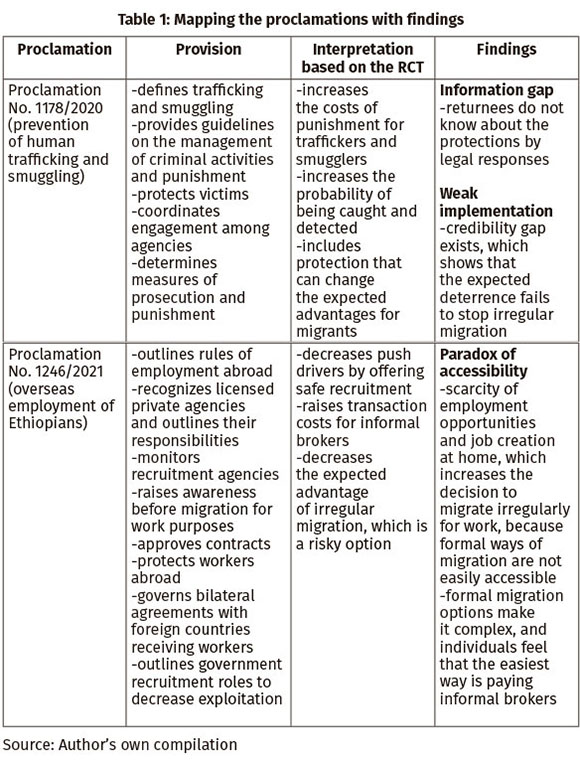
This study examines the effectiveness of Ethiopia's current legal responses in addressing irregular migration through the lens of bounded rationality. Although Ethiopia has implemented various legal responses, this study argues that these responses continue to be ineffective, because they fail to change the "cost-benefit rational decision" of migrants. Through semi-structured interviews with 18 returnees and five government officials, the findings show that Ethiopia's legal responses focus disproportionately on punishment and border control. Crucially, these responses fail to address the structural drivers of irregular migration, specifically socio-economic factors and political grievances, which potential migrants consider as riskier than the legal consequences of such migration. The study concludes that for legal responses to be effective, Ethiopia must transcend the conventional criminalizing and securitizing measures. Instead, the country should focus on creating socio-economic opportunities and formal migration pathways that can shift the rational preference of individuals away from irregular ways.
Irregular migration; Ethiopia; Legal responses; Rational choice theory (RCT); Socio-economic drivers; Migration governance