Examining Migrants' Bounded Rationality in the Face of Ethiopia's Legal Responses to Irregular Migration
Abstract
This study examines the effectiveness of Ethiopia's current legal responses in addressing irregular migration through the lens of bounded rationality. Although Ethiopia has implemented various legal responses, this study argues that these responses continue to be ineffective, because they fail to change the "cost-benefit rational decision" of migrants. Through semi-structured interviews with 18 returnees and five government officials, the findings show that Ethiopia's legal responses focus disproportionately on punishment and border control. Crucially, these responses fail to address the structural drivers of irregular migration, specifically socio-economic factors and political grievances, which potential migrants consider as riskier than the legal consequences of such migration. The study concludes that for legal responses to be effective, Ethiopia must transcend the conventional criminalizing and securitizing measures. Instead, the country should focus on creating socio-economic opportunities and formal migration pathways that can shift the rational preference of individuals away from irregular ways.
Irregular migration; Ethiopia; Legal responses; Rational choice theory (RCT); Socio-economic drivers; Migration governance
BACKGROUND
Irregular migration remains a critical issue of the twenty-first century, deeply rooted in global economic inequality, social expectations, governance failures, and the rise of migration-restricting policies (Barnes et al., 2023). In Africa, particularly within the Horn of Africa (HoA), the situation has escalated significantly, positioning the region as a source and transit zone for migrants heading to the Gulf States, Europe, and South Africa (Fusari, 2018). Ethiopia stands out in this context as a major contributor of migrants to the Gulf States (Kodama, 2024) and a key transit and return point (Tjaden and Gninafon, 2022). This phenomenon is fueled by a complex interplay of socio-economic, political, and structural factors that disproportionately affect the youth (Shewamene et al., 2022).
In response, the Ethiopian government has implemented legal responses aimed at combating human trafficking and regulating recruitment agencies. These measures are designed to align with international standards, including the United Nations Palermo Protocol (UN, 2000), which targets smuggling and trafficking. Despite these efforts, irregular migration to the Gulf States and Europe persists alarmingly (Adem and Ebrahim, 2020), signaling a significant disconnect between governmental responses and the deeply entrenched drivers (Shewamene et al., 2022). Research indicates that punishment, border control, and sanctions are largely ineffective at curbing irregular migration (Gammeltoft-Hansen and Tan, 2017; Tufa, 2019).
Irregular migration across various countries can be attributed to the inadequacy of current responses to drivers such as unemployment and social pressures (Schurmann et al., 2022). In Ethiopia, young individuals continue to migrate irregularly despite their awareness of risks, driven by diverse motivations (Schewel and Fransen, 2018).
Many studies on irregular migration in Ethiopia emphasize drivers of migration. Among others, socio-economic drivers of migration (Kebu et al., 2023; Weldu et al., 2025), climate change (Mayer et al., 2023), political instability (Shewamene et al., 2022), and what Megersa and Tafesse (2024) identified as a culture of migration in which social networks change irregular migration into a normalized household coping mechanism. Several other studies deal with the descriptive legal analyses (Minaye, 2012; Woldemichael, 2017; Adem and Ebrahim, 2020). However, most of these legal studies on migration focus on a simplistic interpretation of human trafficking and smuggling of persons. Moreover, they often neglect to consider the migrants' agency, such as the process and power of individual and collective decision-making, which this study calls a "bounded rationality"-a rational choice that is constrained by multiple factors. To bridge this gap, this study emphasizes the intersection of the state's legal responses and migrants' decision-making power. The article examines how the current legal responses influence the rational deliberations of those considering irregular migration as an alternative pathway. To do this, the article examines: first, the efficacy of the current legal frameworks in reducing or eliminating irregular migration, and second, the intersections of migrants' rational decision-making processes and the enforcement of the legal measures. Efficacy is conceptualized based on Czaika and De Haas's (2013) framework, which distinguishes between the efficacy gap and the implementation gap. The study argues that it cannot be reduced to a simple binary of success versus failure. Therefore, it considers the contribution of the legalistic responses in curbing irregular migration and the agency of the migrants in navigating the complex legal and securitized landscape.
BOUNDED RATIONALITY VERSUS LEGAL RESPONSESRational choice theory (RCT) considers migration a decision-making process in which migrants rationally weigh expected advantages, such as high income, against risks and costs, such as debt, abuses enroute, exploitation, and deportation. It states that individuals decide to migrate, calculating the cost-benefit by choosing alternatives that meet their expectations based on the available information and limitations (Roca Paz and Uebelmesser, 2021). In this article, however, by addressing the philosophical debate that rationality is a concept relative to space and time, the authors overcome the economic conception of rationality. Migrants' decisions are shaped not only by rationality but also by subjective perceptions and emotions based on the conditions in which the migrants and their families make the decisions-this is bounded rationality.
In the Ethiopian context, such subjective rationality is shaped by unequal access to information and operates within powerful socio-economic and political drivers of migration. Under such conditions, aspiring migrants commonly engage in what Max Weber (1978) conceptualized as the rationalization of the irrational, which is the individuals' justification of the risky migration decision. Minaye and Zeleke (2017) maintain that potential migrants overlook risks and consider positive attitudes to migrate irregularly. This study considers migration as a phenomenon that does not always depend on value-rationale (Weber, 1978) but is driven by personal responsibilities to assist parents or to flee a miserable life at home. While some aspirations, like the improvement of social status through education, were traditionally fulfilled through regular forms of migration, the limited access to these formal ways drive individuals to resort to irregular migration practices. This creates a semi-legal conundrum in which the boundary between regular and irregular migration has become blurred, as migrants pursue regular goals via informal ways, when there are high institutional restrictions (Debonneville, 2021).
These decision-making processes are informed by the disparity between existing legal responses and the reality of the migrants on the ground. These processes also highlight the efficacy gap, which is the extent to which these responses change the subjective perceptions of migrants. This article foregrounds the importance of understanding the decision-making rationalities of migrants and their families, despite these processes being constrained by multiple factors. In this context, the effectiveness of legal responses largely depends on their capacity to render regular migration pathways accessible and attractive options rather than primarily focusing on securitized legal regimes.
DETERRENCE PARADIGM IN THE GLOBAL AND REGIONAL LEGAL RESPONSESIn Africa, challenges like conflict, weak governance, and economic hardship foster irregular migration (IOM, 2019). In response, many governments have implemented strict punitive laws (Tufa, 2019). This approach, known as the "deterrence paradigm," has led to increased pressure from the global community to combat human smuggling and trafficking (Gammeltoft-Hansen and Tan, 2017). Frasca (2023) explored how the European Union's (EU's) externalization policies and the Palermo Protocol influence African migration governance, emphasizing security and anti-smuggling. Bish et al. (2024) highlight how donor countries, along with major bodies such as the International Organization for Migration (IOM), the United Nations Office on Drugs and Crime (UNODC), and the EU have opted for legal responses to smuggling and trafficking in transit and coastal nations.
Additionally, European countries consider security, anti-trafficking, and smuggling as issues affecting them and thus influence the reshaping of national legal responses to irregular migration from Africa (Maher, 2017). Okunade et al. (2024) note that irregular migration from Africa to Europe continues despite ongoing efforts in Africa to contain it. Governments focus on punishment, believing that consequences like arrest and deportation will deter irregular migration. Similar measures focusing on punishment and border control in northern African transit countries, such as Tunisia and Morocco, have had mixed outcomes, often increasing migrants' vulnerability without effectively addressing irregular migration. In Morocco, strict border policies have trapped many migrants in challenging conditions due to the EU's externalization policies (Gross-Wyrtzen, 2020). Similarly, Tunisia's outdated laws classify individuals as "illegal," and unclear security measures worsen their vulnerability and fail to tackle poverty (Parikh, 2023). Further, Meddeb and Louati (2024) note that these measures have not reduced migrant numbers but rather increased their risk of exploitation, highlighting that enforcement-focused policies cannot address the root causes of migration. It is evident that punitive policies fail to achieve the expected goals because they fail to address the drivers of migration (Mesnard et al., 2024).
Ethiopia has implemented reforms like Proclamation Nos. 1178/2020 and 1246/2021, aimed at combating trafficking and informal recruitment, which include victim protection, agency cooperation, and legal prosecution (Busza et al., 2023). It also ratified international conventions such as the International Labour Organization (ILO) Convention on Forced Labor and the UN Palermo Protocol (Woldemichael, 2017). Strategies include punishing informal brokers (Tufa, 2019), considering travel bans (ILO, 2022), regulating recruitment agencies (Gezahegne and Bakewell, 2022), and raising awareness among potential migrants (Busza et al., 2023).
However, the irregular migration persists due to gaps in implementation, lack of inter-agency cooperation, and a disconnect between policies and the root causes of migration (Gezie et al., 2021). Efforts to punish informal brokers and impose restrictions often drive migration underground, increasing migrants' vulnerability (Soto-Nishimura, 2023). Strict laws focused on enforcement do not change migrants' perceptions of migration's benefits nor provide alternatives to discourage irregular migration (Johnson et al., 2021).
Responses to irregular migration have been explored in various African countries. In Nigeria, the National Agency for the Prohibition of Trafficking in Persons has implemented measures and public awareness campaigns but has not effectively addressed the underlying causes, particularly in Benin City (Akhigbe and Effevottu, 2023). This indicates that enforcement alone is insufficient without efforts to enhance livelihoods and economic conditions. Albert-Makyur and Mbanaso (2022) highlight the governance challenges that Nigeria faces in dealing with irregular migration, including the risks of human trafficking along migration routes.
DRIVERS OF MIGRATION AND MIGRANTS' RATIONALITY
Although the Ethiopian government enforces strict measures to stop irregular migration from the country, youth continue to migrate irregularly. They decide to migrate, not out of ignorance, but by making rationally calculated decisions, assuming the benefits of migration over its risks. RCT is an essential lens through which to explain this situation, whereby individuals strive to maximize personal gain on the basis of a cost and benefit analysis (Klabunde and Willekens, 2016). Migration decisions are influenced by expectations of better employment and living conditions abroad, but risks such as financial loss and exploitation can deter individuals from moving (Huber and Nowotny, 2020). While individuals expect improved opportunities, the associated costs and uncertainties can discourage migration (Roca Paz and Uebelmesser, 2021).
Studies indicate that measures to reduce irregular migration, like punishment, are ineffective without addressing migration's root causes (Tjaden and Gninafon, 2022; Mesnard et al., 2024). Mesnard et al. (2024) highlight that externalization policies often lead individuals to riskier routes rather than curbing migration. Tjaden and Gninafon (2022) found that awareness programs in Guinea and Senegal amplified migration risks and slightly reduced migration plans, but many still pursue migration for its perceived benefits.
Moreover, expectations from families and social norms influence the belief in migration as a possible way out of a miserable life in the home country. The rationale is to fulfill socio-economic needs and moral obligations (Schewel and Fransen, 2018). Although Schewel and Fransen (2018) indicate that migration from Ethiopia is driven by family expectations and the desire for improved status, with education through scholarships seen as a key factor, this study argues that these social pressures and desires for the improvement of life drive individuals to irregular migration as a rationale. Assfaw and Minaye (2022) explain that individuals do not decide to migrate based on their personal desires, because their choices are determined by subjective social norms and the community at large.
Frameworks that focus on restrictions may increase irregular migrations, because migrants seek assistance from informal brokers and smugglers to circumvent the bureaucratic process (Tufa, 2019). Tufa (2019) argues that punishment and the enforcement of laws that fight brokers fail to avoid demand, because when formal methods are limited in terms of access, youths and their families continue to rely on informal brokers to assist them. The Ethiopian government's measures against irregular migration result in covert migrations, suggesting that current legal responses are merely symbolic, failing to address socio-economic limitations.
Experiences outside Ethiopia highlight the challenges of irregular migration. In Bangladesh, restrictive recruitment policies have led to the rise of informal migration, as migrants rely on brokers for transport and visas when formal options are limited (Babbitt et al., 2023). Similarly, in the Philippines, economic hardship and weak legal protections push migrants to use informal channels, leading to vulnerabilities and semi-legal activity (Debonneville, 2021). Migrant choices reflect both rational decisions and institutional realities.
LEGAL RESPONSES IN ETHIOPIA: IMPLEMENTATION AND EFFICACY GAPS
Research in the HoA indicates that strict border enforcement does not deter migration. Gammeltoft-Hansen and Tan (2017) found that individuals weigh opportunities in destination countries despite barriers. Similarly, Weldu et al. (2025) note that youth in Tigray choose to migrate due to economic hardship and limited livelihood options. These studies highlight that migration decisions, whether regular or irregular, are often rational, especially in contexts of scarce opportunities.
In Ethiopia, attempts to curb irregular migration, such as banning informal brokers and imposing travel restrictions, address unsafe routes and recruitment practices (Shewamene et al., 2022), yet they fail to tackle the root drivers of migration (Kodama, 2024). For instance, a 2013 ban on women's migration aimed to reduce exploitation but did not address family pressures or labor demand (Dori et al., 2024). Similarly, punishing brokers targets individuals rather than the broader socio-economic factors driving secret migration (Busza et al., 2023). This framework is important because it highlights the gap between the objectives of the response and the results. In the context of RCT, individuals calculate the benefits and risks of migration. Thus, bans on migration do not eliminate migration incentives (Rosina, 2024).
In Ethiopia, from an RCT perspective, when individuals experience unemployment and limited access to formal ways, they consider that they have little to lose if they migrate, and migrating on risky routes appears to be their rational choice (Eshetu et al., 2023). Shewamene et al. (2022) note that since formal agencies are located in urban areas and formal ways are difficult to access, informal methods of migration are easily understood; hence, irregular migration becomes a simple option. Migration, including rural out-migration, often happens due to limited access to land, employment, irrigation, and public services.
PROCLAMATION NO. 1178/2020: PREVENTION AND SUPPRESSION OF HUMAN TRAFFICKING AND SMUGGLING
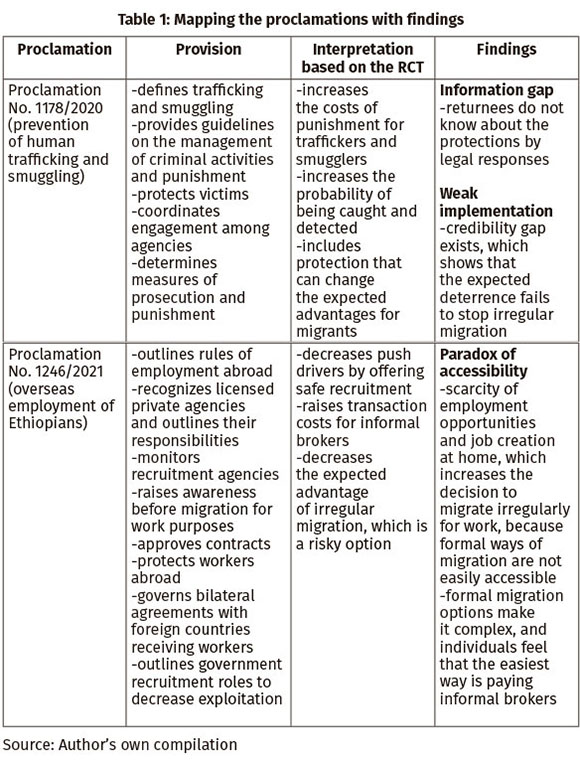
Proclamation No. 1178/2020 replaces Proclamation No. 909/2015 and aims to combat human trafficking and smuggling through a punishment-focused legal framework. It includes measures for prevention, protection, and prosecution of related crimes. Structurally, it consists of 50 articles across seven sections, covering definitions, offenses and penalties, the National Council's role in police oversight, victim support through rehabilitation and compensation, and the protection of workers abroad (FDRE, 2020).
The proclamation defines trafficking and smuggling as crimes against humanity, with punishments for those who commit or assist in these actions. It focuses on punishment while establishing protections and support for victims, including services, rehabilitation funds, temporary stays, and cooperation between government and organizations (FDRE, 2020). This highlights its dual purpose of penalizing these crimes and enhancing victim protection.
However, this proclamation does not comprehensively address the push factors driving irregular migration. It is about recruitment rules, working conditions, and victims in theory and practice, yet prevailing push factors such as unemployment, poverty, and the absence of proper channels for migration are left untouched. Simply put, it treats symptoms, ignoring the main drivers. The reason for this practice is that the proclamation was enacted to regulate specific activities instead of addressing the structural socio-economic problems, such as poverty and unemployment. As a result, it does not promise job creation initiatives or rural development mechanisms, resultantly leaving the main drivers of irregular migration unaddressed.
In addition, awareness campaigns targeting norms, beliefs about migration, and information on irregular migration often fail to bring about real change. The proclamation and other related efforts in Ethiopia focus on controlling human trafficking and smuggling as the main problems. However, they are almost oblivious to the socio-economic factors that trigger irregular migration (Gezie et al., 2021; Sisay, 2024). Therefore, it can be concluded that the proclamation, on its own, does not address the issues that cause individuals to engage in irregular migration. RCT assumes that traffickers and smugglers act as rational actors based on potential gains and losses (Giannini and Di Filippo, 2019). Accordingly, the government tries to change individuals' decisions by publicizing information about the punishment for irregular migration and increasing the implementation of existing legal responses.
This aims to change their rational calculation, as it increases the expected risks and costs of irregular migration.
Regarding the recruitment of migrants, the proclamation complicates the process because it demands that agents have a government license and a formal business office with an open location. This makes it more difficult and costly for informal brokers and agents to operate. This forces informal brokers to work secretly with low costs and hidden locations. While it aids victims in accessing financial support, it does not fully address the socio-economic drivers of irregular migration, such as unemployment and poverty, as it primarily focuses on punishing brokers, smugglers, and traffickers. Consequently, many individuals in Ethiopia still view the risks of irregular migration as worthwhile. From an RCT perspective, effective implementation of the proclamation could deter some migrants from attempting irregular migration by increasing apprehension about being caught and the challenges of successful migration (Wang and Pei, 2019). However, RCT suggests that human traffickers become involved in trafficking based on expected benefits against being caught.
If the implementation of laws is weak and inconsistent, smugglers and traffickers will not fear punishment, as they perceive the likelihood of being caught and convicted as low. A report by the U.S. Department of State (2024) indicates that human trafficking convictions are rare due to witness non-cooperation, highlighting the law's ineffective deterrent role. Consequently, those facilitating irregular migration adapt to this weakness, leading to more covert routes, increased migration costs, and rising exploitation and abuse.
Furthermore, gaps exist in the proclamation, as it is not designed to address economic hardships; thus, it does not link job opportunities to better income options at home. Because migration through irregular ways seems preferable, the advantages of acting against the law remain the same. It is a highly punishment-focused law intended to punish informal brokers, traffickers, and smugglers, but its implementation is insufficient, as it does not guarantee they will be caught and punished.
PROCLAMATION NO. 1246/2021: ETHIOPIA'S OVERSEAS EMPLOYMENT (AMENDMENT) PROCLAMATION
Proclamation No. 1246/2021 was established by replacing Proclamation No. 923/2016. Proclamation No. 923/2016 is known as the Overseas Employment Proclamation, because it aims to protect Ethiopians migrating for work abroad, with particular emphasis on domestic workers (ILO, 2017). It introduced new activities, such as pre-departure training, licensing for agencies that recruit and control them, and bilateral labor agreements, with a focus on protecting workers and reintegrating returnees (FDRE, 2021).
This amendment aims to address gaps in the implementation process, including tougher enforcement for agencies created to hire migrants, penalties for unlicensed agents, and enhanced cooperation. There is also a widening role for the Ministry of Labor and Skills for better monitoring of recruitments (ILO, 2017).
This proclamation, because it is punishment-focused, makes such punishment very difficult to enforce in the context of trafficking, smuggling, and informal recruitment. Punishment includes long prison sentences and high fines for individuals and agencies involved in these activities (see Article 15 (d)F and (e) of the FDRE 2021 Proclamation). In other words, it is punishment-focused and imposes strict penalties (Busza et al., 2023).
However, it falls short in addressing the root causes of irregular migration. While it aims to control informal recruitment and ensure safer migration practices (see Article 15 (d)), such as regulating recruitment agencies and establishing training rules, it does not address the deeper reasons driving individuals to migrate irregularly (Shamebo and Zewde, 2022). The strict guidelines are often poorly implemented due to corruption, ongoing informal practices, and persistent socio-economic challenges, showing that the existence of these proclamations alone does not deter irregular migration (Nigusie, 2022).
Since individuals decide to migrate irregularly based on their subjective experiences and success stories, they weigh the benefits and costs of migration and decide to migrate irregularly if the perceived benefits outweigh the costs. So, instead of making rational decisions, they decide to migrate irregularly, regarding expensive and risky migration as a reasonable choice. Proclamation No. 1246/2021 alters this practice by increasing penalties for informal brokers and smugglers, making irregular migration riskier and more expensive. It also imposes stricter licensing requirements for formal recruiters, complicating their operations. The proclamation aims to promote safe, formal migration pathways through licensed agencies and bilateral agreements for work migration.
Despite legal proclamations against irregular migration, many individuals continue to pursue it, as they believe the chances of being caught are low. The perceived benefits of irregular migration often outweigh the risks, especially given the difficult circumstances at home and better opportunities abroad (Barako, 2022). Even as penalties increase, informal brokers, smugglers, and traffickers adapt by operating covertly and charging higher fees, which does not deter migrants from seeking irregular routes. While legal responses may slow down irregular migration, they are unlikely to eliminate it. The existing laws focus on punishing individuals and unlicensed recruiters, failing to address the root causes driving migration (Busza et al., 2023).
From the bounded RCT perspective, this measure fails to make formal migration accessible, instead pushing individuals toward high-cost informal routes. Consequently, irregular migration, especially to the Gulf States, persists (Kodama, 2024). The proclamation has a dual focus: increasing penalties for irregular migration and informal brokers, while also implementing regulations to control formal migration. Though it aims to strengthen official systems, punishment alone does not curb irregular migration (Tufa, 2019). Additionally, issues such as poor coordination and corruption hinder the execution of existing responses, leaving the root causes of irregular migration unaddressed (Gezie et al., 2021).
The interface of Proclamation Nos. 1178/2020 and 1246/2021 provides a dual-track mechanism. While the first one aims at protecting migrants from various forms of exploitation, the second aims at monitoring formal labor migration. However, practically, the strict rules of the license and the requirements for high finance under the second proclamation make formal migration challenging. To this end, it has limited access to formal migration ways and created what Czaika and De Haas (2013) term implementation gaps.
From an RCT perspective, migrants are highly inclined to approach informal brokers when formal ways of migration are costly, inaccessible, and complex to access (Tufa, 2019; Nigusie, 2022). In other words, such a mechanism intended to stop irregular migration may unintentionally drive individuals toward it. Accordingly, unless formal ways of migration are proven to be faster, easily accessible, and more advantageous than irregular ones, Ethiopia's current proclamations will continue to be more symbolic than effective (Kodama, 2024; Rosina, 2024).
Moreover, weak cooperation among institutions in Ethiopia makes irregular migration worse. For instance, weak cooperation between the Ministry of Labor and Skills and the Ministry of Justice may create protection gaps, which leaves room for informal brokers to continue facilitating migrants' journeys secretly by making themselves assistants and consultants by avoiding formal rules and punishment (Busza et al., 2023; Gezie et al., 2021). Furthermore, formal migration generally requires education, training, and time, which several young people from rural Ethiopia may not have, notably when they are constrained by limited finances. Given this scenario, Ethiopian migrants may prefer easily accessible informal ways, although they know that they are risky. Therefore, by using bounded rationality, this study argues that irregular migration from Ethiopia continues because of a rationality gap-legal responses focus on punishment and controlling migration, yet they fail to address how migrants make decisions based on the challenges they encounter (Schewel and Fransen, 2018; Eshetu et al., 2023).
METHODS
Research approach
Although RCT primarily employs qualitative modeling to measure utility, this study used a qualitative framework of bounded rationality as a guide to evaluate Ethiopia's current legal responses intended to address irregular migration. Hence, this shift does not provide a quantitative approach, because it focuses on the subjective interpretation of irregular migration risk, which is driven by pressures at home. This approach is important for addressing how existing laws are effective in addressing structural and behavioral factors driving irregular migration from Ethiopia. A qualitative approach can be used to investigate participants' perspectives in detail and to examine how different types of proclamations and policies are designed to manage migration and to evaluate their implementation (Maxwell, 2013). In addition, it helps to collect rich information and context-based qualitative data. To this end, the study merged an analysis of documents of three selected proclamations and codes with semi-structured interviews conducted with returnees and government officials.
DATA COLLECTION INSTRUMENTS AND PROCEDUREThe study collected primary data and consulted secondary data. It conducted semi-structured interviews with returnees and government officials (lawmakers and enforcers), using a detailed guiding protocol. To ensure the safety of participants and the integrity of the data, the interviews were conducted in private and neutral settings, notably private offices for officials and secured community space for returnees to provide a confidential environment for an open information exchange. The interviews were conducted from January to December 2023, each lasting 50 to 60 minutes. Interviews were recorded with participants' consent, and the transcripts were prepared later. In addition, legal documents (proclamations) were sourced from secondary sources. Proclamations were reviewed using qualitative content analysis to identify articles related to punishment of irregular migration, human smuggling, trafficking, protection of the rights of workers, and the integration of socio-economic drivers of migration. Because the study assesses the implementation and efficacy gaps of Ethiopia's current legal responses, it gathered secondary data from peer-reviewed scholarly articles and official reports from the IOM, ILO, and U.S. Department of State. These were used to triangulate the interview data, as it provides a documented benchmark of migration trends and international legal standards to make a macro-level analysis of Ethiopia's legal responses. This triangulation ensures the dependability and credibility of the findings by comparing the subjective bound experiences of returnees and officials' perspectives against these benchmarks and legal standards.
Sampling technique
This study used a purposive and snowball sampling technique to choose participants with relevant knowledge and lived experience of migration control and awareness of the dynamics of irregular migration. Purposive sampling was important to identify rich information cases, notably those directly involved in the making and implementation of laws governing migration. Subsequently, the snowball sampling technique was used to extend the sample size by which initial participants suggested others in their network who had similar experiences in irregular migration. This technique enabled access to participants who were difficult to reach because of the sensitive (irregular nature of migration) experience, the issue of trust, and stigma. The study was conducted at the national level with primary data collected in Addis Ababa, the capital of the country. The capital was chosen as the main study setting, as it hosts the main institutions responsible for migration-related issues and law-making and implementation organs of the government. In addition, the capital serves as the main center for returnees, including those forced to return via international organizations and formal government programs. However, many returnees who participated in this study were from migration-prone areas in the Amhara region. This required the study to capture irregular migration experiences beyond the capital. On this basis, 23 participants-18 returnees and five government officials-were chosen. The integration of the above sampling techniques enabled researchers to incorporate institutional perspectives and lived experiences, which enhanced the depth, contextual richness, and credibility of the collected data.
Data analysis
The research team analyzed the data using thematic analysis to identify patterns and themes. While some themes were analyzed deductively on the basis of the RCT, others emerged directly from the primary data collected through semi-structured interviews (Braun and Clarke, 2006). In so doing, a codebook was used to explain these themes, including the time needed to use them, so that coding was organized. Thereafter, patterns that occurred between the proclamations and the interviews were compiled in tables (see Table 1) to show the perspectives from both the participants and a legal standpoint.
FINDINGS
This study found that Ethiopia's legal responses to irregular migration, particularly Proclamations Nos. 1178/2020 and 1246/2021 are ineffective, as they focus on punishment rather than addressing root causes, such as poverty and unemployment. These punishments increase migration risks and make staying at home less advantageous, ultimately failing to reduce irregular migration.
Punishment and implementation-focused response
The findings show that despite the prevalence of legal responses, implementation is inconsistent due to resource constraints, which affects the effectiveness of punishment based on the logic of the RCT. A government official remarked,
Our laws are strong. However, they are weak in implementation. Limited conviction, the prevalence of a limited rate of conviction, and lack of witnesses decrease effective implementation. (GO2, May 09, 2023).
Another added,
Because our strict laws are not properly implemented, [irregular] migration continues. (GO1, April 17, 2023).
Another official supported this, saying:
Since our laws provide ways of controlling [irregular] migration, we need to strictly work on controlling our border and illegal brokers. If laws are properly implemented, we can decrease it. (GO5, December 01, 2023).
The participants noted that legal responses are not effective in deterring individuals and stopping them from irregular migration, as informal brokers and other smugglers assume the prevalence of a low chance of being caught and punished. They noted that responses are not effectively implemented and do not address the main factors that influence individuals' preferences for irregular migration. Government officials explained that "irregular migration is illegal" and has resulted in the activities of smugglers and informal brokers being conducted in secret. According to them, this made migrants highly vulnerable and migration more costly. They consistently remarked that legal responses fail to decrease the number of irregular migrants. Notably, they stated that Ethiopia's legal responses focus on punishment, as they emphasize arresting unlicensed brokers, smugglers, and traffickers.
The participants' accounts also show that even when punishment is implemented, the government targets supply-side actors, such as unlicensed brokers, smugglers, and traffickers. From an RCT perspective, the narrower focus on punishment creates an efficacy gap, as it fails to change the migrants' cost-benefit calculations. Accordingly, legal responses are implemented as a weak deterrent, because the bounded rationality of these migrants remains focused on the expected benefits of migration, instead of the legal risks. This is considered as being externalized to informal brokers instead of migrants considering the risks.
The continuation of irregular migration despite legal responses
The findings reveal that, despite existing legal responses, many individuals continue to migrate irregularly on risky routes. The findings indicate the gap between awareness of legal responses and deterrence. Most of the returnees explained that they were already aware of the existing responses but decided to migrate due to economic hardship and social pressure at home. Their knowledge of legal responses failed to change their decision-making. A returnee said,
I knew it was against the law, but I have chosen to face the risks instead of suffering and dying being unemployed. (RT1, January 5, 2023).
Another substantiated this, saying:
Are laws designed to punish the poor? I want laws that can help me obtain jobs and a safe life. Because they could not do so, I migrated to search for better jobs, as most individuals did. (RT12, June 13, 2023).
In light of bounded rationality, this implies that legal responses fail to stop individuals from irregular migration, because their miserable lives at home matter more than legal risks. Another participant confirmed this:
I went because my family had no means to support me. They pushed me to migrate, like friends in the neighborhood, because I had no job. (RT2, January 05, 2023).
Migrants' fear of punishment and sanctions is overshadowed by economic drivers and the prospect of remaining unemployed. Thus, the legal responses do not work effectively, because they are not aligned with individuals' real-life experiences at home.
Interviews with government officials also corroborated the failure of deterrence. They recognized that although legal responses are technically in place, they fail to change individuals' decisions to migrate. An official noted,
We have laws to punish unlicensed brokers. However, they cannot address the increasing unemployment and economic problems that push individuals to migrate. (GO4, November 21, 2023).
Another official added,
By using laws only, we cannot stop irregular migration. I believe that bringing job opportunities can at least decrease the number of migrants. (GO3, November 20, 2023).
From the perspective of assessing legal responses, this highlights a significant efficacy gap, as the laws remain symbolic rather than effective. It is evident that these governmental responses do not address the drivers that push individuals to migrate. Resultantly, people consider punishment as a risk and do not change their decisions to embark on irregular migration.
Disconnect between legal responses and socio-economic drivers
The findings reveal that legal responses intended to control irregular migration are not aligned with Ethiopia's development plans, particularly in terms of employment opportunities. According to a government official, the country's efforts to prevent irregular migration are not aligned with the basic needs of people in areas most affected by irregular migration:
Our laws are not human-centered, as they do not prioritize the socio-economic problems of the people. Instead, they focus on punishing them if they migrate irregularly. (GO4, November 21, 2023).
The RCT suggests that without effective legal avenues at home, people view irregular migration as their only option to escape a difficult life. According to the participants, legal responses do not effectively address the main drivers of irregular migration. Notably, returnees mentioned that increasing unemployment, economic hardship, poverty, family pressure, and a belief in success through migration pushed them to migrate irregularly. Many of them also warned that they would again migrate irregularly if the government failed to improve their economic circumstances. They confirmed that they received little support upon returning home, which led them to consider irregular remigration.
In response, government officials stated that although Proclamation 1178/2020 contains provisions to support and assist victims of trafficking, implementation is limited. Officials also reported that government organs, including ministries and local administrations, do not work in effective coordination, which has an impact on the effective management of migration. They also remarked that this weakens the country's efforts to prevent irregular migration.
Returnees confirmed that programs designed to raise awareness about migration were implemented after their migration. One of them said,
I heard that the government informs people about the disadvantages of [irregular] migration, after leaving my country. (RT9, May 08, 2023).
Another confirmed this, saying:
It is after most of us migrated that the government tried to inform us about the risky nature of [irregular] migration. (RT11, June 02, 2023).
According to the RCT, individuals will continue to choose irregular migration despite the risks, unless legal responses create opportunities for them to remain and work at home.
Gaps in perception and rational calculation
The findings show that most individuals who decided to migrate irregularly were aware of the risks. In fact, they compared two separate risks: the risk of staying at home without a bright future and the expected risk during irregular migration. This returnee's context suggests that their risk-taking was a deliberate decision, because they felt that they were in a situation of relative deprivation:
I have tried to achieve my dreams through migration, although I am deported. I know very well that I have nothing here. (RT8, April 16, 2023).
Another added,
I knew what would happen to me, but it would not be riskier than suffering and dying here with my family. At least there is a chance outside this country. (RT14, July 27, 2023).
Another further explained:
The government told us not to make [irregular] migration, but it does not give us employment opportunities. Therefore, I decided to migrate, although I know the risks on the route. It is better than dying here. (RT13, July 27, 2023).
So, returnees' migration is not irrational, but a good enough choice. They believe that the opportunity to improve their economic circumstances is more important than legal risks. Returnees' accounts show that risk is part of their irregular migration rather than a form of punishment, indicating that their rational calculation prioritizes anticipated advantages over risks and punishment.
From an RCT point of view, individuals make rational decisions, as they anticipate the advantages of migrating irregularly to make their dreams come true through securing a good job with better payment and sending a remittance home, more than the risk of being caught and punished. An official explained this as follows:
I think we could not stop migrants unless we meet their needs at home. (GO1, April 17, 2023).
A returnee agreed:
Unless the government creates jobs and improves our lives [at home], I will migrate again when I get a suitable chance. (RT15, September 14, 2023).
An official supported this claim:
We need to provide available opportunities for safe migration by giving migrants proper training. (GO5, December 01, 2023).
These accounts of returnees' decisions to remigrate reveal a serious problem, because existing legal responses as well as conditions at home are too weak to support job creation. Although some respondents suggested starting their own business, other returnees felt that this would be impossible without access to loans, access to markets, and improved state support. This highlights respondents' views that their decisions to migrate were not because of their denial of opportunities at home.
In contrast to the returnees' accounts and those of four government officials, another official attributed irregular migration to misinformation. He said,
Most of the migrants do not know the risks of [irregular] migration. I believe that if they had enough information, they would not migrate [irregularly]. (GO3, November 20, 2023).
According to several officials, this is the result of a disconnect between legal responses and migrants' rational choices. Based on the RCT, until the core factors of irregular migration are addressed and appropriate channels for migration are provided, individuals will continue to find it more advantageous, despite the punishing legal measures.
DISCUSSION
This study assesses the effectiveness of Ethiopia's current legal responses in relation to irregular migration using an RCT framework. The findings show that the legal system responds punitively, implying that irregular migration is considered an offense, rather than addressing its drivers. Migration is perceived by individuals as a subjective rational decision that is informed by the socio-economic drivers, rather than the law. Consequently, the issue of irregular migration has not been addressed by the existing policies. Other studies concur that official responses that inspire hope, capacity (De Haas, 2021), poverty alleviation, and opportunities, rather than strict policies, influence and drive migration (Kebu et al., 2023).
Irregular migration decisions and RCT
According to the RCT, individuals decide to migrate irregularly, prioritizing the anticipated advantages over the costs (risks) and increasing their expected utility when they encounter certain limitations (Addeo et al., 2023). However, this study finds that such calculations are bounded by limited information and social pressure. This means that irregular migration is a rational reaction to challenges at home (Johnson et al., 2021). As a result, legal responses that may restrict or prohibit migration that allows working abroad are intended to shift such calculation of utility by increasing the costs and decreasing the advantages of such migration (Rosina, 2024).
Nevertheless, the findings show that legal responses have not changed how individuals think about migrating irregularly, as the returnees asserted that their acts of irregular migration were value-rational choices (Weber, 1978). Legal responses do not prevent individuals from migrating irregularly, given that poverty and social expectations continue to shape their decisions. These problems make irregular migration a rational choice for many individuals in Ethiopia, regardless of the challenges along the routes.
Limitations of the punitive legal response to irregular migration
Ethiopia's current legal responses to irregular migration focus mostly on punishment. These responses align with international conventions against human trafficking and smuggling, which primarily emphasize arresting criminals instead of addressing the main drivers of irregular migration (Nigusie, 2022). The responses, notably Proclamation No. 1178/2020, were intended to punish unlicensed informal brokers, smugglers, and traffickers. Proclamation No. 1246/2021 similarly focuses on identifying and punishing private employment agencies if they are not licensed (Busza et al., 2023). Legal responses outline the formal steps to be followed by government organs responsible for the investigation and prosecution of criminals. However, this study's findings show that the focus on implementing legal responses and punishments has not led to significant changes in individuals' decisions to migrate irregularly.
Official responses in Ethiopia follow international declarations but do not address the challenges individuals face at home. According to the RCT, legal measures making migration riskier will only be effective if people believe in their implementation and have better local opportunities. Currently, the Ethiopian government struggles to implement its legislation effectively, and economic opportunities remain limited (Busza et al., 2023). Consequently, many desperate people see irregular migration as a rational choice, despite legal repercussions. This reflects criticisms of developing countries' migration policies, which often focus on punishing migrants rather than tackling the root causes of migration (Gammeltoft-Hansen and Tan, 2017). This indicates that punitive measures fail to change individuals' decisions, because they do not address the deep-seated socio-economic drivers that push them to migrate irregularly. For many Ethiopians in rural areas, the decision-making process is a kind of survival rationality in which the risk of staying home due to limited opportunities is considered better than the risk of irregular migration.
This finding is consistent with existing studies, which suggest that when legal responses focus primarily on punishment without providing opportunities, they fail to change individuals' cost-benefit calculations (De Haas, 2021; Schurmann et al., 2022). According to bounded rationality, since migration is considered the only way out to improve their lives, existing legal responses will not stop individuals from migrating irregularly, as they view these responses as invalid reasons to avoid migration. The Ethiopian legal responses demonstrate what De Haas (2021) calls the "aspiration-capability gap" in individuals who truly want to migrate, yet they do not have access to formal methods because of limited opportunities and resources.
Disconnect between legal responses and socio-economic drivers
One of the main findings of this study was the prevalence of a disconnect between legal responses and reality at home. Ethiopia's current legal responses are good on paper and align with the UN Palermo Protocol (United Nations, 2000). Nevertheless, their implementation occurs in areas with many unemployed individuals, suggesting a gap between the rich and the poor and between rural and urban dwellers (Gezie et al., 2021). Theoretically, the gap between responses and reality shows that many individuals undertake irregular migration as a rational choice, as responses intend to make migration riskier. For example, unemployed youth in rural areas under family pressure to earn money may consider irregular migration their best option, although it is prohibited by law.
The findings also show that individuals' knowledge of legal responses does not mean that they will be obedient to them. Because these individuals continue to expect greater benefits from such irregular migration while overlooking its costs, legal responses alone are not enough to change their behavior. Real change is also needed to improve individuals' lives through ensuring the creation of employment and several other economic opportunities. This finding supports the view that legal responses are important, but they are not enough, unless they lead to changes in individual behavior by expanding domestic employment opportunities and enhancing livelihood capabilities (Mussa, 2020).
Weak assistance to returnees and protection of migrants
Another finding is a problem related to the weak assistance to returnees and migrants, including their protection. Ethiopia does not have a strong or stable system of assisting migrants and returnees. The two legal responses make provision for the assistance, recovery, and reintegration of victims. However, these services are not well implemented in practice, because they are implemented by external organizations. The interviews revealed that several returnees do not receive meaningful assistance, as they receive only short-term emergency aid. Because of this, many returnees continue to face risks, as they are subjected to debt and forced to repay loans, continue to struggle for money, and decide to remigrate irregularly again. This aligns with the findings of Busza et al. (2023), who note that responses intended to assist returnees are weak, resource-limited, and poorly structured.
From the RCT perspective, a weak system limits the availability of resources and information to individuals. When assistance from nongovernmental agencies and the government itself fails to improve their living conditions or facilitate reintegration, individuals may choose to remigrate as a solution to their plight. This is not their rational impulse, but a calculated response to the miserable situation they face at home. As Birara (2017) indicates, returnees are more likely to remigrate irregularly when reintegration fails, leading to inequalities and unemployment. Strict legal responses focus on punishment rather than addressing the root causes, suggesting a conflict between Ethiopia's international commitments to protect victims and its domestic efforts to curb irregular migration. Additionally, anti-human trafficking systems often prioritize border control over victim assistance (Demeke, 2024).
Other countries' experiences reflect similar problems. For example, in Nigeria, a national agency was established to assist returnees and reintegrate them. However, such assistance is limited, its implementation varies by state, and it depends on foreign aid. As a result, several returnees attempted to remigrate irregularly (Shaidrova, 2022). In Kenya, reintegration initiatives do not work effectively because of a lack of sufficient funding and weak cooperation between national and local institutions (Ochanda, 2022). Several other countries are also struggling because their legal responses focus on punishing individuals and implementing laws rather than assisting returnees in pursuing various opportunities. As a result, returnees face challenges in reintegrating with their community.
All in all, Ethiopia's experience reflects policy problems, as the government tries to be strict to stop irregular migration rather than create essential assistance mechanisms for returnees. Consequently, the returnees feel that they are unsupported in their efforts to access the necessary opportunities to stay at home; hence, their plans to remigrate. To address this problem, Ethiopia needs to review its focus on punishment and law implementation by embracing development-focused measures to improve individuals' lives.
IMPLICATIONS OF THE STUDYThis study offers practical and theoretical insights for policymakers aiming to address irregular migration while fostering development. It advocates for government investment in domestic labor-market opportunities and formal migration pathways, alongside public awareness initiatives rather than punishment. The research employs the RCT to highlight the necessity of collaboration among divided institutions. It emphasizes the importance of creating employment and reintegration programs that address socio-economic factors and enhance anti-human trafficking awareness, while strengthening cooperation among local and regional agencies.
LIMITATIONS OF THE STUDY AND FUTURE STUDY AREASAs this study is limited to 23 participants and in the specific sociopolitical landscape of Addis Ababa, the findings can be applied to a specific context instead of representing all situations. The context of the geographic landscape is characterized by high unemployment, which is determined by the bounded rationality of the participants. Accordingly, future studies should consider a large sample size and longitudinal access to returnees and other migrants by employing a mixed-method design. This enables us to measure how strict legal responses focusing on punishment or socio-economic assistance programs can change individuals' rational decisions to migrate irregularly.
CONCLUSION
Irregular migration from Ethiopia is rising despite legal responses put in place. These responses focus on punishment and overlook factors driving the migration, such as poverty, unemployment, conflict, and the allure of success abroad. According to the RCT, individuals make decisions by weighing the benefits of irregular migration against its risks. Although formal migration channels and improved job opportunities can help to decrease irregular migration, they are not enough. Such an approach must consider other factors, like individuals not trusting institutions-including the government-social networks, and a culture of migration. To make responses more effective and encourage people to stay, the government should enhance opportunities at home, including accessible formal migration options.
Although the Ethiopian government tried to stop irregular migration by implementing legal responses, it has also made further efforts to enable migrants to return and reintegrate them in an organized way. Using strategies like the National Partnership Coalition on Migration "Wedemahiberesebu makatet" (inclusion), Ethiopia has developed initiatives in collaboration with the IOM and the ILO to provide psychological support and training for returnees. Nevertheless, the efforts to create jobs have limitations because of economic challenges and because the skills that the returnees have do not align with the jobs available at home.
However, Ethiopia currently focuses on punishing irregular migration. As a result, many still view irregular migration as their best option, because current legal measures lack positive alternatives. Effective responses must involve development initiatives that improve living conditions, as simply enforcing laws will not stop irregular migration. Instead, the government should provide essential options that encourage people to stay or migrate through formal channels.
REFERENCES
- Addeo, F., Blanco‑Gregory, R., Maddaloni, D. and Moffa, G. 2023. At the origins of migration choices: A survey of students at two South European universities. Societies, 13(2): 40. https://doi.org/10.3390/soc13020040
- Adem, G. and Ebrahim, I. 2020. Causes of irregular migration, institutional and legal responses, political crisis in Ethiopia and the measures taken by the laureates Nobel Peace winner Abiy Ahmed. English Language, Literature and Culture, 5(4): 124-131. https://doi.org/10.11648/j.ellc.20200504.11
- Akhigbe, A.O. and Effevottu, E.S. 2023. For the greater good: The economic and social impacts of irregular migration on families in Benin City, Nigeria. In Tiilikainen, M., Hiitola, J., Ismail, A.A. and Palander, J. (eds.), Forced migration and separated families. IMISCOE Research Series. Cham: Springer, pp. 95-110. https://doi.org/10.1007/978-3-031-24974-7_6
- Albert‑Makyur, S.D. and Mbanaso, M.U. 2022. Irregular migration and governance: Implications for Nigeria. Journal of Global Social Sciences, 3(11): 135-171. https://doi.org/10.58934/jgss.v3i11.72
- Assfaw, A.K. and Minaye, A. 2022. Explaining migration intention from selected psycho‑social variables in South Wollo, Ethiopia. Frontiers in Sociology, 7. https://doi.org/10.3389/fsoc.2022.960203
- Babbitt, L.G., Brown, D., Antolin, A. and Toosi, N.R. 2023. Improving migration experiences for workers: Recruitment practices along the Bangladesh-Qatar corridor. World Development Perspectives, 30: 100506. https://doi.org/10.1016/j.wdp.2023.100506
- Barako, B.B. 2022. Reviewing the effectiveness of migration governance tools and institutions in controlling irregular migration in Ethiopia: A rapid review. ASIO Journal of Humanities, Management and Social Sciences Invention, 8(2): 14-24.
- Barnes, J., Naser, M.M. and Aston, J.N. 2023. A vulnerability approach to irregular migration and modern slavery in Austria. Austrian Journal of Human Rights, 29(1): 1-20. https://doi.org/10.1080/1323238x.2023.2229619
- Birara, D. 2017. Challenges of social reintegration for the 2013 Saudi Arabian returnees in Ethiopia. International Journal of Humanities and Social Science Research, 3: 31-37. https://doi.org/10.6000/2371-1655.2017.03.03
- Bish, A., Cockbain, E., Walsh, P.W. and Borrion, H. 2024. Exploring the "blurred boundary": Human smuggling and trafficking on the Central Mediterranean route to Europe. Journal of Illicit Economies and Development, 5(1): 70-94. https://doi.org/10.31389/jied.214
- Braun, V. and Clarke, V. 2006. Using thematic analysis in psychology. Qualitative Research in Psychology, 3(2): 77-101. https://doi.org/10.1191/1478088706qp063oa
- Busza, J., Sabe, Z. and Zimmerman, C. 2023. The role of agents and brokers in facilitating Ethiopian women into domestic work in the Middle East: Findings from the Meneshachin ("Our Departure") study on responsible recruitment models. Addis Ababa: The Freedom Fund. https://knowledgecommons.popcouncil.org/focus_gender-equty/7/?utm.com
- Czaika, M. and De Haas, H. 2013. The effectiveness of immigration policies. Population and Development Review, 39(3): 487-508. https://doi.org/10.1111/j.1728-4457.2013.00613.x
- De Haas, H. 2021. A theory of migration: The aspirations‑capabilities framework. Comparative Migration Studies, 9(1). https://doi.org/10.1186/s40878-020-00210-4
- Debonneville, J. 2021. An organizational approach to the Philippine migration industry: Recruiting, matching and tailoring migrant domestic workers. Comparative Migration Studies, 9(1). https://doi.org/10.1186/s40878-020-00220-2
- Demeke, S. 2024. A human rights‑based approach for effective criminal justice response to human trafficking. Journal of International Humanitarian Action, 9(1). https://doi.org/10.1186/s41018-023-00143-4
- Dori, D. F., Hagen-Zanker, J. and Mazzilli, C. (2024). The entanglement between tangible and intangible factors in shaping Hadiya migration aspirations to South Africa. International Migration Review. doi: https://doi.org/10.1177/01979183241226635
- Eshetu, F., Haji, J., Ketema, M. and Mehare, A. 2023. Impact of rural out‑migration on poverty of households in southern Ethiopia. Cogent Economics and Finance, 11(1). https://doi.org/10.1080/23322039.2023.2169996
- Federal Democratic Republic of Ethiopia (FDRE). 2020. Prevention and suppression of trafficking in persons and smuggling of persons. Proclamation No. 1178/2020. https://sherloc.unodc.org/cld/uploads/res/document/proclamation_no_1178202 0_prevention_and_suppression_of_trafficking_in_persons _and_smuggling_of_persons_proclamation_html/Proc.1178_Preven_supp._of_Traffic._in_person_Smuggling.pdf
- Frasca, E. 2023. Informal agreements and quasilegal mechanisms in EU‑Africa cooperation on migration: How the EU takes advantage of the GCM commitments. Frontiers in Human Dynamics, 5. https://doi.org/10.3389/fhumd.2023.1207628
- Gammeltoft‑Hansen, T. and Tan, N.F. 2017. The end of the deterrence paradigm? Future directions for global refugee policy. Journal on Migration and Human Security, 5(1): 28-56. https://doi.org/10.1177/233150241700500103
- Gezahegne, K. and Bakewell, O. 2018. EFFEXT Background Paper - National and international migration policy in Ethiopia. CMI - Chr. Michelsen Institute. https://www.cmi.no/publications/8427-national-and-international-migration-policy-in-ethiopia?utm.com
- Giannini, M.C. and Di Filippo, L.C. 2019. The trafficking in human beings prevention: A criminological perspective. Lex et Scientia International Journal, 22(2): 122-140. https://www.ceeol.com/search/article-detail?id=307977
- Gross‑Wyrtzen, L. 2020. Contained and abandoned in the "humane" border: Black migrants' immobility and survival in Moroccan urban space. Environment and Planning: Society and Space, 38(5): 887-904. https://doi.org/10.1177/0263775820922243
- Huber, P. and Nowotny, K. 2020. Risk aversion and the willingness to migrate in 30 transition countries. Journal of Population Economics, 33(4): 1463-1498. https://doi.org/10.1007/s00148-020-00777-3
- International Labour Organization (ILO). 2017. The Ethiopian overseas employment proclamation No. 923/2016: A comprehensive analysis. Addis Ababa: ILO. https://www.ilo.org/sites/default/files/wcmsp5/groups/public/%40africa/%40ro-abidjan/documents/publication/wcms_554076.pdf
- International Organization for Migration (IOM). 2019. Migration governance indicators: Ethiopia profile. Geneva: IOM. https://publications.iom.int/system/files/pdf/mgi_ethiopia_2019.pdf
- Kebu, H., Berisso, O. and Mulugeta, M. 2023. Drivers of migration and determinants of wellbeing among internal youth migrants in Ethiopia: Towns along Addis Ababa-Adama route in focus. Heliyon, 9(3): e13780. https://doi.org/10.1016/j.heliyon.2023.e13780
- Klabunde, A. and Willekens, F. 2016. Decision‑making in agent‑based models of migration: State of the art and challenges. European Journal of Population, 32(1): 73-97. https://doi.org/10.1007/s10680-015-9362-0
- Kodama, Y. 2024. The migration of Ethiopian women to Gulf countries for employment opportunities. Nilo‑Ethiopian Studies, 29: 29.a02. https://doi.org/10.11198/niloethiopian.29.a02
- Maher, S. 2017. Historicizing "irregular" migration from Senegal to Europe. Anti‑Trafficking Review, 9. https://doi.org/10.14197/atr.20121796
- Maxwell, J.A. 2013. Qualitative research design: An interactive approach. London: SAGE.
- Mayer, N., Darebo, T.D., Fourie, E. and Bosse, G. 2023. Climate variability and development interventions influence migration aspirations and capabilities of project beneficiaries in southern Ethiopia. Migration and Development, 12(1): 68-90. https://doi.org/10.1177/21632324231194762
- Meddeb, H. and Louati, F. 2024. Tunisia's transformation into a transit hub: Illegal migration and policy dilemmas. Eurasia. https://eurasia.ro/2024/03/29/tunisias-transformation-into-a-transit-hub-illegal-migration-and-policy-dilemmas/
- Megersa, H. and Tafesse, T. 2024. Cultural dynamics of irregular Ethiopian migration: Insights from Kembata emigrants to the Republic of South Africa. Journal on Migration and Human Security, 12(2): 110-124. https://doi.org/10.1177/23315024241253506
- Mesnard, A., Savatic, F., Senne, J. and Thiollet, H. 2024. Revolving doors: How externalization policies block refugees and deflect other migrants across migration routes. Population and Development Review. https://doi.org/10.1111/padr.12650
- Minaye, A. 2012. Trafficked to the Gulf States: The experiences of Ethiopian returnee women. Journal of Community Practice, 20(1-2): 112-133.
- Minaye, A. and Zeleke, W.A. 2017. Attitude, risk perception and readiness of Ethiopian potential migrants and returnees towards unsafe migration. African Human Mobility Review, 3(1). https://doi.org/10.14426/ahmr.v3i1.817
- Mussa, E.C. 2020. Youth aspirations, perceptions of farming, and migration decisions in rural Sub‑Saharan Africa: Further empirical evidence from Ethiopia. SSRN Electronic Journal. https://doi.org/10.2139/ssrn.3616359
- Nigusie, A.A. 2022. Interrogating the inter‑linkage between Ethiopian migration policies and irregular migration. In Kefale, A. and Gebresenbet, F. (eds.), Governing irregular migration from Ethiopia: Policy‑making and (un)desired outcome. Oxford: Oxford University Press, pp. 23-42. https://doi.org/10.1093/oso/9780197631942.003.0002
- Ochanda, R.M. 2022. Human trafficking - Poor rescue and reintegration for victims and survivors in Kenya: Case of Consolation East Africa, a Kenyan counter human trafficking NGO. SSRN Research Paper. https://doi.org/10.2139/ssrn.4167006
- Okunade, S., Monyani, M. and Oni, E.O. 2024. European Union/Africa synergy: A panacea to ending irregular/illegal migration from Africa? The Round Table, 113(6): 612-627. https://doi.org/10.1080/00358533.2024.2440209
- Parikh, S. 2023. How Tunisia produces "irregular" migrants. The Tahrir Institute for Middle East Policy. https://timep.org/2023/06/13/how-tunisia-produces-irregular-migrants/
- Roca Paz, R. and Uebelmesser, S. 2021. Risk attitudes and migration decisions. Journal of Regional Science. https://doi.org/10.1111/jors.12530
- Rosina, M. 2024. Criminalising migration: The vicious cycle of insecurity and irregularity. Social Sciences, 13(10): 529. https://doi.org/10.3390/socsci13100529
- Schewel, K. and Fransen, S. 2018. Formal education and migration aspirations in Ethiopia. Population and Development Review, 44(3): 555-587. https://doi.org/10.1111/padr.12159
- Shaidrova, M. 2022. Performing a "returnee" in Benin City, Nigeria. Journal of International Migration and Integration. https://doi.org/10.1007/s12134-022-00976-9
- Shamebo, D. and Zewde, M. 2022. Factors that perpetuate international migration in Ethiopia: The case of Angacha Woreda, southern Ethiopia. Journal of African Development Studies, 9(1): 19-27. https://doi.org/10.56302/jads.v9i1.8283
- Sisay, G. 2024. Scoping review of empirical studies on human trafficking in Ethiopia. Cogent Social Sciences, 10(1). https://doi.org/10.1080/23311886.2024.2341957
- Soto-Nishimura, A. 2023. The criminalisation of irregular migration in Europe: Globalisation, deterrence, and vicious cycles. European Journal of Migration and Law, 25(3): 384-386.
- Tjaden, J. and Gninafon, H. 2022. Raising awareness about the risk of irregular migration: Quasi‑experimental evidence from Guinea. Population and Development Review, 48: 745-766. https://doi.org/10.1111/padr.12468
- Tufa, B.A. 2019. The state, brokers and migration in Ethiopia: Can criminalisation of brokers mitigate irregular migration? Institute of Development Studies (IDS). https://hdl.handle.net/20.500.12413/14948
- U.S. Department of State. 2024. Trafficking in persons report: Ethiopia. Document #2111666. https://www.ecoi.net/en/document/2111666.html
- Wang, Y. and Pei, Y.R. 2019. The optimal deterrence of crime: A focus on the time preference of DWI offenders. ArXiv. https://arxiv.org/abs/1909.06509
- Weber, M. 1978. Economy and society: An outline of interpretive sociology. Berkeley: University of California Press. https://archive.org/details/economysociety00webe/page/n10/mode/1up
- Woldemichael, Z.S. 2017. Prevention of human trafficking in Ethiopia: Assessing the legal framework. Hasanuddin Law Review, 3(3): 208-217. https://doi.org/10.20956/halrev.v3i3.1076
Accepted 13 April 2026
Published 30 April 2026