Development of an artificial intelligence framework to combat tax noncompliance in Botswana
Abstract
ORIENTATION: The article focuses on the recognition that artificial intelligence technologies can be a key solution to effectively mitigate growing tax noncompliance in Botswana RESEARCH PURPOSE: The purpose of this study is to design and propose an artificial intelligence framework that can effectively address and minimise tax noncompliance in Botswana MOTIVATION FOR THE STUDY: The motivation for this study is to address the persistent issue of tax noncompliance in Botswana, which undermines effective revenue generation. By developing an artificial intelligence framework, the study aims to enhance the efficiency and effectiveness of tax administration, fostering greater compliance and fiscal stability RESEARCH DESIGN, APPROACH AND METHOD: Guided by disruptive innovation theoretical lens, this study adopts a qualitative research approach, using in-depth interviews with key participants from the Botswana Unified Revenue Service (BURS) and the business community. The data collected were analysed using thematic analysis to identify key patterns and insights related to tax compliance issues MAIN FINDINGS: The findings indicate that current compliance measures are insufficient to address the complexities of tax noncompliance. Furthermore, the BURS has not yet implemented an innovative and tailored framework designed to effectively mitigate tax noncompliance in Botswana and still incur significant tax revenue leakages PRACTICAL/MANAGERIAL IMPLICATIONS: The implementation of the framework may help to combat tax noncompliance, resulting in increased tax revenue and voluntary tax compliance CONTRIBUTION/VALUE-ADDED: This study makes a significant contribution to the body of knowledge by developing a modern and comprehensive framework tailored specifically to address tax noncompliance in Botswana
tax noncompliance; tax administration; BURS; AI; digital era; tech-solution
Introduction
Tax enforcement strategies are well documented and widely adopted to optimise revenue collection and promote voluntary tax compliance. Despite these efforts, anecdotal evidence suggests significant tax noncompliance in many jurisdictions (Dularif, Nurkholis & Saraswati 2019; Sehar et al. 2023). Tax non-compliance, characterised by non-conformity with tax laws and various forms of illegitimate practices (Allam et al. 2023; Doyle, Frecknall-Hughes & Summers 2022), continues to undermine revenue generation, service delivery and economic development (Sarhan, Elmagrhi & Elkhashen 2024). This persistent issue is particularly critical in countries reliant on domestic revenues (Khyareh 2019), prompting the introduction of various strict legislative measures, and high penalties have been levied for tax noncompliance aimed at mitigating tax noncompliance (Ministry of Finance 2023). Despite these measures, the challenge remains substantial (Soled & Thomas 2023).
While several studies have explored the impact of traditional tax enforcement strategies on noncompliance (e.g., Allingham & Sandmo 1972; Gobena 2023; European Commission 2023), they often overlook the potential impact of artificial intelligence (AI) adoption in the field of tax on combating tax noncompliance. Recent literature suggests that AI could significantly enhance tax compliance by streamlining processes and detecting fraud in real time (Alm 2023; Hassan, Ahmed & Gulzar 2021). This is particularly relevant in the Global South, where tax authorities face unique challenges that can be effectively addressed by AI (Nembe & Idemudia 2024; Nembe et al. 2024).
Extant research predominantly focuses on case studies from developed countries (Belahouaoui & Attak 2024; Faúndez-Ugalde, Mellado-Silva & Aldunate-Lizana 2020; KPMG 2023; Ramic 2023) and often neglects the context of developing countries such as Botswana. In Botswana, the absence of an AI framework for tax compliance highlights a significant gap (Botswana Unified Revenue Service [BURS] 2020). Thus, a possible alternative modern framework is required in response to tax noncompliance (Strauss, Schutte & Fawcett 2020). This study seeks to address this gap by exploring the 'state of the art' of AI applications in Botswana and developing an AI framework for combating tax noncompliance in Botswana. In other words, this study aims to provide actionable practical solution(s) for tax administration to prevent possible tax evasion or fraud.
This research aims to contribute to the international literature by providing empirical evidence on the application of AI to tax compliance in developing nations and the potential impact of AI adoption in the tax domain on tax compliance. Focusing on Botswana's unique socio-economic environment, this study offers valuable information for policymakers and tax authorities on the use of AI to improve tax compliance and revenue collection in contexts previously overlooked. This study will first provide a synopsis of the concepts of tax compliance and AI and then discuss the confluence of AI and tax compliance, including a comprehensive review of the existing literature and the theoretical framework grounded in institutional theory. Then, the research design adopted for this study is discussed, and the results are presented and discussed. The study concludes with a discussion and an AI framework that connects the study results. It is important to note that an AI framework will be developed based on the results of this study.
The concepts of artificial intelligence and tax compliance: Theoretical framework
Neoinstitutional theory, as propounded by Meyer and Rowan (1977), offers a fundamental paradigm for comprehending both individual and organisational behaviour through the prism of legitimacy and institutional norms (Coccia 2018). Scott (2001) states that institutions are arranged around three key pillars: regulative, normative and cultural-cognitive. The regulative pillar is premised on rewards and consequences and stresses adherence to rules and regulations in order to shape organisational behaviour (Ruiz 2022; Munjeyi & Schutte 2024). The normative pillar focuses on shared values and ideas that create social reality, whereas the culture-cognitive pillar emphasises societal standards that affect behaviour beyond ordinary self-interest (Scott 2001). From a neo-institutional theoretical perspective, the regulative pillar of tax law compliance and AI affirms the ability of the AI solution to transform compliance procedures and thus improve the efficacy of tax enforcement. The normative paradigm underscores how AI can perhaps improve compliance levels by addressing local norms and realigning tax methods with society standards. The ability of AI technologies to conform to local conventions or standards is further demonstrated by the cultural cognitive pillar, which raises the perceived legitimacy of tax administration.
Adoption of artificial intelligence in tax compliance
Artificial intelligence has evolved significantly since John McCarthy coined the term in 1956. Artificial intelligence is broadly defined as systems capable of analysing their environment and performing actions autonomously to achieve specific goals (Agencia Espanola Proteccion Datos 2020). Artificial intelligence systems exhibit intelligent behaviour by making decisions, learning and adapting based on context rather than direct input. The three main categories of AI, namely, Artificial Narrow Intelligence (ANI), Artificial General Intelligence (AGI) and Artificial Super Intelligence (ASI), reflect the varying levels of capability and functionality (Moll 2022; Munjeyi & Fourie 2024).
Artificial intelligence has shown considerable promise in various sectors, including tax administration. Studies indicate that AI technologies can improve tax compliance by improving the detection of tax noncompliance through advanced data analysis and pattern recognition (Hayward & Maas 2020; Rahman et al. 2020; Ramezani et al. 2023). For example, AI's capabilities in data mining can significantly reduce tax evasion and avoidance (De Almeida 2020). Ministry of Finance (2023) and Rathi et al. (2021) highlight AI's role in reducing errors and assessment times in tax systems, enhancing transparency and accountability.
In the Global North, AI has been instrumental in addressing tax noncompliance. For example, the UK is exploring AI to tackle a substantial tax gap (Baker 2021), and various AI applications have been developed in countries such as China, France and India to streamline tax processes and improve compliance (Huang 2018). These applications range from automated tax robots to advanced data analytics tools designed to improve tax administration efficiency (Viglione & Deputy 2017). Despite the benefits, the integration of AI into tax systems raises several critical issues. Privacy concerns arise because of the extensive collection and analysis of personal and financial data by AI systems (Nelson 2005; Strauss 2021), leading to potential data protection issues (European Parliament 2022). Algorithmic bias, resulting from flawed training data or biased model design, poses risks of unfair treatment of certain taxpayer groups (European Union 2023). Furthermore, the complexity of AI systems introduces risks of errors that could compromise the accuracy of tax assessments (Adam & Fazekas 2021; Dwianika, Sofia & Retnaningtyas 2023). Addressing these ethical and legal challenges is crucial to ensuring the integrity and fairness of AI-driven tax systems (Aslett et al. 2024; Giovanni & Russon 2018).
This review of the literature identifies a significant gap in current research regarding the application of AI in tax compliance within the Global South. While extensive studies focus on AI's impact in the Global North, there is limited and fragmented empirical evidence on how AI can address tax noncompliance in developing countries like Botswana. This study aims to fill this lacuna by developing an AI framework customised to Botswana, providing information that could inform policy and practical implementation in similar contexts. To understand the transformative and disruptive nature of AI in the context of tax administration, one suitable theoretical framework is the disruptive innovation theory (DIT). Disruptive innovation theory, which was propounded by Clayton Christensen in 1997 (Yu & Hang 2010), posits that the traditional systems, processes and products will soon disappear or be displaced because of the 'wave of technological innovation' (Ramdorai & Herstatt 2015; Terry 2020). The theory seeks to demonstrate how the rapid proliferation of the novel digital tools, which include AI, disrupts the traditional systems, norms and practices (Christensen et al. 2018). It sees AI technologies as 'innovations that eventually overturn the existing dominant … processes' (Greenacre, Gross & Speirs 2012). In other words, AI technologies emerge as a threat to the existing conventional practices. The potential benefits it carries and demand have propelled its rapid diffusion in all facets of life, hence disruptive (Yu & Hang 2010).
From this theoretical viewpoint, this study views advanced AI technology as a disruptor to tax administration. Therefore, the current study adopts technological DIT to tax administration. The study stresses 'disruptive' and 'sustaining innovation' in tax administration. The study underscores AI has the potential to redefine the traditional landscape to novel and unique processes and systems. Thus, this study seeks to comprehend the transformative (disruptive) and sustaining effects of AI and how revenue authorities have sought to leverage AI. The study seeks to answer the following question: Can AI solutions be diffused into tax administration to combat tax noncompliance in Botswana?
Research design
To understand current compliance enforcement measures and their effectiveness, this study employs an interpretivist-qualitative approach (Thomas et al. 2024). This methodology is deemed appropriate because it enables researchers to gain a detailed understanding of the reality of life experienced by tax administrators and discover the societal meaning they assign to it. Furthermore, the approach allows researchers to gather data that are too subjective and circumstantial interpretations of reality because meaningful realities are 'culturally derived and historically situated' (Strauss 2019:30). The study is based on in-depth interviews and analysis of official documents (both internal and external) from BURS, a government commission responsible for the collection of tax revenue in Botswana. The study population consisted of employees from the Ministry of Finance (MoF) the BURS and the business community. However, the MoF did not participate in this study because of their indication that matters pertaining to taxation are predominantly managed by the BURS, which is the primary agency responsible for tax administration in the country. Consequently, the MoF referred to BURS as the central repository of relevant information and expertise on tax-related issues. This referral reflects the delineation of responsibilities between the MoF and the BURS, with the latter being the principal entity handling the implementation and oversight of tax policies and practices.
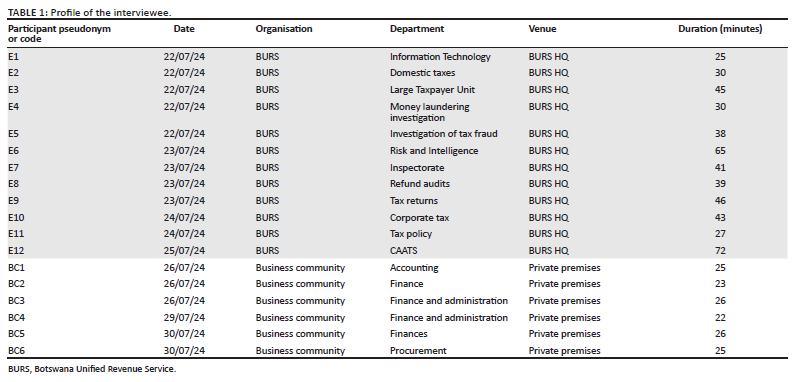
The study draws insights from unstructured interviews conducted with participants in Gaborone, Botswana, to 'capture the meaning and diversity of their lived experiences in the greatest depth' (Closs-Davis, Bartels & Merkl-Davies 2024:6). Researchers obtained diverse opinions on the level of tax compliance and the behaviour of taxpayers towards tax; this deepens the researchers' understanding of the tax environment. Additionally, the interview attracted participants from various positions and different levels of participation within the organisation, widening the researchers' knowledge of the BURS tax administration process and procedures. A multiplicity of participants from different levels were interviewed to critically investigate and analyse their response (Table 1). The use of unstructured interviews allowed participants to share their true story and lived experience in their own words and provide succinct and comprehensive descriptions of their lived experience (Strauss et al. 2020). The interview guide was structured in such a way that it has 100% open-ended questions to gain more insight into the topic in question.
The interview questions depict prior theorisations of taxpayer compliance behaviour, including tax evasion. As a result, the interview guide was prepared using emerging themes to maintain the focus on the key topic while allowing participants to introduce new thought-provoking topics and issues. In this way, the study produced rich data on participants' experience with tax compliance, tax investigation and risk profiling, the practices through which they interact with taxpayers and the relational patterns underlying them. The structure of the interview guide includes headings such as current enforcement measures (how efficient they are and how the AI framework can potentially address these issues), diffusion of AI in the domain of tax (how AI can be adopted into tax) and ethical and legal issues (what ethical and legal issues are).
The purposive sampling technique, according to Elhami and Khoshnevisan (2022:5), is a nonrandom strategy in which the researcher chooses participants with a large amount of relevant information for analysis and was applied to recruit participants (Nyimbili & Nyimbili 2024). Because of the focus on engagement with tax compliance, participants were selected based on their knowledge or access to taxpayers or members of tax compliance, audit and investigation, and risk and intelligence teams. As a supporting technique, snowball sampling was used, where referrals from participants who have been interviewed led the researcher to another key participant. A total of 19 interviews were conducted, which lasted between 22 and 72 min and were conducted physically, and audio recordings were recorded, transcribed ad verbatim and anonymised. These in-depth interviews were conducted to capture stakeholders' experiences and perspectives about how they are or are planning to infuse AI in the field of taxation. Semi-structured interviews are vital as they allow a conducive environment for open-ended discussions, thus allowing interviewees to discuss openly the development (or progress) made and the challenges they encountered in implementing AI as a tool to combat tax noncompliance.
Pursuing the principle of triangulation, the field researchers collected and reviewed archival data drawn from BURS and MoF, including policy and procedure documents, minutes and all other strategic documents (from 2019 to 2024) to understand the current tax initiatives around AI solutions in tax administration. This provided a basis for evaluating how novel technological tools are within the domain of taxation. In total, the field researchers collected and perused 20 documents collected from BURS and 10 public reports and laws on money laundering, tax fraud and unexplained wealth orders (UWO) from credible websites. The study analysed the documents in order to assess the extent to which the AI solution has been deployed in the tax function in Botswana. This was done to build a multidimensional insight into the tax environment and augment the confirmability and reliability of the findings and interpretations (Braun & Clarke 2021).
To maintain the confidentiality and anonymity of the participants, this study used pseudonyms to hide the true identities of the participants. In addition, participants, whether female or male, are always expressed in the masculine form, without reference to gender.
Ethics approval for this study was obtained and granted from the Economic and Management Science Research Committee of North-West University and the Botswana Unified Revenue Services, where the research was carried out before the fieldwork commenced. The researchers assured all interviewees that all the information they provided will be kept confidential. Furthermore, the researchers explained the roles and rights of participants, especially to abandon participation at any stage in the research process. Hence, the researchers adhered to the following principles as enshrined in the NWU's code of conduct for researchers:
Honesty in all aspects of research.
Accountability in the conduct of the research.
Professional courtesy and fairness in working with others.
Good stewardship of research on behalf of others.
Fair treatment of participants.
The interviewees were requested to sign a consent form, and all the interviewees signed, except a few participants from the business community who consented to participate verbally. This was done to confirm the participant's understanding of the study and the willingness to participate in this study. In particular, the true identities of the participants were anonymised using codes or pseudonyms, with participants from BURS coded as E and the Gaborone Business Community as BC. The participants from each category or organisation are uniquely identified by a number, for instance, E1, E4, E5, BC1, BC2, etc. All interviews were conducted in suitable and convenient locations for the interviews, as advised by Polit and Beck (2018) that qualitative researchers gather data in the natural environment to obtain a true story. Consequently, participants preferred to be interviewed at their workstations and boardrooms where they would be more free and open to expressing their lived experiences.
It is important to note that the researchers sought verbal consent from the participants to record interview sessions, and it was granted. All interview sessions were audio recorded. The researcher transcribed raw data from the audio recordings. The data collected were analysed using thematic analyses as per Braun and Clarke (2006). The transcribed text was then used to develop or find common themes, words and trends amongst the responses from the various interviewees (or participants). Because this study aims to develop an AI framework to combat tax noncompliance in Botswana, using an AI tool such as Chat Generative Pre-trained Transformer (ChatGPT) to code the qualitative data was deemed appropriate and practical. Chat Generative Pre-trained Transformer was provided with the text generated by researchers and prompted to identify trends for the topics and keywords that were predetermined by the researchers. To have higher quality data coding, the information fed into ChatGPT was first broken down into the responses to pre-determined questions. Chat Generative Pre-trained Transformer was then given the questions and topic and prompted to identify any trends or emerging themes from the responses. The researchers then manually perused and revised the coded data and summarised the findings further into sub-categories and themes that will specifically address the primary objective of this study.
Ethical considerations
Ethical clearance to conduct this study was obtained from the North-West University's Economic and Management Sciences Research Ethics Committee (EMS-REC) (No. NWU-00649-24-A4).
Results and discussion
The research findings presented in this section are grouped according to the following three distinct themes. The first theme discusses the challenges and opportunities in tax compliance. The second theme focuses on the feasibility of AI adoption in the domain of taxation in Botswana. The third theme delves into ethical issues around AI adoption in the field of taxation. These three overarching themes, though largely descriptive, provide discussions, analysis and interpretation of the results. The findings of the interviews are presented below.
Theme A: Systemic challenges and solutions in tax compliance
To establish whether current tax compliance measures are effective, the following question was posed to participants: What are the main challenges and barriers to tax compliance faced by individuals and organizations in Botswana, and how could an AI solution be adopted to address these particular challenges?
Participants reported multifaceted challenges and barriers to tax compliance, including complex tax codes, culture, low levels of tax literacy, corruption, cash dominance, inadequate digital infrastructure and a huge informal economy. Participants contend that tax non-compliance in Botswana is persistent and negatively impacts revenue generation and service provision. The evidence from the participants relating to the intersection between tax compliance levels and tax revenue strongly attests to this systemic challenge. For example, E1 argued that:
'Generally, in Botswana, there is a low level of tax compliance among "high-risk" taxpayers, specifically small and medium enterprises (SMEs) taxpayers, due to limited access to tax information. The tax literacy rate in Botswana is considerably low, and there are also complex procedures that contribute to this issue….'
The response of participant E1 suggested that there is a low level of tax awareness and complex regulatory procedures. The lack of awareness about tax regulations and complex procedures evident in Botswana is consistent with broader international literature on tax compliance. As outlined by Munjeyi and Fourie (2024), there is a positive direct correlation between tax education, tax knowledge and tax compliance. E2 recommends: 'AI-based educational platforms can be instrumental in promoting and improving taxpayer awareness and comprehension of tax related issues in Botswana'. The views set out by participant E2 imply specific support for Bellon et al. (2022) that AI-driven educational tools have successfully enhanced tax literacy and tax compliance in other regions.
Similarly, E4 confirms the presence of a high informal sector and poor financial documentation as impediments to tax compliance among taxpayers in Botswana. The same findings were documented by Zhonghui (2018) in his studies on tax compliance. E11 argued that AI can be used to counteract tax noncompliance because of its ability to analyse transaction patterns and integrate data from informal sectors. This strategy is further supported by contemporary studies demonstrating that AI can effectively track, detect, deter, prevent and manage data from the informal sector, thus improving compliance monitoring (Murorunkwere et al. 2022, 2023; Owens, Lazarov & Costa 2021).
Participants E10, E11 and E9 discuss the influence of corruption and a lack of trust in tax authorities, cultural perceptions of taxation, infrastructural challenges, the complexity of tax codes and the use of cash on tax compliance. They believe that these factors negatively impact the compliance level of taxpayers in Botswana, typified in the opinion of participant E9:
'Corruption, lack of trust in the tax framework and government, cultural perceptions, inadequate infrastructure, complexity of tax codes and prevalence of cash transactions in Botswana-all contribute significantly to tax non-compliance, creating an environment where evasion becomes more feasible and less risky.'
Similarly, BC1 stated that:
'As long as cash is a dominant payment system, tax non-compliance is inevitable. Cash transactions are less likely to be reported and recorded accurately, creating opportunities for individuals and businesses to under-report income and evade taxes.'
Participant E5 said:
'Those second-hand car sales and other stores owned by Chinese and Indian nationalities do not accept swipe and prefer cash as a payment method. I think because cash does not have an audit trail, they can falsify the invoice or under-declare.'
Furthermore, mixed responses were received from BURS 5, who said:
'Most companies are now promoting online payment methods that increase transparency, with banks such as Stanbic and FNB taking an important role in promoting online and cashless transactions in Botswana.'
This is a well-documented issue in the tax compliance literature, where corruption undermines trust and compliance (Ramic 2023). Participant E7 explains how AI can help address these identified challenges:
'AI can play a significant role in improving various aspects of the tax system by addressing corruption, infrastructural inadequacies, complex tax codes, cultural issues, and lack of trust in the tax system. It improves transparency and reduces opportunities for corrupt practices through automated and auditable processes. AI-driven solutions can streamline and upgrade outdated infrastructure, offer real-time updates and simplified interpretations of complex tax codes, and provide insight into cultural attitudes towards taxation. Furthermore, by increasing the efficiency and fairness of tax administration, AI can help rebuild public trust in the tax system.'
From the excerpt, AI holds potential to enhance detection, deterrence, prevention and reporting of suspicious (or fraudulent) transactions in (near) real time, leading to improved tax compliance, reduction in costs of collection and tax justice in the tax landscape. Consistent with Mpofu (2019) and OECD (2022), the study shows that the deployment of AI in tax functions could assist taxpayers to value transparency and compliance with tax law, hence reducing errors and penalties. The study further highlights a growing interest in integrating AI into tax administration in countries in the Global South (Abubakar et al. 2024). This finding strengthens the assertion of Night and Bananuka (2020), Alm, Jackson and McKee (1993) and Alm (2021) that digitalisation of the payment system is an effective strategy for reducing tax non-compliance and increasing tax revenue. This implies that the government should invest in AI and introduce a cashless payment system that can detect and monitor all business-related transactions. Based on the document reviewed, The Commissioner of South Africa Revenue Services (SARS), Mr Edward Kieswetter said (Microsoft Africa 2025):
Embracing AI in tax and customs administration is revolutionizing our engagement with taxpayers and traders […] it enables hyper-personalization, in the provision of service as well as detecting non-compliance. It automates routine tasks and augments the work of tax professionals with insights from data.
This means that SARS has extensively adopted AI in its function, resulting in tax revenue of R1.74 trillion for the 2023/24 fiscal year. The increase in revenue by R54 billion (3.2%) compared to the 2022/2023 tax period is an indication of the efficacy of AI and machine learning launched by SARS in its tax administration function (Mzekandaba 2024).
The study's findings underscore the potential of generative AI to improve transparency and reduce bias through automated audits, aligning with institutional objectives to bolster trust and accountability in tax administration (Saragih et al. 2022). Furthermore, the creation of AI tools that operate offline or with minimal connectivity addresses infrastructural limitations in resource-constrained environments, demonstrating responsiveness to institutional needs for practical and accessible solutions (Sarker 2022). Artificial intelligence systems that streamline complex tax codes and offer real-time updates correspond to institutional demands for regulatory compliance and operational efficiency, illustrating AI's role in advancing regulatory practices (Pranckute 2021). Furthermore, the incorporation of multilingual support and simplified language into AI tools reflects institutional values of inclusivity and equitable access, addressing cultural barriers and literacy challenges to ensure widespread availability of tax information (Belahouaoui & Attak 2024).
Theme B: Feasibility and adoption of artificial intelligence technologies
To establish non-compliance practices commonly experienced and reported by BURS in Botswana, the following question was posed to the participants: 'How can artificial intelligence be effectively integrated into existing tax administration systems in Botswana, taking into account the technological infrastructure and resource constraints of the region?'
Participants after participants argue that AI can be used as a solution to tax noncompliance in Botswana. This result generally reverberates with the findings obtained by Mpofu (2024) and Belahouaoui and Attak (2024), who argue that AI technologies emerge as a potential solution for tax compliance. This means policymakers must develop a legal and regulatory framework guiding the implementation of AI in the field of taxation. Consistent with this idea or argument, the digital infrastructure and financial resources were viewed as critical factors influencing AI adoption and acceptance within the domain of taxation (Deloitte 2019). To embrace AI in the existing tax framework in Botswana, considering challenges in technological infrastructure and resources, the proposed key measures or strategies of the participants offer a valuable practical framework. The comments of the interviewees suggested several actionable strategies and recommendations. These possible practical solutions include introducing pilot programmes, collaborating with the Botswana Investment Hub (BIH) and the MoF, developing an AI policy framework and gradually incorporating AI into existing systems and leveraging modular designs. These strategies align with the contemporary literature on technology adoption and are supported by empirical evidence from similar contexts. The evidence from the interviews suggests that the government of Botswana can leverage on the existing digital infrastructure to improve tax compliance levels. Another participant also had this to say:
'BURS has some plans to introduce an integrated network system that is linked to other stakeholders such as Government Accounting and Budgeting System (GABS), Government Payroll Pensions and Passages System (GPPPS), Supplies Warehousing and Management System (SWIMS), Integrated Fixed Asset Register (IFAR), Agriculture, Home Affairs1, and transport … so that BURS will be in a position to view client transactions remotely … this is our grand plan as BURS.' (E11)
On this note, a participant substantiated this by stating that:
'Currently we use Lekgetho Live which has replaced the Integrated Tax Management System, but the government is planning to introduce a physical electronic device, connected to every operator in Botswana that reports in real time all transactions and computes tax in a phase approach …' (E2)
Some of the excerpts from the participants include: 'As the government of Botswana, we are not yet there to embrace technology … and adopting such a huge project, it starts with cultural reforms' (BC4).
Interviewee E12 believed that while the adoption of AI in the domain can potentially improve tax compliance, the reality is that Botswana is far from reaping these benefits. He suggested that:
'As we plan to integrate AI into the tax system, I suggest that BURS conduct a comparability analysis to understand different phases of adoption by other regional and international tax authorities followed to successfully integrate AI technologies into their tax framework. I believe that a pilot project is prudent to test the feasibility of AI adoption.'
This strategy allows for the testing and refinement of AI technologies before a wider rollout, which is crucial given the varied technological landscape of Botswana. Cloud-based AI solutions are recommended to minimise the need for extensive local hardware, which aligns with recent studies that emphasise the benefits of cloud computing in resource-constrained environments (Bassey, Mulligan & Ojo 2022). This approach helps address infrastructure limitations while providing scalable resources. In light of the above point, E12 advocated for the removal of cash from the payment system and for implementing AI in a phased way. Adopting a cashless payment system creates room for technological tools to access individual financial information. Participant E12 stated that:
'The national wide rollout of AI may be a challenging project that leads to unfavorable results; therefore, the Government of Botswana should first and foremost go cashless and promote the use of online banking platforms and other cashless outlets. After this, the government must adopt AI in the domain of tax in a phased manner, for instance, starting with large taxpayers (LP) and gradually incorporating other taxpayers, including SMEs.'
The focus of the participants on the participation of key stakeholders, including policymakers, community leaders and scholars, shows awareness that AI technologies must be adapted to fit specific sociocultural and economic contexts. This approach is consistent with institutional theory, which underscores the importance of integrating local knowledge and addressing localised needs to improve both the acceptance and effectiveness of technological innovations (OECD 2023). The incremental adoption of AI, exemplified by automating routine tasks and developing modular systems, aligns with the institutional requirement for manageable technological transitions, especially in resource-constrained settings (Night & Bananuka 2020). This method corresponds to scholarly arguments that favour adaptable and gradual technology adoption in developing regions (Baker 2021). Additionally, the emphasis on establishing collaborations with governments and international entities underscores the role of external partnerships in mitigating resource limitations, reflecting institutional theory's focus on inter-organisational networks for successful technology implementation (OECD 2022). Participants recommended that the use of AI in a supportive role rather than as a full substitute aligns with DIT by ensuring that technological integration enhances existing systems and addresses local connectivity challenges, thus promoting smoother transitions and higher adoption rates (Bellon et al. 2021).
Empirical data indicate that Botswana recorded a budget deficit of P11.11 billion during the 2023/2024 tax period, which is 4.25% of gross domestic product (GDP). According to reports, this deficit was higher by over P4 billion when compared to the 2022/2023 tax year (Ministry of Finance 2025). Tax noncompliance and poor diamond sales were viewed as the contributing factors to this deficit. The study also established that VAT and corporate tax are poorly performing because of leakages and illicit trade and largely noncompliance. In a bid to increase its tax revenue, the government of Botswana increased its corporate tax and pay-as-you-earn by 1.5%. To date, BURS has not yet implemented AI tools or advanced technologies in its tax administration function. However, during document analysis, the Boko-led government announced its resources. Botswana Unified Revenue Service has plans to automate and deploy technological solutions to counteract tax noncompliance and optimise tax administration. From the reports whose contents were analysed, the study identifies several strategies proposed by the government to improve its domestic resource mobilisation, including re-enacting the VAT Act to automate the VAT invoicing system, taxation of digital trade (e-commerce), a review of the VAT Act on zero-rated or exempt items and the development of a digital-marking and tracking solution. This means the government of Botswana is prepared to embrace technology to 'track and trace' to enforce compliance, especially in the VAT system (Ministry of Finance 2025). These developments show the readiness of the government of Botswana to embrace AI solutions in tax administration. The government is already supporting the adoption of AI technologies to ensure compliance with tax laws. As Mpofu (2019) notes, despite conspiracies about AI, several tax authorities in developing countries (including South Africa, Kenya, Rwanda and Indonesia) have deployed AI in tax administration functions to eliminate unfavourable budget deficits, tax evasion and avoidance. The study depicts that taxpayers in Botswana are comfortable with the conventional 'brick and mortar' tax system, which creates room for underreporting of income. This confirms the findings of Strauss (2021), who argues that the challenge to migrate to tech-driven tax solutions is the preference of taxpayers to use a manual system.
Theme C: Ethical considerations and risk mitigation strategies in artificial intelligence diffusion
To identify ethical, legal and technical concerns related to the integration of AI in the tax framework and strategies to address these concerns, the following question was asked to participants: What ethical, legal, and technical concerns do stakeholders have regarding the use of AI in tax administration, and how can these concerns be mitigated in the development of an AI framework for Botswana?
Participants expressed concern about the potential risks associated with the integration of AI in the field of taxation. Numerous ethical issues and risk-related aspects were highlighted, including privacy, bias, violation of fundamental human rights - informed consent, trust issues, cultural distortion or erosion, and displacement of jobs, among others. These identified challenges and concerns merit further consideration to ensure that these technologies are both effective and equitable. In this regard, participant E12 argued that:
'[…] the acceptability of AI depends on the clarification of privacy issues. Stakeholders are concerned with the violation of their privacy since their personal information will be under 24-hour surveillance.'
Therefore, it is important that the 'AI policy document' provides a guide on how data privacy issues should be addressed' (Participant BC4). Another participant reaffirms this argument: 'System developers must specify how they will deal with data privacy as enshrined in the Data Protection Act of 2018' (Participant, E2). Participants underscore the importance of data privacy through encryption and anonymisation, along with the need for strict access controls to prevent misuse and surveillance. This aligns with contemporary literature that highlights robust data protection as essential for maintaining trust in AI systems (Bakaeva et al. 2021). Privacy concerns are particularly acute in Botswana, where data breaches can have significant consequences because of less mature data protection frameworks.
The interviewees argued for the development of measures for ensuring a high level of transparency, respect for fundamental human rights and sociocultural cohesion. Artificial intelligence technologies may potentially bring more harm than good to society, as such a culturally driven AI policy should be formulated to protect citizens and organisations. Most of the participants raised concerns about potential bias, violation of fundamental rights, lack of transparency and cultural issues. One participant, BC3, stated that:
'AI technologies are associated with bias (unfairness) due to possibly flawed algorithms or poor data quality' leading to "opaque decision making".' (Participant BC5)
Another participant, E8, lamented that:
'I did IT, and if AI tools are not tested and tested for equity and discrimination before implementation, unintended discriminatory consequences can 'go undetected' and further exacerbates marginalization and vulnerability of some people.' (Participant E10)
Some of the excerpts from the participants include the following:
'The loss of human judgment due to the overreliance on AI technologies in the field of tax may possibly overlook ethical considerations or the broader sociocultural implications of the tax system.' (E8)
'Relying on AI on certain issues involving cultural norms or social or human judgements based on case by case has negative social implications […]' (E11)
'The danger associated with virtualized data is that it is susceptible to hacking or manipulation to produce desired results, thus destroying the integrity, trust and transparency of the system.' (E5)
The participants emphasised the necessity of continuous monitoring and participation of stakeholders to mitigate possible biases, aligning with the advocacy of Zhou, Zhou and Ji (2023) for a multi-stakeholder approach to promote social fairness and cultural sensitivity. This recommendation is in agreement with institutional theory, which posits that inclusive practices and ongoing supervision are essential to ensure that technological innovations conform to institutional norms and social expectations. Moreover, the call for strict adherence to best practices in data protection and ethics highlights the critical need to incorporate ethical standards into AI deployment, reinforcing institutional norms regarding data integrity and privacy (Alm 2021). The participants' suggestions to implement robust security protocols and to simplify AI decision-making processes align with institutional theory's emphasis on maintaining system integrity and transparency. These strategies address the risks associated with cyberattacks and ensure that AI systems are both secure and comprehensible, thus meeting institutional requirements for operational reliability and public trust (Gorski et al. 2024). Additionally, the participation of local traditional leaders and policymakers throughout the AI development and implementation phases underscores the need for culturally sensitive and contextually relevant solutions. This approach is supported by institutional theory, which highlights the importance of aligning new technologies with local norms and regulations to ensure their acceptance and effectiveness (Habbal, Ali & Abuzaraida 2024). By incorporating feedback from diverse stakeholders and adapting to evolving ethical standards, AI systems can more effectively address Botswana's unique socio-cultural and regulatory contexts, thereby maintaining their relevance and fairness over time.
Proposed artificial intelligence framework to combat tax noncompliance in Botswana
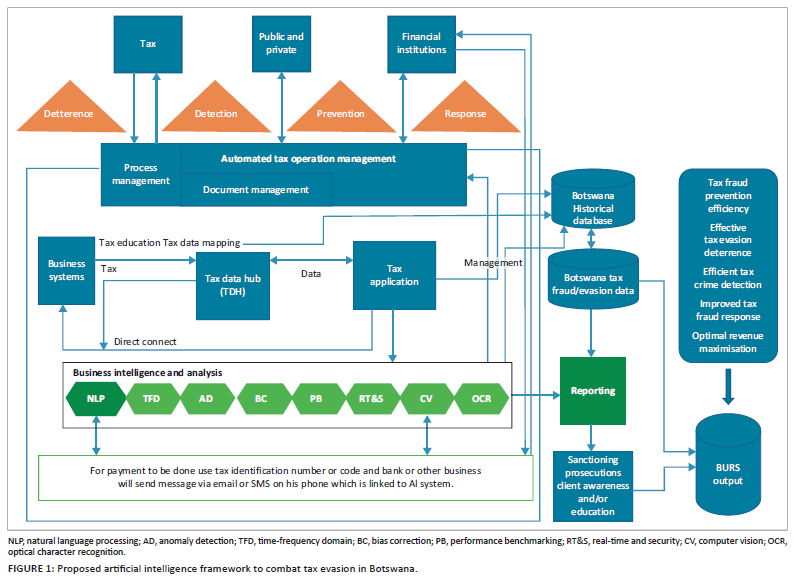
The primary objective of this study, as presented earlier, was to develop an AI framework to combat tax noncompliance in Botswana. Emphasis was placed on the efficacy of the current tax administration model and how AI can be deployed as a tool to combat tax crime and improve efficiency. As recommended by Strauss et al. (2020), when proposing an alternative solution for tax administration, it is important to consider the historical (or traditional) model or policy; thus, a possible AI framework designed to detect, deter, prevent and report fraud/or tax evasion is proposed and is based on the findings and observations of the current study. In light of the above discussions, the designed AI framework presented (or illustrated) in Figure 1 offers the solutions. It is a synthesis of the qualitative interpretation of the results obtained through document analysis and interviews. Therefore, this section proposes an AI framework to combat tax noncompliance in Botswana. The proposed framework is developed based on the interview results and the extant literature (Belahouaoui & Attak 2024; European Commission 2024; Huang 2018; McKinsey & Company 2021; United Nations, Economic and Social Commission for Asia and the Pacific 2023) that combines studies on tax noncompliance with studies that consider aspects such as emerging technologies and AI. The scope of the study is not to test the framework but to develop a framework to combat tax non-compliance in Botswana. Therefore, the process of testing the feasibility and significance of the variables was not performed. Details of the development of an AI framework are highlighted in the following sections. Based on the literature reviewed, this study proposes an AI framework to combat tax noncompliance (Figure 1). Thus, the focus of the framework is on the detection, prevention, response and deterrence of tax fraud and tax evasion. The following description is provided in the proposed AI framework:
The AI framework is composed of AI components with different capabilities whose functions are to prevent, deter, detect and respond (Munjeyi & Fourie 2020; Shi, Li & Fu 2020). Each component includes special algorithms trained from historical data to fight tax non-compliance, tax fraud and tax evasion. The framework has supervised and unsupervised AI algorithms. Supervised algorithms prevent the likelihood of tax fraud or evasion fraud using previously learned techniques from historical data; for instance, for tax evasion or tax fraud detection, AI algorithms then detect tax fraud or tax non-compliance by comparing incoming transactions with previous transactions to check for any discrepancies (Munjeyi & Schutte 2024; Wirjo & Calizo 2022). Unsupervised AI algorithms use their advanced analytical and predictive analysis to detect fraudulent transactions in real-time incoming transactions.
Any anomaly or deviation in behaviour is reported immediately, and further investigation is initiated. The results of each pillar of the model will be immediately reported. Any suspicious transaction is flagged, blocked or rejected, awaiting human reviews to either authenticate or totally reject the transaction. Business intelligence and analytics are interrelated with the Botswana historical database to constantly spy on all data and/or transaction activity entries and investigate them to detect, prevent and deter fraudulent activities by generating a unique transaction reference code for taxpayers with detailed information from well-structured taxpayers attached per transaction, which also compares with the taxpayer's identification number (TIN). The proposed AI framework is exemplified and presented in Figure 1.
To facilitate the adoption and implementation of the proposed AI framework, this study proposes that the government of Botswana must phase out the use of cash and promote the use of a cashless payment system. The successful implementation and use of the digitalised tax framework for revenue collection from both formal and informal economies, as presented in Figure 1, is anchored in the collaboration and active participation of the following key stakeholders, as well as the updated policy framework. Botswana telecommunication, mobile network operators (MASCOM, Orange and Bemobile), politicians, IT specialists, programmers, software developers, FinTech players, tax experts, banking institutions including the central bank, civic societies, MoF and BURS. The government should also provide technical and financial support to private companies to facilitate the installation of a base station in some remote parts of Botswana to allow wide network coverage.
The study proposes the development of an integrated database or central shared platform (online system) connecting all citizens and organisations' databases, or alternatively, BURS can make use of the existing financial infrastructure that supports the financial technology ecosystem in Botswana. The creation of interconnected databases requires extensive synergies with third-party information providers, including service providers (such as Orange Botswana, Mascom, BTCL and Be Mobile), banking institution databases, private and public organisations, and all government ministries, so that BURS can access the financial information of any person anywhere in any institution in Botswana. Therefore, it is recommended that the MoF develop a harmonised tax policy to facilitate the collaboration and active participation of key stakeholders.
Conclusions
The purpose of this study was to explore the current state of the art of AI applications in the tax administration function in Botswana and develop an AI framework to combat tax noncompliance in Botswana. Overall, the findings of this study support the view that AI is a possible alternative solution to detect, deter, prevent and report possible tax risks in (near) real time. The utilisation of AI solutions enhances tax compliance, improves efficiency, minimises errors and augments tax yield. From the interviews, this study identified several challenges that can hinder the adoption of AI in Botswana, including lack of digital infrastructure, lack of funding, lack of political support and poor digital infrastructure.
The study has some practical and actionable recommendations that BURS should consider. Firstly, due to novelty of the proposed AI framework (Figure 1), it should be tried and tested by tax gurus, AI experts, and academia before deploying it into tax domain with the aim of refine or revising the recommended construct. Secondly, the proposed framework can be replicated and used in other developing countries that experience similar tax non-compliance challenges. Therefore, Botswana can use AI tools based on the available data and draw some lessons (benchmarking) from countries (for example, Brazil, France and Indonesia) that have used the AI frameworks in their tax administration because it is expected to close the revenue leakages and increase voluntary tax compliance (VTC) if properly applied. Nevertheless, to fully deploy the proposed AI framework, it is imperative to phase out cash or promote an e-payment system in Botswana. The adoption of a cashless system is essential to monitor income through transaction tracking (Munjeyi & Fourie 2024; Zervoudi 2020). This will provide the basis for estimates of an individual's annual revenue and tax liability. The operationalisation of the proposed framework is feasible in a paperless or cashless economy where there is limited use of cash. The overall contribution of this study includes the development of an AI framework that is deemed suitable for Botswana to ensure efficient domestic revenue mobilisation and to (re)solve the identified compliance challenges to ensure tax revenue optimisation. From the literature reviewed, limited documented studies could be located that develop an alternative solution which integrates AI tools to prevent the occurrence of tax risks.
Although this study immensely contributed to the body of knowledge, there are several limitations that should be stated. Firstly, the study used a small sample size of participants from one geographical setup, which makes it difficult to generalise the results. Using a large sample size could have produced different results. Secondly, the research design adopted in this study is merely qualitative based on interviews confined to a small environment; adopting a sequential explorative research design could subsequently produce unique results, which can be further applicable to other jurisdictions. Against this backdrop, future researchers could consider random sampling and possibly the use of sequential explorative research design, which may generate some statistical data. Furthermore, the study is premised on a general approach to tax compliance, without focusing on a specific tax head(s) such as VAT, corporate taxes and personal income tax. Tax compliance levels vary for different tax heads; the challenges to tax compliance vary; and the ease of collecting the taxes and complying with tax legislation differs with the tax heads; hence, they cannot be treated the same. Therefore, future work should examine the compliance level from an individual tax head angle in order to develop specific measures for that particular tax head(s).
In conclusion, the proposed AI framework has the potential to address significant challenges in tax compliance and can be replicated in other developing countries facing similar issues. Its successful implementation will require collaboration, ongoing monitoring and adaptation to local contexts to maximise its impact.
Competing interests
The authors declare that they have no financial or personal relationships that may have inappropriately influenced them in writing this article.
Authors' contributions
The authors, E.M. and D.S., authors contributed equally to this work.
Funding information
This research received no specific grant from any funding agency in the public, commercial or not-for-profit sectors.
Data availability
The authors confirm that the data supporting this study and its findings are available within the article.
Disclaimer
The views and opinions expressed in this article are those of the authors and are the product of professional research. They do not necessarily reflect the official policy or position of any affiliated institution, funder, agency or that of the publisher. The authors are responsible for this study's findings and content.
Acknowledgements
A preprint version of this work is availalbe at SSRN: https://ssrn.com/abstract=4969085 or http://dx.doi.org/10.2139/ssrn.4969085, and we acknowledge its role in shaping the final manuscript.
References
-
Abubakar, J., Yusuf, S.O., Ocran, G., Owusu, P., Yusuf, P.O. & Paul-Adeleye, A.H., 2024, 'Exploring the impact of AI-driven and blockchain-enabled tax filing systems on smes in the era of technological innovation: A review of benefits, challenges, and adoption barriers', World Journal of Advanced Research and Reviews 23(03), 1867-1878. https://doi.org/10.30574/wjarr.2024.23.3.2754
» https://doi.org/10.30574/wjarr.2024.23.3.2754 -
Adam, I. & Fazekaz, M., 2021, 'Are emerging technologies winning the fight against corruption? A review of the state of evidence', Information Economics and Policy 57, 100950. https://doi.org/10.1016/j.infoecopol.2021.100950
» https://doi.org/10.1016/j.infoecopol.2021.100950 -
Agencia Espanola Proteccion Datos, 2020, GRPR compliance of processings that embed artificial intelligence an introduction, AEPD, Madrid, viewed 11 May 2024, from https://www.aepd.es/sites/default/files/2020-07/adecuacion-rgpd-ia-en.pdf.
» https://www.aepd.es/sites/default/files/2020-07/adecuacion-rgpd-ia-en.pdf -
Allam, A., Moussa, T., Abdelhady, M. & Yamen, A., 2023, 'National culture and tax evasion: The role of institutional environment quality', Journal of International Accounting, Auditing and Taxation 52, 100559. https://doi.org/10.1016/j.intaccaudtax.2023.100559
» https://doi.org/10.1016/j.intaccaudtax.2023.100559 -
Allingham, M.G. & Sandmo, A., 1972, 'Income tax evasion: A theoretical analysis', Journal of Public Economics 1(3-4), 323-338. https://doi.org/10.1016/0047-2727(72)90010-2
» https://doi.org/10.1016/0047-2727(72)90010-2 -
Alm, J., 2021, 'Tax evasion, technology, and inequality', Economics of Governance 22(4), 321-343. https://doi.org/10.1007/s10101-021-00247-w
» https://doi.org/10.1007/s10101-021-00247-w -
Alm, J., 2023, 'Tax compliance, technology, trust, and inequality in a post-pandemic world', eJournal of Tax Research 21(2), 152-172. https://doi.org/10.1007/s10101-021-00247-w
» https://doi.org/10.1007/s10101-021-00247-w -
Alm, J., Jackson, B.R. & McKee, M., 1993, 'Fiscal exchange, collective decision institutions, and tax compliance', Journal of Economic Behavior & Organization 22(3), 285-303. https://doi.org/10.1016/0167-2681(93)90003-8
» https://doi.org/10.1016/0167-2681(93)90003-8 - Aslett, J., Gustavo, G., Stuart, H. & Miguel, P., 2024, Tax administration: Essential analytics for compliance risk management, IMF Technical Notes and Manuals 2024/01, International Monetary Fund, Washington, DC.
- Bakaeva, O.Y., Belikov, E.G., Pokachalova, E.V., Razgildieva, M.B. & Katkova, M.A., 2021, 'Legal aspects of using artificial intelligence (digital technology) in the field of taxation', Advances in Research on Russian Business and Management 2021, 419-426.
- Baker, E.M., 2021, 'I've got my AI on you: Artificial intelligence in the law enforcement domain', Thesis- Master, Naval Postgraduate School.
-
Bassey, E., Mulligan, E. & Ojo, A., 2022, 'A conceptual framework for digital tax administration-A systematic review', Government Information Quarterly 39(4), 101754. https://doi.org/10.1016/j.giq.2022.101754
» https://doi.org/10.1016/j.giq.2022.101754 -
Belahouaoui, R. & Attak, E.H., 2024, 'Digital taxation, artificial intelligence and tax administration 3.0: Improving tax compliance behavior - A systematic literature review using textometry (2016-2023)', Accounting Research Journal 37(2), 172-191. https://doi.org/10.1108/ARJ-12-2023-0372
» https://doi.org/10.1108/ARJ-12-2023-0372 -
Bellon, M., Dabla-Norris, E., Khalid, S. & Lima, F., 2022, 'Digitalization to improve tax compliance: Evidence from VAT e-invoicing in Peru', Journal of Public Economics 210, 104661. https://doi.org/10.1016/j.jpubeco.2022.104661
» https://doi.org/10.1016/j.jpubeco.2022.104661 -
Braun, V. & Clarke, V., 2006, 'Using thematic analysis in psychology', Qualitative Research in Psychology 3(2), 77-101. https://doi.org/10.1191/1478088706qp063oa
» https://doi.org/10.1191/1478088706qp063oa -
Braun, V. & Clarke, V., 2021, 'Conceptual and design thinking for thematic analysis', Qualitative Psychology 9(1), 3-26. https://doi.org/10.1037/qup0000196
» https://doi.org/10.1037/qup0000196 -
Christensen, C.M., McDonald, R., Altman, E.J. & Palmer, J., 2018, 'Disruptive innovation: An intellectual history and directions for future research', Journal of Management Studies 55(7), 1-36. https://doi.org/10.1111/joms.12349
» https://doi.org/10.1111/joms.12349 -
Closs-Davies, S.C., Bartels, K.P.R. & Merkl-Davies, D.M., 2024, 'How tax administration influences social justice: The relational power of accounting technologies', Critical Perspectives on Accounting 100, 1-15. https://doi.org/10.1016/j.cpa.2024.102758
» https://doi.org/10.1016/j.cpa.2024.102758 - Coccia, M., 2018, 'An introduction to the theories of institutional change', Journal of Econoics Library 5(4), 337-344.
-
De Almeida, A.L.R., 2020, The necessary dialogue between big data and trust in Brazil's tax administration, Blavatnik School of Government, University of Oxford, viewed 10 March 2024, from https://www.bsg.ox.ac.uk/research/publications/necessary-dialogue-between-big-data-and-tax-brazils-tax-administration.
» https://www.bsg.ox.ac.uk/research/publications/necessary-dialogue-between-big-data-and-tax-brazils-tax-administration -
Deloitte, 2019, Artificial Intelligence-Entering the world of tax, viewed 16 May 2024, from https://www.scribd.com/document/533212607/dttl-tax-artificial-intelligence-in-tax.
» https://www.scribd.com/document/533212607/dttl-tax-artificial-intelligence-in-tax -
Doyle, E., Frecknall-Hughes, J. & Summers, B., 2022, 'Ethical reasoning in tax practice: Law or is there more?', Journal of International Accounting, Auditing and Taxation 48, 100483. https://doi.org/10.1016/j.intaccaudtax.2022.100483
» https://doi.org/10.1016/j.intaccaudtax.2022.100483 -
Dularif, M., Nurkholis, S.T. & Saraswati, E., 2019, 'Is deterrence approach effective in combating tax evasion? A meta-analysis', Problems and Perspectives in Management 17(2), 93-113. https://doi.org/10.21511/ppm.17(2).2019.07
» https://doi.org/10.21511/ppm.17(2).2019.07 -
Dwianika, A., Sofia, I.P. & Retnaningtyas, I., 2023, 'Tax compliance: Development of Artificial Intelligence on tax issues', KnE Social Sciences 8(12), 728-733. https://doi.org/10.18502/kss.v8i12.13719
» https://doi.org/10.18502/kss.v8i12.13719 -
Elhami, A. & Khoshnevisan, B., 2022, 'Conducting an interview in qualitative research: The Modus Operandi', MEXTESOL Journal 46(1), 1-7. https://doi.org/10.61871/mj.v46n1-3
» https://doi.org/10.61871/mj.v46n1-3 -
European Commission, 2023, Compliance risk management in the digital era, FPG083/FPG012 Update of the CRM Guide, Brussels, Belgium, viewed 10 May 2024, from https://taxation-customs.ec.europa.eu/document/download/8672cbf6-9f42-4680-8a30-822891d1b985_en?filename=2023_CRM_Guide.pdf&prefLang=es.
» https://taxation-customs.ec.europa.eu/document/download/8672cbf6-9f42-4680-8a30-822891d1b985_en?filename=2023_CRM_Guide.pdf&prefLang=es - European Commission, 2024, Artificial Intelligence in the European Commission (AI@ EC), Directorate-General for Digital Services, Brussels.
-
European Parliament, 2022, Cashless payments and their future, Brussels, viewed 13 August 2024, from https://www.europarl.europa.eu/doceo/document/P-9-2022-003595_EN.html.
» https://www.europarl.europa.eu/doceo/document/P-9-2022-003595_EN.html -
European Union, 2023, Annual report on taxation 2023, viewed 10 May 2024, from https://taxation-customs.ec.europa.eu/system/files/2023-07/ART%20Report%20presentation.pdf.
» https://taxation-customs.ec.europa.eu/system/files/2023-07/ART%20Report%20presentation.pdf -
Faúndez-Ugalde, A., Mellado-Silva, R. & Aldunate-Lizana, E., 2020, 'Use of artificial intelligence by tax administrations: An analysis regarding taxpayers' rights in Latin American countries', Computer Law & Security Review 38, 105441. https://doi.org/10.1016/j.clsr.2020.105441
» https://doi.org/10.1016/j.clsr.2020.105441 -
Giovanni, I. & Russon, F.F., 2018, 'Cashless payments and tax evasion', European Journal of Political Economy 55, 36-43. https://doi.org/10.1016/j.ejpoleco.2017.11.001
» https://doi.org/10.1016/j.ejpoleco.2017.11.001 -
Gobena, L.B., 2023, 'Justice, power and voluntary tax compliance: A moderation analysis among taxpayers in Addis Ababa, Ethopia', Asian Review of Accounting 32(4), 628-645. https://doi.org/10.1108/ARA-03-2023-0072
» https://doi.org/10.1108/ARA-03-2023-0072 -
Gorski, L., Ong, J., Nickel, B., Van Gerpen, R., Kokotis, K. & Hadaway, L., 2024, 'Development of an evidence-based list of non-antineoplastic vesicants: 2024 update', Journal of Infusion Nursing 47(5), 290-323. https://doi.org/10.1097/NAN.0000000000000568
» https://doi.org/10.1097/NAN.0000000000000568 -
Greenacre, P., Gross, R. & Speirs, J., 2012, Innovation theory: A review of literature, Imperial College Centre for Energy Policy and Technology (ICEPT) working paper, ICEPT/WP/2012?011, ICEPT, London, viewed 19 February 2024, from https://www.imperial.ac.uk/media/imperial-college/research-centres-and-groups/icept/Innovation-review---ICEPT-working-paper-version-(16.05.12).pdf.
» https://www.imperial.ac.uk/media/imperial-college/research-centres-and-groups/icept/Innovation-review---ICEPT-working-paper-version-(16.05.12).pdf -
Habbal, A., Ali, M.K. & Abuzaraida, M.A., 2024, 'Artificial intelligence trust, risk and security management (AI TRiSM): Frameworks, applications, challenges and future research directions', Expert Systems with Applications 240, 122442. https://doi.org/10.1016/j.eswa.2023.122442
» https://doi.org/10.1016/j.eswa.2023.122442 -
Hassan, I., Ahmed, N. & Gulzar, S., 2021, 'Voluntary tax compliance behavior of individual taxpayers in Pakistan', Financial Innovation 7(1), 1-23. https://doi.org/10.1186/s40854-021-00234-4
» https://doi.org/10.1186/s40854-021-00234-4 - Hayward, K.J. & Maas, M.M., 2020, 'Artificial intelligence and crime: A primer for criminologists', Crime Media Culture 17(2), 1-25.
-
Huang, Z., 2018, 'Discussion on the development of artificial intelligence in taxation', American Journal of Industrial and Business Management 8, 1817-1824. https://doi.org/10.4236/ajibm.2018.88123
» https://doi.org/10.4236/ajibm.2018.88123 -
Khyareh, M.M., 2019, 'A cointegration analysis of tax evasion, corruption and entrepreneurship in OECD countries', Economic Research-Ekonomska Istraživanja 32(1), 3627-3646. https://doi.org/10.1080/1331677X.2019.1674175
» https://doi.org/10.1080/1331677X.2019.1674175 -
KPMG, 2023, 2023/2024 budget speech highlights, viewed 19 July 2024, from https://assets.kpmg.com/content/dam/kpmg/us/pdf/2023/02/tnf-botswana-feb6-2023.pdf.
» https://assets.kpmg.com/content/dam/kpmg/us/pdf/2023/02/tnf-botswana-feb6-2023.pdf -
McKinsey & Company, 2021, Building the AI bank of the future, global banking practice, New York, viewed 16 June 2024, from https://www.mckinsey.com/~/media/mckinsey/industries/financial%20services/our%20insights/building%20the%20ai%20bank%20of%20the%20future/building-the-ai-bank-of-the-future.pdf.
» https://www.mckinsey.com/~/media/mckinsey/industries/financial%20services/our%20insights/building%20the%20ai%20bank%20of%20the%20future/building-the-ai-bank-of-the-future.pdf -
Meyer, J.W. & Rowan, B., 1977, 'Institutionalised organisations: Formal structure as myth and ceremony', American Journal of Sociology 83(2), 340-363. https://doi.org/10.1086/226550
» https://doi.org/10.1086/226550 -
Microsoft Africa, 2025, AI worldwide: South Africa, viewed 15 June 2024, from https://www.microsoft.com/en-us/microsoft-cloud/blog/2025/03/03/ai-in-south-africa-empowering-innovation-transforming-industries-and-unlocking-potential/?msockid=26bcf7364e3964ed039ae4fd4fc465e2.
» https://www.microsoft.com/en-us/microsoft-cloud/blog/2025/03/03/ai-in-south-africa-empowering-innovation-transforming-industries-and-unlocking-potential/?msockid=26bcf7364e3964ed039ae4fd4fc465e2 - Ministry of Finance, 2023, Virtual workshop: Leveraging new technology for tax administration in the post-COVID Era, APEC Project: FMP 01 2022A, Asia-Pacific Economic Cooperation Secretariat, Taipei.
-
Ministry of Finance, 2025, 2025 budget speech, viewed 15 June 2024, from https://www.finance.gov.bw.
» https://www.finance.gov.bw -
Moll, I., 2022, Debunking the myth of the fourth industrial revolution, University of the Witwatersrand, Occasional Paper, University of the Witwatersrand, Johannesburg, viewed 27 June 2024, from https://wiredspace.wits.ac.za/server/api/core/bitstreams/fea7b291-b7ab-44ec-b259-f033ad181bd8/content.
» https://wiredspace.wits.ac.za/server/api/core/bitstreams/fea7b291-b7ab-44ec-b259-f033ad181bd8/content -
Mpofu, F.Y., 2019, 'Prospects, challenges, and implications of deploying artificial intelligence in tax administration in developing countries', Studia UBB Nehotia 6(3), 39-78. https://doi.org/10.24193/subbnegotia.2024.3.03
» https://doi.org/10.24193/subbnegotia.2024.3.03 - Mpofu, F.Y., 2024, 'The carbon credits controversy in rural communities in Africa: A solution or problem to fostering climate change mitigation and economic sustainability?', in D. Mhlanga & M. Dzingirai (eds.), Sustainable finance and business in Sub-Saharan Africa, pp. 147-173, Springer, Cham.
-
Munjeyi, E. & Fourie, H., 2024, 'A framework for digitalising tax revenue collection for the informal economic sphere in Zimbabwe', Cogent Economics & Finance 12(1), 2409427-240. https://doi.org/10.1080/23322039.2024.2409427
» https://doi.org/10.1080/23322039.2024.2409427 -
Munjeyi, E. & Schutte, D., 2024, 'Examining the critical success factors influencing the diffusion of AI in tax administration in Botswana', Cogent Social Sciences 10(1). https://doi.org/10.1080/23311886.2024.241953
» https://doi.org/10.1080/23311886.2024.241953 -
Murorunkwere, B.F., Ihirwe, J.F., Kayijuka, I., Nzabanita, J. & Haughton, D., 2023, 'Comparison of tree-based machine learning algorithms to predict reporting behavior of electronic billing machines', Information 14, 140. https://doi.org/10.3390/info14030140
» https://doi.org/10.3390/info14030140 -
Murorunkwere, B.F., Tuyishimire, O., Haughton, D. & Nzabanita, J., 2022, 'Fraud detection using neural networks: A case study of income tax', Future Internet 14(6), 168. https://doi.org/10.3390/fi14060168
» https://doi.org/10.3390/fi14060168 -
Mzekandaba, S., 2024, SARS doubles down on AI, machine learning after revenue gains, iWeb, viewed 10 March 2024, from https://www.itweb.co.za/article/sars-doubles-down-on-ai-machine-learning-after-revenue-gains/rxP3jqBEyeoMA2ye.
» https://www.itweb.co.za/article/sars-doubles-down-on-ai-machine-learning-after-revenue-gains/rxP3jqBEyeoMA2ye - Nelson, R.R., 2005, Technology, institutions, and economic growth, Harvard University Press, Cambridge.
- Nembe, J.K. & Idemudia, C., 2024, 'Designing effective policies to address the challenges of global digital tax reforms', World Journal of Advanced Research and Reviews 22(3), 1171-1183.
-
Nembe, J.K., Atadoga, J.O., Mhlongo, N.Z., Falaiye, T., Olubusola, O., Daraojimba, A.I. et al., 2024, 'The role of artificial intelligence in enhancing tax compliance and financial regulation', Finance and Accounting Research Journal 6(2), 241-251. https://doi.org/10.51594/farj.v6i2.822
» https://doi.org/10.51594/farj.v6i2.822 -
Night, S. & Bananuka, J., 2020, 'The mediating role of adoption of an electronic tax system in the relationship between attitude towards electronic tax system and tax compliance', Journal of Economics, Finance and Administrative Science 25, 73-88. https://doi.org/10.1108/JEFAS-07-2018-0066
» https://doi.org/10.1108/JEFAS-07-2018-0066 -
Nyimbili, F. & Nyimbili, L., 2024, 'Types of purposive sampling techniques with their examples and application in qualitative research studies', British Journal of Multidisciplinary and Advanced Studies: English Language, Teaching, Literature, Linguistics & Communication 5(1), 90-99. https://doi.org/10.37745/bjmas.2022.0419
» https://doi.org/10.37745/bjmas.2022.0419 - OECD, 2022, OECD economic outlook, 22(2): Confronting the crisis, OECD Publishing, Paris.
- OECD, 2023, The state of implementation of the OECD AI principles four years on OECD Artificial Intelligence Papers, No. 3, OECD Publishing, Paris.
-
Owens, J., Lazarov, I. & Costa, N.O., 2021, Exploring the opportunities and challenges of new technologies for EU tax administration and policy, Policy Department for Economic, Scientific and Quality of Life Policies, Directorate-General for Internal Policies, PE 695.458 4, Brussels, viewed 19 June 2024, from https://www.europarl.europa.eu/supporting-analyses.
» https://www.europarl.europa.eu/supporting-analyses - Polit, D.F. & Beck, C.T., 2018, Essentials of nursing research, 9th edn., Wolters Kluwer, Philadelphia, PA.
-
Pranckute, R., 2021, 'Web of Science (WoS) and Scopus: The titans of bibliographic information in today's academic world', Publications 9(1), 12. https://doi.org/10.3390/publications9010012
» https://doi.org/10.3390/publications9010012 -
Rahman, R.A., Masrom, S., Omar, N. & Zakaria, M., 2020, 'An application of machine learning on corporate tax avoidance detection model', IAES International Journal of Artificial Intelligence 9(4), 721-725. https://doi.org/10.11591/ijai.v9.i4.pp721-725
» https://doi.org/10.11591/ijai.v9.i4.pp721-725 - Ramdorai, A. & Herstatt, C., 2015, Disruptive innovations theory, pp. 27-38, Springer, Cham.
- Ramezani, M., Takian, A., Bakhtiari, A., Rabiee, H.R., Faeli, A.A. & Sazgarnejad, S., 2023, 'The application of artificial intelligence in health financing: Scoping review', Cost Effectiveness and Resource Allocation 21(1), 83.
- Ramić, L., 2023, 'Tax administration toward digitalization in the COVID-19 environment-Case study Bosnia and Herzegovina', in K. Mathis & A. Tor (eds.), Law and economics of the digital transformation. ILEC 2023. Economic analysis of law in european legal scholarship, vol. 15, pp. 91-118, Springer, Cham.
-
Rathi, A., Sharma, S., Lodha, G. & Srivastava, M., 2021, 'A study on the application of artificial intelligence and machine learning in Indian taxation system', Psychology and Education 58(2), 1226-1233. https://doi.org/10.17762/pae.v58i2.2265
» https://doi.org/10.17762/pae.v58i2.2265 -
Ruiz, M.A.G., 2022, 'Fiscal transformations due to ai and robotization: Where do recent changes in tax administrations, procedures and legal systems lead us?', Northwestern Journal of Technology and Intellectual Property 19(4), 325-363, viewed 25 June 2024, from https://scholarlycommons.law.northwestern.edu/njtip/vol19/iss4/1.
» https://scholarlycommons.law.northwestern.edu/njtip/vol19/iss4/1 -
Saragih, A.H., Reyhani, Q., Setyowati, M.S. & Hendrawan, A., 2022, 'The potential of an artificial intelligence (AI) application for the tax administration system's modernization: The case of Indonesia', Artificial Intelligence and Law 31(3), 491-514. https://doi.org/10.1007/s10506-022-09321-y
» https://doi.org/10.1007/s10506-022-09321-y -
Sarhan, A.A., Elmagrhi, M.H. & Elkashen, E.E., 2024, 'Corruption prevention practices and tax avoidance: The moderating effect of corporate board characteristics', Journal of International Accounting, Auditing and Taxation 55, 100615. https://doi.org/10.1016/j.intaccaudtax.2024.100615
» https://doi.org/10.1016/j.intaccaudtax.2024.100615 -
Sarker, I.H., 2022, 'AI-based modeling: Techniques, applications and research issues towards automation, intelligent and smart systems', SN Computer Science 3, 1-20. https://doi.org/10.1007/s42979-022-01043-x
» https://doi.org/10.1007/s42979-022-01043-x - Scott, W.R., 2001, Institutions and organizations, 2nd edn., Sage, Thousand Oaks, CA.
-
Sehar, N., Ishfaq, M., Butt, A.A. & Shahzad, A., 2023, 'Moderating role of personality traits between tax audit, tax rate, tax penalty and sales tax compliance in Pakistan', International Journal of Social Science and Entrepreneurship 3(3), 2790-7724. https://doi.org/10.58661/ijsse.v3i3.208
» https://doi.org/10.58661/ijsse.v3i3.208 -
Shi, L., Li, S. & Fu, X., 2020, The fourth industrial revolution, technological innovation and firm wages: Firm-level evidence from OECD Economies, Revenue D'Economue Intsrustielle, De Boeck Supérieur, 1ER Trimester, pp. 89-125, viewed 08 May 2024, from https://journals.openedition.org/rei/8798.
» https://journals.openedition.org/rei/8798 - Soled, J.A. & Thomas, K.D., 2023, 'AI, taxation and valuation', Iowa Law Review 108, 651-701.
-
Strauss, H., 2021, 'Tax administration in a post-digital era: A tax authority perspective', in Owens & Risse (eds.), Tax law and digitalization: The new frontier for government and business, principles, use case and outlook, chapter 10, Kluwer Law International B.V. Wolters Kluwer, viewed 19 February 2024, from https://law-store.wolterskluwer.com/s/product/tax-law-and-digitalization-the-new-frontier-for-government-and-business/01t4R00000OivXAQAZ.
» https://law-store.wolterskluwer.com/s/product/tax-law-and-digitalization-the-new-frontier-for-government-and-business/01t4R00000OivXAQAZ - Strauss, H., Schutte, D. & Fawcett, T., 2020, 'An evaluation of the digital response of tax authorities to optimise tax administration within the digitalised economy', eJournal of Tax Research 18(2), 382-401.
-
Strauss, S., 2019, 'Digital transformation of taxation', ISACA Journal 2019(5), viewed 30 May 2024, from https://www.isaca.org/resources/isaca-journal/issues/2019/volume-5/digital-transformation-of-taxation.
» https://www.isaca.org/resources/isaca-journal/issues/2019/volume-5/digital-transformation-of-taxation -
Terry, O., 2020, 'Disruption innovation and theory', Journal of Service Science and Management 13(3), 449-458. https://doi.org/10.4236/jssm.2020.133030
» https://doi.org/10.4236/jssm.2020.133030 -
Thomas, S.L., Pitt, H., McCarthy, S., Arnot, G. & Hennessy, M., 2024, 'Methodological and practical guidance for designing and conducting online qualitative surveys in public health', Health Promotion International 39(3), daae061. https://doi.org/10.1093/heapro/daae061
» https://doi.org/10.1093/heapro/daae061 -
United Nations, Economic and Social Commission for Asia and the Pacific (UN.ESCAP), 2023, The digitalization of tax administrations in Asia and the Pacific: A manual for practitioners, UN ESCAP, Bangkok, viewed 18 July 2024, from https://hdl.handle.net/20.500.12870/5291.
» https://hdl.handle.net/20.500.12870/5291 -
Viglione, J. & Deputy, D., 2017, 'Your Tax data is ripe for artificial intelligence. Are you prepared? AI is still evolving, but machine learning is already used here', Tax Executives, viewed 12 May 2024, from https://www.highbeam.com/doc/1G1-510480668.html.
» https://www.highbeam.com/doc/1G1-510480668.html -
Wirjo, A. & Calizo, S., 2022, Artificial intelligence in economic policymaking, APEC Policy Support Unit, Policy Brief No. 52, viewed 11 February 2024, from https://www.apec.org/docs/default-source/publications/2022/11/artificial-intelligence-in-economic-policymaking/222_psu_artificial-intelligence-in-economic-policymaking.pdf?sfvrsn=341777ad_2.
» https://www.apec.org/docs/default-source/publications/2022/11/artificial-intelligence-in-economic-policymaking/222_psu_artificial-intelligence-in-economic-policymaking.pdf?sfvrsn=341777ad_2 -
Yu, D. & Hang, C.C., 2010, 'A reflective review of disruptive innovation theory', International Journal of Management Reviews 12, 435-452. https://doi.org/10.1111/j.1468-2370.2009.00272.x
» https://doi.org/10.1111/j.1468-2370.2009.00272.x - Zervoudi, K.E., 2020, Fourth industrial revolution: Opportunities, challenges, and proposed policies, IntechOpen, London, UK.
-
Zhonghui, 2018, Will it be a high-tech enterprise to enjoy 75% of the research and development expenses?, viewed 11 February 2024, from http://www.shui5.cn/article/b1/118937.html.
» http://www.shui5.cn/article/b1/118937.html -
Zhou, S., Zhou, P. & Ji, H., 2022, 'Can digital transformation alleviate corporate tax stickiness: The mediation effect of tax avoidance', Technological Forecasting and Social Change 184, 122028. https://doi.org/10.1016/j.techfore.2022.122028
» https://doi.org/10.1016/j.techfore.2022.122028

Accepted: 21 July 2025
Published: 30 Aug. 2025