Law, poetry and lack in Kandinsky, Rothko and Kentridge
Following the work of Maria Aristodemou, while subtly departing from it, the article proposes a (novel) understanding of the relationship between law and "poetry" (instead of the more familiar "literature") in the terms of the literary devices of metaphor and metonymy. I propose as the operative inoperative metaphor and metonymy at stake for a more nuanced understanding of the relationship between law and poetry, the relationship between the Lacanian analyst and their analysand (in which lack is the central analytic category). From this vantage point, I investigate the visual poetry of three artists - Wassily Kandinsky, Mark Rothko and William Kentridge - who all had one or the other highly specific formative encounter with the law and, so the argument goes, went on transgressively to articulate that encounter with law in (at least some of) their poetry. I contend that each of these artists do not stop at the mere exposure of the lack in law that their poetry exposes, but are, rather also at pains to both proceed from and state the lack in poetry itself, thereby pointing up the existential lack of every subjective constitution. The analysis yields a critical divergence of law and literature, a necessary separation which nonetheless relates intimately, or extimately, in the form of the function of an analytics of law that leaves it in, or brings it to, a state of subjective destitution in which it may at last be able truly to apprehend for itself, the lack that makes it what it is.
Kandinsky; Kentridge; Lacan; lack; law; literature; metaphor; metonymy; modernism; poetry; Rothko
Law, poetry and lack in Kandinsky, Rothko and Kentridge
Jaco Barnard-Naudé
Centre for Rhetoric Studies, Faculty of Law, Department of Private Law, University of Cape Town, Rondebosch, South Africa. E-mail:
ABSTRACTFollowing the work of Maria Aristodemou, while subtly departing from it, the article proposes a (novel) understanding of the relationship between law and "poetry" (instead of the more familiar "literature") in the terms of the literary devices of metaphor and metonymy. I propose as the operative inoperative metaphor and metonymy at stake for a more nuanced understanding of the relationship between law and poetry, the relationship between the Lacanian analyst and their analysand (in which lack is the central analytic category). From this vantage point, I investigate the visual poetry of three artists - Wassily Kandinsky, Mark Rothko and William Kentridge - who all had one or the other highly specific formative encounter with the law and, so the argument goes, went on transgressively to articulate that encounter with law in (at least some of) their poetry. I contend that each of these artists do not stop at the mere exposure of the lack in law that their poetry exposes, but are, rather also at pains to both proceed from and state the lack in poetry itself, thereby pointing up the existential lack of every subjective constitution. The analysis yields a critical divergence of law and literature, a necessary separation which nonetheless relates intimately, or extimately, in the form of the function of an analytics of law that leaves it in, or brings it to, a state of subjective destitution in which it may at last be able truly to apprehend for itself, the lack that makes it what it is.
Keywords: Kandinsky; Kentridge; Lacan; lack; law; literature; metaphor; metonymy; modernism; poetry; Rothko.
Where introduction was, there the three witches shall be
"Justice is what society lacks and desires. It has no other definition or rather justice is the definition of the undefinable, the unconscious of the law. We can only know it through its symptoms, injustice."1
"I have always suspected the law, as well as language, of being mad, of being, at any rate, the unique place and the first condition of madness."2
"For literature to function as a good analyst she has to situate herself at the blind spot, at the place from which law cannot see itself."3
In limine: transgressing the law of "law and literature"
Displacing "literature", making room for poetry
To begin with, two transgressive departures: one in the form of a displacement by way of a substitution (being therefore a departure both metonymic and metaphoric), the other in the form of a deviation. The displacement concerns the traditional and no doubt, artificial, disciplinary confines of the "law and literature" genre - an itself "literary" confinement, according to which it is only literary text (and then, even more problematic in the African context, only written literary text) that falls to be considered in the terms of "the law of genre"4 of most of what passes for the law and literature movement. This displacement takes, against this backdrop, the form of a resistance that challenges, indeed desires to contribute to the nullification, if such a thing was possible, of such a decidedly modern, as opposed to modernist (as we shall see), law of the genre. The displacement here can only take place by way of a substitution that, as challenge, grounds itself in what one could designate a certain return of the repressed, the return by re-presentation of the repressed Greek category of poēsis and along with it the equally repressed meaning of the term as the original collective noun of all the arts and not simply what disciplinary compulsions have come to designate in the modern period as "poetry".5 Poēsis, then, as that activity of making, that form of the sharing of the unveiling of truth6 which is at stake in all artistic production. So, instead of the reductive modern terminology "law and 'literature'", I propose to enlarge the mentality7 with which the modern frame was constructed, by displacing literature so as to make room for poetry and so make it "appear" (once more).
We are, incidentally, in exceedingly good company in so far as the concern is for the reappearance and reconsideration in law and literature of poēsis as the collective noun for all the arts and at least as far as the chosen modernist subjects of my contribution are involved and engaged in this re-presentation of poēsis. For it is none other than Wasilly Kandinsky, the so-called "father of abstract art",8 who had read the Greeks and, in their spirit, denied absolutely the distinction between poetry and painting that had been imposed as the law at the heart of the modern tradition, when he wrote that the "painting is a pictorial poetic creation. It possesses its own means of being 'pure poetry'".9 What is shared between poetry and painting, indeed between all the arts, Kandinsky went on to claim, is the "source" of their language: "It is the same; they share the same root: intuition - soul".10
For those not so easily inclined to the affective, artistic and ephemeral realm of "intuition" and "soul" that Kandinsky evokes here, we could easily also come to the problem from the perspective of philosophy stricto sensu, namely, of course, Martin Heidegger's assertion that all art is, in essence, poetry, if we are prepared to incline ourselves to the understanding that what is at stake in all art is what the term "poetry" designates as (in a somewhat clumsy translation, it is true) "the letting happen of the advent of truth of what is".11
From deviation to lack
So much for the displacement of "literature" with the more expansive, more original, "poetry". What of the deviation? This "deviation" concerns what Desmond Manderson calls the "romantic fantasy"12 and it is the fantasy that forms the central target of the present argument. The romantic fantasy, Manderson writes, consists in the "aesthetic ideal, central to all conceptions of romanticism, that the purpose of art is to heal the world's wounds".13 In "law and literature" the romantic fantasy translates as the "salvific belief in the capacity of literature to cure law or perfect its justice".14
As a deviation from this common, and perhaps still most predominant, theme with the force of law in what I, finding myself in distinguished company,15 increasingly consider to be bad, or at least less good, law and literature "scholarship", I join Maria Aristodemou's (2014) suggestion16 that we might do much worse than understanding the relationship between law and literature very differently as a relationship which grounds itself as being without a ground - a ground and its grounding, rather, in (the Lacanian concept of) constitutive lack, the lack that defines the subject as well as its "law" and its "literature". As such it is the lack fundamental to Hamlet's question, the question of the lack in order "to be"17 and which, as such cannot, indeed must not (if there is to be a law at all), be filled out as the romantic fantasy would have liked things "to be".
I would risk going as far as saying that it is a lack that abides as much as the law of the subject's being as it does as the law of its law and the law of its literature, not least because the latter are instances of the signification of the subject's lacking being, but also because these rely for their very being on signifiers that are, more or less, for better or for worse, always already lacking, inadequate and incomplete. There is no signifier, including the so-called master-signifier, in law or in literature that can be forced to finally say it all; or to put it in Lacan's language, there is no meta-language, no "Other of the Other".18
I can do no more here, but I can also do nothing less than, a brief illustration of how the work of Kandinsky, Mark Rothko and William Kentridge have, in modernist fashion, stayed with the trouble of the lack in both law and poetry. In this way, their work figures a relationship between law and literature not through the familiar worn out distinctions or the equally familiar and worn out similarities,19 but rather in the differential terms of a metaphor that is metonymic and, at the same time, a metonymy that is metaphoric - the terms, then, of what Lacan called the "différence absolue",20 the "radical difference"21 that is the desire of the analyst and that obtains in the relationship between the psychoanalyst (here (as a "figuration" of) poetry) and their analysand ((who bears) the law (t)here).
In other words, the proposal is that the analytic relationship can be treated as both a metaphor for the relationship between law and poetry and as a metonymy for it, so that a fundamental undecidability between the metaphoric and the metonymic aspects ultimately structures the relation between law and poetry in the form of a relational nonrelation much like the relationship between the Lacanian analyst and their analysand.
Wassily Kandinsky
Vologda becomes the "law"
Kandinsky is the one of the three artists under consideration who was perhaps most directly influenced in his artistic expression by his experience with law as the positive institution of state and it should at the same time be noted from the outset that he adopted as the "model" for his painting a version of law far removed from the essentially Roman based positive law that continues to dominate in the institution across the world today. In 1889, Kandinsky was a law student. Upon the advice of Sergei Bulgakov, he travelled to the remote province of Vologda (some 300 miles north of Moscow), to conduct field research on the largely non-Western customary law of the peasants who inhabited Vologda.22 Of this customary law, Kandinsky would write:
Here . . . the people have devised the most human principle, punishing lesser guilt severely and greater offences leniently or not at all. The serfs have their own expression for this: 'according to the man'. Thus it was not a stiff code of law that was established . . . but an extremely free and flexible form, determined not by the external, but exclusively by the internal.23
Years later, Kandinsky as much as admitted that his conception of art had its "origins in the true Russian soul, as it is expressed in the primitive forms of peasants' law, in contrast to the western European principles of jurisdiction which have their roots in heathen Roman law".24 The emphasis on the "exclusively" internal in Russian peasant law, eventually led Kandinsky to an endorsement of and his own meditation upon, the famous concept of "inner necessity", which was at the time being actively explored in the Western art world.25 Inner necessity is an artistic principle that decidedly directs the artist away from figurative mimetic practice with material objectality as referent, in order to paint entirely from feeling (or from what today is termed "affect") instead.
Kandinsky recognised early on that the non-objective painting from inner necessity was an essentially anarchistic, iconoclastic enterprise, for it was inspired by an abhorrence of convention, tradition and artificial rules that together constituted the law of painting of the time and it is the demonstrated abhorrence of that law in Kandinsky's abstract form of artistic expression that caused it to acquire the status of a "a scandal without equal"26 - a revolutionary scandal, then, which I would say eventually developed into the revolutionary fact that changed the face of modern art in a definitive way.
For Kandinsky there was, moreover, no contradiction between the anarchist dimensions of the abstract artistic practice that he adopted and the simultaneous evolution or derivation of that practice from the internality of Russian peasant law, for in the work of the prominent anarchists of the time, like Kropotkin and Landauer (which he had read), there was a pronounced recourse precisely to what they called the "natural law of the peasant", as opposed to the positive law of the State.27
Considered from the point of view of the law as institution of state, there is sufficient literature to suggest that Kandinsky's art was from the start an oppositional, resistant and decidedly rebellious effort to expose what we might designate as a lack that resided in the constitution of the modern, Roman based, law of the Russian state, which was a law constituted in externality at the cost of the internal. He encountered the lack in this modern law in a concrete way at Vologda where it was being figured in the form of and practiced as an other law.
The "deluge" of the lack
We might note here how it is at least arguable that Kandinsky aligned his art with notions and practices that would eventually become the ethical mainstay of critical jurisprudence in the second half of the twentieth century, when he asserted that the main instrumentalities of the inner necessity that constituted the mental companion of his abstract artistic expression, are "strife, tension, or counterpoint".28 These are concepts that inspired and continue to inspire generations of critical legal scholars all over the world and they have been and are still readily enlisted, whether in the registers of atonal war cry or more tonal lamentation, in the constructed, deconstructed and reconstructed "genres of critique"29 of the modern legal tradition (we might recall, as only one exemplar, Duncan Kennedy's famous "fundamental contradiction"30 here).
There is yet a further point to be made in relation to the conclusion that Kandinsky arrives at strife, tension, counterpoint and indeed contradiction and conflict as the main instrumentalities of inner necessity and that point is that for Kandinsky the work of art as the product of those instrumentalities cannot and does not offer resolution, it cannot, if we are to speak Lacanese for the moment, enable ultimately the acquisition of definitive, finite, completed, positive and posited knowledge about or in relation to the Other as the law, precisely because as poetry it lacks too and at least in a double sense: it is a reflection or perhaps even a representation of the lack that it finds in law and it is at the same time both a conscious and unconscious "figuration" of the lack in which it is itself grounded as a signifying formation. In one way one could reduce this doubling to a suggestion that Kandinsky's abstract art poses questions in the place where there once were answers as well as reposes (in) the questions for which there have never been answers.
This is the case as a result of the fact that in Kandinsky inner necessity is ontologically constituted as a concept by sustaining in the psyche processes that are characterised by (their) irresolution, by doubt and by uncertainty. We are talking, in other words, about inner necessity as the psyche's conscious or cognitive encounter with the unconscious into which these processes are generally repressed. Kandinsky expresses it as follows: "clashing discords, loss of equilibrium, "principles overthrown"... great questionings, apparently purposeless strivings, stress and longing ... chains and fetters ... broken (which had united many), opposites and contradictions - this is our harmony".31 (He is sounding like many a critical legal scholar that I have known and revered.)
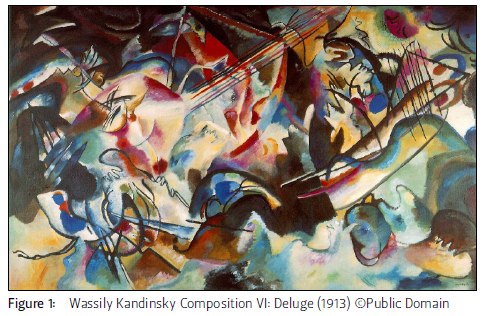
The lasting impression of a critical divergence of poetry from law in Kandinsky's work - a divergence that is simultaneously premised on the convergence of lack - is, however, not the way in which Kandinsky has been recently read in the law and literature movement. Instead, the "romantic fantasy" in Manderson's analytical crosshairs carries the day in Jack Sammons's 2015 reading32 of arguably Kandinsky's most famous "composition" - the 1913 improvisation, given the title Deluge.33 In as much as Sammons affirms that "[t]he painting is not a resolution of [...] tensions or a resignation to them so much as it is a celebration of tensions in a way that is life-affirming", he is nonetheless at pains to argue that Deluge shows us that law can be art if we are prepared "through the experience of the interplay of law's dynamic forces", "to experience the internal necessities of law and, with this, its internal truths".34
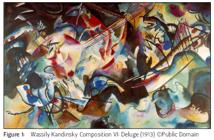
The problem, of course, lies in the (formal) necessity of abstraction as the access to this "internal truth" of law: "[i]t requires that law be removed from all of the ordinary mannered functions that have been assigned to it so that we might experience it anew in its own independent life",35 Sammons writes. To his credit, Sammons does not flinch in the face of the problem. Indeed, he asks what is left of law when it is so abstracted from its "ordinary mannered functions". Instead of giving the obvious answer, namely that precisely nothing is left of the law when it is so abstracted, Sammons answers in a way that deftly circumvents, at the level of consciousness, the nothing. In the place of the nothing, Sammons posits a substitution: what is left of the law in abstraction, he says, is, in fact, not law at all, but instead "justice" as the inner necessity of law.
Very early on in his teaching, Lacan told his students that that which is not worked out or worked through, that which is "rejected", avoided, circumvented, in the symbolic, does nothing but return in the Real.36 At the level of the unconscious, the lack will not abide its disavowal, for even on Sammon's own discursive terms, the abstract poetry at work in Deluge is a matter of law only to the extent that it is not or no longer, a matter of law, but rather and instead a matter of law's lack, for which "justice" is made to stand in all the time and all over as the potent signifier of the law's lack.
There is no need to boringly rehearse or re-rehearse the repressed conceptual incongruity between law and justice that Derrida brought to the surface of our contemporary juridical consciousness and conscience in such a critical way in 1990.37 Suffice it to say that it is an incongruity which provoked Costas Douzinas, writing in the late nineties, into the decisive psychoanalytic formulation with which I began: justice is "the unconscious of law. We can only know it through its symptoms, injustice". Deluge, I would suggest, represents Kandinsky in his maturity at the height of his abstract poetics, his "literature". And it is justice anarchic, in opposition to the law, but not "without law" at all (as though that has ever been possible (and yet, as we shall see …)), that is, it is painting produced from a psychic plane constituted by an encounter with the unconscious where there resides precisely that which the law continues to and always will, lack. In this way, Deluge itself is lack, nothing other than (a painting of (the)) lack.
Mark Rothko
The suits of authority
Rothko's life is, like Kandinsky's also marked in decisive ways by a pronounced experience with law and here an experience that was decidedly not ultimately generative, at least not in the sense that it was for Kandinsky. Instead, the experience with the law was tragically deleterious - as traumatic experience so often is. Rothko's traumatic encounters with the law in its guise as punishing and deathly authority are scattered across the trajectory of the artist's biography. In 1986, his celebrated biographer, James Breslin, published a piece in which he wrote that "Rothko"s childhood awareness and perhaps his direct experience of Czarist persecution"38 in the infamous Settlement of Pale into which he was born at the very height of the persecution in 1903, shaped his later "suspicion and hatred of authority".39 The numerous instances of bitter confrontations with authority in the artist's life after he eventually left the Pale for Portland, USA, at the age of ten,40 made a lasting impression together with the early experiences in the Pale, on how Rothko would come to express himself artistically. The biographical instances are too numerous to discuss here, but they came to a head of sorts in the form of the framing of Rothko's life as a painter by two lawsuits which were the direct results of betrayal by two older Jewish men who stood in a relationship of authority vis-à-vis the artist.41
Given that the second lawsuit took place only after Rothko's tragic suicide in the early morning of 25 February 1970, I will not discuss it here.42 The first lawsuit, however, especially its timing in the painter's career as well as the discursive matrix within which the consequent legal hearing unfolded within this timing, could be suggested as having left the definitive impression on Rothko as regards the way in which he would henceforth artistically treat authority and its law(s) in his work.
The suit took place at a time when Rothko was particularly impressionable as a poor and vulnerable twenty-five-year-old newly arrived New Yorker, contracted by a rabbi turned writer, one Lewis Browne, to assist with illustrations for a book called The Graphic Bible.43 While, initially, Browne enjoyed playing the relatively wealthy benefactor to Rothko's impoverished artist, relations eventually soured towards the end of the Graphic Bible project, after Rothko demanded his last payment from Browne, the latter refused, a heated argument ensued and Browne ordered Rothko out of his apartment and Rothko angrily and bitterly told the religiously devoted Browne that he will see him "in hell".44
Rothko somehow found the money to sue Browne not only for the outstanding contractual payment, but also for royalties that were allegedly promised orally.45 As could perhaps be expected, the young Rothko stood no chance, and the court found categorically in favour of Browne.46 Of this Breslin writes that "judicial authority in New York proved as inflexible"47 as Rothko's earlier experiences with authority. Succinctly, Breslin points to how the discursive matrix of the hearing rubbed in the legal defeat: "Instead of vindication, the hearing provided Rothko with a painful public attack on his integrity, his artistic ability and knowledge, and even his intelligence".48
With this, Breslin suggests that the legal battle between Rothko and Browne acquired the status of something symbolically worth much more than simply a juridical dispute, for from Rothko's point of view, it pitted him against the system, against politically liberal authority, Jewish authority and even a certain kind of artistic authority (which were all prominently represented publicly in the person of Browne).49 The courtroom, Breslin contends, became a stage on which Rothko - admittedly with a penchant for the theatre and tragedy formed early on - dramatized his conflict with authority.50 In other words, the hearing became the public symbolic stand-in, the metaphor, of all the previous more or less traumatic and alienating encounters with authority as law.
Rothko's performance at the hearing, Breslin writes, "may impress us, [but it] did not persuade the referee, and his defeat reveals with "maximum poignancy" (a favorite phrase) one of the crucial issues of his identity: how to free himself from persecutory authority in a way that did not turn out to be self-defeating or self-punishing".51 That this "crucial issue of his identity" arose just at the same time as Rothko was commencing his career in art should give us pause, not least because it is abundantly clear that the singular mode of abstract painting which Rothko adopted and practiced not just until he was world famous, but until he had reached the very end, can be argumentatively apprehended as an artistic expression of his lifelong hatred of authority and the equally lifelong longing for freedom from all authority, including, ultimately and tragically, his own.
I do not think that it is possible finally to say whether his artistic attempt at freeing himself from "persecutory authority" was not "self-defeating or self-punishing". Not only would an affirmation risk succumbing to the "romantic fantasy" against which the present contribution sets itself - there is also an abundance of evidence of what could be considered self-punishing and self-defeat in Breslin's definitive version of Rothko's life, of which the least is surely not the way in which the artist ended his life. On the other hand, it is by no means possible to deny or disavow either Rothko's enormous artistic success during his lifetime, which endures to this day and, I think, will endure indefinitely, or the definitive impact of his "abstract sublime"52 on the scene of the modernist art that followed in its wake and heralded the postmodern.
Painting (in) the void
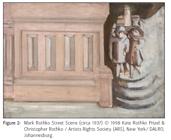
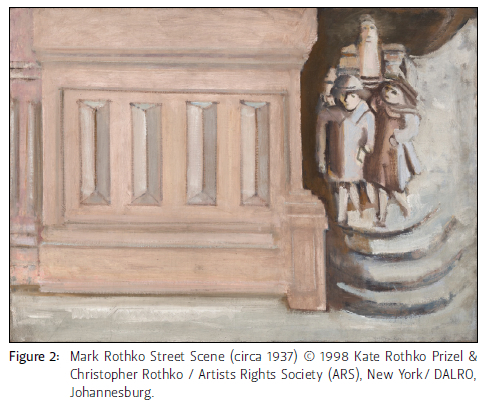
Yet Rothko's artistic treatment (we might even suggest "processing") of the traumatic biographical encounters with authority did not wait for abstraction to set in definitively at the level of artistic approach. Breslin discusses an early figurative work in this regard which was a harbinger of what was to come.53 The painting dates from 1937 and is entitled Street Scene. It renders three human figures (perhaps a family), in the manner of statuary, amidst the impersonal setting of a formal building that closely resembles a tomb.54 But the "truth" of / in the painting55 lies in the "the stark black behind the human figures"56 which "seems to reveal what is really behind these classical facades - namely, a black void".57 Breslin writes that the overall impression is of a "curved black shape descending from the top right corner" which "gives the impression that a dark curtain has been pulled back to expose a thick grey substrate that is deeper, more primitive, and more powerful than the shaped areas."58
It is as though in Street Scene we encounter the artist's early painterly image as a rendering of his betrayal by authority, with Rothko making it clear that what ultimately founds authority and its law is nothing other than, to invoke Derrida's idiom, a "mystical" black void that is "deeper, more primitive and more powerful" than the overt shapes that it assumes from time to time, a fundamental absence, then, at the very heart of authority's metaphysical pretensions to "presence" and "solidity". In this way, we can read Rothko's Street Scene as the work of an artist concerned to state poetically the a-legal, pre-legal, non-legal, "neither legal nor illegal"59 lack at the heart of law's authority - in other words, the "mystical foundation of authority" that Derrida takes from Montaigne, first and Pascal, citing the former.60
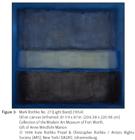
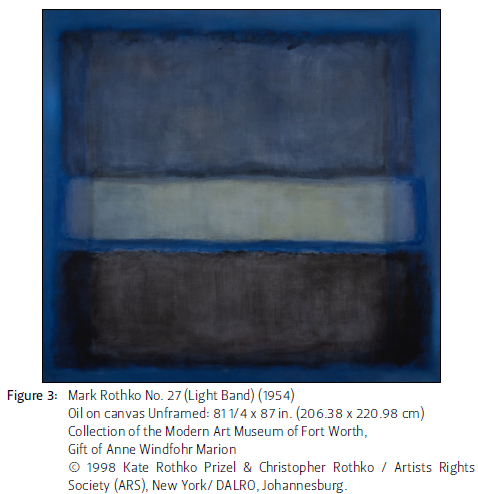
Moving, hastily, to the mature painting - the famous rectangular shapes of many different colours piled onto each other, mostly occupying the whole paintable space of the canvas, which are shapes that seem to pulsate with a primordial energy. Ronnie Lippens has suggested that these uncanny shapes can actually be interpreted as "sovereigns" "who move about, unabashed by legal, moral or social code".61 They have been freed, to paraphrase Rothko himself, from both "the sense of community and the feeling of security"62 that the adherence to an authority typically provides. Liberated, these sovereigns in Rothko's mature work enable that kind of transcendental experience that grounds itself in the apprehension of, and the meditation on, the lack at the heart of human existence and the human condition. The rectangular shapes, Rothko writes, "move with internal freedom, and without need to conform with or to violate what is probable in the familiar world".63 In other words, they are sovereigns to the extent that they neither conform nor violate - they are simply impervious to worldly authority, they have freed themselves from law, they are to the fullest possible extent "without law"64 - anarchic - much more so, at least, than the forms of abstraction of which Kandinsky proved to be a master. For the point is perhaps precisely that Rothko was, in many ways that I cannot elaborate here, decidedly not a master, certainly not, in the first place, master of himself or his self. And there is also much evidence with which to show how he actively worked, over and over again, towards the erasure both of (his) mastery and of (his) masters.
Lippens suggests that the focus in the mature paintings is always what Rothko called "the single human figure", whose "solitude [cannot] be overcome".65 He concludes that "[n]early all of Rothko's signature paintings were and remained part of, in Rothko's own words, "a tableau vivant of human incommunicability"66 - the lack in and of the signifier. In absolute incommunicable solitude, these sovereigns become vessels of reflection, clearly not of anything, least of which worldly authority, but are rather facilitators for a reflection upon: "upon the world, that is, upon the stifling, 'embarrassing', 'shaming' laws and codes in it".67
As in Kandinsky, the issue of tension, of ambivalence, hesitation and provisionality is close to the surface. Lippens designates the process of sovereign reflection as a deeply in-tense one, in which a "boiling tension" insists, suggested by the uneven applications of paint within the shapes. Rothko's sovereigns are not by any means deprived of will, for they will to be "radically sovereign"68 and such a radical embodiment / figuration of a sovereignty wilfully in tension (as opposed to lawyerly sovereign wilful intention), without law, can only proceed by way of a radical detachment from anything that is mannered, "familiar" as norm(ality) and as normativity69 - in other words, it necessitates withdrawal.
Here, then, we arguably have the painterly equivalent of Andreas Philippopoulos-Mihalopoulos's version of withdrawal from the lawscape in the effort to approximate something like justice which, of course, for this particular author cannot but be a spatial justice.70 Withdrawal is described here as a "radical" but also "intensely difficult" process. "Withdrawal has nothing passive about it", Philippopoulos-Mihalopoulos writes, "withdrawal requires an articulated strategy that may be risky and often desperate".71 When all is said and done, Rothko's painterly or poetic "strategy" was nothing if not highly "articulated", "risky" and, yes, "often desperate". This kind of withdrawal, suggests Lippens (without using the word), "requires one to move beyond the world, into the void of pure, utterly abstract, but in[-]tensive reflection where the tragedy of human existence is, quite simply, reflected".72 It was precisely the "tragic predicament"73 of the human condition that Rothko attempted to articulate with his "living pictures" of human incommunicability and, like Kandinsky but very differently, the ultimate articulation of Rothko's reflecting sovereigns is (the) lack as the "tragic predicament" that we are faced with by ourselves, by others, by our law as much as by our poetry.
In JM Coetzee's Waiting for the Barbarians of 1980,74 the protagonist magistrate / man of the law has a series of strange encounters with a blind "barbarian" girl which he brings into his rooms from the street after her release from prison where she, along with others of her kind, were tortured by a sadist officer of Empire, Colonel Joel. Instead of exploiting her sexually, as is predictable and expected as conduct true to the character of a magistrate in a frontier town in a realm called Empire, the magistrate proceeds to wash the girl's feet broken by Joel's torture and, later, he washes her entire body.75 The experience of the ministrations ultimately leads the magistrate to becoming completely undone or, to put it in Lacanese, the experience "unmoors" him from the institutional master-signifier of "Empire". At the end of the episode he reflects that the girl has come to force him to interrogate nothing less than his desire and even further, she has compelled him to look inside himself and see "only a vortex and at the heart of the vortex oblivion".76 Something similar can be said in relation to the alterity of Rothko's mature paintings - they force upon us, however gently, a temporary withdrawal from the world in order to interrogate our desire and discover at the heart of that desire nothing more than an "unbudgeable void".77 To put it in Jean-Luc Nancy's words, they force upon us a being "alone with the void as the truth of self".78 In this they are akin to and on par with the Lacanian session.
This reading of Rothko is at least in part confirmed by Timothy Martin's assertion that Rothko wanted to paint a pre-narrative, even pre-symbolic, "underlying categorical level" and that abstraction gave him the means to do so.79 Availing himself of the Lacanian terminology explicitly, Martins suggests that "Rothko attempts to paint the Other of the Symbolic, the radical unconscious alterity" by force of which we are alienated - and first of all from ourselves.80 As Martins puts it later in his piece, Rothko is at pains to render in his "tonal poetry"81 that for which Lacan could not do otherwise than abide by Freud's language which apprehended it as "das Ding".82 And as any Lacanian knows, the Thing (in) itself is just another name for the radical absence that is lack, because the Thing is that which is lost at the origin of our subjectivity and as the origin of that subjectivity and which as such founds the lack and grounds it, which is why Lacan refers to our experience of the Thing as the "emptiness" inherent in the signifier and "the emptiness at the center of the real"83 - "to be found at the most as something missed."84
The devastations of the law
In both Rothko and Kandinsky before him, the work of art is not by any means made to function as the law's saving grace. It is rather the opposite, because this poetry devastates the law, it is a devastation of the law. Devastation is an admittedly painful yet necessary stage in the process of psychoanalytic treatment. And after all, had it not been for the devastation of the law and the legal system in the history of colonialism, imperialism and apartheid (to mention only these), its "transition", partial as it undoubtedly is here as well as everywhere, would most likely not have come about or it would have taken impossibly longer.
Of course, there are good and less good devastations of the law. The devastations that we are presently experiencing in the world might very well be devastations of the human rights based legal tradition that has until now enjoyed the status of a largely global hegemony that has secured the reigning visuality, at least, of a carefully curated "peace" after the last world war. Yet, these devastations are not the devastations wrought upon the law by poetry. Rather, they are devastations of the law as much as they are devastations by the law, or at least by that which explicitly claims for itself by arrogation the power of naming itself as and being called, the law, of being lawful as lawful being. They are, then, not the devastations wrought by poetry but by the law by itself, upon itself. The law is devastating itself, the law has gone mad all on its own, it has driven itself mad, it has been driving itself mad for a very long time now and it is devastating indeed.
These devastations perpetrated by the law upon its self, this self-harming of the law, are, in the final analysis, then, foreclosures of the law of and upon the (very concept of) law and this means that they are the signs of lawful power that has driven itself into psychosis, the law foreclosing on the law, withdrawing into its own lonely and isolated world.85 It is not the poetic withdrawal in intensive reflection of Rothko's rectangular sovereigns, for the reader might have noticed that Rothko's sovereigns are in "solitude", they are not in the "loneliness" wrought by totalitarian psychosis.86 As much as they are withdrawn from it, they are ultimately still of the world, for the world. In view of the law's psychotic foreclosure, in view of the law's madness, we need poetry more than ever.
This world is nothing if it is not the world of a law that is always going to lack, that will therefore always have a desire. If I can put it psychoanalytically, the wager of law's encounter with the alterity of poetry has always been that it might be brought through the encounter to an apprehension of its desire not through navel gazing at itself and into itself, but precisely through the gaze of a reflection of itself in the mirror upheld by the poetic other which not only "forces" it to "interrogate" its desire (like Coetzee's magistrate) but which might, just might also come to "figure" for it from time to time, the elusive, transient and fleeting justice of its desire. Such "poetic justice" is a justice which the law cannot "uphold", as we say, it cannot hold on to it, fix it, assign it a place and a time, because not only is this justice other, it also lacks as that other.
The poetic lesson of Kandinsky and Rothko for law is a lesson in the form of a visual morality tale about the value of modesty and humility. It is a lesson that justice is, like the pleasant dream from which one eventually wakes, something only ever marginally and partially recoverable as a signifying formation of representation, if it is (to be) at all. Forever out of the reach of a reality that would almost immediately totalise it, Kandinsky and Rothko render it as lack, as what will always lack and as what will always be the lack.
The famous opening line of William Gaddis's A frolic of his own, a novel somewhere in the transition between high modernism and early postmodernism, imposes itself here: "you get justice in the next world, in this world you have the law".87 Far from nihilistic, the lesson of the morality tale in the line is once more a plea for modesty and humility. Note that the line does not say that you get justice in "heaven", it says that you get justice in "the next world", the world after the law, the world that follows from the law, the world that is still a world. As such the formulation performs a subtle metonymy in the form of a sliding of the common signifier "world", so that a kind of correspondence between "next world" and "this world" is effected, which blurs the ostensibly strict boundaries that separates "this" from "next" "world", rendering those boundaries permeable and so holding open the only very slight possibility of "this" world's potentiality always for its becoming as the "next" world, which is nothing other than the potential of law for the actualisation of justice, the potential of justice to be done by the law. More than ever, we need, knowing fully that this potential of the law for justice is always already precarious and frail and fraught with pitfalls, to hold on, at least, to the potential of its actuality. It is, again, poetry that can show us how we might hold on.
Kandinsky and Rothko's different but similar trajectories, their experiences with law and the way in which they work (with) the representation of those experiences in their artistry, suggest that the holding on might begin, in the end, in this world with the holding on to the lack in that it is a world defined by lack and that the human predicament, tragic as it may be, resides in coming to terms with this lack, living (with) it, instead of disavowing it all the time and in so many destructive ways. The work of Slavoj Žižek, Jacques-Alain Miller, Alain Badiou and others have insisted that the lack might not be as tragic a predicament in that coming to terms with it can only mean political and ethical paralysis and stasis. Rather, this work suggests that the very possibility of emancipatory political action depends today on living with the lack, coming to its terms, in the sense of acting from the lack and in the lack, minding "the gap", so to speak, which is to say in the space that has not already been colonised by the symbolic order. It is precisely those legal systems that have pompously disavowed their lack and that have pretended that they will be "all" for "everyone" (by which they of course meant a very specific and exclusive kind of "everyone") that have been historically and are now again at the centre of the totalitarian nightmare of injustice.
Modernist poetry, whether visual or literary, has always been a form of action in and of or by the lack, in the gap between the given signifiers, in the space between the lines, out of the ruin(s)88 and ruinations wrought by the totalising mimesis and "representation" (which meant something very specific then) of yesteryear. Joyce and Beckett and Brecht and the proto-modernist Melville and Alban Berg in the opera, along with the other usual modernist suspects that the (post)postmodern masters are again so fond of invoking at every turn, surely did not invent poetic action from the lack but, of course, they were responsible for its intensification and concentration, for driving it "beyond the pale", if I may say so in a section concluding with Rothko. Modernist poetics would not be what it was and has become if it was not for the lacks and the gaps in the laws (of modern signification) that it set its curious gaze upon. There is currently, arguably no "curiouser and curiouser"89 artistic gaze upon the "psychoanalytic wonderland"90 that we have wandered into quite a while ago already, than the one cast by William Kentridge.
William Kentridge
Living (with) the lack
How to live in a productive way with, and direct one's action from, the lack is a question at the heart of William Kentridge's practice. He, in turn, was born into a family of prominent anti-apartheid lawyers and made aware at an early age of "the appalling cost of South Africa's apartheid system, both to the victims of an oppressive regime and in the corruption of the entire social order".91 In his becoming as an artist, Kentridge became fascinated "with the ambiguous experience of both witnessing and participating in the tragedy of apartheid".92 As for the influence of the close familial proximity of law on his artistry, Kentridge reflected in his Norton Lectures of 201493 on the general history of lawyering in his family and specifically on his father's status as a human rights lawyer who became increasingly prominent during the years of the artist's upbringing. "It became imperative", he writes, "to make something, a self, impervious to cross-examination."94 An imperative, a law, then, of imperviousness with which to displace the authority of the law that would "cross-examine" him. It is, therefore, as though Kentridge had practiced and may be practicing still, his own particular version of Rothkoean sovereign reflection in tension. As an artist deeply steeped in the modernist legacy, Kentridge knows Rothko well and the latter's influence on the former is noticeable in the subtle punctuations by intensely dynamic or kinetic abstract forms of the often figurative black and white palette.
In the same Norton lecture, Kentridge goes on to link the attainment of such a law of imperviousness to cross-examination, to the idea of stupidity and specifically what he calls "the necessary stupidity that is essential in the studio".95 It is stupidity as a categorical imperative - a categorical lack of knowledge, an imperative lapse of the intentional will - that explores intensely the artistic value of doubt, hesitation and uncertainty as mainstays of the creative practice. Moreover, of contemporary South Africa Kentridge has written that it "is a place in which the edges are important; where that which does not fit needs to be acknowledged; where contradiction is central. We need to understand that instability and provisionality are the order of the day".96 It is not difficult to notice that Kentridge is profoundly concerned artistically with the lack that he has detected at the heart of the South African constitution (in the widest possible sense of the word) as well as the lack from which he draws the action of his creative practice. It could, therefore, be suggested that Kentridge is not only concerned with and by the lack at the heart of law, but also with the lack at the heart of his visual poetry and, further, that he answers, in the manner of Lacan's definition of love,97 the one lack - the law's lack - with the other - poetry's lack.
What is the main complaint?
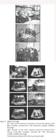
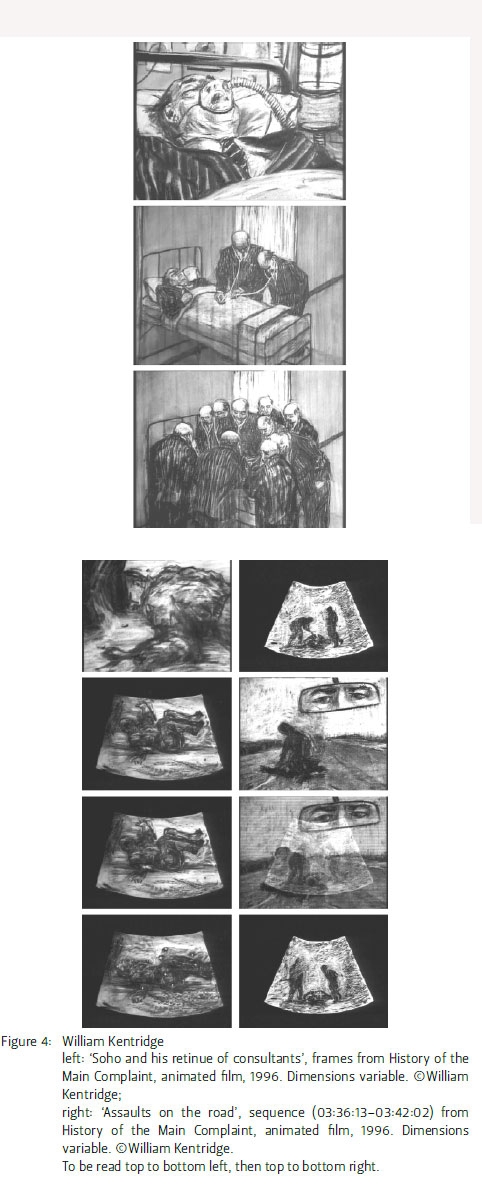
This artistic answering of law's lack with and by the poetic lack plays out in concrete terms in, to take just one instance, arguably Kentridge's most famous work, History of the Main Complaint (1996), where he shows, to put it in Michael Rothberg's words, why "loss is unredeemable": "not just because of the materiality of political violence but because of the temporal structure that accompanies it".98 This "temporal structure" is the structure of what Kentridge has called "thick time",99 implicating as it does the embodied and relevant subject that declines, refuses, to let the past be relegated finally to the confines of "history". This is how two prominent critics have described this work, rendered in the medium of animated film: "Behind a cordon sanitaire, dressed in his signature pin-striped suit, South African mining magnate Soho Eckstein - one of the stock [allegorical] characters in William Kentridge's body of animated films - lies in his hospital bed: prone, insensible".100 Eckstein, it turns out, is in a coma. Kentridge himself says: "Here's a person who's in a coma because of the weight of what he sees. The question is, is it going to kill him?"101 Eckstein, who is the artist's alter ego, is connected to a respiratory mask and a number of doctors are attending to him.
Next, images of Soho's interior, monitored by radiographical machines of all sorts, morphs into a landscape. "The scene cuts to Soho driving, his eyes reflected in the car's rear-view mirror, the road in front flanked by an avenue of pylons and thickening trees".102 At the same time, we are "propelled forward", "the unfolding scene rushes towards us as memory".103 Then, "[s]uddenly, a figure charges out of the darkness, hurtles into view, is momentarily held in the beam of the car headlights. The impact is brutal: the face is crushed, the windscreen shatters."104
Dubow and Rosengarten remark that the collision represents the moment of crisis for memory in the events: "it is the moment of crisis itself that signals the awareness of history, an awakening to the past at the point [that] it is wrenched into shocking correspondence with present sight".105 At this moment of the collision, Eckstein wakes up from his coma and the implication is clear: in the moment of crisis for memory, History of the Main Complaint, as a work of art, wakes up, "stands, epistemologically, on entirely different ground from the logic of traditional historicism"106 that has been so central not just to modern law in general, but specifically to the (post)modern legal notion of "transitional justice". History of the Main Complaint performs a "flash irruption of a radical temporal discontinuity"107 that dramatizes the disruption and the rupture of law's aspirations to and appeals for linear temporal continuity (through the widespread dissemination of the stare decisis principle as the basis of the legal judgment, for instance). Kentridge does not shy away from the discontinuity that he evokes in this work - he embraces it, affirms it, instead. The crash scene "is less an image of time than a plunge into the time-image itself, into that Benjaminian dimension in which the compaction of the "what-has-been" and the "now" is apprehended within the density of their consonance and dissonance".108
As for my own take on History of the Main Complaint, it is for a lawyer impossible to neglect as the starting point of commentary here that the work premièred as a film at the Fault Lines: Inquiries into Truth and Reconciliation exhibition at The Castle in Cape Town on 16 June 1996109 - thus on the date commemorating the Soweto Uprisings - just as the so-called "novel" institution of the law, the Truth and Reconciliation Commission (TRC), was performing its widely published work in South Africa. The film is a powerful critique of the TRC as lawful institution and as a process of the law. As to the specificities of the critique, we must note, too, Dubow and Rosengarten's contention that the crash scene suggests at once a "refusal of historic reverie" at the same time as it endorses a "rejection, too" of that psychic process that attempts to lay the (love) object to rest forever and found the law anew.110 As much as the TRC has been described as a process of national mourning - a dream as nightmare - with which to displace, at least at the institutional level, apartheid's nightmarish interdiction on mourning,111 (one nightmare for another), the metaphor of "closing the book" on the past endured as a widespread rhetorical device, as the "reverie" in which its work could be (summarily) summarised.
History of the Main Complaint stages critical opposition to the ideology underlying that metaphor, it exhausts the metaphor, productively undermines its representation of the (legal) ideology that mourning can be completed, can be over and done with, can be closed like a book that one has finished reading. Rather, Kentridge insists on a "counter-law"112 of mourning as a mnemonic process that contemplates no conclusion, a process we might say in an echo of Rothko, that incessantly reflects on, circles around, loss and the lack for which loss is responsible, never letting (it) go. In Kentridge, to be sure, we are dealing with the presentation of a certain kind of temporal overflow of the "what has been" into "what is now" and into "what will be" and it is a temporal overflow for which the law, as transitional justice or otherwise, does not have an answer, that it is incapable of accommodating and as such lacks. In the end, the law does not, cannot, stay with the trouble. In this way, History of the Main Complaint answers law's lack with the lack that it figures poetically.113
What, then, of the lack not simply as an instantiated poetic figuration but as the overall practice of the artist? In the Norton lectures, Kentridge asserts that the work of art implies "a system of representation and narrative closer to the logic of dreams and their associations than the rationality of waking hours".114 Taking his cue from the Surrealists before him by situating the work of art alongside (the logic of) the unconscious, Kentridge goes on entirely to subvert the metaphysical relation between positive knowledge and truth, by asserting that "NOT knowing the answer to the riddle opens all the possibilities and different possible answers".115 He returns to the primordial riddle, the riddle of the sphinx in the Oedipus myth and remarks that a riddle with a clear answer like that given by Oedipus "stops us short", "is answered and leaves no trace".116
The real riddle or the riddle in the Real which is the truth and that underlies the sphinx's riddle is the riddle of the sphinx itself, its "unfathomability", the "double creature", the "shift between what is human and what is not".117 This secondary riddle, the riddle "which does not have an answer"118 is primary as the riddle that for Kentridge moves the creative powers of the artist. He writes that his experience in the studio is of a gathering of energy that does not know what to do. "What are the images to be made? […] The only thing I had confidence in was the very circling itself, the riddle that had no clear answer".119 In this way, the work of art is conceived as practice from and with the lack, an encounter with lack that reflects, will reflect, the lack, will lack (itself). It is the nonplace where "sublation" comes to die and in its place there comes to be only the encircling, the tracing, the erasure and the drawing again on the same page. There is only, we might say, the "more sweetly"120 play of the dance around and with the lack (of the answer).
Coda for the blind spot
This deviant exploration of the lack in law and in literature, this exposition of the lack as constitution or of constitution as lack is not an exercise simply aimed at the portrayal, for its own sake, of an alternative relationship between law and literature that locates its foundations in modernism and modernist psychoanalysis.121 For as Mari Ruti has suggested, "every attempt to fill or cover over the subject's lack distances the subject further from the possibility of accurately reading his desire".122 The possibility of "accurately reading desire" is, in Lacan, the condition precedent of ethics. So the effort directed at the lack could be read as an ethical attempt, however minimal, to bring the law closer to the quite political desire for justice that lies inhumed in its unconscious.123 Bruno Bosteels, reading Alain Badiou, calls this justice "the force of nonlaw".124 But as Douzinas suggests, we can know such justice, such nonlaw, precisely only negatively, through what it is not, through its symptoms, through what figures as the "nonlaw" of poetry, through what (it) lacks.
Ultimately, I follow Maria Aristodemou's understanding of literature as a very specific kind of analyst for law, namely that kind of analyst-literature that reduces itself not to a mirror for the analysand-law, but rather more importantly to the blind spot from which law cannot ordinarily see itself, the blind spot exemplarily figured and precisely in the poetry of the famous Holbein painting, The Ambassadors that Lacan discusses in Seminar XI125 and there too, but in a different way, in the poetry of Las Meninas.126 These are exemplary exemplars, but on the argument of this contribution, the blind-spot of law figured by poetry is not limitable to a few exemplary exceptions and the works of Kandinsky, Rothko and Kentridge discussed here each "depict" it in their own way. From the blind spot, it becomes possible to see what (one) truly is and this truth begins with the lack. Indeed, the blind spot in poetry is a representation of lack that reveals or points to the lack in law. In addition, I think that it goes without saying that a truthful sighting / citation of law from (or in) the point of its blind spot, must involve, at the very least, law's confrontation with the Real of violence, the lack of justice, at its origin, the violence as a lack of justice that makes it what it is. It means, too, a political confrontation with the "field of pain and death"127 in which law takes its interpretative bearings as the adjudication that takes its decisions of division and surely, then, a truthful citation of the law would have to reckon politically as well (it has to be said in our context especially) with the violent land-appropriation, the arrogation of the earth that precedes, and so is situated at the heart of, nomos.128
It is well known and accepted in Lacanian psychoanalysis that a successful analysis does not leave the analysand complete and whole, but instead in a state of what Lacan called "subjective destitution".129 Slavoj Žižek has suggested that such a state of subjective destitution is also the point at which the subject is pure potentiality for "radical social change", if not revolution, because it emerges, in an echo of Kentridge, on account precisely of a gap, a lack, that arises in the "continuity of History".130 It is perhaps safe to say, then, bringing everything back to the South African situation, that a law successfully analysed by poetry, a subjectively destitute law brought to an acute consciousness of its lack (of justice), is a law at least susceptible to the kind of transformation in which Karl Klare placed his hopes in 1998 for the law, the vision being a law that is more open, fluid, less exclusive, less violent, decolonising itself, perhaps. We might say that it is a law that would arrive "after" poetry, in its pursuit, yes, but also critically on account of the encounter. No doubt, it is a law that remains radically to come as the law of the "next world" and so it raises acutely Freud's 1937 problematic of "analysis terminable and interminable"131 for law and literature anew.
References
-
Agamben G. 1999. The man without content. Stanford: Stanford University Press. https://doi.org/10.1515/9780804765428
» https://doi.org/10.1515/9780804765428 - Arendt H. 2006. Between past and future. London: Penguin.
- Arendt H. 1968. The origins of totalitarianism. Orlando: Harcourt.
-
Aristodemou M. 2014. Law, psychoanalysis, society: taking the unconscious seriously. Abingdon: Routledge. https://doi.org/10.4324/9781315885155
» https://doi.org/10.4324/9781315885155 - Ashmore J. 1962. The theoretical side of Kandinsky. Criticism 4: 175.
-
Bate J and Rasmussen E (eds). 2007. William Shakespeare complete works. Houndmills: Macmillan. https://doi.org/10.1007/978-1-137-00453-6
» https://doi.org/10.1007/978-1-137-00453-6 - Blanchot M. 1987. Our responsibility. In: J Derrida and M Tlili (eds). For Nelson Mandela: 249.
- Bosteels B. 2008. Force of nonlaw: Alain Badiou's theory of justice. Cardozo Law Review 29(5): 1905.
-
Breslin JEB. 1986. The trials of Mark Rothko. Representations 16: 1. https://doi.org/10.2307/2928511
» https://doi.org/10.2307/2928511 - Breslin JEB. 1993. Mark Rothko: a biography. Chicago: University of Chicago Press.
-
Butler J. 2019. Genius or suicide. London Review of Books 41(20). Available at: https://www.lrb.co.uk/the-paper/v41/n20/judith-butler/genius-or-suicide [accessed on 5 March 2025].
» https://www.lrb.co.uk/the-paper/v41/n20/judith-butler/genius-or-suicide - Carroll L. 1998. Alice's adventures in Wonderland. London: Penguin.
- Christov-Bakargiev C, Cameron D and Coetzee JM (eds). 1998. William Kentridge. London: Phaidon.
- Coetzee JM. 1980. Waiting for the barbarians. London: Minerva.
-
Cover R. 1986. Violence and the word. Yale Law Journal 95(1): 1601. https://doi.org/10.2307/796468
» https://doi.org/10.2307/796468 -
Davis DM and Klare K. 2010. Transformative constitutionalism and the common and customary law. South African Journal on Human Rights 26: 403. https://doi.org/10.1080/19962126.2010.11864997
» https://doi.org/10.1080/19962126.2010.11864997 -
Derrida J. 1980. The law of genre. Critical Inquiry 7(1): 55. https://doi.org/10.1086/448088
» https://doi.org/10.1086/448088 - Derrida J. 1986. Memoirs for Paul de Man. New York: Columbia University Press.
-
Derrida J. 1987. The truth in painting. Chicago: University of Chicago Press. https://doi.org/10.7208/chicago/9780226807690.001.0001
» https://doi.org/10.7208/chicago/9780226807690.001.0001 - Derrida J. 1990. Force of law: the 'mystical foundation of authority'. Cardozo Law Review 11: 921.
- Derrida J. 1998. Monolingualism of the other or the prosthesis of origin. Stanford: Stanford University Press.
- Derrida J. 2001. The work of mourning. Chicago: University of Chicago Press.
- Douzinas C. 1996. Psychoanalysis becomes the law: notes on an encounter foretold. Legal Studies Forum 20: 323.
-
Douzinas C. 2019. The responsibilities of the critic: law, politics and the Critical Legal Conference. In: C Christodoulidis, R Dukes and M Goldoni (eds). Research handbook on critical legal theory: 223. https://doi.org/10.4337/9781786438898.00020
» https://doi.org/10.4337/9781786438898.00020 -
Dubow J and Rosengarten R. 2004. History as the main complaint: William Kentridge and the making of post-apartheid South Africa. Art History 27(4): 671. https://doi.org/10.1111/j.0141-6790.2004.00443.x
» https://doi.org/10.1111/j.0141-6790.2004.00443.x - Fink B. 2016. Lacan on love: an exploration of Lacan's Seminar VIII, Transference. Cambridge: Polity.
- Foucault M. 1970. The order of things: an archaeology of the human sciences. London: Routledge.
- Freud S. 1961. The ego and the id. In: The standard edition of the complete psychological works of Sigmund Freud, Vol. XIX (1923-1925). London: Hogarth Press, p.20.
- Freud S. 1964. Analysis terminable and interminable. In: The standard edition of the complete psychological works of Sigmund Freud, Vol. XXIII (1937-1939). London: Hogarth Press, p.209.
- Gaddis W. 1994. A frolic of his own. London: Penguin.
-
Godby M. 1999. William Kentridge: retrospective. Art Journal 58(3): 74. https://doi.org/10.1080/00043249.1999.10791955
» https://doi.org/10.1080/00043249.1999.10791955 - Grohmann W. 1962. Kandinsky - a summary study. In: Solomon R Guggenheim Foundation (ed). Vasily Kandinsky 1866-1944: supplement to the exhibition catalogue.
-
Hall JM. 2012. Kandinsky's Composition VI: Heideggerian poetry in Noah's ark. Journal of Aesthetic Education 46(2): 74. https://doi.org/10.5406/jaesteduc.46.2.0074
» https://doi.org/10.5406/jaesteduc.46.2.0074 - Harrow G. 1977. Reflections on Estate of Rothko: the role of the legal advisor in relation to the artist. Cleveland State Law Review 26(4): 573.
- Harrow G. 1978. The final word in the Rothko case: salient legal holdings of the Court of Appeals. Art & the Law 4(2): 33.
- Heidegger M. 1971. Poetry, language, thought. New York: HarperCollins.
- Hobbs R. 1978. Early abstract expressionism: a concern with the unknown within. In: R Hobbs and G Levin. Abstract expressionism: the formative years: 16.
- Kandinsky W. 1982a. Statement in Journal des Poètes. In: KC Lindsay and P Vergo (eds). Kandinsky: complete writings on art. Boston: Da Capo Press, p.833.
- Kandinsky W. 1982b. On the spiritual in art. In: KC Lindsay and P Vergo (eds). Kandinsky: complete writings on art. Boston: Da Capo Press, p.193.
- Kandinsky W. 1982c. Reminiscences / Three pictures. In: KC Lindsay and P Vergo (eds). Kandinsky: complete writings on art. Boston: Da Capo Press, p.362.
-
Kennedy D. 1976. Form and substance in private law adjudication. Harvard Law Review 89: 1685. https://doi.org/10.2307/1340104
» https://doi.org/10.2307/1340104 - Kentridge W. 2014. Six drawing lessons. Cambridge: Harvard University Press.
-
Kentridge W. 2015. More sweetly play the dance. Available at: https://www.kentridge.studio/william-kentridge-projects/more-sweetly-play-the-dance/ [accessed on 6 March 2025].
» https://www.kentridge.studio/william-kentridge-projects/more-sweetly-play-the-dance/ -
Kentridge W. 2016. Hope as a political category. Arts & Humanities in Higher Education 15: 11. https://doi.org/10.1177/1474022215613601
» https://doi.org/10.1177/1474022215613601 -
Lacan J. 1967. Seminar XIV: the logic of phantasy 1966-1967. Available at: http://www.lacaninireland.com/web/wp-content/uploads/2010/06/THE-SEMINAR-OF-JACQUES-LACAN-XIV.pdf [accessed on 6 March 2025].
» http://www.lacaninireland.com/web/wp-content/uploads/2010/06/THE-SEMINAR-OF-JACQUES-LACAN-XIV.pdf - Lacan J. 1977. The seminar of Jacques Lacan Book XI: the four fundamental concepts of psychoanalysis. New York: WW Norton & Company.
- Lacan J. 1993. The seminar of Jacques Lacan Book III: the psychoses 1955-1956. New York: WW Norton & Company.
- Lacan J. 1995. Proposition of 9 October 1967 on the psychoanalyst of the school. Analysis 6: 1.
- Lacan J. 2002. The seminar of Jacques Lacan Book XII: crucial problems for psychoanalysis 1964-1965. London: Karnac.
- Lacan J. 2007. The seminar of Jacques Lacan Book VII: the ethics of psychoanalysis 1959-1960. New York: WW Norton & Company.
- Lacan J. 2019. The seminar of Jacques Lacan Book VI: desire and its interpretation. Cambridge: Polity.
- Lindsay KC and Vergo P (eds). 1982. Kandinsky: complete writings on art. Boston: Da Capo Press.
-
Lippens R. 2012. Control over emergence: images of radical sovereignty in Pollock, Rothko, and Rebeyrolle. Human Studies 35(3): 351. https://doi.org/10.1007/s10746-012-9237-x
» https://doi.org/10.1007/s10746-012-9237-x -
Loizidou E. 2023. Anarchism: an art of living without law. London: Routledge. https://doi.org/10.4324/9780429952692
» https://doi.org/10.4324/9780429952692 -
Long R-C Washton. 1987. Occultism, anarchism, and abstraction: Kandinsky's art of the future. Art Journal 46(1): 38. https://doi.org/10.1080/00043249.1987.10792337
» https://doi.org/10.1080/00043249.1987.10792337 -
Manderson D. 2011. Modernism and the critique of law and literature. Australian Feminist Law Journal 35(1): 107. https://doi.org/10.1080/13200968.2011.10854462
» https://doi.org/10.1080/13200968.2011.10854462 -
Martin TD. 2010. Psychosis and the sublime in American art: Rothko and Smithson: the sublime object. Tate Papers 13. Available at: https://www.tate.org.uk/research/tate-papers/13 [accessed on 4 March 2025].
» https://www.tate.org.uk/research/tate-papers/13 -
Nancy J-L. 2006. Multiple arts: the muses II. Stanford: Stanford University Press. https://doi.org/10.1515/9781503618923
» https://doi.org/10.1515/9781503618923 -
Olin M. 1989. Validation by touch in Kandinsky's early abstract art. Critical Inquiry 16(1): 144. https://doi.org/10.1086/448529
» https://doi.org/10.1086/448529 - Oppermann J. 2009. William Kentridge - creating animated images in space and time. South African Journal of Art History 24(2): 20.
-
Philippopoulos-Mihalopoulos A. 2015. Spatial justice: body, lawscape, atmosphere. Abingdon: Routledge. https://doi.org/10.4324/9781315780528
» https://doi.org/10.4324/9781315780528 -
Pickstone C. 2011. A theology of abstraction: Wassily Kandinsky's 'Concerning the spiritual in art'. Theology 114(1): 32. https://doi.org/10.1177/0040571X10387346
» https://doi.org/10.1177/0040571X10387346 - Rose G. 1992. The broken middle: out of our ancient society. Oxford: Blackwell.
- Rose J. 1991. The haunting of Sylvia Plath. London: Virago.
-
Rosenblum R. 2005. The abstract sublime. In: EG Landau (ed). Reading abstract expressionism: 239. https://doi.org/10.12987/9780300185720-032
» https://doi.org/10.12987/9780300185720-032 - Rosenthal M. 2009. William Kentridge: five themes. New Haven: Yale University Press.
-
Rothberg M. 2012. Progress, progression, procession: William Kentridge and the narratology of transitional justice. Narrative 20(1): 1. https://doi.org/10.1353/nar.2012.0005
» https://doi.org/10.1353/nar.2012.0005 - Rothko M. 2006a. The romantics were prompted. In: M Rothko. Writings on art. New Haven: Yale University Press, p.58.
- Rothko M. 2006b. Writings on art. New Haven: Yale University Press.
-
Ruti M. 2008. The fall of fantasies: a Lacanian reading of lack. Journal of the American Psychoanalytic Association 56(2): 483. https://doi.org/10.1177/0003065108319687
» https://doi.org/10.1177/0003065108319687 - Sammons JL. 2015. Can law be art? Mercer Law Review 66: 527.
- Sanders M. 2007. Ambiguities of witnessing: law and literature in the time of a truth commission. Stanford: Stanford University Press.
-
Sass LA. 2015. Lacan: the mind of the modernist. Continental Philosophy Review 48: 409. https://doi.org/10.1007/s11007-015-9348-y
» https://doi.org/10.1007/s11007-015-9348-y - Schmitt C. 2003. The nomos of the earth in the international law of the Jus Publicum Europaeum. New York: Telos Press Publishing.
- Shakespeare W. 2007. Hamlet. In: J Bate and E Rasmussen (eds). William Shakespeare complete works. Houndmills: Macmillan, p.1918.
-
State Tretyakov Gallery. n.d. Kandinsky V. Composition VI (1913, Hermitage). Available at: https://artsandculture.google.com/asset/kandinsky-v-composition-vi-1913-hermitage/kgExsxhp7qzWsA?hl=en-GB [accessed on 3 March 2025].
» https://artsandculture.google.com/asset/kandinsky-v-composition-vi-1913-hermitage/kgExsxhp7qzWsA?hl=en-GB - Stockenström W. 1970. Vir die bysiende leser. Cape Town: Reijger-Uitgewers.
- Unger RM. 1986. The critical legal studies movement. Cambridge MA: Harvard University Press.
-
Van Marle K and Motha S. 2013. Genres of critique: law, aesthetics and liminality. Stellenbosch: SUN Press. https://doi.org/10.18820/9781920689032
» https://doi.org/10.18820/9781920689032 - Verhaeghe P. 1995. From impossibility to inability: Lacan's theory on the four discourses. The Letter: Lacanian Perspectives on Psychoanalysis 3: 76.
- Watson S. 1986. Colonialism and the novels of J M Coetzee. Research in African Literatures 17(3): 370.
-
Zijing W and Blinova E. 2019. Non-figurative art in Russia in the late 20th to 21st centuries. Curator: The Museum Journal: 241. https://doi.org/10.1111/cura.12292
» https://doi.org/10.1111/cura.12292 -
Žižek S. 2023. Subjective destitution in art and politics: from being-towards-death to undeadness. Enrahonar: An International Journal of Theoretical and Practical Reason 70: 69-81. https://doi.org/10.5565/rev/enrahonar.1393
» https://doi.org/10.5565/rev/enrahonar.1393
Acceptance: 7 July 2025
Published: 30 June 2026
2 Derrida J Monolingualism of the Other or The Prosthesis of Origin Stanford: Stanford University Press (1998) at 10.
3 Aristodemou M Law, Psychoanalysis, Society: Taking the unconscious seriously Abingdon: Routledge (2014) at 128.
4 Derrida J "The law of genre" (1980) 7(1) Critical Inquiry 55-81.
5 Heidegger M Poetry, language, thought New York: HarperCollins (1971) at 70; Nancy, J-L Multiple Arts: The Muses II Stanford: Stanford University Press (2006) at 3, 20.
6 Heidegger (1971) at 72; Nancy (2006) at 6.
7 Arendt H Between past and future London: Penguin (2006) at 237.
8 Zijing W & Blinova E "Non-Figurative Art in Russia in the Late 20th to 21st Centuries" (2019) Curator: The Museum Journal 241 at 242.
9 Kandinsky W "Statement in Journal des Poètes" in Lindsay KC & Vergo P (eds) Kandinsky: Complete Writings on Art (1982) at 833.
10 Kandinsky (1994) at 833.
11 Heidegger (1971) at 70. Agamben G The man without content Stanford: Stanford University Press (1999) at 69.
12 Manderson D "Modernism and the critique of law and literature" (2011) 35(1) Australian Feminist Law Journal 107 at 118.
13 Manderson (2011) at 107.
14 Manderson (2011) at 107.
15 Aristodemou (2014) at 131 refers, in the context of a critique of the dominant approaches in the law and literature movement, to 'the pitfalls of bad interdisciplinarity'.
16 Aristodemou (2014) at 7-16.
17 Shakespeare W "Hamlet" in Bate J & Rasmussen (ed) William Shakespeare Complete Works (2007) 1918 at 1957.
18 Lacan J The seminar of Jacques Lacan Book VI: Desire and its interpretation Cambridge: Polity (2019) at 298.
19 I am well aware that this point beyond mere similarity, gesturing in the direction of metonymic metaphor and metaphoric metonymy beyond the literary device of simile (indicating similarity), risks confounding the simile, the metaphor and the metonymy as distinct literary devices. Yet, it is precisely such a confounding of the established classical and romantic categories of literary criticism, on which turns at least a great part of the modernist reading (of three modernists) that I attempt to resuscitate or re-establish here in the terms and spirit of the 'différence absolue' (perhaps already and admittedly partaking of a complexifying shift from the strictly modernist to the postmodernist). For a brilliant application of the concepts of simile, metaphor and metonymy in their discrete difference from one another as literary devices, which yet serves overall to show up the modernist crisis of representation, see Rose, J The Haunting of Sylvia Plath (1991) at 228-229.
20 Lacan, J The Seminar of Jacques Lacan Book XI: The Four Fundamental Concepts of Psychoanalysis New York: WW Norton & Company (1977) at 276.
21 Verhaeghe P "From impossibility to inability: Lacan's theory on the four discourses" (1995) 3 The Letter: Lacanian Perspectives on Psychoanalysis 76 at 96.
22 The facts here are sourced from Pickstone C "A theology of abstraction: Wassily Kandinsky's 'Concerning the Spiritual in Art'" (2011) 114(1) Theology 32 at 33.
23 Kandinsky W "Reminiscences / Three Pictures" in Lindsay & Vergo (1982) at 362.
24 Kandinsky W "Reminiscences / Three Pictures" (1982) at 362.
25 Olin M "Validation by touch in Kandinsky's early abstract art" (1989) 16(1) Critical Inquiry 144 at 148.
26 Grohmann W "Kandinsky - A summary study" in Solomon R Guggenheim Foundation (ed) Vasily Kandinsky 1866-1944: Supplement to the exhibition catalogue (1962) 6 at 6.
27 Long R-C Washton "Occultism, anarchism, and abstraction: Kandinsky's art of the future" (1987) 46(1) Art Journal 38 at 41.
28 Ashmore J "The theoretical side of Kandinsky" (1962) 4 Criticism 175 at 179.
29 Van Marle, K & Motha S Genres of critique: Law, aesthetics and liminality Stellenbosch: SUN Press (2013). The best representation of these genres en général across the two major traditions are Unger RM The Critical Legal Studies Movement Cambridge Massachusetts: Harvard University Press (1986) and Douzinas C "The responsibilities of the critic: law, politics and the Critical Legal Conference" in Christodoulidis C, Dukes R & Goldoni M (eds) Research Handbook on Critical Legal Theory (2019) 223-237.
30 Kennedy D "Form and substance in private law adjudication" (1976) 89 Harvard Law Review 1685.
31 Kandinsky W "On the spiritual in art" in Lindsay & Vergo (1982) at 193.
32 Sammons JL "Can law be art?" (2015) 66 Mercer Law Review 527-556.
33 Sammons (2015) at 537. For a truncated prehistory of the work and the title, see The State Tretyakov Gallery "Kandinsky V. Composition VI (1913, Hermitage)" at https://artsandculture.google.com/asset/kandinsky-v-composition-vi-1913-hermitage/kgExsxhp7qzWsA?hl=en-GB (accessed 3 March 2025). For a more elaborate discussion, including of Kandinsky's own reflection on the composition, see Hall JM "Kandinsky's Composition VI: Heideggerian poetry in Noah's ark" (2012) 46(2) The Journal of Aesthetic Education 74 at 75-77.
34 Sammons (2015) at 544.
35 Sammons (2015) at 544.
36 Lacan J The Seminar of Jacques Lacan Book III: The Psychoses 1955-1956 New York: WW Norton & Company (1993) at 46: "what has been rejected from the symbolic reappears in the real."
37 Derrida J "Force of law: The 'mystical foundation of authority'" (1990) 11 Cardozo Law Review 920-1045.
38 Breslin JEB "The Trials of Mark Rothko" (1986) 16 Representations 1 at 10.
39 Breslin (1986) at 10.
40 Breslin (1993) at 22.
41 Breslin (1986) at 1.
42 Breslin JEB Mark Rothko: A Biography Chicago: University of Chicago Press (1993) at 521. For analysis in addition to Breslin (1986) of the second suit from a legal point of view, see Harrow G "Reflections on Estate of Rothko: The role of the legal advisor in relation to the artist" (1977) 26(4) Cleveland State Law Review 573-586 and Harrow G "The final word in the Rothko case: Salient legal holdings of the Court of Appeals" (1978) 4(2) Art & The Law 33-41.
43 Breslin (1993) at 65.
44 Breslin (1993) at 67.
45 Breslin (1993) at 67.
46 Breslin (1993) at 74.
47 Breslin (1993) at 74.
48 Breslin (1993) at 74.
49 Breslin (1993) at 77.
50 Breslin (1993) at 78.
51 Breslin (1986) at 8.
52 Rosenblum R "The Abstract Sublime" in Landau EG (ed) Reading Abstract Expressionism (2005) 239-244.
53 Breslin (1993) at 127
54 Breslin (1993) at 23.
55 Derrida J The truth in painting Chicago: The University of Chicago Press (1987) at 5-8 for the multiplication of the meanings of 'truth' in the phrase 'the truth in painting' which Derrida credits to Cézanne (at 2). The sense in which 'truth' is used in the present iteration at stake here is closest to the third meaning that Derrida considers (at 6), namely as that which is proper to an art, the art of the signatory […] the truth, as shown, presented or represented in the field of the pictural properly speaking, in the pictural, properly pictural mode, even if this mode is tropological' (emphasis added).
56 Breslin (1986) at 14.
57 Breslin (1986) at 14
58 Breslin (1993) at 23.
59 Derrida (1990) at 927.
60 Derrida (1990) at 937.
61 Lippens R "Control over emergence: Images of radical sovereignty in Pollock, Rothko, and Rebeyrolle" (2012) 35(3) Human Studies 351 at 358.
62 Rothko M "The romantics were prompted" in Rothko M Writings on Art (2006) at 58.
63 Rothko (2006) at 59 (emphasis added).
64 For an extensive recent treatment that explicitly situates the phrase in the midst of (an) "art", see Loizidou E Anarchism: An Art of Living Without Law (2023).
65 Rothko (2006) at 59; Lippens (2012) at 358.
66 Rothko (2006) at 59.
67 Lippens (2012) at 359.
68 Lippens (2012) at 359.
69 Lippens (2012) at 359.
70 Philippopoulos-Mihalopoulos A Spatial Justice: Body, Lawscape, Atmosphere Abingdon: Routledge (2015).
71 Philippopoulos-Mihalopoulos (2015) at 199.
72 Lippens (2012) at 359.
73 Lippens (2012) at 359.
74 Coetzee JM Waiting for the Barbarians London: Minerva (1980).
75 Coetzee (1980) at 30.
76 Coetzee (1980) at 50.
77 Watson S "Colonialism and the novels of J. M. Coetzee" (1986) 17(3) Research in African Literatures 370 at 389.
78 Nancy (2006) at 75.
79 Martin TD "Psychosis and the sublime in American art: Rothko and Smithson: The sublime object" (2010) 13 Tate Papers at tatepapersno13 (accessed 4 March 2025).
80 Martin (2010).
81 Hobbs R "Early Abstract Expressionism: A concern with the Unknown Within" in Hobbs R & Levin G Abstract Expressionism: The Formative Years (1978) at 16.
82 Lacan J The Seminar of Jacques Lacan Book VII: The Ethics of Psychoanalysis 1959-1960 New York: WW Norton & Company (2007) at 43-70.
83 Lacan (2007) at 121.
84 Lacan (2007) at 52.
85 Blanchot M "Our responsibility" in Derrida J & Tlili M (eds) For Nelson Mandela (1987) 249 at 250. Writing against the backdrop of the apartheid 'legal order', it is Blanchot (as opposed to Derrida) who expressly associates the "withdrawal into one's own world" (after all the most common prevailing designation for psychosis) with the foreclosure on law that attended in the state of emergency without which, by the middle of the nineteen eighties, apartheid could not prolong its institutional life as state racism.
86 Arendt H The Origins of Totalitarianism Orlando: Harcourt, Inc (1968) at 476. Stockenström W Vir die Bysiende Leser Cape Town: Reijger-Uitgewers (1970) in the poem "Te veel lig" ("Too much light") stresses the psychodynamic dimension of this loneliness as first of all the loss of the relation with oneself (the 'between' of me and me) at 20 when she writes: "Eensaamheid gooi geen skaduwee, / want 'n skaduwee sou kon saamstap / en eensaamheid is vir een, nooit vir twee." ("Loneliness casts no shadow, / because a shadow could have walked with / and loneliness is for one, never for two".)
87 Gaddis W A Frolic of His Own London: Penguin (1994) at 1.
88 Rose G The Broken Middle: Out of our Ancient Society (1992) at 112.
89 Carroll L Alice's Adventures in Wonderland London: Penguin (1998) at 16.
90 Butler J "Genius or suicide" (2019) 41(20) London Review of Books at https://www.lrb.co.uk/the-paper/v41/n20/judith-butler/genius-or-suicide (accessed 5 March 2025).
91 Godby M "William Kentridge: Retrospective" (1999) 58(3) Art Journal 74 at 75.
92 Godby (1999) at 75.
93 Kentridge W Six Drawing Lessons Cambridge: Harvard University Press (2014).
94 Kentridge (2014) at 15 (emphasis added).
95 Kentridge (2014) at 15.
96 Kentridge W "Hope as a political category" (2016) 15 Arts & Humanities in Higher Education 11 at 13 (emphasis added).
97 Lacan J The Seminar of Jacques Lacan Book XII: Crucial Problems for Psychoanalysis 1964-1965 London: Karnac (2002) at 165: "love is to give what one does not have to someone who does not want it". See further Fink B Lacan on Love: An Exploration of Lacan's Seminar VIII, Transference Cambridge: Polity (2016).
98 Rothberg M "Progress, progression, procession: William Kentridge and the narratology of transitional justice" (2012) 20(1) Narrative 1 at 12.
99 Rosenthal M William Kentridge: Five Themes New Haven: Yale University Press (2009) at 66-91.
100 Dubow J & Rosengarten R "History as the main complaint: William Kentridge and the making of post-apartheid South Africa" (2004) 27(4) Art History 671 at 671.
101 Christov-Bakargiev C, Cameron D & Coetzee JM (eds) William Kentridge London: Phaidon (1998) at 110.
102 Dubow & Rosengarten (2004) at 673.
103 Dubow & Rosengarten (2004) at 673.
104 Dubow & Rosengarten (2004) at 673.
105 Dubow & Rosengarten (2004) at 678.
106 Dubow & Rosengarten (2004) at 678.
107 Dubow & Rosengarten (2004) at 678.
108 Dubow & Rosengarten (2004) at 678. Some might protest that this is precisely what following the stare decisis principle achieves in the law - apprehension (of a set of facts) within the density of consonance and dissonance - and that it is concretely illustrated, time and time again, in the jurisprudence following the formal institutional dismantling of the apartheid legal system. After all, we have followed and we have departed. Unfortunately (and as a number of studies across the law's 'post'-apartheid body have shown, notably Davis DM & Klare K "Transformative constitutionalism and the common and customary law" (2010) 26 South African Journal on Human Rights 403-509, the "following" has, on the whole, enjoyed great precedence over the "departing". Following is the norm, departing the exception. Continuity over discontinuity, consonance over dissonance, constitution over transformation, this is the underlying, structuring ideological choice reflected in the mirror of the legal record of the post-apartheid era. The law has chosen, is choosing, Kentridge has chosen, chooses, otherwise.
109 Oppermann J "William Kentridge - creating animated images in space and time" (2009) 24(2) South African Journal of Art History 20 at 28.
110 Dubow & Rosengarten (2004) at 681.
111 Sanders M Ambiguities of Witnessing: Law and Literature in the Time of a Truth Commission Stanford: Stanford University Press (2007) at 49.
112 Derrida (1980) at 57.
113 Does Kentridge's Main Complaint as well as the oeuvre on the whole compose, then, a poetry grounded in psychic melancholia? I cannot answer the question one way or another here. I can only note that Freud himself insisted in "The Ego and the Id" in Freud S Standard Edition of the Complete Psychological Works of Sigmund Freud Volume XIX (1923-1925) London: Vintage (1961) at 20 that melancholic identification constitutes a signal contribution to ego formation and thereby annulled his previous insistence on mourning as a terminable, finite process in which the cathexis is definitively abandoned. The Freudian turn, of course, inspired Jacques Derrida to devote at least two books (Derrida J Memoirs for Paul de Man New York: Columbia University Press (1986) and Derrida J The Work of Mourning Chicago: University of Chicago Press (2001)) to the subject of mourning, two books that are finally themselves ambivalent, undecided, deconstructing as they do the distinction between 'mourning' as opposed to 'melancholia', while preferring the term 'mourning'. It is, of course, in the imposition of the deconstructive undecidability that their enduring value is to be located.
114 Kentridge (2014) at 133.
115 Kentridge (2014) at 136.
116 Kentridge (2014) at 137.
117 Kentridge (2014) at 137.
118 Kentridge (2014) at 137.
119 Kentridge (2014) at 155.
120 Kentridge W More Sweetly Play the Dance (2015) at https://www.kentridge.studio/william-kentridge-projects/more-sweetly-play-the-dance/ (accessed 6 March 2025).
121 See Sass LA "Lacan: the mind of the modernist" (2015) 48 Continental Philosophy Review 409-443.
122 Ruti M "The fall of fantasies: A Lacanian reading of lack" (2008) 56(2) Journal of the American Psychoanalytic Association 483 at 484.
123 Lacan J did not say for nothing in the unpublished Seminar XIV: The Logic of Phantasy 1966-1967 at 122 that "[t]he unconscious is politics". Cormac Gallagher's translation of the seminar from the unedited French manuscripts is available at http://www.lacaninireland.com/web/wp-content/uploads/2010/06/THE-SEMINAR-OF-JACQUES-LACAN-XIV.pdf (accessed 6 March 2025).
124 Bosteels B "Force of Nonlaw: Alain Badiou's theory of justice" (2008) 29(5) Cardozo Law Review 1905-1926.
125 Lacan (1977) at 86-89.
126 Foucault M The Order of Things: An Archaeology of the Human Sciences London: Routledge (1970) at 4 makes the point that the spectacle that the painter is observing in the painting is precisely situated in "the blind point […] into which our gaze disappears from ourselves at the moment of our actual looking" and that the painting makes this invisibility highly visible.
127 Cover R "Violence and the word" (1986) 95(1) The Yale Law Journal 1601 at 1601.
128 Schmitt C The Nomos of the Earth in the International Law of the Jus Publicum Europaeum New York: Telos Press Publishing (2003) at 44.
129 Lacan, J "Proposition of 9 October 1967 on the Psychoanalyst of the School" (1995) 6 Analysis 1 at 8. Žižek S "Subjective destitution in art and politics: From being-towards-death to undeadness" (2023) 70 Enrahonar. An International Journal of Theoretical and Practical Reason 69-81.
130 Žižek (2023) at 81.
131 Freud S "Analysis terminable and interminable" in Freud S Standard Edition of the Complete Psychological Works of Sigmund Freud Volume XXIII (1937-1939) London: The Hogarth Press (1964) 209-253.