




Serviços Personalizados
Journal

Artigo
 Inglês (pdf)
 Artigo em XML
 Referências do artigo

 Tradução automática
 Enviar este artigo por email
Indicadores
Links relacionados
-
 Citado por Google
-
 Similares em Google
Compartilhar

 Permalink

Journal of Geography Education in Africa
versão On-line ISSN 2788-9114
JoGEA vol.9 Pretoria 2026
https://doi.org/10.46622/jogea.v9i.6788
ARTICLE
https://doi.org/10.46622/jogea.v9i.6788
A scoping review of Geography Education research in South Africa, 2014-2025
Di WilmotI; Paul L. GoldschaggII
IFaculty of Education, Rhodes University, Makhanda 6139, South Africa. d.wilmot@ru.ac.za; https://orcid.org/0000-0001-8184-4624
IIWits School of Education, University of the Witwatersrand, Parktown 2193, Johannesburg, South Africa. paul.goldschagg@wits.ac.za; https://orcid.org/0000-0002-2941-0236
ABSTRACT
In a world of rapid socioecological change and intensifying geopolitical and environmental crises, Geography Education has an important role in addressing global challenges by developing learners who have knowledge of places and natural forces at work, and of the interactions between the natural and social worlds. This study provides insights for understanding how Geography Education research in schooling and teacher education in South Africa is contributing to the field of Geography Education in general, and how it is (or is not) responding to calls from within and outside the field of enquiry for teaching and learning that address global concerns. Drawing on the six-stage research methodology framework used by Arksey & O'Malley (2005), this paper presents a scoping literature review of Geography Education research in South Africa from January 2014 to September 2025 based on a dataset of 102 published peer-reviewed journal articles. The overview is used to identify thematic and methodological trends, and research gaps. Results indicate that Geography Education research in South Africa is actively contributing to the field through small-scale, empirical studies that are mostly practice-oriented and focused on problems associated with curriculum, teacher and learner perceptions, and knowledge and teaching practices. Less attention is paid to learning, assessment, theory-building and engaging with global education calls for transformative education that advance the field theoretically and pedagogically.
Keywords: Education for sustainability, Global realities, Research gaps, School geography, Scoping review, Teacher education
INTRODUCTION
The world today is characterised by rapid change, inequality and poverty, geopolitical instability and conflict, and intensifying environmental crises. Globally, calls are being made from both within and outside the field of Geography for a new type of transformative education which is necessary for creating a sustainable future (Chang & Kidman, 2019; UNESCO, 2020, 2021; Wilmot & Brooks, 2023). Geography Education has an important role to play in developing understanding of environmental issues and the underlying natural life support systems and processes, and their interactions with social and economic systems (IGU-CGE, 2016). Furthermore, Geography Education develops spatial and systems thinking, it supports critical inquiry, and provides experiential learning opportunities that help people to make connections between scientific knowledge offered in school and their everyday knowledge, and acquire problem-solving and communication skills. International scholars affirm the essential role Geography Education can play in enabling and supporting transformative learning that addresses global and national concerns, develops agency and the capability to re-imagine and take action for a more sustainable future (Wilmot et al., 2025).
In the absence of a scoping review, little is known about how Geography Education scholarship in South Africa contributes to the field in general and how it is engaging with global calls for transformative education. This study addresses this gap by presenting the findings of a scoping review designed to map, analyse, and synthesise trends and identify gaps in Geography Education research in South Africa.
GLOBAL REALITIES
The world is more interconnected than ever before yet, paradoxically, it also faces deep divisions and pressing global challenges that threaten both human well-being and planetary sustainability. Among the most urgent are anthropogenic climate change, intensified by patterns of industrialisation, and unsustainable development (UNESCO, 2021). Climate change manifests in extreme weather events that directly affect food security, livelihoods, and human health. Alongside these are water quality and scarcity, urbanisation, geopolitical conflict, forced displacement, and refugee crises, often linked to environmental stressors. These dynamics intersect with rapid population growth, exacerbating vulnerabilities and deepening global inequalities. Additional global challenges include non-renewable resource over-extraction and over-consumption, waste and pollution, environmental degradation and biodiversity loss (UNESCO, 2021). The situation is more complex in changing African societies (Lotz-Sisitka & Lupele, 2017) where, in South Africa for example, there are intertwined issues of social inequality and poverty, corrupt and weak political leadership, natural resources depletion, poor delivery of basic services, loss of biodiversity and the emerging consequences of climate change (National Planning Commission, 2012).
South Africa's National Development Plan identified poverty and unemployment, inadequate housing and service delivery, and entrenched inequalities as key constraints on national development (National Planning Commission, 2012), a diagnosis reaffirmed in its 2025 update (National Planning Commission/University of KwaZulu-Natal, 2025). Moreover, ongoing struggles around decolonisation and decoloniality signal the need for systemic transformation that dismantles entrenched structural inequities and affirms diverse knowledge systems (UNESCO, 2021). The Sub-national Climate Change Fact Sheets for South Africa, released in September 2025, constitutes the first comprehensive scientific assessment of climate change-related risks and vulnerabilities at the local (district) scale in South Africa (Engelbrecht et al., 2025). It is evident that the matters of concern highlighted by UNESCO (2021) are not distant global abstractions but lived realities that intersect with South Africa's development trajectory. Education is seen as having a pivotal role in navigating these intersecting and complex, multi-layered global and national challenges (Lotz-Sisitka & Lupele, 2017; Schudel et al., 2021).
Education in the context of global realities
UNESCO's Education for Sustainable Development Roadmap for 2030 provides a coherent rationale for transformative learning for the survival of people and the planet (UNESCO, 2021). The UNESCO documents (UNESCO, 2020, 2021) emphasise the need for building teacher capacity for transformative education, and developing learners' intellectual, social and moral capacities for understanding and critiquing global realities, and ability to work together to transform the world with empathy and compassion.
For more than two decades, Environmental Education in South Africa has focused on transformative learning and pedagogy, which is both theoretical and empirical (e.g., Chitsiga & Schudel, 2021; Mkhabela & Schudel, 2021; O'Donoghue et al., 2021; Lotz-Sisitka et al., 2022). Drawing on such work, Lotz-Sisitka et al. (2022) explained that transformative learning involves:
• Active learning that engages with matters of concern arising at the interface of social-ecological-political-economic systems;
• Learning processes that foster critical, ethical, and action-oriented capacities, challenge assumptions, nurture problem-solving, and empower learners to imagine and work towards alternative futures;
• Situated learning that is contextually relevant and allows learners to engage with global challenges as they manifest locally while connecting these to broader global issues;
• Learning processes that draw on indigenous and local knowledge to enable epistemological access to abstract scientific ideas;
• Social learning processes and collective efforts in classrooms and community spaces for experimentation, dialogue, and co-creation of new ways of living with the Earth;
• Knowledgeable and skilled teachers who draw on disciplinary expertise to facilitate participatory, inquiry-based, and interdisciplinary learning.
Geography Education, with its focus on spatial interconnections, human-environment relationships, and global-local linkages is uniquely positioned to equip school learners and in-training teachers with the analytical capacity and competence needed for addressing global and national challenges (IGU-CGE, 2016). The integrated identity of Geography makes it an ideal vehicle for enabling transformative learning and developing future citizens who can be leaders in a more sustainable and world (Kidman & Schmeinck, 2022). Global challenges such as climate change have necessitated a stronger education for sustainability focus.
The changing nature of teacher education and teacher capability building are topics of discussion in Geography Education (e.g., Artvinli et al., 2022). Kidman & Schmeinck (2022) called for Geography Education to be mandatory for all children because it provides foundational learning and empowers them with knowledge, skills and attitudes to question and engage with complex global challenges. In their view, more research is needed at a primary school level where such learning foundations are laid. Wi (2022) showed that although there has been an increase in research publications in the past decade, primary school Geography is still an under-researched area.
In their review of the IGU's International Perspectives on Geographical Education book series, Wilmot & Brooks (2023) found that while Geography Education engages with global realities and issues of climate change, more careful conceptual work needs to be done on what transformative teaching looks like and how it can be enacted at all levels of education. They call for research that moves beyond perceptions and knowledge of complex issues to that which is more political in orientation and seeks to uncover hegemonic ways of being and doing which militate against a sustainable future. They also call for more research on decolonising the curriculum and the use of indigenous and local knowledge for epistemological access. The researchers Chang and Kidman argue that Geography Education should help young people rise above the gloom so often associated with change, and educate them on how to respond to rapidly changing times (Chang & Kidman, 2019; Kidman & Chang, 2024). They contend that more attention should be given to what crisis education looks like and how it can be enacted at a classroom level. This situation is often complex because of an inverse relationship between the importance teachers attribute to a topic and their willingness to discuss it in their classrooms (Yaar-Waisel & Wolff-Seidel, 2025). In addition, rapidly advancing technology is transforming teaching and learning. This includes how digitalisation, artificial intelligence (AI) and generative AI language models such as ChatGPT can drive pedagogical change (Chang & Kidman, 2023).
The foregoing discussion shed lights on developments in the field and identifies some research gaps. To date, no synthesising review has been conducted to understand how Geography Education research in South Africa contributes to the wider discipline, and how it engages with global realities. This study seeks to address that gap.
METHODOLOGY
This study used the six-stage scoping review framework developed by Arksey & O'Malley (2005) and adapted by McKenna & van Schalkwyk (2023). This approach enabled the systematic identification, mapping, and analysis of Geography Education research within the South African context within a bounded timeframe (January 2014 to September 2025) (Table 1). In this study, peer-reviewed academic research papers that were published in recognised academic journals indexed in academic databases were included. Research and materials not peer-reviewed nor formally published or distributed through standard academic publishing channels were excluded. Book chapters and conference proceedings were excluded because it was not clear whether they had been peer reviewed and thus of scholarly standing.
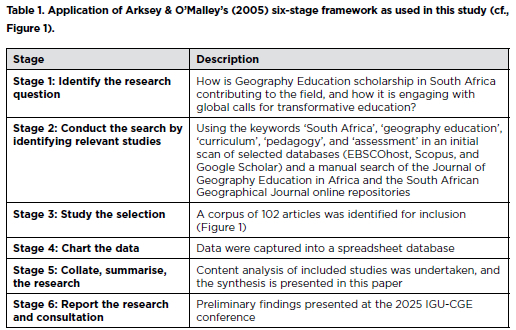
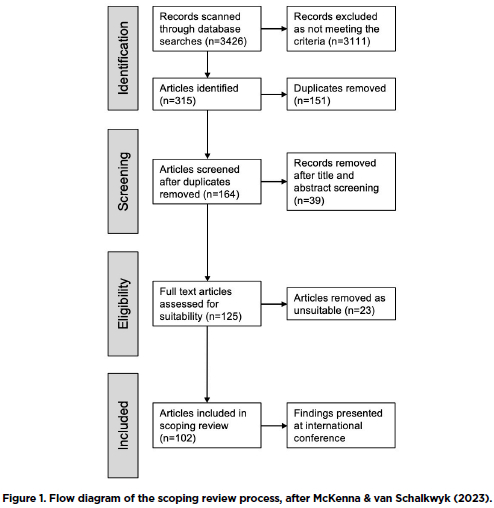
In Stage 1, an initial desktop scan was conducted using specific keywords and with reference to two local journals in which it is likely where South African Geography Education research would be published (Table 1). Owing to the intentionally broad and inclusive nature of the search terms, this initial scan yielded 3426 potentially relevant records (see Figure 1). Stage 2 comprised the systematic search process, where 3111 of these records were excluded during title and abstract screening. The remaining 315 records met the inclusion criteria, namely a focus on South Africa, Geography Education, curriculum, pedagogy, and assessment. After duplicates were removed, 164 records met the inclusion criteria. Subsequent full-text screening then led to a further 39 articles being excluded on the basis that they did not meet the inclusion criteria (Stage 3). The analysis presented in this study is of the abstract extraction, which was captured into an internally developed database (Stage 4). Biographical data, first-author institutional affiliation, date of publication, and the abstracts were summarised, which led to a range of topics or themes being identified. Following Arksey & O'Malley (2005), the abstract texts were then subjected to content analysis to refine the topics. This resulted in 102 articles being included in the study (Stage 5). In Stage 6, preliminary findings were presented at an international conference (Figure 1). In keeping with scoping review conventions, we do not evaluate the quality of the identified studies (McKenna & van Schalkwyk, 2023) but use them to explore the breadth and nature of Geography Education research in South Africa over the past decade. The approach taken permitted the inclusion of a range of study types and the identification of key research areas, trends and knowledge gaps in the field.
RESULTS
The analysis revealed that Geography Education research in South Africa is published in 35 journals, 24 of which are international and 11 are local. The most common international journals are: International Research in Geographical and Environmental Education (8); Journal of Geography (6); and Journal of Geography Education in Higher Education (4). Several journals outside the field also featured. These include Solid State Technology, International Journal of Education and Development using Information and Communication Technology, Journal of Communication, International Journal of Self-Directed Learning and Indonesian Journal of Educational Research and Technology. The Journal of Geography Education in Africa, launched in 2018, with 31 of the 102 publications reviewed, is the most common outlet for research publication in the field, nationally and regionally. Other local journals featured include Southern African Journal of Environmental Education (10) and South African Geographical Journal (9).
Based on authorship, publications are spread unevenly across 20 higher education institutions in South Africa. The most prolific knowledge producers were Northwest University (21); University of the Witwatersrand (15); University of KwaZulu-Natal (13), and Rhodes University (11). The analysis also showed a wide range of research topics. These included AI, GIS, digital resources, in-service and pre-service teacher professional development, mapwork, assessment, indigenous knowledge, code switching, textbook reviews, decolonisation of the curriculum, teacher knowledge, self-directed learning, problem-based learning, place-based education, stream bio-monitoring, mapwork, map literacy and spatial cognition, using drones to teach geomorphology, climate change, using TikTok memes, using smartphones for ICT integration, fieldwork, transformative learning in GE, learning styles, and balancing learner centred and teacher centred approaches.
The analysis revealed that most research is specific to South Africa's national context and/or with a specific group of participants. There is a predominance of small-scale, empirical studies that are practice-oriented and focused on specific problems such as the curriculum, teacher and learner perceptions and knowledge, and teaching practices. Only four comparative studies were identified. These were: a study of textbooks and pedagogy in selected North/South contexts (Manik & Malahlela, 2018); textbook writers' perceptions of the role of textbooks in creating a Geography curriculum (Lee et al., 2021); investigating the barriers and enablers of curriculum thinking and teacher agency in Geography Education in different national contexts (Krause et al., 2025), and what transformative Geography Education looks like in selected national contexts (Wilmot et al., 2025). No evidence was found of comparative research at a regional scale of southern Africa.
THEMATIC ANALYSIS AND DISCUSSION
Using inductive coding the topics were categorised and grouped under five broad themes, presented below.
Pedagogy
Topics associated with the 'what' and 'how' of teaching, learning and assessment are grouped under this theme. There was a predominance of small-scale qualitative studies focused on perceptions and knowledge associated with challenges at the level of classroom practice. This includes research on teachers' perceptions of poor learner performance in matric examinations (Ahiaku & Mncube, 2018) and another on Grade 11 learners' perceptions of climate change (Lekgeu & Davis, 2017). Teachers' knowledge was also a common research topic, for example, on climate change literacy (Anyanwu et al., 2015). Such studies are informative but have limited value unless they recommend follow-up actions such as interventions to strengthen teacher knowledge.
There was less attention given to practical pedagogical experimentation and innovation in the publications examined. Only three studies on assessment were found: Golightly (2022) focused on pre-service teachers' self and peer-assessment in problem-based learning; Shatri & Zabeli (2022) studied the implementation of verbal and written feedback by teachers; and Ferreira & Molala (2017) looked at the assessment of environmental education concepts and skills in Grade 10 Geography in South African schools.
Practice-focused studies include the implementation of teacher capacitation programmes for climate change education (Mavuso et al., 2022); how environmental education is taught in Grade 11 classrooms (Ndaba & Fru, 2024); how interventions can improve teachers' mapwork competence (Schoeman & Chidzungu, 2025); and how the Covid pandemic could enable teachers' geographical learning (Wilmot, 2023). There was a lack of research on detailed school Geography classroom activities. An exception was Singh et al.'s (2018) experiential study involving 12-year-olds using the SASS method for stream biomonitoring. Very few studies focused on primary school learners. Teachers' experiences of mapwork in Grade 6 (Ramasaroop & Kwayi, 2024) and enhancing young children's spatial literacy through a comic book (Heath, 2023) are examples of research at this level. Little attention has been paid to primary school teacher education. Naidoo (2021) and Wepener (2022, 2023) examined learners' lived experiences in South African and Namibian schools, respectively.
This analysis identified a range of topics under the theme of pedagogy. Research is mainly but not exclusively interpretive, exploratory and diagnostic, and focused towards teaching and practice-based problems. Interviews, surveys, questionnaires and group discussions were the most frequently used data collecting methods. Very few studies included classroom observations. There was also limited evidence of theory building and pedagogical innovation.
Curriculum
Research grouped under this theme includes decolonisation of the curriculum; indigenous knowledge, language and curriculum making; teachers' perceptions of curriculum change; and recontextualization of the curriculum in textbooks.
Little evidence was found for engagement with changes in the way knowledge is viewed and the integration of indigenous knowledge. Tarisayi (2023) argued that Geography Education should explicitly recognise excluded knowledge systems, perspectives, and injustices, and the need to decolonise the curriculum, and emphasises the importance of empowering teachers to enact these in practice. Two studies focused on using indigenous knowledge to increase access to learning about weather. Selepe et al. (2022) explored a rural community's indigenous knowledge practices related to weather to identify knowledge overlaps between elders and Grade 5 Social Science teachers. They found that teachers favoured integrating indigenous knowledge with scientific knowledge to elicit learners' prior knowledge and misconceptions. Riffel (2015) used a quasi-experimental intervention research design to explore the teaching of meteorological science concepts in Grade 9.
In South Africa, many learners' home language is different to the language of instruction in schools. Although language is frequently cited as a barrier to learning, only two studies in this review dealt with language, one of which was undertaken in Lesotho. Khalema & Raselimo (2024) found that code-switching in Grade 10 classrooms in Lesotho improved learners' comprehension. However, they caution that an over-reliance on code switching must be avoided, as learners can lose their ability to use Geography vocabulary. Strategies used for translating Grade 4 Geography concepts from English into Tshivenda were investigated by Mudau et al. (2024). This provides some translation strategies to address the non-equivalence between terminologies. Mkhabela & Manik (2024) examined how Grade 12 textbooks recontextualise the issue of land dispossession.
Curriculum change was examined from the perspective of teachers (Wilmot & Dube, 2015), the impacts of curriculum changes on Geography at school level (Rusznyak, 2020), and on the representation of climate change adaptation in teacher education courses (Naidoo & Heath, 2024). Vogel et al. (2015) presented examples of teacher education materials, high school material design, and the design and implementation of a degree offering centred on teaching and learning for climate change.
Technology
Research under this theme showed a range of topics including geospatial and GIS technologies (12 papers), digital and AI-based tools (six papers), and the use of smartphones to extend learning in the classroom (one paper). Research on using GIS platforms explored the following: how GIS supports spatial reasoning and geographical inquiry (Fleischmann & van der Westhuizen, 2021); pedagogical models for integrating GIS into the curriculum (Mzuza & van der Westhuizen, 2023); pre-service and in-service teachers' perspectives and competencies in GIS use (Kriel & van der Merwe, 2025); subject advisors' perspectives when using GIS (Mkhize, 2023); and barriers and enablers to GIS adoption in schools and universities (Fleischmann et al., 2015). The use of digital and Al-based tools in Geography Education reflects a growing interest in the digital transformation of Geography classrooms. This includes the use of smartphones, YouTube, TikTok and memes to enhance effective teaching (Tarisayi, 2022, 2023); a chatbot to teach map skills (van Staden, 2025); drones to map soil erosion (Riddle et al., 2021); and using video annotation software to critique pre-service Geography teachers' lessons (van der Westhuizen & Golightly, 2015). Only one study on the use of generative AI, to teach climate adaptation, was included however (Naidoo, 2024). This analysis revealed limited research on the developing field of digital technologies, and there was minimal critical research on their educational potential, appropriation, and misuse. There was no published research on virtual or simulated fieldwork in Geography Education despite its potential to enhance accessibility and inclusivity in resource-constrained school contexts.
Teacher professional development
Teacher professional development is an important component of strengthening Geography Education in South Africa. As the curriculum has evolved to incorporate new content areas, the professional knowledge base of pre-service and in-service teachers must be continually renewed (Artvinli et al., 2022; Golightly, 2025a). The research papers identified here have explored different ways in which teacher professional development can enhance content knowledge and pedagogical practice. Although teacher professional development was acknowledged as important, only six studies explored this. Two of these studies (Golightly, 2022, 2025b) explored the relationship between the experiences of Geography teachers and their involvement in self-directed professional development. The other four studies considered: relationships between Geography teachers' self-directed learning skills; participation in self-directed professional development and the use of learner-centred instructional strategies (Golightly, 2025c); how in-service teacher training can address gaps in mapwork and GIS knowledge (Schoeman & Chidzungu, 2025); the role of short-course interventions in environment and sustainable development and climate change education (Thenga et al., 2021); and the role of the Southern African Geography Teachers' Association's online Google Group in supporting teacher collaboration and curriculum engagement (Wilmot & Goldschagg, 2023).
Environment and sustainability challenges
Twenty papers were identified in this category. Climate change (nine papers) was the most prominent topic. Most of the studies focused on perspectives, awareness and knowledge of climate change with less attention given to teacher agency, pedagogical innovation, and the implementation of active learning pedagogy that is critical, situated, transformative and social (UNESCO, 2020, 2021; Lotz-Sisitka et al., 2022). The remaining 11 papers examine how environmental education, education for sustainable development, and environmental awareness are conceptualised and implemented within the South African Geography Education context. Strongly represented topics included the integration into various curricula of environmental content such as environmental attitudes (Loubser & Simalumba, 2016; Singh et al., 2018; Fru & Ndaba, 2023), and sustainable development principles (Goldschagg & Long, 2022). Several studies discussed how environmental issues are integrated into Geography and other school subjects such as Life Science and Life Orientation (Dalu et al., 2020). Plastic pollution, for example, appears in curriculum content but is poorly supported by practical management strategies or place-based learning. Further research of this nature is therefore needed to examine how different pedagogical designs, contexts, and durations of intervention shape learners' environmental understanding and behaviour. Despite being a water-scarce country, no studies from South Africa were identified that discussed water education research, or disaster management, risk reduction and adaptation associated with extreme weather and climate events. Likewise, there was little evidence of epistemic uncertainty (Lotz-Sisitka et al., 2022), an important consideration when dealing with 'wicked' problems such as climate change.
Setting a future research agenda
The findings of this scoping review show that Geography Education scholarship in South Africa is actively contributing to the field internationally and nationally, but it reveals some shortcomings and gaps. There is a predominance of pedagogic research focused on teachers and teaching strategies, with less attention given to learners' learning and assessment. Many of the studies identified are small-scale, qualitative case studies, mostly descriptive and diagnostic in nature, and focused on challenges of the status quo, what Brooks (2018) refers to as 'problems of the day'. In addition, perceptions and knowledge are foregrounded at the expense of practice. There is little research showing what is happening in Geography lessons at all levels of education.
The results also show that Geography Education research in South Africa is engaging with global realities of environment and sustainability, especially climate change. This needs to be expanded from the current focus on perceptions and knowledge to investigating how transformative pedagogies can be enacted in teacher education and schools. More critical engagement is needed with sensitive and often contested issues such as land reform, health inequalities and climate change, and through active learning approaches (Lotz-Sisitka et al., 2022). More attention should be paid to transformative learning that involves proactive engagement with risk reduction and mitigation and that engenders an ethic of care.
The outcome of this analysis is that Geography Education researchers in South Africa should shift attention from inward-looking and focused on 'problems of the day', to outward-looking by engaging more rigorously with theoretical and empirical approaches to education in a time of crises. More attention should be given to disaster risk management and creating more pathways for epistemological access by drawing on indigenous knowledge. Addressing these gaps will expand and strengthen Geography Education researchers' contributions to the field as global matters of concern as manifested in the southern African context (Golightly, 2025a). More research is also needed on building pre-service and in-service teachers' abilities to critically engage with information generated through digital platforms and AI systems and developing their pedagogical integration of digital technologies. Collaboration is also needed, within and between regions and disciplines, to enrich and extend Geography Education scholarship.
CONCLUSIONS
This scoping review provides a baseline for understanding the current state of Geography Education research in South Africa. It also offers guidance to policymakers, educators, and emerging researchers interested in Geography Education as a site of critical inquiry and transformative potential in the South African and global context. There is evidence for engagements with local challenges and some resonance with global trends (e.g., Lotz-Sisitka et al., 2022; Mzuza & van der Westhuizen, 2023; Naidoo, 2024). However, to make a more significant impact on policy and practice, Geography Education researchers must expand their scope and collaborations with international partners, engage more actively with global education discourses, and deepen their theoretical contributions (Kidman & Chang, 2024).
REFERENCES
Ahiaku, P. K. A., & Mncube, D. W. (2018). Geography Educators' Perceptions of Learner Performance in Grade 12 Geography in Public Schools. Alternation, 21, 68-90. [ Links ]
Anyanwu, R., Le Grange, L., & Beets, P. (2015). Climate change science: The literacy of Geography teachers in the Western Cape Province, South Africa. South African Journal of Education, 35(3), 1160. https://doi.org/10.15700/saje.v35n3a1160 [ Links ]
Arksey, H., & O'Malley, L. (2005). Scoping studies: Towards a methodological framework. International Journal of Social Research Methodology, 8(1), 19-32. [ Links ]
Artvinli, E., Gryl, I., Lee, J., & Mitchell, J. (2022). Introduction: Why Geography Teacher Education and Professionalization Matter. In: Artvinli, E., Gryl, I., Lee, J., & Mitchell, J. T. (eds), Geography Teacher Education and Professionalization. International Perspectives on Geographical Education, pp. 1-6. Springer, Cham.
Brooks, C. (2018). Insights on the field of geography education from a review of master's level practitioner research. International Research in Geographical and Environmental Education, 27(1), 5-23. [ Links ]
Chang, C.-H., & Kidman, G. (2019). Curriculum, pedagogy and assessment in geographical education - for whom and for what purpose? International Research in Geographical and Environmental Education, 28(1), 1-4. [ Links ]
Chang, C-H., & Kidman, G. (2023). The rise of generative artificial intelligence (AI) language models - challenges and opportunities for geographical and environmental education. International Research in Geographical and Environmental Education, 32(2), 85-89. [ Links ]
Chitsiga, C., & Schudel, I. (2021). An Examination of the Nexus between Environmental Knowledge and Environmental Learning Processes. In: Schudel, I., Songqwaru, Z., Tshiningayamwe, S., & Lotz-Sisitka, H. (eds), Teaching and Learning for Change: Education and Sustainability in South Africa, pp. 148-164. African Minds, Somerset West.
Dalu, M. T. B., Cuthbert, R. N., Muhali, H., Chari, L. D., Manyani, A., Masunungure, C., & Dalu, T. (2020). Is Awareness on Plastic Pollution Being Raised in Schools? Understanding Perceptions of Primary and Secondary School Educators. Sustainability, 12(17), 6775. https://doi.org/10.3390/su12176775 [ Links ]
Engelbrecht, F. A., Maviza, A., Steinkopf, J., Vogel, C., Von Maltitz, G., Yose, P., & Barnett, M. (2025). Sub-national climate change Fact Sheets for South Africa. SANBI/WITS-GCI, Johannesburg.
Ferreira, J. G., & Molala, K. N. I. (2017). The assessment of environmental education concepts and skills in Grade 10 Geography. The Independent Journal of Teaching and Learning, 12(2), 113-125. [ Links ]
Fleischmann, E., & van der Westhuizen, C. (2021). A GIS Integrational Framework for Poorly Resourced Schools. Journal of Geography Education in Africa, 1, 52-69. [ Links ]
Fleischmann, E. M.-L., van der Westhuizen, C. P., & Cilliers, D. (2015). Interactive-GIS-Tutor (IGIST) integration: Creating a digital space gateway within a textbook-bound South African Geography class. International Journal of Education and Development using Information and Communication Technology, 11(2), 23-37. [ Links ]
Fru, R. F., & Ndaba, T. L. (2023). Educators' Perceptions and Approaches to Environmental Education and Pro-Environmental Behaviour in South African Secondary Schools. International Journal of Learning, Teaching and Educational Research, 22(5), 359-373. [ Links ]
Goldschagg, P., & Long, D. (2022). Influencing Generations: Pre-service teachers' environmental worldviews at a South African university. Southern African Journal of Environmental Education, 37(1), 106-123. [ Links ]
Golightly, A. (2022). The relationship between the teaching experience of South African geography teachers and their involvement in self-directed professional development activities. Journal of Geography Education in Africa, 5, 96-124. [ Links ]
Golightly, A. (2025a). The relationship between a set of selected variables characterizing FET phase South African geography teachers and their self-directed learning abilities. South African Geographical Journal, 107(3), 283-300. [ Links ]
Golightly, A. (2025b). Relationships between geography teachers' SDL skills, participation in self-directed professional development and the use of learner-centred instructional strategies. South African Geographical Journal, 107(4), 548-564. [ Links ]
Golightly, A. (2025c). The importance of meaningful quality geography education in South African learning contexts. South African Geographical Journal, 107(4), 443-446. [ Links ]
Golightly, A., & van der Westhuizen, C. (2018). Geography Student Teachers' Perceptions of Online Problem-based Learning Activities: A Case Study. Alternation, 21, 131-158. [ Links ]
Heath, G. (2023). The acquisition of spatial and mountain literacy by children in Hergé's Tintin in Tibet. Journal of Geography Education in Africa, 6, 53-78. [ Links ]
International Geographicai Union, Commission on Geographical Education (IGU-CGE). (2016). International Charter on Geographical Education. international Geographical Union, Commission on Geographical Education, University of Istanbul, Turkey.
Khalema, T. F., & Raselimo, M. G. (2024). Learners' and teachers' perspectives on the use of code switching in Geography teaching and learning. Journal of Geography Education in Africa, 7, 1-16. [ Links ]
Kidman, G., & Chang, C.-H. (2024). Sustainability education: meeting the demands of climate change aspirations Gillian Kidman and Chew-Hung Chang. International Research in Geographical and Environmental Education, 33(1), 1-5. [ Links ]
Kidman, G., & Schmeinck, D. (eds) (2022). Teaching Primary Geography: Setting the Foundation. Springer, Cham.
Krause, U., Rawlings Smith, E., Flajshans Nedbalova, R., He, X., He, Y., ito, N., Milaras, M., Yang, J., Hanus, M., & Béneker, T. (2025). The barriers and enablers of curriculum thinking and teacher agency in geography education: a multinational study. International Research in Geographical and Environmental Education, 34(3), 220-236. [ Links ]
Kriel, C., & van der Merwe, C. D. (2025). Teaching Geographic information Systems in South African Geography classrooms, using Problem-Based Learning. South African Geographical Journal, 107(4), 586-602. [ Links ]
Lee, J., Catling, S., Kidman, G., Bednarz, R., Krause, U., Martija, A. A., Ohnishi, K., Wilmot, D., & Zecha, S. (2021). A multinational study of authors' perceptions of and practical approaches to writing geography textbooks. Journal of International Research in Geographical and Environmental Education, 30(1), 54-74. [ Links ]
Lekgeu, M. S., & Davis, N. (2017). Perceptions of climate change among Grade 11 learners in the Tshwane Metropolitan Municipality, South Africa. Southern African Journal of Environmental Education, 33, 52-70. [ Links ]
Lotz-Sisitka, H., & Lupele, J. (2017). ESD, learning and quality education in Africa: Learning today for tomorrow. in: Lotz-Sisitka, H., Shumba, O., Lupele, J., & Wilmot, D. (eds), Schooling for Sustainable Development in Africa, pp. 3-24. Springer, Cham.
Lotz-Sisitka, H., Schudel, i., Wilmot, D., Songqwaru, Z., O'Donoghue, R., & Chikunda, C. (2022). Transformative learning for teacher educators: Making sense of Education for Sustainable Development (ESD) policy emphasis on transformative education. in: Eberth, A., Goller, A., Günther, J., Hanke, M., Holz, V., Krug, A., Roncevic, K., & Singer-Brodowski, M. (eds), Bildung für nachhaltige Entwicklung - Impulse zu Digitalisierung, Inklusion und Klimaschutz, pp. 265-293. Verlag Barbara Budrich, Berlin.
Loubser, C., & Simalumba, P. (2016). The implementation of environmental education in geography (Grades 8-10) in the Caprivi Region, Namibia. Southern African Journal of Environmental Education, 32, 51-65. [ Links ]
Manik, S., & Malahlela, T. (2018). Through the Lens of Teachers: The Use of Geography CAPS Textbooks, Concomitant Challenges and a Reimagining of the Textbook. Alternation, 21, 37-67. [ Links ]
Mavuso, M. P., Olawumi, K. B., Khalo, X., Kafu-Quvane, B., & Mzilikazi, B. (2022). Implementation of teacher capacitation programs to integrate climate change education: The case study of Geography teaching in South African secondary schools. International Journal of Learning, Teaching and Educational Research, 21(11), 73-86. [ Links ]
McKenna, S., & van Schalkwyk, S. (2023). A scoping review of the changing landscape of doctoral education. Compare: A Journal of Comparative and International Education, 54(6), 984-1001. [ Links ]
Mkhabela, A. T., & Schudel, I. (2021). Emergent curriculum and sustainability competencies in environmental learning. In: Schudel, I., Songqwaru, Z., Tshiningayamwe, S., & Lotz-Sisitka, H. (eds), Teaching and Learning for Change: Education and Sustainability in South Africa, pp. 223-238. African Minds, Somerset West.
Mkhabela, Z. & Manik, S. (2024). Land dispossession and reform: An optic into South African Grade 12 Geography textbooks. Journal of Geography Education in Africa, 7, 62-77. [ Links ]
Mkhize, T. F. (2023). Experiences of the Geography Subject Advisors in the Implementation of Geographic Information Systems in KwaZulu-Natal Province. Research in Social Sciences and Technology, 8(1), 63-73. [ Links ]
Mudau, T., Kabinde-Machate M. L., & Mandende, I. P. (2024). Analysis of the translation strategies used for non-equivalent Grade 4 geography concepts. Southern African Linguistics and Applied Language Studies, 42(3), 345-356. [ Links ]
Mzuza, M., & van der Westhuizen, C. (2023). Improving the quality of geography teacher education through geographical information systems and self-directed learning. Journal of Geography Education in Africa, 6, 104-121. [ Links ]
Naidoo, D. (2021). Deep learning opportunities in the geography classroom. South African Journal of Education, 41(2), 1901. https://doi.org/10.15700/saje.v41n2a1901 [ Links ]
Naidoo, S. (2024). Imagining a South African Climate Change Adaptation-aligned school curriculum using Generative Artificial Intelligence. Journal of Geography Education in Africa, 7, 117-140. [ Links ]
Naidoo, S. & Heath, G. (2024). Representation of Climate Change Adaptation in Geography Education Modules at the University of KwaZulu-Natal (UKZN). Journal of Geography Education in Africa, 7, 41-61. [ Links ]
National Planning Commission (2012). National Development Plan 2030: Our future - make it work. The Presidency, Pretoria.
National Planning Commission/University of KwaZulu-Natal (2025). National state of service delivery in South Africa. National Planning Commission, Pretoria.
Ndaba, T., & Fru, R. (2024). Positioning Environmental Education in the South African Classroom: The Case of the Grade 11 Geography Curriculum. E-Bangi Journal of Social Sciences and Humanities, 21(2), 70-78. [ Links ]
O'Donoghue, R., Misser, S., & Snow-Macleod, J. (2021). Review of a Course-supported Design Research Intervention Process for the Inclusion of Education for Sustainable Development in School Subject Disciplines. In: Schudel, I., Songqwaru, Z., Tshiningayamwe, S., & Lotz-Sisitka, H. (eds), Teaching and Learning for Change: Education and Sustainability in South Africa, pp. 165-182. African Minds, Somerset West.
Ramsaroop, S. & Kwayi, A. M. (2024). Navigating Learning: Teaching Map Skills in Grade 6 Social Sciences. Journal of Geography Education in Africa, 7, 98-116. [ Links ]
Riddle, L, Hill, T., & Gijsbertsen, B. (2021). Geomorphology from 'on high': The use of drones/ UAV technology in teaching soil erosion. Journal of Geography Education in Africa, 4, 58-74. [ Links ]
Riffel, A. D. (2015). An Insight into a School's Readiness to Implement a CAPS Related Indigenous Knowledge Curriculum for Meteorological Sciences. Universal Journal of Educational Research, 3(11), 906-916. [ Links ]
Rusznyak, L. (2020). 'What is this curriculum doing to my subject?' Using geographical questions to interpret the CAPS curriculum. Journal of Geography Education in Africa, 3, 51-64. [ Links ]
Schoeman, T., & Chidzungu, T. (2025). Can the map work content knowledge (CK) competence be improved among geography teachers? Empirical evidence from the University of Johannesburg in-service teacher training in Gauteng, South Africa. South African Geographical Journal, 107(4), 565-585. [ Links ]
Schudel, I., Lotz-Sisitka, H., Songqwaru, Z., & Tshiningayamwe, S. (2021). Engaging Education for Sustainable Development as Quality Education in the Fundisa for Change Programme. In: Schudel, I., Songqwaru, Z., Tshiningayamwe, S., & Lotz-Sisitka, H. (eds), Teaching and Learning for Change: Education and Sustainability in South Africa, pp. 3-22. African Minds, Somerset West.
Selepe, K., & Ramsaroop, S., & Carolin, A. (2022). Incorporating indigenous knowledge in the teaching of weather and climate in primary school classrooms in KwaZulu-Natal, South Africa. Journal of Geography Education in Africa, 5, 1-25. [ Links ]
Shatri, Z. G., & Zabeli, N. (2022). Implementation of verbal and written feedback classroom practices by teachers. South African Journal of Education, 42(1), 2262. https://doi.org/10.15700/saje.v42ns1a2262 [ Links ]
Singh, S., Dent, M., & Hill, T. (2018). Perceptions, outcomes and attitudes experienced by scholars on stream bio-monitoring through the implementation of the mini-SASS method, using a social learning lens: KwaZulu-Natal, South Africa. Journal of Geography Education in Africa, 1, 27-37. [ Links ]
Tarisayi, K. S. (2022). Using TikTok, memes, and YouTube in the geography classroom. Journal of Geography Education in Africa, 5, 125-146. [ Links ]
Tarisayi, K. (2023). Towards a Transformed Geography Curriculum: A Post-colonial Critique. Indonesian Journal of Social Research, 5(3), 222-230. [ Links ]
Thenga, M., Goldschagg, P., Ferguson, R., & Mandikonza, C. (2021). Teacher Professional Development and Geography Teachers' Pedagogical Practices for Climate Change Education. Southern African Journal of Environmental Education, 36(1), 34-47. [ Links ]
UNESCO (2020). Education for Sustainable Development. A roadmap. ESD for 2030. UNESCO, Paris.
UNESCO (2021). International Commission on the Futures of Education (ICFoE). Reimagining our futures together: a new social contract for education. UNESCO, Paris.
Van der Westhuizen, C. P., & Golightly, A. (2015). Video annotation software application for thorough collaborative assessment of and feedback on microteaching lessons in geography education. Journal of Geography in Higher Education, 39(3), 420-436. [ Links ]
Van Staden, C. J. (2025). Geography's ability to interpret topographic maps and orthophotographs, adoption prediction, and learning activities to promote responsible usage in classrooms. Journal of Geography Education in Africa, 8, 16-32. [ Links ]
Vogel, C., Schwaibold, U., & Misser, S. (2015). 'Teaching and Learning for Climate Change' - the Role of Teacher Materials and Curriculum Design in South Africa. Southern African Journal of Environmental Education, 31, 78-97. [ Links ]
Wepener, T. (2022). Namibian secondary school learners' lived experiences of Physical Geography. Journal of Geography Education in Africa, 5, 49-56. [ Links ]
Wepener, T. (2023). Geography learners' awareness and lived experiences of their local environment: A case of Namibia. Journal of Geography Education in Africa, 6, 104-113. [ Links ]
Wi, A. (2022). Primary geography for a sustainable future. In: Kidman, G., & Schmeinck, D. (eds), Teaching Primary Geography: Setting the Foundation, pp. 29-44. Springer, Cham.
Wilmot, D. (2023). Using COVID-19 as a vehicle for enabling geographical thinking in teacher education. Journal of Geography Education in Africa, 6, 1-31. [ Links ]
Wilmot, D., & Dube, C. (2015). School geography in South Africa after two decades of democracy: teachers' experiences of curriculum change. Geography, 100(2), 94-101. [ Links ]
Wilmot, D., & Brooks, C. (2023). Addressing global challenges in geographical education: Perspectives from the CGE Springer book series. Journal of International Research in Geographical and Environmental Education, 33(3), 193-209. [ Links ]
Wilmot, D., & Goldschagg, P. (2023). Exploring the inner workings of the Southern African Geography Teachers' Association Google Group. Journal of Geography Education in Africa, 6, 79-103. [ Links ]
Wilmot, D., Bednarz, S. W., Fatima, M., de la Vega, A. G., Grob, R., Mãsgen, J., & Wilson, S. (2025). Transformative learning in geography education: international perspectives and practices. International Research in Geographical and Environmental Education, 34(3), 254-273. [ Links ]
Yaar-Waisel, T., & Wolff-Seidel, S. (2025). Training teachers to teach geopolitics subjects - a comparative study of Israel and Germany. In: Hardouin, M., & Leininger-Frézal, C. (eds), Curricular Changes in Geography Education: Meeting Social and Societal Challenges of Tomorrow, pp. 131-145. Springer, Cham.
Article history: 17 November 2025
Accepted 27 January 2026
Published 18 February 2026
