



Services on Demand
Journal

Article
 English (pdf)
 Article in xml format
 Article references

 Automatic translation
 Send this article by e-mail
Indicators
Related links
-
 Cited by Google
-
 Similars in Google
Share

 Permalink

Journal of Contemporary Management
On-line version ISSN 1815-7440
JCMAN vol.17 n.2 Meyerton 2020
https://doi.org/10.35683/jcm20037.63
RESEARCH ARTICLES
The role of trust in influencing customer willingness to help fellow customers with online-only retailers' self-services: a mediated model
E Van TonderI, *; A HeymansII
INorth-West University, School of Management Sciences 25621610@nwu.ac.za ORCID NR: https://orcid.org/0000-0002-6285-7582
IINorth-West University, School of Management Sciences annekeheymans@gmail.com ORCID NR: https://orcid.org/0000-0002-9543-7867
ABSTRACT
Trust in an online retail context remains an important research topic in management, considering its impact on uncertainty reduction and purchase intentions. There is however, little scientific understanding of the extent to which trust towards online-only retailers may contribute to customer willingness to help fellow customers with online-only retailers' self-services. Insight is important seeing that online-only retailers are unable to rely on physical store presence as a form of assurance to gain credibility and attract new customers. Prospective customers receiving help with self-services from existing users trusting the retailer may be of valuable assistance in this regard. Consequently, the current study aimed to verify the impact of trust towards online-only retailers on customer willingness to help fellow customers with online-only retailers' self-services. The influence of perceived ease of use and usefulness of self-services on trust was also studied. An electronic survey was completed by 311 customers of online-only retailers. The structural model analysis validated the proposed relationships and identified trust as a strong mediating variable. The research findings advance the understanding of strategies online-only retailers could employ to promote helping behaviour among customers. Theoretically, a novel perspective is provided on relationship marketing factors contributing to customer citizenship helping behaviours.
Key phrases: Customer citizenship helping; online-only retailers; online retailing; perceived value and trust
1. INTRODUCTION AND BACKGROUND
Online retailing has stimulated numerous academic debates over the last 20 years. Several studies have been conducted to advance the understanding of consumer behaviour in an online retail context, including perceptions of service quality (Al-dweeri, Obeidat, Al-dwiry, Alshurideh & Alhorani 2017; Cai & Jun 2003; Lee & Lin 2005; Shi, Mu, Lin, Chen, Kou & Chen 2018), technology acceptance (Beckers, Cárdenas & Verhetsel 2018; Gefen, Karahanna & Straub 2003; Sohn 2017; Zhou, Dai & Zhang 2007), and online customer loyalty (Bilgihan 2016; Boateng 2019; Jiang, Jun & Yang 2016; Lin & Wang 2006; Zheng, Lee & Cheung 2017). Another related research stream that is of interest to this study is consumers' trust in an online retail context (McKnight, Choudhury & Kacmar 2002; Sarkar, Chauhan & Khare 2020; Stouthuysen, Teunis, Reusen & Slabbinck 2018; Zheng et al. 2017; Zhou 2011). Trust is broadly defined as "the willingness of a party to be vulnerable to the actions of another party based on the expectation that the other [party] will perform a particular action important to the trustor, irrespective of the ability to monitor or control that other party" (Mayer, Davis & Schoorman 1995:712). Scholars have substantiated research concerning trust in an online retail context by asserting that it reduces uncertainty levels, perceived risk and positively impacts purchase intentions (Bilgihan 2016:105; Brengman & Karimov 2012:792). Trust may lead to adoption, repurchase intentions and success (Sarkar et al. 2020:286; Zheng et al. 2017:713), and therefore plays a key role in online retailing (Bilgihan 2016:105), as well as in motivating customers to adopt the online retailers' self-services and transact with them online.
Of further interest is that trust does not only seem to promote interactions between retailers and customers in the online retail environment. A study by Van Tonder and De Beer (2017:1127) denotes that trust may additionally serve as motivation for customers to reach out to other customers in need of help using an online retailer's self-services. The authors found that grounded in social exchange theory (Blau 1964), customers valuing the bank's self-services they can trust may want to reciprocate and voluntarily help other customers requiring assistance in adopting and using the bank's self-services (Van Tonder & De Beer 2017:1127). These helping initiatives are considered "customer citizenship behaviours", as they are generally performed by customers in addition to their expected roles of engaging in transactions with the retailer and because no formal remuneration is received for the help provided (Groth 2005:11; Van Tonder & De Beer 2017:1127).
The findings of Van Tonder and De Beer (2017) however are restricted to competence trust of self-services in online retail banking, thereby limiting their generalisability. The relationship between trust and customer citizenship helping has also not received much attention in other online retail studies - especially concerning trust towards the online retailer in general that offers a more comprehensive account of trust in an online retail context. Accordingly, there is little scientific understanding of the extent to which the relationship between trust (particularly trust towards the online retailer in general) and customer citizenship helping can be applied to the broader online retail environment.
Further insight into this particular benefit of trust is of great importance considering the advantage it may provide to other online retailers in obtaining customers' voluntary cooperation to help more customers adopt and use the online retailers' self-services and to grow their market share. Of particular relevance are online-only retailers that do not have a physical store presence, as products are only sold on the Internet (Goga, Paelo & Nyamwena 2019:14). Examples of online-only retailers include Superbalist and Zando (Goga et al. 2019:14). Previous research has indicated that customers may be more inclined to trust and conduct business with an online retailer that also has a physical store presence, subsequently providing some form of assurance in the online operation (Benedicktus, Brady, Darke & Voorhees 2010:322). Receiving voluntary help from a fellow customer who has already formed trusting perceptions about the online-only retailer may be of great value in this context and in persuading customers to rather purchase from online-only retailers. Assistance on the adoption and use of an online-only retailer's self-service would be received from customers who have dealt with the online-only retailer before and have indicated that it can be trusted.
Subsequently, to assist in closing the research gap, the current investigation sought to address the research question concerning the extent to which trust towards the online-only retailers in general may contribute to customers being willing to help fellow customers using online-only retailers' self-services. Relating to the first research question, the study was additionally interested in factors that may influence trust perceptions towards online-only retailers in general. Valuable guidance on this matter was provided by the perspective that trust is grounded in relationship marketing theory (Morgan & Hunt 1994), and is a key indicator of relationship quality (Ulaga & Eggert 2006:312). Relationship quality is generally a function of perceptions of accumulated value (Gummesson 1987), and within the relationship marketing domain, an assessment of relationship quality, which includes trust, is preceded by views of perceived value benefits received (Moliner, Sánchez, Rodríguez & Callarisa 2007:1399, 1401). Furthermore, understanding customer perceptions of value is essential in retail, considering that the most important task for any retailer is to create value for customers (Karjaluoto, Shaikh, Saarijärvi & Saraniemi 2019:253). The importance of capturing the essence of customer perceived value is further underscored by the growing number of value-conscious customers (Huang, Mou, See-To & Kim 2019:70). Subsequently, this study's intention was to explore if perceived value perceptions of self-services may contribute to customers developing trust towards the online-only retailers in general and ultimately being willing to engage in customer citizenship helping behaviour towards fellow customers using the online-only retailers' self-services.
Since perceived value is a benefit that customers may receive when operating self-services, it may also directly influence customer citizenship helping behaviours. Grounded in the social exchange theory (Blau 1964), customers may want to reciprocate and be of assistance to the online-only retailer that has benefitted them. Accordingly, it was further necessary to advance the understanding of: (1) the extent to which trust towards the online-only retailers in general may mediate the relationship between perceived value perceptions and customer citizenship helping behaviour towards fellow customers using online-only retailers' self-services; and, subsequently, (2) the prominent role that trust may perform in the identified model.
The study was conducted in the emerging market context of South Africa and provides several practical and theoretical insights. Specifically, online retail adoption in South Africa is still relatively low with mostly high-income earners, working full-time, making purchases online (Goga et al. 2019:7). Accordingly, the findings may allow South Africa's online-only retailers to obtain a better understanding of the extent to which they could rely on customers with whom they have built trusting relationships with to combat fears of more reluctant customers and to facilitate greater adoption and use of their self-services. From a theoretical perspective, several studies have identified antecedents of customer citizenship helping in online retailing, including affective commitment (Van Tonder, Saunders, Lisita & De Beer 2018), satisfaction and loyalty (Anaza 2014; Anaza & Zhao 2013). The current findings may offer a fresh perspective on the matter, indicating the extent to which trust towards the online-only retailer in general may act as a mediating variable and connect perceived value perceptions and customer citizenship helping behaviours in the online retail environment.
2. OVERVIEW OF ONLINE RETAILING IN SOUTH AFRICA
Online retailing in South Africa commenced about two (2) decades ago with Kalahari.com being one of the pioneers. The most popular product categories being purchased online in South Africa are consumer and electronic goods, followed by media products, apparel and footwear, food and drinks. The majority of products purchased online are delivered to customers in Johannesburg and Cape Town (Goga et al. 2019:8, 10). Overall, there are three (3) main business models in the South African online retail environment. First, some retailers follow an Omni channel model and offer consumers the option of ordering products online, as an alternative to making in-store purchases. Once the transaction is completed, customers are expected to collect their purchases at the store or, in some regions, the parcels will be delivered to the customers' homes. Examples of retailers in South Africa following this model include: Woolworths, Pick n Pay, Spar, and Checkers. Second, a "marketplace" model is followed, which involves the provision of a website infrastructure for sellers to trade their goods. Sellers may distribute their products independently. Alternatively, shipment services may be provided at a central warehouse location. Retailers in South Africa following this model include Bid or Buy and Hello Pretty. Third, there are also retailers like Superbalist that do not have a physical store presence and sell their own products online. Retailers following this online-only model tend to operate from a warehouse. Products purchased online are delivered directly to the customers (Goga et al. 2019:13-14). Collectively, online-only and marketplace retailers are referred to in marketing literature as "pure plays" (Goga et al. 2019; Krueger, Lu & Swatman 2003).
Online retailing furthermore offers many benefits to retailers and customers, including lower prices, a greater variety of product options, access to markets for small businesses, convenience, lower transaction costs, and an opportunity for extension of retail services to rural populations (Goga et al. 2019:1, 45; Wait 2019:3). Despite these advantages, the adoption level of online retailing in South Africa is still very low, with less than 2% of total retail sales occurring online and the majority of customers purchasing online being high-income earners who work full-time, as mentioned in the introduction (Deloitte 2019:7; Goga et al. 2019:7; World Wide Worx 2019). Accordingly, these findings contribute to the importance of involving customers who trust online retailers and have dealt with them before to combat fellow customers' fears and provide help with adoption and use of self-services. This customer citizenship helping behaviour is especially important to online-only retailers with no physical store presence which may struggle more to build trusting relationships with customers.
3. THEORETICAL FRAMEWORK
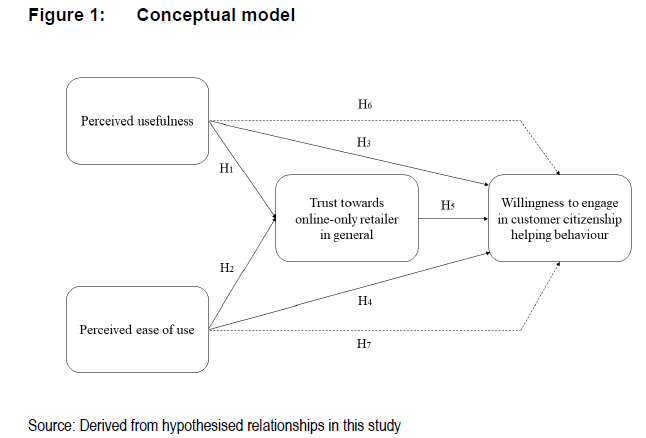
Figure 1 provides a graphic illustration of the theoretical concepts and hypotheses examined.
3.1 Perceived value
Perceived value has received extensive attention in marketing literature, owing to the growing number of customers who have become value-conscious (El-Adly 2019:323). Perceptions of perceived value may be influenced by customer benefits that are sought after, expected or experienced, and possible undesirable consequences that may result upon their realisation (Karjaluoto et al. 2019:253). Moreover, several theories have been developed to advance the understanding of customer perceived value and to identify benefits that may be relevant to customers in determining value. For example, Zeithaml (1988:14) related to perceived value as "the consumer's overall assessment of the utility of a product based on what is received and what is given". Sheth, Newman and Gross (1991) developed the theory of consumption-related values and identified five (5) dimensions of value: functional (effective task fulfilment), social (approval from others), emotional (affective state), epistemic (knowledge acquired), and conditional (circumstances impacting choice). Another perspective on perceived value is that it comprises hedonic and utilitarian value dimensions. Hedonic value concerns the feelings customers may experience when using the service, while utilitarian value denotes the practical value that may be derived from using the service (Babin, Darden & Griffin 1994; Holbrook & Hirschman 1982; Sánchez-Fernández & Iniesta-Bonillo 2007). Of further interest is that the aforementioned theories have all identified utilitarian or functional value as a dimension of customer perceived value. This perceived value dimension has also been studied most often in research involving business services relationships (Arslanagic-Kalajdzic & Zabkar 2017), and hence seems to be of great relevance in the examination of perceived value in the current study.
Extant literature further indicates that perceived utilitarian value, as measured within the context of technology, relates to the extent to which customers view the technology as useful and easy to use (Hsiao, Chang & Tang 2016:346). Grounded in technology acceptance theory (Davis 1989), perceived usefulness and perceived ease of use are further regarded as key predictors of technology acceptance (Abdullah, Ward & Ahmed 2016:7), attitudes and intentions (Stocchi, Michaelidou & Micevski 2019:29), and online shopping behaviour (Lee, Shi, Cheung, Lim & Sia 2011:186; Srinivasan 2015:180). Subsequently, perceived ease of use and perceived usefulness were included in the proposed model, as they seem to be highly relevant in assessing consumer perceptions of value benefits that may be derived from using the technology in an online shopping environment.
Perceived usefulness is measured by assessing "the degree to which a person believes that using a particular system would enhance his or her job performance" (Davis 1989:320). In an online shopping context, enhancement of job performance may relate to greater effectiveness and efficiency in seeking and comparing products or information during the purchase process and in making purchases through the online store (Sohn 2017:27; Srinivasan 2015:181). Accordingly, adapted from Gefen et al. (2003), perceived usefulness was measured in this study as follows: the extent to which the customer perceives the website of the online-only retailer to be useful for searching and buying products, improving their performance, productivity and effectiveness in searching and buying products, enabling them to search and buy products faster, and making it easier to search for and purchase products.
Perceived ease of use concerns "the degree to which a person believes that using a particular system would be free of effort" (Davis 1989:320). In an online shopping context, perceived ease of use may relate to the degree to which consumers believe that online shopping does not require much effort (Chiu, Chang, Cheng & Fang 2009:765). Additional characteristics of easy-to-use websites include being able to communicate with the website in a clear and understandable way, and not requiring much effort to become skilful at using it (Gefen et al. 2003:84). Accordingly, adapted from Zhou (2012), perceived ease of use in the current study was measured as follows: the extent, to which an online-only retailer's website quickly loads all the text and graphics, is easy to use and navigate, and is visually attractive.
3.2 Trust towards online-only retailer in general
As noted earlier, trust is grounded in relationship marketing theory (Morgan & Hunt 1994). Relationship marketing concerns "to identify and establish, maintain, and enhance relationships with customers and other stakeholders, at a profit, so that the objectives of all parties involved are met" (Grönroos 1996:7). In any exchange relationship, businesses and customers tend to conduct independent evaluations of the relationship, affecting their willingness to continue with the relationship (Sánchez-Garcia, Moliner-Tena, Callarisa-Fiol & Rodríguez-Artola 2007:152). Building good relationships with customers is therefore imperative for businesses, such as retailers, because improved client relationships may contribute to greater customer loyalty (Rootman, Tait & Sharp 2011:316).
An assessment of relationship quality is helpful in this regard, as it is suggestive of the strength or health of the relationship between businesses and customers (Badawi & Battor 2020:136; Sánchez-Garcia et al. 2007:152). Relationship quality can be measured by determining the extent to which trust has been established in the relationship (Badawi & Battor 2020:136; Crosby, Evans & Cowles 1990; Sánchez-Garcia et al. 2007:152). Furthermore, trust in an online context is not much different to trust in a traditional context. In an online context, trust relates to "the belief that allows consumers to willingly become vulnerable to Web retailers after having taken the retailers' characteristics into consideration" (Pavlou 2003:106). Accordingly, trust as a research construct comprises of three (3) fundamental beliefs. First, trust is established when it is believed that the other party has the necessary knowledge and skills (competence) needed to conduct the required behaviour. In an online context, competence may relate to the extent to which the retailer has the necessary knowledge and skills to conduct business online and is able to deliver products purchased online. Measures that can be implemented to demonstrate competence include communication of the number of registered accounts and items sold. Second, trust may develop when it is believed that the other party will act with integrity and meet their obligations or promises. In an online shopping context, integrity may relate to the manner in which online transactions are carried out, the customer service policies implemented once a transaction has been completed, and the manner in which customer information is handled. Third, trust perceptions may also form when it is believed that one's well-being and interests are valued by another party who intends to do good (benevolence). In an online shopping context, this belief may relate to resolving problems in an appropriate manner and the actions taken to promote a satisfying online experience (Bhattacherjee 2002:217-219; Brun, Rajaobelina & Ricard 2016:222; Mohr & Walter 2019:1232).
Consequently, against this background, all three (3) beliefs of trust were considered in the assessment of customer trust towards the online-only retailer in general. Adapted from Zhou (2012), customers in the current investigation had to rate the extent to which the online-only retailer they most conducted business in the last 12 months has the ability to fulfil its tasks and also will keep its promises and customers' best interests in mind. An additional self-generated item was added that measured customers' perceptions of the extent to which the online-only retailer will keep its word.
3.3 Customer citizenship helping behaviour
Customer citizenship behaviour is formally defined as "voluntary and discretionary behaviors that are not required for the successful production and/or delivery of the service but that, in the aggregate, help the service organization overall" (Groth 2005:11). Accordingly, customer citizenship behaviours are perceived by scholars as extra-role behaviours, as they are not needed in service production (Choi & Lotz 2016:540). Grounded in social exchange theory (Bettencourt 1997; Blau 1964), customers are motivated to engage in citizenship behaviours when they have benefitted from a positive customer experience and want to return the favour (Kim & Choi 2016:387). The social exchanges promoting citizenship behaviours also tend to be multiple, as relationships develop over time (Delpechitre, Beeler-Connelly & Chaker 2018:10).
Generally, customer citizenship behaviour is studied with reference to individuals exhibiting the behaviour (subject-based conceptualisation), individuals rating the citizenship behaviour (rater entity-based conceptualisation), and individuals to whom the citizenship behaviour is directed (target-based conceptualisation). Customers may perform the citizenship behaviours or be the recipient of citizenship behaviours from other customers. Subsequently, customers may rate their own citizenship behaviours or those of fellow customers. In addition to targeting customers, customer citizenships behaviours can also be aimed at the organisation and its employees or even brands. Customer citizenship behaviours directed towards organisations take the form of constructive suggestions for improvement, while customer citizenship behaviours directed towards fellow customers may involve the provision of help regarding a service-related matter (Gong & Yi 2019:9; Yi & Gong 2013:1281).
Subsequently, the current study's interest was in the target-based conceptualisation of customer citizenship behaviour, with specific reference to the help customers may provide to other customers in adopting and using an online-only retailer's self-services. From a customer citizenship point of view, helping behaviour is formally defined as "customer behavior aimed at assisting other customers" (Yi & Gong 2013:1281). Hence, guided by the work of Yi and Gong (2013), as well as the study by Van Tonder and De Beer (2017) that informed the current research, customer citizenship helping behaviours were measured by considering: the extent to which customers, if provided with the opportunity, would themselves assist other customers if they need help using the service from the online-only retailer, aid other customers if they seem to have problems using the service from the online-only retailer, teach other customers to use the service from the online-only retailer correctly, and give advice to other customers with respect to using the online-only retailer's service. Therefore, customers who participated in the study were expected to rate their own citizenship behaviours.
3.4 Hypotheses development
The relationship between perceived value and relationship quality (of which trust is a key dimension) has not been extensively expo9lored before. Key studies, however in this field offer valuable guidance on the matter. It is believed that customers at the initial stage of the relationship may be more concerned with transactional factors (such as comparison of product quality among a set of alternatives) and forming views about value. Once they have passed this stage, the focus shifts to perceptions of relationship quality (Kim & Han 2008:224; Ravald & Grönroos 1996). Accordingly, an assessment of relationship quality is preceded by views of perceived value benefits received (Gummesson 1987; Moliner et al. 2007:1399, 1401). From a branding perspective, customer trust in a brand is justified through perceived value perceptions, serving as a tangible indication of the brand's proficiency in satisfying future consumption (Aurier & De Lanauze 2011:816). Moreover, Sánchez-Garcia et al. (2007:159) proclaimed that perceived value may lead to trust and deemed perceived value as relationship benefits, subsequently building their argument on Morgan and Hunt's (1994) perspective that trust may develop when relationship benefits are experienced.
Hence, considering earlier findings, this study argued that perceived usefulness and perceived ease of use, as dimensions of perceived value, may lead to trust towards the online-only retailer in general. Once customers have engaged with the online-only retailer's self-services and believe it is useful and easy to use, their views of these relationship benefits may contribute to them trusting the online-only retailer and experiencing relationship quality. Therefore, it was hypothesised that:
H1: Perceived usefulness has a positive and significant impact on customer trust towards the online-only retailer in general.
H2: Perceived ease of use has a positive and significant impact on customer trust towards the online-only retailer in general.
Extant literature further denotes that perceived value and relationship quality are positively linked to customer citizenship behaviours.
Grounded in social exchange theory, positive customer experiences are likely to stimulate reciprocity and voluntary behaviours (Bettencourt 1997; Kim & Choi 2016:387). According to Xie, Poon and Zhang (2017:270), customers experiencing relationship benefits are likely to engage in a deeper relationship with the service brand, which may promote helping intention. Subsequently, since perceived value is a benefit that customers may experience when operating self-services, there is a possibility that it may also directly influence helping behaviours. Customers experiencing the benefit that the online-only retailer's self-services are useful and easy to use may want to reciprocate and assist the online-only retailer that has been good to them by being willing to help other customers with the self-services, thus promoting greater adoption. Accordingly, it was hypothesised that:
H3: Perceived usefulness has a positive and significant impact on willingness to engage in customer citizenship helping behaviour.
H4: Perceived ease of use has a positive and significant impact on willingness to engage in customer citizenship helping behaviour.
Once perceptions of relationship quality have been established, customer citizenship helping behaviours may be stimulated, too. Extant literature perceives relationship quality as an important antecedent of customer citizenship behaviour (Hwang, Han & Choo 2016:100). Relationships are generally characterised by reciprocal exchanges between partners (Fournier 1998; Xie et al. 2017:270). When the social exchanges between businesses and customers are successful and high relationship quality is experienced, customer citizenship behaviour is likely to occur (Kim & Choi 2016:387). Similarly, Xie et al. (2017:270) noted that when high relationship quality is experienced, customers tend to engage in positive behaviour, such as undertaking to help customers of the organisation at no extra cost. Moreover, besides the study by Van Tonder and De Beer (2017) that informed the current investigation, prior research has also established positive relationships between the credibility dimension of trust, measuring integrity and competence beliefs, and customer citizenship behaviour (Balaji 2014:227), as well as the benevolence dimension of trust and customer citizenship behaviours (Celuch, Walz & Hartman 2018).
Against this background, it was proposed in the current research that customer trust towards the online-only retailer in general, relating to competence, integrity and benevolence beliefs, may positively impact on willingness to engage in customer citizenship helping behaviour. Customers experiencing high relationship quality from the online-only retailer, as indicated by trust, may be motivated to engage in positive behaviours, such as undertaking to help other customers in using the online-only retailer's self-services. It was hypothesised that:
H5: Customer trust towards the online-only retailer in general has a positive and significant impact on willingness to engage in customer citizenship helping behaviour.
Finally, extant literature also recognises the value of relationship quality as a potential mediator, noting that it is "the most influential mediator in relationship marketing (RM) research" (Clark, Fine & Scheuer 2017:42). It was expected that relationship quality could mediate relationships in the current model as well. As explained earlier, relationships between businesses and customers are processes that evolve from being concerned about product comparisons and perceived value at the initial stage of the relationship to views of relationship quality over time (Kim & Han 2008:224; Ravald & Grönroos 1996). These quality perceptions may motivate customers to engage in positive behaviours, such as undertaking to help other customers of the organisation (Xie et al. 2017:270). Hence, while perceptions of perceived value may directly affect customer citizenship helping behaviour, there is also a possibility that as relationships evolve from initial perceptions of perceived value, and trust (relationship quality) is now established, customer citizenship helping behaviours may emanate as an outcome, because customers are now further motivated by relationship quality to reciprocate and engage in positive behaviours. Accordingly, trust (relationship quality) may provide an indirect path to the relationship between perceived value perceptions regarding online-only retailers' self-services and customer citizenship helping behaviour, and act as a mediating variable in the model. As such, it was hypothesised that:
H6: Perceived usefulness has a significant positive indirect effect on willingness to engage in customer citizenship helping behaviour, as mediated by trust towards the online-only retailer in general.
H7: Perceived ease of use has a significant positive indirect effect on willingness to engage in customer citizenship helping behaviour, as mediated by trust towards the online-only retailer in general.
4. METHODOLOGY
4.1 Questionnaire and measurements
The research design was quantitative in nature. A self-administered survey was conducted to test the research hypotheses and advance understanding of the extent to which consumers: (1) perceive online-only retailers' self-services as useful and easy to use; (2) believe online-only retailers can be trusted; and (3) are willing to help other customers in using online-only retailer's self-services. Four (4) previously validated measurement scales were employed to measure perceived usefulness (Gefen et al. 2003) and perceived ease of use (Zhou 2012), trust towards the online-only retailer in general (Zhou 2012), as well as willingness to engage in customer citizenship helping behaviour (Yi & Gong 2013). The statements, as listed in the literature review, were adapted to the context of the study, but the original meaning of each item remained intact. As mentioned earlier, one self-generated item was also added to the trust scale to measure the extent to which respondents believe that the online-only retailer would keep its word. The inclusion of this statement was informed by the literature review and the need to account for integrity beliefs in the measurement scale. All statements were measured on a five-point Likert scale, with "1" (strongly disagree) and "5" (strongly agree) serving as the extreme ends of the scale. The respondents were requested to comment on the online-only retailer they used most often to make a purchase during the last 12 months. The questionnaire was pretested with a panel of marketing experts and a few minor corrections were made before the questionnaire was launched into the field.
4.2 Sampling procedure, data collection and analysis
The survey was conducted in Gauteng, with online-only retailers selling products through their mobile apps as the research context. A sample size of 300 respondents was targeted to effectively conduct the structural equation modelling analysis and to test the research hypotheses (Hair, Black, Babin & Anderson 2014). The targeted population included males and females in Gauteng, who were older than 18 years and have purchased products from online-only retailers using their mobile apps in the last 12 months. For the reason that a research frame was not available, a convenience sampling approach was followed. A link to the online survey (created using Google Forms) was posted on Facebook platforms of residential online activity communities in Gauteng, where respondents were invited to participate in the survey. Facebook groups were selected as a platform for reaching respondents based on the argument that individuals who are comfortable using the internet and social media sites would mostly likely also be comfortable using the online-only retailers' mobile apps. Two (2) screening questions were included in the questionnaire to ensure only respondents forming part of the targeted population would be permitted to continue with the online survey. Respondents participated on a voluntary basis and all respondents remained anonymous, as the data were automatically recorded in an Excel sheet. A total of 43 Facebook groups were selected on the basis of being residential online activity community Facebook groups and because permission was granted by the group administrators to post the survey link online. No incentive was provided for participating in the online survey.
The final realised sample was 311 respondents. All questionnaires obtained were deemed suitable for further analysis. No missing responses were obtained as the online survey did not permit the respondents to continue with the next question, if they had not provided an answer to the current question. Furthermore, the sample size far exceeded the recommended 10 observations per estimated item (18 items were included in the survey) and subsequently was regarded satisfactory for further statistical testing (Bentler & Chou 1987; Bollen 1989).
The majority of the respondents who participated in the survey were female (86%), while 14% were male. All respondents who participated in the survey resided in Gauteng, were older than 18 years and had purchased products from online-only retailers using their mobile apps in the last 12 months. These statistics confirm that only respondents forming part of the study population were surveyed. The respondents who shared their perceptions and behaviour regarding online-only retailers were still fairly young. Most of the respondents who completed the online survey were aged 47 years or younger (74.9%), followed by 23.5% in the 48 to 66 years age group. Only 1.3% of the respondents were aged 67 years and older. One (1) respondent did not want to disclose her age. Moreover, most respondents purchase at least once every six (6) months from the online-only retailer they considered when they answered the survey questions (55%). The majority of the respondents (73.6%) have been purchasing from retailers online in the last one (1) to five (5) years. Overall, the constructs examined were rated fairly positive. Trust towards the online-only retailer obtained the highest mean (4.28), followed by perceived usefulness (4.27), perceived ease of use (4.23), and willingness to engage in customer citizenship helping behaviour (4.05).
Thereafter, structural equation modelling, using IBM SPSS Amos version 26 was conducted in the more advanced stage of the analysis to assess the measurement and structural models, and to conclude on the research hypotheses formulated. Bootstrapping procedures were employed to test for indirect effects (mediation). The analysis was based on 5 000 replications and a confidence interval of 95%.
5. RESULTS AND RESEARCH FINDINGS
5.1 Measurement model
Prior to building the structural model, the validity and reliability of the measurement model was examined first.
Upon initial inspection of the model, it was noted that the root mean square error of approximation (RMSEA) exceeded the cut-off value of 0.08 (Van de Schoot, Lugtig & Hox 2012). The modification indices showed that two (2) of the items of the customer citizenship helping behaviour construct (teaching other customers to use the service correctly and giving advice to other customers regarding the use of the service) had large error covariance (25.20). However, the items were not deleted as they loaded significantly and measured different aspects of customer citizenship helping. Instead, the covariance was accounted for in the revised model.
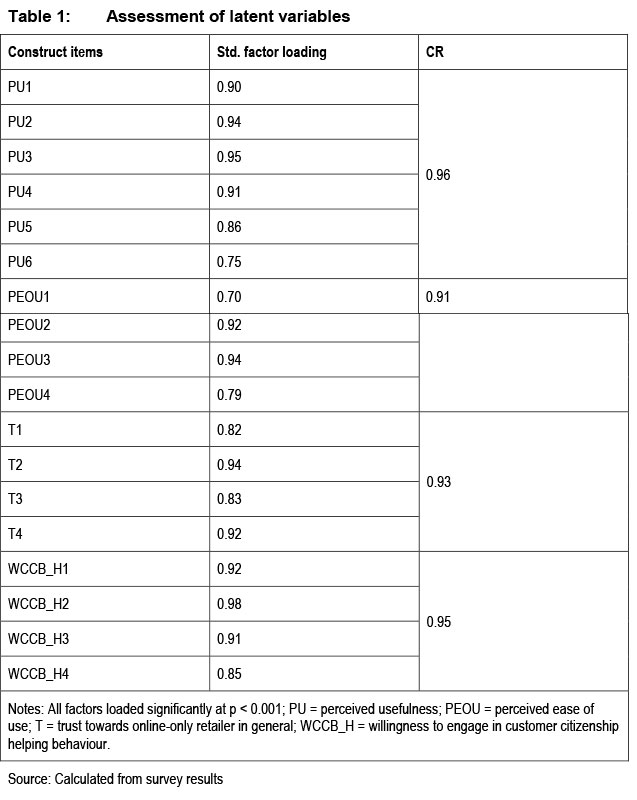
Adequate model fit indices were obtained in the subsequent confirmatory factor analysis (Van de Schoot et al. 2012; Wheaton, Muthén, Alwin & Summers 1977): Chi-Square/degrees of freedom (χ2 /df) = 2.811, comparative fit index (CFI) = 0.962, TuckerLewis index (TLI) = 0.954, RMSEA = 0.076. Table 1 indicates that the standardised factor loadings of all items measured were greater than 0.7 (ranging from 0.70 to 0.98) and loaded significantly onto the respective latent variables (p < 0.001). Not any of the composite reliability (CR) values were below 0.7, thereby evidencing high factor reliability. As all average variance extracted (AVE) values also exceeded 0.5, convergent validity was subsequently evident (Bagozzi & Yi 1988; Byrne 1998; DeVellis 2012; Fornell & Larcker 1981; Hair et al. 2014; Tabachnick & Fidell 2001).
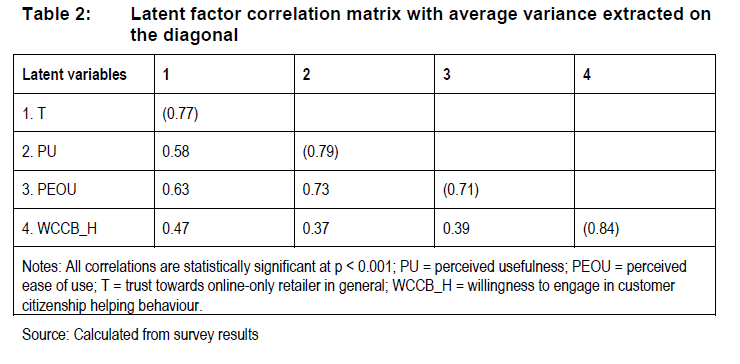
Furthermore, Table 2 provides evidence of discriminant validity. In all instances, the respective AVE values were greater than the shared variance among the latent variables examined (Fornell & Larcker 1981; Hair et al. 2014).
5.2 Structural model
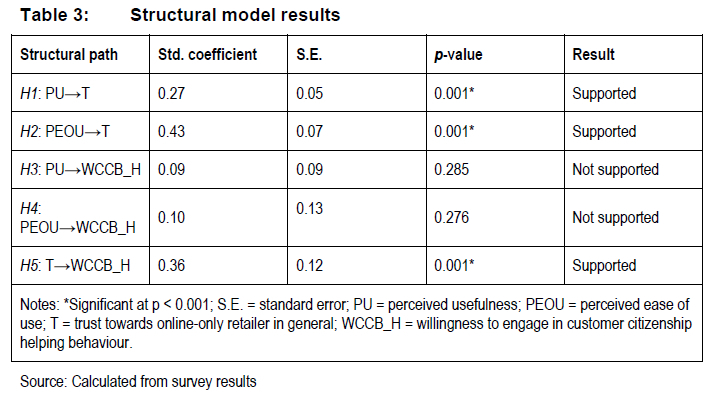
The structural model presented acceptable fit indices (Hair et al. 2014): x2/df = 2.811, CFI = 0.962, TLI = 0.954, RMSEA = 0.076. The findings from the structural model analysis are presented in Table 3.
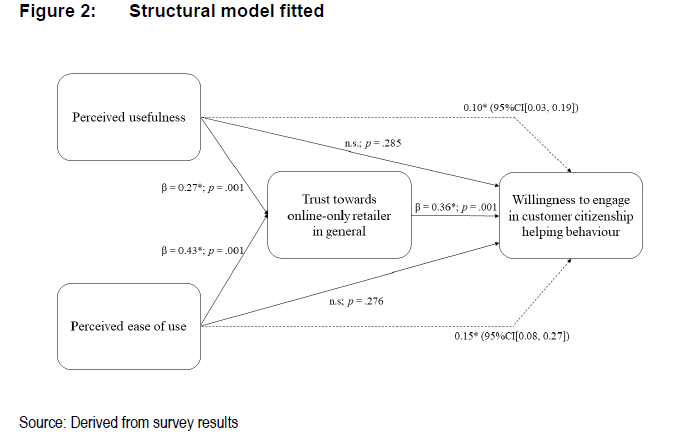
All structural paths were statistically significant at p < 0.001, except for the relationship between perceived usefulness and willingness to engage in customer citizenship helping behaviour, as well as perceived ease of use and willingness to engage in customer citizenship helping behaviour. Therefore, only H1, H2, and H5 were supported. The standardised regression weights that were statistically significant varied between 0.27 and 0.43.
The bootstrapping of the indirect effects evidenced that perceived usefulness had a significant indirect relationship with willingness to engage in customer citizenship helping behaviour through trust towards the online-only retailer (0.10; p < 0.05; CI [0.03, 0.19]). Perceived ease of use also had a significant indirect relationship with willingness to engage in customer citizenship helping behaviour through trust towards the online-only retailer (0.15; p < 0.05; CI [0.08, 0.27]). Hence, support was found for H6 and H7. Considering that the direct effects of perceived usefulness and ease of use on willingness to engage in customer citizenship helping behaviour were not significant after accounting for trust in the model (H3 and H4), it can be concluded that the indirect effects established point towards full mediation (Zhao, Lynch & Chen 2010:201). Figure 2 provides an illustration of the research findings.
6. DISCUSSION
6.1 Theoretical implications
The literature review emphasised the importance of building good relationships with customers to benefit from customer citizenship behaviours. Affective commitment, satisfaction and loyalty are outcomes of effective relationship marketing practices that according to earlier research may stimulate customer citizenship helping behaviours in the online retail environment (Anaza 2014; Anaza & Zhao 2013; Van Tonder et al. 2018). The current findings provide a novel perspective on further relationship marketing factors that may influence customer citizenship behaviours as well.
Specifically, the research findings uncovered that trust towards the online-only retailer in general has a positive and significant impact on willingness to engage in customer citizenship helping behaviour (H5). These findings are significant when interpreted in the context of the literature review. Many scholars have theoretically implied that a relationship exists between trust and customer citizenship behaviours (Temerak, Winklhofer & Hibbert 2009:14; Yi & Gong 2008:979), yet empirical evidence of this relationship is limited (Van Tonder & De Beer 2017). It has been noted that relationship quality precedes customer citizenship behaviour (Hwang et al. 2016:100; Kim & Choi 2016:387; Xie et al. 2017:270), but only two (2) studies were found that empirically confirmed the relationship between dimensions of trust (denoting relationship quality) and customer citizenship behaviour (Balaji 2014:227; Celuch et al. 2018). However, the studies by Balaji (2014) and Celuch et al. (2018) addressed other aspects of customer citizenship behaviour and did not focus on helping. Seeing that the findings by Van Tonder and De Beer (2017) are also limited to competence trust towards electronic banking self-services, the unique contribution of the current research is that it advances understanding of the relationship between trust (particularly trust towards the online retailer in general, denoting relationship quality) and customers' willingness to help other customers with online-only retailer's self-services. Therefore, the implication of this finding is that customers' perceptions about online-only retailers' integrity, competence and benevolence in general seem to influence the extent to which they would be willing to reciprocate and reach out to other customers in need of help using online-only retailers' self-services.
The research findings further revealed that perceived usefulness and perceived ease of use, denoting relationship benefits (Sánchez-Garcia et al. 2007:159), may also indirectly through trust towards the online-only retailer in general impact on customers' willingness to engage in customer citizenship helping behaviour (H6 and H7). These findings are also significant, given that as mentioned earlier, perceived usefulness and perceived ease of use are regarded key predictors of technology acceptance (Abdullah et al. 2016:7), attitudes and intentions (Stocchi et al. 2019:29), and online shopping behaviour (Lee et al. 2011:186; Srinivasan 2015:180). Accordingly, the current findings offer further support to the importance of studying perceived usefulness and perceived ease of use in technology-related research and point towards the relevance of these factors in influencing customer citizenship behaviour in an online retail context as well.
Another important observation is that central to this process is customers' trust towards the online-only retailer in general, serving not only as an indicator of relationship quality but also as a mediator, providing an indirect path to the relationship between perceived value perceptions regarding online-only retailers' self-services and customers' willingness to engage in citizenship helping behaviours. Furthermore, trust appears to be a strong mediator, considering that H3 and H4 were not significant when trust was accounted for in the model. Subsequently, the current research extends the list of benefits of trust, as mentioned in the literature review (Bilgihan 2016:105; Brengman & Karimov 2012:792; Sarkar et al. 2020:286; Zheng et al. 2017:713), by highlighting its significance as a mediator and by offering a greater understanding of the extent to which it may promote interactions between customers in the online retail environment of an emerging market country, such as South Africa.
Finally, the literature review explained that relationship quality is a function of perceptions of accumulated value (Gummesson 1987) and within the relationship marketing domain, an assessment of relationship quality (including trust) is preceded by views of perceived value benefits received (Moliner et al. 2007:1399, 1401). The current findings offer a novel perspective on the matter by indicating that perceived ease of use and perceived usefulness may contribute to trust towards online-only retailers in general as an element of relationship quality (H1 and H2). The implication of this finding is that the utilitarian dimension of perceived value (most often studied in business service relationships) also seems to be relevant in the formation of trust (relationship quality) towards online-only retailers in general (Arslanagic-Kalajdzic & Zabkar 2017). However, perceived ease of use may be more important than perceived usefulness in developing trust, as it had the largest impact on trust (β = 0.43).
6.2 Managerial implications
The managerial value of the research findings is that it offers confirmation of the extent to which customers could be employed to voluntarily help other customers in using the online-only retailers' self-services and also the strategies online-only retailers could implement to promote this helping behaviour. Specifically, the high mean value that was obtained for the customer citizenship helping behaviour scale provides evidence of customers' willingness to assist other customers if they need help using the online-only retailer's self-service, aid other customers if they seem to have problems using the service, teach other customers to use the service correctly, and give advice to other customers with respect to using the online-only retailer's service.
Furthermore, while several theories have been presented to promote customer citizenship behaviour, the solution for influencing customers' willingness to engage in customer citizenship helping behaviour in an online-only retail context appears to be fairly simple. Extant literature views an understanding of customer perceptions of value as essential in retail and it is considered the most important task for any retailer to create value for customers (Karjaluoto et al. 2019:253). Following the empirical findings, it seems this principle is also highly relevant in the current study. Online-only retailers need to warrant that their self-service options have high utilitarian value, as this may promote customer citizenship helping behaviours. Value perceptions can be achieved by ensuring self-service options are viewed as useful and easy to use. Perceived usefulness can be promoted by offering customers access to self-services that are practical and will enable them to search for products more effectively. For example, online-only retailers could include useful links on their self-service platforms, and ensure the platforms are always updated and well-structured. Moreover, productivity and effectiveness may be enhanced by including a search box and reducing the number of options available to products that only sell well on the platform. Perceived ease of use can be influenced by designing a platform that loads all text and graphics quickly, is easy to navigate, and is visually attractive. Platforms that are easy to use may also include tips, a list of questions and answers, a simplistic design, as well as the use of easy-to-read font sizes, simple wording and short sentences that are easy to read and understand.
A further suggestion is that online-only retailers study their target markets carefully and adapt their self-service platforms accordingly to ensure they appeal to the expectations of the targeted segment in being useful and easy to use. This strategy is especially important should online-only retailers wish to expand their customer base beyond high-income earners, working full-time, who seem to dominate the online retail market. Segments to be targeted should be carefully studied to determine their unique preferences and potential differences. For example, self-service platform requirements may vary among age groups. Younger consumers may find it easier to navigate self-service platforms than older consumers or consumers in less advantaged communities who have had limited prior exposure to the internet. Consumer needs may also be different based on how often they buy from online-only retailers and the amount of experience they have in making purchases online.
Once trust (relationship quality) has been established and customers are willing to engage in customer citizenship helping behaviours, online-only retailers should facilitate opportunities that will enable customers to provide the necessary help to other customers in using the online-only retailers' self-services. For example, social media like Twitter and Facebook can be used to build online communities and stimulate conversations between existing customers and new users of the self-service. Additionally, campaigns can be created, targeting customers with whom online-only retailers have established good relationships, reminding them of their obligation to help friends, family and other customers to adopt and use the online-only retailers' self-services. Incentives may also be provided to customers for bringing other customers "on board" and helping them to register and use the online-only retailer's self-services.
7. CONCLUSIONS, LIMITATIONS AND DIRECTIONS FOR FURTHER RESEARCH
Trust in an online retail context remains an important research topic in management, considering its contribution to the reduction of uncertainty levels, perceived risk and in influencing purchase intentions (Bilgihan 2016:105; Brengman & Karimov 2012:792). The current study adds to this knowledge base by advancing scientific understanding of the role of trust in influencing customer willingness to help fellow customers with online-only retailers' self-services. Specifically, it seems that perceived value perceptions of self-services (perceived ease of use and usefulness) may contribute to customers developing trust towards the online-only retailer in general, which affects willingness to engage in customer citizenship helping behaviour towards fellow customers using the online-only retailers' self-services. Additionally, confirmation was obtained that trust towards the online-only retailer in general may mediate the relationship between perceived value perceptions and customer citizenship helping behaviour towards fellow customers using online-only retailers' self-services. From a practical perspective, the findings provide insight into underlying requirements for promoting customer citizenship helping behaviours that may contribute to greater adoption of online-only retailers' self-services and expansion of market share.
Nevertheless, more research is needed to further knowledge on the topic and to address the shortcomings of the current study. For example, considering that the majority of the respondents who participated in the study were females residing in Gauteng and younger than 47 years, the study could be repeated on a larger scale, among a sample that is more representative of the population of online retail purchasers in South Africa. Future research could also explore the extent to which the type of online-only retailers being studied (characterised by criteria like products sold or being local/foreign) would moderate the proposed relationships. Continued interactions with online-only retailers over a longer period may contribute to customers having different expectations of their relationships with online-only-retailers, hence other factors may become more important in ensuring trust towards the online-only retailers is maintained. Consequently, it may be worthwhile to survey respondents who have been interacting with online-only retailers for more than five years and to determine the extent to which the identified model would remain valid. The current model may also be extended by examining additional factors of customer citizenship behaviour, such as providing feedback to the retailer, and by surveying the customer citizenship helper and the recipient of help, and comparing their views and experiences. Moreover, it may be worth exploring the validity of the current model among consumers in more developed regions of the world who have had greater prior exposure to the internet and conducting transactions online. Finally, future research could examine if helping customers offline would be more effective than engaging in customer citizenship helping behaviours on online platforms, such as Facebook and Twitter.
REFERENCES
ABDULLAH F, WARD R & AHMED E. 2016. Investigating the influence of the most commonly used external variables of TAM on students' perceived ease of use (PEOU) and perceived usefulness (PU) of e-portfolios. Computers in Human Behavior 63:75-90. (DOI:https://doi.org/10.1016/j.chb.2016.05.014. [ Links ])
AL-DWEERI RM, OBEIDAT ZM, AL-DWIRY MA, ALSHURIDEH MT & ALHORANI AM. 2017. The Impact of E-Service Quality and E-Loyalty on Online Shopping: Moderating Effect of E-Satisfaction and E-Trust. International Journal of Marketing Studies 9(2):92-103. (DOI:http://doi.org/10.5539/ijms.v9n2p92. [ Links ])
ANAZA NA. 2014. Personality Antecedents of Customer Citizenship Behaviors in Online Shopping Situations. Psychology & Marketing 31(4):251-263. (DOI:https://doi.org/10.1002/mar.20692. [ Links ])
ANAZA NA & ZHAO J. 2013. Encounter-based antecedents of e-customer citizenship behaviors. Journal of Services Marketing 27(2):130-140. (DOI:https://doi.org/10.1108/08876041311309252. [ Links ])
ARSLANAGIC-KALAJDZIC M & ZABKAR V. 2017. Is perceived value more than value for money in professional business services? Industrial Marketing Management 65:47-58. (DOI:https://doi.org/10.1016/j.indmarman.2017.05.005. [ Links ])
AURIER P & DE LANAUZE GS. 2011. Impacts of in-store manufacturer brand expression on perceived value, relationship quality and attitudinal loyalty. International Journal of Retail & Distribution Management 39(11):810-835. (DOI:https://doi.org/10.1108/09590551111177945. [ Links ])
BABIN BJ, DARDEN WR & GRIFFIN M. 1994. Work and/or Fun: Measuring Hedonic and Utilitarian Shopping Value. Journal of Consumer Research 20(4):644-656. (DOI:https://doi.org/10.1086/209376. [ Links ])
BADAWI NS & BATTOR M. 2019. Do social capital and relationship quality matter to the key account management effectiveness? Journal of Business & Industrial Marketing 35(1):134-149. (DOI:https://doi.org/10.1108/JBIM-01-2019-0003. [ Links ])
BAGOZZI RP & YI Y. 1988. On the evaluation of structural equation models. Journal of the Academy of Marketing Science 16(1):74-94. (DOI:https://doi.org/10.1007/BF02723327. [ Links ])
BALAJI MS. 2014. Managing customer citizenship behavior: a relationship perspective. Journal of Strategic Marketing 22(3):222-239. (DOI:https://doi.org/10.1080/0965254X.2013.876076. [ Links ])
BECKERS J, CÁRDENAS I & VERHETSEL A. 2018. Identifying the geography of online shopping adoption in Belgium. Journal of Retailing and Consumer Services 45:33-41. (DOI:https://doi.org/10.1016/j.jretconser.2018.08.006. [ Links ])
BENEDICKTUS RL, BRADY MK, DARKE PR & VOORHEES CM. 2010. Conveying Trustworthiness to Online Consumers: Reactions to Consensus, Physical Store Presence, Brand Familiarity, and Generalized Suspicion. Journal of Retailing 86(4):322-335. (DOI:https://doi.org/10.1016/j.jretai.2010.04.002. [ Links ])
BENTLER PM & CHOU C-P. 1987. Practical Issues in Structural Modeling. Sociological Methods & Research 16(1):78-117. (DOI:https://doi.org/10.1177/0049124187016001004. [ Links ])
BETTENCOURT LA. 1997. Customer voluntary performance: customers as partners in service delivery. Journal of Retailing 73(3):383-406. (DOI:https://doi.org/10.1016/S0022-4359(97)90024-5. [ Links ])
BHATTACHERJEE A. 2002. Individual trust in online firms: scale development and initial test. Journal of Management Information Systems 19(1):211-241. (DOI:https://doi.org/10.1080/07421222.2002.11045715. [ Links ])
BILGIHAN A. 2016. Gen Y customer loyalty in online shopping: an integrated model of trust, user experience and branding. Computers in Human Behavior 61:103-113. (DOI:https://doi.org/10.1016/j.chb.2016.03.014. [ Links ])
BLAU PM. 1964. Exchange and power in social life. New York NY: Wiley. [ Links ]
BOATENG SL. 2019. Online relationship marketing and customer loyalty: a signaling theory perspective. International Journal of Bank Marketing 37(1):226-240. (DOI:https://doi.org/10.1108/IJBM-01-2018-0009. [ Links ])
BOLLEN KA. 1989. Structural equations with latent variables. New York, NY: Wiley. [ Links ]
BRENGMAN M & KARIMOV FP. 2012. The effect of web communities on consumers' initial trust in B2C e-commerce websites. Management Research Review 35(9):791-817. (DOI:https://doi.org/10.1108/01409171211256569. [ Links ])
BRUN I, RAJAOBELINA L & RICARD L. 2016. Online Relationship Quality: Testing an Integrative and Comprehensive Model in the Banking Industry. Journal of Relationship Marketing 15(4):219-246. (DOI:https://doi.org/10.1080/15332667.2016.1242400. [ Links ])
BYRNE BM. 1998. Structural equation modelling with LISREL, PRELIS, and SIMPLIS: basic concepts, applications, and programming. Mahwah, NJ: Lawrence Erlbaum. [ Links ]
CAI S & JUN M. 2003. Internet users' perceptions of online service quality: a comparison of online buyers and information searchers. Managing Service Quality: An International Journal 13(6):504-519. (DOI:https://doi.org/10.1108/09604520310506568. [ Links ])
CELUCH K, WALZ AM & HARTMAN L. 2018. The roles of trust and confidence in customer citizenship behavior. Journal of Consumer Satisfaction, Dissatisfaction and Complaining Behavior 31:90-111. (Internet:https://jcsdcb.com/index.php/JCSDCB/article/view/289; downloaded on 23 July 2020. [ Links ]]
CHIU C-M, CHANG C-C, CHENG H-L & FANG Y-H. 2009. Determinants of customer repurchase intention in online shopping. Online Information Review 33(4):761-784. (DOI:https://doi.org/10.1108/14684520910985710. [ Links ])
CHOI L & LOTZ SL. 2016. Motivations leading to customer citizenship behavior in services: scale development and validation. Journal of Consumer Marketing 33(7):539-551. (DOI:https://doi.org/10.1108/JCM-01-2016-1683. [ Links ])
CLARK M, FINE MB & SCHEUER C-L. 2017 Relationship quality in higher education marketing: the role of social media engagement. Journal of Marketing for Higher Education 27(1):40-58. (DOI:https://doi.org/10.1080/08841241.2016.1269036. [ Links ])
CROSBY LA, EVANS KR & COWLES D. 1990. Relationship quality in services selling: an interpersonal influence perspective. Journal of Marketing 54(3):68-81. (DOI:https://doi.org/10.1177/002224299005400306. [ Links ])
DAVIS FD. 1989. Perceived usefulness, perceived ease of use, and user acceptance of information technology. MIS Quarterly 13(3):319-340, September. (DOI:https://doi.org/10.2307/249008. [ Links ])
DELOITTE. 2019. Consumer sentiment in retail: insights for South Africa. [Internet:https://www2.deloitte.com/za/en/pages/consumer-industrial-products/articles/consumer-sentiment.html; downloaded on 22 March 2020. [ Links ]]
DELPECHITRE D, BEELER-CONNELLY LL & CHAKER NN. 2018. Customer value co-creation behavior: a dyadic exploration of the influence of salesperson emotional intelligence on customer participation and citizenship behavior. Journal of Business Research 92:9-24. (DOI:https://doi.org/10.1016/j.jbusres.2018.05.007) [ Links ]
DEVELLIS RF. 2012. Scale development: theory and applications. 3rd ed. Thousand Oaks, CA: Sage. [ Links ]
EL-ADLY MI. 2019. Modelling the relationship between hotel perceived value, customer satisfaction, and customer loyalty. Journal of Retailing and Consumer Services 50:322-332. (DOI:https://doi.org/10.1016/j.jretconser.2018.07.007. [ Links ])
FORNELL C & LARCKER DF. 1981. Structural Equation Models with Unobservable Variables and Measurement Error: Algebra and Statistics. Journal of Marketing Research 18(3):382-388. (DOI:https://doi.org/10.1177/002224378101800313. [ Links ])
FOURNIER S. 1998. Consumers and Their Brands: Developing Relationship Theory in Consumer Research. Journal of Consumer Research 24(4):343-353. (DOI:https://doi.org/10.1086/209515. [ Links ])
GEFEN D, KARAHANNA E & STRAUB DW. 2003. Trust and TAM in online shopping: an integrated model. MIS Quarterly 27(1):51-90. (DOI: https://doi.org/10.2307/30036519. [ Links ])
GOGA SI, PAELO A & NYAMWENA J. 2019. Online retailing in South Africa: an overview. [Internet:https://static1.squarespace.com/static/52246331e4b0a46e5f1b8ce5/t/5cd008fcb208fc5e822 f92c2/1557137668486/IDTT+2+eCommerce+1+Research+Report+2.pdf; downloaded on 08 April 2020. [ Links ]]
GONG T & YI Y. 2019. A review of customer citizenship behaviors in the service context. The Service Industries Journal. (DOI:https://doi.org/10.1080/02642069.2019.1680641. [ Links ])
GRÖNROOS C. 1996. Relationship marketing: strategic and tactical implications. Management Decision 34(3):5-14. (DOI:https://doi.org/10.1108/00251749610113613. [ Links ])
GROTH M. 2005. Customers as Good Soldiers: Examining Citizenship Behaviors in Internet Service Deliveries. Journal of Management 31(1):7-27. (DOI:https://doi.org/10.1177/0149206304271375. [ Links ])
GUMMESSON E. 1987. The new marketing - Developing long-term interactive relationships. Long Range Planning 20(4):10-20, August. (DOI: https://doi.org/10.1016/0024-6301(87)90151-8. [ Links ])
HAIR JF, BLACK WC, BABIN BJ & ANDERSON RE. 2014. Multivariate data analysis. Essex: Pearson. [ Links ]
HOLBROOK MB & HIRSCHMAN EC. 1982. The experiential aspects of consumption: consumer fantasies, feelings, and fun. Journal of Consumer Research 9(2):132-140. (DOI:https://doi.org/10.1086/208906. [ Links ])
HSIAO C-H, CHANG J-J & TANG K-Y. 2016. Exploring the influential factors in continuance usage of mobile social apps: Satisfaction, habit, and customer value perspectives. Telematics and Informatics 33(2):342-355, May. (DOI:https://doi.org/10.1016/j.tele.2015.08.014. [ Links ])
HUANG L, MOU J, SEE-TO EWK & KIM J. 2019. Consumer perceived value preferences for mobile marketing in China: A mixed method approach. Journal of Retailing and Consumer Services 48:70-86. (DOI:https://doi.org/10.1016/j.jretconser.2019.02.007. [ Links ])
HWANG J, HAN H & CHOO S-W. 2016. An investigation of the formation of rapport between players and dealers in the casino industry. Journal of Destination Marketing & Management 5(2):97-106. (DOI:https://doi.org/10.1016/j.jdmm.2015.11.004. [ Links ])
JIANG L, JUN M & YANG Z. 2016. Customer-perceived value and loyalty: how do key service quality dimensions matter in the context of B2C e-commerce? Service Business 10(2):301-317. (DOI:https://doi.org/10.1007/s11628-015-0269-y. [ Links ])
KARJALUOTO H, SHAIKH AA, SARRIJÄRVI H & SARANIEMI S. 2019. How perceived value drives the use of mobile financial services apps. International Journal of Information Management 47:252-261. (DOI:https://doi.org/10.1016/j.ijinfomgt.2018.08.014. [ Links ])
KIM HS & CHOI B. 2016. The effects of three customer-to-customer interaction quality types on customer experience quality and citizenship behavior in mass service settings. Journal of Services Marketing 30(4):384-397. (DOI:https://doi.org/10.1108/JSM-06-2014-0194. [ Links ])
KIM W & HAN H. 2008. Determinants of Restaurant Customers' Loyalty Intentions: A Mediating Effect of Relationship Quality. Journal of Quality Assurance in Hospitality & Tourism 9(3):219-239. (DOI:https://doi.org/10.1080/15280080802412727. [ Links ])
KRUEGER C, LU N & SWATMAN PMC. 2003. Success factors for online music marketing - etransformation: from the four P's to the four C's. Santiago, Chile. (CollECTeR Latin America Conference on Electronic Commerce). (pp 1-16. [ Links ])
LEE G-G & LIN H-F. 2005. Customer perceptions of e-service quality in online shopping. International Journal of Retail & Distribution Management 33(2):161-176. (DOI:https://doi.org/10.1108/09590550510581485. [ Links ])
LEE MKO, SHI N, CHEUNG CMK, LIM KH & SIA CL. 2011. Consumer's decision to shop online: The moderating role of positive informational social influence. Information & Management 48(6):185-191. (DOI:https://doi.org/10.1016/j.im.2010.08.005. [ Links ])
LIN H-H & WANG Y-S. 2006. An examination of the determinants of customer loyalty in mobile commerce contexts. Information & Management 43(3):271-282, April. (DOI:https://doi.org/10.1016/j.im.2005.08.001. [ Links ])
MAYER RC, DAVIS JH & SCHOORMAN FD. 1995. An Integrative Model of Organizational Trust. Academy of Management Review 20(3):709-734. (DOI:https://doi.org/10.5465/amr.1995.9508080335. [ Links ])
MCKNIGHT DH, CHOUDHURY V & KACMAR C. 2002. The impact of initial consumer trust on intentions to transact with a web site: a trust building model. The Journal of Strategic Information Systems 11(3-4):297-323. (DOI: https://doi.org/10.1016/S0963-8687(02)00020-3. [ Links ])
MOHR H & WALTER Z. 2019. Formation of Consumers' Perceived Information Security: Examining the Transfer of Trust in Online Retailers. Information Systems Frontiers 21:1231-1250. (DOI:https://doi.org/10.1007/s10796-019-09961-7. [ Links ])
MOLINER MA, SÁNCHEZ J, RODRIGUEZ RM & CALLARISA L. 2007. Perceived relationship quality and post-purchase perceived value: An integrative framework. European Journal of Marketing 41(11/12):1392-1422. (DOI:https://doi.org/10.1108/03090560710821233. [ Links ])
MORGAN RM & HUNT SD. 1994. The Commitment-Trust Theory of Relationship Marketing. Journal of Marketing 58(3):20-38, July. (DOI:https://doi.org/10.1177/002224299405800302. [ Links ])
PAVLOU PA. 2003. Consumer Acceptance of Electronic Commerce: Integrating Trust and Risk with the Technology Acceptance Model. International Journal of Electronic Commerce 7(3):101-134. (DOI:https://doi.org/10.1080/10864415.2003.11044275. [ Links ])
RAVALD A & GRÖNROOS C. 1996. The value concept and relationship marketing. European Journal of Marketing 30(2):19-30. (DOI:https://doi.org/10.1108/03090569610106626. [ Links ])
ROOTMAN C, TAIT M & SHARP G. 2011. Bank managers' views on relationship marketing. Journal of Contemporary Management 8(1):315-336. [Internet: https://journals.co.za/docserver/fulltext/jcman/8/1/jcman_v8_a14.pdf?expires= 1591707334&id=id&accname=guest&checksum=434E14AB16D8C851A6BD7F7199F8893F; downloaded on 09 June 2020. [ Links ]]
SÁNCHEZ-FERNÁNDEZ R & INIESTA-BONILLO MÁ. 2007. The concept of perceived value: a systematic review of the research. Marketing Theory 7(4):427-451. (DOI:https://doi.org/10.1177/1470593107083165. [ Links ])
SÁNCHEZ-GARCIA J, MOLINER-TENA MA, CALLARISA-FIOL L & RODRÍGUEZ-ARTOLA RM. 2007. Relationship Quality of an Establishment and Perceived Value of a Purchase. The Service Industries Journal 27(2):151-174. (DOI: https://doi.org/10.1080/02642060601122710. [ Links ])
SARKAR S, CHAUHAN S & KHARE A. 2020. A meta-analysis of antecedents and consequences of trust in mobile commerce. International Journal of Information Management 50:286-301. (DOI:https://doi.org/10.1016/j.ijinfomgt.2019.08.008. [ Links ])
SHETH J, NEWMAN B & GROSS B. 1991. Consumption values and market choices, theory and applications. Fort Knox, TX: South-Western Publishing. [ Links ]
SHI S, MU R, LIN L, CHEN Y, KOU G & CHEN X-J. 2018. The impact of perceived online service quality on swift guanxi: implications for customer repurchase intention. Internet Research 28(2):432-455. (DOI:https://doi.org/10.1108/IntR-12-2016-0389. [ Links ])
SOHN S. 2017. A contextual perspective on consumers' perceived usefulness: the case of mobile online shopping. Journal of Retailing and Consumer Services 38:22-33. (DOI:https://doi.org/10.1016/j.jretconser.2017.05.002. [ Links ])
SRINIVASAN R. 2015. Exploring the Impact of Social Norms and Online Shopping Anxiety in the Adoption of Online Apparel Shopping by Indian Consumers. Journal of Internet Commerce 14(2):177-199. (DOI:https://doi.org/10.1080/15332861.2015.1008891. [ Links ])
STOCCHI L, MICHAELIDOU N & MICEVSKI M. 2019. Drivers and outcomes of branded mobile app usage intention. Journal of Product & Brand Management 28(1):28-49. (DOI:https://doi.org/10.1108/JPBM-02-2017-1436. [ Links ])
STOUTHUYSEN K, TEUNIS I, REUSEN E & SLABBINCK H . 2018. Initial trust and intentions to buy: the effect of vendor-specific guarantees, customer reviews and the role of online shopping experienced. Electronic Commerce Research and Applications 27:23-38. (DOI:https://doi.org/10.1016/j.elerap.2017.11.002. [ Links ])
TABACHNICK BG & FIDELL LS. 2001. Using multivariate statistics. 4th ed. New York, NY: Harper and Row. [ Links ]
TEMERAK M, WINKLHOFER H & HIBBERT S. 2009. Managing customer participation through customer education. (The 2009 Naples Forum on Service - service-dominant logic, service science, and network theory; 16-19 June. [ Links ])
ULAGA W & EGGERT A. 2006. Relationship value and relationship quality: Broadening the nomological network of business-to-business relationships. European Journal of Marketing 40(3/4):311-327. (DOI:https://doi.org/10.1108/03090560610648075. [ Links ])
VAN DE SCHOOT R, LUGTIG P & HOX J. 2012. A checklist for testing measurement invariance. European Journal of Developmental Psychology 9(4):486-492. (DOI:https://doi.org/10.1080/17405629.2012.686740. [ Links ])
VAN TONDER E & DE BEER LT. 2017. Trust and citizenship behaviours: an initial investigation. Journal of Contemporary Management 14(1):1118-1142. [Internet:https://journals.co.za/docserver/fulltext/jcman_v14_a41.pdf? expires=1591707537&id=id&accname=guest&checksum=119F949E01F2810D116ABE3B4F7D0577; downloaded on 09 June 2020. [ Links ]]
VAN TONDER E, SAUNDERS SG, LISITA IT & DE BEER LT. 2018. The importance of customer citizenship behaviour in the modern retail environment: Introducing and testing a social exchange model. Journal of Retailing and Consumer Services 45:92-102. (DOI:https://doi.org/10.1016/j.jretconser.2018.08.011. [ Links ])
WAIT M. 2019. The rivalry between online and direct selling - is there a winner? Acta Commercii 19(1):1-7. (DOI: http://dx.doi.org/10.4102/ac.v19i1.679. [ Links ])
WHEATON B, MUTHÉN B, ALWIN DF & SUMMERS GF. 1977. Assessing reliability and stability in panel models. Sociological Methodology 8(1977):84-136. (DOI:https://www.jstor.org/stable/270754. [ Links ])
WORLD WIDE WORX. 2019. Online retail in South Africa 2019: executive summary. [Internet:http://www.worldwideworx.com/wp-content/uploads/2018/12/Exec-Summary-Online-Retail-in-SA-2019.pdf; downloaded on 22 March 2020. [ Links ]]
XIE L, POON P & ZHANG W. 2017. Brand experience and customer citizenship behavior: the role of brand relationship quality. Journal of Consumer Marketing 34(3):268-280. (DOI:https://doi.org/10.1108/JCM-02-2016-1726. [ Links ])
YI Y & GONG T. 2008. If employees "go the extra mile," do customers reciprocate with similar behavior? Psychology & Marketing 25(10):961-986, October. (DOI:https://doi.org/10.1002/mar.20248. [ Links ])
YI Y & GONG T. 2013. Customer value co-creation behavior: Scale development and validation. Journal of Business Research 66(9):1279-1284. (DOI:https://doi.org/10.1016/j.jbusres.2012.02.026. [ Links ])
ZEITHAML VA. 1988. Consumer Perceptions of Price, Quality, and Value: A Means-End Model and Synthesis of Evidence. Journal of Marketing 52(3):2-22. (DOI:https://doi.org/10.1177/002224298805200302. [ Links ])
ZHAO X, LYNCH JG & CHEN Q. 2010. Reconsidering Baron and Kenny: Myths and Truths about Mediation Analysis. Journal of Consumer Research 37(2):197-206. (DOI:https://doi.org/10.1086/651257. [ Links ])
ZHENG X, LEE M & CHEUNG CMK. 2017. Examining e-loyalty towards online shopping platforms: the role of coupon proneness and value consciousness. Internet Research 27(3):709-726. (DOI: https://doi.org/10.1108/IntR-01-2016-0002. [ Links ])
ZHOU L, DAI L & ZHANG D. 2007. Online shopping acceptance model - a critical survey of consumer factors in online shopping. Journal of ElectronicCommerce Research 8(1):41-62. [Internet:https://pdfs.semanticscholar.org/98aa/8c77557707244c1b1ebe300d735146b77298.pdf; downloaded on 09 June 2020. [ Links ]]
ZHOU T. 2011. An empirical examination of initial trust in mobile banking. Internet Research 21(5):527-540. (DOI:https://doi.org/10.1108/10662241111176353. [ Links ])
ZHOU T. 2012. Understanding users' initial trust in mobile banking: an elaboration likelihood perspective. Computers in Human Behavior 28(4):1518-1525. (DOI:https://doi.org/10.1016/j.chb.2012.03.021. [ Links ])
* corresponding author