




Servicios Personalizados
Revista

Articulo
 Inglés (pdf)
 Articulo en XML
 Referencias del artículo

 Traducción automática
 Enviar articulo por email
Indicadores
Links relacionados
-
 Citado por Google
-
 Similares en Google
Compartir

 Permalink

SA Orthopaedic Journal
versión On-line ISSN 2309-8309versión impresa ISSN 1681-150X
SA orthop. j. vol.25 no.3 Centurion 2026
https://doi.org/10.17159/2309-8309/2026/v25n3a6
HAND
Injury pattern, management and outcomes of gunshot-related fractures to the hand and wrist at a tertiary level trauma centre
William T Howard; Nando Ferreira; Marilize C Burger; Hendrik F van Zyl
Division of Orthopaedic Surgery, Department of Surgical Sciences, Faculty of Medicine and Health Sciences, Tygerberg Hospital, Stellenbosch University, Cape Town, South Africa
ABSTRACT
BACKGROUND: Civilian gunshot-related hand and wrist injuries are underreported in the literature. These injuries can carry significant financial, social and quality of life implications. This study aims to describe the injury pattern, management, complications and treatment outcomes of patients with gunshot-related injuries to the hand and wrist. A secondary objective was to identify risk factors for loss to follow-up.
METHOD: This retrospective descriptive study included all patients with gunshot-related injuries to the hand and wrist managed at a tertiary level hospital between January 2014 and December 2017. Patient demographics, injury data, management strategies, complications and functional ability were recorded. Associations between risk factors and loss to follow-up were investigated.
RESULTS: A total of 144 patients (92% male) were included in the study (mean age 29 ± 9 years, range 10-62). Most injuries were sustained to the metacarpals (43%) and phalanges (41%). Conservative management (45%) and open reduction and internal fixation (ORIF) with Kirschner-wires (31%) were the most common treatment modalities. Complications included nonunion defined at nine months (4%), infection (1%) and range of motion loss (40%). Loss to follow-up was 51% and showed significant associations with injury site (p = 0.037) and type of definitive treatment (p = 0.042).
CONCLUSION: Gunshot-related injuries to the hand and wrist predominantly affected young males. A wide spectrum of injuries was identified with low complication rates to treatment. Stiffness and high loss to follow-up were common. Future research should focus on interventions to reduce loss to follow-up and improve functional outcomes.
Level of evidence: 4
Keywords: gunshot wounds, hand, wrist, loss to follow-up
Introduction
Gunshot wounds (GSW) are common presentations in emergency departments. The Western Cape, in particular, faces an epidemic of violence, with murder rates exceeding international averages.1,2 Firearms are used in 94% of gang-related homicides.3 The burden of gun-related trauma at Tygerberg Hospital is comparable to warzones, with 1 706 GSW-related musculoskeletal injuries recorded between 2014 and 2017.4
GSW injuries to the hand and wrist are particularly concerning, often resulting in long-term functional impairment and loss of productivity.5-7 Upper extremity injuries significantly impact quality of life, especially in the domains of self-care, daily tasks and pain.8
GSW injuries are commonly lost to follow-up due to multiple reasons.4,9 Orthopaedic trauma outcomes are worse when follow-up after discharge is neglected.10
Given the paucity of literature on the treatment of gunshot injuries to the hand and wrist, this study aims to describe the injury pattern, management, complications and outcomes of management in civilian GSW injuries at Tygerberg Hospital between 2014 and 2017. A secondary objective was to investigate treatment-related risk factors for patients lost to follow-up.
Methods
A retrospective review was conducted on all patients who sustained GSW injuries to the hand and wrist between January 2014 and December 2017, who had electronic records that were accessible. Ethics approval (including a waiver of informed consent) and institutional approval was obtained before study commencement.
Demographic information, injury characteristics, treatment modalities and outcomes were extracted from clinical records. Outcomes assessed included:
a. Union: determined on radiographs and clinical examination. Nonunion was defined as lack of union at nine months after the injury or the need for secondary surgery11,12
b. Fracture-related infection: defined as per criteria proposed by Metsemakers et al. incorporating host physiology, clinical presentation, laboratory tests, imaging modalities and intraoperative cultures13
c. Range of motion loss: defined as any clinically significant loss of normal range of motion which could impede daily functioning, as well as an inability to perform at previous employment. This assessment was reliant on adequate clinical documentation, and if insufficient, the outcome was recorded as 'not reported'
Loss to follow-up was defined as: 1) having a scheduled follow-up noted in the records, and 2) no recorded attendance at the appointment date. Patients discharged to their local clinic or those with no follow-up scheduled were counted as having completed the full treatment course.
Data were analysed using Statistica v13 (Tibco software). Continuous data are described as means ± standard deviations or medians (interquartile ranges), depending on distribution, while categorical data are represented as frequencies and counts. Associations between specific variables (injury site, definitive treatment) and outcomes (range of movement [ROM] loss and loss to follow-up) were investigated using a Pearson's chi-squared test, and an alpha level of 0.05 was accepted. Data was excluded if not meeting the inclusion criteria, including patients with only soft tissue injuries. Information lacking was noted and missing data for specific outcomes were reported as 'unknown'. Any missing information was noted. Only non-missing data were reported for specific patient and injury characteristics, while missing data for specific outcomes were reported as 'unknown'.
Results
A total of 144 patients with gunshot-related injuries to the hand or wrist were included in this study. The mean age was 29 ± 9 years, with 132 male (92%) and 12 female (8%) patients (Table I).
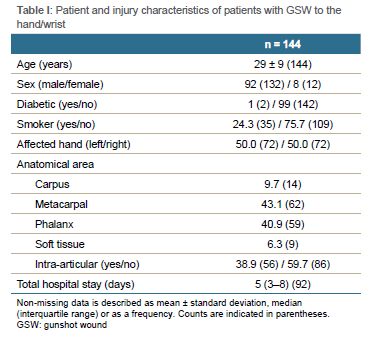
Most patients suffered from metacarpal (43%, n = 62) or phalanx fractures (41%, n = 59) (Table I). Twelve patients (8%) sustained injuries to multiple bones of the hand and wrist, while nine (6%) had multiple GSW.
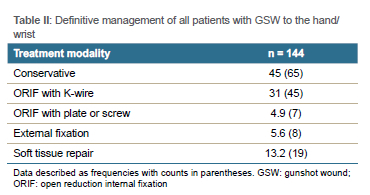
The most common treatment was conservative management (45%, n = 65), followed by open reduction internal fixation (ORIF) with Kirschner-wires (31%, n = 45) (Table II). Eleven patients (8%) were treated with temporary external fixation. Six patients (4%) underwent secondary procedures, including carpal tunnel release, bone grafting and K-wire placement after external fixation.
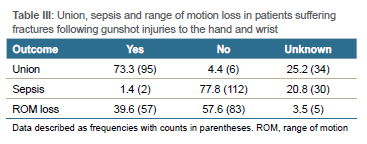
Of the 135 patients with fractures, six patients (4%) failed to unite (Table III). The union information of 34 patients (25%) was missing due to either loss to follow-up or being discharged to another facility. Of the 34, 14 patients (10%) were lost to follow-up before union could be confirmed, and two patients (1.4%) developed fracture-related infection.
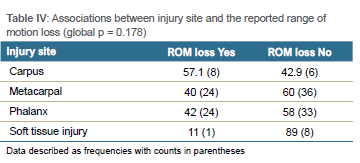
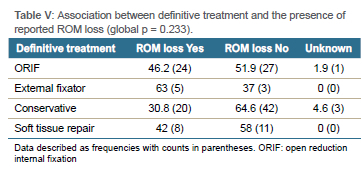
There was no association between the loss of ROM and the injury location (Table IV) (p = 0.178), or between the loss of ROM and the type of definitive treatment (Table V) (p = 0.233).
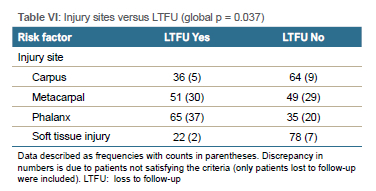
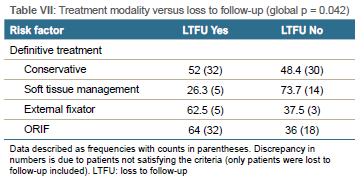
The median follow-up period for patients who were admitted was 200 days (IQR 32-214 days), with 74 patients (51%) being lost to follow-up. A significant association (p = 0.037) was observed between the injury location and being lost to follow-up (Table VI), driven primarily by higher rates in phalangeal (65%) and metacarpal (51%) fractures. A significant association between the type of definitive treatment and loss to follow-up was also observed (p = 0.042), with those treated with ORIF being most likely to be lost to follow-up (Table VII). Overall, loss to follow-up was high (51%), and smaller cell counts in other subgroups may have limited detection of differences.
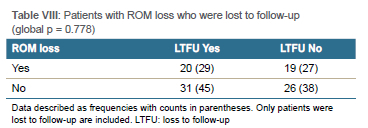
A total of 56 patients (40%) had loss of ROM noted at the last review, and of these 56 patients, 29 (20%) were lost to follow-up at varying periods (Table VIII). This was, however, not statistically significant (p = 0.778).
Discussion
This study aims to provide an overview of the injury patterns, management and outcomes of patients sustaining gunshot injuries to the hand and wrist seen at a tertiary hospital between 2014 and 2017.
Few studies have investigated civilian gunshot injuries to the hand and wrist and are typically retrospective, reporting on small cohorts. A 2012 study in the USA included 89 patients over a ten-year period,14 while a 2018 study reported on 77 patients over four years.15 The present study included 144 patients over four years, underscoring the high burden of interpersonal violence experienced in Cape Town, and highlighting its pressures on the local healthcare system.
Consistent with previous literature, the cohort predominantly comprised young males (mean age 29 years), likely related to gang-related activities, substance abuse and socioeconomic factors.4,14-19
Metacarpal (43%) and phalangeal (41%) fractures were most common, likely due to their larger surface area compared to the relatively compact carpal bones - a finding consistent with Ghareeb et al.15 Our study shows a high frequency of intra-articular fractures which are more challenging to manage and have a higher risk of complications such as post-traumatic arthrofibrosis and osteoarthritis.20
Current evidence indicates that metacarpal fractures can often be treated conservatively with good outcomes.21,22 The treatment of phalangeal fractures is more variable, with some authors suggesting fixation with plates and screws,23 while others recommend K-wires or external fixation as the optimal fixation.24 A conservative management approach was frequently used in our study, followed by treatment with K-wire fixation. In a comparable study with a similar patient population, K-wire fixation was the most commonly used surgical intervention.15 In contrast, Gonzales et al. cautioned against K-wires for gunshot-related phalangeal fractures due to soft tissue tethering risk,23 while Hutchinson et al. favoured conservative management in a cohort that included less severe pellet gun injuries.25 Further highlighting the lack of consensus in the treatment of gunshot-related phalangeal fractures, Nalbantoglu et al., in turn, recommended plate fixation with early mobilisation as the best way to manage phalangeal fractures.23,26 Plate fixation is a viable option, with infection not as prevalent as previously thought in open fractures and early mobilisation as allowed by plate fixation to be of great benefit in outcomes.26,27
In our study, union was achieved in 73% of patients, with only 4% experiencing nonunion. In 25% of cases, union status could not be confirmed due to loss to follow-up. Previous GSW-related studies of the hand and wrist and of the rest of the body reported a similarly low rate of nonunion with 3.1% and 5.2%, respectively.4,15 The low nonunion rate may be attributed to the cohort consisting predominantly of young and healthy patients.28
A low rate of fracture-related infection was observed in our study, with only two patients (1%) developing an infection. Earlier comparable studies reported similarly low rates of fracture-related infection.15 Standardised care of GSW-related fractures and open hand fractures with prophylactic antibiotics and early debridement is likely to be the reason for the low infection rate.29,30
In our cohort, 40% of patients had ROM loss reported in their clinical notes. No associations between ROM with either injury site or treatment modality were observed. These tests were, however, likely underpowered given the small sample sizes within subgroup analyses. Although similar studies suggest poor documentation of functional loss or ROM loss, a significant number of patients showed ROM loss.15,30,31 Perreira et al. reported that 86% of their participants had moderately good functioning, and only 35% returned to work.14
ROM loss can usually be improved with correct management.32 Twenty per cent of our patients with ROM loss missed one or more of their follow-up appointments, which may have prohibited improved ROM had stiffness been detected earlier. Over 50% of all our patients missed one or more follow-up appointments. Kiehn et al. reported 39% loss to follow-up after discharge in Philadelphia, USA,33 while Jakoet et al. reported a more than 30% loss to follow-up rate in a Cape Town-based study on gunshot injuries.4
Reasons why patients do not complete follow-up are often region and population specific.34,35 Socioeconomic factors and travel distance are predictors of poor follow-up.4 Other reasons for patients not attending follow-up include having to take time off work, long waiting times in clinics and already-achieved satisfactory outcome. Loss to follow-up was more common among patients who sustained phalangeal injuries. Similarly, an association between the loss to follow-up and type of definitive treatment was also observed, with those patients undergoing open reduction and internal fixation or those being treated conservatively being more likely not to attend follow-up visits. While these findings are interesting and might provide preliminary information on what type of injuries are more likely to lead to loss to follow-up, given the small sample sizes, the findings should be interpreted with caution, and replicated in other populations and settings.
Limitations to our study include its retrospective design and inconsistent clinical documentation, limiting our ability to subclassify fracture and expand on associated injuries. Community initiatives to improve follow-up compliance and long-term functional outcomes may be relevant.
Conclusion
This study presents one of the largest cohorts of gunshot-related hand and wrist fractures reported to date and highlights the burden of firearm-related trauma in a high-volume trauma centre. Although the majority of injuries in our study were managed successfully, the high rates of ROM loss and loss to follow-up remain concerning.
Ethics statement
The authors declare that this submission is in accordance with the principles laid down by the Responsible Research Publication Position Statements as developed at the 2nd World Conference on Research Integrity in Singapore, 2010.
Prior to the commencement of the study ethical approval was obtained from the following ethical review board: Stellenbosch University Undergraduate research ethics committee ref nr: U20/11/099. All procedures were in accordance with the ethical standards of the responsible committee on human experimentation (institutional and national) and with the Helsinki Declaration of 1975, as revised in 2008.
Ethics approval included a waiver of informed consent for this retrospective review.
Declaration
The authors declare authorship of this article and that they have followed sound scientific research practice. This research is original and does not transgress plagiarism policies.
Author contributions
WTH: study conceptualisation, data capture, data analysis first draft preparation, manuscript revision
HFvZ: manuscript revision
NF: study conceptualisation, manuscript revision
MCB: manuscript revision, data capture, data analysis
ORCID
Howard WT https://orcid.org/0000-0002-7630-4444
van Zyl HF https://orcid.org/0000-0002-1479-0854
Ferreira N https://orcid.org/0000-0002-0567-3373
Burger MC https://orcid.org/0000-0003-2831-4960
References
1. World Bank. World Bank. 2018 [cited 2021 Oct 20]. Intentional homicides (per 100,000 people) | Data. Available from: https://data.worldbank.org/indicator/VC.IHR.PSRC.P5?name_desc=false [ Links ]
2. Western Cape Government. Western Cape Crime Report 2018/19 Department of Community Safety. 2019;1-76. [ Links ]
3. Western Cape Government. Western Cape Crime Report 2018/19 Department of Community Safety. 2019;1-76. [ Links ]
4. Jakoet MS, Burger M, Van Heukelum M, et al. The epidemiology and orthopaedic burden of civilian gunshot injuries over a four-year period at a level one trauma unit in Cape Town, South Africa. Int Orthop. 2020;44(10):1897-904. [ Links ]
5. de Putter CE, Selles RW, Polinder S, et al. Economic impact of hand and wrist injuries. J Bone Joint Surg Am. 2012;56(9):1-7. [ Links ]
6. Robinson LS, Sarkies M, Brown T, O'Brien L. Direct, indirect and intangible costs of acute hand and wrist injuries: A systematic review. Injury. 2016 Dec 1;47(12):2614-26. [ Links ]
7. Watt AJ, Chang J. Functional reconstruction of the hand: the stiff joint. Clin Plastic Surg. 2011;38:577-89. [ Links ]
8. de Putter CE, Selles RW, Haagsma JA, et al. Health-related quality of life after upper extremity injuries and predictors for suboptimal outcome. Injury. 2014 Nov 1;45(11):1752-58. [ Links ]
9. Zelle BA, Buttacavoli FA, Shroff JB, Stirton JB. Loss of follow-up in orthopaedic trauma: who is getting lost to follow-up? J Orthop Trauma [Internet]. 2015 Nov 1 [cited 2022 Jun 29]; 29(11):510-5. Available from: https://journals.lww.com^orthotrauma/Fulltext/2015/11000/Loss_of_Follow_up_in_Orthopaedic_Trauma__Who_Is.6.aspx [ Links ]
10. Kirchner G, Kerbel Y, Kim A, et al. Looking forward: a systematic review assessing risk factors predicting orthopaedic trauma 'loss to follow-up.' J Orthopaedic Experience & Innovation. 2022 Aug 28;3(2). [ Links ]
11. Nandra R, Grover L, Porter K. Fracture non-union epidemiology and treatment: 2015 Jun 24;18(1):3-11. http://dx.doi.org/101177/1460408615591625 [ Links ]
12. Di Silvio F, Foyil S, Schiffman B, et al. Long bone union accurately predicted by cortical bridging within 4 months. JBJS Open Access. 2018 Dec 1;3(4):E0012. [ Links ]
13. Metsemakers WJ, Kuehl R, Moriarty TF, et al. Infection after fracture fixation: Current surgical and microbiological concepts. Injury. 2018 Mar 1;49(3):511-22. [ Links ]
14. Pereira C, Boyd JB, Olsavski A, et al. Outcomes of complex gunshot wounds to the hand and wrist: A 10-year level I urban trauma center experience. Ann Plast Surg. 2012;68(4):374-77. [ Links ]
15. Ghareeb PA, Daly C, Liao A, Payne D. Current trends in the management of ballistic fractures of the hand and wrist: experiences of a high-volume level I trauma center. Hand. 2018;13(2):176-80. [ Links ]
16. Martin C, Thiart G, McCollum G, et al. The burden of gunshot injuries on orthopaedic healthcare resources in South Africa. SAMJ. 2017;107(7):626-30. [ Links ]
17. Engelmann E, Maqungo S, Laubscher M, et al. Epidemiology and injury severity of 294 extremity gunshot wounds in ten months: a report from the Cape Town trauma registry. SA Orthop J. 2019;18(2). [ Links ]
18. Peden M, van der Spuy J, Smith P, Bautz P. Substance abuse and trauma in Cape Town. SAMJ. 2017 Jun 7;90(3):251-55. [ Links ]
19. Socio-Economic Determinants of Crime in South Africa: an Empirical Assessment [Internet]. [cited 2022 Apr 28]. Available from: https://www.africaportal.org/publications/socio-economic-determinants-crime-south-africa-empirical-assessment/ [ Links ]
20. McKinley TO, Borrelli J, D'Lima DD, et al. Basic science of intra-articular fractures and posttraumatic osteoarthritis. J Orthop Trauma. 2010 Sep;24(9):567. [ Links ]
21. Khan A, Giddins G. The outcome of conservative treatment of spiral metacarpal fractures and the role of the deep transverse metacarpal ligaments in stabilizing these injuries. J Hand Surg Eur Vol. 2015 Jan 26;40(1):59-62. [ Links ]
22. Giddins GEB. The non-operative management of hand fractures. J Hand Surg Eur Vol. 2015;40(1):33-41. [ Links ]
23. Gonzalez MH, Hall M, Hall J. Low-velocity gunshot wounds of the proximal phalanx: Treatment by early stable fixation. J Hand Surg Am. 1998;23(1):150-55. [ Links ]
24. Kömürcü M, Alemdaroölu B, Kürklü M, et al. Handgun injuries with metacarpal and proximal phalangeal fractures: Early definitive treatment. Int Orthop. 2008;32(2):257-62. [ Links ]
25. Hutchinson AJ, Kusnezov NA, Dunn JC, et al. Epidemiology of gunshot wounds to the hand. Hand Surg Rehab. 2019;38(1):14-19. [ Links ]
26. Nalbantoglu U, Gereli A, Cilli F, et al. Open reduction and low-profile plate and/or screw fixation in the treatment of phalangeal fractures. Acta Orthop Traumatol Turc. 2009;43(4):317-23. [ Links ]
27. Ghilzai U, Ghali A, Singh A, et al. Management of gunshot wounds near the elbow: experiences at a high-volume level I trauma centre. Clin Shoulder Elbow. 2024;27(1):3-10 [ Links ]
28. Clark D, Nakamura M, Miclau T, Marcucio R. Effects of aging on fracture healing. Curr Osteoporos Rep. 2017;15(1)601-608. [ Links ]
29. Davies J, Roberts T, Limb R, et al. Time to surgery for open hand injuries and the risk of surgical site infection: a prospective multicentre cohort study. J Hand Surg Eur Vol. 2020;45(6):622-28. [ Links ]
30. Turker T, Capdarest-Arest N. Management of gunshot wounds to the hand: a literature review. J Hand Surg Am. 2013;38(8):1641-50. [ Links ]
31. Mousoulis C, Thomas K, Leighton P, et al. Treatment interventions for hand fractures and joint injuries: a scoping review of randomized controlled trials. J Hand Surg Eur Vol. 2020;45(2):111-18. [ Links ]
32. Case-Smith J. Outcomes in hand rehabilitation using occupational therapy services. Am J Occup Ther. 2003 Sep 1;57(5):499-506. [ Links ]
33. Kiehn MW, Mitra A, Gutowski KA. Fracture management of civilian gunshot wounds to the hand. Plast Reconstr Surg. 2005 Feb;115(2):478-81. [ Links ]
34. Badenhorst DHS, van der Westhuizen CA, Britz E, et al. Lost to follow-up: challenges to conducting orthopaedic research in South Africa. SAMJ. 2018 Nov 1;108(11):917-21. [ Links ]
35. Zelle BA, Buttacavoli FA, Shroff JB, Stirton JB. Loss of follow-up in orthopaedic trauma: who is getting lost to follow-up? J Orthop Trauma. 2015 Nov 1;29(11):510-15. [ Links ]
Received: June 2025
Accepted: January 2025
Published: August 2026
* Corresponding author: nferreira@sun.ac.za
Editor: Prof. Theo le Roux, University of Pretoria, Pretoria, South Africa
Funding: No funding was received for this study.
Conflict of interest: The authors declare they have no conflicts of interest that are directly or indirectly related to the research.
