



Services on Demand
Journal

Article
 English (pdf)
 Article in xml format
 Article references

 Automatic translation
 Send this article by e-mail
Indicators
Related links
-
 Cited by Google
-
 Similars in Google
Share

 Permalink

Journal of the South African Institution of Civil Engineering
On-line version ISSN 2309-8775Print version ISSN 1021-2019
J. S. Afr. Inst. Civ. Eng. vol.68 n.2 Midrand Jun. 2026
https://doi.org/10.17159/2309-8775/2026/v68n2a5
TECHNICAL PAPER
Mechanical properties of tropical residual soils - recommended test procedures and evaluation
C Meier; F Hörtkorn
ABSTRACT
Current soil mechanical testing procedures and methods for deriving soil parameters are based on experience and research on soils transported from temperate climates. This research has resulted in well-accepted and well-understood soil mechanical principles and, combined with decades of experience, has led to numerous reliable correlation methods for deriving various soil mechanical parameters. However, there are vast areas of the world where the soils are formed by in-situ weathering, mostly in tropical regions, so the correlation methods and experience based on transported soils may not be applicable and should be used with great caution.
Extensive research on tropical residual soils has been conducted by geologists and there is a good understanding of the genesis and processes leading to the unique parameters of these soils. Unfortunately, this knowledge is not as well known among geotechnical engineers.
This paper is therefore addressed to the geotechnical engineer and attempts to provide unambiguous definitions to describe tropical residual soils. It also highlights the differences between tropical and temperate soils, both in terms of the soil itself and the test results obtained using conventional, well-established test methods. Practical recommendations for the derivation of soil parameters are given.
Keywords: tropical residual soils, temperate soils, transported soils, red soils
INTRODUCTION INTO TROPICAL RESIDUAL SOILS
Historic review and genesis
The basic principles of modern soil mechanics date back about a hundred years. Names such as Terzaghi, Atterberg or Casagrande are well known. Many of the modern test methods for describing soils from a geotechnical point of view were developed by these outstanding and pioneering engineers. Based on experience with these test procedures, numerous correlation methods and tables for geotechnical parameters have been developed and successfully applied (Carter & Bentley 2016). However, there is a historical limitation in the application of knowledge and correlation methods to soils found in tropical areas.
Almost all the test methods, procedures and correlation methods currently available have been developed on soils available in Europe or North America. The geology of both these regions is quite comparable - both originate from the Laurasian supercontinent and have been drifting apart along the mid-ocean ridge since the Mesozoic era, and both are characterised by extensive mountain regions and have spanned several glacial periods. In summary, these types of soils are the basis of the classic discipline of geotechnics and are in some way moved or transported from their original location by natural formation processes (Wesley 2013) such as wind, water, ice, or gravity.
Tropical residual soil, on the other hand, is typically found in tropical areas characterised by heavy precipitation, high temperatures, and humidity, either year-round or with distinct dry and wet seasons. The simplest way to define this area is through its astronomical definition. It is defined in latitude by the Tropic of Cancer in the Northern Hemisphere at 23°26'10.2" N and the Tropic of Capricorn in the Southern Hemisphere at 23°26'10.2" S, (see also the highlighted tropical zone in Figure 1). Note that there are many more definitions, for example based on the climate (Köppen 1884), the vegetation (Troll 1964) or the radiant flux density (Lauer et al 1996), but they converge in almost the same area as shown in Figure 1.
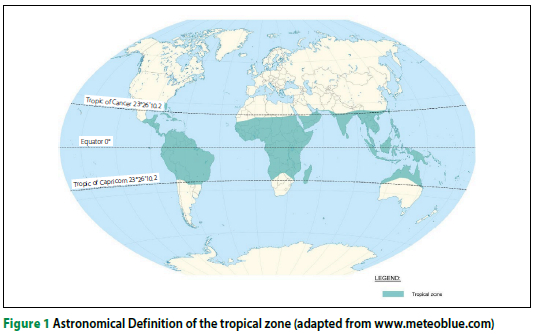
It is important to note that the tropical area represents approximately 40% of the land surface and is home to approximately 40% of the world's population, with the number increasing to an estimated 50%. The increase in population leads to increased construction activity in these regions. It is clear that building on and with tropical residual soils is becoming increasingly important, as Wesley (2013) has already stated, "it is well past the time when residual soil behaviour should be an integrated part of mainstream soil mechanics".
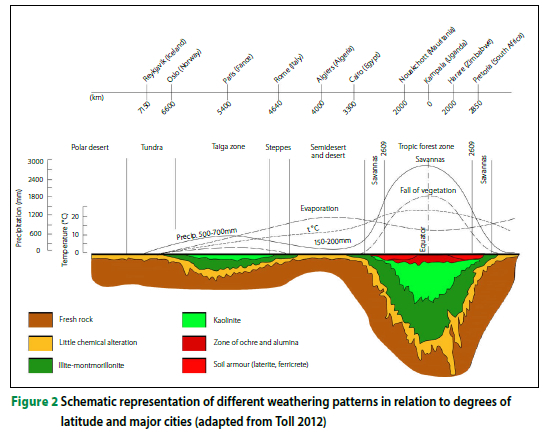
As noted above, the major difference with transported soils is that tropical residual soil has not been transported. It has been formed in situ by the tropical environment over long geological periods. Parameters such as rainfall and temperature are the main factors that cause the parent rock to weather. Depending on the exact location and distance from the equator, this weathering process will result in weathered zones of different depths. A schematic representation of the different weathering patterns in relation to the major climate zones, latitudes and major cities is shown in Figure 2.
Tropical residual soil behaves differently when transported and occurs like hillwash or colluvium, that means different to transported or residual soils. This type of soil is generally referred to as 'transported tropical soil'. Further information on this topic can be found in Brink (2015), who investigated the geotechnical behaviour of transported tropical red soils in a selected area of the Mayoko region in the Republic of the Congo.
The focus of this paper is the geotechnical behaviour of tropical residual soils. In cases where historical information or historical test results have been used, it may not always be possible to make a clear distinction between tropical residual and transported tropical soil.
Terminology and geotechnical investigation for tropical residual soils
Various institutions and societies have published classification schemes and terminologies for tropical residual soils. According to Wesley (1994), the methods underlying the existing classification systems can be categorised into three broad types:
-
Methods based on weathering profile
-
Methods based on pedological classification
-
Methods intended for local use on specific soil type only.
Systems based on method 3 make a cross-country comparison difficult, which is why Morin & Todor (1970), for example, have published an approximate correlation of some selected classification systems.
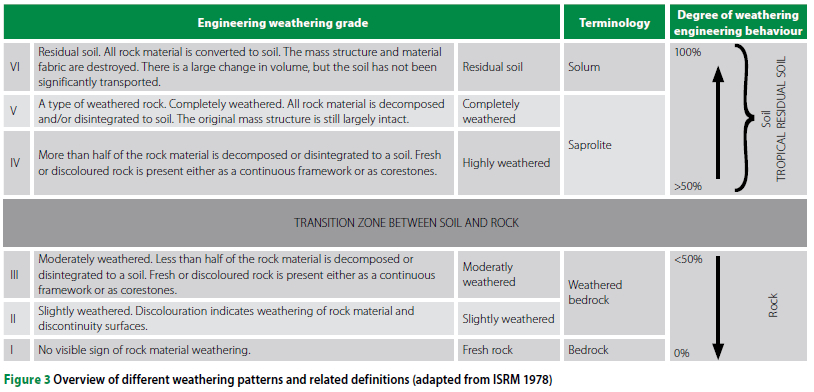
Many commonly used classification systems, however, focus on agricultural/pedological or geological aspects. The United States Department of Agriculture (1999) Soil Taxonomy System is one such example. Although it describes almost all soils found in tropical areas, it focuses on pedological aspects and is therefore not of much help to the geotechnical engineer who needs parameters for design purposes. The most widely recognised and practically applicable classification regarding tropical residual soils has been developed and published by the Geological Society (Fookes 1997). The terminology is directly related to established rock weathering classes that should be well known to geotechnical engineers, as these classes are identical to the classes described for example in ASTM D5878-19, BS 5930:2015, EN ISO 14689-1 or by the International Society for Rock Mechanics and Rock Engineering (ISRM 1978) - see Figure 3.
The correlation with the weathering classes and subsequent terminology provided in Figure 3 is sufficient information to describe tropical residual soils. In addition to the categories shown above, there are many more categories that are subdivided into small groups - see Fookes (1997) or Wesley and Irfan (1997). These subcategories are not discussed further in this paper as they are considered less important in describing the engineering behaviour of tropical residual soils.
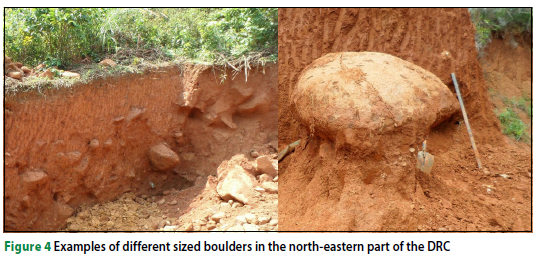
Depending on the location, the depth of the weathering profile may vary and not all rock and soil types will necessarily be encountered during a geotechnical investigation. Local weathering patterns are also very common, especially in hilly topography. In addition to local patterns, the presence of spheroidal weathered boulders or core stones of various sizes can be expected (see Figure 4). These features should not be confused with erratic boulders as occurring in transported soils typical for moderate climatic regions.
In areas with distinct wet and dry seasons, layers of cemented minerals such as iron oxides, silica, or calcium carbonate may occur. These layers vary in thickness, can be found near the surface or in deeper layers, and can be of considerable strength (almost like concrete).
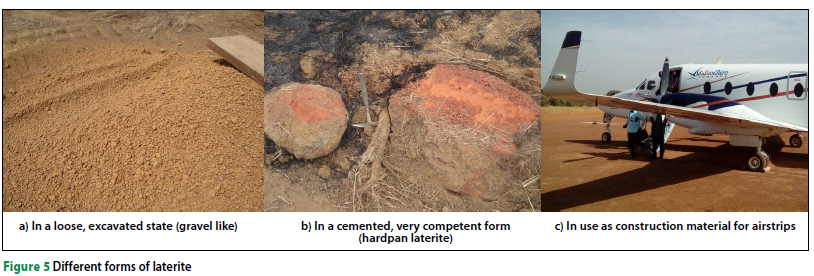
Depending on the origin and strength of the material, these layers may be called laterite, duricrust, ferricrete, or other names. Although lateritic soils are often a valued building material and make very good pavement material (see Figure 5), they can also pose significant risks during construction. Planned foundation methods and/or selected construction equipment may need to be adapted to penetrate the lateritic layers. Indirect ground investigation methods should be avoided, not only because of the lateritic layers, but also because of the presence of unknown boulders.
Although lateritic soils are not the main focus of this paper, it is considered useful to provide a brief definition of laterite in order to distinguish it from other tropical residual soils. As Netterberg (2014) explains, the term 'laterite' has been in use in the scientific literature for over 200 years, with Dr Francis Buchanan-Hamilton (India) being the first to use this term (Buchanan 1807). Over the last two centuries, further technical terms for "this type of material to include practically all reddish iron-rich soils of any origin, whether indurated or capable of induration or not" (Netterberg 2014) have been developed and used. This multitude of terms and their sometimes divergent descriptions of geotechnical properties have led to considerable confusion among experts. One reason for this is that the various scientific disciplines (geology, pedology and engineering) use their own definitions and terminology. For further information see Netterberg (2014), Gidigasu (1972, 1974, 1976) and Charman (1988).
CHARACTERISTICS OF TROPICAL RESIDUAL SOILS
Qualification and appearance
The mechanical parameters discussed in the following section are relevant for weathered material corresponding to weathering classes IV to VI, also referred to as "tropical residual soil" (see Figure 4).
Depending on the exact degree of weathering, it may be possible to predict the unusual soil behaviour to some extent (Little 1969, Blight 1997). However, the authors believe that this is rather academic because it is very difficult to determine the exact degree of weathering in the field and the weathering profile can change suddenly. Therefore, the paper does not differentiate in this regard but rather provides an overview of the range of possible parameters and emphasises the importance of sample preparation and the effect of testing. Based on test results of tropical residual soils obtained from projects in the Democratic Republic of the Congo (DRC), as well as other published results, the influence of the test procedures and the possible range are shown for the following standard tests:
-
Particle size distribution (PSD)
-
Plasticity index (PI)
-
Particle density
-
Bulk densities
-
Permeability
-
Effective shear strength (soil cohesion and friction angle).
The list of geotechnical investigations is extensive and is not set out in full here. However, the standard geotechnical tests listed above have been selected because it is assumed that these tests are familiar to all geotechnical engineers and are often used.
Due to the variability of the relevant soil mechanical properties and parameters, the sampling of these soils is of particular importance. For this reason, sampling, test methods and their evaluation are dealt with in detail later in a separate section as well.
In-situ soil identification
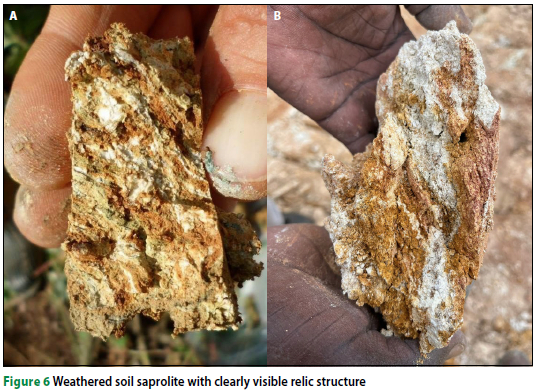
Tropical residual soils are easy to identify, as the relic structure is often clearly visible. Two typical examples of weathered soils (saprolite) are shown in Figure 6. They were obtained by the authors from a site in the north-east of the DRC (Figure 6a) and a site in Uganda, near Kampala (Figure 6b).
Subject to weathering, some minerals may still be intact and not degraded, such as in clay minerals. These intact and semi-intact minerals form cemented larger particles. At the same time, a significant amount of small clay minerals is contained in the interstices of these larger particles. Any application of mechanical force causes the particles to disintegrate. The same effect is obtained when samples are "chemically" treated, for example with a dispersing agent when preparing a soil sample for a particle size distribution test (sedimentation). In addition, drying of samples can also change the structure and physical behaviour. This is a very important aspect as drying is often required in test procedures but can also occur during shipment or storage of samples. Note that these changes are not reversible.
Particle size distribution
The effect of sample preparation and test procedure on the PSD is shown in Figure 7, which shows eight different PSD-curves for the same material but prepared and tested differently.
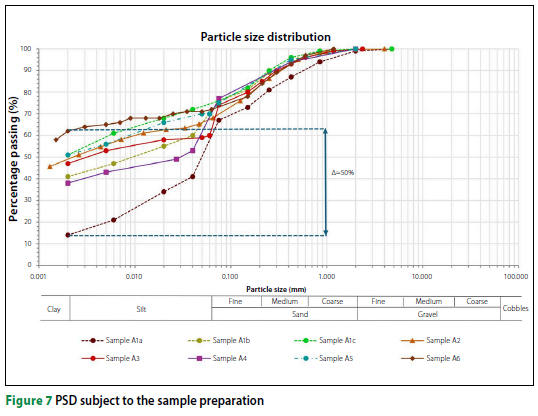
The sample test results shown in Figure 7 are from a sample taken in the DRC and is shown in Figure 6a. The material was dried differently (from air-dried (undercover, no direct sun) to oven-dried (60° up to 105°)), mechanically prepared differently (from handshaking to stir-mixing), and chemically prepared using different dispersants agents at varying doses (see Brink & Hörtkorn 2016).
It is a common observation for tropical residual soils - and is confirmed in Figure 7 - that particle sizes obtained by sieving (not sedimentation) are not really affected by sample preparation (Dubé 2020), unless the tropical residual soils are weakly cemented. These soils can undergo changes in their grain size distribution during the sieving process, as studies from Gidigasu (1972) show.
There may, however, be significant differences in the fine fraction tested by sedimentation, for which samples must be dried and prepared both chemically and physically. The clay content for the tests shown in Figure 7 varies from about 15% to 65%, an almost 50% variation. According to Toll (2012), standard dispersion techniques often only partially disaggregate the aggregated clay fractions, so the clay fraction may be underestimated. The American standard test methods for particle size distribution (ASTM 6913) provides testing procedures which cover some of the above issues discussed for tropical residual soil. They even recommend that other dispersing agents can be used subject to soil mineralogy. Terzaghi (1958) had already described that the clay-size fraction obtained using sodium hexametaphosphate as dispersing agent results in a considerably higher clay fraction compared to other agents. Similar results have been published by Kaur & Fanourakis (2016).
The choice of dispersion agent should be made with particular care and it is advisable to use different agents if necessary and to carry out interlaboratory tests to verify the results. Standard correlation tables, for example to determine permeability or filter stability, must be used with great caution.
Plasticity
For differently dried samples similar differences can be observed when the liquid limit (LL) and PL are determined.
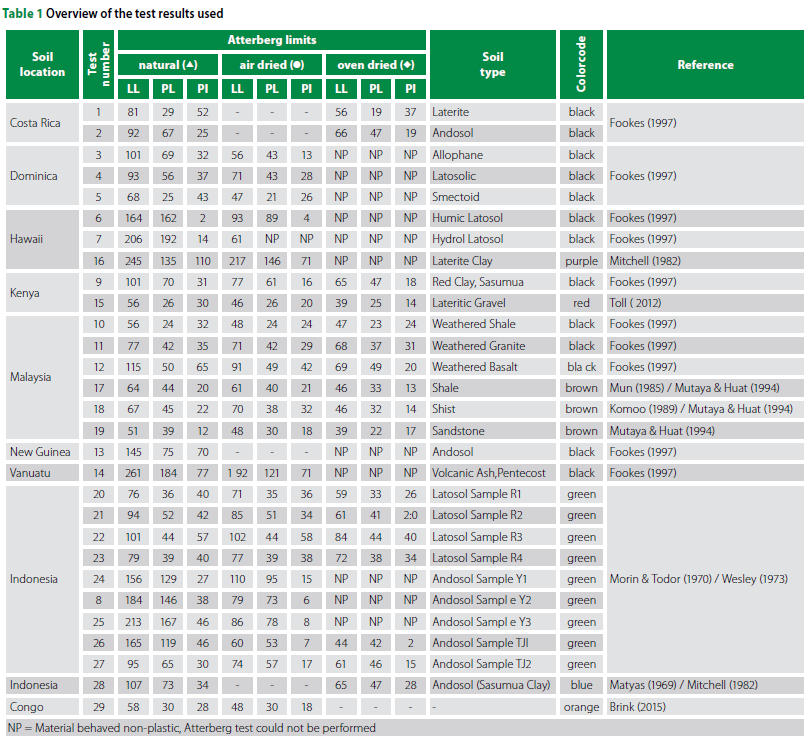
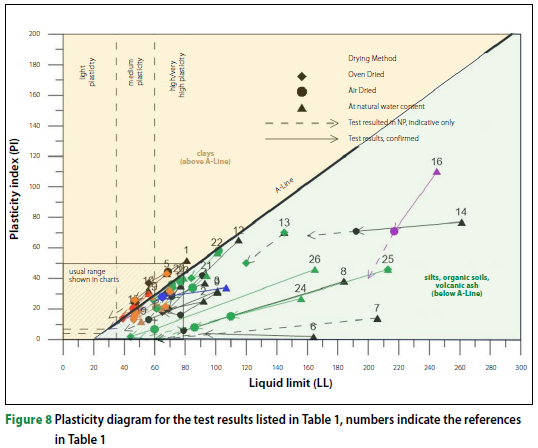
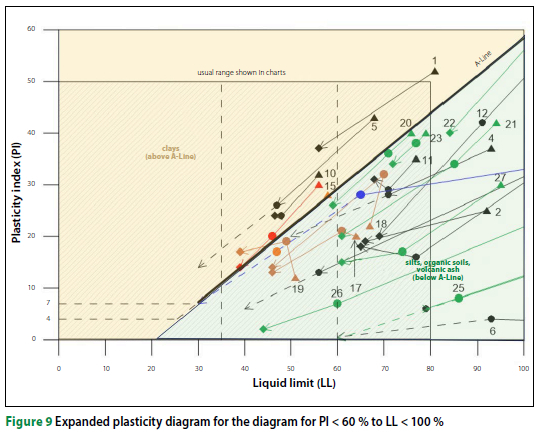
Only a few test results have been published comparing the LL and PL for tropical residual soils tested in their natural state, air dried, and oven dried. The authors have attempted to summarise the publicly available information for test results ranging from South America over Africa to Asia. The results are presented in Table 1 and are shown as plasticity diagrams in Figures 8 and 9.
The results shown in Table 1 are based on a comprehensive literature review, trying to provide the original references which are partially dating back to the early 1950s. Attempts to group materials based on their mineralogical description (Andosol, Latosol) were unsuccessful as the terminology used to describe tropical residual soil changed over time.
With increasing drying temperature, both the LL and the PL, and therefore the PI, drops, sometimes to the point where the material behaves in a non-plastic manner. Furthermore, most test results indicate that the material has a high plasticity, mostly on the silty side, close to the A line. None of the results indicate silty/clayey sand. Many of the results obtained for the same material dried differently, lie on a straight line, often parallel and very close to the A line. This may indicate that both the LL and the PL are equally affected by drying, more specifically by the drying method and temperature, respectively.
The representation of all three test results in Figures 8 and 9 - i.e. natural moisture content, air dried and oven dried - illustrates the dependence on the type of drying often mentioned in the specialist literature (e.g. Toll 2012). Compared to previous graphical illustrations (e.g. Moh & Mazhar 1969, Morin & Todor 1970, Fookes 1997), Figures 8 and 9 deliberately show the result of different drying methods.
The range of the diagram for PI < 60 % to LL < 100 % is expanded out for a more detailed view in Figure 9.
Given the broad spectrum of mineralogy encompassed by the term "tropical residual soils", it is unsurprising that the test results displayed in Figures 8 and 9 exhibit significant variation. The major impact of mineralogy on the plasticity behaviour and the relative positioning of individual test results of different soils in relation to the A-line has been previously delineated by Moh and Mazar (1969) and Brink and Brook (2023). The markedly low plasticity index of samples 6 and 7 can be attributed to their elevated humus content. It is a well-established principle that humic soils invariably fall below the A-line. This phenomenon has been thoroughly analysed by Whitesell and Isherwood (1971) and Tatarniuk and Bowman (2019), among other researchers. Volcanic ash, for which the geotechnical properties were investigated by Wesley and Matuschka (1988) and others, also often lies below the A-Line, just as silt does. This, however, depends on the ash grain size.
A sample air dried by Moore and Styles (1988) took around two weeks to reduce the water content from 200% to 30%. Adding hydraulic binding agents can be useful in such cases but might affect geotechnical parameters as well.
It is imperative to acknowledge the pivotal role of test competence and the suitability of equipment and facilities in determining the quality of plasticity test outcomes, as outlined in ASTM D3740-19. In the context of soils containing organic matter, it has also been observed for temperate soil that the drying method can exert a significant impact on the liquid limit of a soil sample, potentially leading to a substantial decrease in this parameter. This phenomenon is outlined in ASTM D4318-17e1. Consequently, a comparison of the liquid limit of a sample before and after oven drying can serve as a qualitative measure of the organic matter content of a soil (see ASTM D2487-06). In a similar manner to ASTM D2487-06, it could be evaluated whether the alterations in the liquid limit could be utilised as an indication of the presence of tropical residual soil.
Particle density
Testing for particle density, such as using a pycnometer as described in ASTM D854-23, is often tedious and time consuming. For transported soils in temperate climates, particle density is often assumed, especially if the mineralogy of the tested material is known.
When dealing with tropical residual soils, it is not advisable to assume a typical particle density. The particle density depends not only on the parent rock, but also on the stage of weathering and the type of clay mineral present, which develops as the rock itself is weathered. Typical values of 2.65 g/cm3 are only be expected for silica and alumina-silica minerals. The presence of, for example, sesquioxide will obviously give higher values. Unusually low or high values can occur, the latter especially in areas where mineral extraction takes place, such as the iron ore mining areas in the Mayoko District, which is a district in the Niari Department of south-western Republic of Congo (Brink & Hörtkorn 2016).
Bulk density, porosity and hydraulic properties
Bulk density, porosity and hydraulic properties are described together in this section because these parameters are affected by the same result of the underlying weathering process, which can result in high void ratios in tropical residual soils. This void ratio, possibly even in combination with an unusual particle density, can lead to extremely low values of bulk density. For some ferruginous soils (red coffee soils), Toll (2012) reports values as low as 0.6 t/m3, less than the density of water. If the soil is not saturated, this loose structure can be maintained by suction, which gives strength to clay "bridges" that support the coarser particles and maintain a low density. If the soil is saturated, the suction forces may disappear, and the soil will exhibit collapsible behaviour. In addition, Jefferson and Rogers (2012) observed that the relic structure exhibits a form of cementing that contributes to the loose and potentially meta-stable structure of tropical relic soils. This cementation is often misinterpreted as over-consolidation when conducting oedometer tests. It is generally incorrect to speak of any type of over-consolidation, as tropical relic soils have never been subjected to a stress history as is typical of transported soils (Nait-Rabah et al 2023).
If a low bulk density is associated with high porosity or void ratio, it affects not only the stress-strain behaviour but also permeability. When subjected to weathering, the permeability of a saprolite classified as clay by both conventional geotechnical testing and mineralogy can be up to 3 to 5 orders of magnitude higher than expected. Undrained conditions are therefore not as likely for residual soils as for transported soils. In addition, fractures as well as termite and other insect activity can increase permeability. Reading (1991) and Vaughan (1988) mentioned the importance of void ratio and proposed a classification method for residual soils, based on an index of the void ratio at the liquid limit and optimum water content.
Shear strength parameter
The influence of different weathering patterns, sampling and sample preparation on the shear strength parameters of tropical residual soils is the most difficult parameter to assess. At the same time, it is the most relevant for many geotechnical projects. For example, the determination of the stability of a slope is directly related to many of these parameters as input parameters. In this context, reference is made to Blight (1997), which is considered a well-founded work on the conceptual variation of effective shear strength parameters (cohesion and friction angle) with depth.
Only limited information is available that compares the shear parameters of tropical residual soils, where the specimens were prepared and/or tested differently. For example, Brink (2015) reported on a detailed geotechnical investigation project involving transported soils from the Mayoko region of the DRC. The results showed a significant decrease in effective cohesion for the disturbed material. For the effective shear friction angle, no clear trend could be established between the in-situ material and the remoulded material. However, it should be noted that, with values up to 38°, unexpectedly high effective friction angles were obtained for the material tested (clay content up to 50%), as, for example, Mitchell and Sitar (1982) also reported.
Similar observations are reported by Brink and Hörtkorn (2016) for soils in the northern part of the DRC.
For tropical residual soils from Singapore, Meng and Chu (2011) found that friction angles were highly dependent on consolidation stresses and tended to decrease with increasing stress. This is an indication that consolidation beyond the in-situ stress state could lead to destruction of the residual soil structure, confirming the observations described above. This phenomenon has already been investigated in relevant works by Vaughan (1985) and Leroueil and Vaughan (1990).
There are other published results (e.g. Rigo et al 2011 or Meng & Chu 2011) that show unusual results, but because the sampling method, sample preparation, test method, etc. are not clearly described, it makes it very difficult or almost impossible to quantify the influence of these parameters on the results.
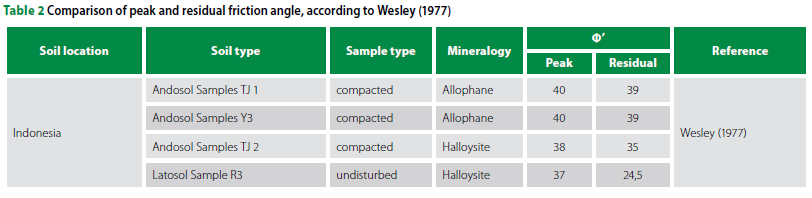
Another relevant systematic study on the shear strength has been carried out by Wesley (1977) in which, although cohesion also plays an important role in cemented soil, only the friction angle was examined. Table 2 contains an extract from Wesley (1977) for the peak and residual friction angle.
Residual values were measured by Wesley (1977) on four samples with different dominant clay minerals. Only a very small decrease in strength from peak to residual was to be noted on the samples TJ1 and Y3, where allophane was the dominant clay mineral. For the halloysite samples (TJ2 and R3) the drop is somewhat greater, although the residual friction angles are still high. Due to its essentially non-crystalline/amorphous nature, the very small drop from peak to residual strength for the allophane samples is not surprising. On the other hand, the clay particles of the halloysite are crystalline, resulting in a small strength reduction (Wesley (1977)). It should therefore be noted that, as with plasticity, the mineralogy of the soil also plays an essential role in the strength parameters and should therefore always be analysed in subsoil investigations.
With regard to Table 2 it is important to note that disturbed (compacted) and undisturbed samples behave differently in strength and residual strength. That topic that has been widely discussed in the literature, for instance Terzaghi (1958), Gidigasu (1974) and Vargas (1974).
SOIL SAMPLING AND TEST PROCEDURES
The wide range of geotechnical parameters obtained, depending on the sampling and testing procedures, is a clear indication that standard geotechnical sampling and testing procedures are obviously inadequate when applied to tropical residual soils. Recommendations or engineering decisions based on these results could have serious consequences. It is therefore important to be aware of the uniqueness of these soils and to take this into account during sampling, testing and results interpretation.
As Brand and Phillipson (1985) has already determined, when building in and with tropical residual soils, the investigation must be more extensive than for most other soils. The work of Oyelami et al (2022) on tropical residual soils as materials for road substructures also illustrates the need for intensive investigation of these soils.
When compiling and analysing existing data (see Figures 8 and 9), the authors noticed some implausible data. A further discussion in this regard is not possible due to the incomplete, very old and not sufficiently documented data. This also justifies the present article and the urgent recommendation to document the sampling and experiment implementation thoroughly.
The authors propose a differentiated approach to sampling and analysing tropical residual soils, which is intended to overcome the limitations and uncertainties of existing methods. The cardinal question to be answered when determining a sampling and testing programme should be whether the geotechnical parameters of undisturbed or disturbed material are required.
Recommendations to soil sampling and testing
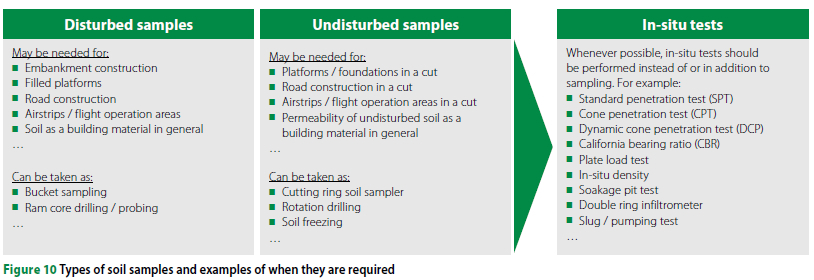
The type of soil sample or testing required is determined by project requirements, whereby a distinction must be made between disturbed and undisturbed soil samples (see Figure 10).
If parameters of the disturbed material are required to evaluate a geotechnical problem, for example when tropical residual soil is used as fill or for embankment construction, it is advisable to describe the test procedures as precisely as possible, especially if the tests are carried out in different laboratories, which should be avoided. Otherwise, the results are not comparable and thus meaningless. The following has been found to be pragmatic for disturbed samples:
-
Avoid any kind of drying during sample collection, transport and storage as far as possible
-
Perform the relevant tests available to determine specific parameters, e.g. to identify materials of a similar nature, rather using correlations due to their sensitivity to changes in water content
-
Use a sample for one test only, not multiple times for different tests
-
Whenever sample drying is necessary, use air-drying without exposure to direct sunlight
-
Generally, avoid the classic Atterberg tests for plasticity and preferably perform the one-point liquid limit tests already mentioned, also especially for African soils, by Morin and Todor (1970), provided that a suitable correlation has been established locally for each soil type (Fookes 1997).
If undisturbed material parameters are required to evaluate a geotechnical problem, it is more appropriate to perform in-situ tests. This means that, whenever possible, in-situ testing should be favoured over taking undisturbed samples. The following procedure has been found to be pragmatic in the case of laboratory tests on undisturbed samples (LTUS) or in-situ tests (IST):
-
Permeability:
-
LTUS: triaxial permeability test (BS1377-6)
-
IST: percolation tests (falling head permeability tests) in boreholes.
-
-
Stiffness:
-
LTUS: oedometer test (BS1377-5) or triaxial test (BS1377-8)
-
IST: large-diameter plate load tests (BS1377-9/4.1).
-
-
Shear strength:
-
LTUS: direct Shear box (BS1377-7), triaxial test (BS1377-8)
-
IST: in-situ direct shear test according to suggested method of ISRM.
-
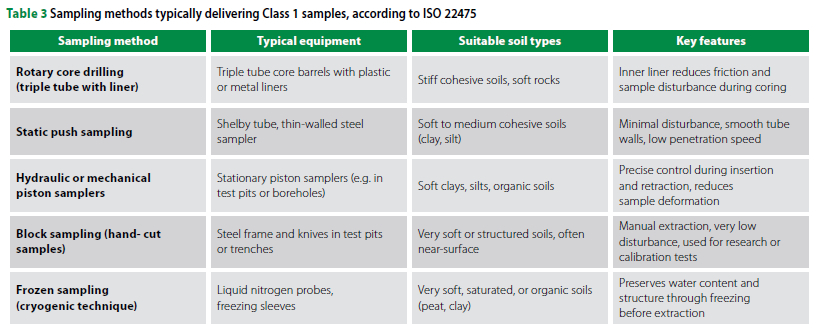
Careful sampling is particularly important whenever undisturbed samples are to be examined. DIN EN ISO 22475 specifies important requirements for the extraction of soil samples as part of a geotechnical investigation and testing programme. It defines three sample quality classes that reflect the degree of disturbance and the suitability of the samples for different types of laboratory testing:
-
Quality Class 1: Undisturbed sample with preserved structure, density, and natural water content; typically used for advanced laboratory tests (e.g. shear strength, deformation/stiffness).
-
Quality Class 2: Slightly disturbed sample; water content remains representative; typically used for basic index properties (e.g. grain size, density).
-
Quality Class 3: Disturbed sample; structure and original state are not preserved; typically used for soil classification, moisture content, chemical testing only.
For tropical residual soils on which the aforementioned laboratory tests are to be carried out, samples of Quality Class 1 are required. Various specialised techniques are used to obtain undisturbed samples with minimal disturbance to the soil structure, see Table 3.
Frozen sampling may be unsuitable for soils with a high water content or a small grain size and so should be used with great caution due to the risk of ice lens formation.
Needless to say, the quality class depends not only on the method used, but also on how well it is executed, the sampler used, and how the samples are transported to the laboratory.
In recent decades, based on the normative regulations such as BS1377, attempts have been undertaken to reliably determine the soil mechanical properties of tropical residual soils, e.g. the scientific work of Wesley (1977), Ching et al (1984) and Vaughan (1988) on the determination of shear strength. For tropical residual soils, no specific recommendations regarding the shear rate exists. The experience gained with temperate soils should therefore be considered until further notice. From a soil mechanical perspective, the authors recommend selecting the lowest possible shear rate for tropical soils.
The Geological Society Engineering Group Working Party Revised Report, published by Fookes (1997), and the paper by Netterberg (2014) should be emphasised as comprehensive and outstanding works. Both papers cover a wide range of issues relating to tropical residual soils and include recommendations on soil sampling and testing methods. Netterberg (2014) also contains practical building recommendations for the use of laterite in road construction. In this context, i.e. for the compaction and compaction control of tropical residual soils during earthworks, the laboratory report No. 115 (Bulman 1967) and No. 600 (O'Reilly 1974), as well as the work of Wesley (1988) and Wesley (1994) should be mentioned.
For more specific information on laboratory testing, Oliveira (2017) discusses an extensive compilation of data on tropical residual soils as a guide for laboratory testing, particularly in the context of tunnel boring machines.
Furthermore, it is advisable to use the "observational" method as described in Eurocode EC7. Many natural features, especially natural slopes, can be seen as additional proofs of concept, and it should seriously consider these observations instead of relying only on complex numerical calculations with doubtful input parameters.
CONCLUDING REMARKS
This paper has been written by two geotechnical engineers who have dealt with this problem in their daily work and have realised that, although knowledge exists, many engineers have never been exposed to these interesting and challenging soils.
The paper is far from covering all aspects relevant to tropical residual soils, and many relevant aspects such as settlement of tropical residual soils, dispersity or stabilisation of these soils have not been addressed. The authors' main intention is to raise awareness and provide some general guidance on the subject in the hope that it will help colleagues involved in projects in tropical regions.
For further information, please refer to the relevant and already mentioned outstanding works by Fookes (1997) and Netterberg (2014) and the literature sources referenced therein.
REFERENCES
ASTM D2487-06: Standard practice for classification of soils for engineering purpose (unified soil classification system). ASTM International. [ Links ]
ASTM D3740-19: Standard practice for minimum requirements for agencies engaged in testing and/or inspection of soil and rock as used in engineering design and construction. ASTM International. [ Links ]
ASTM D4318-17e1: Standard test methods for liquid limit, plastic limit, and plasticity index of soils. ASTM International. [ Links ]
ASTM D5878-19: Standard guides for using rock-mass classification systems for engineering purposes. ASTM International. [ Links ]
ASTM D6913/D6913M: Standard test methods for particle-size distribution (gradation) of soils using sieve analysis. ASTM International. [ Links ]
ASTM D854-23: Standard test methods for specific gravity of soil solids by the water displacement method. ASTM International. [ Links ]
Blight, G E. 1997. Mechanics of residual soils. Rotterdam: Balkema. [ Links ]
Brand, E W & Phillipson, H B. 1985. Sampling and testing of residual soils. A review of international practice. Hong Kong: Scorpion Press. [ Links ]
Brink, G & Brook, M S. 2023. Engineering properties of tropical transported soils: case study from the Republic of Congo. Quarterly Journal of Engineering Geology and Hydrogeology, 56(4): 134. [ Links ]
Brink, G & Hörtkorn F. 2016. The effect of sample preparation and test procedure on the evaluation. Proceedings of the first Southern African Geotechnical Conference, pp 249-253. [ Links ]
Brink, G E. 2015. Engineering geological evaluation of transported tropical red soils. PhD thesis. University of Pretoria, South Africa. [ Links ]
BS 1377:1990. Methods of test for soils for civil engineering purposes. London: British Standard Institute. [ Links ]
Buchanan, F. 1807. A Journey from Madras through the countries of Mysore, Canara and Malabar. London: East India Company. [ Links ]
Bulman, J N. 1967. Investigations into road building practice in the tropics. A study of the compaction of earthworks at the New International Airport for Kuala Lumpur, Malaysia. TRRL Reports, Road Research Lab, UK. [ Links ]
Carter, M & Bentley, S P. 2016. Soil properties and their correlations. West Sussex: John Wiley & Sons. [ Links ]
Charman, J H. 1988. Laterite in road pavements. London: Construction Industry Research and Information Association. [ Links ]
Ching, R K H, Sweeney, D J & Fredlund, D G. 1984. Increase in factor of safety due to soil suction for two Hong Kong slopes. Proceedings of the Fourth International Symposium on Landslides, pp 617-623. [ Links ]
De Oliveira, D G G, Diederichs, M, Rasmussen, L L & Cecílio, M O. 2017. Tropical residual soil data compilation as guidance for laboratory tests and EPB excavation process simulation. Proceedings, 9th International Symposium on Geotechnical Aspects of Underground Construction in Soft Ground, Sao Paulo, Brazil, pp 185-193. [ Links ]
DIN EN 1997-1 (2009-09): Eurocode 7: Geotechnical design - Part 1: General rules. Beuth Verlag, Berlin. [ Links ]
DIN EN ISO 22475-1:2022. Geotechnical investigation and testing: Sampling methods and groundwater measurements - Part 1: Technical principles for the sampling of soil, rock and groundwater. Beuth Verlag, Berlin. [ Links ]
Dubé, J S, Ternisien, J, Boudreault, J P, Duhaime, F & Éthier, Y. 2021. Variability in particle size distribution due to sampling. Geotechnical Testing Journal, 44(1): 148-173. [ Links ]
EN ISO 14688-1: 2003. Geotechnical investigation and testing - Identification and classification of soil - Part 1: Identification and description. London: British Standards Institution. [ Links ]
Fookes, P G. 1997. A review: Genesis and classification of tropical residual soils for engineers. In: Blight, G E, Fourie, A B, Luker, I, Mouton, D J, Scheurenberg, R J (eds). Geotechnics in the African Environment. Rotterdam: Balkema. [ Links ]
Fookes, P G. 1997. Tropical residual soils: A Geological Society Engineering Group working party revised report. London: Geological Society of Publishing House. [ Links ]
Gidigasu, M D. 1972. Mode of formation and geotechnical characteristics of laterite materials of Ghana in relation to soil forming factors. Engineering Geology, 6(2): 79-150. [ Links ]
Gidigasu, M D. 1974. Degree of weathering in the identification of laterite materials for engineering purposes - a review. Engineering Geology, 8(3): 213-266. [ Links ]
Gidigasu, M D. 1976. Laterite soil engineering. Pedogenesis and engineering principles. Amsterdam: Elsevier. [ Links ]
ISRM. 1978. Suggested methods for the quantitative description of discontinuities in rock masses. International Journal of Rock Mechanics and Mining Sciences & Geomechanics Abstracts, 15: 319-368. [ Links ]
Jefferson, I & Rogers, C D F. Collapsible soils. In: Burland, J, Chapman, T, Skinner, H & Brown, M (eds). ICE Manual of Geotechnical Engineering. London: Institution of Civil Engineers. pp 391-412. [ Links ]
Kaur, A & Fanourakis, G C. 2016. Influence of phosphate dispersing agents on particle size distribution of soil fines. Geotechnical and Geophysical Site Characterisation 5. Sydney: Australian Geomechanics Society. [ Links ]
Köppen, W. 2011. The warm zones of the earth, according to the duration of the hot, temperate and cold periods and according to the effect of heat on the organic world. Meteorologische Zeitschrift, 20(3): 351-360. [ Links ]
Lauer, W, Rafiqpoor, M D & Frankenberg, P. 1996. Die Klimate der Erde: Eine klassifikation auf ökophysiologischer grundlage der realen vegetation (Climates of the Earth - A classification on the base of eco-physiological characteristics of the real vegetation). Erdkunde, 50(4): 275-300. [ Links ]
Leroueil, S & Vaughan, P R. 1990. The general and congruent effects of structure in natural soils and weak rocks. Géotechnique, 40(3): 467-488. [ Links ]
Little, A L. 1969. The engineering classification of residual tropical soils. Proceedings, 7th Conference on Soil Mechanics & Foundation Engineering, Mexico City, Mexico, pp 1-10. [ Links ]
Meng, G H & Chu, J. 2011. Shear strength properties of a residual soil in Singapore. Soils and foundations, 51(4): 565-573. [ Links ]
Mitchell, J K & Sitar, N. 1982. Engineering and Construction in Tropical and Residual Soils. Proceedings, ASCE Geotechnical Engineering Division Speciality Conference, Honolulu, Hawaii, pp 30-58. [ Links ]
Moh, Z C & Mazhar, M F. 1969. Effects of method of preparation on index properties of lateritic soils. Proceedings, 7th International Conference on Soil Mechanics and Foundation Engineering, Mexico City, Mexico, pp 23-35. [ Links ]
Moore, P J. 1988. Some characteristics of a volcanic ash soil. Proceedings, 2nd International Conference on Geomechanics in Tropical Soils, Singapore, 12-14 December, pp 161-165. [ Links ]
Morin, W J & Todor, P C. 1975. Laterite and lateritic soils and other problem soils of the tropics. Washington, DC: U.S. Agency for International Development. [ Links ]
Nait-Rabah, O, Germain, F, Estevez, Y, Guiraud, J, Medjigbodo, G, Dias, D & Maalouf, C. 2023. Characterisation of geotechnical properties of residual tropical soils used for road infrastructure: French Guiana experience. Applied Sciences, 13(13): 7943. [ Links ]
Netterberg, F. 2014. Review of specifications for the use of laterite in road construction. Pretoria: Council for Scientific and Industrial Research. [ Links ]
O'Reilly, M P. 1974. The compaction of soils and stabilized bases on roads in East Africa, TRRL Laboratory Report No. 600. US Army Engineer Research and Development Center, Transport and Road Research Laboratory. [ Links ]
Oyelami, C A, Akande, W & Kolawole, T O. 2022. A preliminary geotechnical assessment of residual tropical soils around Osogbo metropolis as materials for road Subgrade. Journal of the Nigerian Society of Physical Sciences, 4(2): 157-164. [ Links ]
Reading, A J. 1991. Stability of tropical residual soils from Dominica, West Indies. Engineering Geology, 31(1): 27-44. [ Links ]
Rigo, M L, Pinheiro, R J B, Bressani, L A, Bica, A V D & Silveira, R M D. 2006. The residual shear strength of tropical soils. Canadian Geotechnical Journal, 43(4): 431-447. [ Links ]
Tatarniuk, C M & Bowman, E T. 2019. Engineering behaviour and mechanical-empirical relationships for a problematic New Zealand tropical residual soil. Quarterly Journal of Engineering Geology and Hydrogeology, 52(3): 386-398. [ Links ]
Terzaghi, K & Robertson, R H S. 1958. Design and performance of the Sasumua Dam. Proceedings of the Institution of Civil Engineers, 9(4): 369-394. [ Links ]
Toll, D. G. 2012. Tropical Soils. In: Burland, J, Chapman, T, Skinner, H & Brown, M (eds). ICE Manual of Geotechnical Engineering. London: Institution of Civil Engineers. pp 341-361. [ Links ]
Troll, C. 1964. Karte der jahreszeiten-klimate der erde (The map of the seasonal climates of the earth). Erdkunde, 18(1): 5-28. [ Links ]
United States Department of Agriculture. 1999. Soil Taxonomy. A basic system of soil classification for making and interpreting soil surveys, 2nd edn. United States Natural Resources Conservation Service. [ Links ]
Vargas, M. 1974. Engineering properties of residual soils from south-central region of Brazil. Proceedings, 2nd International Conference of International Association of Engineering Geology, Sao Paulo, Brazil. [ Links ]
Vaughan, P R. 1985. Mechanical and hydraulic properties of in-situ residual soils. Proceedings, First International Conference on Geomechanics in Tropical, Lateritic and Saprolitic Soils, Brasilia, Brazil, 11-14 February. [ Links ]
Vaughan, P R. 1998. Characterising the mechanical properties of in-situ residual soil. Proceedings, Second International Conference on Geomechanics in Tropical Soils, Singapore, 12-14 December. [ Links ]
Wesley, L D & Irfan, T Y. 1997. Classification of residual soils. In: Blight, G E. Mechanics of residual soils. Rotterdam: Balkema. pp 17-29. [ Links ]
Wesley, L D & Matuschka, T. 1988. Geotechnical engineering in volcanic ash soils. Proceedings, Second International Conference on Geomechanics in Tropical Soils, Singapore, 12-14 December. [ Links ]
Wesley, L D. 1977. Shear strength properties of halloysite and allophane clays in Java, Indonesia. Géotechnique, 27(2): 125-136. [ Links ]
Wesley, L D. 1994. The use of consolidometer tests to estimate settlement in residual soils. Proceedings, 13th International Conference on Soil Mechanics and Foundation Engineering, New Delhi, India, 5-10, pp 929-934. [ Links ]
Wesley, L D. 2013. Residual soils and the teaching of soil mechanics. Proceedings, 18th International Conference on Soil Mechanics and Geotechnical Engineering, Paris, France, 2-6 September, pp 3479-3482. [ Links ]
Whitesell, C D. 1971. Adaptability of 14 tree species to two Hydrol Humic Latosol soils in Hawaii. Pacific Southwest Forest and Range Experiment Station. [ Links ]
 Correspondence:
C Meier
Nolte Services Group
Nottuln, 48301, Germany
claas.meier@nolteservices.com
F Hörtkorn
University of Applied Sciences
Karlsruhe, 76133, Germany
florian.hoertkorn@h-ka.de

CLAAS MEIER studied civil engineering at the University of the German Armed Forces in Munich from 2001 to 2004. For around 15 years he worked as a geotechnical engineer at Boley Geotechnik - Consultants and Engineers in Munich, most recently as a member of the management board. He has also been lecturing on soil dynamics at the University of the German Armed Forces in Munich since 2011. He has been Head of the BD division at the Nolte Services Group since 2025. ORCID iD: orcid.org/0009-0001-4017-7586

PROF FLORIAN HÖRTKORN has been a professor at Karlsruhe University of Applied Sciences since 2019. Prior to that, he worked in South Africa for over 10 years, most recently as a partner in an engineering firm in Johannesburg. In addition to traditional geotechnical engineering, his work focuses on mine and dam construction as well as the field of geosynthetics. He is a member of the DGGT and DWA as well as the British Institute of Civil Engineers and is active on various committees of these associations as well as in national and international standardisation work. ORCID iD: orcid.org/0009-0003-7342-2255