



Services on Demand
Journal

Article
 English (pdf)
 Article in xml format
 Article references

 Automatic translation
 Send this article by e-mail
Indicators
Related links
-
 Cited by Google
-
 Similars in Google
Share

 Permalink

Journal of the South African Institution of Civil Engineering
On-line version ISSN 2309-8775Print version ISSN 1021-2019
J. S. Afr. Inst. Civ. Eng. vol.68 n.2 Midrand Jun. 2026
https://doi.org/10.17159/2309-8775/2026/v68n2a1
TECHNICAL PAPER
The development of a framework to register, grade, and assess contractors' performance
S Chiloane-Nwabueze; A Fitchett; A Glendinning
ABSTRACT
The construction sector plays a key role in the economic development of a country. The management of this sector is thus crucial in maximising both the performance of the sector and the economy. South Africa's construction sector has some level of inefficiencies that could be improved to enhance the sector's performance outputs. To achieve this, the study reviewed the literature on relevant key concepts and developed a questionnaire and framework using the Analytical Hierarchy Process.
In the study, a questionnaire was developed and distributed to key participants in the industry to establish whether there is a need to enhance the current registration, grading, and performance evaluation of contractors in the construction sector and to establish relevant criteria. The grading and performance assessment of contractors is a multi-criteria decision-making process. This paper applied the Analytical Hierarchy Process to develop a framework to register, grade, and assess the performance of contractors. From the 149 respondents, the results received from the questionnaires have revealed that improving the current contractor grading system, construction entry requirements, efficacy of the grading system, and efficacy of the grading and performance evaluation criteria may lead to enhanced contractor capabilities and project performance, which is the outcome variable. Thus, the paper proposes a system for registering, grading, and assessing the performance of contractors in the infrastructure construction sector.
Keywords: construction sector, grading system, multi-criteria decision making, contractor grading, performance assessment
INTRODUCTION
Economic development can be measured by the physical development of infrastructure such as bridges, roads, and buildings (Alzahrani & Emsley 2013). According to Thwala (2005), investment in infrastructure has huge potential to redress the high unemployment and poverty levels in South Africa. The aim of all parties - including client, contractor, consultants, suppliers, and end users - involved in a construction project in either the public or private sector is to complete the project on schedule, within the planned budget, with the required quality, and in the safest manner (Abiodun et al 2017). However, this is not always the case, as contracts are sometimes awarded to contractors who cannot deliver the project outputs (Mohlala 2015).
The Construction Industry Development Board (2011) indicates that the failure rate of infrastructure projects in South Africa has greatly increased. Factors such as time, cost, quality, and client satisfaction are some indicators used to measure performance in a project environment (Cheung et al 2004). Unfortunately, most contractors in government infrastructure projects fall short when assessed against these indicators (Mohlala 2015). Among many other failures experienced in the South African construction industry is the failure to complete projects within the agreed schedule and period and against the required quality standards (Dithebe et al 2022). Contractors responsible for the failures are required to rectify work done, which in turn increases the cost of the project, resulting in both cost and time overruns.
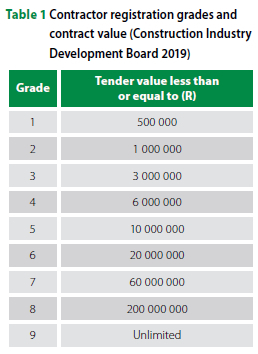
Unsurprisingly, most South African contractors who have implemented government projects fall short when assessed against project management indicators. Ratshisusu (2014) noted that the Construction Industry Development Board (cidb) grade does not reflect the contractors' capabilities in South Africa. Presently, the cidb has nine grading levels, and contractors are upgraded to the next level based on their financial capabilities and evidence of completed projects. Table 1 shows the nine different grades in which contractors can be registered, along with the corresponding contract value in South African Rands (R).
The cidb seeks not only to grow the South African economy through the construction industry, but also to develop improved industry performance and best practices (Republic of South Africa 2000). One method for improving industry performance and best practices in the construction sector is to ensure that the process for grading contractors is efficient, effective, and benchmarked against international practices and norms.
Currently, registration for all cidb grades is based solely on the contractor's financial capability and evidence of completed projects submitted during the application process. The cidb requires the following documents for application (Construction Industry Development Board 2020):
-
Application form
-
Proof of company registration
-
Identity documents
-
Tax clearance certificate
-
Electrical certificate for EB works
-
Financial statements for the two years immediately preceding the application
-
Track record documents (appointment or award letter, completion certificate, and payment certificate).
It is interesting to note that only electrical works (EB) require some form of certification, which is not the case with civil engineering (CE) and general building (GB) works. The cidb's 2012/13 annual report states that the following amendments to the registration regulations were proposed (Construction Industry Development Board 2013):
-
Removal of the requirement for contractors to have registered professionals in their employee base
-
Reduction in the annual turnover requirements
-
Reduction in track record requirements
-
Provision for review of the tender value limits
-
Removal of the method B registration option where enterprises are registered with high financial capacity but no track record
-
Improvement to the grading calculation of joint ventures.
According to Construction Industry Development Board (2013), these amendments were designed to better align the Register of Contractors with developments in the construction industry and with the state of development of the emerging sector. It is observed from the requirements that contractors are able to progress from one grade to the next without any meaningful emphasis being placed on their technical knowledge or expertise. Instead, it is assumed that when contractors have implemented projects and are financially within the required specifications, they are competent to move to the next grade. The 2013 amendments are a further indication that the cidb does not put emphasis on the technical knowledge and expertise of the contractor.
The cidb's grading system should be robust, as contractors are awarded public sector infrastructure and construction projects based on the grade they hold. An enhanced contractor grading and performance assessment framework has the potential to not only improve the accuracy of the alignment of the capabilities of contractors with their grades (Ratshisusu 2014), but also to improve the performance of the South African construction sector.
It is important to understand that spending money on public infrastructure is synonymous with spending money on people themselves (Arif 2013). Therefore, decision makers are required to think innovatively and develop inventive and improved ways of grading contractors and monitoring and evaluating infrastructure project performance. This creates a need for systematic processes, decision support frameworks, and procedures that would enable better decision making (Mihai et al 2000).
According to Ratshisusu (2014), the cidb's grading system has some deficiencies. Notably, the system does not provide enough information to clients on the capacity and ability of firms to undertake construction works. The system would be more effective if contractor grades accurately reflected the contractor's actual capacity and ability to execute a construction project at a given point in time, with such information being made available by the cidb.
For instance, the cidb's Register of Contractors includes more than 50 firms at Grade 9 level - the highest grade a contractor can attain - that may potentially qualify to undertake large infrastructure projects. In practice, however, only a limited number of firms possess the capacity and expertise to successfully deliver such projects. The number of firms within the Grade 9 category creates a false impression that there is a substantial pool of large construction firms, whereas competition for major infrastructure projects is effectively limited to a small group of leading contractors (Ratshisusu 2014).
Presently, the South African construction and civil engineering sector does not have a minimal requirement for contractors who wish to enter the construction industry. Anyone, with or without technical knowledge, with little or no schooling, can register a construction firm. It is posited herein that considering minimal entry requirements for registering a construction firm can also assist in improving the status quo of the local construction sector.
Having such requirements would likely increase the success rate of Grade 1 contractors and would also make it easier for companies seeking to develop enterprises to select entities with potential (Construction Industry Development Board 2016). Any minimum criteria for registration would, however, need to consider the currently registered Grade 1 contractors. According to Construction Industry Development Board (2016), 91% of the current registered Grade 1 contractors are black-owned, 32% are women-owned, and 26% are youth-owned. The high representation of historically disadvantaged individuals, women, and youth among Grade 1 contractors highlights the importance of this category as a route in the transformation of the construction industry (Construction Industry Development Board 2016).
This research was carried out to address the aforementioned need by developing a decision support framework that integrates multiple decision criteria and guides decision makers on registering, grading contractors, and assessing infrastructure project performance. To achieve this goal, a literature review was conducted, followed by the development of a questionnaire to assess the existing state of practice and establish whether there is a need for an improved registration, grading, and performance evaluation of contractors by the role players involved in the construction sector. The Analytical Hierarchy Process (AHP) was utilised as a multi-criteria decision-making tool to develop a framework for grading and assessing the performance of contractors.
If South Africa is to improve its construction outputs, the utilisation of a grading and performance assessment framework may be required.
LITERATURE REVIEW
According to Ngai et al (2002), the construction industry is an integral part of the nation's infrastructure development and is an essential part of the economic backbone of many countries, often contributing 7% to 10% of Gross Domestic Product. The industry is often criticised for inefficiencies in outcomes such as time and cost overruns, low productivity, poor quality, and inadequate customer satisfaction (Chan et al 2003). It is therefore important to have a change in attitudes and procedures to enhance the chances of success in construction projects (Dubois & Gadde 2002).
The South African construction sector is faced with several challenges, some of which are poor project performance and unethical conduct. The increase in the failure of infrastructure projects raises great concern about the way the construction sector operates. Maseko (2017) notes that infrastructure construction projects are largely characterised by remarkable levels of unethical practices and poor performance, which has impaired the image of the industry. Moreover, the delivery of good-quality infrastructure projects in some emerging economies is continuously disrupted because of poor performance.
South Africa's Construction Industry Development Board Act (38 of 2000) established the cidb to implement an integrated strategy for the reconstruction, growth, and development of the construction industry. The cidb regulations, adopted in 2004, provide a framework for grading contractors in terms of their capabilities as well as the volume and nature of the projects they can undertake. Initially, the grade of a contractor was based on two methods: one based on track record and the other on available capital (Mohlala 2015). The latter method meant that a contractor could achieve a high grade provided it had available capital, regardless of its track record. This led to the amendment of the cidb regulations in 2013 to provide for a ranking framework based on both track record and available capital.
It is posited herein that, in order to improve the state of the construction sector, an enhanced contractor grading and performance assessment framework should be considered to decrease the failure rate of infrastructure projects in South Africa. For example, a study conducted by Construction Industry Development Board (2016) on contractor progression showed a strong correlation between a contractor having construction-related training or qualifications and that contractor's survival and progression.
Mohlala (2015) studied the relationship between the project performance of emerging contractors in South African government infrastructure projects and their experience and technical qualifications and found that contractors with technical qualifications and experience generally perform better than those without technical backgrounds. The study also found that, where there is no technical background, the level of education also affects the level of project performance. The grading of contractors using relevant criteria may improve the client's confidence in the quality of the contractor who will roll out the infrastructure project and may enhance the performance of the construction industry.
According to Hanson (2006), contractor project performance in South Africa is affected by poor workmanship because of contractor incompetence. Operational skills, which include project management and business skills such as planning and financial accounting, are crucial for the success of any business (Thwala & Mvubu 2008). However, Mofokeng (2012) found that small and medium construction companies lack business and managerial experience.
Previous literature (Jaafar & Abdul-Aziz 2005; Lin 1998; Jo & Lee 1996; Yusoff 1995; Fredland & Morris 1976) has shown that managerial expertise and experience are vital for the success of any enterprise and have a significantly positive relationship with the performance of the enterprise. According to Croswell and McCutcheon (2001), some of the difficulties facing emerging contractors include a lack of entrepreneurial, managerial, technical, and administrative expertise. These skills and expertise are vital for emerging contractors' performance through the life cycle of a project and from one project to the next.
The acquisition of competence is, thus, an ongoing process, especially in project-based enterprises (i.e. construction companies) since each project is inherently unique. Emphasis should therefore be placed on continuous learning from one project to the next to improve competence in government infrastructure projects. The increase in the failure rate of South African infrastructure projects (Mohlala 2015) indicates a need to identify the root causes to improve the sector's performance.
Presently, the grading of contractors does not consider multiple criteria. A study conducted by Cheung et al (2004) found that there are seven main key performance indicators: time, cost, quality, client satisfaction, client changes, business performance, and health and safety. According to Xiao and Proverbs (2003), the improvement of project performance, which leads to improved contractor performance, can result in increased client satisfaction, better reputation, and improved competitiveness. Some authors attribute project performance to the contractor's technical competence (Faridi & El-Sayegh 2006; Iyer & Jha 2005; Hanson et al 2003).
The study has developed a framework for registering and grading contractors in the construction sector. The problem at hand is to have a robust framework to register and grade contractors that may assist in improving the performance of the South African construction sector. It is envisaged herein that a robust contractor registration and grading framework could assist in improving the performance of the construction sector and reflect the true capabilities of contractors. This study has developed such a framework, considering relevant multi-criteria for contractor registration, grading, and performance evaluation using the AHP.
FORMULATION OF THE RESEARCH METHODOLOGY
The primary data for this study comprised questionnaires directed at members of the South African Institution of Civil Engineering (SAICE), cidb contractors, and registered members of the South African Council for Project and Construction Management (SACPCMP). The questionnaire covered issues related to construction sector entry requirements, the contractor grading system, the efficacy of the grading system and grading criteria, and project performance evaluation of contractors. The questions focused on matters pertaining to the knowledge, adequacy, relevance, and efficacy of the construction sector entry requirements, grading systems, performance evaluation, and criteria. It also focused on the efficiency and effectiveness of the public sector performance evaluation systems on infrastructure projects.
Once the questionnaire was developed, expert opinion was considered to finalise the questionnaire's content so that the most appropriate information for the research scope and objectives could be elicited. The questionnaire was designed in a user-friendly online format using Google Forms. Before sending the online survey to the participants, the response time and other technical features of the survey were tested through a pilot survey.
The results from the questionnaire formed the basis for determining the criteria for registering and grading contractors. The AHP was utilised for this study as described and motivated below. Thereafter, simulated scenarios were used to validate the framework.
The data collected from the completed questionnaires was analysed using structured equation modelling (SEM) and SPSS software.
SEM is a framework that incorporates the simultaneous solution of linear systems of equations and procedures such as regression, factor analysis, and path analysis (Harrell & Langton 2015). SmartPLS was used to conduct concurrent confirmatory factor analysis and path analysis (Davari & Rezazadeh 2015). The Pearson product-moment correlation was calculated using SPSS software (version 23) to explore the direction, strength, and significance of the bivariate relationships of the contractor grading system, construction entry requirements, grading and performance evaluation criteria, and enhanced contractor capabilities and project performance. Multiple regression analysis was employed to test the hypotheses.
Research suggests that questionnaire surveys are the most frequently used research method, specifically for psychological, management, and marketing research (Woodside 2010). The questionnaire method is based on the logic that the responding individual represents not only his/her thinking process but also that of others who are involved in the decision process over the span of the respondents' experience.
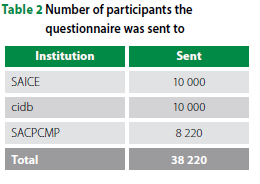
Table 2 depicts the institutions the survey was sent to, as well as the estimated number of potential participants. A total of 149 responses were received. Selecting an appropriate sample size requires consideration of several factors that may affect the research study. To ensure an accurate sample size, the formula for determining sample size should be used, which considers population size, margin of error, confidence level, and standard deviation (Qualtrics 2022). Graglia (2023) states that 100 responses are needed for a population of 3 000 to 10 million for a 10% margin of error. Thus, 100 responses are needed for marginally acceptable accuracy (Great Brook 2023).
Of the 149 responses received, 49 respondents (32.9%) are registered as Grade 1, 2, and 3 contractors, 16 respondents (10.7%) are registered as Grade 4, 5, and 6 contractors, and 17 respondents (11.4%) are registered as Grade 7, 8, and 9 contractors. The remaining 67 (45%) respondents are members of SAICE and the SACPCMP. Figure 1 shows the years of experience in the construction sector.
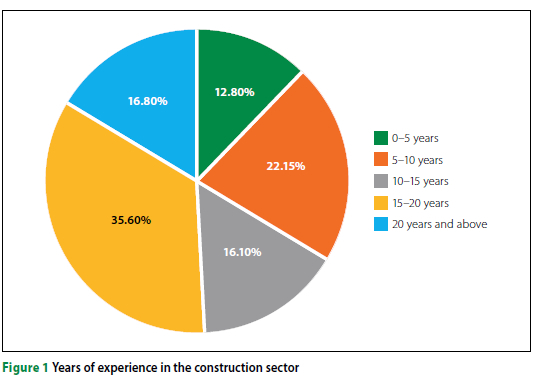
In terms of construction sector experience, 19 respondents (12.8%) have 0 to 5 years' experience, 33 respondents (22.15%) have 5 to 10 years' experience, 24 respondents (16.1%) have 10 to 15 years' experience, 14 respondents (9.4%) have 15 to 20 years' experience, and 53 respondents (35.6%) have over 20 years' experience. Four respondents indicated that they are consultants, and two respondents indicated that they are not yet practicing in the construction sector.
In terms of professional registration with the Engineering Council of South Africa (ECSA), as depicted in Figure 2, 33 respondents (22.1%) are registered as candidate engineers, 38 respondents (25.5%) are registered as professional engineers, 21 respondents (14.1%) are registered as professional engineering technologists, 2 respondents (1.3%) are registered as professional certificated technologists, 10 respondents (6.7%) are registered as professional engineering technicians, and the remaining 45 (30.2%) respondents are not registered with ECSA.
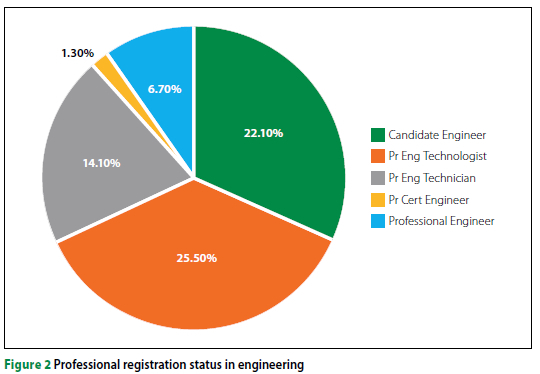
Figure 3 shows the registration status of the respondents with the SACPCMP indicates that 30 respondents (20.1%) are registered as candidate construction managers, 20 respondents (13.4%) are registered as candidate project managers, 10 respondents (6.7%) are registered as professional construction managers, and 41 respondents (27.5%) are registered as professional construction project managers. The remaining 48 (32.2%) respondents are not registered with the SACPCMP.
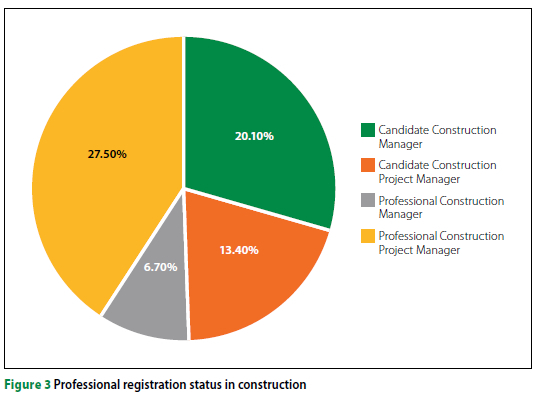
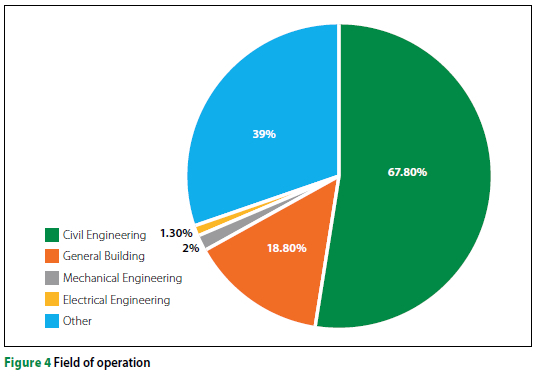
Figure 4 delineates that 101 respondents (67.8%) operate in the civil engineering field, 28 respondents (18.8%) are in the general building field, 3 respondents (2%) operate in the mechanical engineering field, and 2 respondents (1.3%) operate in the electrical engineering field. The remaining 15 respondents (10.1%) operate in other fields, which include construction of large integrated projects from cradle to grave, project management, water management, general property development, toll road operation and maintenance, government, and mega project delivery.
The Analytical Hierarchy Process
According to Saaty (1990), the AHP is a technique widely used to guide the decision-making processes in a multi-criteria and multi-stakeholder environment. In general terms, this technique arranges the factors that are important for the decision in a hierarchical structure descending from an overall goal to criteria, sub-criteria, and alternatives in successive levels; it values the importance of criteria and makes it possible to assess several alternatives according to these criteria.
The advantage of the AHP is in integrating qualitative aspects, which are often excluded from analysis processes but can be relevant to some actors involved in the decision-making process. Some of these qualitative factors are the risk of the decision, the uncertainty, the equity, and the participation level, to name a few (Ávila 2000).
The AHP splits a complex multi-factor problem into a hierarchy. It uses hierarchical structures and linear algebra to understand the problem better and support the final decision. The AHP determines weights for each criterion and alternatives by analysing the judgmental matrices and by applying the mathematical theory of eigenvalues and eigenvectors. The AHP combines both subjective and objective judgments in an integrated framework based on ratio scales from simple pairwise comparisons.
In this study, the AHP was crucial and relevant given that contractor grading and performance evaluation is a multi-criteria decision-making process, and the key criteria to be considered in the decision making are both qualitative and quantitative (Ávila 2000).
Moreover, the AHP seems to be a useful tool for discovering the core of decision problems, including differences and similarities between the stakeholders' different points of view (Nielsen & Mathiesen 2006). This advantage is applicable to this study given that the framework which is developed is intended to be utilised by the cidb, which operates with various stakeholders. This made the AHP more applicable compared to other multi-criteria decision-making processes for the study, as the AHP also makes it possible to assess the consensus rate among different stakeholders around a specific issue (Masozera 2002).
These advantages were considered very important to this research in the sense that the framework may assist the cidb to better explain the context of their contractor grading and performance evaluation decisions to their clients. Furthermore, the application of the AHP may assist the cidb to easily clarify and open the decision process to their clients.
As indicated, the AHP process includes defining the project objective and structuring elements in criteria, sub-criteria, and alternatives. Then, it involves making a pairwise comparison of the elements in each group, calculating the weighing and consistency ratios, evaluating alternatives according to weighing, and lastly, getting the ranking. The goal, main criteria, sub-criteria, and alternatives are arranged in a hierarchical structure.
In this study, the goal is to grade construction contractors and evaluate the performance of contractors tendering for public sector projects. The framework may, however, also be utilised by the private sector or any client. The aim is to grade and evaluate contractors based on their level of experience, qualifications, skills, and other relevant criteria.
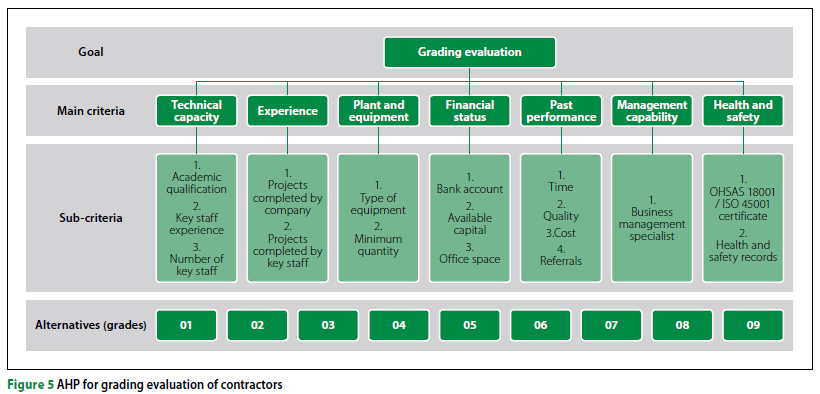
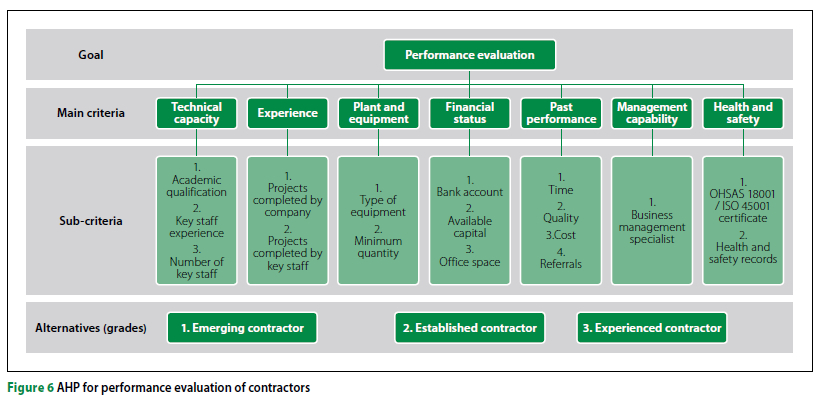
The goal, main criteria, sub-criteria, and alternatives are arranged in a hierarchical structure. The AHP hierarchical structure used for this study is depicted in Figure 5 (AHP for grading evaluation of contractors) and Figure 6 (AHP for performance evaluation of contractors).
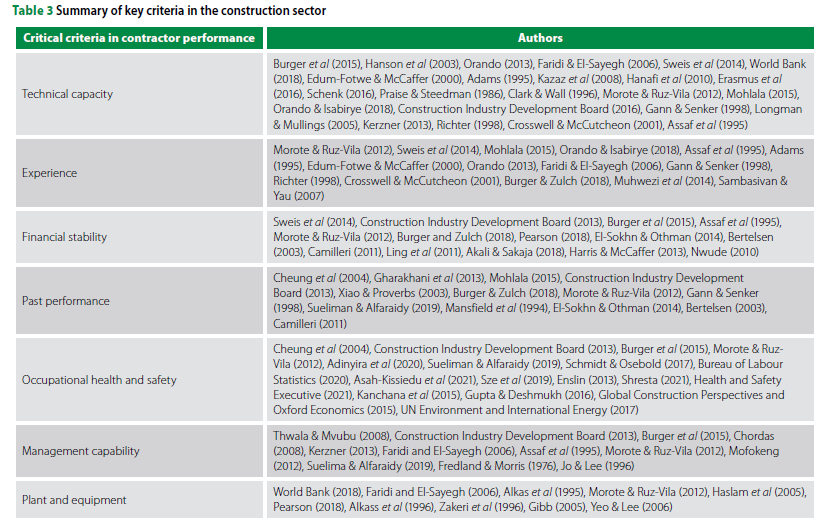
The goal is to grade and assess contractors' performance. The main criteria and sub-criteria were established from the literature as depicted in Table 3. The feedback from the questionnaire has further affirmed that the main criteria and sub-criteria may assist in grading and assessing contractors' performance. The grading and evaluation of the contractor's project performance by the cidb can be key and can assist in improving the performance of the sector. The grading and performance evaluation systems both have the same criteria and sub-criteria. However, the calculations for the grading and performance evaluation system needed to be done separately because the alternatives for the grading and performance evaluation system are not the same. The alternatives for contractor grading and performance evaluation are depicted in Figures 5 and 6.
A common sequence for assessing a proposed technological development is to consider its technological feasibility, economic consequences, and other impacts, i.e. environmental/ecological, political, and social/cultural impacts, etc. (Kalbar et al 2012). After an intensive literature review, as depicted in Table 3, the summary of key criteria for consideration by various authors when grading and evaluating the performance of contractors in the construction sector was found to be technical capability, experience, plant and equipment, financial status, past performance, management capability, as well as occupational health and safety. This was further affirmed by the state of practice survey in the present study to be the main criteria for selecting an appropriate grade for contractors and evaluating contractors' performance.
The summary of key criteria for consideration by various authors when grading and evaluating the performance of contractors in the construction sector is tabulated in Table 3.
The importance of these criteria in terms of project performance cannot be emphasised enough. Construction Industry Development Board (2016) notes that having such requirements would improve the success rate of Grade 1 contractors. Consideration was therefore given to the currently registered contractors to ensure alignment with the enhanced contractor entry and grading requirements, and to not disadvantage the historically disadvantaged individuals in South Africa. Two proposals are made in this report.
The top level of Figures 5 and 6 indicates that the overall goal is to grade and evaluate the performance of contractors. A contractor grade needs to provide a true reflection of the contractor's capabilities. The second level shows the seven main criteria. The third level shows sub-criteria against which each option is evaluated. Technical capacity criteria consider the contractor's ability to perform the activities of the specific project for which it is seeking grading. Experience criteria consider contractors' participation in previous projects, especially if they are similar to the project that will be executed. Financial status and plant and equipment criteria consider the overall financial position and capacity of the contractor.
Considering the past performance of each contractor, the cidb will have a higher or lower degree of confidence in the possible contractor regarding the quality, time, and cost control requirements. The cidb may collect and analyse information about the contractor's past relationship with other entities with which the contractor has executed construction works. After considering the contractor's past performance, the cidb must have an overall estimation or opinion about how good the contractor is for the purpose of grading.
In terms of management capability, the contractor must demonstrate that it has several managerial staff with relevant business-related qualifications and skills who contribute to the sustainability of the business. Over and above these criteria, the cidb must consider occupational health and safety to establish and maintain effective systems and manage the risks to the occupational health and safety of employees arising from the construction work.
A Microsoft Excel spreadsheet-based program, set up using the AHP principle, was used to calculate the criteria priority vectors and project priority vectors, checking the consistency of pairwise comparisons and producing the overall ranking of the grading alternatives.
Tanyimboh and Kalungi (2009) indicate that matrix A is an n×n real matrix, where n is the number of evaluation criteria considered. Each entry ajk of matrix A represents the importance of the jth criterion relative to the kth criterion. If:
ajk > 1: jth criterion is more important than the kth criterion
ajk < 1: jth criterion is less important than the kth criterion
ajk = 1: jth criterion is of the same importance as the kth criterion.
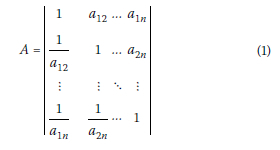
Where A is the matrix and the numerical values that the criteria may take as indicated in Table 1.
After building matrix A, the normalised pairwise comparison matrix B, depicted as bjk, can be derived from matrix A by making the sum of entries on each column equal to 1; see Equation 2.

Where bjk is matrix B and ajk is the criteria value divided by the total value of the overall criteria values.
Finally, the priority vector P is then obtained by averaging the entries in each row of matrix B.
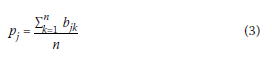
Priority vector P rates the seven main criteria listed in Figure 1 according to their importance to the overall goal, which is performance evaluation of contractors.
The consistency ratio (CR) is defined by Equation 4.
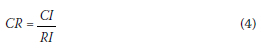
Where CI, the consistency index (see Equation 7), is the matrix of comparisons A (Equation 1), the priority vector P = (p1, ..., pn) (Equations 2 and 3), the column vector X = (x1, ..., xn)T (Equation 5) and λmax the maximum eigenvalue (Equation 6) of the pairwise comparison matrix A.
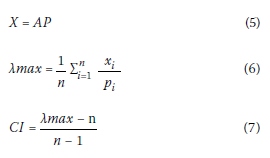
The comparison - the elements of A - is tolerated/considered satisfactory when Equation 8 is satisfied.

A perfectly consistent comparison will be CI = 0. RI in Equation 8 is the random index, i.e. the consistency index when the entries of A are completely random. The values of RI for small problems (n < 10) are shown in Table 4.
RESULTS AND DISCUSSIONS
The questionnaire results indicated that the contractor grading system, construction entry requirements, and the effectiveness of both the grading system and the grading and performance evaluation criteria may contribute to enhanced contractor capabilities and improved project performance, which represents the outcome variable. To determine whether there is a need to improve the current registration, grading, and performance evaluation processes for contractors in the construction sector, respondents were specifically asked to indicate whether enhancements to these processes are necessary.
90.6% (135) of the respondents indicated that enhancing the current construction sector entry requirements will assist in improving the performance outputs of the construction sector, while 84.6% (126) agreed that enhancing the current grading system could assist in improving contractors' capabilities and performance outputs. The results are depicted in Figure 7.
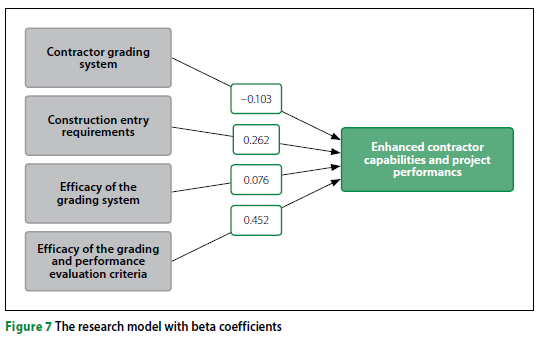
The results indicate a positive relationship between the efficacy of the grading and performance evaluation criteria and enhanced contractor capabilities and project performance. This suggests that improvements in the effectiveness of the grading and performance evaluation criteria are associated with enhanced contractor capabilities and improved project performance. Furthermore, the path modelling results (β = 0.418, t = 3.665, p = 0.000) confirm that this relationship is positive and statistically significant. In other words, the efficacy of the grading and performance evaluation criteria has a substantial positive effect on enhanced contractor capabilities and project performance.
Path modelling describes the relationship between observed or measured variables and a theoretical construct (Roche et al 2011) and assesses the structural paths of a conceptualised research model (Anderson et al 1998). The purpose of the SEM procedure was to demonstrate and test the theoretical foundations of the study and the significance of the relationship between model constructs (Jenatabadi & Ismail 2014).
The study found a positive relationship between the contractor grading system and grading criteria efficacy. This suggests that an effective contractor grading system is associated with higher grading criteria efficacy. The results further demonstrate that the contractor grading system has a significant positive effect on the efficacy of the grading criteria (β = 0.659, t = 11.288, p = 0.000). Path modelling also revealed that the relationship between these two constructs is the second strongest in the proposed model.
Furthermore, the findings revealed a marginally positive relationship between the contractor grading system and enhanced contractor capabilities and project performance. However, the relationship was not statistically significant (β = 0.08, t = 0.71, p = 0.474) because the t-statistic was less than 1.96. Literature suggests that t > 1.96 indicates a significant relationship, and higher path coefficients indicate a strong relationship between latent variables (Zhang 2022).
The findings confirm a positive relationship between the efficacy of the grading system and enhanced contractor capabilities and project performance. In other words, improvements in the efficacy of the grading system are associated with enhanced contractor capabilities and improved project performance. However, the path modelling results (β = 0.015, t = 0.215, p = 0.829) show that this relationship is extremely weak and statistically insignificant. This suggests that the efficacy of the grading system has a considerably smaller influence on enhanced contractor capabilities and project performance than construction entry requirements and the efficacy of the grading criteria.
Testing the potential relationship between construction entry requirements and enhanced contractor capabilities and project performance revealed a positive association between these variables. However, the relationship was statistically insignificant (β = 0.041, t = 0.530, p = 0.596).
The Durbin-Watson value was 2.094, which falls within the acceptable range of 1.5 to 2.5, thereby satisfying one of the assumptions for bivariate and multivariate correlation analyses. Based on these results, as presented in Table 5, it can be concluded that the model is accurate and reliable for contractor grading and performance assessment.
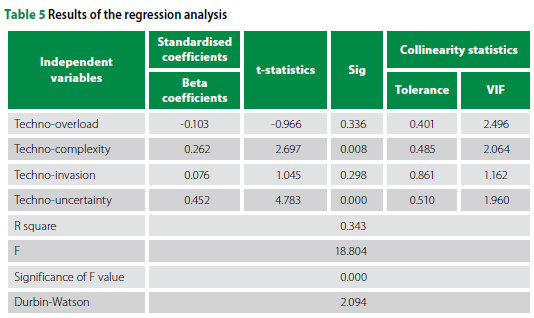
The study model indicates that the efficacy of the grading and performance evaluation criteria has the strongest positive influence on enhanced contractor capabilities and project performance (β = 0.452), followed by construction entry requirements (β = 0.262) and the efficacy of the grading system (β = 0.076). In contrast, the contractor grading system shows a negative relationship with enhanced contractor capabilities and project performance (β = -0.103).
These findings suggest that a more effective contractor grading system is associated with improved contractor capabilities, whereas inefficiencies in the system may have a detrimental effect. The results further indicate that a one-unit increase in the efficacy of the grading and performance evaluation criteria corresponds to a 0.452-unit increase in enhanced contractor capabilities and project performance. Statistical significance was assessed using t-statistics and p-values.
Contractor grading evaluation results
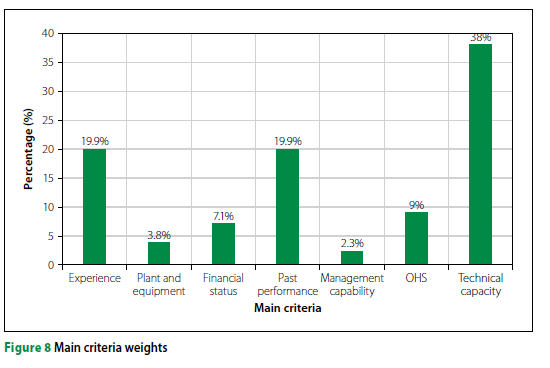
Using AHP, the derived priority vector indicates that technical capacity is the most important criterion, followed by experience and past performance, occupational health and safety (OHS), financial status, plant and equipment, and, lastly, management capability. Figure 8 illustrates the weights of the main criteria, as calculated using Equations 1 to 3 above.
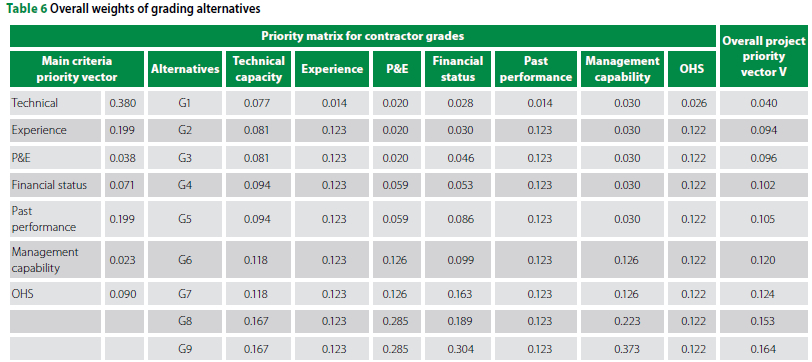
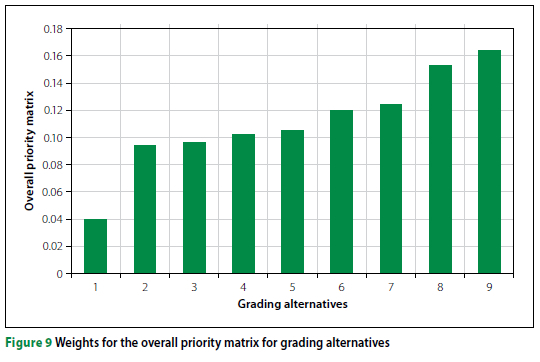
The results of the overall project priority vector, in relation to the overarching goal of contractor grading and performance assessment, are presented in Tables 4 and 5. Table 4 shows the overall weights (V) for contractor grades (options 1 to 9) as 0.040, 0.094, 0.096, 0.102, 0.105, 0.120, 0.124, 0.153, 0.164. Table 5 presents the overall priority vector for contractor performance assessment, with weights of 0.151, 0.288, and 0.534.
Figure 9 depicts that grade 9 has the overall highest priority weight (Equation 3) of 0.164, with the overall priority matrix of 0.140, 0.094, 0.096, 0.102, 0.105, 0.120, 0.124, and 0.153 for the respective lower grades. A sensitivity analysis was conducted on six scenarios to check the reliability and robustness of the AHP results. Sensitivity analysis is an analytical method that is used to identify how much variations in the input values for a given variable will impact the results of a mathematical model. When the results of a study or computation do not significantly change due to variations in underlying assumptions, they are considered to be robust (Maverick 2021). Figure 10 illustrates the summary of the overall weights of the grades for each scenario.
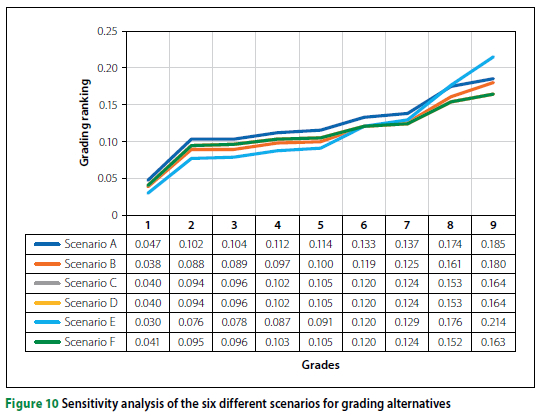
Scenario A incorporated professional registration as the fourth sub-criterion for the technical capacity criteria. Scenario B checked the effect of variations in the main criteria weighting. The plant and equipment and financial status criteria have equal weight as opposed to the technical capacity, experience, past performance, management capability, and health and safety. In scenario C, the effect of variations in the experience sub-criteria of weightings is assessed. Projects completed by key staff are reduced by 50%, and company project completion is increased by 50%. Scenario D analysed the effect of variations in the past performance sub-criteria weighting. Scenario E checked the effect of variations in the main criteria weighting. This resulted in all the main criteria having equal weight. Scenario F incorporated leadership skills as a second sub-criterion for management capability criteria. Leadership skills are defined as the contractor's ability to manage the project team, problem-solve, communicate, and negotiate, as indicated by Edum-Fotwe and McCaffer (2000).
The results indicate that there is no significant change due to variations in underlying assumptions. The scenarios checked the effects of variations on the main criteria and sub-criteria. It is noted that scenarios B, C, D, and E have similar results for technical capacity, plant and equipment, and management capability criteria, and slight variations in other criteria. Scenario A and F also have similar overall weights in plant and equipment, with slight variations on the other criteria and sub-criteria. The overall project priority vector of these scenarios is indicated in Figure 6.
Contractor performance evaluation results
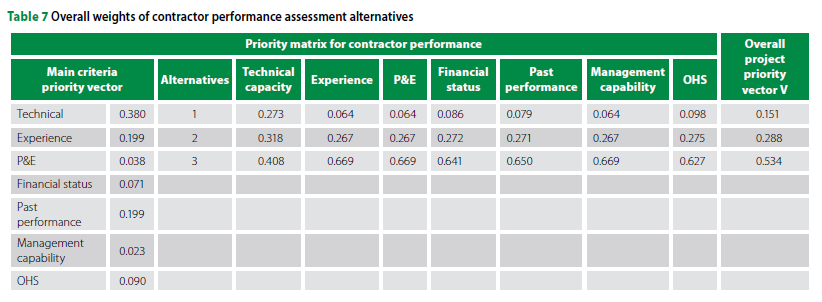
As indicated in Table 7, the AHP depicts that, of the three contractor performance alternatives (refer to Figure 6), alternative 3 (experienced contractor) has the highest ranking, followed by alternative 2 (established contractor) and alternative 1 (emerging contractor), respectively.
Alternative 3 has the highest priority weight of 0.534, followed by alternative 2 (0.288) and alternative 1 (0.151). Thus, the weighting of an experienced contractor would be higher than the weighting of an established and emerging contractor. A sensitivity analysis was conducted on three different scenarios to check the reliability and robustness of the AHP results achieved. The results indicate that there is no significant change due to variations in underlying assumptions.
TOWARDS THE DEVELOPMENT OF THE GRADING AND PERFORMANCE ASSESSMENT FRAMEWORK
In developing the framework, the results of the comparison matrix for AHP, which involved pairwise comparisons between the sub-criteria in relation to each main criterion, were utilised.
Weight allocation
To determine the weight of the sub-criteria for academic qualifications, the following assumptions were applied. The overall weight obtained for the sub-criteria in level 2 of the AHP hierarchy (Figures 5 and 6) was divided by the number of criteria. For example, academic qualification is subdivided into five criteria, as shown in Table 8. The weight of the criteria (0.633) was divided by 5, which equals 0.1266. To get the criteria for the lowest qualification, the value obtained (0.1266) was further divided by 2 because the first lowest qualification is the second after no qualification. Thereafter, the same answer would be added to get the next higher level. The formula is as follows:
Weight of academic qualifications = 0.633 (from level 2 of the AHP model results) divided by the number of academic qualifications sub criteria = 0.1266 divided by 2 = 0.0633.
Therefore, 0.0633 is the weight for the lowest criteria for academic qualifications, which is a certificate. The next criteria weight is the criteria weight of the lowest criteria plus the same criteria weight = 0.0633 + 0.0633 = 0.1266.
Then, 0.1266 is added to 0.0633 to get the next higher criteria weight, which is 0.1899. To get the criteria weight for the last criteria, the weights of the four criteria are added, which equals 0.3798. Therefore, the weight of the academic qualifications, 0.633 less 0.3798 equals the weight of the last criterion, 0.2532.
The weight of all the criteria equals the overall weight obtained of the sub-criteria in level 2, which is 0.633. This principle was adopted in calculating all the criteria weights. Thus, Tables 8 to 14 depict the sub-criteria weights.
Key staff refers to staff with the relevant technical qualifications and experience. Similarly, experience is subdivided into five criteria. The weight of these criteria and all the other criteria (i.e. experience, plant and equipment, financial status, management capability, occupational health and safety, and past performance) are shown in Tables 9 to 14.
Application of the framework to grade contractors and rate contractors' performance
Tables 8 to 14 have broken down the weights of the criteria to make better sense of the weighting and apply the results that may be used in practice. The results should provide guidance on how to grade contractors and rate contractor performance. The use of scenarios will be illustrated to indicate how contractors can be graded and rated in terms of performance.
Scenario A
This scenario assumes that Contractor A has a registered company and wants to register as a contractor. The company has a certificate in water engineering and occupational health and safety, three years of relevant technical experience, has managed two water-related projects, and has a business account. In terms of the weight allocation as described above, Table 15 outlines how it will be annotated.
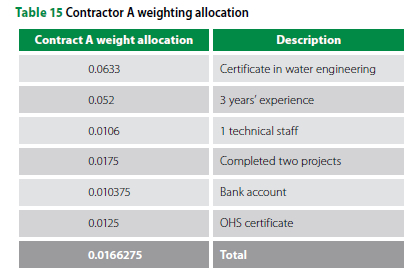
To grade Contractor A, the total weight will be divided by the number of sub-criteria, which is 17, as depicted in Figures 5 and 6. The total is divided by the total number of the sub-criteria because the sub-criteria are what is considered when grading contractors.
Therefore, Contractor A is a Grade 1 contractor because the overall project priority vector for Grade 1 contractors is 0.040, as shown in Table 6. Thus, anything that is below 0.040 means that the contractor is a Grade 1. To determine the performance of the contractor, the total weight is divided by 7, which is the number of main criteria. This is so because contractor performance is the overarching performance of the contractor.
The contractor's performance is for an emerging contractor because it is between 0 and 0.151, which is the overall priority vector of emerging contractors, as shown in Table 7. This is expected because Contractor A is new in the sector.
Scenario B
This scenario assumes that Contractor B is a registered Grade 1 contractor and wants to upgrade. The contractor has two employees with technical degrees in civil engineering, an occupational health and safety certificate, two years of relevant technical experience, has managed four civil engineering-related projects, and has a business account. Moreover, the contractor has office space and two referral letters, and 90% of its projects were completed within time, cost, and the stipulated specifications. The weighting is outlined in Table 16.
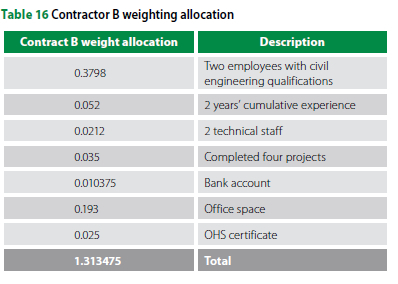
To grade Contractor B, the total weight will be divided by the number of sub-criteria, which is 17.
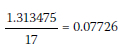
Therefore, Contractor B is a Grade 2 contractor because the overall project priority vector for Grade 2 contractors is 0.094, as shown in Table 6 - anything that is between 0.040 and 0.094 means that the contractor qualifies to be graded as a Grade 2.
Scenario C
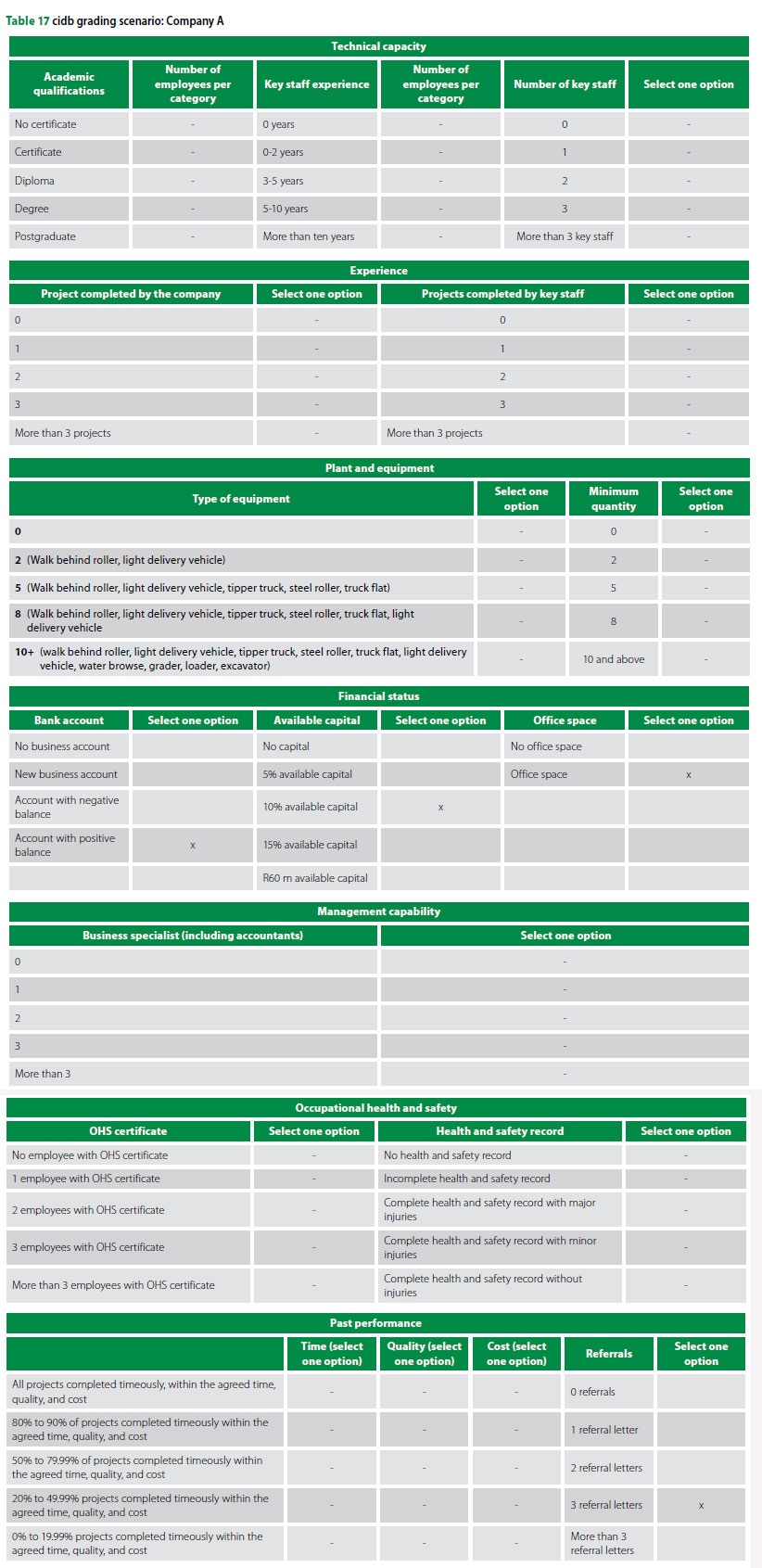
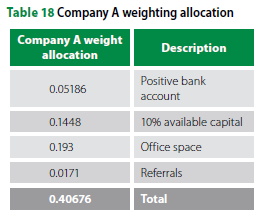
This scenario considers the cidb grading criteria, which only considers track record and available capital. The assumption is that Company A is a Grade 4 contractor. Thus, the company would need to have completed projects in Grade 3 that are worth more than R3 million and have available capital of R100 000 in terms of the current cidb requirements. In terms of the enhanced grading criteria, the weighting of the company can be calculated based on information that would have been submitted to the cidb, shown in Table 17. Where there is no information that would have been provided to the cidb because it is required, (-) is inserted.
To grade Company A, the total weight will be divided by the number of sub-criteria, which is 17.
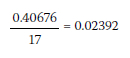
Thus, Company A, in terms of the weighting, is supposed to be a Grade 1 contractor because the Grade 1 contractor's overall project priority vector is 0.040, as shown in Table 6. This is the case because currently, the cidb does not request the other criteria information since it is not a requirement (only track record, which is in the form of completion certificates and financial records).
CONCLUSIONS AND RECOMMENDATIONS
This paper provides results, analysis, and discussion from the questionnaire, which was conducted with the members of SAICE, cidb, and SACPCMP. Data was analysed using the structural equation modelling approach and SPSS software. The results indicated that improved construction sector entry requirements, an efficient grading system, and a broader range of criteria may result in enhanced contractor capabilities and project performance.
Moreover, the study has developed a decision support framework for registering, grading, and performance assessment of contractors using AHP. The registration, grading, and performance assessment process of contractors with the cidb has been investigated to assess the way contractor registration, grading, and performance is conducted in South Africa. This study has introduced criteria and a framework for the registering, grading, and performance assessment of contractors which may be considered by the cidb or any person or private sector utilising construction civil engineering contractors. As depicted in Figure 4, the priority vector indicates that the technical capacity criterion is the most important, followed by the experience and past performance criteria, then occupational health and safety, financial status, plant, and equipment, and lastly, the management capability criterion.
The framework was developed with the aim of applying it to register, grade, and assess the project performance of contractors. In developing the framework, the results of the comparison matrix for level 2, which involved pairwise comparisons between the sub-criteria in relation to each main criterion, were utilised to dissect the sub-criteria in order to provide weighting using a standardised formula. Thereafter, various scenarios were created to apply the developed framework for registering, grading, and assessing the project performance of contractors.
The study recommends the following:
-
Construction sector entry requirements must be introduced and take into consideration various criteria. The importance of introducing entry requirements into the construction sector cannot be emphasised enough.
-
Contractor grading progression requirements should consider various criteria. Given the status quo of the performance of the construction sector in South Africa, the current grading system for qualifying contractors, based only on completed projects and availability of capital, seems to be inadequate. Various other criteria need to be considered such as contractors' technical capacity, experience, plant and equipment, financial status, past performance, management capability, and occupational health and safety. This should improve contractors' performance outputs because of considering relevant criteria for grading and performance assessment of contractors which may in turn improve the sector's performance.
-
Performance evaluation of contractors should consider various criteria. Using the same grading criteria to evaluate the performance of contractors will assist contractors in knowing their performance level and provide a clear framework from which to improve. This will also assist clients and the cidb in knowing the performance of the contractor and put relevant measures in place to assist the contractor.
-
Consideration will need to be given to currently registered contractors to ensure alignment with the enhanced contractor entry and grading requirements, and to not disadvantage the historically disadvantaged individuals in South Africa.
Two proposals may be considered by the cidb to inform contractors of the new requirements and request submission of the relevant information. As such, companies can be asked to submit all the requested documentation for the purpose of filing, not downgrading. Therefore, only companies wishing to upgrade to a higher grade will have to meet the new grading criteria requirements.
Alternatively, the cidb could consider providing the current contractors with reasonable timeframes regarding the gaps that they will need to close to be considered eligible for their current grading. If this approach is considered, this could greatly assist in rapidly improving all the current contractors (i.e. both those wishing to upgrade and those who do not wish to upgrade) and performance output. This process could further be utilised by the cidb to identify gaps for contractor development. The cidb would have to provide a reasonable timeline for companies to provide this information and for the contractor development process, failing which a downgrade may be considered by the cidb.
The cidb could also consider providing support to enhance the skills of the currently active contractors in its database to align the skillsets of current contractors with the criteria proposed in the study.
REFERENCES
Abiodun, O E, Segbenu, N S & Oluseye, O. 2017. Factors affecting contractors' performance in construction project delivery in Akure, Ondo State, Nigeria. Journal of Knowledge Management, 6(4): 1-23. [ Links ]
Adams, O A. 1995. Indigenous contractors' perceptions of the constraints on contractors' performance and development programmes required in Nigeria. Habitat International, 19(4): 599-613. [ Links ]
Adinyira, E, Manu, P, Agyekum, K, Mahamadu, A M & Olomolaiye, P. 2020. Violent behaviour on construction sites: Structural equation modelling of its impact on unsafe behaviour using partial least squares. Engineering Construction Architecture Management, 27(10): 3363-3393. [ Links ]
Akali, T & Sakaja, Y. 2018. Influence of contractors' financial capacity on performance of road construction in Kakamega County. American Scientific Research Journal for Engineering, Technology, and Sciences, 46(1): 34-50. [ Links ]
Alkass, S, Mazerolle, M, & Harris, F. 1996. Construction delay analysis techniques. Construction Management and Economics, 14(5): 375-394. [ Links ]
Alkass, S, Mazerolle, M, Tribaldos, E, & Harris, F. 1995. Computer-aided construction delay analysis and claims preparation. Construction Management and Economics, 13(4): 335-352. [ Links ]
Alzahrani, J I & Emsley, M W. 2013. The impact of contractors' attributes on construction project success: A post-construction evaluation. International Journal of Project Management, 31(2): 313-322. [ Links ]
Anderson, J R, Bothell, D, Lebiere C, & Matessa, M. 1998. An integrated theory of list memory. Journal of Memory and Language, 38(4): 341-380. [ Links ]
Arif, F. 2013. A decision support framework for infrastructure maintenance investment decision-making. Doctoral dissertation. Florida International University. [ Links ]
Asah-Kissiedu, M, Manu, P, Booth, C, Mahamadu, A M & Agyekum, K. 2021. An integrated safety, health, and environmental management capability maturity model for construction organisations: A case study in Ghana. Buildings Journal, 11(12): 645. [ Links ]
Assaf, S A, Al-Khalil, M & Al-Hazmi, M. 1995. Causes of delay in large building construction projects. Journal of Management in Engineering, 11(2): 45-50. [ Links ]
Ávila, R. 2000. El AHP (proceso analítico jerárquico) y su aplicación para determinar los usos de las tierras. Technical report prepared for the FAO. Santiago, Chile: FAO. [ Links ]
Bertelsen, S. 2003. Complexity - Construction in a new perspective. IGLC-11, Blacksburg, Virginia, pp 1-12. [ Links ]
Bureau of Labor Statistics. 2020. National census of fatal occupational injuries in 2019. Available at: www.bls.gov/news.release/archives/cfoi_12162020.pdf [accessed on 4 October 2021]. [ Links ]
Burger, M & Zulch, B G. 2018. A construction project management knowledge model: The type and level of knowledge required. Acta Structilia, 25(1): 98-125. [ Links ]
Burger, M, Verster, J J P & Zulch, B G. 2015. The construction project manager in South Africa: Analysis of industry-specific knowledge. Acta Structilia, 21(1): 48-72. [ Links ]
Camilleri, E. 2011. Project Success: Critical Factors and Behaviors. Surrey: Gower Publishing. [ Links ]
Chan, A, Chan, D & Ho, K. 2003. An empirical study of the benefits of construction partnership in Hong Kong. Construction Management and Economics, 21(5): 523-533. [ Links ]
Cheung, S O, Suen, H C H & Cheung, K K W. 2004. PPMS: A web-based construction project performance monitoring system. Automation in Construction, 13(3): 361-376. [ Links ]
Chordas, L. 2008. Solving the puzzle. Best's Review Magazine, 109(2): 66-69. [ Links ]
Clarke, L & Wall, C. 1996. Skills and the Construction Process: A comparative study of vocational training and quality in social house building. Policy Press. [ Links ]
Construction Industry Development Board. 2011. Construction Quality in South Africa; A client perspective. Pretoria: Construction Industry Development Board. [ Links ]
Construction Industry Development Board. 2013. 2012/2013 Annual Report. Pretoria: Construction Industry Development Board. [ Links ]
Construction Industry Development Board. 2016. Study of Grade 1 Contractors. Available at: www.cidb.org.za/download/98/otherreports/6074/study-of-grade-1-contractors report.pdf [accessed on 10 October 2019]. [ Links ]
Construction Industry Development Board. 2019. About the register of contractors. Available at: www.cidb.org.za/contractors/Pages/Register-of-Contractors.aspx [accessed on 29 October 2019]. [ Links ]
Construction Industry Development Board. 2020. Guidelines for contractor registration. Available at: www.cidb.org.za/contractors/register-ofcontractors/tips-on-registration/ [accessed on 3 March 2024]. [ Links ]
Croswell, J & McCutcheon, R. 2001. Small contractor development and employment - A brief survey of Sub-Saharan experience in relation to civil construction. Urban Forum, 12(3): 365-379. [ Links ]
Davari, A & Rezazadeh, A. 2015. Toward the measurement of alliance entrepreneurship: Initial scale development and validation. International Journal of Management and Enterprise Development, 14(2): 103-125. [ Links ]
Dithebe, K, Thwala, W D, Aigbavboa, C & Madumelane, B. 2022. Reflections on the performance of South Africa's construction industry. IOP conference series: Materials science and engineering, 1218(1): 012031. [ Links ]
Dubois, A & Gadde, L E. 2002. The construction industry as a loosely coupled system: Implications for productivity and innovation. Construction Management and Economics, 20(7): 621-632. [ Links ]
Edum-Fotwe, F T & McCaffer, R. 2000. Developing project management competency: perspectives from the construction industry. International Journal of Project Management, 18(2): 111-124. [ Links ]
El-sokhn, N H & Othman, A A E. 2014. Project failures and their impact on the construction industry: A literature review. Proceedings, The International Conference on Civil and Architecture Engineering, 10(1): 1-20. [ Links ]
Enslin, N. 2013. Construction health and safety in South Africa. Available at: forum.safebuild.co.za/index.php?threads/construction-health and-safety-in-south-africa.737/ [accessed on 5 February 2023]. [ Links ]
Erasmus, B, Loedolff, P, Mda, T & Nel, P. 2016. Managing training and development in South Africa. Cape Town: Oxford University Press. [ Links ]
Faridi, A & El-Sayegh, S. 2006. Significant factors causing delay in the UAE construction industry. Construction Management and Economics, 24(11): 1167-1176. [ Links ]
Fredland, E J & Morris, C E. 1976. A cross-section analysis of small business failure. American Journal of Small Business, 1(1): 7-18. [ Links ]
Gann, D & Senker, P. 1998. Construction skills training for the next millennium. Construction Management and Economics, 16(5): 569-580. [ Links ]
Gharakhani, D, Sinaki, M T, Dobakhshari, M A & Rahmati, H. 2013. The relationship of customer orientation, customer satisfaction, customer loyalty, and innovation in small and medium enterprises. Life Science Journal, 10(6): 684-689. [ Links ]
Gibb, A. 2005. Towards the Entrepreneurial University: Entrepreneurship education as a lever for change. National Council for Graduate Entrepreneurship. Available at: ncee.org.uk/wp-content/uploads/2023/09/towards_the_entrepreneurial_university.pdf [accessed on 9 April 2023]. [ Links ]
Global Construction Perspectives and Oxford Economics. 2015. Global Construction 2030: A global forecast for the construction industry to 2030. Available at: www.cvf.or.kr/uploads/bestpractice/GlobalConstruction2030_ExecutiveSummary_WEB(0).pdf [accessed on 19 January 2023]. [ Links ]
Graglia, D. 2023. What is a good survey response rate? Available at: www.surveymonkey.com/curiosity/how-many-people-do-i-need-to-take-my-survey/ [accessed on 14 April 2023]. [ Links ]
Great Brook. 2023. Survey statistical confidence: How many is enough? Available at: greatbrook.com/survey-statistical-confidence-how-many-is enough/ [accessed on 14 April 2023]. [ Links ]
Gupta, A R & Deshmukh, S K. 2016. Energy efficient construction materials. Key Engineering Materials, 678: 35-49. [ Links ]
Hanafi, M H, Khalid, A G, Razak, A A & Abdullah, S. 2010. Main factors influencing labour productivity of the installation of on-site prefabricated components. International Journal of Academic Research, 2(6): 139-146. [ Links ]
Hanson, D, Mbachu, J & Nkando, R. 2003. Causes of client dissatisfaction in the South African building industry and ways of improvement: the contractors' perspectives. South Africa: Construction Industry Development Board. [ Links ]
Hanson, D. 2006. Causes of client dissatisfaction in the South African Building industry and ways of improvement: the contractor's perspectives. PhD thesis. University of Witwatersrand, South Africa. [ Links ]
Harrell, E & Langton, L. 2015. Victims of identity theft, 2014. Bureau of Justice Statistics of the U.S. Department of Justice. [ Links ]
Harris, F & McCaffer, R. 2013. Modern Construction Management. Oxford: John Wiley & Sons. [ Links ]
Haslam, R A, Hide, S A, Gibb, A G F, Gyi, D E, Pavitt, T & Atkinson, S. 2005. Contributing factors in construction accidents. Applied Ergonomics, 36(4): 401-415. [ Links ]
Health and Safety Executive. 2021. Workplace fatal injuries in Great Britain, 2021. Available at: https://www.hse.gov.uk/statistics/pdf/fatalinjuries.pdf [accessed on 25 October 2021]. [ Links ]
Iyer, K C & Jha, K N. 2005. Factors affecting cost performance: Evidence from Indian construction projects. International Journal of Project Management, 23(4): 283-295. [ Links ]
Jaafar, M & Abdul-Aziz, A R. 2005. The resource-based view and critical success factors: A study on small and medium-sized contracting enterprises (SMCEs) in Malaysia. International Journal of Construction Management, 5(2): 61-77. [ Links ]
Jenatabadi, H S & Ismail, N A. 2014. Application of structural equation modelling for estimating airline performance. Journal of Air Transport Management, 40: 25-33. [ Links ]
Jo, H & Lee, J. 1996. The relationship between an entrepreneur's background and performance in a new venture. Technovation, 16(4): 161-211. [ Links ]
Kalbar, P P, Karmakar, S & Asolekar, S R. 2012. Selection of an appropriate wastewater treatment technology: a scenario-based multiple-attribute decision-making approach. Journal of Environmental Management, 113: 158-169. [ Links ]
Kanchana, S, Sivaprakash, P & Joseph, S. 2015. Studies on labour safety in construction sites. Scientific World Journal, 2015(5): 1-6. [ Links ]
Kazaz, A, Manisali, E & Ulubeyli, S. 2008. Effect of basic motivational factors on construction workforce productivity in Turkey. Journal of Civil Engineering and Management, 14(2): 95-106. [ Links ]
Kerzner, H. 2013. Project Management, 11th edn. New Jersey: Wiley. [ Links ]
Lin, C Y Y. 1998. Success factors of small-and medium-sized enterprises in Taiwan: An analysis of cases. Journal of Small Business Management, 36(4): 43-56. [ Links ]
Ling, Y, Low, P, Wang, Q & Lim, H. 2011. Key project management practices affecting Singaporean firms, project performance in China. International Journal of Project Management, 27(1): 59-71. [ Links ]
Longman, A & Mullins, J. 2005. The rational project manager: A thinking team's guide to getting work done. New Jersey: John Wiley & Sons. [ Links ]
Mansfield, N R, Ugwu, O O & Doran, T. 1994. Causes of delay and cost overruns in Nigerian construction projects. International Journal of Project Management, 12(4): 254-260. [ Links ]
Maseko, C M. 2017. Literature on theory and practices in the construction of projects: A case of an emerging economy. Risk Governance and Control: Financial Markets & Institutions, 7(4): 214-224. [ Links ]
Masozera, M K. 2002. Socioeconomic impact analysis of the conservation of the Nyungwe forest reserve, Rwanda. Doctoral dissertation. University of Florida, United States of America. [ Links ]
Maverick, J B. 2021. Understanding sensitivity analysis: Applications and benefits. Available at: www.investopedia.com/ask/answers/052115/what-are-some-examples-ways-sensitivity-analysis-can-be-used.asp [accessed on 5 February 2022]. [ Links ]
Mihai, F, Binning, N & Dowling, L. 2000. Road network asset management as a business process. Proceedings, Road Engineering Association of Asia and Australasia Conference, Tokyo, Japan, pp 1-10. [ Links ]
Mofokeng, T G. 2012. Assessment of the causes of failure among small and medium-sized construction companies in the Free State province. Doctoral dissertation. University of Johannesburg, South Africa. [ Links ]
Mohlala, F T. 2015. The relationship between project performance of emerging contractors in government infrastructure projects and their experience and technical qualifications: an analysis of 30 projects conducted in the Mpumalanga Province over the 2011-2013 period. Master's dissertation. University of the Witwatersrand, South Africa. [ Links ]
Morote, A N & Ruz-Vila, F. 2012. A fuzzy multi-criteria decision-making model for construction contractor prequalification. Automation in Construction, 25(2012): 8-19. [ Links ]
Muhwezi, L, Acai, J & Otim, G. 2014. An assessment of the factors causing delays on building construction projects in Uganda. International Journal of Construction Engineering and Management, 3(1): 13-23. [ Links ]
Ngai, S, Drew, D, Lo, H P & Skitmore, M. 2002. A theoretical framework for determining a minimum number of bidders in construction bidding competitions. Construction Management and Economics, 20(6): 473-482. [ Links ]
Nielsen, J R & Mathiesen, C. 2006. Stakeholder preferences for Danish fisheries management of sand eel and Norway pout. Fisheries Research, 77(1): 92-101. [ Links ]
Nwude, C. 2010. Working capital management in Nigerian agro-allied firms. The Nigerian stockbroker, pp 5-22. [ Links ]
Orando, M & Isabitey, A K. 2018. Construction workers skill development: A strategy for improving capacity and productivity in South Africa. International Journal of Economics and Finance Studies, 10(1): 66-80. [ Links ]
Orando, M. 2013. The influence of human behaviour factors on construction productivity. PhD thesis. University of the Free State, South Africa. [ Links ]
Pearson. 2018. Introduction to construction financial management. Available at: www.pearsonhighered.com/assets/samplechapter/0/1/3/5/0135232872.pdf [accessed on 17 April 2023]. [ Links ]
Praise, S J & Steedman, H. 1986. Vocational training in France and Britain: The building trades. National Institute Economic Review, 116(1): 45-55. [ Links ]
Qualtrics. 2022. How to determine sample size. Available at: www.qualtrics.com/uk/experience-management/research/determine-sample-size/ [accessed on 15 November 2022]. [ Links ]
Ratshisusu, H. 2014. Limiting collusion in the construction industry: A review of the bid-rigging settlement in South Africa. Journal of Economic and Financial Science, 7(si-1): 587-606. [ Links ]
Republic of South Africa. 2000. Construction Industry Development Board Act 38 of 2000. Government Gazette No. 21755. Cape Town: Republic of South Africa. [ Links ]
Richter, A. 1998. Qualifications in the German construction industry: Stocks, flows, and comparisons with the British construction sector. Construction Management and Economics, 16(5): 581-592. [ Links ]
Roche, M, Duffield, C & White, E. 2011. Factors in the practice environment of nurses working in inpatient mental health: A partial least squares path modelling approach. International Journal of Nursing Studies, 48(12): 1475-1486. [ Links ]
Saaty, R W. 1987. The analytic hierarchy process - What it is and how it is used. Mathematical Modelling, 9(3-5): 161-176. [ Links ]
Saaty, T L. 1990. How to make a decision: The analytical hierarchy process. European Journal of Operational Research, 48(1): 9-26. [ Links ]
Sambasivan, M & Yau, W S. 2007. Causes and effects of delays in the Malaysian construction industry. International Journal of Project Management, 25(5): 517-526. [ Links ]
Schenk, H. 2016. Career management and performance. In: M Meyer. ed. Managing human resource development: A strategic learning approach. Cape Town: Lexis Nexis. pp 407-440. [ Links ]
Schmidt, J S & Osebold, R. 2017. Environmental management systems as a driver for sustainability: State of implementation, benefits, and barriers in German construction companies. Journal of Civil Engineering Management, 23: 150-162. [ Links ]
Shresta, S. 2021. Occupational hazards in building construction. SCITECH Nepal, 15(1): 16-21. [ Links ]
Sueliman, H A & Alfaraidy, F A. 2019. Influences of project management capabilities on the organisational performance of the Saudi construction industry. Engineering Technology and Applied Science Research, 9(3): 4144-4147. [ Links ]
Sweis, R J, Bisharat, S M, Bisharat, L & Sweis, G. 2014. Factors affecting contractor performance on public construction projects. Life Science Journal, 11(4s): 28-39. [ Links ]
Sze, N N, Chan, D W M, Chan, A P C & Yiu, N. 2019. Implementation of safety management system in managing construction projects: Benefits and obstacles. Safety Science, 117: 23-32. [ Links ]
Tanyimboh, T & Kalungi, P. 2009. Multi-criteria assessment of optimal design, rehabilitation, and upgrading schemes for water distribution networks. Civil Engineering and Environmental Systems, 26(2): 117-140. [ Links ]
Thwala, W D & Mvubu, M. 2008. Current challenges and problems facing small and medium-sized contractors in Swaziland. African Journal of Business Management, 2(5): 93-98. [ Links ]
Thwala, W D. 2005. Employment creation through the construction and maintenance of public infrastructure in South Africa through the use of labour-intensive methods: Experiences and problems. Proceedings, 24th Southern African Transport Conference, 11-13 July 2005, Pretoria, South Africa. [ Links ]
UN Environment and International Energy Agency. 2017. Towards a zero-emission, efficient, and resilient buildings and construction sector: Global status report. Available at: worldgbc.org/wp-content/uploads/2022/03/UNEP-188_GABC_en-web.pdf [accessed on 23 February 2023]. [ Links ]
Woodside, A G. 2010. Case Study Research: Theory, Methods, and Practice. Bingley: Emerald Group Publishing Limited [ Links ]
World Bank. 2018. The minimum requirements for registration of works contractors. Available at: www.ppadb.co.bw/Manuals%20%20Acts/Minimum%20Requirements%20for%20registration%20of%20Works%20Contractors%20Rev%2002.pdf [accessed on 4 February 2020]. [ Links ]
Xiao, H & Proverbs, D. 2003. Factors influencing contractor performance: An international investigation. Engineering, Construction and Architectural Management, 10(5): 322-332. [ Links ]
Yeo, H Y & Lee, J. 2006. Limited liability partnership - New business entity in Singapore. Journal of Business Law, 8: 859-880. [ Links ]
Yusuf, A. 1995. Critical success factors for small business: Perceptions of South Pacific entrepreneurs. Journal of Small Business Management, 33(2): 68-73. [ Links ]
Zakeri, M, Olomolaive, P O, Holt, G D & Harris, F C. 1996. A survey of constraints on Iranian construction operatives' productivity. Construction Management Economics, 14 (5): 417-426. [ Links ]
Zhang, H. 2022. Structural equation modelling. Models and Methods for Management Science, 363-381. [ Links ]
 Correspondence:
S Chiloane-Nwabueze
School of Civil and Environmental Engineering, University of Witwatersrand
Private Bag 3, Wits, 2050, South Africa
salomenwabueze@gmail.com
A Fitchett
School of Civil and Environmental Engineering, University of Witwatersrand
Private Bag 3, Wits, 2050, South Africa
anne.fitchett@wits.ac.za
A Glendinning
School of Civil and Environmental Engineering, University of Witwatersrand
Private Bag 3, Wits, 2050, South Africa
glendinning.aj@gmail.com

DR SALOME CHILOANE-NWABUEZE is the Head of Integration, Monitoring and Evaluation at the Bulk Water Services Business Unit at Rand Water, which is responsible for informing continuous improvement in bulk water supply. She holds both an MSc and a PhD in civil engineering from the University of Witwatersrand. Her academic interests are in the areas of project management, water engineering, and wastewater engineering. She is actively involved in the water sector, research, and guiding postgraduate students. ORCID iD: orcid.org/0000-0002-1033-523X

PROF ANNE FITCHETT is a retired Honorary Associate Professor in the School of Civil and Environmental Engineering at the University of the Witwatersrand. Her PhD was on employment creation. Her research specialisations are in project management, environmental engineering (specifically stormwater management) and innovative structural systems, especially those using cement-stabilised earth construction. ORCID iD: orcid.org/0000-0003-4676-296X

ADV. ALISTAIR GLENDINNING has 32 years' experience in project management and law and has worked on some of the largest multi-disciplinary projects in South Africa from the consulting, contracting, and client perspectives. He has extensive experience in the fields of construction, engineering, and labour law. His strength lies in the integration of the technical and legal elements of the engineering process, whether at concept, design, construction or implementation phase. In addition, he can accurately impart advice on the existence of contractual breaches, possible ramifications, and the assessment for the speediest resolution thereof.