



Servicios Personalizados
Revista

Articulo
 Inglés (pdf)
 Articulo en XML
 Referencias del artículo

 Traducción automática
 Enviar articulo por email
Indicadores
Links relacionados
-
 Citado por Google
-
 Similares en Google
Compartir

 Permalink

South African Journal of Agricultural Extension
versión On-line ISSN 2413-3221versión impresa ISSN 0301-603X
S Afr. Jnl. Agric. Ext. vol.54 no.4 Pretoria 2026
https://doi.org/10.17159/2413-3221/2026/v54n4a17593
ARTICLES
Participation of Farmers in Planning and Designing of Extension Support Through Stakeholder Platforms: Lessons from Strengthening Agriculture and Nutrition Extension Project in Malawi
Saidi A.M.I; Loki O.II
IPrincipal Agricultural Gender Roles Extension Support Services Officer: Blantyre Agricultural Development Division, Ministry of Agriculture - Malawi, Private Bag 379, Blantyre. Email: u20783044@tuks.co.za, ORCiD ID: 0009-0009-3228-2448
IILecturer: Department of Agricultural Economics, Extension and Rural Development, Faculty of Natural and Agricultural Sciences, University of Pretoria, Private Bag X20, Pretoria 0002. Email: o.loki@up.ac.za, ORCiD ID: 0000-0003-4187-3345
ABSTRACT
Agricultural extension systems continue to shift from a centralised, public, top-down system to a more pluralistic, demand-driven system. However, in many countries, principles and institutional arrangements of the latter have not been adequately achieved. This study was conducted to evaluate the effectiveness of the Strengthening Agriculture and Nutrition Extension (SANE) project on the Malawi decentralised agricultural extension services system (DAESS) in improving farmers' participation in the design of extension support. A structured questionnaire was administered to 389 randomly selected SANE farmers of Dedza district and 22 service providers from governmental and non-governmental organisations involved with SANE. Using descriptive and content analysis, the study found that 76% of the farmers participated in discussions on DAESS platforms regarding planning and extension support. Still, only 1.7% and 0.9% were involved in the actual "needs identification" and "proposal development," respectively. Although DAESS platforms were perceived as 'tolerant' and as allowing farmers the freedom of expression, they were not the preferred choice for seeking advice due to issues of inaccessibility: driven by their reliance on periodic meetings, limited expertise among platform members, lack of enforcement authority, and insufficient resources within the platforms to effectively address farmers' needs. Overall, the study showed that SANE increased opportunities for farmer participation in extension planning; however, it also indicated that DAESS platforms remain underdeveloped. The study recommends that all agricultural projects be implemented through DAESS platforms.
Keywords: Agricultural Extension System, Farmer Participation, Demand-Driven, Extension Planning.
1. INTRODUCTION
With approximately 85% of Malawi's population depending on smallholder farming (World Bank, 2022), agriculture is a mainstay of the country's economy, contributing 30% of gross domestic product GDP (World Bank, 2025a), 62% of the labour force (World Bank, 2025b) and over 80% of foreign exchange earnings (World Bank, 2025c). Agricultural extension is central to development and crucial for delivering knowledge, technologies, market connections, and other solutions to the rural economy. (Ongachi & Belinder, 2025; Mungaia, Messinaa, Zulub, Chikowo & Snapp, 2024; Abhijeet et al., 2023; Loki & Mdoda, 2023). Extension systems outline how extension is organised, implemented, financed and coordinated in a country (Christoplos, 2010). Malawi's farmalised extension system began under colonial rule in around 1903 and has since been dominated by the government (Chiwasa & Kambewa, 2018). The Ministry of Agriculture is the main provider of extension services to the majority of smallholder farmers who mostly produce maize, the country's staple food (Masangano & Mthinda, 2012). Primarily, agricultural extension was to "force" farmers to adopt prescribed farming practices, notably land resource management technologies, to increase the production of raw materials like cotton for European industries (Peters, 1997). Following independence in the 1960s, the extension system moved to a more persuasive model-farmer approach, in which the government supported individual farmers with agricultural messages and inputs for the rest of the farmers to emulate their valuable farming practices. Later in the 1980s, with an aim of being more inclusive, extension shifted to a group-based approach: the Block Extension System (BES). This was a modification of the World Bank-funded Training and Visit system, with strict supervision and rigorous programming of farmer training. Like the previous systems, BES used the top-down model of extension delivery, where the transmission of national interests was emphasised over farmers' individual interests (Masangano et al., 2016). This is what the BES was blamed for, and, paradoxically, the approach is still predominant in the current extension system after BES was phased out (Chiwasa & Kambewa, 2018). Management of extension was also affected by the birth of multiparty democracy in the 1990s. There was an emergence of new players to complement the government's efforts, and farmers were accorded greater power and authority to hold service providers accountable. In 2000, Malawi adopted the decentralised agricultural extension services system (DAESS) which bases on the model village approach - "a process of getting farmers to analyse their situations, articulate demands and needs, generate solutions and options and demand quality extension services from service providers available in their respective areas" (Chinsinga, 2008:12). Decentralised agricultural extension service system operationalises Malawi's extension policy whose key principles include accountability, pluralism and demand-driven, aligning with the government's decentralisation agenda (Masangano & Mthinda, 2012). The system is therefore built on four pillars: farmer demands articulation and organisation; stakeholder engagement and innovation in responding to demands; stakeholder coordination; and collective resource mobilisation. The decentralised agricultural extension service system integrates into the district assembly structure, comprising the district assembly's agriculture subcommittee (elected members and chiefs), the district executive committee's agriculture subcommittee (representatives of extension service providers) and stakeholder panels at district, area and village levels representing all actors in the agricultural sector, including farmers, farmer organisations, and NGOs (Masangano & Mthinda, 2012). These stakeholder panels serve as fora for dialogue, where farmers can demand services directly from private and public service providers while maintaining the quality and standards of the services (Masangano & Mthinda, 2012). However, by 2015, many elements of the DAESS remained unimplemented due to capacity constraints (Soroko et al., 2019), vindicating the need for a system-strengthening intervention, the Strengthening Agriculture and Nutrition Extension (SANE) project. Besides, Chiwasa & Kambewa (2018) noted that the extension system remained dominated by the state in terms of funding, coverage, and staffing levels, providing quality control and supporting public good services such as achieving food security. Public extension offices, such as the Extension planning area (EPA) office, are meant to serve as secretariats for the DAESS.
Strengthening Agriculture and Nutrition Extension was a USAID/Malawi project implemented in collaboration with the Malawi Department of Agricultural Extension Services (DAES) from 2015 to 2020, across the 10 districts of the Feed the Future (FTF) Expanded Zone of Influence (E-ZOI) in Malawi1 (USAID, 2017). Strengthening Agriculture and Nutrition Extension aimed at strengthening DAESS platforms to support farmers' voices and to coordinate and collaborate among service providers, contributing to better access to and improved quality of extension services (Álvarez-Mingote, Moore & McNamara, 2020). Álvarez-Mingote et al. (2020) and Soroko et al. (2019) reported improvements through SANE in transforming DAESS platforms into functional, coordinated extension service provider platforms in Malawi, thereby increasing farmers' voice and their ability to raise their needs. However, Ragasa and Comstock (2019) reported that although coordination of extension services improved due to the SANE project, the percentage of farmers requesting information from extension services decreased from 12% in 2016 to only 4% in 2018.
Why do farmers hesitate to seek extension advice from the extension service system? Literature highlights several factors, including farmers' lack of awareness of their information needs (Sani, Boadi, Oladokun & Kalusopa, 2014), limited empowerment (Masangano & Mthinda, 2012), inappropriate communication channels (Talib, Ashraf, Agunga & Chaudhary, 2018), and concerns about the credibility of the extension system (Stevens & Ntai, 2011; Maake & Antwi, 2022). In Malawi, Chowa, Garforth, and Cardey (2013), along with more recent studies by Chiwasa and Kambewa (2018), Stull, Kambewa and Tchuwa (2020), Mikwamba, Dessein, Kambewa, Messely and Strong (2020), and FAO (2021), have documented similar experiences of a weak pluralistic and demand-driven extension system. However, none of these studies provides a clear explanation of the underlying causes of this issue. It is against this background that the study was conducted in Dedza district to provide empirical evidence on the status of pluralistic, demand-driven extension and to fill a gap in the literature regarding the effectiveness of the extension service system in Malawi in increasing farmers' voice after the SANE project was phased out. This article, therefore, seeks to determine whether DAESS platforms and networks under SANE have improved farmers' participation in planning and designing extension support.
2. RESEARCH METHODOLOGY
The study was conducted in Dedza district, one of the districts that implemented the SANE project. The literature reviewed (Suvedi, 2011; Dedza SEP, 2013; Ragasa & Niu, 2017; Chiwasa & Kambewa, 2018; Stull et al., 2020; Tchuwa, 2021) played a crucial role in guiding the selection of the district. Dedza had had a relatively longer-term active engagement with the SANE project, a factor necessary for evaluation studies. Besides, Dedza has perfect representations of all the topographic areas in which the SANE project worked, as discussed in the following sections. The district has also been part of research areas for most studies around extension systems. These studies present a basis for comparison with the current research.
Dedza lies in the Central Region of Malawi at 14.3817°S, 34.3255°E. It borders the southern part of Lilongwe, the capital city district. To the east lies part of Lake Malawi, and to the southwest lies the Malawi-Mozambique border. Dedza covers a total land area of 3,624 square kilometres, about 4% of Malawi's total land surface area (94,276 square kilometres) (Dedza SEP, 2013). The district has four topographic zones: (i) the Lilongwe-Kasungu Plain in the northern and western parts of the district, lying at an altitude of 1100-1300 metres; (ii) Dedza Highlands; (iii) the Escarpments zone, falling steeply to the Great Rift Valley; and (iv) the Coastal Plain of Lake Malawi in the Great Rift Valley. Each zone has distinctive climatic features, geomorphology, soils and human factors that affect agricultural development differently (Remmington, 1963). Dedza has eight traditional authority (TA) areas with 222,416 farming households. The district is also demarcated into 10 extension-planning areas (EPAs) and 169 sections for agricultural operations. An Assistant Agricultural Extension Development Officer is supposed to staff each section. At the time of the study, only 62 sections were staffed, implying a staff: farm household ratio of 1:3 587, against a recommendation of 1:750 (MoAIWD). Seven non-governmental organisations are also involved in the district, providing agricultural services.
A mixed-methods approach was used to conduct the study, combining quantitative and qualitative research methods (Johnson & Onwuegbuzie, 2004). This approach offered opportunities for between-methods triangulation and explanation of existing causal relationships (Johnson, Onwuegbuzie & Turner, 2007). Results of the descriptive and content analyses of the extension system's performance were compared with baseline information collected from studies conducted at different stages of project implementation to determine whether any improvements had occurred.
2.1. Sampling
A total of 931 farm households had participated in at least one SANE activity in Dedza district and were therefore sampled. A disproportionate multi-stage random sampling method was used to select 389 respondents from all eight district TAs for the study. The list for SANE participating farmers was obtained from SANE project offices.
Purposive sampling was used to identify 22 key informants, extension service providers from government and non-government organisations such as United Purpose, International Potato Centre (CIP), SANE and Mlimi wa Nzeru Agrodealer, based on their involvement with the SANE project and their experience with the districts' DAESS. Data were collected through structured household questionnaires administered in the TAs and semi-structured interviews with the informants.
2.2. Data Collection and Analysis
Primary data were collected through structured household questionnaires administered in the TAs and semi-structured interviews with informants. Surveys using a standardised questionnaire are effective for obtaining quantitative data from large samples (Creswell, 2014). Semi-structured interviews complemented the surveys by providing insights from service providers. Combining both methods enhanced the reliability and richness of the data, which aligns with best practices in mixed methods research (Creswell, 2014). Secondary data were collected through project document reviews, including SANE project reports, studies and Dedza Agricultural Office reports. This data was collected from the official USAID-funded projects link. The criteria for selecting the documents were that they were not older than 2015, when the SANE project started, and that the relevant controlling officers approved them or that they had been peer-reviewed.
Data were analysed using descriptive, content analysis, and cross-tabulation methods. Quantitative data were analysed using Statistical Package for the Social Sciences (SPSS) to compute descriptive statistics (frequencies, means, and standard deviations) and to perform statistical tests. Descriptive statistics then allowed comparisons between the derived information and baseline or prior-study information. Qualitative data from key informant interviews' checklists were assessed using content analysis to develop themes and narratives (Creswell, 2014). The content analysis involved familiarising with the data, identifying categories and main themes, creating themes and sub-themes, and coding, charting, and running code reviews to identify agreements, similarities, and differences. This analysis provided additional insights and concrete examples of SANE's impact, and where necessary, the coded responses were also quantified.
3. RESULTS AND DISCUSSION
3.1. Farmer Participation in the Planning of Extension Support Through Platforms
Farmer participation in extension is effective through decentralised platforms (Okorley, 2007; MoAI, 2000), which are expected to give rural people a vehicle to voice and pursue broader concerns (Davis, Faure, Nahdy, & Chipeta, 2009; Okorley, 2007). One of the study's thrusts was to identify these types of platforms. In addition to DAESS platforms, respondents identified platforms of other decentralised structures: local government structure (LGS) platforms, nutrition coordinating committees, EPA office-affiliated platforms like lead farmer networks, and 'other platforms' specific to departments or NGOs. In the previous two years, farmers participated in discussions related to the planning of extension support on DAESS platforms (76%), LGS platforms (50%), Nutrition platforms (43%), EPA offices (34%), and other platforms (22%). This means that DAESS platforms are among the most important platforms on which farmers discuss issues related to the planning and design of extension support in the Dedza district. This was not surprising, as the DAESS platform has agricultural agendas as its core business. A considerable percentage of farmers participating in the planning of extension support in LGS and nutrition platforms indicate that other platforms, not necessarily agricultural, are involved in taking on board farming needs. This result is not surprising, as most development and nutrition projects include an agricultural component. The result is interesting because it calls for coordination across platforms of different fields. Okorley (2007) noted that other government departments' decentralised platforms are an important external factor influencing the performance of the decentralised extension system. Drawing on the Agricultural Innovation Systems (AIS) framework, which views innovation as a product of networking among diverse actors (Klerkx, Aarts & Leeuwis, 2006), the involvement of platforms such as local governance in extension planning illustrates innovation networks operating within a broader environment where effective coordination is crucial. These findings suggest that enhancing farmer participation depends not only on strengthening DAESS but also on improving integration across platforms.
A comparison of the current results with IFPRI surveys in 2016 and 2018 shows an increase in the percentage of farmers participating in DAESS. Only 39% and 40% of households participated in DAESS's VACs in 2016 and 2018, respectively (Ragasa & Comstock, 2019).
3.2. Type of Planning Activities in Which Farmers Are Involved
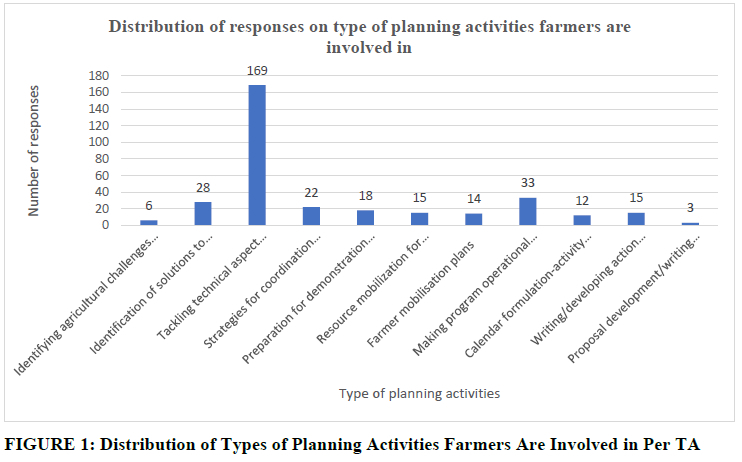
The type of planning activities in which farmers are involved reflects the significance of their participation and its potential contribution to demand-driven extension. Having measured the proportion of farmers participating in extension planning, the study identified the types of planning activities in which farmers are involved, as shown in Figure 1.
'Tackling technical aspects' was farmers' most frequently mentioned type of planning activity, occurring 169 times and accounting for 50% of responses. This was followed by 'making program operational plans' (33 mentions), such as the livestock pass-on program, and 'identifying solutions to challenges' (28 mentions). 'Proposal development' was the least frequently mentioned activity, recorded only three times (0.9%), followed by 'identifying agricultural challenges in local areas' (six mentions).
These results indicate that farmers are still not very involved in needs identification and proposal development-type planning activities on DAESS platforms, but rather in tackling the technical aspects. The following are possible reasons for this result. Firstly, SANE may not have sufficiently strengthened the platforms' capacity to facilitate needs identification and proposal development. FAO (2021) reported a shortage of skills among platforms in resource mobilisation, including donor liaison and drafting fundable proposals. Secondly, due to staff shortages, platforms tend to be used as technology channels (lead farmers), as stated by Stull et al. (2020). This is worrisome because it is at the expense of their core purpose of making the extension demand-driven and self-financing. This finding is consistent with Chiwasa and Kambewa (2018), who found limited farmer involvement in extension planning. Still, it contrasts with Álvarez-Mingote et al. (2020), who reported high platform effectiveness in identifying farming needs. The results of Álvarez-Mingote et al. (2020) are based on self-reported data by platform leaders, which may explain the divergence. Decentralised agricultural extension services system implementation guidelines stipulate that to achieve demand-driven extension, platforms should identify needs through participatory rural appraisals, develop and handle project proposals, and identify service providers (MoAFS, 2006). Drawing on PRAs' theory (Chamber, 1994), PRAs help communities develop, identify, and assimilate local knowledge into needs assessments and agenda-setting.
3.3. Levels of Farmer Participation
Farmer participation in extension planning activities can occur at various levels along a continuum, including receiving information, passive information-giving, consultation, collaboration, and self mobilisation (Leeuwis & van den Ban, 2004). For a demand-driven extension system, the required level of participation is self-mobilisation (Okorley, 2007). Each farmer was asked to identify the typologies describing their involvement in the planning activities they attended. Table 2 shows the results.
Nearly 69% of respondents described their participation in planning extension activities as 'being informed about what the project will do'. In contrast, a smaller proportion (33%) indicated 'initiating, working on, and independently deciding on a project' as their mode of participation. This suggests that most farmers in Dedza remain at the lower levels of participation in extension planning. Since the required level of demand-driven extension is 'self-mobilisation', these results imply that the DAESS in Dedza is not yet a demand-driven extension system. The finding agrees with Stull et al. (2020), who reported that Malawi's extension system is not yet fully demand-driven. However, with SANE's efforts, achieving this goal appears highly feasible. Chowa et al. (2013) reported an equally unfavourable status of the demand-driven principle in the system before SANE. If SANE could influence policy so that all agricultural projects are implemented through the DAESS, the capacity of DAESS platforms for demand-driven procedures would increase, as most of these projects involve resource mobilisation, which aligns well with these procedures. Drawing on social constructionist theory (Gergen, 1994), high-quality social interactions among actors in DAESS through the projects will improve the platforms' functionality, leading to stakeholders' positive behaviours towards extension services and farming. It goes beyond an individual's cognitive capabilities.
3.4. Farmers' Identification of Farming Needs and Activities
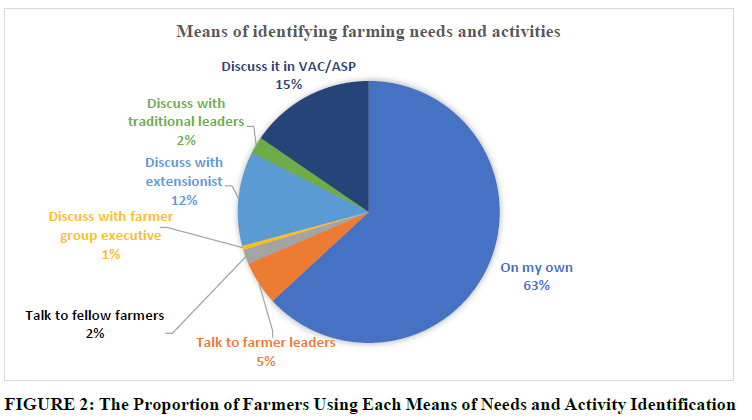
Identifying farming needs is critical for demand-driven extension. Farmers were asked to describe how they usually identify their farming needs and activities, and Figure 2 shows the results.
The most frequently mentioned farmers' usual means of identifying farming needs and activities was 'on their own' (63%), followed by 'discussions in DAESS platforms' (15%). In 2016, only 3% of farmers sought support through DAESS platforms (Ragasa & Niu, 2017). While these findings highlight persistent challenges, they indicate progress in DAESS's recognition as a demand-driven extension system among farmers. Similarly, Álvarez-Mingote et al. (2020) reported that SANE increased farmers' voice and ability to identify needs. Identifying farming needs and activities on one's own, being the most frequently mentioned usual means for smallholder, resource-poor, and largely illiterate farmers, indicates the deprivation of most farmers to come up with meaningful farming needs for extension support objectively. The finding agrees with Chiwasa and Kambewa (2018), who found that extension service providers in Dedza identify extension needs through baseline surveys. This confirms that a challenge still exists regarding having a proper demand-driven extension system. This challenge can best be understood through the lens of Participatory Development Theory, which emphasises that genuine participation requires facilitated, inclusive, and empowering processes rather than mere individualised engagement (Chamber, 1994). When farmers are left to articulate needs in isolation, the participatory promise of systems like DAESS is not fulfilled. Instead, platforms must foster deliberation, knowledge exchange, and co-learning to enable meaningful participation. Without these structural supports, participation remains nominal rather than transformative.
3.5. Farmers' Extension Needs and Preferred Demand Platform
To validate whether farmers have specific extension needs, the study assessed the proportion of farmers who would use a voucher to trade for preferred advice. Farmers indicated the services they would select in exchange for a voucher, ensuring targeted advice. The voucher system considers the economic dimension of the demand-driven extension approach, as it captures farmers' willingness to pay for services (Klerkx et al., 2006). Table 3 presents the results.
Most sampled farmers (99%) would request at least one extension of advice, and 36% would request up to three. This confirms that farmers have farming needs which require extension advice. This aligns with the statements of all interviewed service providers, who emphasised that farmers have needs that require extension support. Given that the farming population interviewed is from the smallholder subsector, which requires significant support to make informed decisions, this finding is not surprising. The finding confirms a study by Phiri, Chipeta and Chawinga (2019), which found that farmers in Malawi have information needs for their farming activities. Similarly, Momodu (2002) reported that agricultural information is one of the important needs of farmers in Nigeria. Moreover, Masangano et al. (2016) stated that, in Malawi, farmers have multiple interests in extension services, but their expenditure on extension services is limited. The finding not only justifies the need for demand-driven, bottom-up extension approaches but also offers hope that they are possible. Unlike the current status of extension delivery, where a top-down approach is still dominant with messaging mostly focused on the production of staple foods for the attainment of national food security, the findings show that demand-driven extension is possible even in publicly funded extension. This finding underscores the need for investments in demand-driven extension programmes if agricultural development is to be meaningful.
Further analysis was conducted on the types of technical advice for which farmers would exchange the voucher. Table 4 shows the results.
The most significant proportion of SANE participating farmers in Dedza (53%) would prefer to trade their vouchers for advice on cropping techniques such as plant spacing or ridge making. The second-largest proportion (28%) would prefer to trade their voucher for advice on livestock production techniques such as housing, feeding, or breeding. About 22% of farmers would prefer to trade their voucher for soil fertility improvement and management advice. Farmers also mentioned extension needs, such as crop protection techniques (12%) and veterinary services (5%). The type of advice cited by the least proportion of farmers is on access to agricultural loans and financial advice (2%).
While the results further confirm the existence of farmers' extension needs, they also highlight their diversity, revealing that more farmers prioritise trading for extension services in livestock and crop production techniques over managerial skills like financial management. Similarly, crop husbandry needs were the most frequently mentioned among the diverse needs reported in northern Malawi by Phiri et al. (2019). This was the least expected, as farmers are assumed to know about production from their experiences. The finding is important because it shows that while extension workers play a linkage function, they should not stop focusing on their education function. Diversified extension needs also mean that public-dominated extension services focusing on national food security, as is the case with Malawi (Chiwasa & Kambewa, 2018), may not adequately address most other interests of farmers, such as access to financial loans and access to affordable farm inputs, because of their limited resource capacity as an entity. In pluralistic, demand-driven extension services, the diversity of needs implies that demand-driven and privatised extension services are feasible among smallholder farmers in Malawi. Technical advice related to veterinary services, crop protection, seed variety selection, farm and household planning, and access to loans can easily be made exclusive by tying it to the sale of goods and services. For example, crop protection information can be bundled with the sale of herbicides by a private farm input dealer. Chiwasa and Kambewa (2018) reported similar farming needs in Dedza, including pests and diseases, farming implements, access to markets, and low incomes. The finding that demand-driven and privatised extension services are feasible is in line with Loki et al. (2019), who found in South Africa that 64% of land reform beneficiaries favoured a privatised extension service and were willing to pay for private extension services. However, privatisation only addresses demand-driven extension in the economic sense and not the substantive sense, that is to say, "the interest that clients have in certain services and in the contents of these services and the questions that clients pose (Klerkx et al., 2006: 198). Demand-driven extension services in the substantive sense depend greatly on the quality of interaction between service providers and farmers (Klerkx et al., 2006), calling for greater attention to the process of formulating and meeting needs. When there are tensions between public interests, as defined by the government, and the private interests of farmers, it is obvious that this may create substantial complexities and inconsistencies. Moreover, even in cases where there is no such tension, there is still a need for critical reflection on the quality of the needs articulation process. Farmers' ability to observe, learn as a farm unit or group, and articulate their needs through participatory approaches is crucial to the formulation of substantive needs (Chiwasa & Kambewa, 2018). The Agricultural Innovation Systems upon which DAESS is based outline an opportunity for farmers to jointly establish a common discussion that continues throughout the innovation process as partners leave or enter the network or circumstances change. Accordingly, DAESS would be the preferred platform.
The study assessed farmers' preferred platforms for demanding extension support. For each piece of advice, a farmer said, they stated their preferred platform for requesting information (Figure 3).
Results in Figure 3 show that, across most types of advice, farmers preferred EPA offices (38%) on average, followed by DAESS platforms (31%). Extension-planning area offices have the highest percentages of farmer preferences of advisory services in various agricultural domains, including seed variety and animal breed selection (75%), livestock production (53%), crop production (49%), post-harvest handling, farm business, and fruit production (47%), soil and water conservation (46%), as well as veterinary services and soil fertility improvement (44%). Decentralised agricultural extension service platforms had the second-highest percentages of farmer preference for most types of advice. However, they ranked highest in guiding access to agrarian loans (67%) and affordable farm inputs (63%). Along the same vein, facilitation of access to credit and provision of farm inputs were associated with the non-public extension in Nigeria (Ogbonna, Onwubuya, Akinnagbe & Iwuchukwu, 2016; Burkina Faso Sylla, Al-Hassan, Egyir & Anim-Soumah, 2019). The results indicate that farmers consider only EPA offices as the most important platforms for requesting technical support, rather than the pluralistic DAESS platforms. This supports the results of Stull et al. (2020) and Chiwasa and Kambewa (2018), who found that pluralism might not occur consistently in the system. Similar results were reported in South Africa by Loki et al. (2020), who found that 61% of farmers rated public extension as very good, compared with only 18% for pluralistic extension. Results showing that pluralistic extension systems are not yet popular among poor smallholder farmers were also reported in Nigeria (DLEC/GFRAS, 2017) and in the Democratic Republic of Congo (Ragasa, Ulimwengu, Randriamamonjy & Badibanga, 2016). This can be explained by the persistent dominance of public extension, upon which even NGOs rely for technical training, as is the case in Malawi (Masangano, Kambewa, Bosscher & Fatch, 2017). Hence, the farmers' positive perception towards public extension. The finding is concerning, as it undermines efforts to achieve a power balance between farmers and extensionists for effective demand articulation, as required in AIS (Landini, 2015).
Further analysis was conducted to determine why farmers preferred certain platforms for specific types of advice. Figure 4 shows the results of the analysis.
Figure 4 shows that the most frequently cited reason for farmers preferring one platform over another was their perception that it had experts, which was mentioned 234 times. The second most frequent reason was the ease of access to the platform (107 times). Notably, both reasons were most often mentioned in relation to EPA offices, with 204 mentions for expert availability and 65 for ease of access. The third most frequently cited reason for preferring a platform was familiarity, either as a member or a lead farmer (82 times). This reason was mainly mentioned in relation to the DAESS platforms (76 times). Another reason mentioned most often about the DAESS platforms was their tolerance for farmers speaking out freely (29 times). The most commonly mentioned reason for LGS platforms was 'the ability to enforce or lobby'. 'Responding to issues timely' and 'possession of resources' mainly were associated with 'other platforms' specific to individual NGOs or departments.
These results mean that while DAESS platforms offer farmers a valuable opportunity to express their needs freely, key factors such as accessibility, expertise among platform members, enforcement authority, and resources, especially funds within the platform to address farmers' needs effectively, are more prominent on other platforms. The Decentralised Agricultural Extension Service System's reliance on periodic meetings mainly drives inaccessibility. In contrast, EPA offices have infrastructure throughout the country maintained by the BES, making them more accessible. As stated in the previous sections, public or EPA offices are intended to serve as secretariats for the DAESS. The lack of expertise among the Decentralised Agricultural Extension Service System's membership is most likely because there is still not enough patronage from service providers on the DAESS platforms. Moreover, as discussed in the previous sections, donor-funded NGOs, which form the larger part of pluralism, tend to bring financial resources but use government extension staff for technical training. Likely, this is because these NGOs are understaffed or use it as a strategy to ensure project activities' sustainability beyond the project or as a means to easily maintain government standards. Financial resources which NGOs bring to training are a major constraint the public extension services face. Accessibility and technical expertise were also important factors influencing farmers' choice of extension sources in South Africa (Loki et al., 2020). The finding supports the guidance of Neuchâtel Group (2007) that pluralistic, demand-driven services should be accessible and offer diverse expertise to provide farmers with choices. Incorporating all departments, including agriculture and other service providers, would enhance farmers' perceptions of DAESS platforms' expertise, accessibility, and available resources. Decentralised Agricultural Extension Service System also seemed to lack enforcement authority, unlike LGS platforms. The Local Government Structure platform membership has chiefs as advisors (MOLGRD, 2013). Chiefs mobilise their communities to pursue development goals using force, sometimes, because generally chiefs are autocratic (Msewa, 2005). This finding underscores the need to consider mechanisms for leveraging the chiefs' authority in the DAESS for agricultural development. In Namibia, Jona and Terblance (2018) suggested that village headmen be leaders of extension platforms, as 29% of the farmers they interviewed reported depending on such influential people for information. Drawing on AIS, the interface among diverse actors enables collaboration and knowledge exchange, enabling farmers to demand the information and services they require to solve their problems (Klerkx et al., 2006).
4. CONCLUSION AND RECOMMENDATIONS
In conclusion, while DAESS platforms in the Dedza district offer opportunities for farmer participation in planning extension support, their impact remains limited due to superficial engagement. Farmers are still not much involved in needs identification and proposal development, with most still being on the lowest level of participation, just being informed about project objectives, and the majority still identifying farming needs on their own. Although farmers have specific needs, they tend to avoid the DAESS platform because of limitations such as its reliance on periodic meetings, limited expertise among its members, lack of enforcement authority, and insufficient resources within the platform. This suggests that the extension system is not yet demand-driven, with the platforms not fully developed to foster farmers' positive behaviours of demanding services through social interactions, as emphasised by the social constructivism theory. Additionally, the limited accessibility, expertise, authority, and resources of the DAESS platforms cause farmers to prefer other platforms, highlighting an underdeveloped pluralism as outlined by the Agricultural Innovation Systems (AIS) framework.
A critical factor affecting DAESS's effectiveness is the poor composition of its platforms. Strengthening the presence of relevant activities and personnel within DAESS would enhance its credibility and functionality. The SANE project, in collaboration with the Department of Extension Services, needed to ensure that all agricultural initiatives, including national programs such as the Affordable Input Program, were implemented through DAESS. Additionally, SANE should have actively engaged and lobbied for the inclusion of all relevant NGOs at every level of the DAESS platform. The Department of Extension Services and the District Council should develop clear mechanisms to ensure comprehensive representation within DAESS, such as composition requirements for DAESS platforms. The mechanism could include establishing a regulatory framework to mandate registration and participation of all service providers across all DAESS levels.
5. ACKNOWLEDGEMENTS
We acknowledge the financial support from the Malawi Government Scholarship Fund.
REFERENCES
ABHIJEET SAHU, K.K., BARDHAN, R., CHOUHAN, N.S., DIXIT, D., TRIPATHI, S., PANDEY, A. & AHMED, R., 2023. A comprehensive review on role of agricultural extension services in the sustainable development of global agriculture. Int. J. Environ. Clim. Change., 13(10): 3514-3525. [ Links ]
ÁLVAREZ-MINGOTE, C., MOORE, A. & MCNAMARA, P., 2020. Assessing the role of stakeholder platforms as drivers of resilient communities: The case of Malawi. J. Agric. Educ. Ext., 26(1): 75-95. [ Links ]
CHAMBERS, R., 1994. The Origins and Practice of Participatory Rural Appraisal. World Development. [ Links ]
CHINSINGA, B., 2008. The political economy of the Ministry of Agriculture at the district level: The Case of Rumphi District. Brighton: Future Agricultures Consortium. University of Sussex. [ Links ]
CHIWASA, H. & KAMBEWA, D., 2018. Demand-based extension models for smallholder farmers in Malawi. Theme 1 - Learning and knowledge systems, education, extension and advisory services. Presented at the 13th European IFSA Symposium, 1-5 July, Chania (Greece). [ Links ]
CHOWA, C., GARFORTH, C. & CARDEY, S., 2013. Farmer experience of pluralistic agricultural extension, Malawi. J. Agric. Educ. Ext., 19(2): 147-166. [ Links ]
CHRISTOPLOS, I., 2010. Mobilizing the potential of rural and agricultural extension. Rome: Food and Agriculture Organisation (FAO) of the United Nations Office of Knowledge Exchange, Research and Extension, and Global Forum for Rural Advisory Services (GFRAS). [ Links ]
CRESWELL, J.W., 2014. A concise introduction to mixed methods research. SAGE Publications. [ Links ]
DAVIS, K., FAURE, G., NAHDY, M.S. & CHIPETA, S., 2009. Institutional changes and challenges for agricultural advisory services in Africa. Presented at the 19th European Seminar on Extension Education, 15-19 September, Assisi, Italy, pp. 41-45. [ Links ]
SOCIAL ECONOMIC PROFILE (DEDZA SEP)., 2013. Dedza District Socio-Economic Profile 2013-2018. [ Links ]
DLEC/GFRAS., 2017. Nigeria: In-depth Assessment of Extension and Advisory Services. Developing Local Extension Capacity (DLEC) Project. USAID. Global Forum for Rural Advisory Services. [ Links ]
FAO., 2021. National Agricultural Innovation System Assessment in Malawi - Consolidated report. Rome. [ Links ]
GERGEN, K.J., 1994. Realities and relationships: Soundings in social construction. Cambridge, MA: Harvard University Press. [ Links ]
JOHNSON, R.B. & ONWUEGBUZIE, A.J., 2004. Mixed methods research: A research paradigm whose time has come. Educ. Res., 33(7): 14-26. [ Links ]
JOHNSON, R.B., ONWUEGBUZIE, A.J. & TURNER, L.A., 2007. Toward a definition of mixed methods research. J. Mix. Methods Res., 1(2): 112-133. [ Links ]
JONA, C.N. & TERBLANCHÉ, S.E., 2018. Proposed framework to improve the coordination of and to strengthen agricultural support services linkages in the Oshikoto region in Namibia. S. Afr. J. Agric. Ext., 46(2): 24-35. [ Links ]
KLERKX, L., AARTS, N. & LEEUWIS, C., 2006. Adaptive management in agricultural innovation systems: The interactions between innovation networks and their environment. Agric. Syst., 103(6): 390-400. [ Links ]
LANDINI, F., 2015. Different Argentine rural extensionists' mindsets and their practical implications. J. Agric. Educ. Ext., 21(3): 219-234. [ Links ]
LEEUWIS, C. & VAN DEN BAN, A., 2004. Communication for rural innovation rethinking agricultural extension. Oxford: Blackwell Science. [ Links ]
LOKI, O., MUDHARA, M., PAKELA-JEZILE, Y. & MKHABELA, T.S., 2019. Factors influencing Land Reform beneficiaries' willingness to pay for Extension Services in Eastern Cape and Kwazulu-Natal, South Africa. S. Afr. J. Agric. Ext., 47(4): 29-45. [ Links ]
LOKI, O., MUDHARA, M. & PAKELA-JEZILE, Y., 2020. Factors influencing farmers' use of different extension services in the Eastern Cape and KwaZulu-Natal Provinces of South Africa. S. Afr. J. Agric. Ext., 48(1): 84-98. [ Links ]
LOKI, O. & MDODA, L., 2023. Assessing the contribution and impact of access to extension services toward sustainable livelihoods and self-reliance in Eastern Cape Province, South Africa. Afr. J. Food Agric. Nutr. Dev., 23(4): 23000-23025. [ Links ]
MAAKE, M.M.S. & ANTWI, M.A., 2022. Farmer's perceptions of effectiveness of public agricultural extension services in South Africa: An exploratory analysis of associated factors. Agriculture and Food Security. Department of Agriculture and Animal Health, University of South Africa. [ Links ]
MASANGANO, C. & MTHINDA, C., 2012. Pluralistic Extension System in Malawi. Eastern and Southern Africa Regional Office. IFPRI Discussion Paper 01171, pp. 37. [ Links ]
MASANGANO, C.M., CHIWASA, H., KAMBEWA, D.K., KAKWERA, M., CHIMOMBO, M., MATITA M. & GAUSI, W., 2016. Making the demand driven extensions services systems work through decentralised structures: Prospects for the future extension service delivery in Malawi. Malawi: Extension Department, Bunda College Campus, Lilongwe University of Agriculture and Natural Resources. [ Links ]
MASANGANO, C.M., KAMBEWA, D., BOSSCHER, N. & FATCH, P., 2017. Malawi's experiences with the implementation of pluralistic, demand-driven and decentralized agricultural extension policy. Malawi: Extension Department, Bunda College Campus, Lilongwe University of Agriculture and Natural Resources. [ Links ]
MIKWAMBA, K., DESSEIN, J., KAMBEWA, J., MESSELY, L. & STRONG, R., 2021. Collaborative governance dynamics in innovation platforms: case of Malawi's District Stakeholder Panel. J. Agric. Educ. Ext., 27(2): 255-275. [ Links ]
MINISTRY OF AGRICULTURE & FOOD SECURITY (MOAFS)., 2006. The district agricultural extension services system. Implementation guide. Lilongwe. Malawi: MoAFS. [ Links ]
MINISTRY OF AGRICULTURE & IRRIGATION (MOAI)., 2000. Agricultural extension in the new millennium: Towards pluralistic and demand-driven services in Malawi. Policy Document. Lilongwe. Malawi: Agricultural Communication Branch, MoAI. [ Links ]
MINISTRY OF LOCAL GOVERNMENT AND RURAL DEVELOPMENT (MOLGRD)., 2013. Local Government System in Malawi. Guidebook. Lilongwe. Malawi. [ Links ]
MOMODU, M.O., 2002. Information needs and information seeking behaviour of rural dwellers in Nigeria: A case study of Ekpoma in Esan West local government of Edo State, Nigeria. Libr. Rev., 1(8): 406-410. [ Links ]
MSEWA, E.F., 2005. Decentralisation and local governance in the Lilongwe district of Malawi. Masters thesis, University of the Western Cape, South Africa. [ Links ]
MUNGAIA, L.M., MESSINAA, J.P., ZULUB, L.C., CHIKOWOC, R. & SNAPP, S.S., 2024. The role of agricultural extension services in promoting agricultural sustainability: A Central Malawi case study. Cogent Food Agric., 10(1): 2423249. [ Links ]
NEUCHÂTEL GROUP., 2006. Demand-driven agricultural advisory services. Deutsche Gesellschaft für Technische Zusammenarbeit (GTZ). The Netherlands: Wageningen. [ Links ]
OKORLEY, E.L., 2007. An operational framework for improving decentralized agricultural extension: A Ghanaian case study. Unpublished doctoral thesis, Massey University, Palmerston North, New Zealand. [ Links ]
ONGACHI, W. & BELINDER, I., 2025. Agricultural extension as a pathway to livelihood diversifcation and sustainable development in rural communities: A systematic review. BMC Agric., 1(6). https://doi.org/10.1186/s44399-025-00005 [ Links ]
OGBONNA, O.I., ONWUBUYA, E.A., AKINNAGBE, O.M. & IWUCHUKWU, J.C., 2016. Evaluating effectiveness and constraints of private sector agricultural extension services of the Green River Project in Imo and Rivers States, Nigeria. Afr. Eval. J., 4(1). https://doi.org/10.4102/aej.v4i1.118. [ Links ]
PETERS, P., 1997. Against the Odds. Crit. Anthropol., 17(2): 189-210. [ Links ]
PHIRI, A. CHIPETA, G.T. & CHAWINGA, W.D., 2019. Information needs and barriers of rural smallholder farmers in developing countries: A case study of rural smallholder farmers in Malawi. Inf. Dev., 35(3): 421-434. [ Links ]
RAGASA, C., ULIMWENGU, J., RANDRIAMAMONJY, J. & BADIBANGA, T., 2016. Factors affecting performance of agricultural extension: Evidence from the Democratic Republic of Congo. J. Agric. Educ. Ext., 22(2): 113-143. [ Links ]
RAGASA, C. & NIU, C., 2017. The state of agricultural extension and advisory services provision in Malawi. Insights from household and community surveys. Technical Report. Lilongwe: International Food Policy Research Institute. [ Links ]
RAGASA, C. & COMSTOCK, A., 2019. Dynamics in agricultural extension services provision in Malawi: Insights from two rounds of household and community panel surveys. IFPRI Discussion Paper 01853. Development Strategy and Governance Division [ Links ]
REMMINGTON, G.T., 1963. Agricultural development in the Dedza district of Nyasaland. Nyasaland J., 16(1): 28-48. [ Links ]
SANI, L., BOADI, B.Y., OLADOKUN, O. & KALUSOPA, T., 2014. The generation and dissemination of agricultural information to farmers in Nigeria: A Review. IOSR J. Agric. Vet. Sci., 7(2): 102-111. [ Links ]
SOROKO, D., MTINUMI, B., MASANGANO, C., FIEBIG, W., PHILLIPS, J. & PRICE, A., 2019. Midterm evaluation of the of the Feed the future strengthening agricultural and nutrition extension activity (SANE). Washington, D.C.: Agency for International Development (USAID). [ Links ]
SYLLA, A.Y., AL-HASSAN, R.M., EGYIR, I.S. & ANIM-SOUMAH, H., 2019. Perceptions about quality of public and private agricultural extension in Africa: Evidence from farmers in Burkina Faso. Cogent Food Agric., 5(1): 1685861. [ Links ]
STEVENS, J.B. & NTAI, P.J., 2011. The role of extension support to irrigation farmers in Lesotho. S. Afr. J. Agric. Ext., 39: 104-112. [ Links ]
STULL, V.J., KAMBEWA, D. & TCHUWA, F., 2020. Systems strengthening to improve agricultural and nutrition extension services: A rapid assessment of SANE and DAES effort in Malawi. Lilongwe. Malawi. [ Links ]
SUVEDI, M., 2011. Evaluation of agricultural extension and advisory services. A MEAS Training Module. Michigan State University and the MEAS. [ Links ]
TALIB, U., ASHRAF, I., AGUNGA, R. & CHAUDHARY, K.M., 2018. Public and private agricultural extension services as sources of information for capacity building of smallholder farmers in Pakistan. J Anim Plant Sci., 28(6): 1846-53. [ Links ]
TCHUWA, F., 2021. Extension services providers' response to the COVID-19 pandemic in Malawi. Lilongwe. [ Links ]
USAID., 2017. Strengthening Agricultural and Nutrition Extension Cooperative Agreement Number: AID-612-LA-15-00003. Quarterly Report Year 2. Washington D.C.: Agency for International Development (USAID). [ Links ]
WORLD BANK., 2022. New pathways to commercialize agriculture in Malawi. World Bank. Available from https://blogs.worldbank.org/en/nasikiliza/new-pathways-commercialize-agriculture-malawi [ Links ]
WORLD BANK., 2025a. Agriculture, forestry, and fishing, value added (% of GDP) - Malawi. World Bank collection of development indicators. Available from https://data.worldbank.org [ Links ]
WORLD BANK., 2025b. Employment in agriculture (% of total employment) - Malawi. World Bank collection of development indicators. Available from https://data.worldbank.org [ Links ]
WORLD BANK., 2025c. Agriculture, value added (% of foreign exchange earnings) - Malawi. World Bank collection of development indicators. Available from https://data.worldbank.org/indicator/NE.EXP.GNFS.ZS?locations=MW [ Links ]
 Correspondence:
A.M. Saidi
Correspondence Email: u20783044@tuks.co.za
1 Feed the Future zone of influence districts in Malawi are Mnchinji, Lilongwe, Dedza, Ntcheu, Mangochi, Blantyre, Chikwawa, Nsanje, Machinga and Balaka