



Serviços Personalizados
Journal

Artigo
 Inglês (pdf)
 Artigo em XML
 Referências do artigo

 Tradução automática
 Enviar este artigo por email
Indicadores
Links relacionados
-
 Citado por Google
-
 Similares em Google
Compartilhar

 Permalink

SAMJ: South African Medical Journal
versão On-line ISSN 2078-5135versão impressa ISSN 0256-9574
SAMJ, S. Afr. med. j. vol.115 no.5 Pretoria Jun. 2025
https://doi.org/10.7196/SAMJ.2025.v115i5.2558
RESEARCH
Orthopaedic-related pathological conditions in the paediatric population presenting at outreach clinics in central South Africa over a 20-year period
J P J SmitI, II; G JoubertIII; J du ToitI; M C BurgerIV
IFC (Orth), PhD; Division of Orthopaedic Surgery, Faculty of Medicine and Health Sciences, Stellenbosch University, Cape Town, South Africa
IIFC (Orth), PhD; Department of Orthopaedics, Faculty of Health Sciences, University of the Free State, Bloemfontein, South Africa
IIIPhD; Department of Biostatistics, Faculty of Health Sciences, University of the Free State, Bloemfontein, South Africa
IVPhD; Division of Orthopaedic Surgery, Faculty of Medicine and Health Sciences, Stellenbosch University, Cape Town, South Africa
ABSTRACT
BACKGROUND. Outreach, as a component of health service delivery in South Africa (SA), increases diagnostic and treatment capacity for populations living in remote areas. It further allows for close population surveillance of specific health-related conditions. Paediatric orthopaedic outreach for central SA provides a unique opportunity to provide insight into the incidence rates of common paediatric orthopaedic-related conditions.
OBJECTIVE. To investigate the absolute numbers and incidence rates of orthopaedic-related pathological conditions in the paediatric population presenting at outreach in central SA between 1997 and 2016.
METHODS. A retrospective investigation was conducted, which included all paediatric patients residing in the Northern Cape and Free State provinces accessing public healthcare for orthopaedic-related conditions during outreach services. Patient demographic and clinical data were collected and divided into (i) periods; (ii) age groups; (iii) geographical location; and (iv) presenting pathology. Age group-specific incidence rates (ASIR) and paediatric incidence rates (PIR) were calculated using census data from 2001, 2006 and 2011, and estimated values were adjusted to reflect the percentage of the population expected to use public health facilities per 10 000 paediatric population per year.
RESULTS. A total of 3 418 patients were included, with the largest number of patients seen in the Central Free State (n=985). The ASIR for all age groups varied considerably between geographic regions and periods, with the highest rates (2005 - 2008, 21.8 per 10 000 per year) observed in the neonate/infant age group in the northern Free State region. The PIR for pathological groups also varied considerably, with high incidences of congenital talipes equinovarus observed in the northern and eastern Free State regions and a high incidence of cerebral palsy in the central (2001 - 2004, 0.79 per 10 000 per year) and Eastern Free State (2001 - 2004, 0.62 per 10 000 per year).
CONCLUSION. This information can provide a unique context for planning healthcare service delivery and pathology-orientated scientific research.
Keywords: outreach, academic medical centre, urban disadvantaged, rural disadvantaged, descriptive paediatric age groups, childhood orthopaedic disease
Orthopaedic disease is a rare but important occurrence in paediatric populations. Orthopaedic disease refers to abnormalities and symptomatology of the musculoskeletal (muscle, bone, nerves, joints, ligaments, tendons and connective tissue) and neurological systems.[1] Underlying causes vary, and can be congenital, developmental or acquired. Risk factors may be associated with these conditions. Orthopaedic disorders manifest as injuries, arthritis, soft tissue abnormalities, weakness, cancer, autoimmune diseases, infections and inflammations of muscle, bone, joints and tendons. Children are a unique patient population with very distinctive yet widely variable orthopaedic issues and traumatic events, and the presentation, management and clinical outcomes in this population can differ from those of the adult population. In South Africa (SA), reconstructive management for paediatric patients with orthopaedic disease who do not have access to private healthcare is predominantly performed at academic medical centres (AMCs). The AMC is an educational and tertiary healthcare institute organisationally and administratively integrated with a medical school and Faculty of Health Sciences of a university, with the purpose that management breakthroughs lead to direct clinical benefits for patients. There is, however, discordance in the distribution of specialist medical care to the population in SA.[2] The AMCs affiliated with the University of the Free State (UFS) are Universitas and Pelonomi Hospitals in Bloemfontein. These centres are also responsible for tertiary care referrals from the Free State and Northern Cape provinces, Lesotho and an enclave in the north-western part of the Eastern Cape Province. At the time of this study, some provinces with even larger populations did not have an AMC, e.g. Limpopo Province (population 5.6 million), compared with the Western Cape Province (population 6.3 million), which has two health sciences faculties.[3,4]
It has been shown that outreach services provide closer population surveillance and improve the continuum of care.[5] In addition, outreach also increases diagnostic capacity, and thus enables earlier detection of illness.[5] A dedicated paediatric orthopaedic outreach in central SA has existed for the past 29 years. This programme commenced in 1995 in Kimberley (the capital of the Northern Cape Province) owing to apparent limitations in general orthopaedic service provision in this region. The Department of Orthopaedic Surgery at UFS supported the development of this programme, which subsequently expanded to the other areas and referral hospitals of the Free State, namely Welkom (region of Lejweleputswa), Kroonstad (region of Fezile Dabi), Bethlehem and Phuthaditjhaba (region of Thabo Mufutsanyana). The outreach programme of the Free State Department of Health strives to maximise access to specialist services for all people of central southern Africa, beyond the borders of the Free State Province. Outreach extends service delivery and offers a platform for training, teaching, research and capacity building.[6]
The current study aimed to investigate the absolute numbers and incidence rates of orthopaedic-related pathological conditions in the paediatric population presenting at outreach in central SA between 1997 and 2016.
The specific objectives were to: (i) investigate trends in absolute numbers and incidence rates of patients served by outreach in central SA; and (ii) report trends in numbers and incidence rates in terms of patients presenting with common and less common paediatric orthopaedic conditions.
Methods
Design, outreach structure and setting
The study followed a retrospective longitudinal design. During the study period 1997 - 2016, a single paediatric orthopaedic surgeon performed clinical activities four times a year at four regional centres in secondary hospitals, and one tertiary care hospital. Within the public health system, a four-tiered system exists that includes (i) primary care (e.g. community health centres) in rural areas and small towns;[7,8] (ii) district hospitals;[2] (iii) secondary or regional hospitals, which function independently with fully staffed specialist services;[2,7] and (iv) the AMC or tertiary hospital.[2] The outreach clinics included were in the three regions (north, central and eastern) of the Free State, and the Northern Cape. Outreach took place at Boitumelo Hospital (Kroonstad, northern Free State), Bongani Hospital (Welkom, central Free State), Mofumahadi Manapo Mopeli Hospital (Phuthaditjhaba, Qwaqwa) and Dihlabeng Hospital (Bethlehem), the latter both in the eastern Free State, as well as Robert Mangaliso Sobukwe Hospital (the tertiary hospital in Kimberley, Northern Cape Province).
The study population comprised patients accessing public health services residing in the two provinces of interest. According to the Cochrane report on outreach, the patients represented typical outreach populations of low socioeconomic status groups from urban, rural or rural-disadvantaged populations.[9] They excluded patients with access to private health insurance, who represent 14% in the Free State and 19% in the Northern Cape provinces.[10-19] The present study examined contact activities with patients in an orthopaedic clinic setting. All clinic activities were included, while surgical interventions were excluded. The regions where the study population resided were characterised as follows:
• The outreach for the central Free State was among the urban disadvantaged. It is traditionally an industrial region with economic activity related to the mining sector. This sector shrank considerably during the study period, as reflected by household income and employment data.[20-22]
• The northern Free State is rural, and people reside in small towns and on farms. Economic activity depends on the farming sector.[23]
• In the eastern Free State, the population may be classified as rural disadvantaged.[23]
• The activity strove to offer services over a 373 000 km2 area in the Northern Cape Province. The population consists of the urban disadvantaged and the rural disadvantaged.[20,24]
Data collection
Patient demographic and clinical data were extracted from the outreach and MEDITECH health filing systems. Based on the date of their first visit, children were categorised into the following five periods: 1997 - 2000, 2001 - 2004, 2005 - 2008, 2009 - 2012 and 2013 - 2016. The five periods were categorised for ease of interpretation. The MEDITECH electronic files were compiled as a clinical activity at the AMC by the paediatric orthopaedic consultant and registrars per the usual standard of practice procedures in each facility. No specific exclusion criteria were employed by this study. Specific data collected included demographic and diagnostic-related data under the following categories:
Age group
The descriptive age groups were used as commonly applied by paediatric clinicians, namely 'neonate and infant' (N/I - birth until the end of 11 months), 'toddler' (Td - 1 year until the end of 1 year), 'early childhood' (E/C - 2 years until the end of 5 years), 'middle childhood' (M/C - 6 years until the end of 11 years) and 'early adolescence' (E/A - 12 years until the end of 18 years).[25]
Pathology
To facilitate the comparisons and interpret the data, the listing for 52 paediatric orthopaedic diseases was used according to the International Classification of Diseases 10th Revision (ICD-10).[261 Seven distinct pathological groups were created (appendix Table S1: http://coding.samedical.org/file/2343). The groups were based on prevalence and clinical characterisation. It was either pathology-specific, such as congenital talipes equinovarus (CTEV) or cerebral palsy (CP), or pathologies were grouped owing to similar management approaches, such as developmental abnormalities of the lower limb. Group diagnoses for paediatric orthopaedic disease were subsequently further grouped as common (first four categories) and less common (final three categories).
Common disease categories
Category 1: Developmental disorders of the lower limb (DDLL) are diverse conditions affecting connective tissue and muscle, with associated joint malorientation and bony deformation. Hip conditions include slipped capital femoral epiphysis (SCFE), Legg-Calvé-Perthes disease, developmental dysplasia of the hip (DDH) and idiopathic chondrolysis. Blount's disease (multiplanar deformities with predominant genu vara), rickets and osteogenesis imperfecta (multiplanar deformities) are pathological DDLL. This category also included the cavovarus foot and pes planus, associated with connective, muscle and neurological tissue pathology. Finally, minor foot deformities unrelated to any pathology were also considered under the DDLL category.[27,28]
Category 2: CTEV - clubfoot describes the common orthopaedic-related idiopathic congenital condition, and may cause impairment. It is characterised by complex connective tissue and muscle abnormality associated with joint malorientation and eventual bony deformation. It is also characterised by hindfoot varus and equinus, midfoot cavus and forefoot adduction.[29,30]
Category 3: CP is a group of permanent disorders affecting the central nervous system, characterised by abnormalities in movement and posture. It often involves muscle tone, joint malalignment and skeletal deformities. CP is attributed to non-progressive disturbances in the developing fetal or infant brain.[31,32]
Category 4: Bone and joint sepsis, trauma complications, tumours and arthritides (STT) describe orthopaedic manifestations in terms of connective tissue and muscle changes, joint malorientation and bony deformation associated with tumours, sequelae of trauma, bone sepsis (acute or chronic osteitis) and arthritides. The included conditions are typically associated with an initiating pathological event, and sometimes with a genetic predisposition. [33-36]
Less common disease categories
Category 5: Congenital limb deformities (CLD) - other CLD are congenital conditions affecting connective tissue and muscle, with associated joint malorientation and bony deformation. CLD is a diverse category and may involve the connective tissue (i.e. amniotic band, arteriovenous malformation), or be combined with bone and joint pathology and duplications or deletions of the limbs.[37,38]
Category 6: Spinal abnormalities are characterised by connective tissue, muscle and bone abnormalities with associated vertebral malorientation. They manifest as scoliosis, but also include spinal infections, tumours, spondylolysis and spondylolisthesis.[39]
Category 7: Neuromuscular diseases (other), genetic and chromosomal abnormalities (NM&G) may manifest as muscle, joint and bone abnormalities, where patients may suffer from multisystem involvement. These include muscle disease (muscular dystrophy and myopathy), joint disease (arthrogryposis) and neurological diseases (spina bifida, polio-like syndromes, delayed motor milestones and a brachial plexus injury). Chromosomal and genetic disorders may present with connective tissue and muscle abnormalities with associated joint malorientation and bony deformation, i.e. Down syndrome, haemophilia and Marfan syndrome.[40]
Statistical analysis
Analysis was performed using SAS version 9.4 (SAS, USA). Results were summarised by frequencies and counts for categorical variables. Denominators to calculate incidence rates were based on figures from the three censuses of 2001, 2006 and 2011. [3,41] Regression lines were fitted to the census figures to estimate the population at the midpoint of the five-study cohort periods per region and age group (appendix Table S2: http://coding.samedical.org/file/2343). These estimated values were adjusted to reflect the percentage of the population expected to use public health facilities. In the Northern Cape Province the adjustment was 0.81, and in all other regions, 0.86.[3,41] Age group-specific incidence rates (ASIRs) refer to the specific age groups per 10 000 paediatric population per year in a particular period and region. Paediatric incidence rates (PIR) for disease groups were expressed as the incidence rate per 10 000 paediatric population per year in a specific period and region.
Ethical considerations
Data were de-identified, and confidentiality principles were applied. Ethics approval was obtained from the Health Sciences Research Ethics Committee of the University of the Free State (ref. no. UFS HSD 2018/0942) and the Health Research Ethics Committee of Stellenbosch University (ref. no. S20/11/299), as well as the respective Departments of Health of the Free State and Northern Cape Provinces.
Results
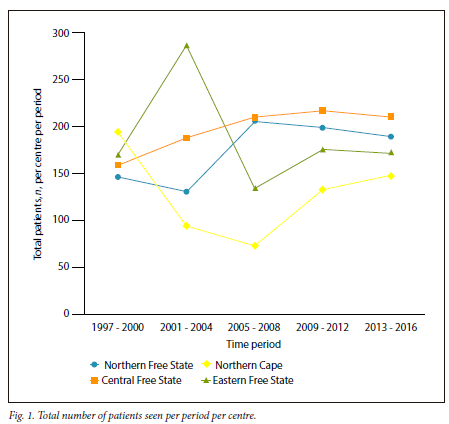
Outreach assessed 3 418 clinic patients over the 20-year study period (1997 - 2016). The total number of clinic visits (initial consultation and follow-up) by the patients was 8 477, of which 1 643 were single visits, while 159 patients attended outreach >8 times. The largest total number of patients (n=985) were seen in the central Free State, and the fewest patients (n=642) were assessed in the Northern Cape Province (Fig. 1). In the Northern Cape, patient numbers decreased from inception to 2005 - 2008, and then remained relatively unchanged in the final two periods. The numbers recorded for the central and northern Free State regions followed similar upward trends. There was a steep increase in patient numbers in the eastern Free State after 2001 - 2004, with numbers stabilising in the two final periods (2009 - 2012 and 2013 - 2016) (Fig. 1).
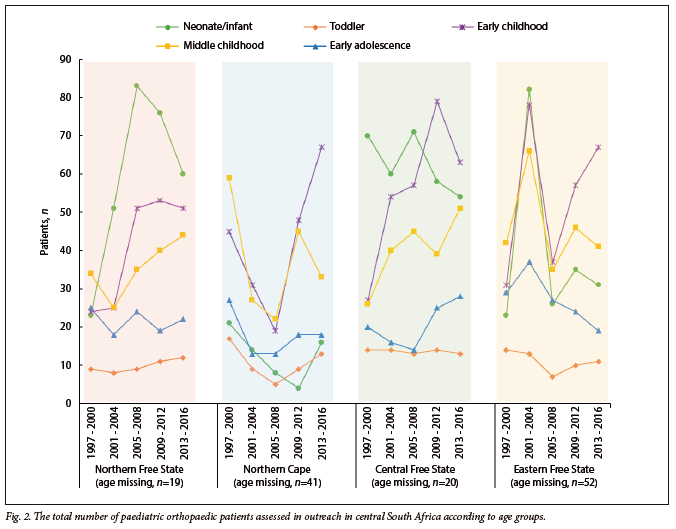
The total number of patients assessed during outreach was evaluated according to age groups, period and region (Fig. 2). High numbers were observed in the northern and central Free State in N/I - especially during 2005 - 2008. From 1997 to 2000, the highest numbers were recorded for the Northern Cape, but the lowest in the subsequent four periods. The number of Td was the lowest in all the centres during most periods. E/A was consistently the second smallest age group across periods and geographical locations, with numbers for the E/C and M/C varying across regions and periods.
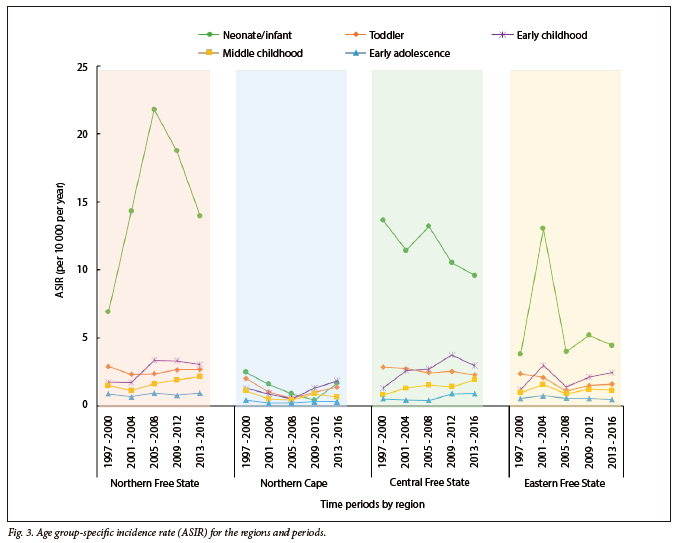
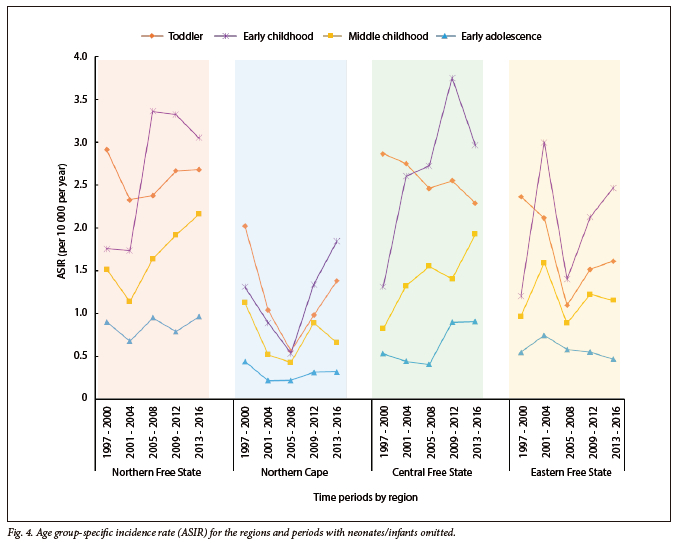
The ASIR varied considerably between regions (Fig. 3). It was highest for N/I throughout the regions of the Free State, with peaks in the northern Free State during 2005 - 2008 (21.8 per 10 000 per year) and the eastern Free State during 2001 - 2004 (13.1 per 10 000 per year), while it did not drastically decrease or increase for the central Free State (9.6 - 13.7 per 10 000 per year). The ASIRs for all age groups were similarly low for the Northern Cape (0.44 - 2.49 per 10 000 per year), with a decrease during the 2001 - 2004 and 200 - 2008 periods. E/A consistently constituted the lowest ASIR across all four centres and five periods (Fig. 4, showing ASIR with N/I omitted). Td and E/C were the most prominent age groups with N/I excluded.
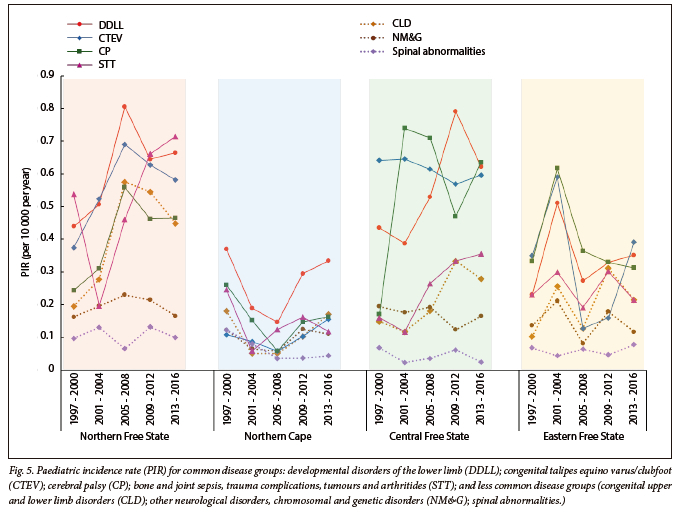
For the common disease categories, DDLL and CTEV, the PIR followed the same trend as ASIR for N/I and E/C, with DDL peaking in the northern Free State in 2005 - 2008, and the central Free State in 2009 - 2012 (Fig. 5). CTEV peaked in 2005 - 2008 in the northern Free State and the Eastern Free State in 2001 - 2004, which was followed by a sharp decline (2005 - 2008). There was a remarkably high incidence of CP during 2001 - 2004 in the central Free State (0.79 per 10 000 per year) and eastern Free State (0.62 per 10 000 per year). In the northern Free State during the latter periods, a sharp increase in STT was observed (0.46 - 0.66 - 0.72 per 10 000 per year). The incidence of NM&G and spinal abnormalities remained relatively unchanged in the less common disease categories, but CLD in the northern Free State peaked during 2005 - 2009 (at 0.58 per 10 000 per year).
Discussion
This study aimed to investigate the absolute numbers and incidence rates of orthopaedic-related pathological conditions in the paediatric population presenting at outreach in central SA between 1997 and 2016. Socioeconomic status plays a crucial role in access and outcomes in healthcare management, with outreach, including the programme examined in the present study, making it possible for families to access specialist care.[5] The paediatric population in the four regions investigated in this study changed considerably during the 20 years, even though limited economic migration capabilities exist in these regions.[41] A 2% decline was observed in the total paediatric population in the northern Free State and Northern Cape, with a 10% and 13% decrease in the central Free State and the eastern Free State, respectively.[41-44]
In addition to variability in the total paediatric population, the first main finding was the considerable changes in total and subgroup patient numbers. These changes are partly due to population shifts observed during deteriorating economic circumstances.[3] Changes within local health structures must also be considered when interpreting presentation patterns.[6,45,46] In outreach, local personnel and referring doctors are responsible for screening patients and facilitating contact between the visiting doctor, the patient and the family (appendix Table S3: http://coding.samedical.org/file/2343).[45,46] In the SA healthcare context, junior doctors in their third year of vocational training, colloquially known as the 'community service' year, play a vital role at secondary referral hospitals. The purpose of this service is to achieve better distribution of human resources for healthcare to underserviced areas, and improve equitable access to healthcare services. The doctors usually feel that they make a difference (91%) and develop professionally (81%).[47] These young doctors and the affiliated health professionals in smaller, remotely located referring hospitals are frequently inexperienced, and therefore often request a more experienced clinical opinion, in this case, from the outreach doctor. The increased referral rate, and therefore increased patient numbers, observed in the present study were especially evident in the high number of N/I patients assessed in the central and northern Free State (2005 - 2008), which might have been a result of the possible problem of limited supervision. However, the exact reasons for these observations are not known.
The findings of this study further illustrate how resident orthopaedic surgeons influenced patient numbers. This was seen especially in the eastern Free State, where an appointed Cuban-trained specialist was employed from 1997 to 2000 at Mofumahadi Manapo Mopeli Hospital, and the N/I ASIRs increased following his resignation (2001 - 2004). A similar trend was observed again from 2005 to 2008, when another orthopaedic surgeon maintained a voluntary presence, which was later discontinued due to institutional and support constraints. Similarly, the highest patient numbers in total, across all age groups, were recorded in the Northern Cape during the start of outreach, but decreased noticeably between 2001 and 2004 and 2005 and 2008, arguably due to the appointment and activities of an orthopaedic surgeon with an interest in paediatric orthopaedic surgery. During the final two periods, the Northern Cape Department of Health maintained the employment of orthopaedic surgeons. The activities of the newly appointed orthopaedic surgeons affected the number of patients referred to outreach across all age groups. Considering the distance to travel from the remote areas to outreach in Kimberley, the low ASIR could also be ascribed to the effort and cost challenges for families, resulting in undiagnosed cases.[48,49] At all the centres, the ASIR stabilised toward the two final periods, and for the Northern Cape, the ASIR remained the same from 1997 to 2000, with a slight increase in E/C and Td age groups in the final two periods. Outreach requires a prolonged and committed effort to reach a stable continuum. Outreach policies are crucial in health institutions in order to maintain effective service delivery, as illustrated by these findings.[45,46]
Congenital pathology typically presents during the first year of life (N/I), while acquired pathology and developmental delay are often present in children of walking age (Td and E/C).[50] Following the initial assessment, outreach activities frequently took over management.[49,51,52] DDLL, which included hip conditions, with SCFE the most important, followed by Perthes disease and DDH, as well as alignment abnormalities, were all considered together, and the PIR varied across geographical areas. Incidence rates worldwide for these conditions vary geographically and in different population groups, and are difficult to relate to our findings.[50,53-56] Reported numbers usually refer to patients presenting to AMC reconstructive clinics rather than to the PIR. It was difficult to speculate on environmental and socioeconomic factors that might have played a role in the high PIR for DDLL in the central and northern Free State (a mix of urbanised and rural disadvantaged populations). In the rural areas of the eastern Free State, the PIR for DDLL was lower. Future studies should aim to investigate potential reasons for these observations.
CTEV remained the most important orthopaedic congenital abnormality of paediatric orthopaedic diseases.[29,52,57] Given that CTEV can be easily managed with the Ponseti technique, patients can be treated at local clinics, and not only at AMCs. Non-specialists can manage these patients with good results.[58] The findings from the present study illustrate that the presentation of CTEV varied between regions, with PIR per 10 000 paediatric population per year for Northern Cape at 0.06, v. 0.69 for northern Free State for the period 2005 - 2008. A valuable finding of this study is the PIR for CTEV for central Free State, ranging between 0.57 and 0.65 per 10 000 paediatric population per year. This result represents the true PIR for this specific geographic location, given that outreach managed all the patients with CTEV. It is important to note that outreach may play a role in supervision and education, instead of simply the active management of patients.[58] The data on CTEV suggest that the involvement of local staff played an important role from 2001 to 2008 in the Northern Cape and the eastern Free State. Outreach offers co-ordinated CTEV management as an example of the application of clinical governance.
The incidence of CP has remained stable since 1995 in developed countries.[59] In contrast, the PIR for CP in the outreach clinics, as reported in the present study, was high and increasing (i.e. 0.24 per 10 000 at initiation (1997 - 2000), 0.56 in 2005 - 2008 and 0.46 towards the conclusion of the study period in northern Free State). Determining the prevalence in sub-Saharan Africa is problematic, but it may be as high as 10 per 1 000 live births.[60] The perception is therefore that outreach creates a critical care environment for children with neurological disorders, including CP.
For STT, there was a marked difference between the centres (PIR 0.71 per 10 000 for 2013 - 2016 for the northern Free State, and only 0.06 for 2000 - 2003 in the Northern Cape Province). The differences in PIR reflected general orthopaedic care. Tumours are referred to a tertiary care tumour facility, but outreach performed the complex surgery for bone sepsis and trauma complications. Outreach played an important role in secondary sepsis and trauma reconstructions that had traditionally belonged to the AMC.
Of the three less common disease categories, congenital upper-and lower-limb abnormalities were frequently observed in the northern Free State. It is unclear what the causes may be. Disease registries are helpful in the documentation of less common diseases such as CLD and NM&G. In SA, such registries are typically established for scientific research purposes only.[61] For example, the SA birth defect surveillance system is modelled on the International Clearinghouse for congenital disorders monitoring systems.[62,63] Congenital disorders are usually reported per diagnosis, not per group. Therefore, congenital disorders statistics reporting could be enhanced in SA.[40] The PIR for NM&G was the highest in the northern and eastern Free State regions, while similarly low PIRs were observed for spinal conditions across all study centres.
Outreach can remain responsible for caring for and managing children with orthopaedic-related problems. An effective regional orthopaedic service can influence outreach in terms of continuity of service. The AMCs affiliated with health sciences faculties and smaller hospitals can interact effectively within an outreach programme. Outreach must also expand to more remote regions. It can also improve patient satisfaction, is a cost-saving measure and educates personnel.
Study limitations
A critical limitation of the study was that outreach data needed to be tied in with the data on paediatric orthopaedic-related referrals presenting at the AMC of the UFS. Patients may be primarily assessed at the AMC because they were directly referred, and the outreach data may be underestimated. Although extensively used in the outreach domain, the descriptions of geographical origin, socioeconomic status and background (rural and rural disadvantaged) remain cryptic. In the health sphere, these depend on impressions of the developmental level and background of the patient. They should be assigned with thorough criteria, which was not done for this study. At the outset, the intention was to interpret the clinical data against socioeconomic parameters - but such an undertaking was overwhelming. Admittedly, it would be best to analyse clinical data against unemployment data. Finally, the limitations associated with a retrospective design, such as missing data points, need to be taken into consideration.
Conclusion
The data obtained from orthopaedic outreach offered a unique opportunity to interpret childhood orthopaedic diseases and their presentation over 20 years in central SA. A child's rapid growth and development provide a unique context for healthcare delivery and pathology-orientated scientific research, and the age-based groups can be utilised to identify differences and similarities across childhood.
Outreach can remain responsible for caring for and managing children living in rural and remote geographical regions. An effective regional service can influence outreach in terms of continuity of service over time, and ensure that the AMCs affiliated with health sciences faculties and smaller hospitals can interact effectively.
Data availability. N/a.
Declaration. This study formed part of a PhD in Orthopaedic Surgery, awarded by Stellenbosch University to JPJS in 2024.
Acknowledgements. The authors would like to thank Ms Theanette Mulder for her support in formatting and editing the manuscript.
Author contributions. JPJS: research conceptualisation, design, data collection, analysis, preparation and final approval of manuscript. GJ: design, analysis, final approval of manuscript. JdT: design, general supervision, final approval of manuscript. MCB: design, analysis, general supervision, final approval of manuscript.
Funding. None.
Conflicts of interest. None.
References
1. Ghandour M, Klotz M, Horsch A. Orthopedics and trauma in children: Key problems and future insights. Children 2023;10(1):119. https://doi.org/10.3390/children10010119 [ Links ]
2. Dell AJ, Gray S, Fraser R, Held M, Dunn R. Orthopaedic surgeon density in South Africa. World J Surg 2018;42:3849-3855. https://doi.org/10.1007/s00268-018-4709-4 [ Links ]
3. Massyn N, Day C, Ndlovu N, Padayachee T. District Health Barometer 2019/2020 Release. Durban: Health System Trust, 2020. https://www.hst.org.za/publications/Pages/DHB2019-20.aspx (accessed 1 April 2024). [ Links ]
4. Department of Statistics, South Africa. Census 2022 population count results, 10 October 2023. Pretoria: StatsSA, 2023. https://www.statssa.gov.za/?p=16716 (accessed 15 January 2024). [ Links ]
5. Gruen R, Bailie R, Wang Z, Heard S, O'Rourke I. Specialist outreach to isolated and disadvantaged communities: A population-based study. Lancet 2006;368(9530):130-138. https://doi.org/10.1016/S0140-6736(06)68812-0 [ Links ]
6. Van Zyl N, Musapelo MM. Free State Department of Health outreach and tele-health strategic plan. Bloemfontein: Universitas Academic Hospital, 2013. [ Links ]
7. National Department of Health. A policy on quality of health care for South Africa. Pretoria: National Department of Health, 2007. https://www.gov.za/sites/defaut/fues/gcis_document/201409/qhc-policy.pdf (accessed 15 February 2018). [ Links ]
8. Malakoane B, Heunis JC, Chikobvu P, Kigozi NG, Kruger WH. Public health system challenges in the Free State, South Africa: A situation appraisal to inform health system strengthening. BMC Health Serv Res 2020;20(1):58. https://doi.org/10.1186/s12913-019-4862-y [ Links ]
9. Gruen RL, Weeramanthri TS, Knight SE, Bailie RS. Specialist outreach clinics in primary care and rural hospital settings. Cochrane Database Syst Rev 2004;2003(1):CD003798. https://doi.org/10.1002/14651858.CD003798.pub2 [ Links ]
10. Department of Statistics, South Africa. General household Survey 2002 - 2004. Pretoria: Statistics South Africa, 2005. https://istmat.org/files/uploads/51272/general_household_survey_ghs_2004.pdf (accessed 1 February 2020). [ Links ]
11. Department of Statistics South Africa. General household Survey 2010. Pretoria: Statistics South Africa, 2011. https://www.statssa.gov.za/publications/P0318/P03182010.pdf (5 May 2023). [ Links ]
12. Department of Statistics South Africa. General household Survey 2011. Pretoria: Statistics South Africa, 2012. https://www.statssa.gov.za/publications/P0318/P03182011.pdf [ Links ]
13. Department of Statistics South Africa. General household Survey 2013. Pretoria: Statistics South Africa, 2014. https://www.statssa.gov.za/publications/P0318/P03182013.pdf (accessed 15 July 2022). [ Links ]
14. Department of Statistics South Africa. General household Survey 2014. Pretoria: Statistics South Africa, 2015. https://www.statssa.gov.za/publications/P0318/P03182014.pdf (accessed 9 August 2022). [ Links ]
15. Department of Statistics South Africa. General household Survey 2016. Pretoria: Statistics South Africa, 2017. https://www.statssa.gov.za/publications/P0318/P03182016.pdf (accessed 8 July 2022). [ Links ]
16. Department of Statistics South Africa. Census 2001. Pretoria: Statistics South Africa, 2001. https://www.statssa.gov.za/?page_id=3892 (16 June 2019). [ Links ]
17. Department of Statistics South Africa. Census 2006. Pretoria: Statistics South Africa, 2006. https://www.statssa.gov.za/publications/SAStatistics/SAStatistics2006.pdf (accessed 15 August 2020). [ Links ]
18. Department of Statistics South Africa. Census 2011. Pretoria: Statistics South Africa, 2012. https://www.statssa.gov.za/publications/P03014/P030142011.pdf (accessed 15 October 2019). [ Links ]
19. South African Institute for Race Relations. 81st Annual Report. Johannesburg: IRR, 2019. https://irr.org.za/about-us/annual-report/2010-11-annual-report-web-22jun11.pdf (accessed 15 January 2024). [ Links ]
20. O'Connor M. Mapping poverty in South Africa. South Africa Gateway, 2018. https://southafrica-info.com/people/mapping-poverty-in-south-africa/ (accessed 15 January 2024). [ Links ]
21. Strambo C, Atteridge A. Collapse of the Free State goldfields, South Africa: Lessons from industrial transitions. Stockholm Environment Institute, 2021. https://www.sei.org/wp-content/uploads/2021/06/collapse-of-the-free-state-goldfields.pdf (accessed 12 March 2023). [ Links ]
22. Nel E, Binns JA. Decline and response in South Africa's Free State goldfields. Internat Developmental Planning Rev 2002;24(3):249-269. https://doi.org/10.3828/idpr.24.3.2 [ Links ]
23. Jankielsohn R. Reasons for unemployment and poverty in the FS are visible in QwaQwa. Polity, 2021. https://www.polity.org.za/article/reasons-for-unemployment-and-poverty-in-the-fs-are-visible-in-qwaqwa-2021-10-07/searchString:Reasons+for+unemployment+and+poverty+in+the+FS+are+visible+in+QwaQwa (accessed 10 October 2024). [ Links ]
24. Department of Statistics, South Africa. Poverty mapping in South Africa. Applying small area estimation techniques using IES 2010/11 and Census 2011. Pretoria: Statistics South Africa, 2018. Maps 4 and 5. https://www.statssa.gov.za/publications/Report%2003-10-00/Report%2003-10-002011.pdf (accessed 8 August 2021). [ Links ]
25. Williams K, Thomson D, Seto I, et al. Standard 6: Age groups for pediatric trials. Pediatrics 2012;129(Suppl 3):S153-160. https://doi.org/10.1542/peds.2012-0055I [ Links ]
26. National Task Team for the Implementation of ICD-10. South African ICD-10 Coding Standards. Version 3. Pretoria: National Department of Health, 2009. [ Links ]
27. Paul GR. Common foot deformities in infancy and childhood. J Fam Pract 1976;3(5):537-543. [ Links ]
28. Wenger DR, Leach J. Foot deformities in infants and children. Pediatr Clin North Am 1986;33(6):1411-1427. https://doi.org/10.1016/s0031-3955(16)36151-x [ Links ]
29. Smythe T, Kuper H, Macleod D, Foster A, Lavy C. Birth prevalence of congenital talipes equinovarus in low- and middle-income countries: A systematic review and meta-analysis. Trop Med Int Health 2017;22(3):269-285. https://doi.org/10.1111/tmi.12833 [ Links ]
30. Mosca VS. Clubfoot pathoanatomy-biomechanics of deformity correction: A narrative review. Ann Transl Med 2021;9(13):1096. https://doi.org/10.21037/atm-20-7491 [ Links ]
31. Rosenbaum P, Paneth N, Leviton A, Goldstein M, Bax M. A report: The definition and classification of cerebral palsy April 2006 (published correction in Dev Med Child Neurol 2007;49(6):480). Dev Med Child Neurol 2007;49(Suppl 2):8-14. [ Links ]
32. Sadowska M, Sarecka-Hujar B, Kopyta I. Cerebral palsy: Current opinions on definition, epidemiology, risk factors, classification and treatment options. Neuropsychiatr Dis Treat 2020;16:1505-1518. https://doi.org/10.2147/NDT.S235165 [ Links ]
33. Gillani R, Camp SY, Han S, et al. Germline predisposition to pediatric Ewing sarcoma is characterised by inherited pathogenic variants in DNA damage repair genes. Am J Hum Genet 2022;109(6):1026-1037. https://doi.org/10.1016/j.ajhg.2022.04.007 [ Links ]
34. Randall RL, Lessnick SL, Jones KB, et al Is there a predisposition gene for Ewing's sarcoma? J Oncol 2010;2010:397632. https://doi.org/10.1155/2010/397632 [ Links ]
35. Lisenda L, Linda ZA, Snyman FPJ, Kyte RD, Lukhele M. Osteosarcoma patient outcomes at a South African tertiary hospital. S Afr Med J 2017;107(9):754-757. https://doi.org/10.7196/SAMJ.2017.v107i9.11424 [ Links ]
36. Hart H, Parkes JD. Long-term outcomes in osteosarcoma patients in the Groote Schuur Hospital patient population: A retrospective review. S Afr J Oncol 2017;1(2017):a17. https://doi.org/10.4102/sajo.v1i0.17 [ Links ]
37. Bedard T, Lowry RB, Sibbald B, Kiefer GN, Metcalfe A. Congenital limb deficiencies in Alberta - a review of 33 years (1980 - 2012) from the Alberta Congenital Anomalies Surveillance System (ACASS). Am J Med Genet A 2015;167A(11):2599-2609. https://doi.org/10.1002/ajmg.a.37240 [ Links ]
38. Swanson AB. A classification for congenital limb malformations. J Hand Surg Am 1976;1(1):8-22. https://doi.org/10.1016/s0363-5023(76)80021-4 [ Links ]
39. Wiggins GC, Shaffrey CI, Abel MF, Menezes AH. Pediatric spinal deformities. Neurosurg Focus 2003;14(1):e3. https://doi.org/10.3171/foc.2003.14.1.4 [ Links ]
40. Jenkins T. Medical genetics around the world: Medical genetics in South Africa. J Med Genet 1990;27:760-779. [ Links ]
41. Department of Statistics, South Africa. Population. Pretoria: Statistics South Africa, 2016. https://www.statssa.gov.za/publications/P0302/P03022016.pdf (accessed 20 June 2020). [ Links ]
42. Municipal Demarcation Board. Study on municipal demarcation process and its impacts on good governance and financial sustainability for local government, 2018. https://www.salga.org.za/Documents/Documents%20and%20Publications/Publications/p20/2018%20Study%20on%20Demarcation%20branded.pdf (accessed 12 September 2021). [ Links ]
43. Department of Statistics, South Africa. Community survey 2016. Pretoria: Statistics South Africa, 2016. https://cs2016.statssa.gov.za/wp-content/uploads/2016/07/NT-30-06-2016-RELEASE-for-CS-2016-_Statistical-releas_1-July-2016.pdf (accessed 15 February 2020. [ Links ]
44. Parliamentary Monitoring Group. Realignment of provincial boundaries. Cape Town: Parliamentary Monitoring Group, 2005. https://static.pmg.org.za/docs/2005/051019realignment.htm (accessed 11 March 2019). [ Links ]
45. Gadiel D, Ridoutt LS, Bune A, Cheang C, Cook K, Thiele DE. Evaluation of outreach models of medical specialist service delivery. Sydney: Human Capital Alliance, 2004. [ Links ]
46. Vierhout WP, Knottnerus JA, Crebolder HFJM, et al. Effectiveness of joint consultation sessions of general practitioners and orthopaedic surgeons for locomotor-system disorders. Lancet 1995;346(8981):990-994. https://doi.org/10.1016/s0140-6736(95)91686-5 [ Links ]
47. Reid SJ, Peacocke J, Kornik S, Wolvaardt G. Compulsory community service for doctors in South Africa: A 15-year review. S Afr Med J 2018;108(9):741-747. https://doi.org/10.7196/SAMJ.2018.v108i9.13070 [ Links ]
48. Badenhorst DHS, Van der Westhuizen CA, Britz E, Burger MC, Ferreira N. Lost to follow-up: Challenges to conducting orthopaedic research in South Africa. S Afr Med J 2018;108(11):917-921. https://doi.org/10.7196/SAMJ.2018.v108i11.13252 [ Links ]
49. Coetzee MJ, Badenhorst PN, Le Loux EP, Doman MJ. Haematology outreach clinics in the Free State and Northern Cape. S Afr Med J 1998;88(6):702-706. [ Links ]
50. Feldkamp ML, Carey JC, Byrne JLB, Krikov S, Botto LD. Etiology and clinical presentation of birth defects: Population-based study. BMJ 2017;357:j2249. https://doi.org/10.1136/bmj.j2249 [ Links ]
51. Deprez R. Physician specialty practices: Strategic survival for rural hospitals. Healthcare Financ Manage 2004;58(1):76-80. [ Links ]
52. Fornari E, Schwend RM, Schulz J, Bray C, Schmitz MR. Development of a global pediatric orthopedic outreach program in Ecuador through project perfect world: Past, present, and future directions. Orthop Clin North Am 2020;51(2):219-225. https://doi.org/10.1016/j.ocl.2019.12.002 [ Links ]
53. Loder RT, Skopelja EN. The epidemiology and demographics of hip dysplasia. ISRN Orthop 2011;2011:238607. https://doi.org/10.5402/2011/238607 [ Links ]
54. Wiig O, Terjesen T, Svenningsen S, Lie SA. The epidemiology and aetiology of Perthes' disease in Norway: A nationwide study of 425 patients. J Bone Joint Surg Br 2005;88(9):1217-1223. https://doi.org/10.1302/0301-620X.88B9.17400 [ Links ]
55. Jansen N, Hollman F, Bovendeert F, Moh P, Stegmann A, Staal HM. Blount disease and familial inheritance in Ghana, area cross-sectional study. BMJ Paediatr Open 2021;5(1):e001052. https://doi.org/10.1136/bmjpo-2021-001052 [ Links ]
56. Hosalkar HS. Legg- Calvé-Perthes disease: Where do we stand after 100 years? Symposia. Clin Orthopaed Rel Res 2012;479(9):2345-2346. [ Links ]
57. Kromberg JG, Jenkins T. Common birth defects in South African blacks. S Afr Med J 1982;62(17):599-602. [ Links ]
58. Chen SN, Ragsdale TD, Rhodes LN, Locke LL, Moisan A, Kelly DM. Prospective, randomised Ponseti treatment for clubfoot: Orthopaedic surgeons versus physical therapists. J Pediatr Orthop 2023;43(2):e93-99. https://doi.org/10.1097/BPO.0000000000002291 [ Links ]
59. McIntyre S, Goldsmith S, Webb A, et al. Global prevalence of cerebral palsy: A systematic analysis. Dev Med Child Neurol 2022;64(12):1494-1506. https://doi.org/10.1111/dmcn.15346 [ Links ]
60. Donald KA, Samia P, Kakooza-Mwesige A, Bearden D. Pediatric cerebral palsy in Africa: A systematic review. Semin Pediatr Neurol 2014;21(1):30-35. https://doi.org/10.1016/j.spen.2014.01.001 [ Links ]
61. Colias M. Disease registries. Hosp Health Netw 2005;79(2):62-64. [ Links ]
62. Christianson A, Howson CP, Modell B. March of Dimes. Global report on birth defects. The hidden toll of dying and disabled children. New York: March of Dimes Birth Defects Foundation, 2006. [ Links ]
63. Thiart M, Fenn C, du Toit J, Burger M. The epidemiology and treatment outcomes of clubfoot in a South African tertiary academic hospital. S Afr J Child Health 2022;16(1):28-31. https://doi.org/10.7196/sajch.2022.v16.i1.1825 [ Links ]
 Correspondence:
M C Burger
mcburger@sun.ac.za
Received 17 December 2024
Accepted 24 February 2025