



Services on Demand
Journal

Article
 English (pdf)
 Article in xml format
 Article references

 Automatic translation
 Send this article by e-mail
Indicators
Related links
-
 Cited by Google
-
 Similars in Google
Share

 Permalink

South African Journal of Education
On-line version ISSN 2076-3433Print version ISSN 0256-0100
S. Afr. j. educ. vol.44 n.4 Pretoria Nov. 2024
https://doi.org/10.15700/saje.v44n4a2539
ARTICLES
Strengthening teachers' assessment skills for accurate reading inferences and learning support in Grade 3 classrooms
Annaly M. Strauss
Department of Early Childhood Education and Care, University of Namibia, Keetmanshoop, Namibia astrauss@unam.na
ABSTRACT
In this study I explored how professional development training impacts Grade 3 teachers' ability to assess reading proficiency and provide targeted support to enhance learner outcomes in Namibia. An action research methodology was used to plan, engage, and reflect on reading assessment. Data were collected from artifacts gathered during training and teacher reflections in focus groups. Key themes included pacing when taking running record assessment, sign and symbol conventions, and effective data capturing. The main findings reveal teachers' accuracy in recording running records, assessment influenced by learners' reading pace, fluency and comprehension of text, and the overall reading levels of Grade 3 learners. The focus group results indicate the need for more effective assessment tools such as running records, consideration of linguistic diversity within the classroom setting, strategies to address the impact of class size on individual reading assessment, and opportunities for training teachers. Further research is recommended to identify teachers' English language needs and explore integrating linguistic frameworks into teachers' practices to tailor professional development for improved Grade 3 reading outcomes. The study contributes toward research in professional development to refine teachers' assessment skills for learners' literacy development.
Keywords: assessment; learning support; professional development; reading; teaching
Introduction
In this study I evaluated the accuracy of teachers' interpretations of running records (RR) when assessing Grade 3 learners' reading abilities during professional development sessions. Professional development allows teachers to reflect, observe peers during training, and mentor colleagues. Morrison, Woika and Breffni (2020) emphasise that professional development is essential for teachers' continuous learning, particularly because educational research and practices constantly advance. Reading emerged as a significant challenge for teachers and learners in multilingual classrooms. According to Tomas, Villaros and Galman (2021), reading is defined as the process of deriving meaning from printed words and symbols. Hulme and Snowing (2011) state that reading is a fundamental skill for school achievement. When learners can read text effortlessly, they can read fluently. Copeland and Keefe (2018) report a positive correlation between reading fluency and comprehension at lower reading levels, but this relationship diminishes as learners encounter more challenging texts. These authors suggest that learners demonstrate improved reading fluency with easier texts. However, as the complexity of the text increases, their reading fluency and comprehension are hindered. Processing words easily and correctly is a sign of automatic reading, and it influences the accuracy of the comprehension of text (Saggion, 2017; Snow, Burns & Griffin, 1998). The authors further reveal that reading fluency assessment might highlight potential reading problems. These problems may occur because of sight recognition issues, decoding problems, or a lack of background knowledge about a topic.
Emergent literacy interventions are based on the idea that knowledge of reading and writing develops through social interactions with others (Breit-Smith & Justice, 2010). Strauss and Bipath (2020) evaluated parents' reading habits and concluded that these practices significantly influence the development of emergent literacy in a child's early years. When reading behaviour is not modelled at home, learners' word recognition, phonological awareness, spelling, and vocabulary remain diminutive during the first years of school. Research by Puglisi, Hulme, Hamilton and Snowling (2017) indicates that children's home literacy environment plays a role in the development of language and literacy. Similarly, classroom assessment provides an important measure of learners' reading proficiency and literacy skills, highlighting the significance of both home and school environments in supporting literacy development.
Wiggins and McTighe (2011) suggest that the choice of methods for collecting evidence and documenting learning should be tailored to fit various dimensions to capture and evaluate learners' progress and achievements effectively. A running record (RR) is a formative assessment method used to train pre-service teachers to assess learners' reading skills (Clay, 2000). When using RR as reading assessment, learners' phonemic awareness and reading behaviour are coded, scored and analysed, and learners' progress over a period of instruction is tracked. The assessment of reading reveals learners' particular difficulties and guides teachers in addressing these specific learning needs. RRs are useful tools that may yield rich information on learners' reading abilities to guide teachers about what interventions they may use to strengthen reading skills for increased reading proficiency for learners with communication support needs (Clay, 2000). RRs help pinpoint specific challenges, such as mispronunciations, omissions or substitutions, providing a clear picture of where interventions are needed - especially for learners with communication challenges.
Namibia's Ministry of Education, Art, and Culture implemented the Early Grade Reading Assessment (EGRA) tool in 2012 (Haifidi, 2019). The EGRA tool assesses learners' letter recognition, simple words, and understanding of sentences or paragraphs (Gove & Wetterberg, 2011). Therefore, it is essential to address the text-reading needs of learners in the Foundation Phase. When teachers fail to move learners from phonics instruction to real reading texts, learners might not have the opportunity to understand the text and become proficient readers. Research by Eimann (2013) provides insight into pre-service and practicing teachers' attitudes and experiences of learning and using RRs to enhance the reading development of K-1 learners in the United States of America (USA). However, previous research in Namibia has not revealed how endless isolated letter or word drills throughout the Junior Primary Phase affect learners' prospects for reading longer texts. Considering the potential negative impact of isolated letter or word drills on reading, I examined how accurately teachers infer Grade 3 learners' reading abilities from RR assessment data during professional development.
Literature Review
With this study I address an unexplored research area of assessment in the Junior Primary Phase, offering new insights that have not been studied extensively. The conceptual framework details the nature of reading assessment, its significance, the process of making inferences from assessment data, various assessment strategies, and factors influencing reading. Assessment is defined in the next section.
Definition of assessment
McAfee, Leon and Bodrova (2004) define assessment as the process of gathering, organising, and interpreting information about children using various forms of evidence. Likewise, the National Assessment Governing Board (2013:iv, cited in Afflerbach, 2016:415) describes reading assessment as "an active and complex process that involves understanding written text, developing and interpreting meaning, and applying that meaning according to the type of text, purpose, and context." Reading assessment allows for identifying the specific needs of learners at risk of not meeting the targeted reading levels. When teachers assess learners' reading, assessment outcomes must direct the improvement of learners' reading skills. The National Reading Panel ([NRP], 2000) defines fluency as the skill to read a text swiftly, accurately, and with appropriate expression. Fluency entails the ability to recognise words quickly within the text, maintain an appropriate reading pace while reading and exposed to print, and comprehend text accurately to achieve gradual reading progress. The emphasis on extensive reading is further supported by research, such as Grabe' s (2010) study, which highlights its impact on improving reading comprehension, fluency, and vocabulary for second language (L2) learning and reading.
Importance of assessment of reading
The assessment of reading is critical for understanding and supporting the development of foundational skills essential for reading success. Beginning reading requires the development of several foundational skills, including (a) phonological awareness, which is the ability to hear and manipulate the sound structures of language, (b) alphabetic understanding, which involves mapping print to speech and phonologically recoding letter strings into sounds, then blending those sounds into words, and (c) accuracy and fluency with connected text, or the seemingly effortless recognition of words in continuous text (Adams, 1990; Kame'enui & Simmons, 1998; NRP, 2000). Building on the importance of foundational reading skills, unobtrusively low initial reading abilities can put learners at risk, making reading increasingly difficult. Formative assessment is a task intended to provide feedback to the learner to improve and self-regulate work and for the teacher to adjust teaching (Irons & Elkington, 2021). Systematic, ongoing assessment of reading skills guides instruction and tracks progress. Pre-service teachers should be trained in these assessment practices to prepare them for their future role as teachers. Early identification of developmental delays in reading enables the design of targeted interventions and support for learners. However, the lack of literature on explicit reading assessment for Namibian teachers in the Junior Primary Phase underscores the need for targeted professional development training on RR.
Making inferences about reading
Afflerbach (2016) asserts that effective assessment hinges on the inferences drawn from assessment data. Copeland and Keefe (2018) outline common reading deviations. These are rereading, omitting words or punctuation, transposing words, and miscues such as substituting one word for another or mispronouncing a word. Eimann (2013) indicates that when scoring an RR, the teacher calculates the child's error, accuracy, and self-correction ratios. Each incorrect response is examined and marked according to whether a child was influenced by meaning, structure, or visual information when errors were made. The teacher then interprets the overall pattern of results for the running record to assess the child's reading behaviour. Eimann (2013) further reveals that if multiple attempts to read a word exist, only one miscue is counted. Omissions, insertions, and interventions by the teacher to correct a word count as one miscue. Teacher training ought to prepare teachers to use data effectively to match and guide teachers in addressing learners' learning needs. For example, rereading may signal problems with tracking text across the page or problems with decoding. A follow-up assessment or reteaching can provide insight into the assessor's initial inferences. To address issues when tracking reading texts on paper, learners might use their fingers or a piece of paper to follow the text. Challenges with tracking reading on paper imply that the learner may struggle to maintain attention or process the text visually. Similarly, a learner' s enthusiasm for daily reading can be interpreted as intrinsic motivation, unlike a learner who avoids reading. Clay (2000) notes that children's progress in learning to read is typically assessed by measuring their recognition of letters, sounds, or words. Conducting follow-up assessments or reteaching can refine the initial inferences drawn from these measures. Within this context, teachers can use reading scores to develop targeted intervention strategies to address issues such as reading tracking, and engagement to render targeted support to enhance learners' reading skills.
Assessment strategies
Reading assessment strategies help both the teacher and learners to pay attention to textual cues, the speed of reading, and signs or symbols in text or comprehension. Clay (2000) describes an RR as an assessment strategy for text reading. Clay (2000) emphasises that an RR offers a detailed perspective on learners' reading abilities, beyond just correct or incorrect words. For example, RRs consider how learners use context and visual cues and assess the overall comprehension of text. This comprehensive information helps practising teachers assess whether learners are emergent, developing, or independent readers. These assessment outcomes guide teachers' instructional strategies accordingly. When comparing these assessment strategies, Dubeck and Gove (2015) show that the EGRA tool does not measure literacy behaviour, background knowledge, or attitudes about reading. Unlike the EGRA tool, an RR assesses text reading, text difficulty, captures progress, and describes reading behaviour (Clay, 2000). However, the EGRA tool does not directly measure these influences but considers them as part of the broader context that impacts reading outcomes (Guthrie, 2004; Neuman, 2004). In contrast, while the EGRA is a standardised assessment that measures what learners have learned over time, the RR is a practical tool used to assess individual reading proficiency, including skills such as retelling a story and understanding story grammar.
Factors affecting reading
Teaching learners to read fluently and comprehend reading texts is embedded in reading fluency and thus, comprehension. Reading achievement is influenced by phonemic awareness, phonics and decoding, oral reading fluency, spelling, vocabulary, and writing. The assessment of reading holds great promise for improving the reading performance of many struggling readers in the Junior Primary phase. Emergent literacy skills include important precursors of word reading, such as letter knowledge, knowledge of letter-sound correspondences, phonemic awareness, concepts about print, and handwriting (Molfese, Beswick, Jacobi-Vessels, Armstrong, Culver, White, Ferguson, Rudasill & Molfese, 2011; Snow et al., 1998; Whitehurst & Lonigan, 2001).
Decoding refers to the ability to translate print into sound to read fluently (NICHD Early Childcare Research Network, 2005). The assessment of reading may show how learners decode words into their corresponding sounds. Failure to decode print to sound affects reading fluency and comprehension negatively. Rasinski, Chang, Edmondson, Nageldinger, Nigh, Remark, Srsen Kenney, Walsh-Moorman, Yildirim, Nichols Paige and Rupley (2017) note that the benefits of oral reading fluency extend beyond the primary grades, and it is equally important in the academic achievement of middle and secondary students' reading performance.
Reading fluency does not involve only word recognition ability but also semantic and syntactic knowledge and knowledge of written text features, such as punctuation marks, and signal prosody (Schwanenflugel & Benjamin, 2017). Failure to advance learners in the Foundation Phase from learning isolated letters/sounds to words, phrases, and ultimately sentences may impede reading success. As a result, learners may not reach the desired level of reading proficiency by the end of Grade 3. When teachers assess targeted reading skills, learners' needs can be identified and addressed to improve reading outcomes and school achievement.
Methodology
In this study I used action research methodology to engage teachers in professional development, deliver a reading lesson, assess Grade 3 learners' reading proficiency, and calculate and use reading scores to inform practice. Stringer (2019) defines action research as a "systematic approach to investigation that enables people to find effective solutions to the problems that confront their everyday lives." In this study, I used participating teachers' and learners' artifacts generated during professional development (PD) training such as reading assessment sheets and focus-group reflections as data. Thirty-six practising and pre-service teachers were trained to read and score self-corrections, identify visual cues, deletions, insertions, omissions, and reading comprehension errors. The pre-service teachers were trained beforehand and assessed individual learners within a classroom context after school. During the PD sessions, practising teachers evaluated the reading skills of pre-service teachers. Grade 3 teachers met on targeted days at a training venue to discuss the implementation of the assessment tool and shared reading resources, and the pre-service teachers were enrolled in the second year of their Bachelor of Education (B.Ed.) studies. During a scheduled session a teacher demonstrated a reading lesson in her classroom. Even though some practising teachers did not perform very well in the recording of assessment results, others were excited to share their knowledge on the use of RRs and its benefits to increasing narrative reading and expanding vocabulary during practice. The ultimate goal was to score an RR to identify learners' needs to render learning support for increased reading proficiency.
After the initial assessment of learners, the RR for text reading had to be adjusted to include emergent literacy and foundational skills, such as alphabet knowledge, phonics, word reading, and short sentences, to match the learners' reading levels. Data were collected from pre-service and practicing teachers' reading assessment documents, video recordings, and field notes from focus-group discussions. Participating teachers were engaged for a period of 2 months during allocated sessions for PD training. During the RR training process, research assistants recorded brief video clips of the assessments. At the end of the PD sessions, one teacher volunteered to demonstrate the knowledge acquired by teaching a reading lesson and administering RR assessment in a classroom setting.
Selection of the Sample
Purposive sampling techniques involve the selection of certain cases "based on a specific purpose rather than randomly" (Teddlie & Tashakkori, 2011). Purposive sampling leads to a greater depth of information from a smaller number of carefully selected cases. For this study, 16 practising teachers in the Kalahari circuit responded to an invitation to participate in the training. The selected participants met the following criteria: (i) Junior Primary Phase teachers; and (ii) teachers employed by the Ministry of Education, Arts, and Culture. Twenty second year B.Ed. students also volunteered to participate in the study and served as research assistants.
Ethical Considerations
Firstly, ethical clearance, number KMC0017, from the University of Namibia was sought. Furthermore, regional coordinators of Junior Primary education in the Kalahari circuit were contacted to obtain permission to conduct the PD training. The regional coordinator obtained assent from the parents to engage learners after school. Schools' identities were protected, and participants' personal identifying information was omitted in writing the report. Participation in the assessment and PD training was voluntary.
Data Analysis
Session 1: Professional development training
A thematic approach was used to analyse and interpret assessment documents, focus-group transcription data, and short video snippets. The reading text, The Bug, was used to assess reading in sessions 1 and 2.
Full-text reading
The Bug
The bug.
I see a bug.
It has six legs.
It is red.
It is very small.
It is fun to look at it.
The bug is very busy.
I see it goes up a hill.
I see it comes down.
I see it digs.
I see it stops. The sun is out now.
It is a hot sun. It is time for a nap.
The bug naps in the sun.
I will nap in the sun, too.
(Diagnostic assessment, McMillan/McGraw-Hill)
The reading assessment documents/RRs taken during PD yielded information on the frequency of errors, and challenges of scoring RRs used as an assessment tool for reading development. The main themes that stood out were:
• Pacing/speed when taking a running record.
• Conventions related to signs and symbols.
• Effective capturing of data.
Pacing/speed of reading
Initially, the participating pre-service teachers recorded the start time of reading but the learners' inability to read narrative reading text fluently prevented them from keeping accurate time records.
Conventions, signs, and symbols
Practicing teachers used (✓) for correct and (x) for incorrect word-by-word errors. However, they could not indicate the miscues such as self-correction (SC) and noting the specific error (E) or self-correction on the RR while following learners' text reading.
The results reveal that participating pre-service and practising teachers found it relatively difficult to identify/name and record the words uttered by the learners or to connect the language challenges to the conventions for recording specific reading behaviour. For example, letter-sound correspondence, or inability to identify sight words such as "the" or "a." Furthermore, the learners were unable to pronounce unfamiliar/nonsense words or consonant-vowel blends, thus failing to decode single words accurately. For example, in Line 1 of the text, The Bug, learners were unable to read the title. This difficulty also connects with the reading pace/speed. Copeland and Keefe (2018) state that miscues should be interpreted with frequency in mind. For example, when a large number of miscues are graphonetically similar, but not semantically similar, this may indicate an over-reliance on phonics during reading.
Effective data capturing of learners' reading
In the analysis of text reading, commonly made and repeated mistakes by learners include "boeg" for "bug", "soen" for "sun" and "say" for "see." The interference of Afrikaans/Khoekhoegowab in English as L2 could not be ruled out in the pronunciation of words. Cues related to the grammatical function of the text were "son" or "soen" for "sun", "no" for "now", "oop" for "up", and "gom" for "gum." In the miscue analysis, the word related to the text was compared to what the learner actually read. Teachers' data capturing shows the following challenges:
Graphophonic knowledge
• Participating pre-service and practising teachers generally felt comfortable with the graphophonic (visual) structure of letters and words, for example, bug, sun, etc.
Challenges with specific reading behaviour
• Teachers struggled to recognise the connection between the letter/symbol /c/ and the letter/symbol
• Teachers could not name errors, score or recommend learner support.
Reflections from practicing teachers
• One teacher highlighted that "narrative text reading is a challenge."
• Another teacher observed that "comprehending text as a second language speaker is difficult!"
Concerns about reading levels and assessment
• Although a participating teacher noted that "the reading level of the text reading was low", many teachers found it challenging to score the reading text accurately.
• Teachers requested additional follow-up training to improve their skills in this area.
The practising teachers identified several specific aspects for improvement, including practicing error behaviour identification, naming and recommending support based on these errors, self-correction, miscue analysis, and scoring the RR.
Session 2: Follow-up professional development training
The results of the first PD were used for further training and reflection. The results show that
• Practicing teachers found it difficult to identify, record or link words that were linguistically similar to the error behaviour. Other difficulties were prosody - no pause structures were observed or recorded in the RR.
• Most Grade 3 learners could not read the narrative text or pace their reading.
• Reading comprehension showed mainly no responses or one-word responses.
• In the meaning-making/comprehension section of the text reading, learners' responses included "I don't know."
• Numerical scores ranged from 25% to 50% correct on the comprehension text questions.
Grade 3 learners found it difficult to read narrative text. In the second assessment session, the assessment included alphabet knowledge, phonics, jumbled words, sentences, and then the narrative text to identify learners' level of reading proficiency.
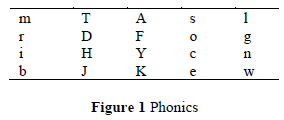
Figure 1 indicates the assessment of phonics. Learners' errors revealed confusion about the concepts /b/, /d/, /v/, /f/, /w/, /c/, /k/, and /p/. In most cases, Grade 3 learners could not decode letters into sounds. The graphic relationship between /k/ and /c/ was also commonly mistaken by learners and some participating teachers. Figure 2 indicates jumbled words.
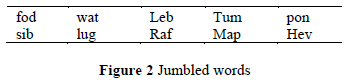
Based on Figure 2, the majority of learners did not score or score minimally on jumbled/nonsense word reading and could not advance to word and sentence reading. Other behaviour includes long pauses and the inability to sound out/say letters or words. Learners' reading scores are presented in Table 1.
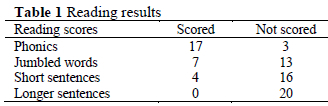
The classification of Grade 3 learners into emergent, developing, or independent readers based on assessment data scores on the RR was as follows. Of the 20 learners assessed, 13 (65%) were unable to start reading the narrative text. Using the adjusted assessment tool, four learners (20%) completed all reading quizzes. Additionally, 17 learners (85%) were able to read phonics, some jumbled words, short sentences, and longer texts, although they made errors in their reading.
Session 3: Participatory professional development
In this training session that lasted 2 hours, a reading lesson, conventions for assessing learners' reading proficiency, and calculating the RR score were practised. This training session was held at the school where one of the teachers presented the lesson. Teachers collaborated on the project and presented the reading lesson based on the week's theme: "Reduce, Reuse, Recycle" - a theme prescribed in the Grade 3 language curriculum. When teachers showcased their knowledge and skills, sight words and the spelling of difficult words from the text reading were practised and encouraged. After the lesson, teachers took an RR of individual learners' reading. The participating teachers commented and critiqued the lesson and assessment process. The majority of teachers found it difficult to use an RR to score the learners while reading. Clay (2000) describes the conventions for scoring records. These conventions include omissions, repeated errors, multiple errors and self-corrections, broken words, and insertions. The majority of the teachers scored correct (✓) marks instead of errors (x).
Focus-group Discussions
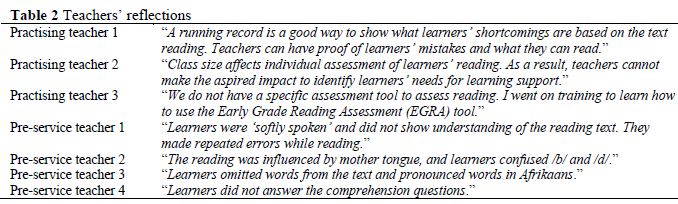
The following verbatim statements reflect the perspectives of practising and pre-service teachers on challenges and observations related to the PD training on reading assessment.
The participating teachers' responses in Table 2 reveal that while the RR is valued for identifying reading difficulties, challenges such as large class sizes and a lack of specific assessment tools are notable. Galang, Ancho, Dela Cruz and Dela Cruz (2021) suggest that class sizes should be small enough to allow teachers to focus on learners' individual needs, particularly in reading, which requires patience and guidance. The findings also highlight the influence of mother tongue and specific issues like confusing letters and the inability to comprehend text reading.
Discussion
In this study I determined how accurately teachers made inferences about Grade 3 learners' text reading using RR assessment during PD training. Action research methodology was used to collect data during three after-school practice sessions and focus-group discussions. Copeland and Keefe (2018) allude that if learners have sufficient skills to read a short passage, even at a very low reading level, a simple running record provides useful information about reading comprehension. RRs help determine the types of decoding errors that learners make and assess their understanding of the text.
The results show that learners' overall reading pace has influenced the accuracy of taking the RR. Furthermore, the results also show that the majority of the participating learners in Grade 3 read at an emergent literacy/basic reading level and did not have fluency and comprehension reading skills. This phenomenon may be attributed to teachers teaching phonics only. Phonics is a prerequisite for reading and writing. Teaching phonics focuses on building connections between sounds and the spelling patterns (graphemes) that represent them (Daud & Salamah, 2016). There is a need to move beyond individual letter-sound teaching and one-word responses in comprehension in Namibian classrooms.
The implication is that when teachers use different assessment strategies to assess text reading, they may capture accurate reading scores that may inform teaching interventions/learning support to increase learners' reading proficiency. According to Clay (2000), comprehension is dependent upon the level of difficulty in the text. Efficient word recognition is necessary for high-level reading comprehension (Cartwright & Duke, 2019; Perfetti & Stafura, 2014). Exposure to identifying multi-letter words, common syllables, and words with suffixes or affixes may improve learners' reading levels.
The findings reveal that a lack of mechanical knowledge of English prevented the participants from identifying linguistic structures of English linked to error behaviour. As a result, both pre-service and practising teachers could not make inferences about learners' reading. Learners' inability to decode letter sounds requires teachers' knowledge to identify repeated patterns of reading difficulties. Perfetti and Stafura (2014) indicate that failure in decoding defines a basic reading disability or dyslexia. However, the participating teachers understood the importance of phonics instruction for young readers but could not make inferences beyond phonics teaching about Grade 3 learners' reading. This limitation might be due to a lack of training or experience in applying more comprehensive reading assessment.
During the focus-group discussions it was revealed that there was a mismatch between what was taught to pre-service teachers and what was practised in schools. While this PD prepared pre-service teachers for practice, a practising teacher noted during a focus-group discussion that they did not have a specific tool for assessing reading. The EGRA tool, used in schools, is a standardised assessment tool for foundation literacy skills, and cannot identify specific reading behaviour that may guide learning support to increase reading proficiency. There is a need for Grade 3 teachers in Namibia to move beyond phonics teaching to the linguistic frameworks of language to develop reading proficiency. Using a broader approach to teaching reading helps learners decode words and enhances their understanding and use in sentences.
When teachers know how to identify patterns of reading errors, they may be able to design appropriate learning support. Perfetti and Stafura (2014) explain the processes of reading decoding, word identification, meaning retrieval, constituent building (sentence parsing), inferencing, and comprehension monitoring. These authors reveal that knowledge sources are used in constrained ways (e.g., decoding uses orthographic and phonological knowledge but not general knowledge) and in interactive ways (e.g., inferences use general knowledge and propositional meaning extracted from sentences). There is a disconnect between the teacher training provided to teachers and the practical needs they encounter in the classroom (Perfetti & Stafura, 2014). Targeted assessment can help teachers understand and support various stages of reading, from decoding to comprehension, thus bridging the gap between theoretical knowledge and practical application in teaching. The results of this study imply a need for more effective assessment tools such as RRs, consideration of linguistic diversity within the classroom setting, strategies to address the impact of class size on individual assessment, and opportunities for training teachers.
Recommendations
I recommend that effective assessment strategies should be implemented to identify learners' reading needs. I also recommend further research to identify the specific linguistic needs of Grade 3 teachers to tailor PD programmes that address English language learning needs to impact the reading outcomes of young learners.
Conclusion
In conclusion, I explored how accurately teachers inferred Grade 3 learners' reading abilities. While phonics instruction is vital, it is insufficient for developing Grade 3 learners' comprehensive reading skills. The study underscores the need for PD to enhance teachers' linguistic needs, instructional practices and assessment skills that may foster learners' reading development. The study contributes toward research in PD to refine teachers' assessment skills for learners' reading development.
Acknowledgement
I would like to extend my sincere gratitude to the early childhood education students who served as research assistants, as well as the Grade 3 teachers in the Kalahari circuit of Keetmanshoop who participated in this study, providing invaluable insights that contributed to the depth and success of my community participation and research.
Notes
i. Published under a Creative Commons Attribution Licence.
References
Adams MJ 1990. Beginning to read: Thinking and learning about print. Cambridge, MA: MIT Press. Available at https://files.eric.ed.gov/fulltext/ED315740.pdf. Accessed 14 October 2024. [ Links ]
Afflerbach P 2016. Reading assessment: Looking ahead. The Reading Teacher, 69(4):413-419. https://doi.org/10.1002/trtr.1430 [ Links ]
Breit-Smith A & Justice LM 2010. Building emergent literacy skills. In C Carnahan & P Williamson (eds). Quality literacy instruction for students with autism spectrum disorders. Lenexa, KS: AAPC Publishing. [ Links ]
Cartwright KB & Duke NK 2019. The DRIVE model of reading: Making the complexity of reading accessible. The Reading Teacher, 73(1):7-15. https://doi.org/10.1002/trtr.1818 [ Links ]
Clay MM 2000. Running records: For classroom teachers. Auckland, New Zealand: Heinemann. [ Links ]
Copeland SR & Keefe EB (eds.) 2018. Effective literacy instruction for learners with complex support needs. Baltimore, MD: Paul H. Brookes Publishing. [ Links ]
Daud B & Salamah U 2016. Teaching phonics and phonemic awareness in English beginning reading. English Education Journal, 7(3):329-340. Available at https://jumal.usk.ac.id/EEJ/article/view/4587/3960. Accessed 14 October 2024. [ Links ]
Dubeck MM & Gove A 2015. The early grade reading assessment (EGRA): Its theoretical foundation, purpose, and limitations. International Journal of Educational Development, 40:315-322. https://doi.org/10.4102/SAJIM.V20I1.926 [ Links ]
Eimann AM 2013. Running records as an assessment technique in K-1. MEd thesis. St. Louis, MO: University of Missouri-St. Louis. [ Links ]
Galang A, Ancho I, Dela Cruz A & Dela Cruz R 2021. Investigating student-teacher ratio as a factor in reading performance: The case of the Philippines. ETERNAL (English, Teaching, Learning, and Research Journal), 7(1):52-64. https://doi.org/10.24252/Etemal.V71.2021.A4 [ Links ]
Gove A & Wetterberg A (eds.) 2011. The early grade reading assessment: Applications and interventions to improve basic literacy. Research Triangle Park, NC: RTI Press. https://doi.org/10.3768/rtipress.2011.bk.0007.1109 [ Links ]
Grabe W 2010. Fluency in reading-Thirty-five years later. Reading in a Foreign Language, 22(1):71 - 83. Available at https://scholarspace.manoa.hawaii.edu/server/api/core/bitstreams/72012a09-6096-4fS5-94a0-a08dfc306e8f/content. Accessed 13 October 2024. [ Links ]
Guthrie JT 2004. Teaching for literacy engagement. Journal of Literacy Research, 36(1):1-30. https://doi.org/10.1207/s15548430jlr3601_2 [ Links ]
Haifidi E 2019. An evaluation of Early Grade Reading Assessment in Namibia [PowerPoint presentation]. [ Links ]
Hulme C & Snowling MJ 2011. Children's reading comprehension difficulties: Nature, causes, and treatments. Current Directions in Psychology Science, 20(3):139-142. https://doi.org/10.1177/096321411408673 [ Links ]
Irons A & Elkington S 2021. Enhancing learning through formative assessment and feedback (2nd ed). London, England: Routledge. https://doi.org/10.4324/9781138610514 [ Links ]
Kame'enui EJ & Simmons DC 1998. Beyond effective practice to schools as host environments: Building and sustaining a school-wide intervention model in beginning reading. OSSC Bulletin, 41(3):1-24. Available at https://files.eric.ed.gov/fulltext/ED418403.pdf. Accessed 13 October 2024. [ Links ]
McAfee O, Leong DJ & Bodrova E 2004. Basics of assessment: A primer for early childhood educators. Washington, DC: National Association for the Education of Young Children (NAEYC). [ Links ]
Molfese VJ, Beswick JL, Jacobi-Vessels JL, Armstrong NE, Culver BL, White JM, Ferguson MC, Rudasill KM & Molfese DL 2011. Evidence of alphabetic knowledge in writing: Connections to letter and word identification skills in preschool and kindergarten. Reading and Writing, 24:133-150. https://doi.org/10.1007/s11145-010-9265-8 [ Links ]
Morrison GS, Woika MJ & Breffni L 2020. Fundamentals of early childhood education (9th ed). Harlow, England: Pearson Education. [ Links ]
National Reading Panel 2000. Teaching children to read: An evidence-based assessment of the scientific research literature on reading and its implications for reading instruction (Reports of the Subgroups). Washington, DC: National Institute of Child Health and Human Development. Available at https://www.nichd.nih.gov/sites/default/files/publications/pubs/nrp/Documents/report.pdf. Accessed 13 October 2024. [ Links ]
Neuman SB 2004. The effect of print-rich classroom environments on early literacy growth. The Reading Teacher, 58(1):89-91. [ Links ]
NICHD Early Childcare Research Network (ed.) 2005. Child care and child development: Results from the NICHD study of early child care and youth development. New York, NY: The Guilford Press. [ Links ]
Perfetti C & Stafura J 2014. Word knowledge in a theory of reading comprehension. Scientific Studies of Reading, 18(1):22-37. https://doi.org/10.1080/10888438.2013.827687 [ Links ]
Puglisi ML, Hulme C, Hamilton LG & Snowling MJ 2017. The home literacy environment is a correlate, but perhaps not a cause, of variations in children's language and literacy development. Scientific Studies of Reading, 21(6):498-514. https://doi.org/10.1002/cae.22111 [ Links ]
Rasinski TV, Chang SC, Edmondson E, Nageldinger J, Nigh J, Remark L, Srsen Kenney K, Walsh-Moorman E, Yildirim K, Nichols WD, Paige DD & Rupley WH 2017. Reading fluency and college readiness. Journal of Adolescence & Adult Literacy, 60(4):45-460. https://doi.org/10.1002/jaal.559 [ Links ]
Saggion H 2017. Automatic text simplification. San Rafael, CA: Morgan & Claypool. [ Links ]
Schwanenflugel PJ & Benjamin RG 2017. Lexical prosody as an aspect of oral reading fluency. Reading and Writing, 30:143-162. https://doi.org/10.1007/s11145-016-9667-3 [ Links ]
Snow CE, Burns SM & Griffin P (eds.) 1998. Preventing reading difficulties in young children. Washington, DC: National Academy Press. [ Links ]
Strauss AM & Bipath K 2020. Exploring the influence of parents' home reading practices on emergent literacy. Journal for Language Teaching, 54(1):195-213. https://doi.org/10.4314/jlt.v54i1.5 [ Links ]
Stringer E 2019. Theory in educational action research. In CA Mertler (ed). The Wiley handbook of action research in education. Hoboken, NJ: John Wiley & Sons. [ Links ]
Teddlie C & Tashakkori A 2011. Mixed methods research: Contemporary issues in an emerging field. In NK Denzin & YS Lincoln (eds). The Sage handbook of qualitative research (4th ed). Thousand Oaks, CA: Sage. [ Links ]
Tomas MJL, Villaros ET & Galman SMA 2021. The perceived challenges in reading of learners: Basis for school reading programs. Open Journal of Social Sciences, 9:107-122. https://doi.org/10.4236/jss.2021.95009 [ Links ]
Whitehurst GJ & Lonigan CJ 2001. Emergent literacy: Development from prereaders to readers. In SB Neuman & DK Dickinson (eds). Handbook of early literacy research. New York, NY: The Guilford Press. [ Links ]
Wiggins G & McTighe J 2011. The understanding by design guide to creating high-quality units. Alexandria, VA: ASCD. [ Links ]
Received: 22 February 2024
Revised: 30 September 2024
Accepted: 17 October 2024
Published: 30 November 2024