



Servicios Personalizados
Revista

Articulo
 Inglés (pdf)
 Articulo en XML
 Referencias del artículo

 Traducción automática
 Enviar articulo por email
Indicadores
Links relacionados
-
 Citado por Google
-
 Similares en Google
Compartir

 Permalink

South African Journal of Surgery
versión On-line ISSN 2078-5151versión impresa ISSN 0038-2361
S. Afr. j. surg. vol.64 no.3 Cape Town 2026
https://doi.org/10.36303/SAJS.05030
UPPER GASTRO-INTESTINAL ENDOSCOPY
Diagnostic yield and appropriate use of an upper endoscopy service in a resource-constrained setting
J PapeI; M ScribaII; DA LevinIII; S HlatshwayoIII; SR ThomsonIII; M SetshediIII; G ChinneryII
IDivision of General Surgery, Department of Surgery, Groote Schuur Hospital, University of Cape Town, South Africa
IISurgical Gastroenterology, Department of Surgery, Groote Schuur Hospital, University of Cape Town, South Africa
IIIMedical Gastroenterology, Department of Medicine, Groote Schuur Hospital, University of Cape Town, South Africa
ABSTRACT
BACKGROUND: Oesophagogastroduodenoscopy (OGD) is an important diagnostic resource, but access remains limited in resource-constrained healthcare systems. Appropriate referral is therefore essential to maximise diagnostic yield while avoiding unnecessary use of limited endoscopic capacity. This study assessed the diagnostic yield and appropriateness of OGD referrals at a South African public-sector tertiary hospital.
METHODS: A retrospective observational study was conducted of adults undergoing index diagnostic OGD at Groote Schuur Hospital between 26 March 2018 and 25 March 2022. Demographic characteristics, indications, urgency and endoscopic findings were obtained from a prospectively maintained endoscopy registry. Referral indications were assessed against predefined British Society of Gastroenterology (BSG) red-flag criteria. Endoscopic findings were categorised as normal, mild, significant or malignant, with malignancy requiring histopathological confirmation. Multivariable logistic regression was used to identify factors independently associated with confirmed malignancy and significant endoscopic findings.
RESULTS: A total of 8 773 index diagnostic OGDs met the eligibility criteria. Among the 7 205 examinations for which appropriateness could be assessed, 80.2% met the BSG criteria. Complete endoscopic findings were available for 8 481 examinations; 18.6% were normal and 16.8% demonstrated significant non-malignant pathology. Of 406 examinations suspicious for malignancy, 323 were histologically confirmed (3.8% of the overall cohort). Older age and male sex were independently associated with malignancy. Dysphagia was the strongest indication associated with malignancy, with approximately eightfold higher odds, and was also independently associated with significant endoscopic pathology; weight loss and vomiting were additionally associated with malignancy.
CONCLUSION: This South African tertiary OGD service had a lower rate of normal examinations than reported internationally, while the malignancy detection rate was comparable. Dysphagia was the strongest clinical predictor of malignancy and significant endoscopic pathology. These findings provide a local baseline for OGD utilisation and support further evaluation and local validation of referral criteria.
Keywords: endoscopy, gastrointestinal, diagnostic yield, South Africa
Introduction
Oesophagogastroduodenoscopy (OGD) is a critical diagnostic resource used in the evaluation of upper gastrointestinal symptoms and detection of malignancy. However, it remains a scarce and costly tool, particularly in resource-constrained environments such as South Africa, where equitable access to specialist services is limited.1 Optimising the utilisation of OGD is vital to ensure timely diagnosis of serious pathology while maintaining cost-effectiveness and accessibility for a broader patient population.2
Gastric and oesophageal cancers are of particular concern. Globally, gastric cancer ranks fifth in incidence and fourth in cancer-related mortality, while oesophageal cancer is eighth in incidence and sixth in mortality.3 In South Africa, oesophageal and gastric cancers contribute substantially to the cancer burden.4 Early diagnosis is crucial, as it significantly improves patient outcomes; however, symptomatology is often non-specific in the early stages, complicating the diagnostic process.5
International guidelines, such as those issued by the British Society of Gastroenterology (BSG), advocate for endoscopy in the presence of "red flag" symptoms, including dysphagia, unexplained weight loss, persistent vomiting, and iron-deficiency anaemia.6 These criteria are designed to prioritise high-risk individuals, ensuring that limited resources are directed toward those most likely to benefit. Nevertheless, these guidelines were developed in high-income settings and often assume the availability of advanced diagnostics and well-resourced healthcare systems, assumptions that may not hold in limited-resource settings, such as the public healthcare sector in South Africa.2,7-9
Although South Africa is classified as an upper-middle-income country, substantial disparities exist between the public and private healthcare sectors.8,10,11 The public sector serves the majority of the population despite having substantially fewer healthcare personnel and financial resources.7,10,12 The number of gastroenterologists is also limited, estimated at 0.12 per 100 000 population compared with 1.41 in the United Kingdom and 3.9 in the United States, and below the recommended minimum of 0.22.8,11 Endoscopy infrastructure is similarly constrained, with services concentrated predominantly in urban centres and some units reliant on ageing or donated equipment.9
These constraints contribute to the development of "closed" referral systems, where patients are triaged through specialist review before endoscopy is scheduled. While this structure supports quality control and efficiency, it may also delay access. In contrast, "open access" systems used in higher-income countries, allow direct referrals by primary physicians, potentially increasing throughput but at the risk of higher rates of inappropriate procedures.13
International studies have shown that rates of normal endoscopy range from 16.8-53.2%,13-16 with appropriateness of referral varying widely depending on the system used. While some studies from Europe and Asia report malignancy detection rates between 1.7% and 5.2%,14,16 no such data currently exist from South Africa. The lack of locally validated guidelines or standardised referral pathways further complicates evaluation of service efficiency and appropriateness.
This study therefore aimed to assess the diagnostic yield and appropriateness of OGD referrals at a South African public tertiary-level hospital, using BSG red-flag criteria as an international benchmark rather than as locally validated criteria.6 We evaluated the proportion of normal endoscopies, the rate of histologically confirmed malignancy, and the association between referral indications and significant endoscopic findings. The findings were intended to provide a local baseline against which future referral pathways and locally appropriate criteria for prioritising OGD can be evaluated in resource-constrained settings.
Methods
Study design and setting
This was a retrospective observational study of adult patients undergoing index diagnostic OGD at Groote Schuur Hospital in Cape Town, South Africa, one of two major public-sector tertiary academic hospitals serving a catchment population of approximately 4.8 million people.17 The study period extended over four years, from 26 March 2018 to 25 March 2022. The manuscript was prepared in accordance with the Strengthening the Reporting of Observational Studies in Epidemiology (STROBE) guidelines.18
Patient selection
All adults aged 18 years or older who underwent an index diagnostic OGD through either the surgical or medical gastroenterology services during the study period were eligible for inclusion. Repeat and surveillance examinations, therapeutic or planned interventional procedures, and records with incomplete demographic or procedural data were excluded from the analysis.
Data collection
Data were extracted from the Groote Schuur Hospital Upper Gastrointestinal Surgery Registry, a prospectively maintained and ethically approved endoscopy registry (HREC R031/2015). This study received additional ethical approval from the University of Cape Town Human Research Ethics Committee (HREC 778/2022). No direct patient contact occurred, and all data were anonymised prior to analysis.
Collected variables included age, sex, urgency of procedure (emergent, urgent, elective), endoscopic indication, and procedural findings. Where biopsies were taken, histopathology results were obtained from the National Health Laboratory Service (NHLS) database. For patients who underwent multiple biopsies, all available reports were reviewed to confirm or exclude malignancy.
Classification of indications and findings
The appropriateness of each recorded indication for OGD was assessed retrospectively against the BSG guidance on indications for diagnostic upper gastrointestinal endoscopy.6 An indication was classified as appropriate when it met one or more of the specified BSG criteria, including dysphagia; unexplained upper abdominal pain with weight loss; an upper abdominal mass with or without dyspepsia; persistent vomiting with weight loss; unexplained weight loss; iron deficiency anaemia; unexplained worsening dyspepsia; unexplained and persistent recent-onset dyspepsia in patients over 55 years of age; persistent long-term reflux; or dyspepsia unresponsive to six weeks of treatment in primary care. These criteria were used as an international benchmark and were not considered to represent locally validated South African referral criteria.
Endoscopic findings were categorised as normal, mild, significant or malignant. A normal examination was defined as one in which no abnormality was identified. Mild findings comprised non-serious abnormalities, including gastritis, oesophagitis and hiatus hernia. Significant findings comprised clinically important non-malignant pathology, including ulcers, strictures and varices. Malignant findings were defined as lesions considered suspicious for malignancy at endoscopy and subsequently confirmed histologically.
The appropriateness assessment was based on the indication recorded in the registry and the predefined BSG criteria. Formal assessment of inter-rater variability was not performed.
Data analysis
Data were analysed using Microsoft Excel and IBM SPSS Statistics, version 30.0.0.0. Descriptive statistics were used to summarise demographic and clinical characteristics. Continuous variables were expressed as means with standard deviations or medians with interquartile ranges, according to the distribution of the data.
Univariate analyses were performed to identify factors associated with confirmed malignancy and with significant endoscopic findings. Pearson's chi-square test or Fisher's exact test was used, as appropriate. Variables demonstrating an association with the outcome at a p-value of < 0.10 on univariate analysis were subsequently entered into multivariable logistic regression models. The results of the logistic regression analyses were expressed as odds ratios with 95% confidence intervals and corresponding p-values. A two-sided p-value of < 0.05 was considered statistically significant.
Results
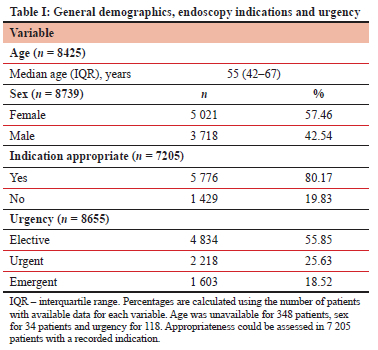
During the 48-month study period, 8 773 index OGDs met the eligibility criteria. The demographic characteristics, appropriateness of indications and urgency of procedures are summarised in Table I. The cohort had a median age of 55 years and comprised slightly more women than men. Among the 7 205 examinations for which appropriateness could be assessed, the majority met the predefined BSG red flag criteria. Elective procedures constituted the largest proportion of examinations, followed by urgent and emergent procedures.
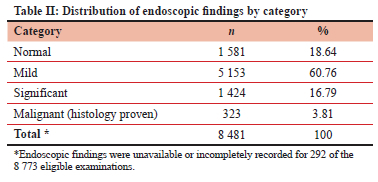
Endoscopic findings are presented in Table II. Of the 8 481 examinations with complete recorded findings, most demonstrated mild abnormalities, while approximately one in five examinations was normal. Significant non-malignant pathology was identified in a smaller proportion of examinations. Endoscopic examination raised suspicion of malignancy in 406 patients, of which histopathological assessment confirmed malignancy in 323 patients (3.8% of the overall cohort).
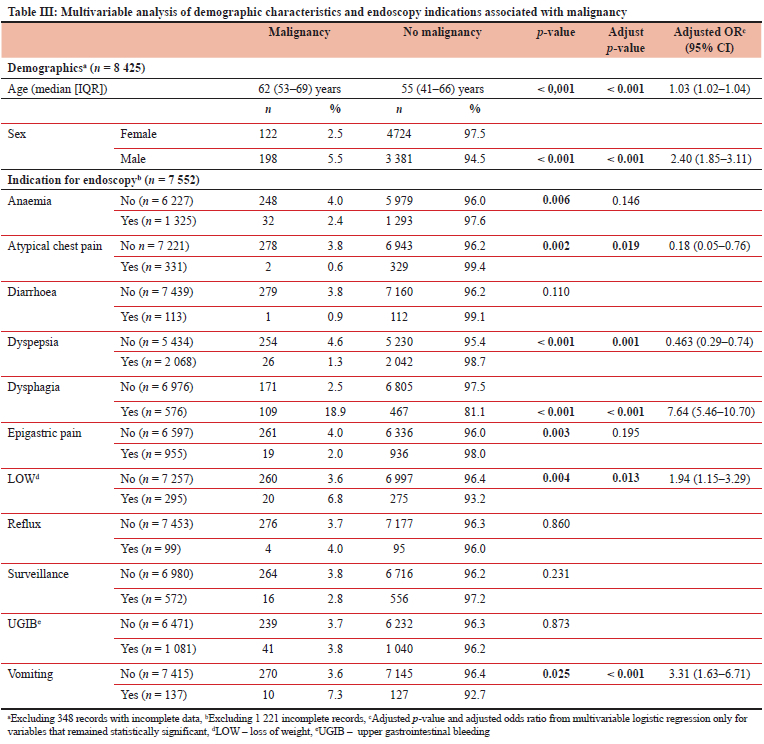
Multivariable analyses of factors associated with confirmed malignancy are shown in Table III. Patients with malignancy were older and more likely to be male than those without malignancy. Among the recorded indications, dysphagia was the strongest independent predictor of malignancy. Weight loss and vomiting were also independently associated with malignancy, whereas atypical chest pain and dyspepsia were associated with a lower likelihood of malignancy after adjustment. Other recorded indications did not demonstrate an independent association with malignancy.
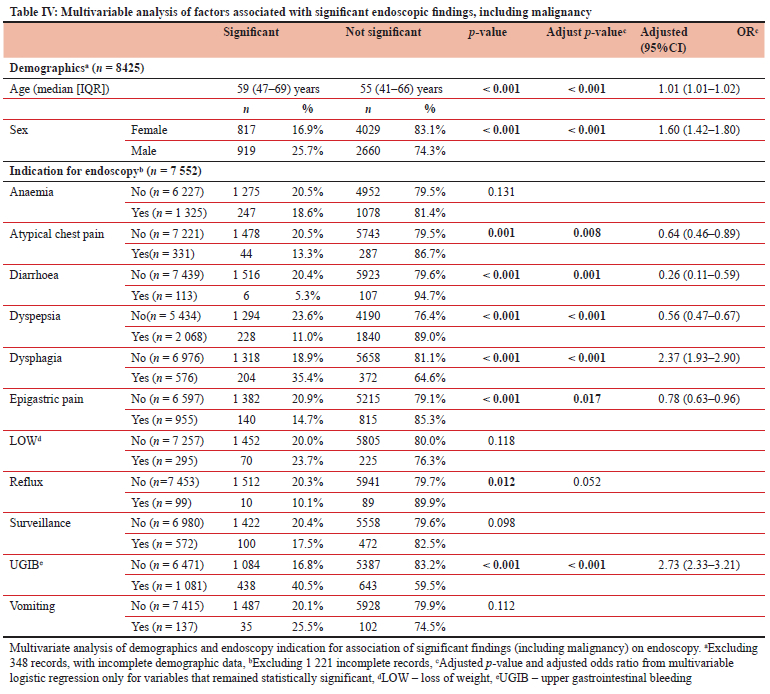
Factors associated with significant endoscopic findings, including malignancy, are shown in Table IV. Older age and male sex were independently associated with significant pathology. Dysphagia and upper gastrointestinal bleeding (UGIB) were the principal indications associated with an increased likelihood of significant findings. In contrast, atypical chest pain, diarrhoea, dyspepsia and epigastric pain were independently associated with a lower likelihood of significant pathology. Weight loss, reflux, surveillance and vomiting were not independently associated with significant findings after adjustment.
Discussion
To our knowledge, this is the first study to describe the diagnostic yield, appropriateness of referral and malignancy detection rate of an upper gastrointestinal endoscopy service in a South African public-sector tertiary hospital. Data from other African settings assessing the appropriateness of OGD referrals are limited. In this cohort, 80.2% of indications that could be assessed met the predefined BSG red-flag criteria. This was substantially higher than the 40-46% reported from the Netherlands and Italy, but comparable to rates reported from Portugal (82.7%) and Malaysia (88.3%).13-16
These differences should be interpreted cautiously because definitions of an appropriate referral and referral pathways vary between healthcare systems. The Dutch and Italian studies were conducted in open-access systems, in which primary care practitioners can refer patients directly for endoscopy, potentially increasing the proportion of inappropriate examinations.14,16 Conversely, specialist-mediated or "closed" referral systems may improve prioritisation but can also restrict access to patients whose symptoms are less specific. Thus, a high proportion of appropriate referrals cannot, by itself, be regarded as evidence of optimal utilisation. The objective is to balance avoidance of unnecessary procedures with timely investigation of patients with clinically important disease.
The lower rate of normal examinations in our cohort is relevant in this context. Only 18.6% of examinations were normal, compared with 36.1% in the Netherlands, 49.3% in Malaysia, 53.0% in Italy and 82.7% in Portugal.13-16 A Ghanaian study reported a normal endoscopy rate of 41.4%.19 Our lower rate, together with the high proportion of referrals meeting BSG criteria, may indicate effective selection of patients at higher risk of significant pathology. However, an alternative explanation is that patients with less severe or less specific symptoms may not reach endoscopy because of restricted access. South African patients may face substantial barriers including geographical distance from endoscopy services, transport costs, limited access to primary healthcare and complex referral pathways, with considerable differences in endoscopic availability between provinces.7,9,20 Consequently, the observed endoscopy population cannot be assumed to represent all patients in the catchment population who might potentially benefit from OGD.
This distinction is important because the study cannot determine whether patients who did not undergo endoscopy subsequently had significant pathology. The low normal-endoscopy rate should therefore not be interpreted simply as evidence of efficient triage, nor as evidence that the service is failing to investigate sufficient patients. The study period also included the COVID-19 pandemic, when less urgent procedures were frequently deferred or cancelled, potentially altering the pattern of referrals and findings. These factors limit the extent to which the observed normal-endoscopy rate can be regarded as representative of routine practice.
Despite the lower normal-endoscopy rate, the confirmed malignancy rate of 3.8% was similar to that reported in other international studies.14,16 This is noteworthy because a lower proportion of normal examinations might be expected to result in a higher proportion of detected malignancies if additional examinations were being directed towards high-risk patients. The finding may reflect effective selection of patients with significant disease, differences in the underlying prevalence of malignancy, or differences in the classification of endoscopic findings between studies. For example, the Malaysian study classified minor abnormalities as a negative or normal result.14 Such differences make direct comparison of diagnostic yield between healthcare systems problematic.
As in previous studies, older age and male sex were independently associated with malignancy.14,16 Smoking could not be assessed because of inconsistent recording in the registry. This is an important limitation because smoking is an established risk factor for upper gastrointestinal malignancy and is also associated with other pathology, including refractory peptic ulcer disease and peptic strictures. Future registry development should therefore incorporate consistent recording of smoking and other relevant clinical variables.
The strongest indication associated with malignancy was dysphagia, with approximately eightfold higher adjusted odds of malignancy compared with patients without dysphagia (OR 7.64, 95% CI 5.46-10.70). Almost one in five patients presenting with dysphagia had confirmed malignancy, compared with 2.5% of those without dysphagia. Dysphagia was also independently associated with significant endoscopic pathology. This strong association supports dysphagia as an important prioritising symptom when endoscopic capacity is limited. Its association with malignancy is consistent with its established role as an alarm symptom.21 Weight loss was also independently associated with malignancy, while the association with vomiting was less expected and should be interpreted cautiously until confirmed in other cohorts. When significant endoscopic findings, including malignancy, were considered as the outcome, dysphagia and UGIB were independently associated with significant pathology. This is clinically plausible, given the association of both symptoms with important structural and mucosal disease. Conversely, atypical chest pain, diarrhoea, dyspepsia and epigastric pain were independently associated with a lower likelihood of significant findings. The Ghanaian study similarly reported a negative association between dyspepsia and significant findings, as did the Portuguese study, while the other negative associations observed in our cohort have not been consistently reported in the comparable literature.15,19
These findings should not be interpreted as suggesting that patients with non-red-flag symptoms should be denied endoscopy. Dyspepsia, epigastric pain and other non-specific symptoms remain common clinical presentations, and the absence of a BSG red-flag symptom does not exclude significant pathology.6 Rather, the findings support the use of clinical characteristics to prioritise limited endoscopic capacity while recognising that clinical judgement remains essential. The BSG criteria were developed in a different healthcare environment and were used in this study as an international benchmark, not as validated South African referral criteria.
The principal limitation of this study is the retrospective use of registry data, with incomplete information requiring different analytic denominators. Age was unavailable for 348 patients, sex for 34, endoscopic findings for 292 examinations and indication data for 1 221 examinations. These missing data may introduce selection bias if incomplete recording was related to the indication, patient characteristics or endoscopic findings. Appropriateness was also assessed retrospectively from the recorded indication against predefined BSG criteria, without formal assessment of inter-rater variability. In addition, the registry included multiple endoscopists with differing levels of experience, potentially introducing variability in the recognition and recording of findings. These limitations highlight the importance of improving prospective data capture; mandatory fields for demographic, indication and procedural information are planned for the registry.
The study nevertheless provides an important local baseline. The combination of a relatively low normal-endoscopy rate, an 80.2% rate of indications meeting the predefined BSG criteria and a malignancy detection rate comparable with international reports suggests that the tertiary service is receiving a population enriched for clinically relevant pathology. Whether this represents optimal utilisation cannot be determined from diagnostic yield alone, because the study does not capture patients who were referred but did not undergo endoscopy. Future prospective and multicentre South African studies should therefore examine both patients undergoing OGD and those excluded or not referred and should evaluate whether international red-flag criteria adequately identify significant pathology in the local healthcare environment.
Conclusion
This study demonstrated a lower proportion of normal OGDs than reported in most comparable international studies, while the rate of confirmed malignancy was similar. Most indications that could be assessed met the predefined BSG red-flag criteria, and dysphagia was the strongest indication associated with malignancy and significant endoscopic pathology.
There is unlikely to be a single "ideal" normal OGD rate applicable to all healthcare systems. In South Africa, the appropriate balance will depend on disease prevalence, referral pathways, endoscopic capacity and access to alternative investigations. The present findings provide a baseline for future local and multicentre studies aimed at determining how international referral criteria can best be adapted and validated for the South African and wider African context.
Conflict of interest
The authors declare no conflict of interest.
Funding source
No funding was required.
Ethical approval
This study was approved by the University of Cape Town Human Research Ethics Committee (HREC 778/2022). No direct patient contact occurred, and all data were anonymised prior to analysis.
ORCID
J Pape https://orcid.org/0000-0002-2325-6231
M Scriba https://orcid.org/0000-0001-8903-0510
DA Levin https://orcid.org/0000-0003-4242-6715
S Hlatshwayo https://orcid.org/0000-0002-3152-5534
SR Thomson https://orcid.org/0000-0002-9485-997X
M Setshedi https://orcid.org/0000-0002-7979-2981
G Chinnery https://orcid.org/0000-0002-9097-8648
REFERENCES
1. Thomson S, Hair C, Oyeleke GK. Outside the training paradigm: Challenges and Solutions for endoscopy provision in resource-limited settings. Tech Innov Gastrointest Endosc. 2024;26(3):270-82. https://doi.org/10.1016/j.tige.2024.06.002. [ Links ]
2. Menachem T, Decker GA, Evans JA, et al; American Society for Gastrointestinal Endoscopy. Appropriate use of GI endoscopy. Gastrointest Endosc. 2012;75(6):1127-31. https://doi.org/10.1016/j.gie.2012.01.011. [ Links ]
3. World Health Organization. The Global Cancer Observatory. Available from: https://gco.iarc.fr/today/data/factsheets/cancers/7-Stomach-fact-sheet.pdf. Accessed 14 June 2023. [ Links ]
4. Statistics South Africa. Cancer in South Africa, 2008-2019. Pretoria: Statistics South Africa; 2023. Report No. 03-08-00. [ Links ]
5. Talley NJ, Vakil NB, Moayyedi P. American Gastroenterological Association technical review on the evaluation of dyspepsia. Gastroenterology. 2005;129:1756-80. https://doi.org/10.1053/j.gastro.2005.09.020. [ Links ]
6. British Society of Gastroenterology, The Association of Coloproctology of Great Britain and Ireland; Association of Upper Gastrointestinal Surgeons of Great Britain and Ireland. Guidance on the indications for diagnostic upper GI endoscopy, flexible sigmoidoscopy and colonoscopy. December 2019. Available from: www.bsg.org.uk/clinical-resource on 12 September 2022. [ Links ]
7. Loots E, Clarke DL, Newton K, Mulder CJ. Endoscopy services in KwaZulu-Natal Province, South Africa, are insufficient for the burden of disease: Is patient care compromised? S Afr Med J. 2017;107(11):1022-5. https://doi.org/10.7196/SAMJ.2017.v107i11.12484. [ Links ]
8. Perl D, Leddin D, Bizos D, et al. Endoscopic capacity in West Africa. Afr Health Sci. 2016;16(1):329-38. https://doi.org/10.4314/ahs.v16i1.44. [ Links ]
9. Watermeyer G, Van Wyk ME, Goldberg PA. Audit of provincial gastroenterology services in the Western Cape. S Afr J Surg. 2008;46(3):68-72. PMID: 18807301. [ Links ]
10. Mayosi BM, Benatar SR. Health and health care in South Africa - 20 years after Mandela. N Engl J Med. 2014;371(14):1344-53. https://doi.org/10.1056/NEJMsr1405012. [ Links ]
11. Okorafor OA. National Health Insurance reform in South Africa: Estimating the implications for demand for private health insurance. Appl Health Econ Health. 2012;10(3):189-200. https://doi.org/10.2165/11594830-000000000-00000. [ Links ]
12. Padarath AKJ, Mackie E, Casciola J. South African Health Review. Durban: Health Systems Trust, 2016. [ Links ]
13. Chan YM, Goh KL. Appropriateness and diagnostic yield of OGD: A prospective study in a large Asian hospital. Gastrointest Endosc. 2004;59:517-24. https://doi.org/10.1016/S0016-5107(04)00002-1. [ Links ]
14. Manes G, Balzano A, Marone P, Lionello M, Mosca S. Appropriateness and diagnostic yield of upper gastrointestinal endoscopy in an open-access endoscopy system: A prospective observational study based on the Maastricht guidelines. Aliment Pharmacol Ther. 2002;16:105-10. https://doi.org/10.1046/j.1365-2036.2002.01136.x. [ Links ]
15. Mangualde J, Cremers MI, Vieira AM, et al. Appropriateness of outpatient gastrointestinal endoscopy in a non-academic hospital. World J Gastrointest Endosc. 2011;3:195-200. https://doi.org/10.4253/wjge.v3.i10.195. [ Links ]
16. Crouwel F, Meurs-Szojda MM, Klemt-Kropp M, Fockens P, Grasman ME. The diagnostic yield of open-access endoscopy of the upper gastrointestinal tract in the Netherlands. Endosc Int Open. 2018;6(4):E383-E394. https://doi.org/10.1055/s-0043-123185. [ Links ]
17. World Population Review. Available from: https://worldpopulationreview.com/world-cities/cape-town-population. Accessed 12 July 2023. [ Links ]
18. Vandenbroucke JP, von Elm E, Altman DG, et al.; STROBE initiative. Strengthening the Reporting of Observational Studies in Epidemiology (STROBE): Explanation and elaboration. Ann Intern Med. 2007;147(8):W163-94. https://doi.org/10.7326/0003-4819-147-8-200710160-00010-w1. [ Links ]
19. Dakubo JC, Clegg-Lamptey JN, Sowah P. Appropriateness of referrals for upper gastrointestinal endoscopy. West Afr J Med. 2011;30(5):342-7. PMID: 22752822. [ Links ]
20. Nel D, Omar M, Chinnery G, Jonas E. Disparity in oesophageal cancer management in South Africa: A comparison between two tertiary centres with special focus on the palliation of dysphagia. S Afr J Surg. 2019;57(2):10-5. https://doi.org/10.17159/2078-5151/2019/v57n2a2842. [ Links ]
21. Fransen GA, Janssen MJ, Muris JW, Laheij RJ, Jansen JB. Meta-analysis: The diagnostic value of alarm symptoms for upper gastrointestinal malignancy. Aliment Pharmacol Ther. 2004;20(10):1045-52. https://doi.org/10.1111/j.1365-2036.2004.02251.x. [ Links ]
 Correspondence:
G Chinnery
Email: galya.chinnery@uct.ac.za