



Servicios Personalizados
Revista

Articulo
 Inglés (pdf)
 Articulo en XML
 Referencias del artículo

 Traducción automática
 Enviar articulo por email
Indicadores
Links relacionados
-
 Citado por Google
-
 Similares en Google
Compartir

 Permalink

South African Journal of Surgery
versión On-line ISSN 2078-5151versión impresa ISSN 0038-2361
S. Afr. j. surg. vol.64 no.3 Cape Town 2026
https://doi.org/10.36303/SAJS.04978
COLONOSCOPY
Colonoscopy quality indicators in a South African district hospital: a baseline assessment using international quality standards
AL GriffithsI; P NguyenII; E CoetzeeI; J PlaskettI, III; PN OmwansaIV; J FourieV; C NelVI
IDepartment of Surgery, Faculty of Health Sciences, University of Cape Town, South Africa
IISchool of Public Health, Department of Medicine, Faculty of Health Sciences, University of Cape Town, South Africa
IIIVictoria Hospital, South Africa
IVDepartment of General Surgery, Frere Hospital, South Africa
VDepartment of Medicine, Faculty of Health Sciences, University of Cape Town, South Africa
VIDepartment of Radiography, University of Pretoria, South Africa
ABSTRACT
BACKGROUND: Validated colonoscopy key performance indicators (KPIs) are widely used to assess and improve colonoscopy quality, but South Africa has no nationally endorsed framework for routine quality measurement. This study evaluated colonoscopy quality indicators in a South African district hospital using internationally recognised standards and established a baseline for future quality improvement.
METHODS: A retrospective quality assessment was performed at the gastrointestinal endoscopy unit of Victoria Hospital Wynberg, Cape Town. All lower gastrointestinal endoscopic procedures performed between June 2018 and April 2022 were reviewed. After exclusion of procedures in which complete colonoscopy was not intended or was not technically feasible, 610 examinations constituted the eligible colonoscopy quality-assessment cohort. Caecal intubation rate (CIR), adenoma detection rate (ADR), polyp detection rate (PDR) and bowel preparation quality using the Boston Bowel Preparation Scale (BBPS) were assessed against internationally recommended standards.
RESULTS: A total of 777 lower gastrointestinal endoscopic procedures were identified, of which 767 were available for analysis. Among 610 eligible colonoscopies, CIR was 89.0% (543/610), ADR 24.9% (152/610), and PDR 27.4% (167/610). Adequate bowel preparation (BBPS ≥ 6) was achieved in 65.1% (397/610). ADR and PDR were significantly higher in males than females (32.3% vs 19.4%, p = 0.005 and 35.0% vs 21.7%, p = 0.006, respectively). Colorectal cancer was detected in 83/744 procedures (11.2%).
CONCLUSION: Colonoscopy quality assessment using internationally recognised indicators is feasible in a South African district hospital. CIR and ADR closely approached international benchmarks, whereas adequate bowel preparation was substantially below the recommended standard. Despite this major deficiency in bowel preparation, ADR remained close to the international benchmark, identifying optimisation of bowel preparation as the principal opportunity for further quality improvement.
Keywords: colonoscopy, quality indicators, adenoma detection rate, caecal intubation rate, Boston Bowel Preparation Scale, South Africa
Introduction
Colorectal cancer (CRC) is an important cause of cancer-related morbidity and mortality worldwide, with an estimated incidence of 12.7 cases per 100 000 population in South Africa (SA).1 Colonoscopy remains the gold standard for the diagnosis of colorectal neoplasia and other colonic disorders because it permits direct mucosal visualisation, tissue sampling and therapeutic intervention.2 The effectiveness of colonoscopy, however, depends not only on access to the procedure but also on the quality with which it is performed.
Over the past two decades, international gastroenterology societies have recognised that variation in colonoscopy performance influences diagnostic accuracy, adenoma detection and ultimately patient outcomes. Consequently, evidence-based key performance indicators (KPIs), including adenoma detection rate (ADR), caecal intubation rate (CIR), bowel preparation quality and withdrawal time, have been developed to standardise performance, benchmark endoscopy services, and drive continuous quality improvement.3,4 Routine measurement of these KPIs is now a cornerstone of quality assurance in endoscopy units worldwide.
South Africa, however, has no nationally endorsed colonoscopy quality standards and therefore relies largely on recommendations developed in the United Kingdom and the United States. In the public sector, colonoscopy is performed predominantly for the investigation of symptoms, including iron-deficiency anaemia, rectal bleeding and chronic diarrhoea, as well as surveillance of known colorectal disease, because there is no population-based colorectal cancer screening programme. As endoscopy services continue to expand beyond tertiary referral centres, ensuring consistent measurement of recognised quality indicators across all levels of care has become increasingly important. Adequate bowel preparation is fundamental to high-quality colonoscopy because poor preparation is associated with incomplete examinations, missed lesions and repeat procedures. Among the validated scoring systems available, the Boston Bowel Preparation Scale (BBPS) provides an objective and reproducible assessment of bowel cleanliness after washing and suctioning and facilitates comparison between endoscopy units.5,6 A BBPS of equal to or greater than 6 (and specifically a score of at least 2 in each individual segment) is considered adequate preparation for optimal polyp detection.
Three South African studies from academic referral centres have reported colonoscopy KPIs.7-9 However, no published study has evaluated whether comparable quality standards can be achieved within a district-level hospital endoscopy service. Demonstrating the feasibility of structured KPI measurement in this setting is important for assessing the quality of care delivered beyond tertiary referral centres and for informing the development of quality assurance programmes across the South African public health sector.
The aim of this study was to assess colonoscopy KPIs at Victoria Hospital Wynberg (VHW), a district-level hospital in Cape Town, using internationally recognised quality standards. We also describe the clinical profile and indications of patients undergoing lower gastrointestinal endoscopy and establish a baseline assessment of colonoscopy quality against which future quality improvement initiatives can be measured.
Methods
Study design and setting
This retrospective quality assessment included all lower gastrointestinal endoscopic procedures performed at the gastrointestinal endoscopy unit of Victoria Hospital Wynberg (VHW), Cape Town, between 22 June 2018 and 21 April 2022. During the study period, colonoscopy services were provided by two experienced endoscopists. Data collection concluded when additional trainee endoscopists joined the unit, thereby maintaining a consistent operator cohort for assessment.
The study population comprised all procedures recorded in the unit's endoscopy database. Procedures undertaken for limited perioperative or therapeutic purposes, in which a complete colonoscopic examination was not intended, were excluded from the colonoscopy KPI analysis. The remaining procedures constituted the colonoscopy quality assessment cohort. Individual KPIs were analysed using the denominator appropriate to the procedure and quality indicator being assessed.
Endoscopy database and data collection
All procedures were identified from a prospectively maintained electronic endoscopy reporting database developed using FileMaker Pro (now Claris Pro; Claris International Inc., Santa Clara, California, USA). The database forms part of the routine clinical record and is completed contemporaneously by the endoscopists immediately following each procedure using structured reporting fields supplemented by free-text documentation and integrated endoscopic images.
All eligible lower gastrointestinal endoscopic procedures performed during the study period were extracted for analysis. Data were entered into a purpose-designed, pre-piloted Microsoft Excel database protected by password authentication and encryption. Access was restricted to members of the research team, and the principal investigator was responsible for maintaining data integrity and quality.
Data collected included patient demographics, indications, procedural findings and colonoscopy KPIs. Indications were categorised as investigation of symptoms, surveillance following previous colorectal neoplasia or polypectomy, screening of high-risk individuals, and other indications. Histopathology results were obtained from the National Health Laboratory Service electronic database. Conscious sedation using intravenous midazolam (2.5 mg) and fentanyl (50 μg) was administered in most patients.
Study outcomes and quality indicator definitions
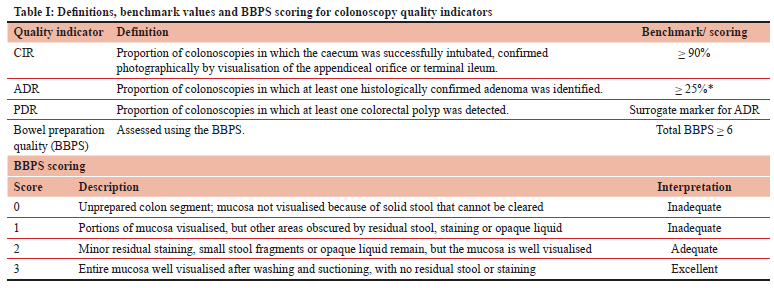
The primary outcome was assessment of colonoscopy quality using internationally recognised KPIs based on recommendations from the British Society of Gastroenterology and the US Multi-Society Task Force on Colorectal Cancer.3,10 The KPIs assessed were CIR, ADR, polyp detection rate (PDR), and bowel preparation quality using the BBPS. Definitions and benchmark values are summarised in Table I.
Caecal intubation was considered successful when the caecum was reached and confirmed by endoscopic visualisation and photographic documentation of the appendiceal orifice and/or terminal ileum. CIR was calculated among examinations in which caecal intubation was intended and technically feasible. Withdrawal time was not routinely recorded during the study period and was therefore not included as a KPI.
ADR was defined as the proportion of colonoscopies in which at least one histologically confirmed adenoma was identified. PDR was defined as the proportion of colonoscopies in which at least one colorectal polyp was detected and was analysed as a supplementary measure of lesion detection. Bowel preparation quality was assessed using the BBPS, with the colon divided into right, transverse and left segments, each scored from 0 to 3 after washing and suctioning. A total BBPS score of ≥ 6, with no individual segment scoring < 2, was considered adequate preparation.
Secondary outcomes included patient demographics, indications for lower gastrointestinal endoscopy, reasons for procedures not eligible for CIR and colorectal cancer detection.
KPI analysis
Of the procedures identified in the database, 10 were excluded because of missing data points or duplicate entries, leaving 767 procedures available for analysis of the lower gastrointestinal endoscopy cohort. A further 23 procedures involving limited perioperative or therapeutic interventions, in which a complete colonoscopic examination was not intended, were excluded from the colonoscopy quality assessment. A further 134 procedures were not eligible for the principal colonoscopy KPI analysis because caecal intubation was not intended or was technically impossible. The resulting 610 examinations constituted the eligible colonoscopy KPI cohort. CIR, ADR and PDR were assessed within this cohort. BBPS was assessed where a valid score was recorded.
Statistical analysis
Continuous variables are presented as means with standard deviations (SD) or medians with interquartile ranges (IQR), as appropriate. Categorical variables are summarised as frequencies and percentages.
Comparisons between categorical variables were performed using the χ2 test or Fisher's exact test where appropriate. Continuous variables were compared using t-test or the Wilcoxon rank-sum test according to data distribution.
Statistical analyses were performed using R version 4.2.2 (R Foundation for Statistical Computing, Vienna, Austria). Statistical significance was defined as a two-sided p-value < 0.05.
Study population
Between June 2018 and April 2022, 777 lower gastrointestinal endoscopic procedures were identified. After excluding 10 procedures with incomplete demographic data or duplicate entries, 767 procedures were available for analysis of the lower gastrointestinal endoscopy cohort. Twenty-three limited perioperative or therapeutic procedures in which a complete colonoscopic examination was not intended were excluded from the colonoscopy quality assessment, leaving 744 procedures for the broader colorectal cancer detection cohort. A further 134 procedures were not eligible for the principal colonoscopy KPI analysis because caecal intubation was not intended or was technically impossible. The resulting 610 eligible examinations constituted the principal KPI cohort (Figure 1).
Patient characteristics
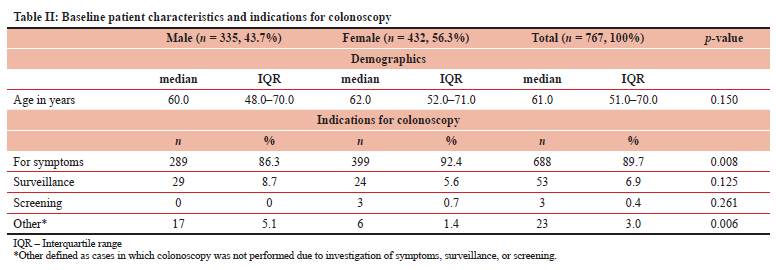
The median patient age was 61 years (IQR 49-71), and 43.7% of patients were male. The lower gastrointestinal endoscopy service was used predominantly for investigation of symptoms (89.7%), with surveillance examinations accounting for 6.9% and screening examinations for only 0.4% of procedures. The commonest indications were rectal bleeding, change in bowel habit, anaemia and abdominal pain (Table II).
Colonoscopy quality indicators
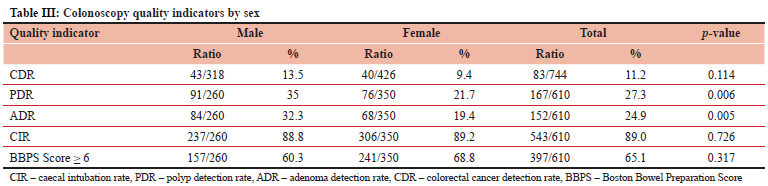
Among the 610 eligible colonoscopies, the overall CIR was 89.0% (543/610), PDR was 27.4% (167/610), and ADR was 24.9% (152/610). Colorectal cancer was identified in 11.2% (83/744) of the broader colonoscopy cohort.
Bowel preparation and sex differences
Adequate bowel preparation, defined as a BBPS score ≥ 6, was achieved in 397 of the 610 eligible colonoscopies (65.1%). PDR and ADR were significantly higher in males than females (35.0% vs 21.7%, p = 0.006 and 32.3% vs 19.4%, p = 0.005, respectively). There was no significant sex difference in CIR (91.2% vs 87.4%, p = 0.726), adequate BBPS (60.4% vs 68.9%, p = 0.317), or CDR (13.5% vs 9.4%, p = 0.114) (Table III).
Comparison with international benchmarks
Observed colonoscopy quality indicators were compared with internationally recommended performance standards (Table IV). The CIR of 89.0% closely approached the recommended minimum benchmark of 90%, while the ADR of 24.9% was marginally below the benchmark of 25% derived largely from average-risk screening populations. Adequate bowel preparation was achieved in only 65.1% of eligible colonoscopies, substantially below the recommended target of > 85-90%. The PDR was 27.4%; no universal international benchmark was applied to PDR.
Discussion
This study represents the first comprehensive assessment of colonoscopy quality indicators in a South African district hospital using internationally recognised quality standards. Overall performance approached accepted international benchmarks, with a CIR of 89.0% and an ADR of 24.9%. In contrast, only 65.1% of eligible examinations achieved adequate bowel preparation according to the BBPS. Although not all benchmark values were achieved, the study identifies bowel preparation as the principal modifiable quality deficit and establishes an objective baseline against which future quality improvement can be measured.
Colonoscopy is a highly operator-dependent procedure and unlike many surgical interventions, procedural quality cannot be verified retrospectively once the examination has been completed.7 Consequently, validated quality indicators have become the cornerstone of modern colonoscopy quality assurance. Routine measurement of KPIs allows endoscopy units to benchmark performance against accepted standards, identify deficiencies, implement targeted quality improvement interventions and monitor the effect of service changes over time.
South Africa currently has no nationally endorsed framework for routine measurement of colonoscopy quality indicators. Training pathways remain heterogeneous, quality metrics are inconsistently documented, and regular audit is uncommon outside selected academic centres.11 Consequently, objective data describing colonoscopy quality in district hospitals are scarce. The present study therefore provides important baseline information from a secondary-level public hospital and demonstrates that structured quality monitoring is feasible outside tertiary referral centres.
Colonoscopy quality indicators
The CIR is widely regarded as one of the fundamental indicators of technical competence in colonoscopy, reflecting the completeness of examination and the opportunity to detect proximal colonic pathology.3,10,12 The CIR of 89.0% in the present study was marginally below the internationally recommended benchmark of 90%, but compares favourably with previous South African reports, which have ranged from 80% at Charlotte Maxeke Johannesburg Academic Hospital (CMJAH) to 97% at Wits Donald Gordon Medical Centre (WDGMC).7-9 Differences in patient populations, procedural complexity and trainee involvement may account for some of this variation. Nevertheless, the findings demonstrate that internationally accepted completion rates are achievable within a district hospital setting.
ADR is widely regarded as the most important quality indicator for colonoscopy because of its established inverse relationship with interval colorectal cancer.13,14 In the present study, the ADR was 24.9%, closely approaching the internationally recommended benchmark of 25% and exceeding rates reported in previous South African series from Wits Donald Gordon Medical Centre and Groote Schuur Hospital.7-9 Interpretation of the 25% benchmark requires some caution, however, as it was derived largely from average-risk screening populations, whereas 89.7% of patients in the present study underwent colonoscopy for investigation of symptoms and fewer than 1% underwent screening.
A significant sex difference in adenoma detection was observed, with an ADR of 32.3% in males compared with 19.4% in females (p = 0.005). PDR showed a similar pattern, at 35.0% in males and 21.7% in females (p = 0.006). This male predominance in adenoma detection is consistent with both international and South African observations. Kruger and Thomson have also demonstrated variation in adenoma detection according to demographic characteristics within the South African population, highlighting the potential limitations of applying a single international ADR benchmark across populations with differing adenoma prevalence.8 The sex difference observed in the present study is therefore likely to reflect, at least in part, differences in underlying adenoma prevalence rather than endoscopist performance alone.
Importantly, the higher ADR in males was observed despite no significant sex difference in CIR or adequate bowel preparation, suggesting that the difference in adenoma detection was unlikely to be explained simply by differences in examination completion or bowel cleansing.
Bowel preparation was the principal quality deficit identified in this study. Only 65.1% of eligible colonoscopies achieved an adequate BBPS (≥ 6, with no individual segment < 2), substantially below the recommended target of 85-90%. This finding is important because the ADR of 24.9% nevertheless approached the international benchmark despite the poor bowel-preparation performance. The relatively high ADR may reflect the predominantly symptomatic case mix, the underlying prevalence of adenomas in this population and consistent performance by two experienced endoscopists. Nevertheless, the marked deficiency in bowel preparation represents the clearest modifiable opportunity for further improvement in lesion detection and examination quality.
Since the conclusion of this study, the VHW unit has incorporated the recording of withdrawal time of all colonoscopies, as well as adopted a lower volume bowel preparation polyethylene glycol (PEG) agent with improved patient tolerance. A multilingual information leaflet has also been designed to improve split bowel preparation adherence. A follow-up audit after implementation of these changes is planned.
Conclusion
This study demonstrates that measurement of internationally recognised colonoscopy KPIs is feasible in a South African district hospital. Overall performance approached accepted international benchmarks, with a CIR of 89.0%, an ADR of 23.0%, and objective assessment of bowel preparation using the BBPS. These findings establish an important baseline assessment of colonoscopy quality against which future quality improvement initiatives can be measured. The study also identified bowel preparation as the principal modifiable determinant of quality. Despite suboptimal bowel cleansing, adenoma detection remained close to international standards, suggesting that optimisation of bowel preparation may provide the greatest opportunity for further improvement in colonoscopy performance.
Conflict of interest
The authors declare no conflict of interest.
Funding sources
No funding was required.
Ethical approval
Ethical approval for the study was obtained from the Human Research Ethics Committee of the University of Cape Town (HREC Ref: 101/2023). The prospective endoscopy database used for data collection had previously received ethical approval from the same committee (HREC Ref: 617/2018).
ORCID
AL Griffiths https://orcid.org/0009-0000-9105-3738
P Nguyen https://orcid.org/0009-0003-0535-5978
E Coetzee https://orcid.org/0000-0001-7384-1386
J Plaskett https://orcid.org/0000-0002-9917-3475
PN Omwansa https://orcid.org/0009-0002-0867-9305
J Fourie https://orcid.org/0009-0007-7741-047X
C Nel https://orcid.org/0009-0003-3949-4052
REFERENCES
1. Sung H, Ferlay J, Siegel RL, et al. Global Cancer Statistics 2020: GLOBOCAN estimates of incidence and mortality worldwide for 36 cancers in 185 countries. CA Cancer J Clin. 2021;71(3):209-49. https://doi.org/10.3322/caac.21660. [ Links ]
2. Shaukat A, Kahi CJ, Burke CA, Rabeneck L, Sauer BG, Rex DK. ACG Clinical Guidelines: Colorectal cancer screening 2021. Am J Gastroenterol. 2021;116(3):458-79. https://doi.org/10.14309/ajg.0000000000001122. [ Links ]
3. Rex DK, Johnson DA, Anderson JC, et al. American College of Gastroenterology guidelines for colorectal cancer screening 2009 [corrected]. Am J Gastroenterol. 2009;104(3):739-50. https://doi.org/10.1038/ajg.2009.104. [ Links ]
4. Williams JE, Holub JL, Faigel DO. Polypectomy rate is a valid quality measure for colonoscopy: Results from a national endoscopy database. Gastrointest Endosc. 2012;75(3):576-82. https://doi.org/10.1016/j.gie.2011.12.012. [ Links ]
5. Kastenberg D, Bertiger G, Brogadir S. Bowel preparation quality scales for colonoscopy. World J Gastroenterol. 2018;24(26):2833-43. https://doi.org/10.3748/wjg.v24.i26.2833. [ Links ]
6. Lai EJ, Calderwood AH, Doros G, Fix OK, Jacobson BC. The Boston bowel preparation scale: A valid and reliable instrument for colonoscopy-oriented research. Gastrointest Endosc. 2009;69(3 Pt 2):620-5. https://doi.org/10.1016/j.gie.2008.05.057. [ Links ]
7. Bouter C, Barrow P, Bizos D, et al. The 'ins and outs' of colonoscopy at Wits Donald Gordon Medical Centre, South Africa: A practice audit of the outpatient endoscopy unit. S Afr Med J. 2020;110(12):1186-90. https://doi.org/10.7196/SAMJ.2020.v110i12.14419. [ Links ]
8. Kruger J, Katsidzira L, Setshedi M, Thomson SR. Prevalence and characteristics of incidental colorectal polyps in patients undergoing colonoscopy at a South African tertiary institution. S Afr Med J. 2020;110(12):1191-4. https://doi.org/10.7196/SAMJ.2020.v110i12.14582. [ Links ]
9. Mahomed AD, Cremona E, Fourie C, et al. A clinical audit of colonoscopy in a gastroenterology unit at a tertiary teaching hospital in South Africa: Original. South African Gastroenterology Review. 2012;10(3):9-15. [ Links ]
10. Rees CJ, Thomas Gibson S, Rutter MD, et al. UK key performance indicators and quality assurance standards for colonoscopy. Gut. 2016;65(12):1923-9. https://doi.org/10.1136/gutjnl-2016-312044. [ Links ]
11. Katsidzira L, Thomson S. Colonoscopy practice in South Africa: The way forward. S Afr Med J. 2020;110(12):1144-5. https://doi.org/10.7196/SAMJ.2020.v110i12.15270. [ Links ]
12. Arditi C, Peytremann-Bridevaux I, Burnand B, et al. Appropriateness of colonoscopy in Europe (EPAGE II). Screening for colorectal cancer. Endoscopy. 2009;41(3):200-8. https://doi.org/10.1055/s-0028-1119626. [ Links ]
13. Corley DA, Jensen CD, Marks AR, et al. Adenoma detection rate and risk of colorectal cancer and death. N Engl J Med. 2014;370(14):1298-306. https://doi.org/10.1056/NEJMoa1309086. [ Links ]
14. Kaminski MF, Regula J, Kraszewska E, et al. Quality indicators for colonoscopy and the risk of interval cancer. N Engl J Med. 2010;362(19):1795-803. https://doi.org/10.1056/NEJMoa0907667. [ Links ]
 Correspondence:
E Coetzee
Email: emile@rectalsurgery.co.za