



Servicios Personalizados
Revista

Articulo
 Inglés (pdf)
 Articulo en XML
 Referencias del artículo

 Traducción automática
 Enviar articulo por email
Indicadores
Links relacionados
-
 Citado por Google
-
 Similares en Google
Compartir

 Permalink

South African Journal of Surgery
versión On-line ISSN 2078-5151versión impresa ISSN 0038-2361
S. Afr. j. surg. vol.64 no.2 Cape Town 2026
https://doi.org/10.36303/sajs.03692
TRAUMA SURGERY
Early experience with the Clavien-Dindo classification in a major trauma unit
HD MakhubeleI; TE LuvhengoI, II; MS MoengI
IDepartment of Surgery, Faculty of Health Sciences, University of the Witwatersrand, South Africa
IIDepartment of Surgery, Charlotte Maxeke Johannesburg Academic Hospital, South Africa
ABSTRACT
BACKGROUND: The Clavien-Dindo system is an essential traditional approach for classifying surgical complications. This research primarily aimed to evaluate and assess the use of the Clavien-Dindo classification (CD classification) to classify complications and determine in-hospital mortality rates among patients admitted to a level one trauma facility in Johannesburg, South Africa.
METHODS: Data were collected retrospectively over a period of two years. We excluded patients younger than 18 years and those with incomplete clinical records. Frequencies and percentages illustrated the distributions of categorical variables. The association of each continuous variable with the complications was evaluated using Pearson's chi-square or Fisher's exact test. A p < 0.05 was considered statistically significant.
RESULTS: One hundred and ninety-six records of patients who developed complications were reviewed, representing a 6.3% complication rate among patients admitted to the unit during this study period, with 87.2% males and a median age of 32 years across both sex groups. Penetrating injuries accounted for 69.4% of the cases. Grade I complications (34.2%) were the most commonly reported. Wound infections had the highest reported incidence, representing 21% of the cases. Most complications, comprising 63.8%, were associated with surgical procedures across all types of CD grades. The overall mortality rate was 9.2% (grade V).
CONCLUSIONS: Through this early experience we were able to test and demonstrate the applicability of the CD classification system within a real-world trauma population. This approach provides a structured method for documenting adverse events and facilitates comparability across centres. This audit demonstrated a high grade I complication rate and additionally highlighted several other trends, such as the prevalence of penetrating injuries in South Africa, and the impact of surgical procedures as a primary predictor of complications.
Keywords: Clavien-Dindo classification, morbidity, trauma, complications, mortality
Introduction
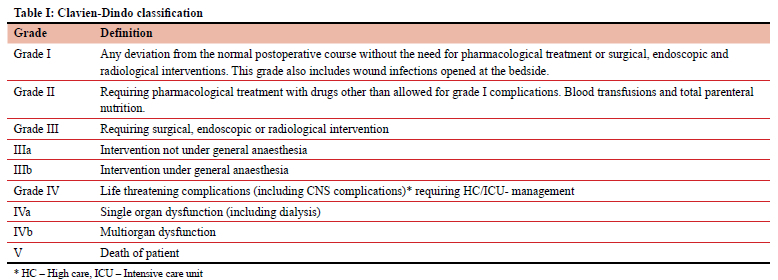
Trauma, both globally and within the South African context, continues to be one of the most prevalent causes of morbidity and a major risk for early death, particularly among young, healthy individuals lacking additional comorbidities and mortality risk factors.1 As of 2021, the World Health Organization estimated that over 4.4 million individuals worldwide die from injuries annually, representing nearly 8% of total global fatalities. Owing to South Africa's distinctive history of political conflict and racial division, interpersonal violence remains prevalent, and there is rising alarm over a surge in intimate partner violence.2 Trauma primarily affects males, with men being killed each year from injuries and violence at more than twice the rate of females.3 Similar to all individuals hospitalised, most trauma patients develop complications throughout their admission and treatment. However, women remain less likely than men to experience severe, life-threatening complications, indicating a survival advantage following traumatic injuries.4 Nonetheless, there is a paucity of data suggesting the reasons behind the male-to-female disparity, and studies on sexual dimorphism in trauma are still insufficient, particularly in low- to middle-income countries (LMICs).5 The CD classification is based on five established grades that relate to treatments applied to modify or correct a particular complication, evaluating complications consistently and objectively.5 The CD classification includes seven levels, as detailed in Table I.6,7
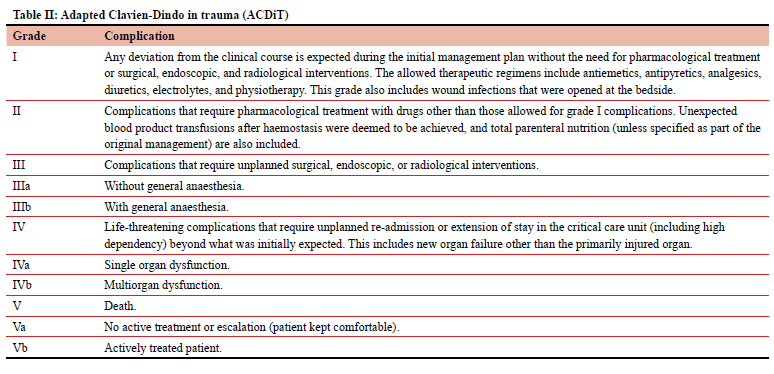
Historically, CD classification was designed for surgeries done electively and, by contrast, management of trauma patients has also evolved over the years. The CD classification is utilised in trauma, with the adapted Clavien-Dindo in Trauma (ACDiT) scoring system representing one of the modifications. In recent times, the ACDiT scoring system has gained much traction in its use for grading the severity of post-trauma complications in patients managed either surgically or non-operatively.8 The original Clavien-Dindo classification and the ACDiT scoring systems outline the complications that occurred and the treatments required. Therefore, it is vital to interrogate, paying particular attention to the limitations regarding how some of these investigators reported Clavien-Dindo complications after trauma. See Table II for the ACDiT scoring system.
Nonetheless, we also acknowledge various other systems employed to categorise surgical complications; however, at our institution, we regularly use the traditional CD system to record, classify, and report complications.
In this audit, we reviewed and assessed the records of patients who arrived at a single major trauma centre and utilised the CD classification for the complications they developed following admission and treatment. The objective was to assess and categorise the complications and in-hospital mortality rates, as seen in a high-capacity accredited level 1 trauma centre that caters to a vast catchment area and treats a substantial number of injured patients each day. By sharing our initial experiences with the CD classification system, we believe this will provide a strong basis for future studies, especially as it relates to complications in trauma patients.
Methods and materials
We collected data retrospectively from patients who were admitted to Charlotte Maxeke Johannesburg Academic Hospital (CMJAH) between 1 January 2018 and 31 December 2019. We excluded all persons under 18 years of age and those with incomplete or missing records. The information utilised was gathered from hospital records, trauma Medibanks, and CMJAH surgery REDCap.
The gathered data included patient demographics, mechanisms of injury (MOI), all complications as documented using the CD system and complications related to interventions. MOIs were classified into penetrating, blunt, and burn injuries. The complications for each patient were noted and adjusted to avoid duplication. We categorised complications into procedural and non-procedural groups for examination. We analysed and evaluated the presence or absence of complications, classified these complications based on CD grading, and determined the mortality rate in patients who had complications. The collected data were anonymised and entered into an Excel spreadsheet for further analysis. Frequencies and percentages were used to present categorical findings. The association between categorical variables and complications was evaluated using Pearson's chi-square or Fisher's exact test, as well as the t-test for continuous variables. Wilcoxon rank-sum tests were used to evaluate the differences between categorical variables and the difference in the medians along with interquartile ranges (IQR) for data that followed a normal distribution with p-value. A p-value under 0.05 was considered statistically significant. Statistical analysis was performed using STATA version 16 (College Station, Texas 77845, USA). Our intention focuses specifically on those cases which developed complications, thereby allowing a detailed appraisal of the classification system's utility.
Results
Demographics
Eight thousand nine hundred and fifteen (8 915) patients were seen in the CMJAH trauma unit emergency department for the study period. A total of 3 120 were admitted to the unit for various injuries. Out of the total number of patients admitted, 196 developed complications resulting in an overall complication rate of 6.3%. The vast majority, 171 (87.2%), consisted of males, while females accounted for 25 (12.8%). The patients had a median age of 32 years, with an interquartile range (IQR) of 27-33 years. The relationship between patient sex and CD grade was, however, not statistically significant (p = 0.120). Table III highlights this demographic data.
Mechanism of injury and complications
We divided the mechanisms of injury into penetrating, blunt and burns. The common injury pattern and mechanism of injury were penetrating in 69.2% of patients, blunt in 30.3%, and burns in 0.5% (Figure 1). In the cohort of penetrating trauma, the primary cause was gunshot injuries, followed by stab injuries. For patients with blunt injuries, the primary causes were motor vehicle and pedestrian vehicle collisions. We recorded scald injuries under burns.
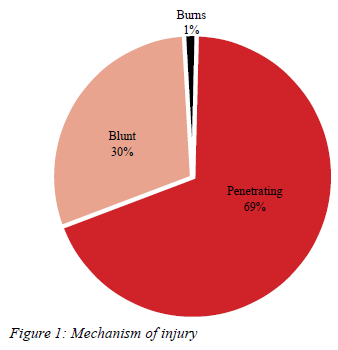
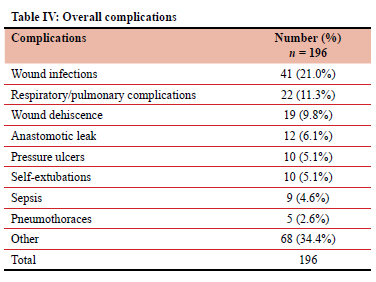
Table IV details the overall complications recorded in this cohort, which consisted of wound infections in 41 (21.0%) patients, respiratory/pulmonary complications in 22 (11.3%), anastomotic leaks in 12 (6.1%), pressure ulcers in 10 (5.1%), and self-extubation in 10 (5.1%) patients within the emergency department and intensive care unit (ICU). Infrequently occurring additional complications were classified as "other" and included venous thrombosis, thrombophlebitis, and compartment syndromes, along with various other complications with rare frequencies. Table V shows that CD grade I is the most frequently reported complication, with 67 (34.2%) occurrences, while grade IIIb complications closely follow with 48 (24.5%) cases. The Fisher's exact test was utilised to assess the association between surgical procedures as a predictor of complications across all levels (p = 0.002) in 125 (63.8%) cases (Table V).
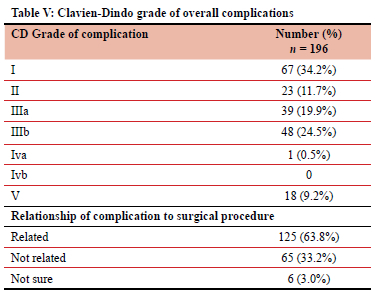
While male patients made up a larger portion of this group, complications resulting from penetrating trauma were more prevalent among them, with males 123 (91.1%) exhibiting a higher rate of complications than females 12 (8.9%). This showed statistical significance (p = 0.014). Eighteen patients accounted for grade V complications, comprising a mortality rate of 9.2%. We chose a more focused design, as expanding the scope to include all admissions would have altered the study question to one of incidence or risk factor epidemiology, which was not our objective. Instead, our narrower approach provides depth and granularity in describing complication types, grading, and reporting standards.
Discussion
The primary aim of this study was to evaluate and analyse the application of the CD classification in patients who develop complications during their admission to our facility. CMJAH is a quaternary and tertiary hospital, and its trauma unit provides undergraduate, postgraduate, and subspecialty training. Patient care in the unit is at all times consultant-driven, yet complications are still observed and recorded. Complications are documented throughout the patient's hospital stay, from admission through to disposition and discharge.
The majority of records are managed by medical officers, registrars, or fellows in training. The data collected from these registries may occasionally be subject to human errors, including the non-reporting of certain complications. We address this issue through weekly morbidity and mortality meetings (M&M), during which we systematically review patient records. Our weekly M&M meeting, along with high-quality grand rounds that include multidisciplinary presentations and discussions, ensures that moderation adheres to the highest standards. This serves as a platform for identifying areas for improvement and exchanging effective and best practices. Consequently, we rely on these results to initiate modifications and changes in our practice. M&M meetings have been recognised as effective educational tools for targeting initiatives aimed at reducing human error, a significant contributor to complications.9 The challenges and risks associated with inaccurately classifying patient complications are considered to influence the accuracy of results. Moreover, since this study is retrospective and relies largely on previously collected data, it has its limitations.
Despite the various classification systems utilised to evaluate complications in surgical patients, inconsistencies in recording adverse outcomes have rendered data analysis in surgical literature challenging and prone to bias.8,9 Prior to our institution implementing the CD reporting system, our recording of patient complications and outcomes was inconsistent, lacking uniformity and standardisation, which made it difficult to compare our results and outcomes with those from other centres. This audit did not intend to determine causality for complications; rather, we aimed to show through the gathered data that the CD classification can be an essential tool for defining patient outcomes.
The overall 6.3% complication rate in this cohort is lower than most local and international literature. The median age was 32 (27-37) years across both sexes, and no significant statistical difference (p = 0.120) was found between patient gender and CD classification grade. This audit revealed that females were less prone than males to experience complications following trauma. This trend may be attributed to the fact that trauma is primarily a male affliction, with men experiencing fatal injuries and violence at double the rate of women each year.2-5 This cohort further exhibited a notably high occurrence of penetrating injuries as the main cause of injury.
The Modified Clavien-Dindo classification was employed in a retrospective study at Sri Venkateswara Institute of Medical Sciences (SVIMS), India. They validated it as easy to use and categorised postoperative complications after nephrectomy. The most frequent complications in their study were grade I and II.10 The findings from this Indian group aligns with our findings locally. Table IV illustrates the significant complications identified in our study, highlighting the most commonly encountered complications in our unit. The most frequently recorded complication was grade I and the complication most commonly seen was septic wound complications, consistent with findings from multiple studies. The total mortality observed in our study population was recorded at a rate of 9.2%.
Acknowledging the difficulties in assessing and documenting complications in trauma using an evidence-based method, we implemented and evaluated the CD classification system to examine the various kinds of complications arising in admitted trauma patients. Table V shows the complications observed and documented based on the CD classification. It is important to mention that there have not been many studies published so far regarding the use of the CD classification in trauma. It is also fair to acknowledge that numerous studies in the current literature were conducted in high-income countries, predominantly within specialised trauma facilities. Another study in a low- to middle-income country (LMIC) setting assessed the significance of the CD classification across different surgical specialties. Their results indicated that the majority of complications were infections and arose following surgery.11
A minor correlation existed between complications and the type of surgical specialty (p < 0.0001); yet, they found that the degree of complications was partially influenced by surgical specialty. Our findings also support this postulation that the main predictor of complications is linked to surgical interventions across all levels (p = 0.002) in 63.8% of cases. Mentula et al.12 also validated the applicability of the Clavien-Dindo scale for complications in emergency surgical procedures through a retrospective analysis of 444 consecutive patients who underwent general emergency surgery within a three-month period. They determined and confirmed the relevance of the CD classification. In their research, preoperative organ impairment was an essential factor evaluated when postoperative organ failure happened. Furthermore, the kind of surgery was crucial to mention, particularly when detailing grade IV complications after the operation. This is in contrast to our cohort, which predominantly comprises of young and relatively healthy individuals.
The REASON study, a prospective, multicentre, observational investigation for non-cardiac surgical patients, showed that complications and mortality among older surgical patients aged 70 and above, the majority of whom had prior comorbidities, were frequently attributable to patient factors closely linked to mortality.13
In our study, sepsis was identified as a contributing factor to morbidity and extended hospital stays; thus, measures of swiftly identifying injured patients and transferring them to acute care facilities is crucial to reducing in-hospital complications, such as multi-organ failure.12 The CD classification is a component of counselling and informed decision-making process for patients prior to surgery.13,14 Various classification systems are used to evaluate complications in surgical patients, and a lack of uniformity in the reporting of adverse outcomes has made data interpretation in surgical literature cumbersome and subject to bias.14 It is for this reason that our institution has adopted the CD classification as a standard reporting system that increases the quality of reporting results and has the capability to compare and measure results from two different periods in time in a single-centre unit. Such a system can measure and compare results between two centres, along with the ability to estimate results of surgical versus non-surgical measures, enhance the capacity to perform a meta-analysis, and identify preoperative risk factors and prognostic scores.7
A preventable event or complication is always an anticipated or unexpected outcome of a procedure or injury that could have been avoided or greatly minimised.9,14 Our review has shown that quality control methods are crucial in preventing complications and can prevent severe outcomes if complications are accurately classified and treated with an appropriate approach. Prompt referral to specialised centres also remains a significant way to reduce morbidity in severely injured trauma patients. However, complications can arise at any point in the care process, and undergoing treatment at a higher level does not protect one from complications.
A merged prospective and retrospective, multicentre, international observational study by Naumann et al.15 applied the ACDiT scale to 484 trauma patients at various teaching University hospitals. The results presented a strong relationship between higher ACDiT grade category as well as lower hospital-free and ICU-free days (p < 0.01). Access to critical care forms a vital part of healthcare systems and the treatment of trauma patients.16 The scarcity of ICU beds, often experienced at our facility, contributes to the challenges of illness and complications that patients may encounter.
A major study utilising prospectively collected data compared mortality rates in trauma centres and non-trauma centres, showing that mortality reduced by more than 25% for patients under 55 treated in a designated trauma centre compared to those in a non-trauma unit.17 The grade V complication rate observed in this study appears higher than those reported internationally; however, it is crucial to note the limited data accessible for comparison, particularly in LMICs.
Trauma patients may be treated in one or more ways. Initially, based on the type of their injuries, a specific group of patients might benefit from non-surgical methods or approaches, particularly those who remain hemodynamically stable, as observed in most traumatic head and solid organ injuries. Interventional radiology has transformed trauma treatment and played a crucial role in reducing the incidence of complications associated with non-therapeutic surgical procedures. Finally, some individuals require additional surgical procedures to prevent residual complications.18 Adverse event data from KwaZulu-Natal, reported by Wain et al.,19 indicate that over half of all morbidity in their institution was attributable to preventable human error, highlighting the substantial impact of such errors on healthcare complications. This underscores the multifaceted nature by which complications can arise and accordingly managed. Bashir et al.20 identified the primary cause of adverse events as deficiencies in commission, omission, planning and execution. The authors concluded that effective communication is essential for reducing errors.
Limitations of this study
This was a retrospective single-centre analysis, and the reliance on already collected data may have resulted in a small sample size and the omission of certain patients from the study group, potentially due to inaccurate data recording and/or unreported relevant complications in the data system. This study audited our initial experience with CD classification in trauma. We believe that although the denominator is narrow, this study remains scientifically valid and appropriate and can serve as a basis for a future multicentre, prospective study that could potentially yield more important and relevant insights.
Conclusions
This study makes a valuable contribution since the literature often lacks detailed classification of complications in trauma, and this work complements rather than replaces broader epidemiological studies. The CD classification serves as a valuable tool, and we consistently utilise it in our local practice to document patient outcomes and facilitate comparability across centres. We determined through this preliminary work that grade 1 complications are the common complications, which may suggest the effectiveness of CD system and its intervention in less severe complications. Additionally, the main predictor of complications relates to surgical procedures at all tiers of care for trauma patients, which is consistent with findings in the international literature. We therefore recommend the strong application of the CD system in trauma, especially in LMICs.
Conflict of interest
The authors declare no conflict of interest.
Funding source
This research received no external funding.
Ethical approval
Ethical approval was obtained to conduct this study from the Human Research Ethics Committee (Medical) of the University of the Witwatersrand. Reference no: M221189 approved on the 6 January 2023.
ORCID
HD Makhubele https://orcid.org/0000-0002-2830-2436
TE Luvhengo https://orcid.org/0000-0002-2901-1809
MS Moeng https://orcid.org/0000-0001-7459-3388
REFERENCES
1. World Health Organization. Global burden of disease. 2021. Available from: http://www.cdc.gov/injury/wisqars/nonfatal.html. [ Links ]
2. Mathews S, Abrahams N, Martin LJ, et al. Every six hours a woman is killed by her intimate partner: A national study of female homicide in South Africa [Report no. 5]. Cape Town: Medical Research Council; 2004. [ Links ]
3. Peden M, McGee K, Krug E, editors. Injury: A leading cause of the global burden of diseaes-2000. Geneva: World Health Organization; 2002. Available from: https://www.who.int/publications/i/item/injury-a-leading-cause-of-the-global-burden-of-disease-2000. [ Links ]
4. Haider AH, Crompton JG, Oyetunji T, et al. Females have fewer complications and lower mortality following trauma than similarly injured males: A risk adjusted analysis of adults in the National Trauma Data Bank. Surgery. 2009;146(2):308-15. https://doi.org/10.1016/j.surg.2009.05.006. [ Links ]
5. Sperry JL, Minei JP. Gender dimorphism following injury: making the connection from bench to bedside. J Leukoc Biol. 2008;83(3):499-506. https://doi.org/10.1189/jlb.0607360. [ Links ]
6. Dindo D, Demartines N, Clavien PA. Classification of surgical complications: A new proposal with evaluation in a cohort of 6336 patients and results of a survey. Ann Surg. 2004;240(2):205-13. https://doi.org/10.1097/01.sla.0000133083.54934.ae. [ Links ]
7. Clavien PA, Sanabria JR, Strasberg SM. Proposed classification of complications of surgery with examples of utility in cholecystectomy. Surgery. 1992;111:518-26. PMID: 1598671. [ Links ]
8. Hutter MM, Rowell KS, Devaney LA, et al. Identification of surgical complications and deaths: An assessment of the traditional surgical morbidity and mortality conference compared with the American College of Surgeons - National Surgical Quality Improvement Programme. J Am Coll Surg. 2006;203:618-24. https://doi.org/10.1016/j.jamcollsurg.2006.07.010. [ Links ]
9. Clarke DL, Furlong H, Laing G, Aldous C, Thomson SR. Using a structured morbidity and mortality meeting to understand the contribution of human error to adverse surgical events in a South African regional hospital. S Afr J Surg. 2013;51(4):122-6. [ Links ]
10. Khan A, Palit V, Myatt A, et al. Assessment of Clavien-Dindo classification in patients > 75 years undergoing nephrectomy/nephroureterectomy. 2013;5(1):18-22. https://doi.org/10.4103/0974-7796.106959. [ Links ]
11. Pfeifer R, Tarkin IS, Rocos B, Pape HC. Patterns of mortality and causes of death in polytrauma patients: Has anything changed? Injury. 2009;40(9):907-11. https://doi.org/10.1016/j.injury.2009.05.006. [ Links ]
12. Mentula PJ, Leppaniemi AK. Applicability of the Clavien-Dindo classification to emergency surgical procedures: A retrospective cohort study on 444 consecutive patients. Patient Saf Surg. 2014;8:31. https://doi.org/10.1186/1754-9493-8-31. [ Links ]
13. Story DA, Leslie K, Myles PS, et al. Complications and mortality in older surgical patients in Australia and New Zealand (the REASON study): A multicentre, prospective, observational study. Anaesthesia. 2010;65:1022-30. https://doi.org/10.1111/j.1365-2044.2010.06478.x. [ Links ]
14. Dijkink S, Nederpelt CJ, Krijnen P, Velmahos GC, Schipper IB. Trauma systems around the world: A systematic overview. J Trauma Acute Care Surg. 2017;83(5):917-25. https://doi.org/10.1097/TA.0000000000001633. [ Links ]
15. Naumann DN, Vincent LE, Pearson N, et al. An adapted Clavien-Dindo scoring system in trauma as a clinically meaningful non-mortality endpoint. J Trauma Acute Care Surg. 2017;83(2):241-8. https://doi.org/10.1097/TA.0000000000001517. [ Links ]
16. Murthy S, Leligdowicz A, Adhikari NK. Intensive care unit capacity in low-income countries: A systematic review. Plos One. 2015;10:e0116949. https://doi.org/10.1371/journal.pone.0116949. [ Links ]
17. MacKenzie E, Rivara F, Jurkovich G, et al. A national evaluation of the effect of trauma-centre care on mortality. N Engl J Med. 2006;354:366-78. https://doi.org/10.1056/NEJMsa052049. [ Links ]
18. Lamb CM, Garner JP. Selective non-operative management of civilian gun-shot wounds to the abdomen: A systematic review of the evidence. Injury. 2014;45(4):659-66. https://doi.org/10.1016/j.injury.2013.07.008. [ Links ]
19. Wain H, Clarke DL, Wall S. A decade-long overview of adverse events in a tertiary surgical service in South Africa. S Afr Med J. 2024;114(10):e2035. [ Links ]
20. Bashir AA, Kong VY, Buitendag JJ, et al. An analysis of adverse events and human error associated with the imaging of patients at a major trauma centre in South Africa. S Afr Med J. 2019;109(9):693-7. https://doi.org/10.7196/SAMJ.2019.v109i9.13726. [ Links ]
 Correspondence:
HD Makhubele
Email: mgwenahd@gmail.com