



Servicios Personalizados
Revista

Articulo
 Inglés (pdf)
 Articulo en XML
 Referencias del artículo

 Traducción automática
 Enviar articulo por email
Indicadores
Links relacionados
-
 Citado por Google
-
 Similares en Google
Compartir

 Permalink

South African Journal of Surgery
versión On-line ISSN 2078-5151versión impresa ISSN 0038-2361
S. Afr. j. surg. vol.63 no.4 Cape Town 2025
https://doi.org/10.36303/SAJS.02492
TRAUMA SURGERY
The economic burden of traumatic brain injury at Pietersburg Hospital, Limpopo Province: a retrospective micro-costing study
SN PhalengI; TC HardcastleI, II
IDepartment of Surgery, University of KwaZulu-Natal, South Africa
IITrauma and Burns Unit, Inkosi Albert Luthuli Central Hospital, South Africa
ABSTRACT
BACKGROUND: Trauma cost studies have been limited in low-to middle-income countries (LMICs). The aim of the study was to calculate economic costs resulting from major trauma in those with brain injuries.
METHODS: This is a retrospective study of patients who sustained a traumatic brain injury (TBI) and injury severity score (ISS) >16 treated at Pietersburg Hospital in a 2-year period (January 2019 to December 2020). Theatre registers were used as starting point for data collection. Additional data was obtained from ICU and the neurosurgical ward. Data analysis utilised dual methods with both micro-costing and grossing models.
RESULTS: The review identified 83 patients. The most common mechanism of injury was assault with a blunt object (54.2%), followed by motor vehicle collisions (MVC) (16.9%). The mean length of stay for ICU admissions was 14 days, while ward admissions were 9.2 days. The most common diagnosis on CT scan was epidural haematoma with or without skull fracture (51.8%), followed by isolated skull fracture (21.8%). The average cost per admission was R572 925.00 for ICU patients and R244 503.00 for the ward stay.
CONCLUSION: The most common cause of TBI was assault. The cost of treating a patient with TBI was higher than in most studies and exceeded R50 000 per patient per day.
Keywords: trauma, brain injury, cost of care, economic impact, system planning
Introduction
Traumatic brain injury (TBI) is a brain dysfunction caused by a violent blow to the head. The damage can be open or closed.1 TBI is a growing international public health problem. In injured patients, TBI results in the greatest overall mortality and disability globally.2 Patients are classified as having mild TBI if Glasgow Coma Scale (GCS) is 13-15, moderate if GCS is 9-12 and severe if GCS < 9.3 However, GCS alone does not predict intracranial computer tomographic findings and also ignores the impact of associated injury. TBI can also be classified in terms head-specific abbreviated injury score (AIS), where a score of 1 refers to minor injury, scores of 2 moderate injury, and scores of 3-6 severe TBI. Injury severity score (ISS) is obtained by squaring each score for the three worst injuries in each of three body regions. A score of 16 or greater denotes severe injury.4 A TBI with a score of 3 or greater on the AIS is considered a severe TBI, especially when combined with one or more other moderate injuries in other regions, resulting in an ISS of equal or more than 16.
In low-to middle-income countries (LMICs) there is epidemiological and outcome data reported on TBI. Some scoping and systematic reviews have been conducted. A scoping review of 107 studies in sub-Saharan Africa by Adegboyega et al.5 revealed that TBI affects all age groups and sexes but was more common among young males between 20 and 40 years. Motor vehicle crashes (MVCs) caused TBI and craniectomies were the most commonly reported surgical treatment at 18.7%, followed by burr hole (7.5%). A systematic review of 136 articles on paediatric TBI also revealed that the most common mechanism of injury was MVC at 39%.6 A systematic review of 12 articles by Ryan-Cocker et al.,7 specifically addressing MVCs, found that the cost of illness was R200 498.30 with half of the included articles utilising both direct and indirect costs while the other half were only direct costs and only 1 covered rehabilitation costs. A systematic review of 13 articles with full economic evaluations in LMICs by Wesson et al.8 found that the mean cost of injuries ranged between R243.25 and R302 325.00. There were six articles examining MVCs, four including prehospital trauma care, two hospital-based trauma care and one only examined drowning. A study by Hode et al.9 on isolated traumatic brain injuries on direct medical costs without rehabilitation revealed that the cost for severe TBI was R10 585.00.
In South Africa, several studies on epidemiology and costs of TBI have already been conducted. A study in Pietermaritzburg found that the mechanism of injury of TBI was mainly interpersonal violence (39.4%), followed MVC/PVC (30.7%). The total direct costs over a 2-year period were R62 000 000 for isolated head injuries. The costs included analgaesia, laboratory, CT scan and cost of hospital stay but without including rehabilitation costs.10 Another study conducted in Durban, KwaZulu-Natal (KZN), found that in MVC/PVC patients admitted to the quaternary trauma ICU, the head was the most commonly injured region (26%), followed by chest (23%). The average cost per admission was R163 879.65 and average inpatient per day of R12 727.56.11 In that study mainly direct costs, which included procedure cost, medications, ICU costs, CT scan, laboratory costs, compensation of employees and goods and services, were assessed, again without including rehabilitation costs.
Limpopo Province has a population of 6 million. As a rural province, 85% of the population rely on public health facilities. There are no published cost studies in the under-researched province of Limpopo. Therefore, the aim of the study was to calculate the economic costs resulting from severe trauma (ISS > 16) in those with brain injuries as part of the injury pattern, in Limpopo Province.
Methods
Study design and setting
This was a retrospective cohort study conducted at Pietersburg Hospital from 1 January 2019 to 31 December 2020. Pietersburg Hospital is the only neurosurgical referral hospital in Limpopo Province. This hospital has 500 beds and 8 theatres. Trauma patients are managed either in ICU or general wards. There is no high care ward.
Study participants
All patients who sustained a TBI and with an ISS > 16 were included. Excluded were patients with incomplete documentation and those who died at the scene prior to hospitalisation.
Data collection
Theatre registers were the initial point for identifying those who met inclusion criteria. Additional data were obtained from the ICU and neurosurgical wards. A pre-defined data collection tool was used to collect information from theatre registers, ICU and the neurosurgery department.
Costs
This cost analysis used a dual method. Micro-costing (bottom-up approach) collects all the resources and adds all individual costs to achieve a total cost. Gross costing (top-down approach) estimates the cost per patient by retrospectively obtaining the cost of resources consumed.
Baseline costs were determined by the unified patient fee used in the state sector.
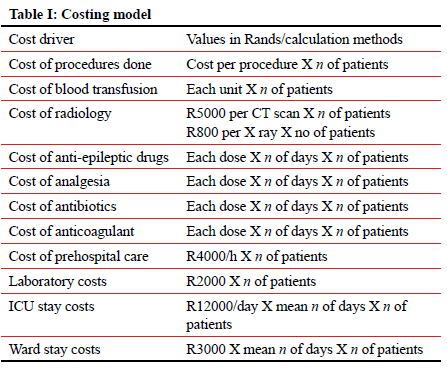
The direct cost-drivers, which included operative procedures, ICU stay, ward stay, drugs (analgesia, antibiotics, anti-epileptics and anticoagulants), blood tests, radiological investigations, blood transfusions and prehospital care transportation cost, intravenous fluids used, resuscitative procedures and oxygen administered, were calculated for each individual patient that met inclusion criteria. Formulae were used in keeping with the bottom-up approach and the costing model is shown in Table I.
Data analysis
Descriptive statistics were used to describe the demographic and clinical characteristics of the study participants. It included means and standard deviations for continuous variables, and frequencies and percentages for categorical variables. Inferential statistical methods were also employed to determine the effect of demographic and clinical factors on the total medical costs of patients. The comparison of mean costs between two-group variables (i.e. variables with only two outcomes) was determined using independent samples t-tests (i.e. sex, ICU stay, surgical procedures performed, etc.). Statistical significance was set atp < 0.05. All analyses were performed using IBM SPSS Statistics version 28.0 (IBM, Armonk, NY). Micro-costing calculated costs such as components, e.g. imaging, laboratory tests, surgical costs and ICU costs. The prehospital transfer costs for transfer to the tertiary facility were included as follows: transportation, in-transit interventions, medication and oxygen. Compensation of employees and services such as total salaries for medical doctors, nurses, allied health staff and administrative staff, goods and services which included cleaning and food, surgical consumables which included catheters, gloves, equipment, surgical devices (intracranial pressure monitors and intermittent pressure pumps) and nutrition (enteral and parenteral) calculated as gross-cost. Gross costing once accumulated was divided by number of inpatient days and multiplied by each patient length of stay in the unit and then equalised to total gross costing fee per patient. The micro-cost and gross-cost were added together. The cost per admission was the summation per each ICU or ward patient. The average cost per inpatient was total costs of patients divided by length of stay.
Results
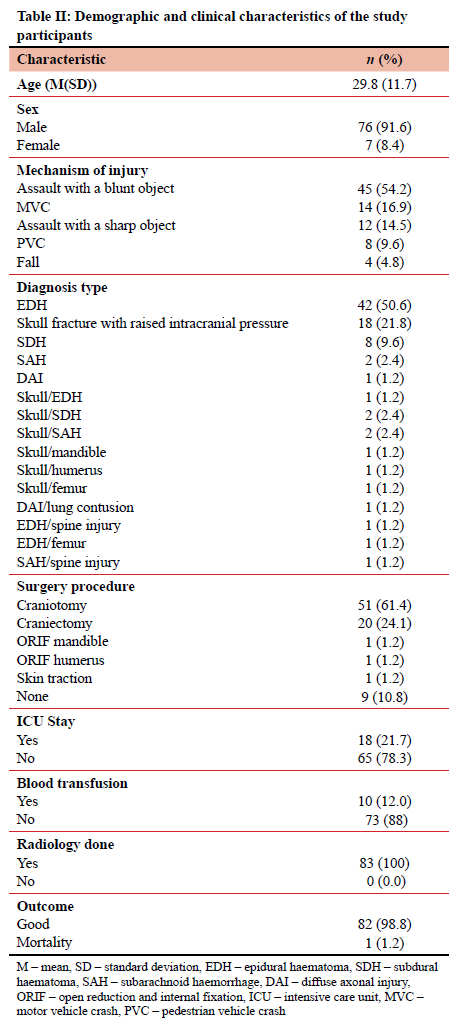
The retrospective review identified 83 patients with all forms of TBI. Males contributed 91.6% of patients. The mean age was 30 years. The most common mechanism of injury was assault with a blunt object at 54.2%, followed by MVC at 16.9%. This is outlined in Table II. The mean length of stay (LOS) in ICU was 14 days, while LOS in the ward was 9.2 days. This is outlined in Table III. All the patients had severe injury according to ISS, with a TBI present, irrespective of severity.
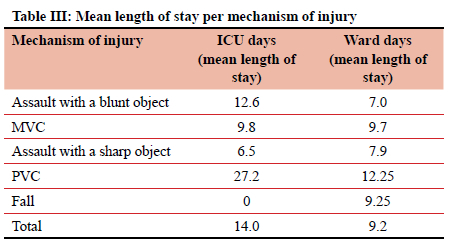
The mechanism of injury with the longest mean length of stay both in ICU and the wards was PVC as shown in Table III.
The most common diagnosis at the time of CT scan imaging was epidural haematoma (EDH) (51.8%) with or without associated skull fracture, followed by isolated skull fracture (19.2%). This is documented in Table II. Extracranial injuries contributed 6% of all the cases. Lung was involved in 1 case, spine 2 cases, femur 1 case and mandible l case. Compound fractures constituted 21.6% of all the cases. The 74 surgical procedures performed included craniotomies for evacuation of EDH (45.6%), followed by craniectomy for skull fracture (24.1%). Admission into ICU was 21.0%.
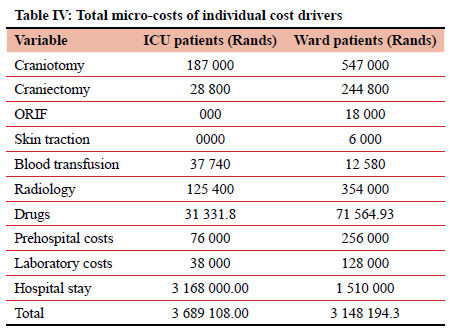
The total micro-cost for ICU was R3 689 108.00 while for the ward admissions costs were R3 148 194.3. The major cost drivers were length of stay (in-hospital bed cost) in both.
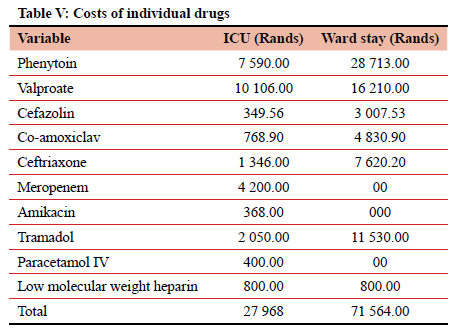
The most expensive drug used in ICU was valproate, while in the ward it was phenytoin.
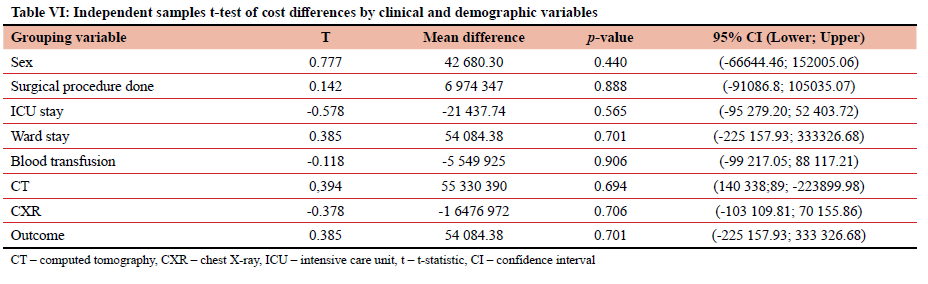
The statistical tests did not produce significant results (p > 0.05) which indicates that these factors did not contribute significant cost variations as shown in Table VI.
The gross cost for all patients was R100 004 499.50. Compensation of employees and services was R151 054 275.00, goods and services (cleaning, building and food) were R14 387 449.50 and surgical consumables (catheters, gloves, enteral and parenteral nutrition, surgical equipment including pumps and intracranial pressure monitors) were R10 089 913.00. The cost per ICU patient was R10 885 577.00 and for ward patients was R15 648 194. The average cost per ICU admission was R572 925.00 and for ward stay was R244 503.00.
Discussion
There are very few studies which estimated TBI costs in LMICs. A Pietermaritzburg study found that the most common cause of TBI was interpersonal violence (39.4%) and the total cost over a 2-year period was R62 000 000.10 Among the two methods, the micro-costing approach is considered the gold standard.10 In South Africa, cost analysis studies can only estimate the economic impact of violence (trauma) because of paucity of detailed data.12 In the SA setting, 82% of the population rely on public health services therefore health information, e.g. cost analysis, is crucial in planning, implementation, evaluation and management of healthcare resources.13-15 In the current study, young males were the most affected. Young males seem to be the most socially and economically active thus making them the most vulnerable victims of trauma. More social and educational programmes should be targeted to this group. The patient population in the current study is consistent with studies by Ogunleye et al.16 and Amare et al.17 which reported mean age of 37 years and 30 years respectively.
The most common mechanism of injury was assault at 68.9%. This concurs with the fact that there are more intentional injuries than non-intentional injuries in South Africa. This is due to free availability of weapons. There should be more prevention programmes aimed at reducing the burden of this kind of trauma, to reduce healthcare expense. More focus should be on improved law enforcement policies, adequate education and poverty eradication. This is consistent with studies by Messelu et al.18 (54%) and Ramdheen et al.19 (59. 7%). The most common radiological diagnosis was epidural haematoma (EDH) (49.4%). This is particularly strange because most local studies showed a predominance of subdural haematoma (SDH). This may be due to the way the assault cases happen, with direct blows, or may reflect a referral pattern unique to the Limpopo Province, with limited neurosurgical capacity. This finding is consistent with findings by Motah et al.,20 where the rate of EDH (31%) exceeded that of SDH (23.7%). This finding is contrary to previous studies by Maegele et al.21 and Tran et al.22 that demonstrated that SDH was the most common pathology at 47.1 % and EPH (9.6%), and 26% SDH and 11.7% EPH respectively; however, both of these studies were from high-income regions.
Locally, Tau et al.23 also reported the most common pathology to be SDH at 40% and EDH at 15%, Mamo et al.24 also reported a predominance of SDH at 24.8% and EDH at 22.8%, while Groshi et al.25 reported a predominance of intracerebral haemorrhage of 48%, SDH (42%) and EDH (8%). The most common surgical procedure performed was evacuation of EDH in 45.6%. This is not surprising since it is the most common radiological diagnosis. This obviously raises the general financial costs in this cohort of patients. This is consistent with Global Neurotrauma Outcomes Study (GNOS) by Clark et al.26 which reported that the most common procedure was evacuation of supratentorial haematoma at 31%.
In the study, the cost per each TBI admission was R572 925.00 for ICU admission and R244 503.00 for patients admitted in the wards. These costs are generally higher than those reported in many countries. Some of the costs reported are only based on micro-costs and do not include gross costs. The other reason why the costs appear higher is the fact that the mean length of stay of patients appears longer. The major cost driver was compensation of employees which included salaries of medical specialists and specialist nurses. In comparison with other previous studies, the ICU costs are higher than Mahomed et al.27 (R245 087. 00) in a combined ICU, who tend to have longer hospital stays due to seriousness of their illness (they used mixed methods assessment without rehabilitation and indirect costs), Fountain et al.28 which included complex neurosurgical patients requiring extensive interventions and where direct cost for both ICU and ward patients with 71.3% isolated head injuries (R485 276.00), but lower than Te Ao et al.29 from New Zealand with isolated severe head injuries (R660 334.68 for ICU and general ward costs with direct costs including rehabilitation and indirect costs).26 It is significantly higher than Pillay et al.11 (R163 879. 00) in trauma ICU (with mixed methods without rehabilitation and indirect costs), and Mahomed et al.27 (R157 883. 00). Also, the general ward costs are expectedly higher than an earlier study by Norberg et al.30 costing firearm injuries (with 16% isolated head injuries and including both ICU and ward cost) per patient per day at R7 286.70 and average per admission of R42 207.65 (which did not include staff salaries, laboratory, pharmacy and rehabilitation) and was conducted 14 years prior to the current study.
The costs of treating patients in a trauma centre are high and as part of this PhD study, one of the objectives was to look at possibilities of establishing a trauma system in Limpopo Province and investigate the trauma costs. The context is that return to functional community participation is higher in those treated in a well-designed trauma system. Future research should be aimed at identifying key factors which lead to increased occurrence of head injuries, the delay in patients obtaining CT scans and reviewing of the rehabilitation process and associated cost thereof. Trauma systems are underdeveloped in most countries of sub-Saharan Africa, and the average healthcare spending is low on trauma care, thus efficient and cost-effective planning is essential. Although treatment at a level one trauma centre is expensive, the benefits of this approach in terms of lives and quality adjusted life years outweighs costs.30,31
Limitations
It is a single centre study and there may be selection bias. The other main cost drivers, such as loss of income and rehabilitation costs were not considered; however, this is evidence of the limitations and underestimation that such costing studies create. Finally, the underuse of low molecular weight heparin in this patient cohort is not in line with standard of care and is an opportunity for clinical improvement.
Conclusion
The most common mechanism of injury is assault. The cost of treating patients with TBI is significant and affects the health budget in the rural setting, namely ICU admission per patient of R572 925.00 and ward stay per admission of R244 503.00.
Acknowledgements
I would like to acknowledge the administrative staff of Pietersburg Hospital for the retrieval of files.
Conflict of interest
The authors declare no conflict of interest. This work is part of a PhD in surgery for the lead author.
Funding source
No funding was required.
Ethical approval
Ethical approval was granted by University of KwaZulu-Natal BREC (BREC 9000039912022) and the Pietersburg Mankweng Research Ethics Committee (PMREC 300408006) as part of a PhD study on trauma in this under-researched part of South Africa.
ORCID
SN Phaleng https://orcid.org/0000-0001-8779-0436
TC Hardcastle https://orcid.org/0000-0002-3967-0234
REFERENCES
1. Ownbey MR, Pekari TB. Acute mild traumatic brain injury as assessment and management in acute setting: A review. Mil Med. 2021;1479(1/2):e47-e51. https://doi.org/10.1093/milmed/usab104. [ Links ]
2. Dewan MC, Rattani A, Gupta S, et al. Estimating the incidence of traumatic brain injury. J Neurosurg. 2019;130:1080-97. https://doi.org/10.3171/2017.10.JNS17352. [ Links ]
3. Centres for disease control and prevention. Reports to congress on traumatic brain injury in the US: Epidemiology and rehabilitation. National centre for injury prevention and control, Division of unintentional injury prevention, Atlanta, 2015. 2014. Available from: https://stacks.cdc.gov/view/cdc/29215/cdc29215-DS1.PDF. Accessed 27 March 2015. [ Links ]
4. Carrol CP, Cochran JA, Guse CE, Wang MC. Revision in severe traumatic brain injury: Mission accomplished or problems for future research. Ann Adv Automed Med. 2010;54:233-8. PMID:21050606. [ Links ]
5. Adegboyega G, Zolo Y, Sebopelo LE, et al. The burden of traumatic brain injury in Sub-Saharan Africa: A scoping review. World Neurosurg. 2021;156:e192-e195. https://doi.org/10.1016/j.wneu.2021.09.021. [ Links ]
6. Bandyopadhay S, Kawka M, Marks K, et al. traumatic brain injury-related paediatric mortality and morbidity in low- and middle-income countries: A systematic review. World Neurosurg. 2021;153:109-30. https://doi.org/10.1016/j.wneu.2021.06.077. [ Links ]
7. Ryan-Cocker MFD, Davies D, RinaldiG, et al. Economic burden of road traffic injuries in Sub-Saharan Africa. A systematic review of existing literature. BMJ Open. 2021;11;e048231.https://doi.org/10.1136/bmjopen-2020-048231. [ Links ]
8. Wesson HKG, Boikhutso N, Bachani AM, et al. The cost of injury and trauma care in low- and middle-income countries. A review of economic evidence. Health Policy and Planning. 2014;29:795-808. https://doi.org/10.1093/heapol/czt064. [ Links ]
9. Hode L, Madougou S, Fatigba HO, et al. The direct cost of treatment of traumatic brain injury in Sub-Saharan Africa country (Benin). World Neurosurg. 2016;99:210-13. https://doi.org/10.1016/j.wneu.2016.11.083. [ Links ]
10. Kong VY, Odendaal JJ, Bruce JL, et al. Quantifying the funding gap for management of traumatic brain injury at a major trauma centre in South Africa. S Afr J Surg. 2017:55(4):26-30. [ Links ]
11. Pillay RC, Kista Y, Hardcastle TC, Mahomed O. Intensive care unit costs associated with road traffic crashes at a central hospital in KwaZulu-Natal for the 2017/18 financial year. S Afr J Surg. 2021;59(2):47-51. PMID: 34212570. [ Links ]
12. Parkinson F, Kent SJW, Aldous C, et al. The hospital cost of road traffic accidents at a South African regional trauma centre: A micro-costing study. Injury. 2014;45(1):342-5. https://doi.org/10.1016/j.injury.2013.04.007. [ Links ]
13. KPMG Human and social services. Too costly to ignore: The economic impact of gender-based violence in South Africa (homepage on internet). Johannesburg. 2016. Available from: https://assets.kpmg.com/content/dam/kpmg/29pdf/2017/01/29. Accessed 24 August 2024. [ Links ]
14. Shaw V. Health information system reform in South Africa: Developing an essential data set. Bull World Health Organ (serial online). 2005;83:632-6. Available from: https://iris.who.int/handle/10665/269471. Accessed 24 August 2024. [ Links ]
15. Rommelmann V, Setel PV, Hemed Y, et al. Cost and results of information systems for health and poverty indicators for health in the United Republic of Tanzania. Bull World Health Organ (serial online). 2005;83:569-77. Available from: https://www.scielosp.org/pdf/bwh/2205,v38n8/569-577/en/. Accessed 24 August 2024. [ Links ]
16. Ogunleye OO, Shuaibu IS, Obanife HO. Epidemiological patterns of head injury in Bauchi, North-Eastern Nigeria. Acta Scient Neuro. 2021;4(5):27-32. https://doi.org/10.31080/ASNE.2021.04.0349. [ Links ]
17. Amare AT, Tesfaye TD, Ali AS. Survival status and predictors of mortality among traumatic brain injury patients in an Ethiopian hospital: A retrospective cohort study. Afr J Emerg Med. 2021;11(4):396-403. https://doi.org/10.1016/j.afjem.2021.06.003. [ Links ]
18. Messelu MA, Ayenew T, Shibabaw AT, et al. Outcomes and factors associated with traumatic brain injury patients admitted to ICU of comprehensive specialised hospitals in the Amhara region, 2022. A multi-centre retrospective cross- sectional study. Int J Africa Nurs Sci. 2023;19(3):100603. https://doi.org/10.1016/j.ijans.2023.100603. [ Links ].
19. Ramdheen S, Naicker B. Evaluating the burden of head injuries in a rural emergency department in South Africa. S Afr Fam Pract. 2021;63(1):5327. https://doi.org/10.4102/safp.v63i1.5327. [ Links ]
20. Motah M, Ndoumbe A, Massi DG, et al. Traumatic intracranial haemorrhages in Cameroon: Clinical features, treatment options and outcome. Interdisciplinary Neurosurg. 2021;26:101346. https://doi.org/10.1016/j.inat.2021.101346. [ Links ]
21. Maegele M, Lefering R, Sakowitz O, et al. The incidence and management of moderate to severe head injury. Dtsch Arztebel Int. 2019;116(10):167-73. [ Links ]
22. Tran TM, Fuller AT, Kiryabirwe J, et al. Distribution and characteristics of severe traumatic brain injury at Mulago National Referral Hospital in Uganda. World Neurosurg. 2015;83(3):269-77. https://doi.org/10.1016/j.wneu.2014.12.028. [ Links ]
23. Tau T, Kelly A, Lekgwara P. Predicting outcomes in patients with traumatic brain injury who undergo decompressive craniectomy at a single academic centre in Pretoria, South Africa. Interdisciplin Neurosurg. 2020;21:100753. https://doi.org/10.1016/j.inat.2020.100753. [ Links ]
24. Mamo DG, Ouma JR. The demographics of traumatic brain injury and in-patient costs in high dependency neurosurgical unit. A cross-sectional study in a tertiary academic hospital. Available from: https://wiredspace.wits.ac.za. [ Links ]
25. Groshi AGM, Enicker B. Factors influencing the outcome of patients with severe traumatic brain injury following road traffic crashes. S Afr J Surg. 2022;60(4):273-7. https://doi.org/10.17159/2078-5151/SAJS3599. [ Links ]
26. Clark D, Joainnedes A, Adeleye AO, et al. Casemix management and mortality of patients receiving emergency neurosurgery for traumatic brain injury in the Global Neurotrauma Outcomes Study (GNOS). A prospective observational cohort study. Lancet Neurol. 2022;21:438-49. https://doi.org/10.1016/j.bas.2022.101316. [ Links ]
27. Mahomed S, Mahomed OH. Cost of intensive care at a central hospital in South Africa. S Afr Med J. 2019;109(1):35-9. https://doi.org/10.7196/SAMJ.2018.v109i1.13268. [ Links ]
28. Fountain DM, Kolias AG, Laing RJ, et al. The financial outcome of traumatic brain injury: A single centre study. Br J Neurosurg. 2017;31(3):350-5. https://doi.org/10.1080/02688697.2016.1244254. [ Links ]
29. Te Ao B, Brown P, Tobias M, et al. BIONIC Study Group. Cost of traumatic brain injury in New Zealand: Evidence from a population-based study. Neurology. 2014;83(18):1645-52. https://doi.org/10.1212/WNL.0000000000000933. [ Links ]
30. Norberg NI, Nilsson T, Eriksson A, Hardcastle T. The cost of a bullet-inpatient costs of firearm injuries in South Africa. S Afr Med J. 2009;99(6):1-3. Available from: http://www.scielo.org.za/scielo.php/script=sci-arttext&pid=s0256. [ Links ]
31. Chao TE, Chu K, Hardcastle TC, et al. Trauma care and its financing around the world. J Trauma Acute Care Surg. 2024;9(7):e60-e64. https://doi.org/10.1097/TA.0000000000004448. [ Links ]
 Correspondence:
email: samphaleng73@gmail.com