



Servicios Personalizados
Revista

Articulo
 Inglés (pdf)
 Articulo en XML
 Referencias del artículo

 Traducción automática
 Enviar articulo por email
Indicadores
Links relacionados
-
 Citado por Google
-
 Similares en Google
Compartir

 Permalink

South African Dental Journal
versión On-line ISSN 0375-1562versión impresa ISSN 0011-8516
S. Afr. dent. j. vol.81 no.4 Johannesburg may. 2026
https://doi.org/10.17159/sadj.v81i04.23745
RESEARCH
Assessing Waiting Lists and Operational Challenges at Two Oral Health Centres in the Western Cape
N RampersadI; D SmitII; A AmodIII; S BataIV; BA DalvieV; MA KhanV; A LaryaVI; MA MauvliVII; MT RoykerVIII
IDepartment of Community Dentistry, University of the Western Cape
IIDepartment of Community Dentistry, University of the Western Cape
IIIUniversity of the Western Cape
IVDepartment of Community Dentistry, University of the Western Cape
VDepartment of Community Dentistry, University of the Western Cape
VIDepartment of Community Dentistry, University of the Western Cape
VIIDepartment of Community Dentistry, University of the Western Cape
VIIIDepartment of Community Dentistry, University of the Western Cape
ABSTRACT
BACKGROUND: Access to timely oral healthcare in South Africa is limited, particularly in the public sector where demand exceeds capacity. Long waiting times, resource constraints, and inequities in service distribution disproportionately affect low-income populations reliant on public oral health facilities.
AIM: To assess the status, management, and operational challenges of oral health service waiting lists at Tygerberg and Mitchell's Plain Oral Health Centres in the Western Cape, and to explore staff perspectives on system effectiveness.
METHODS: A descriptive cross-sectional mixed-method study was conducted using structured staff interviews and analysis of 14 official waiting lists. Purposive sampling identified staff directly involved in waiting list management. Quantitative data was analysed using descriptive and comparative statistics.
RESULTS: A total of 10,353 patients were on waiting lists, with an average waiting time of 25.2 months. Orthodontic and prosthetic services had the longest waits. Mitchell's Plain Oral Health Centre showed significantly longer waits compared to Tygerberg (38.4 vs 19.8 months). Most departments used hybrid systems, however, faced challenges such as high demands for services, among others.
CONCLUSION: Public oral health services face systemic delays and inefficiencies. Addressing digital infrastructure, human resources, and service decentralisation is vital to achieving equitable, timely care in alignment with national and global health goals.
Keywords: Oral health services, oral health waiting lists, health care equity
INTRODUCTION
Healthcare access is the ability of people to utilise health care services in a timely manner.1 Access to timely oral health care is essential to maintaining oral health and general well-being.2 In South Africa (SA), the private health sector services a small minority of the population, especially for specialised dental services.3 As a result, patients are forced to "desperately" seek oral health care in the public sector, either as the only option or if medical insurance funds are depleted. However, SA's public sector experiences long waiting times and overcrowding. This sector is unable to readily provide the services patients always require.4
Moreover, oral health SA remains underfunded and under prioritised, which leaves the population with a high burden of oral disease5 as well as unmet dental treatment needs.6 This disproportionately affects lower-income populations who rely on the public sector for dental care.5 Given the limited number of public-sector dentists, the system struggles to accommodate patient demand, thereby affecting access to timely and quality oral health care, resulting in delayed care6 and overcrowding at SAs academic hospitals and dental schools.4 In effort to meet the demands of the public health patients at tertiary-level dental schools, patients are often placed on a waiting list (often indefinitely) or wait for extended periods of time before receiving the appropriate dental treatment.4
Timely access to dental care is essential for maintaining oral health, as well as for preventing broader health complications and financial strain. Prolonged waiting periods, particularly those exceeding one year or involving over 1000 patients, have been associated with delayed rehabilitative treatments such as dentures and urgent root canal procedures. These delays can significantly impact patients, quality of life, disrupt daily functioning, and place added emotional and financial burdens on families.7 Moreover, untreated conditions may worsen over time, resulting in more complex and costly interventions, thereby increasing the overall burden on the health system.8
Notably, patients on long WLs experience high levels of anxiety and frustration, lower earning capacity, prolonged suffering as well as poorer health outcomes. Therefore, waiting to receive elective healthcare can be a considerable burden in a health system. In these instances, disease can become a chronic burden to patients whilst waiting for healthcare services.9
However, unlike the medical school counterparts, dental schools are naturally resource-intensive and require sufficient financing to perform optimally. Unfortunately, dental schools remain severely under-resourced to provide costly dental services. Typically, a dental school employs approximately 100 clinicians to, in turn, treat an average of 3,000 patients monthly. The massive demand for specialised dental services, coupled with academic responsibilities of clinicians, the resource-limited public oral health system as well as highly unaffordable private health care in South Africa, are a few, of the many, challenges facing dental services.4
Despite the growing burden of oral disease and increasing pressure on public oral health services, there remains a scarcity of South Africa-specific research examining the status and management of waiting lists within oral health systems. This gap limits understanding of how waiting lists function within the public sector and how they influence service delivery, patient access, and treatment outcomes. In the context of ongoing health system reforms, including the WHO Global Oral Health Strategy and Action Plan,10 South Africa's proposed National Health Insurance (NHI),11 and the National Oral Health Policy and Strategy (2024-2034).12 This evidence is essential to inform planning and resource allocation within the oral health sector.
Therefore, this study aims to evaluate the status, management, and perceived operational effectiveness and challenges of patient waiting lists for general and specialist oral health services, as reported by staff involved in these processes at Tygerberg (TBH) and Mitchell's Plain (MP) Oral Health Centres (OHCs) in the Western Cape Province, South Africa.
METHODS
Study Design and Setting
This study employed a descriptive cross-sectional design to assess the status and management of patient waiting lists at two major OHCs in the Western Cape, South Africa, namely, Tygerberg OHC and Mitchell's Plain OHC. The study focused on both general and specialist oral health care services and followed a quantitative methodological approach, allowing for the collection and analysis of numerical data related to patient volumes, waiting times, and system effectiveness.
Study Population and Sampling
The study population comprised two components, (1) all official patient waiting lists for general and specialist oral health services at the two centres during the data collection period, and (2) staff members directly involved in the scheduling, booking, or management of those lists. Services included in the analysis were prosthetic dentistry (full and removable partial dentures), fixed orthodontics, surgical extractions (including removal of impacted third molars), endodontic procedures (root canal treatment), crown and bridge work, and paediatric dental care under general anaesthesia.
A purposive sampling strategy was used to identify relevant waiting lists and to select staff who had direct administrative or clinical responsibilities in patient scheduling. These included booking clerks, dental assistants, department managers, and any other administrative personnel. The inclusion criteria required that all selected staff be actively engaged in patient booking and list management at the time of the study. Staff who declined to participate or were not involved in the relevant administrative functions, including temporary personnel, were excluded from the study.
Recruitment Procedures
Following ethical clearance and formal permission to conduct the study, recruitment involved communicating to department heads and relevant staff, who were provided with full details of the study and given the opportunity to voluntarily participate. To ensure minimal disruption to services, interviews and assessments were conducted at times convenient to each participant. All participants were informed of their right to withdraw at any point without consequence.
Data Collection
Data were collected using two complementary instruments to capture both objective waiting list data and staff-reported operational insights. The first instrument, a waiting list assessment tool, was used to extract quantitative data from official waiting list records. This included information on the number of patients per service, overall waiting list lengths, waiting times, as well as existing booking and scheduling practices.
The second instrument was a structured staff questionnaire, consisting predominantly of closed-ended items with a limited number of open-ended responses. This questionnaire was administered to staff involved in waiting list management and captured data on perceptions of waiting list usability, the operational effectiveness of booking systems, challenges associated with managing waiting lists, and administrative workflows and practices. All interviews were conducted in private offices to ensure participant privacy and comfort.
Both tools underwent face validity assessment, using the Face Validity Index,13 by the Manager of Dental Services and heads of departments across seven clinical areas to ensure clarity, relevance, and ease of use. Revision to the instruments were made based on their feedback, and the researchers received training to standardise procedures and reduce bias.
Measurement of Staff Perspectives
The staff interview tool explored the operational effectiveness and challenges of the waiting list systems. Respondents provided feedback on the adequacy of the booking process, administrative workflows, and perceived barriers to timely patient care. The structured components of the instrument enabled quantitative analysis of key trends. Open-ended responses were analysed using a content analysis approach, whereby similar responses were grouped into thematic categories and subsequently quantified to identify recurring patterns across the two sites. This approach allowed qualitative insights to be systematically integrated with quantitative findings.
Data Analysis
All data were captured, coded, cleaned, and analysed using Epi Info™. Descriptive statistics were used to summarise the data, including means and standard deviations (SDs) for continuous variables, and frequencies and percentages for categorical variables.
Given the small sample size (N = 14) and the non-normal distribution of variables, as assessed using the Shapiro-Wilk test, non-parametric statistical methods were applied. The Kruskal-Wallis H test was used to explore differences in waiting times and waiting list sizes across clinical service areas, while Spearman's rank correlation coefficient was used to assess relationships between variables such as waiting list size and perceived usability. Associations between categorical variables were examined using the Chi-square test of independence, with Fisher's exact test applied where assumptions for Chi-square were not met. Odds ratios (ORs) were calculated to estimate the likelihood of reported challenges associated with waiting list characteristics. However, due to the limited number of service units and the aggregated nature of the data, many findings were interpreted descriptively rather than relying solely on inferential statistical significance. A significance level of p < 0.05 and a 95% confidence interval were applied throughout.
To enhance the validity and depth of the analysis, data triangulation was used by integrating quantitative findings from waiting list records with staff-reported perceptions and operational insights. Quantitative indicators such as waiting times, patient volumes, and list sizes were examined alongside staff-reported challenges, usability concerns, and management practices. Areas of convergence between these data sources were used to corroborate key findings, while divergences were explored to identify gaps between recorded system performance and the operational realities experienced within clinics. This approach allowed for a comprehensive understanding of waiting list dynamics across both study sites.
Ethical Considerations
Ethical clearance for the study was obtained from the Biomedical Research Ethics Committee of the University of the Western Cape. Additionally, operational permission to conduct the research was secured from the Manager of Dental Services overseeing both the OHCs. Informed consent was obtained in writing from all participating staff members prior to data collection. On all data capture forms, a unique identifier based on the date and time of the interview was assigned to each record. Data captured electronically were stored on a password-protected, secure digital drive, while all paper-based documents are stored in a locked cabinet accessible only to the research team.
RESULTS
The status of patient waiting lists
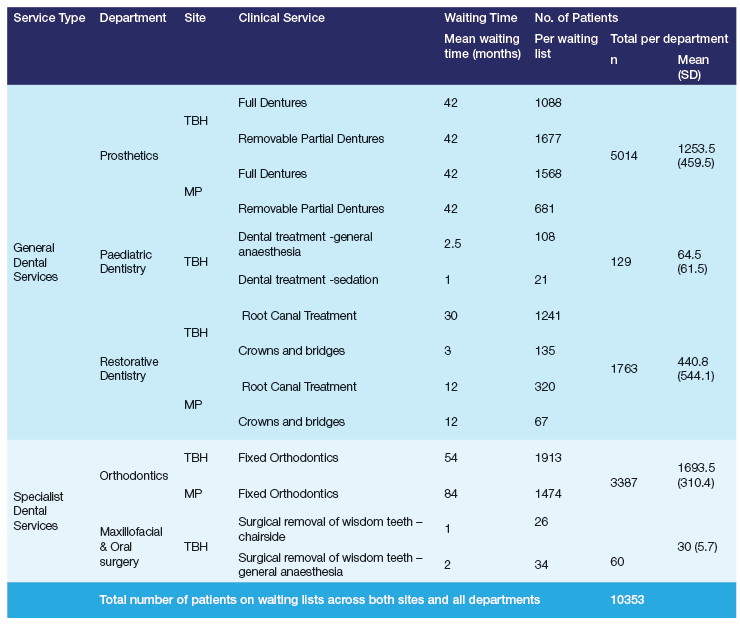
Table 1 describes the status of patient waiting lists (per clinical service area). A total of 10,353 patients were recorded across all departments on the official waiting lists of Tygerberg and Mitchell's Plain Oral Health Centres (OHCs). The overall mean waiting time for services at both facilities was 25.2 months, indicating a significant backlog in service delivery (Table I).
As described in the above table (Table I), Prosthetics and Orthodontics were the most overburdened departments, both of which recorded the highest patient volumes and the longest waiting times.
Orthodontics demonstrated the longest mean waiting time across both sites at 69 months, with site-specific figures reaching up to 84 months at the MP OHC and 48-60 months at TBH OHC. Prosthetics followed with a consistent 42-month average (ranging from 36-48 months), while restorative dentistry services recorded a mean waiting time of 14.25 months, exceeding one year. In contrast, Paediatric Dentistry and Maxillofacial & Oral Surgery (MFOS) demonstrated significantly shorter average waiting times of 1.75 months and 1.5 months, respectively.
These shorter durations are aligned with the lower number of patients on their respective waiting lists. However, it is important to note that MFOS services, specifically the surgical removal of wisdom teeth, employed a distinct booking system. Patients were required to initiate contact with the department, which differs from the formal waiting list approach used in other services.
Comparative analysis of waiting lists between both OHCs
A comparative analysis of the two Oral Health Centres (OHCs), presented in Table II, revealed differences in both patient volumes and average waiting times. The mean number of patients on the waiting list at Mitchell's Plain (MP) OHC was higher (822; SD = 603.91) than at Tygerberg (TBH) OHC (693.7; SD = 782.41). Similarly, the average waiting time at MP (38.4 months; SD = 29.58) exceeded that of TBH (19.8 months; SD = 21.93).
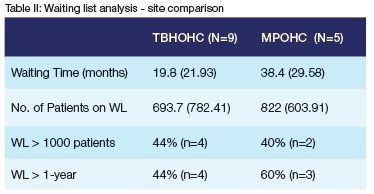
When analysed at the level of clinical service units (departments), these differences were not statistically significant (Mann-Whitney U = 12, p = 0.190). The substantial variability observed within both sites further supports cautious interpretation of these findings. Additionally, a higher proportion of departments at MP reported waiting times exceeding one year (60% vs 44%), while the proportion of departments with waiting lists exceeding 1,000 patients was similar between the two sites (40% vs 44%). However, these differences were also not statistically significant (Fisher's Exact Test, p > 0.05). Therefore, while Mitchell's Plain OHC consistently demonstrated longer waiting times and higher patient volumes, these findings should be interpreted as descriptive trends rather than statistically significant differences.
Further analysis identified that six waiting lists across the two centres each contained more than 1,000 patients, all with waiting periods exceeding 12 months.
Waiting list management, strategies, operational practices
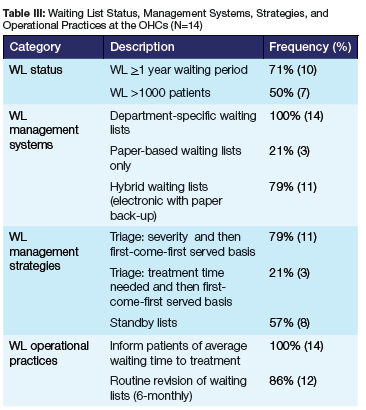
Table III describes a summary of waiting list management systems, strategies, and operational practices at the OHCs.
• Waiting list status
Substantial delays in patient access were observed, with 71% (n = 10) of departments reporting waiting lists exceeding one year. These prolonged delays were particularly notable in services such as orthodontics, root canal treatments, and prosthetic dentistry (both full and removable partial dentures) at both sites. Additionally, crown and bridge services at Mitchell's Plain OHC were affected. Half of the departments (50%; n = 7) reported waiting lists with more than 1,000 patients, concentrated in departments managing fixed orthodontics at both sites, full dentures at Mitchell's Plain, and prosthetics and endodontic services at Tygerberg.
• Waiting List Management Systems
All departments (100%; n = 14) operated department-specific waiting lists, which were not updated in real time. This siloed approach likely limited the ability to streamline referrals or redistribute caseloads between services. In terms of format, a hybrid model, which combines electronic systems with paper-based backups, was the most common and used by 79% (n = 11) of departments. However, 21% (n = 3), all located at Tygerberg, relied solely on paper-based systems. All departments at Mitchell's Plain used hybrid systems, indicating a higher level of digital integration at this site compared to Tygerberg.
• Waiting List Management Strategies
Both OHCs applied structured triage protocols for patient prioritisation. The most widely used method (79%; n = 11) involved assessing clinical severity, followed by a first-come-first-served principle. An alternative approach based on estimated treatment duration was applied in 21% (n = 3) of departments. Furthermore, standby lists which were used to manage no-shows and last-minute appointment availability, were present in 57% (n = 8) of departments and provided flexibility in handling patient flow. Notably, no departments reported using after-hours services or telehealth consultations, which could have enhanced capacity or reduced waiting times.
• Operational Practices
Across all departments, staff consistently reported informing patients about the estimated waiting time for treatment. Staff also offered guidance on alternative care pathways, including services at other public sector facilities or private practices. This practice reflected a commitment to transparency and patient autonomy despite long delays.
Routine revision of waiting lists occurred every six months in 86% (n = 12) of departments. However, site-level discrepancies were noted. At Tygerberg, all departments maintained regular revision schedules. In contrast, only two out of the five departments at Mitchell's Plain conducted six-monthly reviews, with three departments reporting no capacity for such updates. This variation suggests resource and administrative capacity constraints at the Mitchell's Plain OHC.
Staff perceptions on WL effectiveness and challenges
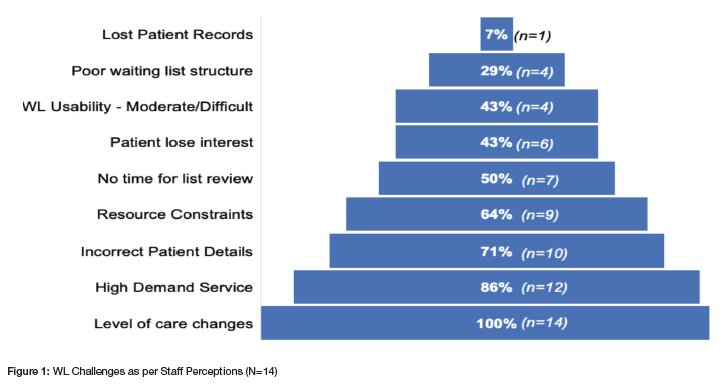
Staff perceptions revealed widespread concerns about the effectiveness and operational efficiency of the existing waiting list systems at both OHCs. As illustrated in Figure 1, a total of 79% (n = 11) of service areas reported experiencing significant challenges related to waiting list management, which included issues of structure, usability, and resource limitations.
• Impact of Waiting Time and List Size on Usability
An inverse relationship was observed between waiting time and perceived usability. Waiting lists with durations under one year were more likely to be perceived as manageable compared to those exceeding one year (OR = 0.20; p = 0.057). Similarly, larger waiting lists (>1,000 patients) were associated with increased reports of patient attrition, although this association was not statistically significant (OR = 0.56; p = 0.706).
• Structural and Operational Constraints
Multiple systemic challenges were cited by staff as limiting their ability to efficiently manage waiting lists. The most prevalent issues included, a high service demand, which was reported by 100% (n = 14) of departments, frequent level-of-care changes which required adjustments to scheduling across service tiers as well as incorrect patient information, noted by 71% (n = 10), complicating follow-up and continuity of care. Additionally, resource constraints (i.e., staff shortages and limited materials), were challenges expressed by 64% (n = 9) of staff participants, as well as insufficient time for list review, which affected 50% (n = 7) of departments.
Challenges, in terms of the user-friendliness (usability), were compounded by the fact that 43% (n = 6) of departments observed that patients lost interest in remaining on the list, further destabilising service planning. Moreover, 43% (n = 6) of staff also indicated that navigating the current waiting list systems were moderately difficult to use, particularly in paper-based environments or where hybrid systems lacked real-time updating capabilities. A smaller proportion (29%, n = 4) reported structural problems with the design of the waiting list system itself, while only 7% (n = 1) noted cases of lost patient records, suggesting that while data loss was rare, the accuracy and utility of the data collected still posed significant concerns.
Integration of Quantitative and Staff-Reported Findings
Findings from staff-reported data were consistent with patterns observed in the quantitative analysis, particularly within high-burden departments such as orthodontics, prosthetic dentistry, and endodontic services. These departments demonstrated the longest waiting times (e.g., orthodontics up to 84 months and prosthetics approximately 42 months) and the largest patient volumes, often exceeding 1,000 patients per waiting list. Correspondingly, staff within these service areas reported greater operational challenges, including difficulties in managing large waiting lists, reduced system usability, and increased patient attrition.
In contrast, departments with shorter waiting times and lower patient volumes, such as paediatric dentistry and maxillofacial and oral surgery (MFOS), reported fewer operational challenges and improved manageability of waiting lists. However, the distinct booking system used in MFOS, where patients initiate contact rather than being placed on a formal waiting list, may contribute to these differences.
This alignment between quantitative indicators (waiting time and list size) and staff-reported experiences (usability, workload, and patient engagement) demonstrates a consistent pattern across both sites. Specifically, departments with higher waiting list burdens were more likely to experience inefficiencies in waiting list management, supporting the observed relationship between service demand, system capacity, and operational challenges within the studied oral health centres.
DISCUSSION
A well-functioning health system is able to provide access to good quality health services that is equitable, timely, people-centred and responsive to the needs of a population. It aims to improve population health through protecting the population against threats to health and well-being, as well as against the financial burdens which comes with ill-health.14 However, in resource strained countries with weak policies and leadership, health systems are unable to respond to the populations challenges.14
Access to healthcare services is a fundamental aspect of South Africa's primary healthcare approach, emphasising availability, affordability, and acceptability.14 However, waiting for healthcare remains a significant challenge universally, hindering access to services within the healthcare system.15,16 The findings of the present study reflect widespread systemic limitations which have the potential to hinder service efficiency, contribute to prolonged wait times, and negatively affect both staff morale as well as patient retention and outcomes.
The status of oral health care waiting lists
The analysis of waiting lists at Tygerberg and Mitchell's Plain OHCs have provided critical insights into the service pressures and patient access constraints within public oral health systems. Notably, the findings revealed that services such as orthodontics and prosthetics were under particularly high demand, with waiting times for routine procedures, such as restorations and root canal treatments, often exceeding one year. This trend is indicative of the persistent burden of untreated dental caries and malocclusion in South Africa, as documented in the National Children's Oral Health Survey (1999-2002)17 and supported by subsequent literature.18,19 These lengthy delays raise concerns about delayed access to essential dental care and may result in disease progression and shifting treatment needs, which could potentially compromise clinical outcomes and increase the complexity of care needed. Moreover, findings reinforce the need for tailored strategies addressing department-specific pressures in order to optimise service delivery and reduce disparities in patient access.
As suggested by McIntyre and Chow,20 health system strain directly correlates with challenges in delivering timely, high-quality care. When service pressures intensify, waiting times lengthen, and the capacity to respond to patient needs reduces. Oudhoff et al.,21 emphasised that prolonged treatment delays pose a significant risk to the quality of healthcare delivery, as they may lead to deterioration in patient health and increased burden on services. This was consistent with the findings of this study, where high patient volumes and insufficient capacity created substantial bottlenecks, particularly in departments managing prosthetic, orthodontic and endodontic workloads.
The consequences of extended waiting times are multifaceted. McIntyre and Chow,20 reported that patients frequently reported experiencing anxiety, frustration, discomfort, and a sense of hopelessness while awaiting treatment. Delays in elective procedures often result in worsening (oral) health, reduced earning capacity, and broader social inequality, especially for patients navigating multiple points within an overburdened healthcare system.16,21 These opportunity costs are substantial and may lead to declines in quality of life, which further emphasises the importance of responsive and well-coordinated service delivery.
Oral diseases, when untreated, can lead to serious complications. These include difficulties in communication, impaired nutritional intake, and even reduced cognitive development, particularly among children.18 Functional limitations, persistent pain, and social discomfort are well-documented consequences of delayed oral health interventions. Extended waiting times exacerbate these challenges, compounding the negative impact on individuals' daily lives and well-being. The South African context adds further complexity. With a high burden of dental caries among children, there is a substantial need for dental treatment under general anaesthesia. This demand places additional strain on public healthcare resources due to the high operational costs and limited theatre availability.6,19 While GA is effective in improving oral health-related quality of life (OHQoL), the delays in accessing care through this route may compromise its potential benefits.6,18
Research further suggested that patients with conditions such as impacted third molars experience a measurable decline in OHQoL, which worsens the longer the patients waited for surgery.22 Similarly, satisfaction with dental prosthetics, including dentures, is closely tied to their timely provision.23 Therefore, delays in access may reduce patient satisfaction as well as potentially perpetuate physical, emotional, and economic hardship, particularly among socioeconomically disadvantaged populations dependent on public health services.18
Inequities in access between OHCs
The significantly longer waiting times observed at Mitchell's Plain OHC, when compared to Tygerberg OHC, highlight a disparity in access to oral healthcare. This imbalance is particularly alarming given that the Mitchell's Plain OHC serves a predominantly low socioeconomic population, many of whom lack access to private oral healthcare and are entirely reliant on the public health system. Therefore, the extended delays in treatment at Mitchell's Plain OHC reflect systemic inequities in service distribution as well as risk worsening oral health outcomes in already vulnerable communities. According to Author(s) in press,6 the Western Cape continues to experience structural disparities in the delivery of even basic oral health care services, such as examinations, radiographs, extractions, restorations, and antibiotic prescriptions. A provincial study found that less than one-third of public clinics offered the full basic oral healthcare package, and only 15% of satellite clinics, on which marginalised populations disproportionately depend, were able to provide these essential services.6 Furthermore, a low dentist-to-population ratio of 1:71,875 further impairs access, especially in satellite clinics, where dental services were available for just 3.2 days per month, compared to 7.3 days at better-resourced public clinics.6 These geographic and socioeconomic disparities compound the burden on communities, such as those served by MPOHC, where residents face limited service availability, prolonged waiting times, and barriers to continuity of care, all of which contribute to the entrenchment of oral health inequalities. These findings are particularly important to assist in guiding resource allocation and service improvement efforts.
Staff perspectives: waiting lists management, operational effectiveness and challenges
The perspectives of frontline staff are essential in healthcare for identifying operational barriers and driving quality improvement.24 Therefore, integrating staff input into decision-making processes is critical for effectively managing the complexities of patient waiting lists in oral health services.
Similar to the findings of this study, Kavalieratos et al.,9 highlighted that waiting lists are often poorly managed, and are characterised by inconsistent record-keeping, a lack of standardised triage protocols, and significant variation in management systems. These deficiencies can obstruct equitable access to care by delaying service delivery and undermining system efficiency. A particularly persistent challenge cited in literature was the difficulty in reaching patients due to outdated or inaccurate contact details, which hampers communication and contributes to further delays or missed appointments.9,25
Moreover, the challenges identified in this study, such as insufficient clinical staff, inadequate time, and limited materials, mirror broader systemic issues seen in medical and surgical service delivery. Naidu and Chu,25 reported that surgical care at district hospitals is hindered by both human and non-human resource constraints, and along with deficits in equipment and financial resources, limits service capacity, delays care and results in excessively lengthy waiting lists at regional and tertiary hospitals in the Western Cape. These parallels highlight that the difficulties experienced in oral health are not isolated, but rather indicative of system-wide structural weaknesses affecting the broader public health sector.
From an ethical perspective, lengthy waiting lists compromise the delivery of quality health care. Apart from the ethical consequences related to rationing care through long waiting lists, it is well-established that waiting lists are generally poorly managed, and consequently, fairness to healthcare access is often compromised by difficulties in contacting patients.9 Ideally, waiting times for patients on waiting lists need to be clearly outlined and should not exceed a certain threshold of time and therefore be linked to an average waiting time.26 However, literature recognised that in public healthcare systems, the maximum waiting time for patients on waiting lists may span into years.26,27 As a result, patients that are deserving and eligible for care, might not receive the appropriate care at the appropriate time. This is concerning and unjustifiable, which pose numerous ethical threats to sound clinical practices, and symbolise larger issues with policy implementation.4
Study Limitations
This study has several limitations which should be considered when interpreting the findings. At the outset, the reported waiting times for maxillofacial and oral surgery may not accurately reflect actual service delays, as they are dependent on the accuracy and completeness of existing waiting list records. In addition, the absence of rotating postgraduate registrars at MP OHC meant that these surgical services were unavailable at that site, further restricting access and potentially influencing the overall assessment of service delivery.
The use of purposive sampling for staff interviews, while valuable for obtaining in-depth insights, may have introduced selection bias by limiting the inclusion of a broader range of perspectives. Furthermore, interview data are inherently subject to individual interpretation, which may affect objectivity.
Although variations in waiting times and patient volumes were observed across clinical service areas, the small number of service units and the aggregated nature of the data limited the ability to perform robust inferential statistical analyses. As a result, these differences were interpreted descriptively rather than statistically. Furthermore, the context-specific nature of the study limits the generalisability of the findings to other settings. Variations in resource availability, staffing models, and healthcare infrastructure may result in different waiting list dynamics elsewhere. Future research should therefore consider more inclusive sampling approaches and multi-centre study designs to better capture variability and enhance the external validity of findings.
RECOMMENDATIONS AND CONCLUSIONS
Despite the demand for oral health care services, this study has also highlighted that public oral health services continue to face challenges in scaling up their capacity to meet these needs. A high burden of oral disease, persistent resource constraints, limited clinical time, and high staff workloads have been suggested to contribute to the prolonged waiting times for oral health care services at the OHCs, however, have far-reaching implications for equity, health outcomes, and patient trust in the healthcare system.
Addressing these challenges requires a multifaceted approach. Strengthening waiting list management through the implementation of integrated electronic booking systems could improve the accuracy, transparency, and efficiency of waiting lists9, while regular audits are essential to maintain data integrity.22 In addition, investing in capacity-building initiatives and workforce support is critical to improving service delivery.23 Aligned with the WHO Global Oral Health Strategy and Action Plan,7 these efforts should be complemented by targeted oral disease prevention strategies and improved availability of general dental services at district and primary levels of care.7,28 Furthermore, longer-term strategies such as decentralising specialist services to district-level facilities may help address systemic inefficiencies and reduce pressure on tertiary institutions.23,25
Importantly, future research should adopt broader sampling methods, and could employ multi-centre designs to capture broader trends in waiting list management practices. By addressing identified deficiencies, Tygerberg and Mitchell's Plain OHCs, as well as similar oral health settings, can advance towards delivering more accessible, equitable, and efficient oral health services, without imposing a financial burden to patients. This approach aligns with the goals of SA's NHI Act, which endeavours toward provision of equitable, timely and quality healthcare access for all11, South Africa's revised National Oral Health Policy and Strategy 2024-2034,12 as well as the WHO's Global Oral Health Strategy and Action Plan.10
REFERENCES
1. Jacobs B, Ir P, Bigdeli M, Annear PL, Van Damme W. Addressing access barriers to health services: an analytical framework for selecting appropriate interventions in low-income Asian countries. Health Policy Plan. 2011;27(4):288-300. doi:10.1093/heapol/czr038. [ Links ]
2. Peres MA, Macpherson LMD, Weyant RJ et al. Oral diseases: a global public health challenge. The Lancet. 2019;394(10194):249-60. [ Links ]
3. Bhayat A, Chikte U. The changing demographic profile of dentists and dental specialists in South Africa: 2002-2015. Int Dent J. 2020;68(2):91-96 [ Links ]
4. Motloba PD, Gwengu PRQ, Moipolai PD. Inaccessible specialised oral health services in South Africa- rationing policy uncertainty. S Afr Dent J. 2023;78(8):414-8 [ Links ]
5. Ramphoma KJ. Oral Health in South Africa: Exploring the role of dental public health specialists. S Afr Dent J. 2016;71(9):402-3. [ Links ]
6. Author(s) in press [ Links ]
7. Kruk ME, Gage AD, Arsenault C, Jordan K, Leslie HH, Roder-DeWan S, et al. High-quality health systems in the Sustainable Development Goals era: time for a revolution. Lancet Glob Health. 2018 Nov;6(11):e1196-e1252. Available from: https://pmc.ncbi.nlm.nih.gov/articles/PMC7734391/ [ Links ]
8. Goodwin M, Sanders C, Davies G, Walsh T, Pretty IA. Issues arising following a referral and subsequent wait for extraction under general anaesthetic: impact on children. BMC Oral Health. 2015;15(3). [ Links ]
9. Kavalieratos T, Nortje M, Dunn RN. Hip and knee arthroplasty waiting list - how accurate and fair? S Afr Med J. 2017;107(4):323-6. [ Links ].
10. World Health Organiation. WHO Global Strategy and Action Plan on Oral Health 2023-2030 [Internet]. 2024. Available from: https://www.who.int/publications/i/item/9789240090538 [ Links ]
11. South African Government. National Health Insurance Bill [Internet]. 2019. Available from: https://www.gov.za/sites/default/files/gcis_document/201908/national-health-insurance-bill-b-11-2019.pdf [ Links ]
12. National Department of Health. National Oral Health Policy and Strategy 2024-2030 [Internet]. 2024. Available from: https://www.health.gov.za/wp-content/uploads/2024/12/NOHPS-for-website-122024.pdf [ Links ]
13. Yusoff N. Oral health literacy and service utilisation in Malaysia. IIUM Medical Journal Malaysia. 2019; 19(3):73-9. [ Links ]
14. World Health Organization. Key components of a well functioning health system [Internet]. 2010. Available from: https://www.who.int/healthsystems/EN_HSSkeycomponents.pdf [ Links ]
15. Daniels J, Zwiegenthal V, Reagon G. Assessing the impact of a waiting time survey on reducing waiting times in urban primary care clinics in Cape Town, South Africa. J Public Health Afr. 2017;8(639):98-102. [ Links ]
16. Fogarty C, Cronin P. Waiting for healthcare: a concept analysis. J Adv Nurs. 2008 Feb;61(4):463-71. doi: 10.1111/j.1365-2648.2007.04507.x. PMID: 18234043. [ Links ]
17. Van Wyk PJ, van Wyk C. Oral health in South Africa. Int Dent J. 2004; 54(6 Suppl 1):373-7 [ Links ]
18. Peerbhay F, Barrie RB. The burden of early childhood caries in the Western Cape Public Service in relation to dental general anaesthesia: implications for prevention. S Afr Dent J. 2012;67(1):14-6. [ Links ]
19. Mohamed N, Barnes JM. Early childhood caries and dental treatment need in low socio-economic communities in Cape Town, South Africa. Health SA Gesondheid. 2018;23. doi:10.4102/hsag.v23i0.1039. [ Links ]
20. McIntyre D, Chow CK. Waiting time as an indicator for health services under strain: A narrative review. J Healthc Org Provis Financ. 2020;57. doi:10.1177/0046958020910305. [ Links ]
21. Oudhoff JP, Timmermans DR, Knol DL, Bijnen AB, van der Wal G. Waiting for elective general surgery: impact on health related quality of life and psychosocial consequences. BMC Public Health. 2007 Jul 19;7:164. doi:10.1186/1471-2458-7-164. PMID: 17640382; PMCID: PMC1959190. [ Links ]
22. Hallab L, Azzouzi A, Chami B. Quality of life after extraction of mandibular wisdom teeth: A systematic review. Annals of Medicine & Surgery. 2022;81. [ Links ]
23. Adam RZ, Geerts GA, Lalloo R. The impact of new complete dentures on oral health-related quality of life. SADJ. 2007 Jul;62(6):264-6, 268. PMID: 17927034. [ Links ]
24. Satterstrom P, Vogus TJ, Jung OS, Kerrissey M. Voice is not enough: A multilevel model of how frontline voice can reach implementation. Health Care Manag Rev. 2024;49(1):35. doi:10.1097/HMR.0000000000000389. [ Links ]
25. Naidu P, Chu KM. District hospital surgical capacity in Western Cape Province, South Africa: A cross-sectional survey. S Afr Med J. 2021;111(4):343-9. doi:10.7196/samj.2021.v111i4.15281. [ Links ]
26. Bradfield OM. Waiting lists: waiting for the evidence! Aust Health Rev. 2008;32(4):589-92. doi: 10.1071/ah080589. [ Links ]
27. Siciliani L, Moran V, Borowitz M. What Works? Waiting Time Policies in the Health Sector. Eurohealth OBSERVER [Internet]. 2015;21(4). Available from: https://iris.who.int/bitstream/handle/10665/332975/Eurohealth-21-4-14-17-eng.pdf [ Links ]
28. World Health Organization. Global oral health status report: towards universal health coverage for oral health by 2030 [Internet]. 2022. Available from: https://www.who.int/publications/i/item/9789240061484 [ Links ]
 Correspondence:
Nashna Rampersad
Email: nrampersad@uwc.ac.za