



Servicios Personalizados
Revista

Articulo
 Inglés (pdf)
 Articulo en XML
 Referencias del artículo

 Traducción automática
 Enviar articulo por email
Indicadores
Links relacionados
-
 Citado por Google
-
 Similares en Google
Compartir

 Permalink

South African Dental Journal
versión On-line ISSN 0375-1562versión impresa ISSN 0011-8516
S. Afr. dent. j. vol.81 no.2 Johannesburg 2026
https://doi.org/10.17159/sadj.v81i02.22833
RESEARCH
Effectiveness of the Tooth Keepers Digital Intervention in Enhancing Oral Health Awareness and Behaviours Among College Students in Durban, South Africa: A Quasi-Experimental Study
L NaidooI; SC OnwubuII
IUniversity of the Western Cape, Cape Town, South Africa. ORCID: https://orcid.org/0000-0002-1774-0705
IIChemistry, Durban University of Technology (DUT), Durban, South Africa. ORCID: https://orcid.org/0000-0002-4499-1534
ABSTRACT
INTRODUCTION: Poor oral hygiene habits are common among college students in South Africa, contributing to a high prevalence of oral health issues. Digital platforms have shown promise in improving awareness and encouraging positive oral health behaviours.
AIMS AND OBJECTIVE: This study evaluated the effectiveness of digital oral health education in promoting awareness and behaviour change among college students in Durban, South Africa.
METHODS: A quasi-experimental design was employed with 258 college students. Pre- and post-tests assessed changes in oral health knowledge, awareness, self-efficacy, and self-care behaviours following exposure to the Tooth Keepers digital platform. Data were analysed using descriptive statistics, independent t-tests, and chi-square tests.
RESULTS: The findings revealed a significant improvement in knowledge, awareness, and self-efficacy (p < 0.001) related to oral health self-care practices after exposure to digital oral health education. Additionally, participants reported significant improvements in their oral hygiene behaviours (p < 0.001) after exposure to digital oral health education.
CONCLUSION: Digital oral health education effectively improves knowledge and self-care practices among college students. This study supports the integration of accessible, technology-based interventions to promote oral health, particularly in diverse and underserved populations.
Keywords: Digital oral health education, college students, South Africa, awareness, behaviours, quasi-experimental study
INTRODUCTION
The maintenance of oral health is a fundamental component of one's overall health and state of well-being. Neglecting proper oral hygiene practices can result in a range of health complications such as heart disease, diabetes, respiratory infections, and complications during pregnancy, among others.1, 2 Janakiram and Dye3 suggest that an individual's oral health is deemed suboptimal when they exhibit dental caries, periodontal disorders, or complete edentulism. According to a recent estimation conducted by Bernabe, Marcenes,4 a substantial number of individuals, around 3.5 billion people globally, experience the impact of oral disease conditions. Dental disorders provide a substantial public health concern in South Africa, since a considerable number of individuals have dental caries, periodontal disease, and several oral health ailments.5 Mthethwa, Mahomed5 showed that the prevalence of dental caries among individuals aged 18-59 years in South Africa is approximately 66.4%. The study further revealed that patients tend to seek treatment for dental caries only when they have symptoms, such as pain, which motivates them to seek relief. This observation suggests a deficiency in knowledge and comprehension of the significance of oral health and the necessity of proactive interventions. In addition, scientific investigations indicate that individuals in their youth frequently underestimate the possible hazards associated with oral conditions, exhibit a perception of reduced vulnerability towards such disorders, and possess little knowledge regarding their prospective progression. In a 2024 study among 12-year-olds in Maputo, for example, researchers found a significant gap between self perception and actual risk: many teens reported a "negative perception" of their dental health yet displayed suboptimal hygiene habits.6 Similarly, a Brazilian study examining oral health impacts on daily performance reported:
"Young people often do not realise that they need dental treatment until their oral health conditions affect their daily activities."7
The above underscores that youths generally underestimate these risks, seeking treatment only after symptoms arise. Research from Iran highlights that limited oral health knowledge among adolescents is strongly linked to poorer oral behaviours.8
Oral disorders are a significant concern as they can adversely impact the quality of life (QoL).7 For instance, oral health conditions contribute to substantial losses in school and work hours and can interfere with daily activities across various environments, including schools, workplaces, and homes.1 Despite this, research indicates that many people, particularly young people, prioritise the cosmetic outcomes of tooth brushing over its preventive function against oral diseases.9 As such, there is a need for oral health intervention that promotes positive behaviour change in the South African context. Nakre and Harikiran10 emphasise that the most effective strategy for promoting oral health involves the implementation of preventive measures at the community or population level, spanning settings such as schools, neighbourhoods, and even entire nations.
According to the World Health Organisation,11 oral health education should be integrated into broader health promotion initiatives, with a particular focus on fostering positive habits. Early education plays a crucial role in laying the foundation for healthy behaviours and supports the long-term adoption of effective lifestyle changes.12 However, much of the existing literature has focused on traditional approaches to oral health promotion, such as classroom-based lectures and printed materials.13, 14 These conventional methods often suffer from limited user engagement and accessibility, thereby reducing their overall effectiveness and reach.15
According to Frontini, Sousa,16 the use of digital platforms-such as websites, mobile applications, and social media-in oral health education has the potential to effectively reach a broader audience by providing immersive and interactive instructional content. As a result, digital media has emerged as a promising tool for enhancing oral health awareness and encouraging positive health behaviours. Sharma, Mohanty17 highlight that the increasing accessibility of digital media serves as a valuable health resource, particularly for individuals with limited access to oral health professionals and expertise. Interactive digital interventions have shown efficacy in improving oral health knowledge and promoting behavioural change, thereby playing a vital role in reducing the overall burden of oral diseases.17 A 2024 randomised controlled trial with elementary students demonstrated that theory-driven school interventions, using multimedia, gamification, and community reinforcement, led to substantial improvements in brushing frequency (up 48.5%), flossing (up 64%), and plaque reduction, highlighting the success of school-based preventive strategies.18
Although there is a growing interest in using digital health interventions to promote healthy behaviours and prevent diseases, however, there remains a lack of comprehensive research on the implementation and impact of such interventions within the South African context. This study focuses on promoting oral health knowledge, practices, and self-care behaviours among college students within the South African context. It forms part of an ongoing research and innovation project centred around the Tooth Keepers digital health platform. Tooth Keepers is an interactive online platform that uses multimedia elements to educate users, assess individual risk factors, and offer personalised guidance on oral hygiene, behaviours, and dietary habits. The platform is accessible through both mobile phones and web-enabled devices (http://www.toothkeepers.co.za). College students were chosen for this study because they represent a transitional age group forming lifelong health behaviours, yet often exhibit inadequate oral health knowledge and poor self care practices, making them an ideal target for preventive digital interventions.19, 20 The research is, therefore, grounded in the Behaviour Change Techniques (BCT) framework, which emphasises the use of technological interventions to support positive behavioural change.21 BCT incorporates a range of digital tools - including apps, online programs, and wearable devices - to deliver targeted interventions aimed at modifying health behaviours effectively. The primary objective of the study is to evaluate the effectiveness of Tooth Keepers in enhancing students' oral health awareness, knowledge, and self-monitoring practices.
RESEARCH METHODOLOGY
Research design
The study used a quasi-experimental design, specifically a pre-test/post-test design, to assess the effectiveness of digital oral health education on knowledge, self-efficacy, and behaviour change among the public in South Africa. In a quasi-experimental approach, the researcher manipulates an independent variable without randomly assigning individuals to conditions or ordering of conditions, whilst in post-test method, the dependent variable is measured twice in this design (once before and once after the application of the intervention).22
Sampling technique and sample size
The study's sample size was calculated using the Raosoft sample size calculator. It was determined based on a 95% confidence level, a 5% margin of error, a 50% response distribution, and population sizes of 30000 students. While the estimated sample size calculated was 380, only 254 students participated in the study. This constitutes a response rate of 66.8%. All students aged 18 years and above who reside in Durban, South Africa, were considered for the study. A convenience sample process was carried out to target students who showed interest in participating in the study. While more than 380 indicated willingness, 87 did not proceed to the training process and dropped off without completing the second questionnaire. 254 participants completed the research process.
Instrument for data collection
In a quasi-experimental research design following a pre-test post-test approach, data were gathered using structured questionnaires administered before and after the treatment. These questionnaires were specifically designed to assess oral health knowledge, awareness, and behavioural practices. The questions in the questionnaire were closed-ended, presenting two options such as "Yes" and "No," True/False, or Agree/Disagree. Additionally, Likert scales were utilised, ranging from a 1 to 5 rating scale or from "strongly agree" to "strongly disagree," making it easier to analyse the quantitative data. The questionnaire encompassed four sections: 1. Demographics, 2. Oral Health Knowledge, 3. Oral Health Awareness, and 4. Self-Checking and Self-Care Methods. The questionnaire was adapted from previous studies by Slade23 and Tubert-Jeannin, Riordan,24 with slight modifications to ensure its appropriateness for the targeted population.
The survey was created using a Google form and emailed to students who expressed their willingness to participate. Participants were given a 30-minute time limit to complete the initial part of the pre-test questionnaire. Following this, they received a multimedia oral health primary care promotional presentation based on the Tooth Keepers' oral health journey. This presentation spanned three days, with each day consisting of approximately 20 minutes of content covering various aspects of oral health education, awareness, and self-care practices. The presentation was delivered through the Microsoft Teams video-conferencing application, which allowed for the transmission of digital oral health education materials. After the completion of all three media components, a post-test questionnaire, identical to the pre-test questionnaire, was administered by providing an email link to the participants. All students who completed the initial questionnaire and viewed the multimedia content also completed the post-test questionnaire.
Data analysis
For both the pre- and post-testing of oral health knowledge scores, a standardised questionnaire was employed. In this questionnaire, a rating of 1 was assigned to the correct response, while a rating of 0 was given to an incorrect response. The collected data were then subjected to statistical analysis using SPSS version 28.0, a software by IBM Statistics Inc. based on Chicago, Illinois, USA. The difference in scores before and after the digital oral health training was assessed using the McNemar and Wilcoxon signed-rank tests. A significance level of P < 0.05 (two-tailed) was used to determine statistical significance.
Ethical consideration
Ethical approval for the study was obtained from the Biomedical Research Ethics Committee (BM 20/09/16). Furthermore, the study was authorised by the Directorate of Research and the research committee at the Durban University of Technology (IRIC) to be carried out at the university.
RESULTS
3.1 Socio-demographic characteristics
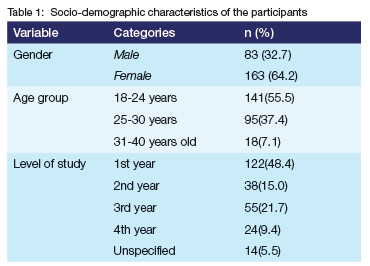
The study recruited a sample of 254 participants in Durban, South Africa. The descriptive statistics in Table 1 showed that the majority of the participants were mostly female (64.2%), within the age group of 18-24 years (55.5%), and mostly in their 1st year of study (48.4%).
3.2 Participants' knowledge of oral health
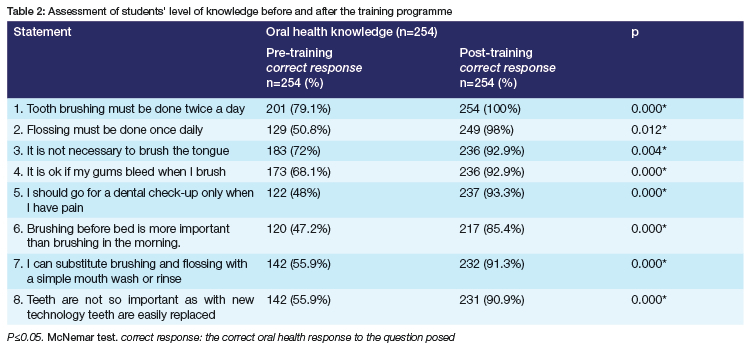
The data in Table 2 presents the results of oral health knowledge before and after digital oral health education among the study participants. A total of 254 participants were included in the analysis. Before the digital oral health education, only 79.1% of the participants knew that tooth brushing should be done twice a day. However, after the digital oral health education, all participants (100%) responded correctly to this statement. Similarly, before the intervention, only 50.8% of the participants knew that flossing should be done once daily, whereas after the intervention, 98% of the participants responded correctly to this statement.
The results also showed that before the digital oral health education, 72% of the participants believed that it was not necessary to brush the tongue, and 68.1% of the participants thought that it was okay if their gums bled when brushing. However, after the intervention, 92.9% of the participants responded correctly to these statements.
Furthermore, before the intervention, only 48% of the participants knew that they should go for a dental check-up even if they do not have pain, while after the intervention, 93.3% of the participants responded correctly to this statement. Lastly, before the intervention, only 47.2% of the participants believed that brushing before bed is more important than brushing in the morning, while after the intervention, 85.4% of the participants responded correctly to this statement.
All the differences in correct responses before and after the intervention were statistically significant (p < 0.05). These findings indicate that digital oral health education was effective in increasing the oral health knowledge of the study participants.
3.2.1 Distribution of the participants' self-assessment of Knowledge
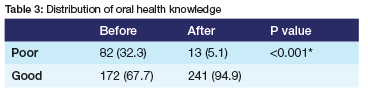
The data in Table 3 presents the distribution of oral health knowledge scores before and after the digital oral health education program. Before the intervention, 82 participants (32.3%) reported having poor oral health knowledge, while 172 participants (67.7%) reported having good oral health knowledge. After the intervention, only 13 participants (5.1%) in the poor oral health knowledge group remained, indicating a significant improvement in their knowledge level (p<0.001*). Among the good oral health knowledge group, 241 participants (94.9%) remained, indicating a high level of oral health knowledge.
3.3 Participants' oral health awareness
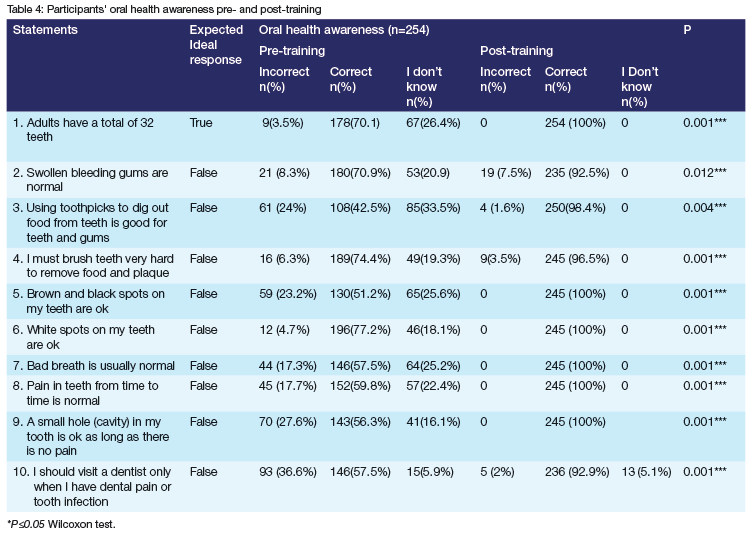
The data in Table 4 shows the expected ideal response and the oral health knowledge of the participants before and after the training for various statements related to oral health. Before the training, a significant number of participants provided incorrect responses to all the statements except for statement 1 (Adults have a total of 32 teeth), where the majority provided the correct response. After the training, there was a significant increase in the number of participants providing correct responses and a decrease in the number providing incorrect responses for all the statements. The improvement in knowledge after the training is statistically significant for all statements (p < 0.05). This suggests that the oral health education program was effective in improving the oral health knowledge of the participants.
3.4 Self-Care and Self-Checking Behaviour
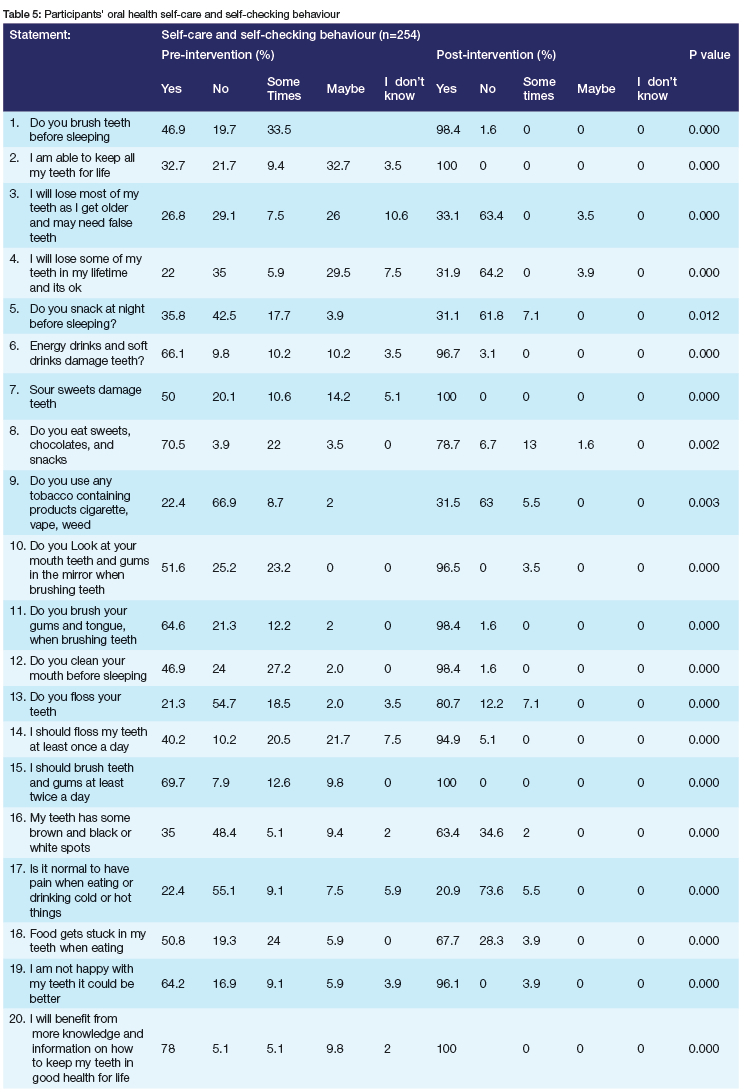
The oral health self-care and self-checking behaviour are given in Table 5. It was observed that all of the statements emphasised in Table 5 demonstrated a statistically significant difference, respectively pre- and post-training. For example, the participants' perception of maintaining their teeth, measured by questions (1-4), demonstrates significant improvement in brushing of teeth before going to bed.
Self-care behaviours evaluated by questions (10-13) demonstrated significant increases post-evaluation. In the areas of "Do you look at your mouth, teeth, and gums in the mirror when brushing your teeth" (96.5%), "Do you brush your gums and tongue, when brushing your teeth" (98.4%), "Do you clean your mouth before sleeping" (98.4%), and "Do you floss your teeth" (80.7%), there was a significant improvement in self-care practises.
The respondents' intentions to practise oral self-care evaluated by questions (14-15) reveals significant improvement in the areas of "I should floss my teeth at least once a day" (94.6%), and "I should brush my teeth and gums at least twice a day" (100%). The respondents' capacity to self-evaluate their oral health conditions, evaluated by questions 16 through 18, shows significant improvement in the respondents' self-checking skills after the training. For example, there were improvements in the respondents' ability to detect that their teeth had some brown, black, or white spots.
The intention of the respondents to alter their perspective on oral health, evaluated using questions 19 and 20, showed a marked increase in their intention post-intervention. It was found that the percentage of respondents who seemed dissatisfied with their teeth and thought they could be better rose from 64.2% to 96.1% post-evaluation. The percentage of those who agreed that they would benefit from more knowledge and information on how to maintain their teeth in good health for life rose from 78% to 100% post-intervention.
DISCUSSION
The utilisation of digital platforms for oral health education represents a promising strategy to enhance public awareness and promote positive oral health behaviours. This study provides strong evidence that digital platforms can be highly effective in promoting oral health knowledge, awareness, and self-care behaviours among college students in South Africa. The significant improvements observed in participants' oral health knowledge and behaviours following the Tooth Keepers digital intervention align well with existing research emphasising the promise of technology-based health education. Sharma, Mohanty17 highlighted that digital oral health education improves knowledge, self-efficacy, and positive behavioural change, which this study corroborates through substantial post-intervention gains across all measured outcomes.
Before the intervention, a considerable proportion of participants demonstrated limited knowledge of key oral health practices such as the recommended frequency of brushing and flossing, the necessity of regular dental check-ups regardless of pain, and the importance of brushing before bedtime. Post-intervention, knowledge levels increased markedly, with correct responses reaching near or full saturation (e.g., 100% awareness of brushing twice daily, 98% understanding of daily flossing). This sharp knowledge gain supports Shirahmadi, Bashirian18 and Bakhtiar, Hosseini,25 who also documented the efficacy of digital education in improving students' oral health literacy. For example, in a study involving 70 teenagers, Bakhtiar, Hosseini25 reported a significant increase in knowledge scores after using multimedia-based oral health education software, with average correct responses improving from 76.64% to 85.86%, which is even lower than our study. These findings reflect the capacity of interactive multimedia platforms like Tooth Keepers to provide accessible, engaging, and personalised education that addresses specific gaps in oral health understanding. The results reinforce the argument that digital technologies can effectively shape health behaviours and facilitate positive oral health outcomes, supporting the observations of Zolfaghari, Shirmohammadi12 regarding the potential of digital tools in promoting healthy practices.
Behavioural outcomes further reinforce the tool's effectiveness. For instance, brushing teeth before bed - a critical habit often overlooked - rose dramatically from 46.9% to 98.4%. Similarly, self-care behaviours including flossing, brushing gums and tongue, and oral self-examination showed statistically significant improvements. Such shifts in behaviour likely stem from the program's emphasis on self-monitoring and risk awareness, which has been identified by Dahlke, Fair26 as essential components of successful oral health promotion. In addition, the substantial behavioural shift may be attributed to the enhanced accessibility and engagement afforded by digital platforms, which allow flexible, user-friendly delivery of oral health education.27 The digital format offers the added advantage of easy access and repeated engagement, overcoming barriers commonly encountered in traditional oral health education.15
Importantly, the intervention also corrected widespread misconceptions, such as the acceptability of brown or black spots on teeth and bleeding gums during brushing, symptoms often ignored until advanced disease occurs. Awareness of these signs increased from approximately half of the participants recognising their significance pre-intervention to near-universal understanding post-intervention. Similarly, the improvement in understanding effective brushing techniques - from 74.4% to 96.5% - aligns. This aligns with findings from Asimakopoulou and Newton28 and Blaggana, Grover29, who emphasised the role of accurate health knowledge in fostering preventive behaviours and early care-seeking attitudes. The high post-intervention intention to adopt recommended oral health practices further supports the Behaviour Change Techniques (BCT) framework guiding this study.21 By combining education with personalised feedback and goal setting, Tooth Keepers effectively encouraged participants to internalise and act upon oral health information, thus bridging the often-observed gap between knowledge and behaviour.
Despite these positive findings, it is crucial to recognise limitations. The quasi-experimental design and reliance on self-reported data may introduce bias, and the sample's restriction to Durban college students limits wider applicability. However, the results underscore the feasibility and potential of digital oral health interventions within the South African context - a setting marked by significant disparities in healthcare access and knowledge. Future research should expand on this foundation with randomised controlled trials across diverse populations and regions, incorporate culturally adapted content, and explore the long-term sustainability of behavioural changes. Additionally, evaluating the cost-effectiveness and scalability of such interventions will be vital for informing public health policy and integrating digital education into comprehensive oral health strategies.
Overall, this study provides robust evidence that digital oral health education, exemplified by the Tooth Keepers platform, can substantially improve oral health knowledge and self-care behaviours among young adults. Given the burden of oral diseases globally and in South Africa specifically, harnessing digital innovations offers a promising avenue to advance prevention, promote health equity, and reduce oral health disparities.
CONCLUSION
The findings of the study indicate that the digital self-assessment tool has proven effective in improving individuals' awareness of oral health and oral diseases. Therefore, it is imperative to affirm that the utilisation of digital technologies is expected to enhance the extent of oral health knowledge, awareness, and preventative self-care activities among university students. The findings hold significant implications for the design and implementation of oral health education initiatives targeted at students in higher education institutions. These programs aim to enhance accessibility and efficacy, ultimately fostering oral health equity within the context of South Africa.
Acknowledgement
This study acknowledges the participating college students as well as the Department of Public Health, University of the Western Cape, South Africa. Declaration: No conflict of interest declared
REFERENCES
1. Peres MA, Macpherson LM, Weyant RJ, Daly B, Venturelli R, Mathur MR, et al. Oral diseases: a global public health challenge. Lancet. 2019;394(10194):249-60. [ Links ]
2. Leite HQ, de Vasconcelos LP, de A. Medeiros A, Cascaes AM, Bomfim RA. Implementing Oral Hygiene Guidelines in Brazilian Primary Healthcare: Dentists' and Managers' Perspectives Study. Glob Implement Res Appl. 2025;5(1):124-38. [ Links ]
3. Janakiram C, Dye BA. A public health approach for prevention of periodontal disease. Periodontol 2000. 2020;84(1):202-14. [ Links ]
4. Bernabe E, Marcenes W, Abdulkader RS, Abreu LG, Afzal S, Alhalaiqa FN, et al. Trends in the global, regional, and national burden of oral conditions from 1990 to 2021: a systematic analysis for the Global Burden of Disease Study 2021. Lancet. 2025;405(10482):897-910. [ Links ]
5. Mthethwa J, Mahomed O, Yengopal V. Epidemiological profile of patients utilizing dental public health services in the eThekwini and uMgungundlovu districts of KwaZulu-Natal province, South Africa. S Afr Dent J. 2020;75(10):541-7. [ Links ]
6. Mepatia AI, Myburgh N, Barrie R, Kimmie-Dhansay F. Self-assessment of dental health status, behaviours and oral health risk factors among adolescents from public schools in Maputo City-Mozambique. BMC Oral Health. 2024;24(1):145. [ Links ]
7. da Cunha IP, Pereira AC, Frias AC, Vieira V, de Castro Meneghim M, Batista MJ, et al. Social vulnerability and factors associated with oral impact on daily performance among adolescents. Health Qual Life Outcomes. 2017;15:1-10. [ Links ]
8. Marashi SZ, Hidarnia A, Kazemi SS, Zarei F. Factors predicting oral health behaviors among students age 13-15 years in Shushtar city, Iran. BMC Oral Health. 2023;23(1):691. [ Links ]
9. Dodd VJ, Logan H, Brown CD, Calderon A, Catalanotto F. Perceptions of oral health, preventive care, and care-seeking behaviors among rural adolescents. J Sch Health. 2014;84(12):802-9. [ Links ]
10. Nakre PD, Harikiran A. Effectiveness of oral health education programs: A systematic review. J Int Soc Prev Community Dent. 2013;3(2):103-15. [ Links ]
11. World Health Organization. Diet, nutrition, and the prevention of chronic diseases: report of a joint WHO/FAO expert consultation, World Health Organization 2003 [ Links ]
12. Zolfaghari M, Shirmohammadi M, Shahhosseini H, Mokhtaran M, Mohebbi SZ. Development and evaluation of a gamified smart phone mobile health application for oral health promotion in early childhood: a randomized controlled trial. BMC oral health. 2021;21:1-9. [ Links ]
13. Larrañaga SC, Ruiz ME, Vela PC, Conde AC, Villarroya LA, Gómez AG, et al. Atención Primaria y promoción de la salud bucodental: evaluación de una intervención educativa en población infantil. Aten Primaria. 2019;51(7):416-23. [ Links ]
14. Soldo M, Matijević J, Malčić Ivanišević A, Čuković-Bagić I, Marks L, Nikolov Borić D, et al. Impact of oral hygiene instructions on plaque index in adolescents. Cent Eur J Public Health. 2020;28(2):103-7. [ Links ]
15. Ab Mumin N, Yusof ZYM, Marhazlinda J, Obaidellah U. Exploring the opinions of secondary school students on the strengths and weaknesses of the school dental service in Selangor, Malaysia: a qualitative study. BMC oral health. 2021;21:1-9. [ Links ]
16. Frontini R, Sousa P, Dixe M, Ferreira R, Figueiredo M. Designing a mobile app to promote healthy behaviors and prevent obesity: analysis of adolescents' preferences. Inform Health Soc Care. 2020;45(3):327-41. [ Links ]
17. Sharma S, Mohanty V, Balappanavar AY, Chahar P, Rijhwani K, Balappanavar A. Role of digital media in promoting oral health: a systematic review. Cureus. 2022;14(9):1-11. [ Links ]
18. Shirahmadi S, Bashirian S, Soltanian AR, Karimi-Shahanjarini A, Vahdatinia F. Effectiveness of theory-based educational interventions of promoting oral health among elementary school students. BMC public health. 2024;24(1):130. [ Links ]
19. Peltzer K, Pengpid S. Oral health behaviour and social and health factors in university students from 26 low, middle and high income countries. Int J Environ Res Public Health. 2014;11(12):12247-60. [ Links ]
20. Onwubu SC, Ogwo K, Onyenu U, Iwueke G, Mokhothu T. Evaluating the oral health knowledge, attitude and practice among undergraduate students and staff at selected federal University in Imo state, Nigeria. S Afr Dent J. 2022;77(10):610-9. [ Links ]
21. Arigo D, Jake-Schoffman DE, Wolin K, Beckjord E, Hekler EB, Pagoto SL. The history and future of digital health in the field of behavioral medicine. J Behav Med. 2019;42:67-83. [ Links ]
22. Price PC, Jhangiani R, A CI-C. Research methods in psychology. Canada: BCCampus; 2015. [ Links ]
23. Slade GD. Measuring oral health and quality of life. Chapel Hill. 1997;3:385. [ Links ]
24. Tubert-Jeannin S, Riordan P, Morel-Papernot A, Porcheray S, Saby-Collet S. Validation of an oral health quality of life index (GOHAI) in France. Community Dent Oral Epidemiol. 2003;31(4):275-84. [ Links ]
25. Bakhtiar M, Hosseini SM, Behbahanirad A, Kamyab A, Khani Jeihooni A. Preparation and evaluation of a multimedia oral health education software for teenagers. BMC Oral Health. 2025;25(1):1-11. [ Links ]
26. Dahlke DV, Fair K, Hong YA, Beaudoin CE, Pulczinski J, Ory MG. Apps seeking theories: results of a study on the use of health behavior change theories in cancer survivorship mobile apps. JMIR mHealth and uHealth. 2015;3(1):e3861. [ Links ]
27. Bastani P, Manchery N, Samadbeik M, Ha DH, Do LG. Digital health in children's oral and dental health: an overview and a bibliometric analysis. Children. 2022;9(7):1039. [ Links ]
28. Asimakopoulou K, Newton JT. The contributions of behaviour change science towards dental public health practice: a new paradigm. Community Dent Oral Epidemiol. 2015;43(1):2-8. [ Links ]
29. Blaggana A, Grover V, Kapoor A, Blaggana V, Tanwar R, Kaur H, et al. Oral health knowledge, attitudes and practice behaviour among secondary school children in Chandigarh. J Clin Diagn Res. 2016;10(10):ZC01. [ Links ]
 Correspondence:
Onwubu Stanley Chibuzor
Department of Chemistry, Dental Technology Programme, Durban University of Technology (DUT), Durban, South Africa
Email: stanleyo@dut.ac.za
Authors contributions
1. Lesley Naidoo, Writing article, data collection, experimental design and development 50%
2. Stanley Chibuzor Onwubu, Writing article, editing, and data analysis 50%