




Servicios Personalizados
Revista

Articulo
 Inglés (pdf)
 Articulo en XML
 Referencias del artículo

 Traducción automática
 Enviar articulo por email
Indicadores
Links relacionados
-
 Citado por Google
-
 Similares en Google
Compartir

 Permalink

South African Dental Journal
versión On-line ISSN 0375-1562versión impresa ISSN 0011-8516
S. Afr. dent. j. vol.81 no.2 Johannesburg 2026
https://doi.org/10.17159/sadj.v81i02.23784
RESEARCH
Knowledge, attitudes, and self-reported practices related to oral squamous cell carcinoma among oral health practitioners in South Africa
LN MasukaI; AI MasilanaII; A BhayatIII; RAG KhammissaIV; MM BeetgeV
IBDS. Registrar, Department of Periodontics and Oral Medicine, University of Pretoria, Pretoria, South Africa
IIBDS, MDent (OMP). Department of Periodontics and Oral Medicine, School of Dentistry, Faculty of Health Sciences, University of Pretoria, Pretoria, South Africa
IIIBDS, MSc (Dent), MPH, MDent (Com Dent). Department of Community Dentistry, School of Dentistry, Faculty of Health Sciences, University of Pretoria, Pretoria, South Africa
IVBChD, MSc, PDD, MDent, HDip Educ. Department Periodontics and Oral Medicine, School of Dentistry, Faculty of Health Sciences, University of Pretoria, Pretoria, South Africa
VBChD, PG Dip/Aesthetic Dentistry, MChD (OMP), PGDip(HPEL,). Department of Periodontics and Oral Medicine, School of Dentistry, Faculty of Health Sciences, University of Pretoria, Pretoria, South Africa
ABSTRACT
INTRODUCTION: Oral cancer remains a major global health concern, with oral squamous cell carcinoma (oral SCC) accounting for most cases. Early detection is critical for improving prognosis, and oral health practitioners (OHPs) play an important role in screening and referral.
AIM: To describe the self-reported knowledge, attitudes, and practices of oral health practitioners in South Africa regarding oral squamous cell carcinoma.
METHODS: A descriptive, cross-sectional survey was conducted among oral health practitioners in South Africa between October 2023 and January 2024. Participants were recruited through professional associations using a non-probability sampling approach. Data were collected using an adapted, self-administered online questionnaire. Descriptive statistics were used to summarise responses, and exploratory comparisons of mean knowledge and practice scores were performed using analysis of variance (ANOVA), with cautious interpretation.
RESULTS: Of the 342 oral health practitioners invited, 164 completed the questionnaire (response rate: 48%). The mean self-reported knowledge and practice scores were 75% and 67%, respectively. Exploratory analyses suggested differences in practice scores across levels of knowledge (p = 0.017). Most respondents reported routinely examining the oral mucosa and referring patients with suspicious lesions, while fewer reported participation in continuing professional development activities related to oral SCC.
CONCLUSION: Within the limitations of this exploratory, self-reported survey, participating oral health practitioners demonstrated generally acceptable awareness and practices related to oral squamous cell carcinoma, alongside identifiable gaps in specific knowledge areas and post-qualification training. These findings highlight the need for further research using validated instruments and representative sampling, as well as targeted educational initiatives to support early detection and referral.
Keywords: Oral squamous cell carcinoma, oral health practitioners, knowledge, practice, attitudes, malignant transformation.
INTRODUCTION
Oral cancer (OC) represents a substantial global health burden and remains among the most common malignancies of the head and neck region.1 Population-based analyses from the Global Burden of Disease Study demonstrate considerable geographic variation in incidence and mortality. Oral squamous cell carcinoma (oral SCC) accounts for more than 90% of malignancies arising within the oral cavity and is associated with high mortality, particularly when diagnosed at advanced stages.2-4
The principal risk factors for oral SCC include tobacco use and alcohol consumption, which have been shown in multiple case-control and retrospective studies to act synergistically in oral carcinogenesis.5 Dietary deficiencies, particularly low intake of fresh fruits and vegetables, have also been associated with increased risk.4-6 While infection with high-risk human papillomavirus (HPV) genotypes is a well-established etiological factor for oropharyngeal squamous cell carcinoma, primary molecular studies indicate a relatively low prevalence of transcriptionally active HPV in oral cavity SCC7-9 (Machado et al., 2010, Shomorony et al., 2019, Fonseca 2023). This distinction has important implications for risk assessment, prevention strategies, and clinical suspicion during oral examination.
Oral SCC most commonly affects the ventral and lateral surfaces of the tongue and the floor of the mouth.10 Clinicopathological and population-based studies consistently identify these sites as high risk, likely due to thinner non-keratinized epithelium and prolonged exposure to pooled carcinogens.10 Despite advances in diagnostic and therapeutic modalities, survival outcomes for oral SCC have improved only modestly over recent decades.11 Primary registry data indicate that five-year survival exceeds 85-90% for early-stage disease but declines to below 30% in advanced stages, highlighting the importance of early detection.12
Oral health practitioners (OHPs) are well positioned to contribute to early identification of oral SCC through routine oral mucosal examinations and timely referral of suspicious lesions. However, empirical evidence suggests variability in practitioners' knowledge, confidence, and clinical practices related to oral cancer screening13-15 (Novak et al., 2025; Marino 2017; Algudaibi et al., 2021). This study aimed to describe the self-reported knowledge, attitudes, and practices of oral health practitioners in South Africa regarding oral squamous cell carcinoma, providing baseline descriptive data to inform future educational and implementation-focused research.
MATERIALS AND METHODS
The study included dentists, dental therapists, and oral hygienists registered with the South African Dental Association (SADA) or the Dental Professionals Association (DPA) and licensed by the Health Professionals Council of South Africa (HPCSA) practicing in the field of general dentistry. Dental specialists and those who did not consent to participate in the study were excluded. All the OHPs resided and practiced in South Africa. A sample size of 342 was calculated using the Raosoft® sample size calculator.
A modified version of published questionnaires was converted into a Google® survey format and employed for data collection from OHPs in South Africa.2, 16, 17 Before its distribution to participants, the survey was thoroughly tested through a pilot study among a small group (n = 10) of OHPs in Gauteng employed and working at the University of Pretoria Oral Health Center (UPOHC).
The questionnaire was disseminated electronically to all OHPs enrolled with the SADA and the DPA. The survey link was sent to the OHPs via email and SMS services, with the support of SADA and DPA.
The self-explanatory and closed-ended questionnaire comprised 18 items, categorised into four sections: demographic information, knowledge about oral SCC, attitudes towards oral SCC, and practices related to oral SCC (Appendix 1). The survey evaluated clinical practices and opinions on oral mucosal examination and oral SCC prevention, OHPs barriers to conducting oral mucosal examination, understanding of oral SCC risk factors and diagnostic procedures, and sources of oral SCC information. Responses were provided using multiple-choice questions with several correct answers and a 'yes,' 'no,' or 'unsure' format.
DATA ANALYSIS
Data were analysed using IBM SPSS Statistics version 25. Descriptive statistics were used to summarise the data, including means and standard deviations for continuous variables and frequencies with percentages for categorical variables.
Exploratory comparisons of mean knowledge and practice scores across selected groups were conducted using analysis of variance (ANOVA). These analyses were intended to explore differences in mean scores rather than to establish causal relationships. Assumptions of normality and homogeneity of variance were assessed descriptively. Effect sizes (η2) were calculated where applicable to provide an estimate of the magnitude of observed differences.
All statistical tests were interpreted cautiously given the non-probability sampling strategy and limited subgroup sizes. Statistical significance was set at p < 0.05.
RESULTS
Demographic characteristics of the participants
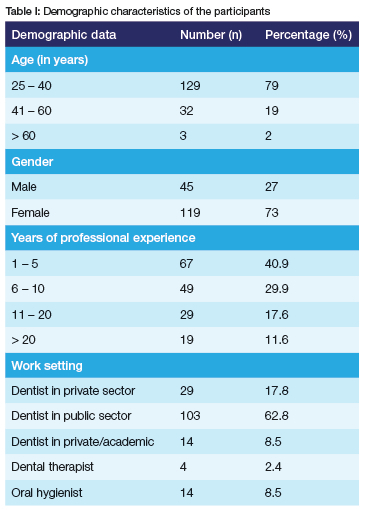
Out of the 342 individuals invited to take part in the study, 164 OHPs completed the questionnaires, yielding a response rate of 48%. Most of the study population were females (73%) and 80% were aged between 25 and 40 years (Table I). Moreover, 41% of the respondents had 1 to 5 years of work experience, and 63% of them were employed in the public sector.
Knowledge about oral SCC
As presented in Table II, the majority of participants (76.8%) correctly identified tobacco smoking, alcohol consumption, and advanced age as major risk factors for oral squamous cell carcinoma (SCC).
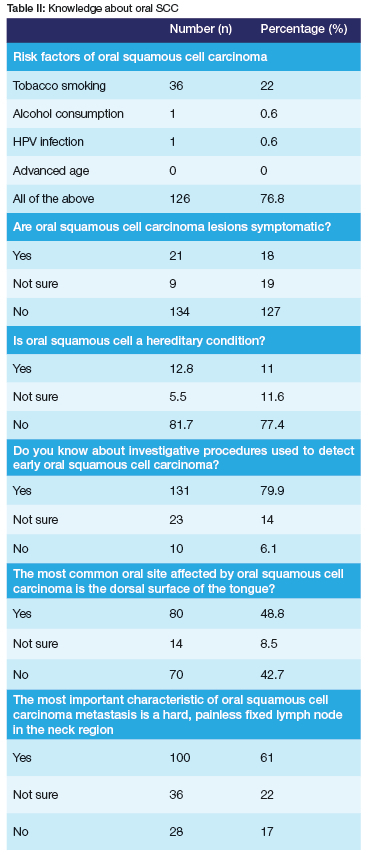
Most participants (81.7%) accurately recognised that oral SCC is frequently asymptomatic, particularly in its early stages. Additionally, 77.4% correctly reported that oral SCC is not a hereditary condition. A substantial proportion of participants (79.9%) demonstrated adequate knowledge of the diagnostic procedures used for the detection of oral SCC. However, when questioned about the most common anatomical sites affected, 48.8% of oral healthcare professionals (OHPs) incorrectly identified the dorsum of the tongue. Nevertheless, 61% of participants were aware of the characteristic features of oral SCC metastasis, notably the presence of hard, painless, and immobile cervical lymph nodes.
The knowledge levels were quantified using a scoring system where complete knowledge was assigned a score of 100% and no knowledge received a score of 0%. The mean knowledge score obtained from the study was 75%.
Attitudes toward oral SCC
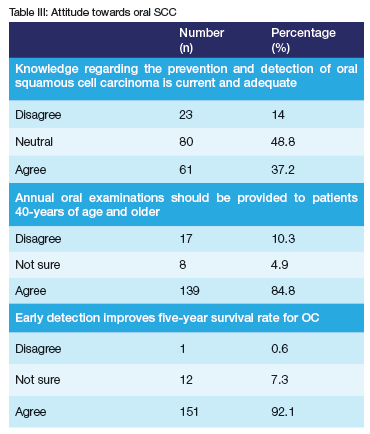
Table III illustrates the attitudes of oral healthcare professionals (OHPs) toward oral squamous cell carcinoma (SCC). Nearly half of the participants (48.8%) expressed uncertainty regarding the adequacy and currency of their knowledge related to the prevention and early detection of oral SCC. A substantial majority (84.8%) agreed that routine oral examinations should be conducted for patients aged 40 years and older. Furthermore, most participants (92.1%) acknowledged that early detection significantly improves the five-year survival rate of oral SCC.
Practices toward Oral SCC
Table IV presents the practices of oral healthcare professionals (OHPs) related to the prevention and early detection of oral squamous cell carcinoma (SCC). The majority of participants (76.6%) reported routinely examining the oral mucosa during clinical assessments. Additionally, 70.7% indicated that they routinely inquired about current or past tobacco and alcohol use when obtaining patients' medical histories, while 58.5% reported educating patients about these risk factors and providing support for cessation. A substantial proportion of participants (90.9%) reported referring patients with suspicious oral lesions to an oral surgeon for further evaluation. However, only 53.7% of participants had attended continuing professional development (CPD) activities or educational sessions related to oral SCC since qualifying as OHPs.
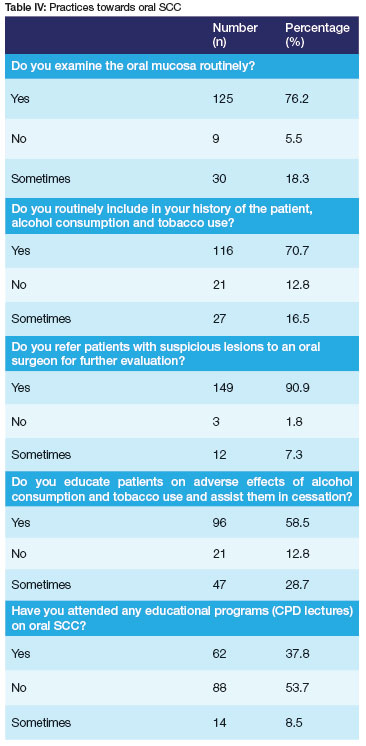
Practices were assessed using a scoring system in which a score of 100% represented optimal practice and 0% indicated poor practice. The mean practice score achieved in the study was 67%. No statistically significant association was identified between knowledge and years of professional experience (p = 0.566). Similarly, no significant relationship was observed between knowledge and professional group (p = 0.460). In contrast, a statistically significant association was found between knowledge and practice (p = 0.017).
DISCUSSION
This descriptive, exploratory study examined self-reported knowledge, attitudes, and practices related to oral squamous cell carcinoma (oral SCC among oral health practitioners in South Africa). The findings provide baseline insight into practitioners perceived awareness and stated clinical behaviours, rather than objective measures of screening quality, diagnostic accuracy, referral appropriateness, or health system performance.
The majority of respondents correctly identified tobacco use and alcohol consumption as major risk factors for oral SCC, consistent with findings from previous studies conducted in South Africa and other low- and middle-income settings.18 This is encouraging, given the high prevalence of alcohol use in South Africa and its established synergistic effect with tobacco in oral carcinogenesis.18 A substantial proportion of participants also identified human papillomavirus (HPV) as a risk factor. While HPV plays a well-established etiological role in oropharyngeal squamous cell carcinoma, its contribution to oral cavity SCC is limited.9, 16 The presence of HPV-related items in the questionnaire may therefore reflect broader head and neck cancer awareness rather than oral SCC-specific risk stratification. This distinction is important for accurate risk communication and prevention strategies and has been clarified in the interpretation of the findings.
Although most respondents were aware that early-stage oral SCC may be asymptomatic, nearly half incorrectly identified the dorsal surface of the tongue as a common high-risk site. This finding suggests a potential gap in anatomical risk knowledge that may affect the thoroughness of oral mucosal examinations. However, as this study relied on self-reported practices, it cannot determine whether oral examinations were performed systematically or whether high-risk sites were consistently examined.
Previous studies have demonstrated discrepancies between reported and observed examination practices, underscoring the need for caution when interpreting self-reported data.19
The overall mean knowledge score of 75% suggests moderate to high perceived awareness among respondents, while the mean practice score of 67% indicates variable adherence to recommended practices. The observed difference in practice scores across knowledge levels suggests that higher perceived knowledge may be associated with more favourable self-reported practices. However, this relationship should be interpreted cautiously, as the analyses were exploratory and the measurement instrument was not formally validated following modification.
Encouragingly, most respondents reported referring patients with suspicious lesions to an oral surgeon for further evaluation. While this suggests awareness of appropriate referral pathways, the study does not assess referral timeliness, diagnostic yield, or downstream outcomes. Similarly, although many practitioners reported routinely examining the oral mucosa, this study cannot evaluate the quality or completeness of these examinations.
Notably, more than half of participants reported not having attended continuing professional development (CPD) activities related to oral SCC following qualification. This finding aligns with previous studies conducted in similar settings and highlights a potential area for targeted educational intervention.20, 21 Rather than indicating deficiencies in clinical competence, this result may reflect limited access to structured post-qualification training opportunities.
This study has important limitations. The use of non-probability sampling limits representativeness, and self-selection bias cannot be excluded. The adapted questionnaire was not subjected to formal psychometric validation, and the scoring system reflects descriptive indicators rather than validated constructs. Additionally, self-reported data are susceptible to recall and social desirability bias. Consequently, the findings should be viewed as hypothesis-generating and should not be used to inform specific screening, referral, or policy decisions without further investigation.
Future research should build on these findings by employing validated instruments, probability-based sampling, and designs that assess observed clinical practices, referral timelines, and structural barriers within the oral cancer care pathway. Such studies would be better positioned to inform implementation strategies and public health decision-making.
CONCLUSIONS
Within the limitations of this descriptive, exploratory study, participating oral health practitioners demonstrated generally acceptable self-reported knowledge, attitudes, and practices related to oral squamous cell carcinoma. Nonetheless, gaps were identified in anatomical risk awareness and participation in post-qualification training activities. These findings highlight the need for targeted educational initiatives and further research using validated tools and representative sampling to support early identification and referral of suspicious oral lesions.
ETHICS
This research was approved by the Ethics Committee at the University of Pretoria, Faculty of Health Sciences (319/2023)
CONFLICT OF INTEREST
None
ACKNOWLEDGMENTS
The authors extend their gratitude to all the OHPs in South Africa for their participation in this study; it is evident that without their cooperation, this study could not have been conducted. The authors also express their appreciation for the cooperation of the University authorities at the University of Pretoria Oral Health Centre (UPOHC).
ABBREVIATIONS
ANOVA - analysis of variance
CPD - Continuing professional development
DPA - Dental Professionals Association
HPCSA - Health Practitioners Council of South Africa
HPV - human papilloma virus
OC - Oral cancer
OHPs - Oral health practitioners
Oral SCC - Oral squamous cell carcinoma
SADA - South African Dental Association
SD - Standard deviation
UPOHC- University of Pretoria Oral Health Centre
REFERENCES
1. Botha P, Schoonees A, Pontes C. Mapping oral cancer research in South Africa. South African Dental Journal. 2018;73(6):384-94. [ Links ]
2. Fidele NB, Patrick SMN, Okonji OC, Kazadi EK. Oral cancer awareness and knowledge: Survey of dentists in Democratic Republic of the Congo. Journal of Cancer Policy. 2022;32:100332. [ Links ]
3. Hobdell M, Oliveira E, Bautista R, Myburgh N, Lalloo R, Narendran S, et al. Oral diseases and socio-economic status (SES). British dental journal. 2003;194(2):91-6. [ Links ]
4. Golburean O, Hagen MH, Uncuta D, Tighineanu M, Manrikyan G, Vardanian I, et al. Knowledge, opinions, and practices related to oral cancer prevention and oral mucosal examination among dentists in Moldova, Belarus and Armenia: a multi-country cross-sectional study. BMC Oral Health. 2021;21(1):652. [ Links ]
5. Tenore G, Nuvoli A, Mohsen A, Cassoni A, Battisti A, Terenzi V, et al. Tobacco, alcohol and family history of cancer as risk factors of oral squamous cell carcinoma: case-control retrospective study. Applied Sciences. 2020;10(11):3896. [ Links ]
6. Gilbert GH, Gordan VV, Korelitz JJ, Fellows JL, Meyerowitz C, Oates TW, et al. Provision of specific dental procedures by general dentists in the National Dental Practice-Based Research Network: questionnaire findings. BMC Oral Health. 2015;15(1):11. [ Links ]
7. Machado J, Reis PP, Zhang T, Simpson C, Xu W, Perez-Ordonez B, et al. Low prevalence of human papillomavirus in oral cavity carcinomas. Head & neck oncology. 2010;2(1):6. [ Links ]
8. Shomorony A, Puram SV, Johnson DN, Chi AW, Faquin WC, Deshpande V, et al. A non-oropharyngeal squamous cell carcinoma and the pitfalls of HPV testing: A case report. Otolaryngology Case Reports. 2019;13:100129. [ Links ]
9. Fonsêca TC, Jural LA, Marañón-Vásquez GA, Magno MB, Roza ALOC, Ferreira DMTP, et al. Global prevalence of human papillomavirus-related oral and oropharyngeal squamous cell carcinomas: a systematic review and meta-analysis. Clinical Oral Investigations. 2023;28(1):62. [ Links ]
10. Ekici Ö. Knowledge and attitudes of the dentists regarding oral cancer in Ankara, Turkey. 2020. [ Links ]
11. Da Cunha AR, Compton K, Xu R, Mishra R, Drangsholt MT, Antunes JLF, et al. The global, regional, and national burden of adult lip, oral, and pharyngeal cancer in 204 countries and territories: a systematic analysis for the global burden of disease study 2019. JAMA oncology. 2023;9(10):1401-16. [ Links ]
12. Yang J, Guo K, Zhang A, Zhu Y, Li W, Yu J, et al. Survival analysis of age-related oral squamous cell carcinoma: A population study based on SEER. European Journal of Medical Research. 2023;28(1):413. [ Links ]
13. Novák P, Szabó RM, Braunitzer G, Vereb I, Bágyi K, Nagy Á, et al. Diagnostic Confidence and Oral Cancer Screening: Insights From a Nationwide Cross-Sectional Study in Hungary. international dental journal. 2025;75(5):100878. [ Links ]
14. Mariño R, Haresaku S, McGrath R, Bailey D, Mccullough M, Musolino R, et al. Oral cancer screening practices of oral health professionals in Australia. BMC oral health. 2017;17(1):151. [ Links ]
15. Algudaibi LY, AlMeaigel S, AlQahtani N, Shaheen NA, Aboalela A. Oral and oropharyngeal cancer: Knowledge, attitude and practices among medical and dental practitioners. Cancer Reports. 2021;4(4):e1349. [ Links ]
16. Melo BAdC, Vilar LG, Oliveira NRd, Lima POd, Pinheiro MdB, Domingueti CP, et al. Human papillomavirus infection and oral squamous cell carcinoma-a systematic review. Brazilian journal of otorhinolaryngology. 2021;87:346-52. [ Links ]
17. Messadi DV. Diagnostic aids for detection of oral precancerous conditions. International journal of oral science. 2013;5(2):59-65. [ Links ]
18. Glantz MD, Bharat C, Degenhardt L, Sampson NA, Scott KM, Lim CC, et al. The epidemiology of alcohol use disorders cross-nationally: Findings from the World Mental Health Surveys. Addictive behaviors. 2020;102:106128. [ Links ]
19. Razavi SM, Zolfaghari B, Foroohandeh M, Doost ME, Tahani B. Dentists' knowledge, attitude, and practice regarding oral cancer in Iran. Journal of Cancer Education. 2013;28(2):335 [ Links ]
20. Alaizari NA, Al-Maweri SA. Oral cancer: knowledge, practices and opinions of dentists in Yemen. Asian Pacific Journal of Cancer Prevention. 2014;15(14):5627-31. [ Links ]
21. Hassona Y, Sawair F, Baqain Z, Maayta W, Shahin A, Scully C. Oral cancer early detection-a pressing need for continuing education in Jordan. Asian Pacific Journal of Cancer Prevention. 2015;16(17):7727-30. [ Links ]
 Correspondence:
Lucy Nurse Masuka
PO Box 1266, Pretoria 0001, South Africa
E-mail: lucy.masuka@up.ac.za ORCID number: 0000-0002-9757-2317
Authors Contribution
1. Dr LN Masuka: Principal researcher - 40%
2. Dr. AI Masilana: Protocol development and writing article (introduction and conclusion) - 15%
3. Prof. A Bhayat: Statistical analysis - 5%
4. Prof. RAG Khammissa: formulating a questionnaire and writing an article (results) - 20%
5. Dr. MM Beetge: Protocol development and writing article (discussion) - 20%
