



Servicios Personalizados
Revista

Articulo
 Inglés (pdf)
 Articulo en XML
 Referencias del artículo

 Traducción automática
 Enviar articulo por email
Indicadores
Links relacionados
-
 Citado por Google
-
 Similares en Google
Compartir

 Permalink

South African Dental Journal
versión On-line ISSN 0375-1562versión impresa ISSN 0011-8516
S. Afr. dent. j. vol.81 no.2 Johannesburg 2026
https://doi.org/10.17159/sadj.v81i02.22833
RESEARCH
Oral health care and edentulism: perspectives of patients attending public health clinics in Harry Gwala and eThekwini districts, KwaZulu-Natal
Y BandeziI; S SinghII
IND: Dental Technology (DUT), B. Tech: Dental Technology (DUT), MHSc: Dental Technology (DUT). Discipline of Dentistry, School of Health Sciences. University of KwaZulu-Natal, Private Bag X54001, Durban, 4000, South Africa, Cell: +27642048122. Email: 218088142@stu.ukzn.ac.za ORCID iD: https://orcid.org/my-orcid?orcid=0009-0004-3525-9618
IIB.OH (UDW), M.Sc [DENT], PhD (UWC), PG Dip Health Research Ethics (Stell) PhD [Clinical and Res Ethics] (Stell). Discipline of Dentistry. School of Health Sciences. University of KwaZulu-Natal. Private Bag X54001, Durban, 4000, South Africa. Telephone: +2731 260 8591. Telefax: +2731 260 8069. Email: singhshen@ukzn.ac.za ORCID iD: https://orcid.org/0000-0003-4842-602X
ABSTRACT
INTRODUCTION: Maintaining oral health is vital for overall well-being, and offering dental care services is a crucial part of public healthcare systems globally. A significant portion of South African population faces socioeconomic barriers to accessing private oral health services resulting in dependency on public oral health services. However, not much is known of patients' experiences in accessing such care in these facilities.
AIMS AND OBJECTIVES: To determine perspectives of public health recipients on oral health care, the nature of edentulism and impact of edentulism in Harry Gwala and eThekwini districts, KwaZulu-Natal.
DESIGN: A cross-sectional descriptive research design.
METHODS: A systematic sampling technique was employed to select participants that attended the public health facilities (n=810). The total sample was stratified according to urban, peri-urban and rural public health facilities deriving five sub-populations of (n=162). Data was collected using a questionnaire that was derived from the WHO Oral Health Surveys guidelines. Data was analysed using R Statistical computing software of the R Core Team, 2020, version 3.6.3. Descriptive statistics were applied for numerical measurements and categorical variables were described as counts and percentage frequencies.
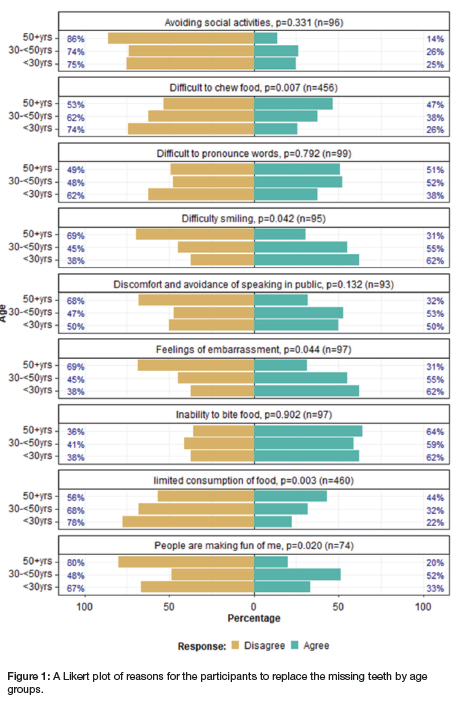
RESULTS: A total of 770 out of 810 patients consented to participate in the study with a 95% response rate, of which 73.9% were female (p=0.016). The majority of participants were between the ages of 30 to 50 (n=396; 47.9%). Pain from teeth and gums were reported by the majority of patients (n=509; 70.2%) as the reasons for visiting a dentist. The majority of the patients (n=449; 76.4%), indicated that they accessed public oral facilities and 80.9% of responses came from rural participants (n=267). All age groups reported having missing teeth (between 1-9 teeth lost) with participants aged 30 to 50 representing the majority (n=280; 75.9%). Participants identified the following reasons to replace missing teeth: difficulty to chew food (n=456 majority being 50 years and above (43%), difficulty smiling (n=95) majority being 30 years and below (62%), feelings of embarrassment (n=97) majority being 30 years and below (62%), limited consumption of food (n=460) majority being 50 years and above (44%), and being made fun of by people (n=74) majority being 30 to 50 years (52%).
CONCLUSION: This study found that both psychological and functional impacts of edentulism were reported as the reasons why most patients indicated their need to replace their missing teeth. The study findings suggested that participants in rural settings reported poor access to facility-based oral health care and that pain was the major reason for seeking care.
Keywords: Public oral health, edentulism, tooth loss, oral health-related quality of life, dental care, oral health access, social justice, oral health services.
INTRODUCTION
Oral health is an essential component of overall health, and the provision of oral health services is a critical aspect of public healthcare systems worldwide (WHO Global Oral Health Action Plan 2023-2030). In South Africa, a significant portion of the population, particularly in rural areas faces socioeconomic barriers to accessing private dental care resulting in their only option being the reportedly under-funded public health services. Studies show that approximately 0.8% funding was allocated for oral health in some health districts of KwaZulu-Natal, which has only increased to 0.86% 22 years later.1, 2 This under-funding negatively impacts resources for dental care resulting in lack of certain vital services such as replacement of lost teeth.
Non-replacement of lost teeth contributes to a compromised Oral Health-Related Quality of Life (OHRQoL) which affects physical, emotional, social, and functional aspects of life.
Individuals who have lost their teeth are likely to experience feelings of sadness, highlighting the emotional strain of edentulism and being unprepared for the consequences of losing their teeth.3 Edentulism is highlighted as one of the most critical public health burdens and should be seen as a major public health concern given its impact on the quality of life and being a devastatingly irreversible condition.4-6 It is often associated with a significant decline in oral health and can severely impact an individual's ability to speak, eat, and maintain good nutrition.7 The prevalence of edentulism is said to be particularly high in older populations, as tooth loss tends to be exacerbated by natural progression of aging (8, 9). Studies further show that people are now living longer in all parts of the world and the impact of poor oral health on the quality of life of older adults must be highlighted as an important public health issue.8, 10 Considering the impacts of edentulism, restoring lost teeth becomes a salient area that requires attention for the public oral health sector, since its recipients cannot afford to obtain dental prostheses from private health providers.11 The skewed distribution of oral health services between the private and public sector reiterates the communities' dependency on public dental clinics to provide these services.12 However, it is unclear of the extent to which denture delivery services are offered in public dental clinics. At the same time, there is a paucity of published evidence that explores patients' perspectives on the availability and accessibility of denture services in these public sector dental clinics. This study is part of a bigger study which aims to develop a framework for the provision of denture services, as part of the minimum package of oral health care, in health districts of KwaZulu-Natal, to contribute to improved quality of oral health care.
The objective of this paper is therefore to determine perspectives of public health recipients on oral health care, the nature of edentulism and impacts of edentulism by means of a survey, with theoretical underpinnings of social justice and principles of oral health-related quality of life model. In the context of health care systems, social justice can be considered to mean that individuals with the same medical conditions have availability of the same treatment options, regardless of their socioeconomic status.13 Engaging with patients in public health clinics is important in revealing their perspectives on their own oral health conditions based on their lived experiences.14
MATERIALS AND METHODS
Study design
A cross-sectional descriptive research design was used to collect the quantitative data.
Study setting
Data for this study was collected from selected public health facilities of eThekwini District which represented the urban and peri-urban areas with two of the three health facilities located in the same community or catchment, while the rural areas were represented by three distinct communities of the Harry Gwala district. This research was approved by the HUMANITIES AND SOCIAL SCIENCES RESEARCH ETHICS COMMITTEE (HSSREC) of the University of KwaZulu Natal, with reference number: HSSREC/00000444/2019. Gatekeeper permission was obtained from the KZN Department of Health.
Study sampling
At the time of data collection, the total population of the Harry Gwala Health district was 502 265 (harrygwaladm.gov.za, 2019). The eThekwini district had a total population of 3,442,361 (Durban.gov.za, 2019). A statistically sound sample was drawn using Raosoft ® online sample calculator where the total population size was entered, with the confidence level of 95%, marginal error of 5%. This resulted in a population sample n=810 being 162 per selected public health facility, enabling a reasonable completion of 54 questionnaires per research site per day over a period of 3 days, during a fixed time period from 7:00am to 11:00am. A systematic sampling technique was employed to select participants from the walk-in patients who attended the public health facilities. The sampling interval of 3 was derived by dividing the total population per site (n=162) by the desired daily sample (n=54) and a starting point between 1 and 3 was identified, followed by selecting every third person thereafter to participate in the survey until the desired sample was reached.
Study population
The study population consisted of adult individuals who were 18 years and older, attending the public health facility. Persons who are intellectually or mentally impaired and those who do not understand English, isiZulu or isiXhosa were excluded from participating. Exclusion was also applied to individuals who presented to the facilities in critical health conditions. People of all races, gender, and education status participated in the survey.
Research Instrument
Data was collected using a digital Google Forms questionnaire which was adapted from Annexure 7 of the 5th Edition of the WHO Oral Health Surveys guidelines. The first section of the questionnaire consisted of the title of the study, researcher's information, a description of the study and reiteration of voluntary participation, confidentiality, anonymity and risks associated with participation. The next set of text contained ethical approval details, including the supervisor's contact details. The second part of the questionnaire was a mandatory field of informed consent. The subsequent sections of the questionnaire would only unlock when the respondent has indicated consent which toggled the "I Agree' to participate function.
The second section recorded biographical information such as age, gender, race, geographical location, level of education and whether the responded is a denture wearer or not. The third section recorded data about the number of teeth lost and the perceived reasons that caused the reported loss of teeth. The fourth section recorded information about dental visits, allowing the respondents to indicate whether the last dental treatment received was from a public or a private facility. The fifth and larger section of the questionnaire solicited responses by means of a 5-point Likert scale ranging from Strongly-Agree to Strongly disagree. The statements under this section ranged from reasons for visiting a dentist to reasons for desiring to replace teeth or for having replaced lost teeth, as well as the impact of living with missing teeth. The last three sections were applicable to respondents who have replaced their missing teeth and it solicited information about the type of prostheses received, the benefits of replacing the missing teeth and the maintenance of the prostheses.
Data collection procedure
On the day of data collection, an appointed supervisor of the facility introduced the researcher to the patients. It was practical to interact with the patients during general administration before they were redirected to specific consultation areas. Thereafter, the researcher verbally informed the prospective participants that their participation is voluntary and that there are no incentives applicable and guaranteed them anonymity and confidentiality.
The researcher first explained the purpose of this study as well as the scope of involvement of the patients. This was done in the prospective participants' preferred language of communication between English, and IsiZulu and IsiXhosa. Subsequently, each member who agreed to participate verbally indicated informed consent which was captured on the digital questionnaire. Then the researcher proceeded to administer the digital questionnaires using a tablet as an electronic device to capture the responses. The use of an electronic device, optimised and streamlined data management because this decreased the need to carry hard copies of the collected data. It also decreased the risk of possible cross-contamination of the paper-based hard copies by contact- transmissible viruses such as Covid-19. This process was carried out until there were no more individuals presenting to the facility.
Ethical Considerations
This study was conducted following the ethical guidelines of the University of KwaZulu-Natal and ethical clearance was obtained from the Humanities and Social Sciences Ethics Committee (HSSREC/00000/444/2019). Subsequently, gatekeeper permissions were obtained from various authorities before commencing the research study. Firstly, permission was obtained from the Department of Health, KwaZulu-Natal, to conduct research in the provincial health facilities that have dental services. This was followed by gatekeeper permissions from the Harry Gwala and eThekwini health district offices. After the districts had granted their permission, the managers of the dental facilities were contacted to offer their support which was useful in obtaining the final gatekeeper permission from the managers of respective public health facilities.
Data analysis
The data collected via Google Forms was exported to a MS Excel spreadsheet for data verification and organisation in preparation to be statistically analysis. The statistical data analysis was conducted using R Statistical computing software of the R Core Team, 2020, version 3.6.3. Where applicable, the descriptive statistics of numerical measurements were summarised as the minimum, maximum, quartiles, interquartile range, means, standard deviation and the coefficient of variation. On the other hand, the categorical variables were described as counts and percentage frequencies where Likert plots were used to visually display the categorical variables. Kruskal Wallis was used for assessing the median difference of the non-normally distributed measurements for at least three categories and post-hoc tests were conducted using Dunn test for significant difference in the medians. To determine the association between categorical variables, a Chi-Square Test was used and when the distribution of the cross tabulations contained an expected value of less than five, a Fisher's exact test was applied. In the case of significant difference between the Chi Square or Fisher exact test, a row wise paired z-test was used as a post hoc analysis following the omnibus tests (Chi-Square or Fisher exact test). All the inferential statistical analysis tests were conducted at 5% levels of significance. The results are presented in the form of descriptive and inferential statistics.
RESULTS
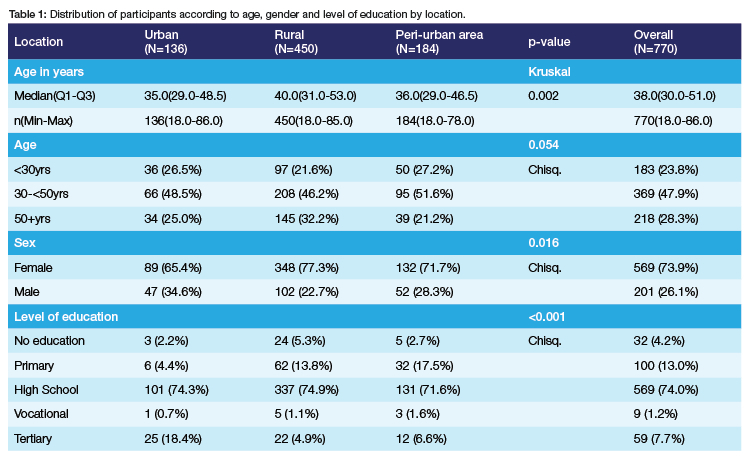
A total of 770 out of 810 patients consented to participate in the study with a 95% response rate, of which 73.9% were female (p=0.016). The majority of participants were between the ages of 30 to 50 (n=396; 47.9%), followed by those aged 50 and above (n=218;28.3%). The least represented age group is the 18 to 30 (n=183; 23.8%). The data on age groups shows a statistical significance (p= 0.054) with non-normal distribution across urban, peri-urban and rural participants, hence the Kruskal Wallis pairwise test was applied to determine the median differences within independent locations. About 74.0% of participants indicated high school education as their highest education obtained. Data showed high statistical significance for responses about the level of education (p=<0.001). The majority of participants indicated that they reside in rural areas with (n=450; 58.4%). The distribution of the participants according to age, gender and level of education by location is presented in Table 1.
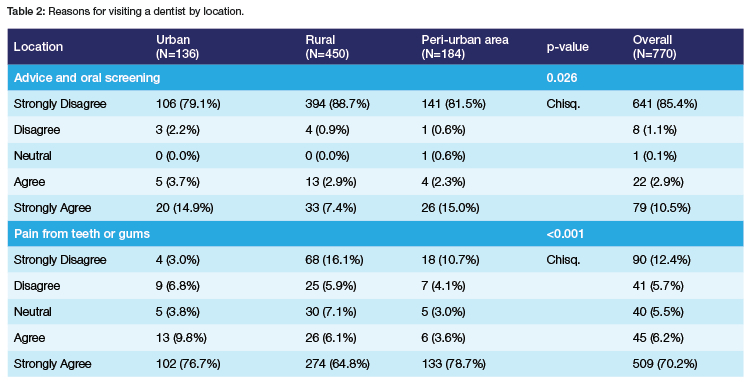
As shown in Table 2, the overall responses indicate that pain from teeth and gums were reported by majority of patients as the reasons for visiting a dentist (n=509; 70.2%). For this variable, participants from the peri-urban area account for 78.7%, urban area accounting for 76.7, whilst rural participants accounted for the lowest percentage of 64.8% with a high statistical significance (p=<0.001). Visiting a dentist for oral screening and dental advice has the lowest percentage of 10.5%. For this variable, participants from rural areas accounted for the least responses of 7.4% with urban and peri-urban closely related at 14.9% and 15% respectively with a moderate statistical significance (p=0.026).
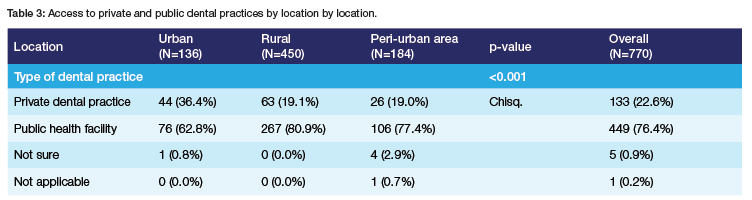
The results on access to private and public dental facilities by location are presented in Table 3. Overall, the majority of the participants from all represented locations indicated that they last presented to a public oral health facility for their dental needs at 76.4 % of which 80.9% of participants came from rural areas, followed by peri-urban at 77.4% and the least percentage representation came from the urban areas at 36.4%. The data shows a strong statistical significance of (p=<0.001).
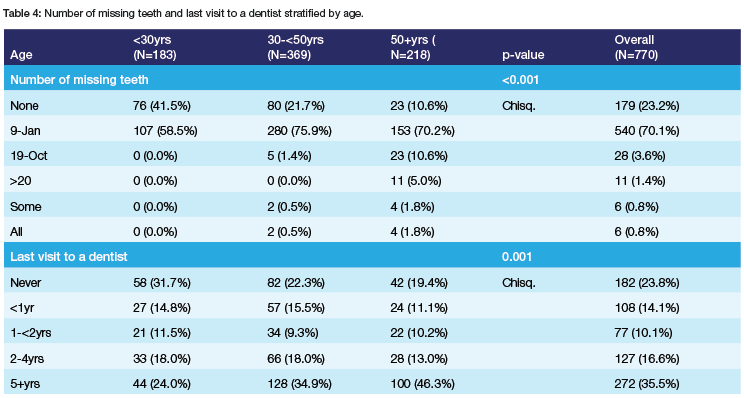
The distribution of number of missing teeth and the last visit to the dentist by age are presented in Table 4. Overall, the highest number of teeth missing across all age groups is in the range of 1-9 (n=540; 70%) with participants aged 30 to <50 representing the majority (n=280; 75.9%), followed by age 50 and above (n=153; 70.2%) and the lowest being participants aged 18 to 30 (107;58.5%). The data for this variable shows a strong statistical significance (p=<0.001). The majority of participants indicated that they last visited a dentist over 5 years ago (n=272; 35.5%) with participants aged 50 and above having a high representation (n=100; 46.3%) in this variable. The second largest category is that of participants who have never visited a dentist at 23.8% (n=182) with the 18 to 30 years old age group accounting for the majority at 31.7%. These results have a statistical significance of p=0.001.
The indicated reasons for the participants who desire to replace the missing teeth by age groups are illustrated in a Likert plot in Figure 1. This applied to those participants who in the questionnaire indicated having missing teeth but are not wearing any prosthesis. Statistically significant variables were difficulty to chew food (p=0.007), difficulty smiling (p=0.042), feelings of embarrassment (p=0.044), limited consumption of food (p=0.003) and being made fun of by people (p=0.020). The variables that showed no statistically significant differences among different age groups were the avoidance of social activities (p=0.331), difficulty to pronounce words (p=0.79), discomfort and avoidance of speaking in public (p=0132) and inability to bite food (p=0.902).
DISCUSSION
The results highlight significant perceived disparities in dental health access based on location, age, and education level, underscoring the need for targeted interventions to improve oral health care, particularly in rural areas.
In this study, 74% of participants indicated high school education as their highest education obtained. This is consistent with studies that reported a demonstrable positive correlation between education, oral health awareness and practices, and lower OHRQoL.15, 16 The overall results of this study showed a concerning lack of commitment to oral health care with majority of participants reporting to have last visited a dentist over 5 years ago, and predominantly being patients who are 50 and above. This supports the sentiment by multiple authors that highlight the need to address the impact of poor oral health on the quality of life of older adults due to people living longer in all parts of the world. 8, 9, 17 Equally concerning is that younger participants of the 18 to 30 age group reported to have never visited a dentist. This is an edentulism risk factor since these young patients may end up seeking oral health interventions when only dental extractions can be the solution, which perpetuates the prevalence of tooth loss as reported by Mthethwa, Mahomed.18 Considering that the majority of participants indicated that they reside in rural areas, it is important to explore the determinants of access to primary oral health, particularly in the rural areas. Such information could inform and strengthen oral health planning in the province.
Reasons for seeking oral health services
This study's findings indicate that most individuals who sought access to oral services do so only when they start experiencing pain from teeth and gums. This is consistent with findings from another study which purported that while dental treatment in most public primary health care facilities is free or highly subsidised, patients continue to access dental treatment only in the symptomatic phases of the disease, making pain the driving force for seeking relief.18 In support of these findings, Thema and Singh,4 reported that there is a possibility of teeth being extracted as a quick solution to pain and discomfort without exploring the benefits of saving and restoring the dentition in public primary health care facilities.
This delay in seeking oral health highlights a gap in patient education on the importance of regular dental check-ups even when they are not experiencing pain. This correlates with this study's low results on the participants who indicated that they visit a dentist for oral screening and dental advice, particularly from those representing the rural areas.
Dependence on public oral health facilities
From the results of this study, there is an indication of significant predominance of access to public oral health facilities in comparison to private dental practices, with majority of participants representing rural areas. A study that investigated oral health community engagement for rural communities reported that while oral health strategies were effective in improving the oral health and quality of life of children and edentulous older adults in rural communities, these communities are still heavily burdened by oral diseases, due to unequal access to dental care and a shortage of oral health professionals.19 This suggests that there are disparities between urban, peri-urban, and rural areas in terms of equity of access to oral health services that are not part of public health care. The implications of this is individuals who are predisposed to living with edentulism since the essential oral health services do not include basic dentures. Subsequently, this necessitates the review of the current essential oral health package and consider the incorporation of basic dentures. This study further found that participants across all age groups reported having lost between 1-9 natural teeth, especially in the ages 30 to 50 and above.
Reasons for needing to replace missing teeth
The results of this study indicated that all participants reported that they need to replace their missing teeth not only because of the obvious functional effects of tooth loss, but due to psychological effects as well. These results are consistent with the findings of one study which reported that there is significant evidence of causality between tooth loss and depression symptoms.20 While these participants may be experiencing these negative psychological effects, such as difficulty smiling and feelings of embarrassment, they also indicated that they are not affected to the extent of avoiding social activities. This may be due to the iteration by Kimmie-Dhansay, Pontes,7 that, cultural beliefs and personal values about appearance have an influence on how tooth loss affects individuals.
RECOMMENDATIONS
The results of this study indicate that there is a need to strengthen oral health education and improve community outreach programmes to resolve the issue of individuals seeking oral health care too late, which often leads to tooth extractions being the only treatment to relieve symptoms. With the occurrence of tooth loss being associated with advancing in age and considering that people are living longer, there needs to be an all-inclusive strategy that does not leave out oral rehabilitation through basic prostheses, for those patients who are already living with some form of edentulism. As mentioned earlier in this paper, the Global Oral Health Action Plan (2023-2030) is determined to address oral health inequities through a comprehensive framework that emphasises prevention, promotion, and integration into universal health coverage in rural areas. However, there needs to be an all-inclusive strategy that does not leave out oral rehabilitation through basic prostheses, for those patients who are already living with edentulism. Thus, the current district level oral health care plans should consider incorporation of basic partial dentures in primary oral health care.
There is a need for a province-wide research to determine whether there is gender-based, age-based location and cultural related barriers to accessing oral health care, particularly prosthodontic restorations. Due to the limitations of this scope of this study, more research in the form of cohort studies is necessary, to uncover and report on the extent of the need for dentures for all districts in the KZN province. Another area of future research is a prospective study that will track younger patients over a period of time from their initial tooth extraction treatment to determine the frequency of their return for further extractions with the intention to highlight the potential contribution of exodontia to edentulism.
STENGTHS AND LIMITATIONS OF THE STUDY
The study findings provided an important snapshot of the current state of edentulism for individuals who access the public oral health facilities. While, other studies have reported on patients accessing oral health services in the public sector, this is the first study, to our knowledge, that specifically focused on edentulism in the identified research sites.
Despite the value of such information, some limitations were noted. The main limitation of this study was the cross-sectional design. Thus, this study could not establish cause-and-effect relationships in respect of edentulism, because data was collected at a single point in time. The study results are also susceptible to self-reported bias whereby the data collected may be inaccurate due to being influenced by the participants' social desirability bias or recall bias which may lead to under- or over-reporting of the impacts of edentulism. It may be worthwhile for this type of research to include a clinical examination component so as to corroborate the reported findings with clinical data from the same participant. Sample bias could also have been possible as most participants of this study came from rural areas. However, this study provided much needed baseline information on patient's perspectives of accessing facility-based oral health care and such information could be of value to oral health planners in the region.
CONCLUSION
This study found that both psychological and functional impacts of edentulism were reported as the reasons why most patients indicated their need to replace their missing teeth. These results present an opportunity for an exploration of the potential to incorporate basic removable partial dentures in the essential oral health package at district level in KZN. The study findings further suggest that participants in rural settings reported poor access to facility-based oral health care and that pain was the major reason for seeking care. This highlights the need to strengthen oral health and community outreach programmes in the identified research sites.
Acknowledgments
Research activities of this study were funded by the Department of Higher Education and Training (DHET) scholarship under the University Capacity Development Programme (UCDP) University Staff Doctoral Programme (USDP), Phase 5.
Conflict of interest
The authors declare that there is no conflict of interest.
REFERENCES
1. Brindle R, Wilkinson D, Harrison A, Connolly C, Cleaton-Jones P. Oral health in Hlabisa, KwaZulu/Natal--a rural school and community based survey. 2000. p. 13--20. [ Links ]
2. Mahomed O, Mthethwa J. Estimating the Cost of Oral Health Services for 2018/19 Financial Year at Public Health Facilities in Two KwaZulu-Natal Districts, South Africa: A Retrospective Study. Journal of International Oral Health. 2022;14(1):40-6. [ Links ]
3. Silva AAMe, Pontes VOLd, Clemente LM, Ribeiro AB, Muglia VA, Silva-Lovato CH. Quality of life in edentulous patients: the role of dentures. REVISTA DELOS. 2024;17(59):e1965. [ Links ]
4. Thema LK, Singh S. Epidemiological profile of patients utilising public oral health services in Limpopo province, South Africa. 2017. p. e1-e-e5. [ Links ]
5. Barclay CW. Should our older, edentulous patients live with their teeth sitting in a glass of water? 2024. p. 535--6. [ Links ]
6. Peltzer K, Hewlett S, Yawson AE, Moynihan P, Preet R, Wu F, et al. Prevalence of loss of all teeth (edentulism) and associated factors in older adults in China, Ghana, India, Mexico, Russia and South Africa. 2014. p. 11308--24. [ Links ]
7. Kimmie-Dhansay F, Pontes CC, Chikte UME, Chinhenzva A, Erasmus RT, Kengne AP, et al. Impacts of Tooth Loss on OHRQoL in an Adult Population in Cape Town, South Africa. 2021. [ Links ]
8. Kailembo A, Preet R, Stewart Williams J. Common risk factors and edentulism in adults, aged 50 years and over, in China, Ghana, India and South Africa: results from the WHO Study on global AGEing and adult health (SAGE). 2016. p. 29-. [ Links ]
9. Small C, Brits D, Hemingway J. Assessing the effects of tooth loss in adult crania using geometric morphometrics. 2016. p. 233--43. [ Links ]
10. Shaik PS, Medapati A, Pachava S, Pavani NPM, Ravoori S, Palli C. Impact of Dentures on Oral Health-Related Quality of Life in Assisted Living Facility Elders, Guntur District, Andhra Pradesh. Journal of Indian Association of Public Health Dentistry. 2022;20(3). [ Links ]
11. Ayo-Yusuf IJ, Naidoo S. Social gradient in the cost of oral pain and related dental service utilisation among South African adults. BMC Oral Health. 2016;16(1):117. [ Links ]
12. Tiwari R, Bhayat A, Chikte U. Forecasting for the need of dentists and specialists in South Africa until 2030. PLoS One. 2021;16(5):e0251238. [ Links ]
13. Krau SD. Social Justice: A Basis for Health Care Delivery. Nurs Clin North Am. 2015;50(3):xiii-xv. [ Links ]
14. Jawad S. The edentulous patient: the impact of implants on quality of life. Primary Dental Journal. 2024;13(3):91-8. [ Links ]
15. Sun J, Meng J, Shan J, Lu H, Wei W, Zhang S, et al. Knowledge, attitudes, and practice related to tooth loss and dentures among patients with dental arch deficiencies. BMC Public Health. 2024;24(1):1--12. [ Links ]
16. Al Shammary NH. Exploring the impact of oral health on the quality of life in older patients: a cross-sectional study. BDJ Open. 2024;10(1):60. [ Links ]
17. Cheng Y, Cheng L, Zhu F, Xiang Y, Duan S, Luo J, et al. New measure of functional tooth loss for successful Oral ageing: a cross-sectional study. BMC Geriatrics. 2023;23(1):859. [ Links ]
18. Mthethwa J, Mahomed O, Yengopal V. Epidemiological profile of patients utilizing dental public health services in the eThekwini and uMgungundlovu districts of KwaZulu-Natal province, South Africa. The Journal of the Dental Association of South Africa = Die Tydskrif van die Tandheelkundige Vereniging van Suid-Afrika. 2020;75:541-7. [ Links ]
19. Nghayo HA, Palanyandi CE, Ramphoma KJ, Maart R. Oral health community engagement programs for rural communities: A scoping review. PLOS ONE. 2024;19(2):e0297546. [ Links ]
20. Matsuyama Y, Jürges H, Dewey M, Listl S. Causal effect of tooth loss on depression: evidence from a population-wide natural experiment in the USA. Epidemiol Psychiatr Sci. 2021;30:e38. [ Links ]
 Correspondence:
Name: Yonela Bandezi
Cell: +27642048122; Email: 218088142@stu.ukzn.ac.za
Authors' contribution
1. Y Bandezi: Study conceptualisation, data analysis, manuscript preparation, writing and final editing (70%).
2. S Singh: Data analysis, manuscript preparation and editing (30%).