



Servicios Personalizados
Revista

Articulo
 Inglés (pdf)
 Articulo en XML
 Referencias del artículo

 Traducción automática
 Enviar articulo por email
Indicadores
Links relacionados
-
 Citado por Google
-
 Similares en Google
Compartir

 Permalink

South African Dental Journal
versión On-line ISSN 0375-1562versión impresa ISSN 0011-8516
S. Afr. dent. j. vol.81 no.2 Johannesburg 2026
https://doi.org/10.17159/sadj.v81i02.24177
REVIEW
Oral-health related quality and substance use disorder
D SmitI; S NaidooII
IChairperson: Department of Community Dentistry. Faculty of Dentistry, University of the Western Cape
IIBDS, LDS.RCS, MDPH, DDPH.RCS, MChD, PhD, Dip IRE, DSc. Faculty of Dentistry, University of the Western Cape, South Africa. Email: suenaidoo@uwc.ac.za ORCID Number: 0000-0001-7424-8082 (https://orcid.org/0000-0001-7424-8082
ABSTRACT
WHY THE WORK WAS DONE: The oral health impact of substance use disorder (SUD) has been comprehensively described, but not as yet been investigated for its effect on oral health-related quality of life (OHRQoL) especially within the South African context.
HOW THE WORK WAS DONE: A cross-sectional study with a mixed methods approach was applied to investigate the oral health impact of SUD and the objective was to assess OHRQoL of drug users admitted to a treatment centre. A validated questionnaire (OHIP-14) supported by clinical oral examinations was applied to achieve the aim of the research project. A sample of 504 patients enrolled in a treatment programme for SUD within the Western Cape was included in the study. All ethical considerations were adhered to.
WHAT ARE THE MAIN FINDINGS: The physical pain and psychological discomfort dimensions of the instrument showed the highest negative impact on OHRQoL with a mean of 3.51 and 3.4 respectively. A significant difference in OHIP-14 score was detected for those who used alcohol as well as for those who used methamphetamine as a primary drug. Those who used heroin/opiates and methamphetamine had the highest OHIP-14 score. A multivariate regression analysis found that 19% of the variability in the OHIP score could be explained by the combined effect of the risk predictors cigarette smoking, DMFT score, poly-drug use, level of education, number of extractions needed, active caries and having a medical condition or not.
WHY THE WORK IS IMPORTANT: The present study highlighted the drug-specific oral health impact of SUD and reaffirmed dental status and oral health behaviours are poor among these patients. Therefore, oral health professionals as well as staff at treatment centres can play a significant part in placing more emphasis on oral health during treatment for SUD.
BACKGROUND
Substance use disorder (SUD) is the problematic use of alcohol, hallucinogens, opioids, cocaine, cannabinoids, sedative hypnotics, tobacco and other elicit stimulants (Cuberos et al., 2020). Oral health burden of disease and SUD are intertwined with South Africa's socio-economic disparities such as the lack of access to basic oral health care (Smit et al., 2017). Aspects such as oral health status and history of substance use have been investigated in previous studies, but there is a paucity of information on the oral health effects of different drug types. The oral health impact of SUD has been comprehensively described outside South Africa (Murphy et al., 2016; Mukerjee et al., 2018; Abdelsalam, 2023), but not as yet been investigated for its effect on Oral Health Related Quality of Life (OHRQoL) especially within the South African context. Oral health status of substance users does have a substantial effect on their quality of life, which can be greatly improved by dental treatment (Van Wijk et al., 2016). In 2017, Antoniazzi et al. (2017) found that crack users and other drug users exerted a negative impact on OHRQoL compared to controls independently of socio-demographic characteristics and tobacco use (Antoniazzi et al., 2017). The association between SUD and OHRQoL in poly-drug users also remains unclear. The present study investigated the oral health status, dental treatment needs, oral health behaviour (OHB) and OHRQoL of patients who were enrolled in a treatment programme for SUD in the Western Cape, South Africa.
MATERIAL AND METHODS
The aim of the study was to investigate the oral health impact of SUD. A cross-sectional study design with a mixed methods approach was applied. A major focus of the study involved a descriptive quantitative component to investigate oral health status, oral health behaviour, dental treatment needs and OHRQoL of participants. This was achieved by using a structured researcher-administered questionnaire and performing oral examinations to measure decayed, missing and filled teeth (DMFT) as well the presence of periodontal disease via the basic periodontal examination (BPE). The OHIP-14, developed by Slade (1997) known for its good reliability, validity and precision was used to investigate OHRQoL. The study population were enrolled adult patients at registered SUD treatment centres in the Western Cape. Sample selection took into consideration the prevalence of SUD as well as the on-point population enrolled for SUD treatment. The sample size was estimated with an 80% power and 5% level of significance and a delta of -0.129. n = 2 {Zα/ES}^2= 2*{1.96/(-0.129)}^2 = 457.00. Finally, 504 patients were included to ensure a robust sample size and to safeguard a decent buffer for data analysis. The exclusion criteria were individuals who were re-entering a treatment programme and who had participated in the study previously. Captured data was exported to Microsoft Excel, Epi Info version 7 (CDC) and STATA (Stata Corp., College Station, TX). Student's t-test was used to investigate differences between group means and proportions respectively and Spearman's rank correlation for associations. Chi Square (χ2) tests were used to test for association and when assumptions were not met, the Fisher's exact test (FET) was applied. P-value for statistical significance was set at 5%. Post-hoc analyses, including Bonferroni, Sidak, and Scheffé tests, were performed. Both univariate and multivariate Poisson regression analyses were done to examine the relationship between various variables and the OHIP-14 overall score. Potential confounding variables such as age, gender and cigarette smoking were controlled in the multivariate regression analysis models. Ethical approval to conduct the study was obtained from the University of the Western Cape (UWC) Bio-Medical Research Ethics Committee (BMREC), City of Cape Town as well as from the Provincial Government of the Western Cape. Participation was anonymous, voluntary, and confidential. The purpose of the study was explained through the study information sheet and informed consent was obtained before data collection. All collected data was secured in a locked office and on a password protected computer.
RESULTS
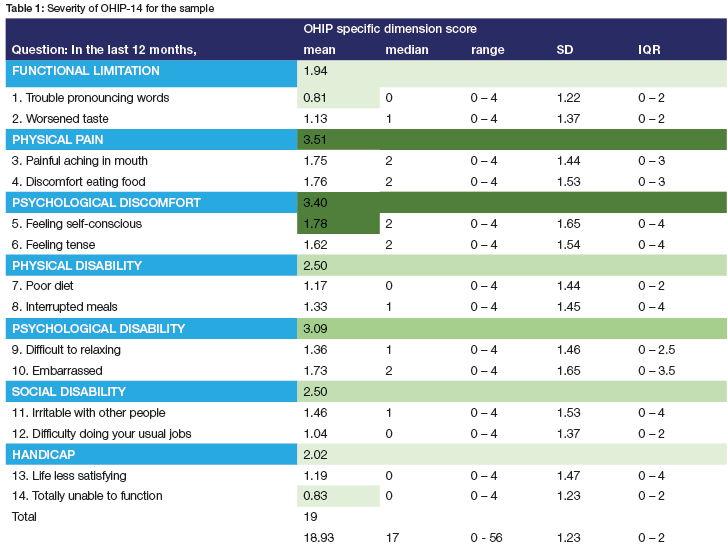
Each of the 14 questions on the OHIP-14 questionnaire, a 5-point Likert scale response format (0 = never, 1 = hardly ever, 2 = occasionally, 3 = fairly often, 4= very often) was given. The sum of the scores was used to calculate a total score as well as the sum for each of the 7 dimensions. Higher scores indicated a poorer OHRQoL and thus a greater negative impact on OHRQoL. The mean OHIP-14 score for the sample was 18.93. The physical pain and psychological discomfort, over the preceding 12 months, showed the highest mean scores, while the functional limitation- and handicap dimensions showed the lowest scores (Table 1).
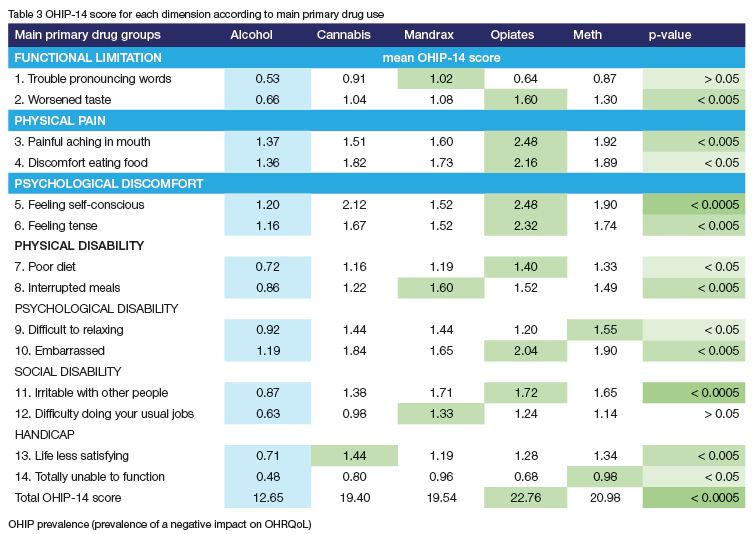
Those who used heroin/opiates and methamphetamine had the highest OHIP-14 score among all the drug groups. However only methamphetamine users had a significant difference in OHIP-14 compared to the rest of the sample (p < 0.005). Those who used alcohol as a primary drug had the lowest OHIP-14 score. Methamphetamine users were the most negatively impacted by finding it difficult to relax and feeling totally unable to function (Table 3).
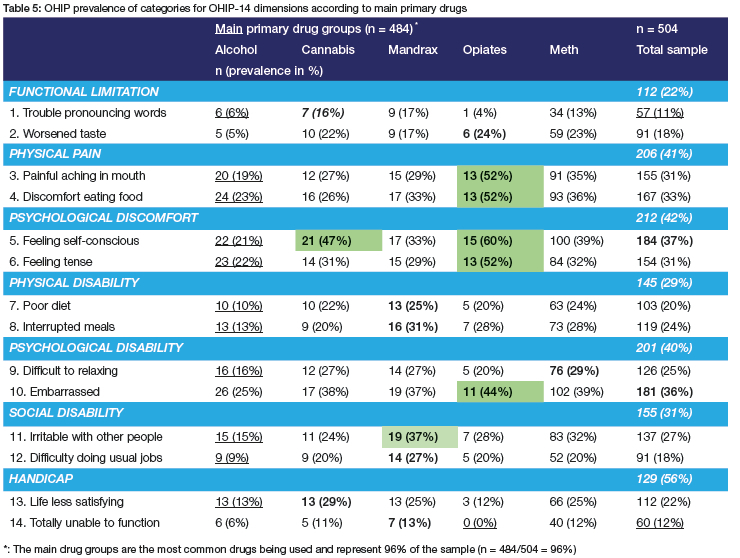
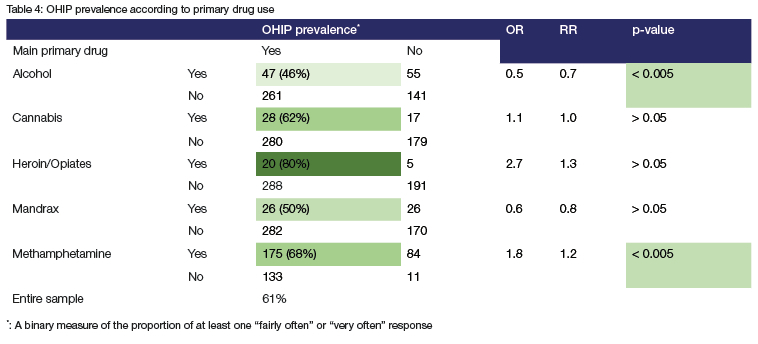
OHIP-14 responses were categorized and classified to signify the presence of a negative impact on OHRQoL if there was at least one response of "fairly often" or "very often". The added percentage of "fairly often" and "very often" responses were used to determine prevalence. Those who were using heroin/opiates showed the highest OHIP prevalence at 80% followed by methamphetamine (68%) while those who used alcohol (46%) and mandrax (50%) showed the lowest prevalence. An association was found between methamphetamine use and OHIP prevalence (p < 0.005). The odds of a negative impact on oral health were 1.8 times more among methamphetamine users compared to those who did not use methamphetamine as a primary drug.
The prevalence of a negative impact on OHRQoL of the different dimensions of the OHIP-14 instrument was analysed according to main primary drug groups. The highest negative impact on OHRQoL was felt by opiate users reporting feeling self-conscience (60%), feeling tense (52%), having a painful aching in the mouth (52%) and having discomfort when eating food (52%) due to problems with their teeth mouth or dentures. Those who were using mandrax reported the highest negative impact related to trouble pronouncing words (17%), poor diet (25%), interrupted meals (31%), irritable with other people (37%), difficulty doing usual jobs (27%) and unable to function at all (13%). Those who used alcohol as a primary drug reported the lowest negative impact for most categories. The values below that are underlined indicates the lowest value in each row while the values that are in bold indicated the highest (Table 5)
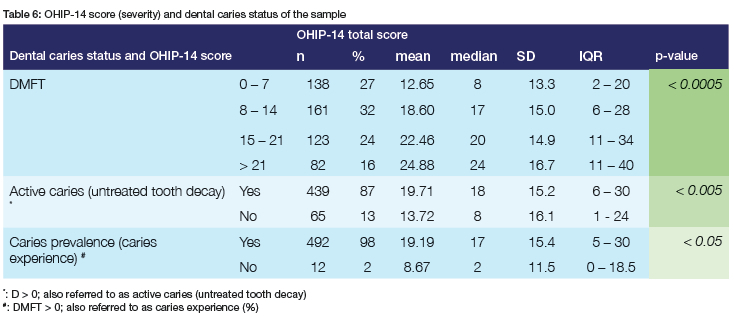
The OHIP-14 score was also analyzed according to categories of dental caries severity (DMFT) as well as to the patients who presented with active caries (D > 0) and those who suffered from dental caries (DMFT-score > 0). Those with a DMFT score of 7 and less, had shown an OHIP-14 score of 12.65 which was significantly lower than the rest of the sample.
Dental caries severity and OHRQoL
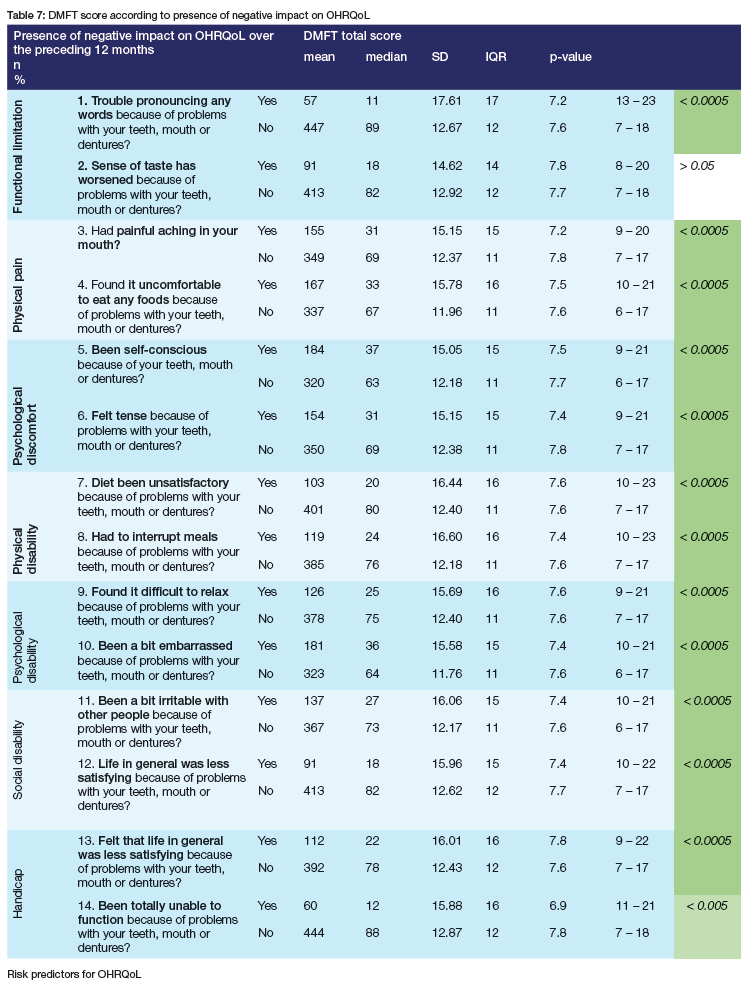
Mean DMFT score was analyzed according the OHIP prevalence. All the questions, where a negative impact was felt by the participants on their OHRQoL in the preceding 12 months, had a significant higher (< 0.005) mean DMFT score except for the question of a worsened sense of taste (Table 7).
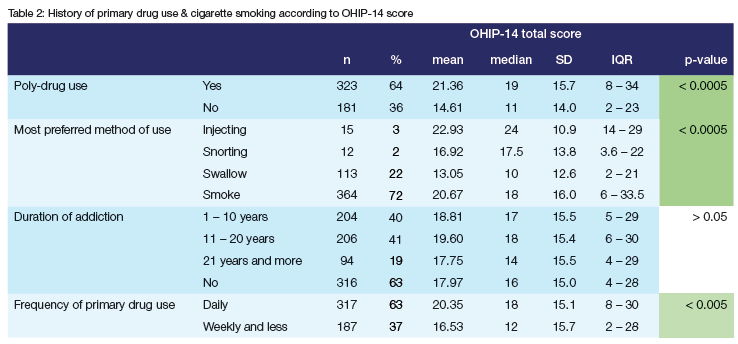
A multivariate regression analysis for OHIP-14 score as the outcome variable was done on: age, sex, cigarette smoking, DMFT score, poly-drug use, highest school grade completed, number of extractions needed, frequency of drug use, having periodontal health, having active caries, duration of addiction, and having a medical condition. Nearly a fifth of the variability in the OHIP score was explained by the combined effect of the predictors. Cigarette smoking, DMFT, poly-drug use, highest school grade completed, the number of dental extractions needed, having active caries and having a medical condition were significant predictor variables (p < 0.05) (Table 8).
DISCUSSION
The present study is unique with regards to its primary focus on the impact substance use disorder (SUD) has on oral health status (dental caries and periodontal disease) and OHRQoL. The prevalence of impact on OHRQoL of 61%, among substance users, was much higher that 17.5% that was found among the general South African adult population (Ayo-Yusuf et al., 2016). Mukerjee et al. (2018) found that more than half (59%) methamphetamine users reported a painful aching in the mouth, discomfort while eating (63.5%), feeling embarrassed (60.7%) and avoidance of particular foods (56.5%). These findings were slightly higher than the present study, probably on account of different sample distribution. The present study reported on other drug types including alcohol (20% of the sample) and found lower negative impact on OHRQoL. On the other hand, Brown et al. (2021) investigated DMFT- and OHIP-14 scores of 398 psychoactive substance users in Brazil. The results on OHIP-14 severity for almost all the dimensions concurred with the present study. Only the mean OHIP-14 score for psychological discomfort was much higher than the present study (5.0 vs 3.4) and this could be attributed to the fact that the Brown study was done at psychiatric hospitals (Brown et al., 2021). The relationship between dental caries and OHRQoL was also investigated in the present study with those who had a high DMFT score (15 and more) having a worse OHRoL than those with a lower DMFT score (14 and less) (p < 0.0005). This finding also concurred with Brown et al. (2021). In the present study, oral health status encompassed the severity and prevalence of dental caries and periodontal disease as well as specific oral health symptoms that were experienced during substance use. Symptoms included grinding teeth, experiencing dental pain, gum problems, stiff facial muscles, a bad taste, a burning sensation in the mouth, increased tooth sensitivity and a dry mouth.
CONCLUSION
The present study highlighted the drug-specific oral health impacts of SUD. The study found that OHRQoL dental status and oral health behaviour is poor among SUD patients. The study considered a multifactorial cascade of risk predictors related to the socio-demographic profile, history of substance use and oral health behaviour of the patient. Evidence from published literaturend an in-depth analysis was incorporated in this model to explain the different contributing factors towards poor oral health of the patient who suffers from SUD.
RECOMMENDATIONS
It is recommended that prior to and during enrolment of patients with SUD the following factors need to be considered: access to oral health care, oral health pre-admission screening, the referral process, oral health profession collaborative partnership, oral health education and behaviour, staff training, nutrition and food products at tuckshops. Dental management should be aligned with substance use treatments and it is recommended that this is done at the initial stage of admission. Pre-admission screening will permit staff to refer the patient for appropriate care. Furthermore, if urgent dental treatment is needed, it can be addressed prior to admittance. A clear referral process must be available during treatment and will require coordination with local private and public dental clinics. Staff at the treatment centre should be aware of the referral channels and processes. Health and oral health education and promotional material needs to be available at all SUD treatment centres. Healthy food choices and educating patients on the association between high sugar intake and dental caries should be included in oral health education material.
REFERENCES
1. Abdelsalam, S., Livingston, M., Quinn, B., Agius, P.A., Ward, B., Jamieson, L. and Dietze, P. (2023) 'Correlates of poor oral health related quality of life in a cohort of people who use methamphetamine in Australia', BMC Oral Health, 23(1). [ Links ]
2. Antoniazzi, R. P., Sari, A. R., Casarin, M., Moraes, C. M. B., & Feldens, C. A. (2017). Association between crack cocaine use and reduced salivary flow. Brazilian Oral Research, 31, e42. [ Links ]
3. Ayo-Yusuf, I. J., Naidoo, S., and Ayo-Yusuf, O. A. (2016). The association between area level socio-economic position and oral health-related quality of life in the South African adult population. South African Dental Journal, 71(1). [ Links ]
4. Brown, M. A., De Castro, A. S., Orestes, S. G. F., Koch, L. F. A., Gabardo, M. C. L., De Lima, A. A. S. and Machado, M. Â. N. (2021). Oral health and quality of life of addicts in brazilian population. World Journal of Dentistry, 12(2), pp. 115-120 [ Links ]
5. Cuberos, M., Chatah, E.M., Baquerizo, H.Z. and Weinstein, G. (2020). Dental management of patients with substance use disorder, Clinical Dentistry Reviewed, 4(1). [ Links ]
6. Mukherjee, A., Dye, B. A., Clague, J., Belin, T. R., & Shetty, V. (2018). Methamphetamine use and oral health-related quality of life. Quality of Life Research : An International Journal of Quality of Life aspects of treatment, care and rehabilitation, 27(12), 3179-3190. [ Links ]
7. Murphy, D. A., Harrell, L., Fintzy, R., Belin, T. R., Gutierrez, A., Vitero, S. J., & Shetty, V. (2016). A Comparison of Methamphetamine Users to a Matched NHANES Cohort: Propensity Score Analyses for Oral Health Care and Dental Service Need. The Journal of Behavioral Health Services & Research, 43(4), 676-690. [ Links ]
8. Slade G. D. (1997). Derivation and validation of a short-form oral health impact profile. Community Dentistry and Oral Epidemiology, 25(4), 284-290. [ Links ]
9. Smit, D. A., and Osman, Y. I. (2017). The availability of the basic oral health care package in the Western Cape. South African Dental Journal, 72(6), 258-261. [ Links ]
10. Van Wijk, A. J., Molendijk, G., & Verrips, G. H. (2016). OHRQoL in a Sample of Alcohol and Drug Abusers. The Open Dentistry Journal, 10, 338-346. [ Links ]
 Correspondence:
Prof Dirk Smit
Tel: +27 21 937 3148; E-mail: dsmit@uwc.ac.za