




Servicios Personalizados
Revista

Articulo
 Inglés (pdf)
 Articulo en XML
 Referencias del artículo

 Traducción automática
 Enviar articulo por email
Indicadores
Links relacionados
-
 Citado por Google
-
 Similares en Google
Compartir

 Permalink

South African Dental Journal
versión On-line ISSN 0375-1562versión impresa ISSN 0011-8516
S. Afr. dent. j. vol.81 no.2 Johannesburg 2026
EDITORIAL
When Certification Outpaces Competence: Microcredentialling in Dentistry
NH Wood
Managing Editor, SADJ - BChD, DipOdont(MFP), MDent(OMP), FCD(SA), PhD
1. A quiet shift in what it means to be "Qualified"
There is a subtle but profound shift occurring in global education, one that is beginning to reshape how competence is defined, acquired, and recognized. Increasingly, the traditional architecture of professional formation structured degrees, supervised training, and longitudinal assessment, is being complemented, and in some instances challenged, by a new form of certification: the microcredential.
Microcredentials, broadly defined as short, targeted learning experiences that certify discrete competencies, have rapidly gained traction across higher education and workforce development systems. Their rise is not accidental. It reflects a world in which knowledge evolves quickly, skills must be updated continuously, and learners seek flexible, accessible pathways to remain relevant. Policymakers, institutions, and industry stakeholders increasingly view microcredentials as tools to address skills gaps, enhance employability, and support lifelong learning.
Yet beneath this promise lies a more complex and less explored question, particularly for regulated professions such as dentistry:
What happens when competence is no longer built as a whole, but assembled in parts?
This question is not merely academic. It speaks directly to the integrity of professional identity, the safety of patients, and the credibility of educational systems. Dentistry, perhaps more than many other fields, has historically depended on integrated, longitudinal training, where knowledge, technical skill, clinical reasoning, and professional judgement develop in concert. The emergence of microcredentialling invites us to reconsider whether such integration can or should be modularized.
2. The promise of microcredentials: flexibility, access, and lifelong learning
The appeal of microcredentials is both intuitive and evidence-supported. At their core, they offer flexible, focused, and often digitally enabled learning opportunities that allow professionals to acquire specific skills without committing to extended periods of formal study. In a rapidly changing global landscape, characterized by technological advancement, shifting disease burdens, and evolving patient expectations, this adaptability is undeniably valuable.
Within health professions education, microcredentials have been positioned as a mechanism to support continuous professional development and workforce responsiveness. The COVID-19 pandemic, alongside accelerated digitalization, further catalyzed their adoption, demonstrating the feasibility of short, targeted learning interventions delivered at scale. For many practitioners, particularly those balancing clinical practice with ongoing education, microcredentials provide a pragmatic pathway to remain current and competitive.
From a systems perspective, they are also aligned with broader global trends. Organizations such as the OECD have highlighted their potential to enhance employability, widen access to education, and support more inclusive learning pathways, particularly for non-traditional learners. Similarly, higher education institutions are increasingly exploring microcredentials as a means to bridge the gap between academic training and industry needs, offering targeted competencies that are immediately applicable in practice.
In dentistry, this promise is already visible. Short courses, certification programmes, and digitally credentialled training modules are proliferating, particularly in areas such as implantology, aesthetic dentistry, and aligner therapy. These offerings respond to genuine demand: clinicians seeking to expand their scope of practice, adapt to new technologies, and meet patient expectations in a competitive environment.
And yet, as this landscape expands, an important tension emerges. While microcredentials excel at delivering discrete skills, dentistry does not operate in discrete fragments. Clinical competence is inherently integrative, requiring not only technical proficiency, but also diagnostic reasoning, ethical judgement, and an understanding of when not to intervene.
It is at this intersection, between modular learning and integrated competence, that the true debate around microcredentialling in dentistry begins.
3. Microcredentialling in dentistry: promise, positioning, and tensions
Before turning to these deeper concerns, it is worth examining how microcredentialling is currently understood and applied within dentistry and the broader health professions.
Microcredentialling in dentistry is most often encountered within the domain of continuing professional development (CPD), where it takes the form of short, focused learning interventions designed to certify discrete competencies. These may include digital badges, modular courses, or micro-learning units targeting specific areas such as periodontal instrumentation, pharmacological updates, or emerging digital workflows. While dentistry-specific implementations remain relatively limited and heterogeneous, the broader literature in health professions education provides a relevant and transferable evidence base, given the shared need for flexible, responsive upskilling in complex clinical environments.
Contemporary perspectives position microcredentialling as part of a wider post-pandemic recalibration of education and workforce development. The rapid expansion of asynchronous, digitally delivered learning during and after COVID-19 demonstrated the feasibility and, in many cases, the necessity of more agile educational models. In this context, microcredentials have been advanced as tools to support lifelong learning, rapid reskilling, and personalised professional development, particularly for clinicians balancing service delivery with ongoing education.
Proponents argue that microcredentials align well with the realities of modern dental practice. They offer time-efficient, targeted learning opportunities, allow for the accumulation of stackable credentials, and provide visible markers of engagement with contemporary techniques and knowledge domains. For practitioners operating in increasingly competitive and technologically evolving environments, such features are attractive and, in many cases, pragmatically necessary.
However, these advantages are accompanied by important and unresolved concerns. Critics caution that microcredentialling may contribute to the progressive dilution of traditional qualifications, particularly if short-form certifications begin to be interpreted as equivalent to comprehensive training. Questions also arise regarding the alignment of microcredentials with established licensure and regulatory standards, especially in a profession where competence must be demonstrated holistically and under conditions of accountability.
These tensions may be usefully summarised as follows:
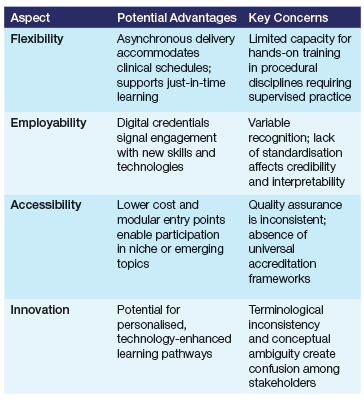
Importantly, these are not binary positions. Rather, they reflect a field in transition, one in which the educational, professional, and regulatory implications of microcredentialling are still being actively negotiated. For dentistry, the central challenge lies not in whether microcredentials should exist, but in how they are interpreted, governed, and integrated within a system that must ultimately prioritise patient safety and professional accountability.
4. The problem: fragmentation of competence
While the appeal of microcredentials is clear, their rapid expansion raises an important and often under-examined concern: the fragmentation of competence. At its core, professional competence in dentistry is not simply the accumulation of discrete technical skills, but the integration of knowledge, clinical reasoning, psychomotor ability, ethical judgement, and contextual decision-making. These elements develop over time, through supervised practice, feedback, and reflection within authentic clinical environments.
Microcredentials, by design, tend to isolate and certify specific components of performance. They are highly effective at signaling that a learner has engaged with a defined body of content or acquired a particular skill. However, the critical question is whether such certification reliably reflects transferable, context-sensitive competence. Educational literature has long cautioned against equating short-term performance or task-specific proficiency with true professional capability, particularly in complex, high-stakes environments such as healthcare. Competence is not only about what can be done, but when, why, and under what circumstances it should be done.
This distinction becomes particularly important when microcredentials are interpreted by practitioners, employers, or patients, as indicators of readiness to perform clinical procedures independently. Without robust frameworks for assessment, supervision, and integration into broader competency models, there is a risk that microcredentials may inadvertently contribute to a form of credential inflation, where the appearance of qualification outpaces the depth of competence. This concern is not theoretical. Studies in higher education and workforce development have highlighted variability in the quality, assessment standards, and recognition of microcredentials, raising questions about their reliability as indicators of professional capability.
In dentistry, where clinical interventions carry direct implications for patient safety, the stakes are considerably higher. A certificate in a discrete procedure, whether implant placement, aesthetic restoration, or orthodontic alignment, does not in itself guarantee the ability to diagnose appropriately, manage complications, or integrate that procedure within a comprehensive treatment plan. The danger lies not in the existence of microcredentials, but in the misalignment between what is certified and what is assumed.
This raises a fundamental question for the profession:
Can competence in dentistry be meaningfully modularized, or does its nature demand integration that cannot be captured in isolated units of certification?
Until this question is addressed with clarity and rigour, the growth of microcredentialling will continue to outpace our ability to ensure that what is being certified truly reflects what is required for safe, ethical, and effective clinical practice.
5. Dentistry as a special case: why this matters more here
The implications of microcredentialling are not uniform across professions. In some fields, discrete skill acquisition may be sufficient to perform bounded tasks with limited risk. Dentistry is not such a field. It is a high-stakes, intervention-based profession in which clinical actions are often irreversible, biologically consequential, and deeply dependent on diagnostic accuracy and longitudinal judgement.
At its core, dentistry requires the integration of multiple domains of competence: biomedical knowledge, procedural skill, patient communication, ethical reasoning, and critically, clinical judgement under conditions of uncertainty. These are not independent attributes. They are developed together, over time, through supervised clinical exposure, structured feedback, and reflective practice. It is precisely this integration that allows a clinician not only to perform a procedure, but to determine whether it should be performed at all, and if so, how it should be adapted to the specific patient context.
Microcredentials, by contrast, are inherently reductive. They isolate a component of practice, often a procedure or technique, and certify exposure to it. While this may be appropriate for continuing professional development, it becomes problematic when interpreted as evidence of clinical readiness or expanded scope of practice. A certificate in implant placement, for example, does not necessarily imply competence in case selection, risk stratification, management of complications, or long-term maintenance, each of which is essential to safe and effective care. The same holds true across aesthetic dentistry, orthodontics, and emerging digital workflows.
The concern, therefore, is not that microcredentials exist, but that they may obscure the difference between procedural familiarity and professional competence. In doing so, they risk creating a parallel system of recognition: one that is faster, more accessible, and often commercially driven, but not always aligned with the standards required for safe clinical practice. This is particularly relevant in environments where regulatory oversight may be uneven, and where market demand for new techniques can outpace the systems designed to evaluate them.
There is also a deeper educational implication. Dentistry has, over time, moved toward integrated, outcomes-based curricula, supported by concepts such as programmatic assessment and competency-based education. These approaches recognize that competence cannot be inferred from isolated performances, but must be demonstrated across multiple contexts, over time, and through diverse forms of evidence. Microcredentialling, if not carefully aligned with these principles, risks reintroducing a fragmented view of learning as one that education has spent decades attempting to move beyond.
Importantly, this is not an argument against innovation in education. Nor is it a dismissal of the value that short, focused learning can bring to practicing clinicians. Rather, it is a call to recognize that dentistry occupies a position where the margin for error is small, and where the consequences of overestimating competence are borne directly by patients. In this context, the profession must ask itself a difficult but necessary question:
Are we allowing new forms of credentialling to reshape our standards of competence, or are we ensuring that these innovations are held to the standards that define our profession?
6. Regulation, responsibility, and the emergence of a parallel credential economy
As microcredentialling expands, it does not do so in isolation. It is increasingly embedded within a broader ecosystem of universities, private education providers, industry partners, and digital platforms, each offering forms of certification that vary in scope, depth, and rigour. This diversification has introduced a new dynamic into professional education: the gradual emergence of what may be described as a parallel credential economy.

In this evolving landscape, the authority to certify learning is no longer held exclusively by traditional academic institutions or statutory professional bodies. Short courses, branded training programmes, and digitally issued certificates are becoming more visible and, in some cases, more influential in shaping clinical practice. While many of these offerings are of high quality and respond to genuine educational needs, the absence of consistent standards, transparent assessment practices, and clear regulatory alignment raises important questions about how such credentials should be interpreted.
For regulated professions such as dentistry, this is not a peripheral issue. The legitimacy of any credential ultimately rests on whether it is recognized, trusted, and aligned with established frameworks of competence and scope of practice. Where this alignment is unclear, there is a risk that credentials begin to function more as signals of participation than indicators of capability. Over time, this may blur the distinction between formal qualification, structured continuing professional development, and commercially driven certification.
The role of regulatory bodies is therefore central, but also increasingly complex. On the one hand, there is a clear responsibility to protect the public by ensuring that practitioners operate within defined competencies and scopes of practice. On the other, there is a need to remain responsive to educational innovation and evolving models of professional development. Striking this balance requires more than passive oversight; it demands active engagement with emerging credentialling systems, including the development of frameworks that can evaluate their quality, relevance, and clinical implications.
Universities and academic institutions also carry a unique responsibility. As custodians of professional standards and training, they must consider how microcredentials fit within existing curricula and postgraduate pathways. This may include integrating high-quality microcredentials into formal programmes, or alternatively, clearly delineating the boundaries between supplementary learning and recognized professional competence. Failure to do so risks ceding educational authority to external actors whose primary drivers may not always align with the long-term interests of the profession or the public.
There is, moreover, an economic dimension that cannot be ignored. Microcredentials are often marketed as efficient, accessible routes to skill acquisition and practice expansion. In competitive clinical environments, this creates incentives for practitioners to pursue such credentials as a means of differentiation or income generation. While understandable, this dynamic can inadvertently reinforce a system in which credential accumulation becomes decoupled from demonstrable competence, particularly if the underlying assessments are not sufficiently rigorous.
None of these developments are inherently problematic. Indeed, they reflect a broader shift toward lifelong learning, professional adaptability, and educational diversification, all of which are desirable. The concern arises when the structures that traditionally ensured coherence, quality, and accountability in professional education do not evolve at the same pace as the innovations they are meant to oversee.
The question, then, is not whether microcredentials should exist, but whether the profession is prepared to govern their meaning, limit their misuse, and integrate them responsibly. Without such stewardship, there is a real risk that dentistry may drift toward a fragmented credential landscape in which the appearance of qualification becomes easier to obtain than the substance it is meant to represent.
7. Reframing the future: integration, standards, and professional responsibility
If microcredentialling is to find a legitimate and sustainable place within dentistry, it must be understood not as an alternative to formal professional formation, but as a complement within a coherent, standards-driven system of lifelong learning. The task before the profession is therefore not to resist change, but to shape it deliberately, ensuring that new forms of credentialling strengthen, rather than dilute, the integrity of clinical competence.
At its best, microcredentialling offers a powerful mechanism to support targeted upskilling, rapid dissemination of emerging knowledge, and ongoing professional development. In an era of accelerating technological innovation, dentists must continually update their skills to remain current. Well-designed microcredentials can contribute meaningfully to this process, particularly when they are anchored in clear learning outcomes, robust assessment, and appropriate levels of supervision.
However, their value is contingent on how they are positioned within the broader competency framework of the profession. Microcredentials should not function as stand-alone indicators of readiness for independent clinical practice. Rather, they should be nested within structured pathways that link learning to demonstrable competence over time. This implies alignment with established principles in health professions education, including longitudinal assessment, workplace-based evaluation, and the triangulation of evidence from multiple sources.
-
A useful distinction may therefore be drawn between participation, proficiency, and competence:
-
Participation reflects engagement with a learning activity;
-
Proficiency reflects the ability to perform a task under defined conditions;
-
Competence reflects the ability to integrate knowledge, skill, and judgement across contexts, consistently and safely, over time.
Microcredentials can reliably signal the first, and in some cases aspects of the second bullet point, but they cannot, in isolation, attest to the third. Recognizing this distinction is critical if the profession is to avoid conflating exposure with expertise.
The responsibility for maintaining this clarity is shared. Regulatory bodies must articulate explicit guidance on how microcredentials relate to scope of practice, ensuring that public protection remains paramount. Academic institutions should lead in developing quality-assured microcredential offerings that are educationally sound and aligned with recognized competency frameworks. Professional associations, meanwhile, have an important role in setting expectations for ethical practice, discouraging the misrepresentation of training as qualification.
There is also an obligation at the level of the individual practitioner. In a landscape where learning opportunities are increasingly abundant and accessible, professional integrity requires discernment. The pursuit of additional skills must be guided not only by opportunity, but by a clear understanding of one's own competence, limitations, and responsibilities to patients. The ethical clinician recognizes that acquiring a certificate does not absolve one from the duty to ensure that care is delivered within the bounds of safe, evidence-based practice.
Ultimately, the question is not whether microcredentials will shape the future of dental education, especially post-qualification and registration, because they already are. The more important question is whether the profession will retain stewardship over the meaning of competence, or allow it to be redefined by convenience, market forces, and fragmented certification.
If approached with rigour, transparency, and collective responsibility, microcredentialling can enrich the professional landscape. If not, it risks becoming another layer of complexity in an already demanding field. This will only obscure, rather than clarify, what it means to be truly competent.
Conclusion: what are we certifying?
Every profession is, at some point, required to pause and ask a deceptively simple question: what, precisely, are we recognizing when we certify someone as competent? In dentistry, this question has historically been answered with clarity. Competence has meant more than the ability to perform a procedure; it has implied judgement, restraint, integration, and accountability, qualities developed over time and tested across contexts.
Microcredentialling invites us to revisit this understanding. It offers speed, accessibility, and responsiveness in a world that increasingly values all three. But it also challenges us to confront an uncomfortable possibility: that the symbols of competence may begin to outpace its substance. When certification becomes more granular, more frequent, and more visible, the risk is not simply proliferation but includes misinterpretation.
This editorial does not argue against microcredentials. On the contrary, it recognizes their potential to enrich professional learning and to support a culture of continuous development. What it calls for, however, is discipline in how they are understood, governed, and applied. Dentistry cannot afford ambiguity in this regard. Our work is not theoretical; it is biological, irreversible, and entrusted to us by patients who assume that certification reflects true capability.
There is, perhaps, a deeper issue at play. Professions are sustained not only by their knowledge base, but by their collective agreement on standards: on what counts, what qualifies, and what does not. These agreements are not static, but neither should they be easily diluted. If new forms of credentialling are to be incorporated into the professional landscape, they must do so on terms defined by the profession itself, grounded in evidence, ethics, and patient safety.
The emergence of microcredentialling is therefore not merely an educational development; it is a test of professional maturity. It asks whether dentistry is prepared to engage critically with innovation, to welcome what is valuable, and to resist what is expedient but insufficient. It challenges institutions, regulators, educators, and practitioners alike to ensure that convenience does not redefine competence.
In the end, the question is not whether we will adopt new forms of learning, we will. The question is whether we will remain clear, as a profession, about what it means to be competent, and vigilant in ensuring that our systems of recognition continue to reflect that meaning.
Because if we are not, we may find ourselves certifying more and understanding less.
References
1. Council of the European Union. Council Recommendation of 16 June 2022 on a European approach to micro-credentials for lifelong learning and employability. Official Journal of the European Union. 2022;C243:10-25. Available from: Council of the European union [ Links ]
2. Kato S, Galán-Muros V, Weko T. Micro-credentials for lifelong learning and employability: uses and possibilities. Paris: OECD Publishing; 2023. OECD Education Policy Perspectives No. 66. doi:10.1787/9c4b7b68-en [ Links ]
3. Oliver B. Making micro-credentials work for learners, employers and providers. Melbourne: Deakin University; 2019. Available from: Making-micro-credentials-work-Oliver-Deakin-2019-full-report.pdf [ Links ]
4. Harden RM. Outcome-based education: the future is today. Med Teach. 2007;29(7):625-9. doi:10.1080/01421590701729930 [ Links ]
5. ten Cate O. Nuts and bolts of entrustable professional activities. J Grad Med Educ. 2013;5(1):157-8. doi:10.4300/JGME-D-12-00380.1 [ Links ]
