Services on Demand
Journal

Article
 English (pdf)
 Article in xml format
 Article references
 Automatic translation
 Send this article by e-mail
Indicators
Related links
-
 Cited by Google
 -
 Similars in Google
Share

 Permalink
Journal of Construction Project Management and Innovation
On-line version ISSN 2959-9652Print version ISSN 2223-7852
JCPMI vol.15 n.2 Johannesburg 2025
https://doi.org/10.36615/jcpmi.v15i2.3619
RESEARCH PAPER
Evaluating Security Expenses in Construction Projects: Insights from Key Stakeholders
Zandré Francois LambrechtsI; Nishani HarinarainII
IDepartment of Quantity Surveying, Nelson Mandela University, South Africa
IISchool of Engineering, University of KwaZulu-Natal, South Africa
ABSTRACT
The construction industry in South Africa faces significant challenges concerning security, particularly in combating crime on construction sites. This study explores the role of the quantity surveyor in mitigating security costs to achieve cost efficiency. During this qualitative study, eleven interviews were conducted with quantity surveyors, construction contractors, and private security professionals to gain insight into the challenges faced when accounting for security expenses in the South African construction industry. The data was thematically analysed to identify trends and themes. The findings highlight that quantity surveyors play a crucial role in managing security costs by integrating various security technologies with strategic planning. Their skill in incorporating security measures early into the budget and evaluating cost-benefit trade-offs ensures projects stay within financial limits while upholding strong security. This approach not only provides immediate and long-term cost savings but also enhances the overall success and safety of construction projects.
Keywords: Crimes, health and safety, quantity surveying, security costs.
1. INTRODUCTION
"Security is a process, not a product" (Schneier, 2015: 273). In the context of South African construction projects, this process has become an indispensable part of the cost structure due to the escalating crime rates. This study delves into the role of the quantity surveyor (QS) in accurately assessing, quantifying and integrating security costs into project budgets to ensure financial feasibility and risk mitigation.
The changing dynamics of security in the construction industry reflect a broader shift in understanding security as a dynamic and ongoing process (Nnadi, Okeke and Alintah- Abel, 2020). Within the South African context, the importance of this process is further accentuated by the rising crime rates (Obagbuwa and Abidoye, 2021), which have become a significant factor in the cost structure of construction projects. Organised crime syndicates, commonly referred to as "construction mafias," have emerged as a major issue in the industry, extorting money from contractors, disrupting projects, and, in some cases, resorting to intimidation and violence to exert control over construction sites. The prevalence of these threats has made security a critical consideration in project planning, significantly impacting budgeting and resource allocation (Nyangiwe, Amoah and Mukumba, 2023). As a result, the cost structure of construction projects in South Africa now includes substantial security expenditures to mitigate these risks.
The field of quantity surveying, particularly in the South African context, has traditionally been focused on the direct costs associated with construction (Towey, 2017). However, the increasing need for private security on construction projects has added a new dimension to this field (PSIRA, 2024). The significance of this research lies in its timeliness and relevance, as it addresses a pressing issue faced by the construction industry today (PSIRA, 2024).
Current literature on this topic is sparse, with little known about the specific role of a QS in pricing security costs. There remains a noticeable gap in research focusing on how QSs assess and price security-related expenses. Security is a crucial but often overlooked aspect of construction projects, with the potential to significantly impact both the overall project budget and its successful delivery (PSIRA, 2024). By adopting a comprehensive approach to security cost management, the research highlights the importance of optimising security expenditure, not only for achieving immediate cost savings but also for ensuring long-term financial efficiency. Previous studies have primarily focused on the broader aspects of cost management in construction projects, with security expenses often overlooked or underestimated.
However, the importance of security in construction projects cannot be overstated. The cost of leaving this issue unresolved could result in budget overruns, project delays, and potentially even loss of innocent lives due to inefficient measures to counter crime (Botrugno, Malagnino, Lazoi and Mangia, 2022).
This study aims to bridge this gap by exploring the role of the construction QS in the context of construction security expenses. It seeks to provide a new understanding of key issues, review and build upon suggestions made by others, and contribute to the theoretical development of the field. This study endeavours to outline effective practices for managing security costs, thereby enabling a more holistic approach to cost management within construction projects.
2. LITERATURE REVIEW
2.1 The Role of Security Measures on Construction Projects
In terms of the regulatory framework in South Africa for construction security, the Occupational Health and Safety Act (OHSA) impose legal obligations on contractors to ensure the safety and security of workers and visitors on site. Compliance with the OHSA, including the provision of adequate security measures, is essential for contractors to avoid penalties and legal liabilities (Department of Labour, 1993).
High crime rates in certain areas make it necessary to invest in strong security measures to protect assets on construction sites. Nnadi, Okeke and Alintah-Abel (2020) highlight the prevalence of crime in South Africa and its direct impact on construction projects. According to Nnadi, Okeke and Alintah-Abel (2020), a country's high crime rates necessitate the use of robust security measures such as flying drones on construction sites to safeguard workers, equipment, and materials. Private security plays a more significant role in crime reduction than previously thought, sometimes acting as a complement or substitute for police (Blackstone, Hakim and Meehan, 2023). To comply with the OHSA, construction companies are required to implement measures such as access control, surveillance systems, trained security personnel, and emergency response plans to protect their workers and visitors from potential hazards or threats (Ashby, 2017).
A structured approach to evaluating construction site security measures emphasises balancing cost and risk reduction, highlighting the need for regular updates and evaluations of security equipment, personnel, and training programmes to adapt to evolving threats. Understanding security fundamentals helps prevent potential exploitation and ensures appropriate budgeting for security measures (Nemeth, 2022). By assessing the impact of security measures on project costs, QSs can make informed decisions to balance security needs with financial constraints, using cost-benefit analyses and return on investment to ensure efficient resource allocation. Evaluating the cost-effectiveness of security measures is crucial for achieving an optimal balance between security benefits and financial concerns (Dahl, 2021).
2.2 Effective Security Measures for Construction Projects
Security measures on construction projects are critical to ensuring the safety of both assets and personnel. When considering which security measures to implement, it is essential to evaluate their effectiveness and relevance in the industry. According to Tiwana, Bass, and Farrell (2015), stakeholders must carefully assess which strategies are not only effective but also align with the specific needs and risks of the project.
A variety of security options are available to construction stakeholders. Ma, Zhong, Liu, and Yu (2023) identified several common measures, such as the deployment of security guards, which remains a widely used strategy across many sites. Ashby (2017) further underscores the importance of installing closed-circuit television (CCTV) cameras to monitor activities in real-time, enhancing overall site security. Additional measures, including perimeter fencing, access control systems, and alarm systems, provide layers of security aimed at deterring unauthorised access and detecting intrusions (Kong, Ahn, Seo, Kim and Huang, 2021). However, these systems come with significant costs, which, if not adequately considered during the planning phase, can burden project budgets.
In the South African context, the Private Security Industry Regulatory Authority (PSIRA) plays a vital role in regulating security measures within the construction industry. PSIRA (2024) ensures professionalism and ethical practices by issuing licenses, monitoring compliance, and investigating complaints. This oversight is critical in maintaining industry standards, particularly in high-risk environments such as construction sites.
Emerging trends in construction security are also reshaping how projects are protected. Technologies like drones and quadcopters are being integrated into security frameworks to provide enhanced surveillance capabilities (Pazzona and White, 2024). The use of K9 units trained to detect weapons during site access checks, along with vehicle stop-and-search procedures, reflects the evolving landscape of construction security. These practices, incorporated into pSiRA's standard training, highlight the increasing complexity of security management on large construction projects. Additionally, the high concentration of private security firm (PSF) headquarters near urban construction sites suggests an expanding infrastructure supporting these security efforts, emphasising the need for QSs and project managers to remain informed of these trends when evaluating the operational costs of a PSF (Pazzona and White, 2024; PSIRA, 2024).
By understanding and integrating both traditional and emerging security measures, construction professionals can develop more robust security strategies that balance effectiveness with cost efficiency, ultimately contributing to the safe and successful completion of projects.
2.3 Quantity Surveyors' Security Cost Evaluation in Construction Projects
Quantity surveyors play a critical role in estimating and managing the costs associated with security measures on construction projects. This task is increasingly important given the rising complexity of security risks and the growing expectations for cost-effective risk mitigation strategies. However, there is a gap in the existing literature regarding the specific role of QSs in evaluating security costs, which this study aims to address. By incorporating both cost-benefit and risk management analyses, QSs can more accurately price security measures while ensuring that project budgets remain balanced and efficient.
A common method employed in the evaluation of security expenses is cost-benefit analysis (CBA). This approach provides a quantitative framework to assess the financial implications of implementing security measures by comparing the potential savings from risk reduction with the cost of the measures themselves (Gordon, Loeb and Zhou, 2020). The CBA theory emphasises the need to balance security expenses with the overall project budget to ensure cost efficiency, particularly on large-scale projects where security breaches can lead to significant financial and reputational losses. For instance, evaluating whether investing in more advanced technologies, such as surveillance drones, is justified by the potential reduction in theft or vandalism is a key aspect of CBA (Jiang and Marggraf, 2021).
In addition to cost considerations, risk management theory plays a pivotal role in shaping the approach to security in construction projects. Risk management focuses on proactively identifying and mitigating security risks to avoid potential disruptions or harm to personnel and assets (Chen and Reniers, 2022). Unlike CBA, which prioritises the financial implications of security measures, risk management theory emphasises the dynamic and evolving nature of security threats, requiring a comprehensive and adaptable approach to managing risks. This theory advocates for the systematic identification of vulnerabilities, evaluating their potential impact, and developing mitigation strategies to protect the project's integrity and safety (Young and Kersbergen, 2019). Integrating these two theoretical approaches enables qSs to develop a holistic and strategic framework for security cost evaluation, minimising the risk of financial overrun while ensuring robust security.
Quantity surveyors must also navigate the complexities of working with private security firms (PSFs), which often hold detailed knowledge of security practices that QSs may lack (Elms and Phillips, 2009). This knowledge gap creates an opportunity for potential exploitation, where PSFs could overprice their services due to the QS's limited expertise in security contracts. According to Van Riet (2020), QSs may rely too heavily on the contracts provided by PSFs without fully understanding the industry norms and benchmarks, leading to inaccuracies in cost estimation. Addressing this issue requires QSs to develop a basic competency in security management to avoid over-reliance on external security providers and improve their ability to critically assess PSF contracts. When equipped with knowledge of security industry standards, QSs can better estimate the costs of diverse services, such as private policing, armed response, and site guards, tailored to the specific needs of each construction project (Van Riet, 2020).
The effectiveness of security measures must also be considered alongside cost evaluations. In the South African construction industry, where crime risks are particularly high, evaluating the cost-effectiveness of security measures is a critical task for QSs (Arthur-Aidoo, et al., 2024). The assessment of security guards' performance, such as their response time to incidents, ability to prevent unauthorised access, and overall vigilance, can provide valuable insights into whether the security investment is achieving its intended objectives (PSIRA, 2024). This is especially relevant in high-risk environments where both the financial and operational impacts of security breaches can be substantial.
The role of the QS in construction site security extends beyond merely incorporating security costs into the project budget. By integrating cost-benefit and risk management theories and by developing a more thorough understanding of the security industry, QSs can significantly enhance their ability to manage security-related expenses effectively, ensuring both cost efficiency and comprehensive protection for construction projects.
3. RESEARCH METHODOLOGY
This research adopted an interpretivist paradigm with an inductive approach to explore the cost estimation practices of QSs for construction security expenses (Saunders, Lewis, and Thornhill, 2016). The use of this paradigm was appropriate for understanding the subjective experiences and perspectives of participants within their professional contexts. Data was collected through eleven semi-structured interviews to provide a rich, in-depth view of how QSs approach the costing of security measures.
3.1 Target Population
Eleven interviews were conducted in this study, with the sample size determined based on the principle of data saturation, meaning no new themes or significant insights emerged from additional interviews. This indicates that the data obtained was sufficiently rich and comprehensive to address the research questions (Ebekozien, Aigbavboa and Thwala, 2025). All participants were male; however, this outcome was incidental rather than deliberate. Active efforts were made to include diverse perspectives during participant recruitment, but the final composition reflects a gender imbalance. This limitation suggests an area for methodological refinement in future studies, such as employing targeted recruitment strategies to ensure more inclusive representation across gender lines and potentially other demographic variables.
Interviewing construction contractors and private security professionals provided a broader perspective on security costs, as QSs relied on input from these stakeholders when estimating expenses. Contractors provided insights into security challenges on-site and budget constraints, and they were the primary party responsible for selecting the private security company that provided their price for services. In contrast, private security professionals offered expertise on security risks, pricing, and the effectiveness of various measures. This holistic approach ensures that the research matter has been accurate, practical, and aligned with real-world security needs.
3.2 Sampling Method
Non-probability purposive sampling was employed to recruit participants with relevant expertise in construction security, targeting QSs, construction contractors, and private security professionals. This method ensured that the participants selected had substantial knowledge and experience, allowing for a comprehensive understanding of the study. Formal invitations were sent via email to recruit participants, which included a cover letter, consent form, and interview questions.
3.3 Data Collection Method
The data collection method involved conducting semi-structured interviews with respondents either in person or via video calls using Microsoft Teams. This approach provided flexibility, allowing participants to choose a convenient format while ensuring in-depth discussions. Semi-structured interviews enabled the researcher to explore key topics while allowing respondents to elaborate on their experiences and perspectives. The interviews lasted 20 minutes, during which participants provided insights into security cost estimation in construction projects. This method collected rich qualitative data while accommodating participants' availability and preferences.
3.4 Data Analysis Method
This meticulous approach to analysis not only promotes reliability but also underscores the study's commitment to producing insights that are both grounded in the data and reflective of the professional realities of those working within South Africa's construction and security sectors.
The thematic analysis followed a structured process to ensure rigorous and meaningful data interpretation. First, data familiarisation involved transcribing and thoroughly reviewing the interviews to identify key patterns. Next, initial codes were generated by systematically categorising meaningful data segments. These codes were then grouped into potential themes based on recurring ideas. The themes were reviewed and refined to ensure coherence and distinctiveness, with validation through peer discussions to minimise bias. Once final themes were defined and named, they were described in detail, supported by participant quotes. Finally, the findings were synthesised into a structured report, integrating relevant literature to provide context and insights into security cost estimation practices.
The interview questions were structured to explore key aspects of security cost estimation in South African construction projects. They began with rapport-building questions to create a comfortable environment and encourage open discussion. The following section examines the impact of security costs on construction budgets, focusing on expenses related to security personnel, advanced security technologies, and cost allocation strategies. Another set of questions investigated how security expenses are assessed within project budgets, including cost determination methods and whether security service providers were reasonably priced. Additionally, questions addressed the effectiveness of security measures, aiming to understand whether implemented strategies provided adequate protection and delivered a good return on investment. The final section focused on strategies for optimising cost efficiency while ensuring adequate security measures, encouraging discussions on industry collaboration and best practices. Overall, the questions were designed to gain in-depth insights into security cost estimation, challenges, and potential improvements in the South African construction industry.
4. RESEARCH RESULTS
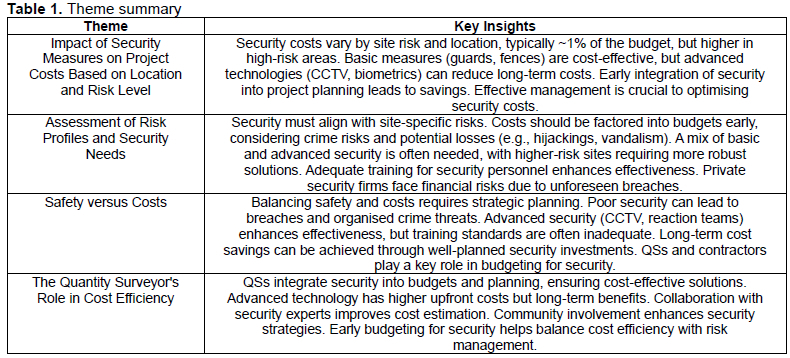
Eleven participants were interviewed from July to August 2024: four QSs, four security officers, and three contractors. The respondents consisted of quantity surveyors, private security officers, and construction contractors, providing diverse perspectives on security cost estimation in construction projects. Their roles varied from regular employees to company owners, ensuring insights from different experience levels and decision-making authority. All respondents, except private security officers, had a tertiary education background, contributing to a well-informed discussion on budgeting, cost assessment, and security implementation in the industry. All the participants were male and had an average of 14 years' experience in the construction industry. Four themes were identified from the data analysis and are discussed below.
4.1 Theme 1: Impact of Security Measures on Project Costs Based on Location and Risk Level
The research revealed a consensus among participants that security measures significantly affect project costs, with variations driven by the location and risk level of the construction site. According to the participants, security expenses typically account for a small fraction of the overall project budget, usually around 1% or less. However, these costs can escalate depending on the complexity and risks associated with the project. Basic security measures, such as guards and perimeter fencing, are generally cost-effective, but more advanced technologies, such as CCTV, access control systems, and biometric surveillance, can reduce long-term costs by minimising the reliance on on-site personnel (Rachamim, Hornik and Ofir, 2023).
Participant B, a CEO of a quantity surveying firm, emphasised that "security measures include hoarding, site access controls, and advanced technologies like webcams and alarm systems." Integrating advanced technology can lower overall security costs by reducing person-hours on-site, as seen in cases where technology replaces or supplements physical security personnel. This viewpoint aligns with findings from research conducted by Strom et al. (2010), which highlighted that early incorporation of security costs into project planning, combined with the adoption of technology, can lead to long-term savings through enhanced risk management. For Participant C, a QS, the assessment of security measures must be tailored to the site-specific risks, noting that "early engagement with private security companies is crucial." This ensures that the security requirements, such as site size and project duration, are well understood, and appropriate measures can be implemented.
Several participants agreed that while basic security measures are essential, more advanced systems are required for high-risk sites, such as distribution centres. For example, Participant F mentioned that "companies like Shoprite and Woolworths utilise high-level security infrastructure, including 4.5-meter-high concrete riot walls with electric fencing and barbed wire around their distribution centres." Such measures significantly increase the upfront costs but are essential in mitigating risks associated with high-value or vulnerable assets.
The importance of management in security cost-effectiveness was a recurring theme. As Participant G noted, "It's all management. If you don't pay a good manager, the system will collapse. The project will fail if the manager won't communicate and listen when you need more guards." This underscores the need for effective leadership in security operations to ensure that security resources are utilised optimally, particularly when more advanced security measures are implemented. Even expensive security systems can fail to provide the intended protection without proper management. This sentiment reflects the broader perspective that successful security management involves collaboration between project managers, clients, QSs, and community liaison officers, ensuring that the security needs are adequately addressed throughout the project lifecycle.
Participants B, C, F, G, and E each provided nuanced insights into the cost dynamics of construction security, reflecting their distinct roles. Participant F, a private security officer, pointed out that "security guards are the most cost-effective option, while reaction and tactical teams are the most expensive." Effective security management requires having a response team on-site to address threats." This was echoed by Participant G, who noted the varying costs based on the type of threat and the project's location. "In high-risk urban or industrial areas, more sophisticated systems such as vehicle registration readers and access control technologies become essential, driving up costs." Both participants also emphasised the inadequacy of basic guards, especially those with minimal training, highlighting the need for "better training programmes" to improve their effectiveness.
Reflecting on the South African context, Participant E highlighted that "security costs are substantial and must be factored into the initial budget," with ongoing adjustments based on technological advancements and risk assessments. This perspective aligns with industry findings on advanced security technologies. At the same time, the costly upfront cost can offer cost-efficiency over time by reducing the need for extensive on-site personnel and preventing costly security breaches (Strom et al., 2010). For instance, high-resolution cameras and biometric systems can reduce long-term security costs by preventing unauthorised access and theft, which are critical concerns in the construction sector.
Ultimately, all participants recognised that advanced security technologies and tailored solutions, though potentially more expensive at the outset, are critical for managing and reducing long-term risks. However, they also acknowledged the importance of site-specific risk assessments, as security requirements can vary significantly based on each project's location and threat profile. For example, rural sites may only require basic measures, while urban or high-value sites may need advanced and layered security solutions. Therefore, participants agreed that early planning and integrating security costs into the overall budget are essential for balancing short-term expenditures with long-term savings through improved risk management and security technology.
4.2 Theme 2: Assessment of Risk Profiles and Security Needs
The assessment of risk profiles and the determination of appropriate security measures are crucial factors in ensuring the safety and cost-effectiveness of construction projects. All participants agreed that security measures must be carefully tailored to each project based on the site's specific risk profile, with costs integrated into the project budget. The diversity in approaches reflects the different roles and expertise of the participants. For example, Participant K emphasised the "difficulties in quantifying the value of third-party security services, especially in high-risk environments." They noted that "the biggest cost we face is related to force majeure, particularly time," highlighting the financial strain that extended project timelines due to security-related delays can impose. This point underscores the broader industry challenge of balancing security costs with project deadlines, particularly in areas where risks such as construction mafia interference can lead to protracted mediation and increased costs.
Participant D pointed out the unpredictability of security crises, such as hijackings, which can result in significant financial losses, including equipment theft valued at hundreds of thousands of rands. "Consider the risks associated with the area I'm working in, including potential costs to life, limb, or equipment. For instance, a hijacking could result in the loss of equipment worth R300 000. As a result, the invoicing or quoting for that job should reflect these potential risks, but often the client is unwilling to accept the higher cost." This observation aligns with the broader industry practice of risk-based costing, where security expenses must reflect the potential losses and vulnerabilities associated with the project location. According to Klick and MacDonald (2023), the principle of deterrence is critical in assessing the likelihood of criminal behaviour by considering the perceived risks and consequences. Private security firms employ similar strategies to estimate the potential security risks and design preventive measures accordingly.
Participants employed various security strategies depending on the specific needs of their projects. Participant A, for example, employed basic security measures such as night guards and electric fencing, adjusting these based on the site's risk profile. On the other hand, Participant B incorporated more advanced technologies, such as webcams and alarm systems, to enhance security while potentially reducing reliance on manned security. This view is supported by research from Rachamim, Hornik, and Ofir (2023), who argued that advanced technologies can reduce the need for on-site personnel and, over time, lower long-term security costs. Participant C took a blended approach, integrating fencing, private security, and technology while focusing on community involvement and long-term benefits. This strategic integration of multiple layers of security highlights the importance of early risk assessment and the adaptation of security measures based on the specific vulnerabilities of the project. The cost management issue was another recurring theme, with participants offering different perspectives. Participant A viewed security as a small fraction of the overall project budget, whereas Participant B believed that advanced technologies might reduce the cost of manned security over time. Participant C emphasised the importance of early planning for high-risk areas, ensuring that security is not an afterthought but an integral part of the budgeting and tendering process. Conversely, Participants F and G cautioned against cutting security costs, stressing the importance of strategic planning to manage expenses effectively without compromising safety. These varying approaches underscore the importance of tailoring security solutions to the specific risks of each project while maintaining cost efficiency.
Risk management approaches also varied across participants. Participants A and C indicated that they adjusted security measures based on the specific risks of each site, while Participant B integrated security considerations into the initial project bids. This proactive approach aligns with the risk management theory, which emphasises the identification and mitigation of risks throughout the project lifecycle (Chen and Reniers, 2022). Participants F and G stressed the importance of advanced systems and adequate training for security personnel, noting that poorly trained guards can compromise the overall effectiveness of security measures. As Participant E highlighted, "security requires accurate information, such as a thorough risk assessment", underscoring the need for informed decision-making based on a detailed understanding of the site's specific risks, including factors such as crime rates, squatter populations, and violence.
Participant G, the owner of a private security firm, discussed the financial challenges of unforeseen security breaches, noting that PSFs sometimes bear the financial burden of such incidents. In one case, the vandalism of a client's truck resulted in a R4 000 deduction from their payment, despite the absence of a formal contract covering the incident. This highlights the financial risks that PSFs face in the absence of clear contractual arrangements, as well as the delicate balance between maintaining client relationships and protecting their own financial interests.
Overall, the participants' insights reflect a strategic and integrated approach to security planning, where risk profiles are carefully assessed, and security measures are tailored to the specific needs and vulnerabilities of each project. While basic security measures may suffice for low-risk sites, advanced technologies and comprehensive security strategies are essential for high-risk environments. Moreover, effective security management requires coordination among stakeholders, including QSs, project managers, and private security firms, to ensure that security costs are accounted for early in the project planning process and adjusted as necessary based on ongoing risk assessments.
4.3 Theme 3: Safety Versus the Costs
Evaluating the effectiveness of security measures in construction projects involves a multi-faceted approach, considering factors such as cost, technology, and management strategies. Participants provided diverse insights into how security interventions are implemented and assessed, with particular attention to the varying levels of risk and their associated challenges. Participant C emphasised the dangers that arise from inadequate security measures, noting that "re-fencing the site" was a recurring necessity due to breaches by the local community. This highlights the need for robust access control measures, though even improved systems are sometimes ineffective, as violent confrontations with security personnel have occurred. These incidents illustrate the vulnerabilities of construction sites, particularly when subcontractors are relied upon for security. The limited use of CCTV, except in very high-risk sites, further reflects the trade-offs often made based on budget constraints and perceived risk levels.
The issue of organised crime was also raised by Participant A, who experienced interference from gangs. This expands the scope of security challenges, showing that threats range from individual breaches to more organised criminal activities. "Preventing such incidents requires both proactive security planning and the ability to respond to diverse threat levels."
Private Security Officers (PSOs), represented by Participants E, F, and G, agreed on the value of advanced security systems such as surveillance cameras and reaction teams. However, they criticised the PSIRA training standards for security guards as inadequate, highlighting the need for well-trained personnel to manage security effectively. This concern resonates with findings from Ariel, Bland, and Sutherland (2017), who demonstrated that increased visibility and focused patrols significantly reduce crime, with victim-generated crimes decreasing by 16% and police-generated detections increasing by 49% in targeted locations. These statistics underscore the tangible benefits of employing well-trained security personnel in high-risk environments.
From a cost-management perspective, Participants F, G, and H discussed the balance between basic security measures, such as guards, and more advanced but costly technologies. Although the upfront costs of advanced systems are higher, they can prevent larger financial losses over time by deterring significant incidents and minimising damage. This approach aligns with Participant E's evaluation strategy, who described the security process as "trial and error," starting with higher levels of security and gradually reducing costs until an incident occurs. This iterative method reflects the dynamic nature of security assessment, where cost optimisation is balanced against maintaining a baseline level of safety.
Contractors, including Participants I, J, K, and M, recognised the high costs associated with advanced security measures, particularly in high-risk areas, where extensive interventions are necessary. However, they stressed the importance of integrating security costs into tender bids and project budgets, with location-specific risks factored into these estimates. QSs play a critical role in this process, as they evaluate the cost-effectiveness of security measures based on risk assessments and historical data from previous projects. Their expertise helps determine how to allocate resources efficiently, ensuring that security measures are both proactive and cost-effective.
The role of technology in enhancing security was further supported by Participant G, who emphasised the need for well-trained guards and advanced surveillance systems in rural construction sites. They pointed out that tracking skills and reaction teams are essential to maintaining adequate security in high-risk or remote areas. This view aligns with Katemba (2022), who highlighted the operational success of PSFs in crime prevention, citing their achievements in information sharing, crime mapping, and identifying crime hotspots. The increased capacity of PSFs through training and the use of advanced technology underscores the necessity of continuous investment in security infrastructure to manage evolving risks.
Across all participants, incident prevention and safety enhancement were identified as key metrics for evaluating security measures. While more expensive initially, advanced technologies are seen as more effective in reducing security breaches and ensuring site safety. The consensus is that long-term benefits, including lower incident rates and enhanced safety, outweigh the higher initial costs of advanced security systems. Contractors and QSs are instrumental in assessing and incorporating these costs into project budgets, ensuring that risk mitigation strategies are adequately funded. By doing so, they facilitate the delivery of safer and more secure construction projects, with quantifiable benefits that extend beyond immediate financial savings.
Therefore, integrating advanced security systems, supported by well-trained personnel and thorough risk assessments, is crucial for the long-term success of security measures in construction projects. As highlighted by the participants, the effective management of security costs through strategic planning, early budgeting, and the incorporation of site-specific risks ensures that security measures are both financially sustainable and operationally effective.
4.4 Theme 4: The Quantity Surveyor's Role in Optimising Cost Efficiency Through Security Measures
The interviews highlighted that QSs play a pivotal role in optimising cost efficiency in construction projects, particularly by integrating security solutions into project planning and budgeting. The strategic management of security measures not only ensures that construction sites are adequately protected but also helps minimise long-term expenses. Through a combination of cost-benefit analyses, the adoption of innovative technologies, and the early incorporation of security costs into the planning stages, QS professionals aim to balance effective risk management with overall budgetary constraints.
Participant E highlighted the impact of advanced technologies: "advanced security technology, such as high-definition surveillance cameras and sophisticated access control systems, does increase upfront costs, but it can be more efficient in the long run." Their firm's experience with these technologies showed that comprehensive monitoring capabilities can reduce the need for as many on-site guards, leading to long-term cost savings. This view aligns with the consensus among QS participants that "early integration of security costs during the feasibility and planning stages is essential for managing overall project expenses effectively."
Participant C further emphasised the significance of location in security budgeting: "The location of the site can significantly impact the budget, so it's important to consider this factor during the feasibility phase early on. For example, projects in high-risk areas may require more expensive security measures, such as control towers at the corners of the site." This illustrates how site-specific risk assessments inform the selection of security solutions, ensuring that the measures adopted are both contextually appropriate and cost-effective.
However, there are differing perspectives on the costs associated with advanced security technologies. Participants F, G, and H pointed out the higher costs linked to well-trained personnel and advanced security systems, expressing concerns about the adequacy of training for security staff. Despite these initial expenses, they acknowledge the long-term effectiveness of advanced security measures in preventing significant losses from theft or vandalism. This underscores the importance of a long-term perspective in security planning, where the reduction of future financial losses justifies initial investments in technology and training.
Supporting these insights, Te, Kadar, Rosés, Brüngger, and Pletikosa Cvijikj (2016) note that sharing crime-related information through security technologies can foster a sense of safety among the public. This aligns with Participant C's advocacy for involving the Community Liaison Officer in security discussions, emphasising a transparent and collaborative approach to security planning.
The role of collaboration is further underscored by Participant E, who emphasised the need to work closely with security technology experts: "We collaborate with security experts, like those from our own firm, to get accurate cost estimates for necessary security services and technology. These estimates are then integrated into the overall project budget, with adjustments made as needed to ensure that security measures are both effective and cost-efficient." This approach reflects a holistic perspective on project management, where expert knowledge is leveraged to ensure cost optimisation and project efficiency.
The optimisation of cost efficiency in construction security requires a careful balance of cost-effective solutions, innovative technologies, and strategic planning. QS professionals are central to this process, ensuring that security measures are not only aligned with project budgets but also contribute to long-term financial savings. By integrating security costs early in project planning, leveraging advanced technologies, and conducting thorough cost-benefit analyses, construction projects can achieve both economic sustainability and enhanced security outcomes.
5. DISCUSSION
The integration of security measures into construction projects, particularly from a cost-efficiency perspective, is crucial for project success. The study aimed to explore the role of the QS, and while many participants did not express a strong opinion on this role, they provided valuable insights from various positions within the construction security process, contributing to a more comprehensive understanding of the overall landscape. Drawing from the four thematic insights derived from interviews with industry professionals, this discussion evaluates the role of security management, risk assessment, cost-benefit optimisation, and the implementation of advanced technologies. These elements are integral to how QSs and other stakeholders mitigate security risks while maintaining budgetary control.
The first theme highlights that security measures can significantly affect project costs, with variations based on location and risk level. Security expenses, though often a small percentage of the overall budget, can escalate depending on the risk profile of the site. Participants emphasised that basic security measures, such as guards and fencing, are cost-effective in the short term but may be inadequate in high-risk areas. Advanced technologies such as surveillance systems and access control offer long-term cost savings by reducing the need for extensive on-site personnel (Rachamim, Hornik and Ofir, 2023). Moreover, Participant G highlighted that security management must be well-coordinated and adaptable to site-specific risks, underscoring the importance of early integration of security strategies into project planning. This aligns with the views of Strom et al. (2010), who emphasise balancing initial investments with long-term risk mitigation.
The second theme delved into the assessment of risk profiles and the tailoring of security measures accordingly. The varying approaches taken by the interviewees, such as engaging third-party security firms or implementing community-driven measures, underscore the need for contextual adaptability in security planning. The unpredictability of security crises, such as equipment hijacking, necessitates that construction professionals proactively factor these risks into their budget estimates. Klick and MacDonald (2023) support this view by highlighting the importance of deterrence in estimating criminal behaviour and shaping preventive strategies. Effective risk assessment not only ensures the safety of personnel and assets but also provides a financial safeguard against unforeseen security breaches.
The third theme focuses on evaluating the effectiveness of security measures, incorporating perspectives on technology, manpower, and incident prevention. Participants broadly agreed that while advanced security technologies such as CCTV and reaction teams are more expensive upfront, they offer significant long-term benefits in terms of reducing security incidents and protecting assets. Ariel, Bland and Sutherland (2017), for example, found that increased visibility and targeted patrols by private security reduced victim-generated crimes. The approach of trial-and-error security adjustments further emphasises the iterative process of evaluating and refining security strategies to strike an optimal balance between cost efficiency and risk management. This continuous assessment highlights the importance of ongoing collaboration among stakeholders to ensure that security solutions are effectively meeting project needs.
The final theme underscores the role of QSs in cost optimisation by implementing cost-effective security solutions and innovative technologies. As security needs vary depending on the location and risk level of construction sites, QS professionals must engage in early planning to integrate security costs into project budgets (Te, Kadar, Rosés Brüngger and Pletikosa Cvijikj, 2016). This involves cost-benefit analyses that weigh the upfront costs of advanced technologies against their potential to reduce long-term expenses. This proactive approach helps balance initial investments with potential savings achieved through improved risk management and advanced technology, ensuring that security measures are both effective and financially sustainable.
This study has significant societal implications, particularly for worker safety, community relations, and policy development in the South African construction industry. By ensuring security costs are effectively integrated into project budgets, QSs contribute to safer work environments, reducing risks associated with theft, vandalism, and violent crime while enhancing worker well-being and productivity. Strengthening community engagement through local employment and collaboration with stakeholders fosters trust, reduces security threats, and promotes economic benefits for surrounding areas. Policy reforms are essential and must be developed in cooperation with the government to establish clearer security regulations, including mandatory risk assessments, enhanced training for security personnel, and public-private partnerships to improve site safety. Additionally, government incentives for security investment and stricter enforcement of security standards and discipline can further enhance crime prevention measures, ensuring construction projects remain both financially sustainable and socially responsible. Such interventions not only contribute to the resilience of individual construction sites but also help stabilise the broader industry. Ultimately, a more secure construction environment supports long-term investment, job creation, and infrastructure development across the country.
This study found that QSs play a role in facilitating adequate financial provision for security by incorporating appropriate items in the Preliminaries section of a project's budget. By detailing costs within the Preliminaries, QSs ensure that sufficient funds are allocated to protect the project's integrity and mitigate potential risks.
Moreover, QS participants agreed on the necessity of collaboration with security technology experts to provide accurate cost estimates and ensure that security measures are both financially sustainable and effective. This strategic approach ensures that security is treated not as an afterthought but as an integral component of project planning and risk management. The role of innovative technologies in security optimisation is increasingly recognised, offering long-term savings through reduced manpower and enhanced incident prevention.
6. CONCLUSIONS
The findings demonstrate that QSs are pivotal in ensuring that security measures are not only effective but also cost-efficient, balancing short-term investments with long-term savings. The ability of QSs to integrate security measures into the project budget early in the planning phase and perform detailed cost-benefit analyses ensures that construction projects not only remain within budget but also maintain a high level of security. This initiative-taking, strategic approach yields both immediate and long-term cost savings, contributing to the overall success and safety of construction projects.
The research demonstrates that integrating security measures into construction project budgets is essential for managing both financial costs and security risks. While basic security provisions such as guards and fencing are seen as cost-effective, the adoption of advanced technologies like surveillance systems and access control mechanisms offers significant long-term savings. These technologies reduce the need for on-site personnel and enhance the project's ability to prevent security breaches.
By incorporating security considerations early in the project planning phase, QSs ensure that budgets remain sustainable while effectively addressing potential security threats. This proactive integration of site-specific risk assessments helps prevent budget overruns by ensuring that necessary security measures are factored into initial cost estimates. The QS's expertise in balancing security needs with financial constraints aligns with the overarching objective of maintaining project financial stability while minimising exposure to risk.
Ultimately, the findings confirm that a strategic, integrated approach to security management, involving early budgeting and the adoption of advanced technologies, is crucial for effective cost optimisation in construction projects. The expertise of QSs in evaluating and incorporating security measures ensures that projects not only remain secure but also achieve economic sustainability. This approach balances risk management with financial efficiency, contributing to the successful delivery of construction projects within the constraints of both time and budget.
7. RECOMMENDATIONS
To enhance the integration of security measures in South African construction projects, several recommendations are proposed. Firstly, there is a need for clearer standards and regulations governing security practices. Government bodies such as PSIRA should establish guidelines for security assessments, training requirements, and minimum standards for security technologies.
Secondly, improving the training and certification of security personnel is crucial. Comprehensive training programmes should include both technical skills, such as the use of surveillance equipment, and soft skills, such as conflict resolution. Thirdly, QSs and contractors should conduct thorough risk assessments and consider security needs during the feasibility and tendering phases. This proactive approach will help avoid budget overruns and delays due to inadequate security provisions.
Integrating security budgeting into the initial stages of project planning is also recommended. Quantity surveyors and contractors should conduct thorough risk assessments and consider security needs during the feasibility and tendering phases. This initiative-taking approach will help avoid budget overruns and delays due to inadequate security provisions.
Lastly, stakeholders should explore the use of advanced security technologies such as CCTV cameras and access control systems. These technologies enhance security and can reduce the need for manned personnel, optimising costs over the project lifecycle.
REFERENCES
Ariel, B., Bland, M., & Sutherland, A. (2017). 'Lowering the threshold of effective deterrence'-Testing the effect of private security agents in public spaces on crime: A randomised controlled trial in a mass transit system. PLoS One, 12(12), Article e0187392. [ Links ]
Arthur-Aidoo, B. M., Coffie, G., Abeka, H., Osae-Ansah, T., & Ametsikor, K. (2024). Theft and vandalism control measures on construction sites. African Journal of Applied Research, 9, 284-301. [ Links ]
Ashby, M. P. (2017). The value of CCTV surveillance cameras as an investigative tool: An empirical analysis. European Journal on Criminal Policy and Research, 23(3), 441-459. [ Links ]
Blackstone, E. A., Hakim, S., & Meehan, B. J. (2023). An overview of private security and policing in the United States. In E. Blackstone, S. Hakim, & B. J. Meehan (Eds.), Handbook on public and private security (pp. 1-24). Cham: Springer International Publishing.
Botrugno Shah, F. H., Bhatti, O. S., & Ahmed, S. (2023). A review of the effects of project management practices on cost overrun in construction projects. Engineering Proceedings, 44(1), Article 1. [ Links ]
Chen, C., & Reniers, G. (2022). Security in the chemical industry: Theory and practice. In The handbook of security (pp. 379-398). Springer.
Dahl, E. J. (2021). Assessing the effectiveness of the Department of Homeland Security, 20 years after 9/11. Watson Institute for International and Public Affairs, Brown University. https://www.hsdl.org
Ebekozien, A., Aigbavboa, C. O., & Thwala, W. D. (2025). A practical research process for developing a sustainable built environment in emerging economies. CRC Press.
Elms, H., & Phillips, R. A. (2009). Private security companies and institutional legitimacy: Corporate and stakeholder responsibility. Business Ethics Quarterly, 19(3), 403-432. [ Links ]
Gordon, L. A., Loeb, M. P., & Zhou, L. (2020). Integrating cost-benefit analysis into the NIST Cybersecurity Framework via the Gordon-Loeb Model. Journal of Cybersecurity, 6(1). [ Links ]
Jiang, W., & Marggraf, R. (2021). The origin of cost-benefit analysis: A comparative view of France and the United States. Cost Effectiveness and Resource Allocation, 19(1), 74. [ Links ]
Katemba, M. (2022). The effectiveness of private security companies in crime prevention: A case of Lilongwe City (Unpublished master's thesis). University of Rwanda.
Kong, F., Ahn, S., Seo, J., Kim, T. W., & Huang, Y. (2021). Beacon-based individualised hazard alarm system for construction sites: An experimental study on sensor deployment. Applied Sciences, 11(24), Article 11654. [ Links ]
Ma, Z., Zhong, J., Liu, W.-L., & Yu, W.-J. (2023). An evolutionary framework for automatic security guards deployment in large public spaces. Applied Intelligence, 53(10), 11586-11598. [ Links ]
Nemeth, C. P. (2022). Private security: An introduction to principles and practice. CRC Press.
Nnadi, E., Okeke, F., & Alintah-Abel, U. (2020). Evaluation of security risk on construction project cost in Nigeria. International Journal of Latest Research in Science and Technology, 3(4), 1-7. [ Links ]
Nyangiwe, T., Amoah, C., & Mukumba, C. P. (2023). The emergence of construction mafia in South Africa: The implication on the construction industry. International Journal of Architectural and Environmental Engineering, 17(11), 422-423. [ Links ]
Obagbuwa, I. C., & Abidoye, A. P. (2021). South Africa crime visualisation, trends analysis, and prediction using machine learning linear regression technique. Applied Computational Intelligence and Soft Computing, 2021, 114.
Pazzona, M., & White, A. (2024). Size matters: Measuring the private security industry in the United Kingdom. Crime Prevention and Community Safety. https://doi.org/10.1057/s41300-024-00213-8
Private Security Industry Regulatory Authority (PSIRA). (2024). Annual performance plan 2024/25. Available online at www.psira.co.za.
Republic of South Africa. (1993). Occupational Health and Safety Act 85 of 1993. Available at: https://www.gov.za/documents/occupational-health-and-safety-act
Saunders, M., Lewis, P., & Thornhill, A. (2016). Research methods for business students (7th ed.). Harlow: Pearson Education. [ Links ]
Schneier, B. (2015). Secrets and lies: Digital security in a networked world. John Wiley & Sons.
Terry, G., Hayfield, N., Clarke, V., & Braun, V. (2017). Thematic analysis. In The SAGE Handbook of Qualitative Research in Psychology (pp. 17-37). SAGE Publications.
Tiwana, N., Bass, G., & Farrell, G. (2015). Police performance measurement: An annotated bibliography. Crime Science, 4(1), Article 1. [ Links ]
Towey, D. (2017). Construction quantity surveying: A practical guide for the contractor's QS. John Wiley & Sons.
Van Riet, G. (2020). Intermediating between conflict and security: Private security companies as infrastructures of security in post-apartheid South Africa. Politikon, 47(1), 81-98. [ Links ]
 Correspondence:
Nishani Harinarain
School of Engineering, University of KwaZulu-Natal, South Africa
Email address: harinarain@ukzn.ac.za
Received: 11-12-2024
Revised: 03-03-2025; 01-06-2025
Accepted: 30-06-2025