



Services on Demand
Journal

Article
 English (pdf)
 Article in xml format
 Article references
 Automatic translation
 Send this article by e-mail
Indicators
Related links
-
 Cited by Google
 -
 Similars in Google
Share

 Permalink
Communicare: Journal for Communication Studies in Africa
On-line version ISSN 2957-7950Print version ISSN 0259-0069
JCSA vol.44 n.1 Johannesburg May. 2025
https://doi.org/10.36615/e8wdwe12
ARTICLES
Sustainability and Expectations in Client-Public Relations Agency Relationships: A Bi-directional Perspective
Yolanda MakhubeleI; Anna OksiutyczII; Elizabeth LubingaIII
IUniversity of Johannesburg, South Africa; https://orcid.org/0000-0002-8369-6917
IIUniversity of Johannesburg, South Africa; https://orcid.org/0000-0002-7236-0924
IIIUniversity of Johannesburg, South Africa; https://orcid.org/0000-0002-1811-7421
ABSTRACT
The sustainability of public relations agencies is often heavily dependent on positive and vibrant relationships with their clients. Such relationships are crucial during challenging economic conditions and intense competition prevalent within the sphere. Public relations agencies in South Africa face a challenge to prove that they are able to contribute positively to their clients' bottom line by meeting these expectations. Good relationships lead to higher client retention for agencies, improvement in the client's return on their investment and it also contributes towards organisational sustainability for the benefit of both parties. This article investigates expectations of client-public relations agency relationships in South Africa as key elements influencing the relationship between the parties. An exploratory qualitative study was conducted. It involved in-depth interviews with six client representatives and six senior public relations consultants from three prominent public relations agencies operating in Johannesburg. The findings indicate that expectations, competencies and communication inform perceptions of how clients and public relations agencies view the relationship and then try to achieve relationship outcomes. To maintain or expand their client base, public relations agencies need to create value for the client organisations and build relationships and mutual understanding with their clients.
Keywords: Agency, client-agency relationships, public relations, relationship expectations, sustainability, value creation
INTRODUCTION
South Africa's public relations (PR) agencies and the industry need to constantly improve their services in order to remain competitive and sustainable. South Africa has a thriving PR industry with a history going back to the 1940s. Today, the PR agency landscape in South Africa includes a mix of multinational and local agencies. Global players such as Edelman, Weber Shandwick, FleishmanHillard and Ketchum (through its affiliate in South Africa, Magna Carta) have their footprint in the country. Bizcommunity (2025), a business-to-business publisher, has listed over 100 communication agencies that listed PR among the services offered. Still, the need for organisational sustainability is compounded during times of economic hardship that these agencies face in South Africa. Sutton et al. (2024) argue that agencies are not only battling a hostile competitive environment in South Africa, but also fighting to survive in declining economic conditions defined by volatile, uncertain, complex and ambiguous (VUCA) business contexts. PR agencies in South Africa are increasingly operating in a highly competitive business environment in which organisations prioritise other organisational functions in a bid to manage their bottom line and ensure their economic sustainability.
The organisational sustainability of PR agencies is strongly linked to their ability to sustain relationships with their clients. Longevity and quality of client-agency relationships are crucial to the sustainability of PR agencies mainly because services offered to clients are the source of income. Authors such as Ziegele (2024) and Ceccotti et al. (2020) specifically argue for good quality agency-client relationships to ensure longevity, adding that relationship quality involves the balance between expectations and perceptions of the client, on the one hand, and the agency, on the other. Stein (2016) argues that good client-agency relationships rely on trust, communication and understanding. These relationships need maintenance (Sidhu, 2014), commitment (Levin et al., 2019) and a shared set of values (Fam & Waller, 2008). Analogous references to marriage (Sidhu, 2014) when examining client-agency interactions emphasise their symbiotic importance. Viewing this relationship as a marriage implies that both parties act in each other's best interest. Such a bond adds stability to the client-PR agency relationship, which is a barrier to its termination (Sidhu, 2014). The advantages of such close relationships include decreased opportunism (Chohan et al., 2019), higher levels of trust and better agency performance (Levin & Lobo, 2011). Examining what undermines the sustainability of client-PR agency relationships is relevant to this discussion.
Unfortunately, client-agency relations are often short-lived (Ceccotti et al., 2020) due to dissatisfactions that arise between both parties and the divergent objectives. Therefore, there is a need to study the expectations that underlie such relationships, which, if unmet, cause breakdowns in interactions. A breakdown in relationships can result in the termination of a client contract (Davies & Prince, 2011). This leads to a business problem: a loss in revenue for the agency and time for the client organisation. As retaining clients and PR agencies is more cost- and time-effective than acquiring new ones (Davies & Prince, 2011), it is in agencies' best interest to understand and maintain client-agency relationships. This helps to sustain their revenue stream. It also allows the client organisation to save time because they would not need to acquire new agencies. Previous studies have focused on the process and structure of relationships (Keegan et al., 2017) and have not accounted for the interactions and the perspectives of organisational representatives participating in these interactions. Many studies have researched either the client perspective (Jensen & Sund 2020) or the agency perspective (Bridgen, 2022; Ceccotti et al., 2020; Sisson, 2015; Sutton et al., 2024) while this study includes the perspectives of both the clients and the agency staff on the relationship expectations between the two parties.
The study intended to answer the following questions:
. What are clients' expectations regarding their relationships with selected major PR agencies in Johannesburg, South Africa?
. What are PR consultants' expectations about relationships with their clients among selected PR agencies in Johannesburg, South Africa?
. What are the causes of relationship termination between clients and PR agencies?
. How can client-PR agency relationships be sustained among selected major agencies in Johannesburg, South Africa?
The article is organised as follows. First, we discuss the literature on agency-client relationships from the perspective of mutual interests and value creation. Then we focus on unpacking the merits and challenges of the agency-client relationships as partnership. In the last section of the literature review we discuss the dynamics, factors and characteristics of different stages of relationships from inter-organisational and the interpersonal perspectives. The next section explains the methodology used in this study and this is followed by the description of the results, discussion and conclusion.
Client-agency bi-directional relationships and value creation
The agency medium- to long-term survival depends to a large extent on relationships with the clients. The relationships depend on the interplay between shared objectives, values, interests and expectations. Early research on the nature of relationships highlighted such characteristics as mutuality and interdependence (Broom et al., 2000; Hung, 2008). Increasingly, clients require justification for marketing and PR communication and its effect on the bottom line of organisations (Verwey, 2015). Conversely, the agencies are business entities that strive for economic success of their own; thus the relationship must be mutually beneficial.
A co-creative approach seems to work for mutual benefits between the client and agency. Especially in service-dominant environments (Frow & Payne, 2011) and knowledge-intensive business services, such as communication agencies (Hughes & Vafeas, 2019), customers and organisations are co-creators of value through interactive processes that combine tangible and intangible resources. Such an approach changes the focus from value creation as a function of a service provider to a co-creative perspective, where value arises from a collaborative process between parties (Corsaro, 2020; Skjølsvik, 2017). Value created through collaboration between communications agencies and clients contributes to the goals of the agency and the client, which the parties achieve in their own operations or from the products offered to customers (Sthapit & Bjork, 2020). Clients co-create communication "products" such as strategies and other content through collaborating with creative, account management and other staff from agencies. However, research shows that, in some instances, collaboration can lead to value no-creation or value co-destruction (Corsaro, 2020; Straphit & Bjork, 2020). During value no-creation, the expectations of resource integration and the respective value outcome remain unfulfilled (Makkonen & Olkkonen, 2017). When value is co-destructed, the parties reduce the value they previously co-created (Corsaro, 2020).
Client-agency relationships as partnerships
The relationship between an agency and its client embodies a strategic partnership (Verčič et al., 2018), which occurs in a business-to-business context, with significant commitment and consequences for both sides. However, Verčič et al. (2018:158) note that there is a power disparity between the parties: "[T] here is no absolute need for organisations to hire agencies, while it is an absolute need for agencies to find clients". Power disparity could result in unequal value appropriation, which means that the actors do not necessarily appropriate created value in proportions corresponding to their inputs (Corsaro, 2020; Ellegaard et al., 2014). In turn, this may lead to relationship dissatisfaction. Conversely, the PR agency has more information about the services provided to the client and the effects of these services, which highlights the principal-agent problem in the relationships where there are various degrees of information asymmetry between the parties. Eisenhardt (1989) suggests that the information asymmetry is reduced in a long-term relationship because the parties learn about each other and are able to evaluate behaviour more efficiently, while short-term relationships result in higher information asymmetry between principal and agent. Long-term relationships are therefore more beneficial to both clients and agencies.
Despite extensive research on the nature of organisation-stakeholder relationships (Shafiee & Tabaeeian, 2021; Verčič et al., 2018), there is no definite answer to what factors determine the sustainability of the relationship. Sisson (2017) notes the importance of perceptions and expectations in a relationship, and Gottfredson at al. (2022) also agree. When both parties perceive the relationship as beneficial, the relationship can be considered satisfying (Sisson, 2017). Research suggests that sustainability of the relationship depends on the relationship's quality and satisfaction and a balance between the perceptions and expectations of both parties. Relationship quality is a higher order construct that reflects the overall strength of relationships (Hani et al., 2021) and is based on the expectations, needs, desires and goals of the parties. In some cases, the clients are sourced through personal networks by agency management.
Some studies consider trust, satisfaction and commitment as dimensions of relationship quality (Shafiee & Tabaeeian, 2021). Ziegele (2024) emphasises a dual-phased nature of trust in client-agency relationships, arguing that trust is a pre-requisite of a quality relationship, because fundamental trust is needed to enter into a relationship, but that it is also an outcome of relationship quality. Trust facilitates long-term partnerships, while mistrust leads to emotional tensions in relationships (Vejnovic et al., 2024). In assessing the relationships, the parties also consider "alternative quality" which Rusbult et al. (1998:359) define as the "perceived desirability of the best available alternative to a relationship". This means that agencies and clients remain in a relationship as long as their relationship offers perceived advantages rather than alternatives. In addition to alternative quality, Xu (2019) notes that commitment in a relationship is predicted by two other variables, namely investment size (the scale and significance of the resources associated with a relationship) and relationship satisfaction. Satisfaction is identified as "favorable response to the reinforcement of positive expectations" (Grunig & Huang, 2000:45). Relationship quality and satisfaction can be considered factors in sustainable relationships. Sustainable relationships are relationships with long-term orientation and desired quality.
Research also points to the importance of "chemistry" or affinity in relations between the agency team and the client (Bridgen, 2022; Ceccotti et al., 2020). Client-agency relationships depend on people with different roles and responsibilities on both sides working together. Interpersonal relations between representatives of companies influence business relationships. For example, good personal relationships between clients and account managers impact client-agency relationships. Collaboration strategies such as communication, collaborative working, role clarification and sharing know-how are also crucial to maintaining a positive relationship (Turnbull & Wheeler, 2016).
For agencies, knowing clients and ensuring a sustainable relationship with them means a stable income, prestige and a higher profit margin (Turnbull & Wheeler, 2016). Similarly, in South Africa, a study by Mokoena et al. (2023) identified profitable revenue, ability to retain clients, creativity and healthy profit margins as the indicators of an advertising agency's sustainability. For the clients, working with the right agency leads to attaining business outcomes. Hence, clients expect agencies to have strategic capabilities and to add value to their business (Oksiutycz & Nhedzi, 2018; Turnbull & Wheeler, 2016). Research in South Africa indicates that clients mostly seek creativity, innovation and solutions to business problems (Mokoena et al., 2023). In long-term relationships, agencies can achieve a better understanding of their clients' business. This competency is highly rated by clients (Huges & Vafeas, 2019). Long-term relationships allow agencies to avoid incurring costs associated with switching agencies. These costs include the time, effort, money and psychological burden of establishing a relationship with a new agency (Davies & Prince, 2011).
Client-agency relationships stages
Three life stages can be distinguished in client-agency relationships: choosing an agency, maintaining a relationship with the agency and terminating the relationship with the agency (Verčič et al., 2018). During each of these stages, different aspects play a key role. Among the main factors influencing the selection of an agency are creative skills, expertise, cost, past success, professionalism, reputation and the efficient delivery of communication services (Brennan, 2015; Oksiutycz & Nhedzi, 2018; Turnbull & Wheeler, 2014). However, Henke (1995) indicates that, in established relationships, the role of creativity and cost-consciousness somewhat diminishes.
Based on the literature on inter-organisational relationships (Broom et al., 2000; Hani, 2021; Hesling et al., 2018; Jones et al., 2018; Park and Rhee, 2010; Stafford, 2010; Xu, 2019) the following behavioural inter-organisational relationships maintenance strategies can be identified: reciprocity (exchange of information and resources), openness (being honest and able to directly discuss the nature of relationships), collaboration (cooperation in solving mutual or individual problems) and communication (communication quality and information exchange). These strategies are further supported by attitudinal and cognitive dimensions such as trust, commitment, integrity, attachment, positivity and respect.
As a factor affecting relationship quality, trust is particularly valued throughout the client-agency relationship life cycle (Hani, 2021; Hesling et al., 2018; Jones et al., 2018) In the case of inter-organisational relationships, not only qualities such as reliability, competence and benevolence are important but also other dimensions derived from the organisational structures and systems, such as, reliability and consistency, play a role (Wiebel et al., 2022). Trust denotes the confidence of one party in exchange for a partner's reliability and integrity (Morgan & Hunt, 1994). Without trust, it may not be logical for the agency to invest in a relationship with the client, given the possibility of the client switching agencies or failing to extend the contract with the agency. "The more the client trusts an agency, the higher the perceived value of the relationship by the client; consequently, one can expect a higher probability that the client will remain in the relationship" (Jansen van Rensburg, 2014:8). Other researchers highlight the importance of interpersonal relations in building trust between organisations (Weibel et al., 2020). Brennan (2015) suggests that people-centred means of maintaining trust within the client-agency relationship entail honesty, consideration for others, tact and the ability to motivate and support others. A South African study by Sutton et al. (2024) listed communication-related qualities such as openness and cooperation as the relationship maintenance strategies employed by agencies.
Levin et al. (2019) assert that agencies are evaluated by clients on two aspects, namely the benefits of core services delivered (economic dimension) and how the service was delivered (social dimension). The economic dimension is linked to costs and output factors, including the fulfilment of promises, satisfaction with the quality of work and delivering the work on time (Fam & Waller, 2008; Quebra et al., 2013). Duhan and Sandvik (2009) report that sometimes clients retain agencies with whom they have long-term relationships, even when costs increase.
Other studies highlight the role of emotional labour in maintaining client-agency relationships. The term relates to their ability to display emotions that are consistent with social, occupational and organisational norms (Fouquereau et al., 2018). Iszatt-White and Lenney (2020) argue that emotional labour in a professional context takes place within the context of ongoing relationships aimed at achieving complex and broadly shared goals. Practitioners have learnt to become skilled at managing their emotions in line with the different expectations of their clients (Yeomans, 2019). Research in South Africa hints at the role of emotional labour in maintaining the agency-client relationship. Sutton et al. (2024) identifies strategies, such as assurance, positivity and being unconditionally supportive, as relationship maintenance tools used by agencies in South Africa.
Clients cite dissatisfaction with agency performance as one of the main reasons for a breakdown in relationships. In contrast, agencies referred to changes in client policy as the most common reason for relationship breakdown (Turnbull & Wheeler, 2016). Other issues negatively affecting relationships include creative disagreements, conflict, a lack of knowledge of the client's business and processes, the ambiguity of objectives and expectations, different interpretations of situations and financial disagreements, and interpersonal issues (Verčič et al., 2018; Weibel et al., 2022). Communication is considered to be a symbolic part of relationships (Ledingham & Bruning, 2000) and is constitutive of relationships through constant negotiation and meaning creation (Koschmann, 2016). Conversely, inadequate, contradictory or ambiguous communication can lead to tension, conflict and the breakdown of relationships (Vejnovic et al., 2024).
Although agencies make an effort to build, understand and maintain a good agency-client relationship, the inability to meet the client's expectations and service delivery (Verčič et al., 2018) may lead to the termination of relationships. Therefore, understanding and managing expectations is essential for customer satisfaction in relation to professional service delivery (Turnbull & Wheeler, 2016). Given the subjective, socially constructed nature of client-agency relationships, client expectations, i.e. the perceived value of the benefits that clients seek from the purchase of a service (Sidhu, 2014), are fundamental in relationships to the extent that Skjølsvik (2017) argues that what the clients subjectively perceive as relevant to their context is more important than the objective service. Expectations influence the nature of interactions and the type of relationship that can be established between the client and the organisation (Jansen van Rensburg, 2014).
RESEARCH METHODOLOGY
This study adopted a qualitative approach to understand how individuals, both clients and PR consultants within agencies, interpret their relationship with each other within a business context. Participants were selected through heterogeneous sampling where different types of agency and client (large, medium, small, local and multinational) were selected. The study participants comprised six PR consultants from three large PR agencies based in South Africa's biggest city, Johannesburg, and six client representatives. These participants were not dyadic, i.e. there was no requirement that they work directly together. This was done to protect the anonymity of the participants. Qualitative research favours small samples in order to get in-depth information (Boddy, 2016). Hence, a sample of 12 was adequate due to data saturation.
Within the context of PR agencies, since the term client refers to the organisation and not individuals, two client representatives from each agency were selected to participate in this study. The client representatives were holders of senior positions and were the primary decision makers in matters pertaining to the continuity and sustainability of contracts with their agencies. The client representatives were chosen on the basis of their timescale involvement with the agencies and the number of consultants allocated to service the account. Client participants comprised two groups: clients with project-based contracts and clients with retainer-based contracts with agencies. The distinction between project-based contracts and retainer-based contracts was crucial because the type of contract affects the expectations that each client representative has of the client-agency relationship. The clients' representatives hold titles such as communication manager, PR manager, marketing manager, PR and marketing manager, brand communication manager and assistant to the CEO. Their tenure with the agency varied from two to five years.
Two senior PR consultants from each of the three agencies, Agency X, Agency Y and Agency Z, were interviewed. These senior consultants oversee heading up the client representative's account, meaning that they are the primary decision makers regarding issues pertaining to the service delivery of the account. Among the participants from the agencies, there were four senior consultants and two senior account managers. Most participants had been in their current position for two to three years. Five of them had been in the agency environment for a more extended period and had previously worked in other agencies in similar positions.
Ethical considerations were observed during the research process, which included obtaining permission from the University Faculty Research Ethics Committee, the organisations and the participants. Trustworthiness was prioritised to ensure the soundness of the study.
Data were collected using face-to-face semi-structured interviews. All interviews were conducted using the same interview guide. The interviews were recorded and field notes were taken for the researchers to refer back to when transcribing the interviews during the data analysis stage.
Thematic analysis was applied for data analysis. Thematic analysis of the data involved a three-step coding process consisting of summarising the transcripts, identifying themes and then comparing these themes with the literature. First, the interviews were re-read and then coded by two researchers to ensure inter-coder reliability. Second, commonalities, differences and unusual themes that arose were tabulated. Third, conclusions were drawn, which resulted in the generation of themes presented in the findings section.
FINDINGS
The findings indicate that although there are similarities in the perspectives of the clients and PR consultants about what contributes to sustainable relationships, there are also differences.
Choosing the agency
Reputation was identified as one of the key reasons for entering into relationships with a particular agency. However, most clients and consultants agreed that industry awards were not highly important in selecting an agency. Several participants observed that clients sometimes choose agencies based on their specialisations. For instance, clients approach them if the agency is known for specific niche services. According to both the client and agency participants, clients look for value for money - the cost of services plays some role in agency choice. Client Participant 9 highlighted the importance of professionalism and past experience in choosing the agency. This was echoed by an agency participant who said: "Clients want you to have done something similar before and that you have the right people to work on the account". In cases where the client had a good experience with the agency, they would make a referral or recommend that agency's services (Participants 7 and 8). One client participant stated that they had "inherited" the agency from their predecessor. Another important factor was having an understanding of the client's brief and business problem. Participant 11 stated: "We usually invite agencies to pitch. If an agency understands our message, has good company values and is cost-effective, then we choose them". Participants 10 and 12 expressed similar views that knowledge of the client's business and industry influenced agency selection. These findings align with previous studies by Turnbull and Wheeler (2014) and Brennan (2015).
Maintaining relationships
When discussing the existing relationships between clients and agencies, participants highlighted the following salient themes: relationship principles, the importance and the impact of personal relationships between the representatives of both parties, the nature of communication between the parties and the significance of expectations in the relationships.
Most participants stated they have good relations with the other party, and used expressions such as open, flexible, likeable and good working relationships. Openness, honesty and trust were mentioned as the foundation of good relationships, with clients also expecting flexibility. It appeared that flexibility in terms of communication meant expecting agency employees to always be available. One consultant reflected on the client-agency relationship when they had worked for a major corporation: "It was like borderline abusive. Things like [...] client calling the agency at 10 pm for certain things". Several participants mentioned similar practices, which confirms that this is a common occurrence.
Personal relationships
Both clients and consultants noted the importance of personal relationships between the agency and client representatives. Agency Participant 2 said: "As a marketing manager and as a client service person from an agency, you build relationships'' Participant 4 testified: "[I]f you don't have a personal rapport with someone, it is difficult to foster a close working relationship". The consultants also highlighted the importance of people skills. Participant 4 stated: "[I]f you are not doing the right work, you are not going to have the right relationships, but it's also taking it to a personal level, remembering their birthday [...] and just being generally friendly". At the same time, a senior consultant pointed out possible pitfalls of long-term relationships: "[U]sually you get stuck in the same routine and people think this is how the client wants it. I have been on the account for years and this is what they want. When actually the client wants new ideas".
Communication
Communication constitutes a relationship (Koschmann, 2016), and it is a necessary condition to achieve relationship outcomes (Grunig & Huang, 2000). A senior consultant stated: "Lack of communication can break any relationship [...] but it's easy to overlook that and get used to lack of communication". Considering that the client-agency relationship is more transaction-based initially, most of the communication pertained to the service level agreement. While understanding the importance of communication, the consultants and clients acknowledged numerous shortcomings in terms of communication between the parties. A senior account manager stated: "[W]e are not even communicating among ourselves, not communicating with the team, not communicating with the client". Several participants noted that communication between the parties was limited to monthly reports, monthly meetings and status checks. A marketing manager admitted: "I don't know if I always communicate [expectations]".. While acknowledging that the current communication was not optimal, both client representatives and consultants agreed that regular interaction, transparency and honesty were instrumental in instilling trust in the relationship. Agency Participant 6 said: "I guess in each step, there has to be clear communication on what's going on, what has been done so far and the turnover time".
Relationship expectations
After the partnership has been established, both the client and the agency commit to the partnership, on either a retainer or project basis. During this process, expectations about the agency's availability are formed. When it comes to quality relationships, the assessment of expectation fulfilment is crucial (Sisson, 2017). These include how services are delivered (agency competencies), interactions between both parties (communication) and the end result (relationship outcomes) (Quebra et al., 2013). This study supports the findings of prior research that clients seek agencies that respond quickly to their needs, are proactive, respond to unforeseen problems and have a quick turnaround time.
Many participating consultants described how clients expect them to work beyond their scope of work and deliverables, which is overservicing the account. This implies that the consultants believe that, in most cases, they are doing more work than they are contracted to do. Chohan et al. (2019) note the existence of bilateral opportunism in pre-contact and post-contract client-agency relationships. Because clients tend to have more power and money, some can be opportunistic by failing to lawfully abide by the terms of a formal contract. In an effort to secure the contract, agencies also engage in opportunistic practices such as misrepresenting their skills (Chohan et al., 2019). The agency consultants and the clients stated that they had experienced promises being made from the agency side that fell very short of being executed. In other words, the agency was seen to be overpromising and underdelivering. Nothhaft and Stenson (2019) attribute this industry-wide phenomenon to years of inadequate measurement and evaluation that results in unrealistic expectations and encourages the PR industry to consistently make exaggerated promises. Interestingly, some senior consultants have realised that this is the fault of the agency itself and not the client. The practice of overpromising is perpetuated because it has become a way of winning clients and because setting realistic expectations is often perceived as falling short of excellence (Nothhaft & Stenson, 2019).
Relationship termination
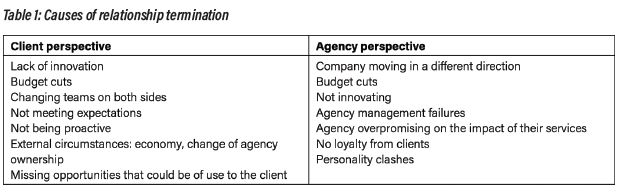
The reasons for terminating the relationships are summarised in Table 1. Generally, clients and agencies identified similar causes of relationship demise. The reasons vary and range from negative perceptions about fulfilling expectations to changes in personnel. Some of the issues had to do with the agency's performance, such as not delivering on the contractual obligations or not innovating. Others pointed to external influences such as budget cuts or the general economic climate.
Sometimes, even a good relationship may result in the client not wanting to renew their contract. It may not be rational for the agency to invest in a relationship with the client, given the possibility of the client switching agencies or failing to extend the contract with the agency. This also leads both parties in the relationship to view the client-agency relationship as short-term and essentially as a transactional relationship (Brennan, 2015:131). Thus, even if the client is satisfied with the agency, the increasing need for short-term contracts poses a threat to the sustainability of client-agency relationships. Under certain circumstances, short-term relationships may be more beneficial for both parties.
Ensuring sustainable reiationships
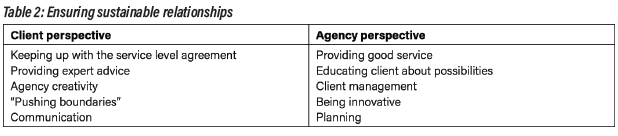
When asked about the aspects that lead to sustainability, most participants mentioned various issues related to fulfilling contractual obligations. These aspects included providing good service (meeting the clients' criteria) and providing expertise to the clients. Several agency and client participants recognised the importance of innovation. A senior consultant cited: "[B]eing bold enough to take them [the clients] into a different direction". Participant 11 observed that "being creative and pushing boundaries" are factors that lead to relationship sustainability. On a practical level, a senior account manager suggested that, to ensure innovation, teams in the agency should be rotated and assigned to different clients to provide a new perspective. Some participants mentioned the importance of regular and honest communication for the sustainability of relationships. For agency consultants, honesty meant managing client expectations about what was possible and reasonable to achieve. The main factors contributing to sustainability of relationships are listed in Table 2.
Surprisingly, neither the consultants nor the client representatives expected closer collaboration and joint problem solving to form part of the relationship. A senior account manager stated: "[Y]ou get clients who don't involve their agency". It appears that a dominant perspective regarding relationships was that the clients wanted the agencies to be expert service providers and offer business solutions. As expressed by a marketing manager: "I expect you to be experts in that because you are my go-to agency". This is also the perspective that is largely accepted by agency participants. Collaboration was viewed as undermining their competence. Nevertheless, there were some hints that the collaborative approach was seen as beneficial, especially from the agency perspective. Agency Participant 3 said:
They [the client's team] come to me for advice, to bounce ideas off. Often, you are an extension of that client team, and they do not necessarily have all the answers, but you are being exposed to a bit more and you might have the answers.
Another senior consultant defined the job of the agency as providing the client with choices. He said: "Our role as consultants is to give them options, but at the end of the day, they are decision makers".
DISCUSSION
Client-PR agency relations comprise a dynamic process that evolves over time, and while the perceptions of clients' representatives and PR consultants are somewhat aligned, there are also some differences.
Clients' expectations about relationships with PR agencies
The study indicates that the clients' expectations regarding PR agencies are influenced by the stage of relationship between the two parties. At the relationship initiation stage, when the client chooses the agency, reputational aspects, including past experience working with the agency, agency expertise and perceived professionalism, play an important role. In addition, economic factors such as cost efficiency play a crucial in the selection of an agency, which is not surprising considering the tight economic conditions under which South African PR agencies operate. As the relationship moves to the relationship maintenance stage, other factors take prominence, which we can cluster around three main dimensions: relational, communication and the quality of service. Among the desired qualities guiding the relationships, honesty, flexibility, openness and commitment to the client were highlighted by the client participants. Clients' communication-related expectations included frequent interaction, feedback, regular follow-ups and easy access to consultants (availability). Service quality expectations included awareness of trends, meeting the client's criteria, timeliness of delivery, achieving desired objectives, understanding the client's industry and showing care for the client's business. Although the participants did not use the term value creation, the latter three factors imply the prominence of value creation as one of the reasons for relationship maintenance.
PR consultants' expectations about relationships with their clients
From the agency side, the perceptions around why agencies are selected by the clients primarily overlapped with those provided by the clients - reputation in the industry and among past clients. In addition, agency professionalism and cost to clients were cited. Furthermore, the PR consultants were aware that they were expected to create value for the client. It was noted that they did not see value creation as a collaborative effort but rather as an agency obligation towards the client. This finding does not support previous studies (e.g. Corsaro, 2020; Skj0lsvik, 2017) that place importance on the co-creational aspects of value creation. Among value-creation factors, the PR consultants stressed the importance of contributing to the client's business performance, i.e. getting impactful results for the client. Similar findings were reported by Mokoena et al. (2023). The consultants also indicated that their clients valued innovation and bold solutions provided by agencies. The findings indicate that the agency participants emphasised the importance of interpersonal relationships between them and clients as a factor in successful relationship maintenance. In addition, PR consultants indicated power disparity in relationships, which manifested itself in an unreasonable industry culture whereby clients expected that the consultants should be available at any time, even outside regular working hours. The same power imbalance existed where the need for agencies to exist and retain clients led to agencies overpromising what they could deliver, which in turn led to the client's dissatisfaction. The overpromising can be attributed to what Bilby et al. (2023) call clientelism - a phenomenon arising from fear of losing the client, which manifests itself in PR consultants pandering to the client. In the end, this has negative consequences for both sides.
Towards sustainable client-PR agency relationships
From the study's findings, the emphasis on building and maintaining relationships to ensure longevity on the part of agencies and clients cannot be understated. Although indirectly, both parties acknowledged that value needs to be created within the relationship in order for it to be sustainable. The stakeholder theoretical perspective places emphasis on value creation by both the organisation and its interest groups, including the PR agency and its clients. However, our study indicates that the notion that value co-creation supersedes economic considerations to encompass a variety of benefits remains normative. While many different factors influenced client-agency relationships in the selected PR agencies in Johannesburg, there was little evidence that the parties actively engaged in value creation as a joint effort. On the one hand, the clients saw value as an agency deliverable; on the other hand, PR consultants saw the value they created for their clients as evidence of their expertise and reason to exist.
Both clients and agencies suggested that there should be open and dialogic communication between them to ensure the sustainability of the relationship. Some agency representatives noted that they often lacked open communication during both internal and external communication. They specified that they met once a month for informational purposes. This practice offers little room for maintaining and sustaining internal relationships within their own agencies, which is crucial to supporting external communication. At the same time, they did not efficiently communicate externally, as one participant mentioned, and they did not always communicate their expectations. Researchers argue that open communication is important for sustainable relationships. As Slabbert (2016) notes, communication can be a form of relationship maintenance. It can do so by assisting in formalising deliverables, defining the agency's role, and eliminating any opportunities for the agency to overpromise and underdeliver.
Existent threats beyond the control of the parties, such as challenging economic conditions, were also identified as important factors affecting relationship sustainability. In line with previous studies conducted in other parts of the globe (Turnbull & Wheeler, 2016; Verčič et al., 2018), this study indicates that the realisation of contractual obligations and technical expertise are some of the most cited expectations among both the clients and agencies.
CONCLUSION
This study presents findings from research on client-PR agency relationships based on the qualitative study of agencies and their clients in South Africa's commercial capital, Johannesburg. The study reveals that the fulfilment of expectations and value creation are the key elements of sustainable quality relationships. Clients expect their consultants to act with their best interests in mind, provide guidance and advice when requested and always be available to them. From an agency's perspective, managing client's expectations about what is possible to deliver was a solid and positive condition for achieving sustainable relationships.
Value creation is a significant contributing factor to sustainable relationships. Clients expect to have strong relationships with agencies that are proactive, respond to unforeseen problems and have a quick turnaround time. In addition, clients and agencies see innovation, creativity and "pushing boundaries" as the engines for value creation. For project-based and retainer contracts, clients expect agencies to be available to them and provide expertise by providing advice and suggestions. At the same time, they expect agencies to scan and be aware of their business landscape to spot opportunities. However, despite the symbiotic nature of this relationship, the parties only acknowledged to a limited extent that the value was co-created through mutual effort.
There are many agencies in South Africa that have a global footprint, and, to a large extent, South African PR agencies have adopted the international (Western) business models. In addition, operational models and structures that lead to a specific industry culture have diffused through the industry over the years. As a result, the findings of this study largely overlap with international studies on client-agency relationships.
This study is not without limitations. The study participants were not linked in dyadic relationships. Future studies should consider studying participant clients involved in relationships with agencies. Furthermore, research should be conducted on a wider pool of client-PR agency relationships or in-depth research on project-based and retainer-contract relationships separately. Nonetheless, studies such as this one are crucial for gaining insight into what is needed for the sustainability and productivity of client-PR agency relationships.
REFERENCES
Bilby, J., Koslow, S. & Sasser, S.L. (2023). Fear in Adland: How client risk aversion and agency clientelism limit the development of great creative campaigns. Journal of Advertising, 52(1) 57-74, DOI: 10.1080/00913367.2021.1981497 [ Links ]
Bizcommunity. (2025). Companies. Available from: https://www.bizcommunity.com/Companies/196/1.html [ Links ]
Boddy, C.R. (2016). Sample size for qualitative research. Qualitative Market Research, 19(4):426-432. https://doi.org/10.1108/QMR-06-2016-0053 [ Links ]
Brennan, R. (2015). Management of the market research client/ agency relationship. Getting Better at Sensemaking, 1:119-141. [ Links ]
Bridgen, E. (2022). Pitch imperfect: Power relations and ceremonial values in the public relations pitching process. Media Practice and Education, 23(4):347-364. [ Links ]
Broom, G.M., Casey, S. & Ritchey, J. (2000). Concept and theory of organisation-public relationships. In J.A. Ledingham, & S. D. Bruning (eds.). Public relations as relationship management: A relational approach to the study and practice of public relations. New York: Routledge, 3-22. [ Links ]
Ceccotti, F., Vernuccio, M. & Mattiacci, A. (2020). The evolution of agency-client relationships within the communication network in Italy: The perspective of communication partners. Sinergie: Italian Journal of Management, 37(3):64-84. [ Links ]
Chohan, R., Watson, R. & Pitt, L. (2019). Perspectives: client-agency opportunism: how does it happen and what can we do about it? International Journal of Advertising, 38(8), 1303-1312, DOI: 10.1080/02650487.2019.1670531 [ Links ]
Corsaro, D. (2020). Value co-destruction and its effects on value appropriation. Journal of Marketing Management, 36:1-2:100-127. DOI: 10.1080/0267257X.2019.1696876 [ Links ]
Davies, M.A.P & Prince, M. (2011). Switching costs and Ad agency client relationship longevity: An exploratory study. Services Marketing Quarterly, 32(2):146-159. DOI: 10.1080/15332969.2011.55760 [ Links ]
Duhan, D. & K. Sandvik. (2009). Outcomes of advertiser-agency relationships: The form and role of cooperation. International Journal of Advertising, 28(5):881-919. doi:10.2501/S0265048709200941 [ Links ]
Ellegaard, C.J., Medlin, C. & Geersbro, J. (2014). Value appropriation in business exchange- Literature review and future research opportunities. Journal of Business & Industrial Marketing, 29(3):185-198. [ Links ]
Eisenhardt, K.M. Agency Theory: 1989. An assessment and review. The Academy of Management Review, 14(1):57-74. https://doi.org/10.2307/258191 [ Links ]
Fam, K.S. & Waller, D.S. (2008). Agency-client relationship factors across life-cycle stages. Journal of Relationships Marketing, 7(2):2017-236 [ Links ]
Fouquereau, E., Morin, A. J. S., Lapointe, É., Mokounkolo, R., & Gillet, N. (2018). Emotional labour profiles: Associations with key predictors and outcomes. Work & Stress, 33(3):268-294. https://doi.org/10.1080/02678373.2018.1502835 [ Links ]
Frow, P. & Payne, A. (2011). A stakeholder perspective of the value proposition concept. European Journal of Marketing, 45(1/2):223-240. [ Links ]
Gottfredson, R.K. & Wright, S.L. & Heaphy, E. (2022). A critical review of relationship quality measures: Is a fresh start needed? An agenda to move forward. Journal of Occupational and Organizational Psychology. 95:624-659. [ Links ]
Grunig, J.E. & Huang, Y. (2000). From organisational effectiveness to relationships indicators: Antecedents of relationships, public relationships strategies and relationships outcome. In J.A. Ledingham & SA Bruning (eds.). Public relations as relationships management: a relational approach to study and practice in public relations. Mahwah, NJ: Lawrence Erlbaum: 23-53. [ Links ]
Hani, U., Wickramasinghe, A. & Kattiyapornpong, U. (2021). Reviving social banking using relationship quality dynamics in a developing country. Journal of Strategic Marketing, 29(7):574-597. https://doi.org/10.1080/0965254X.2021.1891127 [ Links ]
Henke, L.L. (1995). A longitudinal analysis of the Ad agency-client relationship: Predictors of an agency switch. Journal of Advertising Research, 35(2):24-30. [ Links ]
Hessling, V., Åsberg M. & Roxenhall, T. (2018). Relationship commitment and value creation in sponsorship relationships. Journal of Business-To-Business Marketing 25(2):137-160. https://doi.org/10.1080/1051712X.2018.1454646 [ Links ]
Hughes, T. & Vafeas, M. (2019). Marketing agency/client service-for-service provision in an age of digital transformation. Journal of Business-To-Business Marketing. 26(3-4):265-280. [ Links ]
Hung, C.F. (2008). Towards the theory of relationships management in public relations: How to cultivate quality relationships. In E.L. Toth (ed.). The future of excellence in public relations and communication management. Routledge: New York, 443-476. [ Links ]
Iszatt-White, M. & Lenney, P. (2020). Enacting emotional labour in consultancy work: Playing with liminality and navigating power dynamics. Management Learning, 51(3):314-335. https://doi.org/10.1177/1350507620906580 [ Links ]
Jansen van Rensburg, M. (2014). Uncovering client retention antecedents in service organisations. African Journal of Hospitality, Tourism and Leisure, 3(1):1-13. [ Links ]
Jensen, H. & Sund, K.J. (2020). Marketing challenges and advertising partner selection: exploring advertiser-agency relationships in the Danish media industry. Nordic Journal of Media Management, 1(2):297-313. DOI: 10.5278/njmm.2597-0445.4432 [ Links ]
Jones, T., Ranaweera, C., Murray, J. & Bansal, H. (2018). A prototyping analysis of relationship marketing constructs: What constructs to use when. Journal of Marketing Management, 34:9-10, 865-901. DOI: 10.1080/0267257X.2018.152028. [ Links ]
Keegan, B.J., Rowley. & Tonge, J. (2017). Marketing agency-client relationships: Towards a research agenda. European Journal of Marketing, 51 (7/8):1197-223. doi:10.1108/EJM-10-2015-0712 [ Links ]
Koschmann, M.A. (2016). A communication perspective on organisational stakeholder relationships: Discursivity, relationality, and materiality. Communication Research and Practice, 2(3):407-431, DOI: 10.1080/22041451.2016.1217383 [ Links ]
Ledingham, J.A. & Bruning, S.A. (2000). Introduction: background and current trends in the study of relationships management. In J.A. Ledingham & SA Bruning (eds.). Public relations as relationships management: A relational approach to study and practice in public relations. Mahwah, NJ: Lawrence Erlbaum: xi-xvii. [ Links ]
Levin, E. & Lobo, A. (2011). Clients' expectations of their advertising agencies: Creativity and relationship management. Australian and New Zealand Marketing Academy Conference 2011, Perth, Australia, 28-30 November. [ Links ]
Levin, E., Quach, T.N. & Thaichon, P. (2019). Enhancing client agency relationships quality in advertising industry - an application of project management. Journal of Business and Industrial Marketing, 34(2):463-473. doi.org/10.1108/JBIM-08-2017-0186. [ Links ]
Makkonen, H. & Olkkonen, R. (2017). Interactive value formation in interorganizational relationships: Dynamic interchange between value co-creation, no-creation, and co-destruction. Marketing Theory, 17(4):517-535. [ Links ]
Mokoena, A., Prinsloo, J.J., Gawlik, R. & Pelser, T. (2023). A framework for the sustainability of advertising agencies in an emerging economy: The case of South Africa. Journal of Marketing Communications (29)1:46-66. https://doi.org/10.1080/13527266.2021.1989613 [ Links ]
Morgan, R.M. & Hunt, S.D. (1994). The commitment-trust theory of relationship marketing. Journal of Marketing, 58(3):20-38. https://doi.org/10.1177/002224299405800302 [ Links ]
Nothhaft, H. & Stensson, H. 2019. Explaining the measurement and evaluation stasis. A thought experiment and a note on functional stupidity. Journal of Communication Management. (23)3:213-227. [ Links ]
Oksiutycz, A & Nhedzi, A. (2018). Zimbabwean communication agencies: current state and future prospects. Communicare, 37(1):94-117. [ Links ]
Park, H. & Rhee, Y. (2010). Associations among relationship maintenance strategies, organisation-public relationships, and support for organisations: An exploratory study of the non-profit sector. Prism 7(2):1-16. [ Links ]
Quebra, B., Bick, G. & Abratt, R. (2013). Service quality of advertising and promotions agencies in South Africa. Journal of Promotion Management, 19(5):605-628. [ Links ]
Rusbult, C.E., Martz, J.M. & Agnew, C.R. (1998). The investment model scale: Measuring commitment level, satisfaction level, quality of alternatives, and investment size. Personal Relationships, 5(4):357-387. [ Links ]
Shafiee, M.M. & Tabaeeian, R.A. (2021). Integrating knowledge-responsibility-performance via supplier relationship management. International Journal of Integrated Supply Management, 14(4):445-466. [ Links ]
Sidhu, R. (2014). Communication and engagement. In R. Smith, D. King, R. Sidhu & D. Skelsey (eds.). The effective change manager's handbook. Gosport, Hampshire: Kogan Page, 210-256. [ Links ]
Sisson, D.C. (2017). Control mutuality, social media and organisation-public relationships: A study of animal welfare organisations. Public Relations Review, 43:179-189. doi. org/10.1016/j.pubrev.2016.10.007 [ Links ]
Skjølsvik, T. (2017). The impact of client-professional relationships in Ex ante value creation: A service-dominant logic perspective. Journal of Business-to-Business Marketing, 24(3):183-199. doi:10.1080/1051712X.2017.1345259 [ Links ]
Slabbert, Y. (2016). A new conceptual framework to strengthen internal corporate image: A stakeholder-inclusive perspective. Communicatio: South African Journal for Communication Theory and Research, 42(2):253-275 [ Links ]
Stafford, L. (2010). Measuring relationship maintenance behaviors: Critique and development of the revised relationship maintenance behavior scale. Journal of Social and Personal Relationships, 28(2), 278-303. [ Links ]
Stein, L. (2016). Love Me Tender: Why Agencies and Clients Stay - And Why They Stray: The Secrets to Some Long-Term Adland Partnerships. Available from: https://adage.com/article/agency-news/longstanding-agency-client-relationships-highs-lows/302674. [ Links ]
Sthapit, E. & Björk, P. (2020) Towards a better understanding of interactive value formation: Three value outcomes perspective. Current Issues in Tourism, 23(6):693-706. DOI: 10.1080/13683500.2018.1520821 [ Links ]
Sutton, L.B., Kloppers, E.M. & Bezuidenhout, L. (2024). Strategies utilised by communication agencies to build and maintain relationships with clients. The Southern African Journal of Entrepreneurship and Small Business Management, 6(1):a825. https://doi.org/10.4102/sajesbm.v16i1.825 [ Links ]
Turnbull, S. & Wheeler, C. (2016). Exploring advertiser's expectations of advertising agency services. Journal of Marketing Communications, 22(6):587-601. doi:10.1080/13527266.2014.920902 [ Links ]
Vejnovic, E., Purchase, S. & Tarabashkina, L (2024). Marketing research agency, creative agency and client relationships: A study of relationship tensions. Journal of Business & Industrial Marketing, 39(3):461-473. [ Links ]
Verčič, D., Tench, R. & Verčič, A.T. (2018). Collaboration and conflict between agencies and clients. Public Relations Review, 44:156-164. [ Links ]
Verwey, S. (2015). Paradigms, perspectives and practice of public relations and communication: Implication for 'disciplined imagination' in South African scholarship. Communitas, 20(1):1-25. Available from: https://scholar.ufs.ac.za/handle/11660/3765 [ Links ]
Weibel, A., Sachs, S., Schafheitle, S. & Gaito, T. (2022). Distrust: The Neglected Construct in Stakeholder Relations. Paper presented at First International Network on Trust, FINT 2022, Charleston, South Carolina, United States. [ Links ]
Xu, S. (2019). Prioritising relationships: The investment model and relationship maintenance strategies in organisational crises. Public Relations Review, 45(101872):1-16. [ Links ]
Yeomans, L. (2019). Public Relations as Emotional Labour. London: Routledge. [ Links ]
Ziegele, D. (2024). Cultivating effective agency-client relationships: Reviewing the field and proposing a novel framework to measure relationship quality in public relations. Journal of Public Relations Research. DOI:10.1080/1062726X.2024.2433240 [ Links ]
Submitted April 2024
Accepted March 2025