




Services on Demand
Journal

Article
 English (pdf)
 Article in xml format
 Article references
 Automatic translation
 Send this article by e-mail
Indicators
Related links
-
 Cited by Google
 -
 Similars in Google
Share

 Permalink
Southern African Field Archaeology
On-line version ISSN 2789-1844Print version ISSN 1019-5785
South. Afr. Field Archaeol. vol.20 Johannesburg 2025
https://doi.org/10.36615/safa.20.4135.2025
PEER-REVIEWED CONCISE COMPARATIVE STUDY, SYNTHESIS, OR OVERVIEW
https://doi.org/10.36615/safa.20.4135.2025
Arthropod presence and their relevance in South African archaeological deposits
Michelle MoutonI; Annie R. AntonitesII, III; Tharina L. BirdII, IV; James du G. HarrisonV
IDepartment of Anthropology, Archaeology and Development Studies, University of Pretoria, Private Bag X20, Hatfield 0023, South Africa
IIDitsong National Museum of Natural History, P.O. Box 4197, Tshwane 0001, South Africa
IIIDepartment of Anthropology and Archaeology, University of South Africa, P.O. Box 392, Tshwane 0003, South Africa
IVDepartment of Zoology and Entomology, University of Pretoria, Private Bag X20, Hatfield 0023, South Africa
VSchool of Animal, Plant and Environmental Sciences, University of the Witwatersrand, Private Bag 3, Wits 2050, South Africa
ABSTRACT
Arthropod biology, entomology and forensic entomology are well-established fields in South Africa, yet their application in local archaeological studies is underdeveloped. Here, we discuss the nature of arthropod (mainly insects) presence reporting from excavation and laboratory analyses of archaeological materials in South Africa. We assess the shortcomings of reporting trends, explore interpretive possibilities based on a case study from two Early Iron Age sites (Le6 and Le7) and a Middle Iron Age site (Evelyn) in the Limpopo Province, and suggest the way forward for optimal recording of arthropod presence in archaeological deposits. In addition to presenting a case for entomology sensu lato in understanding past environments, site formation processes, agricultural practices and living conditions, we also highlight the role archaeologists can play in entomological research by gathering present-day data on subterranean arthropod presence and behaviour.
Keywords: archaeoentomology, arthropods, bioturbation, entomo-archaeology, human-insed interaction
ABSTRACT IN NORTHERN SOTHO
Payolotši ya dikhunkhwane, thutadikhunkhwane le thutadikhunkhwane ditopong ke makala ao a hlomilwego gabotse kudu ka Afrika Borwa, le ge e le gore phethagatšo ya makala a go thuto ya dilo tša kgale ga se ya hlabollwa gabotse. Mo, re ahlaahla sebopego sa go fa dipego ka ga go ba gona ga diphoofotšwana tša go hloka lerapo la mokokotlo (kudukudu dikhunkhwane) ge go sekasekwa dilo tša kgale tše di epollotšwego le tša ka laporathoring ka Afrika Borwa. Re sekaseka ditlamorago tša go se kgahliše tša mekgwa ya go fa dipego, ra lekola dikgonagalo tša tlhathollo go ya ka dinyakišišo ka ga seemo le go akanya gore go iwa pele bjang go gatiša ka botlalo go ba gona ga dikhunkhwane ka megogolweng ya kgale. Go tlaleletša go hlagiša tiragalo ya go ba gona ga dikhunkhwane go kwešiša ditikologo tša kgale, ditshepedišo tša tlhamego ya lefelo, ditiro tša bolemi le maemo a go phela, re gatelela gape tema yeo bašomi ba diepollwa tša kgale ba ka e ralokago ka go dinyakišišo tša dikhunkhwane ka go kgoboketša tshedimošo ya lehono ka ga dikhunkhwane tša ka fase ga mobu le go ba gona ga diphoofotšwana tše dingwe tša go hloka lerapo la mokokotlo le maitshwaro a tšona.
Keywords: archaeoentomology, arthropods, bioturbation, entomo-archaeology, human-insed interaction
1. Introduction
Arthropods - animals with hard exoskeletons and jointed appendages in the phylum Arthropoda - are the most diverse group of animals on the planet (Miller & Rogo 2002), and the African continent boasts a rich arthropod species diversity (Scholtz & Chown 1995; Foord et al. 2011; Scholtz & Mansell 2017). In terrestrial environments, familiar taxa include spiders, scorpions and kin (Arachnida), millipedes and centipedes (Myriapoda), and numerous insects and kin (Hexapoda), and for societies that live near water bodies, crabs and kin (Crustaceans). In addition to arthropods, other invertebrates such as earthworms (Oligochaeta), and slugs and snails (Gastropoda) are also of relevance in archaeoentomology (Versteegh et al. 2013; Backwell et al. 2022). Different groups of arthropods offer different avenues from which to explore past human societies, or to interpret the environment in which these humans lived.
Insects and arachnids are critical for maintaining ecosystem functioning (e.g., for nutrient cycling and pollination, and as predators and prey). Insects such as aphids (Hemiptera, Aphididae), caterpillars of moths and butterflies (Lepidoptera), beetles (Coleoptera), and grasshoppers, crickets, and locusts (Orthoptera) can impact agricultural systems as pests, while predators such as spiders (Araneae) and parasitoids such as wasps (Hymenoptera) act as biocontrol agents that keep pest numbers in check (Nyffeler & Birkhofer 2017). Some insects such as tsetse flies (Diptera, Glossinidae) and malaria mosquitoes (Diptera, Culicidae) are vectors of disease to both humans and livestock, while medically important arthropods include poisonous and venomous insects and arachnids (Mullen & Durden 2002; Goddard 2012).
Arthropods, in particular insects, are a well-known food source; in Africa, they are often referred to as 'small meats' and supply a rich source of protein and other dietary nutrients to its inhabitants (see van Huis 2003; van Huis et al. 2013; Egonyu et al. 2021). Specific methods were developed on the continent to collect insects for food using, for example, glue, light, and sound traps, and remarkably complicated devices such as clay pipes to detect, attract, and/or trap insects (e.g., Junod 1913; van Huis 2003). Today, entomophagy (the consumption of insects) is common throughout Africa, where many species across different insect orders are consumed, as larvae and/or adults depending on the species, of beetles, moths and butterflies, grasshoppers and crickets, termites (Blattodea, Termitoidea), and ants, bees, and wasps (van Huis 2003: table 1; Kelemu et al. 2015; Farr 2021). People keep bees or collect wild honey, and the soil oftermite mounds (termitaria) is consumed because of its nutrient value (e.g., Grivetti 1979; Hunter 1984; Yamashina 2010; Fairhead 2016; Farr 2021).
Insects and many other arthropods are also exploited for their medicinal value across various localities (Meyer-Rochow 2017). In Africa, for example, traditional healers use insects as medicine for humans and livestock, including the use of crushed wasps to treat headaches, the consumption of mantis (Mantodea) ootheca (egg case) to treat earache, and stick insects (Phasmatodea) to lose weight (van Huis 2003, 2021). Termites also feature prominently in San healing symbolism (Mguni 2006, 2015). An interesting example of contemporary medicinal use that includes both the organism and its burrow is the use of baboon spiders (Araneae, Theraphosidae) to treat wounds. Here, a potion (muthi) is produced by crushing the whole spider and mixing it with the root of a lily. This mixture is then stored in the spider's burrow to preserve its curing properties, after which it is applied to the wound (Manamela 2003).
Beyond their caloric and medicinal value, arthropods are part of various other aspects of human societies. Arthropods are used in biomimicry, biotechnology and biomedical research (Bonning 2009; Pulsifer et al. 2011; Bloemberg et al. 2021). Today, arthropods are used in forensic entomology where specialist knowledge on the identification of (especially) insects, and their behaviour, biology and ecology, provide evidence in civil and criminal cases (Williams & Villet 2006). In South Africa, forensic entomology has aided in medico-legal investigations in criminal cases since the 1980s (e.g., Prins 1983, 1984a, b). The accumulation of research on carrion-associated insects and stored product pests, combined with the long history of taxonomy in southern Africa, form the foundation of forensic entomology in the region.
Arthropods further provide building material, such as soil from termitaria, for the construction of housing (Marchand 2009; Yamashina 2010; Farr 2021), while their body parts serve as ingredients for hunting poisons (Bradfield et al. 2015; Bird et al. 2023). They are also used as material for ritual, ornamental and musical objects. For example, the colourful elytra or hard forewings of jewel beetles (Buprestidae) are incorporated into necklaces, and dancing rattles are made from the silken cocoons of Lasiocampidae and Saturniidae moths (van Huis 2019, 2021). Trade in insects such as mopane caterpillars Gonimbrasia belina Westwood 18491, longhorn grasshoppers Ruspolia differens (Serville 1838), and insect products such as honey, or termitaria soil, have helped to establish significant rural economies across Africa (Y amashina 2010; Mmari et al. 2017; Nemadodzi et al. 2023).
Arthropods are a source of stories, superstition, and symbolism; in particular, insects and arachnids feature strongly in the folklore of many African cultures (e.g., Junod 1913; Mguni 2015; Schmidt 2020). Among Namibian Khoisan, the praying mantis holds special importance, both as an oracle and as an omen, while southern African Bantu-speaking groups similarly consult a mantis to help locate lost cattle (Schmidt 2018). For many groups in South Africa, stick insects have healing properties and promote wellbeing; they are seen as a vessel through which ancestors visit a sick family member (Junod 1913). Bees and termites are 'honey-fat' creatures, substances that hold symbolic value for the southern African San associated with concepts of creation in ritual symbolism (see discussion in Mguni 2015). San groups believe that honey and fat possess supernatural potency and they are used for anointing and are often linked with rain symbolism (Mguni 2015; see also Russell & Lander 2015). In West Africa, the spider-like trickster, Anansi, plays a central role in folklore (Marshall 2007), while termites and termitaria feature strongly in many African creation myths (e.g., Geissler 2000; Mguni 2006; Fairhead 2016; Farr 2021).
These examples show that insects and other arthropods were, and in many cases still are, often welcomed in the living spaces and symbolic worlds of various sub-Saharan communities. The question arises whether we can trace arthropod presence in archaeological contexts, and what their presence might reveal about past peoples and environments, and how they may have impacted the formation and preservation of archaeological deposits. We aim here to provide an overview of archaeoentomological studies, assess the gaps in local reporting trends, and explore interpretive possibilities based on a case study from two archaeological sites in South Africa. We suggest the way forward for optimal recording of insect presence in archaeological deposits, to contribute to both potential research avenues and current biodiversity research in sub-Saharan Africa.
2. Arthropods in archaeology
Arthropod presence in the archaeological record can be detected from the preservation of complete insects or their body parts, or indirectly through ichnological proxies such as casts or imprints of burrows and tunnels, as well as from taphonomic damage left on archaeological materials such as bone (Baucon et al. 2008; Nascimento et al. 2021; Backwell et al. 2022; Bradfield 2023). The preservation of arthropod body components is rare, requiring specific environmental conditions. Although the conditions in which arthropods survive in archaeological deposits is understudied (see Robbiola et al. 2011), preservation is most noted for anaerobic, waterlogged, or desiccated environments (Buckland 1990; Elias 2009; Robbiola et al. 2011). Although rare, arthropod body parts can preserve, particularly sclerites (the chitinous components of exoskeletons) when carbonised (Panagiotakopulu & Buckland 1991).
These remains and trace evidence of arthropods - largely insects and arachnids - are often encountered during archaeological and palaeontological excavations from various localities around the world and may be linked to post-depositional disturbances. Conversely, when deposited within the archaeological timeframe, such remains and signs of arthropods can make an important contribution to the reconstruction of anthropogenic and natural environments and provide insight to the activities and behaviours of the past peoples.
The reconstruction of palaeoenvironments through insect and other arthropod proxies is well known (Elias 1994; Eggermont et al. 2008; Buckland 2014; Dickson & Walker 2015). For example, Versteegh et al. (2013) found that earthworm-secreted calcite granules provide a reliable measure of ancient climates. Similarly, the cells in the nests of social bees (ichnogenus Celliforma Brown 1924) provided an indication of the local palaeoclimate in which the 'Taung Child' Australopithecine had lived (Parker et al. 2016). However, there remains a need to explore the activities of past peoples in relation to their environments (e.g., Sutton 1995). As such, greater emphasis needs to be placed on the use of arthropod traces and remains as archaeological indicators of human activity, by which settlements and past economic landscapes can be reconstructed (Elias 1994, 2009; Sutton 1995; Ponel et al. 2000).
When arthropod remains can be identified to sufficient taxonomic resolution, various detailed questions related to past economy, life, and society can be answered. For example, by exploring the macro-remains of synanthropic beetle species (beetles associated with human settlements) at a multicomponent settlement in Calvados, France, Ponel et al. (2000) were able to reconstruct anthropogenic components in the formation of certain deposits spanning the La Tène and Gallo-Roman periods. Crop pests such as the pea weevil Bruchuspisorum (Linnaeus 1758) and the grain weevil Sitophilus granarius (Linnaeus 1758), contributed to the characterisation of the site's agricultural activities, while the diversity of phytophagous (plant eating) and the absence of silvicolous (species associated with forest habitats) beetle taxa allowed for the reconstruction of the site's environment and immediate surroundings. As S. granarius is not native to France, its identification also helped to reconstruct its introduction into the area. Buckland (1981) similarly used S. granarius and other invasive synanthropic beetles to reconstruct the expansion of agriculture across Europe. These studies not only help characterise prehistoric exchange networks, but also allow for the reconstruction of the species' introduction and changes in their distribution because of such exchanges (e.g., Panagiotakopulu & Buckland 1991, 2009; Panagiotakopulu 2001; King et al. 2009; Tuccia et al. 2022).
Insects can also inform on animal management activities. The presence of parasitic sheep ked Melophagus ovinus (Linnaeus 1758) and chewing lice Bovicola ovis (Schrank 1781), both ectoparasites specific to sheep, in late medieval deposits at Stóraborg on the south coast of Iceland confirmed the presence of sheep, which can be difficult to distinguish from goats based solely on osteology. Ectoparasites, along with coprophagous beetles, e.g., dung beetles (Scarabaeinae), indicate areas where livestock were kept, and areas where wool was likely processed (e.g., Buckland & Perry 1989; Smith 1998; Grove 2001). The contributions of these archaeoentomological studies all address questions archaeologists seek to answer (e.g., Allentuck & Greenfield 2010).
Tracing the antiquity of arthropods as food is difficult, but insect remains, and parasites associated with entomophagy, have been successfully identified in palaeofaeces across the Americas (Reinhard & Bryant 1992; Sutton 1995; Elias 2009), offering a potential means of reconstructing prehistoric diets. In the absence of insect remains, some scholars have suggested studying use-wear patterns (microscopic striations produced by use over time) on stone and bone tools to determine their function, which could provide evidence for the harvesting of insects in prehistoric diets (e.g., Tommaseo-Ponzetta 2005; McGrew 2014). For example, Backwell & d'Errico (2001) argued that the micro-striations on bone tools from Swartkrans, South Africa, were produced by digging into mounds for termites, supporting the role of entomophagy in the early hominid diet.
The strong cross-disciplinary character of forensic sciences, drawing from various fields of knowledge and research, is a good model to follow in archaeological investigations. Taphonomic studies focused on the effects that carrion-associated insects have on organic materials, for example, also feature in archaeological discourse. Archaeological interpretation relies on sound understandings of the formation of archaeological deposits and associated artefacts. Under ideal conditions, insects are collected from graves, tombs and mummified remains of humans and animals (e.g., Panagiotakopulu 2001; Mosothwane 2011; Tuccia et al. 2022). Another example of research relevant to archaeology is how vertebrate remains are modified by beetles, moths, termites, fly larvae, and ants, bees, and wasps (Backwell et al. 2022; Mahomed 2022; Parkinson 2023). Such studies focus on the effects that certain arthropods have on the preservation and interpretation of faunal remains (Backwell et al. 2012, 2022).
3. Methods
To get a general sense of the nature of archaeologists' reporting on the presence of insects and other arthropods in southern Africa, we reviewed literature in two major southern African archaeology journals for reference to insects and other arthropods: the South African Archaeological Bulletin (SAAB, 1950-2022) and Southern African Field Archaeology (SAFA, 1992-2022). To get a broad idea of the kind of arthropod fragments present in southern African archaeological deposits, their possible interpretations, and to identify potential specialised areas of research, we surveyed archaeological materials originating from two Iron Age archaeological excavations (Fig. 1).
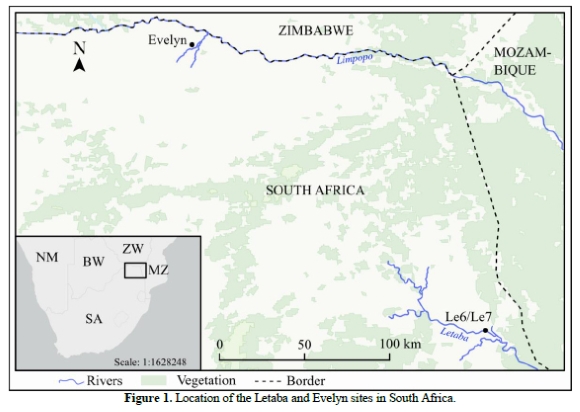
Letaba is a first millennium AD settlement located on the southern banks of the Letaba River in the Kruger National Park, South Africa (Antonites 2024). Materials in this study originate from areas Le7.50, Le7.54, Le6.27 and Le6.52 (see Antonites 2025 for details). Evelyn is a 12th-13th century AD settlement located in the Klein Bolayi Game Lodge in the Limpopo Province, South Africa (Mouton 2025), and the study materials originate from Trench V. At both sites, 10 litre bulk soil samples were systematically collected from the centre of each locus - the discrete excavated context defined by the archaeologist during excavation - within a 2x2 m unit (see Antonites 2025).
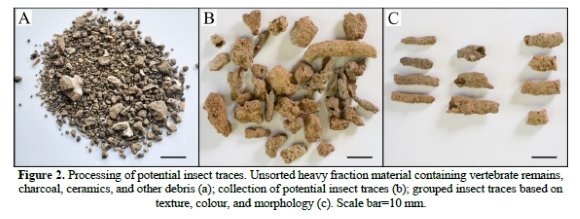
These samples were processed using a water-separation technique often referred to as flotation (e.g., Limp 1974). Through a flotation system, a gentle current separates different substances (e.g., stone, silt, clay, bone, botanicals) into heavy and light fractions. A small sample of heavy fraction material was selected to investigate the presence of arthropod remains and trace elements, which might otherwise not have been collected using dry screening (Fig. 2a). Potential insect traces were identified from the light fraction material (Fig. 2b) and sorted into groups based on texture, colour, and morphology (Fig. 2c) (see Fowler et al. 2004). Within each group, specimens were examined under a stereo microscope for similarity, familiar patterns, and embedded fragments of insect skeletal remains or other trace evidence that could link the specimens to the behaviour or morphology of arthropods. Skeletal remains (e.g., elytra, mandibles, etc.) were identified through morphological comparison with modern species by trained entomologists.
We use trace evidence here to refer to the remains or traces of an animal's lifestyle, for example burrows, earthworm casts, and silk, in line with the use of trace fossil in palaeontology. Features, or activity areas refer to features within a site, such as refuse pits and livestock enclosures.
4. Results
Literature overview: Arthropod reporting trends in southern African archaeology
Arthropods are mentioned in 26 of 722 SAAB articles and in 8 of 148 SAFA articles. Although the archaeological themes of these articles varied, the majority note insect disturbances - usually from termites - when describing excavated deposits (e.g., Humphreys 1982; Webley 2001; Cain 2009). In one detailed example, nest structures and "head capsules" were used to identify Microhodotermes viator (Latreille 1804) (identified as Hodotermes viator) as the termite species responsible for disturbing a rock shelter deposit in southwestern South Africa (Manhire 1993: 5). The presence of actual arthropod remains was sometimes noted, such as a possible mopane worm (G. belina) or larvae of related species from a mummified human burial in northeastern Botswana (Mosothwane 2011).
Beyond exploring arthropods and their effects on the formation of archaeological deposits, other topics include:
• The use of plants and ochre as insect pesticides/repellents in the past (Binneman 2000; Rifkin 2015);
• Reference to historical records of San and Khoi insect use as food and medicine (Prins & Rousseau 1992; Wilson 1993);
• Ethnographic examples where San and Khoi cosmology draw on insect imagery, such as the mythical trickster that can take the form of the praying mantis (Schmidt 2020).
From a rock art perspective, Mguni (2015) provides several examples, especially from the Matopo Hills, Zimbabwe, of termites and termitaria represented in southern African rock art, while Mguni (2013) described several paintings from the Cederberg depicting anthropomorphic forms influenced by San belief and cosmology inspired by the life cycle of dragonflies (Odonata, Anisoptera).
Extending the literature survey beyond the SAAB and SAFA, the depiction of insects in southern African rock art have been noted elsewhere, such as:
• Moths in South Africa's uKhahlamba-Drakensberg Mountains and at the Brandberg in Namibia (Hollman 2007);
• Bees, honeycombs and/or bee's nests in the Drakensberg at Ndedema Gorge (Pager 1971);
• Locusts or grasshoppers (Acrididae) in San rock art in the Mapungubwe National Park (Mguni 2015).
Arthropod traces and skeletal elements in archaeological deposits are explored in more detail in other publications. From a methodological point, Fowler et al. (2004), for example, discuss ancient biotic activity at the first millennium AD site of Ndondondwane in KwaZulu-Natal, South Africa. They described the methods used to identify ceramic ecofacts (organic and environmental remains that are not cultural objects), and their ecological and cultural significance. In doing so, they provide a helpful methodology for analysing the physical and mineralogical properties, and the morphological characteristics, of unusually shaped baked-clay specimens. These specimens were originally thought to be ceramic figurine fragments. Macroscopic and microscopic examination of the baked-clay fragments, however, identified these as earthworm faecal casts, and as plant stalk casts caused by termite activities. They based this interpretation on detailed investigations of the properties of the ecofacts, coupled with a consideration of archaeological provenience and invertebrate ecology and behaviour. In considering the interstitial spaces of different grasses and grass crops, and by comparing these to the shapes of the plant stalk casts, they hypothesised that stalk-like casts are the result of soils baked within sorghum (Sorghum Moench 1794) plant stalks. At some point during the settlement's occupation, these faecal and plant stalk casts were exposed to heat, which preserved them in a baked form. Importantly, the preserved remnants of insect activities suggested first millennium AD sorghum cultivation in the absence of macro-botanical evidence (Fowler et al. 2004).
The link between past and present termite activities and people are also noted elsewhere. At Nanda, another first millennium site in KwaZulu-Natal, Whitelaw (1993) mentions the use of termitaria constructed by fungus growing termite species (Termitidae, Macrotermitinae) as burial locales. He suggests that the termitaria at Nanda might signal a higher status of the individuals buried there (see also Hammond-Tooke 1981; Walker 1991). Farr (2021) similarly emphasises the cultural significance of human-termite interactions in sub-Saharan Africa. Deeply rooted in ideology and cultural practice, he highlights how human action is both a response to and motivated by termite behaviour. Termite mounds are a sign of a healthy ecosystem, a fact which farmers exploit in selecting locations suitable for crop cultivation and raising livestock. Further, termitaria are also an important building material for household structures, kilns and pottery, and furnaces for smelting iron, while women consume the soils from termite mounds (geophaghy) for conditions related to fertility, antenatal and postnatal care (Farr 2021; see also Geissler 2000). As these practices, and the spaces and activities associated with them, are often associated with gendered roles (see Moffett 2023 for overview and critiques), Farr (2021) highlights the significance of human-termite interactions and its implications for understanding gendered interactions, ecological knowledge, and the spatial relationship between termite mounds and past human settlements.
The literature survey provides compelling examples of the spiritual and economic significance of arthropods to farming communities in the past and how exploring such topics can contribute to archaeological studies of southern African farming systems.
Case study: Letaba and Evelyn archaeological sites
Here we describe and discuss the potential significance of arthropod traces collected from the Iron Age sites of Letaba and Evelyn in South Africa. The purpose is not to provide a detailed specialist analysis of the different arthropod fragments and traces, but to provide an overview of the range of remains and traces typically collected during archaeological excavations, provide potential avenues for interpretation, and to suggest ideas for further research into these finds. Evidence related to arthropods from these two sites primarily consisted of trace evidence such as burrows, tunnels, and grass/plant encasings and casts, while direct evidence was less common but included insect bodies and pupal casings.
Tunnels, burrows, and encasings: During excavation, numerous subterranean burrows and tunnels were encountered at both Evelyn and Letaba. Various groups of arthropods construct burrows and tunnels where the depth and shape of burrows are linked to microhabitat, animal body size, substrate characteristics, and slope, and are taxon-specific (Nascimento et al. 2021). Taxon-based modifications include more than one chamber, and side burrows/chambers to hide in, which may provide an escape route to the outside via a second opening (Uchman et al. 2018; Nascimento et al. 2021). Others, for example the species-rich burrowing scorpions Opisthopthalmus Koch 1837 of southern Africa, have spiralling burrows for environmental control and predator protection (Adams et al. 2016). Trace evidence in the form of burrows therefore have the potential to inform on a large variety of issues, from the identity of arthropods that shared the environment with humans, and potentially impacted on the life of the humans, to environmental and soil conditions at the time of burrow construction.
Many of the subterranean structures encountered at Letaba and Evelyn consisted of single, vertical tunnels varying in size from <2 mm to 20 mm, with some having a chamber at the base. Small, nest-like structures with interconnected tunnels were also present. These were mostly modern intrusions by insects such as ants (Formicidae), beetles, and termites, and arachnids such as scorpions (Scorpiones), and solifuges (Solifugae). These intrusions were noted on the recording sheets but were not collected intact.
In terms of the flotation samples, numerous tunnel-like structures were present (Table 1). Sedimentary structures of irregular shape, with interconnected tunnels throughout, resemble broken parts of termite nests (Table 1a). As social insects, their nests contain numerous subterranean tunnels that connect to each other, to various chambers such as brooding chambers, and to the surface aboveground (see Mguni 2015 for discussion). Micro-tunnels (<1 mm in diameter) of smaller invertebrates were also present (Table 1b). Most specimens consisted of hollow, cylindrical sedimentary structures (Table 1c). These can consist of either subterranean tunnels or tunnels and encasings produced by insects aboveground.
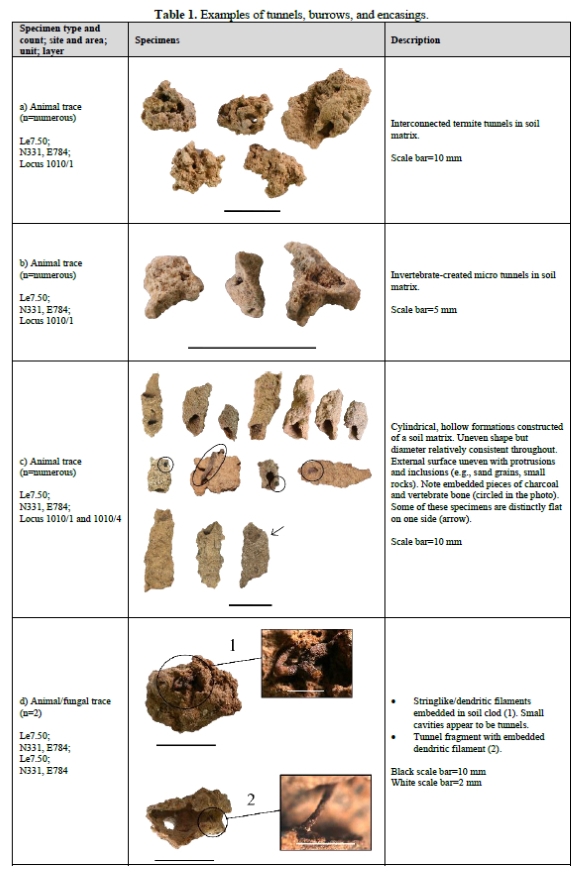
Most of the tunnel-like specimens consisted of individual tunnels of relatively consistent diameter throughout, with diameters ranging from 3 to 8 mm. The outer surfaces were uneven with many protrusions, while the inner surfaces were relatively smooth and even. Of these, many contained inclusions such as charcoal and vertebrate bone fragments, indicating the reworking of archaeological deposits by micro-animals. If these are subterranean tunnels, a potential explanation for their isolation from the soil matrix in which they were constructed is the use of saliva to strengthen the wall of the tunnel. The surrounding soil was removed during the flotation process and the tunnels remained.
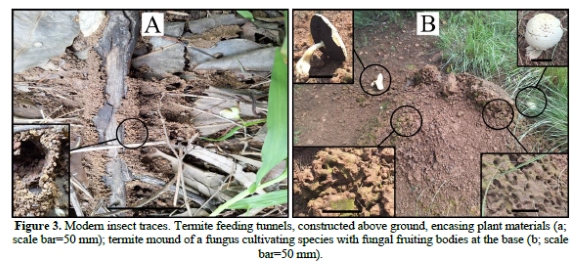
Alternatively, some specimens could represent tunnels or encasings constructed aboveground. Many wasps, for example, construct nest entrances (turrets) which lead to subterranean burrows (see Gess & Gess 2014: fig. II.2.7). Further, most termite species forage aboveground, constructing feeding tunnels that connect the nest to the food source (commonly grass) to protect the termites against the sun and other dangers (Fig. 3a). When the encased plant or wood disintegrates, the tunnels and encasings remain. This could be due to heat exposure baking the soil matrix, or a potential chemical reaction where the cohesive properties of their saliva cures like cement (e.g., van Thuyne & Verrecchia 2021). Branching, dendritic filaments fixed to the walls in cavities of apparent tunnel fragments have also been noted at Letaba (Table 1d). These are almost certainly fungal hyphae, based on the branching pattern. The association of these fungal hyphae with tunnels is significant and suggests the presence of fungus-growing termites in various areas across Letaba. The sprouting body of the fungus cultivated by the termite genus Macrotermes Holmgren 1910 appears after rain at the base of termite mounds (Fig. 3b); a delicacy commonly known as omajova in Namibia (Dieckmann 2014).
Burrows or cavities were also present in the sample (Table 2). Of these, the shape and presence of emergence holes suggests an underground pupal chamber (Table 2a). Various insects such as moths, beetles, soil nesting wasps, and solitary bees construct subterranean pupal chambers. The Letaba specimens have a distinct formation at one end suggesting a burrow was attached to the chamber before being sealed. These almost certainly belong to wasps (Gess & Gess 2014: fig. II.2.8). The morphology of the Letaba specimens is, for example, similar in shape and size to those produced by species in the Ceramius Latreille 1810 and Celonites Latreille 1802 genera (see Gess & Gess 2014: fig. II.2.19). A collection of dung beetle pupal chambers was also exposed in situ at Letaba in area Le7.54 (Table 2b), and a specimen of animal silk was recovered from Evelyn (Table 2c). Various arthropods produce silk, including spiders (Araneae), and insects such as Lepidoptera larvae and some Tenebrionidae beetle larvae (Schulze & Brown 1975).
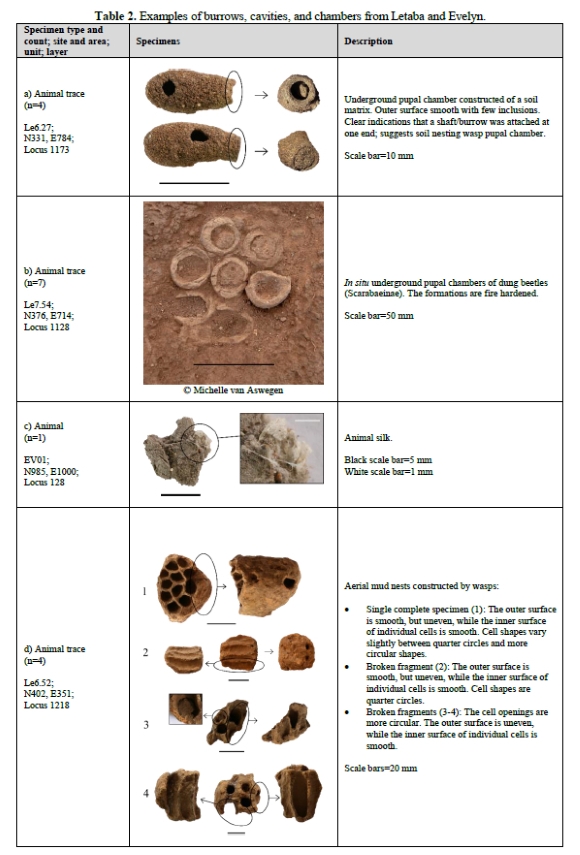
Further specimens from Letaba resemble nest-like sedimentary structures (Table 2d). All these specimens were fire hardened and recovered from a secure context dating to the time the site was occupied. They comprised multiple parallel-walled cells forming honeycomb-like structures. The shape of individual cells varied slightly between quarter circles or more circular shapes, but the size of the cells was relatively similar, measuring 7x10 mm. Fungus-growing termites construct similar structures - termed fungus combs - in which they cultivate fungus (e.g., species of Termitomyces R. Heim 1942, Basidiomycota) (Anwar et al. 2020) for consumption from digested grass and/or wood deep inside their mounds. However, the Letaba specimens lack the nodules (mylospheres - a mixture of digested plant materials and saliva) typically visible on extant fungus combs (e.g., Anwar et al. 2020: fig. 7). The lack of mylospheres could be the result of weathering or damage to the structure. However, the parallel-sided nature of the cells suggests pupal cells, which rules out any hemimetabolous (insects without a distinct pupal phase) insects such as termites. Further, the cells are isolated from one another, whereas the chambers in fungal combs are interconnected. The Letaba specimens are therefore most similar to the mud nests constructed by solitary female wasps. Several dauber wasps construct similar nests including species in the genus Sceliphron Klug 1801 (Sphecidae) and Synagris Latreille 1802 (Vespidae), as well as some potter wasps of the genus Delta de Saussure 1855 (Vespidae) (Terence Bellingan; John Midgley; Simon van Noort pers. comm. March 2025) (see also Gess & Gess 2014).
Plant/animal casts: Some specimens are solid, cylindrical sedimentary structures with smooth surfaces and a generally uniform diameter (Table 3). These appear fire hardened and are non-friable or dispersible in water (Table 3a). Various agents could be responsible for these structures. They could resemble inner casts of plant stems or roots. Some termite species burrow into and hollow out plant and grass stalks, which they then fill with a mixture of soil and faeces (e.g., Anyango et al. 2019; see also Fowler et al. 2004). When the plant decays, the mud constructs remain (e.g., Fowler et al. 2004). Some wasp taxa, for example Cerceris Latreille 1802, produce 'sand sausages' in clearing soil from their burrows (Gess & Gess 2014: fig. 1.4.7). Other specimens appear more organic in nature and might be of a different origin, such as earthworm faecal casts (Table 1c) (e.g., Fowler et al. 2004). Voids are common throughout and could represent decayed organic matter.
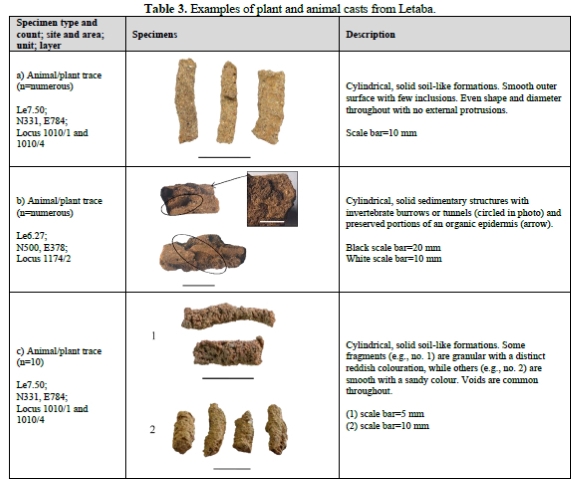
Larger, solid, cylindrical soil formations with relatively uniform shapes and smooth surfaces were also present (Table 3b). Among these, several specimens of baked soil with transecting arthropod burrows from Letaba were encased in an organic epidermis. These specimens most closely resemble tree root casts - in this instance, they consist of sediments that filled decaying tree roots. They were often encountered in the archaeological deposits at Letaba as the site is situated within mopane, Colophospernum mopane (J. Kirk ex Benth.) J. Léonard 1949, woodlands. It is unclear if arthropods transported soil into decaying roots, or if soil filled the roots by means of abiotic processes. Nevertheless, these samples all have distinct burrows indicative of significant bioturbation at the site.
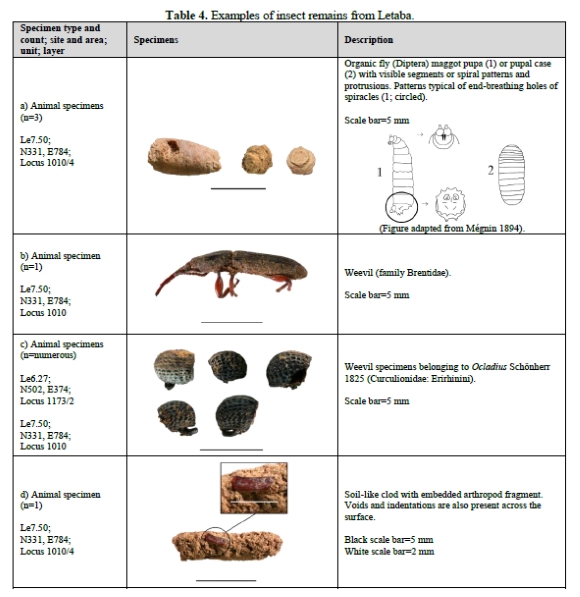
Insect remains: Several insect or larvae bodies were present (Table 4). Three fragments had distinct segments or spiral patterns (Table 4a). Two of these had external protrusions similar to the posterior end, with spiracles of larvae, of some fly taxa, while the other, an oval-shaped specimen, matched with one of these posterior ends. We speculate that the specimens are of dipteran larvae or puparia. The latter would represent a non-feeding stage and the final stage of development. Several beetle specimens were present. One of these, a weevil in the Brentidae family, was well preserved, with the eyes, antennae, and legs intact (Table 4b). This specimen is not carbonised and was collected from a disturbed context in Le7.50 near the base of the excavation. Considering the depth at which it was recovered, the specimen potentially represents a recent intrusion in the archaeological deposits by way of bioturbation or small vertebrate burrowing. Further beetle specimens (Table 4c) were identified as belonging to Ocladius Schönherr 1825 (Curculionidae) (Riaan Stals pers. comm. August 2024). These appear carbonised and could be contemporaneous with the formation of the archaeological deposits. The faecal pellet of a small vertebrate contains a suspected beetle elytron (a hardened beetle fore wing) (Table 4d), and its shape and size suggest it derives from a small insectivorous animal such as a gecko (Gekkonidae), rodent (Muridae), or shrew (Soricidae) (e.g., Olsen 1984). The voids and cavities present across the surface are typically the result of decayed organic matter. The pellet is hard and not dispersible in water, potentially representing micro-animal activity contemporaneous with the formation of the archaeological deposits.
Arthropod damage to archaeological bone: Analysis of the vertebrate skeletal remains also preserved evidence of arthropod activities (Fig. 4). Osteophagia is a common behaviour among many invertebrates, including snails (Gastropoda), millipedes (Diplopoda), and insects such as beetles, moths, termites, cockroaches (Blattodea), fly larvae, and ants, bees, and wasps (Backwell et al. 2022). At Evelyn and Letaba, evidence of such behaviour manifested as five bone surface modification patterns:
• Pits with emanating striae often forming star-like shapes, comparable to the damage inflicted by termite activities (Fig. 4a) (e.g., Backwell et al. 2012, 2022);
• Boring/etching resembling modifications from the mycelium of fungi (Fig. 4b) (Ozeki et al. 2020). Such modifications often occurred in dense concentrations, resulting in extreme surface alteration (Mouton 2025);
• Distinct parallel incisions, often occurring in clusters, on vertebrate bone (Fig. 4c). These incisions resemble gnawing activities of Blattodea such as termites and cockroaches (e.g., Periplaneta americana Linnaeus 1758), carrion-associated beetles (e.g., Dermestidae), and potentially from sapro-detritiphagous beetles (e.g., Tenebrionidae) (Parkinson 2013: fig. 17; Backwell et al. 2022: figs 18.4 & 18.7);
• Small surface pits of various shapes and sizes, often surrounded by a distinct ring or pathway of discolouration (Fig. 4d). Similar modifications are associated with the activities of cockroaches (Parkinson 2013: fig. 13);
• Furrows and pits penetrating through cancellous bone (Fig. 4e), which resemble those produced by the feeding habits of larvae of dermestid and tenebrionid beetles and flies (Blackwell et al. 2022: fig. 18.12; Mahomed 2022).
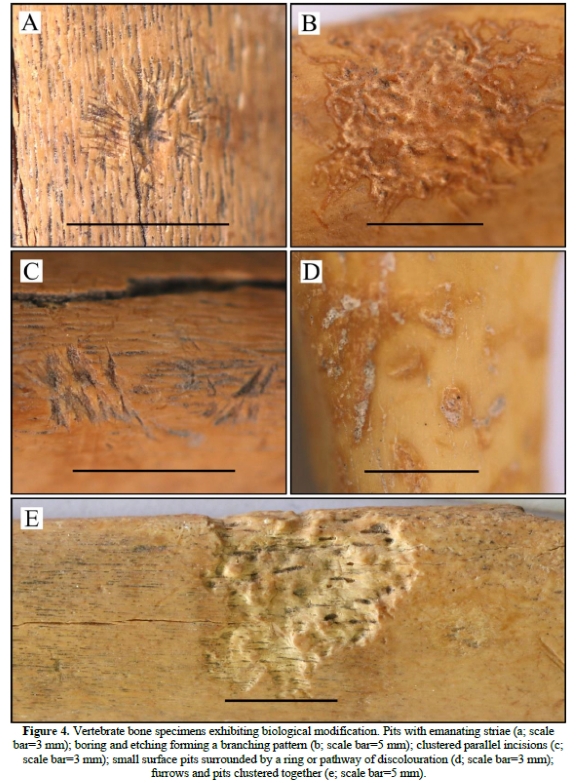
Distinguishing between different arthropod agents is not straightforward, and the vertebrate bone modifications observed at Evelyn and Letaba indicate that both carrion feeders such as Dermestes Linnaeus 1758 species, osteophagous behaviour by termites, and etching from the mycelium of fungi impacted the preservation of faunal materials.
5. Discussion
Although there is a general increase in recognising arthropods, particularly insects, in archaeological research, arthropods continue to be ignored, especially in sub-Saharan Africa. Arthropods, their remains, and trace evidence could be: 1) from the same period as the archaeological deposits, thus providing a direct indication of human-insect entanglements and environmental conditions at the time of occupation; 2) post-depositional, whether negatively compromising the site due to bioturbation, or positively contributing to site interpretations such as indicating change in soils that in turn could highlight a previous site feature (for example changed soils due to an animal holding pen); or 3) current, either as living specimens or current occupation of retreats such as burrows.
The arthropod remains and their trace evidence recovered at Letaba and Evelyn can clarify deposit formation and past human activities. Such evidence extends across various contexts from household structures to middens and refuse pits. The latter was particularly rich in arthropod evidence such as fly larvae, beetle remains, and the modification of vertebrate bone, which indicates significant insect activity in these deposits. Although the osteophagous behaviour of termites includes both fresh and old bones, the identification of necrophagous beetle damage and fly larvae does indicate decaying organic matter. These, and other insect activities, inform on deposit formation within these pit features and other refuse disposal areas.
The numerous burrows and tunnels removed in situ and from the flotation samples further indicate significant arthropod presence at Letaba. These aid in reconstructing potential deposit formation and the potential extent of bioturbation. At Letaba, tunnels, encasings, and damage to vertebrate bone indicate both recent and past termite activities across the site. As of yet, no direct evidence for the use of termitaria clay by the inhabitants has been identified, but the wide distribution of termite activities could help to clarify the location of certain features, and environmental and ecological conditions at the time of occupation. Yamashina (2010) found that termite mounds are situated nearest to huts in Zemba communities in northern Namibia, as some tree species germinate inside termitaria. This phenomenon is likely because of the rich nutrient content of termitaria. Their location near human activity areas, such as the household at Le6.27, might indicate the presence of trees that provided shade. Fowler et al. (2004) made a similar prediction at Ndondondwane in Kwa-Zulu Natal. The distribution of termitaria could also point to areas of relative water abundance as termites need access to ground water (Yamashina 2010).
The preserved aerial wasp nest further highlights that the community at Letaba shared their homes and the environment with a variety of insects. The nest was potentially constructed onto a household structure such as a hut before being deposited into the archaeological record, either from falling off or being removed by the hut users. Although the specific taxon responsible for the nest is not known, most mud nest constructors such as Sceliphron spirifex (Linnaeus 1758) collect mud near the edge of water, also informing on environmental conditions at the time of Letaba's occupation.
Arthropods are often specific to their substrates or resources. Concentrations of a species of arthropod, identified from arthropod remains, ecofacts and other trace evidence (e.g., burrows), could therefore indicate that a particular material was present (grains, wood, dung, medicinal plants), even though the material itself has since decayed. The identification of weevils (Curculionoidea) at Letaba could inform indirectly on agricultural practices. In particular, the cluster of true weevils identified at Le6.27 were recovered from a context associated with potential grain bins (see Antonites 2025). Some Curculionoidea are known stored product pests (Oberprieler et al. 2007) and their concentration at Le6.27, and in Le7.50, could indicate grain storage in the absence of seed preservation. The latter context is particularly interesting as it is a subterranean pit feature. The formation processes of such pit features are currently poorly understood, and the presence of potential stored product pests could provide insights into the purpose of these features at Letaba.
Small numbers of livestock have been identified at Letaba (Plug 1989; Grody 2016), but their management is poorly understood for this period in the Kruger National Park. The identification of dung beetle nests at Letaba in area Le7.54 could indicate the presence of livestock holding pens, or animal latrines (dung mounds) (Jankielsohn 2006). Paracoprid dung beetles collect dung or faeces and bury it underground as feeding (for themselves) or brooding balls for their young. Dung balls are robust and preserve well.
Insect and other arthropod traces exist in the archaeological record, but more care could be taken to recognise and interpret these remains. Methodologies for the optimal recovery, recording, and interpretation of insect-related data have been suggested (Graham 1965; Coope 1986; Sutton 1995). As ancient insects are fragile, the use of a smaller sieve screen to increase recovery might not be sufficient (Graham 1965). In fact, Buckland (1981) blamed the paucity of insects and mites in archaeological data on processing techniques. The addition of flotation techniques and collection of soil samples have been shown to significantly increase the recovery rate of arthropods and their traces (Rousseau 2011). However, similar methodologies were employed at Letaba and Evelyn, but at the latter, no insect remains beyond the animal silk was present. Although excavators noted insects in flotation samples, they were not collected as they were assumed not to be archaeological. As such, the lack of arthropod specimens at Evelyn reflects a flotation-processing bias. As with other fauna, reference collections could be developed to aid in identification (e.g., Nacimento et al. 2021; Toriti et al. 2021). Further, the application of advanced techniques, such as fluorescence light microscopy, can improve the identification of arthropod skeletal remains from archaeological deposits (Bradfield 2023), while petrographic and chemical analysis of pottery and building materials for houses and granaries might identify the use of termite clays (Farr 2021).
Equally important would be the contribution archaeologists can make to current entomological research. During excavations at Letaba from 2021 to 2023, several living arthropod species were noted in and around archaeological deposits. These arthropods include insects, for example, colonies of ants such as Odontomachus Latreille 1804, Camponotus Mayr 1861, and Messor Forel 1890 species, termites, dung beetles, and antlions (Neuroptera); arachnids, for example solifuges, trapdoor spiders (Araneae, Mygalomorphae), and scorpions; and myriapods, namely millipedes. Notes made on arthropods and specimens collected can contribute data on arthropod historic and current distributions. Collecting and depositing voucher specimens at research institutions make these available for taxonomic, behavioural or ecological research. This will contribute directly to current taxonomic checklists and increase our knowledge on species biology.
For example, the arachnid order Solifugae (colloquially known as solifuges, sunspiders, romans) remains poorly understood and its taxonomy remains in disarray. Even basic knowledge such as where, and in which life stage, solifuges overwinter, is lacking (see Hebets et al. 2024). A major obstacle to the study of solifuges is the lack of specimens and observations. Not only do solifuges have a short period of activity, but their activity is also triggered by highly specific environmental conditions. Additionally, whereas males could be common during optimal activity periods, females and juveniles are not, which biases sampling towards males during these periods; thereafter, sampling is biased towards females due to the shorter lifespan of males. During archaeological excavations at Letaba and Evelyn, the unearthing of solifuges frequently occurred. Future collection of these specimens, together with detailed documentation (depth of burrow, time of year, soil), could contribute towards the collection of distribution, different life stages, and general biological data2.
As such, archaeologists could keep a logbook containing information on modern arthropod and other invertebrate fauna. Specimens could be collected and deposited in scientific collections as voucher specimens. Most invertebrates can be placed directly into 70-75% ethanol. Basic data should accompany each specimen, preferably written on a label with a pencil or alcohol proof pen and placed inside the ethanol with the specimen. At a minimum, these should include locality data, collection date, name of collector, and name of archaeological site. Additional data such as time of day unearthed, depth at which the arthropod was found, retreat evidence and description, and soil information - provenience information archaeologists regularly record - would greatly increase the value of the specimen.
Greater detail should be provided when recording the presence of insects in archaeological deposits. A clear description of contemporary arthropod traces in both a qualitative and quantitative fashion -describing traces such as burrows, tracks, and nests (e.g., Baucon et al. 2008) - would not only allow for greater interpretation of site formation processes, but also the comparison of such activities between sites. Although arthropods may not necessarily directly relate to the site's occupation, as bioturbators, they impact artefact preservation and distribution (e.g., McBrearty 1990; Lancaster 2002; White & Miller 2008).
Beyond their taphonomic value, obtaining more detailed data on ancient insect activity may result in a greater understanding of past economy, life and society. The next step for the Letaba arthropod remains would be to confirm their contemporaneity with the site's occupation. Radiocarbon dating of specimens such as insect chitin can produce dates from relatively small samples, providing stratigraphic correlation between site occupation and insect activities (Holden & Southon 2016). Future research on dung beetles may also help to clarify the nature of livestock herding at Letaba. Dung beetle balls can be collected or sampled. For some dung beetle taxa, the dung beetle genus can be revealed based on the size, morphology and arrangement of the dung balls, either by using extant examples where their breeding biology has been documented (e.g., Kingston & Coe 1977), or through investigations on much older dung beetle traces and balls (Sánchez et al. 2013); the location of the nests and the proportion of dung beetles relative to other terrestrial insects could shed light on the presence of high densities of grazing animals (e.g., livestock) (e.g., Smith et al. 2014; Buckland & Buckland 2019). Samples could be collected from the dung balls in the case of good organic preservation for ancient DNA (aDNA) sequencing, phytolith and spherulite analysis, and stable isotope analysis, which might provide species-level identification of the dung beetle itself, determine the defecating species, and a record of the plants that occurred in the area (see Shahack-Gross 2011). The sequencing of insects and their food has the capacity to provide incredible resolution on species that may have shared the environment with early humans, from plants to animals to fungi.
Finally, the significance of arthropod remains is best interpreted within their spatial and cultural contexts, alongside other archaeological objects if we are to understand the various networks of association between arthropods and the range of cultural activities and formation processes at Letaba, and other past human settlements. For this, arthropod remains should first be considered within their unique archaeological features (e.g., granaries versus middens) and then compared between features and sites. Moving forward, arthropod remains, and their traces, will be collected from various archaeological features across Letaba to better explore both the anthropic and taphonomic factors that may have influenced their accumulation and preservation. No archaeoentomological data exist for other settlement types against which Letaba can be compared, so it is unclear how factors like settlement type, economy, or social life impact arthropod preservation and accumulation.
6. Conclusion
Human-insect interactions served both practical and cultural roles among recent communities yet tracing the antiquity of such entanglements remains largely unexplored for much of Africa. The ethnographic record suggests a rich social world intertwined by humans and insects. It is therefore worth exploring such relationships in antiquity. Insects, and other arthropods, offer interpretive value for reconstructing both cultural landscapes and the natural surroundings. Yet, the importance of insect remains, insect traces, or living insects found during the excavation of a site is not yet realised to the full; currently, such evidence is either not, or is insufficiently, documented. The sample of entomological remains and trace evidence presented here help demonstrate the interpretive value of such remains at Letaba. While similar methodologies were employed at Evelyn, no insects or their traces were identified. The abundance of insect modification of vertebrate remains, in contrast, indicate a range of insect activity. Rather than a lack of such activity, the absence of direct evidence instead reflects the effects of collection biases. Although not all the arthropod evidence is directly related to archaeological interpretations, it does indicate a greater range of arthropod influence in contrast to what is typically reported. Comparing archaeoentomological data with data from other sources would allow for more nuanced interpretations of past environments and the exploration of past activities where other data sources did not preserve well. Interpretations remain hypothetical and can only be supported by further research, more samples, and identifying patterns across samples.
Acknowledgements
The Letaba Archaeology Project is funded through the National Research Foundation (NRF) of South Africa awarded to Alexander Antonites, University of Pretoria, with additional support from SANParks Culture Heritage Division. Excavations at Letaba were conducted under SAHRA Permit 3296 and SANParks Research Agreement SS667. Excavations at Evelyn were funded through the NRF (AOP150925143015) and conducted under SAHRA Permit 2733. We are greatly indebted to Terence Bellingan, John Midgley, Riaan Stals, Werner Strümpher, and Simon van Noort for sharing their entomological knowledge.
References
Adams, A.M., Marais, E., Turner, J.S., et al. 2016. Similar burrow architecture of three arid-zone scorpion species implies similar ecological function. The Science of Nature, 103(7): 1-11. https://doi.org/10.1007/s00114-016-1374-z [ Links ]
Allentuck, A. & Greenfield, H.J. 2010. The organization of animal production in an early urban center: The zooarchaeological evidence from Early Bronze Age Titriþ Höyük, southeast Turkey. In: Campana, D.V., Crabtree, P., deFrance, S.D., et al. (eds) Anthropological Approaches to Zooarchaeology: Colonialism, Complexity and Animal Transformations: 12-29. Oxford: Oxbow Books. [ Links ]
Antonites, A. 2024. Overview of the Early Iron Age in the Letaba region of the Kruger National Park. Koedoe: African Protected Area Conservation and Science, 66(2): a1805. https://doi.org/10.4102/koedoe.v66i2.1805 [ Links ]
Antonites, A. 2025. Final Report for excavation of the Early Iron Age sites LE6 and LE7, 2021-2024, Permit 3296. Unpublished report compiled for South African Heritage Resources Agency, case number: 15719. Available from: https://www.sahris.org.za/node/157302 [ Links ]
Anyango, J.J., Bautze, D., Fiaboe, K.K., et al. 2019. Termite-induced injuries to maize and baby corn under organic and conventional farming systems in the Central Highlands of Kenya. Insects, 10(10): 367. https://doi.org/10.3390/insects10100367 [ Links ]
Anwar, K., Sudirman, L.I. & Nandika, D. 2020. Comb establishment of fungus-growing termites species Macrotermitinae (Isoptera: Termitidae) with Termitomyces cylindricus (Basidiomycota: Agaricales) basidiospores. Oriental Insects, 54(4): 591-606. https://doi.org/10.1080/00305316.2020.1762775 [ Links ]
Backwell, L.R. & d'Errico, F. 2001. Evidence of termite foraging by Swartkrans early hominids. Proceedings of the National Academy of Sciences, 98(4): 1358-1363. https://doi.org/10.1073/pnas.98.4.1358 [ Links ]
Backwell, L.R., Parkinson, A.H., Roberts, E.M., et al. 2012. Criteria for identifying bone modification by termites in the fossil record. Palaeogeography, Palaeoclimatology, Palaeoecology, 337-338: 72-87. https://doi.org/10.1016/j.palaeo.2012.03.032 [ Links ]
Backwell, L., Huchet, J.B., Harrison, J.D.G., et al. 2022. Invertebrate modification of bone. In: Pokines, J.T., L'Abbe, E.N. & Symes, S.A. (eds) Manual of Forensic Taphonomy: 631-666. Boca Raton: CRC Press. https://doi.org/10.4324/9781003171492 [ Links ]
Baucon, A., Privitera, S., Morandi Bonacossi, D., et al. 2008. Principles of Ichnoarchaeology: New frontiers for studying past times. Studi Trentini di Scienze Naturali, Acta Geologica, 83: 43-72. [ Links ]
Binneman, J. 2000. Results from two test excavations in the Baviaanskloof Mountains, Eastern Cape Province. Southern African Field Archaeology, 9: 83-96. https://journals.uj.ac.za/index.php/safa/1993_Vol_2_No_1 [ Links ]
Bird, T.L., Moeti, S., Hitchcock, R.K., et al. 2023. Orb-web spider Argiope (Araneidae) as indigenous arrow poison of G/ui and G//ana San hunters in the Kalahari. PLoS ONE, 18(1): e0276557. https://doi.org/10.1371/journal.pone.0276557 [ Links ]
Bloemberg, J., Stefanini, C. & Romano, D. 2021. The role of insects in medical engineering and bionics: Towards entomomedical engineering. IEEE Transactions on Medical Robotics and Bionics, 3(4): 909-918. https://doi.org/10.1109/TMRB.2021.3101693 [ Links ]
Bonning, B.C. 2009. Biotechnology and insects. In: Resh, V.H. & Cardè, R.T. (eds) Encyclopedia of Insects. Second Edition: 105-108. Amsterdam: Academic Press. https://doi.org/10.1016/B978-0-12-374144-8.00035-7 [ Links ]
Bradfield, J. 2023. Pilot study using fluorescence light microscopy to identify arthropod remains in archaeological sediments. South African Archaeological Bulletin, 78(219): 84-94. https://www.jstor.org/stable/27303675 [ Links ]
Bradfield, J., Wadley, L. & Lombard, M. 2015. Southern African arrow poison recipes, their ingredients and implications for Stone Age archaeology. Southern African Humanities, 27: 29-64. https://hdl.handle.net/10520/EJC179773 [ Links ]
Buckland, P.C. 1981. The early dispersal of insect pests of stored products as indicated by archaeological records. Journal of Stored Products Research, 17: 1-12. https://doi.org/10.1016/0022-474X(81)90025-4 [ Links ]
Buckland, P.C. 1990. Insects, granaries and stores: The archaeology of insect synanthropy. In: Fournier, D. & Sigaut, F. (eds) La Preparation Alimentaire des Cèreals: 69-81. Belgium: PACT. [ Links ]
Buckland, P.I. 2014. The Bugs Coleopteran Ecology Package (BugsCEP) database: 1000 sites and half a million fossils later. Quaternary International, 341: 272-282. https://doi.org/10.1016/j.quaint.2014.01.030 [ Links ]
Buckland, P.I. & Buckland, P.C. 2019. When a 'waterhole' is full of dung: An illustration of the importance of environmental evidence for refining archaeological interpretation of excavated features. Archaeometry, 61(4): 977-990. https://doi.org/10.1111/arcm.12461 [ Links ]
Buckland, P.C. & Perry, D.W. 1989. Ectoparasites of sheep from Stóraborg, Iceland and their interpretation: Piss, parasites and people, a palaeoecological perspective. Hikuin, 15: 37-46. https://tidsskrift.dk/Hikuin/article/view/150609 [ Links ]
Cain, C.R. 2009. Cultural heritage survey of Lesotho for the Maloti-Drakensberg Transfrontier Project, 2005-2006: Palaeontology, archaeology, history and heritage management. South African Archaeological Bulletin, 64(189): 33-44. https://www.jstor.org/stable/40588133 [ Links ]
Coope, G.R. 1986. Coleoptera analysis. In: Berglund, B.E. (ed.) Handbook of Holocene Palaeoecology and Palaeohydrology: 703-713. Chichester: Wiley & Sons. [ Links ]
Dickson, T.R. & Walker, I.R. 2015. Midge (Diptera: Chironomidae and Ceratopogonidae) emergence responses to temperature: Experiments to assess midges' capacity as paleotemperature indicators. Journal of Paleolimnology, 53: 165-176. https://doi.org/10.1007/s10933-014-9814-2 [ Links ]
Dieckmann, U. 2014. Kunene, Oshana and Oshikoto regions. In: Dieckmann, U., Thiem, M., Dirkx, E., et al. (eds) Scraping the Pot: San in Namibia Two Decades After Independence: 173-232. Windhoek: Legal Assistance Centre. [ Links ]
Elias, S.A. 1994. Quaternary Insects and Their Environments. Washington: Smithsonian Institution Press. [ Links ]
Elias, S.A. 2009. Advances in Quaternary Entomology. Developments in Quaternary Science No. 12. London: Elsevier. [ Links ]
Eggermont, H., Kennedy, D., Hasiotis, S.T., et al. 2008. Distribution of living larval Chironomidae (Insecta: Diptera) along a depth transect at Kigoma Bay, Lake Tanganyika: Implications for palaeoenvironmental reconstruction. African Entomology, 16(2): 162-184. https://hdl.handle.net/10520/EJC32786 [ Links ]
Egonyu, J.P., Kinyuru, J., Fombong, F., et al. 2021. Advances in insects for food and feed. International Journal of Tropical Insect Science, 41: 1903-1911. https://doi.org/10.1007/s42690-021-00610-8 [ Links ]
Farr, J. 2021. Islands of fertility : A multispecies ethnography of human-termite interactions and their implications for human ecology and the archaeology of gender in the tropics. World Archaeology, 53(4): 667-687. https://doi.org/10.1080/00438243.2021.1997637 [ Links ]
Fairhead, J.R. 2016. Termites, mud daubers and their earths: A multispecies approach to fertility and power in West Africa. Conservation and Society, 14(4): 359-367. https://www.jstor.org/stable/26393258 [ Links ]
Foord, S.H., Dippenaar-Schoeman, A.S. & Haddad, C.R. 2011. South African spider diversity: African perspectives on the conservation of a mega-diverse group. In: Grillo, O. & Venora, G. (eds) Changing Diversity in Changing Environment: 163-182. Croatia: InTech. [ Links ]
Fowler, K.D., Greenfield, H.J. & van Schalkwyk, L.O. 2004. The effects of burrowing activity on archaeological sites: Ndondondwane, South Africa. Geoarchaeology, 19(5): 441-470. https://doi.org/10.1002/gea.20005 [ Links ]
Geissler, P.W. 2000. The significance of earth-eating: Social and cultural aspects of geophagy among Luo children. Africa, 70(4): 653-682. https://doi.org/10.3366/afr.2000.70.4.653 [ Links ]
Gess, S.K. & Gess, F.W. 2014. Wasps and Bees in Southern Africa. SANBI Biodiversity Series 24. Pretoria: South African National Biodiversity Institute. www.sanbi.org/documents/sanbi-biodiversity-series-24-wasps-and-bees-in-south-africa/ [ Links ]
Goddard, J. 2012. Physician's Guide to Arthropods of Medical Importance. Sixth Edition. London: CRC press. [ Links ]
Graham, S.A. 1965. Entomology: An aid in archaeological studies. Memoirs of the Society for American Archaeology, 19: 167-174 https://doi.org/10.1017/S0081130000004512 [ Links ]
Grivetti, L.E. 1979. Kalahari agro-pastoral-hunter-gatherers: The Tswana example. Ecology of Food and Nutrition, 7(4): 235-256. https://doi.org/10.1080/03670244.1979.9990535 [ Links ]
Grody, E. 2016. Of buffalo and butchers: Coupling traditional procurement studies with taphonomic analyses to explore intensive wild animal processing patterns at two Early Iron Age sites in the Kruger National Park. African Archaeological Review, 33(4): 385-409. https://doi.org/10.1007/s10437-016-9236-9 [ Links ]
Grove, K.J. 2001. Discerning beetles, an entomo-archaeological study of Coleopteran faunas in relation to place and time. Doctoral Thesis. Sheffield: University of Sheffield. [ Links ]
Hammond-Tooke, W.D. 1981. Boundaries and Belief: The Structure of a Sotho Worldview. Johannesburg: Witwatersrand University Press. [ Links ]
Hebets, E.A., Oviedo-Diego, M., Cargnelutti, F., et al. 2024. A scientist's guide to Solifugae: How solifuges could advance research in ecology, evolution and behavior. Zoological Journal of the Linnean Society, 202: 1-27. https://doi.org/10.1093/zoolinnean/zlad174. [ Links ]
Holden, A.R. & Southon, J.R. 2016. Radiocarbon dating and stable isotopic analysis of insect chitin from the Rancho La Brea tar pits, Southern California. Radiocarbon, 58(01): 99-113. https://doi.org/10.1017/RDC.2015.9 [ Links ]
Hollman, J. 2007. Kaggen's code: Paintings of moths in southern African hunter-gatherer rock art. Southern African Humanities, 19: 83-101. https://hdl.handle.net/10520/EJC84788 [ Links ]
Humphreys, A.J.B. 1982. Cultural material from burials on the farm St. Clair, Douglas area, Northern Cape. South African Archaeological Bulletin, 37(136): 68-70. https://www.jstor.org/stable/3888678 [ Links ]
Hunter, J.M. 1984. Insect clay geophagy in Sierra Leone. Journal of Cultural Geography, 4(2): 2-13. https://doi.org/10.1080/08873638409478570 [ Links ]
Jankielsohn, A. 2006. The effect of habitat change on the structure of dung beetle assemblages in the north-eastern Free State: A comparison of conserved and farmed land. Doctoral Thesis. Pretoria: University of Pretoria. [ Links ]
Junod, H.A. 1913. The Life of a South African Tribe. Volume 2. London: MacMillan. [ Links ]
Kelemu, S., Niassy, S., Torto, B., et al. 2015. African edible insects for food and feed: Inventory, diversity, commonalities and contribution to food security. Journal of Insects as Food and Feed, 1: 103-119. https://doi.org/10.3920/JIFF2014.0016 [ Links ]
King, G.A., Gilbert, M.T.P., Willerslev, E., et al. 2009. Recovery of DNA from archaeological insect remains: First results, problems and potential. Journal of Archaeological Science, 36: 1179-1183. https://doi.org/10.1016/j.jas.2009.01.006 [ Links ]
Kingston, T.J. & Coe, M. 1977. The biology of a giant dung-beetle (Heliocopris dilloni) (Coleoptera: Scarabaeidae). Journal of Zoology, 181: 243-263. https://doi.org/10.1111/j.1469-7998.1977.tb03239.x [ Links ]
Lancaster, S. 2002. Invertebrate faunalturbation of archaeological sites: Assessing the impact on archaeological stratigraphy. Doctoral Thesis. Sterling: University of Sterling. [ Links ]
Limp, W.F. 1974. Water separation and flotation processes. Journal of Field Archaeology, 1: 337-342. https://doi.org/10.1179/009346974791491386 [ Links ]
Manamela, K. 2003. Traditional beliefs and uses of arachnids in Africa. Annals of the Transvaal Museum, 40: 151-153. https://hdl.handle.net/10520/AJA004117524 [ Links ]
Mahomed, T. 2022. An experimental study of invertebrate damage to bone and its application to archaeology. Masters Dissertation. Johannesburg: University of the Witwatersrand. [ Links ]
Manhire, A. 1993. A report on the excavations at Faraoskop Rock Shelter in the Graafwater district of the south-western Cape. Southern African Field Archaeology, 2: 3-23. https://hdl.handle.net/10520/AJA1019578527 [ Links ]
Marchand, T.H.J. 2009. The Masons of Djenné. Indianapolis: Indiana University Press. [ Links ]
Marshall, E.Z. 2007. Liminal Anansi: Symbol of order and chaos an exploration of Anansi's roots amongst the Asante of Ghana. Caribbean Quarterly, 53(3): 30-40. https://doi.org/10.1080/00086495.2007.11672326 [ Links ]
McBrearty, S. 1990. Consider the humble termite: Termites as agents of post-depositional disturbance at African archaeological sites. Journal of Archaeological Science, 17(2): 111-143. https://doi.org/10.1016/0305-4403(90)90054-9 [ Links ]
McGrew, W.C. 2014. The 'other faunivory' revisited: Insectivory in human and non-human primates and the evolution of human diet. Journal of Human Evolution, 71: 4-11. https://doi.org/10.1016/j.jhevol.2013.07.016 [ Links ]
Mégnin, P. 1894. La Faune des Cadavres. Application de l'Entomologie a la Médicine Légale. Encyclopdie Scientifique des Aides-Mémoire, Paris: G. Masson & Gauthier-Villars et Fils. http://resource.nlm.nih.gov/28421710R [ Links ]
Meyer-Rochow, V.B. 2017. Therapeutic arthropods and other, largely terrestrial, folk-medicinally important invertebrates: A comparative survey and review. Journal of Ethnobiology and Ethnomedicine, 13: 9. https://doi.org/10.1186/s13002-017-0136-0 [ Links ]
Mguni, S. 2006. Iconography of termites' nests and termites: Symbolic nuances of formlings in southern African San rock art. Cambridge Archaeological Journal, 16(1): 53-71. https://doi.org/10.1017/S0959774306000047 [ Links ]
Mguni, S. 2013. Enigmatic rock paintings of insectiforms in the Cederberg, Western Cape, South Africa. South African Archaeological Bulletin, 68(198): 160-172. https://www.jstor.org/stable/23631441 [ Links ]
Mguni, S. 2015. Termites of the Gods: San Cosmology in Southern African Rock Art. Johannesburg: Wits University Press. [ Links ]
Miller, S.E. & Rogo, L.M. 2002. Challenges and opportunities in understanding and utilisation of African insect diversity. Cimbebasia, 17: 197-218. [ Links ]
Mmari, M.W., Kinyuru, J.N., Laswai, H.S., et al. 2017. Traditions, beliefs and indigenous technologies in connection with the edible longhorn grasshopper Ruspolia differens (Serville 1838) in Tanzania. Journal of Ethnobiology and Ethnomedicine, 13: 1-11. https://doi.org/10.1186/s13002-017-0191-6 [ Links ]
Moffett, A.J. 2023. Decoupling identities: Moving beyond gendered binaries in the southern African archaeological record. Southern African Humanities, 36(1): 149-162. https://hdl-handle-net.uplib.idm.oclc.org/10520/ejc-nmsa_sah_v36_n1_a8 [ Links ]
Mouton, M. 2025. Changes in animal use during the development of class-based society, 12th to 13th century CE, Limpopo Valley. Doctoral Thesis. Pretoria: University of Pretoria. [ Links ]
Mosothwane, M.N. 2011. The Tuli mummy: A preliminary report from northeastern Botswana. South African Archaeological Bulletin, 66(194): 157-160. https://www.jstor.org/stable/23631418 [ Links ]
Mullen, G.R. & Durden, L.A. (eds). 2002. Medical and Veterinary Entomology. London: Academic Press. [ Links ]
Nascimento, D.L., Netto, R.G. & Indicatti, R.P. 2021. Neoichnology of mygalomorph spiders: Improving the recognition of spider burrows in the geological record. Journal of South American Earth Sciences, 108: 103178. https://doi.org/10.1016/j.jsames.2021.103178 [ Links ]
Nemadodzi, L.E., Managa, G.M. & Prinsloo, G. 2023. The use of Gonimbrasia belina (Westwood, 1849) and Cirina forda (Westwood, 1849) caterpillars (Lepidoptera: Sarturniidae) as food sources and income generators in Africa. Foods, 12(11): 2184. https://doi.org/10.3390/foods12112184 [ Links ]
Nyffeler, M. & Birkhofer, K. 2017. An estimated 400-800 million tons of prey are annually killed by the global spider community. The Science of Nature, 104(3): 1-12. https://doi.org/10.1007/s00114-017-1440-1 [ Links ]
Oberprieler, R.O.L.F., Marvaldi, A. & Anderson, R.S. 2007. Weevils, weevils, weevils everywhere. Zootaxa, 1668: 491-520. https://doi.org/10.11646/zootaxa.1668.1.24 [ Links ]
Olsen, A.R. 1984. Fecal pellets from a commensal shrew (Suncus murinus) and a house gecko (Gekkonidae). Journal of the Association of Official Analytical Chemists, 67(6): 1035-1036. https://doi.org/10.1093/iaoac/67.6.1035 [ Links ]
Ozeki, C.S., Martill, D.M., Smith, R.E., et al. 2020. Biological modification of bones in the Cretaceous of North Africa. Cretaceous Research, 114: 104529. https://doi.org/10.1016/j.cretres.2020.104529 [ Links ]
Pager, H. 1971. Ndedema: A Documentation of the Rock Paintings of Ndedema Gorge. Graz: Akademische Druck- und Verlagsanstalt. [ Links ]
Panagiotakopulu, E. 2001. New records for ancient pests: Archaeoentomology in Egypt. Journal of Archaeological Science, 28: 1235-1246. https://doi.org/10.1006/jasc.2001.0697 [ Links ]
Panagiotakopulu, E. & Buckland, P.C. 1991. Insect pests of stored products from Late Bronze Age Santorini, Greece. Journal of Stored Products Research, 27: 179-184. https://doi.org/10.1016/0022-474X(91)90043-C [ Links ]
Panagiotakopulu, E. & Buckland, P.C. 2009. Environment, insects and the archaeology of Egypt. In: Ikram, S. & Dodson, A. (eds) Beyond the Horizon: Studies in Egyptian Art, Archaeology and History in Honour of Barry J. Kemp: 347-361. Cairo: American University in Cairo Press. [ Links ]
Parker, J.F., Hopley, P.J. & Kuhn, B.F. 2016. Fossil carder bee's nest from the hominin locality of Taung, South Africa. PLoS ONE, 11(9): e0161198. https://doi.org/10.1371/journal.pone.0161198 [ Links ]
Parkinson, A. 2013. Dermestes maculatus and Periplaneta americana: Bone modification criteria and establishing their potential as climatic indicators. Masters Dissertation. Johannesburg: University of Witwatersrand. [ Links ]
Parkinson, A. 2023. Modern bone modification by Dermestes maculatus and criteria for the recognition of dermestid traces in the fossil record. Historical Biology, 35: 567-579. https://doi.org/10.1080/08912963.2022.2054714 [ Links ]
Plug, I. 1989. Aspects of life in the Kruger National Park during the Early Iron Age. South African Archaeological Society Goodwin Series, 6: 62-68. https://doi.org/10.2307/3858133 [ Links ]
Ponel, P., Matterne, V., Coulthard, N., et al. 2000. La Tène and Gallo-Roman natural environments and human impact at the Touffréville rural settlement, reconstructed from Coleoptera and plant macroremains (Calvados, France). Journal of Archaeological Science, 27: 1055-1072. https://doi.org/10.1006/jasc.1999.0514 [ Links ]
Prins, A.J. 1983. Morphological and biological notes on some South African arthropods associated with decaying organic matter. Part 1. Chilopoda, Diplopoda, Arachnida, Crustacea, and Insecta. Annals of the South African Museum, 92(2): 53-112. [ Links ]
Prins, A.J. 1984a. Morphological and biological notes on some South African arthropods associated with decaying organic matter. Part 2. The predatory families Carabidae, Hydrophilidae, Histeridae, Staphylinidae and Silphidae (Coleoptera). Annals of the South African Museum, 92(4): 295-356. [ Links ]
Prins, A.J. 1984b. Morphological and biological notes on some South African arthropods associated with decaying organic matter. Part 3. The families Dermestidae, Cantharidae, Melyridae, Tenebrionidae and Scarabaeidae (Coleoptera). Annals of the South African Museum, 94(4): 203-304. [ Links ]
Prins, F. & Rousseau, L. 1992. Magico-religious interactions, dreams, and ritual transformations: Towards a better understanding of trance experience among the Khoi. Southern African Field Archaeology, 1: 33-39. https://journals.ui.ac.za/index.php/safa/1992_Vol_1_No_2 [ Links ]
Pulsifer, D.P., Lakhtakia, A., Martín-Palma, R.J., et al. 2011. Engineered biomimicry: Polymeric replication of surface features found on insects. Proceedings of SPIE 7975, Bioinspiration, Biomimetics, and Bioreplication: 79750O. https://doi.org/10.1117/12.876479 [ Links ]
Reinhard, K.J. & Bryant, V.M. 1992. Coprolite analysis: A biological perspective on archaeology. Archaeological Method and Theory, 4: 245-288. https://www.jstor.org/stable/20170225 [ Links ]
Rifkin, R.F. 2015. Ethnographic and experimental perspectives on the efficacy of ochre as a mosquito repellent. South African Archaeological Bulletin, 70(201): 64-75. https://www.jstor.org/stable/24643609 [ Links ]
Robbiola, L., Moret, P. & Lejars, T. 2011. A case study of arthropods preserved on archaeological bronzes-micro-archaeological investigation helps reconstructing past environments. Archaeometry, 53(6): 1249-1256. https://doi.org/10.1111/U475-4754.2011.00607.x [ Links ]
Rousseau, M. 2011. Paraffin flotation for archaeoentomological research: Is it really efficient? Environmental Archaeology, 16(1): 58-64. https://doi.org/10.1179/146141010X12640787648342 [ Links ]
Russell, T. & Lander, F. 2015. 'The bees are our sheep': The role of honey and fat in the transition to livestock keeping during the last two thousand years in southernmost Africa. Azania: Archaeological Research in Africa, 50(3): 318-342. https://doi.org/10.1080/0067270X.2015.1051793 [ Links ]
Sánchez, M.V., Genise, J.F., Bellosi, E.S., et al. 2013. Dung beetle brood balls from Pleistocene highland palaeosols of Andean Ecuador: A reassessment of Sauer's Coprinisphaera and their palaeoenvironments. Palaeogeography, Palaeoclimatology, Palaeoecology, 386: 257-274. https://doi.org/10.1016/j.palaeo.2013.05.028 [ Links ]
Schmidt, S. 2018. The praying mantis in Namibian folklore. Southern African Humanities, 31: 63-77. https://hdl.handle.net/10520/EJC-15405be4f7 [ Links ]
Schmidt, S. 2020. Animals and spirits of the road in Nama and Damara folklore and folk belief. South African Archaeological Bulletin, 75(213): 120-127. https://www.jstor.org/stable/26978074 [ Links ]
Scholtz, C.H. & Chown, S.L. 1995. Insects in southern Africa: How many species are there? South African Journal of Science, 91(3): 124-126. https://hdl.handle.net/10520/AJA0038235310229 [ Links ]
Scholtz, C.H. & Mansell, M.W. 2017. Insect biodiversity in the Afrotropical Region. In: Foottit, R.G. & Adler, P.H. (eds) Insect Biodiversity: Science and Society: 93-109. Oxford: Wiley-Blackwell. https://doi.org/10.1002/9781118945568 [ Links ]
Schulze, L. & Brown, J.M.M. 1975. A Review of Silk Production and Spinning Activities in Arthropoda with Special Reference to Spinning in Tenebrionid Larvae, Coleoptera. Pretoria: Transvaal Museum. [ Links ]
Shahack-Gross, R. 2011. Herbivorous livestock dung: Formation, taphonomy, methods for identification, and archaeological significance. Journal of Archaeological Science, 38(2): 205-218. https://doi.org/10.1016/j.jas.2010.09.019 [ Links ]
Smith, D. 1998. Beyond the barn beetles: Difficulties in using some Coleoptera as indicators of stored fodder. Environmental Archaeology, 1: 63-70. https://doi.org/10.1179/env.1996.1.1.63 [ Links ]
Smith, D., Nayyar, K., Schreve, D., et al. 2014. Can dung beetles from the palaeoecological and archaeological record indicate herd concentration and the identity of herbivores? Quaternary International, 341: 119-130. https://doi.org/10.1016/j.quaint.2013.11.032 [ Links ]
Sutton, M.Q. 1995. Archaeological aspects of insect use. Journal of Archaeological Method and Theory, 2: 253-298. https://doi.org/10.1007/BF02229009 [ Links ]
Tommaseo-Ponzetta, M. 2005. Insects: Food for human evolution. In: Paoletti, M.G. (ed.) Ecological Implications of Minilivestock: Potential of Insects, Rodents, Frogs and Snails: 141-162. Enfield: Science Publishers. https://doi.org/10.1201/9781482294439 [ Links ]
Toriti, M., Durand, A., Excoffon, P., et al. 2021. Xylophagous insects of the wooden floor of Camelin block (Fréjus, France): An interdisciplinary approach combining archaeology and anthraco-entomology. Quaternary International, 593: 60-70. https://doi.org/10.1016/j.quaint.2020.09.034 [ Links ]
Tuccia, F., Giordani, G. & Vanin, S. 2022. State of the art of the funerary archaeoentomological investigations in Italy. Archaeological and Anthropological Sciences, 14: 70. https://doi.org/10.1007/s12520-022-01524-3 [ Links ]
Uchman, A., Vrenozi, B. & Muceku, B. 2018. Spider burrows in ichnological context: A review of literature data and burrows of the wolf spider Trochosa hispanica Simon, 1870 from Albania. Rendiconti Lincei. Scienze Fisiche e Naturali, 29: 67-79. https://doi.org/10.1007/s12210-017-0662-7 [ Links ]
van Huis, A. 2003. Insects as food in Sub-Saharan Africa. International Journal of Tropical Insect Science, 23(3): 163-185. https://doi.org/10.1017/S1742758400023572 [ Links ]
van Huis, A. 2019. Cultural significance of Lepidoptera in sub-Saharan Africa. Journal of Ethnobiology and Ethnomedicine, 15: 1-13. https://doi.org/10.1186/s13002-019-0306-3 [ Links ]
van Huis, A. 2021. Cultural aspects of ants, bees and wasps, and their products in sub-Saharan Africa. International Journal of Tropical Insect Science, 41: 2223-2235. https://doi.org/10.1007/s42690-020-00410-6 [ Links ]
van Huis, A., van Itterbeeck, J., Klunder, H., et al. 2013. Edible insects: Future prospects for food and feed security. Rome: FAO Forestry Paper 171. [ Links ]
van Thuyne, J. & Verrecchia, E.P. 2021. Impacts of fungus-growing termites on surficial geology parameters: A review. Earth-Science Reviews, 223: 103862. https://doi.org/10.1016/j.earscirev.2021.103862 [ Links ]
Versteegh, E.A., Black, S., Canti, M.G., et al. 2013. Earthworm-produced calcite granules: A new terrestrial palaeothermometer? Geochimica et Cosmochimica Acta, 123: 351-357. https://doi.org/10.1016/j.gca.2013.06.020 [ Links ]
Webley, L. 2001. Excavations at /Hei-/Khomas (Vaalhoek) in the Richtersveld, Northern Cape. Southern African Field Archaeology, 10: 46-74. https://journals.uj.ac.za/index.php/safa/2001_Vol_10 [ Links ]
Walker, N. 1991. Report on a burial at Castle Kopje Wedza. South African Archaeological Bulletin, 46(154): 142-148. https://doi.org/10.2307/3889094 [ Links ]
White, D.S. & Miller, M.F. 2008. Benthic invertebrate activity in lakes: Linking present and historical bioturbation patterns. Aquatic Biology, 2: 269-277. https://doi.org/10.3354/ab00056 [ Links ]
Whitelaw, G. 1993. Customs and settlement patterns in the first millennium AD: Evidence from Nanda, an Early Iron Age site in the Mngeni Valley, Natal. Natal Museum Journal of Humanities, 5: 47-81. https://hdl.handle.net/10520/AJA16815564_364 [ Links ]
Williams, K.A. & Villet, M.H. 2006. A history of southern African research relevant to forensic entomology. South African Journal of Science, 102: 59-65. https://hdl.handle.net/10520/EJC96497 [ Links ]
Wilson, M.L. 1993. Early records of some flora and fauna used by the Khoisan of the Western Cape. Southern African Field Archaeology, 2: 67-73. https://hdl.handle.net/10520/AJA10195785_37 [ Links ]
Yamashina, C. 2010. Interactions between termite mounds, trees, and the Zemba people in the Mopane savanna in northwestern Namibia. African Study Monographs, 40: 115-128. https://doi.org/10.14989/96293 [ Links ]
Received March 2025
Revised August 2025
Published December 2025
* Corresponding author email: michelle.mouton@tuks.co.za
1 Throughout the text, genus and species identifications include taxon authorities. These are the surnames, and in some cases surname and initials, of the person(s) who first described the species. If a species is described under the same genus where it is currently placed, the taxon authority does not get parentheses; if the species was described by a particular author but the species was since moved to another genus, the taxon authority is placed in parentheses. In Botany, additional taxon authorities are listed to indicate the authors involved in the name changes.
2 The South African National Biodiversity Institute (SANBI) website lists the relevant biodiversity permitting authorities under the resource tab for collection of living specimens.
