Services on Demand
Journal

Article
 English (pdf)
 Article in xml format
 Article references
 Automatic translation
 Send this article by e-mail
Indicators
Related links
-
 Cited by Google
 -
 Similars in Google
Share

 Permalink
Southern African Field Archaeology
On-line version ISSN 2789-1844Print version ISSN 1019-5785
South. Afr. Field Archaeol. vol.19 Johannesburg 2024
https://doi.org/10.36615/safa.19.3061.2024
RESEARCH REPORT (PEER-REVIEWED)
Ostrich eggshell beads from Little Muck Shelter, southern Africa: First impressions and regional perspectives
Siphesihle KuhlaseI; Tim ForssmanI, II, III,
IDepartment of Anthropology and Archaeology, University of Pretoria, Private Bag X20, Hatfield 0023, South Africa
IICulture and Heritage Studies, School of Social Sciences, University of Mpumalanga, Mbombela, 1200, South Africa
IIIPalaeo-Research Institute, University of Johannesburg, P.O. Box 524, Auckland Park, 2006, South Africa
ABSTRACT
Hunting and gathering communities in southern Africa produced ostrich eggshell (OES) beads for personal ornamentation, trade and exchange, and various forms of symbolism. OES beads convey information related to not only technological processes, but also social histories, making them useful tools for investigating these processes in the archaeological record. In the middle Limpopo Valley, hunter-gatherers produced beads from periods that predated the arrival of farmer societies, before ca. AD 150, until the decline of the Mapungubwe capital, AD 1300. Their analysis may therefore lead to insights into local economies, craft activities, trade and exchange, and social roles. However, no study in the middle Limpopo Valley has sufficiently investigated these beads and their status within forager society. In this paper we study the manufacture of OES beads from one of the excavated forager-occupied shelters in the valley, Little Muck. This study is the first of its kind from a hunter-gatherer context in the region. It shows that Little Muck's beads were standardised but produced in varying frequencies across temporal periods, and made following different production strategies. Use-wear analysis hints that some of the beads were pigmented and possibly altered using heat treatment. As an initial foray into a forager bead assemblage of the region, this study demonstrates the value such an approach may yield, and it aids in guiding future attempts. It also compares Little Muck's bead assemblage with those from other sites across a much wider region where such studies have taken place. The findings demonstrate similar patterns to other parts of southern and eastern Africa, but also illustrate local shifts in bead production that follow changes in local socio-political dynamics.
Keywords: ostrich eggshell beads, bead production techniques, Little Muck Shelter, Later Stone Age, middle Limpopo Valley.
1. Introduction
The production of ostrich eggshell (OES) beads extends back in Africa to the late Pleistocene (McBrearty & Brooks 2000; Miller 2012; Miller & Wang 2022). Their production and use are known through many studies across the continent, looking at technological approaches, production strategies, identities, and interactions, among other topics (e.g., Jacobson 1987; Kandel & Conard 2005; Orton 2008; d'Errico et al. 2012; Dayet et al. 2017; Hatton et al. 2022; Mouton & Antonites 2023; Mitchell & Stewart 2024). Studying bead presence, production and occurrence in archaeological contexts, across time, space and between people, also provides an opportunity to examine interactions between different groups, economies, and social hierarchies (Stewart et al. 2020; Klehm 2021; Hatton et al. 2022; Miller & Wang 2022). Ethnographic studies demonstrate the importance of beads, and, as such, they are hermeneutic packages that we can unlock (Mitchell 2003). The potential of doing so in the middle Limpopo Valley is particularly important due to the socio-political developments that took place in the region, and the continued production of OES beads from before contact through to the decline of the Mapungubwe capital, ca. AD 1300, generally regarded to be southern Africa's earliest state -level society (Huffman 2015).
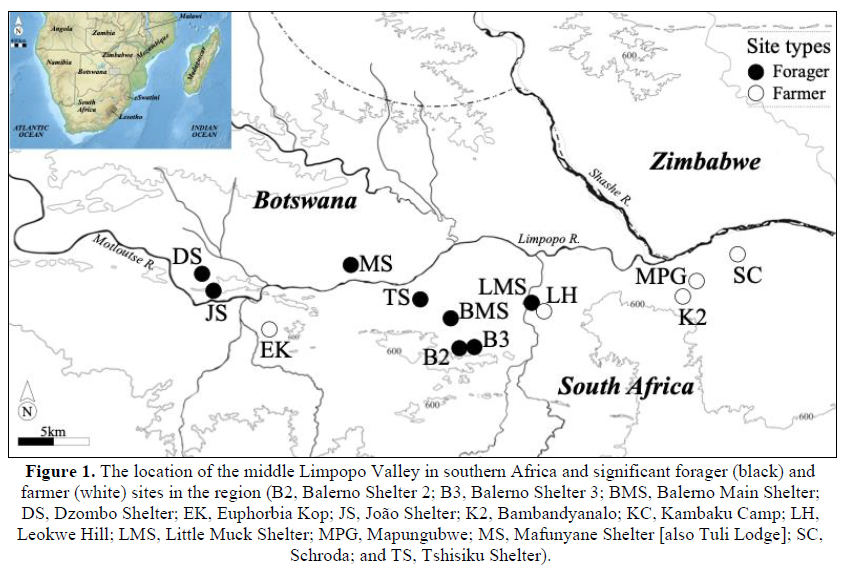
The middle Limpopo Valley is located along a stretch of the Limpopo River where the modern international borders of Botswana, South Africa and Zimbabwe are located (Fig. 1). Prior to the BC/AD transition, only foragers lived in the region (Forssman 2020). These forager groups produced finely worked stone and bone tools, subsisted on local wildlife and plants, painted and engraved a variety of motifs, and made jewellery including OES beads (van Doornum 2005; Forssman 2014, 2020). It is debated whether herders arrived in the region, and when, but if they did there is presently no evidence other than finger paintings that are ascribed to them by many scholars (Eastwood & Smith 2005). However, in the first centuries AD, farmer groups passed through the region and possibly settled the valley in small numbers. By at least AD 900, a widespread Zhizo ceramic-using farmer community settled the region and lived in open-air, fixed settlements, produced metal items, cultivated crops, possessed domestic livestock, and also manufactured their own OES beads (Huffman 2000; Mouton & Antonites 2023). Changes in local socio-political structures, which include the arrival of new farmer communities and the emergence of long-distance trade, all contributed to the appearance of Mapungubwe (Huffman 2015). OES beads were produced throughout this period, under different social frameworks, and by multiple groups, and potentially store information relating to technology, use, interaction, exchange, and trade.
Since little research has been conducted on OES beads in the valley, we chose to examine an assemblage from Little Muck Shelter. Little Muck is a rock shelter that was occupied by forager groups from the last centuries BC throughout the period of state-level development (Forssman et al. 2023). During this period, resident foragers traded goods with farmers to obtain items including glass beads, ceramics and metal (Forssman et al. 2023; Sherwood & Forssman 2023). Therefore, the site presents an opportunity to examine bead assemblages and their potential significance during a period of socio-political upheaval. In this paper, we present the morphological and technological features of the site's bead assemblage and place them into a regional context. Our investigation shows that two recognised manufacturing techniques were utilised, but with a preference for drilling unshaped fragments first, followed by rounding them (pathway 1; see Orton 2008). However, this changes both over time and across space at the site. Our study provides a baseline for investigating variability within the region and a foundation for ongoing studies in the valley and beyond that should include experimental approaches. We are nonetheless reluctant at this stage to over interpret our findings until a larger body of evidence, that allows for greater integration of more social histories based on bead analyses, and other kinds of evidence, is produced.
2. The context, production, and use of ostrich eggshell beads
The earliest OES beads date to the late Pleistocene. Early examples were identified at Mumba Rock Shelter, Tanzania, and date to ca. 52 000 BP (McBrearty & Brooks 2000; Miller & Willoughby 2014), as well as from Enkapune ya Muto, Kenya, dating to between 37 000 and 39 900 BP (Ambrose 1998). Somewhat later than in East Africa, in South Africa OES beads appear at Border Cave, at 44 000-41 000 BP (d'Errico et al. 2012). Although earlier preforms have been found at Spitzkloof, South Africa, dating to >51 000 BP, they number only two and are difficult to interpret (Dewar & Stewart 2012, 2016). From the Pleistocene into the Holocene, bead frequencies increase, as do the number of Stone Age sites containing them across Africa (Miller & Sawchuk 2019). Not only were complete beads preserved, but also broken beads and preforms (incompletely produced beads) in different stages of manufacture, demonstrating production strategies.
The first phase of making a bead is obtaining shell material, which ethnographic accounts indicate might have been achieved through collections made at ostrich nests or from recycling broken shell flasks (Silberbauer 1981). From the eggs, roughly shaped fragments were produced by snapping the edges of shell pieces. Following this, two strategies, called pathways, were employed: either the perforation was drilled before trimming (pathway 1) or afterwards (pathway 2). Trimming the fragment, in both strategies, involved further snapping of its edges into a more rounded shape followed then by grinding of the shell disc/preform into a more uniformly rounded shape (Orton 2008). It is possible to discern which strategy was opted for in the archaeological sequence, depending on whether the bead has a perforation prior to rounding or not, and sites tend to exhibit both. For instance, Orton (2008) documented sites in South Africa's Northern Cape Province dominated by pathway 1, whereas at Bushman Rock Shelter in Limpopo Province, there was evidence of both approaches (Plug 1982; Dayet et al. 2017). These stages have not only been constructed using archaeological remains but were also recorded by Kalahari ethnographers (Wiessner 1977; Lee 1979; Silberbauer 1981). However, they are not limited to sites in southern Africa (e.g., Wei et al. 2017). The experimental work conducted by Wang et al. (2009) showed that this method is preferred as it reduces the chances of the fragment breaking, since the inner mammillary layer of an eggshell is much softer than the outer cuticle (Werner & Miller 2018).
Beads and fragments sometimes occur in colours that are not typical of ostrich eggshell. This alteration is likely the result of heat exposure or contact with pigments (Craig et al. 2020, 2023). It may be that heat and pigments were intentionally applied to alter the aesthetic of the bead or to convey symbolic information (Martí et al. 2017). In their study of pigmented beads from Bushman Rock Shelter, Dayet et al. (2017) noted variability in mineral resources used as pigments, and they concluded that this was either an indication of personal preference by the wearer, the conveyance of symbolic meaning, or the result of regional interactions since some of the minerals originated from locations far from the shelter. Heat treatment is less clearly linked to symbolic or other explanations than the intentional application of a pigment. Heating shell during the manufacturing process was seldom recorded ethnographically (Craig et al. 2020). However, experimental work on shell assemblages shows that it was a method used in the past, although in some instances natural heating could not be excluded (see Craig et al. 2020; Diehl et al. 2022). More research into heat-related colour variation is necessary to assist with understanding and interpreting this process (Collins & Steele 2017).
The value of beads in the archaeological assemblage goes beyond technological approaches and decision making; they are linked with notions of identity and beliefs. Early work by Jacobson (1987) examined bead-size variability in central Namibian sites and identified three bead categories organised around size. He concluded that each was produced by a different ethnic group. Small beads were made by San-ancestral foragers, medium-to-large beads by herder groups, and large beads by Iron Age farmers (see Smith et al. 1991; Tapela 2001; Kandel & Conard 2005; Orton 2008). In another study that compared 31 sites in eastern and southern Africa, largescale exchange networks have been suggested (Miller & Wang 2022), although this requires further examination and a larger sample size (1516 beads were analysed). As such, beads may facilitate the identification of specific groups, stylistic changes (Jacobson 1987; Yates 1995), and social networks over vast geographic landscapes (Miller & Wang 2022).
In daily life, OES beads were used to decorate clothing items such as headbands, skirts, and bags (Miller 2012). However, they were also important social and spiritual devices, such as playing a role in the creation of myths, possessing supernatural potency, and being used as important exchange items (Mitchell & Stewart 2024). Among San groups in the Kalahari Desert, beads were used as gift items (Wiessner 1982). For example, Ju/'hoansi foragers practised a reciprocal gift-giving system called hxaro whereby they exchanged items with partners to establish social networks. OES beads were one of the exchanged items and were largely regarded as the most important (Wiessner 1982; Dowson 1989). It is also the most readily identified item archaeologically that was recorded in the hxaro system. Not all San groups practised this form of exchange (Mitchell 2003) and other groups exchanged with one another following different conventions. The Nharo from north-eastern Botswana, by way of an example, practised //at, which entailed the exchange of various consumable items but not in a reciprocal manner (Barnard 1992). The time-depth of such exchange practices is of course difficult to ascertain but a recent study of strontium in OES beads from Sehonghong and Melikane, Lesotho, dating as far back as ca. 33 000 BP showed that some have a provenance of up to 300 km away (Stewart et al. 2020). While this does not definitively show exchange it certainly indicates its possibility, if not likelihood. OES is not only symbolically important when in bead form but also while used as water containers. At Diepkloof Rock Shelter, Western Cape Province, Middle Stone Age occupants engraved eggshells likely for both stylistic and symbolic reasons (Texier et al. 2010) and, where farmers settled elsewhere in the subcontinent, beads might have become identity markers during the late Holocene (Carden et al. 2024). Both OES containers and beads feature in rock art, thus indicating their likely spiritual association, and shamans often wore beaded items while performing trance rituals (Dowson 1989).
Beads were imbued with meaning in both the physical and spiritual realms. Studying their context, production and use provides insight into several important avenues of life, including trade, access to resources, decision-making, economies, and spirituality. Thus, on a landscape like the middle Limpopo Valley upon which significant social change was orchestrated by multiple ethnic groups, the potential insight one might gather from studying OES beads cannot be overlooked.
3. Materials and methods
Site and excavation context
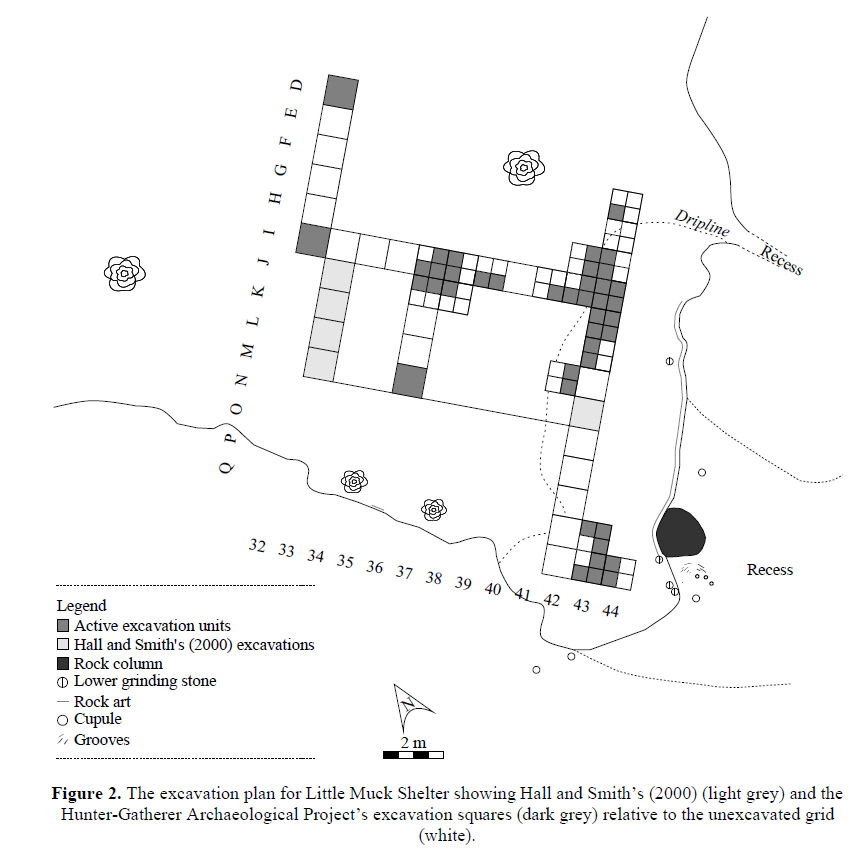
Little Muck was first excavated by Hall and Smith (2000) in the late 1990s. The aim of their study was to investigate forager-farmer relations in the middle Limpopo Valley, and they chose this particular shelter to begin with due to its proximity to a nearby prominent farmer settlement, called Leokwe Hill, that was occupied from the beginning of the first millennium AD. The excavators established two 1x2 m trenches, one inside the shelter (L-M42) and another nine metres away in the open area outside (J-M33). Their excavations revealed an occupation sequence marked by four phases that spanned the last few centuries BC until the second millennium AD. With renewed interest in the forager archaeology of the middle Limpopo Valley, the Hunter-Gatherer Archaeological Project (led by TF) initiated excavations at the shelter in October 2020. At first, 1x1 m squares (P-Q 43 & Q 44) were excavated on the western side of the shelter, and later nearer to Hall and Smith's (2000) L-M42 squares (Fig. 2). Over the following two years, additional excavation squares were opened in the eastern portion of the shelter and in the areas outside.
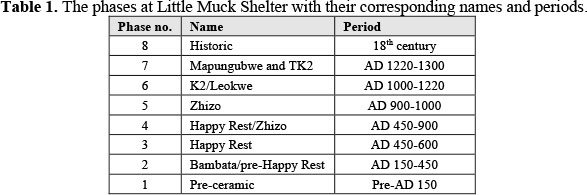
The site's stratigraphy has been divided into four phases (van Doornum 2005, 2008). The first of these is the precontact phase that predates AD 150 with an unknown initial date but likely within the last centuries BC. Capping this is the first millennium AD contact period that predates AD 900, at which point the Zhizo phase begins. Following this is the Leopard's Kopje phase, which includes the K2 (AD 1000-1220) and Mapungubwe (AD 1220-1300) phases. Renewed excavations identified additional strata not reported in Hall and Smith's (2000) study, and these are subsequently being subjected to both relative and absolute (radiocarbon) dating assessments. The result of this work is a refined assessment of the site's chronology and an improved understanding of the stratigraphic sequence. Following this, eight periods have been identified, with one being uncertain (either Zhizo or Happy Rest). We combine the relevant strata into the following eight periods using the ceramics facies to name them, where possible, for convenience; we prefer the use of phases (numeric) to avoid cultural associations. Having eight phases is confusing so we use their numerals only in the tables (Table 1). It should be noted, however, that the stratigraphic sequence is complex and a review of this is forthcoming, but a summary is available in Forssman et al. (2023). However, squares Q and P (with relevant numbers) have not been subjected to a full assessment, but it is suspected, based on a range of modern items found in these units, that they are historic.
Ostrich eggshell bead analysis
The analysed OES assemblage, which includes both beads and fragments, is from squares J42, H42, I42, I36-38, I40-41, P43 and Q43-44. The assemblage was investigated following standard procedures used in other studies (e.g., Plug 1982; Kandel & Conard 2005; Orton 2008). For each bead, the minimum aperture diameter, maximum external diameter, and maximum thickness were measured using a Neiko Digital Calliper®. Furthermore, beads were categorised into two different processes of production called pathways, following Orton (2008). Pathway 1 begins with selecting a piece of unmodified OES (stage I), followed by partly drilling (stage II) and then completely drilling a hole (stage III), partly trimming (stage IV) and completely trimming the edges (stage V), and finally partly grounding (stage VI) and completely grounding (stage VII). Pathway 2 also begins with blank selection (stage I) but is followed by the trimming of the OES fragment into a sub-circular or circular shape (stages II & III), and only then by perforation (stages IV & V), and lastly by grinding (stages VI & VII). As such, the distinguishing factor between pathways 1 and 2 is the stage at which drilling takes place, either before trimming or after. It must be emphasised that it is not possible to determine which pathway was used when analysing completed beads since the sequence of production strategies cannot be established. It is only from specimens in stages II to IV that a pathway can be identified. Each stage is also classed as unbroken or broken, with 'a' or 'b' placed after the stage's roman numeral, respectively (Orton 2008). Additionally, beads were categorised following three size classes: small (<5 mm), medium (>5-6 mm), and large (>6 mm) (following Orton 2008). The maximum thickness was measured for preforms, including those which are broken and with >50% of their external circumference remaining.
The assemblage was also analysed with a handheld LED+UV Triplet Loupe (10x mm), and beads with notable features were further examined with a Nikon SMZ 745 T stereomicroscope (10-300x magnification). For the beads, the surface was investigated for evidence of grinding or trimming (e.g., striations), post-production finishing (e.g., polishing), the presence of residue (e.g., pigment), and evidence of heating (e.g., discolouration). The side of perforation (inside, outside, or both) was also investigated as well as bead shape (i.e., polygonal, roughly circular, oval, or circular) along with the shape of the aperture, aperture position, and lastly, the degree of abrasion. This analysis was conducted following the methodologies of Miller (2019) and Craig et al. (2020). Finally, beads were also categorised into a colour using the Munsell colour chart, following Miller (2012). The Munsell value was used because, under microscopic inspection, the beads could not be classified into normative colour categories due to variability. Using a Munsell value compensates for this variability although also problematically standardises colour.
For unmodified OES fragments, maximum width, length, thickness, and weight, were measured and colour was identified. In addition, fragments were also categorised into shape, which could either be polygonal or triangular (Hatton et al. 2022), but a quadrilateral shape category was formulated since some of the fragments exhibit four perfect vertices and edges with an approximate internal angle of 90°. Quadrilateral fragments from Little Muck were deemed distinctive enough to warrant this specific sub-category.
4. Results
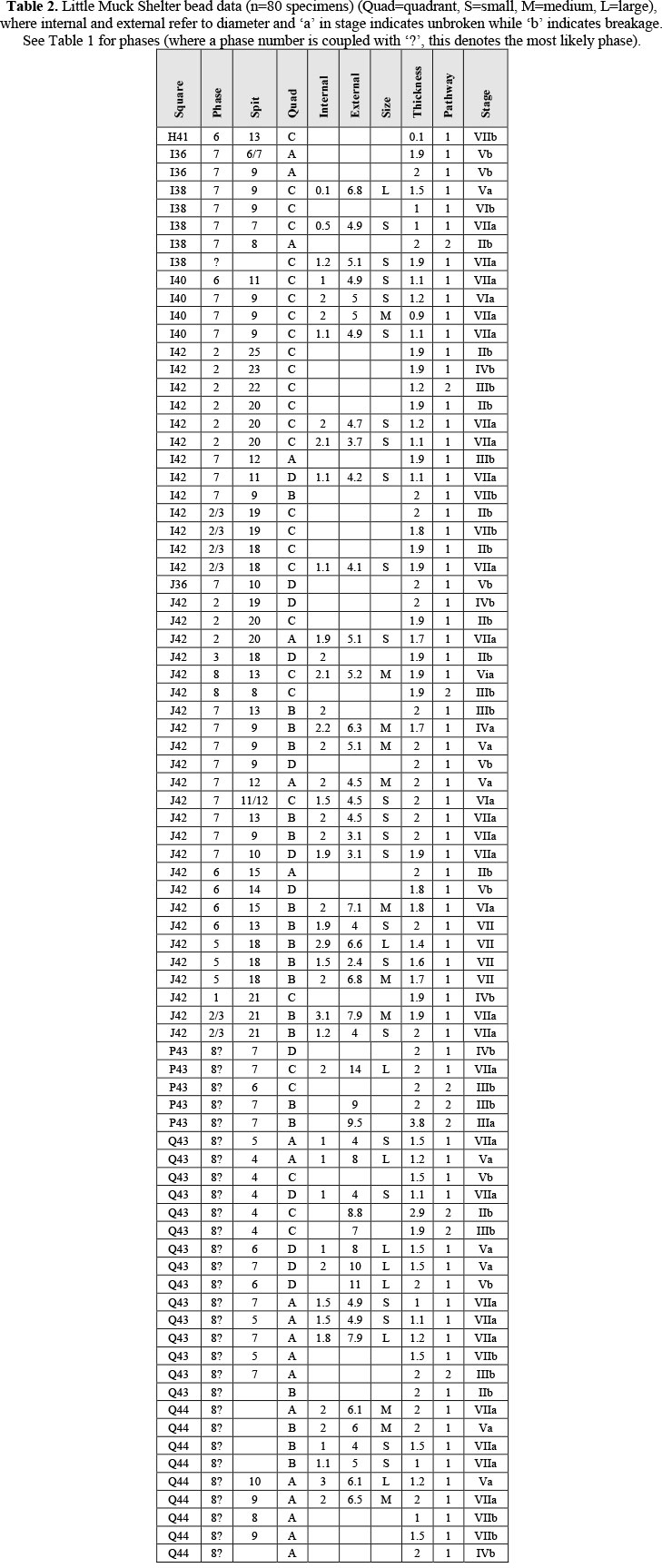
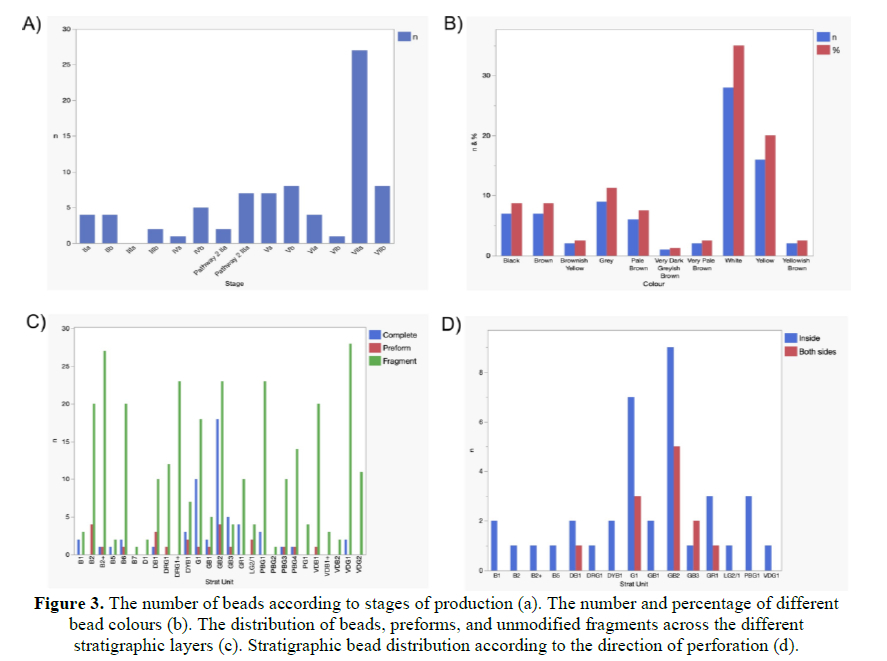
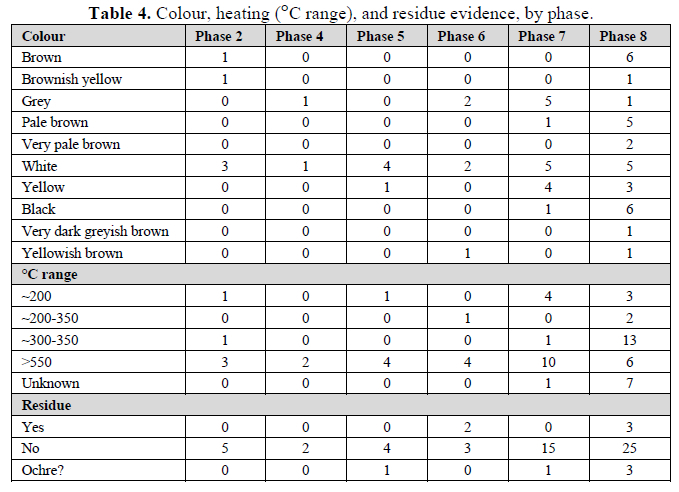
In total, 56 complete beads and 24 preforms were examined (Table 2). The mean aperture diameter for complete beads is 1.9 mm with a range of 0.9-3.1 mm (SD=0.6 mm), whereas the mean external diameter is 5.1 mm with a range of 2.1-14 mm (SD=2.5 mm). In total, the beads have a mean thickness of 1.7 mm. In terms of size, most of the complete beads are small (n=23), followed by large (n=11) and medium (n=9). The colours of the beads and preforms include white (n=28, 35%), yellow (n=16, 20%), grey (n=9, 11.25%), black (n=7, 8.75%), brown (n=7, 8.75%), pale brown (n=6, 7.5%), yellowish brown (n=2, 2.5%), brownish yellow (n=2, 2.5%), very pale brown (n=2, 2.5%), and very dark greyish brown (n=1, 1.25%), all of which are likely the result of heating (Fig. 3a); these colours are to be expected for OES materials that have been exposed to heat. The abovementioned colours generally range within the spectrum of the primary colours of yellow, brown, and grey which are characteristic of oxidising conditions, whereas reduction conditions result in black (Dayet et al. 2017).
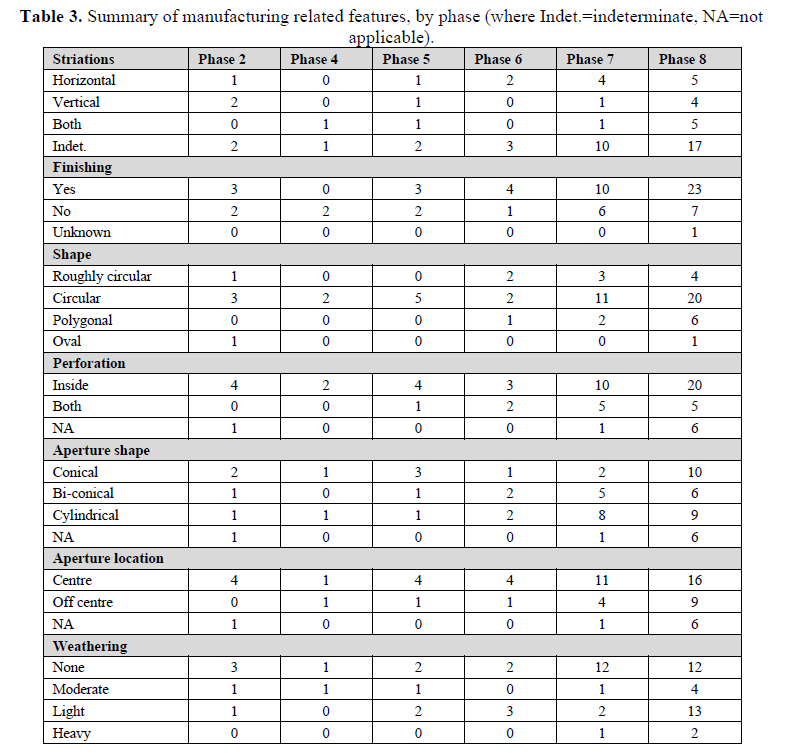
Most of the beads were manufactured following pathway 1 and almost all stages of production are present in the assemblage (Fig. 3a; Table 3). Stage VII predominates (43%) and phase 7 (stratum GB2) shows the greatest variety of beads and preforms (Fig. 3c). The most common method of drilling is from the inside of the eggshell (n=43), followed by both sides (n=15), while none were drilled first from the outside (Fig. 3d; Table 2). The method of drilling appears to have a connection with the shape of the aperture. Beads drilled from both sides have a bi-conical aperture shape (n=13), whereas those drilled from the inside either have a cylindrical (n=22) or conical (n=21) shape. Of the drilled beads, more have a centred aperture (n=40, 71%) than an uncentred one (n=16, 29%). However, at Little Muck there seems to be no relationship between aperture position and production technique. Orton (2008) noted that aperture position could be altered by several factors such as excessive usage and weathering. The latter, however, does not seem to be the case at Little Muck since only a small number of beads (n=3, 5%) are heavily weathered around the aperture.
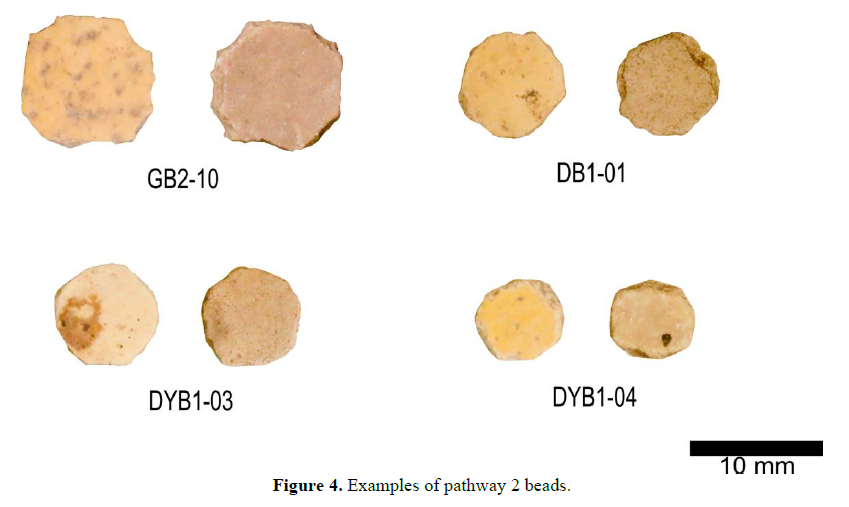
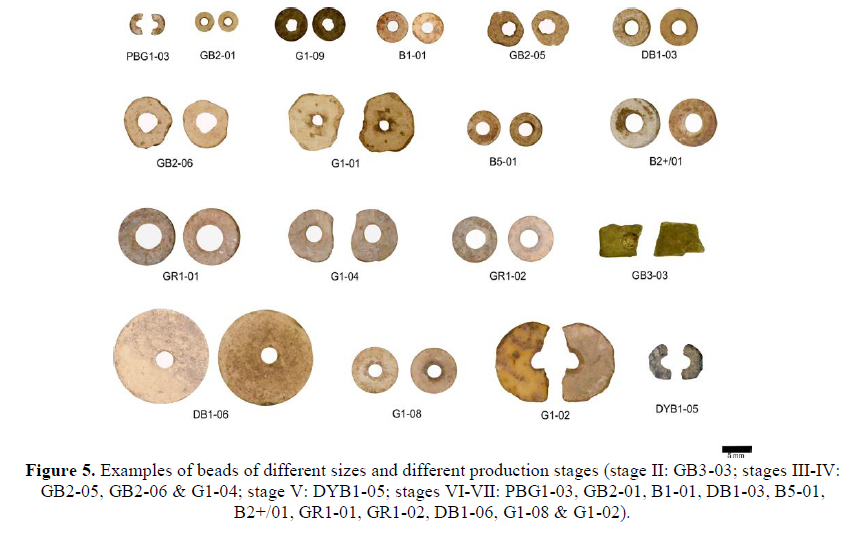
A total of nine preforms were manufactured following pathway 2 (Fig. 4). Pathway 2 beads are generally rare, and once they are in advanced stages of manufacture (e.g., V-VII; Fig. 5) it is difficult to distinguish them from pathway 1 beads. Orton (2008) reported fewer pathway 2 beads compared to those following pathway 1 in the Northern Cape, possibly reflecting production preference patterns. Nevertheless, of the nine pathway 2 specimens, seven of them are in stage III while two are in stage II. Beads in stage II are characterised by partly trimmed edges, while those in stage III are completely circular. None of the pathway 2 beads are broken or completely drilled and all of them are circular, which is the most common shape for pathway 2 beads (Orton 2008) (Fig. 4).
When observed under magnification, parallel striations were recorded on 18 beads (20%) and a further eight had perpendicular striations (13%) along the outer circumference. The striations were most likely the result of abrasion against a hard material, such as a stone, and this action could have resulted in scars parallel to the outer surface of the beads' lateral edge. Little can be said of surface striations without further experimentation.
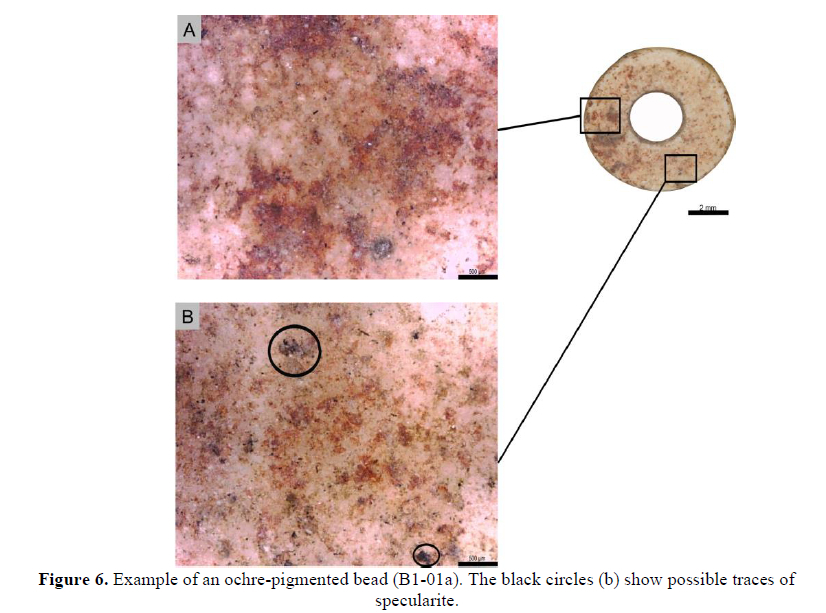
Some of the beads have evidence of polish and use-wear (n=10, 16%) (Table 4), and the reddish residue on all of the observed specimens might be ochre (Fig. 6). Without conducting chemical analysis on the residues, their composition remains tentative, as does our interpretation of whether they were intentionally applied or transferred through contact with clothing, skin, or from chemicals in the sediment (Martí et al. 2017). Another reason for the presence of the red residue could be the usage of ochre for grinding, as opposed to its intentional application for aesthetic or symbolic purposes (Orton 2008; Collins et al. 2020).
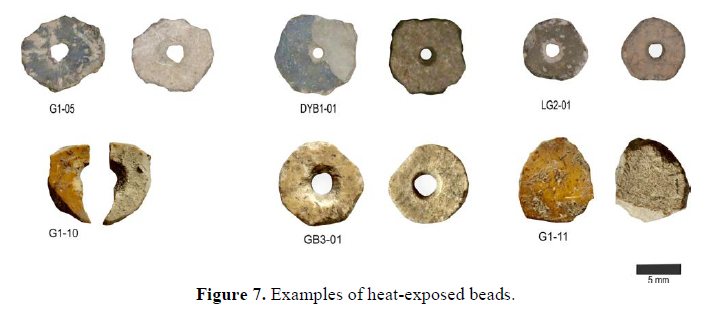
Seventy-two of the beads were heated. Following Collins and Steele (2017), and based on the colours identified in this study compared to theirs, most of the heated beads were exposed to temperatures in excess of 550°C (n=29, 45.3%), followed by 15 heated to between ca. 300 and 350°C (23.4%), nine ca. 200°C (14.1%), eight unknown (12.5%), and a further three between ca. 200 and 350°C (4.7%) (Fig. 7). Seven black beads and a very dark greyish brown bead were heated to unknown temperatures. Although Collins and Steele (2017) do not currently know what temperature range might produce black burning, Diehl et al. (2022) suggest over 900°C. However, at this stage it is not possible to confidently determine whether the heating was deliberate or post-depositional, although no evidence of post-depositional burning in the deposit was recorded in the excavations.
Lastly, bead shape varies with oval, circular, roughly circular, and polygonal all being recorded. While Miller (2012) has suggested that bead shape is not always intended to be circular, at Little Muck circular beads predominate the assemblage (n=45, 67%), followed by roughly circular (n=8, 16%), polygonal (n=9, 14%) and oval (n=2, 3%).
A total of 307 unmodified OES fragments were examined. The most frequent shape is polygonal (n=265, 86%), followed by triangular (n=36, 12%) and quadrilateral (n=6, 2%). Altogether, the fragments weigh 276 g and have a mean width and length of 8.4 (range: 1.2-19.5 mm, SD: 3.97) and 13.2 mm (range: 4.3-26 mm, SD: 5.14), respectively. The mean thickness is 2 mm (SD: 0.29). Five colour categories were identified on the OES fragments. Most of the fragments are unburnt (n=167, 54.4%). This contrasts with the beads which exhibit regular heat exposure across a variety of temperature ranges. Of the heated fragments, grey-white (28%, >550°C) was most common, followed by yellow (9.5%, ~200°C), red (5.9%, ~300-350°C) and lastly black (2.3%, unknown temperature, but possibly >900°C). None of the fragments are iridescent. Furthermore, under microscopic investigation, some of the fragments have striations (i.e., random scratches and marks) on the cuticle.
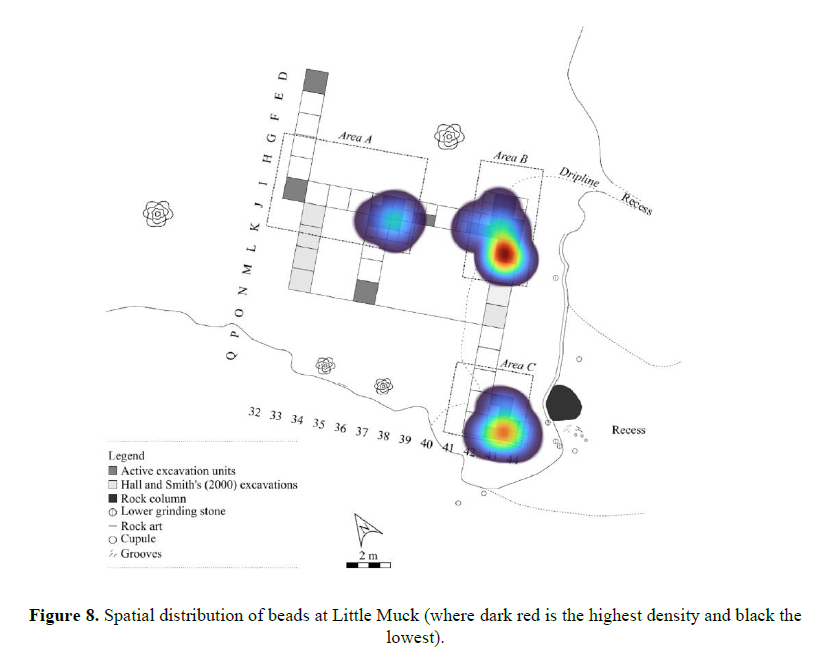
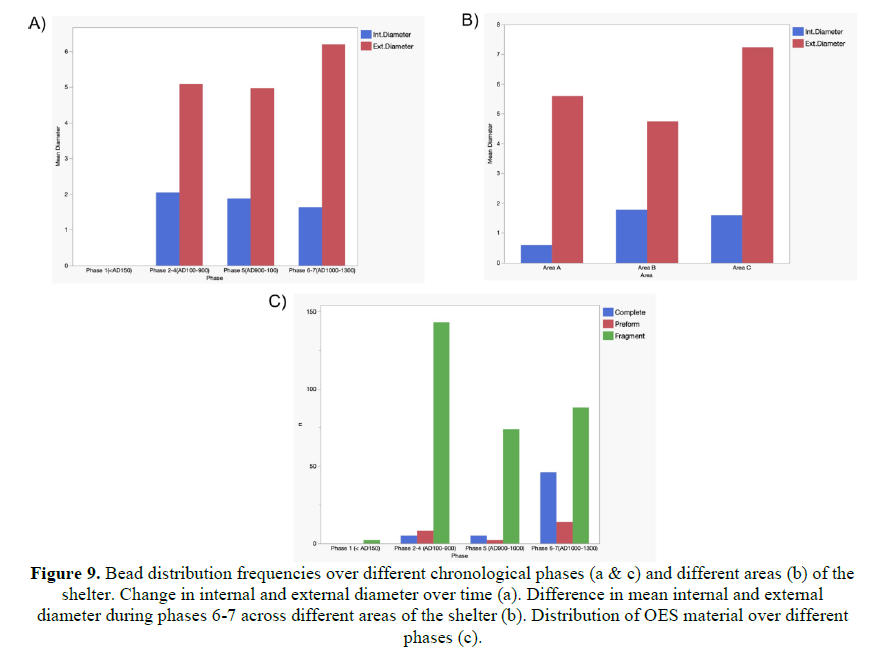
The production of OES beads at the shelter appears to have been spatially organised. The outside area (area A: squares I32-8, J36; see Fig. 8 for area locations) has the least number of fragments (n=13), preforms (n=1), and complete beads (n=6) (Fig. 9). The western section of the shelter (area C: squares Q43, 44, P43) contains more beads (n=20), preforms (n=9) and fragments (n=54); however, it is the eastern section of the shelter (area B: squares J42, I40-2, H41-2, 140-2) that contains the most beads (n=28), preforms (n=16), and fragments (n=240). Area B also contains the highest frequencies of all other categories of material culture recovered at the shelter (Forssman et al. 2023). As such, most of the bead processing and production at Little Muck appears to have occurred in area B along with other domestic forager activities. These differences might be related to periodic shifts or different activity patterns over time. For example, bead production is absent during phase 1 (pre-AD 150) with only two OES fragments. However, during phases 2-4 (AD 100-900) there is an increase in the number of complete beads, preforms, and fragments with a slight decrease in preforms and fragments in phase 5 (AD 900-1000). The most intense production of beads took place during phases 6-7 (AD 1000-1300), which is also a period when production seems to have been spatially organised between areas B and C, with a preference for the former.
5. Beads and their context from the perspective of Little Muck Shelter
The bead analysis revealed a series of patterns that are worth exploring, but most importantly it exposes the potential beads have in unpacking social relations and economic networks in the middle Limpopo Valley's sequence. We first consider the morphological and technological observations made in this study before considering the broader context of the beads.
Little Muck's foragers preferred beads that were small and round. Their production, however, is more time consuming, tedious, and risky when compared to that of making other bead sizes (Orton 2008), therefore requiring a more careful and skilful approach to the chain of operations (Wei et al. 2017). Made by predominantly drilling from the inside, this technique might have been favoured due to the increased success rate when compared to drilling from the outside, in addition to potentially reducing production times (Martí et al. 2017). However, some beads were drilled from both sides, a method recorded ethnographically (Plug 1982; Orton 2008), and this seems to have broadened their aperture. Despite the various risks associated with producing small beads, the associated challenges with producing them likely enhanced their value (Moffett et al. 2020).
There is also a possibly unusual dynamic between pathway 1 and 2 beads. Pathway 1 was favoured possibly given the lowered breakage risk (Wang et al. 2009). However, an increase in pathway 2 beads in the contact layers (phases 4-7) may indicate a diversification of production strategies, the introduction of new skills that might have been linked to informational exchanges, or the ability to make beads more efficiently using this pathway. Experimentation might aid in resolving this if the risks and rewards (perhaps in terms of production rate, ease of manufacture, etc.) can be assessed. A major limitation though is our inability to distinguish between these pathways for complete beads, so it is possible that many more pathway 2 specimens exist (in stage VII) than pathway 1.
The difference in heat exposure between beads and fragments is interesting. All beads exhibit heat exposure, but only half of the fragments do. The presence of heated fragments might suggest that heating was an important and deliberate part of the bead manufacturing process at Little Muck, and depending on the outcome of this, influenced which were chosen for further processing. However, it is also possible that shell exposed to heating through cooking, for example, represents the heated fragment assemblage (Robbins et al. 1996; Diehl et al. 2022), which subsequently broke into fragments so their heating might not relate to the bead manufacturing process. However, that fragments exhibiting heating were found alongside those without rules out the possibility of post-depositional heating, as in such a case one would expect the entire assemblage to show degrees of heating. Had the heated shell beads and fragments been retrieved from an isolated area or different stratum, such as a hearth, one could suggest that it was unintentional heating, but this is not the case. In addition, the black beads and shell fragments are difficult to explain. Kandel and Conard (2005) have suggested that beads are burnt black for aesthetic purposes. However, experimental studies have failed to replicate this archaeologically observed colour (Craig et al. 2020; but see Diehl et al. 2022), limiting our full understanding. The usage of pigmentation in combination with heat treatment on some of the beads may have been for symbolic, identity, or aesthetic purposes.
Aside from the morphological and technical attributes of the beads, their context indicates an interesting set of outcomes. In the pre-contact phase, before farmers migrated to the region, there is less evidence for bead production. However, shortly after the arrival of farmers, bead frequencies increase and peak during phase 7 (AD 1220-1300). The number of beads and preforms in this phase support the consistent manufacturing of beads. This might lead one to suspect that contact with farmers led to an increasing demand for beads. However, in the preceding phases 5 and 6 (AD 900-1220), during which farmers were present on the landscape, there seems to be less bead production in comparison to phase 7. This could be the result of different sets of craft requirements, such as an emphasis on other goods, bead production primarily taking place at other sites, or of farmers primarily producing their own beads during this time. Using Jacobson's (1987) bead-size analysis, 40.43% (n=19) fall within the 'farmer' size range, whereas slightly more are within the 'forager' range (n=20; 42.55%). However, if the suggested farmer size class is reliable, we should expect to see less of them during the pre-ceramic period. In these strata, only three beads could be measured, and all are less than 6 mm in maximum diameter. The small sample does not allow for a confident interrogation of size variability from pre-contact to ceramic periods, and therefore we cannot assess bead size as a potential stylistic or ethnic marker (Wilmsen 2015; also see Mouton & Antonites 2023).
Despite the second millennium AD increase in complete beads it is not possible to argue, with confidence, for trade or exchange in beads, whether forager or farmer produced. Had higher frequencies of preforms occurred in various stages of production, one could make the argument that the low number of complete beads was the result of them being traded or exchanged, but this does not appear to be the case. Identifying production could also be sought by examining the potential tools used in making beads, other than just the beads themselves. A use-wear analysis of stone scrapers, accompanied by experimentation, showed that shell was being worked in low frequencies during the pre-ceramic period, along with hide, wood and bone, but thereafter bone working predominated (Sherwood & Forssman 2023). This appears to suggest that working shell with stone scrapers was not a regular activity after contact. However, would scrapers be used for making beads? Given that ethnographically recorded production strategies include trimming, boring, and polishing extremities, which are not scraper-associated processes, perhaps not. A recent study on shell beads identified stone drill bits in the Little Muck assemblage that had tip damage consistent with experimentally used drilling pieces (Sherwood & Forssman submitted). Such pieces had not been identified until this experimental study, and further analysis identifying converging tips with comparable damage is necessary to examine the significance of this possible production-associated tool form. However, it serves to show that a variety of tool forms should be consulted to assist with identifying production strategies.
Trade and exchange are also dynamic processes that are present in multiple contexts. As such, consideration of the broader landscape assists in examining such networks. Further support might therefore be found at Leokwe Hill and Schroda, large Zhizo settlements nearby, dating to the end of the first millennium AD. At Leokwe Hill, 1.5 km south-east of Little Muck, Calabrese (2000) notes a difference in OES and Achatina beads between a hilltop and low-lying area, which he interpreted as indicating different statuses. He recorded 218 OES and 62 Achatina beads in the former area, and 1 and 204, respectively, in the latter. Schroda is further from Little Muck, over 18 km north-east, and the relationship between the two sites has not been considered at all. Here, however, the OES beads number in the thousands (Hall & Smith 2000). Mouton and Antonites (2023) suggest that at this time foragers might have acted as suppliers of shell material while Leokwe or lower-status farmer settlements produced the beads. If foragers were involved in this craft activity, it may be that they oscillated between farmer settlements and their own (e.g., Wadley 1996). From findings made at other sites occupied by foragers during this period, such as Balerno Main (Forssman 2020), foragers continued producing beads throughout this period (van Doornum 2007, 2008; Forssman 2014, 2020; Seiler 2016), although not at Little Muck. During this late first millennium AD period, foragers instead appear focused on activities associated with producing bone items for trade with farmers, and in return received ceramics (possibly with their contents) and glass beads (Sherwood & Forssman 2023).
Ornaments such as beads are powerful tools of communication (Miller 2024). In both eastern and southern Africa, they played an important role in carrying messages in specific contexts and denoting social roles and statuses. This important role they played within society, and specifically among foragers, became enmeshed within a wider socio-political and economic context in the early second millennium AD in the middle Limpopo Valley. From at least AD 900, social, political, and economic transformations began in the region, and they culminated in the appearance of the Mapungubwe state (Huffman 2015). It is noteworthy that the period with the highest frequency of complete beads is phases 6 and 7 at Little Muck. During this period, regional mercantile contexts and forager-farmer relations were notably different to earlier phases of contact. Beads, which were already imbued with meaning, likely took on new roles within society, such as reinforcing identity groups or marking status. Their increase at Little Muck, from this perspective, was possibly the result of wider social patterns emerging across the region. At the time, farmers used OES and Achatina beads to distinguish status groups (Calabrese 2000). OES beads marked elevated status. Little Muck's foragers producing beads from OES were possibly part of this larger market economy. These shifts demonstrate consistent forager engagement in the local, social and economic landscapes that led to changes in their own activities at a time when trade wealth was driving reform within local society. At this period, wealth items and social status were crucial facets of society that played an important role in the establishment of elite or royal groups and the local hegemony of the Mapungubwe state. Foragers were part of this milieu and were cognisant of the importance of beads given their increased frequency within this framework.
Despite this being an early attempt at understanding middle Limpopo Valley beads, it is possible to compare the data from Little Muck with other regions where similar bead studies have taken place. Miller and Wang (2022) note that bead sizes in southern Africa fall within a narrow size range of 4.5±0.9 mm, compared to East African beads from the mid- to late Holocene at 6.9±1.2 mm. The southern African dataset was derived from 23 sites, mostly from South Africa (n= 13) and Namibia (n=7). Various studies have also shown that bead sizes increase from 5000 BP towards the present. For example, Geelbek's beads from 2500-4000 BP range from ca. 3-5 mm in diameter, but immediately before the turn of the first millennium AD they increase to >5.5 mm. Geduld and Witklip show the same trend, whereas sites with late occupations, such as Kasteelberg (A and B) and Rooiwal, contain larger beads (see Miller 2019: fig. 10 for a summary). Little Muck's average across the sequence is 5.9 mm (from n=47). Unfortunately, when the measured bead assemblage is divided into the eight phases, their numeral values per period is low. Only in phase 7 are there a high number of beads (n=13) and these average 4.8 mm. In one unit thought to date to the historic period, or possibly the Mapungubwe phase, there is an average of 10.8 mm from three specimens. Therefore, it is not possible to assess whether bead size changes over time and in particular after 2500 BP when the average bead diameters begin to increase.
6. Conclusions
Foragers at Little Muck had the skills and technical ability required to produce morphologically similar OES beads. Pathway 1, like at other sites in southern Africa, was the production strategy of choice used to manufacture small, round beads, and drilling was characterised by perforations initiated from the inside of the shell. However, pathway 2 was utilised albeit less commonly, particularly during the contact period. Additionally, manufacturers at Little Muck seem to have applied pigments and altered beads using heat treatment. Further experimentation is needed to confirm this and to better our understanding of these processes. For example, it is worth testing whether heat treating shell fragments assisted with manufacturing stages, perhaps for shaping or drilling or one and not the other, and whether heating impacted the chosen production strategy. Moreover, regional dynamics in the middle Limpopo Valley seem to have had an impact on the manufacture of Little Muck's beads. Before the movement of farmers onto the landscape, bead production was less intense than during the Mapungubwe period, and at this time the production strategies to produce them diversified. This shift was likely the result of unfolding socio-political change in the region that was leading to new hierarchies and needs that distinguished social status and group identity. Foragers were part of this broader social milieu and therefore produced goods with associated meanings. Beads, as an important social item, were likely used as meaning-carrying communication devices.
While the method of analysis is based on a host of previous studies, the sample size is limiting. As such, this research will be followed by studies from other sites in the valley that further investigate the technological variation of OES beads, and their socio-economic significance. It would also be worthwhile comparing bead assemblages from forager and farmer contexts and, specifically, their production strategies and sizes. We suspect that completing these studies will broaden our analytical scope and facilitate the comparative analysis of possible site-specific manufacturing techniques, bead size variability, and the integration of OES data from the middle Limpopo Valley with that of the broader southern African region.
Ackn owledgem entsWe are grateful for the financial support provided by the Palaeontological Scientific Trust to SK and the National Research Foundation's African Origin Platform grant to TF (136506). The South African Heritage Resources Authority (Permit ID 3124) and SANParks (Permit ID FORT1660) issued permits for excavations at Little Muck Shelter. We also thank the members of the Hunter-Gatherer Archaeological Research Project for all of their assistance.
6. Conclusions
Ackn owledgem ents
We are grateful for the financial support provided by the Palaeontological Scientific Trust to SK and the National Research Foundation's African Origin Platform grant to TF (136506). The South African Heritage Resources Authority (Permit ID 3124) and SANParks (Permit ID FORT1660) issued permits for excavations at Little Muck Shelter. We also thank the members of the Hunter-Gatherer Archaeological Research Project for all of their assistance.
References
Ambrose, S.H. 1998. Chronology of the Later Stone Age and food production in East Africa. Journal of Archaeological Science, 25: 377-392. [ Links ]
Barnard, A. 1992. Hunters and Herders of Southern Africa: A Comparative Ethnography of the Khoisan Peoples. Cambridge: Cambridge University Press. [ Links ]
Calabrese, J. 2000. Interregional interaction in southern Africa: Zhizo and Leopard's Kopje relations in northern South Africa, southwestern Zimbabwe, and eastern Botswana, AD 1000 to 1200. African Archaeological Review, 17: 183-210. [ Links ]
Carden, N., Martinez, G., Mitchell, P., et al. 2024. Spatial and temporal trends in the distribution of engraved eggshell fragments: A comparative view from the Holocene archaeological record of southern Africa and southern South America. Journal of Anthropological Archaeology, 73: 101571. [ Links ]
Collins, B. & Steele, T.E. 2017. An often overlooked resource: Ostrich (Struthio spp.) eggshell in the archaeological record. Journal of Archaeological Science: Reports, 13: 121-131. [ Links ]
Collins, B., Wojcieszak, M., Nowell, A., et al. 2020. Beads and bead residues as windows to past behaviours and taphonomy: A case study from Grassridge Rockshelter, Eastern Cape, South Africa. Archaeological and Anthropological Sciences, 12: 192. [ Links ]
Craig, C., Collins, B., Nowell, A., et al. 2020. The effects of heating ostrich eggshell on bead manufacturing: An experimental approach. Journal of Archaeological Science: Reports, 31: 102287. [ Links ]
Craig, C., Collins, B., Nowell, A., et al. 2023. Abrasive wear in heat-treated ostrich eggshell beads: Implications for the archaeological record. Archaeological and Anthropological Sciences, 15: 4. [ Links ]
d'Errico, F., Backwell, L., Villa, P., et al. 2012. Early evidence of San material culture represented by organic artifacts from Border Cave, South Africa. Proceedings ofthe National Academy of Sciences, 109: 13214-13219. [ Links ]
Dayet, L., Erasmus, R., Val, A., et al. 2017. Beads, pigments and early Holocene ornamental traditions at Bushman Rock Shelter. Journal of Archaeological Science: Reports, 13: 635-651. [ Links ]
Dewar, G. & Stewart, B.A. 2012. Preliminary results of excavations at Spitzkloof rockshelter, Richtersveld, South Africa. Quaternary International, 270: 30-39. [ Links ]
Dewar, G. & Stewart, B.A. 2016. Paleoenvironments, sea levels, and land use in Namaqualand, South Africa, during MIS 6-2. In: Jones, S.C. & Stewart, B.A. (eds) Africa from MIS 6-2, Vertebrate Paleobiology and Paleoanthropology: 195-212. Dordrecht: Springer Netherlands. [ Links ]
Diehl, R.J., Keller, H.M. & Hodgkins, J. 2022. Towards an interpretive framework for heated ostrich eggshell: An actualistic study. Journal of Archaeological Science: Reports, 43: 103465. [ Links ]
Dowson, T.A. 1989. Dots and dashes: Cracking the entopic code in Bushman rock paintings. South African Archaeological Society Goodwin Series, 6: 84-94. [ Links ]
Eastwood, E.B. & Smith, B.W. 2005. Fingerprints of the Khoekhoen: Geometric and handprinted rock art in the Central Limpopo Basin, southern Africa. South African Archaeology Society Goodwin Series, 9: 63 -76. [ Links ]
Forssman, T. 2014. The spaces between places: A landscape study of foragers on the Greater Mapungubwe Landscape, southern Africa. Doctoral Thesis. Oxford: University of Oxford. [ Links ]
Forssman, T. 2020. Foragers in the Middle Limpopo Valley: Trade, Place-making, and Social Complexity. Oxford: Archaeopress. [ Links ]
Forssman, T., Kuhlase, S., Barnard, C., et al. 2023. Foragers during a period of social upheaval at Little Muck Shelter, southern Africa. Azania: Archaeological Research in Africa, 58: 114-150. [ Links ]
Hall, S. & Smith, B. 2000. Empowering places: Rock shelters and ritual control in farmer-forager interactions in the Northern Province. South African Archaeological Society Goodwin Series, 8: 30-46. [ Links ]
Hatton, A., Collins, B., Schoville, B.J., et al. 2022. Ostrich eggshell beads from Ga-Mohana Hill North Rockshelter, southern Kalahari, and the implications for understanding social networks during Marine Isotope Stage 2. PLoS ONE, 17: e0268943. [ Links ]
Huffman, T.N. 2000. Mapungubwe and the origins of the Zimbabwe culture. South African Archaeological Society Goodwin Series, 8: 14-29. [ Links ]
Huffman, T.N. 2015. Mapela, Mapungubwe and the origins of states in southern Africa. South African Archaeological Bulletin, 70: 15-27. [ Links ]
Jacobson, L. 1987. The size variability of ostrich eggshell beads from central Namibia and its relevance as a stylistic and temporal marker. South African Archaeological Bulletin, 42: 55-58. [ Links ]
Kandel, A.W. & Conard, N.J. 2005. Production sequences of ostrich eggshell beads and settlement dynamics in the Geelbek Dunes of the Western Cape, South Africa. Journal of Archaeological Science, 32: 1711-1721. [ Links ]
Klehm, C. 2021. Material histories of African beads: The role of personal ornaments in cultural change. In: Mattson, H.V. (ed.) Personal Adornment and the Construction of Identity: A Global Archaeological Perspective: 135-151. Oxford: Oxbow Books. [ Links ]
Lee, R.B. 1979. The !Kung San: Men, Women and Work in a Foraging Society. Cambridge: Cambridge University Press. [ Links ]
Martí, A.P., Wei, Y., Gao, X., et al. 2017. The earliest evidence of coloured ornaments in China: The ochred ostrich eggshell beads from Shuidonggou Locality 2. Journal of Anthropological Archaeology, 48: 102-113. [ Links ]
McBrearty, S. & Brooks, A.S. 2000. The revolution that wasn't: A new interpretation of the origin of modern human behaviour. Journal of Human Evolution, 39: 453-563. [ Links ]
Miller, J.M. 2012. The ostrich eggshell beads of Mlambalasi Rockshelter. Masters Dissertation. Edmonton: University of Alberta. [ Links ]
Miller, J.M. 2019. Variability in ostrich eggshell beads from the Middle and Later Stone Age of Africa. Doctoral Thesis. Edmonton: University of Alberta. [ Links ]
Miller, J.M. 2024. Perspectives on Stone Age sociality: A new role for ostrich eggshell beads. In: Nowell, A. & Collins, B. (eds) Culturing the Body: Prehistoric Perspectives on Identity and Sociality: 68-86. New York: Berghahn. [ Links ]
Miller, J.M. & Sawchuk, E.A. 2019. Ostrich eggshell bead diameter in the Holocene: Regional variation with the spread of herding in eastern and southern Africa. PLoS One, 14: e0225143. [ Links ]
Miller, J.M. & Wang, Y.V. 2022. Ostrich eggshell beads reveal 50,000-year-old social network in Africa. Nature, 601: 234-239. [ Links ]
Miller, J.M. & Willoughby, P.R. 2014. Radiometrically dated ostrich eggshell beads from the Middle and Later Stone Age of Magubike Rockshelter. Journal of Human Evolution, 74: 118-122. [ Links ]
Mitchell, P.J. 2003. Anyone for hxaro? Thoughts on the theory and practice of exchange in southern African Later Stone Age archaeology. Oxford University School of Archaeology Monograph, 57: 35-43. [ Links ]
Mitchell, P.J. & Stewart, B.A. 2024. Enveloping oneself in others: Semiotic, spatial, and temporal dimensions of ostrich eggshell bead use in southern Africa. In: Nowell, A. & Collins, B. (eds) Culturing the Body: Prehistoric Perspectives on Identity and Sociality: 9-40. New York: Berghahn. [ Links ]
Moffett, A.J., Hall, S. & Chirikure, S. 2020. Crafting power: New perspectives on the political economy of southern Africa, AD 900-1300. Journal of Anthropological Archaeology, 59: 101180. [ Links ]
Mouton, M. & Antonites, A. 2023. Shell disc beads and the development of class-based society at the K2- Mapungubwe settlement complex (South Africa). Archaeological and Anthropological Sciences, 15: 34. [ Links ]
Orton, J. 2008. Later Stone Age ostrich eggshell bead manufacture in the northern Cape, South Africa. Journal of Archaeological Science, 35: 1765-1775. [ Links ]
Plug, I. 1982. Bone tools and shell, bone and ostrich eggshell beads from Bushman Rock Shelter (BRS), Eastern Transvaal. South African Archaeological Bulletin, 37: 57-62. [ Links ]
Robbins, L.H., Murphy, M.L., Stevens, N.J., et al. 1996. Paleoenvironment and archaeology of Drotsky's Cave: Western Kalahari Desert, Botswana. Journal of Archaeological Science, 23: 7-22. [ Links ]
Seiler, T.C.S. 2016. An archaeological landscape study of forager and farmer interactions at the Motloutse/Limpopo confluence area, South Africa. Master Dissertation. Tshwane: University of Pretoria. [ Links ]
Sherwood, N.L. & Forssman, T. 2023. Macro use-wear identifiers on lithic scrapers and behavioural shifts at Little Muck Shelter, SLCA. Journal of Archaeological Science: Reports, 49: 104034. [ Links ]
Sherwood, N.L. & Forssman, T. Submitted. Ostrich eggshell beads: Hole drilling technology at Little Muck Shelter, South Africa. Journal of Archaeological Science: Reports. [ Links ]
Silberbauer, G.B. 1981. Hunter and Habitat in the Central Kalahari Desert. Cambridge: Cambridge University Press. [ Links ]
Smith, A.B., Sadr, K., Gribble, J., et al. 1991. Excavations in the south-western Cape, South Africa, and the archaeological identity of prehistoric hunter-gatherers within the last 2000 years. South African Archaeological Bulletin, 46: 71-91. [ Links ]
Stewart, B.A., Zhao, Y., Mitchell, P.J., et al. 2020. Ostrich eggshell bead strontium isotopes reveal persistent macroscale social networking across late Quaternary southern Africa. Proceedings of the National Academy of Sciences, 117: 6453-6462. [ Links ]
Tapela, M.C. 2001. An archaeological examination of ostrich eggshell beads in Botswana. Pula: Botswana Journal of African Studies, 15: 60-74. [ Links ]
Texier, P.J.P., Parkington, G., Rigaud, J., et al. 2010. A Howiesons Poort tradition of engraving ostrich eggshell containers dated to 60,000 years ago at Diepkloof Rock Shelter, South Africa. Proceedings of the National Academy of Sciences, 107: 6180-6185. [ Links ]
van Doornum, B.L. 2005. Changing places, spaces and identity in the Shashe Limpopo region of Limpopo Province, South Africa. Doctoral Thesis. Johannesburg: University of the Witwatersrand. [ Links ]
van Doornum, B.L. 2007. Tshisiku Shelter and the Shashe-Limpopo confluence area hunter-gatherer sequence. Southern African Humanities, 19: 17-67. [ Links ]
van Doornum, B.L. 2008. Sheltered from change: Hunter-gatherer occupation of Balerno Main Shelter, Shashe- Limpopo confluence area, South Africa. Southern African Humanities, 20: 249-84. [ Links ]
Wadley, L. 1996. Changes in the social relations of precolonial hunter-gatherers after agropastoralist contact: An example from the Magaliesberg, South Africa. Journal of Anthropological Archaeology, 15: 205-217. [ Links ]
Wang, C.Z., Gao, Y., Zhang, X., et al. 2009. Archaeological study of ostrich eggshell beads collected from SDG Site. Chinese Science Bulletin, 54: 3887-3895. [ Links ]
Wei, Y., d'Errico, F., Vanhaeren, M., et al. 2017. A technological and morphological study of Late Paleolithic ostrich eggshell beads from Shuidonggou, North China. Journal of Archaeological Science, 85: 83-104. [ Links ]
Werner, J.J. & Miller, J.M. 2018. Distinguishing Stone Age drilling techniques on ostrich eggshell beads: An experimental approach. Journal of Archaeological Science: Reports, 22: 108-114. [ Links ]
Wiessner, P. 1977. Hxaro: A regional System of Reciprocity for Reducing Risk Among the !Kung San. Ann Arbor: University of Michigan. [ Links ]
Wiessner, P. 1982. Risk, reciprocity and social influences on !Kung San economics. In: Leacock, E. & Lee, R.B. (eds) Politics and History in Band Societies: 61-84. Cambridge: Cambridge University Press. [ Links ]
Wilmsen, E. 2015. Ostrich eggshells and their beads. South African Archaeological Bulletin, 70: 89-105. [ Links ]
Yates, R. 1995. Appendix B: Report on the analysis of ostrich eggshell beads from Geduld. South African Archaeological Bulletin, 50: 17-20. [ Links ]
Received March 2024
Revised June 2024
Published July 2024
* Corresponding author email: tim.forssman@ump.ac.za