Services on Demand
Journal

Article
 English (pdf)
 Article in xml format
 Article references
 Automatic translation
 Send this article by e-mail
Indicators
Related links
-
 Cited by Google
 -
 Similars in Google
Share

 Permalink
Journal of Geography Education in Africa
On-line version ISSN 2788-9114
JoGEA vol.8 Pretoria 2025
https://doi.org/10.46622/jogea.v8i1.5434
ARTICLE
South African Geography educators' contributions to Geography Education: A perspective from the 35th International Geographical Congress, Dublin City University, Ireland, August 2024
Di WilmotI; Clinton David van der MerweII
IFaculty of Education, Rhodes University, Makhanda 6139, South Africa. d.wilmot@ru.ac.za; https://orcid.org/0000-0001-8184-4624
IIDepartment of Humanities Education, Faculty of Education, University of Pretoria, Groenkloof 0181, South Africa. clinton.vandermerwe@up.ac.za; https://orcid.org/0000-0001-6861-2773
ABSTRACT
A key responsibility of academic scholarship is to contribute to and further develop the field of disciplinary enquiry. This paper offers a critical qualitative reflection on how South African Geography Education scholars are contributing to and advancing the field of enquiry from the perspective of the International Geographical Congress held in Dublin (Ireland) in August 2024. This event is the largest global gathering of Geography scholars and researchers in some 43 commissions, one of which is Geography Education. This study provides an overview of who produces knowledge and where it is being produced in the Global North and Global South. This is followed by a thematic analysis of the nine abstracts of the South African papers presented at the Congress. The findings affirm the scholarly contribution South African scholars are making to the field, both individually and in collaboration with colleagues and postgraduate students. The findings also reveal unevenness in terms of who contributes, and highlights factors constraining participation in the field of Geography Education. The paper concludes by identifying how constraining factors may be addressed to cultivate a stronger, more inclusive, Global South voice in the field of Geography Education.
Keywords: International Geographical Union, Commission on Geographical Education, authorship, emergent trends, pedagogy, GIS
INTRODUCTION
A key responsibility of academic scholarship is to contribute to and further develop the field under investigation. This includes the field of Geography Education (Wilmot & Brooks, 2023). This paper offers a critical qualitative reflection on how South African Geography Education scholars are contributing to and advancing the field of enquiry from the perspective of the International Geographical Congress (IGC).
The 35th IGC held in August 2024 in Dublin, Ireland, had 2654 delegates from over 80 countries presenting 1812 oral papers in 33 commissions, each of which represents a different subfield of the discipline of Geography. The Commission on Geographical Education, with 111 oral paper presentations, was one of the strongest participating commissions. The IGC theme, Celebrating a World of Difference, attracted papers spanning a broad range of topics in Geography Education. The papers, most of which were context-specific, nevertheless addressed topical and enduring themes in contemporary Geography Education literature. This included, for example, climate change education, teaching strategies and teacher education for the latter.
The impetus for this study came from a curiosity to understand the topics and issues that Geography Education researchers in South Africa are focusing on, the level(s) of the education system where research is being undertaken, and how similar or different this situation is to Geography Education research being done in other regions and contexts. We are cognisant that in addition to the IGC, South African scholars and researchers contribute to the field of Geography through theses, dissertations and honours projects, journal publications and book chapters, and that the selected IGC perspective is partial at best. Nevertheless, the IGC, held every four years, is a significant event (arguably the largest in the world for the discipline of Geography) at which scholars and researchers globally share their research. It is thus an important forum for showcasing and sharing South African Geography Education research with the wider community. It also provides an opportune moment to reflect on how South African Geography Education scholars contribute to their field of enquiry.
Guided by the congress theme, Celebrating a world of difference, this study considers whether and to what extent South African Geography Education research is engaging with contextual realities, many of which are different to those in the Global North. The insights provided by this review may catalyse more extensive, detailed work about Geography Education in South Africa. It may also be useful when setting a contextually relevant and globally responsive future research agenda.
Contextual realities
Geography teaching and learning, research and knowledge production do not happen in a vacuum. They are shaped by and respond to contextual realities at global and national scales and set against a background of rapid change, uncertainty and risk. There is a burgeoning body of research being generated inside and outside the Geography Education field that addresses issues of risk and crisis associated with climate change at all levels of the education system (e.g. Vogel et al., 2013; Chang & Kidman, 2020; UNESCO, 2021). There is a view that the Global South, particularly Africa, will be hardest hit if global warming is not limited to below 2°C (IPCC, 2023). Johnston (2024, no page number) contends that climate modelling shows a high probability of more heatwaves, droughts and heavy rainfall in South Africa. He cautions that these will have a ripple effect, making it 'impossible to end poverty, unemployment and food insecurity. Infrastructure will continue to collapse, and inequality will widen.' Fitchett (2023) provides insight into how global warming is causing more intense tropical cyclones in the Indian Ocean, how Jacaranda trees are flowering earlier, and how changing seasonal rainfall patterns caused the drought that led to Day Zero in Cape Town.
The impacts of climate change on water scarcity is well documented (Schewe, 2013). In South Africa, this is exacerbated by societal inequality, poor maintenance and mismanagement of water resources, and inefficient service delivery (e.g. Botha, 2024; Sheridan, 2024). A strong case is made for a new type of transformative education that is change-oriented and focused on building knowledge, skills and values for a more sustainable, better future (Lotz-Sisitka & Lupele, 2017). Geography teaching and learning at all levels should include climate change education, and mitigation and adaptation strategies. Geography Education research must support meaningful teaching, learning and assessment in the field of climate change (e.g. Lotz-Sisitka et al., 2021, 2022).
The COVID-19 pandemic and shift to remote teaching and learning highlighted the rapid pace at which change was enacted globally. It also revealed a digital divide and unequal access to resources, particularly in South Africa, where there is a disparity in access to technology and resources in the school system and society (du Preez & le Grange, 2020; Knight, 2021). In times of crisis and severe weather disasters, many feel isolated, lack motivation, despondent, and anxious (Day et al., 2021). It raises the questions asked by Kidman & Chang (2020): What does crisis education look like in Geography Education? What role does/can/should Geography Education play in preparing learners and teachers for unforeseen crisis events, and how do we avoid fear-mongering and develop resilience and agency for action? Like many other Global South countries, South Africa is also grappling with the often-controversial topic of decolonisation, including indigenous knowledge for epistemological access at all levels of schooling and higher education (le Grange, 2019). This is a topic where Geography Education research can make a valuable contribution. This present study can help understand the extent to which global and national challenges described above are attracting the attention of South African Geography Education scholars.
LITERATURE REVIEW
This qualitative review aims to generate insights on how South African scholars contribute to the field of Geography Education based on the papers they presented at the 2024 IGC. This review uses the Commission of Geographical Education's flagship journal, International Research in Geographical and Environmental Education (IRGEE), and its Springer book series, International Perspectives on Geographical Education, as a proxy for research trends in the field of Geography Education in the period 2020-2024. This analysis helps situate local scholarship and enhances the validity of this review's findings.
Wilmot and Brooks' (2023) review of research published in the seven books in the Springer series found a strong emphasis on curriculum development, with careful conceptual work being done on the theme of recontextualising knowledge. Important themes through the series include global realities, environmental and sustainability challenges, particularly climate change, spatial and systems thinking, GIS technology, and multicultural competence. These themes are mostly addressed through curriculum research. Pedagogy research tended to be more descriptive and evaluative than conceptual, with teacher education receiving less attention and being under-theorised. Wilmot and Brooks' (2023) review identified research gaps in Geography Education. These include, inter alia, decolonising the curriculum, examining the role of traditional (indigenous) knowledge in enabling epistemological access, and examining how Geography Education addresses transformative, action-oriented learning.
This study undertook content analysis of the titles of 102 articles published in IRGEE between 2020 and 2024. Of these articles examined, there was a strong focus on pedagogy (44 articles) on a wide range of topics, including, for example, the use of online games for e-learning, map work, field-based enquiry, problem-based learning, and GIS. Forty articles focus on curriculum and 18 on teacher education, particularly teacher identity, perceptions, and competence (the 'what' rather than the 'how' of teacher education). Within curriculum, pedagogy and teacher education research, important themes include education for sustainable development, environment and sustainability, and climate change. These focus more on perceptions, misconceptions, knowledge and recontextualization (the 'what') and less on the 'how' of enactment and transformation.
The editors of IRGEE express similar views. For example, Special Edition editors Bagoly-Simó & Kriewaldt (2023) contend that a range of topics, including map skills, GIS and education for sustainable development have been high on the agenda of Geography Education scholars. Nevertheless, there is a dearth of research on whether initial teacher education equips prospective teachers to enact meaningful education for sustainable development learning in their classrooms and beyond. Chang & Kidman (2024a) call for more effective sustainability education, which requires proactive teachers, pedagogical competency for fostering learner agency and action, resources to support meaningful learning. They appeal for more research on how geography education can help learners navigate the complexities of the contemporary global environment and sustainability issues (Chang & Kidman, 2024b). Furthermore, they argue that more consideration be given to the use of AI tools like ChatGPT to support good geography education (Chang & Kidman, 2023).
Both the Springer book series and IRGEE shed light on the themes and topics attracting the attention of Geography Education scholars from diverse contexts. Against this backdrop, we consider how South African Geography Education scholars are participating in the field, based on papers presented at the 2024 IGC.
METHODOLOGY
To generate insight on Geography Education contributions at the IGC, the 111 papers presented in the Commission on Geographical Education's 13 conference sessions were examined thematically to understand who was contributing to the field and what they were contributing. This provided an overview of the papers presented, the distribution of papers between the Global North and Global South, and gaps and absences in contributions. In the second stage, analysis of the abstracts of the South African papers in these sessions was undertaken in terms of authorship, affiliated institution, focus (research concern), research methods, and key findings.
RESULTS AND DISCUSSION
Overview of the Geography Education paper presentations
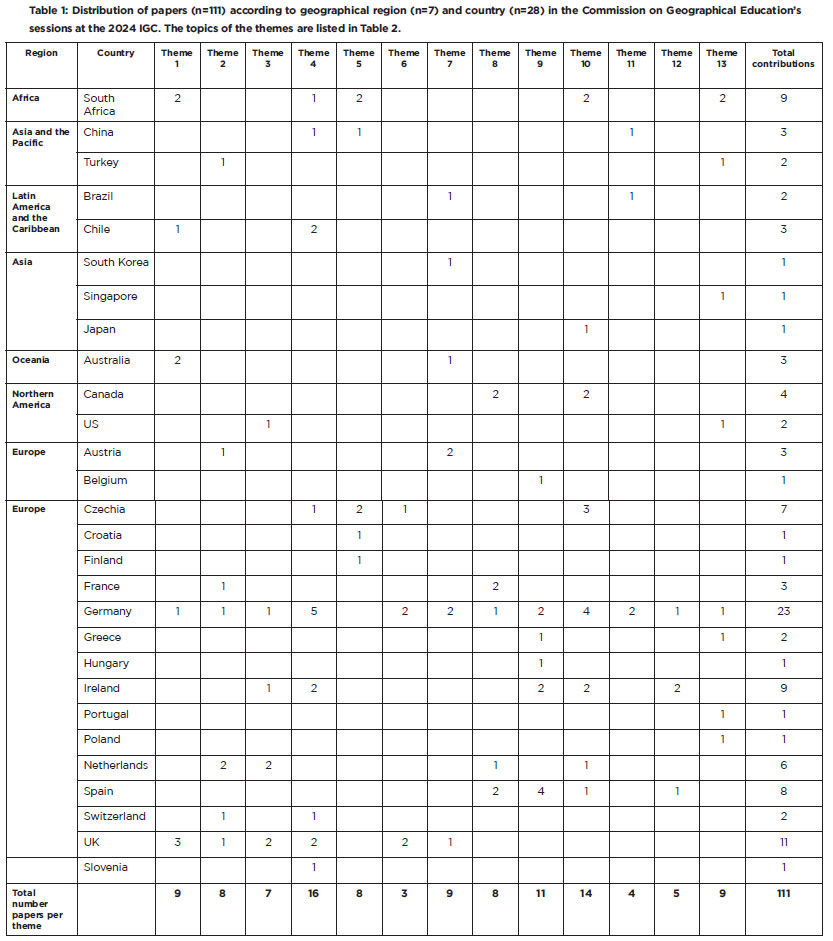
Table 1 shows the source and distribution of the 111 papers presented in the Commission on Geography Education's sessions according to geographical region, the Global North and Global South divide, and the country where the first author's institution is located. In terms of the distribution of papers presented, all regions apart from Antarctica were represented, albeit at different levels of participation. Papers from the Global North (83%) far exceeded those from the Global South (17%), similar to the pattern at recent IGCs. Given the location of the 2024 Congress in Dublin, the high number of papers from European countries (81) (73%) is to be expected. While the largest total national contribution came from Germany (23 papers, 21%), first authors came from another 16 European countries. Ireland, the Congress host country, with a population of 5.2 million, contributed nine papers, the same number as South Africa with a population of 64 million. Relatively few papers (12) came from Oceania, Asia and North America.
The Global South's contribution was low (19 papers, 17%) but not unexpected considering the language, funding, travel and visa challenges experienced by many countries. South Africa had the strongest Global South geography education voice with almost half of the papers (9 of 19) from the five Global South countries present. This shows commitment and active participation in the field of South African researchers.
The Commission on Geographical Education's paper presentations were grouped loosely according to 13 themes (Table 2). The total number of papers per theme varied from three in 'Digital creativity in geography education' (theme 6) to 16 in 'New voices in creative methods to geography education and education for/as sustainable development' (theme 4). The low level of participation in the former was surprising given the rapid technological developments that have taken place since COVID-19 and the emergence of AI tools and applications. One would have expected a greater interest in research on this impact on geography education at all system levels, particularly in secondary school geography and higher education. Two papers in theme 1 focused on assessment and the challenges of ChatGPT and barriers to digital transformation.
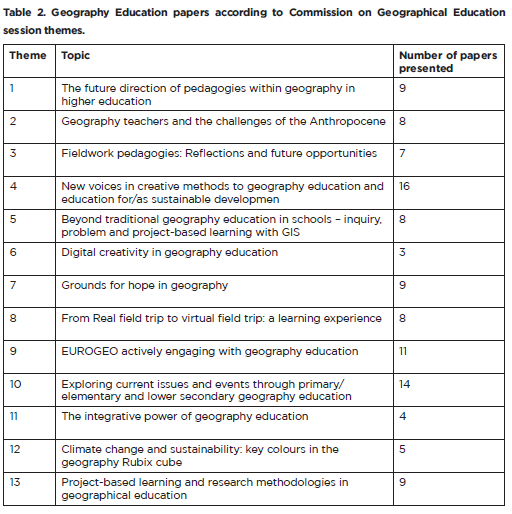
Theme 4 included three papers from the Global South (one of which was from South Africa) and 13 from Europe. This raises the question of why there were no new voices from other regions. 'Exploring current issues and events through primary/elementary and lower secondary geography education' (theme 10) was the second most popular theme.
Papers presented by South African authors were spread across five of the themes: 'Future direction of pedagogies within geography in higher education' (theme 1, two papers), 'New voices in creative methods to geography education and education for/as sustainable development' (theme 4, one paper), 'Beyond traditional geography education in schools - inquiry, problem and project-based learning with GIS' (theme 5, two papers), 'Exploring current issues and events through primary/elementary and lower secondary geography education' (theme 10, two papers), and 'Project-based learning and research methodologies in geographical education' (theme 13, two papers). With six of the nine papers being included in the latter three themes, all of which have a pedagogical focus, one Infers a strong research Interest In teaching about relevant topical Issues and events and active learning approaches. This emergent trend is particularly encouraging given global calls for education that Is relevant and transformative, and the adoption of active learning approaches using different participatory strategies (UNESCO, 2021). The extent to which these papers are concerned with learning and the assessment of learning when using active learning approaches is discussed in the findings of the detailed analysis of the nine South African papers.
South Africa: Geography Educators' contributions to the field
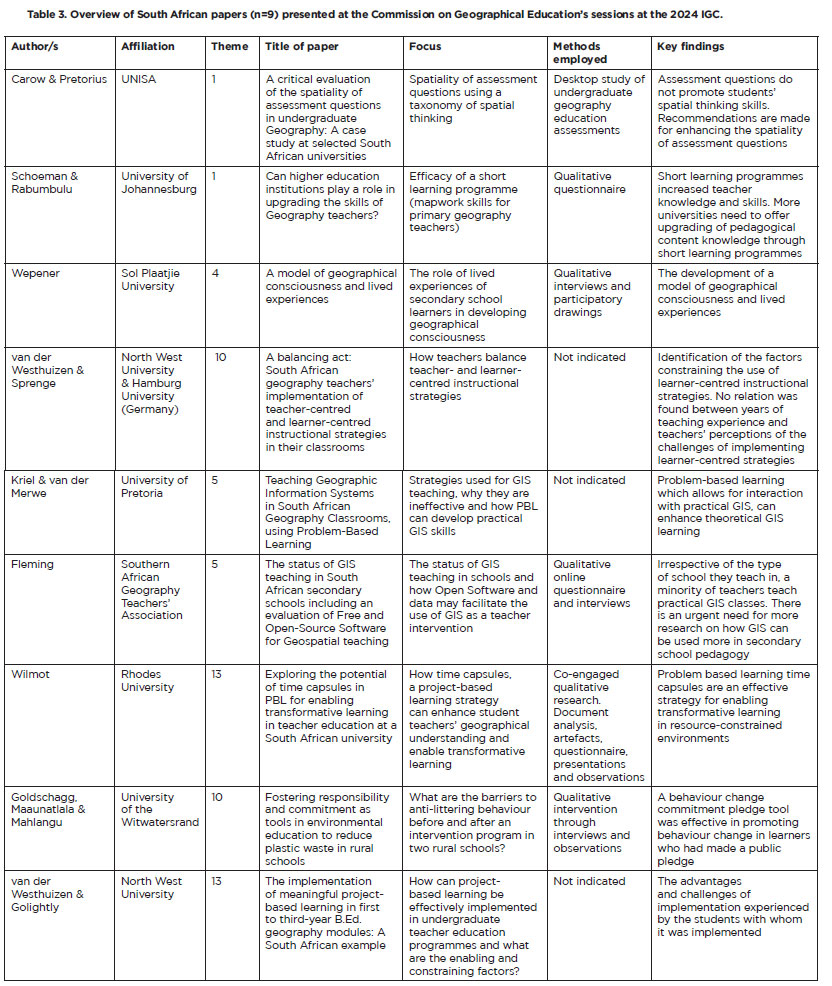
Table 3 provides an overview of the nine South African papers presented. It summarises the different foci of the papers, the sessions in which they were presented, the research method used, and key findings. Only three papers were single-authored with the majority (six) being written in collaboration with a colleague or postgraduate student. None of the student co-authors appeared to be present at the conference, likely due to funding challenges. The 2025 Commission on Geographical Education's conference will be held in Stellenbosch, South Africa, and this will provide an opportunity to bring emerging South African scholars into the international community. This conference may also create new and strengthened collaborations between Higher Education Institutions that offer geography teacher education qualifications and the Southern African Geography Teachers' Association (SAGTA).
Table 3 shows the six universities to which the first authors are affiliated. It raises questions about the state of Geography Education scholarship at other South African universities, particularly the research-intensive ones and those with Education faculties.
Content analysis of the paper abstracts (Table 3) reveals that, apart from that by Carow & Pretorlus, the other papers report on small-scale, case study, qualitative research projects that are context- and content-specific and from which no generalisations may be made. The insights provided are useful for understanding ongoing challenges in Geography Education in South Africa. More research on effective pedagogical content knowledge in Geography teaching and learning is necessary.
Most papers address what Brooks (2018, p.5) calls 'problems of the day' relating to teacher knowledge, skills, and teaching methods. The paper by Schoeman & Rabumbulu considered what role higher education plays in upgrading teachers' skills. This paper suggests that a short course on mapwork offered at their university is successful and may provide the impetus for other universities to design additional short courses. Similarly, the paper by Fleming critically reviewed current methods of teaching GIS in schools and argued for open-source software and data that may facilitate the use of GIS as a teacher intervention. The paper by Kriel & van der Merwe addressed the issue of improving the teaching of GIS using problem-based learning. Teacher capacity for GIS and mapwork teaching are enduring challenges in South African school Geography (Larangeira & van der Merwe, 2016), which negatively impact learner performance in summative assessments including the National Senior Certificate. The paper by van der Westhuizen & Sprenger focused on inadequate teacher capacity for learner-centred teaching methods, another 'problem of the day'.
The nine South African papers are skewed towards teaching and teacher education, with only two focused on learning in geography education - one at a secondary school level (paper by Goldschagg et al.), the other in an undergraduate initial teacher programme (paper by Wilmot). The former explored changing secondary learners' behaviour towards pollution while the latter looked at how time capsules, a simple project-based learning strategy, could enable transformative learning about the place the students call home. This trend mirrored the general trend of foregrounding teaching and teacher education evident at the 2024 Congress.
The paper by Schoeman & Rabumbulu was the only one that focused on teacher education at primary school level. Primary school education, which lays the foundation on which more sophisticated geographical knowledge and skills are built (Hilton & Pellegrino, 2012), did not attract a great deal of attention at the 2024 Congress. Very few papers focused on primary school geography, and those that did were systematic literature reviews, for example of how primary school children deal with fake news and their conceptualisation of sustainable mobility. This should be considered in future research agendas, such as how South African learners develop geographical knowledge and deal with risk and uncertainty.
Undoubtedly, the nine South African Geography Education papers presented at the 2024 Congress contribute to the field, albeit with mostly small-scale empirical studies focused on 'problems of the day'. However, the extent to which they advance the field is a moot point. Wepener's theoretical paper offers a model for understanding how secondary learners' lived experiences shape their geographical consciousness, and Wilmot's paper on transformative learning also performs this role.
This overview of the 2024 Congress is inevitably partial and incomplete and there may well be rich evidence outside the congress of how South African Geography Education scholarship is pushing the field forward. A more extensive review of research outputs is needed to uncover how this may be happening, and we recommend that this role is considered when setting a future research agenda, particularly at the doctoral level.
CONCLUSIONS
This paper provides insights on how South African Geography educators are contributing to the field from the perspective of the 2024 IGC. The insights provided herein are partial and incomplete and more extensive work is required in understanding the theoretical frameworks, research methods, and issues being addressed in contemporary South African Geography Education scholarship. Future research into pedagogical content knowledge, fieldwork, and transformative education will shape the discourse in Geography Education going forward.
REFERENCES
Bagoly-Simó, P., & Kriewaldt, J. (2023). Future geography teachers for the planet. Powerful (disciplinary) knowledge and education for sustainable development (ESD) in initial teacher education (ITE). International Research in Geographical and Environmental Education, 32(1), 1-3. [ Links ]
Botha, S. (2024). Environment issues neglected by powers that be, says concerned Makhanda citizen. Available at https://grocotts.ru.ac.za/2024/03/07/environment-issues-neglected-by-powers-that-be-says-concerned-makhanda-citizen/.
Brooks, C. (2018). Insights on the field of geography education from a review of master's level practitioner research. International Research in Geographical and Environmental Education, 27(1), 5-23. [ Links ]
Chang, C.-H., & Kidman, G. (2023). The rise of generative artificial intelligence (AI) language models - challenges and opportunities for geographical and environmental education. International Research in Geographical and Environmental Education, 32(2), 85-89. [ Links ]
Chang, C.-H., & Kidman, G. (2024a). Celebrating a world of difference - how geographical and environmental education will help. International Research in Geographical and Environmental Education, 33(3), 173-176. [ Links ]
Chang, C.-H., & Kidman, G. (2024b). Teacher identity and geographical & environmental education: why it matters. International Research in Geographical and Environmental Education, 33(4), 261-266. [ Links ]
Day, T., Chang, I. C. C., Chung, C. K. L., Doolittle, W. E., Housel, J., & McDaniel, P. N. (2021). The immediate impact of COVID-19 on postsecondary teaching and learning. The Professional Geographer, 73(1), 1-13. [ Links ]
du Preez, P., & Le Grange, L. (2020). The COVID-19 pandemic, online teaching/learning, the digital divide and epistemological access. In: Ramrathan, L., Ndimande-Hlongwa, N., Mkhize, N., & Smit, J.A. (eds), Re-thinking the Humanities Curriculum in the Time of COVID-19. CSSALL, Durban, pp. 90-106.
Fitchett, J. (2023). Southern Africa must brace itself for more tropical cyclones in future. Available at https://theconversation.com/southern-africa-must-brace-itself-for-more-tropical-cyclones-in-future-103641.
Hilton, M. L., & Pellegrino, J. W. (eds) (2012). Education for life and work: Developing transferable knowledge and skills in the 21st century. National Academies Press, Washington DC.
IPCC (2023). Summary for Policymakers. In: Climate Change 2023: Synthesis Report. Contribution of Working Groups I, II and III to the Sixth Assessment Report of the Intergovernmental Panel on Climate Change. IPCC, Geneva, pp. 1-34.
Johnston, P. (2024). Climate change makes life harder: in South Africa it's likely to bring heatwaves, water stress and gender-based violence. Available at https://theconversation.com/climate-change-makes-life-harder-in-south-africa-its-likely-to-bring-heatwaves-water-stress-and-gender-based-violence-226937.
Kidman, G., & Chang, C.-H. (2020). What does 'crisis' education look like? International Research in Geographical and Environmental Education, 29(2), 107-111. [ Links ]
Knight, J. (2021). Assessment practices in Geography under COVID-19. The Journal of Geography Education in Africa, 4(1), 1-22. [ Links ]
Larangeira, R., & van der Merwe, C.D. (2016). Map literacy and spatial cognition challenges for student teachers in South Africa. Perspectives in Education, 34(2), 120-138. [ Links ]
le Grange, L. (2019). Different voices on decolonising of the curriculum. In: De Beer, J. (ed), The decolonisation of the curriculum project: The affordances of indigenous knowledge for self-directed learning. NWU Self-Directed Learning Series Volume 2. AOSIS, Cape Town, pp. 25-47.
Lotz-Sisitka, H., & Lupele, J. (2017). ESD, Learning and Quality Education in Africa: Learning today for tomorrow. In: Lotz-Sisitka, H., Shumba, O., Lupele, J., & Wilmot, D. (eds), Schooling for Sustainable Development in Africa. Springer, Dordrecht, pp. 3-25.
Lotz-Sisitka, H., Mandikonza, C., Misser, S., & Thomas, K. (2021). Making Sense of Climate Change in a National Curriculum. In: Schudel, I., Songqwaru, Z., Tshiningayamwe, S., & Lotz-Sisitka, H. (eds), Teaching and Learning for Change: Education and Sustainability in South Africa. African Minds, Somerset West, pp. 92-112.
Lotz-Sisitka, H., Schudel, I., Wilmot, D., Songqwaru, Z., O'Donoghue, R., & Chikunda, C. (2022). Transformative Learning for Teacher Educators: Making sense of Education for Sustainable Development (ESD) policy emphasis on transformative education. In: Eberth, A., Goller, A., Günther, J., Hanke, M., Holz, V., Krug, A., Roncévic, K., & Singer- Brodowski, M. (eds), Bildung für nachhaltige Entwicklung - Aktuelle Impulse zu Digitalisierung, Inklusion und Klimaschutz. Barbara Budrich. Opladen, pp. 267-296.
Sheridan, C. (2024). Johannesburg's water crisis is getting worse - expert explains why the taps keep running dry in South Africa's biggest city. Available at https://theconversation.com/johannesburgs-water-crisis-is-getting-worse-expert-explains-why-the-taps-keep-running-dry-in-south-africas-biggest-city-223926.
Schewe, J. (2013). Water supply will struggle to meet demands of thirstier world. Available at https://theconversatlon.com/water-supply-wlll-struggle-to-meet-demands-of-thlrstler-world-21658.
UNESCO (2021). International commission on the futures of education report. Reimagining our futures together: A new social contract for education. UNESCO, Paris.
Vogel, C., Misser, S., & Vallabh, P. (2013). Teaching Climate Change. Fundisa for Change Programme. Environmental Learning Research Centre, Rhodes University, Grahamstown.
Wilmot, D., & Brooks, C. (2023). Addressing global challenges in geographical education: Perspectives from the CGE Springer book series. Journal of International Research in Geographical and Environmental Education, 33(3), 193-209. [ Links ]
Received 17 October 2024
Accepted 20 February 2025
Published 4 March 2025