



Services on Demand
Journal

Article
 English (pdf)
 Article in xml format
 Article references

 Automatic translation
 Send this article by e-mail
Indicators
Related links
-
 Cited by Google
-
 Similars in Google
Share

 Permalink

Wits Journal of Clinical Medicine
On-line version ISSN 2618-0197Print version ISSN 2618-0189
WJCM vol.8 n.2 Johannesburg 2026
https://doi.org/10.18772/26180197.2026.v8n2a4
REVIEW ARTICLE
Single-pill combination antihypertensive therapy for adults in sub-Saharan Africa: a clinically oriented narrative review
Francis Agyekum; Florence Koryo Akumiah; Vincent Boima; Dwomoa Adu
Department of Medicine and Therapeutics, University of Ghana Medical School, College of Health Sciences, University of Ghana
ABSTRACT
Hypertension is the leading modifiable risk factor for cardiovascular disease in Sub-Saharan Africa (SSA) and a primary driver of stroke, the dominant hypertension-related endpoint in the sub-region. Despite the high prevalence, control and treatment rates remain critically low, with monotherapy persisting as the default initial prescription in many settings even though most patients require two or more agents for adequate blood pressure control. Single-pill combinations (SPCs) offer a pharmacologically rational and operationally simpler alternative; they reduce pill burden, improve adherence, and shorten time to blood pressure control. This narrative review examines the pharmacological reasoning, evidence for regimen selection, and clinical decision content most relevant to practising clinicians in SSA. We summarise the pathophysiological rationale for combination-first therapy in African populations, the regional trial evidence, the case for indapamide over hydrochlorothiazide, and a practical patient-archetype framework for SPC selection. The implementation, supply chain, and economic dimensions are summarised briefly. We conclude that combination-first therapy with an amlodipine-anchored SPC is a reasonable default for most adults with hypertension in SSA, and that indapamide is preferable to hydrochlorothiazide where available. For patients with diabetes or proteinuric chronic kidney disease, an angiotensin receptor blocker (ARB)- or angiotensin-converting enzyme inhibitor-based combination is appropriate, with monitoring of creatinine and potassium; where dual therapy at standard doses fails, progression to low-dose triple single-pill therapy should precede up-titration to maximally tolerated doses.
Keywords: hypertension; single-pill combination; fixed-dose combination; sub-Saharan Africa; dual antihypertensive therapy
INTRODUCTION
Hypertension is the leading modifiable risk factor for cardiovascular disease worldwide and the dominant driver of stroke, ischaemic heart disease, and chronic kidney disease in SSA.(1) The age-standardised prevalence of hypertension among adults in the World Health Organisation (WHO) Africa Region exceeds 27%, with estimates as high as 46% among adults aged 25 years and over.(2,3) Control rates remain critically low. The WHO Global Hypertension Report 2025 found that, of an estimated 1.4 billion adults aged 30-79 years living with hypertension worldwide in 2024, fewer than one in five (approximately 23% had their BP controlled below 140/90 mmHg, and 99 countries, including the majority of those in SSA, had national control rates below 20%.(4,5) In several SSA countries, the proportion controlled is closer to one in ten, a position that has changed little over the past two decades.(2,6)
The disease burden is dominated by stroke.(7) Ischaemic stroke is the more common subtype across SSA, accounting for approximately two-thirds of cases in the Stroke Investigative Research and Education Network (SIREN) African cohorts.(8) Still, the proportion of haemorrhagic stroke (approximately one-third) is substantially higher than in high-income populations (where it is approximately one-tenth), and 87% of these haemorrhagic strokes in SIREN were attributed to hypertension by the Structural lesion, Medication, Amyloid angiopathy, Systemic disease, Hypertension, Undetermined (SMASH-U) classification.(8) Stroke presents at younger ages and with greater severity in African than in high-income populations and accounts for a disproportionate share of cardiovascular mortality and disability across the region.(7,8)
Monotherapy remains the default initial prescription in many SSA primary-care settings, yet the great majority of patients require two or more antihypertensive agents for adequate BP control.(4,9) Relying on monotherapy compounds two distinct problems. The first is therapeutic inertia during titration. The tendency for both clinicians and patients to prefer slow up-titration of a single agent rather than progress promptly to combination therapy. The second is the related but distinct failure to intensify treatment when a control target is not reached at a follow-up visit.(10) Single-pill combinations (SPCs), in which two, three, or four antihypertensive agents are formulated in a single tablet, address both problems by collapsing the titration ladder into a single prescribing decision and by reducing the pill burden that erodes long-term adherence.(11,12) Recent international and regional guidelines, including the 2021 WHO pharmacological treatment guideline, the 2020 International Society of Hypertension (ISH) global practice guidelines, the Pan-African Society of Cardiology (PASCAR) hypertension roadmap, the 2023 European Society of Hypertension (ESH) practice guidelines, the 2024 European Society of Cardiology (ESC) guideline on elevated blood pressure and hypertension, and the 2025 ACC/AHA multisociety guideline, now recommend combination-first therapy for most adults with stage 2 hypertension or with stage 1 hypertension at high cardiovascular risk.(13-18)
This narrative review distils the pharmacological reasoning, regimen-selection evidence, and clinical-decision content most relevant to practising clinicians in SSA. Implementation, supply chain, and health-economic dimensions are addressed only briefly here, to the extent needed to make the clinical recommendations actionable; a fuller treatment of those dimensions is beyond the scope of this review. The present review is reported in line with the Scale for the Assessment of Narrative Review Articles (SANRA) quality framework.(19)
METHODS
This is a structured narrative review. PubMed/MEDLINE, Embase, and the Cochrane Library were searched from inception using combinations of the terms "hypertension", "single pill combination", "fixed-dose combination", and "sub-Saharan Africa" or the names of individual African countries. The reference lists of identified articles and of recent international and regional guidelines (WHO 2021, ISH 2020, ESH 2023, ESC 2024, ACC/AHA 2025, PASCAR 2017, South African Hypertension Practice Guideline 2014) were hand-searched. Randomised controlled trials with sub-Saharan African participants, systematic reviews and meta-analyses, regional cohort studies, and authoritative guidelines were prioritised, with greater weight given to evidence directly applicable to sub-Saharan African primary-care practice. This review is structured rather than systematic; it does not aim to enumerate all records identified in the database searches but to draw on the evidence most directly relevant to clinical decision-making in sub-Saharan Africa. Forty sources are cited. The review was developed to meet all six SANRA quality criteria.(19)
PHARMACOLOGICAL RATIONALE FOR COMBINATION-FIRST THERAPY IN AFRICAN POPULATIONS
The pathophysiology of hypertension in populations of African descent has classically been described as low-renin and salt-sensitive, with implications for first-line drug class selection.(20,21) This characterisation is broadly correct but should not be applied uniformly. Renin profiling within African cohorts demonstrates considerable heterogeneity, including a substantial subgroup with normal- or high-renin profiles and another with resistant hypertension that does not fit a simple volume-overload model.(22) The clinically actionable implication is not that renin-angiotensin system (RAS) blockers are ineffective in African patients but that they should rarely be used as monotherapy in this population. A calcium channel blocker (CCB) or a thiazide-like diuretic is a more reliable anchor for first-line therapy because both classes target the salt-sensitive, volume-dependent component that predominates.(20,22)
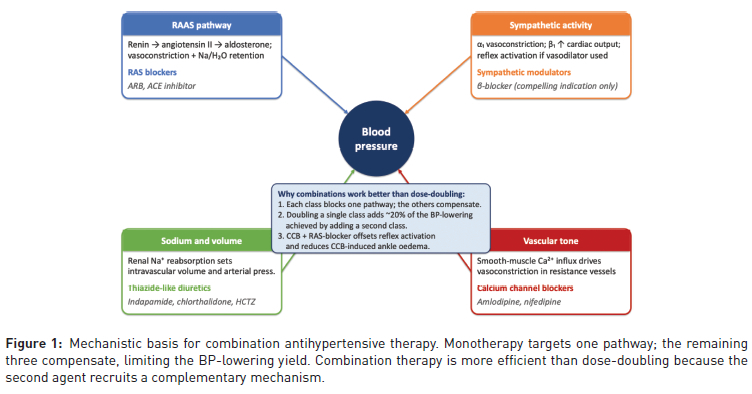
Several interacting mechanisms regulate blood pressure: the renin-angiotensin-aldosterone system, sympathetic nervous activity, sodium and volume handling, and vascular tone; such that targeting any single pathway with monotherapy leaves the others unopposed (Figure 1). Combination therapy outperforms dose-doubling of monotherapy because the second agent employs a complementary mechanism rather than amplifying a single one. Dose-response relationships for each antihypertensive class are flat at standard doses; the BP-lowering yield from doubling the dose of any monotherapy is approximately 20% of the yield from adding a second agent at standard dose.(23) A CCB combined with a RAS blocker is the most pharmacologically efficient pairing: the CCB delivers arterial vasodilation and natriuresis while the RAS blocker offsets the reflex sympathetic activation that limits CCB efficacy and mitigates CCB-induced ankle oedema by venodilation of the post-capillary circulation.(24) A CCB combined with a thiazide-like diuretic provides a similar synergy through complementary volume reduction and vasodilation, with the additional benefit of long-acting BP control when indapamide is used. RAS-blocker plus thiazide-diuretic combinations are pharmacologically coherent but are the least effective of the three pairings in Black African patients, as the CREOLE trial demonstrated directly.(25)
TRIAL EVIDENCE IN AFRICAN COHORTS: WHAT CREOLE TELLS US
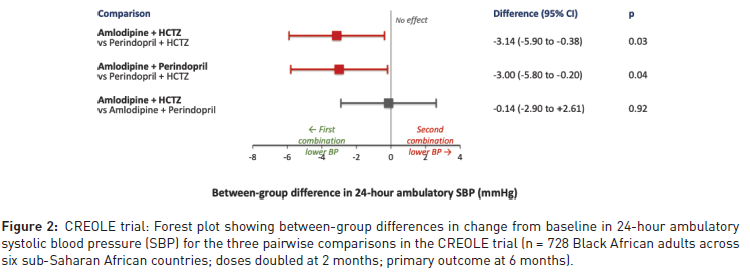
The Comparison of Three Combination Therapies in Lowering Blood Pressure in Black Africans (CREOLE) trial is the most clinically informative randomised trial of dual SPC strategies conducted in the region.(25) CREOLE randomised 728 Black African adults with uncontrolled hypertension across six SSA countries to one of three dual regimens: amlodipine plus hydrochlorothiazide (HCTZ), amlodipine plus perindopril, or perindopril plus HCTZ. Each agent was administered at a standard dose for two months, then doubled for a further four months, with 24-hour ambulatory BP at six months as the primary endpoint. Both amlodipine-containing regimens reduced 24-hour ambulatory systolic BP more than perindopril plus HCTZ, by approximately 3 mmHg for amlodipine plus HCTZ and 1.8 mmHg for amlodipine plus perindopril at standard doses, with similar findings on office and home BP, and there was no statistically significant difference between the two amlodipine-containing arms (Figure 2).(25) The actionable conclusion is that an amlodipine-anchored dual SPC should be the default first-line combination in Black African adults, with the partner agent chosen based on comorbidity and tolerability rather than potency. CREOLE measured blood-pressure lowering rather than cardiovascular outcomes, which should be borne in mind when generalising this recommendation.
Secondary analyses of CREOLE have refined the picture. A pre-specified sex analysis reported greater BP reductions in women than in men, with women more likely to achieve target BP at six months across all three regimens.(26) A post-hoc analysis of dipping patterns demonstrated that non-dipping nocturnal BP was common at baseline (in over 70% of participants) and partially improved with effective combination therapy, reinforcing the case for ambulatory or home BP monitoring in this population where feasible.(27) A network meta-analysis of pharmacotherapy trials in SSA, including CREOLE, supports the same hierarchy and emphasises that the choice between CCB+diuretic and CCB+RAS-blocker is best individualised by comorbidity profile.(28)
Trial evidence from other regions extends rather than contradicts the CREOLE message. The Anglo-Scandinavian Cardiac Outcomes Trial-Blood Pressure Lowering Arm (ASCOT-BPLA) legacy supports the use of amlodipine-based regimens to reduce cardiovascular events in mixed populations.(29) The Triple Pill vs Usual care Management for Patients with mild-to-moderate Hypertension (TRIUMPH) trial of a low-dose triple SPC in Sri Lanka demonstrated superiority of triple-pill therapy over usual care for time to BP control.(11) A meta-analysis of dual-combination therapy as initial treatment supports the same combination-first principle across populations.(30) The Quadruple Ultralow-dose treatment for Hypertension (QUARTET) Trial of an ultra-low-dose quadruple SPC (irbesartan 37.5 mg, amlodipine 1.25 mg, indapamide 0.625 mg, bisoprolol 2.5 mg) showed superior BP control versus standard-dose monotherapy with no excess adverse events, with effects sustained at 12 months.(31)
CHOOSING THE SPC: SUGGESTED CLINICAL DECISION FRAMEWORK FOR SUB-SAHARAN AFRICAN PRACTICE
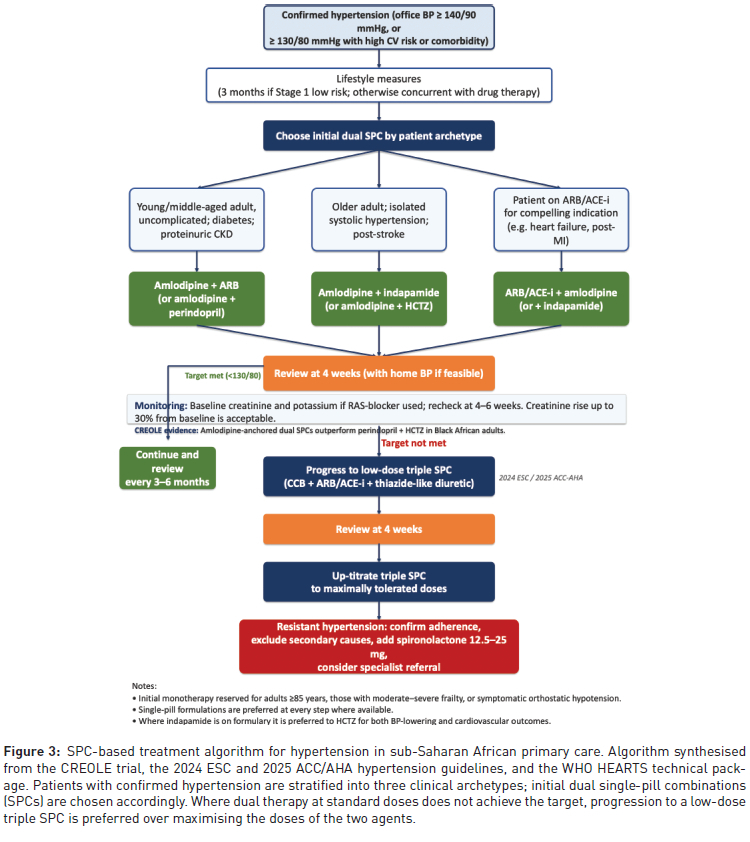
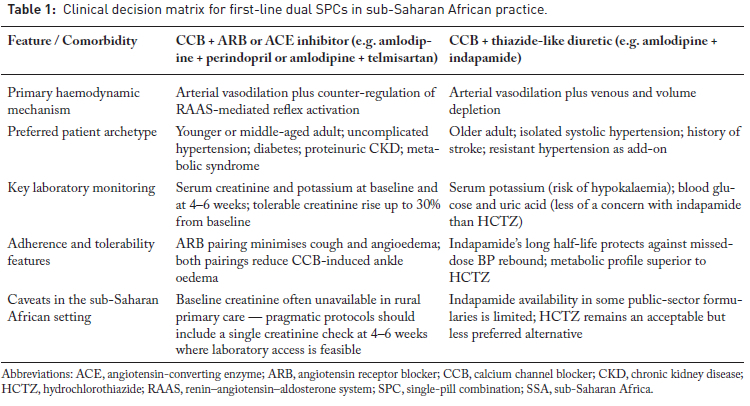
In outpatient practice in sub-Saharan Africa, most patients requiring SPC therapy fall into one of three clinical archetypes. The framework below is summarised in Figure 3 and Table 1 and is intended to support, not replace, clinical judgment.
The young- or middle-aged adult with uncomplicated hypertension is best served by amlodipine combined with either an angiotensin receptor blocker (ARB, e.g. losartan, telmisartan, valsartan) or an angiotensin-converting enzyme (ACE) inhibitor (lisinopril, ramipril, or perindopril). The ARB pairing is preferred where ACE-inhibitor cough is a concern; perindopril remains a reasonable choice where ARBs are not on the local formulary, given that it was the ACE inhibitor tested in the CREOLE trial. CCB-induced ankle oedema, the principal limiting side effect, is mitigated by the addition of an ARB or ACE inhibitor through venous dilation.
The older patient with isolated systolic hypertension, or with a history of stroke, is best served by amlodipine plus a thiazide-like diuretic, with indapamide preferred to HCTZ where available. This preference must, however, be weighed against availability: hydrochlorothiazide is the diuretic included in most African essential medicines lists and fixed-dose combinations, and was used in CREOLE; it is frequently cheaper, so hydrochlorothiazide remains an entirely acceptable choice where indapamide is not reliably accessible. Head-to-head evidence supports indapamide and chlorthalidone over HCTZ for both BP lowering and surrogate outcomes, including reductions in left ventricular mass.(32,33) Pooled analyses of trials of indapamide-based regimens in patients with type 2 diabetes mellitus, predominantly with perindopril, demonstrate significant reductions in all-cause mortality and stroke in older patients.(34) Indapamide's longer half-life also confers a practical advantage in settings where missed doses are common.
The patient with diabetes or proteinuric chronic kidney disease (CKD) should receive an ARB- or ACE-inhibitor-based SPC, paired with amlodipine for additional BP lowering. Two cautions apply in the sub-Saharan African setting. First, baseline creatinine and potassium should be checked before initiation and at four to six weeks, particularly important in West and Southern African populations where APOL1 risk variants contribute to chronic kidney disease, including a strong association with HIV-associated nephropathy.(35) Second, the modest creatinine rise that follows RAS-blocker initiation should not lead to immediate discontinuation, as an increase of up to 30% from baseline that subsequently stabilises is consistent with appropriate renal autoregulation rather than nephrotoxicity. Where dual therapy at standard doses does not achieve the target, current 2024 ESC and 2025 ACC/AHA guidelines recommend progressing to low-dose triple therapy (typically by adding a thiazide-like diuretic to the CCB and RAS-blocker base, preferably as a single triple pill) before up-titrating to maximally tolerated doses, to expedite BP control and minimise dose-related adverse effects. Both are high-income-country guidelines; the low-dose triple step is therefore an extrapolation to the sub-Saharan African setting rather than a regionally derived recommendation, although it is consistent with the combination-first orientation of the PASCAR roadmap and the WHO HEARTS protocols, neither of which specifies this step directly.(17,18)
IMPLEMENTATION AND ACCESS REALITIES: A BRIEF SYNTHESIS
Translation of trial evidence into population-level BP control depends on three contextual factors, which are summarised here at the level needed for clinical practice. First, SPC availability is shaped by inclusion on national essential medicines lists (EMLs); the 2020 South African EML lists amlodipine, perindopril, enalapril, hydrochlorothiazide, and indapamide as individual agents, but fixed-dose combination antihypertensives have entered the EML more slowly than the trial evidence justifies.(36) Second, the cost of an SPC to the patient or to the public-sector payer is generally higher than the cost of the equivalent free combination (the same two drugs taken as two separate tablets), although price differentials narrow substantially when SPCs are procured at scale and locally manufactured. Third, the prescribing behaviour change that SPCs enable is realised only when standardised, simplified titration protocols are in place. The Nigerian HEARTS programme demonstrated that the prescribing of SPCs rose from 16% to 65% after the introduction of such a protocol, and similar effects have been reported across the Global HEARTS initiative (Figure 4).(37,38)
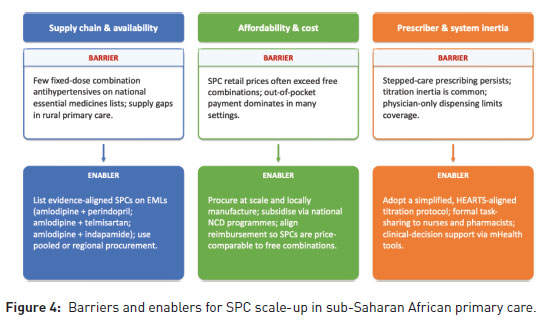
Three implementation actions follow from this framework. First, evidence-aligned SPCs should be prioritised on the South African EDL and equivalent national essential medicines lists but supported by pooled or regional procurement to ensure reliable availability, particularly in rural primary care. Secondly, the affordability of these SPC's must be addressed through price negotiation, scaled procurement and local manufacture where feasible. Third, prescriber and system inertia should be reduced through a simplified, HEARTS-aligned titration protocol and task-sharing with nurses and pharmacists.(38,39) Together, these actions would move SPCs from guideline recommendation to practical, equitable implementation in low- and middle-income settings.
EMERGING DIRECTIONS
Two developments are likely to reshape SPC practice within the next five years. The first is the low-dose quadruple combination ("quadpill"). The Quadruple Ultra-low-dose treatment for Hypertension (QUARTET) trial demonstrated that an ultra-low-dose quadruple combination delivered superior BP control compared with standard-dose monotherapy without an excess of adverse events.(31) A quadpill formulation that approaches monotherapy doses while still employing four complementary mechanisms may be particularly suited to primary-care settings where titration is constrained by clinic visit frequency. Trials of similar quarter-dose strategies in SSA populations are in development and warrant close attention. The second development is the integration of SPCs with low-cost digital adherence and monitoring tools. SMS-based adherence reminders, automated home BP monitoring, and pharmacist-led digital titration support have each shown signals in resource-constrained settings, and pairing an SPC strategy with a digital adjunct is a logical next step given the rapid expansion of mobile phone penetration across the region.(40)
KEY STATEMENTS FROM THIS REVIEW
-
For adults with hypertension in sub-Saharan Africa, single-pill combinations should be the default first-line strategy for stage 2 hypertension and for stage 1 hypertension at high cardiovascular risk.
-
The CREOLE trial supports amlodipine as the anchor agent in dual SPCs for Black African patients
-
Indapamide is preferred over hydrochlorothiazide where available, given superior blood pressure lowering at equivalent doses, a better metabolic profile, and a longer half-life
-
Where dual therapy at standard doses fails to achieve the target, progression to a low-dose triple SPC is preferred in line with current 2024 ESC and 2025 ACC/AHA guidance.
-
Wider SPC uptake in sub-Saharan Africa depends on inclusion in essential medicines lists, simplified titration protocols, and task-shifting to nurses and pharmacists in primary care.
LIMITATIONS
This review has limitations. The narrative design means selection of evidence was guided but not systematic; we cannot claim that all relevant studies were identified. The number of randomised trials conducted in sub-Saharan African cohorts remains small, and our key inferences for African patients rest principally on CREOLE and a small set of related trials. The Creole trial included patients from only 6 countries in SSA, and because the SSA population is highly heterogeneous, unexplored selection bias may be present.
CONCLUSIONS AND IMPLICATIONS FOR SUB-SAHARAN AFRICAN PRACTICE
Hypertension control in sub-Saharan Africa will not improve substantially if treatment relies on slow, stepwise monotherapy. The clinical burden is large, and the predominance of stroke as a hypertension-related endpoint makes earlier and more reliable blood pressure control a priority. Single-pill combination therapy offers a practical way to address both pharmacological complexity and health-system limitations by improving adherence, reducing therapeutic inertia, and shortening the time to effective control.
For most adults with hypertension in sub-Saharan Africa, an amlodipine-anchored dual single-pill combination should be regarded as the preferred default strategy. The choice of partner drug should be individualised: an ARB or ACE inhibitor is appropriate for younger patients and for those with diabetes, proteinuric chronic kidney disease, or metabolic risk, while a thiazide-like diuretic is more attractive in older patients, isolated systolic hypertension, prior stroke, or volume-dependent phenotypes. Where available and affordable, indapamide is preferred to hydrochlorothiazide because of its longer duration of action, stronger antihypertensive profile, and more favourable metabolic profile.
The evidence base from sub-Saharan Africa remains limited, and further confirmatory African-based trials, pharmacoeconomic studies, and implementation studies are needed. The important challenge is therefore not only evidentiary, but operational. National formularies, procurement systems, and primary-care protocols must align with the available evidence. Wider adoption of evidence-based single-pill combinations, supported by simplified titration pathways and nurse- or pharmacist-led follow-up, could represent one of the most immediately actionable strategies to reduce uncontrolled hypertension, stroke, kidney disease, and premature cardiovascular mortality across the region.
Author contributions: FA conceptualisation, methodology, writing (original draft, review and editing), supervision. FKA conceptualisation, writing (original draft, review and editing). VB writing (review and editing), validation. DA writing (review and editing). All authors approved the final version.
Conflict of interest: The authors declare no conflicts of interest.
Funding: This review received no funding.
REFERENCES
1. Schutte AE, Srinivasapura Venkateshmurthy N, Mohan S, Prabhakaran D. Hypertension in low- and middle-income countries. Circ Res. 2021; 128(7):808-826. doi:10.1161/CIRCRESAHA.120.318729. [ Links ]
2. Mills KT, Stefanescu A, He J. The global epidemiology of hypertension. Nat Rev Nephrol. 2020; 16(4):223-237. doi:10.1038/s41581-019-0244-2. [ Links ]
3. Adeloye D, Basquill C. Estimating the prevalence and awareness rates of hypertension in Africa: a systematic analysis. PLoS One. 2014; 9(8):e104300. doi:10.1371/journal.pone.0104300. [ Links ]
4. NCD Risk Factor Collaboration. Worldwide trends in hypertension prevalence and progress in treatment and control from 1990 to 2019: a pooled analysis of 1201 population-representative studies with 104 million participants. Lancet. 2021; 398(10304):957-980. doi:10.1016/S0140-6736(21)01330-1. [ Links ]
5. World Health Organization. Global report on hypertension 2025: high stakes - turning evidence into action. Geneva: World Health Organization; 2025. [ Links ]
6. Ataklte F, Erqou S, Kaptoge S, et al. Burden of undiagnosed hypertension in sub-Saharan Africa: a systematic review and meta-analysis. Hypertension. 2015; 65(2):291-298. doi:10.1161/HYPERTENSIONAHA.114.04394. [ Links ]
7. GBD 2019 Stroke Collaborators. Global, regional, and national burden of stroke and its risk factors, 1990-2019. Lancet Neurol. 2021; 20(10):795-820. doi:10.1016/S1474-4422(21)00252-0. [ Links ]
8. Owolabi MO, Sarfo F, Akinyemi R, et al; SIREN Team. Dominant modifiable risk factors for stroke in Ghana and Nigeria (SIREN): a case-control study. Lancet Glob Health. 2018; 6(4):e436-e446. doi:10.1016/S2214-109X(18)30002-0. [ Links ]
9. Cohn J, Pickering R, Roa C, et al. Addressing failures in achieving hypertension control in low- and middle-income settings through simplified treatment algorithms. Glob Heart. 2022; 17(1):28. doi:10.5334/gh.1082. [ Links ]
10. Phillips LS, Branch WT, Cook CB, et al. Clinical inertia. Ann Intern Med. 2001; 135(9):825-834. doi:10.7326/0003-4819-135-9-200111060-00012. [ Links ]
11. Webster R, Salam A, de Silva HA, et al; TRIUMPH Study Group. Fixed low-dose triple combination antihypertensive medication vs usual care for blood pressure control in patients with mild to moderate hypertension in Sri Lanka: the TRIUMPH randomized clinical trial. JAMA. 2018; 320(6):566-579. doi:10.1001/jama.2018.10359. [ Links ]
12. Sherrill B, Halpern M, Khan S, Zhang J, Panjabi S. Single pill vs free-equivalent combination therapies for hypertension: a meta-analysis of healthcare costs and adherence. J Clin Hypertens (Greenwich). 2011; 13(12):898-909. doi:10.1111/j.1751-7176.2011.00550.x. [ Links ]
13. World Health Organization. Guideline for the pharmacological treatment of hypertension in adults. Geneva: WHO; 2021. [ Links ]
14. Unger T, Borghi C, Charchar F, et al. 2020 International Society of Hypertension global hypertension practice guidelines. J Hypertens. 2020; 38(6):982-1004. doi:10.1097/HJH.0000000000002453. [ Links ]
15. Dzudie A, Rayner B, Ojji D, et al. Roadmap to achieve 25% hypertension control in Africa by 2025. Cardiovasc J Afr. 2017; 28(4):261-273. doi:10.5830/CVJA-2017-040. [ Links ]
16. Mancia G, Kreutz R, Brunström M, et al. 2023 ESH Guidelines for the management of arterial hypertension. J Hypertens. 2023; 41(12):1874-2071. doi:10.1097/HJH.0000000000003480. [ Links ]
17. McEvoy JW, McCarthy CP, Bruno RM, et al. 2024 ESC Guidelines for the management of elevated blood pressure and hypertension. Eur Heart J. 2024; 45(38):3912-4018. doi:10.1093/eurheartj/ehae178. [ Links ]
18. Jones DW, Ferdinand KC, Taler SJ, et al; 2025 AHA/ACC/AANP/AAPA/ABC/ACCP/ACPM/AGS/AMA/ASPC/NMA/PCNA/SGIM guideline for the prevention, detection, evaluation and management of high blood pressure in adults. J Am Coll Cardiol. 2025; 86(18):1567-1678. doi:10.1016/j.jacc.2025.05.007 [ Links ]
19. Baethge C, Goldbeck-Wood S, Mertens S. SANRA - a scale for the quality assessment of narrative review articles. Res Integr Peer Rev. 2019; 4:5. doi:10.1186/s41073-019-0064-8. [ Links ]
20. Brewster LM, Seedat YK. Why do hypertensive patients of African ancestry respond better to calcium blockers and diuretics than to ACE inhibitors and β-adrenergic blockers? A systematic review. BMC Med. 2013; 11:141. doi:10.1186/1741-7015-11-141. [ Links ]
21. Rayner BL, Spence JD. Hypertension in blacks: insights from Africa. J Hypertens. 2017; 35(2):234-239. doi:10.1097/HJH.0000000000001171. [ Links ]
22. Spence JD, Rayner BL. Hypertension in blacks: individualized therapy based on renin/aldosterone phenotyping. Hypertension. 2018; 72(2):263-269. doi:10.1161/HYPERTENSIONAHA.118.11064. [ Links ]
23. Wald DS, Law M, Morris JK, Bestwick JP, Wald NJ. Combination therapy versus monotherapy in reducing blood pressure: meta-analysis on 11,000 participants from 42 trials. Am J Med. 2009; 122(3):290-300. doi:10.1016/j.amjmed.2008.09.038. [ Links ]
24. Makani H, Bangalore S, Romero J, Wever-Pinzon O, Messerli FH. Effect of renin-angiotensin system blockade on calcium channel blocker-associated peripheral oedema. Am J Med. 2011; 124(2):128-135. doi:10.1016/j.amjmed.2010.08.007. [ Links ]
25. Ojji DB, Mayosi B, Francis V, et al; CREOLE Study Investigators. Comparison of dual therapies for lowering blood pressure in Black Africans. N Engl J Med. 2019; 380(25):2429-2439. doi:10.1056/NEJMoa1901113. [ Links ]
26. Ojji DB, Shedul GL, Sani M, et al. A differential response to antihypertensive therapy in African men and women: insights from the CREOLE trial. Am J Hypertens. 2022; 35(6):551-560. doi:10.1093/ajh/hpac014. [ Links ]
27. Ingabire PM, Ojji DB, Rayner B, et al; CREOLE Study Investigators. High prevalence of non-dipping patterns among Black Africans with uncontrolled hypertension: a secondary analysis of the CREOLE trial. BMC Cardiovasc Disord. 2021; 21:254. doi:10.1186/s12872-021-02074-7 [ Links ]
28. Seeley A, Prynn J, Perera R, Street R, Davis D, Etyang AO. Pharmacotherapy for hypertension in Sub-Saharan Africa: a systematic review and network meta-analysis. BMC Med. 2020; 18:75. doi:10.1186/s12916-020-01530-z. [ Links ]
29. Dahlöf B, Sever PS, Poulter NR, et al; ASCOT Investigators. Prevention of cardiovascular events with an antihypertensive regimen of amlodipine adding perindopril as required versus atenolol adding bendroflumethiazide as required, in the Anglo-Scandinavian Cardiac Outcomes Trial-Blood Pressure Lowering Arm (ASCOT-BPLA): a multicentre randomised controlled trial. Lancet. 2005; 366(9489):895-906. doi:10.1016/S0140-6736(05)67185-1. [ Links ]
30. Salam A, Kanukula R, Atkins E, et al. Efficacy and safety of dual combination therapy of blood pressure-lowering drugs as initial treatment for hypertension: a systematic review and meta-analysis of randomized controlled trials. J Hypertens. 2019; 37(8):1567-1573. doi:10.1097/HJH.0000000000002096. [ Links ]
31. Chow CK, Atkins ER, Hillis GS, et al; QUARTET Investigators. Initial treatment with a single pill containing quadruple combination of quarter doses of blood pressure medicines versus standard dose monotherapy in patients with hypertension (QUARTET): a phase 3, randomised, double-blind, active-controlled trial. Lancet. 2021; 398(10305):1043-1052. doi:10.1016/S0140-6736(21)01922-X. [ Links ]
32. Roush GC, Ernst ME, Kostis JB, Tandon S, Sica DA. Head-to-head comparisons of hydrochlorothiazide with indapamide and chlorthalidone: antihypertensive and metabolic effects. Hypertension. 2015; 65(5):1041-1046. doi:10.1161/HYPERTENSIONAHA.114.05021. [ Links ]
33. Roush GC, Abdelfattah R, Song S, et al. Hydrochlorothiazide vs chlorthalidone, indapamide, and potassium-sparing/hydrochlorothiazide diuretics for reducing left ventricular hypertrophy: a systematic review and meta-analysis. J Clin Hypertens (Greenwich). 2018; 20(10):1507-1515. doi:10.1111/jch.13386. [ Links ]
34. Chalmers J, Arima H, Woodward M, et al. Effects of combination of perindopril, indapamide, and calcium channel blockers in patients with type 2 diabetes mellitus: results from the Action in Diabetes and Vascular Disease (ADVANCE) trial. Hypertension. 2014; 63(2):259-264. doi:10.1161/HYPERTENSIONAHA.113.02252. [ Links ]
35. Kasembeli AN, Duarte R, Ramsay M, et al. APOL1 risk variants are strongly associated with HIV-associated nephropathy in Black South Africans. J Am Soc Nephrol. 2015; 26(11):2882-2890. doi:10.1681/ASN.2014050469. [ Links ]
36. National Department of Health, South Africa: Essential Drugs Programme. Standard treatment guidelines and essential medicines list for South Africa, primary healthcare level. 7th ed. Pretoria: NDoH; 2020. [ Links ]
37. Banigbe BF, Husain MJ, Moran AE, et al. Lessons learned from treating 34 million people with hypertension: the Global HEARTS Initiative. J Am Coll Cardiol. 2025; 86(23):2374-2387. doi:10.1016/j.jacc.2025.09.324. [ Links ]
38. Moran AE, Gupta R; Global Hearts Initiative Collaborators. Implementation of Global HEARTS hypertension control programs in 32 low- and middle-income countries: JACC International. J Am Coll Cardiol. 2023; 82(19):1868-1884. doi:10.1016/j.jacc.2023.08.043. [ Links ]
39. Seedat YK, Rayner BL, Veriava Y. South African hypertension practice guideline 2014. Cardiovasc J Afr. 2014; 25(6):288-294. doi:10.5830/CVJA-2014-062. [ Links ]
40. Schwalm JD, McCready T, Lopez-Jaramillo P, et al. A community-based comprehensive intervention to reduce cardiovascular risk in hypertension (HOPE-4): a cluster-randomised controlled trial. Lancet. 2019; 394(10205):1231-1242. doi:10.1016/S0140-6736(19)31949-X. [ Links ]
 Correspondence:
Florence Koryo Akumiah
fkakumiah@gmail.com