



Services on Demand
Journal

Article
 English (pdf)
 Article in xml format
 Article references

 Automatic translation
 Send this article by e-mail
Indicators
Related links
-
 Cited by Google
-
 Similars in Google
Share

 Permalink

Journal of Education (University of KwaZulu-Natal)
On-line version ISSN 2520-9868Print version ISSN 0259-479X
Journal of Education n.104 Durban 2026
https://doi.org/10.17159/2520-9868/i104a03
ARTICLES
Time to read: A critical review of early grade reading curriculum policy and enactment in South Africa
Colleen Boyd
School of Education, Faculty of Humanities, University of Cape Town, Cape Town, South Africa. colleenanne.boyd@uct.ac.za; https://orcid.org/0000-0002-7669-2600
ABSTRACT
Research shows that children from literate, middle-class homes typically receive up to 1,000 hours of joint caregiver-child book reading prior to starting school (Rose, 2006). In contrast, many South African children begin formal schooling not knowing the rudiments of book handling such as which way to hold a book or how to turn a page (Ramadiro & Porteus, 2017). Schools play a pivotal role in supporting children from homes with limited resources by building foundational reading skills and providing sufficient time in which to do this. Differential access to time in school is an important aspect of educational inequality. Despite policy frameworks prescribing, for over a decade, how to teach reading and for how long, international standardised tests show that most South African children are unable to read with understanding in their home language by the end of the Foundation Phase. This paper draws on an extensive review of current curriculum policy and research on time allocations for teaching reading in the early years. The review reveals that while the CAPS curriculum allocates adequate time for reading when compared to other comparable countries, challenges in teacher capacity and complex reading activities limit time spent reading in classrooms. The paper argues for transforming reading activities to accommodate contextual realities, thus addressing tensions between policy intentions and the classroom realities where these are enacted. Structured pedagogic programmes that include scripted lesson plans for teachers, one-on-one material for learners, and teacher assistants may show some promise in optimising time spent reading in Foundation Phase classrooms, but these programmes need meaningful teacher support and improved accountability mechanisms across the system.
Keywords: early grade reading, curriculum, reading pedagogy, instructional time, time use, South Africa
Introduction
The 2021 PIRLS established that 81 per cent of South African children cannot read with comprehension on an international benchmarking test of reading after completing at least four years of Foundation Phase schooling (Department of Basic Education [DBE], 2023). More recently, the South African Minister of Education lamented that 15 per cent of Grade 3 children cannot read a single word in their home language according to the Funda Uphumelele national survey (DBE, 2025). These reading outcomes can be explained partly by the fact that many South African children come to school largely unprepared to encounter written language (Combrinck et al., 2014; Hofmeyer, 2022; Posel & Grapsa, 2017).
Rose (2006) posited that children from middle-class contexts begin formal schooling with approximately 1,000 hours of regular, joint caregiver reading experiences compared to their peers from low socio-economic contexts. In South Africa, most children are socialised in their early years into an oral culture that provides rich "resources, knowledge and experience that may include: oral storytelling and performance, children's embodied games such as hand-clapping routines with their accompanying songs and rhymes; and imaginative play" (Abdulatief et al., 2018, pp. 9-10). It often, however, does not afford them many opportunities to develop basic print awareness such as recognising that print carries meaning, or the rudiments of book handling like which way to hold a book or how to turn a page (Ramadiro & Porteus, 2017).
The school is central to supporting children from homes with limited textual resources in learning to read and providing sufficient time so that they can decode text successfully and read with understanding, interest, and enjoyment. Ideally, the school builds on the rich oral resources and emergent literacy skills that children come to school with, providing access to the written code that forms the basis for all subsequent, formal educational activity.1
To meet this end, South Africa has a highly specified language curriculum aiming to ensure that reading instruction is afforded sufficient time in the Foundation Phase and that reading instruction is largely uniform and follows specific reading activities across disparate educational contexts. Despite this, many children are not managing to learn to read and write at the levels expected by the curriculum. In response, the Right to Read campaign was established in 2024 to mobilise civil society and the education sector to make early grade literacy a funded and supported national priority, reflected through legislative reform. Four focus areas were identified for the campaign: time, teaching, text, and testing.
This paper forms part of the work of the campaign, focusing specifically on the issue of time in learning to read in learners' home language in the Foundation Phase. Constituting an integrative review, it draws on a range of sources including official policy documents, scholarly and grey research literature, and two expert focus groups. The review contributes to our understanding of the complex nature of curriculum time and its implementation, draws on valuable expert fora, and highlights critical entry points for intervention and improvement.
The broad research question is: "How are the challenges regarding the allocation and use of time for reading instruction understood in the South African research, policy, and intervention spheres?" I consider this question at three levels: time allocation (in the curriculum), time use (in the classroom), and monitoring and support for the use of allocated time (at different levels in the system).
Theoretical framework
Time as a concept in education is critical because it functions as a stabiliser of activity within the social world of the school (Leek et al., 2024). At the same time, it also operates as a hidden curriculum, "subtly transmitting lessons on productivity, efficiency, and the prioritisation of specific skills or knowledge domains" (Leek et al., 2024 p. 82). It is a complex and multidimensional concept within education settings, which can be conceived of as linear, "clock time" but also as something that is a lived social practice (Schatzki, 2002), organisationally embedded (Meyer, 2009), as crucially entailing a spatial dimension as in rhythm analysis (Lefebvre, 2013), or conceived of as part of the "specialising" function of pedagogy in relation to time, space, and text (Bernstein, 1996).
In this paper, I am concerned with the linear, fixed, and segmented pace and sequencing of literacy in the curriculum, and the specialising of time for reading and writing activity in the classroom, where teachers negotiate and adapt time allocations according to their contextual realities. Kraft and Novicoff (2024) developed a conceptual framework of time based on Berliner's (1990) notion of instructional time as a superordinate concept, identifying three main categories of instructional time: Total time (the amount of time in an academic calendar), instructional time (the amount of time dedicated to instruction), and learning time (the amount of time students spend learning), with multiple layers in between to show how incremental challenges collectively erode the amount of active learning time that individual students experience in school in relation to the total time allocated.
Alongside this conception of time, I draw on the intended-enacted-assessed curriculum model (Porter & Smithson, 2001) to organise the issues of time as stipulated by curriculum policy as well as challenges that exist in implementing, supporting, and monitoring how time is used in classrooms. Unlike the original model where "assessed" is generally applied to assessment systems or whether the curriculum has been "attained." I use assessed to refer to the monitoring and assessment of curriculum implementation, especially as it pertains to teacher monitoring and support. My framing questions in this regard are: "How is instructional time allocated (intended)?" "How is it used (enacted)?" and "How is its use supported and monitored (assessed)?"
The "intended" policy refers to the time allocations and reading activities formally stipulated in national curriculum policy documents. These prescriptions signal educational authorities' prioritised strategies for teaching literacy and how much time should be afforded different strategies. In Berliner's (1990) instructional time terms, "intended" refers to the amount of time dedicated to reading and writing instruction in this case.
"Enacted" policy refers to how prescribed time is implemented and used in classrooms, shaped by teachers' practices, resource availability, and contextual realities. Variability in how teachers allocate time for various reading activities are influenced by their preparedness and expertise within varying school and classroom conditions. I also consider the time enacted outside of school, given the importance of the home in learning to read outlined above, and the on-going possibilities it has for extending instructional time.
"Assessed" policy attempts to capture how monitoring systems evaluate or track actual time use in classrooms and schools, and the support functions of governments, districts, Heads of Departments (HoDs), and principals in protecting, extending, and supporting time use in classrooms. The framework helps to organise research on the complex nature of curriculum time and its implementation, and highlights critical entry points for intervention and improvement.
Methodology
This work employs an integrative review methodology to synthesise existing knowledge around time in teaching reading in the Foundation Phase in South Africa. Integrative reviews provide a flexible and iterative approach that extends beyond traditional systematic reviews to incorporate diverse data sources (Jones-Devitt et al., 2017). These sources may include empirical studies, theoretical literature, and evaluations employing various research designs. The aim is to produce a comprehensive, unified framework or state of knowledge.
The review draws on multiple data sources. Primarily, I focused on peer-reviewed research, prioritising empirically-based evidence, but broadened this to include evaluation reports of projects and relevant position papers offering critical commentary on the state of reading in South Africa. My aim was to capture broader perspectives from a range of key stakeholders. Relevant research literature and policy documents were identified through targeted searches of academic databases, grey literature, and institutional repositories, using keywords related to "time use," "time allocations," "early grade literacy instruction," "Foundation Phase," and "South Africa." Selection criteria focused on studies and documents that explicitly addressed instructional time allocation or use in early grade reading within South African education contexts. To contextualise the question of time allocation, I also considered curriculum frameworks from a selection of low- and middle-income countries to provide a comparative perspective on time allocations and reading activities prescribed by the South African curriculum.
Lastly, the review was supplemented by reports of two expert fora. The authors having participated in both, and generated the reports, the two fora were treated analogously to focus groups, capturing key debates and areas of consensus among members of the literacy research community on time. This provided a valuable source of expert knowledge complementing the peer-reviewed literature. The first expert forum was a 2022 roundtable convened by two key NPOs in the South African literacy space-Zenex Foundation and Funda Wande. Participants included representatives from a range of South African educational and literacy organisations, including policy and research bodies (National Planning Commission, Zenex Foundation, and Funda Wande), universities (University of Cape Town, University of the Western Cape, and University of South Africa) and international literacy organisations (Room to Read and the Molteno Institute). Together, participants considered processes of reviewing and strengthening the current South African home language curriculum. This work is referred to as Zenex Foundation (2023).
The second forum was convened by Binding Constraints Lab, an education think tank, and the Legal Resources Centre-South Africa's largest public interest law centre. The participants represented prominent legal and civil society organisations including the Department of Basic Education, Funda Wande, public universities, Section 27, Equal Education, Economic Education and Labour Centre, South African Human Rights Commission, Centre for Child Law, VVOB, and Right to Read Campaign. The forum was convened to consider issues around the issue of time specifically in early grade reading policy. The report detailing the findings from this forum will be referred to as Right to Read (2025).
Data extraction involved systematically collating information from the diverse sources on time allocations, instructional practices, challenges experienced, and policy implications, which were then thematically synthesised to highlight convergences and divergences across sources. This integrative approach to review enabled a comprehensive understanding across multiple data sources of how time spent reading is allocated, enacted, supported, and monitored in the Foundation Phase.
Findings
Time intended for the teaching of reading
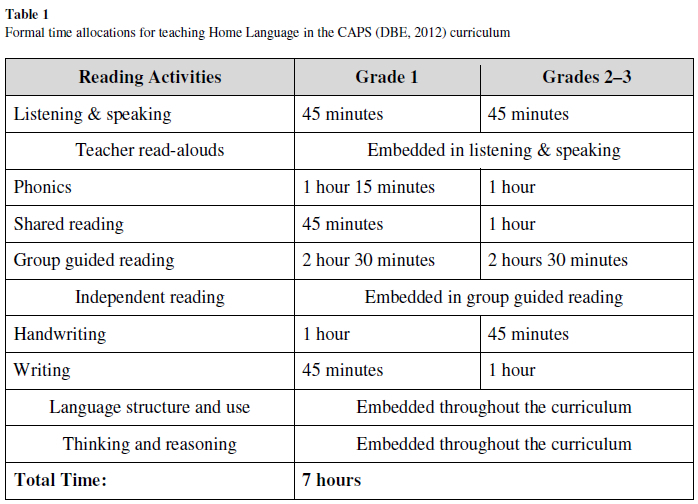
The formal allocations of instructional time to various literacy activities are pivotal to enabling early reading success in educational contexts as unequal as South Africa's (Zenex Foundation, 2023). This section explores the first of Berliner's (1990) distinctions: total time or the amount of time in an academic calendar. The South African Curriculum and Assessment Policy Statement (CAPS) prescribed detailed daily and weekly time allocations for subjects. Home language is allocated 35% of total instructional time in Grade 1 and 32% in Grades 2 and 3. For Foundation Phase home language (Grades 1-3), the weekly instructional time allocated to various literacy activities are presented in Table 1.
Weekly instructional time allocated to home language in the curriculum document totals seven hours for Foundation Phase. Following COVID-19 school closures and the resultant learning losses, a 2023 circular allowed schools to allocate an additional two hours from life skills to home language by integrating life skills into daily lessons (DBE, 2023). This adjustment extended foundational literacy instructional time to a maximum of nine hours per week, in 2023 and 2024. Unfortunately, there is no data available on the extent of uptake of this curriculum proposal in schools or how a 29% increase in allocated time impacted pedagogical practice or learners' reading performance.
Among the literacy activities, group guided reading (GGR) receives the largest, single time allocation, with 2.5 hours per week from Grades 1 to 3. GGR is a sophisticated reading methodology delivering individualised reading instruction and remediation at the instructional level of a small group of eight to 10 learners, rotating daily to meet diverse instructional needs.
Phonics instruction, essential for decoding text (Castles et al., 2018; Pretorius et al., 2022; Spaull & Pretorius, 2019; Zenex Foundation, 2023), receives greater time allocation in Grade 1 of 15 minutes per day as learners are taught phonemic awareness, letter-sound relationships, blending, segmenting words, and how to write letters. Other reading activities such as read aloud, shared reading, paired reading, and independent reading are allocated instructional time-as per the Department of Basic Education's (DBE) commitment to following a "balanced approach to literacy teaching and learning" through the combination of systematic reading instruction (phonics) with whole language strategies where reading takes various forms (National Reading Panel, 2000 as cited in Pretorius et al., 2022, p. 148). Although beyond the scope of this paper, there is significant critique of the supposed balanced approach in the CAPS, arguing that there are conceptual tensions and misconceptions in bringing together two opposing approaches to reading instruction (Barends & Reddy, 2024; Pretorius et al., 2022; Zenex Foundation, 2023).
Additional literacy activities of listening and speaking, handwriting, writing, and language structure and use are also stipulated, with some embedded throughout reading and writing activities rather than having explicit time allocations.
Criticisms of CAPS allocations and activities
A central concern in the research literature is around the transition from home language to English first additional language instruction at the end of Grade 3, which adds to the complexities of allocating sufficient time to reading. This research suggests that the 2-3-hour weekly allocation for English first additional language in Grades 1-3 is unlikely to build the vocabulary and conceptual understanding needed for a successful Grade 4 transition, particularly in rural and multilingual settings (Schaefer & Kotzé, 2019). Mohohlwane et al. (2024) demonstrated that foundational home language (L1) decoding skills transfer effectively to a second language (L2), and cautioned against an early emphasis on L2 decoding that shows negative effects on L1 outcomes. This implies that early instructional time should be weighted toward L1 development rather than premature L2 immersion, particularly for struggling readers. It also demonstrates the importance of considering and optimising home language curricula to ensure the development of L1 reading capabilities both for itself, and for later learning through an L2.
A growing body of evidence suggests that the amount of instructional time dedicated to home language teaching is also inadequate (Pretorius et al., 2022; Zenex Foundation, 2023). Regarding time spent on literacy instruction, some researchers have advocated for a legal minimum of 9-10 hours to improve learning outcomes (McConnachie & Lucwaba, 2022; Spaull, 2023). Others argued that, while the prescribed instructional time may be sufficient, time allocated to life skills could be harnessed for the development of literacy skills if these were clearly identified (Right to Read, 2025).
The Zenex Foundation (2023) emphasised the need for dedicated time for teacher read-alouds and independent reading within the curriculum rather than subsuming these within other literacy activities as shown in Table 1 to ensure the explicit development and practice of fluent decoding and comprehension skills (Spaull & Pretorius, 2019). At present, it is assumed that independent reading-which offers learners the opportunity to practise reading without teacher assistance to build fluency-occurs during GGR sessions. However, Fleisch (2023) demonstrated that if teachers follow the prescribed GGR model in typical classrooms, learners may only spend 8-12 minutes per week reading aloud and independently. This critique highlights a fundamental issue: the allocated time for these essential reading activities in the current curriculum is insufficient to foster capable readers by the end of the Foundation Phase.
Another criticism of the CAPS comes from researchers working within a sociocultural approach, who argued that learning to read and write requires opportunities to engage with texts in meaningful and authentic ways (Abdulatief et al., 2018). The importance of reading for pleasure has been shown to foster growth across all aspects of literacy when children are given choice and agency in their reading (Cremin & Scholes, 2024; Sullivan & Brown, 2013). There is currently limited empirical evidence in the South African context around how this is best accomplished (for example, how much time is required, at what level, and in what format)-important given that claims for the success of reading-for-pleasure approaches generally derive from high-income contexts where reading is socially valued and enjoyable for adults (DG Murray Trust, 2015). Motivation and engagement in reading and writing are deeply embedded in unique and specific social and cultural settings (Cremin & Scholes, 2024) and thus strategies cannot simply be transplanted from other contexts. Some small-scale work in this regard points to possibilities outside formal school hours (Edwards, 2013; Guzula, 2021). What is clearly argued is that ensuring time is allocated to reading for pleasure requires the provision of sufficient high-quality, enjoyable children's books in learners' home languages (Kell et al., 2023).
Regarding phonics, despite research consensus that decoding should be mastered early and rapidly (Castles et al., 2018; Pretorius et al., 2022), the progression principles underpinning the South African curriculum do not support an early or rapid induction into phonics. Formal phonics instruction does not occur in Grade R, which is appropriately dominated by informal, play-based learning (Zenex Foundation, 2023). Critics argue, however, for the teaching of foundational pre-reading skills necessary for later phonics instruction such as alphabet knowledge, oral language development, and phonological and morphological awareness (Zenex Foundation, 2023). These are not specified at the Grade R level. By Grade 3, spelling-sound correspondences are still being introduced-long after learners should be decoding fluently and reading independently (Pretorius et al., 2022). This misalignment between the progression principles in phonics and reading and writing undermines both the earlier phonics programme and later writing tasks, such as poetry and paragraph construction, which assume greater linguistic proficiency than learners typically possess. Some argue that the phonics allocation falls short in that the curriculum only stipulates a short time on daily phonics instruction, and that time spent practising phonics should be introduced (Pretorius et al., 2022).
Curriculum expectations reportedly outpace on-the-ground capacity and access to resources. CAPS assumes teacher knowledge of grouping strategies (for GGR) and the ability to implement sophisticated routines, access to reading materials, and learners with rich reading backgrounds-all assumptions not born out in many public schools (Fleisch, 2023; Metcalfe & Witten, 2019). Research shows teachers consistently reporting that the strong pacing requirements don't match the requirements of most of their learners. They argue the curriculum is overloaded and too fast and rigidly paced. Zenex Foundation (2023) and others asserted that these limitations lead to superficial coverage rather than conceptual or skill mastery (Bertram et al., 2021; Botha & Schollar, 2018; Govender & Hugo, 2018; Metcalfe & Witten, 2019).
Structured pedagogic programmes such as Funda Wande, the Early Grade Reading Study (EGRS) and Jika iMfundo, have introduced daily scripted lessons to support curriculum coverage and improve pacing (Fleisch & Alsofrom, 2022; Mtsatse, 2022). The programmes are structured to maximise predictability and create a supportive and motivating environment conducive to efficient time use (Simonsen et al., 2008). While showing some gains in learning outcomes, the success of these programmes in South Africa remains contingent on context, training, and sustained support, with uptake and fidelity varying widely (Taylor et al., 2025).
Returning to Grade R, literacy experts urge for more productive use of the Grade R year as described earlier (Right to Read, 2025; Zenex Foundation, 2023). Currently, the curriculum prescribes 30 minutes of story time as well as three teacher guided activities per day of approximately 30 minutes, each split between language, mathematics, and life skills (DBE, 2012). As indicated above, some argue for time allocations to demarcate time spent developing alphabet knowledge and phonological awareness at this stage (Castles et al., 2018; Pretorius et al., 2022) alongside rich, play-based, literacy experiences, story times, and read-alouds. This is necessary particularly in contexts where learners begin formal schooling with fewer foundational literacy skills developed in the home (Hofmeyer, 2022), which increases how much time they need to learn to read (van Staden & Bosker, 2014).
International comparisons of time allocations
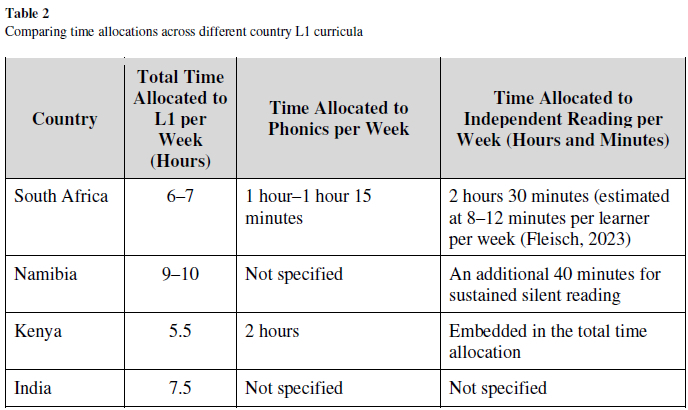
Comparing total time for early grade reading across selected countries provides a basis for contextualising the South African case and for considering alternative policy approaches. I selected three comparable low- and middle-income country contexts that varied in their degree of policy centralisation and linguistic complexity: Namibia, Kenya, and India. The sampling of these countries was intentional rather than representative in any way. The L1 curriculum policy documents from each country were considered and the prescribed time allocations for early grade literacy instruction were extracted. Where detail was available, I reviewed time explicitly allocated to phonics instruction and to opportunities for independent or sustained reading. Table 2 shows official weekly time allocations across the three countries benchmarked against South Africa's curriculum prescriptions.
Despite wide variation in the specificity of curricular prescriptions, the comparison highlights substantial cross-country differences in both the total time allocated to early grade L1 instruction and the extent to which foundational reading components, such as phonics and independent reading, are mandated by policy.
South Africa's allocation of six to seven hours per week is lower than Namibia's total allocation of nine to 10 hours. In addition, Namibia mandates an additional 40 minutes per week of "sustained silent reading" (Ministry of Education, Arts and Culture [MoEAC], 2016, p. 51), a policy intervention conceptually like South Africa's erstwhile Drop All and Read campaign,2 although formally mandated in curriculum policy rather than positioned as a supplementary initiative.
Namibia does not specify time allocations for phonics instruction, nor does it prescribe explicit reading strategies as in the South African case. Adopting a competency-based approach, the curriculum specifies broad outcomes that learners should demonstrate by the end of the lower primary phase, expecting learners to "express themselves well orally, read appropriate texts, and write reasonably correctly for their everyday purposes, in their Mother Tongue" (MoEAC, 2010, p. 21). This lack of specification appears to be an intentional design principle in which instructional decisions including the sequencing and emphasis of foundational skills like phonics are left largely to teacher discretion. This is further reinforced by the curriculum's explicit statement that "timetabling may be as flexible as needed, provided that the total time allocation is adhered to" (MoEAC, 2010, p. 40).
In theory, such flexibility allows teachers to adapt instruction to local contexts and learner needs. In practice, however, it also places significant demands on teacher knowledge and expertise. In contrast to South Africa's CAPS curriculum, which specifies both time allocations and discrete components of literacy instruction, Namibia's curriculum offers limited policy-level safeguards to ensure that different literacy activities are consistently implemented across classrooms. This points to the equity implications of a highly flexible curriculum in highly unequal education systems as found in Namibia and South Africa.
In the Kenyan curriculum, literacy is conceptualised as foundational to all learning, addressing learners' ability to "make meaning of letters and sounds thus making sense of written codes . . . [and] to communicate with others through reading and writing" (Kenya Institute of Curriculum Development [KICD], 2017, p. 32). This definition foregrounds decoding, signalling a strong policy emphasis on phonics teaching as the basis of early reading development. Kenya's subject, literacy-allocated 2.5 to 3 hours total time in the curriculum-sits alongside three other language subjects: Kiswahili language activities, English language activities, and Indigenous language activities. When considered together, Kenyan learners spend a total of five and a half hours engaged in language and literacy activities (KICD, 2017).
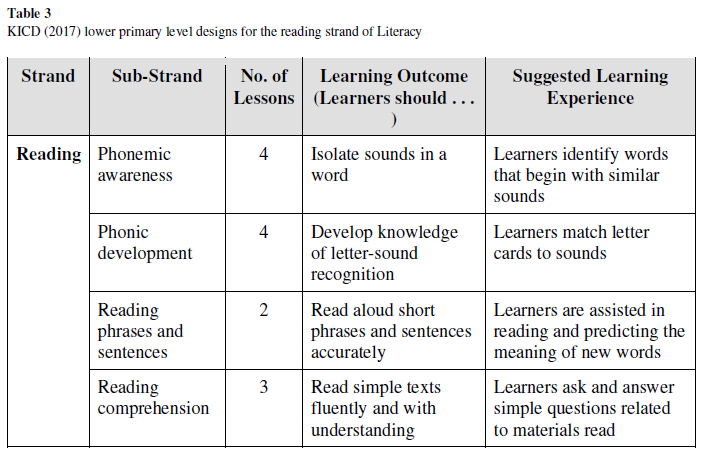
Kenya follows a phonics-based, systematic approach to reading within a competency-based curriculum. This competency-based curriculum is organised around strands (listening, speaking, reading, and writing), with each strand delineated into numerous sub-strands that specify learning outcomes, suggested learning experiences or classroom activities and the number of lessons allocated per week as shown in Table 3.
This level of internal granularity is notable given the relatively small amount of instructional time devoted to literacy. Rather than relying on teacher discretion to prioritise foundational skills as in the Namibian case, the Kenyan curriculum tightly sequences early reading development, prescribing a clear progression from sound isolation to phrase-level reading to basic comprehension. It appears that Kenya compensates for limited total time by increasing the specificity of curricular guidance in relation to phonics and early decoding skills.
India's curriculum for the foundational stage, like South Africa's, is underpinned by a balanced approach to early reading instruction encompassing phonics instruction, oral language development, shared, group-guided, and independent reading, and writing. Unlike South Africa, however, the Indian curriculum does not prescribe total time allocations for language instruction, nor does it mandate specific amounts of time for discrete reading methodologies such as phonics or independent reading. Instead, policy documents provide "illustrative daily and weekly routines" (National Steering Committee for National Curriculum Frameworks [NSCfNCF], 2022, p. 189) that indicate broad areas of instructional focus such as L1 reading/writing without specifying the time that is to be allocated to each component. These examples function as pedagogical guidance rather than regulations. This approach appears to reflect an intentional policy response to India's linguistic, cultural, and administrative diversity. With instruction delivered across 22 official languages and implemented by 32 States and Union Territories with substantial autonomy (NSCfNCF, 2022), prescriptive time allocations would be difficult to standardise and enforce. By providing pedagogical guidance without fixed timetabling requirements, the curriculum appears to accommodate wide variation in classroom conditions, teacher capacity, and learner needs while still promoting a balanced model of early literacy instruction. In contrast to Kenya's highly specified and time-bound phonics instruction, and Namibia's flexible but minimally specified outcomes-based framework, India's curriculum occupies a middle position. It offers guidance on what and how to teach reading, while deliberately leaving decisions about how long to teach to teachers or local agents (often NGOs).
Comparison of the three country cases highlights South Africa's approach to total time that combines explicit pedagogical guidance with strong, centralised regulation. This contrasts with broad flexibility in both pedagogy and time (Namibia), specified pedagogy without time stipulations (India), and tightly regulated pedagogy within limited time (Kenya). In South Africa, it appears that by mandating both activities and time allocations, CAPS seeks to reduce variation in instruction in a system characterised by uneven teacher preparation, persistent inequalities in school resources, and weak early literacy outcomes (Beatty, 2011; Msibi & Mchunu, 2013). This differs from India's approach where similar pedagogical approaches are articulated but time regulation is only illustrative to allow for contextual realities. South Africa's tighter regulation suggests lower confidence in the system's capacity to translate broad curriculum guidance into effective classroom practice without central policy prescription.
The positioning of phonics in the curricula systems is also of interest. In contrast to Namibia where phonics is either implicit or unspecified, South Africa's curriculum positions phonics as a non-negotiable and central component. This policy choice is in line with longstanding international evidence on early literacy instruction that prioritises decoding in contexts where many learners do not encounter print-rich environments outside of school (Snow et al., 1998). This is similar to the Kenyan case where systematic phonics is tightly prescribed even within limited instructional time.
The allocation of time for independent reading within GGR within CAPS reflects a commitment to a balanced approach to literacy instruction recognising that decoding must be taught alongside individual reading practice and engagement with text to ensure the development of fluency and comprehension. Absent in the prescriptions is an explicit recognition of the affective dimensions of learning to read-that it requires motivation, interest, and enjoyment. Though difficult to regulate, a lack of emphasis on these purposes are also likely to reinforce existing inequalities between learners who have access to books and reading-rich environments and those who do not.
Viewed comparatively, South Africa's time prescriptions can be seen as an attempt to ensure equity across a heterogeneous system to guarantee minimum instructional exposure to a range of reading activities. It also signals limited confidence that less prescriptive policy directives would be implemented reliably at the classroom level, and does not allow for flexibility and variation at the local school or classroom level. It also misses out on explicitly allocating time to a crucial literacy activity-reading for enjoyment.
Time enacted
This category is situated within the intended-enacted-assessed curriculum framework to consider aspects of instructional time (Berliner, 1990) or the amount of time dedicated to early grade literacy instruction. The enacted curriculum captures how much total time teachers dedicate to reading in classrooms. This perspective has been extended to include the active learning time learners are afforded to engage with reading in the home.
Reading at home
Children's reading development begins long before they set foot in a classroom. The home and community environment plays a critical role in shaping learners' early exposure to oral language, vocabulary, alphabet and conceptual knowledge. These early experiences significantly influence how much active learning time (Berliner, 1990) is required to learn to read once formal schooling begins.
Evidence from prePIRLS (van Staden & Bosker, 2014) shows that learners who frequently engaged in home literacy activities such as storytelling, rhyming, and play-based reading scored up to 50 points higher in reading achievement than their peers with minimal exposure (Combrinck et al., 2014). This aligns with international research highlighting that 'unconstrained' literacy skills, such as vocabulary, background knowledge, and oral fluency develop through rich, informal, and time-intensive interactions in the home (Snow & Matthews, 2016).
Children from academically disadvantaged households are less likely to have access to print-rich environments or caregivers adept at reading written language and often miss out on certain foundational text-based literacy experiences that prepare learners for reading (Combrinck et al., 2014; Snow & Matthews, 2016). In South Africa, this disadvantage extends across domains such as emergent literacy, cognitive and executive functioning, and fine motor coordination-all foundational skills in learning to read, as demonstrated by Hofmeyer (2022). In a nationally representative time use survey, Posel and Grapsa (2017) showed that children from low-income households spend significantly less time on learning activities than other children, particularly outside school hours. They also spend significantly more time on household and production work and on school-related travel.
This gap in preparedness has direct implications for instructional time in the classroom and the active learning time learners from different home environments need to reach the same outcomes (Shalem & Hoadley, 2009; Spaull & Pretorius, 2019; van Staden & Bosker, 2014). Van Staden & Bosker (2014) found that children with a higher aptitude towards reading, bolstered by parental involvement in early pre-reading exposure, required less opportunity or active learning time to achieve reading proficiency in school.
This underscores the urgency of maximising instructional time, since well-protected and effectively used instructional hours are the foundation for expanding learners' active learning time, especially for children who have had fewer home opportunities to prepare them for learning to read written language (McConnachie & Lucwaba, 2022; Right to Read, 2025; Sloat et al., 2007). The systemic injustices run deep, however: in South Africa, the learners with the greatest learning backlogs often attend schools that have the fewest resources and instructional assets that can safeguard instructional time (Shalem & Hoadley, 2009). In this way, an initial home disadvantage is compounded by a school-based literacy disadvantage, reinforcing cycles of inequality (Spaull & Pretorius, 2019).
Ardington and Spaull (2022) examined the impact of the successful distribution of an isiXhosa anthology in the Eastern Cape, which included 44 phonically sequenced and levelled stories for Grades 1 and 2 and a collection of 22 grade-level stories for Grade 3 for use in the classroom and at home. Their findings show reports of widespread use of the anthologies in learners' homes, effectively extending children's active learning time through exposure to print. This extension of active learning time may occur through repeated engagement with familiar texts and through shared reading practices with family members, even in households with limited adult literacy. Reports of increased engagement with text both at home and at school led to an average improvement of three additional isiXhosa words read correctly per minute-equating to a 20% improvement in scores across comparable cohorts without access to these materials.
Evidence from other low-income contexts suggests that these gains are not simply a function of increased time on task, but of the availability of appropriately levelled, high-quality texts that enable independent and supported reading outside the classroom. Menendez et al. (2025), for example, showed in Liberia how significant gains in reading were driven by students' access to and use of high-quality reading materials in their homes. Time allocation and use therefore cannot be understood solely in terms of classroom instruction: text provision reshapes the home learning environment by increasing the effective amount of reading practice available to learners. The centrality of text provision in learning to read is consistently underscored by a number of reviews that identify the importance of access to appropriate reading materials beyond the classroom, often at a one-to-one ratio (Evans & Acosta, 2021; Graham & Kelly, 2018; Stern et al., 2021). Together this shows that maximising active learning time through text provision, both in school and at home, is a critical lever for strengthening children's reading achievement.
At the school and in the classroom
Although time at school is controlled at the level of policy stipulations and school and classroom timetables, research in South Africa continually shows that it is not always adhered to or protected. There are a multitude of challenges that prevent schools from converting total time in school to active learning time (Kraft & Novicoff, 2024). In the South African case, total time is frequently eroded by systemic disruptions at school level. National evaluations have recorded pervasive timetable interruptions due to union activities, departmental training, as well as cultural and sporting activities, which are often inadequately managed or mitigated by district or provincial authorities (Botha & Schollar, 2018; Department of Planning, Monitoring and Evaluation [DPME], 2017; Taylor, 2019). These losses are compounded by chronic teacher absenteeism and overcrowded classrooms, which directly reduce time-on-task or instructional time (Hoadley & Boyd, 2022; Spaull & Pretorius, 2022).
Studies show significant challenges around the instructional time allocated towards various reading activities as prescribed by the curriculum. CAPS assigns 2.5 hours per week to GGR, intended as the cornerstone of reading development. However, implementation is undermined by the realities of large class sizes, resource constraints, and lack of teacher preparedness (Botha & Schollar, 2018; Kitsili & Murray, 2024). Across all research that investigated GGR, the 8-12 minutes of individualised instruction mandated for GGR (Fleisch, 2023) is not realised. GGR is either not done at all or is only partially implemented in classrooms (Botha & Schollar, 2018; Fleisch, 2023; Fleisch & Motilal, 2020; Kitsili & Murray, 2024). Teachers, generally, are not seen implementing individualised instruction and remediation during these sessions when they occur. Instead, the chorused reading of a text by a group of learners with different reading abilities is often observed (Botha & Schollar, 2018; Fleisch & Motilal, 2020; Kitsili & Murray, 2024) sustaining the characteristic South African whole-class, teacher-led pedagogy (Hoadley, 2024). This calls into question the practicality of the single largest time allocation, which contains the only time allocated to learners practicing reading independently in the Home Language curriculum.
Further, despite calls that the curriculum prescribe time for phonics instruction and phonics practice (Pretorius et al., 2022), classroom studies show that teachers spend more time on phonics than is officially prescribed (Hoadley & Boyd, 2022; Spaull & Pretorius, 2022). This apparent contradiction is explained when attention is paid not to the quantity of phonics instruction, but to the form it takes. In many classrooms, what is regarded as phonics teaching is often the rote chanting of syllables which offers limited support for the development of productive decoding strategies (Spaull & Pretorius, 2019). From this perspective, increasing the time allocated to phonics practice may send a policy signal that teachers should simply do more phonics, without addressing how it is taught. The risk, therefore, is that a prescription of total time intensifies existing low-level practices rather than leading to more effective forms of decoding instruction.
Hoadley (2024) cited Connor et al. (2009) who shows that the effectiveness of phonics instruction is highly contingent on teacher knowledge. Where teachers demonstrated high knowledge scores, increased instructional time spent on phonics was associated with improved reading outcomes. However, in classrooms where teachers had lower knowledge scores, increased time spent on phonics instruction was associated with poorer reading outcomes. This finding raises important questions in contexts where teacher knowledge is uneven and often constrained. Rather than increasing time allocations to reading approaches that demand high levels of specialised knowledge, it may be necessary to consider emphasising approaches more accommodating of variations in teacher expertise.
Although teachers struggle to manage instructional time in accordance with CAPS time allocations generally (Hoadley & Boyd, 2022), evaluations of some structured pedagogic programmes show that Shared Reading is one methodology that conforms to CAPS time stipulations (Chetty et al., 2022; Hoadley et al., 2022). Hoadley (2024) suggested that Shared Reading may be more readily adopted by South African teachers and enacted with greater fidelity than something like GGR because it is a well-established practice, familiar to teachers' teacher-led activity that engages the whole class around a single text.
Instructional time, generally, remains low in many classrooms, due to large class sizes, poor classroom management, an enduring slow pace and a lack of consistent routines (Ramadiro & Porteus, 2019; Spaull & Pretorius, 2022). Teachers frequently spend significant portions of lessons on management tasks like handing out books or securing sufficient pencils, in-class marking, and on passive learning activities such as copying from the board (Boyd & Hoadley, 2025; Fleisch, 2023; Hoadley & Boyd, 2022; Hoadley et al., 2022). When instructional activities are underway, they are completed at a slow pace which further slows curriculum coverage and reduces opportunity for active learning time (Ramadiro & Porteus, 2019).
Structured pedagogy programmes such as Funda Wande, the Primary School Reading Improvement Programme, PILO, Jika iMfundo, and the EGRS have shown promise in educational change efforts in South Africa throughout the last decade, and much research on time use has arisen from reports evaluating the efficacy of these programmes. These interventions include scripted lessons, pacing guides, and repeated instructional routines, enabling teachers to break the day into manageable, purposeful segments (Chetty et al., 2022; Fleisch & Alsofrom, 2022). A study by Marais and Wessels (2020) reported teachers describing their instructional approach as a "guessing game," particularly in the absence of a structured pedagogic programme which exteriorises the sequencing, pacing and progression of curriculum content (Shalem, 2017).
However, the success of structured pedagogic programmes hinges on implementation fidelity and teacher confidence and often requires intensive classroom coaching resulting in uneven uptake and implementation as well as uneven outcomes (Shalem & De Clerq, 2019; Taylor et al., 2025).
Time assessed for the teaching of reading
The assessed dimension of the intended-enacted-assessed curriculum framework refers here to the systematic monitoring and evaluation of instructional time for reading in classrooms. It reviews the monitoring and support functions carried out by education authorities outside the school as well as curriculum implementors inside the school such as HoDs and principals who are responsible for ensuring that total time prescribed by policy is upheld during instructional time to prioritise active learning time. The main in-school strategies for monitoring active learning time spent reading in the Foundation Phase include conducting baseline assessments to measure reading proficiency, tracking the levels of completion and marking in workbooks and exercise books, and having HoDs formally approve teachers' written lesson plans.
Monitoring of instructional time, and particularly active learning time spent reading, is a challenge. Weak monitoring emerges from the interaction between limited administrative capacity, weak accountability mechanisms, and systematic incentives that prioritise bureaucratic compliance over instructional quality (Metcalfe & Witten, 2019). Within this context, district- and school-level monitors default to low-cost, low-risk monitoring practices that are misaligned with the pedagogical demands of effective reading instruction (Zenex Foundation, 2023). Teachers are mostly monitored by district subject advisors (SAs) on completed and marked learner books-a proxy for time spent learning (Botha & Schollar, 2018; Metcalfe & Witten, 2019). Research suggests that this promotes superficial coverage rather than developmentally driven teaching (Govender & Hugo, 2018; Right to Read, 2025) and likely emphasises certain activities (like the completion of written tasks) at the expense of others that are not monitored (like independent reading, oral language development, and engagement with rich children's literature).
SAs tasked with monitoring and supporting teachers, are overstretched. Often responsible for large numbers of schools, regular and meaningful pedagogical engagement with teachers and HODs is not feasible. Consequently, oversight tends to focus on compliance mechanisms such as workbook checks and pacing trackers, rather than qualitative assessments of teaching practice or learner progress (Botha & Schollar, 2018; Metcalfe & Witten, 2019). SAs' reliance on workbook coverage and pacing trackers may reflect a binding capacity constraint rather than a pedagogical preference.
Within the school, research by Wills (2019) and Taylor (2019) showed that schools with functional school management teams proactively monitor curriculum coverage and provide regular instructional support. In turn, they exhibit significantly stronger use of instructional time and better learner outcomes. However, the depletion of middle-management posts, especially HoDs, whose numbers declined by 7 per cent between 2012 and 2016, has critically undermined in-school instructional leadership in the poorest of schools (Wills, 2019). Many HoDs-responsible for overseeing a handful of teachers within the phase-retain full teaching loads which significantly limits their capacity to observe, mentor, and monitor teachers. They also frequently lack the expertise to provide meaningful instructional oversight (DPME, 2017; Wills, 2019). A critical part of their role that directly impacts time spent reading in classrooms involves approving and monitoring teachers' lesson plans, conducting classroom observations, and mentoring teachers to align instructional activities to time allocated for reading by the curriculum (DBE, 2022). Heavy workloads and limited training undermine the pivotal role of HoDs in supporting teachers to maximise instructional time and thereby expand learners' active learning time spent reading.
Zimmerman (2017) conducted a study of high-functioning schools to gain insight into effective monitoring strategies, and highlighted what is possible for ordinary public schools under strong leadership. Zimmerman noted that effective schools track instructional time across grades, maintain continuity in teaching plans, and coordinate teacher efforts to prevent redundancy and gaps-practices that are not evidenced by research in most South African schools. Most schools lack the support and instructional assets needed to achieve coordinated planning across grades, ongoing curriculum scoping, and active leadership involvement in instructional time management that establishes coherent and efficient teaching and optimises active learning time (Shalem & Hoadley, 2019).
Much research on the monitoring and support of instructional time forms part of evaluations of structured pedagogic programmes as previously shown in Hoadley and Boyd (2022). Teacher coaching has shown measurable benefits in improving reading outcomes but also in improving active learning time, measured by time-on-task and curriculum coverage. The EGRS, PILO, Funda Wande, and Primary School Reading Improvement Programme schools receiving regular coaching displayed stronger curriculum coverage and improved learner outcomes (Boyd & Hoadley, 2025; Chetty et al., 2022; Fleisch & Alsofrom, 2022; Hoadley et al., 2022).
Additionally, the introduction of teacher assistants (TAs) represents a scalable and effective support strategy that has demonstrated the largest instructional gains when measured against key success metrics. Within the Funda Wande structured pedagogic programme in Limpopo-which combined scripted lesson plans, aligned materials, on-site coaching, and the deployment of TAs-classrooms with TAs saw a remarkable 129 per cent greater improvement in reading outcomes over two years compared to classrooms that used only lesson plans, materials, and coaching (Ardington, 2024). The presence of TAs was associated with increased use of instructional time and a notable reduction in classroom disruptions (Hoadley et al., 2022; Makaluza & Mpeta, 2022; Spaull, 2023). Classrooms with TAs completed two to three times more workbook pages than control classrooms without the programme (Spaull, 2023), reflecting improved time-on-task and enhanced learner participation in reading and writing tasks. Makaluza and Mpeta (2022) argued that when properly recruited, trained, monitored, and supported, TAs can play a pivotal role in scaling up learning recovery initiatives through their contribution to more effective use of instructional time that translates into active learning time.
The success of structured pedagogic programmes and TA intervention programmes demonstrates that more effective monitoring and use of instructional time is achievable under conditions of enhanced support, resourcing, capacity, and accountability. However, these programmes operate largely outside the routine functions of the education system and are typically supported by additional donor funding. Their effectiveness therefore, is constrained by the prevailing political economy-scaling such interventions would require reallocating resources, redefining roles, and strengthening accountability in ways that disrupt established administrative routines (Metcalfe & Witten, 2019).
In the cases above, which involved evaluations of various structured pedagogic programmes, data on reading outcomes was established by the Early Grade Reading Assessment (EGRA). In South African education policy, the EGRA is officially recognised and increasingly mandated to support foundational reading monitoring and improvement. Launched in 2015 as a pilot in selected primary schools, the DBE views EGRA as a national diagnostic tool to assess early reading skills in Grades 1 to 3. The policy encourages teachers to conduct informal baseline assessments at the start of each term using EGRA to identify learners' reading proficiency and tailor instruction accordingly. By enabling termly monitoring in this way, teachers can be encouraged to maximise instructional time to improve learners' reading proficiency. Critics argue that any campaign centred around testing will unintentionally lead to teachers teaching to the test (Prinsloo & Krause, 2018), strengthen the deficit views of learners and teachers, and take significant time away from teaching and learning (Bua-Lit Collective, n.d.).
Finally, Right to Read (2025) highlighted a significant gap in the monitoring of reading time in classrooms and the lack of accountability by institutions at the district, provincial, and national levels. No dedicated or transparent accountability mechanisms that rigorously track the implementation of reading policies are apparent, nor are there strong legislative norms defining responsibilities related to monitoring time spent reading (Right to Read, 2025). Further, a study by the Department of Planning, Monitoring and Evaluation (DPME, 2017, p. 1) revealed that district and provincial departments of education were aware of poor time use in schools and classrooms, have the authority and obligation to act on time wastage in schools, yet they "do not intervene."
The finding that district and provincial officials do not intervene, despite knowing that instructional time is poorly used (DPME, 2017) pointed to a profound accountability gap rather than a lack of information or authority. Responsibilities for monitoring reading time are diffused across multiple levels of the system, yet no level is held directly accountable for ensuring that the prescribed time allocations are realised in classrooms. In the absence of clear consequences for inaction, weak monitoring practices persist even when their limitations are widely acknowledged (Right to Read, 2025).
Taken together, the weak monitoring of time spent reading is shaped by constrained capacity, diffuse accountability, incentives that favour procedural compliance over instructional quality, and the use of imperfect proxies to measure time spent reading. Within this, district and school leaders often possess both the knowledge and formal authority to act yet lack the institutional conditions that would make intervention feasible, low-risk, and worthwhile. Addressing the lack of active learning time spent reading therefore requires support and accountability mechanisms that ensure instructional time obligations in the classroom are met.
Discussion
This review has surfaced the complexities involved in allocating, prescribing, implementing, monitoring, and supporting time dedicated to learning to read. It highlights that the central challenge in improving early literacy outcomes lies not only in the allocation of total time, or the protection of instructional time, but in expanding learners' active learning time. Berliner's (1990) distinctions showed that at each layer time is vulnerable to erosion. I return to my initiating questions.
Time intended
Is the total time allocated to literacy instruction and the various reading activities appropriate? The CAPS curriculum allocates an adequate amount of time, in the mid- to upper range, when compared to similar countries' policies. The highly specified prescription of time for phonics reflects a strong commitment to evidence-based early literacy practices as well as an equity-driven attempt to reduce instructional variability across an unequal system with capacity constraints at the level of teachers and schools.
Strategies to extend total time could be introduced to maximise learners' opportunities to read. This could be achieved in policy through leveraging time allocated to life skills to explicitly develop literacy skills, a strategy attempted during COVID, advocated by Right to Read (2025), and accomplished in the Funda Wande programme (Mtsatse, 2022). Another strategy could be to resurrect and reinvigorate the 2015 Drop All and Read Campaign, similar to that seen in the Namibian case, providing an additional 30 minutes of sustained and independent reading or active learning time per week. Any sustained reading practice requires the provision of sufficient one-to-one texts that learners can engage with at school and at home, and this has demonstrated marked improvement in learners' reading outcomes (Ardington & Spaull, 2022).
A major concern among South African researchers and policy designers remains the time allocation for independent reading in the curriculum, currently embedded in the complex GGR methodology that is seldom implemented correctly, if at all, in classrooms. This review suggests the need to consider alternative independent reading strategies that South African teachers are familiar with and likely to implement. In this regard, shared reading might merit more curriculum time and could, through increased instructional time, translate into increased active learning time. Additionally, a portion of allocated time that allows for some flexibility in how instructional time is used-that can accommodate the diversity of children's motivations to learn and engage in diverse literacy practices in different social and cultural contexts (Martin, 2021)-could also be considered.
Time enacted
The review identified the erosion of instructional time as a central problem in children learning to read and that even when total time is adequate, erosion occurs if prescribed practices are not enacted as intended. When answering the question of how time is used in classrooms, it is evident that instructional time needs to be broadly protected and safeguarded. Teacher absenteeism needs to be addressed. Union meetings, government training, and community and schooling events should not be scheduled during school hours. Protecting instructional time in these ways requires accountability mechanisms and strategies at the level of school, district, provincial, and national levels. Such protection is essential to increase active learning time.
Findings suggest that structured pedagogic programmes may be effective in supporting teachers in maximising and extending instructional time spent reading. Simply increasing time stipulations in policy appear to result in superficial or bureaucratic compliance rather than an increase in instructional or active learning time. Scripted lesson plans-a core element of structured pedagogic programmes-provide guidance to teachers on how to teach literacy daily, and for how long. The establishment of these routines leads to instructional time being used more efficiently (Fleisch & Dixon, 2019). Central to any intervention or introduction of material, however, ought to be teacher development in the opportunities provided by the material, how it is to be used, and why (Hoadley et al., 2026; Shalem & De Clerq, 2019). Further, the materials should be contextually appropriate.
Thirdly, properly recruited, trained, monitored, and supported TAs, as part of structured pedagogic programmes, were found to be effective in improving reading outcomes, through learners receiving increased active learning time or opportunities to engage in reading practice. The political will to consider teaching assistants in classrooms already exists considering the Presidential Youth Unemployment Initiative's Basic Education Employment Initiative. This initiative could be extended and focused on increasing the active learning time spent reading and writing in Foundation Phase classrooms.
Time assessed
Finally, this review found that mechanisms to ensure that teachers are accountable for and supported in translating total time into active learning time were limited. Determining what kinds of support and monitoring are effective entails the development of a measure that accurately measures active learning time spent reading in classrooms. The Right to Read (2025) forum identified critical areas where stronger and refined policy legislation and accountability mechanisms are necessary, particularly around school governance and leadership, and in the monitoring of time. Reducing SA-to-school ratios may lead to the supportive monitoring of teachers' instructional time by SAs and enhance learners' active learning time. Similarly, HoDs could be allocated a classroom TA to increase their capacity to support teachers, or structured pedagogic programmes could be leveraged that include an in-class and regular coaching element. Beyond the classroom, a diversity of programmes and practices are required to extend active learning time by promoting reading and writing in homes, communities, and broader society.
In conclusion, coordinated and evidence-informed approaches that integrate policy refinement, teacher development, material resourcing, and robust monitoring and support strategies within a culture of public awareness and accountability are required to ensure that total and allocated instructional time is converted into sustained active learning time-essential to transforming reading outcomes in South Africa.
Acknowledgement
I would like to express my sincere gratitude to Professor Ursula Hoadley for her insightful guidance, constructive feedback, and careful edits throughout the development of this work. Her contributions were invaluable in shaping the clarity and direction of the manuscript, and I am deeply appreciative of her contributions.
References
Abdulatief, S., Guzula, X., Kell, C., Lloyd, G., Makoe, P., McKinney, C., & Tyler, R., (2018). How are we failing our children? Reconceptualising language and literacy education. Bua-lit. http://bua-lit.org.za/wp-content/uploads/2019/02/bua-lit-FINAL051218-2.pdf
Ardington, C. (2024). Funda Wande Limpopo evaluation endline report. SALDRU. https://fundawande.org/wp-content/uploads/2025/03/FW-LP-Endline-Report-April-2024-V03-1.pdf
Ardington, C., & Spaull, N. (2022). Sequenced for success: Evaluating the impact of openly licensed Vula Bula anthologies of graded readers on early grade reading outcomes in South Africa. In N. Spaull & S. Taylor (Eds.), Early grade interventions in South Africa (pp. 127-145). Oxford University Press.
Barends, Z., & Reddy, C. (2024). Moving beyond a balanced approach to reading instruction: In search of a contextualised alternative. South African Journal of Childhood Education 14(1), a1528. https://doi.org/10.4102/sajce.v14i1.1528 [ Links ]
Beatty, B. (2011). The dilemma of scripted instruction: Comparing teacher autonomy, fidelity, and resistance in the Froebelian kindergarten, Montessori, direct instruction, and success for all. Teachers College Record, 113(3), 395-430. https://doi.org/10.1177/016146811111300305 [ Links ]
Berliner, D. C. (1990). What's all the fuss about instructional time? The nature of time in schools: Theoretical concepts, practitioner perceptions, 1, 3-35. https://psycnet.apa.org/record/1990-98855-001 [ Links ]
Bernstein, B. (1996). Pedagogy, symbolic control and identity: Theory, research, critique. Taylor & Francis.
Bertram, C. A., Mthiyane, C. C. N., & Naidoo, J. (2021). The tension between curriculum coverage and quality learning: The experiences of South African teachers. International Journal of Educational Development, 81, 102353. https://doi-org.ezproxy.uct.ac.za/10.1016/j.ijedudev.2021.102353 [ Links ]
Botha, D., & Schollar, E. (2018). The second early grade reading study: Case studies in EGRS II schools 2018. Wits Health Consortium. https://www.education.gov.za/Portals/0/Documents/Publications/EGRS/EGRS%20II%20Website%20Upload/Reports/4_EGRS%20II%20Case%20Study%202018_Final_WEB.pdf
Boyd, C., & Hoadley, U. (2025). BSPC midline qualitative evaluation report. Funda Wande. https://fundawande.org/news/midline-ii-impact-evaluation-of-funda-wande-coaching-intervention-midline-findings
Bua-Lit Collective. (n.d.). Our position. https://bua-lit.org.za/our-position/
Castles, A., Rastle, K., & Nation, K. (2018). Ending the reading wars: Reading acquisition from novice to expert. Psychological Science in the Public Interest 19(1), 5-51. https://doi.org/10.1177/1529100618772271 [ Links ]
Chetty, D., Groome, P., Alsofrom, K., & Thurlow, J. (2022). Professional development to strengthen early grade reading: Lessons from the Primary School Reading Improvement Programme (PSRIP). In N. Spaull & S. Taylor (Eds.), Early grade reading and mathematics interventions in South Africa (pp. 64-88). Oxford University Press.
Combrinck, C., van Staden, S., & Roux, K. (2014). Developing early readers: Patterns in introducing critical reading skills and strategies to South African children. Reading & Writing, 5(1), 1-9. https://doi.org/10.4102/rw.v5i1.45 [ Links ]
Cremin, T., & Scholes, L. (2024). Reading for pleasure: scrutinising the evidence base-benefits, tensions and recommendations. Language and Education, 38(6), 537-559. https://doi.org/10.1080/09500782.2024.2324948 [ Links ]
Department of Basic Education. (2012). Curriculum and Assessment Policy Statement: Foundation Phase home language Grades R-3. https://tinyurl.com/4p9mjcnk
Department of Basic Education. (2015). Basic Education takes Drop All and Read campaign to provinces, 6 Sept. https://www.gov.za/news/media-advisories/government-activities/basic-education-takes-drop-all-and-read-campaign
Department of Basic Education. (2022). Personnel administrative measures (PAM). https://www.gov.za/sites/default/files/gcis_document/202209/46879gon2468.pdf
Department of Basic Education. (2023). Circular S5 of 2023: Guidelines on the adjustment of instructional time for languages and mathematics in the foundation phase for the purpose of curriculum recovery. https://tinyurl.com/3jjkurr9
Department of Basic Education. (2025). Funda Uphumelele National Survey: Early grade reading proficiency in South Africa. https://www.education.gov.za/Portals/0/Documents/Reports/Funda%20Uphumelele/Funda%20Uphumele%20National%20Survey_Summary%20Report_Nov%202025.pdf
Department of Planning, Monitoring and Evaluation. (2017). Implementation evaluation of the National Curriculum Statement Grade R to 12 focusing on the Curriculum and Assessment Policy Statement (CAPS). https://tinyurl.com/y9wzfpuc
DG Murray Trust. (2015). Let's get South Africa reading: Strategies involving all of us. https://dgmt.co.za/wp-content/uploads/2015/08/Lets-Get-SA-Reading-web.pdf
Edwards, V. (2013). Nal'ibali reading-for-enjoyment campaign telling tales: The story of the Nal'ibali reading-for-enjoyment. https://www.researchgate.net/profile/Viv-Edwards/publication/271270485
Evans, D. K., & Acosta, A. M. (2021). Education in Africa: What are we learning? Journal of African Economies. 30(4), 13-54. https://doi.org/10.1093/jae/ejaa009 [ Links ]
Fleisch, B. (2023). Theory of change and theory of education: Pedagogic and curriculum defects in early grade reading interventions in South Africa. Education as Change, 27(1), 1-14. https://doi.org/10.25159/1947-9417/13316 [ Links ]
Fleisch, B., & Alsofrom, K. (2022). Coaching research in the early grade reading studies in South Africa. In N. Spaull & S. Taylor (Eds.), Early grade reading and mathematics interventions in South Africa (pp. 48-63). Oxford University Press.
Fleisch, B., & Dixon, K. (2019). Identifying mechanisms of change in the Early Grade Reading Study in South Africa. South African Journal of Education, 39(3), 1-12. https://doi.org/10.15700/saje.v39n3a1696 [ Links ]
Fleisch, B., & Motilal, G. B. (2020). The triple cocktail programme to improve the teaching of reading: Types of engagement. South African Journal of Childhood Education, 10(1), 1-13. https://doi.org/10.4102/sajce.v10i1.709 [ Links ]
Govender, R., & Hugo, A. J. (2018). Educators' perceptions of the Foundation Phase English home language Curriculum and Assessment Policy Statement. Per Linguam 31(1), 17-32. https://doi.org/10.5785/34-1-767 [ Links ]
Graham, J., & Kelly, S. (2018). How effective are early grade reading interventions? A review of the evidence (English) (Policy Research Working Paper, no. WPS 8292). World Bank. http://hdl.handle.net/10986/29127
Guzula, X. (2021). Constructing a pedagogical third space with multilingual children: A case study of the bilingual Stars of Today Literacy Club [Unpublished doctoral dissertation]. University of Cape Town.
Hoadley, U. (2024). How do structured pedagogy programmes affect reading instruction in African early grade classrooms? International Journal of Educational Development, 107(2), 103023. https://doi.org/10.1016/j.ijedudev.2024.103023 [ Links ]
Hoadley, U., & Boyd, C. (2022). Early grade reading instruction in South African classrooms. In N. Spaull & E. Pretorius (Eds.), Early grade reading in South Africa: Reading (pp. 109-142). Oxford University Press.
Hoadley, U., Boyd, C. & Isaac, N. (2026). Persistent pedagogies: teachers' understanding of instructional norms in early grade reading classrooms [Manuscript submitted for publication]. School of Education, University of Cape Town.
Hoadley, U., Boyd, C., Sandan, A., & Njara, Q. (2022). Funda Wande (Literacy) qualitative study: 2021 Implementation. University of Cape Town. https://fundawande.org/wp-content/uploads/2025/03/Funda-Wande-Implementation-Study-August-2022-V07.pdf
Hofmeyer, H. (2022). ELOM in the Western Cape: Investigating the early roots of reading failure. In N. Spaull & E. Pretorius (Eds.), Early grade reading in South Africa: Reading (pp. 64-82). Oxford University Press.
Jones-Devitt, S., Austen, L., & Parkin, H. J. (2017). Integrative reviewing for exploring complex phenomena. Social Research Update 66, 1-4. https://www.researchgate.net/publication/319504796_Integrative_Reviewing_for_exploring_complex_phenomena [ Links ]
Kell, C., Tyler, R., & Guzula, X. (2023, May 21). South Africa's reading crisis: 5 steps to address children's literacy struggles. The Conversation. https://theconversation.com/south-africas-reading-crisis-5-steps-to-address-childrens-literacy-struggles-205961
Kenya Institute of Curriculum Development. (2017). Basic Education curriculum framework. Republic of Kenya. https://kicd.ac.ke/wp-content/uploads/2017/10/CURRICULUMFRAMEWORK.pdf
Kitsili, N. A., & Murray, S. R. (2024). The challenge of incorporating new methods: The case of group guided reading in South Africa. South African Journal of Childhood Education 14(1). https://doi.org/10.4102/sajce.v14i1.1487 [ Links ]
Kraft, M. A., & Novicoff, S. (2024). Time in school: A conceptual framework, synthesis of the causal research, and empirical exploration. American Educational Research Journal, 61(4), 724-766. https://doi.org/10.3102/00028312241251857 [ Links ]
Leek, J., Rojek, M., Dobinska, G., & Kisiorek, M. (2024). Navigating the power of time in classroom practices: Teachers' and students' perspectives. Educational Review 78(1), 80-102. https://doi.org/10.1080/00131911.2024.2438878 [ Links ]
Lefebvre, H. (2013). Rhythmanalysis: Space, time and everyday life. Bloomsbury.
Makaluza, N., & Mpeta, B. (2022). Two birds with one stone: Improving Grade 1 learning outcomes using Funda Wande teaching assistants in Limpopo 2021-2022. In N. Spaull & S. Taylor (Eds.), Early grade reading and mathematics interventions in South Africa (pp. 146-168). Oxford University Press.
Marais, A-M., & Wessels, E. (2020). Investigating the interpretation and implementation of policies that guide the teaching of reading in the Foundation Phase. Reading & Writing, 11(1), 1-8. https://doi.org/10.4102/rw.v11i1.277 [ Links ]
Martin, C. D. (2021). Everyday literacy practices: Normalising the school literate child. South African Journal of Childhood Education, 11(1), a946. https://doi.org/10.4102/sajce.v11i1.946 [ Links ]
McConnachie, C., & Lucwaba, S. (2022). Developing South Africa's jurisprudence to include a right to read and write. In N. Spaull & E. Pretorius (Eds.), Early grade reading in South Africa: Reading (pp. 236-252). Oxford University Press.
Menendez, A., Hoadley, U., & Solovyeva, A. (2025). Understanding improvements in reading performance in Liberia: Investigating the centrality of text. Economic Development and Cultural Change. https://doi.org/10.1086/738579
Metcalfe, M., & Witten, A. (2019). Taking change to scale: Lessons from the Jika iMfundo campaign for overcoming inequalities in schools. In N. Spaull & J. Jansen (Eds.), South African schooling: The enigma of inequality (pp. 337-354). Springer.
Meyer, U. (2009). "Now" and "then" in tense logic. Journal of Philosophical Logic, 38(2), 229-247. https://link.springer.com/article/10.1007/s10992-008-9090-6 [ Links ]
Ministry of Education, Arts & Culture. (2010). The national curriculum for basic education. Republic of Namibia. https://www.nied.edu.na/assets/documents/05Policies/NationalCurriculumGuide/Po_NationalCurriculumBasicEducation_2010.pdf
Ministry of Education, Arts & Culture. (2016). The national curriculum for basic education. Republic of Namibia. https://www.studocu.com/row/document/university-of-namibia/education/national-curriculum-basic-education-2016/99798344
Mohohlwane, N., Taylor, S., Cilliers, J., & Fleisch, B. (2024). Reading skills transfer best from home language to a second language: Policy lessons from two field experiments in South Africa. Journal of Research on Educational Effectiveness 17(4), 687-710. https://doi.org/10.1080/19345747.2023.2279123 [ Links ]
Msibi, T., & Mchunu, S. (2013). The knot of curriculum and teacher professionalism in post-apartheid South Africa. Education as Change, 17(1), 19-35. https://doi.org/10.1080/16823206.2013.773924 [ Links ]
Mtsatse, N. (2022). Developing the Funda Wande Literacy and Life Skills Grade 1 workbooks and teacher guide. In N. Spaull & E. Pretorius (Eds.), Early grade reading in South Africa: Reading (pp. 196-220). Oxford University Press.
National Steering Committee for National Curriculum Frameworks. (2022). National curriculum framework for foundation stage. Republic of India. https://ncert.nic.in/pdf/focus-group/NCF-FS_2022EN.pdf
Porter, A. C., & Smithson, J. L. (2001). Defining, developing, and using curriculum indicators. Consortium for Policy Research in Education. https://www.researchgate.net/publication/252368536_Defining_Developing_and_Using_Curriculum_Indicators
Posel, D., & Grapsa, E. (2017). Time to learn? Time allocations among children in South Africa. International Journal of Educational Development, 56(1), 1-10. https://doi.org/10.1016/j.ijedudev.2017.07.002 [ Links ]
Pretorius, E. J., Rastle, K., & Mtsatse, N. (2022) A curriculum review of South African CAPS Grades R to 3. In N. Spaull & E. Pretorius (Eds.), Early grade reading in South Africa: Reading (pp. 143-163). Oxford University Press.
Prinsloo, M., & Krause, L. S. (2018). Testing practice in a Southern school. In D. Bloome, J. Rowsell, C. Leung, & M. L. Castanheira (Eds.), Re-theorizing literacy practices (pp. 154-167). Routledge.
Ramadiro, B., & Porteus, K. (2017). Foundation Phase matters: Language and learning in South African rural classrooms. Magic Classroom Collective Press.
Right to Read. (2025). Report on the roundtable discussion on "time": Reviewing time allocations, implementation, support and monitoring. Unpublished.
Rose, D. (2006). Literacy and equality in the classroom. In Proceedings of the National Conference on Future Directions in Literacy. University of Sydney.
Schaefer, M., & Kotzé, J. (2019). Early reading skills related to Grade 1 English second language literacy in rural South African schools, South African Journal of Childhood Education, 9(1), 1-13. https://doi.org/10.4102/sajce.v9i1.644 [ Links ]
Schatzki, T. R. (2002). The site of the social: A philosophical account of the constitution of social life and change. Pennsylvania State University Press.
Shalem, Y. (2017). Scripted lesson plans: What is visible and invisible in visible pedagogy? In B. Barrett, U. Hoadley, & J. Morgan (Eds.), Knowledge, curriculum and equity: Social realist perspectives (pp. 183-199). Routledge.
Shalem, Y., & De Clercq, F. (2019). Teacher development and inequality in schools: Do we now have a theory of change? In N. Spaull & J. D. Jansen (Eds.), South African schooling: The enigma of inequality: A study of the present situation and future possibilities (pp. 243-261). Springer.
Shalem, Y., & Hoadley, U. (2009). The dual economy of schooling and teacher morale in South Africa. International Studies in Sociology of Education, 19(2), 119-134. https://doi.org/10.1080/09620210903257224 [ Links ]
Simonsen, B., Fairbanks, S., Briesch, A., Myers, D., & Sugai, G. (2008). Evidence-based practices in classroom management: Considerations for research to practice. Education and Treatment of Children, 31(1), 351-380. https://doi.org/10.1353/etc.0.0007 [ Links ]
Sloat, E. A., Beswick, J. F., & Willms, J. D. (2007). Using early literacy monitoring to prevent reading failure. Phi Delta Kappan, 88(7), 523-529. https://doi.org/10.1177/003172170708800711 [ Links ]
Snow, C. E., Burns, M. S., & Griffin, P. (1998). Preventing reading difficulties in young children. National Academy Press.
Snow, C. E., & Matthews, T. J. (2016). Reading and language in the early grades. The Future of Children, 57-74. https://doi.org/10.1353/foc.2016.0012
Spaull, N. (2023). 2023 Background report for the 2030 reading panel. https://groundup.org.za/media/uploads/documents/embargoed_2023_reading_panel_background_report_7_feb_2023.pdf
Spaull, N., & Pretorius, E. J. (2019). Still falling at the first hurdle: Examining early grade reading in South Africa. In N. Spaull & J. D. Jansen (Eds.), South African schooling: The enigma of inequality (pp. 147-165). Springer.
Spaull, N., & Pretorius, E. (2022). Coming or going? The prioritisation of early grade reading in South Africa. In N. Spaull & E. Pretorius (Eds.), Early grade reading in South Africa: Reading (pp. 253-272). Oxford University Press.
Stern, J., Jukes, M., Piper, B., DeStefano, J., Mejia, J., Dubeck, P., Carrol, B., Jordan, R, Gatuyu, C., Nduku, T., Punjabi, M., Harris Van Keuren, C., & Tufail, F. (2021). Learning at Scale: Interim Report. RTI International. https://tinyurl.com/54brw276
Sullivan, A., & Brown, M. (2013). Social inequalities in cognitive scores at age 16: The role of reading (CLS Working Paper 2013/10). Economic and Social Research Council: Centre for Longitudinal Studies. https://cls.ucl.ac.uk/wp-content/uploads/2017/04/CLS-WP-2013-10-.pdf
Taylor, S. (2019). Chapter 17: How can learning inequalities be reduced? Lessons learnt from experimental research in South Africa. In N. Spaull & J. Jansens (Eds.), South African schooling: The enigma of inequality (pp. 321-336). Springer.
Taylor, S., Mohohlwane, N., Bohmer, B., & Murru, A. (2025). Key findings from a series of studies on structured learning programmes in South Africa (Synthesis report 2025/004). What Works Hub for Global Education. https://doi.org/10.35489/BSG-WhatWorksHubforGlobalEducation-RI_2025/004
van Staden, S., & Bosker, R. (2014). Factors that affect South African reading literacy achievement: Evidence from prePIRLS 2011. South African Journal of Education, 34(3), 1-9. https://www.sajournalofeducation.co.za/index.php/saje/article/view/838/467 [ Links ]
Wills, G. (2019). Chapter 16: School Leadership and Management: Identifying Linkages with Learning and Structural Inequalities. In N. Spaull & J. Jansens (Eds.), South African schooling: The enigma of inequality (pp. 301-320). Springer.
Zenex Foundation. (2023). Reflections on the Curriculum and Assessment Policy Statement (CAPS) for Foundation Phase Home Languages: eight recommendations for curriculum strengthening. Unpublished.
Zimmerman, L. (2017). Learning from the best: Reading literacy development practices at a high-performing school. Per Linguam, 33(2), 36-50. https://doi.org/10.5785/33-2-740 [ Links ]
Received: 24 November 2025
Accepted: 10 March 2026
1 I understand "literacy" broadly to include the interconnected practices of reading, writing, speaking, listening, and viewing. My focus, however, is on reading instruction in the early grades, treated as a reciprocal yet distinct skill within the wider literacy continuum. While literacy is located across contexts and is culturally embedded, I focus on formal, school-based literacy.
2 A national initiative launched in 2015 that encouraged all schools to devote 30 minutes per week to mandatory reading instruction where everyone-learners, teachers, principals, and community members-stops all work and reads, silently or aloud, to address the country's low literacy levels (DBE, 2015).