Services on Demand
Journal

Article
 English (pdf)
 Article in xml format
 Article references
 Automatic translation
 Send this article by e-mail
Indicators
Related links
-
 Cited by Google
 -
 Similars in Google
Share

 Permalink
Journal of Education (University of KwaZulu-Natal)
On-line version ISSN 2520-9868Print version ISSN 0259-479X
Journal of Education n.101 Durban 2025
https://doi.org/10.17159/2520-9868/i101a01
ARTICLES
A ten-year bibliometric analysis of technology integration in South African higher education (2013-2023)
Loquitur MakaI; Jabulile Zamokuhle ManyikeII; Msimelelo Buyisile NkohlaIII; Thulani NingiIV, V; Jenny Potsiso MokhaukhauVI
IDirectorate for Institutional Research and Academic Planning, Faculty of Education, University of the Free State, Bloemfontein, South Africa. MakaL@ufs.ac.za; https://orcid.org/0000-0001-6856-9410
IIDepartment of Agricultural Economics, Extension and Agri-business, University of Fort Hare, Alice, South Africa. jmanyike@ufh.ac.za; https://orcid.org/0000-0001-6529-9574
IIIDepartment of Science, Mathematics Education and Environmental Studies, Faculty of Education, University of Fort Hare, Alice, South Africa. mnkohla@ufh.ac.za; https://orcid.org/0000-0002-0644-7300
IVDepartment of Agricultural Economics, Extension and Agri-business, University of Fort Hare, Alice, South Africa
VMoore Centre for Science, Conservation International, Arlington, VA, United States of America. tningi@conservation.org; https://orcid.org/0000-0001-9491-4695
VIDepartment of Agriculture and Animal Health, College of Agriculture and Environmental Sciences, University. of South Africa, Florida, Roodepoort, South Africa. mokhaj@unisa.ac.za; https://orcid.org/0000-0003-1361-9251
ABSTRACT
Technology integration in higher education has attracted scholarly attention increasingly over the past decade, driven by rapid digital innovation and shifting pedagogical paradigms. In this bibliometric analysis, we investigate the research landscape on technology integration in South African higher education from 2013 to 2023, aiming to assess publication trends, map thematic structures, and analyse frameworks that inform teaching and learning practices. Data retrieved from the Scopus database yielded 3,594 records, which were refined to 1,406 final-stage, English-language journal articles. A focused search produced 110 South African articles for detailed analysis using the biblioshiny package in RStudio. The thematic mapping revealed a four-quadrant structure: basic themes such as e-learning and digital literacy remain foundational but underdeveloped; motor themes like blended learning and technology adoption are central and well-advanced, reflecting the sector's digital transformation momentum; niche themes, including policy and ICT integration, offer specialised contextual insights; and emerging themes like technology-enhanced learning signal rising but still underdeveloped interest in pedagogical innovation. Further, we identified nine thematic clusters through keyword co-occurrence analysis and aligned them with key South African policy frameworks. These include technology adoption and pedagogy clusters, barriers to online teaching, leadership and innovation, ICT readiness, equity and access, innovative practices, blended learning in local contexts, theoretical lenses for adoption, and pandemic-driven policy responses. These clusters underscore the interplay between infrastructure, policy, institutional leadership, and digital skills in shaping effective and inclusive technology integration. In this study, we map scholarly activity, reveal knowledge gaps, and offer strategic insights for educators, researchers, and policymakers. We advocate a balanced focus on infrastructure development, digital competencies, and pedagogical innovation to drive sustainable and equitable digital transformation in South African higher education.
Keywords: educational technology, technology integration, technology-enhanced learning, higher education, bibliometric analysis, research evaluation
Introduction
Integrating digital technologies into higher education has emerged as a transformative force, reshaping pedagogical models, institutional operations, and student engagement globally. The Fourth Industrial Revolution (4IR) has intensified the demand for agile, technologically literate graduates capable of navigating complex, interconnected knowledge economies (Eden et al., 2024; Schlebusch et al., 2024). Many higher education systems, particularly in the Global South, are increasingly positioning technology as a strategic enabler of education equity, innovation, and global competitiveness (African Union Commission, 2024; Mohd and Murad, 2022). Furthermore, higher education institutions are responsible for embedding technology in student training (Schlebusch et al., 2024).
In Africa, the African Union Agenda 2063 explicitly identifies digital transformation in education as a cornerstone for sustainable development, economic empowerment, and youth employability (African Union Commission, 2024). Technology integration in higher education is critical to generating new and applied knowledge that contributes to a harmonised education system that addresses Africa's challenges while positioning the continent at the forefront of the global knowledge economy (African Union Commission, 2024). In South Africa, universities have adopted various digital learning frameworks to align with this continental vision while addressing localised challenges, including historical disparities in access, infrastructure, and institutional capacity (Khoza, 2023; Mpungose, 2020). However, while the promise of technology-enhanced learning is well recognised, its implementation has been fraught with uneven progress.
In addition, the COVID-19 pandemic has significantly accelerated the adoption of online learning in South African universities, forcing institutions to transition rapidly to remote instruction. This shift exposed critical systemic vulnerabilities, such as limited internet access, inadequate digital literacy among educators and students, and insufficient institutional readiness (Daniel, 2020). It also catalysed innovation, with educators adopting blended learning models, mobile learning applications, and social media to maintain continuity and promote learner engagement (Garrison &Kanuka, 2004; Kaliisa & Picard, 2017). Despite these developments, substantial gaps remain in ensuring equitable access, pedagogical effectiveness, and sustainable digital transformation.
The academic discourse on technology integration in South African higher education is robust in encompassing themes ranging from infrastructural readiness and digital equity to pedagogical adaptation and student experiences (Ng'ambi et al., 2016; Ojo & Onwuegbuzie, 2021; Sokhulu, 2020). However, this body of work remains dispersed across disciplines and often focuses on single institutions or specific technologies. Consequently, it is difficult to understand how the field has evolved, and to find out which scholars and institutions are leading the discourse, and what thematic priorities shape current and future research.
To address this critical gap, we undertook a comprehensive bibliometric analysis of research on technology integration in South African higher education published between 2013 and 2023. By systematically mapping publication trends, citation patterns, author and institutional productivity, co-authorship networks, and thematic evolution, we provide a macro-level view of the intellectual structure and performance of the field. Our study draws on data from the Scopus database. It employs bibliometric tools via the Biblioshiny interface in RStudio to uncover (i) key trends in scholarly output and impact, (ii) influential authors, journals, and institutions, (iii) dominant and emerging research themes, and (iv) collaborative patterns at the national and international levels.
This analysis contributes a structured understanding of the scholarly landscape, identifies knowledge gaps, informs research priorities, and provides evidence-based insights for enhancing digital transformation strategies in the higher education sector. The study supports policymakers, educators, and researchers in designing inclusive, contextually relevant, and innovation-driven frameworks for technology-enhanced learning in South Africa.
Literature review
Technological integration in higher education
The integration of evolving technologies in higher education has progressed to support innovative teaching models and enhance student learning experiences (Criollo-C et al., 2023).
The COVID-19 epidemic forced higher education institutions (HEIs) to adopt technology for teaching and learning (Chugh et al., 2023). In recent years, most HEIs have used online learning platforms to respond to COVID-19 regulations, making teaching and learning more complex (Li et al., 2022). However, although online teaching and learning existed long before the pandemic, they were never mandatory in many South African HEIs, especially in comprehensive universities and universities of technology (Nkohla, 2025). This can be mainly attributed to their unique contextual realities and historical backgrounds that set them apart from their research-intensive counterpart, in which online modalities were more commonly integrated (Ndebele & Mbodila, 2022). During the pandemic, several models for the transition of digital education emerged (Lopez et al., 2021), and literature on the acceptance and use of online platforms has proven the value of using different models (Jaya et al., 2017; Mpungose & Khoza, 2020; Ntlabathi et al., 2014; Sackstein et al., 2019). The epidemic necessitated an increase in multi-modal teaching strategies that ensure that virtual instruction addresses difficulties associated with in-person instruction in the university education system (Makumane et al., 2024; Ndebele and Mbodila, 2022). Research indicates that the HEIs acknowledge the importance of integrating ICT to provide high-quality instruction and emphasise the need for administrative support to guarantee effective execution (Alenezi et al., 2023). HEIs currently aim to use ICT for digital transformation to deliver competitive, high-quality instruction in the face of swift technological improvements and increased worldwide connectedness. To improve teaching strategies and students' educational experiences, this transformation entails implementing new technology, creating strategic organisational changes, and integrating digital tools (Alenezi et al., 2023; Gorrell, 2023; Shoba and Khoza, 2022).
Technology integration models and frameworks in teaching and learning
Models and frameworks for integrating technology have been developed to enhance teaching and learning processes across different educational contexts (Hamilton et al., 2016). Reich et al. (2021) emphasised the significance of technology integration frameworks in education and training. In his section, we examine various frameworks and models for enhancing learning and teaching through technology integration. Furthermore, in this research paper, our bibliometric analysis was guided by publication metrics and theoretical and pedagogical understanding of how technology is accepted and used to enhance teaching and learning. The technological integration trends in South African HEIs draw on four frameworks/models.
The substitution augmentation modification redefinition (SAMR) model
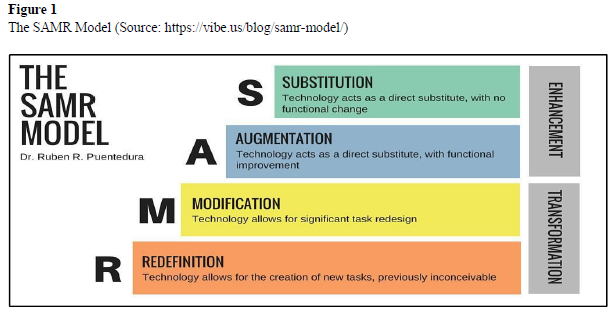
Developed by Puentedura (2006, 2014, 2020), the Substitution, Augmentation, Modification, and Redefinition (SAMR) model is a valuable tool for educators to leverage technology effectively in the educational context. It analyses elementary and secondary education teachers' use of information and communications technologies (ICTs). It is used to integrate technology effectively into education (Bicalho et al., 2023; Capangpangan, 2023). It helps educators assess the level at which technology is utilised in teaching practices, ranging from essential substitution to transformative redefinition (Bicalho et al., 2023).
Technological, pedagogical, and content knowledge (TPACK)
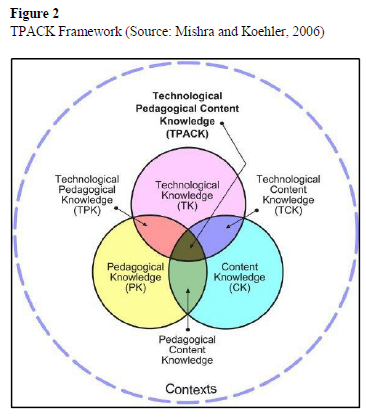
Technological, Pedagogical, and Content Knowledge (TPACK) was developed by Mishra and Koehler (2006). The framework identifies three primary forms of knowledge: content knowledge (CK); pedagogical knowledge (PK); and technological knowledge (TK). TPACK combines understanding learning and teaching procedures and methods, and access to educational resources while utilising digital technology (Mishra, 2019). It attempts to identify the knowledge teachers require for technology integration while addressing teachers' knowledge, which is multifaceted. This framework integrates all three components to create practical, technology-enhanced learning experiences. TPACK assesses teachers' technology, content, and pedagogy readiness.
Technological acceptance model (TAM)
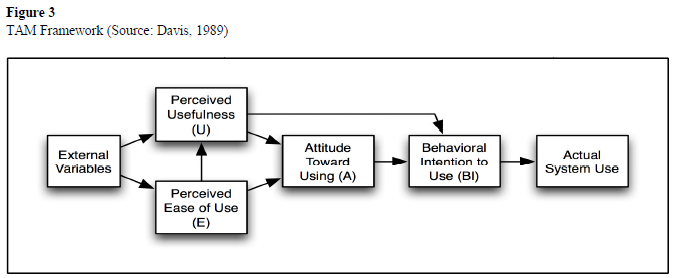
The Technology Acceptance Model (TAM) was developed by Davis (1989). Used widely, it is a framework that explains technology adoption based on Perceived Usefulness (PU) and Perceived Ease of Use (PEOU). TAM shows that individuals are more likely to adopt a technology if they believe it will enhance their performance and is easy to use. TAM extends the Theory of Reasoned Action (TRA) (Fishbein and Ajzen, 1975), posing that attitudes and subjective norms influence behavioural intentions. This was later expanded by the Theory of Planned Behaviour (TPB) (Ajzen, 1985), which includes Perceived Behavioural Control (PBC) that emphasizes the perceived ease or difficulty in performing a behaviour. Rogers' Diffusion of Innovations Theory (DOI) (1962), in identifying factors such as relative advantage and complexity, describes how new technologies spread within a population. To explain technology acceptance in organizational settings, Venkatesh et al. (2003) proposed the Unified Theory of Acceptance and Use of Technology (UTAUT). Performance expectancy, effort expectancy, social influence, and conducive conditions are the main topics of this approach.
Universal design for learning (UDL)
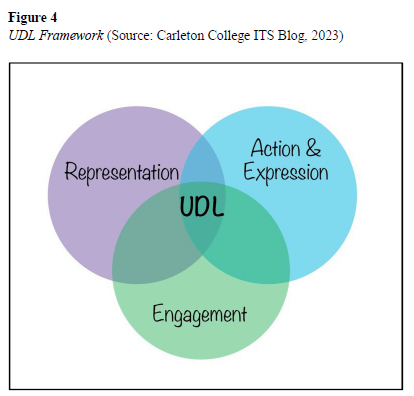
Universal Design for Learning (UDL) can be traced back to 1984 when the Center for Applied Specialized Technology (CAST) Inc. was formed by two Harvard School of Graduate Education academics, Drs. Rose and Meyer (CAST, 2022). To enable teachers and students to personalise their educational experiences, CAST sought first to transform how special education was taught. Three guiding principles form the basis of the UDL framework: multiple means of engagement, which gives students a variety of ways to participate in the learning process; multiple means of representation, which provides students with options for how to access their learning; and multiple means of action and expression, which gives students flexibility and choice in how they share or demonstrate their learning (Bray et al., 2024). The Universal Design for Learning (UDL) guidelines offer a comprehensive framework for designing inclusive learning environments. They emphasise providing multiple means of engagement, representation, and action/expression to accommodate diverse learner needs. Under engagement, UDL suggests strategies to foster motivation, persistence, and self-regulation, including options for recruiting interest, sustaining effort, and promoting self-regulation. Representation offers diverse ways to present information in catering to varied learning styles and preferences, such as providing options for perception, language, symbols, and comprehension. Last, action/expression highlights the importance of offering flexible means for learners to demonstrate their understanding and skills, including physical actions, expression, communication, and supporting executive functions. By addressing these aspects, UDL aims to empower learners of all backgrounds and abilities to become purposeful, motivated, resourceful, and strategic in their learning endeavours.
The models above offer complementary perspectives on technology integration in education, even though each serves a specific purpose. SAMR evaluates digital integration, whereas TPACK guides pedagogical preparation and instructional planning. TAM is crucial for understanding user behaviour and adoption trends, and UDL provides inclusivity and flexibility in the pedagogy. Thus, in the context of South African HEIs, where technological access, pedagogical development, and social or institutional culture remain pressing challenges (Ndzinisa & Dlamini, 2022; Nkohla, 2025), the blended use of the models was most effective.
Methodology
The bibliometric analysis was conducted using the Scopus database, which was accessed through the RStudio package biblioshiny. The initial search was performed on April 1, 2024, using the search string "TITLE-ABS-KEY (("technological integration" OR "technology integration" OR "integrating technology" OR "technology incorporation" OR "technology adoption " OR "educational technology " OR "digital integration " OR "ICT integration ") AND ("higher education" OR "postsecondary education" OR "tertiary education")). " This search yielded 3,594 documents. To narrow down the results, the search was further limited to documents published between 2013 and 2023, resulting in 2,847 documents. Subsequently, the document type was restricted to published articles, resulting in 1,592 documents. Furthermore, the language of the articles chosen was limited to English, resulting in 1,448 documents. Among these, documents in the final publication stage amounted to 1,406, which were selected by identifying articles that had been peer-reviewed, thereby excluding articles in press and early access. Within these refined results, a search explicitly conducted for documents related to South Africa resulted in 110 documents. These 110 documents were exported to CSV format for further analysis. Despite the rigorous selection of these documents, it is essential to acknowledge that the study was limited to articles published in the Scopus database only. Thus, exclusive reliance on this database may result in bias since other non-indexed journals have been excluded, particularly from South Africa. In addition, some documents from less mainstream journals have not been included in the analysis. Therefore, the analysis of the documents may not fully represent the entire body of existing literature on integrating technology in higher education.
Results and discussion
Overview of retrieved publications
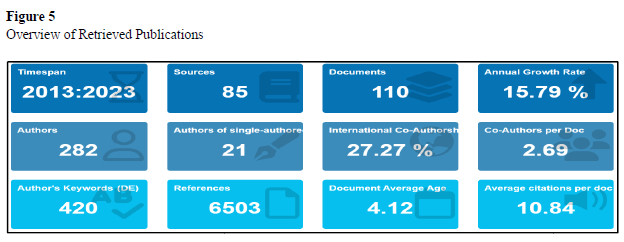
The results in Figure 5 reveal a significant growth in the research output of technology integration in South African higher education from 2013 to 2023, with an annual growth rate of 15.79%. This growth is supported by a substantial dataset comprising 110 documents from 85 sources. The documents are relatively recent, with an average age of 4.12 years, indicating the relevance and timeliness of the research. The average citation per document is high at 10.84, suggesting that the research in this field is influential and widely referenced. Collaboration among authors is prevalent, with 282 authors contributing to the documents and a significant portion engaging in co-authorship, both domestically and internationally, with an international co-authorship rate of 27.27%. Most of the documents are articles emphasizing the scholarly focus on technology integration in South African higher education. Collectively, these findings suggest a dynamic and collaborative research landscape that strongly emphasises recent and impactful scholarship in technology integration within the South African higher education context.
Performance analysis
Annual production and mean total citation per year
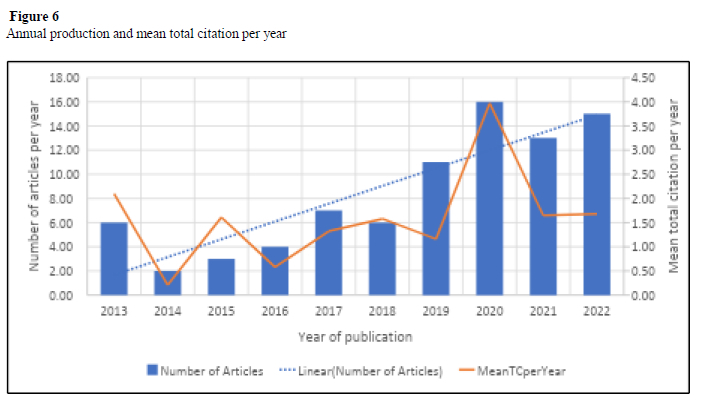
Figure 6 illustrates the annual production and mean total citations per year of articles focused on technology integration in South African higher education. The number of articles published each year shows a fluctuating but generally upward trend, with a notable increase from 2016 onwards. Peaks in production occurred in 2019, 2020, and 2022, indicating growing academic interest. This trend is supported by a strong linear relationship (R2 = 0.7709), suggesting sustained growth in research activity over time. In contrast, the mean total citations per year exhibit more variability. High citation averages in 2013 and 2020 point to particularly impactful publications during those years, possibly driven by foundational research and the global shift to online learning during the COVID-19 pandemic. The fluctuations in citation rates may reflect factors such as publication visibility, the novelty of findings, or time since publication. The data suggests a field gaining momentum in output and influence, especially in response to evolving educational technologies and contextual demands.
Three-field plot: prolific authors, keywords, and journals
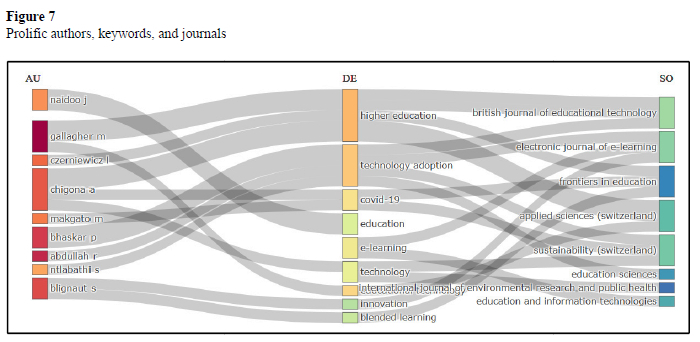
The three-field plot visually represents the relationships between prolific authors (AU), key research themes (DE), and publication sources (SO) in the context of technology integration in South African higher education. Figure 7 below highlights influential contributors such as Gallagher M, the most prolific author with three publications, followed by Blignaut S, Chigona A, Czerniewicz L, Naidoo J, and Ntlabathi S, each with two publications. These authors engage with prominent themes like higher education, technology adoption, COVID-19, e-learning, and blended learning, reflecting research's dynamic and responsive nature in this area. On the journal side, this figure identifies the British Journal of Educational Technology as the leading publication source, with nine articles, underscoring its central role in disseminating research on this topic. It is followed by the Electronic Journal of E-Learning (4 articles) and Sustainability (Switzerland) (3 articles), indicating substantial contributions to the scholarly conversation. Other relevant sources include Applied Sciences (Switzerland), Education and Information Technologies, Education Sciences, Frontiers in Education, and the International Journal of Environmental Research and Public Health, each contributing two articles. These journals span diverse yet interconnected domains, showcasing the interdisciplinary nature of the discourse. This shows a well-connected scholarly ecosystem in which leading authors, critical themes, and reputable journals converge to shape the research landscape of technology integration in South African higher education.
Conceptual structure of research on technology integration in South African higher education
Thematic shifts in technology integration research in higher education in South Africa
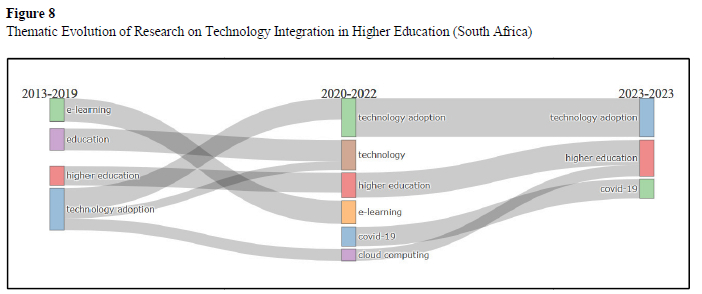
Figure 8 presents the thematic evolution of technology integration research in South African higher education across three distinct periods: pre-COVID-19 (2013-2019), COVID-19 phase (2020-2022), and post-COVID-19 (2023). Initially, technology adoption was the dominant theme, accompanied by growing interest in e-learning, education, and higher education. This early focus reflected foundational efforts to introduce digital tools into the academic environment. During COVID-19, the research focus broadened in response to the shift to remote teaching and learning. While technology adoption remained central, new themes such as COVID-19, cloud computing, and digital transformation gained prominence, highlighting the sector's adaptive response to the crisis.
In the post-COVID-19 period (2023), higher education emerged as the most prominent theme, indicating a shift towards long-term institutional strategies and sustained digital integration. Although technology adoption continues to be relevant, interest in cloud computing has declined. Notably, the theme of e-learning, which was strong before and during the pandemic, has received limited attention in the post-COVID era. Over the past decade, technology adoption and higher education have consistently served as pivotal anchors in the thematic landscape. The rising prominence of higher education, particularly in 2023, may be attributed to policy reforms and a focus on institutional resilience in the aftermath of the pandemic. Meanwhile, the persistent presence of COVID-19 in research themes, even beyond its peak, suggests an ongoing reflection on its long-term impact.
These findings carry important implications for both higher education practice and policy development. First, the consistent emphasis on digital integration underscores the need for universities to move beyond temporary digital solutions and invest in sustainable, scalable digital infrastructure. Strategic capacity building, including staff training and curriculum redesign, will be essential to equip institutions for continued innovation in teaching and learning. For policymakers, the thematic shifts signal the importance of aligning educational policies with long-term digital transformation goals. This includes providing targeted funding for ICT development, creating incentives for technology adoption, and ensuring robust quality assurance in digital education delivery. Additionally, as research attention shifts, policies must continue to address the digital divide, especially in under-resourced and rural institutions, to promote equitable access and participation. Finally, the evolving research focus allows policymakers and institutional leaders to support innovation and interdisciplinary research that addresses the complex challenges of post-pandemic education, helping to shape a more resilient and adaptive higher education sector.
Thematic map analysis: Core, emerging, and peripheral themes
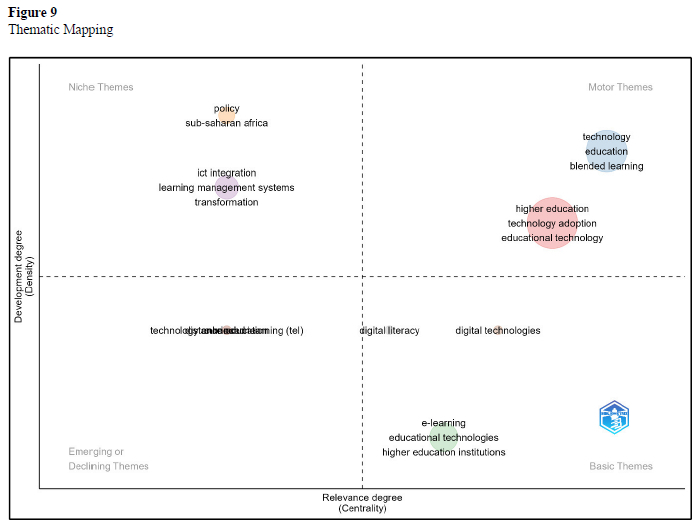
Figure 9 illustrates the thematic structure of technology integration research in South African higher education. The map categorises themes into four quadrants, basic, motor, niche, and emerging, based on their relevance (centrality) and development (density). In the basic themes' quadrant, commonly used keywords such as e-learning, educational technologies, digital technologies, and digital literacy signal foundational yet underdeveloped research areas. These topics are central to the field but require deeper exploration to inform effective teaching practices. Institutions should enhance digital literacy efforts, while policy should support access to quality digital tools.
Motor themes, which are well-developed and central, include technology, education, blended learning, higher education, technology adoption, and educational technology. These reflect the sector's strategic shift towards integrated digital teaching models. Higher education institutions are advised to strengthen blended learning frameworks, and policymakers should sustain support for long-term digital transformation strategies. Niche themes, such as policy, Sub-Saharan Africa, ICT integration, and learning management systems, are well-developed but less central. These represent specialised areas offering contextual insights. Institutions and researchers are encouraged to explore these further, especially regarding regional policy contexts, while government strategies should remain sensitive to institutional and geographic disparities.
Technology-enhanced learning is gaining traction in the emerging themes quadrant but remains underdeveloped. This indicates growing interest in pedagogical innovation using digital tools. Institutions should explore and evaluate such innovations; targeted policy support can help scale promising approaches. Thus, the thematic map revealed that while technology adoption and blended learning dominate current discourse, foundational and emerging themes need further development. For higher education and policy, a balanced focus on infrastructure, digital skills, and innovation is crucial for sustainable digital transformation.
Mapping keyword co-occurrence and thematic clusters
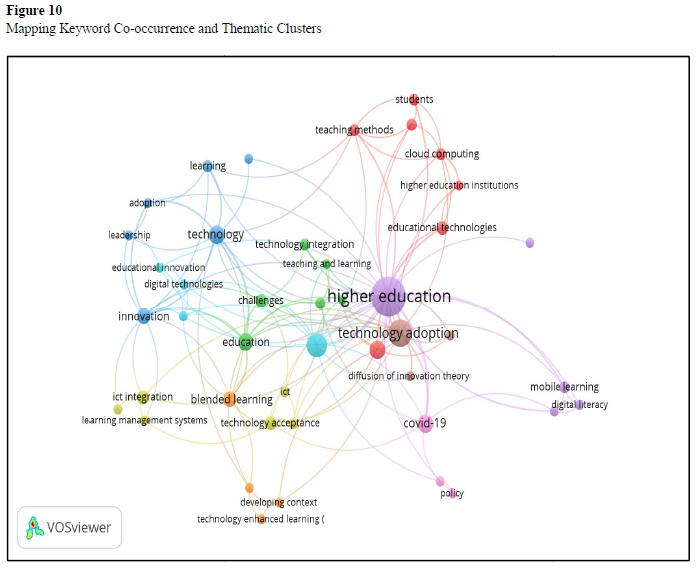
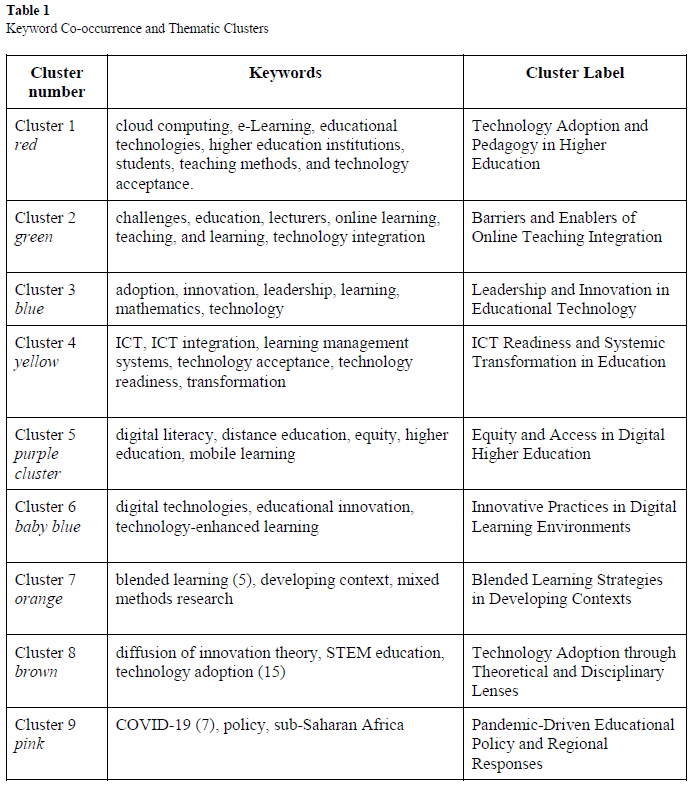
The co-occurrence network analysis in Figure 10 and Table 2 reveals nine thematic clusters that capture key aspects of technology integration in South African higher education, closely linked to national policy frameworks. The first cluster, technology adoption and pedagogy, emphasises the central role of technology in reshaping teaching and learning, aligned with the White Paper on Post-School Education and Training (2013), which advocates for blended and e-learning approaches. The findings highlight the need for ongoing pedagogical innovation to sustain digital transformation.
The second cluster, barriers and enablers of online teaching, identifies challenges such as infrastructure and educator capacity. This reflects the National Digital and Future Skills Strategy (2020-2030), which stresses building digital competencies among educators to address these obstacles. Leadership and innovation in educational technology, the third cluster, underscores the importance of institutional leadership in driving innovation. This aligns with the National Development Plan (NDP) 2030, which emphasises the role of leadership in fostering technology-enhanced education.
The fourth cluster, ICT readiness and systemic transformation, focuses on the need for robust ICT infrastructure and institutional preparedness, consistent with the Department of Higher Education and Training's Digital Learning Framework that calls for systemic strategies to strengthen digital capacity, particularly in under-resourced institutions. The fifth cluster, equity and access in digital education, highlights concern about digital literacy and access, resonating with the National Framework for Enhancing Digital Learning (2021), which advocates for inclusive policies to bridge the digital divide, especially for disadvantaged students. The Innovative Practices in Digital Learning, the sixth cluster, signals the shift towards using digital tools for student-centred learning, supporting the Digital Economy Masterplan, which encourages innovative teaching practices and flexible curriculum designs.
The seventh cluster, blended learning in developing contexts, emphasises the importance of adapting blended learning approaches to local realities, in line with the National Skills Development Strategy (NSDS), which supports context-sensitive educational solutions. The eighth cluster, technology adoption and theoretical lenses, highlights the role of diffusion of innovation theory in understanding technology adoption, aligned with the National Research and Development Strategy (NRDS), which promotes research-based frameworks for technology integration in higher education. Finally, pandemic-driven policy responses underscore how COVID-19 has accelerated digital education reforms, reflecting the Digital Education Policy (2020), which stresses the need for resilient and adaptive education systems. These clusters highlight the multifaceted nature of digital transformation in South African higher education and call for targeted policy interventions, professional development, and infrastructure investments to ensure equitable and effective technology integration.
Future areas of research
While this study provides a macro-level view of technology integration in South African higher education, further research is needed to explore the pedagogical and institutional impact of specific integration models like TPACK and UDL. Longitudinal studies are also required to assess how digital transformation influences student learning and faculty development. Interdisciplinary research combining education, ICT, and public policy is essential to address digital equity, infrastructure, and governance challenges. Additionally, comparative studies across similar developing contexts can offer broader insights. Expanding future analyses to include altimetric and emerging technologies such as AI and VR could further enrich the field.
Conclusion
With a significant increase in research output over the past decade, coupled with high citation rates in certain years and from specific countries, it is evident that technology integration in higher education is gaining momentum and attracting substantial scholarly attention. The collaboration among authors from diverse geographical locations signifies the global interest and collective efforts in advancing knowledge and understanding in this area. These findings provide valuable insights for policymakers, educators, and researchers, highlighting the importance of continued investment in research and collaboration to address the evolving challenges and opportunities presented by technology integration in South African higher education.
Recommendations
In this paper, we offer a few recommendations for practitioners and researchers in educational technology. First, there is a need for continued investment in research and development initiatives aimed at enhancing technology integration in South African higher education institutions. Practitioners should explore innovative approaches to leverage technology effectively in teaching and learning contexts, while researchers can focus on addressing emerging challenges and exploring new opportunities presented by technological advancements. Second, fostering international collaboration and knowledge exchange initiatives can facilitate sharing best practices, resources, and expertise, leading to more robust and impactful research outcomes. Additionally, policymakers should consider these findings when formulating educational policies and allocating resources to support technology integration initiatives. By implementing these recommendations, practitioners, researchers, and policymakers can collectively contribute to advancing technology integration efforts and enhancing the quality of higher education in South Africa.
References
Ajzen, I. (1985). From intentions to actions: A theory of planned behavior. In J. Kuhl & J. Beckmann (Eds.), Action control: From cognition to behavior (pp. 11-39). Springer.
African Union Commission. (2024). Education. https://au.int/en/directorates/education
Alenezi, M., Wardat, S., & Akour, M. (2023). The need of integrating digital education in higher education: Challenges and opportunities. Sustainability, 15, 4782. https://doi.org/10.3390/su15064782 [ Links ]
Bates, A. W. (2019). Teaching in a digital age: Guidelines for designing teaching and learning. BCcampus.
Bicalho, R. N. M., Coll, C., & Engel, A. (2023). Integration of ICTs in teaching practices: Propositions to the SAMR model. Educational Technology Research and Development, 71, 563-578. https://doi.org/10.1007/s11423-022-10169-x [ Links ]
Bray, A., Devitt, A., Banks, J., Sanchez Fuentes, S., Sandoval, M., Riviou, K., Byrne, D., Flood, M., Reale, J., & Terrenzio, S. (2024). What next for Universal Design for Learning? A systematic literature review of technology in UDL implementations at the second level. British Journal of Educational Technology, 55, 113-138. https://doi.org/10.1111/bjet.13328 [ Links ]
Capangpangan, B. R. (2023). Writech: Enhancing students' writing skills using the SAMR model. International Journal of Multidisciplinary: Applied Business and Education Research, 4(4), 1403-1408. https://doi.org/10.11594/ijmaber.04.04.34 [ Links ]
Carleton College ITS Blog. (2023). How you can implement Universal Design for Learning (UDL) in small steps. https://www.carleton.edu/its/blog/how-you-can-implement-universal-design-for-learning-udl-in-small-steps/
CAST. (2022). Universal Design for Learning. https://www.cast.org/what-we-do/universal-design-for-learning/
Chugh, R., Turnbull, D., Cowling, M. A., Vanderburg, R., & Vanderburg, M. A. (2023). Implementing educational technology in higher education institutions: A review of technologies, stakeholder perceptions, frameworks, and metrics. Education and Information Technologies, 28, 16403-16429. https://doi.org/10.1007/s10639-023-11846-x [ Links ]
Criollo-C, S., Govea, J., Játiva, W., Pierrottet, J., Guerrero-Arias, A., Jaramillo-Alcázar, Á., & Luján-Mora, S. (2023). Towards integrating emerging technologies as support for the teaching and learning model in higher education. Sustainability, 15, 6055. https://doi.org/10.3390/su15076055 [ Links ]
Daniel, S. J. (2020). Education and the COVID-19 pandemic. Prospects, 49(1), 91-96. https://doi.org/10.1007/s11125-020-09464-3 [ Links ]
Davis, F. D. (1989). Perceived usefulness, perceived ease of use, and user acceptance of information technology. MIS Quarterly, 13(3), 319-340. [ Links ]
Dede, C. (2010). Comparing frameworks for 21st-century skills. In J. Bellanca & R. Brandt (Eds.), 21st Century Skills: Rethinking how students learn (pp. 51-76). Solution Tree Press.
Eden, C. A., Chisom, O. N., & Adeniyi, I. S. (2024). Harnessing technology integration in education: Strategies for enhancing learning outcomes and equity. World Journal of Advanced Engineering Technology and Sciences, 11(2), 001-008. https://doi.org/10.30574/wjaets.2024.11.2.0071 [ Links ]
Fishbein, M., & Ajzen, I. (1975). Belief, attitude, intention, and behavior: An introduction to theory and research. Addison-Wesley.
Garrison, D. R., & Kanuka, H. (2004). Blended learning: Uncovering its transformative potential in higher education. Internet and Higher Education, 7(2), 95-105. [ Links ]
Gorrell, A. (2023). The impact of digital transformation on academic work. Studies in Technology Enhanced Learning, 3(2), 1-13. https://doi.org/10.21428/8c225f6e.8efe18a1 [ Links ]
Hamilton, E. R., Rosenberg, J. M., & Akcaoglu, M. (2016). The substitution augmentation modification redefinition (SAMR) model: A critical review and suggestions for its use. TechTrends, 60(5), 433-441. [ Links ]
Kaliisa, R., & Picard, M. (2017). A systematic review on mobile learning in higher education: The African perspective. Turkish Online Journal of Educational Technology-TOJET, 16(1), 1-18. [ Links ]
Khoza, S. B. (2023). Can teachers' identities come to the rescue in the Fourth Industrial Revolution? Technology, Knowledge and Learning, 28(2), 846-864. https://doi.org/10.1007/s10758-021-09560-z [ Links ]
Li, N., Huijser, H., Xi, Y., Limniou, M., Zhang, X., & Kek, M. Y. C. A. (2022). Disrupting the disruption: A digital learning HeXie ecology model. Education Sciences, 12, 63. https://doi.org/10.3390/educsci12020063 [ Links ]
Lopez, M., Peddinani, B. K., O'Connor-Cordova, M., & Carrion, B. (2021). Digital educational model: Transformation towards a distance university experience. In Proceedings of the 7th International Conference on Education, Bangkok, Thailand, 810 April 2021 (Vol. 7, pp. 559-565).
Makumane, M. A., Nkohla, M. B., & Khoza, S. B. (2024). Decolonising educational technology in a pragmatic curriculum: A systematic review. South African Journal of Higher Education, 38(3), 131-149. https://doi.org/10.20853/38-3-6357 [ Links ]
Mishra, P. (2019). Considering contextual knowledge: The TPACK diagram gets an upgrade. Journal of Digital Learning in Teacher Education, 35(2), 76-78. https://doi.org/10.1080/21532974.2019.1588611 [ Links ]
Mishra, P., & Koehler, M. J. (2006). Technological pedagogical content knowledge: A framework for teacher knowledge. Teachers College Record, 108(6), 1017-1054. [ Links ]
Mohd, N., & Murad, M. A. A. (2022). The usability of the training management system for teachers' professional development: A preliminary study. Malaysian Journal of Social Sciences and Humanities, 7(5), e001503. [ Links ]
Mpungose, C. B. (2020). Are social media sites a platform for formal or informal learning? Students' experiences in institutions of higher education. International Journal of Higher Education, 9(5), 300-311. https://doi.org/10.5430/ijhe.v9n5p300 [ Links ]
Ndebele, C., & Mbodila, M. (2022). Examining technology acceptance in learning and teaching at a historically disadvantaged university in South Africa through the Technology Acceptance Model. Education Sciences, 12, 54. https://doi.org/10.3390/educsci12010054 [ Links ]
Ndzinisa, N., & Dlamini, R. (2022). Responsiveness vs. accessibility: Pandemic-driven shift to remote teaching and online learning. Higher Education Research and Development, 0(0), 1-16. https://doi.org/10.1080/07294360.2021.2019199 [ Links ]
Ng'ambi, D., Brown, C., Bozalek, V., Gachago, D., & Wood, D. (2016). Technology-enhanced teaching and learning in South African higher education: A rearview of a 20-year journey. British Journal of Educational Technology, 47(5), 843-858. [ Links ]
Nkohla, M. B. (2025). Chronicling digital teaching at a South African historically disadvantaged comprehensive university: Navigating institutional culture for agricultural sciences academics. African Identities, 1-19. https://doi.org/10.1080/14725843.2024.2439412
Oblinger, D., & Oblinger, J. (2005). Educating the Net Generation. Educause.
Ojo, E. O., & Onwuegbuzie, A. J. (2021). University students' experiences of learning in an online environment during the COVID-19 pandemic: A meta-methods research study of perceptions and attitudes of South African students. Journal of Pedagogical Research, 5(4), 1-18. https://doi.org/10.33902/jpr.2021472164 [ Links ]
Puentedura, R. (2006). Transformation, technology, and education. http://hippasus.com/resources/tte/
Puentedura, R. (2014). SAMR and Bloom's taxonomy: Assembling the puzzle. https://www.commonsense.org/education/articles/samr-and-blooms-taxonomy-assembling-the-puzzle
Puentedura, R. (2020). SAMR, observation, analysis, and action. http://hippasus.com/blog/
Reich, A., Rooney, D., & Lizier, A. L. (2021). Using technology integration frameworks in vocational education and training. International Journal of Training Research, 19(2), 93-106. https://doi.org/10.1080/14480220.2020.1864447 [ Links ]
Rogers, E. M. (1962). Diffusion of innovations (1st ed.). Free Press.
Schlebusch, G., Bhebhe, S., & Schlebusch, L. (2024). Technology integration in teacher education practices in two Southern African universities. Open Education Studies, 6(1), 20220223. [ Links ]
Shoba, M., & Khoza, S. (2022). Professionalising socialisation for pragmatic e-curriculum to the rescue of South African universities. In J. Olivier, A. Oojorah, & W. Udhin (Eds.), Multimodal learning environments in Southern Africa: Digital education and learning (1st ed., pp. 119-140). Palgrave Macmillan. https://doi.org/10.1007/978-3-030-97656-9_7
Sokhulu, L. H. (2020). Students' experiences of using digital technologies to address their personal research needs during the COVID-19 lockdown. African Identities, 1(1), 117. https://doi.org/10.1080/14725843.2020.1801384 [ Links ]
Venkatesh, V., Morris, M. G., Davis, G. B., & Davis, F. D. (2003). User acceptance of information technology: Toward a unified view. MIS Quarterly, 27(3), 425-478. [ Links ]
Received: 29 March 2025
Accepted: 15 August 2025