Services on Demand
Journal

Article
 English (pdf)
 Article in xml format
 Article references
 Automatic translation
 Send this article by e-mail
Indicators
Related links
-
 Cited by Google
 -
 Similars in Google
Share

 Permalink
Town and Regional Planning
On-line version ISSN 2415-0495Print version ISSN 1012-280X
Town reg. plan. (Online) vol.87 Bloemfontein 2025
https://doi.org/10.38140/trp.v87i.9713
RESEARCH ARTICLE
Land management and real estate dynamics for urban growth in Nigeria: Towards a conceptual framework
Grondbestuur en eiendomsdinamika: 'n konseptuele raamwerk vir stedelike groei in Nigerië
Taolo ea mobu le maraka oa matlo ho khõlo ea litoropo Nigeria
Victor Olutope Ige
Estate Management Department, Federal University of Technology, Akure, Nigeria & Faculty of Engineering, Built Environment and Information Technology, Walter Sisulu University, Mthatha, South Africa. ROR: https://ror.org/02svzjn28, Email: voige@futa.edu.ng, ORCID: http://orcid.org/0000-0002-4850-4369
ABSTRACT
Rapid urbanisation in Nigeria has exposed significant weaknesses in land-management and real estate systems, including fragmented institutions, insecure land rights, limited technology use, and weak legal enforcement. These issues contribute to volatile property markets, rising informality, and unsustainable urban growth. Despite these challenges, efforts to adapt international best practices to Nigeria remain minimal. This study addresses the research gap, by examining land management models in Australia, Germany, the United States, and China to identify lessons for Nigeria. Using a comparative qualitative approach, the research integrates evidence from 28 peer-reviewed articles, policy documents, and international reports through systematic review and thematic analysis. Guided by the Land Governance Framework, Institutional Economics, and Urban Growth theories, the findings reveal consistent patterns in governance structures, tenure systems, technology integration, and environmental considerations. Three critical pillars for effective land governance emerge, namely secure and efficient tenure regimes, digitised land administration, and environmentally sensitive planning. These elements strengthen property markets, improve housing affordability, and enhance urban resilience. The article proposes a Nigeria-specific policy roadmap emphasising institutional reform, digital transformation, and inclusive strategies for informal settlements to promote sustainable land governance.
Keywords: Urban governance, land administration systems, informal settlements, tenure security, comparative urban policy
OPSOMMING
Vinnige verstedeliking in Nigerië het beduidende swakpunte in grondbestuur- en eien-domstelsels blootgelê, insluitend gefragmenteerde instellings, onseker grondregte, beperkte gebruik van tegnologie en swak wetstoepassing. Hierdie kwessies dra by tot wisselvallige eiendomsmarkte, toenemende informele praktyke en onvolhoubare stedelike groei. Ten spyte van hierdie uitdagings is pogings om internasionale beste praktyke in Nigerië aan te pas minimaal. Hierdie studie spreek die navorsingsgaping aan deur grondbestuursmodelle in Australië, Duitsland, die Verenigde State en China te ondersoek om lesse vir Nigerië te identifiseer. Deur 'n vergelykende kwalitatiewe benadering integreer die navorsing bewyse uit 28 portuurbeoordeelde artikels, beleidsdokumente en internasionale verslae deur middel van sistematiese oorsig en tematiese analise. Gelei deur die Grondbestuursraamwerk, Institusionele Ekonomie en Stedelike Groei-teorieë, toon die bevindings konsekwente patrone in bestuursstrukture, eiendom-sregstelsels, tegnologie-integrasie en omgewingsaspekte. Drie kritieke pilare vir effektiewe grondbestuur kom na vore, naamlik veilige en doeltreffende verblyfregstelsels, gedigitaliseerde grondadministrasie en omgewingsensitiewe beplanning. Hierdie elemente versterk eiendomsmarkte, verbeter behuisings-bekostigbaarheid en verhoog stede-like veerkragtigheid. Die artikel stel 'n Nigerië-spesifieke beleidsroetekaart voor wat klem lê op institusionele hervorming, digitale transformasie en inklusiewe strategieë vir informele nedersettings om volhoubare grondbestuur te bevorder.
KAKARETSO
Ho potlakela ha motse Nigeria ho seno-tse bofokoli bo boholo tsamaisong ea taolo ea mobu le maraka oa matlo, ho ke-nyeletsa mekhatlo e arohaneng, litokelo tsa mobu tse sa sireletsehang, tsebeliso e fokolang ea theknoloji le ho se phetha-hatsoe ha melao ka matla. Mathata ana a baka maraka a matlo a sa tsitsang, keketseho ea matlo a sa reroang le kholo ea litoropo e sa tSoareheng. Leha ho na le liphephetso tsena, boiteko ba ho amohela mekhoa e metle ea machaba Nigeria bo ntse bo le bonyenyane. Thuto ena e lekola mehlala ea taolo ea mobu Australia, Jeremane, United States le China ho fumana lithuto bakeng sa Nigeria. E sebelisa mokhoa oa papiso ea boleng, e kopanya bopaki ho tsoa lingoliloeng tse 28 tse hlahlobiloeng ke lithaka, litokomane tsa maano le litlaleho tsa machaba ka tlhahlobo e hlophisitso-eng le tlhahlobo ea lihlooho. Liphetho li bontsa mekhoa e tsitsitseng ho tsa-maiso ea puso, litokelo tsa mobu, ho ko-panngoa ha theknoloji le tlhokomelo ea tikoloho. Lipilara tse tharo tsa bohlokoa ke: litokelo tse sireletsehileng le tse sebetsang hantle, tsamaiso ea mobu e digital, le moralo o hlokolosi tikolohong. Sena se matlafatsa maraka a matlo, se ntlafatsa theko ea matlo le ho eketsa botsitso ba litoropo. Pampiri e fana ka leano la Nigeria le shebaneng le phetoho ea mekhatlo, phetoho ea digital le maano a kenyeletsang matlo a sa reroang.
1. INTRODUCTION
Land management policies play a central role in shaping national development trajectories, property markets, urbanisation patterns, and overall sustainability. Although land ownership and land use are shaped by diverse cultural, political, and economic contexts, the flexibility and coherence of land administration systems remain decisive determinants of efficient and resilient real estate markets (Calder, 2017; Nagya & Udoekanem, 2022). In Nigeria, however, land management reflects a complex interface between customary, traditional, and statutory tenure systems, and is weakened by institutional inefficiencies, fragmented authority structures, and inconsistent enforcement. These problems are not merely conceptual, as over 90% of land in Nigeria remains unregistered (Vanguard, 2025; Essen, 2024), and only approximately 3% of landholders possess a Certificate of Occupancy, due to costly, bureaucratic, and slow titling procedures (Adepoju, 2025). Although Lagos State's Electronic Document Management System has enhanced transparency, title registration still exceeds 120 days, and legal and administrative inconsistencies persist (Babalola, 2023). Persistent ambiguities in the Land Use Act (1978), overlapping mandates, and non-transparent grievance processes have further entrenched informal transactions, weakened tenure security, and intensified spatial inequalities (Babalola & Hull, 2019).
Against this backdrop, the urgency of reform is clear. Nigeria's challenges share broad similarities with global land governance problems yet are also shaped by uniquely African demographic pressures and governance constraints. Existing policy tools have struggled to keep pace with rapid urbanisation and institutional fragmentation, underscoring the need for policy frameworks that are both informed by international best practice and grounded in the sociopolitical and economic realities of African contexts. Cross-country experiences, therefore, hold value only when adapted to local institutional strength, cultural norms, and tenure hybridity.
This study consequently draws on selected experiences from Kenya, Rwanda, and Namibia to highlight Africa-specific innovations. Kenya's National Land Policy (2009) demonstrates how decentralised governance and stakeholder participation can strengthen transparency and investor confidence. Rwanda's nationwide land registration programme (20092013) illustrates how systematic titling can enhance tenure security and stimulate property market activity. Namibia's Flexible Land Tenure System offers a structured approach for integrating informal settlements into formal land markets through graduated tenure options.
Complementing these, lessons from developed countries are used not as prescriptive models but as analytical contrasts. The United States exemplifies a market-led planning system with decentralised taxation and clear land registration processes that support investment flows. Germany's plan-led, sustainability-oriented system shows the value of environmental integration and federal coordination in stable urban development. China demonstrates the fiscal efficiency of state-controlled land leasing, while Australia provides insight into balancing economic and environmental goals through integrated land-use management. Together, these examples help conceptualise how governance coherence and institutional innovation influence land outcomes and urban development trajectories.
By contrasting these diverse models, the study does not propose replication but seeks to extract adaptable principles that can inform Nigeria's evolving land governance system. The article, therefore, examines how alternative land administration arrangements shape property market performance, urban growth and sustainability, and develops a contextually grounded conceptual framework to support ongoing policy reform efforts. Beyond Nigeria, the study contributes to broader debates on land management reform in sub-Saharan Africa, by integrating local and international insights into a unified model of sustainable urban transformation.
Theoretically, the article is anchored in three interconnected traditions: the Land Governance Framework, Institutional Economics, and Urban Growth Theory. The Land Governance Framework provides a normative lens to assess transparency, equity, efficiency, and accountability. Institutional Economics highlights the role of formal and informal institutions, transaction costs and incentives in shaping market behaviour, while Urban Growth Theory links land management choices to spatial development patterns and investment dynamics. Together, these frameworks offer a multidimensional basis for analysing the relationship between land governance, real estate performance, and urban growth trajectories in Nigeria.
2. LITERATURE REVIEW
2.1 Conceptualising land management and real estate market dynamics
The interdependent relationship between land management, land administration, and real estate market dynamics has been widely theorised as central to sustainable urban development. As urbanisation accelerates globally, these interlinked constructs shape socio-spatial configurations, property values, and urban resilience (Awuah & Abdulai, 2022; Babalola, Hull & Whittal, 2024; Mugisha et al., 2025). Land management broadly refers to the productive and equitable utilisation of land resources (Bako & Balogun, 2023; Lousada, 2024), encompassing policies and strategies that ensure tenure security, effective land-use planning, environmental protection, and property market regulation (Wegerif, Coulibaly & Ouedraogo, 2025). Chigbu et al. (2021) emphasise the need for pro-poor, fit-for-purpose land administration systems that integrate tenure, land value, land use, and development, supported by strong governance to balance competing demands in rapidly urbanising contexts.
Land administration systems operationalise these principles, by offering tenure rights, regulating land markets, and promoting land-use efficiency. Their performance directly influences urban sustainability outcomes, including equitable land distribution, investment security, and market efficiency (Michalina et al., 2021). UN-Habitat (2023) further asserts that achieving sustainable development goals, especially those addressing informal settlements and urban infrastructure, depends on inclusive, transparent, and accountable land administration systems.
Real estate market dynamics encompass property demand-and-supply patterns, price fluctuations, transaction volumes, and investment flows, all influenced by demographic trends, macroeconomic conditions, and regulatory systems (Cho & Jung, 2024). Technological disruptions, climate policy uncertainty, and demographic shifts further shape these dynamics (Cho, Yang & Jang, 2024). Studies confirm that the interaction between land management and market dynamics underpins urban sustainability, with frameworks emphasising adaptive, absorptive, and transformative capacities as key for resilient urban systems (Zeng et al., 2022; Vardopoulos et al., 2023). Data-driven approaches, including big data analytics in land-use management, property valuation, and infrastructure planning improve land administration performance and market efficiency, enabling authorities to respond proactively to market signals and social demands (Wu et al., 2022).
Existing research establishes both normative frameworks (Awuah & Abdulai, 2022; Assede et al., 2023; Babalola et al., 2024; Azie, Egolum & Emoh, 2024), and empirical evidence (Michalina et al., 2021; Zeng et al., 2022; Wu et al., 2022) demonstrating the practical implications of integrating land management, administration, and market dynamics. Notably, the behavioural finance dimensions of land decision-making remain underexplored, representing a critical future research avenue (Cho & Jung, 2024).
2.2 Theoretical frameworks guiding land management and property markets
Several theoretical traditions inform the study of land management and real estate market dynamics, including land governance frameworks, institutional economics, urban growth theories, and market dynamics theories.
The Land Governance Framework (LGF) situates land governance at the intersection of property rights, policy instruments, and administrative practices, with transparent, inclusive, and accountable institutions guiding land markets (Teklemariam et al., 2015). LGF has been influential in understanding transnational land acquisitions and informal settlements, particularly in rapidly urbanising contexts. Durán-Díaz (2023) extends this framework to peri-urban Water-Energy-Food systems, illustrating the role of multidimensional governance in mediating competing land demands. In Nigeria, the relevance of LGF is clear, due to the coexistence of statutory and customary tenure, the centralised Land Use Act (1978), and fragmented institutions across government levels. This plurality and overlapping mandates often create inconsistencies in land allocation, titling, and valuation, key indicators of weak governance in LGF. Thus, LGF offers a useful lens for understanding Nigeria's opaque land markets, slow registration processes, and limited tenure security.
Institutional economics further explains how legal systems, cultural norms, and governance structures shape resource allocation and land market functioning (Whalen, 2021; Valentinov, 2023). Stakeholder theory supports this perspective, highlighting that economic processes are institutionally bound and contested (Bridoux & Stoelhorst, 2022). Socio-technical transition frameworks such as Original Institutional Economics (Correljé, Pesch & Cuppen, 2022) and the New Institutional Economics lens (Desmarais-Tremblay & Stojanovic, 2022) provide additional insight into property rights, transaction costs, and institutional flexibility. In Nigeria, institutional economics explains persistent issues such as bureaucratic delays, rent-seeking, and weak planning enforcement. High transaction costs and the prevalence of informal brokers reflect institutional inefficiencies. The theory thus helps understand how Nigeria's institutional realities shape market incentives, land access, and the functioning of formal and informal property markets.
Urban growth theories elucidate how demographic pressures, infrastructure development, and economic transitions drive urban expansion and shape property markets. Concepts such as "natural resource urbanism" explain fiscal decentralisation and resource-based income effects on African cities' built-up areas (Essien, 2023). Bibliometric analyses of smart and regenerative urban growth models reveal fragmented theoretical integration, calling for interdisciplinary approaches (Peponi & Morgado, 2020). In Nigeria, urban growth theories explain the polycentric and peri-urban expansion of cities such as Lagos, Abuja, and Port Harcourt, driven by population growth, uneven infrastructure, and speculative land practices. Classical principles such as bid-rent dynamics and transport-led growth shape informal subdivisions, while contemporary models highlight mixed-use corridors and emerging "smart city" enclaves, constrained by governance and affordability. These theories clarify how demographic and economic shifts influence land demand, values, and property market development.
Market dynamics theories, particularly behavioural finance and market power analyses, reveal the influence of investor psychology, search frictions, and institutional regulation on property valuation and liquidity (Kan, 2021; Liu et al., 2020). For Nigeria, these theories explain how speculative investment, information asymmetry, and inconsistent valuations distort market prices, while behavioural factors such as developer risk aversion, herd behaviour, and inflated expectations sustain volatility and affordability pressures despite stable demand or supply.
Collectively, these frameworks highlight the multi-scalar interplay of governance structures, institutional arrangements, market forces, and sociopolitical contexts in shaping land management and property markets. Such separate perspectives are momentarily being pushed for joint use to develop broad, context-sensitive frameworks that can tackle land governance issues in both urban environments of the Global North and the Global South. Integrating LGF, institutional economics, and urban growth theory more explicitly provides a coherent conceptual platform for interpreting Nigeria's land management challenges and property market outcomes, ensuring that the theoretical foundation aligns more closely with the empirical realities discussed in subsequent sections of this study.
2.3 Comparative international land management systems
Countries adopt diverse regulations, systems, and approaches to control land use, legislate property rights, and protect the environment. Comparing these approaches offers insights into land and real estate management and provides lessons for countries pursuing development.
2.3.1 China
Wei et al. (2023) highlight Tengtou Village as an example of China's innovative land planning, combining ecological civilisation principles, spatial planning reforms, and village-level land consolidation. Reforms introduced integrated land-use zoning, participatory planning, and mechanisms to quantify land value increases, transforming land from a passive resource into an economic driver that attracts capital, labour, and technology. Xu et al. (2020) show that rural farmers' livelihoods depend on land-use intensity, influencing regional economic outcomes. Ning et al. (2024) found that government-managed farms maintain environmental quality, whereas privately owned farms often exhibit fragmentation and reduced ecosystem services, illustrating how land administration shapes both economic and environmental outcomes.
2.3.2 Australia
Amar et al. (2023) emphasise that Australia's land management framework is grounded in community- and rights-based principles. Indigenous land rights, participatory planning, and cultural heritage protection are central to environmental governance. Through the Native Title Act 1993 and decentralised state systems, local governments and indigenous communities co-manage land, ensuring conservation, urban development, and economic activity occur sustainably. Australia's model shows how flexible governance frameworks and robust institutions resolve competing land claims, while fostering inclusivity and ecological balance. For Nigeria, this highlights the importance of integrating customary land rights into formal systems and enhancing community involvement in urban planning.
2.3.3 Germany
Germany represents a legal-institutional paradigm with strong laws, detailed regulations, and structured spatial planning (Amar et al., 2023). The Federal Building Code (Baugesetzbuch) and Federal Spatial Planning Act ensure uniformity in land allocation, development control, and environmental protection nationwide. Municipalities implement these laws with significant autonomy under national coordination. The system emphasises predictability, transparency, environmental assessment, and community consultation. Germany demonstrates how legal enforcement, institutional coherence, and integrated spatial data can prevent urban sprawl and promote balanced development. Lessons for Nigeria include strengthening legal institutions, improving coordination, and adopting spatial data systems for better land-use monitoring.
2.3.4 The United States
Traditional Ecological Knowledge (TEK) is increasingly applied in U.S. land management. Souther, Colombo and Lyndon (2023) note that incorporating TEK in public land management preserves both the environment and indigenous cultures. TEK encompasses accumulated wisdom, practices, and beliefs from long-term interaction with nature, including ecological observation, resource management, and spiritual relationships with the land. It emphasises adaptive stewardship, seasonal awareness, biodiversity conservation, and ecological balance. Siegel et al. (2022) demonstrate that techniques such as prescribed burns and selective tree removal help reduce wildfire risks, illustrating how land management actions mitigate climate threats. The U.S. experience highlights the benefits of integrating traditional ecological knowledge into formal management frameworks, offering lessons for Nigeria on blending cultural and environmental stewardship.
2.3.5 Kenya
Kenya's land reforms, guided by the 2009 National Land Policy and the 2010 Constitution, focus on equitable access, tenure security, transparent transactions, and ecological protection (Bassett, 2017). Despite these reforms, land administration remains fragmented, with overlapping mandates between the Ministry of Lands and the National Land Commission and ongoing institutional inefficiencies (Opondo, Opio & Ongeti, 2021). Kenya demonstrates that policy articulation alone does not guarantee effective property markets; implementation gaps affect land values and informal settlement growth, providing a useful comparative case for Nigeria.
2.3.6 Rwanda
Rwanda exemplifies post-conflict land reform through a national land tenure regularisation programme (2009-2013), followed by an electronic titling system (Akumuntu, 2022). The reforms incorporated GIS-based land administration and digital title certificates, significantly improving service delivery and tenure security (Niyogakiza & Liu, 2025). Rwanda highlights the critical role of institutional modernisation, digital governance, and clear tenure in positively influencing property markets and urban growth, offering insights for technology-driven reform in Nigeria.
2.3.7 Namibia
Namibia introduced innovative land management through the 2012 Flexible Land Tenure Act, establishing new tenure types, starter title and landhold title, targeted at low-income households and informal settlements (Christensen, 2016). This parallel system complements the formal freehold regime and facilitates gradual tenure regularisation within limited institutional capacity (Ahmed et al., 2025). For Nigeria, Namibia demonstrates how informal land markets can be managed selectively to reduce transaction costs, improve inclusion, and rationalise administration within pluralistic tenure systems.
2.4 Land management systems and property market performance: Empirical insights and policy implications
Empirical studies have long established the close interdependence between land-management systems and real estate market performance. Tenure stability, taxation, regulatory effectiveness, and institutional functionality are key determinants of transaction volumes, price movements, and investment flows in both formal and informal markets (Jeong & Choi, 2017; Cho & Jung, 2024; Dauda, 2024). Understanding these interactions is critical for designing policies that enhance transparency, liquidity, and affordability in property markets.
Jeong and Choi (2017) examine how acquisition tax changes in South Korea influenced property transaction volumes and prices, finding that tax adjustments had immediate and significant effects on demand and market values, often generating short-term volatility. This highlights the need for carefully calibrated fiscal tools, particularly in emerging economies where land administration reforms frequently target taxation.
Cho and Jung (2024) apply a behavioural finance perspective to land management in China, integrating psychological and behavioural factors into conventional economic theory. Investor overconfidence, herd behaviour, and risk perception distort rational decision-making, creating asset bubbles and inefficiencies in speculative urban markets. Using an adapted Mortensen-Pissarides model, originally designed for labour market search and matching, they demonstrate how search frictions (time and cost of finding buyers or properties) and information asymmetries exacerbate price heterogeneity and transaction delays, especially in tightly controlled or supply-constrained urban housing markets.
In Nigeria, Dauda (2024) observes that limited access to arable land and heightened security concerns have driven up housing costs, particularly in Abuja. Combined with weak institutional coordination, these constraints make homeownership unaffordable for nearly three-quarters of urban households. Policy responses must focus on increasing the supply of serviced land, enforcing urban planning, and strengthening tenure security to enable affordable housing provision. Although Nenzhelele (2024) examines South Africa, the findings are relevant to Nigeria and the wider sub-Saharan context, highlighting how incomplete market information and weak valuation systems undermine transparency, distort investment decisions, and exacerbate inequality. This underscores the importance of robust land information systems and open data policies to reduce transaction uncertainty.
Collectively, these studies demonstrate that integrating fiscal, institutional, and informational measures strengthens property markets. For Nigeria, this implies harmonising tax policy, reforming land registration, and improving market information management. Effective governance that balances fiscal incentives, institutional efficiency, and transparency can enhance market liquidity, limit speculation, and expand access to affordable housing.
2.5 Land administration challenges and global policy lessons for real estate market reform in Nigeria
Urban land management is critical for real estate development and sustainable economic growth. Globally, modernisation of land governance has occurred through innovative policies and technological tools such as digital land registry platforms (GIS, BIM, 3D cadastre, blockchain), participatory governance structures, and market-based instruments, all designed to enhance transparency, reduce transaction costs, and improve land-market efficiency (Rajabifard, Atazadeh & Kalantari, 2019; Bizoza & Opio-Omoding, 2020). These innovations provide instructive lessons for adapting urban governance systems in Nigeria.
Despite incremental reforms, Nigeria's land administration remains constrained by fragmented institutional mandates, overlapping tenure systems, and opaque property rights (Oyeniran, 2025). The planning system is outdated and ineffective, relying on analogue records, inflexible colonial-era zoning codes, and centralised approval processes that limit responsiveness to dynamic urban growth (Adesola & Olabiyi, 2023). Consequently, land registration and titling processes are prone to corruption, duplication, and record loss, undermining investor confidence and market transparency. Addressing these issues requires institutional restructuring, land administration digitisation, and participatory planning aligned with contemporary urban dynamics.
China illustrates how spatially coordinated reforms can strengthen land administration. Integration of spatial governance, fiscal decentralisation, and conversion of land-use rights has improved coordination of land use, taxation, and infrastructure planning by local governments (Cai et al., 2020; Zeng et al., 2024). Nigeria could emulate a similar multi-level spatial governance model to curb informal settlement growth, enhance tenure security, and promote orderly urban development. In the U.S., clear property registries and zoning systems secure tenure, but inflexible zoning has reinforced socio-economic segregation and limited affordable housing supply (Morckel, 2017). Nigeria can draw from this experience, by developing hybrid zoning approaches that balance spatial order with flexible, mixed-use development.
Germany demonstrates environmentally integrated land management. By embedding flood protection, biodiversity conservation, and soil preservation into statutory planning, urbanisation decisions account for ecological trade-offs (Artmann, 2014; Stammel et al., 2020). Nigeria can adopt similar environmental accounting mechanisms to strengthen ecological resilience alongside urban growth. Australia leads in 3D cadastre and BIM, which improve precision and transparency in land management (Barzegar et al., 2021). Such technologies allow real-time updates to land-use changes, offering Nigeria a model for coordinating fragmented registries and resolving overlapping claims (Rajabifard et al., 2019).
Developing countries such as Rwanda, Kenya, and Namibia also provide relevant lessons. Rwanda's Land Tenure Regularisation Programme employed GIS-based mapping and digital titling to enhance tenure security and confidence in real estate markets (Bizoza & Opio-Omoding, 2020). Kenya's post-2010 land reforms decentralised governance, increased stakeholder participation, and sought to integrate customary and statutory tenure systems, despite coordination challenges (Klopp & Lumumba, 2017; Bassett, 2017). Namibia's 2012 Flexible Land Tenure System introduced starter and landhold titles, connecting informal settlements to formal markets and lowering transaction barriers (De Vries & Lewis, 2009; Lauterbach & de Vries, 2022). These examples highlight the importance of contextual adaptation and institutional flexibility for successful reform in Africa.
Experiences from Ethiopia, Pakistan, and Zambia further demonstrate the value of stakeholder involvement and digitalisation in promoting transparency and accountability. In Ethiopia and Pakistan, combining digital land records with citizen engagement reduced corruption and administrative delays (Gebrihet & Pillay, 2021; Ahsan et al., 2023). In Zambia, inclusive stakeholder partnerships in informal settlements improved tenure recognition and reduced land conflicts (Lupale & Hampwaye, 2019). Such approaches are especially relevant for Nigeria, where urban administration must balance formal statutory procedures with community-based tenure mechanisms.
These comparative lessons underscore the need for Nigeria to pursue an integrated reform agenda along three interdependent pathways. First, technological modernisation, including full digitisation of land registries and spatial data infrastructure, can enhance transparency, reduce administrative bottlenecks, and support data-driven decision-making. Secondly, institutional coordination and decentralisation, with clear allocation of responsibilities across federal, state, and local agencies, can eliminate overlaps, improve accountability, and ensure efficient service delivery. Thirdly, environmental and social integration, which mainstreams ecological resilience, inclusivity, and community participation, can strengthen urban planning and development policy. Harmonising Nigeria's land management along these intertwined pillars has the potential to revitalise real estate markets, improve tenure security, and support more sustainable and equitable urban development.
3. METHODOLOGY
3.1 Research design
This study employs a comparative qualitative approach, using diverse case studies, suitable for examining complex, multi-jurisdictional land governance issues (Braun & Clarke, 2019). It integrates a thematic literature review and inductive content analysis to identify patterns and derive insights without imposing predefined categories (Özden, 2024). These methods support the development of a grounded conceptual framework for urban land reform in Nigeria.
3.2 Case selection criteria and study locations
Australia, Germany, the United States, and China were specifically chosen, due to their different regimes for managing land, unique economies and ways of preserving the environment. The selection criteria include:
• Various methods of land administration (state, decentralised, market, and hybrid).
• The relevance of these ideas to discussions on urban land management at all stages of development.
• Findings about how their frameworks affected property market stability, the way land is used and environmental well-being.
• Information documenting land management techniques and the progress of the real estate market is easily accessible.
3.3 Data sources and collection
Secondary data forms the backbone of the study, gathered from journal articles, policy documents, government reports, urban land governance reports and international frameworks written between 2007 and 2024. Information was gathered from Scopus, Web of Science, Elsevier, Taylor & Francis Online, SpringerLink, and publications from UN-Habitat. Materials from different organisations were also obtained through their institutional repositories and websites, including the World Bank, UN-Habitat, Global Land Tool Network (GLTN), and Lincoln Institute of Land Policy. Only papers that specifically discuss land management frameworks, real estate market trends, and urban sustainability results in the selected countries were considered. A defined system for literature reviews was used, following established procedures in systematic review methodology (e.g., Page et al., 2021), containing the following phases:
1. Identification of keywords and database search
2. Title and abstract screening
3. Full-text review and eligibility assessment
4. Data extraction and synthesis
A total of 28 met the inclusion criteria and were synthesised. The extracted data were organised and interpreted using thematic analysis (Braun & Clarke, 2006), which enabled the identification of recurrent patterns and conceptual categories relevant to the study's analytical framework.
3.4 Analytical framework
The study adopts an institutional comparative approach grounded in three theoretical lenses: the Land Governance Framework (Teklemariam et al., 2015), Institutional Economics (Valentinov, 2023), and Urban Growth Theories (Essien, 2023). These were operationalised into five dimensions, including institutional structure and governance, land-use and development control strategies, environmental integration in land policies, market performance indicators (price stability, transaction efficiency, housing affordability, investment levels), and sustainability outcomes of cities.
A thematic analysis (Braun & Clarke, 2006) guided the process. After repeated readings of 28 documents, open coding identified recurring ideas such as tenure insecurity, transaction costs, digital land systems, and informal settlement regularisation. Codes were organised in Excel for transparency, then grouped through axial coding into high-level themes using deductive and inductive reasoning. Only themes supported by two or more independent sources were retained, following validation procedures by Miles, Huberman and Saldaña (2018).
A systematic comparative synthesis aligned these themes with the five dimensions, enabling cross-case interpretation of institutional convergences, governance gaps, and policy innovations. Triangulation with scholarly literature, policy reports, and global land governance models enhanced rigour.
To deepen interpretation, the analysis examined mechanisms behind success or failure. For instance, digital land administration strategies were explained through Institutional Economics (Valentinov, 2023), showing how reduced transaction costs and clearer property rights improved market efficiency. Similarly, participatory planning and regularisation were interpreted via the Land Governance Framework (Teklemariam et al., 2015), highlighting the role of transparency and inter-agency coordination. This theoretical interrogation moved beyond description to explain why strategies worked within specific institutional logics.
Finally, applicability to Nigeria was assessed by comparing emergent themes such as tenure insecurity, fragmented governance, high transaction costs, and weak digitalisation with institutional features in selected countries. Urban Growth Theories (Essien, 2023) clarified how land-use regulation shapes market outcomes in rapidly urbanising contexts, informing which international strategies could realistically be adapted to Nigeria's regulatory environment.
3.5 Validation strategy
To ensure reliability, the comparative analysis employed triangulation and was validated through consultations with urban planners, land economists, and land administrators. These discussions contextualised international findings within Nigeria's institutional realities, clarifying practical barriers such as resource constraints and fragmented governance to strategies such as simplified titling and digital cadastre systems. This process strengthened interpretive depth and grounded recommendations in feasibility.
3.6 Ethical considerations
Because this study depended on secondary data, all sources used were acknowledged, and the work followed the expected standards of academic integrity. As no data for the study came from human beings, it was not required to be reviewed by an ethics board.
4. RESULTS AND DISCUSSION
This section presents the outcomes of comparing selected global models for land management to identify lessons for reforming urban land administration and real estate regulations in Nigeria. The results are organised under key thematic areas, namely land management approaches, government involvement, urban planning methods, technology adoption, environmental regulations, property market oversight, and strategies for informal settlements.
By analysing land management practices in Australia, Germany, the United States, China, and Nigeria, the study highlights significant institutional, legal, and operational differences that influence urban sustainability. These insights are summarised in comparison tables and further discussed in terms of lessons, policy gaps, and strategic recommendations. The analysis identifies weaknesses in Nigeria's current land management system and proposes actionable steps aligned with global best practices. Ultimately, the findings are consolidated into a framework aimed to help Nigeria achieve sustainable and inclusive urban growth, secure tenure, improve housing market transparency, and implement equitable housing programmes.
4.1 Land management models
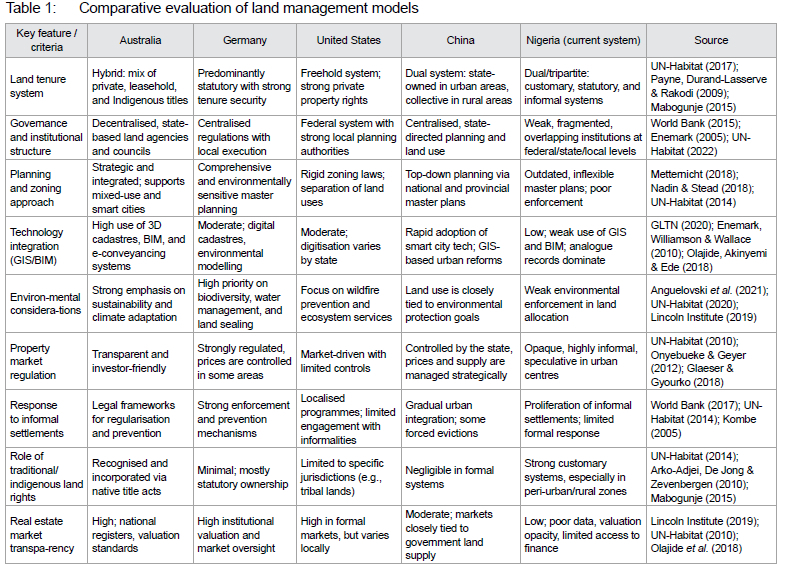
Table 1 provides a side-by-side comparison of urban land governance models in Australia, Germany, the United States, China, and Nigeria. This approach reveals similarities and differences in institutional structures, processes, and policies relevant to Nigeria's urban development. While all criteria in Table 1 are informative, the discussion emphasises dimensions most critical to Nigeria's reform agenda such as tenure security, governance efficiency, planning systems, technology adoption, and environmental sustainability. Interrelated factors such as market transparency, indigenous rights, and responses to informal settlements reinforce the need for a comprehensive and consistent land governance strategy in Nigeria.
Land tenure systems differ widely across countries, shaped by legal traditions, governance structures, and sociopolitical contexts. Australia employs a hybrid tenure system combining private ownership, leasehold, and Aboriginal title, with indigenous land rights recognised under native title law (UN-Habitat, 2017; Arko-Adjei et al., 2010). Germany and the United States offer statutory and freehold systems, respectively, ensuring high tenure security and investor confidence (Payne et al., 2009). Conversely, Nigeria's tripartite tenure system -statutory, customary, and informal - creates legal uncertainty, reduces tenure security, discourages formal investment, and complicates land administration (Mabogunje, 2015; Adeogun & Simeon, 2025).
Governance structures also shape land management outcomes. Australia and the U.S. operate federal and decentralised planning models, characterised by institutional responsiveness (Enemark, 2005; World Bank, 2015). Nigeria's fragmented governance, with overlapping roles across federal, state, and local levels, results in conflicting policies and poor administration (UN-Habitat, 2022). China's centralised model prioritises national development goals but limits participatory planning (Nadin & Stead, 2018). Planning and zoning practices further illustrate institutional disparities: developed countries have adopted greener planning systems (Metternicht, 2018; Anguelovski et al., 2021), while Nigeria relies on outdated master plans, poorly implemented, leading to uncontrolled urbanisation and widespread informal settlements (Kombe, 2005; Popoola et al., 2023).
Technology integration is another key differentiator. Australia and China lead in implementing GIS, BIM, and digital cadastres to streamline land transactions and enhance transparency (GLTN, 2020; Enemark et al., 2010). Nigeria's reliance on analogue systems and weak data infrastructure undermines valuation accuracy and market efficiency (Olajide et al., 2018). Environmental considerations dominate planning in Germany, Australia, and China, where sustainability and climate adaptation are central to land use strategies (Anguelovski et al., 2021; Lincoln Institute, 2019). In contrast, ambiguities in Nigeria's land distribution threaten environmental integrity and long-term urban resilience (UN-Habitat, 2020).
Property market regulation varies significantly. China's state-driven model contrasts with the market-oriented systems of the U.S. and Australia (Glaeser & Gyourko, 2018). Germany's regulatory framework promotes price stability and social equity, offering lessons for Nigeria, where informal and speculative practices prevail (UN-Habitat, 2010; Oloyede, Ajibola & Oni, 2022). Responses to informal settlements also differ. Nigeria's policy relaxation has allowed informal settlements to expand uncontrollably (World Bank, 2017; UN-Habitat, 2014), while Australia and China pursue regularisation and service provision strategies. Australia's recognition of indigenous land rights through native title legislation offers a model for Nigeria, where such rights lack effective statutory integration (Arko-Adjei et al., 2010; Popoola et al., 2023).
Real estate markets are most transparent in countries with robust valuation standards and public land registers such as Germany, Australia, and the U.S. (Lincoln Institute, 2019; Olajide et al., 2018). Nigeria's opaque policies and ineffective systems undermine investor confidence (UN-Habitat, 2010). Effective land management models share common features such as consistent legal frameworks, transparent administration, technology-driven integration, and strong environmental safeguards. Nigeria's fragmented institutions and incompatible tenure systems necessitate decisive reforms to align with global best practices (UN-Habitat, 2022; World Bank, 2015).
4.2 Best practices and policy
Table 2 summarises key policy lessons from international land management practices, outlining six core strategies and examples relevant for Nigeria. These recommendations address the challenges of rapid urbanisation and significant backlogs in Nigeria's land sector, with a strong emphasis on advancing digital land systems.
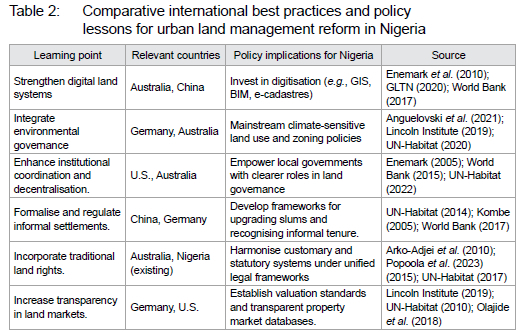
Countries such as Australia and China show that adopting GIS, BIM, and e-cadastre systems significantly improves land registration efficiency, transparency, and urban planning accuracy. In contrast, reliance on analogue systems slows service delivery and hampers market functionality. Therefore, Nigeria must prioritise a national digital agenda for land administration (UN-Habitat, 2020; GLTN, 2020).
Environmental governance is another critical area. Germany and Australia provide strong examples of integrating climate-sensitive zoning and green infrastructure policies into land-use planning to enhance climate resilience and biodiversity protection (Anguelovski et al., 2021; UN-Habitat, 2020). Nigeria urgently needs similar measures as urbanisation and climate pressures intensify (Lincoln Institute, 2019).
Institutional coordination also requires reform. In the U.S. and Australia, clear mandates at local government levels strengthen land governance performance (Enemark, 2005; World Bank, 2015). Nigeria's overlapping legal frameworks and weak accountability hinder effective land management. Reforms must clarify responsibilities across government tiers and harmonise regulations (UN-Habitat, 2022).
Informal settlements demand strategic intervention. China's slum upgrading programmes and Germany's legal mechanisms for informal tenure offer promising models (Kombe, 2005; UN-Habitat, 2014). Nigeria should establish national standards to integrate informal communities into urban planning and provide essential services (World Bank, 2017).
Reconciling customary and statutory systems is equally important. Australia's recognition of indigenous land rights under native title legislation illustrates how traditional ownership can be incorporated into law (Arko-Adjei et al., 2010; Popoola et al., 2023). Nigeria can reduce tenure insecurity, by formally recognising customary land rights.
Finally, land markets must be transparent. In the U.S. and Germany, public valuation systems and accessible land registries ensure investor confidence (Lincoln Institute, 2019; Olajide et al., 2018). Nigeria should implement national valuation standards and electronic property registries to curb speculation and simplify market operations (UN-Habitat, 2010).
4.3 Reform practices
Table 3 compares insights from Germany, Australia, the United States, and China, alongside key challenges facing Nigeria. These lessons provide guidance for reforms and sustainable urban land management.
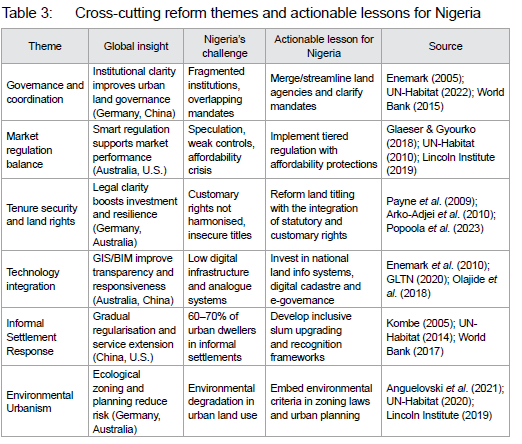
Global models emphasise that successful urban land management depends on institutional clarity. Evidence from Germany and China shows that direct mandates work best when lean, transparent agencies focus on investor confidence and efficient land use (Enemark, 2005; UN-Habitat, 2022). In Nigeria, overlapping roles and conflicting mandates create delays and weak enforcement. Agencies should be reorganised, by clarifying functions through legal and operational reforms (World Bank, 2015).
Market regulation must balance growth and affordability. Australia and the U.S. stabilise housing markets through tiered policies, rent controls, affordable housing programmes, and community-based development (Glaeser & Gyourko, 2018; UN-Habitat, 2010). In Nigeria, speculative real estate practices and poor enforcement drive inequality. Stronger affordability protections and responsive controls are needed (Lincoln Institute, 2019).
Security of tenure underpins investment and social stability. Germany's transparent system and Australia's hybrid tenure regime reduce disputes and maximise land value (Payne et al., 2009). Nigeria's failure to harmonise customary and statutory rights fuels insecurity. Both systems should be integrated under uniform legal regulations (Arko-Adjei et al., 2010; Popoola et al., 2023).
Technology is a game-changer. Australia and China have improved transparency and responsiveness through GIS, BIM, and digital cadastres (Enemark et al., 2010; GLTN, 2020). Nigeria's reliance on analogue systems undermines service delivery and data reliability. Investment in digital infrastructure and a national land information system is essential (Olajide et al., 2018).
Slum management is critical. China and the U.S. are advancing slum upgrading and legalising informal tenure (Kombe, 2005; UN-Habitat, 2014). Nigeria should adopt similar strategies to improve living conditions and integrate informal settlements into urban planning (World Bank, 2017).
Environmental urbanism is no longer optional. Germany and Australia use zoning and land-use planning to integrate ecological priorities and reduce climate risks (Anguelovski et al., 2021). In Nigeria, uncontrolled urbanisation has led to flooding and ecosystem degradation. Zoning laws must incorporate environmental protection measures (UN-Habitat, 2020; Lincoln Institute, 2019).
5. CONCEPTUAL FRAMEWORK FROM GLOBAL INSIGHTS TO NIGERIAN URBAN LAND REFORM
Figure 1 represents both the application and the gathering together of the concepts outlined in the literature review. The approach considers the relationships among land management, land administration and the real estate market, uses the tools of the Land Governance Framework, Institutional Economics, and Urban Growth Theories, and puts together knowledge from international land management systems.
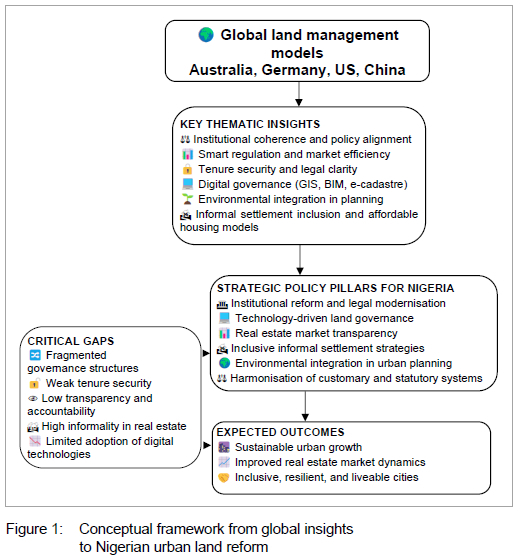
As shown in Figure 1, the conceptual framework was created based on a synthesis of the global land management and application to the Nigerian urban reform. The framework incorporates the interrelationships between land management, land administration, and the real estate market mechanisms, and is supported by the Land Governance Framework (LGF), Institutional Economics, and Urban Growth Theories (Enemark, 2005; Williamson et al., 2010; Teklemariam et al., 2015). It applies these theories to policy-relevant areas in accordance with the gaps and opportunities detected in Nigeria (World Bank, 2015; UN-Habitat, 2017).
At the top, the framework is informed by Global Land Management Models (Australia, Germany, the United States, and China) that focus on institutional coherence, digital land governance, environmental integration, and informal settlement strategies (UN-Habitat, 2022; Lincoln Institute of Land Policy, 2019). These reflections are directly related to section 2.3 (comparative systems) and offer the normative foundation of reform.
The second layer translates these global practices into key thematic insights:
1. Institutional coherence and legal modernisation (Enemark, 2005; UN-Habitat, 2017)
2. Smart regulation and market efficiency (Glaeser & Gyourko, 2018; UN-Habitat, 2010)
3. Tenure security and legal clarity (Payne et al., 2009; Popoola et al., 2023)
4. Digital governance (GIS, BIM, e-cadastre) (Enemark et al., 2010; GLTN, 2020)
5. Environmental integration in planning (Anguelovski et al., 2021; UN-Habitat, 2020)
6. Informal settlement inclusion and affordable housing models (Kombe, 2005; World Bank, 2017)
These are consistent with the theoretical discussions in sections 2.1 and 2.2, in which both land governance and institutional economics highlight that market and land use are formed by legal systems, cultural norms, and governance systems (Teklemariam et al., 2015). Theories of urban growth also describe why the rapid urbanisation trend in Nigeria exacerbates the impact of weak institutions and inadequate regulation (Essien, 2023; Peponi & Morgado, 2020).
Critical gaps in Nigeria are recorded in the third layer, which has already been reported in section 2.5 and supported in the results: fragmented governance, weak tenure security, poor transparency, informality in real estate, and low technological adoption (World Bank, 2015; Olajide et al., 2018). These loopholes refer to the differences between the global standards and the practices in Nigeria.
From these, the framework sets out strategic policy pillars for Nigeria, reflecting sections 4.2 and 4.3 reform lessons:
1. Institutional reform and legal modernisation (UN-Habitat, 2017)
2. Technology-driven land governance (GLTN, 2020)
3. Real estate market transparency (Lincoln Institute of Land Policy, 2019)
4. Inclusive informal settlement strategies (UN-Habitat, 2014; World Bank, 2017)
5. Environmental integration in urban planning (Anguelovski et al., 2021)
6. Harmonised customary and statutory systems (Arko-Adjei et al., 2010)
The final layer defines the expected outcomes, echoing section 4 and the sustainable development discourse in section 2.1:
1. Sustainable urban growth in Nigeria
2. Improved real estate market dynamics
3. Inclusive, resilient, and liveable cities (UN-Habitat, 2020; Williamson et al., 2010)
Generally, the framework outlines the international experience as a policy-based, context-sensitive policy roadmap to reform urban land in Nigeria. It demonstrates the process where theoretical concepts (LGF, institutional economics, and urban growth models) and empirical knowledge (using global practices) are based on the action plan. The framework presents a holistic combination of solutions to the urban land and housing issues in Nigeria, by explicitly linking governance change, technological adoption, market control and regulation, environment integration, and social inclusion.
6. CONCLUSION AND RECOMMENDATIONS
This article highlights that institutional fragmentation, insecure tenure systems, poor uptake of technology, and the lack of integration of environmental priorities are long-standing issues in the land management system in Nigeria. As comparative experience in Australia, Germany, the United States, and China demonstrates, urban growth and equitable real estate performance are more resilient in countries that have harmonised legal frameworks, consistent government organisation, and open market systems. The testimony is that the dependency of Nigeria on a divided tripartite tenure system and on obsolete analogue processes has solidified inefficiencies that compromise the sustainability of the urban region as well as the stability of the market.
Based on international frameworks, the study notes that reform should focus on institutional and legal modernisation, digitalisation, and more multi-level governance. Statutory and customary harmonisation would strengthen tenure security, and digitisation with GIS, BIM, and e-cadastres would make transactions more transparent and less costly. Moreover, experience in Germany and Australia indicates that incorporation of environmental concern within the planning framework, as well as processes of identifying and improving informal settlements precedes stimulation of social inclusion and climate resilience. When properly contextualised, these reforms would put Nigeria in line with international best practices and enhance its ability to cope with high rates of urbanisation. Finally, the suggestions expressed in this article constitute a logical policy pathway to sustainable land governance in Nigeria. The real estate market can be recalibrated to be a source of economic development when the institutions are strengthened, transparency is improved, inclusive urban policies are promoted, and social and environmental weaknesses are mitigated. The theoretical perspective formulated therefore offers a diagnostic and prescriptive resource, mediating theory and practice that facilitates transformative land administration reform, which is evidence-based, context-sensitive, and forward-looking.
REFERENCES
ADEOGUN, R.A. & SIMEON, O.O. 2025. Ownership and compulsory acquisition under customary land tenure in South-West Nigeria: A legal and socio-cultural analysis. African Journal of Law, Political Research and Administration 8(1), pp. 1-12. https://doi.org/10.52589/AJLPRA-TF7UHHFJ [ Links ]
ADEPOJU, A. 2025. Only 3 percent of Nigerians have valid land titles, says Speaker Abbas. https://nujfct.ng [Accessed 20 November 2025]. [ Links ]
ADESOLA, A.S. & OLABIYI, O.B. 2023. Colonialism, migration and the emergence of urban spaces in colonial Nigeria. Sri Lanka Journal of Social Sciences and Humanities, 3(1), pp. 72-79. https://doi.org/10.4038/sljssh.v3i1.87 [ Links ]
AHMED, T., LEY, A., SALHEEN, M. & KOHIMA, J. 2025. Securing land tenure through participatory upgrading processes: Women's experiences in Freedom Square, Gobabis, Namibia. Land, 14(2), article 373. https://doi.org/10.3390/land14020373 [ Links ]
AHSAN, M.S., HUSSAIN, E., ALI, Z., ZEVENBERGEN, J., ATIF, S. et al. 2023. Assessing the status and challenges of urban land administration systems using the framework for effective land administration (FELA): A case study in Pakistan. Land, 12(8), article 1560. https://doi.org/10.3390/land12081560 [ Links ]
AKUMUNTU, A. 2022. Electronic Land Titling (E-Titling) in land administration and economic ecosystems in Rwanda. African Journal on Land Policy and Geospatial Sciences, 5(4), pp. 832-847. https://doi.org/10.48346/IMISTPRSM/ajlp-gs.v5i4.34503 [ Links ]
AMAR, J.H.N., ARMITAGE, L., O'HARE, D. & MOORHEAD, M. 2023. Built heritage management systems: Australia and Germany compared. Athens Journal of Tourism, 10(2), pp. 81-98. https://doi.org/10.30958/ajt.10-2-1 [ Links ]
ANGUELOVSKI, I., CONNOLLY, J.J.T, MASIP, L. & PEARSALL, H. 2021. Scaling up urban nature through equitable land use planning. Lincoln Institute of Land Policy. lincolninst.edu [Accessed 3 March 2024]. [ Links ]
ARKO-ADJEI, A., DE JONG, J. & ZEVENBERGEN, J. 2010. Customary tenure institutions and good governance. Land Use Policy, 27(3), pp. 649-657. https://doi.org/10.1016/j.landusepol.2009.08.006 [ Links ]
ARTMANN, M. 2014. Assessment of soil sealing management responses, strategies, and targets toward ecologically sustainable urban land use management. Ambio, 43(4), pp. 530-541. https://doi.org/10.1007/s13280-014-0511-1 [ Links ]
ASSEDE, E., OROU, H., BIAOU, S., GELDENHUYS, C., AHONONGA, F. & CHIRWA, P. 2023. Understanding drivers of land use and land cover change in Africa: A review. Current Landscape Ecology Reports, 8(1), pp. 62-72. https://doi.org/10.1007/s40823-023-00087-w [ Links ]
AWUAH, K. & ABDULAI, R. 2022. Urban land and development management in a challenged developing world: An overview of new reflections. Land, 11(1), article 129. https://doi.org/10.3390/land11010129 [ Links ]
AZIE, E., EGOLUM, C. & EMOH, F. 2024. Land administration domain model and sustainable land administration system in Southeast Nigeria. American International Journal of Business Management, 7(7), pp. 67-77. https://doi.org/10.5281/zenodo.12624817 [ Links ]
BABALOLA, K. 2023. Assessing land administration systems with their legal frameworks for peri-urban areas of Ekiti State, Nigeria. Unpublished PhD dissertation. University of Cape Town, South Africa. [ Links ]
BABALOLA, K. & HULL, S. 2019. Examining the Land Use Act of 1978 and its effects on tenure security in Nigeria: A case study of Ekiti State, Nigeria. Potchefstroom Electronic Law Journal, 22, pp. 1-34. https://doi.org/10.17159/1727-3781/2019/v22i0a5803 [ Links ]
BABALOLA, K., HULL, S. & WHITTAL, J. 2024. Assessing peri-urban land management using 8Rs framework of responsible land management: The case of peri-urban land in Ekiti State, Nigeria. Land, 12(9), article 1795. https://doi.org/10.3390/land12091795 [ Links ]
BAKO, A.I.B. & BALOGUN, F.A.B. 2023. A review of emerging issues on urban land management policy in Nigeria. Urban and Regional Planning Review, 9(1), pp. 37-44. [ Links ]
BARZEGAR, M., RAJABIFARD, A., KALANTARI, M. & ATAZADEH, B. 2021. A framework for spatial analysis in 3D urban land administration - A case study for Victoria, Australia. Land Use Policy, 111, article 105766. https://doi.org/10.1016/j.landusepol.2021.105766 [ Links ]
BASSETT, E.M. 2017. The challenge of reforming land governance in Kenya under the 2010 Constitution. The Journal of Modern African Studies, 55(4), pp. 537-566. https://doi.org/10.1017/S0022278X17000441 [ Links ]
BIZOZA, A.R. & OPIO-OMODING, J. 2020. Assessing the impacts of land tenure regularisation: Evidence from Rwanda and Ethiopia. Land Use Policy, 100, 104904. https://doi.org/10.1016/j.landusepol.2020.104904 [ Links ]
BRAUN, V. & CLARKE, V. 2006. Using thematic analysis in psychology. Qualitative Research in Psychology, 3(2), pp. 77-101. https://doi.org/10.1191/1478088706qp063oa [ Links ]
BRAUN, V. & CLARKE, V. 2019. Reflecting on reflexive thematic analysis. Qualitative Research in Sport, Exercise and Health, 11(4), pp. 589-597. https://doi.org/10.1080/2159676X.2019.1628806 [ Links ]
BRIDOUX, F. & STOELHORST, J.W. 2022. Stakeholder theory, strategy, and organisation: Past, present, and future. Strategic Organisation, 20(4), pp. 797-809. https://doi.org/10.1177/14761270221127628 [ Links ]
CAI, M., MURTAZASHIVILI, J.B., MURTAZASHVILI, I. & WANG, H. 2020. Sugar-coating the bitter pill: Compensation, land governance, and opposition to land expropriation in China. The Journal of Peasant Studies, 47(6), pp. 1371-1392. https://doi.org/10.1080/03066150.2020.1824180 [ Links ]
CALDER, V.B. 2017. Zoning, land-use planning, and housing affordability. Policy Analysis, 873. cato.org [Accessed 5 March 2025]. [ Links ]
CHIGBU, U.E., BENDZKO, T., MABAKENG, M.R., KUUSAANA, E.D. & TUTU, D.O. 2021. Fit-for-purpose land administration from theory to practice: Three demonstrative case studies of local land administration initiatives in Africa. Land, 10(5), 476. https://doi.org/10.3390/land10050476 [ Links ]
CHO, S. & JUNG, J. 2024. Behavioural finance insights into land management: Decision aggregation and real estate market dynamics in China. Land, 13(9), article 1478. https://doi.org/10.3390/land13091478 [ Links ]
CHO, C., YANG, J. & JANG, B. 2024. Climate policy uncertainty and its impact on real estate market dynamics: A sectoral and regional analysis. PLOS ONE, 19(10), e0311688. https://doi.org/10.1371/journal.pone.0311688 [ Links ]
CHRISTENSEN, A. 2016. The flexible land tenure system: Localised success and national potential, 6, pp. 1-22. Windhoek: Namibia University of Science and Technology Institutional Repository. ir.nust.na. [Accessed 5 March 2025]. [ Links ]
CORRELJÉ, A., PESCH, U. & CUPPEN, E. 2022. Understanding value change in the energy transition: Exploring the perspective of original institutional economics. Science and Engineering Ethics, 28(6). https://doi.org/10.1007/s11948-022-00403-3 [ Links ]
DAUDA, S. 2024. Access to land: Effects on housing affordability in Abuja, Nigeria. International Journal of Civil Engineering, Construction and Estate Management, 12(1), pp. 19-40. https://doi.org/10.37745/ijcecem.14/vol12n11940 [ Links ]
DESMARAIS-TREMBLAY, M. & STOJANOVIC, A. 2022. Framing institutional choice, 1937-1973: New institutional economics and the neglect of the commons. Review of Political Economy, 34(4), pp. 665-691. https://doi.org/10.1080/09538259.2022.2096284 [ Links ]
DE VRIES, W. & LEWIS, J. 2009. Are urban land tenure regulations in Namibia the solution or the problem? Land Use Policy, 26(4), pp. 1116-1127. https://doi.org/10.1016/j.landusepol.2009.02.002 [ Links ]
DURÁN-DÍAZ, P. 2023. Sustainable land governance for water-energy-food systems: A framework for rural and peri-urban revitalisation. Land, 12(10), article 1828. https://doi.org/10.3390/land12101828 [ Links ]
ENEMARK, S. 2005. Understanding the land management paradigm. Survey Review, 38(294), pp. 5-16. https://doi.org/10.1179/sre.2005.38.294.5 [ Links ]
ENEMARK, S., WILLIAMSON, I. & WALLACE, J. 2010. Land administration for sustainable development. ESRI Press. [Accessed 5 March 2025]. [ Links ]
ESSEN, C. 2024. Over 90% of land in Nigeria remains unregistered - Dangiwa. The Guardian. [Accessed 20 November 2025]. [ Links ]
ESSIEN, E. 2023. Urban theories and urbanisation perspectives in cities across Nigeria. Environmental Research Communications, 5(8), article 085008. https://doi.org/10.1088/2515-7620/acefb4 [ Links ]
GEBRIHET, H.G. & PILLAY, P. 2021. Emerging challenges and prospects of digital transformation and stakeholders' integration in urban land administration in Ethiopia. Global Journal of Emerging Market Economies, 13(3), pp. 341-356. https://doi.org/10.1177/09749101211034097 [ Links ]
GLAESER, E.L. & GYOURKO, J. 2018. The economic implications of housing supply. Journal of Economic Perspectives, 32(1), pp. 3-30. https://doi.org/10.1257/jep.32.1.3 [ Links ]
GLTN. 2020. Land information systems in the context of the SDGs. UN-Habitat. unhabitat.org [Accessed 5 March 2025]. [ Links ]
JEONG, S.H. & CHOI, I. 2017. A study on the reaction of the real estate market to the change in the acquisition tax rate in South Korea. International Journal of Business Policy and Strategy Management, 4(1), pp. 51-56. https://doi.org/10.21742/ijbpsm.2017.4.1.09 [ Links ]
KAN, K. 2021. Creating land markets for rural revitalisation: Land transfer, property rights and gentrification in China. Journal of Rural Studies, 81, pp. 68-77. https://doi.org/10.1016/j.jrurstud.2020.08.006 [ Links ]
KLOPP, J.M. & LUMUMBA, O. 2017. Reform and counter-reform in Kenya's land governance. Review of African Political Economy, 44(154), pp. 577594. https://doi.org/10.1080/03056244.2017.1367919 [ Links ]
KOMBE, W.J. 2005. Land use dynamics in peri-urban areas and their implications on the urban growth and form. Habitat International, 29(1), pp. 113-135. https://doi.org/10.1016/S0197-3975(03)00076-6 [ Links ]
LAUTERBACH, R. & DE VRIES, W. 2022. Beyond accuracy: evaluating alternative measurement methods in context of Flexible Land Tenure System in Namibia. Survey Review, 54(385), pp. 281-289. https://doi.org/10.1080/00396265.2021.1933696 [ Links ]
LINCOLN INSTITUTE OF LAND POLICY 2019. Improving land valuation systems in Africa. lincolninst.edu [Accessed 5 March 2025]. [ Links ]
LIU, Z., ZHANG, L., ROMMEL, J. & FENG, S. 2020. Do land markets improve land-use efficiency? Evidence from Jiangsu, China. Applied Economics, 52(3), pp. 317-330. https://doi.org/10.1080/00036846.2019.1645286 [ Links ]
LOUSADA, S.A.N. (Ed.). 2024. Land-use management: Recent advances, new perspectives, and applications. IntechOpen. https://doi.org/10.5772/intechopen.111321 [ Links ]
LUPALE, M. & HAMPWAYE, G. 2019. Inclusiveness of urban land administration in the city of Lusaka, Zambia. BuHetin of Geography. SocioEconomic Series, 46(46), pp. 53-70. https://doi.org/10.2478/bog-2019-0034 [ Links ]
METTERNICHT, G. 2018. Land use and spatial planning: Enabling sustainable management of land resources. Cham: Springer. springer.com [Accessed 5 March 2025]. [ Links ]
MICHALINA, D., MEDERLY, P., DIEFENBACHER, H. & HELD, B. 2021. Sustainable urban development: A review of urban sustainability indicator frameworks. Sustainability, 13(16), article 9348. https://doi.org/10.3390/su13169348 [ Links ]
MILES, M.B., HUBERMAN, A.M. & SALDAÑA, J. 2018. Qualitative data analysis: A methods sourcebook. 4th edition. Thousand Oaks, CA: SAGE Publications. [ Links ]
MORCKEL, V. 2017. Why the Flint, Michigan, USA water crisis is an urban planning failure. Cities, 62, pp. 23-27. https://doi.org/10.1016/j.cities.2016.12.002 [ Links ]
MUGISHA, J., UWAYEZU, E., BABERE, N.J. & KOMBE, W.J. 2025. Fostering neighbourhood social-ecological resilience through land readjustment in rapidly urbanising cities in sub-Saharan Africa: The case of Nunga in Kigali, Rwanda. Urban Science, 9(5), article 171. https://doi.org/10.3390/urbansci9050171 [ Links ]
NADIN, V. & STEAD, D. 2018. European spatial planning systems: Social models and planning cultures. In: Metternicht, G. (Ed.), Land use and spatial planning. Springer, pp. 17-36. [Accessed 3 June 2025]. [ Links ]
NAGYA, U. & UDOEKANEM, N. 2022. Factors influencing access to urban land for private housing development in Minna, Nigeria. Journal of African Real Estate Research, 7(2), pp. 1-23. https://doi.org/10.15641/jarer.v7i2.1205 [ Links ]
NENZHELELE, T. 2024. Competitive intelligence formalisation in the property sector: The emerging market study. Corporate and Business Strategy Review, 5(1), Special Issue), pp. 295-306. https://doi.org/10.22495/cbsrv5i1siart4 [ Links ]
NING, L., PAN, T., ZHANG, Q., ZHANG, M., LI, Z. & HOU, Y. 2024. Differentiated impacts of land-use changes on landscape and ecosystem services under different land management system regions in Sanjiang Plain of China from 1990 to 2020. Land, 13(4), article 437. https://doi.org/10.3390/land13040437 [ Links ]
NIYOGAKIZA, A. & LIU, Q. 2025. GIS-driven multi-criteria assessment of rural settlement patterns and attributes in Rwanda's Western Highlands (Central Africa). Sustainability, 17(14), article 6406. https://doi.org/10.3390/su17146406 [ Links ]
OLAJIDE, O., AKINYEMI, F. & EDE, P. 2018. GIS-based land administration in Nigeria: Challenges and prospects. Journal of African Real Estate Research, 3(1), pp. 1-15. https://doi.org/10.15641/jarer.v3i1.622 [ Links ]
OLOYEDE, S., AJIBOLA, M. & ONI, A. 2022. Informal land transactions and property market distortions in Lagos, Nigeria. Journal of African Real Estate Research, 7(1), pp. 45-60. https://doi.org/10.1080/26730705.2022.2034567 [ Links ]
ONYEBUEKE, V. & GEYER, M. 2012. The informal sector in urban Nigeria: Reflections from almost four decades of research. Town and Regional Planning, 59, pp. 65-76. https://doi.org/10.38140/trp.v59i0.491 [ Links ]
OPONDO, O., OPIO, P. & ONGETI, W. 2021. Land administration in Kenya: The case for leading and managing change. International Journal of Scientific and Research Publications (IJSRP), 11(5), pp. 86-92. https://doi.org/10.29322/IJSRR11.05.2021.p11313 [ Links ]
OYENIRAN, L. 2025. Critical examination of land reforms in Nigeria: Issues, challenges and solutions. African Journal of Law, Ethics and Education, 8(2), pp. 213-226. https://doi.org/10.52589/AJLEE-TF7UHHFJ [ Links ]
ÖZDEN, M. 2024. Content and thematic analysis techniques in qualitative research: Purpose, process and features. Qualitative Inquiry in Education: Theory & Practice, 2(1), pp. 64-81. https://doi.org/10.59455/qietp.20 [ Links ]
PAGE, M., MCKENZIE, J., BOSSUYT, P., BOUTRON, I.,HOFFMANN, T., et al. 2021. The PRISMA 2020 statement: An updated guideline for reporting systematic reviews. PLOS Medicine, 18(3), article 1003583. https://doi.org/10.1371/journal.pmed.1003583 [ Links ]
PAYNE, G., DURAND-LASSERVE, A. & RAKODI, C. 2009. The limits of land titling and home ownership. Environment and Urbanisation, 21(2), pp. 443-462. https://doi.org/10.1177/0956247809344364 [ Links ]
PEPONI, A. & MORGADO, P. 2020. Smart and regenerative urban growth: A literature network analysis. International Journal of Environmental Research and Public Health, 17(7), article 2463. https://doi.org/10.3390/ijerph17072463 [ Links ]
POPOOLA, A., BLAMAH, N., MEDAYESE, S., FALOLA, O. & OGUNMODEDE, O. et al. 2023. The evolution and nature of urban planning in Nigeria. In: Lamond, J. (Ed.). Reimagining urban planning in Africa. Cambridge: Cambridge University Press, pp. 143164. https://doi.org/10.1017/9781009389457.013 [ Links ]
RAJABIFARD, A., ATAZADEH, B. & KALANTARI, M. 2019. BIM and urban land administration. CRC Press. https://doi.org/10.1201/9781351032346 [ Links ]
SIEGEL, K., LARSEN, L.G., STEPHENS, C., STEWART, W. & BUTSIC, V. 2022. Quantifying drivers of change in social-ecological systems: Land management impacts wildfire probability in forests of the western US. Regional Environmental Change, 22(3). https://doi.org/10.1007/s10113-022-01950-y [ Links ]
SOUTHER, S., COLOMBO, S. & LYNDON, N. 2023. Integrating traditional ecological knowledge into US public land management: Knowledge gaps and research priorities. Frontiers in Ecology and Evolution, 11. https://doi.org/10.3389/fevo.2023.988126 [ Links ]
STAMMEL, B., FISCHER, C., CYFFKA, B., ALBERT, C., DAMM, C. et al. 2020. Assessing land use and flood management impacts on ecosystem services in a river landscape (Upper Danube, Germany). River Research and Applications, 36(7), pp. 1174-1185. https://doi.org/10.1002/rra.3669 [ Links ]
TEKLEMARIAM, D., AZADI, H., NYSSEN, J., HAILE, M. & WITLOX, F. 2015. Transnational land deals: Towards an inclusive land governance framework. Land Use Policy, 42, pp. 781-789. https://doi.org/10.1016/j.landusepol.2014.09.021 [ Links ]
UN-HABITAT. 2010. Urban land markets: Economic concepts and tools for engaging in African cities. unhabitat.org [Accessed 5 July 2025]. [ Links ]
UN-HABITAT. 2014. Land tenure security for all. unhabitat.org [Accessed 5 July 2025]. [ Links ]
UN-HABITAT. 2017. Land governance: A review and analysis of key international frameworks. unhabitat.org [Accessed 5 July 2025]. [ Links ]
UN-HABITAT. 2020. Sustainable urban development and environmental planning. unhabitat.org [Accessed 5 July 2025]. [ Links ]
UN-HABITAT. 2022. Urban land governance and planning. unhabitat.org [Accessed 5 July 2025]. [ Links ]
UN-HABITAT. 2023. Accelerating transformation of informal settlements and slums by 2030 (HSP/OECPR.2023/CRP.5/Rev.1). United Nations Human Settlements Programme. unhabitat.org [Accessed 5 July 2025]. [ Links ]
VALENTINOV, V. 2023. Stakeholder theory: Toward a classical institutional economics perspective. Journal of Business Ethics, 188(1), pp. 75-88. https://doi.org/10.1007/s10551-022-05304-w [ Links ]
VANGUARD. 2025. Over 90% of Nigerian lands unregistered, says Minister. Vanguard. [Accessed 20 November 2025]. [ Links ]
VARDOPOULOS, I., PAPOUI-EVANGELOU, M., HOCOBA, B. & SALVATI, L. 2023. Smart 'tourist cities' revisited: Culture-led urban sustainability and the global real estate market. Sustainability, 15(5), article 4313. https://doi.org/10.3390/su15054313 [ Links ]
WEGERIF, M., COULIBALY, M. & OUEDRAOGO, H. 2025. Land tenure governance in the flrst decades of the 21st century: Progress, challenges, and lessons from 18 countries. Land, 14(4), 671. https://doi.org/10.3390/land14040671 [ Links ]
WEI, P., LIU, Y., YAN, J., LI, M. & ZHANG, Y. 2023. Circulation of development factors promoted by the innovation of land management under the background of rural vitalization: A case study of Tengtou village in Zhejiang province, China. Chinese Geographical Science, 33(5), pp. 813-832. https://doi.org/10.1007/s11769-023-1381-x [ Links ]
WHALEN, C.J. (Ed.). 2021. institutional economics: Perspectives and methods in pursuit of a better world. London: Routledge. https://doi.org/10.4324/9781003160434 [ Links ]
WORLD BANK. 2015. Urban land governance: Institutional frameworks and policy challenges. worldbank.org [Accessed 5 July 2025]. [ Links ]
WORLD BANK. 2017. Informal settlements in sub-Saharan Africa: Understanding the dynamics and policy responses. worldbank.org [Accessed 5 July 2025]. [ Links ]
WU, M., YAN, B., HUANG, Y. & SARKER, M. 2022. Big data-driven urban management: Potential for urban sustainability. Land, 11(5), article 680. https://doi.org/10.3390/land11050680 [ Links ]
XU, D., MA, Z., DENG, X., LIU, Y., HUANG, K., ZHOU, W. & YONG, Z. 2020. Relationships between land management scale and livelihood strategy selection of rural households in China from the perspective of the family life cycle. Land, 9(1), article 11. https://doi.org/10.3390/land9010011 [ Links ]
ZENG, C., YIN, Y., GUO, L., LIU, C., ZHANG, Y. & HUANG, Z. 2024. Integrating the administrative spill-over effect into the spatial governance system to revisit land development: A study in urban-rural fringe areas of Wuhan and neighbouring cities, China. Land Use Policy, 139, article 107060. https://doi.org/10.1016/j.landusepol.2024.107060 [ Links ]
ZENG, X., YU, Y., YANG, S., LV, Y. & SARKER, M. 2022. Urban resilience for urban sustainability: Concepts, dimensions, and perspectives. Sustainability, 14(5), article 2481. https://doi.org/10.3390/su14052481 [ Links ]
Received: September 2025
Peer reviewed and revised: November 2025
Published: December 2025
* The author(s) declared no potential conflicts of Interest with respect to the research, authorship, and/or publication of this article