




Services on Demand
Journal

Article
 English (pdf)
 Article in xml format
 Article references
 Automatic translation
 Send this article by e-mail
Indicators
Related links
-
 Cited by Google
 -
 Similars in Google
Share

 Permalink
Town and Regional Planning
On-line version ISSN 2415-0495Print version ISSN 1012-280X
Town reg. plan. (Online) vol.86 Bloemfontein 2025
https://doi.org/10.38140/trp.v86i.9071
REVIEW ARTICLE
Regularisation or squatter incorporation? Land readjustment projects as an alternative approach for Tanzania
Regularisering of plakkerinlywing? Grondaanpassingsprojekte as 'n alternatiewe benadering vir Tanzanië
Regularization kapa squatter incorporation? Merero ea tokiso ea mobu e le mokhoa o mong oa Tanzania
Tumpale Sakijege
Department of Urban and Regional Planning, Ardhi University, P.O. Box 35176, Dar es Salaam, Tanzania. ROR: https://ror.org/05k903r09, Email: tumpaleg@gmail.com / tumpale.mwankenja@aru.ac.tz, ORCID: https://orcid.org/0000-0001-6901-7060
ABSTRACT
Driven by rapid urbanisation and housing shortages, informal settlements pose major challenges to urban development in Tanzania. This article examines the limited effectiveness of regularisation efforts to address them. It outlines the extent to which the implementation of the regularisation scheme in Tanzania has impacted the conditions of informal settlements. A qualitative desktop study, including literature review with thematic analysis, was done. The analysis identified regularisation approaches in different country contexts, and in Tanzania. The article discusses the successes and challenges of informal settlement regularisation, with a focus on stakeholder involvement, land rights and tenure security, implementation costs, institutional capacity, and community awareness. Central to this discussion is that 'regularisation without settlement transformation' (squatter incorporation) prevails in Tanzania and undermines the success of regularisation initiatives. The failure of these initiatives preceded the poor conditions of informal settlements, and only through the adoption of large-scale land readjustment projects can these challenges be addressed. Land readjustment is a collaborative process in which landowners temporarily release their land for re-planning and infrastructure development, in return for a smaller but serviced plot or completed housing unit, ensuring more equitable and inclusive benefits for all residents of informal settlements. The article concludes that Tanzania should pair land readjustment with a strong commitment to high-density, affordable housing development supported by public institutions, as the absence of a clear housing strategy has previously led landowners to delay construction and capitalise on rising land values, undermining the programme's objectives.
Keywords: informal settlements, regularisation, urban development, governance, land readjustment
OPSOMMING
Hierdie artikel ondersoek die beperkte doeltreffendheid van regulariseringspogings om die uitdagings van informele nedersettings in Tanzanië wat hoofsaaklik deur vinnige verstedeliking en behuisingstekorte ontstaan, aan te spreek. Dit evalueer hoe die implementering van regulariseringskemas die lewensomstandighede in hierdie nedersettings beïnvloed het. Deur middel van 'n kwalitatiewe lessenaarstudie en tematiese literatuuranalise word verskeie benaderings tot regularisering, insluitend internasionale voorbeelde, ondersoek. Die studie beklemtoon kernaspekte soos belanghebberbetrokkenheid, grond- en be-sitregsekerheid, implementeringskoste, institusionele kapasiteit en gemeenskapsbewustheid. 'n Sleutelvinding is dat regularisering sonder nedersettings-transformasie - wat neerkom op die eenvoudige inlywing van plakkersgebiede - algemeen in Tanzanië voorkom en die doelwitte van regularisering ondermyn. Hierdie benadering het daartoe gelei dat swak lewensomstandighede voortduur. Die artikel bepleit grondaanpassing as 'n alternatiewe strategie, wat 'n samewerkende proses behels waar grondeienaars tydelik hul grond beskikbaar stel vir herbeplanning en infrastruktuurontwik-keling, in ruil vir 'n kleiner maar verbeterde en gedienste erf of voltooide wooneenheid. Hierdie benadering kan billiker en inklusiewer voordele vir inwoners verseker. Die gevolgtrekking is dat Tanzanië grondaanpassing moet integreer met 'n hoë digtheid, bekostigbare behuisingstrategie wat deur openbare instellings ondersteun word. Die afwesigheid van so 'n strategie het voorheen konstruksievertraging en spekulasie op grondwaardes veroorsaak, wat die sukses van regulariseringsinisiatiewe ondermyn het.
KAKARETSO
Ho ata ha litoropo ka potlako le khaello ea matlo ho matlafalitse kholo ea metse ea mekhukhu Tanzania, ho hlahisa mathata a mangata ntlafatsong ea litoropo. Sengoloa sena se sekaseka hore na ke hobaneng ha boiteko ba kamehla ba ho rarolla bothata bona bo sa atleheng. Ho sebelisitsoe boithuto ba boleng ka tlhahlobo ea lingoliloeng le sehlooho ho utloisisa kamoo ts'ebetsong ea maano a mmuso e amang maemo a mekhukhu. Tlhahlobo e bontsitse mekhoa e fapaneng ea linaha mabapi le tokiso ea mekhukhu, ho kenyeletsa Tanzania. Sengoloa se totobatsa katleho le liphephetso ho sebetsaneng le meaho e sa reroang ka ho shebana le ba amehang, litokelo tsa mobu le ts'ireletseho ea bolulo, litsenyehelo, bokhoni ba mekhatlo le tlhokomeliso ea sechaba. Ho totobala hore 'taolo ntle le phetoho ea bolulo' e ntse e tsoela pele Tanzania, e imetsa katleho ea maano a semmuso. Ho hloleha hona ho baka keketseho ea maemo a sa pheleng hantle. Sengoloa se sisinya hore tharollo ke ho amohela mokhoa oa tokiso ea mobu, moo beng ba mobu ba sebelisanang ho lokolla mobu bakeng sa ntlafatso ea meralo, ka puseletso e lekanang joalo ka matlo a phethiloeng kapa litsebeletso tse ntlafalitsoeng. Qetellong, ho kopanya tokiso ea mobu le maano a matlo a theko e tlaase le tSehetso ea sechaba ho bohlokoa ho rarolla bothata bona bo tebileng Tanzania.
1. INTRODUCTION
The global population continues to grow at an unprecedented rate, reaching 8 billion in 2022, and is projected to rise to nearly 10 billion by 2050 (UN, 2023). Nearly half of this growth is expected to come from only nine countries, including Tanzania (UN, 2023). Key drivers of this expansion include urbanisation, industrialisation, and rapid income growth (Anser et al., 2020; Shang et al., 2018; Suhartini & Jones, 2019; Sulemana et al., 2019). Developing nations face significant challenges in accommodating this growth, as governments struggle to provide adequate services (Oni-Jimoh et al., 2018; Tiffen, 2018). One notable consequence of rapid urban population growth is the proliferation of informal settlements.
Informal settlements have become a global concern, with studies confirming their prevalence and the challenges of addressing them. For instance, in Latin America, nearly one-fourth of the urban population lives in informal conditions. A study of 124 jurisdictions revealed that informality increased in 80% of cities between 2010 and 2020, while only 20% experienced no change or a slight decrease (Goytia, 2021).
In Tanzania, informal settlements accommodate over 60% of the urban population, reflecting both a local and global urban challenge (URT, 2016). In response, the Ministry of Land, Housing and Human Settlements Development (MLHHSD) set an ambitious target to reduce the proportion of land occupied by informal settlements from 66% in 2015/2016 to 50% by 2021 (URT, 2023). Tanzania has enacted a range of policies and legislative frameworks, including the National Human Settlements Policy (2000), the Land Act No. 4 (1999), and the Urban Planning Act No. 8 (2007a), that acknowledge the presence of informal settlements and emphasise the importance of improving them, particularly through regularisation. Nevertheless, financing regularisation initiatives remain a significant barrier, as does ensuring the availability of surveyed and serviced land to meet the growing demand for adequate shelter, particularly for disadvantaged groups (Kyessi, 2008).
Informal settlements are not unique to Tanzania. They are a persistent and evolving concern globally, known by a variety of terms that reflect their cultural and geographic contexts: 'tent cities' in the United States of America (Loftus-Farren, 2011); 'baraccopoli' in Italy (Romano et al., 2021); 'kampongs' in Indonesia (Reerink, 2015); 'shanty towns' in South Africa (West-Pavlo, 2018); 'favelas' in Brazil (Fernandes, 2000), and 'slums' in Kenya and Nigeria (Mukeku, 2018; Fayehun et al., 2022). In Tanzania, they are commonly referred to as 'squatter', 'unplanned', or 'informal settlements' (URT, 2000). This global terminology diversity emphasises the widespread nature of informal urban development, transcending the boundaries of both developed and developing nations.
Although informal settlements are a worldwide phenomenon (Aboulnaga, Badran & Barakat, 2021), their impacts are particularly acute in countries of the Global South (López, Bartolomei & Lamba-Nieves, 2019). It is estimated that over one billion people currently reside in such settlements (UN DESA, 2023). In several major cities, including Nairobi (60%), Cairo (65%), and Dar es Salaam (70%), a vast majority of the population lives in informal conditions (Satterthwaite et al., 2020). Some studies report that, in some regions, informal settlements now house as much as 80% of the urban population (Magina, Kyessi & Kombe, 2020: 3).
In Tanzania, the proliferation of informal settlements is part of this broader global trend. These settlements often emerge in ecologically and economically vulnerable locations such as floodplains, river valleys, central urban areas, and city fringes (Sakijege & Dakyaga, 2023; Bhanjee & Zhang, 2018). Their expansion is frequently driven by rapid urbanisation (Mwaihuti, 2018), population growth, and the persistent shortage of affordable housing (Andreasen, Agergaard & M0ller-Jensen, 2017). Urban migration and the pursuit of economic opportunities further exacerbate land pressure, driving the continued growth of informal settlements.
Since gaining independence in 1961, Tanzania has pursued various long-term strategies to improve informal settlements. These efforts, along with their outcomes and ongoing challenges, are examined in Section 2. Currently, regularisation is the principal strategy employed to address informal settlement issues. However, there are ongoing concerns about how effective it is in delivering lasting and sustainable improvements in these areas.
This study, therefore, seeks to examine the practice and limitations of informal settlement regularisation in Tanzania. It aims to identify alternative strategies for sustainable improvement, by drawing on global experiences. Specifically, the study reviews selected international approaches to improving informal settlements, highlighting their successes and limitations; it evaluates the implementation and effectiveness of regularisation efforts in Tanzania, and proposes land readjustment as a contextually appropriate and sustainable strategy for informal settlement improvement, informed by international best practices.
2. LITERATURE REVIEW
2.1 Informal settlement upgrading initiatives
Tanzania has undertaken various initiatives to improve the conditions of informal settlements through the implementation of diverse, responsive mitigation strategies. These include slum clearance (1960s-1970s), squatter upgrading (1970s-1980s), site and services projects (1980s-1990s), community infrastructure programme (1993-2000), community infrastructure upgrading programme (CIUP) (2005-2012), and regularisation (2000s-2024).
The slum clearance policy aimed to eliminate the undesirable presence of squatter housing in urban areas (Simba, 2019), replacing informal structures with high-quality developments to improve living conditions for low-income residents (Ndezi, 2009). However, the approach led to a range of unintended consequences that ultimately undermined its objectives. These included the mass displacement of residents, often without adequate resettlement options (Magembe-Mushi & Lupala, 2015); high economic and social costs, with limited additions to the formal housing stock, leading to the eventual abandonment of the initiative (Kyessi, 1997), and increased marginalisation of the poor, as higher income groups dominated access to redeveloped areas and financial barriers excluded many intended beneficiaries (Magina et al., 2020; Todd et al., 2019).
Squatter upgrading took place in the late 1970s and early 1980s (Sheuya & Burra, 2016). Funded by the central government and international donors, the initiative was marked by a top-down approach (Kyessi, 1997; Magina et al., 2020). The programme sought to rectify the deficiencies of the earlier slum clearance project, targeting informal areas such as Hanna Nasiff, Buguruni, Magomeni, Manzese, Tandika, and Vingunguti. While community participation was considered important, the implementation relied heavily on contractors rather than community labour to ensure higher quality work. Despite visible improvements, high infrastructure standards increased costs, leading to the decision to upgrade only two communities instead of the initially planned seven (Magina et al., 2020: 5).
The site and services approach sought to address the acute housing shortage in urban areas, by providing serviced plots for individual households, integrating a town-planning approach, and involving the community. It also aimed to relocate households from hazardous, flood-prone areas, focusing on areas such as Sinza, Kijitonyama, Mikocheni, and Mbagala (Magina et al., 2020: 5). Despite major contributions from entities such as the World Bank, the central government, and the city council, a post-project evaluation by the World Bank revealed that only 48.3% of the developed plots were inhabited five years later, with 22% remaining uninhabitable, and 26.6% undeveloped (Kironde, 1991). These shortcomings led to the launch of the Community Infrastructure Programme (CIP).
The CIP, supported by the World Bank, aimed to address housing and related issues for poor urban communities. The approach included a multi-sectoral and participatory strategy, focusing on drainage and community engagement through community-based organisations (CBOs), with support from the International Labour Organisation (ILO) and the Ford Foundation (Magina et al., 2020). The programme relied on community labour and a micro-credit scheme. In collaboration with the World Bank, the Sustainable Dar es Salaam Project (SDP) developed the CIP under the Urban Sector Rehabilitation Programme (USRP). Later, the SDP partnered with the World Bank for an additional upgrading programme in seven communities, supported by the USRP, with technical assistance from Irish entities and funding from the Infrastructure Development Association (IDA).
Initially planned as a five-year programme costing approximately US$ 5.6 million, delays resulted in a revised two-year programme covering two communities (Tabata and Kijitonyama), both poorly serviced but planned settlements with mainly owner-occupiers (Magina et al., 2020: 7).
The Community Infrastructure Upgrading Programme (CIUP) was part of the broader Local Government Support Program (LGSP), aimed at improving infrastructure and urban services in unplanned areas across the country (Worrall et al., 2017). The programme focused on enhancing spatial, social, environmental, and economic conditions, while strengthening local government capabilities in Tanzania. CIUP specifically targeted 31 areas in Dar es Salaam, ensuring functionality, affordability, and alignment with community needs. Key contributors included the World Bank for financial support, the Ministry of Lands, Housing, and Human Settlements Development overseeing implementation, and the Human Settlements Development providing expertise. Grassroots institutions such as Ward and Mtaa Leaders and the community actively participated by contributing manpower and land.
Despite various commendable initiatives, many settlements in Tanzania continue to exhibit informal characteristics - a condition this study terms 'squatter incorporation'. This refers to the process whereby informal settlements (squatter) are partially recognised or legitimised, often through the issuance of certificates of occupancy and the limited extension of basic services. However, the overall structure and form of these settlements largely remain informal. While communities may benefit from some legal recognition and minimal service provision, they frequently lack the comprehensive planning and infrastructure typically associated with sustainable urban development. Key components such as well-defined road networks, adequate public services aligned with population needs, and significant improvements in housing quality are often missing. Consequently, these partially upgraded settlements continue to face many of the challenges linked to unplanned urban growth.
2.2 Land regularisation for informal settlement upgrading
Land regularisation has emerged as a widely adopted and effective strategy for addressing informal settlements globally. It is defined as the process of restructuring land-tenure systems and delivering basic infrastructure services to informally developed areas (URT, 2007a). In the Tanzanian context, the 2007 Guidelines for Preparing General and Detailed Planning Schemes emphasise that the primary objectives of regularisation are to secure tenure and enhance the provision of essential services in informal settlements (Land Portal, 2021: online). This approach is particularly beneficial for low-income populations, who are often excluded from access to land through legally recognised channels (Boshe, 2007).
The legal foundation for regularisation in Tanzania is established in the Land Act No. 4 of 1999, which recognises the multidimensional nature of the process. It extends beyond land titling to include the provision of social infrastructure and the strengthening of tenure security (World Bank, 2002; Mukhija, 2002). According to Kironde (2019), effective regularisation requires the development of trust between authorities and communities, favouring participatory, bottom-up approaches over technocratic or top-down solutions.
Since the early 2000s, regularisation has gained increasing prominence in Tanzania, largely due to its integration of tenure improvement with broader settlement upgrading efforts. The process is outlined in Table 1 and illustrates a step-by-step approach that begins with settlement identification and culminates in the issuance of Certificates of Right of Occupancy (CROs).
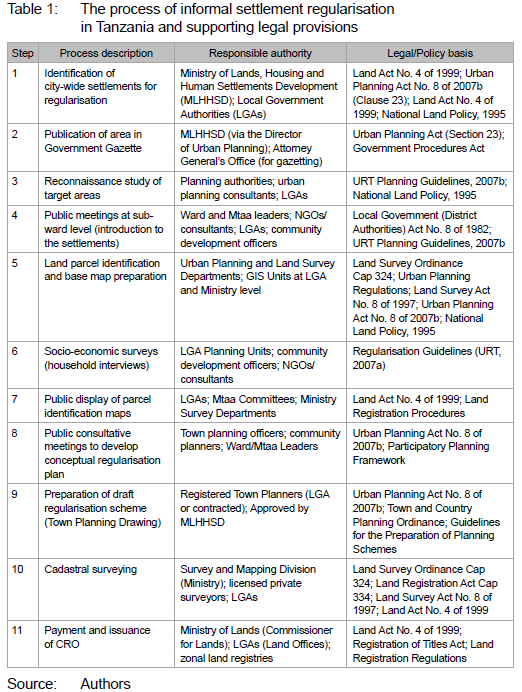
The implementation of regularisation as an upgrading mechanism has been significantly shaped by the enactment of Land Acts No. 4 and No. 5 of 1999 and the Urban Planning Act No. 8 of 2007 (Clause 23). These legal instruments specifically mandate the formalisation of informal settlements, with a strong focus on issuing land titles and plot certificates. The overarching goal is to promote sustainable urban development, by addressing economic, social, and environmental dimensions. This includes securing land tenure, improving access to essential infrastructure such as roads, electricity, and stormwater drainage, and ensuring the availability of clean water and critical social services in education and healthcare.
UN-Habitat (2020) highlights that recent implementation efforts have featured community-led field mapping and registration campaigns, complemented by public awareness initiatives to encourage residents to apply for residential licenses. These participatory strategies aim to support community engagement and strengthen the legitimacy of the process.
Despite these advancements, considerable implementation challenges persist. Issues such as limited institutional capacity, fragmented coordination, and financial constraints have impeded the full realisation of the regularisation objectives. A critical understanding of these challenges is essential for designing sustainable, inclusive interventions that can meaningfully improve the living conditions and socioeconomic well-being of residents in Tanzania's informal settlements.
3. METHODS AND REVIEW APPROACH
This study adopted qualitative research methods, with a focus on desktop-based literature review. Qualitative research is appropriate for exploring context-specific phenomena such as informal settlement upgrading, as it facilitates an understanding of complex sociopolitical and institutional processes (Creswell & Poth, 2018; Silverman, 2021). The study relied on secondary data sources, reviewed and analysed using thematic analysis, a widely recognised technique for identifying, organising, and interpreting patterns within qualitative data (Braun & Clarke, 2006; Nowell et al., 2017). The data collection involved a comprehensive online literature search conducted in 2024 using Google Scholar as the primary database. The main search term was 'approaches to informal settlements in Tanzania', with articles restricted to those published from 1991 onwards. This cut-off point was selected because, although informal settlement interventions began shortly after independence in 1961, the bulk of scholarly engagement on the topic began in the 1990s. To broaden the scope, additional search terms included 'slums', 'squatters', and 'informal settlements', all of which are commonly used descriptors for such settlements globally. The phrase 'regularisation in Tanzania' was employed to target literature from 2000 onwards, a period when regularisation became a central feature of informal settlement upgrading in the country. Another search phrase such as 'regularisation of informal settlements' and the term 'formalisation' were included to explore comparative approaches from other countries, again focusing on literature published post-2000 to ensure relevance to current practices. The initial screening involved reviewing the titles and abstracts of 322 documents, including scholarly articles, official reports, and grey literature. The objective was to identify studies focusing specifically on the regularisation of informal settlements and land-readjustment processes, both within Tanzania and in comparable international contexts. Documents were excluded if they primarily addressed the 'causes' or 'growth' of informal settlements, as this study focuses on practical strategies for upgrading these areas. After full-text screening and applying the inclusion criteria, 80 articles were retained for detailed analysis.
First, the review examines regularisation approaches in different country contexts, focusing on their successes and challenges. It specifically focuses on stakeholder involvement, land rights and tenure security, implementation costs, institutional capacity, and community awareness. The review also assessed land readjustment as an alternative strategy, analysing its application in countries such as South Korea, Japan, and India. These international experiences were reviewed with the aim of identifying adaptable models that could inform sustainable upgrading of informal settlements in Tanzania.
Secondly, the review evaluates the implementation and effectiveness of regularisation efforts in Tanzania, focusing on conflicting interests among stakeholders, delays and reluctance in formalising land tenure, high financial costs of implementation, governance inefficiencies, and community awareness.
Thirdly, the discussion section examines regularisation without settlement transformation, and specific attention was paid to the issuance of CROs. The section explores how these certificates offer formal recognition of land tenure. However, the analysis revealed that they often fall short in addressing critical issues such as inadequate infrastructure, service provision, and settlement planning. This results in what is termed 'squatter incorporation', where residents gain legal recognition but continue to live in structurally substandard and underserved environments.
Finally, the discussion proposes land readjustment as a contextually appropriate and sustainable strategy for informal settlement improvement, informed by international best practices.
4. KEY ISSUES
4.1 Informal settlement regularisation globally: Successes and challenges
Efforts to regularise informal settlements have been implemented across various countries, offering important insights into successes and persistent challenges. This section critically examines these initiatives through five key thematic lenses, namely stakeholder involvement, land rights and tenure security, implementation costs, institutional capacity, and community awareness.
Morocco's 'Cities Without Slums' Programme, launched in 2004, aimed to eliminate slums, by relocating residents to new apartments on the outskirts of cities. By 2021, 59 out of 85 planned cities were declared slum-free. However, while the programme was framed as a community-centred intervention, its underlying goals leaned heavily toward enhancing Morocco's global image, attracting investors, and addressing political concerns, particularly following the 2003 Casablanca attacks. Although many households benefited from improved housing, the programme has been criticised for prioritising aesthetic and economic objectives over addressing the root causes of informality. Without effectively engaging private sector actors or local communities, reliance on state-led efforts mirrors broader challenges observed in other regularisation programmes. These challenges highlight the disconnect between supportive policy frameworks and their actual implementation, ultimately undermining the longterm success of such initiatives (Beier & Elmouelhi, 2023).
Rwanda stands out as a success story in the regularisation of informal settlements, credited to its implementation of a well-functioning land information system (UN-Habitat, 2016). A nationwide systematic land-registration programme was launched in 2010, with the goal of providing legally valid land documents to all rightful landholders. This ambitious programme, completed in 2013, used a visible boundaries approach and incorporated highly participatory data-collection methods. High-resolution orthophotos and satellite imagery were employed for geospatial data, enabling accuracy and efficiency in mapping land parcels. Locally recruited and specially trained teams outlined parcel boundaries on imagery printouts, which were later scanned, geo-referenced, and digitised. Ali, Deininger & Goldstein (2014) pointed out that the success of Rwanda's land registration cannot be separated from its broader socio-economic and political context. Following the 1994 genocide, there was a strong national emphasis on rebuilding institutions and supporting unity, which translated into high levels of community cooperation. The programme also benefited from significant political will, coordinated donor support, and a manageable scale, due to Rwanda's relatively small size and population. Significantly, the programme's participatory approach, especially the involvement of local land committees and community-based para-surveyors, ensured transparency, local ownership, and the resolution of disputes at the grassroots level. By May 2013, approximately 10.4 million parcels had been registered, and 8.8 million printed land-lease certificates had been issued to landholders (UN-Habitat, 2016).
The programme achieved several notable outcomes, including enhanced social harmony through a reduction in land conflicts, strengthened tenure security, increased investment in land, improved land productivity, and a greater contribution of land as an economic resource to national development (UN-Habitat, 2016). These successes have been widely recognised as transformative for the country's land governance and economic landscape. However, despite these achievements, the programme also faced significant challenges that merit scrutiny, particularly in the context of informal settlement regularisation. Critics argue that the programme's focus on systematic registration and formalisation did not adequately address the root causes of informality such as rapid urbanisation, population growth, and inadequate housing supply. While land-tenure security improved for many, some marginalised communities (especially those without prior claims or documentation) were excluded from the process, risking displacement or marginalisation. In addition, the cost of land registration and compliance with formal systems posed a barrier for low-income households, potentially exacerbating inequalities rather than resolving them.
In the Philippines, as reported by Lee (1995), the introduction of the Community Mortgage Programme (CMP) aimed to provide secure land ownership to poor communities. While the programme has demonstrated both notable strengths and significant shortcomings, it remains a key example of state-led efforts to address informal settlement regularisation. Implemented by the National Home Mortgage Finance Corporation (NHMFC), the CMP operates in three stages, namely providing loans to communities for land acquisition; offering additional loans for infrastructure improvements such as water and sanitation, and enabling individuals to secure loans for home improvement. To participate, communities must form associations, obtain government approval, and work with a partner organisation (originator) for guidance. Although thousands of families have successfully acquired land and improved their living conditions, many communities have not advanced beyond the initial stage. Financial constraints and reliance on political promises for free infrastructure upgrades are key factors limiting progress.
Despite its innovative design, the CMP has faced significant challenges in meeting the demand for secure land tenure among marginalised groups. While low-interest loans make the programme more accessible, barriers persist, particularly for communities outside metropolitan Manila. Defaults on payments are a recurring issue, especially among participants with irregular incomes. Efforts by the NHMFC to recover overdue payments through reminders and penalties have met with limited success, as financial mismanagement at the community level continues to erode the programme's effectiveness.
In practice, the CMP has struggled to fully achieve its pro-poor objectives. Similar to other initiatives in the region, the programme has failed to engage private sector actors effectively, despite supportive policies designed to encourage their involvement. This highlights a broader trend where legal frameworks promoting partnerships with private planners or originators are underutilised, resulting in missed opportunities to strengthen the programme. Consequently, while the CMP has delivered benefits to some communities, it has not addressed the growing demand for affordable and inclusive solutions, leaving many vulnerable households underserved.
De Soto's concept of 'formalisation of property rights' presents the idea that, in developing countries, assets such as land, buildings, and businesses are often not legally recognised, thus rendering them 'dead capital'. According to De Soto (2001), without formal property rights, these assets cannot be leveraged for credit or exchanged in the market place, which limits their economic potential and perpetuates poverty within the informal sector. He argues that formalising property transforms these assets from 'dead' to 'live capital', unlocking their full economic potential and supporting growth. However, critics, including Sjaastad and Cousins (2009), highlight the limitations of this approach. They point to evidence from countries such as Botswana, Zambia, and Trinidad, where vibrant land and housing markets existed 'in spite of, and perhaps because of, the lack of legally recognised title'. In these instances, formalisation has not led to significant economic benefits or increased credit availability, challenging the assumption that property rights formalisation is a sufficient condition for development. Sjaastad and Cousins (2009) emphasise that factors such as education, market access, and government intervention play critical roles in economic growth, suggesting that the path to development is more complex than simply providing title deeds.
4.1.1 Land readjustment
Another approach used to improve informal settlements is land readjustment. Nepal serves as an example of a developing country that has effectively used the land readjustment approach to improve informal settlements. This strategy aims to address the challenges posed by rapid population growth, such as accelerated urbanisation, proliferation of unplanned settlements, and inefficient land use (Manandhar, 2019; Neupane, 2020). The process involves the consolidation of fragmented land parcels and their systematic reorganisation to enable the provision of essential infrastructure and services, including roads, open spaces, and other urban amenities. As part of the process, land owners temporarily surrender their land to the government or a designated planning authority. After reorganisation and development, land is redistributed to the original landowners, typically in slightly reduced sizes but with enhanced value, due to improved infrastructure. Compensation is provided for landowners whose land is fully acquired and cannot be returned. The implementation of these projects has been legally supported and financially supported by both the government and private developers (Manandhar, 2019). Although land readjustment has largely been applied at a smallest, neighbourhood level and failed to meet housing demand, it has proven to be a successful tool for urban development and upgrading informal settlements in Nepal, although its impact has been limited.
Before Nepal, land readjustment had already been successfully implemented in South Korea. Land readjustment went beyond simply reorganising land parcels; it played a crucial role in financing and facilitating the construction of low-income housing. The process of land readjustment in informal settlements in Korea involved four key stages, namely district designation, preparation and project planning, substitute land plan, and construction and substitute land allocation (UN-Habitat, 2019). Each stage included detailed steps to ensure the successful implementation of the project. For example, Step 4 of Stage 3 involved the removal of existing construction and the development of public infrastructure. Moreover, once landowners were allocated their upgraded and serviced plots, housing construction would proceed. In many instances, landowners built their homes on these improved plots. Alternatively, the government or private sector could step in to develop housing, particularly for low-income groups. According to Mathews et al. (2018), 30% of the funding for low-income housing in South Korea was sourced directly from land-readjustment projects. While land regularisation addresses the legal and administrative aspects of informal land occupation (Kironde, 2019), land readjustment addresses the spatial and infrastructural challenges, by reshaping urban layouts (Archer, 2009). For sustainable urban development, especially in rapidly growing cities such as those in Tanzania, combining both tools is often necessary.
4.2 Regularisation implementation challenges in Tanzania
Various scholars have extensively reported on regularisation in Tanzania (Adams, Sambu & Smiley, 2019; Kusiluka & Chiwambo, 2018; Mbilinyi, Kaswamila & Assenga, 2022; Kironde, 2019). Regularisation is carried out by stakeholders such as the government and private companies, or through collaborations between these two parties, which face five pertinent challenges in Tanzania.
4.2.1 Conflicting interests among stakeholder
Competing vested interests, which contribute to poor project outcomes and delays, have been identified as key factors constraining the implementation of land regularisation in Tanzania. A study by Kasala and Burra (2016) confirmed that projects involving multiple landowners were often marked by conflicting interests, preferences, and choices, leading to bureaucratic delays and eventual project setbacks. Similarly, Magina et al. (2020) observed that an overemphasis on protecting private rights during project execution caused delays, especially when community participation was neglected at certain stages. A study by Adams et al. (2019) revealed that private firms often lobby with politicians to secure tenders for services in the water sector, and this political interference thrives in environments characterised by limited awareness of people's rights and a lack of transparency. Political interference has also been observed to negatively impact land regularisation in Dar es Salaam, leading to a loss of international support for land projects (Magigi & Majani, 2006).
A recent study by Rajabu (2024) examined the influence of stakeholders in regularisation projects, focusing on case studies in Dar es Salaam's Kibondemaji 'B' and Mtongani sub-wards. The study identified conflicting and uncoordinated interests among political actors, local authorities, community leaders, and private developers, which led to project delays. The findings showed that 62.21% of the projects in Mtongani and Kibondemaji 'B' had not paid for land-regularisation costs as of May 2021, which contributed to further delays. The researcher noted that private companies that pioneered regularisation in these areas were responsible for some of these delays, primarily due to limited personnel capacity and government interference. Rajabu (2024) reported that the Mtongani project took 3.5 years to produce the first approved survey plans, while the Kibondemaji 'B' project took one year to complete its flrst survey plans after starting in February 2020. By 2023, only 1,318 land parcels had been identified, 441 plots had been demarcated, and 268 plots had been approved in Kibondemaji 'B', which represented only 20% of the identified plots. The study concluded that the varying interests of stakeholders influenced the performance of land-regularisation projects, resulting in delayed completion and ineffective outcomes. Rajabu recommended harmonising stakeholders' interests, in order to improve project performance.
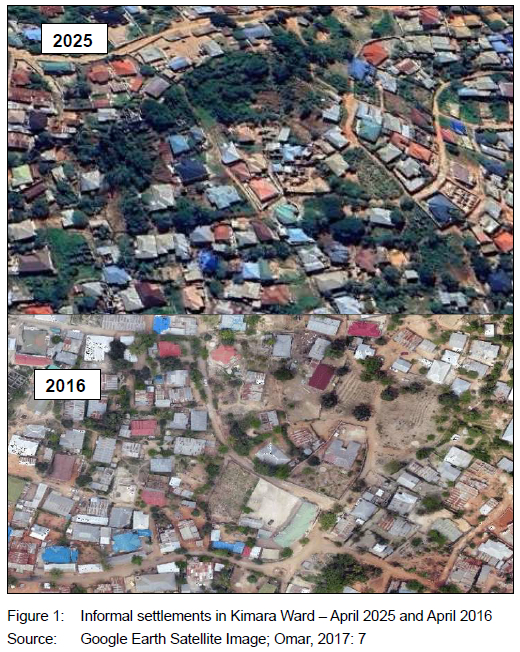
Conversely, some literature highlights that their quality may still be poor, even when regularisation projects are implemented on time. Mbilinyi, Kaswamila & Assenga (2023), for example, examined the effects of land regularisation on housing standards, asset ownership, and livelihoods in Buhongwa and Kimara wards. They concluded that regularisation did not significantly improve housing conditions or asset ownership for the vast majority of the households in the study areas, with over 90% of landowners already enjoying improved conditions before and after the process. Figure 1 illustrates Kimara Ward, one of the areas subjected to regularisation in 2016. Despite formalisation efforts, the plan's implementation largely failed. As shown in the image in Figure 1, there are no noticeable improvements in the area's physical development.
4.2.2 Delays and reluctance in securing land tenure
A lack of land-tenure security is another key factor affecting the successful implementation of land regularisation in Dar es Salaam. Several studies support this argument. Kusiluka and Chiwambo (2018) found discrepancies between the number of surveyed plots and the corresponding number of fully paid land titles in selected settlements.
For example, in Kimara, only 3% of the surveyed plots had fully paid land titles, while in Makongo Juu, the figure was roughly 4% (Kusiluka & Chiwambo, 2018: 284). On the other hand, Tandale and Tuelewane had approximately 42% of the surveyed plots with fully paid titles, and Idundilanga reached roughly 60% (Kusiluka & Chiwambo, 2018: 284). These figures highlight the challenges in land-title application and uptake. Although property owners recognise the importance of land titles for tenure security, accessing credit remains a challenge, due to stringent lending conditions, high interest rates, foreclosure fears, inadequate income, and negative perceptions about borrowing.
In addition, Mbilinyi et al. (2022) conducted a study on the impact of land regularisation on credit access in informal settlements. Despite efforts to increase plot ownership and issue CROs, the anticipated improvement in credit access did not materialise. The main obstacles included the perception that CROs were weak collateral, financial institutions' risk aversion, and a lack of coordination during the regularisation process. The study emphasised the need for a more integrated approach that involves financial institutions, policies, and regulations to effectively link land regularisation with improved credit access for land investment.
Furthermore, a study by Andreasen et al. (2020), focusing on three settlements in Mwanza and Dar es Salaam, revealed that, although the regularisation processes aimed to establish property rights through fees paid by landowners, not all landowners had completed payments. Despite efforts to clarify property rights and enhance land values, concerns persisted about using property as collateral and establishing active formal land markets. Informal land trade, assisted by brokers and local leaders, is already prevalent, and the reluctance to sell land or houses affects housing transactions.
Similarly, Mbilinyi et al. (2022) conducted a study to examine the implications of land regularisation on accessing credit from formal financial institutions in Kimara and Buhongwa Wards in the cities of Dar es Salaam and Mwanza, respectively. Data was collected through household questionnaires and key informant interviews, involving a total of 450 respondents. The findings indicated that the vast majority of landowners with CROs lacked an enabling environment to link their legally documented plots with formal financial institutions to support household investment in land. The researchers also identified several constraints related to regularisation, including the perception among landowners that the lack of collateral was a major barrier to formal credit access. The study concluded that there is a need to reorganise financial plans, in order to integrate them with land-regularisation strategies. This would help mitigate risks for households, firms, and financial institutions, ultimately enhancing access to formal credit and stimulating investment in regularised areas.
Sheuya and Burra (2016) and Kusiluka and Chiwambo (2019) found that landowners in Dar es Salaam, who used their residential licenses to access credit from formal financial institutions, were required to have additional physical assets as collateral, meaning that a residential license alone was insufficient to secure credit.
The challenge of land titles being rejected as collateral for loan access has also been reported in other regions of Tanzania. Sanga (2009) conducted a study in Mbozi district, which revealed that farmers who applied for loans using Customary Certificates of Right of Occupancy (CCROs) were faced with bank-imposed conditions that made it difficult for the vast majority of poor farmers to secure loans. The primary reason for rejection was the low value of their land, which contradicted the common belief that land registration improves access to credit. Loans were only provided in areas with high land value. Banks advised those with smaller farms to form groups to provide joint liability collateral or required to present secondary collateral such as warehouse receipts indicating the value of crops stored awaiting favourable market prices. These findings highlight the need for streamlined processes and increased awareness to promote tenure security and economic development.
4.2.3 High costs associated with land regularisation
The study also revealed that land regularisation is associated with unmanageable cost escalations. This argument is supported by a study conducted by Kusiluka and Chiwambo (2018) in Kimara, Makongo Juu, Tuelewane, Idundilanga, and Tandale, which explored challenges faced in regularised informal settlements. The study identified high costs as a primary obstacle hindering community participation. It also revealed consistently low application and payment rates for land titles, influenced by project duration, awareness efforts, and financial institution involvement. Despite localised cost-relief efforts, land-title uptake remained limited. Financial constraints, high expenses, and procedural complexities were among the reasons why land titles were not obtained.
The review indicated that, despite efforts to manage the growth of informal settlements, there has been a steady and concerning increase in such settlements. This observation is supported by Kombe (2005), who reported that the number of informal settlements surged from 40 in 1985 to 150 in 2000. By 2020, the population residing in informal settlements had grown to over 70% (Anande & Luhunga, 2019; Magina et al., 2020; Sakijege & Dakyaga, 2023). This trend indicates that resolving the challenges facing informal settlements remains a complex endeavour. In line with this, Rajabu (2024) noted that most of the residents of the Mtongani and Kibondemaji 'B' sub-wards that were part of regularisation projects were engaged in informal economic activities. Approximately 62% of the households in Mtongani and 74% in Kibondemaji 'B' participated in the informal sector.
Similarly, Kironde (2019) conducted a study on a community-led regularisation project in Makongo Juu, which involved 3,200 land parcels, resulting in 2,810 surveyed plots. Of those, only 1,143 (39%) fully paid the required financial contribution for planning and surveying, and 159 (6%) paid fees for the preparation of title deeds. This situation indicated that more than 50% of participants abandoned the project before completion. Reasons for dropout included community disagreements over the 1% premium for titling, which amounted to TZS 35,000 per square meter. Another example is the failure of the community to contribute the required 5% upfront payment to meet the preconditions for a World Bank and International Development Association (IDA) grant for the implementation of the CIUP program in Dar es Salaam (Magina et al., 2020; Kironde, 2019).
Considering the pace of implementing regularisation projects in planned areas, a study by URT (2023) found that, by the end of the 2021/2022 financial year, 52% of the land parcels earmarked for regularisation had not yet been surveyed, and 61% of those already surveyed had not been issued land titles. Regarding the delays in project completion, consultants identified two primary causes, namely insufficient funding and the reluctance of land occupiers to make timely and consistent payments. In addition, residents were criticised for failing to pay the agreed amounts in full and on time, further contributing to implementation setbacks (Magina, 2020). A study by Magigi (2013) found that only roughly 40% of citizens were able to make the initial financial contributions required for regularisation projects in their settlements. Moreover, only 37% of community members participated in the project through to the final process of receiving title deeds. However, community members were also reluctant to contribute land for public purposes such as creating open spaces, roads, and playgrounds.
4.2.4 Governance inefficiencies
Poor governance has been linked to the slow pace of land regularisation in Dar es Salaam. Nuhu, Munuo & Mngumi (2023) studied the multifaceted challenges in the land regularisation process in informal peri-urban settlements in Tanzania. The study identified several hurdles, including poor transparency, accountability, leadership, private sector involvement, and political influences. Deficiencies in transparency and accountability have led to delays, conflicts, and corruption within regularisation efforts, often causing undue scrutiny and blame to fall on community leaders. Furthermore, weaknesses in local government leadership hinder effective governance and decision-making processes, while the ambitions of private firms, coupled with a lack of coordination, have worsened inefficiencies and delays in service provision. The discord surrounding the allocation of public and community spaces further complicates regularisation, with politicisation adding complexity, as political agendas intersect with governance mechanisms. Despite these challenges, the study acknowledges some positive outcomes from political engagement, highlighting the complex relationship between politics, governance, and land regularisation in Tanzania and similar contexts.
Similarly, a study by Zakayo, Mhache & Magigi (2019) on land regularisation identified several weaknesses in the process. These stem from inadequate enforcement of laws and policies such as the Right of Occupancy system and compensation regulations, resulting in uncontrolled development and illegal constructions in settlements. Despite efforts to improve infrastructure through community engagement, insufficient policy enforcement by local authorities has led to gaps in providing essential services such as solid waste disposal and road networks. Moreover, challenges associated with labour-based approaches included issues of transparency among contractors and disparities in skill levels among community workers, which called for improved supervision and training. These findings highlight the complexities and deficiencies inherent in land regularisation processes and underscore the need for stronger policy enforcement and effective community involvement strategies.
4.2.5 Limited community awareness
Karni and Vier0 (2017) noted that the level of awareness reflects citizens' capacity to adopt and engage in projects, whether initiated by themselves or others. A study by Rajabu (2024) in Mtongani and Kibondemaji 'B' reported that local community members lacked familiarity with regularisation projects. As a result, they did not pay on time, which caused problems for private firms in implementing projects, due to late and insufficient contributions. Private firms also reported that both community members and local leaders were generally unaware of the issues and tasks related to regularisation projects in their areas. This lack of awareness led some community members to reject cooperation, even though they occupied land in areas undergoing regularisation.
5. DISCUSSION
5.1 Regularisation without settlement transformation - The need for a new land regularisation framework in Tanzania
A critical lens through which to understand the limitations of informal settlement regularisation in Tanzania is the concept of squatter incorporation. In this context, squatter incorporation refers to the formal acknowledgment of informal settlements and the issuance of CROs without significant improvements to infrastructure, service delivery, or broader living conditions. This practice has become a dominant trend in Tanzania's regularisation efforts, reflecting a narrow interpretation of land reform that prioritises tenure security over comprehensive urban transformation.
Regularisation schemes in Tanzania are typically designed to guide the upgrading and integration of informal settlements into formal urban systems, often envisioning infrastructure development, service provision, and improved living conditions. However, a recurring pattern is the limited implementation of these plans, with actual interventions frequently restricted to the issuance of CROs (Kironde, 2019; Kusiluka & Chiwambo, 2018). While this legal recognition provides a measure of tenure security, it fails to address the broader structural deficits such as poor access to roads, water, sanitation, and social amenities that define informality (Wamukaya & Mbathi, 2019: 88).
The outcome is a form of incorporation that legitimises the existence of informal settlements without transforming them, thus effectively institutionalising the very conditions regularisation was intended to overcome. This form of partial formalisation can perpetuate urban inequality, as the settlements remain underserved and structurally inadequate, despite their newfound legal status. In this light, the issuance of CROs in isolation resembles squatter incorporation more than genuine regularisation.
Further complicating the situation is the observation that not all residents within these settlements apply for, or obtain CROs, even when encouraged or coerced by authorities (Kusiluka & Chiwambo, 2018; Zakayo et al., 2019). This indicates that tenure formalisation alone is insufficient to motivate participation or address the full scope of challenges. The narrow focus on land titling undermines the transformative potential of regularisation and fails to create sustainable outcomes.
The persistence of this limited approach reflects broader institutional shortcomings. Disjointed stakeholder priorities, weak enforcement mechanisms, and ambiguous roles among implementing actors consistently hinder the effective execution of regularisation schemes (Nuhu et al., 2023; Zakayo et al., 2019; Kusiluka & Chiwambo 2018). While communities are intended to be primary beneficiaries, limited awareness, mistrust, and exclusion from decision-making processes often suppress their engagement. Yet, evidence suggests that communities are more likely to cooperate and contribute land for public services when they understand the transformative potential of regularisation as a pathway to improved infrastructure, tenure security, and living standards.
Equally important is the role of private sector actors, particularly firms contracted to facilitate regularisation. Without adequate oversight, commercial motivations may eclipse professional standards, leading to substandard planning or prolonged delays. Strengthening regulatory frameworks, including professional boards and regular audits, is crucial to ensuring accountability and safeguarding public interest (Kusiluka & Chiwambo, 2018).
The government's central role remains indispensable. However, rather than operating in isolation, there is a pressing need for a structured Public-Private Partnership (PPP) framework that clearly defines the responsibilities and expectations of all actors (Rajabu, 2024). The absence of such a framework often results in fragmented implementation and unmediated conflicts of interest. A collaborative model, underpinned by enhanced legal interpretation, public education, and professional capacity-building, could bridge institutional gaps and reduce political interference in the regularisation process.
Ultimately, the current model of regularisation that is focused narrowly on title issuance falls short of addressing the systemic challenges of informality (Nuhu et al., 2023). While it may meet short-term policy objectives, it fails to catalyse the kind of spatial, social, and economic transformation needed for equitable urban development. To move beyond squatter incorporation, a new land-regulation framework is essential - one that embraces a holistic approach to regularisation. This would entail integrating land-tenure security with systematic infrastructure development, public service delivery, and participatory planning.
Innovative mechanisms such as land readjustment could be instrumental in this regard. By allowing for the temporary surrender and reorganisation of land parcels, planners can implement more efficient layouts that support the installation of infrastructure and services. Fair and timely compensation - particularly for land allocated to public use - should be embedded in this process, and revenue generated through land readjustment such as through land rent or the sale of public plots should be reinvested into the same communities. Furthermore, robust financing mechanisms, including public and private sector investment in low-income housing, are vital to ensuring that regularisation contributes meaningfully to inclusive and sustainable urban growth.
Without such a comprehensive framework, regularisation efforts will continue to fall into the trap of squatter incorporation - granting legal titles without enabling real change. To fulfil its potential, regularisation in Tanzania must evolve from a practice of symbolic recognition to one of substantive transformation.
6. CONCLUSION
Moving forward, addressing the evolving dynamics of urbanisation and the pressing needs of informal settlement residents in Tanzania requires new and innovative approaches. The persistent challenges of urban poverty and informality underline the urgency of adopting more inclusive, participatory, and responsive urban development strategies. While regularisation has increasingly been promoted as a key mechanism to address these issues, its long-term success depends on going beyond the mere issuance of land titles, in order to encompass comprehensive improvements in infrastructure, housing, and service delivery.
To achieve transformative and lasting outcomes, regularisation must be reframed as a holistic urban development strategy rather than a narrow legal intervention focused on tenure security. Central to this shift is the promotion of voluntary participation by landowners through mechanisms such as land readjustment, which allows for the temporary surrender and reorganisation of land parcels. This process can facilitate more efficient and equitable urban layouts, free from the constraints of fragmented and irregular ownership patterns that often hinder effective planning.
Community-driven initiatives and active participation of the private sector are also essential to the development of infrastructure and affordable housing. Strong PPPs can leverage diverse resources and capacities, ensuring that regularisation efforts contribute meaningfully to inclusive urban growth. The government must play a pivotal role as both facilitator and regulator, ensuring compliance with building codes, safety standards, and principles of equitable development, while also institutionalising oversight mechanisms to maintain accountability.
The findings of this study highlight the need for a paradigm shift within the planning profession and urban policy circles. Sustainable regularisation should incorporate clear, actionable components, namely temporary land surrender to enable rational planning; coordinated infrastructure and public service delivery guided by approved plans, and fair compensation for individuals whose land is designated for public use. Furthermore, revenues such as proceeds from the sale or development of reserved land generated through land readjustment should be reinvested within the same settlements, in order to improve local services and living conditions. To ensure affordability, both government and private sector actors must take a leading role in financing housing for low-income urban populations.
Policy frameworks must support integrated solutions that address both tenure security and the physical transformation of informal settlements. This includes the institutionalisation of PPPs to overcome financial constraints and the strategic alignment of regularisation with broader urban planning and development objectives. By embedding infrastructure development and quality housing provision into regularisation processes, Tanzania can transition toward more inclusive, resilient, and sustainable urban communities.
Lessons from international contexts further reinforce this need for careful and strategic implementation. For example, South Korea's land-readjustment efforts revealed that, without a clear housing construction strategy, landowners delayed development and speculated on land value increases, undermining the programme's objectives. To avoid similar outcomes, Tanzania should pair land readjustment with a strong commitment to high-density, affordable housing development, supported by public institutions to guarantee delivery. In doing so, the country can address land scarcity and housing shortages more effectively, ensuring that informal settlement upgrading contributes to the broader goals of equitable urban transformation.
LIMITATIONS
This study is based on a desktop research approach and does not involve the collection of primary data. As such, methods such as semi-structured interviews or other forms of data triangulation were not applied, which may limit the depth of contextual insights. While the role of partnerships - particularly state-led collaborations - in informal settlement regularisation is acknowledged as critical, it was not extensively explored and remains a valuable area for future research.
REFERENCES
ABOULNAGA, M.M., BADRAN, M.F. & BARAKAT, M.M. 2021. Global informal settlements and urban slums in cities and the coverage. In: Aboulnaga, M., Badran, M. & Barakat, M. (Eds). Resilience of informal areas in megacities - Magnitude, challenges, and policies. Berlin, Germany: Springer International Publishing, pp. 1-51. https://doi.org/10.1007/978-3-030-87794-1_1 [ Links ]
ADAMS, E.A., SAMBU, D. & SMILEY, S.L. 2019. Urban water supply in sub-Saharan Africa: Historical and emerging policies and institutional arrangements. International Journal of Water Resources Development, 35(2), pp. 240-263. https://doi.org/10.1080/07900627.2017.1423282 [ Links ]
ALI, D.A., DEININGER, K. & GOLDSTEIN, M. 2014. Environmental and gender impacts of land tenure regularisation in Africa: Pilot evidence from Rwanda. Journal of Development Economics, 110, pp. 262-275. https://doi.org/10.1016/j.jdeveco.2013.12.009 [ Links ]
ANANDE, D.M. & LUHUNGA, P.M. 2019. Assessment of socio-economic impacts of the December 2011 flood event in Dar es Salaam, Tanzania. Atmospheric and Climate Sciences, 9(3), pp. 421-437. https://doi.org/10.4236/acs.2019.93029 [ Links ]
ANDREASEN, M.H., AGERGAARD, J. & M0LLER-JENSEN, L. 2017. Suburbanisation, homeownership aspirations and urban housing: Exploring urban expansion in Dar es Salaam. Urban Studies, 54(10), pp. 2342-2359. https://doi.org/10.1177/0042098016643303 [ Links ]
ANDREASEN, M.H., MCGRANAHAN, G., KYESSI, A. & KOMBE, W. 2020. Informal land investments and wealth accumulation in the context of regularisation: Case studies from Dar es Salaam and Mwanza. Environment and Urbanisation, 32(1), pp. 89-108. https://doi.org/10.1177/0956247819896265 [ Links ]
ANSER, M.K., ALHARTHI, M., AZIZ, B. & WASIM, S. 2020. Impact of urbanisation, economic growth, and population size on residential carbon emissions in the SAARC countries. Clean Technologies and Environmental Policy, 22(4), pp. 923-936. https://doi.org/10.1007/s10098-020-01833-y [ Links ]
ARCHER, R. 2009. Land pooling for urban development: A review of forms and results. Land Use Policy, 26(4), pp. 810-820. [ Links ]
BEIER, R. & ELMOUELHI, H. 2023. Constructing legitimacy through pro-poor housing? Branding cities in Egypt and Morocco as "slum-free". In: Wippel, S. (Ed.). Branding the Middle East. Berlin, Germany: De Gruyter, pp. 459-478. https://doi.org/10.1515/9783110741100-027 [ Links ]
BHANJEE, S. & ZHANG, C.H. 2018. Mapping latest patterns of urban sprawl in Dar es Salaam, Tanzania. Papers in Applied Geography, 4(3), pp. 292-304. https://doi.org/10.1080/23754931.2018.1471413 [ Links ]
BOSHE, P. 2007. Land regularisation in Tanzania: The revolution in land laws and a tool to millennium development goal 7 target 11. Open University Law Journal, 1(2), pp. 1-14. [ Links ]
BRAUN, V. & CLARKE, V. 2006. Using thematic analysis in psychology. Qualitative Research in Psychology, 3(2), pp. 77-101. https://doi.org/10.1191/1478088706qp063oa [ Links ]
CRESWELL, J.W. & POTH, C.N. 2018. Qualitative inquiry and research design: Choosing among five approaches. 4th edition. Thousand Oaks, CA: SAGE Publications. [ Links ]
DE SOTO, H. 2001. Dead capital and the poor. Sais Review, 21(1), pp.13-43. https://doi.org/10.1353/sais.2001.0011 [ Links ]
FAYEHUN, O., AJISOLA, M., UTHMAN, O., OYEBODE, O., OLADEJO, A., OWOAJE, E. et al. 2022. A contextual exploration of healthcare service use in urban slums in Nigeria. Plos one, 17(2), p.e0264725. https://doi.org/10.1371/journal.pone.0264725 [ Links ]
FERNANDES, E. 2000. The legalisation of favelas in Brazil: Problems and prospects. Third World Planning Review, 22(2), pp. 167-187. https://doi.org/10.3828/twpr.22.2.f765q34rm4600773 [ Links ]
GOYTIA, C. 2021. Enhancing the benefits of agglomeration in Latin American megacities: The role of urban policies and a framework for policy action. In: Sridhar, K. (Ed.). Urbanisation in the Global South. London, UK: Routledge, pp. 304-320. https://doi.org/10.4324/9781003093282-17 [ Links ]
KARNI, E. & VIER0, M.-L. 2017. Awareness of unawareness: A theory of decision-making in the face of ignorance. Journal of Economic Theory, 168, pp. 301-328. https://doi.org/10.1016/j.jet.2016.12.011 [ Links ]
KASALA, S.E. & BURRA, M.M. 2016. The role of public private partnerships in planned and serviced land delivery in Tanzania. ¡Business, 8(1), pp. 10-17. https://doi.org/10.4236/ib.2016.81002 [ Links ]
KIRONDE, J.L. 1991. Sites-andservices in Tanzania: The case of Sinza, Kijitonyama and Mikocheni areas in Dar-es-Salaam. Habitat international, 15(1-2), pp. 27-38. https://doi.org/10.1016/0197-3975(91)90004-5 [ Links ]
KIRONDE, J.M.L. 2019. Community-based settlements regularization: Lessons for scaling up from Makongo Juu informal settlement, Dar es Salaam, Tanzania. Current Urban Studies, 7(2), pp. 170-192. https://doi.org/10.4236/cus.2019.72008 [ Links ]
KOMBE, W.J. 2005. Land use dynamics in peri-urban areas and their implications on the urban growth and form: The case of Dar es Salaam, Tanzania. Habitat International, 29(1), pp. 113-135. https://doi.org/10.1016/S0197-3975(03)00076-6 [ Links ]
KUSILUKA, M.M. & CHIWAMBO, D.M. 2018. Assessing land titles application and uptake in regularised informal settlements in Tanzania. International Journal of Urban Sustainable Development, 10(3), pp. 279-291. https://doi.org/10.1080/19463138.2018.1536661 [ Links ]
KUSILUKA, M.M. & CHIWAMBO, D.M. 2019. Acceptability of residential licences as quasi-land ownership documents: Evidence from Tanzania. Land Use Policy, 85, pp. 176-182. https://doi.org/10.1016/j.landusepol.2019.02.044 [ Links ]
KYESSI, A.G. 1997. Shelter development in Tanzania: Urban development policy considerations. A National Workshop on Urban Development Policy for Tanzania, held at Dar Es Salaam, Tanzania, 12-14 May 1997. [ Links ]
KYESSI, A.G. 2008. Formalisation of unplanned settlements and its implications on poverty reduction: The case of Dar es Salaam city. Tanzania Journal of Development Studies, 8(2), pp. 1-22. https://doi.org/10.4314/tjds.v8i2.60421 [ Links ]
LAND PORTAL. 2021. Guidelines for the preparation of general planning schemes and detailed schemes for new areas, urban renewal and regularization. [Online]. Available at: <https://landportal.org/> [Accessed: 12 March 2024]. [ Links ]
LEE, M. 1995. The community mortgage program: An almost-successful alternative for some urban poor. Habitat International, 19(4), pp. 529-546. https://doi.org/10.1016/0197-3975(95)00006-2 [ Links ]
LOFTUS-FARREN, Z. 2011. Tent cities: An interim solution to homelessness and affordable housing shortages in the United States. California Law Review, 99(4), pp. 1037-1081. [ Links ]
LÓPEZ, O.S., BARTOLOMEI, R.S. & LAMBA-NIEVES, D. 2019. Urban informality: International trends and policies to address land tenure and informal settlements. Center for a New Economy (CNE). [Online]. Available at: <http://grupocne.org/wp-content/uploads/2019/08/Blueprint-White-Paper-Urban-Informality.pdf> [Accessed: 3 May 2024]. [ Links ]
MAGEMBE-MUSHI, D.L. & LUPALA, J.M. 2015. Resettling displaced residents from regularised informal settlements in Dar-es-Salaam, Tanzania: Challenges faced by house owners. Current Urban Studies, 3(2), pp. 71-81. https://doi.org/10.4236/cus.2015.32007 [ Links ]
MAGIGI, W. 2013. Community involvement in informal settlements upgrading: Evidence from Dar es Salaam Metropolitan City, Tanzania. Research on Humanities and Social Sciences, 3(12), pp. 75-89. [ Links ]
MAGIGI, W. & MAJANI, B. 2006. Community involvement in land regularisation for informal settlements in Tanzania: A strategy for enhancing security of tenure in residential neighborhoods. Habitat International, 30(4), pp. 1066-1081. https://doi.org/10.1016/j.habitatint.2005.12.002 [ Links ]
MAGINA, F.B., KYESSI, A. & KOMBE, W.J. 2020. Benefits and burdens accrued in community-led informal settlements regularisation in Tanzania: The case of Magengeni in Dar es Salaam City. Paper prepared for presentation at the Annual World Bank Conference on Land Policy, 16-20 March. Washington DC: The World Bank. [ Links ]
MANANDHAR, R. 2019. Land readjustment for regularization of informal settlements. Journal of Science and Engineering, 6, pp. 40-50. https://doi.org/10.3126/jsce.v6i0.23964 [ Links ]
MATHEWS, R., MADHAV, P., TINTU, S. & SOUHARDHYA, C. 2018. State-led alternative mechanisms to acquire, plan, and service land for urbanisation in India. World Resources Institute India, Working paper for The Coalition for Urban Transitions, pp. 1-68. [Online]. Available at: <https://wrirosscities.org> [Accessed: 12 June 2024]. [ Links ]
MBILINYI, J.J., KASWAMILA, A.L. & ASSENGA, E.A. 2022. Implication of land regularisation in accessing credits from financial institutions in Tanzania. Current Urban Studies, 10(4), pp. 540-555. https://doi.org/10.4236/cus.2022.104032 [ Links ]
MBILINYI, J.J., KASWAMILA, A.L. & ASSENGA, A.E. 2023. Challenges of land regularisation in unplanned peri-urban settlements in Tanzania. African Journal of Development Studies, 13(2), pp. 73-99. https://doi.org/10.31920/2634-3649/2023/v13n2a4 [ Links ]
MUKEKU, J. 2018. Urban slum morphology and socio-economic analogies: A case study of Kibera Slum, Nairobi, Kenya. Urbanisation, 3(1), pp. 17-32. https://doi.org/10.1177/2455747118790581 [ Links ]
MUKHIJA, V. 2002. An analytical framework for urban upgrading: Property rights, property values and physical attributes. Habitat International, 26(4), pp. 553-570. https://doi.org/10.1016/S0197-3975(02)00019-X [ Links ]
MWAIHUTI, M. 2018. The urban land management system and the proliferation of informal settlements and slums in Dar es Salaam, Tanzania. Tanzania Journal of Development Studies, 16(1), pp. 87-111. [ Links ]
NDEZI, T. 2009. The limit of community initiatives in addressing resettlement in Kurasini ward, Tanzania. Environment and Urbanisation, 21(1), pp. 77-88. https://doi.org/10.1177/0956247809103005 [ Links ]
NEUPANE, P. 2020. Public private partnership in land readjustment project: A case study of Nepal. Saudi Journal of Engineering and Technology, 5(10), pp. 397-406. https://doi.org/10.36348/sjet.2020.v05i10.007 [ Links ]
NOWELL, L.S., NORRIS, J.M., WHITE, D.E. & MOULES, N.J. 2017. Thematic analysis: Striving to meet the trustworthiness criteria. International Journal of Qualitative Methods, 16(1), pp. 1-13. https://doi.org/10.1177/1609406917733847 [ Links ]
NUHU, S., MUNUO, N. & MNGUMI, L. 2023. Governance challenges of regularisation of informal settlements in peri-urban Tanzania: Perspectives from local stakeholders. International Journal of Urban Sustainable Development, 15(1), pp. 35-47. https://doi.org/10.1080/19463138.2023.2167821 [ Links ]
OMAR, H. 2017. Regularization of informal settlement 'should it be demand driven or supply driven'? The case of Kimara Ward in Ubungo Municipality, Tanzania. Journal of Geography, 4(7), pp. 2-11. DOI: 10.13140/RG.2.2.35296.64001 [ Links ]
ONI-JIMOH, T., LIYANAGE, C., OYEBANJI, A. & GERGES, M. 2018. Urbanisation and meeting the need for affordable housing in Nigeria. Housing, Amjad Almusaed and Asaad Almssad, IntechOpen, 7(3), pp. 73-91. https://doi.org/10.5772/intechopen.78576 [ Links ]
RAJABU, A.A. 2024. The influence of stakeholders' interests in land regularisation projects: A case of regularisation projects carried out by private firms in Dar es Salaam City. Unpublished Master's thesis. Ardhi University, Tanzania. [ Links ]
REERINK, G. 2015. From autonomous village to 'informal slum': Kampong development and state control in Bandung (1930-1960). In: Colombijn, F. (Ed.). Cars, conduits, and kampongs. Berlin, Germany: Brill, pp. 193-212. https://doi.org/10.1163/9789004280724_009 [ Links ]
ROMANO, B., ZULLO, F., FIORINI, L. & MARUCCI, A. 2021. Illegal building in Italy: Too complex a problem for national land policy? Cities, 112, article103159. https://doi.org/10.1016/j.cities.2021.103159 [ Links ]
SAKIJEGE, T. & DAKYAGA, F. 2023. Going beyond generalisation: Perspective on the persistence of urban floods in Dar es Salaam. Natural Hazards, 115(3), pp. 1909-1926. https://doi.org/10.1007/s11069-022-05645-9 [ Links ]
SANGA, R.T. 2009. Assessing the impact of customary land rights registration on credit access by farmers in Tanzania: A case study in Mbozi district. Unpublished Master's thesis, University of Twente, The Netherlands. [ Links ]
SATTERTHWAITE, D., ARCHER, D., COLENBRANDER, S., DODMAN, D., HARDOY, J., MITLIN, D. & PATEL, S. 2020. Building resilience to climate change in informal settlements. One Earth, 2(2), pp. 143-156. https://doi.org/10.1016/j.oneear.2020.02.002 [ Links ]
SHANG, J., LI, P., LI, L. & CHEN, Y. 2018. The relationship between population growth and capital allocation in urbanisation. Technological Forecasting and Social Change, 135, pp. 249-256. https://doi.org/10.1016/j.techfore.2018.04.013 [ Links ]
SHEUYA, S.A. & BURRA, M.M. 2016. Tenure security, land titles and access to formal finance in upgraded informal settlements: The case of Dar es Salaam, Tanzania. Current Urban Studies, 4(4), pp. 440-460. https://doi.org/10.4236/cus.2016.44029 [ Links ]
SILVERMAN, D. 2021. Qualitative research. 5th edition. London: SAGE Publications. [ Links ]
SIMBA, K. 2019. Land tenure and housing development in Tanzania. In: Tibaijuka, A. (Ed.). The social services crisis of the 1990s. London, UK: Routledge, pp. 243-268. https://doi.org/10.4324/9780429433009-23 [ Links ]
SJAASTAD, E. & COUSINS, B. 2009. Formalisation of land rights in the South: An overview. Land Use Policy, 26(1), pp. 1-9. https://doi.org/10.1016/j.landusepol.2008.05.004 [ Links ]
SUHARTINI, N. & JONES, P. 2019. Urbanisation and urban governance in developing countries. In: Suhartini, N. & Jones, P. Urban governance and informal settlements. London, UK: Springer International Publishing, pp. 13-40. https://doi.org/10.1007/978-3-030-06094-7_2 [ Links ]
SULEMANA, I., NKETIAH-AMPONSAH, E., CODJOE, E.A. & ANDOH, J. 2019. Urbanisation and income inequality in sub-Saharan Africa. Sustainable Cities and Society, 48, pp. 1-8. https://doi.org/10.1016/j.scs.2019.101544 [ Links ]
TIFFEN, M. 2018. Transitions in sub-Saharan Africa: Agriculture, urbanisation and income growth. In: Tacoli, C. (Ed.). The Earthscan Reader in rural-urban Llnkages London, UK: Routledge pp. 90-123. https://doi.org/10.4324/9781315800486-6 [ Links ]
TODD, G., MSUYA, I., LEVIRA, F. & MOSHI, I. 2019. City profile: Dar es Salaam, Tanzania. Environment and Urbanisation ASIA, 10(2), pp. 193-215. https://doi.org/10.1177/0975425319859175 [ Links ]
UN-HABITAT. 2016. Fit-for-purpose land administration guiding principles for country implementation. [Online]. Available at: <https://unhabitat.org> [Accessed: 5 June 2024]. [ Links ]
UN-HABITAT. 2019. Land readjustment in the Republic of Korea: A case study for learning lessons. [Online]. Available at: <https://unhabitat.org> [Accessed: 2 June 2024]. [ Links ]
UN-HABITAT. 2020. Annual Progress Report. [Online]. Available at: <https://unhabitat.org> [Accessed: 3 May 2024]. [ Links ]
UN (UNITED NATIONS). 2023. World population prospects. Population division. United Nations. [Online]. Available at: <https://population.un.org/wpp/> [Accessed: 3 May 2024]. [ Links ]
UN DESA (UNITED NATIONS DEPARTMENT OF ECONOMIC AND SOCIAL AFFAIRS). 2023. The Sustainable Development Goals Report 2023: Special edition. United Nations. https://doi.org/10.18356/9789210024914 [ Links ]
URT (UNITED REPUBLIC OF TANZANIA). 1995. National Land Policy. Ministry of Lands, Housing and Urban Development. [Online]. Available at: <https://www.nlupc.go.tz> [Accessed: 2 June 2024]. [ Links ]
URT (UNITED REPUBLIC OF TANZANIA). 1997. Land Survey Act No. 8 of 1997. Dar es Salaam: Government Printer. [ Links ]
URT (UNITED REPUBLIC OF TANZANIA). 1999. The Land Act No. 4 of 1999. Dar es Salaam: Government Printer. [ Links ]
URT (UNITED REPUBLIC OF TANZANIA). 2000. National Human Settlements Development Policy. Ministry of Lands and Human Settlements Development, Dar es Salaam. [Online]. Available at: <https://faolex.fao.org/docs/pdf/tan205478.pdf> [Accessed: 3 June 2024] [ Links ]
URT (UNITED REPUBLIC OF TANZANIA). 2007a. Guidelines for the preparation of general planning schemes and detailed schemes for new areas, urban renewal and regularization. Ministry of Lands, Housing and Human Settlements Development. [Online]. Available at: <https://www.lands.go.tz> [Accessed: 5 June 2024]. [ Links ]
URT (UNITED REPUBLIC OF TANZANIA). 2007b. The Urban Planning Act No. 8 of 2007. Dar es Salaam: Government Printer. [ Links ]
URT (UNITED REPUBLIC OF TANZANIA). 2016. Habitat III National Report Tanzania. Final Report prepared by The Ministry of Lands, Housing and Human Settlements Development on Behalf of The United Republic of Tanzania. [Online]. Available at: <https://habitat3.org/wp-content/uploads/National-Report-Africa-Tanzania-Final-in-English.pdf> [Accessed: 4 May 2024]. [ Links ]
URT (UNITED REPUBLIC OF TANZANIA). 2023. Performance Audit Report on the Management of Regularisation of Unplanned Settlements. [Online]. Available at: <https://www.nao.go.tz> [Accessed: 3 June 2024]. [ Links ]
WAMUKAYA, E. & MBATHI, M. 2019. Customary system as 'constraint' or 'enabler' to peri-urban land development: Case of Kisumu City, Kenya. Town and Regional Planning, 75, pp. 77-90. https://doi.org/10.18820/2415-0495/trp75i1.9 [ Links ]
WEST-PAVLO, R. 2018. The agency of materials and the future of politics in the shanty-town of the global South. In: Bystrom, K. (Ed.). South and North contemporary urban orientations. New York, USA: Routledge, pp. 43-64. https://doi.org/10.4324/9781351047043-3 [ Links ]
WORLD BANK. 2002. Land policies for growth and poverty reduction. A World Bank Policy Research Report. [Online]. Available at: <https://documents1.worldbank.orgcurated/en/485171468309336484/pdf/multi0page.pdf> [Accessed: 23 April 2024]. [ Links ]
WORRALL, L., COLENBRANDER, S., PALMER, I., MAKENE, F., MUSHI, D., MWIJAGE, J., MARTINE, M. & GODFREY, N. 2017. Better urban growth in Tanzania: Preliminary exploration of the opportunities and challenges. Working paper for The Coalition for Urban Transitions, pp. 39-45. [Online]. Available at: <http://newclimateeconomy.net/content/cities-working-papers> [Accessed: 2 March 2024]. [ Links ]
ZAKAYO, E., MHACHE, E.P. & MAGIGI, W. 2019. A comparative analysis of social service provision and accessibility in regularised settlements in Tanzania. Open Access Library Journal, 6(3), pp. 1-17. https://doi.org/10.4236/oalib.1105278 [ Links ]
Received: February 2025
Peer reviewed and revised: May 2025
Published: June 2025
* The author(s) declared no potential conflicts of Interest with respect to the research, authorship, and/or publication of this article
