




Services on Demand
Journal

Article
 English (pdf)
 Article in xml format
 Article references

 Automatic translation
 Send this article by e-mail
Indicators
Related links
-
 Cited by Google
-
 Similars in Google
Share

 Permalink

Acta Structilia
On-line version ISSN 2415-0487Print version ISSN 1023-0564
Acta structilia (Online) vol.33 n.1 Bloemfontein 2026
https://doi.org/10.38140/as.v33i110797
PERSPECTIVE
Why South Africa's infrastructure maintenance framework has limited practical effect: policy, practice, and comparative lessons from peer countries
Kevin Wall
Department of Construction Economics, University of Pretoria, South Africa. ROR: https://ror.org/00g0p6g84, Email: kevin.wall@up.ac.za, ORCID: https://orcid.org/0000-0002-0940-7515
ABSTRACT
Despite the National Infrastructure Maintenance Strategy (NIMS), the Government Immovable Asset Management Act (GIAMA), and the National Immovable Asset Maintenance Management (NIAMM) framework, the condition of South African public sector infrastructure remains unsatisfactory, as evidenced by national 'report cards' and the three 'Drop' reports that appeared in March 2026. The problem is that there has not (until this article) been a study in South Africa that contrasts the high-level NIMS and its associated NIAMM, on the one hand, with the condition of public sector fixed infrastructure, on the other - and has asked why this strategy and this framework have had hardly any practical effect. This article adopts a qualitative, policy- and practice-oriented approach, drawing on documentary evidence, comparative policy review, and practitioner-informed insight. It investigates the adequacy of implementation of South Africa's infrastructure asset management guidance, and explores whether peer countries achieve better outcomes through alternative mechanisms. Data were collected through a desktop review of relevant overseas strategies, legislation, and guidelines, supplemented by correspondence with practitioners and professional networks in Australia, Canada, New Zealand, and (to a lesser extent) a few other countries, where documents in English could be obtained. Analysis focused on identifying the presence and effectiveness of governance mechanisms, supportive institutions, and enabling cultures that influence infrastructure maintenance outcomes. Findings indicate that, while South Africa possesses documentation or legislation broadly comparable to that of peer countries, the main reason for these countries' better infrastructure condition is their prioritising accountability, competence, adequate budgets, and supportive organisational cultures. By contrast, South African strategy and frameworks, largely unsupported and unpublicised, have limited impact. The article highlights implications for strengthening infrastructure asset management policy and practice in South Africa. It does not set out an explicit reform blueprint.
Keywords: infrastructure maintenance, public-sector governance, asset management, accountability, comparative infrastructure policy, South Africa
ABSTRAK
Ten spyte van die Nasionale Infrastruktuur-onderhoudstrategie (NIMS), die Wet op die Bestuur van Onroerende Bates in die Regering (GIAMA), en die Nasionale Instandhoudingsbestuur van Onroerende Bates (NIAMM) raamwerk, bly die toestand van die Suid-Afrikaanse openbare sektor se infrastruktuur onbevredigend, soos blyk uit nasionale 'rapportkaarte' en die drie 'Drop'-verslae wat in Maart 2026 verskyn het. Die probleem is dat daar (tot hierdie artikel) geen studie in Suid-Afrika was wat die hoëvlak-NIMS en die gepaardgaande NIAMM, aan die een kant, kontrasteer met die toestand van die openbare sektor se vaste infrastruktuur, aan die ander kant nie - en gevra het waarom hierdie strategie en hierdie raamwerk so min praktiese effek gehad het. Hierdie artikel volg 'n kwalitatiewe, beleids- en praktykgerigte benadering, gebaseer op dokumentäre bewyse, vergelykende beleidsoorsig en praktisyn-ingeligte insig. Dit ondersoek die toereikendheid van die implementering van Suid-Afrika se infrastruktuur-batebestuursriglyne, en ondersoek of eweknieë beter uitkomste deur alternatiewe meganismes behaal. Data is ingesamel deur 'n lessenaar-oorsig van relevante oorsese strategieë, wetgewing en riglyne, aangevul deur korrespondensie met praktisyns en professionele netwerke in Australië, Kanada, Nieu-Seeland en (in 'n mindere mate) 'n paar ander lande waar dokumente in Engels verkry kon word. Analise het gefokus op die identifisering van die teenwoordigheid en doeltreffendheid van bestuursmeganismes, ondersteunende instellings en bemagtigende kulture wat die uitkomste van infrastruktuur-instandhouding beïnvloed. Bevindinge dui daarop dat, hoewel Suid-Afrika dokumentasie of wetgewing het wat breedweg vergelykbaar is met dié van eweknieë, die hoofrede vir hierdie lande se beter infrastruktuurtoestand hul prioritisering van verantwoordbaarheid, bevoegdheid, voldoende begrotings en ondersteunende organisatoriese kulture is. In teenstelling hiermee het Suid-Afrikaanse strategie en raamwerke, wat grootliks nie ondersteun en nie gepubliseer word nie, beperkte impak. Die artikel beklemtoon implikasies vir die versterking van infrastruktuur-batebestuursbeleid en -praktyk in Suid-Afrika. Dit stel nie 'n eksplisiete hervormingsbloudruk uiteen nie.
1. INTRODUCTION
Since 2005, South Africa has adopted several national measures to improve the condition of public sector infrastructure. In particular, the National Infrastructure Maintenance Strategy (NIMS), approved by Cabinet in 2006, sought to establish a high-level path toward improved infrastructure condition. Its stated aim was that:
By improving infrastructure asset management planning, budgeting and implementation, public infrastructure will be maintained in such a way as to enable sustainable service delivery, increased economic growth, and increased access to services and economic opportunities for the poor (Department of Public Works [DPW], Council for Scientific and Industrial Research [CSIR] and Construction Industry Development Board [cidb], 2007: 13).
In this context, 'infrastructure asset management' refers to the management of infrastructure across its entire life cycle (planning, commissioning, operation, maintenance, repair, refurbishment, and, where appropriate, replacement) together with the resourcing of this management, including skills and funding. 'Service delivery', by contrast, refers to the provision of services (e.g., water supply) within agreed levels of quality and reliability. As NIMS emphasises, 'delivery' must be understood as encompassing not only construction, but also the operation and maintenance of infrastructure throughout its intended life (DPW, CSIR & cidb, 2007: 3).
The DPW was tasked with leading the implementation of the programme, envisaged as the primary vehicle for delivering on the strategy. The DPW and the cidb were assigned joint responsibility for overall management of the programme, with the latter providing a full-time programme manager (DPW, CSIR & cidb, 2007: 2).
This approval was to be followed by legislating the Government Immovable Asset Maintenance Act (GIAMA) (South Africa, 2007), and by publication of the National Immovable Asset Maintenance Management Framework (NIAMM), a set of six documents setting out the relevant (non-compulsory) guidelines and standards for the implementation of NIMS:
1. Maintenance Management Standard for immovable assets.
2. Maintenance Accounting Framework for immovable assets.
3. Maintenance Monitoring and Evaluation Protocol for immovable assets.
4. National Immovable Asset Maintenance Management Planning Guidelines for immovable assets.
5. Maintenance Competency Framework for immovable assets.
6. Contractor Development in the Maintenance Industry for immovable assets (cidb, 2017).
Although GIAMA was passed in 2007, preparation of the NIAMM framework and consultation processes delayed its approval until 2017. For clarity: GIAMA is legislation and applies only to national and provincial government departments, whereas NIMS was intended to apply to all public-sector fixed infrastructure, and NIAMM was designed for use across all three spheres of government as well as state-owned enterprises. Throughout this article, only fixed infrastructure is considered (for example, in the rail sector, locomotives and rolling stock are excluded, but rail track, signalling, communication, depots, and stations are included).
Municipalities are constitutionally responsible for local services such as water, sanitation, roads, and waste (South Africa, 1996). They may be supported by water boards, private providers, or operate under administration. The Department of Water and Sanitation (DWS) regulates water and sanitation services and manages major national infrastructure, while the Department of Public Works and Infrastructure (DPWI) oversees its assets and NIMS/NIAMM.
For clarity: NIMS and NIAMM are not 'a DPWI/GIAMA framework'. NIMS is a strategy - it says what could/should be done, but it has no power to influence beyond that. NIAMM is a framework of guidelines and standards which can only suggest actions, pointing willing participants in the desired direction, and no penalties are incurred if they are ignored. When it takes initiatives with regard to the NIMS strategy and NIAMM guidelines and standards, DPWI does it as the agent of national government, not in its own right.
Municipalities raise revenue locally through rates and service charges, but they also receive formula-based capital and operational transfers from National Treasury. Treasury may withhold transfers where municipalities commit serious or persistent breaches of financial management requirements, including the adoption of unfunded budgets (South Africa, 1996; 2003).
Despite these frameworks and supporting documents (ASB, 2025; Treasury, 2018), multiple studies continue to report deterioration in the condition of South Africa's public-sector fixed infrastructure (DWS, 2022; 2023; SAICE, 2022; Wall, 2024; 2025). The most recent DWS reports (2025a; 2025b; 2025c) show no evidence of a turnaround, particularly in water and wastewater services.
The DWS is notable as the only national department to have systematically measured both infrastructure condition and performance across an entire sector, despite not owning most of the assets concerned. Its mandate extends beyond regulation to include support aimed at improving infrastructure performance. Since 2008, it has introduced three certification programmes, namely:
• Green Drop (wastewater compliance with discharge standards);
• Blue Drop (drinking water quality compliance), and
• No Drop (water losses and efficiency, added in 2014).
These assessments address indicators of sustainable service delivery, including management commitment, risk planning, process control, quality compliance, staff competence, and budget adequacy. Reports have generally been produced every two to three years, a target largely met.
The most recent set of reports, released on 31 March 2026, include:
• a 33-page Blue Drop interim progress report (DWS, 2025a2), indicating that the vast majority of urban water supplies remain safe, but highlighting emerging risks in several provinces;
• an 800-page Green Drop report (DWS, 2025b), auditing nearly 1 000 wastewater treatment works, over 3 000 pump stations and extensive sewer networks nationwide, and
• a 27-page No Drop interim progress report (DWS, 2025c), assessing non-revenue water and water-use efficiency.
Findings were mixed. The Blue Drop report presented a generally positive picture for major urban areas, but the No Drop report revealed concerning levels of non-revenue water (47% nationally, with 32% physical losses). The Green Drop report was particularly troubling: wastewater system performance, which had improved after 2009, has since declined. Excellence certifications fell from 60 in 2013 to 22 in 2022, and only 15 in 2025. Nearly half of South Africa's 848 municipal wastewater systems were found to be in a critical state, most of them in smaller, less urbanised municipalities (DWS, 2025b: xi, 14).
Despite NIMS, GIAMA, and the NIAMM framework, the condition of South Africa's public-sector infrastructure remains unsatisfactory. These frameworks, while comprehensive, appear to have had limited practical effect. This article investigates why implementation has fallen short, asking: What governance mechanisms, supportive institutions, and enabling cultures are missing that explain South Africa's weaker outcomes compared to peer countries?
Addressing this question is the central purpose of the perspective presented in this article. It highlights implications for strengthening infrastructure asset management in South Africa, without proposing a detailed reform plan.
2. METHODOLOGICAL APPROACH
This article is framed as a policy- and practice-oriented perspective, drawing on documentary evidence, comparative policy review, and practitioner-informed insights. The article adopts a qualitative, interpretive approach, typical of policy analysis and informed commentary (Bowen, 2009) to explore:
• whether South Africa's infrastructure asset management guidance (in particular NIMS and the NIAMM framework) is in itself inadequate or insufficiently implemented, and
• if the intention is to improve the condition of public-sector infrastructure, are there better ways of achieving this, i.e. other than relying on strategies, legislation, and management frameworks?
Peer countries were chosen based on two criteria, namely perceived comparability or stronger public infrastructure outcomes, and availability of documentation and practitioners fluent in English. The initial outreach targeted engineering institutions, professional societies, and communities of practice across 18 countries (Australia, Canada, China, Ghana, India, Israel, Japan, Kenya, Malaysia, New Zealand, Nigeria, Pakistan, Philippines, Singapore, South Korea, Taiwan, the United Kingdom, and the United States).
For data collection, the author simultaneously undertook desktop searches that identified international strategies and guidelines, including the ISO 55000 series and documentation from the Global Forum on Maintenance and Asset Management (GFMAM) and sought overseas practitioner's insights, where emails were sent to institutions in peer countries (often multiple times). Responses were limited, but substantive input was received via the Institute of Public Works Engineers Australasia (IPWEA),3 'Ask your mates' portal, and through GFMAM representatives. Eventually, practitioners from Australia, Canada, New Zealand, Japan, the United States, and the United Kingdom provided the most informative correspondence and documentation. Several thousand pages of documents were received.
Practitioner responses and documents were interpreted qualitatively, focusing on:
• National equivalents to NIMS, NIAMM, and GIAMA.
• Mechanisms (laws, regulations, standards, guidelines) guiding public-sector asset management.
• Use of ISO 55000 and GFMAM frameworks.
• Institutional support and communities of practice.
Correspondence and documents were thematically coded around regulatory frameworks, institutional support, and implementation practices (Williams & Moser, 2019). Practitioner insights were treated as contextual supplements to documentary evidence, clarifying how requirements are operationalised or constrained in practice. To ensure clarity of sources, the study distinguishes between three forms of input:
• Documentary evidence - published strategies, regulations, and guidelines serving as authoritative references.
• Personal communications - practitioner correspondence offering contextual insight into how formal requirements are applied, but not equivalent to official policy.
• Professional interpretation - the author's analytical synthesis, drawing on policy experience to frame comparative insights and implications for South Africa.
This framework prioritises documentary evidence while situating practitioner input and interpretive commentary as complementary.
The study does not claim statistical representativeness. Responses were few, uneven across countries, and based on voluntary contributions. Still, combining authoritative documentation with practitioner commentary yields defensible comparative insight. All practitioner input came through voluntary correspondence; respondents were informed of the enquiry's purpose, and their contributions were used solely for academic synthesis.
3. RESULTS, ANALYSIS AND SYNTHESIS
3.1 Guiding documents and frameworks
The desktop literature survey underlined the importance of the publications of the International Standards Organisation (ISO) ISO 55000 series. In particular:
• 55000:2024: "Asset Management - Vocabulary, Overview and Principles".
• 55001:2024: "Asset Management - Asset Management Systems - Requirements".
• 55002:2018, also published as SANS 55002:2020: "Asset Management - Management Systems - Guidelines for the Application of ISO 55001".
• ISO 55011:2024: "Asset Management - Guidance for the Development of Public Policy to Enable Asset Management" (Respectively: ISO, 2018; 2024a; 2024b; 2024c; SANS, 2020).
The GFMAM proved to be a further useful source of good international practice. In particular:
• The Maintenance Framework (GFMAM, 2021).
• The Asset Management Landscape (GFMAM, 2024a).
There is so much of great value in these documents, including that, as SANS 55002 notes,
[w]hen establishing or reviewing an asset management system, it is important to ensure that its design, scope and implementation are consistent and aligned with the external and internal context of the organisation (SANS, 2020: 1).
SANS 55002 stated that this 'external and internal context' must include:
• understanding the needs and expectations of shareholders (internal and external) - not forgetting communication with stakeholders;
• determining the scope of the asset management systems, including strategic asset management planning;
• the leadership: its commitment, its responsibilities, its policy, its roles and responsibilities;
• the planning: actions to address risks and opportunities for the asset management system, and asset management objectives and planning to achieve these;
• 'support', including resources, competence, awareness, communication;
• information requirements, including asset portfolio, asset management system and asset management ('leadership requirements' and 'its culture' are specifically mentioned);
• 'operation', including operational planning and control, management of change, and outsourcing, and
• performance evaluation: monitoring, measurement, analysis and evaluation (SANS, 2020: 31).
The concluding statement (before the start of the Annexures) in SANS 55002 is worth quoting in full:
Continual improvement actions for asset management are long-term changes in leadership and culture that are intended to produce sustained improvement in value derivation, effectiveness and efficiency from the asset management leadership and activities. These actions are highly dependent on the human factors dimension of resource management and the monitoring of aspects of the organisation's culture (SANS, 50002: 35).
From the bullet-pointed list above, note particularly the importance of context: that infrastructure asset management is not conducive to a 'one-size-fits-all' approach, and the several references to leadership, resources, competence, and culture.
It is probably no coincidence that the chapter 'Leadership and People' (Chapter 4) in "The Asset Management Landscape" (GFMAM, 2024a) covers much the same ground (although organised and phrased differently). For example:
... culture is a factor which guides, inferences and shapes behaviour and is crucial to achieving organisational and asset management objectives. Leadership styles, demographic composition, asset management processes and various other factors influence the organisational culture (GFMAM, 2024a: 52).
A succinct statement summarising the most important single message of all of these documents can arguably be found in SANS 55002 Section 5: Leadership, which sets out what is required for functioning infrastructure asset management. For example:
Top management responsibility includes ... provide appropriate resources to support the asset management system (these resources include appropriate levels of funding, adequate and competent human resources, information technology support, and adequate resources to promote cross-functional teams' collaboration and continual improvement) (SANS, 2020: 8).
Regrettably, this understanding about what constitutes top management responsibility does not appear to inform the regular practice of the vast majority of South African public sector infrastructure-owning institutions -including that 'appropriate resources' are seldom allocated.
3.2 Peer countries guiding documents and frameworks
The condition of infrastructure of each of the six peer countries was learned from the following:
• Australia: Infrastructure Australia, 2019; Australian Local Government Association, 2024.
• Canada: The multiple authors of the Canadian Infrastructure Report Card 2019;4 Canadian Infrastructure Council, 2025.5
• Japan: JSCE, 2021.
• New Zealand: New Zealand Infrastructure Commission, 2025.
• United Kingdom: ICE, 2010; 2022; United Kingdom: HM Treasury, 2025; Independent Water Commission, 2025.
• United States: ASCE, 2021; 2025.
Having gathered information from the respondent countries, it seems that none has a complete set of documents comparable to the NIAMM framework set. The reason would generally appear to be that the law in these countries requires public sector owners of infrastructure to draw up and implement asset management plans and deliver services. Thus, the condition of the infrastructure and the way in which the infrastructure services are operated is measured by the service delivery outcome at least as much as it is measured by the maintenance regime.
In other words, the need to maintain infrastructure is implied by the requirement (sometimes mandatory) to prepare management plans, strategies, and so on, and to implement them - AND by the requirement to deliver services. It is not determined by national-level policy statements or 'frameworks', although something like these might assist the process here and there.
In support can also be found:
• Guidelines, or even mandatory standards, on how to undertake maintenance accounting. Or how to prepare infrastructure asset management plans. Or how maintenance monitoring and evaluation ought to be undertaken.
• Manuals that document recommended ways of doing maintenance - together with good and bad practice examples. (The International Infrastructure Management Manual [IPWEA, [n.d.]6 is a prime example).
• Many other good practice documents such as GFMAM "Digital Transformation in Maintenance and Asset Management" (GFMAM, 2024b).
• Training courses, for all types of people and organisations involved (including politicians), on every related topic.
• Communities of practice such as the aforementioned IPWEA 'Ask your mates'.
• The results of benchmarking surveys, often not simply for the sake of comparison, but also as a means to incentivise improved performance - that is, benchmarking not only the results, but also breaking down the components, i.e. in what way did the one infrastructure owner do better than another, and what led to this?
In addition, in some jurisdictions, the infrastructure owners are referred to the ISO 55000 set and/or to GFMAM "The Maintenance Framework" (GFMAM, 2021) and "The Asset Management Landscape" (GFMAM, 2024).
3.3 South Africa's NIAMM framework
A large number, if not the majority, of South African public-sector institutions are struggling to fulfil their service-delivery mandates. This is evident from successive reports of the Auditor-General South Africa (AGSA) (AGSA, 2023; 2024; 2025), which consistently highlight limited managerial and administrative capacity across the various spheres of government. Further evidence is provided by the persistently low proportion of municipalities achieving clean audit outcomes.
... for years local government has been characterised by deteriorating standards of living, service delivery failures, dysfunctional municipalities, council and administrative instability, financial mismanagement, service delivery protests and crumbling municipal infrastructure7 (AGSA, 2023: 2).
Ministers and various government departments have expressed similar sentiments. For example, the Minister of Cooperative Governance and Traditional Affairs (COGTA) periodically issues warnings about these 'dysfunctional municipalities'.
In light of this situation, it is reasonable to question how suitable the NIAMM framework is for use by the 'average' South African public-sector infrastructure-owning institution. Specifically, would more than a small number of the best-resourced institutions be able to make 'practical use' of the framework's documents - 'practical use' meaning, in particular:
• The extent to which institutions have the ability to take the precepts of the framework as they are and apply them. Bearing in mind that the framework documents are high level and/or, at times, very focused on infrastructure asset management, taking hardly any account of other priorities that the institution might have.
• The ability of a resource-strapped institution, beset by a multitude of issues that it must attempt to address, to attend to the matters discussed in the framework.
These concerns are not uniformly applicable across all six NIAMM documents. However, one document to which they clearly apply is the "Maintenance Competency Framework" (cidb, 2017: Volume 5). This document is both high-level and explicitly focused on infrastructure asset management as a specialised discipline. An institution struggling to attract suitably qualified personnel to fill posts in finance, engineering, and supply-chain management, for example, might legitimately question the expectation that it should also appoint asset management specialists. Evidence of the widespread shortage of engineering staff in many municipalities, as well as the consequent requirement, particularly in smaller municipalities, for staff to be able to multitask, is well documented (see, for example, Lawless, 2016; Water Research Commission, 2015).
GIAMA and the NIAMM framework documents are, in most if not all respects, on a par with their closest equivalents internationally. The critical questions, however, are how sufficient they are to ensure adequate infrastructure asset management in practice, and what is known about their actual implementation. By way of illustration, what the author was able to establish regarding the application of GIAMA, even by its home department, DPWI8, was not encouraging - such as that DPWI:
... can only conduct [condition] inspections of about 2600 facilities annually, out of approximately 90,000 facilities within its asset portfolio (Parliament of the Republic of South Africa: Research Unit, 2024: 18).
Admirable as the NIAMM framework is, it is nonetheless only one of the elements required to improve infrastructure condition in South Africa. It is legitimate to ask how central that element really is. Why, for example, would public-sector institutions prioritise adherence to the framework when they face severe constraints relating to finance, staffing, and service delivery? In many cases, extensive maintenance and repair backlogs would arguably be more effectively addressed through measures such as improving revenue collection, allocating a higher proportion of budgets to maintenance and repair, employing more - and more suitably skilled - technical staff, tightening accountability, cracking down on vandalism and wastage, and actively encouraging a culture of maintenance.
3.4 Relevance of guiding documents and frameworks in practice
It is also useful to comment on differences in practice not only between countries, but also within South Africa itself, where practice is not in accordance with guidelines and standards, and to ask why this is so. A simple illustration concerns asset registers. Public-sector infrastructure owners in South Africa are required to compile and maintain asset registers; however, questions remain as to how well this is done in practice and whether registers are kept up to date. Treasury (2018: 37) makes the point that, if precautions are not taken, "asset registers rapidly lose touch with reality" - as, all too commonly, they do.
Related concerns were raised by the compilers of the most recent (2022) SAICE infrastructure report card, who were informed by impeccable sources that infrastructure asset management plans, required by reputable South African oversight institutions, including municipal asset management plans mandated by national government departments and even by the infrastructure oversight institutions themselves, have, in some sectors, become a tick-box compliance exercise. In such cases, plans are 'checked' by officials who reportedly lack the technical competence required to assess their quality.
Many additional factors contribute to substantial divergences from NIAMM guidelines and standards. One prominent example is chronic under-budgeting for maintenance and repair by most of the South African municipalities; the Treasury Municipal Money website provides ample evidence of this. The situation is further aggravated by the fact that the Treasury's (2014) own guidelines on maintenance and repair budgeting are far from ideal9.
This underbudgeting stands in contrast to what some other countries consider is required. For example, in 2024, the Chief Executive of the New Zealand Infrastructure Commission was quoted as saying that "60% of every dollar we spend on infrastructure should be spent on maintenance" (Infrastructure New Zealand, 2024).
While such a level of investment would be prudent, it is unlikely that a target of this magnitude would be achieved in South Africa. To illustrate: a nationwide study some years ago found that more than twice as much funding was required to be spent on refurbishing existing sanitation infrastructure than was then needed to be spent on building new infrastructure:
It is estimated that based on the 2011 pricing structure, an amount of R44.75 billion is required to provide basic services to the un-served (R13.5bn) and to refurbish and upgrade existing infrastructure (R31.25bn) (DWA, DPME & DHS, 2012: 9).
Differences between South Africa and its peers are not limited to regulation or guidelines; accountability also appears to differ markedly. Whereas the Auditor-General repeatedly reports that hardly any or no action has been taken on recommendations made in previous years, accountability in the peer countries examined appears to be taken more seriously.
The preceding commentary strongly suggests that, if NIAMM and GIAMA have not achieved the effects intended by their drafters, it is not because they are deficient or out of date. It is because the environment in which they are supposed to have effect is not conducive, to put it mildly.
In this regard, what SANS 55002, particularly Section 5, 'Leadership', identifies as the environment required for functioning infrastructure asset management, as quoted earlier, is appropriate.
The commentary above has not addressed the large body of 'how to do infrastructure asset management' publications. There are many such documents worldwide, including several from South Africa, such as the "Guidelines for Infrastructure Asset Management in Local Government 2006-2009" (DPLG, 2007).10 One of the most authoritative is the "International Infrastructure Management Manual" (IIMM), now in its sixth edition, the latest revision having been "driven largely by the updates to the ISO 55011 Asset Management Standards"11 (IPWEA, [n.d.]).
Some of these publications, including the examples cited above, have been written by asset management practitioners for use by fellow practitioners. Others have been written for different audiences, such as what can best be described as 'an informed citizenry' - for example, "Best practice asset management of essential public infrastructure" (IPWEA, 2024).12
4. DISCUSSION
The author's considered view is that the NIAMM set of documents can hold its own, in terms of quality, against widely regarded international and national exemplars, including:
• the ISO 55000 series, in particular 55000:2024, 55001:2024 and 55002:2018;
• "Asset data model and infrastructure profiling" (National Treasury, 2018), and
• "The Maintenance Framework" (GFMAM, 2021).
Granted, each of these sets of documents, including the NIAMM set itself, while they cover parts of the same ground, include or exclude some matters and/or go into different levels of detail. If a document includes or omits matters addressed by another, or treats certain aspects in greater or lesser depth, this does not imply that any one document is 'wrong'. It is because each country, and its needs, are different. In addition, the different authors did not necessarily have the same opinion as to what factors were or were not important to include, nor did they have the same writing style.
Not surprisingly, there are differences between documents that have the same general purpose. For example, between NIAMM 5 "Maintenance Competency Framework" and "Asset Management Competency Framework for Canadian Communities" (Canadian Network of Asset Managers, 2020) or "Āpōpō Competency Framework" (Āpōpō, 2024), but these reflect the different circumstances in the three different countries. The concerns, the lists and descriptions of competencies, what the Canadians call 'competency management program activities', and related concepts are substantially the same in principle.
Despite this similarity in respect of documents, the condition of public-sector fixed infrastructure in South Africa is generally, albeit with some exceptions, inferior to that in the peer countries.
There is plenty of evidence of that, including the DWS 'Drop' reports; the SAICE national infrastructure condition report cards; Stats SA Household Surveys data on service availability and quality; the frequent warnings from many quarters, including the private sector, that the poor state of much infrastructure is damaging the economy and retarding improvement to quality-of-life; and the repeated warnings from the Auditor-General.
A response to this evidence is that attention should not be focused on whether the NIAMM documents are good or bad or out of date. Their main handicap is that, to all intents and purposes, they exist in isolation.
That is to say, many public-sector entities exhibit one or more characteristics which inhibit the application of that which the NIAMM advocates. This manifests in deficiencies in some or all of the following (among many others):
• leadership;
• culture and/or values;
• accountability;
• skills;
• financial management processes;
• financial resources;
• systems (in the infrastructure asset management context, there are many relevant systems, for example a system for capturing information about infrastructure - e.g., recording repair work as it is done; another important system might be for billing and collecting revenue).
To a large extent, these deficiencies incorporate the problem areas identified by the Auditor-General, the challenges referred to by national government when it speaks of 'dysfunction' (as reflected, for example, in the periodic identification of 'dysfunctional municipalities'), and the findings of other investigations, including the Commission on State Capture (the Zondo Commission) (South Africa, 2022). They also correspond closely with the institutional and contextual conditions that the peer country practitioners either explicitly identify as necessary in their countries or implicitly assume to be in place.
Characteristics such as those listed above are critical determinants of infrastructure condition and service delivery. They help explain why, in the peer countries, infrastructure asset management outcomes are generally superior, even though those countries may have NIAMM-type documents that are no better, or only marginally better, than the NIAMM framework
itself.
Insights into why a good document apparently 'succeeds' in one country, whereas a similar document appears to have hardly any impact in another country can be found in much of the evidence gathered, including in:
• ISO 55011: 2024 "Asset Management - Guidance for the Development of Public Policy to enable Asset Management" (ISO, 2024c).
• The chapter "Leadership and People" (Chapter 4) in "The Asset Management Landscape" (GFMAM, 2024a).
• The Canadian "Asset Management Readiness Scale" (Federation of Canadian Municipalities, 2020).13
• Legislation to reinforce (note: not "enforce") improved infrastructure asset management such as the Ontario "regulation" "Asset Management Planning for Municipal Infrastructure" (Ontario, 2017). In addition, the requirement for "sound policies and processes" for asset management in the New South Wales "Local Government Act of 1983", as manifested in New South Wales municipalities being required to create asset management plans and strategies as set out in the Integrated Planning and Reporting Guidelines (New South Wales, 2021).
These documents and the associated comparative evidence from peer countries suggest that effective infrastructure asset management is driven not primarily by the existence of detailed asset management standards per se (for example, those set out in NIAMM volumes such as the "Maintenance Management and Evaluation Protocol" or the "Asset Management Planning Guidelines"). Rather, while standards and planning requirements do exist in peer countries, the emphasis is placed on implementation, particularly on adequate resourcing in terms of finance and competencies, and on service delivery outcomes. Central to this approach are factors such as a culture of maintenance, civic respect for infrastructure (as opposed to vandalism), and the consistent holding to account of those responsible for poor infrastructure condition and/or service delivery, whether they be officials, contractors, elected representatives or others. Reduced to its most simplistic form, the concept may be illustrated in Figure 1.
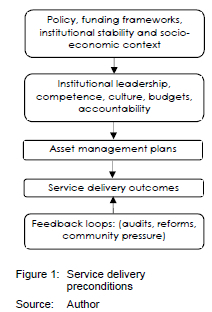
Figure 1 presents a simplified framework linking policy instruments to service delivery outcomes. The arrows indicate not only a forward pathway - from frameworks to institutional preconditions, to asset management processes, and Anally to outcomes - but also feedback loops. In practice, poor outcomes often trigger audits, reforms or community pressure, which, in turn, reshape leadership, accountability, and funding. The figure also acknowledges that wider socio-economic conditions such as poverty, unemployment, and the role of NGOs or business influence both institutional preconditions and outcomes. While reality is more complex and exceptions abound, this representation makes explicit the analyticallinks that underpin the comparative evidence in this article.
A direct response from IPWEA to a question from the autkor yrovides a practical illustration of this perspectiva Bartlett (personal communication, 2025) reported that, ik APstralia, maintenance ik viewed as an activity within asset ma nage ment; con seq uently, thk obligation to maintain infrastructure is implidt in tPe requirements to prepare and implement asset management plans and strategies, as well as in service-delivery obligations placed on infrastructure owners. This implies that infrastructure condition, and the manner in which infrastructure services are operated, is assessed at least as much on the basis of service delivery outcomes as on maintenance inputs. This further suggests that, in Australia, the condition of both the infrastructure itself and its service operation is measured more by the outcomes of service delivery than by maintenance activities or inputs. While Australian infrastructure does not always meet this ideal, it performs reasonably well, as evidenced by the "2024 National State of the Assets Report" (Australian Local Government Association, 2024).
Ultimately, what matters is not only what documents on "why a good document apparently 'succeeds' in one country" say, but the extent to which they are taken seriously and acted upon - particularly, what consequences follow when public-sector entities repeatedly ignore regulations or mandatory standards. In South Africa, non-compliance with regulations and standards relating to infrastructure condition and associated service delivery is widespread. Evidence of this can readily be found in the DWS 'Drop' reports.
In the peer countries cited in this article, two additional features stand out:
• Strong buy-in from infrastructure professionals, including active advocacy directed at infrastructure owners in support of the infrastructure asset management concept and the resources required to implement it.
• Professional organisations, or organisations with aligned interests, that play a visible and active role in supporting practitioners, such as the IPWEA and its 'Ask your mates' online platform.
5. CONCLUSION
The NIAMM framework is a strong and well-conceived set of documents. Its limitation, however, is that it represents only one of the elements required to improve infrastructure condition. Having remained largely unsupported and unpublicised since its delayed introduction in 2017, it could not realistically be expected to have had much if any significant influence on infrastructure asset maintenance in South Africa.
Given that South Africa has such comprehensive documentation, yet public-sector fixed infrastructure remains in poor condition, the question arises: Why? Is the problem a lack of sufficient legislation, standards, and guidance? A failure to implement them? Or do the underlying causes lie elsewhere?
An external observer, considering only the NIAMM framework and GIAMA, might reasonably conclude that South African infrastructure is well managed. But it is, generally speaking, not. If other countries possess broadly similar documentation, designed with comparable objectives, yet achieve better infrastructure outcomes, the key question becomes: What accounts for this difference?
The following factors, individually and collectively, emerge as strong explanations:
• enforced accountability, whether through authorities, peer pressure, citizen demand, or a combination of these;
• competence, in the sense of the ability to manage infrastructure and deliver services effectively;
• adequate budgets, and
• a supportive culture, including ethics.
Together, these can be regarded as the essential ingredients of effective infrastructure asset management, and, more broadly, of a functioning public sector. Without a Arm foundation in all four, meaningful improvement is unlikely.
These same elements have been identified by the Auditor-General (AGSA, 2023; 2024; 2025) and others (Wall, 2025). They are now also evident in the ongoing review of the 1998 Local Government White Paper (COGTA, 2025; 2026).
While space does not allow for detailed discussion of each factor, culture and ethics warrant brief attention. Norms in some countries appear to differ markedly from those in South Africa, suggesting that formal enforcement through legislation alone may not always be decisive. As one respondent from New Zealand noted:
Enforcement [of a national government directive on compliance with asset management requirements] therefore relies on public service ethics to meet the directive. Fortunately, in NZ that ethic is strong.14 Continued failure may result in the Minister writing to the entities' governing Board or the Chief Executive setting out further expectations of compliance or change (i.e. in leadership) to effect compliance (Pugh, personal communication, 2025).
The article concludes that, in countries where infrastructure condition is better than in South Africa, effective asset management is not driven primarily by national frameworks. Rather, it is embedded in the obligation to plan, implement, and deliver services - underpinned by accountability, competence, adequate funding, and supportive institutional culture.
Accordingly, improved infrastructure outcomes are not the result of national policy statements or dedicated asset management 'frameworks' alone, although these may play a supporting role.
6. POLICY AND PRACTICAL IMPLICATIONS FOR INFRASTRUCTURE MANAGEMENT IN SOUTH AFRICA
South Africa presents a clear paradox: the principal instruments intended to give effect to the National Infrastructure Maintenance Strategy - GIAMA and the NIAMM framework - are in place, yet infrastructure condition across the public sector remains, on average, sub-standard.
The issue is thus not the absence of frameworks, but their limited influence in practice.
This gap points to a broader systemic concern. Strategic leadership has not been commensurate with the scale of the problem, and many of the institutions responsible for infrastructure delivery, across national, provincial, and local government, as well as state-owned enterprises, are themselves not fully functional, as repeatedly highlighted in Auditor-General reports. Under such conditions, even well-designed frameworks are unlikely to gain traction.
The comparative insights drawn in this article suggest that improved infrastructure outcomes elsewhere are not primarily the result of stronger or more detailed national frameworks, but of the institutional environments within which such frameworks operate, particularly the presence of accountability, competence, adequate resourcing, and supportive organisational culture.
Against this background, two broad pathways present themselves for adoption by the South African government. The first is to pursue the original intention of systematically 'rolling out' the NIAMM framework across all spheres of government. This would entail:
• draw up regulations to mandate the use of the NIAMM 'standard';
• appoint a service provider to develop a project plan and determine resource requirements (budget and staffing) for the establishment of a centralised support programme within DPW as a dedicated unit to oversee and manage the adoption and implementation of the NIAMM framework across all spheres of government; and
• identify appropriate occupational standards and qualifications.
While this approach was envisaged at the time of the framework's approval in 2017, it was not implemented (Milford, personal communication, 202515). More fundamentally, the international comparison conclusion that "infrastructure condition is not brought about national-level policy statements on infrastructure asset management, or 'frameworks' specifically about infrastructure asset management" raises doubt as to whether such a framework-led strategy, on its own, would materially alter infrastructure outcomes.
The second, and arguably more consequential, pathway is to focus on strengthening the institutional 'essentials' that underpin effective infrastructure management. This would involve sustained efforts to improve accountability, build technical and managerial competence, secure adequate and stable funding, and encourage a culture that values performance and ethical conduct. Infrastructure asset management, like service delivery more broadly, functions as a chain whose strength is determined by its weakest link. It would, for example, be of limited value for a municipality to have competent staff and financial resources adequate to undertake an extensive programme of infrastructure maintenance and repair, if the municipal council (i.e. the elected officials) has other ideas as to what the budget should be allocated to (sadly, this is a common problem). Or if there is the political will and the adequate budget, but it proves impossible to attract competent staff.
Progress along this second pathway will be demanding because of likely strong opposition from the many who currently benefit from weak accountability and ethics, and who occupy posts they are not competent to occupy. However, there are indications of growing recognition within government of the need for such reform, as reflected in ongoing policy processes such as the review of the 1998 Local Government White Paper, which explicitly acknowledges that many of the challenges facing local government are rooted not only in institutional structures and technical capacity, but also in organisational culture, behaviour, and ethics. Unless these institutional weaknesses are addressed, reform initiatives are unlikely to produce meaningful improvements and the prevailing culture of impunity will continue to undermine governance performance in South Africa (COGTA, 2026: 13)
From a practical standpoint, the implication is not that frameworks such as NIAMM are unnecessary, but that their effectiveness depends on the institutional conditions into which they are introduced. Improving those conditions is, therefore, likely to yield greater returns than further refinement or expansion of the frameworks themselves.
ACKNOWLEDGEMENTS
The author is grateful to the people and institutions who contributed to this study: particularly the President of GFMAM, Mr Coetzee, and to the respondents in several peer countries to whom he introduced the author - most of all, Mr Pugh of Āpōpō - Infrastructure Asset Management Professionals Incorporated, New Zealand, Mr Bartlett of the National Transport Research Organisation, Australia, and Mr Verity of IPWEA.
REFERENCES
Accounting Standards Board. 2025. Standard of generally recognised accounting practice property plant and equipment (GRAP 17). https://www.asb.co.za [Accessed 13 April 2026]. [ Links ]
AGSA (Auditor-General South Africa). 2023. Consolidated general report on local government audit outcomes. MFMA 2021-22. https://static.pmg.org.za [Accessed 13 February 2026]. [ Links ]
AGSA (Auditor-General South Africa). 2024. Municipal Financial Management Act. Consolidated general report on local government audit outcomes: 2022-23. https://www.parliament.gov.za [Accessed 13 February 2026]. [ Links ]
AGSA (Auditor-General South Africa). 2025. Consolidated general report on local government audit outcomes. MFMA 2023-24. https://www.agsa.co.za [Accessed 23 March 2026]. [ Links ]
Āpōpō - Infrastructure Asset Management Professionals Incorporated. New Zealand, 2024. Āpōpō competency framework. https://professionals.apopo.co.nz [Accessed 13 February 2026]. [ Links ]
ASCE (American Society of Civil Engineers). 2021. 2021 Infrastructure report card: A comprehensive assessment of America's infrastructure. https://infrastructurereportcard.org [Accessed 13 April 2026]. [ Links ]
ASCE (American Society of Civil Engineers). 2025. 2025 Infrastructure report card: A comprehensive assessment of America's infrastructure. https://infrastructurereportcard.org [Accessed 13 February 2026]. [ Links ]
Australian Local Government Association. 2024. 2024 National state of the assets report - Technical report. https://alga.com.au/wp-content [Accessed 23 March 2026]. [ Links ]
Bowen, G.A. 2009. Document analysis as a qualitative research method. Qualitative Research Journal, 9(2), pp. 27-40. https://doi.org/10.3316/QRJ0902027 [ Links ]
Canadian Infrastructure Council. 2025. National infrastructure assessment report 1. Building foundations for tomorrow. https://canadianinfrastructurecouncil.ca [Accessed 23 March 2026]. [ Links ]
Canadian Infrastructure Report Card. 2019: Monitoring the state of Canada's core public infrastructure. https://canadianinfrastructure.ca [Accessed 23 March 2026]. [ Links ]
Canadian Network of Asset Managers. 2020. Asset management competency framework for Canadian communities. https://cnam.ca/wp-content [Accessed 2 April 2026]. [ Links ]
cidb (construction industry development board). 2009. National infrastructure maintenance strategy (NIMS): Infrastructure maintenance budgeting guideline. http://cidb.org.za [Accessed 23 March 2026]. [ Links ]
cidb (construction industry development board). 2017. National immovable asset maintenance management framework (NIAMM). www.cidb.org.za [Accessed 23 March 2026]. [ Links ]
COGTA (Department of Co-Operative Governance). 2025. White Paper on Local Government 1998: Review of the White Paper on Local Government. Government Gazette number 52498. 10 April 2025. [ Links ]
COGTA (Department of Co-Operative Governance). 2026. Reviewed draft White Paper on Local Government. Government Gazette number 54630. 8 May 2026. [ Links ]
DPLG (Department of Provincial and Local Government). 2007. Guidelines for infrastructure asset management in local government 2006-2009. https://www.cogta.gov.za [Accessed 2 April 2026]. [ Links ]
DPW, CSIR & cidb (Department of Public Works, Council for Scientific and Industrial Research & construction industry development board). 2007. The National Infrastructure Maintenance Strategy. In support of ASGISA and government growth objectives. https://www.cidb.org.za [Accessed 2 April 2026]. [ Links ]
DWA, DPME & DHS (Department of Water Affairs, Department of Performance Monitoring and Evaluation and Department of Human Settlements). 2012. Report on the status of sanitation services in South Africa: Executive Summary. https://www.dpme.gov.za [Accessed 2 April 2026]. [ Links ]
DWS (Department of Water and Sanitation). 2022. Green Drop national report 2022. https://wisa.org.za [Accessed 15 April 2026]. [ Links ]
DWS (Department of Water and Sanitation). 2023. Blue Drop national report 2023. https://ws.dws.gov.za [Accessed 15 April 2026]. [ Links ]
DWS (Department of Water and Sanitation). 2025a. Blue Drop 2025 progress report. https://ws.dws.gov.za [Accessed 15 April 2026]. [ Links ]
DWS (Department of Water and Sanitation). 2025b. Green Drop 2025 national report. https://ws.dws.gov.za [Accessed 15 April 2026]. [ Links ]
DWS (Department of Water and Sanitation). 2025c. No Drop 2025 progress report. https://ws.dws.gov.za [Accessed 15 April 2026]. [ Links ]
Federation of Canadian Municipalities. 2020. Asset management readiness scale: Municipal asset management program. https://fcm.ca [Accessed 15 April 2026]. [ Links ]
GFMAM (Global Forum on Maintenance and Asset Management). 2021. The maintenance framework. https://www.gfmam.org [Accessed 15 May 2026]. [ Links ]
GFMAM (Global Forum on Maintenance and Asset Management). 2024a. The asset management landscape. https://gfmam.org [Accessed 15 May 2026]. [ Links ]
GFMAM (Global Forum on Maintenance and Asset Management). 2024b. Digital transformation in maintenance and asset management. https://gfmam.org [Accessed 15 May 2026]. [ Links ]
ICE (Institution of Civil Engineers). 2010. State of the Nation. Infrastructure 2010. https://www.ice.org.uk [Accessed 25 February 2026]. [ Links ]
ICE (Institution of Civil Engineers). 2022. State of the Nation 2022: Improving infrastructure productivity. https://www.ice.org.uk [Accessed 25 February 2026]. [ Links ]
Independent Water Commission. 2025. Independent Water Commission (Cunliffe Commission): Final report. https://assets.publishing.service.gov.uk [Accessed 15 February 2026]. [ Links ]
Infrastructure Australia. 2019. An assessment of Australia's future infrastructure needs: The Australian Infrastructure Audit 2019. https://www.infrastructureaustralia.gov.au [Accessed 15 February 2026]. [ Links ]
Infrastructure New Zealand. 2024. Building Nations. InfraRead, 30 September, pp. 30-31. https://infrastructure.org.nz [Accessed 15 February 2026]. [ Links ]
IPWEA (Institute of Public Works Engineering Australasia). [n.d.] International infrastructure management manual (IIMM). https://www.ipwea.org/resourcesnew/bookshop/iimm [Accessed 25 February 2026]. [ Links ]
IPWEA (Institute of Public Works Engineering Australasia). 2024. Best practice asset management of essential public infrastructure. https://higherlogicdownload.s3.amazonaws.com [Accessed 25 February 2026]. [ Links ]
ISO (International Standards Organisation) ISO 55000 series: 55002:2018, also published as SANS 55002:2020: Asset Management - Management Systems - Guidelines for the Application of ISO 55001. https://www.iso.org/obp/ui/en/#iso:std:70402:en (ISO, 2018; SANS, 2020). [ Links ]
ISO (International Standards Organisation) ISO 55000 series: 55000:2024: Asset Management - Vocabulary, Overview and Principles (ISO, 2024a). [ Links ]
ISO (International Standards Organisation) ISO 55000 series: 55001:2024: Asset Management - Asset Management Systems - Requirements (ISO, 2024b). [ Links ]
ISO (International Standards Organisation) ISO 55000 series:55011:2024: Asset Management - Guidance for the Development of Public Policy to Enable Asset Management (ISO, 2024c). [ Links ]
JSCE (Japan Society of Civil Engineers). 2021. Japan's infrastructure grades 2020 & introduction of maintenance technologies. https://www.jsce-int.org [Accessed 25 February 2026]. [ Links ]
Lawless, A. 2016. Numbers and needs in local government - Update 2015. In: Proceedings of the Annual Conference of the Institute of Municipal Engineering of Southern Africa, October, East London, pp. 55-61. [ Links ]
New South Wales Office of Local Government. 2021. New South Wales integrated planning and reporting guidelines. https://www.olg.nsw.gov.au [Accessed 25 February 2026]. [ Links ]
New Zealand Infrastructure Commission. 2025. Draft national infrastructure plan. https://tewaihanga.govt.nz [Accessed 25 February 2026]. [ Links ]
Ontario. 2017. Ontario Regulation 588/17. Asset management planning for municipal infrastructure. In terms of: Infrastructure for Jobs and Prosperity Act, 2015. https://www.ontario.ca/laws/regulation/170588 [Accessed 25 February 2026]. [ Links ]
Parliament of the Republic of South Africa: Research Unit. 2024. Review of parliamentary oversight on the state of infrastructure from 2019-2024: Infrastructure development in South Africa. https://www.parliament.gov.za [Accessed 25 February 2026]. [ Links ]
SAICE (South African Institution of Civil Engineering). 2022. The SAICE 2022 infrastructure report card for South Africa. https://saice.org.za [Accessed 25 March 2025]. [ Links ]
South Africa. 1996. Constitution of the Republic of South Africa, Act No. 108 of 1996. Pretoria: Government Printer. [ Links ]
South Africa. 2003. Local Government: Municipal Finance Management Act No. 56 of 2003. Pretoria: Government Printer. [ Links ]
South Africa. 2007. Government Immovable Asset Management Act 19 of 2007. (GIAMA) Pretoria: Government Printer. [ Links ]
South Africa. 2022. Judicial commission of inquiry into allegations of state capture, corruption and fraud in the public sector including organs of state. https://www.sastatecapture.org.za/ [Accessed 25 February 2026]. [ Links ]
Treasury. 2014. MFMA Circular No. 71: Financial ratios and norms. Section 3 "Repairs and maintenance as a % of property, plants and equipment and investment property (carrying value)". https://splshortcourses.co.za [Accessed 25 February 2026]. [ Links ]
Treasury. 2018. Cities Infrastructure Delivery and Management System (CIDMS) Toolkit: Module 3 - Asset data model and infrastructure profiling. Pretoria: National Treasury. https://cidms.co.za [Accessed 25 February 2026]. [ Links ]
Treasury and SECO (Swiss State Secretariat for Economic Affairs). 2019. Public sector entities: Towards budget guidelines for maintenance and repair of infrastructure. Unpublished internal report to the Chief Directorate: Provincial and Local Government Infrastructure. July 2019. [ Links ]
United Kingdom: HM Treasury. 2025. UK Infrastructure: A 10-year strategy. https://assets.publishing.service.gov.uk [Accessed 25 March 2026]. [ Links ]
Wall, K. 2024. Report cards, and other tracking of South Africa's public sector fixed infrastructure condition. Acta Structilia, 31(1), pp. 194-221. https://doi.org/10.38140/as.v31i1.8017 [ Links ]
Wall, K. 2025. Primary causes of the condition of public sector fixed infrastructure in South Africa. Acta Structilia, 32(1), pp. 63-90. https://doi.org/10.38140/as.v32i1.9383 [ Links ]
Water Research Commission. 2015. Integrated water sector skills intervention map based on a sector skills gap analysis. WRC Report No 2113/1/14. https://www.wrc.org.za [Accessed 16 March 2016]. [ Links ]
Williams, M. & Moser, T. 2019. The art of coding and thematic exploration in qualitative research. International Management Review, 15(1), pp. 45-55. [ Links ]
Received: April 2026
Peer reviewed and revised: May 2026
Published: June 2026
1 DECLARATION: The author(s) declared no potential conflicts of interest with respect to the research, authorship, and/or publication of this article.
2 The full 2026 report is expected to be released in early 2027.
3 IPWEA-askyourmates@connectedcommunity.org
4 A collective effort produced by The Association of Consulting Engineering Companies Canada (ACEC), the Canadian Construction Association (CCA), the Canadian Parks and Recreation Association (CPRA), the Canadian Public Works Association (CPWA), the Canadian Society for Civil Engineering (CSCE), the Canadian Urban Transit Association (CUTA), the Canadian Network of Asset Managers (CNAM), and the Federation of Canadian Municipalities (FCM).
5 Although the primary focus of this report is housing-enabling infrastructure, the findings have broader relevance across Canada's infrastructure landscape.
6 The new IIMM mapping tool provides an intuitive alignment between the IIMM, ISO 55001, and the GFMAM Asset Management Landscape, helping asset-intensive organisations integrate their asset management practices with these international standards. It also incorporates guidance from ISO 55010:2019 on aligning financial and non-financial functions in asset management.
7 Emphasis added.
8 The former Department of Public Works, now called the Department of Public Works and Infrastructure.
9 See, for example, CIDB, 2009; Treasury and SECO, 2019.
10 Subsequently renamed the Department of Cooperative Governance and Traditional Affairs (COGTA).
11 "Recognising that the ISO [55000] Standards are very much the 'What to do', the IIMM provides the 'How to do it' in terms of applying the standards for infrastructure asset management."
12 https://www.ipwea.org/educationandevents. Professional institutions in countries such as Australia and Canada are very good at training not only their own kind, but also other people, especially targeting politicians. For example, the 2025 IPWEA course "Infrastructure asset management planning for elected members".
13 The Canadian Asset Management Readiness Scale (AMRS) is a self-assessment tool that helps local governments measure asset management maturity across five areas and five levels, identifying gaps, setting priorities, and improving infrastructure for better service delivery.
14 Emphasis added.
15 Until his retirement in 2019, Dr Milford was the cidb Programme Manager; Construction Industry and, as such, responsible for the development of the NIAMM framework.
