




Services on Demand
Journal

Article
 English (pdf)
 Article in xml format
 Article references
 Automatic translation
 Send this article by e-mail
Indicators
Related links
-
 Cited by Google
 -
 Similars in Google
Share

 Permalink
Acta Structilia
On-line version ISSN 2415-0487Print version ISSN 1023-0564
Acta structilia (Online) vol.31 n.2 Bloemfontein 2024
https://doi.org/10.38140/as.v31i2.8824
REVIEW ARTICLE
Some implications of the condition of South Africa's public sector fixed infrastructure
Kevin Wall
Department of Construction Economics, University of Pretoria, Private Bag X 20, Hatfield 0028, South Africa. Email: <kevinwall468@gmail.com>, ORCID: https://orcid.org/0000-0002-0940-7515
ABSTRACT
This third article in a planned series on the state of South Africa's public sector fixed infrastructure examines the implications of its deteriorating condition. The first two articles focused on efforts to monitor infrastructure conditions and on studies of its state and findings. This review outlines the extent to which the poor condition of infrastructure negatively impacts on the economy and quality of life, providing specific examples from sectors such as land transport, electricity, water, and waste water, with agribusiness as a case study. The article discusses how the failures of institutions such as Eskom (including its neglect of capacity expansion), PRASA, Transnet, and municipal authorities have hindered economic growth and stifled improvements in citizens' quality of life. Central to this analysis is the argument that the root cause is institutional breakdown: the failure of these institutions preceded the deterioration of infrastructure, and only through fundamental institutional reform can these challenges be addressed. The article concludes that institutional reform should be a primary focus in addressing South Africa's infrastructure crisis.
Keywords: agribusiness, economy, infrastructure, operation and maintenance, quality-of-life, service delivery, South Africa
ABSTRAK
Hierdie derde artikel in 'n beplande reeks oor die stand van Suid-Afrika se vaste infrastruktuur in die openbare sektor ondersoek die gevolge van die verslegtende toestand daarvan. Die eerste twee artikels het gefokus op pogings om infrastruktuurtoestande te monitor, sowel as op studies van die toestand en bevindings daarvan. Hierdie oorsig skets die mate waarin die swak toestand van infrastruktuur die ekonomie en lewensgehalte negatief beïnvloed, en verskaf konkrete voorbeelde uit sektore soos landvervoer, elektrisiteit, water en afvalwater, met landboubesigheid as 'n gevallestudie. Die artikel bespreek hoe die mislukkings van instellings soos Eskom (insluitend sy verwaarlosing van kapasiteitsuitbreiding), PRASA, Transnet en munisipale owerhede ekonomiese groei belemmer het en verbeterings in burgers se lewensgehalte gesmoor het. Sentraal tot hierdie ontleding is die argument dat die hoof-oorsaak institusionele ineenstorting is: die mislukking van hierdie instellings het die agteruitgang van infrastruktuur voorafgegaan, en slegs deur fundamentele institusionele hervorming kan hierdie uitdagings aangespreek word. Die artikel kom tot die gevolgtrekking dat institusionele hervorming 'n primêre fokus moet wees om Suid-Afrika se infrastruktuurkrisis aan te spreek.
1. INTRODUCTION
The first article in the series began by stating that engineering infrastructure is designed and built to deliver a service, but how well the infrastructure is operated and maintained is a major determinant of how effectively it is able to deliver that service. It describes high-level effort to improve the condition of infrastructure, including the conducting of research on condition, the compilation of guidelines, the promulgation of legislation. It quoted some examples of infrastructure asset management planning (Wall, 2023). The second article reviewed a number of studies over the course of more than 20 years of the condition of South Africa's public sector fixed infrastructure and reported that this has generally not been good, thus hampering service delivery (Wall, 2024).
As the third in a series (with at least two to follow) published in this Journal, this article on the condition of South Africa's public sector fixed infrastructure discusses some implications of that condition. It describes how, and the broad extent to which the condition of the infrastructure can harm (or boost) the economy and the quality of life.
Engineering infrastructure, which is the responsibility of the public sector, such as pipes, pump stations, water and waste-water treatment works, electricity transmission lines and power stations, roads, railway systems, harbours and airports, has been built to deliver services that should underpin the economy and improve the quality of life of all citizens (Wall, 2024). In order to deliver those services, the infrastructure must be in a good condition and properly operated. However, this infrastructure in South Africa is not always correctly operated and maintained, with the result that its condition is, on average (but with many exceptions), substandard (Wall, 2024).
Non-functioning infrastructure impacts on all citizens, significantly affecting the economy and quality of life (Thukwana, 2024). Section 4 is devoted to describing examples of this, but a key example is the deteriorating power generation capacity of Eskom, a state-owned enterprise (SOE), which has caused widespread power outages. These outages lead to lost production, inconvenience, and hardship for many, while also straining other infrastructure not designed for frequent disruptions (Moodley, 2023). Another example is the lost export opportunities for the mining sector, due to the poor condition and periodic failure of rail and harbour infrastructure (Havenga et al., 2023; Ndeze, 2023). In addition, the deterioration of local passenger rail services has resulted in increased costs and safety risks for commuters (Havenga et al., 2023). Finally, the state of infrastructure often worsens the impact of other disasters such as how poorly maintained stormwater systems exacerbate flooding, leading to greater damage (Tooley, 2022).
Whereas the subject matter of the fourth and fifth articles has not yet been finalised, provisionally, the fourth will describe and discuss the principal factors affecting infrastructure condition, while the fifth will delve into what could possibly be done to improve infrastructure condition and, hence, service delivery.
2. METHODS AND REVIEW
Many South African public sector institutions, mandated to provide specific services, are failing to do so for a myriad of reasons, including insufficient skills and funding, as well as poor governance (SAICE, 2022). This review discusses some implications of that failure, that is, the results of inadequate management (i.e., operation and particularly maintenance) of the fixed infrastructure on which the service delivery is dependent.
Qualitative research methods are employed for the study, primarily through the application of desktop research and data analysis of grey literature (information produced outside of traditional publishing and distribution channels) (Paez, 2017). Relevant grey literature used in this review consists of articles, reports, the Internet and other documents obtained from the author's extensive personal database of relevant material. Two types of publications were consulted: (i) public sector publications, including media releases, annual reports, guidelines, and legislation, and (ii) contemporary reports of the condition of infrastructure in South Africa. The selection criterion was simply: whatever was most relevant and also credible on the topic of the implications of infrastructure failure. Particularly useful sources were Statistics South Africa, South African Human Rights Commission, Department of Water and Sanitation, The Presidency, the Auditor General, the reports of the Commission on State Capture (the Zondo Commission2), and the reports of a number of commercial companies and industry associations3 that are heavy users of public sector infrastructure.
First, the review clarifies the link between service delivery and unobtrusive infrastructure. Secondly, it describes the link between infrastructure failures, on the one hand, and the economy and quality of life, on the other, using readily available infrastructure sector examples from water, waste water, commuter rail, freight rail, and electricity. Thirdly, the discussion section examines the agricultural sector, with a particular focus on agribusiness towns. These towns have emerged as critical hubs for processing agricultural produce from their surrounding regions, playing a central role in the local economy and often serving as the largest employers. The section explores how the economy and livelihoods in these areas can be significantly impacted by the initial failure of the municipality as an institution, which, in turn, leads to cascading failures in public sector infrastructure.
3. KEY ISSUES
3.1 Infrastructure roll-out is not service delivery
"Engineering is crucial for sustainable development ... The role of engineers is vital in addressing basic human needs such as alleviating poverty, supplying clean water and energy, responding to natural disasters, constructing resilient infrastructure, and bridging the development divide, among many other actions, leaving no one behind" (UNESCO, 2021: 1).
Engineers address these basic human needs by designing and constructing infrastructure for, inter alia, water, sanitation, energy transport, and ICT, with the intention of designing and constructing this infrastructure so that it serves the purpose adequately and reliably for years to come - depending on the type of infrastructure, sometimes many decades.
Widespread failure to operate and maintain existing infrastructure is affecting the economy and all of the population - in some instances, it is alleged (SAHRC, 2022), even depriving them of their rights. Infrastructure that is competently operated and well maintained underpins quality of life and economic development. If it is badly operated and inadequately maintained, social and economic growth will be impeded, and the goals of sustainable, inclusive economic growth and spatial transformation will be undermined. In short, water reservoirs and pipes for sustenance and bodily health; waste-water reticulation and treatment plants to promote dignity; electricity generation and distribution for stoves and machines and for domestic lighting so that learners can study after dark; solid waste collection and disposal for hygiene; roads for access to learning, work opportunities, and markets - that is the purpose of infrastructure.
The scale and pace of infrastructure delivery in South Africa since the late 1990s has been phenomenal, especially marked in how basic services infrastructure has been extended to many previously unserved areas (Presidency, 2014: 24-30; Presidency, 2019: 164). For example, access to piped water infrastructure, available to 80.3% of households in 1996 (according to the national census of that year), is now available to 91.3% (Statistics South Africa, 2023: 73). The increase in the proportion of households being lit by electricity has been even more significant, from 58.1% in 1996, to 94.7% in 2022 (Statistics South Africa, 2023: 78).
However, infrastructure roll-out does not necessarily equate to service delivery - even in the short term, but even less likely as the infrastructure ages - especially if the operation and maintenance of that infrastructure since its commissioning has not been up to specification. As the Cabinet-approved National Infrastructure Maintenance Strategy stated: "Delivery needs to be understood as embracing not just the construction of infrastructure but the operation and maintenance of that infrastructure throughout its intended life" (DPW, CSIR & cidb, 2007: 3).
To emphasise: "service delivery" is not achieved by the mere installation of infrastructure - for example, the laying of a pipe in the ground. Nor is "delivery" concluded by the ribbon-cutting ceremony to celebrate the inauguration of the service (DPW et al., 2007; Wall, 2019). Rather, "delivery" is clean, fresh, and pure water coming from that pipe 24 hours of every day of every year, at the right pressure - for the next 50 years! A well-designed, well-funded, and competently implemented operation and maintenance regime is essential.
3.2 Infrastructure is unobtrusive - until it breaks down
It is not easy to demonstrate a direct link between infrastructure improvement and improvement in the economy or quality of life, because, infrastructure, and the services it enables when it is functioning effectively, is only one of the elements contributing to, for example, the economic prosperity or life quality of a particular area (CSIR, 2005: DPW et al., 2007; Wall, 2023). Other contributing elements can readily be imagined - for example, a local resource (e.g., minerals, beaches), an existing local skills base, timely intervention of entrepreneurs, national economic cycles, marketing, and climate.
As long as the infrastructure is delivering the expected service, it is seldom noticed. Indeed, the very unobtrusiveness of effective engineering infrastructure is a significant indicator of its success - that is, it does not hit the headlines because it is doing its job day by day, with absolute reliability.
The downside of that, though, is, because infrastructure is unobtrusive, it is often taken for granted, i.e. , its need for maintenance and careful operation, and renewal or upgrading, is ignored (SAICE, 2022). Ignored, that is, until it breaks down. Then the link between infrastructure, on the one hand, and the economy and quality of life, on the other, becomes clearly visible. For example, most of the state-owned entities - certainly the larger ones (Eskom4 and Transnet, and most of the water boards) - vital to the nation's improvements in quality of life and the economy - have over recent years been incurring massive financial losses and requiring 'bailouts' by government (i.e., by the taxpayer). These bailouts come at a significant financial cost. Moreover, the funds could have gone to service delivery improvements rather than down the drain (literally down the drain, in the case of water leaked).5
4. IMPLICATIONS OF SERVICE DELIVERY FAILURE
The failure of public sector infrastructure impacts on all citizens, either by directly limiting their access to essential services (e.g., water supply) or by affecting facilities and services they rely on, such as workplaces, shopping centres, or educational institutions. It can even undermine employment prospects. These failures certainly hinder South Africa's ability to address its "principal challenge [which is] to roll back poverty and inequality" (NPC, 2012: 25). The implications of infrastructure service delivery failures are illustrated through examples from water, waste water, tourism, commuter rail, freight rail, and electricity, where shifts in infrastructure conditions over recent decades have significantly impacted on service delivery, with serious repercussions for the economy and quality of life.
Failure of most of the types of public sector fixed engineering infrastructure affects all citizens - either because they themselves directly lose access to that service (e.g., water supply), or because the infrastructure failure affects facilities or other services which they use (e.g., their place of work, of shopping, or of education). It might even affect their prospects of employment. It would certainly diminish South Africa's ability to overcome its "principal challenge [which is] to roll back poverty and inequality" (NPC, 2012: 25). The implications of service delivery failures in infrastructure sectors are briefly outlined, drawing on readily available examples from water, waste water, commuter rail, freight rail, and electricity, where significant shifts in infrastructure conditions over the past few decades have notably impacted on service delivery, with serious repercussions for the South African economy and quality of life.
4.1 Water
Failure of a specific type of water service at a specific place can set off a chain of effects. For example, if a major pipe from the water treatment works of a town, blocks or bursts, not only does the water to all households and businesses dwindle to a trickle within a few hours, but the cut-off of water can trigger failure of manufacturing systems which depend on a reliable water supply (reliable in volume, pressure, and quality - with no interruptions to supply). Food processing is an example (Astral Foods, 2023).
Some government departments periodically assess their service delivery capability and infrastructure serviceability, although most do not, and those that do, often fail to make the results publicly accessible or they publish them in formats that are difficult to interpret, even for experts (De Jager & Wall, 2022). In other instances, however, departments have published short and very intelligible summaries of the masses of data in their possession. For example, the national Department of Water and Sanitation (DWS) has over the years been candid about the gap between 'infrastructure delivery' and 'service delivery'. Using, inter alia, information from the annual Statistics South Africa General Household Survey, DWS (2019: 35) stated that, in 2018,
"88.0% of households had been provided with a basic level of water supply infrastructure. However, not all of the infrastructure was able to meet the level of assurance (reliability) of supply requirements, defined for a basic water supply as interruptions of less than 48 hours at any one time and a cumulative interruption time of less than 15 days every three months. If this reliability requirement is taken into consideration, then the 88.0% value reduces to 74.36%".
The Census 2022 results had no directly comparable statistics of this unreliability, but noted that, on average, nearly half (48.4%) of households nationally experienced interruptions to their piped water supply (Statistics South Africa, 2023: 75).
South Africa's water and sanitation service delivery problems are not, in the first instance, of the natural resource, although this issue, in the face of a growing population, is hugely important and becoming even more so. The problems are more of an institutional and financial nature,6 including budgets, skills, politics, and associated inefficiency, ineffectiveness, and ineptitude. All this together with the need to address inequality.
In the nation's economic hub, the province of Gauteng (including the metropolitan municipalities of Johannesburg, Tshwane and Ekurhuleni), an analysis of Census 2022 results revealed that, while
"[t]here has been a large increase in the percentage of households getting water piped into their dwelling, from 62.1% in 2011 to 75.0% in 2022. The numbers behind this are remarkable and worth applauding: whereas Gauteng's total count of households increased by 1 409 643 between 2011 and 2022, 1 560 956 households gained access to water inside their dwellings, closing the gap in access to services" (Gauteng City-Region Observatory, 2023: 21).
Sadly, though, in Gauteng, while water infrastructure availability increased, service unreliability also increased (Moloi, 2023; Phillips, 2023).
A case in point is the water service to South Africa's biggest city, Johannesburg. Consumers in widespread areas of the city have had to cope without reticulated water for long periods. During much of 2023 and 2024, an increasing number of consumers in Johannesburg were not able to receive water through the municipal reticulation system. For example, those living in the suburb of Brixton, west of central Johannesburg, reportedly had dry taps for over three weeks (Njilo, 2023).
The Minister then responsible for DWS was unequivocal in his allocation of blame, stating (as quoted) that:
"Where there is a problem is at water provision level, also known as water reticulation, to your homes. In terms of the legislative architecture], that duty falls into local government [municipalities]. As we all know, municipalities have been declining lately in terms of providing water and other services to communities" (Moloi, 2023: online).
In a complementary technical explanation, his Department's Director General pointed out that the dams, from which Johannesburg draws its water, were at the time near to capacity, so that could not have been the reason for the Johannesburg shortages. The main contributor was7 the operation and maintenance of the infrastructure bringing water from the Vaal River to Johannesburg, as well as the institutional and other problems that had led to the current situation (Phillips, 2023: online).
"More recently, the new8 Minister, while acknowledging that Gauteng's growing population and economy were factors, highlighted the increase in non-revenue water in the municipal systems, saying, 'That includes illegal connections, unbilled connections as well as physical losses such as leaks from municipal water distribution systems'."
The 2023 No Drop Report (DWS, 2024a) noted that one of the main reasons consumption is so high, in Gauteng and nationally, is physical losses in municipal distribution systems, directly traceable to poor operation and maintenance of infrastructure over many years. The report found that, nationally, 47%, or 2.1 billion cubic metres per annum, of the total [all-South Africa] volume of water treated for municipal use is expected to be non-revenue water (26% being leaks and pipe bursts).
Thus, the Minister concluded: "Gauteng is really not affected by drought ... The Gauteng situation is out of self-inflicted pain by municipalities who don't want to cooperate" (Evans, 2024: online).
Regarding the eThekwini Metropolitan Municipality in the KwaZulu-Natal province of South Africa, the national DWS flagged that "many residents of eThekwini have been experiencing increasingly frequent and lengthy interruptions to their water supply". In addition to new infrastructure being brought, over time, into operation:
"... the shortage of treated water in eThekwini must be addressed by the Municipality by reducing non-revenue water in its water distribution system and by water users in the Municipality using water more sparingly to reduce the average consumption of water per capita per day. The 2023 DWS [Department of Water and Sanitation] No Drop audit (which was released by DWS in December 2023) found this to be 298 l/c/d, compared to the international average of 173 l/c/d. It also found that non-revenue water increased from 37% in 2013 to 58% in 2023." (South African Government Official Information and Services, 2024: online; Ngema, 2024).
The South African Human Rights Commission stated that it fears a water supply 'disaster' may be looming in several parts of KwaZulu-Natal, not only coastal towns, unless municipalities are forced to fix and maintain their dilapidated pipelines, pumps, and other crucial water supply infrastructure (SAHRC, 2022).
4.2 Waste water
Prudent infrastructure management involves identifying critical assets where failure would have severe implications, whether humanitarian, financial, or otherwise. For example, a decade ago, the eThekwini Metropolitan Municipality recognised that the failure of pumps at a specific wastewater pump station, despite it not being the largest or most expensive asset, would have devastating effects. A pump failure could lead to contaminants flowing into the sea, damaging the city's beaches and severely harming its international reputation as a tourist destination, with significant economic repercussions for the region. In response, the municipality implemented short-term mitigation measures, including backup pumps, and considered relocating the pump station (Pietersen, 2010: personal communication). However, these efforts were not sustained, and recent years have seen eThekwini's water and sanitation services frequently criticised in the media for operational failures and inadequate maintenance (see section 4.3). While the severe floods of April 2022 worsened the situation, the deterioration of eThekwini's waste-water system had been ongoing for years, due to insufficient maintenance, a lack of upgrades, and rising demand (Erasmus, 2021; Singh, 2021a; Singh, 2021b).9 This was compounded by pump station failures and sewer leaks, which were highlighted by the DWS. The DWS Deputy Minister emphasised the importance of municipalities (specifically Gauteng) improving the operations and maintenance of waste-water treatment works to prevent pollution in the Vaal and Crocodile rivers, which are the key systems that support economic activity in South Africa, as they provide raw water for water users across all sectors, including agriculture, domestic, industrial, mining, and tourism. The dams on these rivers are threatened by pollution from waste-water systems, overloaded systems, pumpstation failures, and sewer leaks from the same Gauteng municipalities (Emphasis added)10 (DWS, 2024b).
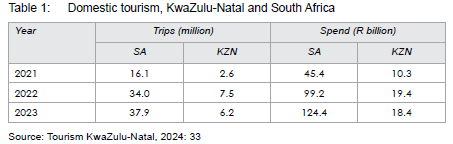
The failure to maintain waste-water infrastructure has a direct impact on tourism, particularly in eThekwini and the broader KwaZulu-Natal region, a major tourist destination known for its warm Indian Ocean waters. Despite a national tourism rebound after the COVID-19 pandemic, KwaZulu-Natal struggled to recover fully, as pollution and beach closures deterred potential visitors (Comins, 2023: online). This resulted in a significant decline in tourism during the 2022/2023 holiday season, with nearly 200,000 fewer tourists visiting Durban compared to 2019, due to concerns over water quality at its beaches (Carnie, 2022; Govender, 2022; Mercury, 2023).
The impact of deteriorating waste-water infrastructure on tourism is further reflected in the broader trends for KwaZulu-Natal. While national tourism rebounded strongly in 2022 and continued growing in 2023, KwaZulu-Natal saw a decline in 2023, likely driven by ongoing pollution and the associated beach closures, and water supply problems (Table 1). These challenges highlight the critical link between infrastructure quality, particularly waste-water management, and the economic vitality of tourism-dependent regions.
4.3 Commuter rail
For many South Africans, especially in the lower income groups, a daily commute by rail has been the normal mode to travel to and from work or school (Walters, 2008: 104). The service might not have been of high riding quality, was frequently overcrowded, and was not always safe from criminal activity, but relative to alternative modes (if there were any) was inexpensive and generally reliable. It was thus often a preferred mode -where it was available (only in the metropolitan areas).
However, come the curtailment or even total cessation of services with the advent of COVID-19, ridership fell drastically. Some poorly considered managerial decisions by the Passenger Rail Authority of South Africa (PRASA), which is responsible for the commuter rail services in the major cities, then followed, leading directly to large-scale damage to the rail infrastructure (Washinvira, 2023). For example, the Board of PRASA decided to cancel the bulk of its private security contracts without considering the implications. Whereas it was reported that the reason given was unease at the procurement procedures, the members of the Board should have had little difficulty in perceiving that the potential for physical damage to the infrastructure and reputational damage to the rail service was immense compared to any damage arising from irregular procurement. At the very least, the Board should have ensured adequate interim security arrangements until the procurement issues had been sorted.11
The Chairperson of Parliament's Standing Committee on Public Accounts subsequently condemned the decision, stating:
"A few years back the [previous] Board of PRASA took an erroneous decision to cancel a security contract, therefore leaving the entire PRASA railway infrastructure vulnerable and susceptible to criminality. ... The pandemic escalated the problem because there was vandalism of the structure throughout the country. ... Our assessment is that the decision to cancel the security contract was reckless, irresponsible, and inconsistent with the financial management" (Washinvira, 2023: online).12
Consequently, over a two-year period, the rail infrastructure was heavily vandalised. Commuter rail passenger journeys dropped from nearly 300 million in 2017 to less than 18 million in 2022. Three years after the onset of COVID-19 and a year after the removal of the last stage of compulsory lockdown, it was still not possible to resume services on most of the lines (Statistics South Africa, 2021; SAICE, 2022; Stent, 2022; PRASA, 2022).
Over the past few years, commuter rail infrastructure has largely been restored (and upgraded), but at enormous financial cost. The cost of this has been borne not only by PRASA (that is, by the taxpayer), but also by commuters over the period described, in the form of inconvenience, higher cost of travel and, often, less safety. Ridership is increasing rapidly from its recent low base.13
4.4 Freight rail
It is common cause that the freight rail service is not what it used to be. The reasons are many and varied, and not all authorities would agree on what they might be, but they definitely include underfunding (for capital improvements, as well as for operation and maintenance), corruption (South Africa, 2022; South Africa, 2022a; South Africa, 2022b), crime, and vandalism. However, irrespective of what the reasons might be, the effect has been to depress the tonnages carried.
"... it has been in the last few years that the network has reached a crisis point, with mainstay Transnet customers like the citrus sector, local car manufacturers, and the mining sector forced to make alternative arrangements. ... The impact on inland transport overall has been twofold, creating both longer lead times and higher costs for users. This is due to increased road congestion, especially outside of overwhelmed port facilities, comparatively higher freight rates, and less forgiving payment terms offered by truckers compared to what was standard with Transnet" (In on Africa, 2024: 5).
The National Logistics Crisis Committee, constituted by the President in 2023, spelt out the severity of sub-par infrastructure performance in this sector:
"The inability to export goods via freight rail and ports is the most severe constraint on economic growth after load-shedding and requires urgent intervention. Transnet's export coal line performance is now at its worst since 1993 and exported iron ore line volumes are at their lowest level in a decade. General freight volumes have declined even more sharply, to World War II levels. Volumes transported on the rail network declined from 226 million tonnes (Mt) in 2017 to just 173 Mt in 2022" (National Logistics Crisis Committee, 2023: 21).
As a result:
"Poor rail performance has left South Africa unable to fully participate in recent commodity price booms. Since 2010, South Africa has forfeited an estimated USD26.7 billion in iron ore and coal export trade" (National Logistics Crisis Committee, 2023: 21).
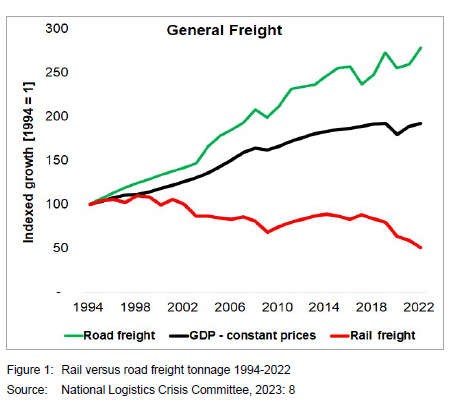
The declining performance of the freight rail network, the (greatest challenge in the freight logistics system , can be attributed to several und erlying factors
• Historical underinvestment in the network, creating a vicious cycle (as a lack of investment reduces availability, which, in turn, reduces revenue and investment).
• Lack of available rolling stock and poor maintenance of existing equipment.
• Security issues, including theft and vandalism of natwork infrastmcture.
• Operational inefficiencies and loss of skills within Transnet.
• Structural barriers preventing private investment and competition (National Logistics Crisis Committee, 2023: 8).
All the above relates to the inability to take adequate care of existing infrastructure, and to upgrade and expand it as demand requires. New technologies, and regenerative design and construction, can play a role in addressing this declining performance, but what is most needed is the political will to invest in management and staff, infrastructure and systems, together with great improvement in the operation and maintenance regime. Costly recapitalisation is undoubtedly also needed.14
There are of course reasons other than the quality of the rail service for rising or decreasing volumes carried. A major determinant is the demand for movement of goods and, within that, the fluctuating international demand for major minerals such as coal and iron ore that can be exported (Minerals Council South Africa, 2024: 1). Another is the capacity at the ports (the ports as it happens also being the responsibility of the same overarching state-owned enterprise, namely Transnet).
In March 2024, it was reported that
"Transnet's recovery plan is showing significant progress, with an additional 10 million tonnes (Mt) recovered against the pre-recovery trend ... significant challenges remain. Rail volumes are projected to be 2% below the recovery plan target for the 2023/2024 financial year. Contributing factors include the condition of the rail network, locomotive reliability, and security incidents" (South Africa, 2024a: online).
Regarding exporting major minerals, the mining companies and the Minerals Council have made it clear where they see the major problem lies. The Minerals Council South Africa (2024: 1) outlined the importance of mining to the South African economy in the following quotations:
"Mining employed 477 000 people or 4.7% of South Africa's total workforce in the third quarter of 2023, creating nearly 7 650 more jobs than the year before, while increasing its wage bill by R12 billion to R86.5 billion, supporting the lives and livelihoods of employees and their families as well as participants in the mining value chain".
"However, logistics problems (and the unreliability and increasing cost of electricity from Eskom) are reducing the ability of mining companies to introduce operational flexibility to adjust to short-term fluctuations in the prices they can obtain for their products - particularly the export prices. In the current environment, where electricity is in short supply and expensive, and rail and ports are inefficient, the options available to companies to adjust are limited".
"Coal exports through the private terminal fell to 1992 levels of 47 million tonnes because of deteriorating rail services. Based on SARS export data, another 26 million tonnes of coal were sent to other ports, partly by road, which is more expensive and inefficient than rail, eroding profit margins for coal companies. It costs up to three times more per ton to send coal by road to a port than by train and has associated road safety hazards".
"As the rail crisis deepened, the Minerals Council was at the forefront of establishing the National Logistics Crisis Committee (NLCC) ... There are encouraging developments in policy reform, namely the Freight Logistics Roadmap, which calls for greater private sector participation, and the Transnet Recovery Plan".
Whereas the private sector and, in particular, the mining industry have long been vocal on the declining performance of the rail and ports system, two other parties have relatively recently drawn attention to how this affects them, namely the Congress of South African Trade Unions (COSATU), which has raised the spectre of job cuts as a consequence of the deteriorating logistics, and the South African Revenue Services (SARS), the taxation authority, which has drawn attention to the loss in tax revenues.
"Trade union federation COSATU (Congress of South African Trade Unions) said tens of thousands of jobs in the mining sector remain at risk because of failing Transnet. ... COSATU spokesperson and parliamentary coordinator Matthew Parks said mining companies are already in the process of laying off workers.
"It's very real. Already about three or four mining companies issued retrenchment notices totalling about 3,500 workers and we see reports that indicate it could be about 55,000" (Ndeze, 2023: online).
"South African Revenue Service (SARS) commissioner Edward Kieswetter points out, ... net [tax] revenue collection contracted significantly on the back of several factors directly linked to rolling blackouts and the failing freight rail system. ..."
"Provisional corporate tax collections from mining companies plunged 55% ... as lower commodity prices, weaker global growth, increased power cuts and logistical constraints weigh heavily on the sector" (Moodley, 2023: online).
There are many other estimates of the cost of deterioration of the freight rail service. For example:
"Altogether, the collapse of Transnet is set to cost the country US$54.6 million (ZAR1 billion) a day in economic output, equivalent to 4.9% of annual GDP or US$19.2 billion (ZAR353 billion) in 2023" (In on Africa, 2024: 5).
Moreover, an important side effect of the deterioration of the rail service has been the extent to which goods, formerly carried on rail, are now transported by road. One consequence of this is the damage to the surfaces of many roads which are now called upon to carry far higher traffic loads than they were ever designed for. To put this into context, though:
"According to the Land Transport Survey released by Statistics South Africa in 2020, more than 75 per cent of land freight is conveyed by road and this compounds the road maintenance backlog" (National Treasury, 2022: 132).
4.5 Electricity
In 2001, Eskom,15 the state-owned enterprise responsible at the time for generating over 90% of electricity in the country, won the Power Company of the Year award in the Financial Times' annual Global Energy Awards (Pillay, 2001).
Over the next two decades, Eskom's fortunes deteriorated, due to inconsistent government decision-making, political interference, and corruption (South Africa, 2022c; South Africa, 2022d). These challenges were further exacerbated by a significant loss of skilled personnel. For over twelve years, Eskom has been compelled to implement rolling blackouts, driven by frequent breakdowns of its generation plants.
Various estimates have been made regarding the economic, quality-of-life, and infrastructural costs of 'load-shedding'. For instance, a calculation based on the South African Council for Scientific and Industrial Research (CSIR) records of load-shedding, which employs the 'Cost of Unserved Energy' (COUE) methodology, estimates that the economic cost of load-shedding to South Africa in 2020 was approximately R160 billion (CSIR, 2005; CSIR, 2021).16
"The economic costs associated with electricity outages - known as load-shedding - have reduced GDP by 1 to 1.3 percent annually since 2007, estimates Quinten Bertenshaw, executive director of ETM Analytics. Had load-shedding never occurred, he estimates the country's economy could be 17 percent larger than it is today" (Gbadamosi, 2023: online).
According to SARS' Commissioner, referring this time to the cost to the economy,17 as opposed to the loss in tax revenue,
"[t]he estimated economic impact of the poorly performing freight rail system is R100-billion, and we lost another R100-billion to load shedding through loss of productivity" (Moodley, 2023: online).
Eskom has repeatedly emphasised that a major reason for the load-shedding (not the only reason) has been significant under-maintenance in the past of generation and transmission infrastructure. For example, in 2021, the then CEO stated: "Eskom's fleet of coal-fired power stations, excluding Medupi and Kusile, are on average 41 years old. These power stations have been run far harder than international norms and have not been maintained as they should have been" (quoted in Eberhard, 2021: online).
5. DISCUSSION
In the author's view, the agricultural sector - specifically agribusinesses involved in processing farm produce - has been one of the hardest hit by infrastructure failure. While much of the focus on service delivery issues in South Africa tends to centre on major urban areas, the challenges are equally relevant in rural towns. Many of these towns were originally established as market centres for farming communities, and over time have developed into hubs for agribusiness, encompassing industries that process agricultural produce and offer essential services to farmers.
Although the proportion of the population employed directly in agriculture has decreased compared to earlier periods, it remains a significant source of employment:
"Employment in agriculture (% of total employment) (modeled ILO estimate) in South Africa was reported at 21.3 % in 2021" (Tradingeconomics, 2023: online).
This statistic only reflects direct employment in farming and does not account for the broader agribusiness sector (e.g., component suppliers, contractors, transport operators), which also sustains many livelihoods in rural towns. The viability of these sectors is closely tied to the efficient functioning of agricultural infrastructure.
"The South African agricultural sector produces a wide variety of crops. In terms of agricultural production, in 2022, sugar cane and maize18 were the leading crops in the country, with about 18 million and 16.1 million metric tons, respectively. Corn plays a major role in the agriculture sector in South Africa. In 2024, it was the agricultural crop covering the largest harvested land area. Additionally, the country was among the 10 leading corn producing nations worldwide as of 2023/2024" (Statistics South Africa, 2024).
Many of the country's smaller towns were founded as trading hubs for agricultural communities, whether for marketing produce, providing religious services, or serving administrative and policing functions (SAHO, 2024). Over time, these towns evolved into key locations for local trade, with communities exchanging goods and services.
Examples of towns with such origins include Aberdeen and Graaff Reinet (mohair, wool, and sheep farming); Bredasdorp (sheep farming, wheat, canola, and dairy); Standerton (cattle, dairy, maize, and poultry); Ficksburg (maize, asparagus, and cherries); Sezela (sugarcane); Malalane (sugarcane, subtropical fruit and winter vegetables), and Lichtenburg (maize, meat). Lichtenburg is home to industries such as liquid fertilizer, animal feed, and agricultural implements, along with two large cement factories and the largest cheese factory in South Africa.19Potchefstroom serves as a hub for servicing a large agricultural region, with industries including steel, food processing (especially poultry), and chemical processing. These towns, among others, became centres for the processing of agricultural produce, due to the expansion of transport infrastructure in the late 19th century. Roads and rail systems allowed local produce to reach urban markets and, in some instances, became centres for local beneficiation, where produce was processed before being sent to distant markets.
As highlighted in two articles on the 'Grain and the Train' initiative (Haarhoff, 2024a; Haarhoff, 2024b), a century ago, over two dozen grain elevators were constructed across the country to process agricultural produce, with rail lines upgraded to connect these centres. Similar infrastructure developments supported other industries in various towns, where processing factories were established to handle local produce, including eggs, dairy, meat, beverages, and sugar.
In addition to agricultural processing, complementary businesses such as banks, builders, and fabricators, flourished in these growing economies (Vink, Van Rooyen & Karaan, 2012). Towns evolved into hubs of 'agribusiness' and, while earlier national governments supported farming through subsidies, 20 more recent administrations have been criticised for failing to translate their promises on agribusiness into action.
In his 2024 State of the Nation address, President Ramaphosa mentioned agriculture as a key sector for economic growth: "We will drive growth in labour-intensive sectors such as services, agriculture, green manufacturing and tourism" (South Africa, 2024b: 7). He also emphasised the importance of an efficient freight rail network for transporting agricultural products (South Africa, 2024b: 5). "To drive inclusive growth, we need an efficient freight rail network to carry our minerals, agricultural produce and manufactured goods to market" (South Africa, 2024b: 5 and 7 - emphasis added).
However, despite such statements, there is hardly any evidence that promises made in his 2019 address to expand agribusiness have been realised. One major issue is infrastructure failure.
"We are going to substantially expand the agriculture and agro-processing sector by supporting key value chains and products, developing new markets and reducing our reliance on agricultural imports" (South Africa, 2019).
As highlighted by Maposa (2023),21 the agro-processing sector, while benefiting from growing yields, faces significant challenges such as load-shedding and poor transport and logistics infrastructure. 22 These issues have made the agricultural sector uncompetitive globally, and local agribusinesses have voiced their frustrations. For example, Chris Schutte, CEO of Astral Foods, criticised the government for focusing on high-tech projects, while basic services remain neglected: "I am flabbergasted that government structures are fixated with the concepts of a fourth industrial revolution, and now bullet trains and megacities, while they are unable to provide basic services to existing companies" (Business Day, 2019).
Official reports, particularly those from the Auditor General, and media accounts confirm that municipalities outside metropolitan areas struggle to provide basic services. Infrastructure failures are directly harming economic activity, causing disruptions such as intermittent or undrinkable water supply, and even factory closures that result in job losses (Auditor General, 2023; Auditor General, 2024). These failures not only harm citizens' quality of life,23 but also damage local economies, which rely on essential services such as water, sanitation, roads, electricity, and waste management.
Agribusinesses in these towns are highly dependent on reliable municipal services, especially water, waste water, solid waste, and electricity. Furthermore, good roads and rail services are essential for transporting agricultural products to and from towns. However, municipalities often neglect this critical infrastructure. A recent example is Makana (Grahamstown), which made headlines again, due to escalating issues with broken water and sewage services equipment. Some of this equipment had been supplied by the DWS, but the municipality failed to properly maintain and oversee it, resulting in further damage (Ellis, 2024).
In Standerton, Astral Foods' poultry processing plant requires 5.5 Ml of water per day to process 2 million broilers weekly. However, due to deteriorating infrastructure, the Lekwa municipality,24 which oversees the town, could not supply even 4 Ml/day. In 2019, Astral had to reduce production and lay off workers. An agreement was reached for the municipality to cede 3.5 Ml/day to Astral, which then installed infrastructure to extract water from the Vaal River. Despite this, the municipality still could not meet the reduced supply. Astral took legal action and, in 2021, the High Court ordered national government intervention in the municipality's affairs (Naidoo, 2021).
The involvement of the national government, though significant, has not led to substantial improvements in Standerton. In its 2023 report, Astral Foods identified infrastructure failures and the collapse of essential services as major challenges:
"Failing infrastructure and the lack of service delivery from a 'Government that is asleep at the wheel' is placing a massive cost burden on businesses and the consumer alike" (Astral, 2023: 3).
The lack of reliable infrastructure has led to massive costs for agribusinesses, as evidenced by Astral Foods, which reported losses of three-quarters25 of a billion rand, due to rolling blackouts26 in 2023 (Crouth, 2023). These costs, along with the need for backup systems, further exacerbate the struggles of agribusinesses in small towns (Crouth, 2023: online).
The condition of transport infrastructure also plays a critical role in the cost and quality of agricultural products. The CSIR has shown that poor road conditions lead to increased vehicle maintenance costs, which ultimately raise logistics costs by up to 10%, a burden passed on to consumers (Ittman et al., 2009). For easily damaged products such as eggs, poor roads can cause significant damage, leading farmers to spend considerable amounts on road maintenance:
"If you're in the egg-farming business, a bumpy road full of potholes27is a nightmare. 'Every load that goes out comes back with credit notes, for cracked eggs. Our credit notes have doubled in the past two years,' says Gilly Scheepers, a farmer in the Eastern Free State. That is why he and other farmers and businessmen spent millions of rands to maintain and repair key routes in the area themselves" (City Press, 2023).28
Avocados and tomatoes are examples of agricultural products that are particularly vulnerable to damage during transit. Research from the University of Pretoria has proved how poor road conditions directly affect the shelf life and quality of these products (Steyn & Du Plessis, 2015; Steyn & Pretorius, 2019). The research found that, when transporting delicate goods such as eggs, avocados, or tomatoes over varied road conditions, the extent of damage such as bruising, or cracks can be correlated with the roughness of the surface on which vehicles travel.
These examples illustrate a critical point. When infrastructure is not properly maintained, the costs are passed on to the users of the service - whether that be in the form of financial losses, inconvenience, discomfort, or other impacts. Infrastructure failures in rural towns are not only hindering local economies, but also increasing the cost of doing business, especially in the agricultural sector. The impacts are felt by both businesses and consumers, illustrating that "bad roads can cost you money" (Simpson, 2016: online). In addition, the costs associated with accidents, which may be linked to poor road conditions, are not accounted for in the calculations of damage to vehicles and goods. The broader implications, including safety hazards and product spoilage, emphasise the critical need for infrastructure maintenance and reform.
6. CONCLUSION
6.1 Significance of the main findings
The difficulties faced by agribusiness towns cannot be easily compartmentalised by types of infrastructure involved. The problem often stems from the dysfunction of the municipality itself, compounded by the breakdown of institutions such as the provincial government, Eskom, Transnet Freight Rail, and others. The root issue is institutional failure. It is not simply the breakdown of infrastructure, but the failure of the institutions tasked with managing it, which, in turn, leads to the deterioration of services.
Public sector institutions responsible for service delivery, including infra-structure operation and maintenance, but which are struggling to cope, pose a substantial threat to progress in any form. While large businesses may be able to withstand the failure of individual services, the cumulative impact of multiple infrastructural and institutional breakdowns forces them to either cease operations or relocate.
It can be inferred that, in many sectors of the public sector-built environment, the most significant contribution to improving service delivery, particularly in the short term, would stem from enhanced institutional performance -beginning, quite frankly, with the appointment of competent leadership at the top management level - alongside better operation and maintenance practices. While aspects such as innovative design and construction may be beneficial, they are likely secondary to institutional reform in terms of immediate impact. In the absence of institutional reform, the frequent call for increased subsidies should also be critically examined and resisted.
The significance of this article lies in its assertion that the condition of South Africa's public sector infrastructure in many areas is so poor - and continues to deteriorate - that it can justifiably be considered a disaster on par with floods, droughts, fires, and other more widely recognised forms of disaster. The implications for service delivery, quality of life, and the economy in numerous instances are similarly disastrous.
6.2 Indicators of public sector infrastructure performance
The Development Bank of Southern Africa (DBSA) has emphasised the significance of the 'in-use' phase of infrastructure life, highlighting its direct link to economic development:
"Infrastructure is directly linked to the economic development and growth of a country. ... When these infrastructures are not operating properly ... [this] causes economic deficit and, in turn, brings low standards of living" (DBSA, 2021: online).
There is widespread, well-founded recognition that many of South Africa's 'infrastructures' are, in fact, 'not operating properly'.
The Government Technical Advisory Centre (GTAC), a division of National Treasury, offers a critical assessment of these challenges. In its evaluation, GTAC identifies four principal ways in which 'infrastructure has underwhelmed'. The fourth of these is:
"After project completion, there is poor general upkeep, maintenance and management of infrastructure thereby nullifying meaningful returns on investment and compromising their lifespan" (GTAC, 2023: 3).
These observations are echoed by Ramokgopa, who, shortly before being appointed South Africa's first Minister of Electricity, summarised the country's 'infrastructure emergency'. He cited 'Infrastructure Maintenance' (more specifically, 'the lack of maintenance in infrastructure') and 'Continued Deterioration of Infrastructure' as two of the "Ave key infrastructural weaknesses ... apparent in South Africa" (Ramokgopa, 2023: 34-35).
Given the pivotal role of the institutions responsible for infrastructure, the failure of infrastructure may be viewed as a man-made disaster. Unfortunately, many of these institutions are grossly inadequate or, at times, dysfunctional - a conclusion readily supported by recent Auditor General reports29.
This situation can only be addressed if the performance of the institutions overseeing infrastructure is fundamentally reformed. This suggests that institutional reform should be a primary focus.
For example, in the case of municipalities, there has been a recent surge in calls for government action, perhaps spurred by the President's promise at the opening of Parliament to "fix our struggling municipalities" (South Africa, 2024b: 4).30 There is a growing demand for more decisive measures to improve service delivery, with varying suggestions for how this can be achieved (PMG, 2024). One of the later articles in this series will delve deeper into this issue.
REFERENCES
Astral Foods. 2023. Unaudited Interim Results for the six months ended 31 March 2023. [Online]. Available at: <https://www.astralfoods.com> [Accessed: 3 November 2024]. https://doi.org/10.1016/j.focat.2023.12.012 [ Links ]
Astral Foods. 2024. Unaudited Interim Results for the six months ended 31 March 2024. [Online]. Available at: <https://www.astralfoods.com> [Accessed: 3 November 2024]. https://doi.org/10.1016/j.focat.2023.12.012 [ Links ]
Auditor General. South Africa. 2023. Consolidated General Report on Local Government Audit Outcomes: 2021-22. [Online]. Available at: <https://www.agsa.co.za/Portals/0/Reports/MFMA/2021-22/> [Accessed: 3 November 2024]. [ Links ]
Auditor General. South Africa. 2024. Consolidated General Report on Local Government Audit Outcomes: 2022-23. [Online]. Available at: <https://www.parliament.gov.za/storage/app/media/OISD/Reports/> [Accessed: 3 November 2024]. [ Links ]
Brooke, M. 2023. Without a rail renaissance the citrus jobs bonanza is under threat. Business Day. [Online]. Available at: <https://www.businesslive.co.za/bd/opinion/2023-10-20> [Accessed: 3 November 2024]. [ Links ]
Business Day. 2019. Editorial: Astral shines a harsh spotlight on municipalities. [Online]. Available at: <https://www.businesslive.co.za/bd/opinion/editorials/2019-06-26> [Accessed: 3 November 2024]. [ Links ]
Carnie, T. 2022. Durban pledges 'aggressive plan' to clean up beach sewage pollution crisis before Christmas holidays. Daily Maverick. [Online]. Available at: <https://www.dailymaverick.co.za/article/2022-10-06> [Accessed: 3 November 2024]. [ Links ]
City Press. 2023. Farmers fix and maintain roads to protect their produce. 12 June. [Online]. Available at: <https://www.news24.com/citypress/news/> [Accessed: 3 November 2024]. [ Links ]
Comins, L. 2023. Faeces again floods pump station near Umhlanga. Mail & Guardian, 14 August. [Online]. Available at: <https://mg.co.za/news/2023-08-14-faeces-again-floods-pump-station-near-umhlanga/> [Accessed: 28 November 2024]. [ Links ]
Crouth, G. 2023. Rolling blackouts a cluck-up for Astral Foods' results -CEO lays into government. Daily Maverick. [Online]. Available at: <https://www.dailymaverick.co.za/article/2023-05-22> [Accessed: 30 November 2024]. [ Links ]
CSIR (Council for Scientific and Industrial Research). 2005. Towards a framework for the maintenance of municipal infrastructure in support of government growth objectives. Pretoria, South Africa: CSIR [ Links ]
CSIR (Council for Scientific and Industrial Research). 2021. South Africa load-shedding statistics. [Online]. Available at: <https://www.csir.co.za/sites/default/flles> [Accessed: 30 November 2024]. [ Links ]
DBSA (Development Bank of Southern Africa). 2021. The effects of poor infrastructure in education, transport and communities. [Online]. Available at: <https://www.dbsa.org/article> [Accessed: 30 November 2024]. [ Links ]
De Jager, P. & Wall, K. 2022. A pragmatic derivative method to assess the condition of a public health-built infrastructure portfolio. Journal of the South African Institution of Civil Engineering, 64(3), pp. 42-49. https://doi.org/10.17159/2309-8775/2022/v64n3a5 [ Links ]
DWS (Department of Public Works), CSIR (Council for Scientific and Industrial Research) and cidb (Construction Industry Development Board). 2007. National Infrastructure Maintenance Strategy. [Online]. Available at: <https://www.cidb.org.za/wp-content/uploads/2021/07> [Accessed: 30 November 2024]. [ Links ]
DWS (Department of Water and Sanitation). 2019. 2019 strategic overview of the water sector in South Africa. In: Governing Board Induction Manual. Pretoria: DWS, pp. 1-35. [ Links ]
DWS (Department of Water and Sanitation). 2024a. No Drop report national 2023. [Online]. Available at: <https://ws.dws.gov.za/> [Accessed: 30 November 2024]. [ Links ]
DWS (Department of Water and Sanitation). 2024b. Gauteng's wastewater treatment plants are the main polluters of the province's water courses -says Deputy Minister Seitlholo. [Online]. Available at: <https://www.dws.gov.za/Communications/PressReleases/2024/> [Accessed: 30 November 2024]. [ Links ]
Eberhard, A. 2021. South Africa's troubled power utility is being reset: CEO sets out how. The Conversation. [Online]. Available at: <https://theconversation.com/> [Accessed: 30 November 2024]. [ Links ]
Ellis, E. 2024. Makana on its knees. Daily Maverick. [Online]. Available at: <https://www.dailymaverick.co.za/article/2024-11-28> [Accessed: 30 November 2024]. [ Links ]
Erasmus, D. 2021. eThekwini Metro (Part One): Broken pumps, faulty valves and hundreds of leaks a day. Daily Maverick. [Online]. Available at: <https://www.dailymaverick.co.za/article/2021-10-18> [Accessed: 18 October 2021]. [ Links ]
Evans, J. 2024. Minister blames municipalities for Gauteng water crisis, offering four immediate actions. Daily Maverick. [Online]. Available at: <https://www.dailymaverick.co.za/article/2024-10-23> [Accessed: 23 October 2024]. [ Links ]
Fin 24. 2021. Clover closes SA's biggest cheese factory due to municipal woes in the North West. [Online]. Available at: <https://www.news24.com/fin24/companies/> [Accessed: 20 November 2024]. [ Links ]
Fruit South Africa. 2023. Fruit South Africa Annual Report 2022/23. [Online]. Available at: <https://fruitsa.co.za/wp-content/uploads/2023/12> [Accessed: 20 November 2024]. [ Links ]
Gauteng City-Regional Observatory. 2023. Statistical surprises: Key results from Census 2022 for Gauteng. [Online]. Available at: <https://d3iy114y1zl2zq.cloudfront.net/media/documents/> [Accessed: 20 November 2024]. [ Links ]
Gbadamosi, N. 2023. How South Africa's energy crisis became an economic crisis. Foreign Policy's Africa Brief. [Online]. Available at: <https://foreignpolicy.com/2023/01/25> [Accessed: 20 November 2024]. [ Links ]
Govender, S. 2022. A whopping R45m-a-day loss as Umhlanga's beaches remain shut. Timeslive. [Online]. Available at: <https://www.timeslive.co.za/sunday-times-daily/news/2022-12-21> [Accessed: 20 November 2024]. [ Links ]
GTAC (Government Technical Advisory Centre). 2023. Infrastructure implementation challenges and what can be done to resolve them. [Online]. Available at: <https://www.gtac.gov.za/resource/> [Accessed: 20 November 2024]. [ Links ]
Greyling, J. & Pardey, P. 2019. Measuring maize in South Africa: The shifting structure of production during the twentieth century, 1904-2015. Agrekon, 58(1), pp. 21-41. https://doi.org/10.1080/03031853.2018.1523017 [ Links ]
Haarhoff, J. 2024a. Grain and the train: Preparing for South Africa's grain elevator system. Civil engineering. May 2024. [ Links ]
Haarhoff, J. 2024b. Grain and the train: Implementing the national grain elevator system. Civil engineering. June 2024. [ Links ]
Havenga, J.H., Simpson, Z.P., Neethling, H., De Bod, A. & Swarts, S. 2023. The macrologistics effect of a state-owned enterprise, Transnet, on the South African economy. Journal of Transport and Supply Chain Management 17(0), a952. https://doi.org/10.4102/jtscm.v17i0.952 [ Links ]
In on Africa. 2024. Changing lanes: South Africa's Transport and Logistics Industry. [Online]. Available at: <https://cisp.cachefly.net/assets/articles/> [Accessed: 20 November 2024]. [ Links ]
Ittman, H., Schoeman, C., King, D., Bean, W. & Viljoen, N. 2009. 6th Annual state of logistics survey for South Africa 2009. Pretoria: Council for Scientific and Industrial Research. [ Links ]
Maposa, J. 2023. Agro-processing could deliver more value for SA agricultural exports. Export value per tonne for agro-processed goods is two to three times higher than non-agro-processed goods. Business Live. [Online]. Available at: <https://www.businesslive.co.za/bd/opinion/2023-10-17> [Accessed: 20 November 2024]. [ Links ]
Mercury. 2023. EThekwini records drop in festive season tourist numbers. [Online]. Available at: <https://www.iol.co.za/mercury/news/> [Accessed: 20 November 2024]. [ Links ]
Minerals Council South Africa. 2024. The State of the Mining Industry. Statement issued in the name of Mzila Mthenjane (the CEO of Minerals Council South Africa). [Online]. Available at: <https://www.iol.co.za/the-star/opinion/> [Accessed: 20 November 2024]. [ Links ]
Mkentane, L. 2023. Government must intervene in distressed councils, says Samwu. Business Live. [Online]. Available at: <https://www.businesslive.co.za/bd/national/> [Accessed: 20 November 2024]. [ Links ]
Moloi, H. 2023. Municipalities water crisis' weakest link - Mchunu. Sowetan. 16 October. [Online]. Available at: <https://www.sowetanlive.co.za/news/south-africa/> [Accessed: 20 November 2024]. [ Links ]
Moodley, N. 2023. Transnet and Eskom's failures have cost South Africa R200bn, says Sars boss. Daily Maverick. [Online]. Available at: <https://www.dailymaverick.co.za/article/2023-11-06> [Accessed: 20 November 2024]. [ Links ]
Naidoo, P. 2023. Blackouts may cost South Africa $51 million a day, Central Bank says. Bloomberg News. [Online]. Available at: <https://www.bloomberg.com/news/articles/2023-02-06/> [Accessed: 20 November 2024]. [ Links ]
Naidoo, S. 2021. Astral secures high court order against government in service delivery battle. Moneyweb. [Online]. Available at: <https://www.moneyweb.co.za/news/> [Accessed: 20 November 2024]. [ Links ]
National Logistics Crisis Committee. 2023. Terms of Reference: Draft for discussion. [Online]. Available at: <https://www.transport.gov.za/wp-content/uploads/2023/02/> [Accessed: 20 November 2024]. [ Links ]
NPC (National Planning Commission). 2012. Our future - make it work. National Development Plan 2030. [ Links ]
National Treasury. 2022. Provincial budgets and expenditure review -2015/16 to 2022/23. [Online]. Available at: <https://www.treasury.gov.za/publications/igfr/2021/> [Accessed: 20 November 2024]. [ Links ]
National Treasury. 2023. Minister of Finance concurs to a R47 billion guarantee facility for Transnet in support of its recovery plan. [Online]. Available at: <https://www.treasury.gov.za/comm_media/press/2023/20231201> [Accessed: 20 November 2024]. [ Links ]
Ndeze, B. 2023. Thousands of mining jobs at risk because of failing Transnet - COSATU. Eyewitness News. [Online]. Available at: <https://ewn.co.za/2023/11/06/> [Accessed: 20 November 2024]. [ Links ]
Ngema, T. 2024. Addressing the sewage crisis in eThekwini: Government initiatives explained. Daily News. [Online]. Available at: <https://www.iol.co.za/dailynews/news/> [Accessed: 20 November 2024]. [ Links ]
Njilo, N. 2023. Johannesburg water's haemorrhaging supply continues to dry up leaving desperate residents pleading for relief. Daily Maverick. [Online]. Available at: <https://www.dailymaverick.co.za/article/2023-09-22> [Accessed: 20 November 2024]. [ Links ]
Paez, A. 2017. Gray literature: An important resource in systematic reviews. Journal of Evidence-Based Medicine,10(3), pp. 233-240. https://doi.org/10.1111/jebm.12266 [ Links ]
Parliament. 2024. Media statement: Standing Committee on Appropriations concerned that Eskom bailouts about to reach R496 billion. [Online]. Available at: <https://www.parliament.gov.za/press-releases/> [Accessed: 20 November 2024]. [ Links ]
Phillips, S. 2023. Gauteng's demand-supply relationship for treated water is very tight. Business Live. 10 October. [Online]. Available at: <https://www.businesslive.co.za/bd/opinion/2023-10-10> [Accessed: 20 November 2024]. [ Links ]
Pietersen, J. 2010. (eThekwini Head of Infrastructure Management and President of the South African Institute of Municipal Engineering). Personal communication. Infrastructure Asset Management, 10 July 2010. [ Links ]
Pillay, R. 2001. Eskom scoops top global award. Independent. [Online]. Available at: <https://www.iol.co.za/news/south-africa/> [Accessed: 20 November 2024]. [ Links ]
PMG (Parliamentary Monitoring Group). 2024. Progress Report on The Implementation of Municipal Support and Intervention Plan. [Online]. Available at: <https://static.pmg.org.za/> [Accessed: 20 November 2024]. [ Links ]
PRASA (Passenger Rail Agency of South Africa). 2022. Integrated Annual Report 2021/22. [Online]. Available at: <https://static.pmg.org.za/> [Accessed: 20 November 2024]. [ Links ]
Presidency. 2014. Twenty Year Review: South Africa 1994-2014: Background Paper: Local Government. [ Links ]
Presidency. 2019. Towards a 25 Year Review: 1994-2019. [ Links ]
Ramokgopa, K. 2023. South Africa's infrastructure emergency: An urgent and collaborative intervention. [Online]. Available at: <https://afrinuus.com/wp-content/uploads/2023/02/> [Accessed: 20 November 2024]. [ Links ]
Ryan, C. 2023. Transnet's turnaround plan needs R122bn. Moneyweb. [Online]. Available at: <https://www.moneyweb.co.za/news/> [Accessed: 18 November 2024]. [ Links ]
SAHO (South African History Online). 2024. Local Government. [Online]. Available at: <https://www.sahistory.org.za/article/local-government> [Accessed: 18 November 2024]. [ Links ]
SAHRC (South African Human Rights Commission). 2022. KZN water enquiry report. Durban, South Africa: SAHRC. [ Links ]
SAICE (South African Institution of Civil Engineering). 2022. The SAICE 2022 infrastructure report card for South Africa. [Online]. Available at: <https://saice.org.za/downloads/SAICE-2022> [Accessed: 24 July 2024]. [ Links ]
SARS. 2023. Annual Report South African Revenue Service 2022/23. [Online]. Available at: <https://www.sars.gov.za/wp-content/uploads/Docs/StratAnnualPerfplans/> [Accessed: 24 July 2024]. [ Links ]
Setena, T. 2023. SANRAL to give Free State roads long overdue attention. News 24. [Online]. Available at: <https://www.news24.com/news24/community-newspaper/> [Accessed: 18 November 2024]. [ Links ]
Simpson, J. 2016. Bad roads can cost you money. GlobalSpec. [Online]. Available at: <https://insights.globalspec.com/article/3599/bad-roads-can-cost-you-money> [Accessed: 18 November 2024]. [ Links ]
Singh, K. 2021a. City pump stations malfunction due to 'unrelenting load shedding' and vandalism causing sewage to enter Durban port. Mercury. [Online]. Available at: <https://www.iol.co.za/mercury/news/look-city-pump-stations-malfunction> [Accessed: 18 November 2024]. [ Links ]
Singh, K. 2021b. EThekwini Municipality issued with 12 compliance directives over sewage spills. Mercury. [Online]. Available at: <https://www.iol.co.za/mercury/news/ethekwini-municipality> [Accessed: 18 November 2024]. [ Links ]
South Africa. 2019. State of the Nation Address by President Cyril Ramaphosa. [Online]. Available at: <https://www.gov.za/speeches/2SONA2019> [Accessed: 18 November 2024]. [ Links ]
South Africa. 2022. Public Affairs Research Institute Reports. [Online]. Available at: <https://pari.org.za/category/publications/reports/> [Accessed: 18 November 2024]. [ Links ]
South Africa. 2022a. Judicial Commission of Inquiry into Allegations of State Capture, Corruption and Fraud in the Public Sector including Organs of State. [Online]. Available at: <https://www.sastatecapture.org.za/> [Accessed: 24 July 2024]. [ Links ]
South Africa. 2022b. Judicial Commission of Inquiry into Allegations of State Capture, Corruption and Fraud in the Public Sector Including Organs of State Report: 2(1): Transnet. [Online]. Available at: <statecapture.org.za> [Accessed: 24 July 2024]. [ Links ]
South Africa. 2022c. Judicial Commission of Inquiry into Allegations of State Capture, Corruption and Fraud in the Public Sector Including Organs of State Report: 4(3): Eskom. [Online]. Available at: <statecapture.org.za> [Accessed: 24 July 2024]. [ Links ]
South Africa. 2022d. Judicial Commission of Inquiry into Allegations of State Capture, Corruption and Fraud in the Public Sector Including Organs of State Report: 4(4): Eskom. [Online]. Available at: <statecapture.org.za> [Accessed: 24 July 2024]. [ Links ]
South Africa. 2022e. Judicial Commission of Inquiry into Allegations of State Capture, Corruption and Fraud in the Public Sector Including Organs of State Report: 5(2): SABC, Waterkloof Landing and PRASA. [Online]. Available at: <statecapture.org.za/site/files/announcements/668> [Accessed: 24 July 2024]. [ Links ]
South Africa. 2024a. President Cyril Ramaphosa notes progress in ending logistics crisis. [Online]. Available at: <https://www.gov.za/news/media-statements/> [Accessed: 24 July 2024]. [ Links ]
South Africa. 2024b. Opening of Parliament Address by President Cyril Ramaphosa 18 July 2024. [Online]. Available at: <https://www.stateofthenation.gov.za> [Accessed: 24 July 2024]. [ Links ]
South African Government Official Information and Services. 2024. Water and sanitation on water supply disruptions in eThekwini: Joint media statement by the Department of Water and Sanitation, eThekwini Municipality and uMngeni-uThukela Water Board. [Online]. Available at: <https://www.gov.za/news/media-statements/> [Accessed: 24 July 2024]. [ Links ]
Statistics South Africa. 2021. Statistical release P7162: Land Transport. [Online] Available at: <http://www.statssa.gov.za/publications/P7162/> [Accessed: 24 July 2024]. [ Links ]
Statistics South Africa. 2023. Census 2022: Statistical release. [Online]. Available at: <https://census.statssa.gov.za/assets/documents/2022/P03014> [Accessed: 24 July 2024]. [ Links ]
Statistics South Africa. 2024. Agriculture in South Africa - Statistics and facts. [Online]. Available at: <https://www.statista.com/topics/9876> [Accessed: 4 July 2024]. [ Links ]
Stent, J. 2022. These graphs show PRASA'S disastrous state. GroundUp. [Online]. Available at: <https://www.groundup.org.za/article> [Accessed: 23 October 2024]. [ Links ]
Steyn, W. & Du Plessis, L. 2015. Evaluation of the effect of rural road condition on agricultural produce transportation. Transportation Research Record, 24(73), pp. 33-41. https://doi.org/10.3141/2473-04 [ Links ]
Steyn, W. & Pretorius, C. 2019. Quality deterioration and loss of shelf life as a result of poor road conditions. International Journal of Postharvest Technology and Innovation, 6(1), pp. 26-45. https://doi.org/10.1504/IJPTI.2019.104178 [ Links ]
Thukwana, N. 2023. Pothole-related incidents per 100km increased 29% across the country in 2022. Moneyweb. [Online]. Available at: <https://www.moneyweb.co.za/news/> [Accessed: 30 June 2023]. [ Links ]
Thukwana, N. 2024. Reserve Bank warns poor infrastructure is a major threat to SA's financial system. [Online]. Available at: <https://www.news24.com/fin24/economy> [Accessed: 30 November 2024]. [ Links ]
Tooley, G. 2022. A transformative riverine management program. Conference Paper presented at 85th Institute of Municipal Engineering in Southern Africa. [ Links ]
Tourism Kwazulu-Natal. 2024. Annual Report 2023/2024. [Online]. Available at: <https://zulu.org.za/corporate/> [Accessed: 12 November 2024]. [ Links ]
Tradingeconomics. 2023. South Africa - Employment in agriculture. [Online]. Available at: <https://tradingeconomics.com/> [Accessed: 12 November 2024]. [ Links ]
UNESCO. 2021. Engineering for Sustainable Development. Paris, France: International Centre for Engineering Education. [ Links ]
Vink, N., Van Rooyen, J. & Karaan, M. 2012. Farmer support programmes: Lessons from implementation. Paper presented at the 'Towards Carnegie3: Strategies to Overcome Poverty & Inequality' conference. [ Links ]
Wall, K. 2019. Service delivery back to basics: What should happen after the ribbon is cut? In: Tinashe, C. (Ed.). Developmental Local Government Research Series: The Journey to Transform Local Government. Cape Town: Juta Publishers, Chapter 3. [ Links ]
Wall, K. 2023. Monitoring the condition of public sector fixed infrastructure in South Africa. Acta Structilia, 30(2), pp. 94-123. https://doi.org/10.38140/as.v30i2.7591 [ Links ]
Wall, K. 2024. Report cards, and other tracking of South Africa's public sector fixed infrastructure condition. Acta Structilia, 31(1), pp. 194-221. https://doi.org/10.38140/as.v31i1.8017 [ Links ]
Walters, J. 2008. Overview of public transport policy developments in South Africa. Research in Transportation Economics, 22(1), pp. 98-108. https://doi.org/10.1016/j.retrec.2008.05.023 [ Links ]
Washinvira, T. 2023. PRASA's decision to cancel railway security contracts "reckless and irresponsible" says SCOPA chair. GroundUp. [Online]. Available at: <https://www.groundup.org.za/article/> [Accessed: 21 April 2023]. [ Links ]
Received: November 2024
Peer reviewed and revised: December 2024
Published: December 2024
1 DECLARATION: The author(s) declared no potential conflicts of interest with respect to the research, authorship, and/or publication of this article.
2 For a readable brief summary, see South Africa (2022).
3 For example, Minerals Council, Bidvest, Kumba, Richards Bay Coal Terminal, Sakeliga, Astral Foods, Clover, Fruit South Africa, and Citrus Growers Association among others. Other types of institutions such as, for example, Rhodes University partially closing down because of the water woes of Makhanda.
4 "According to National Treasury, by 2025/26, the power utility Eskom will have received a staggering R496 billion in bailouts since 2008/09, National Treasury ... [told] the Standing Committee on Appropriations" (Parliament, 2024).
5 "The government has dispersed bailouts to key SOEs, with Eskom, South African Airways (SAA), the South African National Roads Limited and Transnet being the biggest recipients ... National Treasury told the committee that bailouts have contributed enormously to low levels of service delivery, as they have taken the lion's share of funds that could have been directed to other pressing issues" (Parliament, 2024 - emphasis added).
6 One of the later articles will further discuss these problems said to be of an institutional or financial nature.
7 And still is at late 2024.
8 Since the May 2024 national elections.
9 Twelve directives in terms of the National Environmental Management Act had, by that stage, been issued against the eThekwini Municipality, mainly for sewage spillages resulting from malfunctioning pump stations.
10 The Deputy Minister also said that, nationwide, the Department currently has 88 criminal cases ongoing against municipalities.
11 See also the report of the Commission on State Capture on PRASA (South Africa, 2022e).
12 Incidentally, no one has been held to account for this - not even the Board members who made the decision.
13 By March 2024, it was reported that: "28 out of 40 lines [are] fully operational and functional stations [have] increased from 236 to 256 across the county's metropolitan areas" (South Africa, 2024a: online).
14 Ryan (2023) quotes Transnet stating that it needs R122 billion ($6,000 million) for its recapitalisation. "The Minister of Finance has concurred with the Minister of Public Enterprises to issue Transnet with a R47 billion guarantee facility effective immediately in support of its recovery plan including meeting its immediate debt obligations". "Minister Godongwana is positive that the necessary reforms needed to put Transnet back on track can be achieved if the entity commits to meeting the strict conditionalities attached to the guarantee and quickly implementing the reforms informed by the National Logistics Crisis Committee" (National Treasury, 2023: 13).
15 The travails of Eskom were described in some detail, including three graphs, in 4.2.1 in article two of this series (Wall, 2024).
16 Many other estimates have been made in recent years of the cost to the economy of the power cuts. For example, Naidoo, 2023.
17 "South Africa's economic growth was hampered by several structural impediments, including increasingly unreliable electricity supply; crime and corruption; costly and inefficient port and rail networks; high energy and food prices, as well as natural disasters such as the KZN floods during the 2022/23 financial year" (SARS, 2023: 2).
18 Also known as "mielies" and "corn" (Greyling & Pardey, 2019).
19 For a copy of the email confirming that Clover SA was terminated in 2019, contact the author. In 2021, it was widely reported that Clover SA had stated that it would be closing the cheese factory down because of dissatisfaction with the services provided by the municipality, and would be moving the operation to KwaZulu-Natal (Fin 24, 2021). Municipal services in Lichtenburg are sub-par - the town lies within the Ditsobotla municipality which, according to the Auditor General, received a disclaimed audit opinion (the worst possible audit option) for the last financial year, partly because it had "financial statements not submitted (outstanding for two years)" (Auditor General, 2024: 17).
20 Forms of support included extension services, demonstration and research; marketing assistance, and financial assistance including tax breaks.
21 Maposa is MD at strategic research and advisory consultancy for Birguid.
22 See also the logistics development manager at the Citrus Growers Association of Southern Africa (Brooke, 2023: online) and Fruit South Africa (2023: 5), which pointed to "... the period under review saw significant port and logistics challenges. The Transnet labour strike that occurred in October 2022 ... port congestions, bypassing of ports by shipping lines, loadshedding and power outages, unplugging of reefer containers, and a lack of access to port information. The rail system remained a setback throughout the year, especially for inland farming regions."
23 "The SA Municipal Workers Union (Samwu), the largest union in local government, is calling for urgent government intervention in struggling municipalities to prevent their collapse, which could be detrimental to service delivery as the sector is a crucial sphere of government closest to the people" (Mkentane, 2023: online).
24 In the 2022-2023 financial year, Lekwa moved from its previous "disclaimed opinion", which is the "worst possible audit outcome", of the previous two years, to receiving a "qualified audit opinion", but with "material irregularities" (Auditor General, 2024: 21).
25 "Operating profit was down 88% to R98 million (from R785 million year on year), including the R741 million it incurred due to blackouts, which cannot be recovered from the market. The group's operating margin remained barely positive at 1%" (Astral Foods, 2023: 1).
26 "rolling blackouts [are] preventing farmers from ventilating their chicken coops, irrigating crops and impeding abattoirs from slaughtering birds" (Crouth, 2023: online).
27 A major vehicle insurer, Discovery Insurance, was quoted as estimating that South Africans spend R500 million a month on damage due to potholes (Thukwana, 2023: online).
28 Fortunately, "[t]he South African National Roads Agency (SANRAL) has officially confirmed their taking over of major repairs and maintenance of three interprovincial roads in the [Eastern] Free State. "The upgrades to these road corridors will provide a massive boost to the economy of the region and will greatly increase the road capacity in the area. These areas are the lifeblood of our agricultural economy and as SANRAL we must ensure that continuous road upgrades and maintenance will enable farmers and the rural communities to transport their goods, services and produce to the markets on roads that are safe to use, said Dumisani Nkabinde, SANRAL's regional manager for the eastern region" (Setena, 2023: online).
29 For example: "for years local government has been characterised by deteriorating standards of living, service delivery failures, dysfunctional municipalities, council and administrative instability, financial mismanagement, service delivery protests and crumbling municipal infrastructure" (Auditor General, 2023: 2).
30 "To achieve rapid, inclusive growth, we need to fix our struggling municipalities. ... We will ensure that the institutional structure and funding model for local government is fit-for-purpose, and that municipalities are financially and operationally sustainable. We will put in place systems to ensure that capable and qualified people are appointed to senior positions in municipalities and ensure independent regulation and oversight of the appointment process. As an immediate priority, we will bring stability to governance in our metros and restore the delivery of services" (South Africa, 2024b: 4).
