




Services on Demand
Journal

Article
 English (pdf)
 Article in xml format
 Article references
 Automatic translation
 Send this article by e-mail
Indicators
Related links
-
 Cited by Google
 -
 Similars in Google
Share

 Permalink
Southern African Journal of Environmental Education
On-line version ISSN 2411-5959Print version ISSN 1810-0333
SAJEE vol.42 n.1 Makhanda 2026
https://doi.org/10.4313/sajee.v42.1.01
ARTICLES
Mapping Skills Ecosystems to Support the Development of Sustainable Local Food Economies: A conceptual tool
Presha RamsarupI; Victoria HepplethwaiteI; Nicola JenkinI; Clinton Elelwani NesenganiI; Adrupio ScoviaII; Heila Lotz-SisitkaIII; Angela ChappelIII; Phindile SitholeIII
ICentre for Researching Education and Labour, University of the Witwatersrand
IICardiff University
IIIEnvironmental Learning Research Centre, Rhodes University
ABSTRACT
The transition towards sustainable, localised and just food economies requires fundamental structural changes within the skills development system. South Africa's current skills models remain siloed and inadequate for addressing the food system's complex social, technical and ecological dynamics. To address this gap, this article draws on the social skills ecosystems framework to develop an integrated mapping tool that examines skills as an enabler between verticalities (policies and hierarchical structures) and horizontalities (collaborative networks and local actor relationships) within local food economies. The tool was trialled across three South African case studies in the Eastern Cape, KwaZulu-Natal and Gauteng. Initial desktop-based mapping results reveal a systemic bias in regional education and training towards large-scale commercial agriculture, alongside a generic short-course culture lacking clear learning pathways. These models marginalise smallholder farmers and informal traders and provide limited support for sustainable practices such as urban farming and agroecology. Findings further highlight a policy-implementation gap, with municipalities often lacking the capacity to translate local strategies into action, resulting in reliance on under-supported non-state actors. We argue that transitioning to a just food system requires moving beyond linear, individualistic supply-and-demand approaches. The mapping tool offers a practical mechanism for grounded, place-based skills planning that strengthens collaboration between policy frameworks and local implementation to support sustainable living, working, and learning.
Keywords: skills ecosystems, just transition, local food systems, skills planning
Introduction
The unsustainability of the current food system raises the argument for a clearer understanding of a more localised food system model and how this can foster and grow locally resilient and just food economies. If the food system transitions to being more local and just, it could provide more equitable jobs, enhanced entrepreneurial activities, new options for pathways into work and enhanced production and access to nutritious food. This transition will involve deep-seated structural changes across many societal subsystems within South Africa and globally - including within the skills system which is the key focus of this article. This context thus raises key questions on the type of skills systems that can support and promote this urgently needed transition.
There are almost no models of skills development that are systemically oriented towards the social, technical and ecological dynamics of the food system in South Africa. Models or practices that do exist for sectoral skills interventions tend to be one-dimensional or siloed e.g. focused on the agricultural phase of production, or individual skills oriented, or explore supply and demand as a linear process. The net result is that these inadequate models continue to be reproduced via the current skills system.
In this article we draw on a conceptual framing of social skills ecosystems (Hodgson & Spours, 2017) to explore how the transitioning to sustainable local food systems can raise important lessons of just transitioning practices (Swilling et al., 2015). The article focuses on unpacking the mapping of a skills ecosystem and hence offers a systems-based, integrated framework for skills development that is responsive to the social, technical and ecological dynamics of resilient local food systems.
Spours' work draws on the skills ecosystem framework as a place-based perspective that foregrounds context within skill development planning. It helps us to give attention to the history, social context, institutions and actors comprising the ecosystem, as well as the community and collaborative networks. It asks us to think about how these dimensions are connected to policy and government structures.
The article then argues that conceptualising skills for a just transition requires a framework that moves beyond the individual, to organisations and systems as a systemic collective to drive regime change and work against the lock-ins that keep us trapped in unsustainable practices, within the skills ecosystem. Skills development that supports these transitions will only emerge where a mutually reciprocal relationship is developed between the state and social groups including employers, workers and their representatives. The framing of skills ecosystems provided in this article explores the skills needed for a just transition, conceptualising the role of skills within the ecosystem as an enabling factor between the verticalities and the horizontalities of the skills ecosystem. This conceptual framework is then applied to local case studies developed within a National Research Foundation (NRF) project, with some of the emerging lessons on the role of skills highlighted, including how skills ecosystems can be planned and implemented.
Exploring the literature
Just Transition of the food system
South Africa's food system is complex. The formal component of the food system is dominated by five major retailers and 10 major food manufacturers (Ntloedibe & Geller, 2019). The food system is also characterised by a large informal sector, responsible for approximately 30-40% of the country's total food spend (Zourides, 2018). There is a huge disparity in agricultural production, with most large-scale commercial farmers supplying the retail and wholesale markets, and smallholder farmers operating at a medium scale to subsistence level, with recognised difficulties in market access. It is argued that these disparities have resulted in a corporate food retail power that distorts the food economy as well as access to nutritious food by those most in need (Greenberg, 2010). The nexus of land-use, water, energy and food access lie at the heart of a just transition, especially in contexts where food insecurity has developed into a global and national food crisis, which is exacerbated by shocks, such as Covid-19 (World Economic Forum, 2020) with significant social impacts. Food security, understood from the FAO (Food and Agriculture Organisation) definition (1996), can be divided into three elements: food availability (the production, distribution and exchange of food); food access (the affordability, allocation and preference of food); food utilisation (the nutritional and social value of food and food safety), and can be understood more systemically via the food system concept (cf. below, Pereira, 2014). All these dimensions are central to issues of a just transition.
A just transition, which extends beyond incrementalist discourses on green economic transformation towards transformational discourses is urgently needed. The just transition agenda aims to ensure that vulnerable individuals are better off through the transition process, or at least not negatively impacted by it. As such, it has economic- and society-wide relevance (IPCC [Intergovernmental Panel on Climate Change], 2018; Montmasson-Clair, 2021a). Swilling et al. (2015) argued that a just transition would consist of a dual commitment to human well-being (with respect to income, education and health) and sustainability (with respect to decarbonisation, resource efficiency and ecosystem restoration). Proposed dimensions of a just transition include procedural, distributive and restorative justice (Montmasson-Clair, 2021b). A just transition ensures that no-one is left behind in the transition towards sustainability.
Skills and skills ecosystems
As argued for above, there is a need for a new framing of skills development in South Africa that responds more rapidly to local food economies in more inclusive ways. Such a skills system cannot only focus on ad hoc skills programmes and qualifications but must support educational and occupational progression as well as social justice, well-being, resilience and sustainability.
This article thus draws on a 'social skills ecosystem' framing to describe the actors and institutions, and the complex relationships between them within a local food system, to meet local skills needs for transitioning requirements. Finegold (1999) defined skills ecosystems as regional or sectoral social formations in which human capability is developed and deployed for productive purposes. He explained further that skills ecosystems elevate the importance of understanding the context or setting within which skills are developed and used, the wider array of determinants associated with workforce development, and how workforce development relates to trajectories of social and economic development.
Finegold showed that 'high skills ecosystems' (HSEs) comprised four elements: 1) 'catalysts' which can trigger development; 2) 'nourishment' to provide a stream of new talent; 3) a 'supportive environment;' and 4) 'interdependence' between the ecosystem actors (Finegold, 1999).
At its most basic, a skills ecosystem is akin to a biological system, with all separate parts connected, interdependent and working together in order to function well as a whole. The 'skills ecosystem' is a dynamic concept that recognises the intersection of low, intermediate and high skill segments in a system, and their continual inter-development. Formal and informal, organic and intentional skills ecosystems have pushed discussion beyond narrow skills supply and demand approaches and highlighted the importance of the following four features in understanding local skills systems: 1) development, 2) supply, 3) demand, and 4) deployment of skills. Brown (2022, p. 10) argues that skill ecosystems illustrate that "policy focused exclusively on supplying skills through vocational training risks poor labour market outcomes, while policies driven exclusively by linking skill development to industry demand cannot address the problem of skills' underutilisation in the workplace", hence raising the need for a much more nuanced investigation of skills actors, institutions and the dynamics between them.
Spours (2019) has expanded early skills ecosystems work and explained that social skills ecosystem thinking and the social ecosystem model is an integrated conceptual framework that attempts to see beyond the worn-out binaries of market and top-down state; urban centre and periphery; skills supply and skills demand. At its core lies a more connective, devolved and sustainable view of the world that sees rich potential in the synergy of diverse social forces and their respective specialisms to produce a new economic, social and educational dynamic. As such, Grainger and Spours (2018, p.11) conceptualise social ecosystems as "a form of civil society building and a form of transitioning away from current neoliberal realities". Spours (2019) further argued that social ecosystemic skills research should involve '45-degree activity' at the interface of 'facilitating verticalities' and 'collaborative horizontalities'. Based on the formation of networks across different sectors and involving a wide range of social partners (Hall & Lansbury, 2006), the skills ecosystem approach attempts to produce a strong synergy between education, training and workforce development and living in a variety of production settings, both high skill and at more foundational levels. Lotz-Sisitka (2020), using the Spours framework, explained that in social-ecosystemic skills, planning leadership should be place-based and should involve capability to define the problem terrain, and the goal of inclusive sustainable social, economic and educational development. The framework thus allows researchers to include a focus on the actual ecological context of the place-based skills ecosystem context, as well as an in-depth sociological understanding of the histories of social marginalisation and ecological degradation, their emergence and contemporary cultural historical configurations (Lotz Sisitka, 2020). This is important for agro-ecological praxis in local food system development.
This theoretical foundation informs the development of a conceptual tool that could help us to imagine and map out a skills ecosystem for transitioning local food systems.
Methodology
Drawing on Green et al.'s (2017) framework for analysing a local skills ecosystem, we adapted and developed an analytical framework for understanding local food skills ecosystems. The intention of the adapted analytical framework is to reflect on the local context, to ensure stronger inclusion of social partners, and to assess the interface of formal and informal parts of a local food economy. The figure below reflects the key elements that we considered in conceptualising our skills ecosystem.
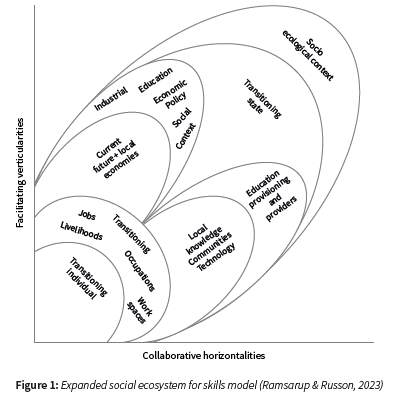
Drawing on the elements represented above, skills are framed as a continuum between the vertical and horizontal domain and are seen as a critical enabler to linking these distinctive elements of the skills ecosystem. This helps to construct a framing that examines skills as the enabling factor between the vertical and the horizontal domains. Constructing the vertical domain involves policies, hierarchical structures, and leadership structures that exist at different levels, and how they may shape activity at the local level (Ramsarup & Russon, 2023). In constructing the horizontal domain, the relationships between actors are examined, including the complex dynamic and multi-layered nature of relationships which may sit within and across various clusters as well as nested relationships associated with the case (Ramsarup & Russon, 2023).
The skills ecosystems mapping process proposed here provides a framework for bringing occupational and educational pathways together with other goals for social development, well-being, resilience and sustainability.
Skills Ecosystem Mapping Tool: Development and trialling
Working with the project team, we designed a conceptual tool to map the skills ecosystem (the draft tool is attached as Annexure 1). The process for mapping a local food skills ecosystem is structured and iterative and we see our tool as aiding in thinking about the elements that need to be considered. It involves several phases, each phase informs the next and involves a process of reflection and discussion. Some phases are document-led, while others rely on gathering insights from key informants within the selected food system.
The tool involved two main sections, firstly, mapping the case study area's local food economy and secondly, mapping the skills ecosystem linked to the local food economy. The mapping of a local food economic system provided a useful contextual understanding which included an exploration of the main types of food produced, manufactured, traded and consumed within the system. In addition, an initial assessment of government, industry and business (formal and informal), education and civil society actors were identified. This helped to provide an indicative assessment of how inclusive (just) the current system is, particularly from the perspective of youth, women and small-scale enterprise inclusivity. The mapping exercise also drew out various characteristics and dynamics associated with the selected system, such as flows of food; political context; and environmental, social and economic variables and trends.
The second part of the mapping exercise built on and further developed the local food economic system by identifying and mapping the associated skills ecosystem. This exercise focused on identifying and understanding the current supply and demand of food-related skills within the system. This helped to set a platform for identifying skills and capability requirements to transition the local food economic system to one which is just and sustainable. This exercise provided a contextual understanding of the current employment and demographic dynamics within the selected region and identified the providers of education and training, including the programmes they currently offer. An assessment of national, provincial, and local (district and municipal) policies that enable or hinder skills provisioning and job creation were also explored.
The local food economic and skills ecosystem mapping activities provided a useful, initial understanding of the current local food system, and therefore set a baseline for developing a vision and pathway for transitioning the system to one which is just and sustainable, and considered the implications this will have on the associated skills ecosystem.
The mapping tools were trialled in three case study areas (discussed below), with this initial phase drawing on desktop sources to inform the mapping exercises. While fieldwork (still to be carried out in the study) will generate more detailed insights, this initial mapping enabled us to think through the dynamics of mapping a skills ecosystem.
The discussion below presents some of the emerging findings from the trialling of the mapping tools within the three cases.
Mini case 1: Eastern Cape
Case description
The Eastern Cape is frequently regarded as the poorest province in South Africa (Ngumbela et al., 2020). It is gripped by a number of challenges such as food insecurity, high levels of poverty, unemployment and inequality compounded with the environmental challenges of climate change. A more recent challenge was the Covid-19 pandemic that highlighted the fragility of the food system at every level of the value chain and how an urgent transformation is required to create a just and resilient system that is able to withstand future shocks. This case study attempted to map, analyse and understand the food system actors, dynamics, consequences, and overall status of the food security of the town of Alice and its 100 km radius located in the Eastern Cape province of South Africa.
Findings from the Eastern Cape case
The Eastern Cape accounts for 10% of South Africa's agricultural production and has 37% of the country's commercial agricultural land (Agribook, 2021; Statistics South Africa, 2020). The region under investigation commercially produces large quantities of pineapples, citrus, tomatoes, and livestock (meat and dairy) as well as several other vegetables on a smaller scale. Some of the produce is processed in East London and much is exported to other regions of the country and internationally. There is a large gap between industrialised agriculture and subsistence agriculture, making it hard for small-scale farmers to compete within the market. In terms of retail, multinational grocery stores and fast-food chains appear to have a monopoly over the food industry. Food choices are limited in smaller rural communities in terms of what is available and the finances to purchase healthy/high quality food.
The agriculture and agri-based industry in the region does not contribute a significant amount to the Gross Value Added by the different municipalities despite the agricultural potential of subsistence farmers and activities of the commercial food sector. For example, the Raymond Mhlaba Local Municipality's economy comprises various industries such as agriculture, mining, manufacturing, electricity, construction, trade, transport, finance, community services and households. However, the community services sector is the largest within the municipality, accounting for 51% of the total Gross Value Added. This is followed by the trade sector accounting for 15% of the local municipality's economy, then the finance sector accounting for 11% (Raymond Mhlaba Local Municipality, 2021/2022).
In the 100km radius under study, four traditional universities were identified: Walter Sisulu University (WSU), University of Fort Hare (UFH), Rhodes University (RU) and Nelson Mandela University (NMU). Only two traditional universities (WSU and UFH) offer food-related courses ranging from national diplomas to post-doctoral studies mainly in agriculture, food science and supply chain management. There are also national training authorities such as the South African Qualification Authority (SAQA) which accredits training courses, as well as the Agricultural Sector Education Training Authority (AgriSETA) based in East London, which provides funding to businesses that offer learnerships. There are two TVET (Technical and Vocational Education and Training) colleges (Lovedale and Fort Cox), and a few community education and training colleges, agricultural high schools as well as other NGOs offering food related courses. Based on the list of education and training providers in the study region, most of the courses offered by training providers focus on conventional farming skills (livestock) and agricultural data management, financial management and horticulture.
The policy actors involved in supporting learning and work represent both regional and local development actors such as the Department of Rural Development and Agrarian Reform (DRDAR), the National Youth Development Agency (NYDA), Department of Agriculture, Forestry and Fisheries (DAFF), Department of Rural Development and Land Reform. There is a notable focus on community development and natural resource skills as opposed to industrial skills policies. Agriculture and rural development in the area is also profoundly shaped by the domination of the food system by super marketisation, such as corporate supply chains, standards, packaging, and logistics systems that effectively exclude small- and medium-sized farmers. This has therefore produced a high-skills ecosystem that exists in direct competition to the smallholder farmers, both for economic and knowledge resources (Wedekind et al., 2021). Facilitating these verticalities between small and medium sized farmers (subsistence agricultural systems) and the agri-industrial systems has therefore created a gap between the two, where institutions find themselves forced to choose between supporting two separate systems.
In addition, agricultural colleges in Alice as evidenced by Sithole (2018), have traditionally been focused on supplying agricultural extension officers. Although the extension officers are supposed to service all farmers, there has been a predominant focus on the needs of larger scale producers. Moreover, the TVET colleges deliver a curriculum that is largely indistinguishable from urban colleges, despite the radically different labour market context. Therefore, smallholder farmers only focus on growing food, with a lack of skills, knowledge and training on how to access the formal retail sector as well as agro-processing.
Mini case 2: KwaZulu-Natal
Case description
KwaZulu-Natal (KZN) province has the second largest population in South Africa estimated at 11.5 million people (Statistics South Africa, 2021a). Approximately 51% of the population resides in rural areas (KZN Department of Human Settlements, 2019), with 82% and 18% of the land being suitable for livestock and crop production respectively (KwaZulu-Natal Top Business Portfolio, 2022). The food system has, however, had a range of challenges over the years from food accessibility and affordability, the COVID-19 pandemic, climate change, civil unrest and the dualistic nature of the agricultural system resulting in food insecurity especially among the poor and rural communities. Despite these challenges, the region has high potential to develop the economy through the agriculture sector. This case study therefore offers an in-depth understanding of a 100km radius of the KZN province, by looking at the local food economy with regard to the region's main foods, actors, and dynamics and the skills ecosystem.
Findings from the KZN case
Manufacturing is KZN's largest economic activity and agriculture is one of the lowest as it only contributed 4% to the economy in 2017 (Statistics South Africa, 2020). KZN is the sugar capital of South Africa, producing 81% of the sugarcane in the nation and providing a livelihood for over 1 million South Africans (Statistics South Africa, 2020). The region produces other agricultural products such as cabbage, maize, livestock, citrus fruits and freshwater/marine fish. Urban areas have the most economic activities pertaining to agriculture, for example KwaDukuza municipality in the Ilembe district is largely urban and manufactures approximately 67% of food products in the district (Ilembe District Municipality, 2013). The rural/local communities, although having an advantage in population size, are faced with barriers such as poor roads and long distances to markets, the monopoly of markets and value chain processes as well as inadequate agricultural skills (Ilembe District Municipality, 2013; Mashaya, 2021; Nxumalo & Oladele, 2013).
The region has a rich endowment of historically significant higher education and training institutions such as the University of Zululand, Umfolozi TVET, Mtshashana TVET College and Owen Sithole Agricultural College. These institutions provide highly structured and technical courses on topics such as animal and plant production, agro-processing and farm management. They also offer courses focusing on supply chain management, hospitality and food management. Other tertiary institutions include private universities and colleges in the region. In addition, the state actors such as the KZN Department of Agriculture, Fisheries and Forestry are mainly concerned with agricultural production, agro processing, skills development and natural resource management in the region.
KZN has a range of socio-economic and skilled focused interventions such as supporting the small business sector, commercialisation of agriculture, skills development, and capacity building programmes in various sectors of the economy that are initiated by a range of state actors in National, Provincial and Local Government. Specifically, the KwaZulu-Natal Agriculture and Rural Development Strategy 2015-2020, the strategic priorities for the Provincial Growth and Development Strategy and Provincial Growth and Development Plan informs the way forward for the province. In line with such strategy, Trade and Investment KwaZulu-Natal's mandate is to promote the province as a premier investment destination, which entails facilitating farming and agro-processing initiatives capable of attracting investment to KwaZulu-Natal through both foreign direct investment and local investment across the agricultural value chain (KZN EDTEA, 2011).
In addition to the national and provincial strategies, various municipalities such as Nquthu, Msinga, Umshwathi, Ulundi and Nongoma have developed their Local Economic Development (LED) strategies suitable for their context (KZN EDTEA [Department of Economic Development, Tourism and Environmental Affairs], 2021). These strategies have identified the agriculture sector as one of the key sectors with potential to create jobs and reduce poverty in the communities (Umshwathi Local Municipality, 2020). However, these strategies fail to highlight job specific (low level, intermediate) skills for the food sector (CoGTA [South African Department of Cooperative Governance and Traditional Affairs], 2020). The different legislative policy frameworks have resulted in significant inequalities across the region and within the district municipalities, with urban areas having highly developed food industries as compared to rural areas and therefore, skills supply and demand mainly being concentrated in the urban municipalities.
While the universities, colleges, TVET institutions and NGOs are working to provide the necessary skills for the food industry in the KZN region, there is little evidence that suggests that there are enough opportunities and courses for specialisation in the green economy such as climate smart agriculture, sustainable food production, aquaculture, agro processing, the marine industry and expanded research and innovation.
Mini case 3: Gauteng
Case description
Gauteng is the smallest province in South Africa but nonetheless it harbours 24% of the national population and is highly urbanised (Municipalities of South Africa, 2021). Gauteng has the lowest number of farms (7%) and occupies only 3% of the country's total agricultural land (Statistics South Africa, 2020). The 2019 agricultural survey showed that commercial agriculture contributed R351.4 billion to the country's economy (Statistics South Africa, 2021b). As an economic hub, Gauteng hosts multiple industries (Mmbengwa et al., 2020) with most agro-processing activities in South Africa being carried out in the province (Gauteng Department of Agriculture and Rural Development, 2015). The informal retail market plays a key role in economic development and in Gauteng it contributes 10% to the GDP (Kenosi, 2020). It also serves as a safety net for people who have lost jobs in the formal sector as well as those lacking the necessary skills for formal jobs (Van Scheers & Mahego, 2016). According to Statistics South Africa (2019), the informal sector accounts for 5 million jobs in South Africa with Gauteng contributing the highest proportion (26%).
The fresh produce sector in Gauteng consists of several commercial farms and small-scale farmers producing mainly vegetables like potatoes, tomatoes, and onions which are marketed through formal and informal channels (Louw & Jordaan, 2016). Fresh produce markets offer the largest formal channel whereas the 'shebeens' and 'spaza' shops and street traders/hawkers offer the main informal channels for fresh produce. Johannesburg market is the largest fresh produce market in Africa and represents 44% market share of the National Fresh Produce market in South Africa (Johannesburg Market, 2019).
Findings from the Gauteng case
Drawing on the case studies, it is possible to comment on the skills dynamics associated with the selected local food systems. In terms of educational and training providers, some topic gaps in were identified such as ichthyology and agro-processing. From all the educational and training providers investigated, only one TVET college specialises in agricultural programmes. Most providers offer different programmes with no special focus in agricultural food-related courses. The Ekurhuleni College is the only TVET institution that offers various entry and intermediate agricultural food-related courses. There is a lack of a linear sequential career development amongst cooking courses offered within the region. Most courses are offered in the form of certificates only, with no further career developments to follow. The region does not have many commercial farmers operating in large farms. These commercial farmers are found in the West Rand and City of Tshwane regions. In the West Rand, most commercial farms are found in Hekpoort, Tarlton, Brandvlei and Randgate. In the City of Tshwane, most commercial farms are found in Cullinan, Bronkhorspruit, and a linear relationship gap was realised between the lack of study of fish and practice of growing fish by farmers within the region. The region has several agro-processing companies, but there was no clear picture of where people working within those units get the training for the skills required.
The National Development Plan has several policies facilitating the food system in the Gauteng region. However, most policies are biased towards urban small-scale agriculture. They neglect the integral role that urban agriculture can play in enhancing food security and skills at both the household and provincial level. Studies (Algert et al., 2014 and Vivier, 2018) have shown that urban agriculture and community gardening have the ability to be the mechanism in enhancing access to food for people to meet their dietary needs. However, the policy plan fails to consider urban small-scale agriculture as a possible source for enhancing local food security and ultimately creating jobs.
The policy strategy does not have any plans of creating jobs or skills for people within the region. Some policy movements, like 'Buya mthetho ('Bring back the law'), aimed at restoring law compromise the food-related skills and jobs embedded in the informal agro-processing, restaurants and distribution of food sector. The benefits of Covid-19 social relief funds aimed at compensating the food retail outlets do not reach the dishes of all spaza owners within the region. Formal food retail outlets are in the majority for receiving benefits from this policy strategy.
On the horizontal axis, there is a trend of urban farming food-related skills starting to be adopted within the Gauteng region. The food skills include the growing of crops on rooftops, old car tyres, landscaping, greenhouses, hydroponics, containers, sidewalks, etc. However, the adoption of this set of skills is still stagnant within townships, where people have small plots of land to practise farming. The provincial food policies still fail to recognise the integral role played by urban small-scale farming in bringing new sets of food-related skills that can be used to enhance local food availability and jobs. Primary agricultural production skills are lacking within the region, with food-processing and agricultural technician skills being dominant. Food-distribution skills are also abundant, dominated by both large and informal food traders. The Gauteng region is dominated by processing and manufacturing industries with agro-processing, agricultural plant operations and technician skills as some of the dominating skills in the region. Further still on the horizontal axis are non-state actors composed of organisations, individuals and groups of communities that are pushing for the much-needed paradigm shift in the food system in Gauteng through initiatives focusing and promoting sustainable approaches like agro-ecology, climate smart agriculture and conservation agriculture. These initiatives contribute to just food systems although they face resistance from large cooperative companies and lack much-needed support from the government. As Anderson et al. (2019) stated, ''agro-ecology represents a framework that focuses on the synergetic relationships between people and nature, agency, knowledge and the rights of food producers and other food systems actors'' (p. 3). It is thus imperative to support and invest in these initiatives as they play a key role in ensuring inclusion of all actors in the food system in Gauteng. An example is the Siyakhana food programme that is using a trans-disciplinary and social development approach to help small-scale farmers and urban farmers to access land, infrastructural resources and access markets while promoting sustainable farming.
Discussion of emerging insights on skills ecosystems
The cases highlight the roles played by a range of actors and institutions in the skills ecosystem and how these should ideally interact to facilitate place-based, socially-just work opportunities that enhance living through working and learning. They clearly illustrate that a human capital approach that focuses on 'train the trainer' and short skill course cultures that reflect generic training 'delivered' in communities cannot enable viable skills for a just transition approach. The institutions of higher training and learning focus on courses that service the large-scale commercial industry players/actors and overlook the smallholder farmers, fishermen, small retailers and informal traders. This inadvertently means that rural communities are not receiving the necessary knowledge and skills required to ensure local economic development. Kirui and Kozicka (2018) similarly noted that there are very limited Agricultural Technical Vocational Education and Training (ATVET) programmes that could enhance labour market opportunities for the rural communities in Africa.
The policies and strategies found in the Local Economic Development (LED) and Integrated Development Plans (IDPs) across the three cases recognise the food sector as critical to job and skills development, although high levels of unemployment, especially amongst the youth, still persist. This could be as a result of a lack of skills to implement the LED and IDP strategies by municipalities, as indicated by Kamara et al. (2017), or as a result of a lack of adequate collaboration amongst sector actors which speaks to the complexity of the relationships that exist within a skills ecosystem. The NGO sector is, however, playing a critical role in bridging the skills divide amongst the formal and informal local actors in their quest to reduce food insecurity, although there is a need for all system stakeholders to collaborate and work together to ensure that sustainable localisation of the food system can be achieved.
By way of example, local colleges can enhance their offerings to support farmers who will require a skilled labour force to adopt optimal and sustainable farming practices to reduce yield loss through improved harvesting practices. Further, food processing outlets will require skilled workers who understand how to reduce food waste during the preparation stage or where and how to divert non-edible food waste from landfill. Entrepreneurial and job creation opportunities will exist in the beneficiation of food waste e.g. in biodegradable packaging, or for identifying opportunities to trade and distribute surplus food from farms, manufacturers, and retailers. These opportunities will require individuals with technical, innovation, business, negotiation, and sales skills, amongst others. The strength of these collective skills can enable a significant transition towards achieving South Africa's food waste goals, with broader expanded benefits also being realised, for example, more people in need having access to nutritious edible food that would have gone to waste. For these skills to be efficiently provided, there will be a need for partnership amongst stakeholders such as local municipalities, business owners, training institutions, NGOs, community members and respective current employers and employees.
The mapping tool used (Annexure A) enabled the analysis of verticalities and horizontalities, as well as the possible points of mediation as indicated above. The tool additionally aided with the identification of existing gaps especially amongst small-scale actors along the food value chain. It further pointed out key priority action areas, key skills (new skills, reskilling and upskilling) needed for a Just Transition of local food systems. The study therefore recognises that the empowerment and support of small-scale farmers is a priority which may include, amongst other aspects, the use of technology, and the diversification of crops to ensure sustainable crop productivity. Furthermore, there is a need to provide improved access to markets where not only smallholder farmers benefit, but also food processors and formal and informal retailers. This could be done through the opening of fresh produce market facilities in the different regions.
Several entry-level and intermediate-level jobs will therefore be central in making this dream a reality. These include farm managers which may include dairy managers and livestock managers, agronomists, irrigation engineers, food scientists/technologists, food processors and food distribution managers, veterinarians, agricultural scientists, and agricultural engineers, bioprocessing engineers, as well as agricultural extension technicians and agricultural research technicians.
The findings helped to illustrate that the envisaged transition is ambitious and will require a comprehensive policy mix. For example, the national policy on Food and Nutrition Security does not consider small-scale urban agriculture and green infrastructure as having the potential to increase food availability and access, especially in a highly urbanised region such as Gauteng. Such a policy could possibly hinder the growth of small-scale urban agriculture. Simultaneously, this will necessitate transversal engagement across the education and training system, as sustainability practices are located across schooling, higher education, adult learning and occupationally directed training. This will further burden the currently overextended and inefficient skills development system.
Despite expanding mandates, skills planning and provisioning for environmental skills development that support a transition of food systems in South Africa have been inadequate, ad hoc, fragmented, reactive and inefficient (Ramsarup, 2017). It is evident that the vertical enablers, such as the policy, institutional infrastructures exist, with good stakeholder engagement and commitment. However, emerging tensions between these and the horizontal dimension of local implementation will require some form of mitigation and prioritisation to ensure scaled collective and effective transformation toward system resiliency and achievement of the voluntary agreements targets. This includes strengthened job permanency and sustained livelihoods throughout the system (whether formal or informal). To mediate and enable the transformation envisaged, the added value system will require more than individual skills or competencies.
Conclusion
This article has illustrated how mapping the skills ecosystem has enabled the study to elicit the dynamics of the skills institutions and actors. It hence provides a much more grounded and contextualised basis for skills planning and shifts focus away from narrow supply side training mentalities. The article has argued that the enabling verticalities, such as government intervention, are critical for ensuring that socio-economic benefits are realised through skills development. However, as indicated by the cases, the interface between the horizontalities and verticalities remains weak across many skills development initiatives, mainly due to poor management and collaboration. This is further compounded by the precarious nature of many of the potentially significant vocational job opportunities. As such, the rural local livelihood benefits that could be sustained by large-scale initiatives may not be realised. In addition, and as is often the case with skills initiatives, much of the discourse and emphasis is on human capital - the number of jobs - with little detailed insight into the actual types of vocational occupations, and skills and knowledge provisioning that is required to support more sustainable living, working and learning.
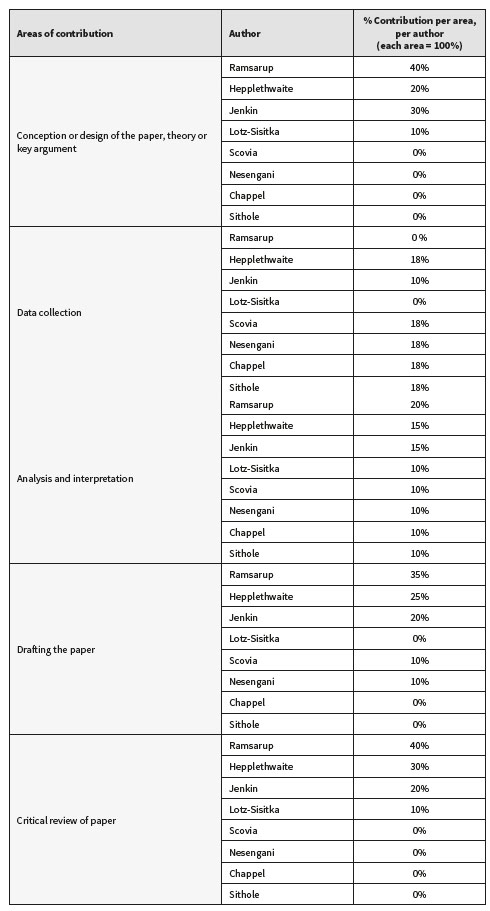
Notes on Contributors and their Contributions
Lead author
Ramsarup, Presha
Presha Ramsarup (Doctor of Philosophy in Education) is the Director of the Centre for Researching Education and Labour, at the University of the Witwatersrand in Johannesburg. Her interests include green skills development, skills ecosystems approaches, sustainability transitions, occupational change and learning pathways for sustainable development.
Co-author
Hepplethwaite, Victoria
Victoria Hepplethwaite has a MSc (Environmental and Natural Resources Management) and is currently a PhD candidate and researcher at the Centre for Researching Education and Labour (University of the Witwatersrand). She is interested in sustainability transitions, skills ecosystems, occupational change and skill formation systems.
Co-author
Jenkin, Nicola
Nicola Jenkin is a Doctor of Philosophy in Education and a research associate at the Centre for Researching Education and Labour (University of the Witwatersrand) who specialises in food systems, supply chains and knowledge networks.
Co-author
Lotz-Sisitka, Heila
Heila Lotz-Sisitka is a Doctor of Philosophy in Education and director of the Environmental Learning Research Centre (Rhodes University). She is particularly interested in education system development and transformative social learning for green, socially just and sustainable economies and societies at local, regional, and international levels.
Co-author
Scovia, Adrupio
Adrupio Scovia (M.Ed) is a PhD candidate at Cardiff University (United Kingdom) who is interested in education and development, agriculture, in particular gender in agriculture.
Co-author
Nesengani, Clinton Elelwani
Clinton Elelwani Nesengani is a master of education and researcher at the Centre for Researching Education and Labour (University of the Witwatersrand) who is interested in food systems, sustainability, skills formation, work-based learning and occupational change.
Co-author
Chappel, Angela
Angela Chappel is a Master of Science (Environmental and Geographical Sciences) and PhD candidate at the Environmental Learning Research Centre, Rhodes University. She is interested in food security, food systems and skills for sustainable development.
Co-author
Sithole, Phindile
Phindile Sithole is a Master of Education in Environmental Education and PhD candidate, with research interests in agriculture, food systems, education and skills development.
Percentage contribution
References
Agribook Digital. (2021). Agriculture in the provinces. https://agribook.co.za/introduction/agriculture-in-the-provinces/ [ Links ]
Algert, S. J., Baameur, A., & Renvall, M. J. (2014). Vegetable output and cost savings of community gardens in San Jose, California. Journal of the Academy of Nutrition and Dietetics, 7, 1072-1076. https://www.researchgate.net/publication/261769467_Vegetable_Output_and_Cost_Savings_of_Community_Gardens_in_San_Jose_California [ Links ]
Anderson, C. R., Bruil, J., Chappell, M. J., Kiss, C., & Pimbert, M. P. (2019). From transition to domains of transformation: Getting to sustainable and just food systems through agroecology. Sustainability, 11(19), 5272. [ Links ]
Brown, T. (2022). Skill ecosystems in the global South: Informality, inequality, and community setting. Geoforum, 132, 10-19. https://doi.org/10.1016/j.geoforum.2022.03.019 [ Links ]
CoGTA [Department of Cooperative Governance and Traditional Affairs]. (2020.). Profile and analysis: District development model: Zululand District Municipality, KZN. https://www.cogta.gov.za/cgta_2016/wp-content/uploads/2023/11/DistrictPronle_ZULULAND08072020-1.pdf [ Links ]
FAO [Food & Agriculture Organisation]. (1996). Food, agriculture, and food security: Developments since the world food conference and prospects. World Food Summit Technical Background Documents 1-5. Technical Background Document No. 1. https://www.fao.org/4/w2612e/w2612e01.htm [ Links ]
Finegold, D. (1999). Creating self-sustaining, high-skill ecosystems. Oxford Review of Economic Policy, 15(1), 60-81. https://doi.org/10.1093/oxrep/15.1.60 [ Links ]
Gauteng Department of Agriculture and Rural Development. (2015). Gauteng agroprocessing strategy. Final draft (October 2015). https://www.gauteng.gov.za/agriculture/Publications/Department%20of%20Agriculture%20and%20Rural%20Development%20Agro-processing%20Strategy.pdf [ Links ]
Grainger, P. & Spours, K. (2018). A social ecosystem model: A new paradigm for skills development. T20. Future of Work and Education for the Digital Age. https://www.global-solutions-initiative.org/wp-content/uploads/2025/03/T20-Social-Ecosystem-Model-revised-KS-2.pdf [ Links ]
Green, A., Hogarth, T., Thom, G., MacLeod, K., Warhurst, C., Willis, R., & Mackay, S. (2017). Local Skills Case Study. Research Report. UK Department for Education. https://nles.eric.ed.gov/fulltext/ED574132.pdf [ Links ]
Greenberg, S. (2010). Contesting the food system in South Africa: Issues and opportunities. http://hdl.handle.net/10566/572 [ Links ]
Hall, R. & Lansbury, R. D. (2006). Skills in Australia: Towards workforce development and sustainable skill ecosystems. Journal of Industrial Relations, 48(5), 575-592. [ Links ]
Hodgson, A. & Spours, K. (2017). Education, skills and employment in East London: An ecosystem analysis. ELVET Programme Research Briefing 1. https://discovery.ucl.ac.uk/id/eprint/10121455/1/Hodgson_Education%20skills%20and%20employment%20in%20East%20London%20-%20an%20ecosystem%20analysis.pdf [ Links ]
Ilembe District Municipality. (2013). Ilembe Regional Spatial Plan - Consolidated Report. IYER Urban Design Studio. https://ilembe.gov.za/wp-content/uploads/2020/05/ISRDPConsolidated-Report-FINA [ Links ]
IPCC [Intergovernmental Panel on Climate Change]. (2018). Global warming of 1.5°C. An IPCC Special Report on the impacts of global warming of 1.5°C above pre-industrial levels and related global greenhouse gas emission pathways, in the context of strengthening the global response to the threat of climate change, sustainable development, and efforts to eradicate poverty. Masson-Delmotte, V., P. Zhai, H.-O. Pörtner, D. Roberts, J. Skea, P.R. Shukla, A. Pirani, W. Moufouma-Okia, C. Péan, R. Pidcock, S. Connors, J.B.R. Matthews, Y. Chen, X. Zhou, M.I. Gomis, E. Lonnoy, T. Maycock, M. Tignor, & T. Waterfield (eds.). Cambridge University Press. https://doi.org/10.1017/9781009157940 [ Links ]
Johannesburg Market (2019). Integrated report. http://www.joburgmarket.co.za/files/%60jm%20integrated%20report%202019%20final.pdf [ Links ]
Kamara, R. D., Leonard, S., & Haines, R. (2017). Enhancing the capabilities of municipalities for local economic development through skills training. SocioEconomic Challenges, 1(4),35-44. https://doi.org/10.21272sec.1(4).35-44.2017 [ Links ]
Kenosi, W. (2020). Competitive strategies for small businesses survival: A Gauteng township retail industry study. [Unpublished doctoral thesis]. University of Pretoria. [ Links ]
Kirui, O. & Kozicka, M. (2018). Vocational Education and Training for farmers and other actors in the agri-food value chain in Africa. ZEF Working Paper No. 164. http://dx.doi.org/10.2139/ssrn.3206514 [ Links ]
KwaZulu-Natal Top Business Portfolio. (2022). Agriculture. https://kzntopbusiness.co.za/site/agriculture [ Links ]
KZN EDTEA [KwaZulu-Natal Department of Economic Development, Tourism and Environmental Affairs]. (2011). Export strategy for the province of KwaZulu Natal. https://www.kznedtea.gov.za/ [ Links ]
KZN EDTEA [KwaZulu-Natal Department of Economic Development, Tourism and Environmental Affairs] (2021). KwaZulu-Natal integrated maritime strategy revision. https://www.kznedtea.gov.za/documents/KZN%20Maritime%20Economic%20Overview%20-%202021%20revision.pdf [ Links ]
KZN Department of Human Settlements. (2019). 2019/20 Annual Performance Plan. https://www.kzndhs.gov.za/Uploads/APP20-compressed.pdf [ Links ]
Lotz-Sisitka, H. (2020). Probing the potential of social ecosystemic skills approaches for green skills planning: Perspectives from Expanded Public Works Programme studies. In E. Rosenberg, P. Ramsarup, & H. Lotz-Sisitka (Eds.), Green skills research in South Africa: Models, cases and methods (pp. 113-127). Routledge. [ Links ]
Lotz-Sisitka, H. & Ramsarup, P. (2020). Green skills research: Implications for systems, policy, work and learning. In E. Rosenberg , P. Ramsarup & H. Lotz- Sisitka (Eds.), Green skills research in South Africa: Models, cases and methods (pp. 208-223). Routledge. [ Links ]
Louw. A. & Jordaan, D. (2016). Supply chain risks and smallholder fresh produce farmers in the Gauteng province of South Africa. Southern African Business Review, 20(1), 286-312. https://www.ajol.info/index.php/sabr/article/view/136580/126088 [ Links ]
Mashaya, R. T. (2021). Factors influencing the degree of smallholder farmer's market participation: The case study of uMkhanyakude and Zululand districts, KwaZulu Natal province of South Africa [Unpublished master's thesis]. Stellenbosch University. https://scholar.sun.ac.za/server/api/core/bitstreams/2fb83fef-76ab-49a8-b3d8-5fb6823101c3/content [ Links ]
Mmbengwa, V. M., Rambau, K., & Qin, X. (2020). Key factors for the improvement of smallholder farmers' participation in agro-processing industries of Gauteng province of Republic of South Africa: Lessons for the extension advisory services. South African Journal of Agricultural Extension, 48(2), 153-165. http://www.scielo.org.za/scielo.php?script=sci_arttext & pid=S0301-603X2020000200013 [ Links ]
Montmasson-Clair, G. (2021a). Policy primers for a South African just transition framework (Working paper). Pretoria: Trade & Industrial Policy Strategies (TIPS) for the Presidential Climate Commission (PCC). https://www.tips.org.za/images/Working_Paper_PCC_Policy_primers_for_a_Just_Transition_framework_2021.pdf [ Links ]
Montmasson-Clair, G. (2021b). A policy toolbox for just transitions. Pretoria: Trade & Industrial Policy Strategies (TIPS) for the Presidential Climate Commission (PCC). [ Links ]
Municipalities of South Africa. (2021). Gauteng municipalities. https://municipalities.co.za/provinces/view/3/gauteng [ Links ]
Ngumbela, X. G., Khalema, E. N., & Nzimakwe, T. I. (2020). Local worlds: Vulnerability and food insecurity in the Eastern Cape province of South Africa. Jàmbá: Journal of Disaster Risk Studies, 12(1), 1-10. https://doi.org/10.4102/jamba.v12i1.830 [ Links ]
Ntloedibe, M. & Geller, L. (2017). South Africa retail food industry. Global Agricultural Information Network (GAIN) Report. United States Department of Agriculture (USDA) Foreign Agricultural Service. https://apps.fas.usda.gov/newgainapi/api/report/downloadreportbyñlename?ñlename=Retail%20Foods_Pretoria_South%20Africa%20-%20Republic%20of_11-7-2017.pdf [ Links ]
Nxumalo, K. K. S. & Oladele, O. I. (2013). Factors affecting farmers' participation in agricultural programme in Zululand district, KwaZulu Natal Province, South Africa. Journal of Social Sciences, 34(1), 83-88. https://doi.org/10.1080/09718923.2013.11893120 [ Links ]
Pereira, L. M. (2014). The future of South Africa's food system: What is research telling us? SA Food Lab South Africa. https://www.southernafricafoodlab.org/wp-content/uploads/2025/05/The-Future-of-South-Africas-Food-System_-What-is-research-telling-us.pdf [ Links ]
Ramsarup, P. (2017). A critical realist dialectical understanding of learning pathways associated with two scarce skill environmental occupations within a transitioning systems frame. [Unpublished doctoral thesis]. Rhodes University. [ Links ]
Ramsarup, P. & Russon, J. A. (2023). Towards an expanded notion of skills ecosystems. In S. McGrath, G. O. Ladaah & H. Lotz-Sisitka (Eds.), Transitioning Vocational Education and Training in Africa (pp. 55-74). Bristol University Press. [ Links ]
Raymond Mhlaba Local Municipality. (2021/2022). Integrated development plan. https://www.raymondmhlaba.gov.za/system/content/documents/reports/2021/idp_sdbip%20/Final%20Intergrated%20Development%20Plan%202021%20-%202022.pdf [ Links ]
Sithole, P. N. (2018). Investigating the role of extension officers in supporting social learning of rainwater harvesting practices amongst rural smallholder farmers in Nkonkobe Local Municipality, Eastern Cape. [Unpublished doctoral thesis]. Rhodes University. [ Links ]
Spours, K. (2019). A social ecosystem model: Conceptual developments and implications for VET. https://discovery.ucl.ac.uk/id/eprint/10082170/3/Spours_Social%20ecosystems%20Final.pdf [ Links ]
Statistics South Africa. (2019). Quarterly labour force survey 2019 (Q4). https://www.statssa.gov.za/publications/P0211/P02114thQuarter2019.pdf [ Links ]
Statistics South Africa. (2020). Census of commercial agriculture 2017. http://www.statssa.gov.za/publications/Report-11-02-01/CoCA%202017%20Fact%20Sheets.pdf [ Links ]
Statistics South Africa. (2021a). Mid-year population estimates 2021. http://www.statssa.gov.za/publications/P0302/P03022021.pdf [ Links ]
Statistics South Africa. (2021b). Agricultural survey 2019. http://www.statssa.gov.za/publications/P1101/P11012019.pdf [ Links ]
Swilling, M., Musango, J., & Wakeford, J. (2016). Developmental states and sustainability transitions: prospects of a just transition in South Africa. Journal of Environmental Policy & Planning, 18(5), 650-672. [ Links ]
Umshwathi Local Municipality. (2020). Umshwathi Municipal Integrated Development Plan 2020/2021 Review. https://umshwathi.gov.za/home/index.html. [ Links ]
Van Scheers, L. & Mashego, M. (2016). Determine small farmers' managerial skill needs in the Tshwane area of Gauteng, South Africa. Investment Management and Financial Innovations, 13(2), 87-91. https://doi.org/10.21511/imfi.13(2).2016.09 [ Links ]
Vivier, T. L. (2018). Joburg is one step closer to having the world's largest urban farm. GoodThingsGuy. https://www.goodthingsguy.com/environment/joburgurban-farm [ Links ]
Wedekind, V., Russon, J. A., Ramsarup, P., Monk, D., Metelerkamp, L., & McGrath, S. (2021). Conceptualising regional skills ecosystems: Reflections on four African cases. International Journal of Training and Development, 25(4), 347-362. https://doi.org/10.1111/ijtd.12251 [ Links ]
World Economic Forum. (2020). The global risks report 2020 (15th ed.) https://www3.weforum.org/docs/WEF_Global_Risk_Report_2020.pdf [ Links ]
Zourides, H. (2017). The sleeping giant - informal trade in South Africa. https://www.supermarket.co.za/news-article.asp?ID=6851 & CatTags=16-Economic%20factors [ Links ]
Kesselman, B. (2019). South Africa still has a long way to go on the right to food. The Conversation, 25 October. https://theconversation.com/south-africa-still-has-a-long-way-to-go-on-the-right-to-food-125423 [ Links ]
Montmasson-Clair, G. (2021). Policy primers for a South African just transition framework [Working Paper for the Presidential Climate Commission]. Trade & Industrial Policy Strategies (TIPS). https://www.tips.org.za/images/Working_Paper_PCC_Policy_primers_for_a_Just_Transition_framework_2021.pdf [ Links ]
Moyo, B., Pereira, L., & Scholtz, L. (2020). Urban lockdown lesson for South Africa: Insights and opportunities for equitable food systems. WWF South Africa. https://wwfafrica.awsassets.panda.org/downloads/insights_and_opportunities_for_equitable_food_systems_1.pdf [ Links ]
ANNEXURE A: A mapping tool for a sustainable and just local food skills ecosystem
A. Mapping local food economies
1. Introduction
South Africa's food system is considered vast, complex, unjust, unequal, fragmented and environmentally unsustainable (Kesselman, 2019; Moyo et al., 2020). To shift South Africa's food system to one that is just, a good starting point is to better understand current local food systems and their associated economic, political, environmental, and social actors, elements, and dynamics. The purpose of mapping a local food system is to analyse, understand and develop all activities related to the production and distribution of food, their connections and cause and effect relationships.
2. Provide an overview of the locally defined area
This stage involves describing the main characteristics of the research area under study looking at a number of aspects such as the geographical location of the area and the main cities and towns under the area. Other critical questions to explore should include: What are the main socio-economic characteristics (e.g., population size and/or density, level of poverty, livelihoods ['formal' or 'informal'], main economic activities)? And are these affected by unique agro-ecological conditions or impacts (e.g., topography, climate, water security)?
3. Identify the main foods grown, processed, manufactured, traded and consumed in the local food economic system
Having described the area under study, the next step involves using various data sources to map and identify the main sources of food that are produced, processed, manufactured, traded and consumed in the local food economic ecosystem. This will help to identify which are the most significant economically and socially to the local food system. Other insights to capture here are: How does the food-type identified contribute economically to the local region, province, or South Africa (e.g., GDP contribution, volumes produced [tonnes] per annum)? How many people does it employ or support? If gender, race, or age profile information is provided, include this. When using statistical data during the mapping process, it is important to use more recent data sources of not more than five years old to make the mapping more relevant and reflective of the current trends in the local food economy.
4. Local food economic system actor mapping
Having defined the boundary of your local food economic system, the main food-types consumed, and their significance, you will have developed a platform from which to investigate the actors (stakeholders) and dynamics of the food system further. Actors are identified based on the value chain starting with the core actors in the economy to more peripheral actors supporting the food economic system. This stage also involves looking at the dynamics of how the different actors relate to each other. For each actor identified, be specific as possible in providing information like the name, location, who they supply, what they demand and the service or product they handle. There is also a need to focus on negative externalities and intrinsic complexity; thus, giving attention to endogenous limits (infrastructural constraints such as resources for its execution and analysis, supply of agricultural products, etc.) and exogenous limits (regional and national political dimensions, national macroeconomic contexts, etc.)
B. Mapping skills ecosystems in a local food system
Following the initial mapping of a local food economy, the next phase is to map and better understand the associated local skills ecosystem that supports the local economy. The purpose of undertaking a local food skills ecosystem mapping exercise is to anticipate, identify and understand the supply and demand for the necessary skills to enable the just and regenerative transition of the food system. It should be noted that this is not a straightforward task, as a complex food system requires a complex range of skills, knowledge, occupations, and capabilities. Therefore, this tool will help you investigate how local food economic transitions occur in 'niches' at local levels, where nexus concerns (social, economic and environmental) arise around the impetus for 'green' work and livelihoods. While information relevant to the mapping of the local food skills ecosystem will have been gathered during the mapping of the local food economic system, this exercise will involve a deep dive into the following:
1. Employment and labour market
The first step in mapping the skills ecosystem associated with a selected local food economic system, is to understand the labour and employment context (summary from section 1 above). This will provide insights into the dynamics, characteristics and level of employment associated with an area. It will therefore set a platform for understanding the opportunities and challenges for jobs and skills creation and capacity requirements to transition the local food system to one which is just and regenerative.
To develop an overarching labour profile for an area, gather the following information using the guiding questions below:
■ What is your local food economy's population size? (By race, age [youth], gender?)
■ What are the main economic activities people are employed in, in the system?
■ Where do food-related activities fit into this?
■ What is the level of (un)employment in the food sector (agriculture, manufacturing, trade, consumption [restaurants etc]?
■ Recognise employment in both the 'formal' and 'informal' sectors
■ Are there any issues of access to work in food-related activities in the system? E.g., skills shortages, reason for lack of access e.g., level of education, patriarchy
■ What have been the key employment trends (past 5 years, next 5-10 years) that are impacting the local food economic system?
2. National, provincial, and regional/local policy
After the identification and assessment of the education and training providers, and courses and research offered, the next step is to assess the food-related policy and level of skills acknowledgement within it. As indicated previously, a local food system is complex involving many actors (as identified in your initial local food economic system map) and contains many layers and dynamics. Questions that can guide identification of policies at different levels are:
■ What are the main food related (agriculture, manufacturing, retail and consumption [e.g., nutrition]) policies and strategies applicable to your region? The policy mix is important consider - industrial, environmental, social, economic policies as a start.
■ Do these policies and strategies acknowledge skills and work in your local food system? e.g.,
- No. of jobs to be created? (human capital)
- The types of skills and education needed?
- Who is identified as the provider(s) of education and training?
- Other elements e.g., funding of skills, targets?
3. Education and training providers
Following an overarching review of the employment and demographic context within a selected region, the next step is to identify the post-school education and training providers. Based on the findings of this exercise, comment on the split of public and private providers, relationships between providers to deliver food-related courses, programmes or research, and the predominant courses offered. It is also relevant to identify the level of student participation in the identified courses per identified provider.
4. Horizontalities and verticalities
The final phase of the local food skills ecosystem mapping exercise is to draw on the findings gathered from both the local food economic and skills ecosystem mapping activities to provide an initial narrative on the overarching local food skills ecosystem. This includes commenting on the 'facilitating verticalities' and 'collaborative horizontalities' of the system, and the enabling implications and relationship between the two. Verticalities tend to refer to the contextual political elements of the system, and horizontalities to the local, practical situation within a locality. The figure below helps to highlight some of the key elements that should be considered when mapping the ecosystem.
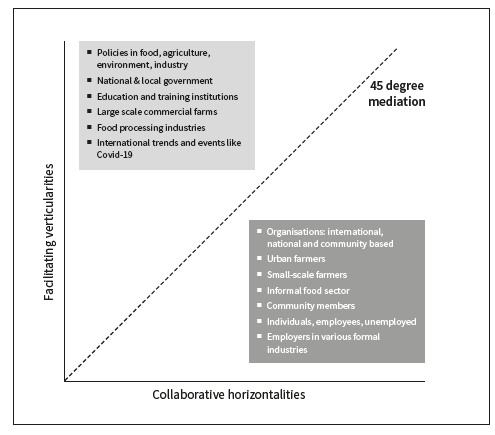
To do this, the following can be used as a guide for this investigation: Facilitating verticalities
■ What are some of the key interventions that actors within the local food system have had to implement to curtail economic, social, and environmental impacts?
■ What are some of the main economic, social, and environmental drivers enabling a transition to a just and regenerative local food system?
■ Briefly list in a table some of the critical national, provincial, and local (district and municipal) policy enablers?
■ What are some of the recognised challenges regarding enabling and implementing these e.g., lack of funding, food system complexity? Briefly expand on these challenges, providing examples where feasible.
■ What types or levels of skill does the relevant provincial and local (district and municipal) policy and strategy focus on e.g., technical, high level, small-holder farmers etc?
■ What are the main activities of focus for relevant provincial and local policy and strategy in relation to the local food system? Comment on how this currently and is likely to impact on skills and knowledge for transitioning the food system to one which is just and regenerative; and what type of shift will be required?
Horizontalities (collaboration)
■ What are the dominant modes of interaction and collaboration between actors within a selected local food system?
■ What are the implications of these dominant nodes of implication e.g., lack of inclusivity, power dynamics, access to food, duplication of efforts etc.? Where feasible, briefly provide examples to illustrate this.
■ What were or are the drivers for collaboration, including the skills and knowledge benefits e.g., sharing of food technology knowledge?
■ What are or have been the consequences of these collaborations? Some of these may have been unintended.
5. Just transitioning of local skills ecosystems
Following the initial mapping of a local food system and its associated skills ecosystem, the next phase is to begin to develop a just transition vision and pathway for your selected local food economic system. The just and regenerative pathway is a vision and plan for how the current local food economic system can become one which is economically equitable and dynamic, socially inclusive, and environmentally sustainable. These are all characteristics of a regenerative economy, with the latter paradigm placing particular emphasis on the uniqueness of place. Achieving a local just and regenerative food economy will require a significant shift from the current system (as mapped in your local food economic system exercise). Montmasson-Clair (2021, p. 5) notes that while the end just economic vision is critical, the "dichotomy between the existing present and the aspired future means that the journey matters as much as the destination". This in essence refers to the proposed pathway to achieve this vision - focus of this framework (research tool).
