



Services on Demand
Journal

Article
 English (pdf)
 Article in xml format
 Article references
 Automatic translation
 Send this article by e-mail
Indicators
Related links
-
 Cited by Google
 -
 Similars in Google
Share

 Permalink
Clean Air Journal
On-line version ISSN 2410-972XPrint version ISSN 1017-1703
Clean Air J. vol.36 n.1 Pretoria 2026
https://doi.org/10.17159/caj/2026/36/1.24710
RESEARCH ARTICLE
Air Pollution and Health Studies in the Highveld Priority Area, South Africa: A Scoping Review
Chantelle Howlett-DowningI, II; Caradee Y WrightI, III
IEnvironment and Health Research Unit, South African Medical Research Council, Pretoria, South Africa
IISchool of Health Systems and Public Health, University of Pretoria, Pretoria, South Africa
IIIDepartment of Geography, Geoinformatics and Meteorology, University of Pretoria, Pretoria, South Africa
ABSTRACT
Air pollution remains a major environmental health concern in South Africa, particularly in the Highveld Priority Area (HPA), where multiple coal-fired power stations, heavy industry, and household solid fuel use contribute to sustained poor air quality. This review systematically assessed the peer-reviewed evidence on air pollution and health in the HPA to establish a baseline of research, identify gaps, and inform future policy and scientific priorities. Following PRISMA guidelines, we searched four bibliographic databases and key journals for English-language studies published up to October 2024. A total of 130 papers met inclusion criteria: 98 focused on air quality only, 19 on health only, and 13 addressed both air quality and health outcomes. Air quality studies span more than four decades, documenting trends in criteria pollutants such as SO2, NO2, PM10, PM2.5, and O3, with recent analyses highlighting the HPA as one of the world's NO2 and O3 hotspots. Health studies, mostly post-2014, primarily investigated respiratory outcomes, and extending to cardiovascular disease and congenital anomalies. Most relied on self-reported health data, while only one study used objective spirometry. Studies combining air quality and health data are few, methodologically limited, and largely unable to establish causal relationships. Nevertheless, evidence consistently suggests that HPA residents, focusing on children, adolescents, and the elderly, are at heightened risk of respiratory morbidity. The review highlights critical research gaps, including insufficient use of personal exposure monitoring, limited objective health assessments, and a narrow focus on respiratory outcomes. We recommend coordinated, large-scale, interdisciplinary studies leveraging the HPA as a natural laboratory to advance understanding of air pollution-health linkages. Strengthening ambient monitoring networks, integrating indoor and outdoor exposure data, and expanding research beyond respiratory effects are essential to guide effective interventions and uphold the constitutional right to a healthy environment in South Africa.
Keywords: air quality; Highveld Priority Area; environmental health; South Africa; public health
Introduction
Air pollution is increasingly recognised as a serious threat to human health by the World Health Organization (WHO) (WHO 2021). It is estimated that 4.2 million people die annually due to ambient air pollution, with an additional 3.8 million deaths attributed to indoor air pollution mainly from emissions by cookstoves and fuels (Bhat et al. 2021). South Africa, with its heavy reliance on coal-fired power stations and the use of coal and kerosene as a domestic fuel in some areas, coupled with urban-industrial activities, has a long history of air pollution problems. Consequently, potential human health impacts are not unexpected.
The declaration of air quality priority areas in terms of Section 18 (1) of the National Environmental Management: Air Quality Act (No. 39 of 2004) is the mechanism used by the South African national government to focus efforts and manage air pollution levels in these targeted areas. Through Air Quality Management Plans (AQMPs) that aim to ensure that the constitutional rights of all citizens to a clean and healthy environment are upheld (RSA 1996), air quality levels are closely monitored and managed.
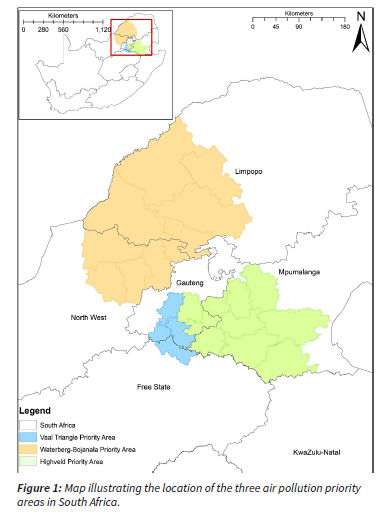
To date, three national air quality priority areas have been declared in the country on the basis that air pollution levels in these areas were exceeding or were expected to exceed national ambient air quality standards (NAAQSs). The first to be declared was the Vaal Triangle Airshed Priority Area (VTAPA) in April 2006, followed by the Highveld Priority Area (HPA) in November 2007, and the Waterberg-Bojanala Priority Area (WBPA) in June 2012.
A study in the WBPA was conducted by Wernecke et al. (2023), however, this is the first such review for the HPA. This paper presents a scoping review of air pollution and health studies in the HPA. The aim is to map the existing peer reviewed evidence, identify gaps, and provide a baseline for future research. This approach is particularly timely given the development of the second generation HPA Air Quality Management Plan and the growing emphasis on health centred air quality management in South Africa.
Study area
The HPA, an area of over 31 000 km2 in the provinces of Gauteng and Mpumalanga, comprises one metropolitan municipality (Ekurhuleni), three district municipalities (DMs) (Gert Sibande, Nkangala and Sedibeng), and nine local municipalities (Lesedi in Sedibeng DM, Victor Khanye, Steve Tshwete, and eMalahleni in Nkangala DM, and Govan Mbeki, Dipalaseng, Msukaligwa, Lekwa, and Pixley ka Seme in Gert Sibande DM (Fig. 1). There are 12 Eskom coal-fired power stations and Sasol's coal to liquids refinery in the area, as well as the towns of eMalahleni, Middelburg, Secunda, Standerton in Mpumalanga and Edenvale, Boksburg and Benoni in Gauteng.
The HPA AQMP was gazetted in March 2012 (No. 35072) (termed AQMP 2011) and aimed to implement interventions to improve air quality in the area. Measured data showed that there had not been significant improvement in air quality and that there were still a significant number of exceedances of NAAQS. In total, less than 50% of the planned interventions had been achieved and only 29% of industry and low-income settlement interventions had been accomplished. It was noted that the number of ambient air quality monitoring stations reporting to the South African Air Quality Information System (SAAQIS) had increased from 20 to 31, but that there were technical and other challenges that hampered data availability.
The draft Second-Generation Highveld Priority Area Air Quality Management Plan was published for public comment in July 2024 (Gov. Gazette 26 July 2024, No. 50985) and contained a far greater emphasis on human health. At the time of writing, it had not been finalised.
Methods
The review followed the PRISMA ScR (Preferred Reporting Items for Systematic Reviews and Meta Analyses Extension for Scoping Reviews) principles to ensure transparency in the search and selection process. As a scoping review, the objective was to describe the breadth of available evidence and identify research gaps; therefore, no risk of bias assessment, dual reviewer screening, or meta analysis was undertaken. Key word search terms were categorised into three groups as summarised in Table 1.
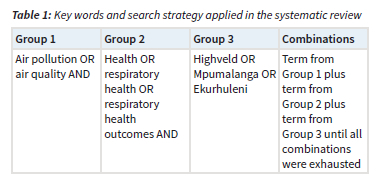
Four bibliographic databases (PubMed, Web of Science, ScienceDirect, and Google Scholar) and two journals (Clean Air Journal and BMC Public Health) were searched for English language papers published up to 31 October 2024. Search terms were grouped into three categories relating to air pollution, health, and the HPA (Table 1). Boolean operators were used to combine terms across categories.
Eligibility criteria
Included studies met the following criteria:
• peer reviewed journal articles
• written in English
• included data from the HPA (either exclusively or as part of a broader study area)
• focused on air quality, health outcomes, or both
Excluded sources:
• student theses
• government reports and AQMPs
• grey literature
Grey literature was excluded to maintain a consistent standard of peer reviewed evidence; this is acknowledged as a limitation
Screening and selection
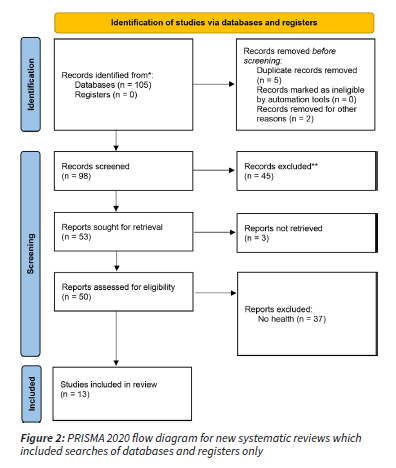
Titles and abstracts were screened to identify potentially relevant papers, followed by full text review. Duplicates were removed manually. Papers were categorised as:
1. air quality only
2. health only
3. combined air quality and health
A PRISMA ScR flow diagram summarises the search and selection process (Figure 2).
Overview
Air Pollution Monitoring and Studies in the HPA
The Mpumalanga Highveld (now comprising much of the HPA) has long been identified as a potential air pollution hotspot as a result of the concentration of heavy industries and multiple coal-fired power stations. An early paper by Louw et al. (1982) reported on near-surface sulphur dioxide (SO2) concentrations at five sites, including two in the Mpumalanga Highveld, based on data for winter 1980. Although none of the prevailing international ambient air quality standards of the time were exceeded, the authors recommended continued air pollution monitoring as a result of industrial expansion. The potential for future deterioration of air quality was recognised.
The most extensive ambient air quality monitoring network in the region is that operated by Eskom, which reports its data to SAAQIS. A chronological overview of the Eskom-operated ambient ground-based network in the region was provided by Mkhatshwa (2008). It commenced with mobile SO2 monitors in 1978, was expanded over time to include 22 SO2 monitoring stations, and was rationalised in 1989 to five stations monitoring SO2, nitrogen oxides (NOx) and particulate matter with a diameter less than 10 μηι (PM10). Today the suite of pollutants monitored has expanded, with Collette et al. (2010) reporting that at the station of Elandsfontein, nitrogen dioxide (NO2), nitric oxide (NO), nitrate (NO3), ammonia (NH3), ozone (O3), carbon monoxide (CO), hydrogen sulphide (H2S) and black carbon (BC) are monitored. The Eskom data have formed the basis of many analyses. The station of Elandsfontein located in the central Highveld, has the longest data record commencing in 1985.
Early papers based on these data by Held et al. (1994) for particulates and Rorich and Galpin (1998) for SO2, NOx, O3 and fine particulate matter (FPM) did not identify the Mpumalanga Highveld as a potential air pollution hotspot. Held et al. (1994), based on data from May 1985 to March 1990 and 15 monitoring stations, concluded that while ground level particulate concentrations were generally not 'unacceptable', stagnant atmospheric circulation patterns and air mass recirculation could result in episodic occurrences of high sulphate and nitrate particulate concentrations, particularly at elevated sites, but they rarely exceeded international air quality standards.
Another early study by Zunckel et al. (1996), which investigated dry and wet deposition of sulphur on the central Mpumalanga highveld based on winter and summer pilot studies noted that the dry deposition rate exceeded the wet deposition rate and drew heavily on the region's location in the subtropical high-pressure belt as explanation for the diurnal and seasonal patterns observed. They concluded that the deposition rates were comparable with those found in other studies in the United States and did not draw attention to the region as an air pollution hotspot.
As trend studies began to be undertaken, a picture emerged of a region where air pollution concentrations were generally rising and reference was made to the Mpumalanga Highveld as one of the top five NO2 emission hotspots in the world (Laakso et al. 2012). For example, Mkhatshwa (2008) analysed long term trends in SO2, NOx and PM10 at three stations and found a slight increase in SO2 at Elandsfontein over a 20-year time period (1986-2005) and increased PM10 at two stations. Feig et al. (2019), on the other hand, found that PM10, PM2.5 and SO2 concentrations were generally improving over a 15-year period. However, they noted that PM levels were non-compliant with NAAQS as were SO2 levels at the station of Witbank.
Surface O3 was the focus of two studies by Zunckel et al. (2004; 2006) as part of the Cross Border Air Pollution Impact Assessment project (CAPIA) which focused on impacts on maize across the southern African region, including the Mpumalanga Highveld. The former was based on observational data, with highest O3 concentrations occur over Botswana and the Mpumalanga Highveld. In both regions, the springtime maximum was between 40 and 60 ppb, but reached a mean of more than 90 ppb in October 2000. The latter paper was based on modelled estimations and indicated large areas on the sub-continent where surface O3 concentrations exceeded 40 ppb for up to 10 hours per day. Maximum concentrations exceeded 80 ppb, particularly in the winter when mean ozone concentrations were higher. The areas where the 40 ppb threshold was exceeded coincided with maize growing areas in South Africa and Zimbabwe. The authors concluded that neither anthropogenic emissions nor biogenic emissions were dominant in the production of surface ozone over southern Africa, rather the formation of surface O3 over the region was attributed to the combined contribution of precursors of anthropogenic and biogenic origin. Laban et al. (2018) also focused on O3 and its relationship with precursor species, noting that the interior of South Africa was volatile organic compound (VOC) limited as a result of high NOx emissions and suggested that the most effective way to reduce O3 was to reduce CO and VOCs, which were mainly associated with combustion of domestic fuels and biomass burning respectively.
Over time, surface-based measurements of ambient air pollutants in the HPA and the surrounding region were supplemented by aircraft measurements (e.g. Broccardo et al. 2018; Kirkman et al. 2000), vertical profile measurements (Campbell et al. 2003) and satellite observations (Broccardo et al. 2018; Cogho et al. 2022; Hersey et al. 2015; Kneen et al. 2016; Lourens et al. 2012; Ross et al. 2007; Sangeetha et al. 2019; Sibiya et al. 2024; and Shikwambana et al. 2020; 2024). While satellite observations, in particular, helped to define the spatial extent of elevated pollution levels and confirmed the existence of a regional NO2 and O3 hotspot in Mpumalanga, Hersey et al. (2015) drew attention to some limitations of satellite data, such as their inability to capture trends in ground PM levels. They argued that they could not be considered as a replacement for a ground-based network of air pollution monitors. Modelling studies also contributed to our knowledge of the spatial configuration of the pollution hotspot and improved spatial resolution of data, and in disaggregating source contributions (Arowsegbe et al. 2021a, 2021b, 2022; Chihindi et al. 2019; De Lange et al. 2021; Hersey et al. 2015; Josipovic et al. 2010a; Zhang et al. 2021; Zunckel et al. 2006) and investigating emission mitigation strategies (De Lange et al. 2021).
Collett et al. (2010) investigated the nitrogen budget using data from Eskom's Elandsfontein station aiming to characterise the conversion, transport and removal of atmospheric nitrogen species. While NO2 and NO3 concentrations were higher in winter months, it was concluded that levels did not pose a significant threat to the natural environment (human health was not mentioned) as between 4% and 15% was deposited to the ground as wet and dry deposition, the remainder being transported out of the region.
A series of papers (Josipovic et al. 2010a; 2010b; 2011; Swartz et al. 2020) reported on the analysis of monthly mean concentrations of near-surface SO2, NO2 and O3 based on data from a network of 37 passive sampling sites over the Mpumalanga Highveld. The data were part of a field campaign conducted between August 2005 and Sept 2007, in which the primary aim was to evaluate whether acidic atmospheric pollutants posed a threat to the natural environment. Risks to human health were not mentioned. Only in the central Highveld (vicinity of Elandsfontein) were pollution levels above critical thresholds for environmental damage.
Although the criteria air pollutants of SO2, NO2 and PM were the early focus of attention, over time, interest emerged in the characteristics of other species, such as BC (Chiloane et al. 2017; Feig et al. 2015; Shikwambana and Tsoeleng 2019; Xulu et al. 2020), brown carbon (BrC) (Xulu et al. 2020), H2S (Cogho et al. 2023), methane (CH4) (Sibiya et al. 2024), asbestos (Moja et al. 2016; Kwata et al. 2017, 2018; Vorster et al. 2018), mercury (Hg) (Belelie et al. 2019a; True et al. 2010), lead (Olufemi et al. 2019), radon (Le Roux et al. 2021; Le Roux 2022), sulphate (Scheifinger 1992; Snyman et al. 1987), the BTEX (benzene, toluene, ethylbenzene and xylene) group (Lourens et al. 2011; Pone et al. 2007), and metals such as lead (Pb), chromium (Cr), nickel (Ni), manganese (Mn), vanadium (V), cobalt (Co) and iron (Fe) (Monna et al. 2006; Zibret et al. 2013). There were also studies that reported on the chemical composition and size of atmospheric aerosols or particulates in an attempt to identify sources (Annegarn et al.1983; Held et al. 1993, 1994; Khumalo et al. 2020; Laakso et al. 2012; Maenhaut et al. 1996; Piketh et al. 1995; Scheifinger and Held 1997; Walton et al.2021; Xulu et al. 2020).
Besides for industrial air pollutants, a few studies reported on levels of pollen and fungal spores which are also known to impact human health (Berman 2007; Ordman 1963) and biogenic VOCs (BVOCs) because of their influence on the formation of O3 (Sowden et al. 2007).
In general, early papers were focused on documenting levels of ambient air quality, describing the observed seasonal patterns, and in some cases on understanding the seasonal climatological and meteorological influences. There was no mention of potential health risks posed by what was clearly recognised as an air pollution hotspot.
By the mid-2010s, potential health impacts were increasingly being mentioned as justification for the studies of various air pollutants (e.g., Chihindi et al. 2019; Chiloane et al. 2017; Feig et al. 2015; 2019; Kneen et al. 2016; Kumar et al. 2014; Language et al. 2016a) and in some cases there was reference to relevant ambient air quality standards. The shift to a central focus on health impacts commenced a few years later, towards the end of the decade.
Another trend that began to emerge around the same time (mid-2010s) was the increased attention on indoor air quality measurements as a result of the combustion of domestic fuel sources, usually coal, in informal dwellings (e.g., Adesina et al. 2020a; 2020b; Language et al. 2016a, 2016b; Le Roux 2022; Le Roux et al. 2021; Madonsela et al. 2024; Nkosi et al. 2017; Olufemi et al. 2019; Rodney et al. 2024; Segakweng et al. 2022; Wernecke et al. 2015). Comparisons between indoor and outdoor pollution levels have yielded variable results that are influenced by, inter alia, season and pollutant species, but a body of evidence is emerging that points to generally higher pollution levels in indoor environments. Monitoring stations have been set up specifically to monitor air quality in low-income communities, for example, KwaZamokuhle established in September 2014, and Ezamokuhle in July 2017.
Results
The 130 included studies were categorized according to their primary focus (air quality only, health only, or combined), data sources, and methodological approaches to facilitate synthesis and identification of research gaps.
Table 2 summarises the number of papers on air quality and/or health-related research in the HPA. The entries are broken down into those that were focused exclusively on the HPA and those that had a broader geographic focus, either on neighbouring urban-industrial areas or South Africa as a whole. As mentioned earlier, only papers that included data from the HPA were included.
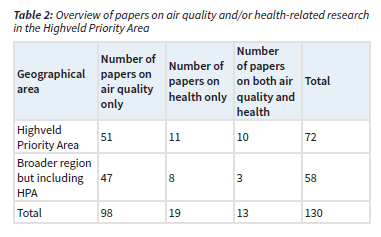
The number of papers on both air quality and health (n=13) in the HPA exceeds the number found in the WBPA (n=7) by Wernecke et al. (2023), who included a broader catchment of papers and not just peer-reviewed journal publications as was the case in the current study. The number of 'air quality only' papers (n=98) far exceeds the number of 'health only' papers (n=19) and 'health and air quality' papers (n=13). There is a long history of air quality studies dating back to 1980 (e.g. Kemeny 1980; Louw et al. 1982), evidence of a renewed focus in the 1990s linked to the Southern-Africa Fire-Atmosphere Research Initiative (SAFARI) and increased activity from 2006 onwards, with a solid focus on air quality research since 2015. With few exceptions (n=5), most of the health only papers tend to be post-2014. Studies linking air quality and health and reflecting a shift from delineating and understanding the nature of the air pollution hot spot to a focus on impacts, are also mainly confined to the last ten years.
Health Studies in the HPA
Poor air quality is often cited as the reason for many health-related studies being conducted in the HPA, even though there was no attempt to link health outcomes directly to ambient air pollution levels. In some cases (e.g., Albers et al. 2015; Bidassey-Manilal et al. 2019; Mashalane et al. 2006; Mudau et al. 2024), surveys elicited information on associated risk factors such as domestic fuel use and/or tobacco smoking to inform conclusions on the relationship with health outcomes. In other cases, comparisons between disease prevalence in urban and rural areas or disease prevalence in communities close to gold mine tailings dumps (exposed) and unexposed communities (Nkosi et al. 2015a; 2015b; 2016; 2017; 2020; Olajide-Ibiejugba et al. 2021) enabled inferences to be made about the role of air pollution. Most of the studies focused on respiratory health, although allergic and non-allergic rhinitis, cardiovascular disease and eczema were also studied. Target populations also varied from children to adolescents to the general population. Few studies relied on objective health-related measurements such as spirometry; the vast majority utilised self-administered questionnaires to elicit health information, which may impose bias due to lack of recall on the part of participants.
Key findings from the various studies are higher prevalence of self-reported respiratory illnesses among children from households relying on non-electrical fuels versus electricity for cooking (43.9% compared with 31.6%) and for heating (37.8% compared with 29.0%), with the highest prevalence (45.5%) amongst those using coal for cooking (Albers et al. 2015). Bidassey-Manilal et al. (2019), in a cross-sectional study across households in four different locations, found that the prevalence of allergic rhinitis ranged between 23% and 64%, with a significant association between higher prevalence and households that relied on coal, wood and kerosene as fuel.
Several studies compared health outcomes of residents living close to gold mine tailings dumps (exposed) and those living further away (unexposed). Although the results are applicable to a broader region than just the HPA, it was concluded that elderly (> 55 years) persons living in exposed areas had significantly higher prevalence of chronic respiratory symptoms and diseases than those in unexposed areas. The Odds Ratio (OR) for asthma was 1.57, chronic bronchitis (1.74), chronic cough (2.02), emphysema (1.75), pneumonia (1.38) and wheeze (2.01) (Nkosi et al. 2015a; 2015b). A study by Nkosi et al. (2020) focusing on non-allergic rhinitis amongst the elderly found the overall prevalence to be 23.99%, compared with 27.08% in exposed and 18.82% in unexposed communities. Another study by Nkosi et al. (2021) compared the prevalence of high blood pressure in exposed versus unexposed communities, concluding that blood pressure levels were higher in exposed communities. In a similar study, investigating the comorbidity of respiratory and cardiovascular diseases amongst the elderly, Nkosi et al. (2016) found a higher prevalence in exposed versus unexposed communities. Comparing disease outcomes amongst adolescents in exposed and unexposed communities, Nkosi et al. (2015a) reported increased likelihoods of wheeze (OR of 1.38) and rhino conjunctivitis (OR of 1.54). Olajide-Ibiejugba et al. (2021) focused on the presence of allergies in adolescents in exposed and unexposed communities and although the prevalence of doctor-diagnosed allergies was higher in exposed communities (26.97%) than unexposed communities (22.69%), the difference was small.
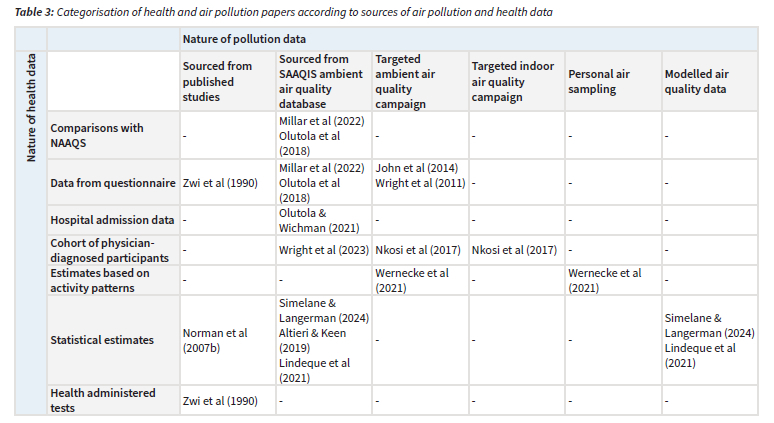
The 13 papers that reported on studies of both air quality and health were further categorised according to the nature of the air pollution data, specifically whether the data were sourced from SAAQIS and/or whether a specific short-term monitoring campaign (ambient, indoor and/or wearable passive samplers) was designed and/or whether air quality data were sourced from the literature and/or from the application of air quality models (Table 3). Health data categories included those that compared air pollution levels with NAAQS, those that collected health-based data based on questionnaires, those based on hospital admission data, those that focused on a cohort of participants with physician-diagnosed illnesses, those that used activity patterns to estimate intake doses, those based on statistical estimates, and finally, those that administered health tests (Table 3). It is noted again that health risk assessment studies that focused solely on comparison of air quality levels with NAAQS were excluded from this analysis. The breakdown facilitated easy identification of gaps.
Most studies (n=7) relied on air quality data from SAAQIS. Four relied on data from targeted air quality measurement campaigns, of which only one (Nkosi et al. 2017) was focused on the indoor environment. The source of health data varied widely, with questionnaires being the most commonly used method. It was noteworthy that only one of the studies (Zwi et al. 1990) relied on objectively determined health tests, such as spirometry, to derive health data.
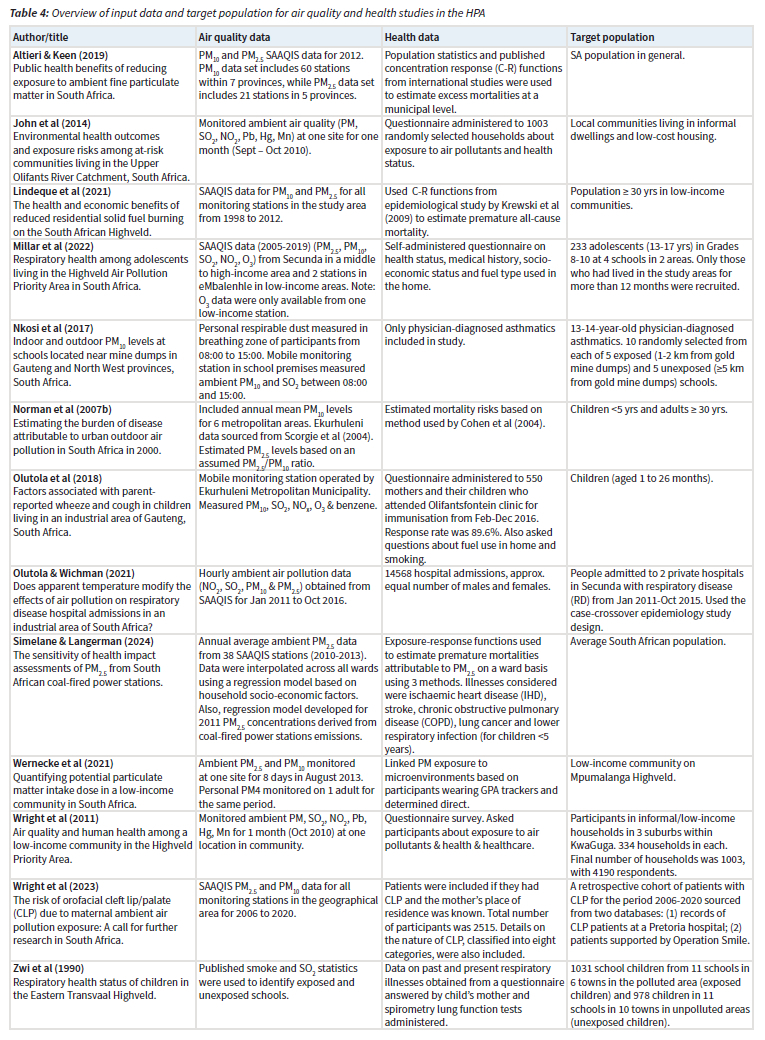
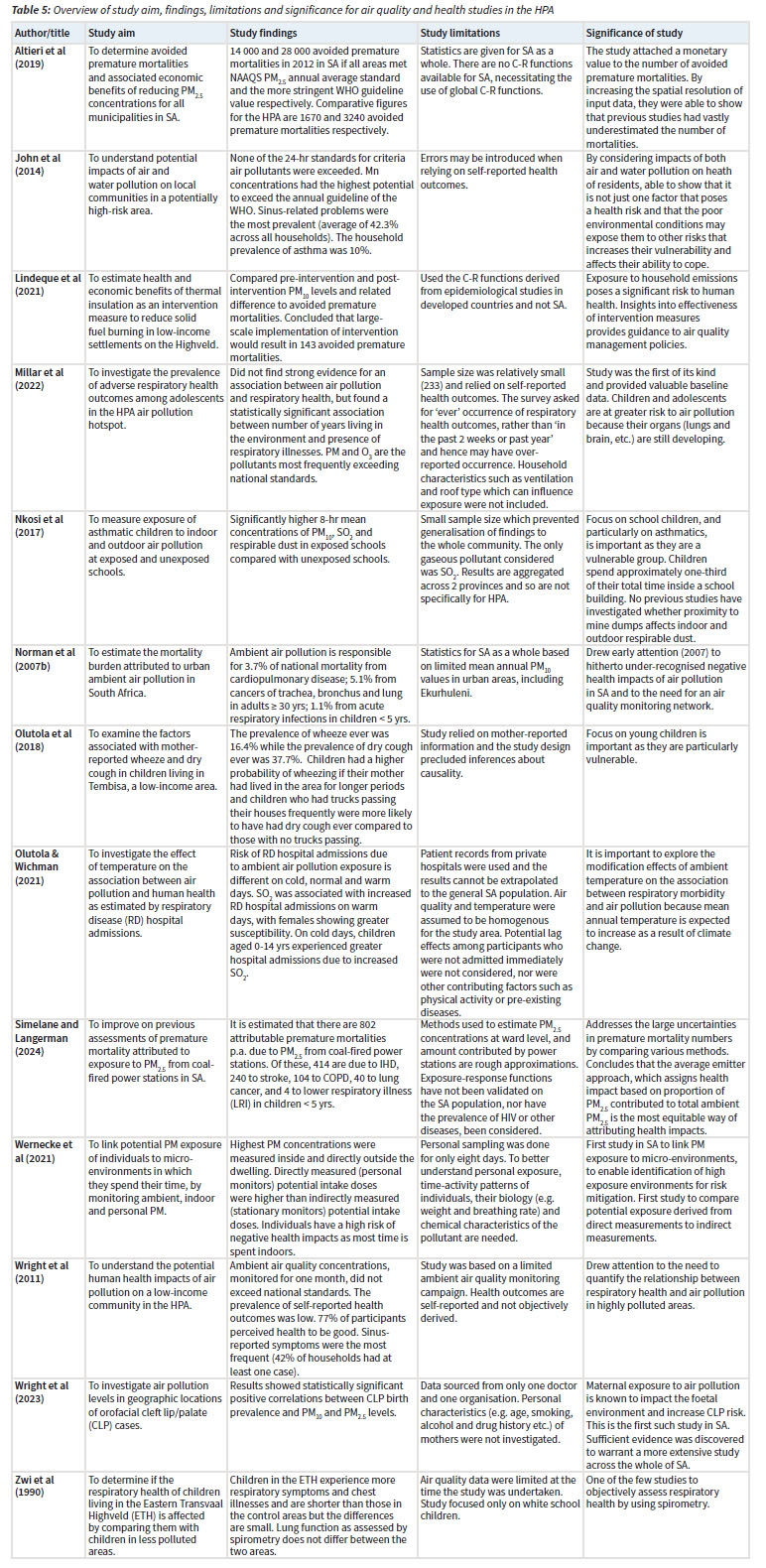
An overview of the air quality and health studies, including air quality and health data, and target population is provided in Table 4. Table 5 summarises the study aims, findings and significance of the study for each of the air quality and health studies.
Discussion
An early, groundbreaking paper that considered air quality and health simultaneously was by Zwi et al. (1990). Despite its limitations (see Table 5), it is still the only study in the HPA that has included objective measurements of health status. Perhaps because the results revealed small differences in respiratory health between exposed and control groups, there were no follow-up studies, which is unfortunate. Another pioneering study by Norman et al. (2007b), and its companion paper (Norman et al. 2007a), which focused on indoor air quality impacts on health, were limited to gross estimates and their focus was not specifically on the HPA.
It is only in the last five years or so that study designs have explicitly addressed both air quality and health. Notwithstanding these investigations, these studies have failed to advance definitive cause-effect relationships between air quality and health and hence have not advanced the knowledge frontier in any meaningful way. In each case, study design limitations are cited, for example, limited data set, reliance on self-reported health data, failure to consider extraneous influences etc.
There is sufficient evidence from health risk studies (not included here) to suggest that air quality in the HPA presents a serious risk to human health. What is lacking is the quantification of impact in terms of mortality and morbidity statistics, and precise identification of which interventions work and where policy interventions should be directed. The study by Lindeque et al. (2021), which compared pre-intervention and post-intervention PM10 levels is a useful starting point.
There is also a need to quantify definitively the relative contributions from indoor and outdoor pollution to health impacts through greater reliance on personal air samplers. It is time to move beyond numerous small, low-budget, short-term projects. The HPA presents an ideal laboratory to focus efforts aimed at quantifying the relationship between ambient and indoor air quality and health by bringing the air pollution and health research communities together. While there is an extensive ambient air quality monitoring network that dates back over a long period, it is hampered by technical issues, which must be addressed. It is recommended that greater use be made of models to improve the spatial resolution of ambient air pollution data.
There are major gaps in the collection of health data that should be addressed in future studies. For example, there is a need for better quantification of personal exposure to air pollutants through personal monitoring and the collection of data on time-activity patterns, and a need for greater reliance on objectively determined health outcomes through direct measurements, such as spirometry. Improved study designs should also seek to shift from descriptive to more analytical approaches that allow for cause-effect relationships to be investigated.
Synthesis of evidence
Air quality studies consistently identify the HPA as a hotspot for NO2, O3, and particulate matter, with both ground based and satellite observations supporting this conclusion. However, health studies remain fragmented, often cross sectional, and heavily reliant on self reported outcomes. Only one study used objective spirometry, and no longitudinal cohort studies were identified. Exposure assessment is generally limited, with few studies incorporating personal monitoring, indoor-outdoor comparisons, or high resolution spatiotemporal exposure models.
Methodological limitations in the evidence base
Across the literature, several limitations constrain the strength of conclusions including reliance on self reported health outcomes, short term or single season monitoring campaigns, limited integration of meteorological and dispersion processes, ecological exposure estimates with potential misclassification, absence of personal exposure monitoring and limited cardiovascular and non respiratory endpoints. These limitations underscore the need for more rigorous, interdisciplinary approaches.
Policy relevance
The findings are directly relevant to the second generation HPA Air Quality Management Plan, which places greater emphasis on health. The review highlights the need for strengthened ambient monitoring networks, integration of indoor and outdoor exposure data, improved exposure assessment methods, routine linkage of air quality and health datasets, and evaluation of interventions and policy measures.
Research gaps and priorities
Key gaps identified include lack of objective health measurements (e.g., spirometry, biomarkers), limited personal exposure monitoring, absence of longitudinal cohort studies, narrow focus on respiratory outcomes, limited assessment of vulnerable populations and insufficient integration of meteorology, emissions, and exposure modelling. Addressing these gaps will require coordinated, large scale, interdisciplinary research efforts.
This scoping review highlights substantial air quality research in the HPA but limited and methodologically constrained health research. Strengthening exposure assessment, expanding health endpoints, and integrating environmental and health datasets are essential to advance understanding of air pollution-health linkages in this region. The HPA remains a critical natural laboratory for interdisciplinary research that can inform policy, guide interventions, and support the constitutional right to a healthy environment.
Conclusion
This study conducted a systematic review of air pollution and health studies following the PRISMA guidelines for the HPA of South Africa. It is the first such review for the HPA. It was based on published and peer-reviewed journal papers written in English. Student theses, reports and AQMPs were excluded. Keyword search terms were categorised into three groups as follows: Group 1 - Air pollution OR air quality; Group 2 - Health OR respiratory health OR respiratory health outcomes; Group 3 - Highveld OR Mpumalanga OR Ekurhuleni. Papers included needed a term from Group 1 plus a term from Group 2 plus a term from Group 3 until all combinations were exhausted.
The number of 'air quality only' papers (98) far exceeds the number of 'health only' papers (19) and 'health and air quality' papers (13). There is a long history of air quality studies dating back to 1980 (Kemeny, 1980; Louw et al., 1982), evidence of a renewed focus in the 1990s and increased activity from 2006 onwards, with a solid focus on air quality research since 2015. With few exceptions (5), most of the health only papers tend to be post-2014. Studies linking air quality and health and reflecting a shift from delineating and understanding the nature of the air pollution hot spot to a focus on impacts, are also mainly confined to the last ten years.
The 13 papers that reported on studies of both air quality and health were further categorised according to the nature of the air pollution data and the nature of health data. It was found that most studies (7) relied on air quality data from SAAQIS. Four relied on data from targeted air quality measurement campaigns, of which only one (Nkosi et al. 2017) was focused on the indoor environment. The source of health data varied widely, with questionnaires being the most commonly used method. It was noteworthy that only one of the studies (Zwi et al. 1990) relied on objectively determined health tests, such as spirometry, to derive health data.
Based on the analysis undertaken it is recommended that it is important to bring the air pollution and health communities together and to use the HPA as a laboratory to mount a large-scale air pollution and health study that overcomes many of the limitations of previous low-budget, short-term research projects. Gaps to be addressed include quantifying the relationship between ambient and indoor air quality and health; ensuring that technical problems associated with the ambient air quality monitoring network are addressed; better quantification of personal exposure to air pollutants through personal monitoring and the collection of data on time-activity patterns; greater reliance on objectively determined health outcomes through direct measurements; and a need to expand research beyond respiratory outcomes.
Acknowledgements
We thank the late Professor Roseanne D Diab (University of KwaZulu-Natal) for support with identifying, screening and summarising the research articles to include in the review.
References
Adesina J.A., Piketh S.J., Qhekwana M., Burger R. and Mkhatshwa G. 2020a. 'Quantifying the effect of air quality offsets on household air pollution and thermal comfort on the South Africa Highveld'. Clean Air Journal, 30 (1). https://dx.doi.org/10.17159/caj/2020/30/1.8282. [ Links ]
Adesina J.A. Piketh S.J., Qhekwana M., Burger R., Language B. and Mkhatshwa, G. 2020b, 'Contrasting indoor and ambient particulate matter concentrations and thermal comfort in coal and non-coal burning households at South Africa Highveld'. Science of the Total Environment, 699: 134403. https://doi.org/10.1016/j.scitotenv.2019.134403. [ Links ]
Albers P.N., Wright C.Y., Voyi K.V. and Mathee A. 2015, 'Household fuel use and child respiratory ill health in two towns in Mpumalanga, South Africa'. South African Medical Journal, 105(7), 573-577. https://doi.org/10.7196/SAMJnew.7934. [ Links ]
Altieri K.E., Keen S.L. 2019, 'Public health benefits of reducing exposure to ambient fine particulate matter in South Africa'. Sci Tot Environ 684:610--620. https://doi.org/10.1016/j.scitotenv.2019.05.355. [ Links ]
Annegarn H.J., Leslie A.C.D., Winchester J.W. and Sellschop J.P.F. 1983, 'Particle size and temporal characteristics of aerosol composition near coal fired electric power plants of the eastern Transvaal'. Aerosol Science and Technology, 2, 489-498. [ Links ]
Arowosegbe O.O., Röösli M., Adebayo-Ojo T.C., Dalvie M.A. and de Hoogh K. 2021a, 'Spatial and temporal variations in PM10 concentrations between 2010-2017 in South Africa'. International Journal of Environmental Research and Public Health, 18(24), p.13348. [ Links ]
Arowosegbe O.O., Röösli M., Künzli N., Saucy A., Adebayo-Ojo T.C., Jeebhay M.F., Dalvie M.A. and de Hoogh K. 2021b, 'Comparing methods to impute missing daily ground-level PM10 concentrations between 2010-2017 in South Africa'. International Journal of Environmental Research and Public Health, 18 (7), 3374. https://doi.org/10.3390/ijerph18073374. [ Links ]
Arowosegbe O.O., Röösli M., Künzli N., Saucy A., Adebayo-Ojo T.C., Schwartz J., Kebalepile M., Jeebhay M.F., Dalvie M.A. and De Hoogh K. 2022, 'Ensemble averaging using remote sensing data to model spatiotemporal PM10 concentrations in sparsely monitored South Africa'. Environmental Pollution, 310, 119883. https://doi.org/10.1016/j.envpol.2022.119883. [ Links ]
Belelie M.D., Piketh S.J., Burger R.P., Venter A.D. and Naidoo M. 2019a, 'Characterisation of ambient total gaseous mercury concentrations over the South African Highveld'. Atmospheric Pollution Research, 10(1), 12-23. [ Links ]
Belelie M.D., Burger R.P., Mkhatshwa G., Piketh S.J. 2019b, 'Assessing the impact of Eskom power plant emissions on ambient air quality over KwaZamokuhle'. Clean Air Journal, 29, 29-37. https://doi.org/10.17159/2410-972x/2019/v29n1a2. [ Links ]
Berman D. 2007, 'Pollen monitoring in South Africa'. Current Allergy and Clinical Immunology, 20 (4), 184-187. [ Links ]
Bhat H.T., Jiawen G., Farzaneh H. 2021, 'Air pollution health risk assessment (AP-HRA), principles and applications. International Journal of Environmental Research and Public Health, 18, 1935. https://doi.org/10.3390/ijerph18041935. [ Links ]
Bidassey-Manilal S., Mbonane T.P., Rathebe P.C. and Senekane M.F. 2019, 'Household fuel use and prevalence of self-reported allergic rhinitis in rural areas of Mpumalanga, South Africa'. Open Innovations, 241-246. [ Links ]
Broccardo S., Heue K.P., Walter D., Meyer C., Kokhanovsky A., van der A R., Piketh S., Langerman K. and Platt U. 2018, 'Intra-pixel variability in satellite tropospheric NO2 column densities derived from simultaneous space-borne and airborne observations over the South African Highveld'. Atmospheric Measurement Techniques, 11(5), 2797-2819. [ Links ]
Campbell J. R., Welton E. J., Spinhirne J. D., Ji Q., Tsay S.-C., Piketh S. J., Barenbrug M. and Holben B. N. 2003, 'Micropulse lidar observations of tropospheric aerosols over northeastern South Africa during the ARREX and SAFARI 2000 dry season experiments'. Journal of Geophysical Research, 108, D10S07. https://doi.org/10.1029/2002JD002563. [ Links ]
Chidhindi P., Belelie M.D., Burger R.P., Piketh S.J. and Mkhatshwa G. 2019, 'Assessing the impact of Eskom power plant emissions on ambient air quality over KwaZamokuhle'. Clean Air Journal, 29 (1), 29-37. https://doi.org/10.17159/2410-972x/2019/v29nla2. [ Links ]
Chiloane K.E., Beukes J.P., van Zyl P.G., Moritz P., Vakkari V., Josipovic M., Venter A.O., Jaars K., Tiitta P., Kulmala M., Wiedensohler A. Liousse C., Mkhatshwa G.V., Ramandh A. and Laakso L. 2017, 'Spatial, temporal and source contribution assessments of black carbon over the northern interior of South Africa'. Atmospheric Chemistry Physics, 17 (10), 6177-6196. https://doi.org/10.5194/acp-17-6177-2017. [ Links ]
Cogho E., Beukes J.P., van Zyl P.G. and Vakkari V. 2022, 'The use of fire radiative power observations to determine spontaneous combustion event activities associated with coal mining on the Mpumalanga Highveld'. Clean Air Journal, 32(2), pp.1-7. [ Links ]
Cogho E., Beukes J.P., Van Zyl P.G., Vakkari V., Laakso L., Josipovic M. and Kulmala M. 2023, 'Concentration, contextualisation, temporal patterns and sources of hydrogen sulphide at a site on the South African Highveld'. Atmospheric Environment, 315: 120140. [ Links ]
Cohen A.J., Anderson H.R., Ostro B., Pandey K.D., Krzyzanowski M., Künzli N., Gutschmidt K., Pope III C.A., Romieu I., Samet J.M. and Smith K.R. 2004, 'Urban air pollution'. In Ezzati M. et al. (Eds), Comparative Quantification of Health Risks: Global and Regional Burden of Disease attributable to Selected Major Risk Factors, Vol. 2, 1353-1433, World Meteorological Organization, Geneva. [ Links ]
Collett K.S., Piketh S.J. and Ross K.E. 2010, 'An assessment of the atmospheric nitrogen budget on the South African Highveld'. South African Journal of Science, 106, 35-43. https://doi.org/10.4102/sajs.vl06i5/6.220. [ Links ]
De Lange A., Naidoo M., Garland R.M. and Dyson L.L. 2021, 'The sensitivity of simulated surface-level pollution concentrations to WRF-ARW-model PBL parameterisation schemes over the Highveld of South Africa'. Atmospheric Research, 254: 105517. [ Links ]
Feig G.T., Vertue B., Naidoo S., Ncgukana N. and Mabaso D. 2015, 'Measurement of atmospheric black carbon in the Vaal Triangle and Highveld Priority Areas'. Clean Air Journal, 25 (1). http://dx.doi.org/10.17159/2410-972X/2015/v25nla4. [ Links ]
Feig G.T., Garland R.M., Naidoo S., Maluleke A. and van der Merwe M. 2019, 'Assessment of changes in concentrations of selected criteria pollutants in the Vaal and Highveld priority areas'. Clean Air Journal, 29 (2). https://doi.org/10.17159/caj/2019/29/2.7464. [ Links ]
Held G., Snyman G.M. and Scheifinger H. 1993, 'Seasonal variations and trends of atmospheric particulates on the South African Highveld'. Clean Air Journal, 8 (8), 4-11. [ Links ]
Held G., Snyman G.M. and Scheifinger H. 1994, 'Recirculation of pollutants in the atmosphere of the South African Highveld'. South African Journal of Science, 90 (2), 91-97. [ Links ]
Hersey S., Garland R., Crosbie E., Shingler T., Sorooshian A., Piketh S. and Burger R. 2015, 'An overview of regional and local characteristics of aerosols in South Africa using satellite, ground, and modeling data'. Atmospheric Chemistry and Physics, 15(8), 4259-4278. https://doi.org/10.5194/acp-15-4259-2015. [ Links ]
John J., Wright C.Y., Oosthuizen M.A., Steyn M., Genthe B., Le Roux W., Albers P., Oberholster P. and Pauw C. 2014, 'Environmental health outcomes and exposure risks among at-risk communities living in the Upper Olifants River Catchment, South Africa'. International Journal of Environmental Health Research, 24(3), 195-214. [ Links ]
Josipovic M., Annegarn H.J., Kneen M.A., Pienaar J. and Piketh S.J. 2010a, 'Concentrations, distributions and critical levels exceedance assessment of SO2, NO2 and O3 in South Africa. Environmental Monitoring and Assessment, 171, 181-196. https://doi.org/10.1007/sl0661-009-1270-5. [ Links ]
Josipovic M., Annegarn H.J., Fourie G.D., Zunckel M. and Kneen M.A. 2010b, 'Comparisons of meso-scale air pollution dispersion modelling of SO2, NO2 and O3 using regional-scale monitoring results'. Clean Air Journal, 18 (1), 3-8. [ Links ]
Josipovic M., Annegarn H.J., Kneen M.A., Pienaar J.J. and Piketh S.J. 2011, 'Atmospheric dry and wet deposition of sulphur and nitrogen species and assessment of critical loads of acidic deposition exceedance in South Africa'. South African Journal of Science, 107 (3), 1-10. [ Links ]
Katima Z.J., Olukunle O.I., Kalantzi O.L., Daso A.P. and Okonkwo J.O. 2018, 'The occurrence of brominated flame retardants in the atmosphere of Gauteng Province, South Africa using polyurethane foam passive air samplers and assessment of human exposure'. Environmental Pollution, 242, 1894-1903. [ Links ]
Kemeny E. 1980, 'Long-Term Trends in Smoke and Sulphur Dioxide Pollution in the Republic of South Africa'. Clean Air Journal, 5(4), 11-20. https://doi.org/10.17159/caj/1980/5/6.7382. [ Links ]
Khumalo L., Kornelius G., Van Zyl P. and Hall G. 2020, 'An exploratory characterisation of the carbon and stable isotope composition of atmospheric particulate matter from opencast coal mining activities and adjacent communities'. Clean Air Journal, 30 (2), 1-8. [ Links ]
Kirkman G. A., Piketh S.J., Andreae M.O., Annegarn H.J. and Helas G. 2000, 'Distribution of aerosols, ozone and carbon monoxide over Southern Africa'. South African Journal of Science, 96 (8), 423-31. [ Links ]
Kneen M.A., Lary D.J., Harrison W.A., Annegarn H.J. and Brikowski T.H. 2016, 'Interpretation of satellite retrievals of PM2.5 over the Southern African interior'. Atmospheric Environment, 128, 53-64. [ Links ]
Krewski D., Jerrett M., Burnett R.T., Ma R., Hughes E., Shi Y., Turner M.C., Pope III C.A., Thurston G., Calle E.E. and Thun M.J. 2009, Extended Follow-up and Spatial Analysis of the American Cancer Society Study linking Particulate Air Pollution and Mortality, Vol. 140. Health Effects Institute, Boston, MA. [ Links ]
Kumar K.R., Sivakumar V., Reddy R.R., Gopal K.R. and Adesina A.J. 2014, 'Identification and classification of different aerosol types over a subtropical rural site in Mpumalanga, South Africa: Seasonal variations as retrieved from the AERONET sun photometer'. Aerosol and Air Quality Research, 14, 108-123. [ Links ]
Kwata M.G., Moja S.J and Chadi G.M. 2018, 'A physico-chemical study of dust samples from the derelict and ownerless asbestos mine dumps in Mpumalanga Province, Republic of South Africa'. WIT Transactions on Ecology and the Environment, 230, 331-342. [ Links ]
Kwata M.G. and Moja S.J. 2017, 'Measurement and characterization of dust fall samples from Mpumalanga Province, South Africa'. WIT Transactions on Ecology and the Environment, 211, 111-120. https://doi.org/10.2495/AIR170111. [ Links ]
Laakso L., Vakkari V., Virkkula A., Laakso H., Backman J., Kulmala M., Beukes J.P., van Zyl P.G., Tiitta P., Josipovic M., Pienaar J.J., Chiloane K.,Gilardoni S., Vignati E., Wiedensohler A., Tuch T., Birmili W., Piketh S., Collett K., Fourie G.D., Komppula M., Lihavainen H., de Leeuw G. and Kerminen V.M. 2012, 'South African EUCMRI measurements: seasonal variation of trace gases and aerosol optical properties'. Atmospheric Chemistry Physics, 12, 1847-1864. https://doi.org/10.5194/acp-12-1847-2012. [ Links ]
Laban T.L., van Zyl P. G., Beukes J.P., Vakkari V., Jaars K., Borduas-Dedekind N., Josipovic M., Thompson A.M., Kulmala M. and Laakso L. 2018, 'Seasonal influences on surface ozone variability in continental South Africa and implications for air quality'. Atmospheric Chemistry Physics, 18 (20), 15491-15514. https://doi.org/10.5194/acp-18-15491-2018. [ Links ]
Language B., Piketh S.J., Wernecke B. and Burger R. 2016a, 'Household air pollution in South African low-income settlements: A case study'. WIT Transactions on Ecology and the Environment, 207, 227-236. https://doi.org/10.2495/AIR160211. [ Links ]
Language B., Piketh S.J. and Burger R. 2016b, 'Correcting respirable photometric particulate measurements using a gravimetric sampling method'. Clean Air Journal, 26 (1), 10-14. [ Links ]
Le Roux R., Bezuidenhout J., Smit H. and Newman R. 2021, 'The anthropogenic impact on indoor radon concentrations for Secunda, Mpumalanga Province, South Africa'. Health Physics, 121 (2), 111-116. [ Links ]
Le Roux R., 2022, 'The effect of the coal industry on indoor radon concentrations in eMalahleni, Mpumalanga Province of South Africa'. Health Physics, 122 (4), 488-494. [ Links ]
Lindeque L.F., Burger R.P. and Piketh S.J. 2021, 'The health and economic benefits of reduced residential solid fuel burning on the South African Highveld'. Atmosphere, 26, 12(11), 1405. https://doi.org/1033.90/atmos12111405. [ Links ]
Lourens A.S., Beukes J.P. and Van Zyl P.G. 2011, 'Spatial and temporal assessment of gaseous pollutants in the Highveld of South Africa'. South African Journal of Science, 107(1), 1-8. https://doi.org/10.4102/sajs.v107i1/2.269. [ Links ]
Lourens A.S., Butler T.M., Beukes J.P., Van Zyl P.G., Beirle S., Wagner T.K., Heue K-P., Pienaar J.J., Fourie G.D. and Lawrence, M.G. 2012, 'Re-evaluating the NO2 hotspot over the South African Highveld'. South African Journal of Science, 108 (11-12), 83-91. https://doi.org/10.4102/sajs.v108i11/12.1146. [ Links ]
Louw C.W., Kemeny E., Henning J., van Niekerk J. and Vleggaar C. 1982, 'The hazardous gaseous and volatile constituents which currently accompany the particulates in the major South African urban/industrial centres'. Clean Air Journal, 6(1), 10-19. [ Links ]
Madonsela B.S., Maphanga T., Malakane K.C., Phungela T.T., Gqomfa B., Grangxabe S., Thamaga H.K., Hajji L., Lekata S., Karmaoui A. and Mbonane T.P. 2024, 'The influence of outdoor exposure concentrations on indoor air quality in rudimentary designed household structures: Mpumalanga Province, South Africa'. Pollution, 10 (1), 466-480. [ Links ]
Maenhaut W., Salma I. and Cafmeyer J. 1996, 'Regional atmospheric aerosol composition and sources in the eastern Transvaal, South Africa, and impact of biomass burning'. Journal of Geophysical Research: Atmospheres, 101 (D19), 23631-23650. https://doi.org/10.1029/95JD02930. [ Links ]
Mashalane M.B.N., Stewart A., Feldman C., Becker P. and De Charmoy S. 2006, 'Prevalence of exercise-induced bronchospasm in Thokoza schoolchildren'. South African Medical Journal, 96(1), 67-70. [ Links ]
Millar D.A., Kapwata T., Kunene Z., Mogotsi M., Wernecke B., Garland R.M., Mathee A., Theron L., Levine D.T., Ungar M., Batini C., John C. and Wright C.Y. 2022, 'Respiratory health among adolescents living in the Highveld Air Pollution Priority Area in South Africa'. BMC Public Health 22. https://doi.org/10.1186/sl2889-022-14497-8. [ Links ]
Mkhatshwa G.V. 2008, 'Air quality monitoring and management for the industrialized Highveld region of South Africa'. WIT Transactions on Ecology and the Environment, 116, 217-224. [ Links ]
Moher D., Liberati A., Tetzlaff J., Altman D.G. and PRISMA Group, T. 2009, 'Preferred reporting items for systematic reviews and meta-analyses: the PRISMA statement'. Annals of Internal Medicine, 151(4), 264-269. [ Links ]
Moja S.J., Kwata M.G., Sebesho L.M., Masindi K.G. and MtunziF. 2016, 'Characterization of surface dust and trapped dust samples collected around human settlements that are in the vicinity of old mine tailings in Mpumalanga Province, South Africa'. Journal of Earth Science and Climatic Change, 7, 360. https://doi.org/10.4172/215-7617.1000360. [ Links ]
Monna F., Poujol M., Losno R., Dominik J., Annegarn H. and Coetzee H. 2006, 'Origin of atmospheric lead in Johannesburg, South Africa'. Atmospheric Environment, 40, 6554-6566. https://doi.org/10.1016/j.atmosenv.2006.05.064. [ Links ]
Mudau R., Voyi K. and Shirinde J. 2024, 'Prevalence of wheezing and its association with environmental tobacco smoke exposure among rural and urban preschool children in Mpumalanga Province, South Africa'. International Journal of Environmental Research and Public Health, 21(4), 469. https://doi.org/10.3390/ijerph21040469. [ Links ]
Nkosi V., Wichmann J. and Voyi K. 2015a, 'Chronic respiratory disease among the elderly in South Africa: Any association with proximity to mine dumps?' Environmental Health, 14, 1-8. [ Links ]
Nkosi V., Wichmann J. and Voyi K. 2015b, 'Mine dumps, wheeze, asthma, and rhino conjunctivitis among adolescents in South Africa: Any association?' International Journal of Environmental Health Research, 25, 583-600. [ Links ]
Nkosi V., Wichman J. and Voyi K. 2016, 'Comorbidity of respiratory and cardiovascular diseases among the elderly residing close to mine dumps in South Africa: A cross-sectional study'. South African Medical Journal, 106 (3), 290-297. https://doi.org/10.7196/SAMJ.2016.vl06i3.10243. [ Links ]
Nkosi V., Wichmann J. and Voyi K. 2017, 'Indoor and outdoor PM10 levels at schools located near mine dumps in Gauteng and North West Provinces, South Africa'. BMC Public Health, 17, 42. 10.1186/s12889-016-3950-8. [ Links ]
Nkosi V., Rathogwa-Takalani F. and Voyi K. 2020, 'Non-allergic rhinitis and associated risk factors among the elderly in communities close to gold mine dumps in Gauteng and North West provinces in South Africa: a cross-sectional study'. International Archives of Occupational and Environmental Health, 93, 715-721. [ Links ]
Nkosi N.C., Burger R.P., Matandirotya N.R., Pauw C. and Piketh S.J. 2021, 'Solid fuel use in electrified low-income residential areas in South Africa: The case of KwaDela, Mpumalanga'. Journal of Energy in Southern Africa, 32 (1), 58-67. [ Links ]
Norman R., Barnes B., Mathee A., Bradshaw D. and the South African Comparative Risk Assessment Collaborating Group. 2007a, 'Estimating the burden of disease attributable to indoor air pollution from household use of solid fuels in South Africa in 2000'. South African Medical Journal, 97 (8), 764-771. [ Links ]
Norman R., Cairncross E., Witi J., Bradshaw D. and the South African Comparative Risk Assessment Collaborating Group. 2007b, 'Estimating the burden of disease attributable to urban outdoor air pollution in South Africa in 2000'. South African Medical Journal, 97 (8), 782-790. [ Links ]
Olajide-Ibiejugba A.O., Nkosi V., Takalani-Rathogwa F., Shirinde J., Wichmann J., Green R.J. and Voyi K. 2021, 'Allergy and household living conditions among adolescents living near gold mine tailing dumps in the Gauteng and North West Provinces of South Africa'. International Journal of Environmental Research and Public Health, 19 (1): 122. [ Links ]
Olufemi A.C., Mji A. and Mukhola M.S. 2019, 'Health risks of exposure to air pollutants among students in schools in the vicinities of coal mines'. Energy Exploration and Exploitation, 37 (6), 1638-1656. [ Links ]
Olutola B.G., Claassen N., Wichmann J. and VoyiK. 2018, 'Factors associated with parent-reported wheeze and cough in children living in an industrial area of Gauteng, South Africa'. Environmental Science and Pollution Research, 25, 33455-33463. [ Links ]
Olutola B.G. and Wichmann J. 2021, 'Does apparent temperature modify the effects of air pollution on respiratory disease hospital admissions in an industrial area of South Africa?' Clean Air Journal, 31 (2), 1-11. [ Links ]
Ordman D. 1963, 'The evolution and present status of the concepts and practice of allergy in South Africa'. South African Medical Journal, 37 (4), 417-424. [ Links ]
Piketh S.J., Annegarn H.J. and Kneen M.A. 1995, 'Composition of suspended particles in the Eastern Transvaal'. Clean Air Journal, 9 (3), 12-18. [ Links ]
Pone J.D.N., Hein K.A.A., Stracher G.B., Annegarn H.J., Finkleman R.B., Blake D.R., McCormack J.K., Schroeder P. 2007, 'The spontaneous combustion of coal and its by-products in the Witbank and Sasolburg coalfields of South Africa'. International Journal of Coal Geology, 72 (2), 124-140. https://doi.org/10.1016/j.coal.2007.01.001 [ Links ]
Rodney M., Kuku V. and Shirinde, J. 2024, 'Indoor and outdoor NO2 and SO2 levels in 13 randomly selected preschools from 7 districts in Mpumalanga Province, South Africa'. Public Health Challenges, 3: e175. https://doi.org/10.1002/puh2.175. [ Links ]
Rorich R.P. and Galpin J.S. 1998, 'Air quality in the Mpumalanga Highveld region'. South African Journal of Science, 14, 109-114. [ Links ]
Ross K., Broccardo S., Heue K.P., Ferguson K. and Piketh S. 2007, 'Nitrogen oxides on the South African Highveld'. Clean Air Journal, 16 (2), 6-15. [ Links ]
RSA Republic of South Africa. 1996, Constitution of the Republic of South Africa (Act number 108 of 1996). Government Printer Cape Town. [ Links ]
Sangeetha S. K. and Sivakumar V. 2019, 'Long-term temporal and spatial analysis of SO2 over Gauteng and Mpumalanga monitoring sites of South Africa'. Journal of Atmospheric and Solar-Terrestrial Physics, 191. https://doi.org/10.1016/j.jastp.2019.05.008. [ Links ]
Scheifinger H. 1992, 'Air-mass movement and sulphate concentrations on the South African Highveld during August 1987'. South African Journal of Science, 88 (7), 391-398. [ Links ]
Scheifinger H. and Held G. 1997, 'Aerosol behaviour on the South African Highveld'. Atmospheric Environment, 31 (21), 3497-3509. [ Links ]
Scorgie Y., Annegarn H. and Burger L. 2004, 'Study to examine the potential socio-economic impact of measures to reduce air pollution from combustion'. Fund for Research into Industrial Development Growth and Equity (FRIDGE). Johannesburg Airshed Planning Professionals. [ Links ]
Segakweng C.K., van Zyl P.G., Liousse C., Beukes J.P., Swartz J.S., Gardrat E., Dias-Alves M., Language B., Burger R.P. and Piketh S.J. 2022, 'Measurement report: Size-resolved chemical characterisation of aerosols in low-income urban settlements in South Africa'. Atmospheric Chemistry and Physics, 22 (15), 10291-10317. [ Links ]
Shikwambana L. and Tsoeleng L.T. 2019, 'Impacts of population growth and land use on air quality. A case study of Tshwane, Rustenburg and Emalahleni, South Africa'. South African Geographical Journal. https://doi.org/10.1080/03736245.2019.1670234. [ Links ]
Shikwambana L., Mhangara P. and Mbatha N. 2020, 'Trend analysis and first time observations of sulphur dioxide and nitrogen dioxide in South Africa using TROPOMI/Sentinel-5 P data'. International Journal of Applied Earth Observation and Geoinformation, 91. https://doi.org/10.1016/j.jag.2020.102130. [ Links ]
Shikwambana L., Kganyago M., Mbatha N. and Mhangara P. 2024, 'First time calculation of the spatial distribution of concentration and air quality index over South Africa using TROPOMI data'. Journal of the Air and Waste Management Association, 74 (8), 556-568. [ Links ]
Sibiya S.S., Mhangara P. and Shikwambana L. 2024, 'Seasonal and trend variation of methane concentration over two provinces of South Africa using Sentinel-5p data'. Environmental Monitoring and Assessment, 196 (8): 713. [ Links ]
Simelane S.P. and Langerman K.E. 2024, 'The sensitivity of health impact assessments of PM2.5 from South African coal-fired power stations'. Air Quality, Atmosphere and Health, 17 (2), 325-340. [ Links ]
Snyman G.M., Turner G.S.M., Wells R.B., Ellerbeck R.H. and Dos Santos A. 1987, 'Seasonal variations in airborne sulphate pollution on the South African highveld'. South African Journal of Science, 83 (9), 541-544. [ Links ]
Sowden M., Zunckel M. and Van Tienhoven A.M. 2007, 'Assessment of the status of biogenic organic emissions and impacts on air quality in southern Africa'. Tellus B: Chemical and Physical Meteorology, 59 (3), 535-541. [ Links ]
Swartz J.S., van Zyl P.G., Beukes J.P., Galy-Lacaux C., Ramandh A. and Pienaar J.J. 2020, 'Measurement report: Statistical modelling of long-term trends of atmospheric inorganic gaseous species within proximity of the pollution hotspot in South Africa'. Atmospheric Chemistry and Physics, 20 (17), 10637-10665. [ Links ]
Thabethe N.D.L., Engelbrecht J.C., Wright C.Y. and Oosthuizen M.A. 2014, 'Human health risks posed by exposure to PM for four life stages in a low socio-economic community in South Africa'. Pan African Medical Journal, 18, 1-12. https://doi.org/10.11604/pamj.2014.18.206.3393. [ Links ]
True A., Panichev N., Okonkwo J. and Forbes P.B.C. 2010, 'Determination of the mercury content of lichens and comparison to atmospheric mercury levels in the South African Highveld region'. Clean Air Journal, 21 (1), 19-25. [ Links ]
Vorster T., Kgokong N. and Phillips J.I. 2018, 'Exploring the South African legacy of asbestos using routinely collected data'. Occupational Health Southern Africa, 24 (5), 135-139. [ Links ]
Walton N.M., Piketh S.J., Van Zyl P., Maenhaut W., Burger R., Language B. and Formenti P. 2021, 'Source apportionment of ambient fine and coarse aerosols in Embalenhle and Kinross, South Africa'. Clean Air Journal, 31 (2), 1-12. https://doi.org/10.17159/caj/2021/31/2.11980. [ Links ]
Wernecke B., Language B., Piketh S.J. and Burger R.P. 2015, 'Indoor and outdoor particulate matter concentrations on the Mpumalanga highveld - a case study'. Clean Air Journal, 25, 12-16. https://doi.org/10.17159/2410-972X/2015/v25n2al. [ Links ]
Wernecke B., Burger R.P., Language B., Wright C.Y. and Piketh S.J. 2021, 'Quantifying potential particulate matter intake dose in a low-income community in South Africa'. Clean Air Journal, 31 (2). https://doi.org/10.17159/caj/2021/31/2.9426. [ Links ]
Wernecke B., Naidoo N.P. and Wright C.Y. 2023, 'Establishing a baseline of published air pollution and health research studies in the Waterberg-Bojanala Priority Area'. Clean Air Journal, 33 (1), 1-12. [ Links ]
WHO 2021, 'World Health Organization global air quality guidelines: particulate matter (PM2.5 and PM10), ozone, nitrogen dioxide, sulfur dioxide and carbon monoxide'. [ Links ]
Wright C.Y., Oosthuizen R., John J., Garland R.M., Albers P. and Pauw C. 2011, 'Air quality and human health among a low-income community in the Highveld Priority Area'. Clean Air Journal, 20 (1), 12-20. https://doi.org/10.17159/caj/2011/20/1.7180. [ Links ]
Wright C.Y., Kapwata T., Wernecke B., Malherbe H., Butow K-W., Naidoo N., Garland R.M., de Lange A., Murray G.E. and Operation Smile. 2023, 'The risk of orofacial cleft lip/palate due to maternal ambient air pollution exposure: a call for further research in South Africa'. Annals of Global Health, 89 (1), 6. https://doi.org/10.5334/aogh.4007. [ Links ]
Xulu N.A., Piketh S.J., Feig G.T., Lack D.A. and Garland R.M. 2020, 'Characterizing light-absorbing aerosols in a low-income settlement in South Africa'. Aerosol and Air Quality Research, 20, 1812-1832. [ Links ]
Zhang D., Du L., Wang W., Zhu Q., Bi J., Scovronick N., Naidoo M., Garland R.M. and Liu Y. 2021,'A machine learning model to estimate ambient PM2.5 concentrations in industrialized highveld region of South Africa'. Remote Sensing of Environment, 266, Article 112713. [ Links ]
Zibret G., Van Tonder D. and Zibret L. 2013, 'Metal content in street dust as a reflection of atmospheric dust emissions from coal power plants, metal smelters, and traffic'. Environmental Science and Pollution Research, 20, 4455-4468. [ Links ]
Zunckel M., Turner C.R. and Wells R.B. 1996, 'Dry deposition of sulphur on the Mpumalanga highveld: a pilot study using the inferential method'. South African Journal of Science, 92, 485-491. [ Links ]
Zunckel M., Venjonoka K., Pienaar J.J., Brunke E.G., Pretorius O., Koosialee A., Raghunandan A. and Van Tienhoven A.M. 2004, 'Surface ozone over southern Africa: synthesis of monitoring results during the Crossborder Air Pollution Impact Assessment project'. Atmospheric Environment, 38 (36), 6139-6147. https://doi.org/10.1016/j.atmosenv.2004.07.029. [ Links ]
Zunckel M., Koosailee A., Yarwood G., Maure G., Venjonoka K., Van Tienhoven A.M. and Otter L. 2006, 'Modelled surface ozone over southern Africa during the cross border air pollution impact assessment project'. Environment Modelling and Software, 21, 911-924. [ Links ]
Zwi S., Davies J.C., Becklake M.R., Goldman H.I., Reinach S.G. and Kallenbach J.M. 1990, 'Respiratory health status of children in the eastern Transvaal highveld'. South African Medical Journal, 78 (11), 647-653. [ Links ]
Received: 25 November 2025
Reviewed: 6 March 2026
Accepted: 27 May 2026