Services on Demand
Journal

Article
 English (pdf)
 Article in xml format
 Article references
 Automatic translation
 Send this article by e-mail
Indicators
Related links
-
 Cited by Google
 -
 Similars in Google
Share

 Permalink
Clean Air Journal
On-line version ISSN 2410-972XPrint version ISSN 1017-1703
Clean Air J. vol.35 n.2 Pretoria 2025
https://doi.org/10.17159/caj/2025/35/2.18224
RESEARCH ARTICLE
Identification and risk assessment of the elements present in atmospheric dust in Lagos State, Nigeria
Ediagbonya Thompson FaradayI, II, ; Uche Joseph IfeanyiIII; Amodu Moyinoluwa AdijatI
IDepartment of Chemical Sciences, Olusegun Agagu University of Science and Technology, Okitipupa, Ondo State, Nigeria
IIFaculty of Environmental Studies, University of Lay Adventists, Kigali, Rwanda
IIIDepartment of Chemical Sciences, University of Delta, Agbor, Delta State, Nigeria
ABSTRACT
This study investigates the elemental composition of atmospheric dust collected from both outdoor (roadside) and indoor environments across five distinct geographic areas in Lagos State, Nigeria, to assess environmental contamination and associated health risks. Surface dust was collected using a soft brush and dustpan, followed by acid digestion and analysis using Inductively Coupled Plasma Optical Emission Spectroscopy (ICP-OES). A total of 34 elements were quantified, with results indicating significant spatial variation in concentrations. Notably, elevated levels of lead (Pb) and cadmium (Cd) were detected, suggesting contributions from industrial activities, vehicular emissions, and other anthropogenic sources. In contrast, concentrations of zinc (Zn), copper (Cu), and nickel (Ni) remained within permissible limits, reflecting lower pollution levels in certain areas. Health risk assessments revealed that the incremental lifetime cancer risk (ILCR) for both adults and children exceeded the U.S. EPA's acceptable thresholds (10-6 to 10-4), particularly in high-traffic zones. The findings underscore the need for targeted pollution control measures and provide essential data to inform air quality management and public health strategies in Lagos State.
Keywords: Atmospheric dust, elemental analysis, health risk assessment, ICP-OES, Lagos State
Introduction
Chakraborty et al. (2016) describe dust as a heterogeneous mixture of particulate matter that serves as a reservoir for a variety of both organic and inorganic pollutants. These fine, solid particles originate from numerous sources and exert diverse effects on atmospheric processes and human health. Remarkably, up to 50% of ambient dust has been attributed to biological origins such as shed skin cells. Mechanical processing of organic and inorganic materials - including rock, ore, and metals - through activities like grinding, handling, or explosions, contributes to the generation of compact particles that comprise road dust (Khan & Strand, 2018; Ediagbonya et al., 2015; 2016; 2013a). In urban environments, dust is composed of various organic compounds and microcomponents that significantly contribute to air pollution and present substantial risks to public health (Li et al., 2018; Ediagbonya et al., 2022). These pollutants are pervasive and, if not managed properly, can impair respiratory and cardiovascular health.
Heavy metals in indoor and ambient dust are of particular concern, with automobile emissions being a major contributor. Other sources include smoking, the use of incense, construction materials, furniture, and the infiltration of outdoor contaminants such as soil and combustion residues (Tran et al., 2020; Levilied et al., 2015; Ediagbonya et al., 2021). Heavy metals are environmentally persistent and toxic, with both anthropogenic and natural processes, such as rock weathering, industrial activities, and volcanic emissions, serving as sources. Once airborne, these metals can adsorb onto dust particles, enabling long-range atmospheric transport and deposition. Despite some metabolic detoxification mechanisms, the non-biodegradable nature of heavy metals means they can accumulate to harmful levels or bioaccumulate in ecosystems (Lawal et al., 2011; Ediagbonya et al., 2014, 2020). Several metals, including Pb, Cd, Hg, and As, pose serious health threats even at low concentrations due to their carcinogenic and neurotoxic effects (Jomova & Valko, 2010; Bawuro et al., 2018; Zhong et al., 2020; Ediagbonya, 2013abc, 2016). Atmospheric dust in urban areas is influenced by diverse factors including desertification, erosion, vehicle exhaust, and industrial pollution (Doe et al., 2023).
In highly populated urban centres like Lagos, street dust - whether from paved or unpaved surfaces - is subject to continuous resuspension and long-distance transport via wind currents, making it a significant vector for toxic metal exposure. Understanding the composition and source of dust is, therefore, crucial for assessing its impact on public health and for designing appropriate mitigation strategies (Ediagbonya et al., 2015; 2016). In Lagos State, existing environmental policies primarily focus on broad air quality monitoring and general sustainability planning under the purview of agencies such as the Lagos State Environmental Protection Agency (LASEPA). However, these frameworks often lack localized, elemental-level data needed for targeted interventions. This study addresses that gap by providing detailed chemical characterization and health risk assessments of atmospheric dust across multiple locations in Lagos. By doing so, it offers data-driven insights that can enhance existing environmental management efforts and support the formulation of more effective, location-specific pollution control strategies.
Materials and methods
Study area
The study was conducted in Lagos State, covering the neighbourhoods of Oshodi, Yaba, Bariga (Odunsi Street), Mushin, and Onipanu (Oluwakemi Street). The district of Oshodi in Lagos State, Nigeria, is recognised as a thriving commercial and transportation centre. Yaba is a neighbourhood renowned for its educational institutions and economic operations. There is a variety of business activity in the region, including market places, stores and dining establishments. One of the most well known markets in Yaba is Tejuosho Market. Yaba is primarily a residential area and is home to a diverse population including different ethnic groups and cultures. Bariga is situated on the mainland of Lagos State, along the coastline of the Lagos Lagoon. Mushin is located on the mainland of Lagos and is very near to the city's core. Mushin is predominantly a residential area with a multicultural population that represents a variety of ethnic backgrounds. The region is also renowned for its thriving commercial activity. Onipanu (Oluwakemi Street) is renowned for its blend of residential and commercial activities. You will find a diverse range of stores, markets and small businesses serving the local population there. It is located on the mainland of Lagos.
Detailed description of sampling sites
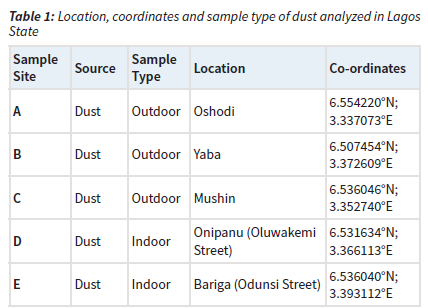
For this study, dust samples were collected from outdoor paved roadside surfaces in the Oshodi, Yaba and Mushin districts, and from indoor environments (floors and horizontal surfaces within buildings) in Onipanu (Oluwakemi Street) and Bariga (Odunsi Street). To provide greater clarity on the sampling environments, the following descriptions detail the specific conditions at each site:
1. Oshodi (outdoor - sample A): Dust was collected from paved sidewalks and curbsides adjacent to major traffic arteries, including the Oshodi-Apapa Expressway and surrounding commercial streets. This area is characterized by heavy vehicular traffic and proximity to industrial zones.
2. Yaba (outdoor - sample B): Dust was collected from paved sidewalks near Tejuosho Market and along roads bordering educational institutions. This area experiences high volumes of pedestrian and vehicle traffic.
3. Mushin (outdoor - sample C): Dust was collected from paved roadside surfaces along busy commercial streets within the Mushin district, an area known for dense residential and commercial development.
4. Onipanu (Oluwakemi Street) (indoor - sample D): Dust was collected from floor surfaces within small retail shops and residential apartments located along Oluwakemi Street. These indoor environments represent typical mixed-use building interiors in the area.
5. Bariga (Odunsi Street) (indoor - sample E): Dust was collected from floor surfaces within residential homes and small businesses situated along Odunsi Street, near the Lagos Lagoon. These indoor settings reflect typical household environments in this neighbourhood.
Sample collection
Dust samples were collected from five locations within the study area during the dry season months (July to September). Sampling was conducted during the early morning and late evening hours, periods chosen to minimise disturbance from human and vehicular activities and to ensure that the dust had adequately settled for accurate collection.
i. Outdoor samples: Surface dust was gently swept from paved roadside surfaces using a soft plastic brush into plastic dustpans. The collected dust was then transferred into pre-labelled polythene bags.
ii. Indoor samples: Dust was collected from indoor environments by gently sweeping settled dust from floors and other horizontal surfaces using a soft plastic brush into plastic dustpans. The collected dust was then transferred into pre-labelled polythene bags.
Sampling was performed randomly at each site to ensure spatial representativeness. Non dust materials such as cigarette butts, paper scraps, plastics and other debris were meticulously removed from the samples to avoid contamination. The collected samples were subsequently transported to the laboratory for further preparation and analysis. All procedures followed protocols similar to those reported in previous studies (Iwegbue et al., 2017; 2018). Table 1 and Figure 1 provide the locations and coordinates of the sampling sites. The specific sample type (outdoor or indoor) for each location is detailed in Table 1.
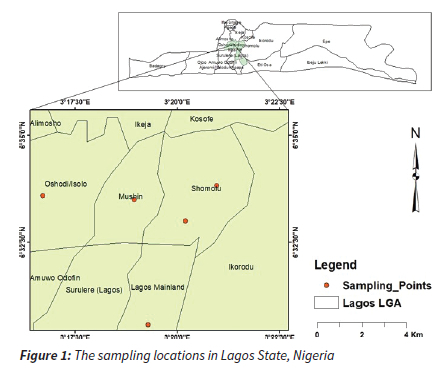
The collection of both outdoor and indoor samples was undertaken to enable a direct comparison of elemental composition and associated health risks between these two distinct microenvironments, providing a more comprehensive assessment of human exposure pathways in urban Lagos.
Sample preparation and digestion of dust samples
Upon arrival at the laboratory, the collected dust samples were air-dried at room temperature (20-25°C) for 48 hours to ensure complete removal of residual moisture. The dried samples were then manually inspected and cleaned to eliminate any remaining non-dust contaminants such as hair, fibres, or organic debris using clean tweezers. To achieve a homogeneous and fine powder, the samples were gently ground with an agate mortar and pestle, taking care to avoid cross-contamination. The ground material was subsequently sieved through a 150 μηι stainless steel mesh sieve to isolate the inhalable particle fraction (<150 μm), which is most relevant for assessing human exposure risks. During sieving, the powder was carefully agitated in a circular motion by hand to allow the fine particles to pass through while retaining larger particles, which were discarded. The sieved fraction was stored in pre-cleaned glass vials for further processing. For acid digestion, 0.5 g of the sieved dust sample was accurately weighed (±0.0001 g) into a 50 mL acid-washed conical flask, and 10 mL of freshly prepared aqua regia - a mixture of concentrated nitric acid (HNO3) and hydrochloric acid (HCl) in a 3:1 ratio - was added. The mixture was allowed to pre-digest at room temperature for 30 minutes to minimize violent reactions before being heated on a hot plate at 125 ± 5°C for 2 hours inside a fume cupboard. Digestion was considered complete once a clear solution was obtained. After cooling to room temperature, the digestate was filtered through a 0.45 μm cellulose nitrate membrane filter to remove any undissolved particulates, and the filtrate was diluted to a final volume of 25 mL with 0.25 M HNO3 to stabilize the metals and prevent precipitation. Metal concentrations in the digested solutions were determined using an Agilent 720 Inductively Coupled Plasma Optical Emission Spectrometer (ICP-OES). The instrument was calibrated with matrix-matched multi-element standards, and quality control measures, including procedural blanks, duplicate samples, and certified reference materials (CRMs), were implemented to ensure the accuracy and precision of the analytical results (Radojevic and Bashkin, 1999; Iwegbue et al., 2018).
Quality control and method of data analysis
An extensive analysis approach was applied to the data gathered. Data were first sorted, cleaned, and accuracy confirmed. The elemental concentrations at various sites were summarised using descriptive statistics, including calculations of the mean and standard deviation. Tukey HSD post hoc tests were utilised to identify particular differences between locations after the one-way Analysis of Variance (ANOVA) was used to evaluate spatial variation. To investigate the connections between pollutant concentrations and pertinent factors, correlation analysis was performed. Diagnostic ratio analysis was utilised to identify potential pollution sources for the elements, Principal Component Analysis (PCA)-Multiple Linear Regression (MLR) in comparison to PCA-MLR was utilised for source identification and apportionment. Furthermore, a risk assessment was carried out in order to assess the combined toxicological effect of the elements. The significance level was set at p < 0.05. All statistical analyses were performed with IBM SPSS Statistics version 28.0 for Windows.
Results and discussion
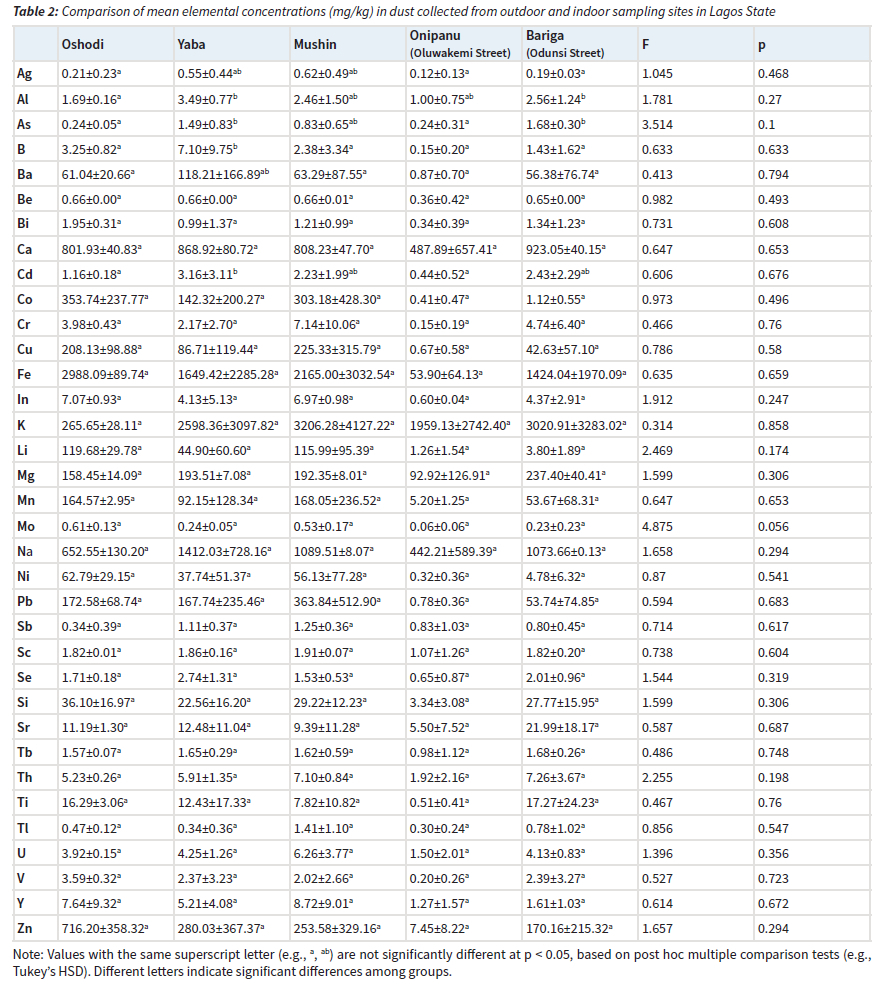
Table 2 presents the mean concentrations of 34 elements in dust samples collected from five sampling sites in Lagos State, comprising three outdoor sites (Oshodi, Yaba, Mushin) and two indoor sites (Onipanu and Bariga). Using one-way ANOVA and post hoc testing, we found no significant difference (p > 0.05) in the concentrations of several elements among the different sites. Notably, the superscript 'a' indicates that Ag, Al, As, and Be showed relatively constant concentrations across all sites, suggesting similar baseline levels or sources regardless of the microenvironment. These results may reflect widespread background contamination or common anthropogenic sources that affect both outdoor and indoor environments in these urban areas.
Only mercury is more hazardous than silver when it comes to heavy metals, which is why it is included in the highest toxicity class along with cadmium, chromium (VI), copper, and mercury (Antsiferova, et.al, 2019). According to Gupta et al. (2015), the food, cosmetics, pharmaceutical, biosphere, and medicinal industries are sources of silver. Silver concentrations in the dust samples varied from 0.12 to 1.045 mg/kg on average. The most common metallic element in the crust of the planet is aluminium, a light metal with superior electrical and thermal conductivity (Keith et al. 2008). The levels of aluminium were between 1.00 and 3.49 mg/kg. The very deadly element arsenic has no known necessary physiological function in humans.
There are many different inorganic and organic forms of arsenic in nature, along with a range of oxidation states (Chen & Costa, 2021). The range of arsenic values was 0.24-3.514 mg/kg.
Boron is a ubiquitous element, appearing in rocks, soil, and water. The levels of boron varied from 0.15 to 7.10 mg/kg. Barium (Ba), while not typically considered a priority pollutant, was detected in the dust samples and is a naturally occurring element. It ranks as the fourteenth most abundant element in the Earth's crust. The range of barium values was 0.87 to 118.21 mg/kg. Beryllium (Be) is a group IIA element found naturally in the Earth's crust, with an average background concentration ranging from 2.8 to 5.0 mg/kg (ATSDR, 1993; USGS, 2002; 2014; Armiento et al. 2013). Bismuth concentrations ranged from 0.34 to 1.95 mg/kg. As the most abundant mineral in the human body, calcium (ca) ranks fifth among the elements that are most abundant in the Earth's crust. Between 487.89 and 923.05 mg/kg of calcium were present. Due to the large human inputs from the industrial and agricultural sectors, cadmium (Cd), a hazardous heavy metal, is present in large quantities in the environment (Jain et al., 2017). Cd concentrations ranged from 0.44 to 3.16 mg/kg across the sampled sites, reflecting contributions from industrial activities and vehicle emissions. Cobalt (Co) levels showed considerable variability, with concentrations ranging from 0.41 to 353.74 mg/kg, suggesting localized or site-specific sources such as paint pigments, metal alloys, or battery-related waste. A crucial trace element in both humans and other animals is copper (Cu) (Bonham et al., 2002). The human body has about 100 mg of copper, which is only required in trace amounts. The range of copper values was 0.67 to 225.33 mg/kg.
Almost all living things require iron (Fe), with very few exceptions like certain Lactobacilli (Archibald, 1983). Foods and beverages both contain iron. The range of iron values was 53.90 to 2988.09 mg/kg. The softest metal that is not an alkali metal is indium. Its concentrations are in the range of 0.60 to 7.07 mg/kg, and it has a silvery-white, tin-like appearance. An essential vitamin needed for healthy cellular activity is potassium (K). Food, the body, and drinking water all contain potassium (Shayne, 2023). Potassium values ranged from 1959.13 to 3206.28 mg/kg. The values of lithium (Li) varied from 1.26 to 119.68 mg/kg. Magnesium (Mg) has been identified as a cofactor for more than 300 metabolic events in the body and is the second most prevalent intracellular divalent cation (Elin et al., 2004). Magnesium concentrations ranged from 92.92 to 237.40 mg/kg. Lead (Pb) is a naturally occurring metal that typically reacts with two or more elements to generate lead compounds. Lead is released into the atmosphere due to lead mining, lead compound and alloy manufacturing facilities, vehicle exhausts, and fossil fuel combustion (Violante et al., 2010). Lead levels varied between 0.78 and 363.84 mg/kg.
Along with arsenic (As), according to Filella et al. (2009), antimony (Sb), which belongs to group 15 of the periodic table, has no biological functions in living things. The 21st element on the periodic table, scandium (Sc), is typically categorized as a rare Earth element. Despite being extensively dispersed across the crust of the Earth, rare Earths are comparatively uncommon in the global economy and are rarely concentrated in an ore (Gambogi et al., 2014). The levels of scandium were rather constant among the groups, hovering around 1.82 mg/ kg. According to Al-Khashman (2004), mining, traffic, sand, soil change, air particles deposition, industrial or building operations, and traffic are all regarded to be sources of dust contamination (Wang et al.2021).
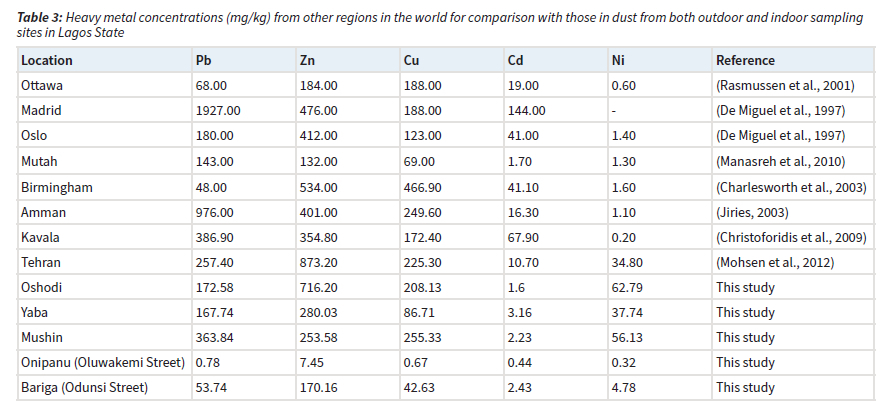
Table 3 compares the concentrations of selected heavy metals (Pb, Zn, Cu, Cd, Ni) in dust samples from five locations in Lagos State with values reported in other urban environments worldwide. The comparison offers insights into the pollution profile of Lagos relative to global trends and helps to contextualize potential sources of contamination. The concentrations of Pb in Mushin (363.84 mg/kg) and Oshodi (172.58 mg/kg) were notably higher than those in Ottawa (68.00 mg/kg), Birmingham (48.00 mg/kg), and Tehran (257.40 mg/kg), although still considerably lower than extreme levels reported in Madrid (1927.00 mg/kg) and Amman (976.00 mg/kg). The elevated Pb levels in Lagos may be attributed to legacy lead-based paints in older buildings, vehicular emissions, and industrial activities - similar to the sources cited for elevated Pb in Madrid (De Miguel et al., 1997) and other industrial cities (USEPA, 2008). Zn levels were highest in Oshodi (716.20 mg/kg), exceeding values reported in Ottawa (184.00 mg/kg) and Tehran (873.20 mg/kg), but lower than those observed in Birmingham (534.00 mg/kg). The Zn concentrations in Lagos suggest significant influence from vehicular wear (e.g., tyre and brake linings), industrial emissions, and solid waste incineration (ATSDR, 2005). Comparable high Zn values have been reported in rapidly industrializing cities such as Kuala Lumpur. Cu concentrations in Mushin (255.33 mg/kg) and Oshodi (208.13 mg/kg) were higher than in Ottawa (188.00 mg/ kg) and Tehran (225.30 mg/kg), but still below the extreme value reported in Birmingham (466.90 mg/kg).
Copper pollution in urban environments is often linked to traffic emissions, industrial discharges, and weathering of building materials (Bonham et al., 2002; ATSDR, 2005). Cd levels were highest in Yaba (3.16 mg/kg) and Mushin (2.23 mg/ kg) among the Lagos samples, exceeding levels recorded in Ottawa (1.70 mg/kg) and Tehran (10.70 mg/kg), though much lower than in Madrid (144.00 mg/kg). Cd pollution is frequently associated with industrial discharges, phosphate fertilizers, battery production, and waste incineration (Alloway, 2013). Ni levels in Oshodi (62.79 mg/kg) and Mushin (56.13 mg/kg) were significantly elevated compared to Ottawa (0.60 mg/kg), Oslo (1.40 mg/kg), and Tehran (34.80 mg/kg). These high levels point toward pollution from fossil fuel combustion, industrial metal processing, and traffic-related sources - common in densely populated urban centres (ATSDR, 2005; Monikh et al., 2014).
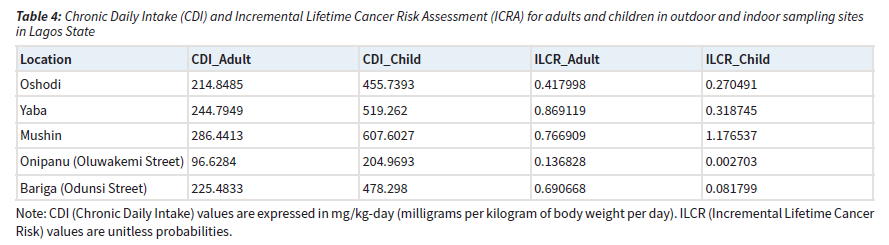
Table 4 presents the Chronic Daily Intake (CDI) and Incremental Lifetime Cancer Risk (ILCR) values calculated for both adults and children across the five sampling locations in Lagos State. CDI estimates the average daily intake of heavy metals through dust ingestion, while ILCR estimates the lifetime risk of developing cancer due to that exposure. Across all locations, children generally showed higher CDI and ILCR values than adults, reflecting their greater susceptibility to dust exposure through hand-to-mouth behavior and lower body weight. The highest values for both CDI and ILCR were observed in Mushin, where children's ILCR reached 1.176537, and adults reached 0.766909, both significantly exceeding the U.S. EPA's acceptable cancer risk threshold of 1 χ 10-4 (0.0001). Other locations such as Yaba and Bariga (Odunsi Street) also demonstrated elevated ILCRs for both adults (0.869119 and 0.690668, respectively) and children (0.318745 and 0.081799, respectively). However, at the Bariga site, the adult ILCR was higher than the child ILCR, representing a localized anomaly that warrants further investigation but does not contradict the overall pattern of elevated risk. These results indicate an unacceptable cancer risk at all sites, with no ILCR value falling within the EPA's safe range. Even at the location in Onipanu (Oluwakemi Street), which recorded the lowest values (adult ILCR = 0.136828, child ILCR = 0.002703), the cancer risk remains above the 1-in-a-million safety level. Although relatively lower than in other areas, these results still call for caution, particularly in environments presumed to be safe. Overall, the findings clearly demonstrate a potentially high cancer risk from chronic exposure to heavy metal-contaminated dust in all sampled locations, with children at disproportionately greater risk in most areas. This underscores the urgent need for localized mitigation measures, including improved indoor air quality controls, public health education, and stricter regulations on emissions and waste management in Lagos State.
Conclusion
This study confirmed the presence and concentration of 34 elemental components in atmospheric dust collected from both outdoor (roadside) and indoor environments across five distinct geographic areas in Lagos State, Nigeria, using Inductively Coupled Plasma Optical Emission Spectroscopy (ICP-OES). The analysis revealed measurable levels of toxic metals, including lead (Pb) and cadmium (Cd), well above safe exposure thresholds set by international standards. These findings establish the presence, not merely the possibility, of hazardous metal pollutants in urban dust. Statistical analyses, including PCA, correlation matrices, and risk assessments, provided deeper insights into pollution patterns. PCA revealed five dominant components contributing to the variance in metal concentrations, suggesting multiple pollution sources such as industrial emissions, traffic exhaust, and waste incineration. Strong positive correlations among metals such as Cu, Ni, Pb, and Zn suggest common anthropogenic origins. Furthermore, the health risk assessment indicated that the incremental lifetime cancer risk (ILCR) for children and adults in several locations exceeded the U.S. EPA's acceptable risk range (10-6-10-4), highlighting significant long-term health risks.
Lagos State's current environmental policy framework emphasizes broad air quality monitoring and urban sustainability initiatives. However, it lacks localized, elemental-specific data necessary for targeted pollution control. This study bridges that gap by providing area-specific, quantitative data that can directly inform the development of more focused interventions. The findings support the urgent need for stricter regulation of industrial emissions, improved urban planning, and the implementation of localized air quality monitoring programs. Ultimately, this research contributes critical baseline data that can aid Lagos State's policymakers, urban planners, and environmental agencies in enhancing existing air quality management strategies. To further improve pollution control efforts, future research should broaden geographic coverage, apply real-time monitoring techniques, and use source apportionment models to more precisely identify pollution contributors. Continuous environmental surveillance and data-driven policy adjustments will be key to protecting public health and promoting a cleaner, safer urban environment in Lagos.
Declaration of competing interest
The authors state that none of their known financial interests or interpersonal connections could have influenced the work published in this paper.
Data availability
Information will be provided upon request.
Funding information
Sponsored in part by the organizations that the authors represent.
Consent to publish
We agree to have the manuscript published.
Acknowledgements
We are grateful to the university administration for creating the conducive environment needed to conduct the research.
References
Al-Khashman, O.A., 2007. The investigation of metal concentrations in street dust samples in Aqaba city, Jordan. Environmental Geochemistry and Health, 29, pp.197-207. [ Links ]
Alloway, B.J., 2013. Sources of Heavy Metals and Metalloids in Soils. In: Heavy Metals in Soils. Springer, pp.11-50. [ Links ]
Antsiferova, M., Piwko-Czuchra, A., Cangkrama, M., Wietecha, M., Sahin, D., Birkner, K., Amann, V.C., Levesque, M., Hohl, D., Dummer, R. and Werner, S., 2017. Activin promotes skin carcinogenesis by attraction and reprogramming of macrophages. EMBO Molecular Medicine, 9(1), pp.27-45. doi:10.15252/emmm.201606493. [ Links ]
Archibald, F., 1983. Lactobacillus plantarum, an organism not requiring iron. FEMS Microbiology Letters, 19(1), pp.29-32. doi:10.1111/j.1574-6968.1983.tb00504.x. [ Links ]
Armiento, G., Bellatrecca, F., Cremsini, C., Venture, G.D., Nardi, E. and Pacifico, R., 2013. Beryllium natural background concentration and mobility: a reappraisal examining the case of high Be-bearing pyroclastic rocks. [ Links ]
ATSDR (Agency for Toxic Substances and Disease Registry), 1993. Toxicological Profile for Beryllium. U.S. Department of Health and Human Services. [ Links ]
ATSDR (Agency for Toxic Substances and Disease Registry), 2005. Toxicological Profile for Nickel. U.S. Department of Health and Human Services. [ Links ]
Bawuro, A., Voegborlo, R. and Adimado, A., 2018. Bioaccumulation of heavy metals in some tissues of fish in Lake Geriyo, Adamawa State, Nigeria. Journal of Environmental and Public Health, 2018(1), pp.1-7. [ Links ]
Chakraborty, P., Prithiviraj, B., Selvaraj, S. and Kumar, B., 2016. Polychlorinated biphenyls in settled dust from informal electronic waste recycling workshops and nearby highways. [ Links ]
Charlesworth, S., Everett, M., McCarthy, R., Ordóñez, A. and De Miguel, E., 2003. A comparative study of heavy metal concentration and distribution in deposited street dusts in a large and a small urban area: Birmingham and Coventry, West Midlands, UK. Environment International, 29(5), pp.563-573. [ Links ]
Christoforidis, A. and Stamatis, N., 2009. Heavy metal contamination in street dust and roadside soil along the major national road in Kavala's region, Greece. Geoderma, 151(3-4), pp.257-263. [ Links ]
Coen, N., Mothersill, C., Kadhim, M. and Wright, E.G., 2001. Heavy metals of relevance to human health induce genomic instability. Journal of Pathology, 195(3), pp.293-299. [ Links ]
Costa, L.G., Cole, T.B., Coburn, J., Chang, Y.C., Dao, K. and Roqué, P.J., 2017. Neurotoxicity of traffic-related air pollution. Neurotoxicology, 59, pp.133-139. doi:10.1016/j. neuro.2015.11.008. [ Links ]
De Miguel, E., Llamas, J.F., Chacón, E., Berg, T., Larssen, S., Royset, O. and Vadset, M., 1997. Origin and patterns of distribution of trace elements in street dust: unleaded petrol and urban lead. Atmospheric Environment, 31, pp.2733-2740. [ Links ]
Doe, J., Smith, A. and Johnson, M., 2023. Atmospheric Dust: A Global Perspective. Journal of Atmospheric Science, 35(4), pp.567-589. [ Links ]
Ediagbonya, T.F., 2016. Enrichment factor of atmospheric trace metals using zirconium, titanium, iron and copper as reference elements. Nigerian Journal of Technology, 35(4), pp.785-795. [ Links ]
Ediagbonya, T.F., Ogunjobi, A.J. and Osomo, T.S., 2021. Effect of highway particulate matter on selected grass species around Oluwa Forest Reserve. Journal of Aerosol Science and Engineering, 5(1), pp.1-12. [ Links ]
Ediagbonya, T.F., Ogunjobi, J.A. and Olutayo, O.O., 2020. Effect of quarry activities on selected biological resources around quarry site within Onigambari forest plantation, Oyo State, Nigeria. Environmental Geochemistry and Health, 42(2), pp.1-13. [ Links ]
Ediagbonya, T.F., Okungbowa, E.G. and Titilayo, O., 2020. Background study of natural radioactivity in soil. Journal of Chemical Society of Nigeria, 45(2), pp.290-298. [ Links ]
Ediagbonya, T.F., Omotade, E.T. and Iranse, B.O., 2021. Investigation of heavy metal accumulation in soil using proton-induced X-ray emission. Environmental Geochemistry and Health, 43(2), pp.1-12. [ Links ]
Ediagbonya, T.F., Oyinlusi, O.C., Okungbowa, E.G. and Uche, I.J., 2022. Environmental and human health risk assessments of polycyclic aromatic hydrocarbons in particulate matter in Okitipupa, Ondo State, Nigeria. Environmental Monitoring and Assessment, 194(9), p.556. [ Links ]
Ediagbonya, T.F., Tobin, A.E., Ehidiamen, G., Asogun, D.A. and Uwidia, I.E., 2015. Heterotrophic bacteria and some selected heavy metals in rainwater harvesting system in Usugbenu, Edo State. Biological and Environmental Sciences Journal for the Tropics, 12(2), pp.795-801. [ Links ]
Ediagbonya, T.F., Tobin, A.E., Olumayede, E.G., Okungbwa, G.E. and Iyekowa, O., 2016. The determination of exposure to total, inhalable and respirable particles in welders in Benin City, Edo State. Journal of Pollution Effects & Control, 4(1), pp.1-6. [ Links ]
Ediagbonya, T.F., Tobin, A.E., Olumese, E.E., Asagba, U.E., Uwidia, I.E. and Osarumwensee, O.P., 2013. Spatial distribution of respirable and inhalable particulate matter concentration in sawmills of south-south region of Nigeria. Environmental Skeptics and Critics, 2(2), pp.63-72. [ Links ]
Ediagbonya, T.F., Tobin, A.E., Ukpebor, E.E. and Okieimen, F.E., 2015. Impact of aerosol on respiratory symptoms among adults (above eighteen years) in an urban area of Nigeria. Scientia Africana, 14(2), pp.1-12. [ Links ]
Ediagbonya, T.F., Tobin, A.E., Ukpebor, E.E. and Okieimen, F.E., 2015. An assessment of respiratory symptoms from inhalation of particulate matter in urban and rural areas of Nigeria. Journal of Chemical, Biological and Physical Sciences, 5(2), pp.1185-1194. [ Links ]
Ediagbonya, T.F., Ukpebor, E.E. and Okieimen, F.E., 2013. The influence of meteorological parameters on respirable and inhalable particles during wet season. Journal of Applied Sciences and Environmental Management, 17(4), pp.441-444. [ Links ]
Ediagbonya, T.F., Ukpebor, E.E. and Okieimen, F.E., 2014. Analysis of seasonal variation of atmospheric total suspended particulate in Sapele (urban area) of Delta State, Nigeria. Nigerian Journal of Scientific Research, 13(1), pp.56-63. [ Links ]
Ediagbonya, T.F., Ukpebor, E.E., Okieimen, F.E. and Unuabonah, E.I., 2015. The synergy between meteorological parameters and the total suspended particles in the atmosphere using polynomial as model. Nigerian Journal of Basic and Applied Science, 23(2), pp.103-109. [ Links ]
Ediagbonya, T.F., Ukpebor, E.E., Okiemien, F.E. and Akojivi, V.O., 2013. Selected trace metals analysis of total suspended particulate matter in rural area in Edo State, Nigeria. Greener Journal of Environmental Management and Public Health, 2(2), pp.91-98. [ Links ]
Ediagbonya, T.F., Ukpebor, E.E., Okiemien, F.E. and Okungbowa, G.E., 2016. Spatial and temporal variation of particulate matter (TSP, PM10, PM25) in urban and rural areas of Niger Delta region, Nigeria. FUTA Journal of Research in Science, 14(1), pp.9-22. [ Links ]
Faiz, Y., Tufail, M., Javed, M.T., Chaudhry, M.M. and Siddique, N., 2009. Road dust pollution of Cd, Cu, Ni, Pb and Zn along Islamabad Expressway, Pakistan. Microchemical Journal, 92, pp.186-195. [ Links ]
Gupta, D., Kim, H., Park, G., Li, X., Eom, H.J. and Ro, C.U., 2015. Hygroscopic properties of NaCl and NaNO3 mixture particles as reacted inorganic sea-salt aerosol surrogates. Atmospheric Chemistry and Physics, 15, pp.3379-3393. [ Links ]
Iwegbue, C.M.A., Obi, G., Emoyan, O.O., Odali, E.W., Egobuezec, F.E., Tesia, G.O. and Nwajei, G.E., 2018. Characterization of metals in indoor dusts from electronic workshops, cybercafés and offices in southern Nigeria: Implications for on-site human exposure. Ecotoxicology and Environmental Safety, 159, pp.342-353. [ Links ]
Iwegbue, C.M.A., Oliseyenum, E.C. and Martincigh, B.S., 2017. Spatio-temporal distribution of metals in household dust from rural, semi-urban and urban environments in the Niger Delta, Nigeria. Environmental Science and Pollution Research, 24(16), pp.14040-14059. [ Links ]
Jiries, A., 2003. Vehicular contamination of dust in Amman, Jordan. The Environmentalist, 23, pp.205-210. https://doi.org/10.1023/B:ENVR.0000017390.93161.99 [ Links ]
Jomova, K. and Valko, M., 2010. Advances in metal-induced oxidative stress and human disease. Toxicology, 283, pp.65-87. [ Links ]
Keith, S., Jones, D., Rosemond, Z., Ingerman, L. and Chappell, L., 2008. Potential for human exposure. In: Toxicological Profile for Aluminum, pp.175-227. [ Links ]
Khan, R.K. and Strand, M.A., 2018. Road dust and its effect on human health: A literature review. Epidemiology and Health, 40, e2018013. [ Links ]
Kline, R.B., 2015. Principles and Practice of Structural Equation Modeling. New York: Guilford Publications. [ Links ]
Lawal, A.O., Batagarawa, S.M., Oyeyinka, O.D. and Lawal, M.O., 2011. Estimation of heavy metals in Neem tree leaves along Katsina-Dutsinma-Funtua Highway in Katsina State of Nigeria. Journal of Applied Sciences and Environmental Management, 15(2), pp.327-330. [ Links ]
Lelieveld, J., Evans, J.S., Fnais, M., Giannadaki, D. and Pozzer, A., 2015. The contribution of outdoor air pollution sources to premature mortality on a global scale. Nature, 525, pp.367-371. [ Links ]
Li, N., Han, W., Tang, J., Bian, J., Sun, S. and Song, T., 2018. Pollution characteristics and human health risks of elements in road dust in Changchun, China. International Journal of Environmental Research and Public Health, 15(9), p.1843. [ Links ]
Mohsen, S., Loretta, Y.L. and Mahdiyeh, S., 2012. Heavy metals and polycyclic aromatic hydrocarbons: Pollution and ecological risk assessment in street dust of Tehran. Journal of Hazardous Materials, 227-228, pp.9-17. [ Links ]
Monikh, F.A. et al., 2014. Source apportionment of heavy metals in street dust of Tehran using positive matrix factorization. Environmental Monitoring and Assessment, 186(3), pp.1491-1500. [ Links ]
Radojevic, M. and Bashkin, V.N., 1999. Practical Environmental Analysis. Cambridge, UK: Royal Society of Chemistry, p.466. [ Links ]
Rasmussen, P.E., Subramanian, K.S. and Jessiman, B.J., 2001. A multi-element profile of house dust in relation to exterior dust and soils in the city of Ottawa, Canada. Science of the Total Environment, 267, pp.125-140. [ Links ]
Tran, V.V., Park, D. and Lee, Y.C., 2020. Indoor air pollution, related human diseases, and recent trends in the control and improvement of indoor air quality. International Journal of Environmental Research and Public Health, 17(8), p.2927. https://doi.org/10.3390/ijerph17082927 [ Links ]
Violante, V., Cozzolino, L., Perelomov, A.G., Caporale, M. and Pigna, M., 2010. Mobility and bioavailability of heavy metals and metalloids in soil environments. Journal of Soil Science and Plant Nutrition, 10(3), pp.268-292. [ Links ]
Wang, S.X., Zhao, Y., Chen, G.C., Wang, F., Aunan, K. and Hao, J.M., 2008. Assessment of population exposure to particulate matter pollution in Chongqing, China. Environmental Pollution, 153, pp.247-256. [ Links ]
Wang, W., Liu, M., Wang, T., Song, Y. and Ge, M., 2021. Sulfate formation is dominated by manganese-catalyzed oxidation of SO2 on aerosol surfaces during haze events. Nature Communications, 12, p.1993. [ Links ]
Zhong, X., Chen, Z., Li, Y., Ding, K., Liu, W., Liu, Y., Yuan, Y., Baker, J.M., Yang, W., Fei, Y., Wang, Y., Chao, Y. and Qiu, R., 2020. Factors influencing heavy metal availability and risk assessment of soils at typical metal mines in Eastern China. Journal of Hazardous Materials, 400, p.123289. [ Links ]
Received: 21 March 2024
Reviewed: 9 April 2025
Accepted: 3 December 2025
* Corresponding author: tf.ediagbonya@oaustech.edu.ng, tf.ediagbonya@gmail.com, thmpson.faraday@unilak.rw.ac