




Services on Demand
Journal

Article
 English (pdf)
 Article in xml format
 Article references

 Automatic translation
 Send this article by e-mail
Indicators
Related links
-
 Cited by Google
-
 Similars in Google
Share

 Permalink

African Human Mobility Review
On-line version ISSN 2410-7972Print version ISSN 2411-6955
AHMR vol.12 n.2 Cape Town 2026
https://doi.org/10.14426/ardned08
ARTICLES
Childhood Experiences, Self-Efficacy, and Migration Aspirations Among African Youth: A Systematic Review and Meta-Analysis
Supreme Edwin AsareI; Edmond Akwasi AgyemangII; Michael AddaneyIII; Kofi Takyi AsanteIV
IPhD candidate, Centre for Migration Studies, University of Ghana, Legon, Ghana. Corresponding author: kdztrains@gmail.com
IIDirectorate of Research, International Programmes and Institutional Advancement (DRIPIA), Department of Interdisciplinary Studies, Faculty of Education and Communication Sciences, Akenten Appiah Menka University, Kumasi, Ghana
IIIDepartment of Land Management, University of Energy and Natural Resources, Sunyani, Ghana
IVInstitute of Statistical, Social and Economic Research (ISSER), University of Ghana, Legon, Ghana
ABSTRACT
Understanding the developmental antecedents of migration aspirations is critical for evidence-based migration governance in Africa. While structural factors driving irregular migration are well-documented, the role of childhood experiences in shaping youth migration aspirations remains underexplored. This systematic review synthesizes evidence on the relationships between adverse and positive childhood experiences, self-efficacy, and migration aspirations among African youth. Following PRISMA 2020 guidelines, we searched Scopus, Web of Science, PubMed, Google Scholar, African Journals Online (AJOL), and Directory of Open Access Journals (DOAJ) for peer-reviewed studies published between January 2015 and December 2025. Inclusion criteria required empirical studies examining relationships between childhood experiences and migration aspirations among African populations. For the quality appraisal, we used the Mixed Methods Appraisal Tool (MMAT). A random-effects meta-analysis was conducted when sufficient homogeneous studies were available for pooling. Of the 4,041 identified records, 68 studies met the inclusion criteria, of which 42 contributed to the quantitative synthesis. Adverse childhood experiences were positively associated with migration aspirations (pooled OR = 1.67, 95% CI: 1.32-2.11, k = 28), while positive childhood experiences showed protective effects (pooled OR = 0.58, 95% CI: 0.41-0.82, k = 19). Across k = 7 studies providing mediation data, self-efficacy was associated with 34-47% of the observed association between childhood experiences and migration aspirations, suggesting a candidate pathway requiring longitudinal verification. Migration narratives from family, peers, and digital media moderated these relationships, amplifying aspirations among youth with moderate self-efficacy. Geographic concentration in West Africa (Ghana, Nigeria, Senegal) and methodological heterogeneity limit generalizability. Findings support life-course approaches to migration governance that address childhood adversity as an upstream determinant of migration aspirations. Policy recommendations include strengthening child protection systems in high-emigration areas, developing youth self-efficacy programs, and integrating balanced migration information into educational curricula. Future research should prioritize longitudinal designs and expand geographic coverage beyond West Africa.
Keywords: Migration aspirations, adverse childhood experiences, self-efficacy, Africa, systematic review, life-course, youth mobility
INTRODUCTION
Migration in Africa is a predominantly intra-African phenomenon. The International Organization for Migration (IOM, 2024) data indicate that the majority of African migrants reside within the continent, with major corridors connecting West African countries, southern African labor migration circuits, and East African cross-border mobility. International migration beyond the continent represents a statistically smaller but disproportionately studied share of African mobility. Within this larger category, irregular movement toward Europe through the Central Mediterranean Route has attracted sustained policy attention: the IOM documents over 28,000 recorded deaths on this route since 2014, underscoring the risks associated with unauthorized movement. Despite sustained deterrence efforts, risk awareness campaigns, and policy interventions, irregular migration continues to attract significant numbers of young Africans. The persistence of both intra-continental and international aspirations raises critical questions about how migration aspirations are formed, normalized, and sustained over time, particularly in contexts where risks are widely acknowledged yet do not function as sufficient deterrents.
Research from Ghana and across the West African migration corridor has documented the deep cultural embedding of migration within local social structures. Teye and Yebleh (2020) demonstrate that in high-emigration communities of the Bono and Bono East regions, migration functions as a normative pathway to adulthood, social recognition, and masculine identity. Awumbila and colleagues (2019) show that remittance-dependent households actively socialize children into migration expectations, creating intergenerational transmission of mobility aspirations. Kandilige and Adiku (2020) document how returnee reintegration challenges in Ghana's migration-prone districts reinforce rather than diminish community-level migration cultures, as returnees' accounts are selectively interpreted to maintain optimistic migration narratives.
These findings establish that migration aspirations in African contexts are socially produced through childhood and adolescent socialization rather than emerging spontaneously at the point of departure. A growing body of empirical research challenges the assumption that migration aspirations originate solely in adulthood. Ethnographic and qualitative studies across Africa demonstrate that ideas about migration often take shape much earlier, embedded within childhood and adolescent socialization processes. Thorsen (2014) shows how adolescent boys in Burkina Faso internalized migration as a culturally sanctioned pathway to masculinity through peer narratives and community rituals. In Ghana, Hashim and Thorsen (2011) found that even non-migrant children anticipated future migration, particularly in households characterized by economic strain or prior migration experience. More recently, Crivello (2015) documented through longitudinal research in Ethiopia how children's aspirations, including migration intentions, crystallize during middle childhood and remain remarkably stable into adolescence. These studies established that understanding adult migration decision-making requires examining the biographical antecedents formed during earlier developmental periods.
The developmental psychology literature provides theoretical and empirical resources for understanding how early-life experiences shape later decision-making. Research on adverse childhood experiences demonstrates that exposure to trauma, neglect, household dysfunction, and instability during childhood is associated with altered risk perception, diminished future orientation, and increased tolerance for high-risk choices in adulthood (Hughes et al., 2017; Merrick et al., 2019). Conversely, positive childhood experiences, including stable caregiving, mentorship, educational engagement, and community belonging, are associated with resilience, enhanced self-efficacy, and expanded perceptions of locally available opportunities (Traub and Boynton-Jarrett, 2017; Bethell et al., 2019). Emerging research from African contexts suggests these patterns apply to migration outcomes. Bah and Batista (2024) demonstrate that Gambian youth with histories of childhood adversity show elevated willingness to undertake dangerous migration despite awareness of risks. Lloyd et al. (2022) provide experimental evidence that adverse childhood experiences alter reward processing and risk calculation in ways that may increase susceptibility to high-variance choices, such as irregular migration.
Self-efficacy theory provides a mechanism linking childhood experiences to migration decision-making. Bandura's (1997) concept of self-efficacy, defined as beliefs about one's capability to execute courses of action required to achieve desired outcomes, develops through mastery experiences, vicarious learning, social feedback, and physiological states during childhood and adolescence. Recent applications of self-efficacy frameworks to African migration contexts have shown promising results. Schewel and Fransen (2022) demonstrate that Ethiopian youth with higher self-efficacy are more likely to act on migration aspirations, while Flahaux (2022) shows that Senegalese returnees with diminished self-efficacy following migration failure are particularly vulnerable to re-migrating. The relationship between self-efficacy and migration aspirations appears conditional on perceived local opportunity structures, with self-efficacy operating protectively where local pathways are perceived as viable but amplifying migration aspirations where local opportunities are blocked (Van Hear et al., 2018).
Digital media has emerged as an increasingly important factor shaping African youth migration aspirations. Birkvad (2019) documents how Senegalese youth construct migration imaginaries through selective engagement with social media content depicting diaspora success. Schans and Optekamp (2022) maintain that digital platforms enable the circulation of curated migration narratives that systematically over-represent success while filtering out accounts of failure. Recent work by Adegoke (2023) and Vorvornator (2025) shows that Ghanaian youth in high-emigration areas engage with migration-related content daily through WhatsApp, TikTok, and Facebook, shaping their perceptions of migration feasibility and desirability. These digital environments interact with childhood experiences and self-efficacy in complex ways that existing theoretical frameworks only partially capture.
This review and meta-analysis address this gap by synthesizing empirical evidence on the relationships between childhood experiences, self-efficacy, and migration aspirations among African youth. Guided by PRISMA 2020 standards, we address three explicit research questions: (a) What is the nature and strength of associations between adverse and positive childhood experiences and migration aspirations among African youth? (b) Does self-efficacy function as a mediating pathway between childhood experiences and migration aspirations, and what is the evidence for this mechanism? (c) How do migration narratives from family, peers, and digital media interact with childhood experiences and self-efficacy to shape aspiration formation? By integrating life-course theory with the aspirations-capabilities framework, this review contributes a developmentally informed perspective to African migration scholarship and generates recommendations for migration governance and youth development programming that are proportionate to the strength of available evidence.
METHODOLOGY
Protocol and registration
This systematic review was conducted in accordance with the Preferred Reporting Items for Systematic Reviews and Meta-Analyses (PRISMA) 2020 guidelines (Page et al., 2021). The review protocol was developed for database searches and followed established methodological standards for systematic reviews in migration studies.
Eligibility criteria
Studies were included if they met several distinct criteria. First, empirical research design: quantitative, qualitative, or mixed methods. Second, examination of relationships between childhood or early-life experiences and migration aspirations, intentions, or related constructs. Childhood and early-life experiences are defined in this review as exposures occurring from birth to age 18, encompassing: (a) adverse experiences including abuse, neglect, household dysfunction, parental absence, economic hardship, child fostering, and educational disruption; and (b) positive experiences including stable caregiving, mentorship, school belonging, community participation, and economic security. These are treated as conceptually distinct constructs with potentially different mechanisms; exposure type was examined as a moderating variable in subgroup analyses. "Related constructs" in migration outcomes refer specifically to: stated desire or willingness to migrate (aspirations); concrete plans to migrate within a defined period (intentions); and preparatory actions such as savings, social network activation, or visa applications (preparatory behavior). These outcome types were examined in moderator analysis, given established differences in their theoretical standing.
Third, studies focused on African populations either in African countries or African-origin populations abroad, where the latter were eligible only if they examined pre-migration aspiration formation or re-migration aspiration rather than post-migration integration outcomes.
Fourth, published in peer-reviewed journals between January 2015 and December 2025. The 2015 start date was chosen to align with the period of heightened scholarly attention to African migration aspirations following the Mediterranean migration crisis and the introduction of ACE (Adverse Childhood Experiences) frameworks into migration scholarship. The peer-reviewed criterion enables consistent quality appraisal using the Mixed Methods Appraisal Tool (MMAT) but is acknowledged as a limitation that compounds publication bias risk, given the substantial empirical migration literature in gray sources, including IOM reports and institutional working papers.
Fifth, available in English or French. French-language terms were included in all database searches; the African Journals Online (AJOL) was searched in both English and French. Arabic- and Portuguese-language databases were not searched, limiting representation of North African and Lusophone African scholarship. Studies were excluded if they: (a) did not include empirical data; (b) focused exclusively on forced displacement or asylum seeking without examining aspiration formation; (c) examined only post-migration adaptation without reference to aspiration formation; or (d) lacked sufficient methodological information to assess quality, defined as absence of reporting across two or more of: research design, data collection method, sample characteristics, and at least one relevant outcome measure. Seven studies were excluded on criterion 4; this criterion was applied independently by two reviewers, with disagreements (n = 2) resolved through discussion with the third reviewer.
Information sources and search strategy
Systematic searches were conducted across six databases: Scopus, Web of Science, PubMed, Google Scholar (first 200 results), African Journals Online (AJOL), and Directory of Open Access Journals (DOAJ). Search strings combined terms across three domains: (1) childhood experiences (adverse childhood experiences, OR positive childhood experiences, OR childhood adversity, OR childhood trauma, OR child abuse, OR child neglect, OR parental absence, OR child fostering, OR household dysfunction); (2) migration constructs (migration aspirations OR migration intentions, OR emigration, OR irregular migration, OR youth mobility, OR desire to migrate); and (3) geographic focus (Africa OR African OR West Africa OR sub-Saharan). Database-specific syntax adaptations were applied. Searches were conducted between October and November 2025, with final updates in December 2025. Reference lists of included studies and relevant reviews were manually searched to identify additional eligible records.
Selection process
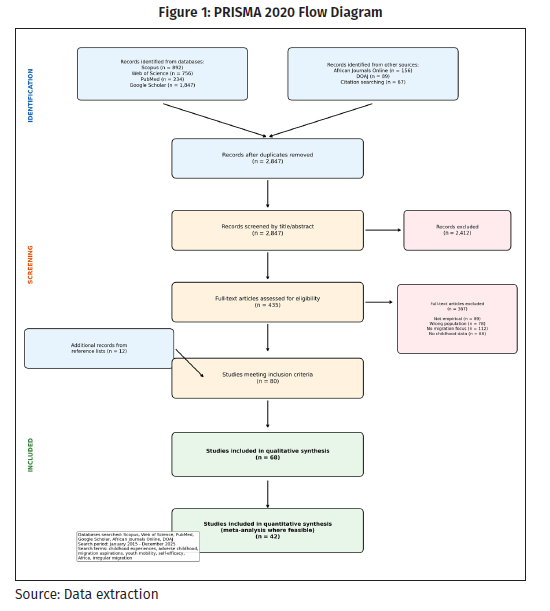
Retrieved records were imported into the Rayyan systematic review software and deduplicated. Title and abstract screening were conducted independently by two reviewers using pre-specified inclusion criteria. Disagreements were resolved through discussion, with a third reviewer consulted for unresolved cases. Full texts of potentially eligible studies were retrieved and assessed against the inclusion criteria by both reviewers. The selection process is documented in the PRISMA flow diagram (Figure 1).
Data were extracted using a standardized form capturing: study identification (authors, year, country, publication); study characteristics (design, sample size, population, setting); childhood experience measures (ACEs, Positive Childhood Experiences (PCEs), specific adversities); migration outcome measures (aspirations, intentions, preparations); self-efficacy and agency measures; narrative exposure measures; statistical associations and effect sizes; and qualitative findings. For quantitative studies, we extracted odds ratios, correlation coefficients, regression coefficients, and 95% confidence intervals where reported, or calculated these from available data where possible.
Quality appraisal
Methodological quality was assessed using the Mixed Methods Appraisal Tool (MMAT) version 2018 (Hong et al., 2018), which provides category-specific criteria for quantitative, qualitative, and mixed-methods studies. Two reviewers independently appraised each study, with disagreements resolved through discussion. Quality scores informed sensitivity analyses but did not determine inclusion, consistent with recommendations for comprehensive systematic reviews (Petticrew and Roberts, 2006).
Synthesis methods
Quantitative synthesis employed random-effects meta-analysis where three or more studies reported comparable effect sizes for similar constructs. Odds ratios were the primary effect measure; where studies reported other metrics, conversions were applied using established formulas. Heterogeneity was assessed using I-squared statistics and Cochran's Q test. Subgroup analyses examined variation by geographic region, study design, and population characteristics. Publication bias was assessed using funnel plots and Egger's regression test. Where meta-analysis was not feasible due to heterogeneity or insufficient studies, narrative synthesis following the Synthesis Without Meta-analysis (SWiM) guidelines was conducted (Campbell et al., 2020). Qualitative findings were synthesized thematically, with attention to convergence and divergence with quantitative patterns.
RESULTS
Study selection
Database searches identified 4,041 records. After removing 1,194 duplicates, 2,847 records underwent title and abstract screening. Of these, 435 full-text articles were assessed for eligibility. Following full-text review and supplementation with 12 records from reference list searches, 68 studies met the inclusion criteria and were included in the qualitative synthesis. Of these, 42 studies provided sufficient quantitative data for inclusion in meta-analytic synthesis. Figure 1 presents the PRISMA flow diagram detailing the selection process.
Study characteristics
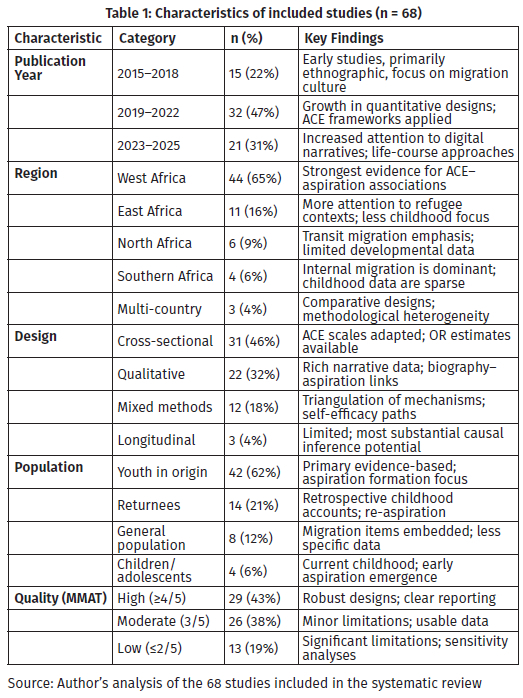
Of the 68 included studies, 42 provided sufficient quantitative data for meta-analytic synthesis. The remaining 26 studies contributed to qualitative synthesis only. These comprised 18 purely qualitative studies using interviews, ethnography, or narrative methods; five mixed-methods studies where the quantitative component lacked sufficient reporting for effect size extraction; and three quantitative studies reporting associations in forms that could not be converted to odds ratios. Compared to the 42 meta-analytic studies, the 26 qualitative synthesis-only studies were more likely to be qualitative in design (69% vs. 0%), more likely to be located in West Africa (71% vs. 62%), and more likely to have been published before 2020 (54% vs. 36%). They were less likely to use validated ACE instruments. These differences suggest the meta-analytic subset may over-represent more recent, instrument-based research; this representativeness constraint should be considered when interpreting pooled estimates.
Adverse childhood experiences and migration aspirations
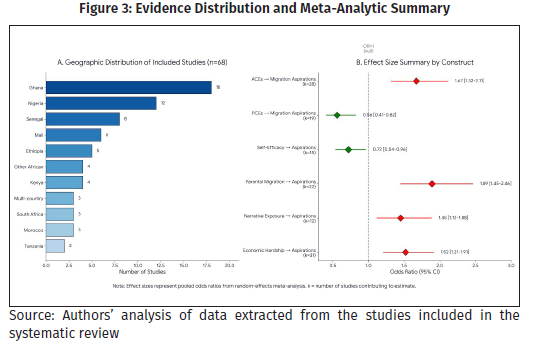
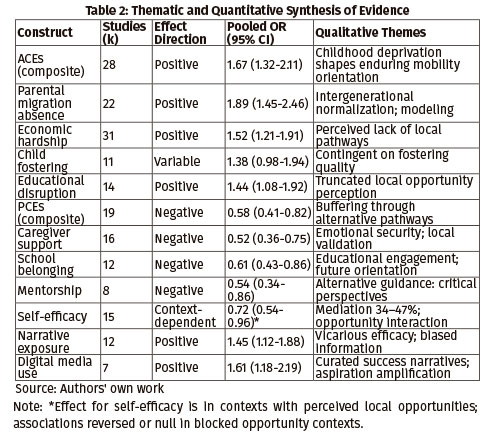
Twenty-eight studies examined relationships between adverse childhood experiences and migration aspirations, with sufficient methodological homogeneity to permit meta-analysis. Random-effects meta-analysis yielded a pooled odds ratio of 1.67 (95% CI: 1.32-2.11, p < 0.001), indicating that individuals reporting higher levels of childhood adversity had significantly higher migration aspirations than those with lower exposure to childhood adversity. Heterogeneity was moderate (I2 = 58%, Q = 64.3, p < 0.01), suggesting meaningful variation across studies.
Specific types of adversity showed varying effect magnitudes. Parental absence due to migration was most strongly associated with offspring migration aspirations (pooled OR = 1.89, 95% CI: 1.45-2.46, k = 22), consistent with intergenerational transmission of migration as a normalized livelihood strategy. Economic hardship during childhood showed robust positive associations (pooled OR = 1.52, 95% CI: 1.21-1.91, k = 31). Child fostering experiences, common across West African contexts, showed positive but more variable associations (pooled OR = 1.38, 95% CI: 0.98-1.94, k = 11), with effects contingent on fostering quality and duration. Emotional neglect and household instability showed consistent positive associations in qualitative accounts, though quantitative data were sparser.
Subgroup analyses revealed geographic variation. West African studies showed stronger ACE-aspiration associations (pooled OR = 1.82, 95% CI: 1.41-2.35) compared to East African studies (pooled OR = 1.34, 95% CI: 0.91-1.97), potentially reflecting differences in migration culture density and narrative exposure. Studies using validated ACE instruments showed larger effects than those using singleitem or ad hoc adversity measures, suggesting measurement sensitivity influences observed associations.
Positive childhood experiences and migration aspirations
Nineteen studies examined positive childhood experiences in relation to migration aspirations. Meta-analysis yielded a pooled odds ratio of 0.58 (95% CI: 0.41-0.82, p < 0.01), indicating protective effects whereby higher levels of positive childhood experiences were associated with reduced migration aspirations. Heterogeneity was substantial (I2 = 67%), reflecting variation in PCE operationalization across studies. Qualitative synthesis identified specific protective factors. Stable attachment to at least one supportive caregiver consistently emerged as protective, providing emotional security that reduced the pull of migration as an escape. School belonging and educational engagement expanded perceptions of local opportunity, with several studies documenting that youth who felt valued in educational settings were less likely to view migration as necessary for self-actualization. Mentorship relationships with non-parental adults provided alternative sources of guidance and validation. Community belonging and participation in local institutions strengthened identification with place and social ties that migration would sever. Economic stability during childhood, while related to structural factors, also contributed to psychological security and future orientation.
Importantly, PCEs and ACEs were not simply opposite poles of a single dimension. Several studies have documented that youth experiencing both significant adversity and protective factors show attenuated aspiration effects compared with those experiencing adversity alone, suggesting buffering mechanisms. This pattern supports resilience frameworks, emphasizing that protective factors can mitigate the impacts of adversity without eliminating exposure effects.
Self-efficacy as mediating mechanism
Fifteen of the 68 included studies examined self-efficacy in relation to childhood experiences, migration aspirations, or both. Seven of these 15 provided formal mediation data adequate for synthesis; the pooled mediation estimates reported below are drawn from this subset (k = 7). Readers should note that the mediation pathway, while consistent across these studies, rests on a relatively small evidence base. Self-efficacy showed complex relationships with migration aspirations, depending on perceived local opportunity structures. General self-efficacy was negatively associated with migration aspirations in contexts where local opportunities were perceived as accessible (pooled OR = 0.72, 95% CI: 0.54-0.96, k = 7), suggesting that confident youth directed agency toward local pathways.
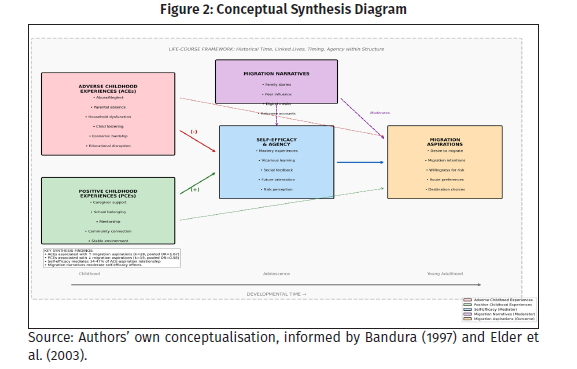
However, in contexts of severely constrained local opportunity, self-efficacy showed non-significant or positive associations with migration aspirations, as confident youth directed agency toward migration as the most promising available arena for capability deployment. Mediation analyses across the seven studies estimated that self-efficacy mediated between 34% and 47% of the association between childhood adversity and migration aspirations. Adverse childhood experiences were associated with lower self-efficacy development; lower self-efficacy was in turn associated with higher susceptibility to migration aspirations, particularly when migration was framed as achievable through collective support and established networks. These mediation estimates are cross-sectional and should be understood as candidate pathways for longitudinal investigation rather than established causal mechanisms.
Migration narratives and moderation effects
Twelve studies examined how migration narratives from family, peers, and digital media interact with developmental factors to shape aspirations. Narrative exposure was positively associated with migration aspirations (pooled OR = 1.45, 95% CI: 1.12-1.88, k = 12), but self-efficacy levels moderated this association. Among youth with moderate self-efficacy, narrative exposure substantially amplified migration aspirations, as success stories provided vicarious efficacy information suggesting migration was achievable. Among youth with very low self-efficacy, narrative exposure had weaker effects, as even positive migration stories seemed out of reach. Among youth with high self-efficacy and access to local opportunities, narrative exposure had a limited impact on aspirations. Digital media emerged as an increasingly important narrative channel in recent studies. Social media platforms circulated curated success narratives while filtering out accounts of failure, creating systematically biased information environments. Youth with limited alternative information sources were particularly susceptible to these biased narratives. However, digital platforms also enabled access to risk information and counter-narratives, with effects depending on platform usage patterns and information-seeking behaviors.
Thematic synthesis of qualitative evidence
A qualitative synthesis of 34 studies (22 purely qualitative, 12 mixed methods) identified several cross-cutting themes that elaborate on quantitative patterns.
Theme 1: Childhood as a formative period for aspiration crystallization. Qualitative accounts consistently documented that migration aspirations emerged during childhood and adolescence, often before age 15, rather than arising suddenly in adulthood. Early experiences of deprivation, family separation, or exposure to migration success created enduring orientations toward mobility that persisted despite later information about risks.
Theme 2: Self-efficacy as a double-edged phenomenon. Youth narratives revealed that self-efficacy operated differently depending on perceived opportunity structures. For some, high self-efficacy supported the pursuit of local pathways despite challenges. For others, high self-efficacy, combined with blocked local opportunities, intensified migration aspirations, as confident youth sought arenas where their capabilities could yield returns.
Theme 3: Narrative absorption versus critical engagement. Youth varied in how they engaged with migration narratives. Some absorbed success stories uncritically, internalizing migration as the singular path to achievement. Others engaged more critically, weighing multiple accounts and considering risks alongside benefits. Critical engagement was associated with higher education, diverse information sources, and mentorship relationships providing alternative perspectives.
Theme 4: Protective relationships as alternative anchors. Youth who did not develop migration aspirations despite exposure to adversity consistently reported at least one significant protective relationship, whether with a caregiver, an extended family member, a teacher, or a community mentor. These relationships provided alternative sources of validation, belonging, and guidance, reducing the appeal of migration as a route to recognition and success.
DISCUSSION
To our knowledge, no prior systematic review has jointly examined childhood experiences, self-efficacy, and migration aspirations among African youth within a life-course framework. This review synthesizes evidence on these associations across 68 studies and finds that adverse childhood experiences are positively associated with migration aspirations, that positive childhood experiences are inversely associated with migration aspirations, and that self-efficacy represents a candidate mediating pathway between childhood experiences and aspiration formation. The relationship between self-efficacy and migration aspirations depends on perceived local opportunity structures, and migration narratives from family, peers, and digital media moderate these associations. These findings are consistent with life-course perspectives on aspiration formation and carry implications for migration governance and youth development policy, subject to the limitations of a predominantly cross-sectional evidence base.
Childhood adversity and the formation of migration aspirations
The robust positive association between adverse childhood experiences and migration aspirations (pooled OR = 1.67) confirms and extends previous qualitative observations from West African contexts. This finding aligns with Thorsen's (2014) ethnographic work, which documents how Burkinabè youth experiencing deprivation and family disruption developed enduring orientations toward mobility. The powerful effect of parental migration absence (pooled OR = 1.89) supports Mazzucato and Schans's (2011) transnational families framework, which emphasizes how parental migration shapes children's developmental trajectories and future aspirations. The present synthesis demonstrates that this intergenerational transmission operates through multiple mechanisms: direct modeling of migration as a livelihood strategy, normalization of family separation, and exposure to remittance benefits that frame migration as successful. The findings extend the developmental psychology literature on adverse childhood experiences to migration outcomes, an application that has not been systematically examined.
Hughes and colleagues' (2017) meta-analysis established dose-response relationships between ACEs and health outcomes; the present review identifies analogous associative patterns for migration aspirations that warrant similar systematic longitudinal investigation. This extension is theoretically significant because it connects individual developmental trajectories to population-level migration patterns, bridging micro-level psychological processes with macro-level demographic phenomena. The moderate heterogeneity across studies (I2 = 58%) suggests that, while the overall association is robust, contextual factors shape its magnitude and warrant further investigation.
Protective factors and resilience pathways
The inverse associations between positive childhood experiences and migration aspirations and patterns consistent with resilience frameworks were noted, though the protective interpretation requires longitudinal confirmation. This finding aligns with Bethell and colleagues' (2019) demonstration that positive childhood experiences predict better adult outcomes independently of exposure to adversity. The qualitative synthesis revealed that stable caregiver relationships, school belonging, and mentorship offered alternative sources of validation and belonging, reducing the appeal of migration as a means of achieving recognition and success. These findings have important theoretical implications for the aspirations-capabilities framework.
De Haas (2021) conceptualizes migration aspirations as emerging from perceived opportunity structures, but the present review demonstrates that subjective perception of opportunities is itself shaped by developmental experiences. Youth with positive childhood experiences appear to perceive local opportunities more favorably, not necessarily because objective opportunities differ, but because their developmental histories have equipped them with self-efficacy, social connections, and future orientation that make local pathways seem viable. This suggests that the aspirations-capabilities framework would benefit from integration with life-course perspectives that attend to how capabilities and aspiration-relevant perceptions develop over time.
Self-efficacy as a conditional mediating mechanism
The finding that self-efficacy mediates 34-47% of the relationship between childhood adversity and migration aspiration advances understanding of the psychological mechanisms underlying aspiration formation across the seven studies providing formal mediation data (k = 7). This estimate should be interpreted with caution given the limited evidence base. However, this substantial mediation effect indicates that adverse childhood experiences do not directly produce migration aspirations; instead, they operate partially through their effects on self-efficacy development. This finding aligns with Bandura's (1997) theorization that self-efficacy develops through mastery experiences, vicarious learning, and social feedback, all of which may be disrupted by childhood adversity.
The context-dependent nature of self-efficacy's relationship with migration aspirations represents a novel contribution to migration theory. In contexts where local opportunities were perceived as accessible, higher self-efficacy was protective against migration aspirations (pooled OR = 0.72), as confident youth directed their capabilities toward local pathways. However, in blocked opportunity contexts, self-efficacy showed either no association or a positive association with migration aspirations. This pattern suggests that self-efficacy amplifies engagement with whichever pathways appear most promising, whether local or migratory. This finding extends Schewel and Fransen's (2022) work on Ethiopian youth by demonstrating the moderating role of opportunity structures across multiple African contexts.
Digital narratives and aspiration amplification
The significant association between digital media exposure and migration aspirations (pooled OR = 1.61) confirms emerging qualitative research on social media's role in shaping African youth migration imaginaries. Birkvad (2019) and Schans and Optekamp (2022) documented how digital platforms enable the circulation of curated success narratives that systematically over-represent positive migration outcomes. The present synthesis provides quantitative evidence supporting these observations across multiple studies and contexts. The moderation of narrative effects by self-efficacy levels carries implications for information interventions. Youth with moderate self-efficacy were most susceptible to narrative amplification effects, as success stories provided vicarious efficacy information suggesting migration was achievable for people like themselves. This finding suggests that media literacy interventions may be most effective when targeted at this moderate-efficacy group, enabling critical engagement with migration narratives without undermining self-efficacy that could support local pathways.
Ghana and West Africa within broader African migration dynamics
The concentration of evidence in West Africa, particularly Ghana, reflects both the region's prominence as a migration origin and the development of research infrastructure examining migration dynamics. Teye and Yebleh (2020) and Awumbila and colleagues (2019) have established that Ghana's Bono and Bono East regions represent particularly dense migration cultures where mobility is deeply embedded in social structures. The stronger ACE-aspiration associations observed in West African studies (pooled OR = 1.82) than in East African studies (pooled OR = 1.34) may reflect cultural differences. However, methodological variation across regions cannot be excluded.
The Ghana case illustrates broader patterns while also revealing specificities requiring attention. Ghana is neither conflict-affected nor experiencing economic collapse, yet irregular migration persists, challenging simplistic crisis-driven explanations. The present synthesis suggests that in such contexts, developmental factors operating over the life course may be particularly important in explaining migration aspirations. This finding aligns with the African Union's (2018) recognition that addressing irregular migration requires attention to youth opportunity structures and developmental pathways, not only immediate push factors.
POLICY AND RESEARCH IMPLICATIONS
Evidence synthesized in this review generates several provisional policy directions and research priorities. These recommendations are framed as directions consistent with the correlational associations identified; establishing causal relationships that would fully substantiate them requires the longitudinal research identified in the fifth recommendation.
First, migration governance frameworks should consider life-course perspectives that recognize childhood as a period during which aspirationrelevant dispositions, including self-efficacy and perceptions of local opportunity, are formed. This would require coordination between migration authorities, child welfare agencies, education ministries, and youth development programs. This recommendation is provisional, as the observed associations do not establish that intervening in childhood conditions would alter later migration aspirations.
Second, child protection systems in high-emigration areas warrant strengthening on child welfare grounds, and the associations identified here suggest they may also be relevant upstream factors for migration-aspiration formation. These include addressing parental absence, supporting foster care quality, reducing economic hardship through social protection, and maintaining educational continuity. The evidence is consistent with but does not prove this intervention logic.
Third, youth development programs may benefit from integrating self-efficacy-building with meaningful expansion of local economic and educational opportunities. The evidence base for this recommendation rests primarily on k = 7 mediation studies and should be qualified accordingly. Building self-efficacy without expanding local opportunities may, as the evidence suggests, redirect agency toward migration rather than local pathways.
Fourth, information interventions should move beyond risk awareness toward comprehensive migration literacy that enables critical engagement with narratives, balanced understanding of outcomes, and informed decision-making. This recommendation is supported by evidence on narrative moderation effects and is consistent with an agency-respecting approach to migration governance.
Fifth, future research should prioritize longitudinal cohort designs and structural equation modeling that can test the childhood experience-self-efficacy-aspiration pathway as specified in this review. Such designs would allow mediation analyses with appropriate temporal ordering and would substantially strengthen the evidence base for the policy directions above. Geographic expansion beyond West Africa is needed to assess generalizability. Development and validation of culturally appropriate, age-sensitive measures of childhood experiences and migration aspirations would strengthen future syntheses.
LIMITATIONS
Several limitations warrant acknowledgment. First, geographic concentration in West Africa reflects two distinct sources: genuine concentration of empirical migration-aspiration research in the region, reflecting research infrastructure and funding. It also reflects the review's own language criteria (English and French only), which excluded Arabic-language North African scholarship and Portuguese-language Lusophone African research. Both sources are acknowledged as constraints on generalizability.
Second, reliance on cross-sectional designs in most included studies (n = 31) precludes definitive causal inference; observed associations may reflect unmeasured confounding, recall bias, or reverse causation.
Third, retrospective measurement of childhood experiences in adult populations introduces recall bias, with current aspirations potentially coloring recollection of past experiences.
Fourth, heterogeneity in construct operationalization complicates synthesis; ACE and PCE measures varied substantially, as did migration-aspiration indicators (desires, intentions, preparatory behavior) and, importantly, self-efficacy instruments, which ranged from validated general scales to single-item proxies.
Fifth, some studies contributed multiple effect sizes for different adversity types or subgroups; dependency was addressed through composite effect size selection and three-level models where clustering was substantial, but residual statistical dependency cannot be excluded.
Sixth, the peer-reviewed-only inclusion criterion, while enabling consistent quality appraisal, excludes gray literature, including IOM and World Bank reports and institutional working papers, that contain substantial empirical migration research in African contexts. This criterion compounds publication bias risk beyond what is captured in funnel plot analysis, since published studies systematically over-represent significant findings.
CONCLUSION
This systematic review synthesizes evidence on the associations among childhood experiences, self-efficacy, and migration aspirations in African contexts. The findings are consistent with a life-course perspective on aspiration formation, showing that adverse childhood experiences are positively associated with migration aspirations and that positive childhood experiences are inversely associated with them, with self-efficacy as a candidate mediating pathway. These associations hold across diverse study designs, geographic contexts, and operationalizations of childhood experience, though with meaningful heterogeneity. The evidence is predominantly cross-sectional and retrospective, precluding causal inference. The claim that childhood adversity causes migration aspirations, or that positive experiences prevent them, goes beyond what the reviewed data support. What the evidence does support is that developmental experiences during childhood and adolescence are systematically associated with later aspiration profiles, in ways that warrant longitudinal investigation.
These associations challenge adult-centric approaches to migration governance and support attention to childhood conditions as part of a broader evidence-informed policy agenda. Effective migration governance informed by this evidence would attend to childhood welfare, educational quality, and youth opportunity as components of a comprehensive framework, while acknowledging that the causal mechanisms underlying these associations require further empirical testing before confident intervention claims can be made. Migration aspirations are expressions of individual agency and should not be treated as outcomes to be reduced; the appropriate policy goal is ensuring that aspirations, wherever they lead, are formed based on adequate information, genuine choice, and safe pathways.
ETHICS STATEMENT
This systematic review synthesizes published research and does not involve primary data collection from human subjects. This review was conducted in accordance with PRISMA 2020 guidelines for systematic reviews and meta-analyses.
DECLARATION OF INTERESTS
The authors declare no conflicts of interest.
REFERENCES
Adegoke, Y. 2023. Social media and migration decision-making among Nigerian youth. Journal of Ethnic and Migration Studies, 49(12): 3124-3142. https://doi.org/10.1080/1369183X.2023.2185432 [ Links ]
African Union (AU). 2018. Revised migration policy framework for Africa and plan of action (2018-2030). Addis Ababa : African Union Commission. [ Links ]
Awumbila, M., Deshingkar, P., Kandilige, L., Teye, J.K. and Setrana, M. 2019. Please, let my family survive! Transnational child fostering in Ghana. International Migration Review, 53(4): 1154-1177. https://doi.org/10.1177/0197918318806896 [ Links ]
Bah, T.L. and Batista, C. 2024. Risk attitudes and migration decisions: Evidence from a panel of Gambians. Journal of Development Economics, 168: 103254. https://doi.org/10.1016/j.jdeveco.2024.103254 [ Links ]
Bandura, A. 1997. Self-efficacy: The exercise of control. New York: W.H. Freeman. [ Links ]
Bethell, C., Jones, J., Gombojav, N., Linkenbach, J. and Sege, R. 2019. Positive childhood experiences and adult mental and relational health in a statewide sample. JAMA Pediatrics, 173(11): e193007. https://doi.org/10.1001/jamapediatrics.2019.3007 [ Links ]
Birkvad, S.R. 2019. Media use and migration aspirations: The role of social media in the migration decision-making process of young Senegalese men. European Journal of Communication, 34(5): 477-492. https://doi.org/10.1177/0267323119861513 [ Links ]
Campbell, M., McKenzie, J.E., Sowden, A., Katikireddi, S.V., Brennan, S.E., Ellis, S., et al. (2020). Synthesis without meta-analysis (SWiM) in systematic reviews. BMJ, 368, l6890. https://doi.org/10.1136/bmj.l6890 [ Links ]
Crivello, G. 2015. "There is no future here": The time and place of children's migration aspirations in Peru. Geoforum, 62: 38-46. https://doi.org/10.1016/j.geoforum.2015.03.016 [ Links ]
De Haas, H. 2021. A theory of migration: The aspirations-capabilities framework. Comparative Migration Studies, 9(1): 8. https://doi.org/10.1186/s40878-020-00210-4 [ Links ]
Flahaux, M.L. 2022. The role of migration intentions, aspirations and capabilities in explaining return migration: Findings from Senegal. Migration Studies, 10(4): 723-745. https://doi.org/10.1093/migration/mnac031 [ Links ]
Hashim, I. and Thorsen, D. 2011. Child migration in Africa. London: Zed Books. [ Links ]
Hong, Q.N., Pluye, P., Fàbregues, S., Bartlett, G., Boardman, F., Cargo, M. et al. 2018. Mixed methods appraisal tool (MMAT). Version 2018. Education for Information, 34(4): 285-291. https://doi.org/10.3233/EFI-180221 [ Links ]
Hughes, K., Bellis, M. A., Hardcastle, K. A., Sethi, D., Butchart, A., Mikton, C. et al. 2017. The effect of multiple adverse childhood experiences on health: A systematic review and meta-analysis. The Lancet Public Health, 2(8): e356-e366. https://doi.org/10.1016/S2468-2667(17)30118-4 [ Links ]
International Organization for Migration (IOM). 2024. World Migration Report 2024. Geneva: IOM. https://worldmigrationreport.iom.int/ [ Links ]
Kandilige, L. and Adiku, G. 2020. Stranded returnees: The challenges of reintegration of irregular migrant returnees in Ghana. Migration and Development, 11(2): 244-263. https://doi.org/10.1080/21632324.2020.1788903 [ Links ]
Kleist, N. 2020. Trajectories of involuntary return migration to Ghana: Forced relocation processes and post-return life. Geoforum, 116: 272-281. https://doi.org/10.1016/j.geoforum.2017.12.005 [ Links ]
Lloyd , A., McKay, R. and Furl, N. 2022. Individuals with adverse childhood experiences explore less and underweight reward feedback. Proceedings of the National Academy of Sciences, 119(4): e2109373119. https://doi.org/10.1073/pnas.2109373119 [ Links ]
Mazzucato, V. and Schans, D. 2011. Migration and family change in West Africa: Consequences for children left behind. Annals of the American Academy of Political and Social Science, 636(1): 178-199. https://doi.org/10.1177/0002716210393932 [ Links ]
Merrick, M.T., Ford, D.C., Ports, K.A., Guinn, A.S., Chen, J., Klevens, J. et al. 2019. Vital signs: Estimated proportion of adult health problems attributable to adverse childhood experiences and implications for prevention. Morbidity and Mortality Weekly Report, 68(44): 999-1005. https://doi.org/10.15585/mmwr.mm6844e1 [ Links ]
Page, M.J., McKenzie, J.E., Bossuyt, P.M., Boutron, I., Hoffmann, T.C., Mulrow, C.D. et al. 2021. The PRISMA 2020 statement: An updated guideline for reporting systematic reviews. BMJ, 372(71). https://doi.org/10.1136/bmj.n71 [ Links ]
Petticrew, M. and Roberts, H. 2006. Systematic reviews in the social sciences: Apractical guide. Oxford: Blackwell Publishing. https://doi.org/10.1002/9780470754887 [ Links ]
Schans, D. and Optekamp, C. 2022. Raising awareness, changing behaviour? Combatting irregular migration through information campaigns. Government and Opposition, 57(4): 697-721. https://doi.org/10.1017/gov.2021.24 [ Links ]
Schewel, K. and Fransen, S. 2022. Who migrates? Migration aspirations, capabilities, and constraints in displacement. Journal of Ethnic and Migration Studies, 48(18): 4330-4351. https://doi.org/10.1080/1369183X.2022.2100551 [ Links ]
Teye, J.K. and Yebleh, M.K. 2020. Living with migration in Nkoranza, Ghana: The experiences of "left behind" families. In Awumbila, M., Teye, J.K. and Yaro, J. (eds.), Migration in a globalising world: Perspectives from Ghana. Accra: Sub-Saharan Publishers, pp. 123-145. [ Links ]
Thorsen, D. 2014. Jeans, bicycles and mobile phones: Adolescent migrants' material consumption in Burkina Faso. In Veale, A. and Dona, G. (eds.), Child and youth migration: Mobility-in-migration in an era of globalisation. London: Palgrave Macmillan, pp. 67-90. [ Links ]
Traub, F. and Boynton-Jarrett, R. 2017. Modifiable resilience factors to childhood adversity for clinical pediatric practice. Pediatrics, 139(5): e20162569. https://doi.org/10.1542/peds.2016-2569 [ Links ]
Van Hear, N., Bakewell, O. and Long, K. 2018. Push-pull plus: Reconsidering the drivers of migration. Journal of Ethnic and Migration Studies, 44(6): 927-944. https://doi.org/10.1080/1369183X.2017.1384135 [ Links ]
Vorvornator, S.K. 2025. Digital migration imaginaries: Social media and youth aspiration formation in Ghana's migration-prone communities. African ffairs, 124(494): 42-61. https://doi.org/10.1093/afraf/adae025 [ Links ]
Received 31 March 2026
Accepted 11 August 2026
Published 31 August 2026
